A Newsletter Named 23 Stocks — Its Biggest Model-Portfolio Winner No Longer Trades
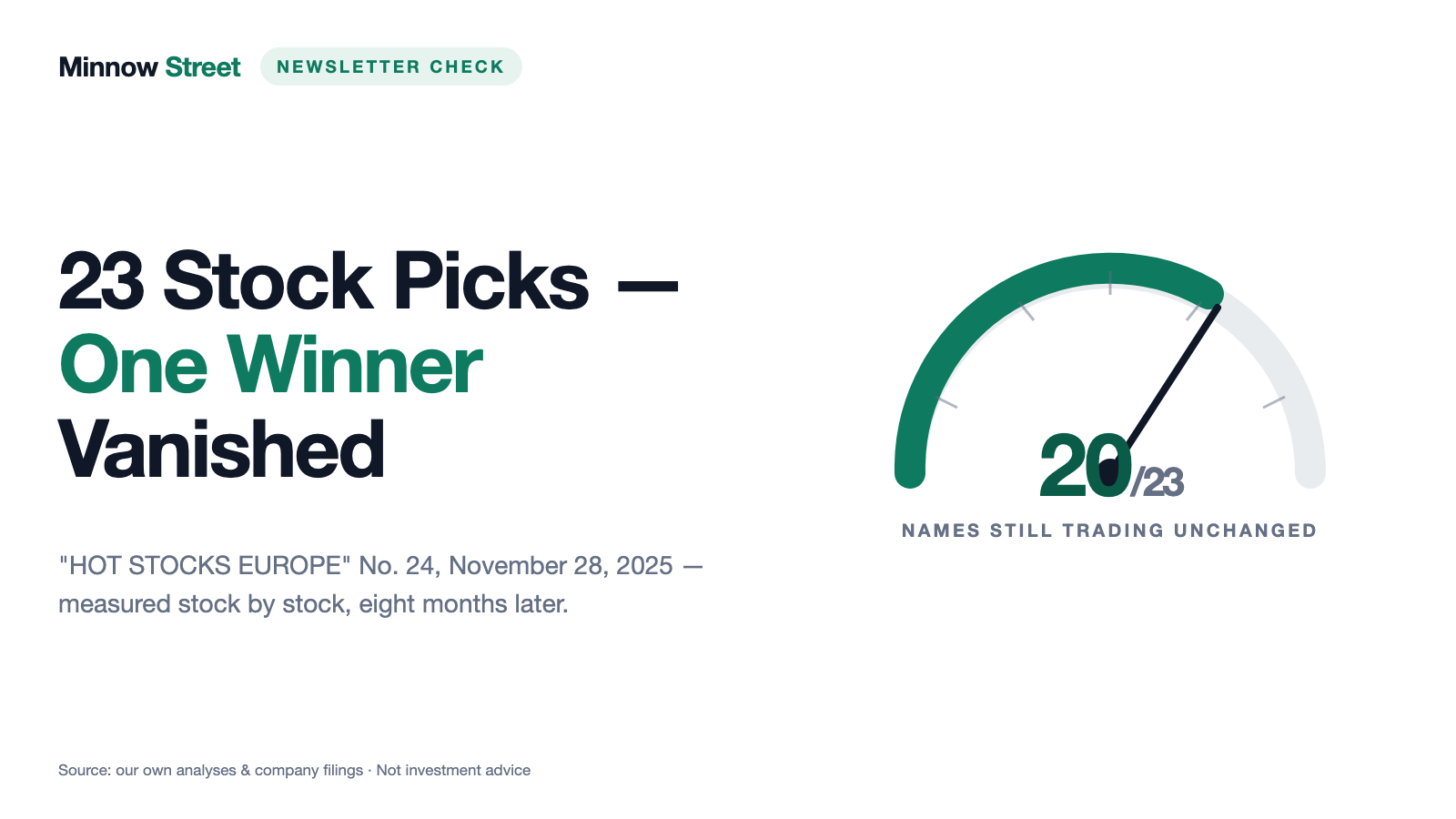
"HOT STOCKS EUROPE" issue No. 24, dated November 28, 2025, featured 23 European stocks — we wrote our own deep dive on 21 of them, and here we check the full picture eight months later. Three names no longer exist under the labels the newsletter used, and the biggest winner in the newsletter's model portfolio, SolGold, was taken off the London Stock Exchange by court order — 28 pence in cash, with no follow-up analysis of our own, because there is nothing left to analyze. Where the newsletter got it right, we say so; where it did not, we say that too. Not investment advice, just a status check eight months later.
 Thomas Mücke
Founder & Publisher
Thomas Mücke
Founder & Publisher
Do you know survivorship bias? During the Second World War, the U.S. Air Force wanted to know where to add armor to its bombers, so it studied the bullet holes on the planes that made it home. A statistician named Abraham Wald flipped the question around: precisely where the returning planes were untouched is where the shot-down ones must have been hit hardest. Count only the survivors, and you get a distorted picture. Stock newsletters run on the same mechanism: a model portfolio loves to show you the winners that are still there. But what happens when the biggest winner itself disappears — not through a price crash, but because the stock simply stops existing? That is exactly what happened with a reader tip that landed issue No. 24 of the newsletter "HOT STOCKS EUROPE," dated November 28, 2025, on our desk: 23 European stocks, carefully presented, complete with price targets, model-portfolio positions, and a year-end review of the "top performers of the past year." We wrote our own deep dive on 21 of them — every figure checked against annual and quarterly reports, not against the newsletter. This article is the wrap-up: what became of the expectations from back then? And what does an eight-month check do to a portfolio whose best-performing position no longer exists?
What "HOT STOCKS EUROPE" Is and How the Publisher Makes Money
According to its own imprint, "HOT STOCKS EUROPE" is a "twice-monthly information service for investments in Europe's growth-market segments," published by B-Inside International Media GmbH, Christaweg 42, 79114 Freiburg im Breisgau, Germany (managing director Tom Jordi Ruesch, commercial register HRB 270560). The editor responsible under German press law (V.i.S.d.P.) is Arno Ruesch; the author of issue No. 24 is Michael Calivas. Issue No. 24 was published on November 28, 2025, in the newsletter's 23rd year, running eight pages. The publisher makes its money the classic way, through subscriptions: €29.50 including German VAT and shipping per month, according to the page-8 imprint.
That same page 8 also discloses the conflict of interest that is worth reading in almost any stock newsletter, translated from the German original:
"The publisher, author, or related third parties may also have entered into long positions in the investments discussed. In that case, a conflict of interest exists within the meaning of EU Market Abuse Regulation No. 596/2014, which we disclose below. […] The publisher, author, or related third parties hold long positions in the following securities named in this newsletter: – . The named persons intend to sell the shares as prices rise."
— "HOT STOCKS EUROPE" issue No. 24, page 8, imprint & disclaimer (translated from German)
Two things are worth noting here, without turning either into an accusation. First, the mechanism itself is transparent and anchored at a fixed spot in every issue — more than many free investment newsletters offer. Second, the field for specifically named long positions was left blank in issue No. 24, as was the field for paid placements. Whether, or to what extent, the publisher, author, or related parties actually held positions in the 23 stocks discussed cannot be read from the issue itself — only that the possibility exists and is disclosed. Now to the substance: what became of the 23 stocks?
All 23 Stocks at a Glance: Expectation vs. Reality
The table below lists all 23 stocks that appear in issue No. 24 — individual write-ups, model-portfolio positions, the year-end review of the "top performers of the past year," and the one stock that appeared only as a chart. The middle column quotes the newsletter as a third party's expectation from November 28, 2025, never as a source for company figures; the right column summarizes what the latest audited report actually shows — every single figure already documented in our linked deep dive.
| Company (current name) | What the newsletter said (11/28/2025) | What the latest report shows | Our analysis |
|---|---|---|---|
| Nokia Oyj | per the newsletter, Nokia "belongs to the base positions in Europe's AI cycle"; 2028 target of €2.7-3.2 billion comparable operating profit | Q2 2026 reported operating loss of €50 million, comparable profit of +€434 million (+18 percent) – Nokia itself confirmed the 2028 target | Nokia analysis |
| R&S Group Holding AG | Berenberg price target CHF 35; Zurich Cantonal Bank expected only about 17 percent EBIT margin for 2026 | 2025 revenue up 47 percent to CHF 414.8 million, profit up 41 percent to CHF 58.1 million – but equity only 12.2 percent of total assets | R&S Group analysis |
| Fermi Inc. | 2030 P/E ratio of about 1.5, "tenfold upside potential" (Berenberg estimate) | still $0 in revenue since its January 2025 founding, going-concern doubt in its own quarterly filing, founder no longer CEO | Fermi analysis |
| Pfisterer Holding SE | GBC price target raised from €48 to €85, "order backlog at a record level" of €339 million | share price €80.00 (7/24/2026), close to the target – but the order book has not grown further since | PFISTERER analysis |
| SUSS MicroTec SE | MWB price target raised from €48 to €56 | share price already €79.15 (7/24/2026), above the target – but Q1 2026 EBIT down 83.6 percent | SUSS MicroTec analysis |
| The Platform Group AG | price targets of €19.50 (MWB), €20 (First Berlin), and €21 (Nuways) against a share price of €6.60 | share price €0.78 (down 88 percent, 7/24/2026), plus unresolved allegations over cancelled bank loans and a tax claim | Platform Group analysis |
| DPM Metals Inc. (ex Dundee Precious Metals) | Q3 EBITDA of $166 million; mentioned the Adriatic acquisition as "early September" | full-year net profit of $369.2 million, debt-free – Ecuador environmental permit revoked after four months | DPM Metals analysis |
| Thor Explorations Ltd. | Canaccord price target GBp 89, EBITDA above $238 million expected | best year in company history ($325.5 million revenue), share price still below its level on the newsletter's date | Thor Explorations analysis |
| ACG Metals Ltd. | Canaccord expected $0.48 profit per share | audited loss of $2.04 per share | ACG Metals analysis |
| Pharming Group N.V. | Jefferies ("conservative" €1.70 target), H.C. Wainwright (stock to double), and Oppenheimer (nearly triple) expected | first-ever annual profit ($2.5 million) – key patent protection expires 10/7/2026 | Pharming analysis |
| Tharisa plc | model-portfolio position stopped out at €1.06, no gain | net cash melted from $54.0 million to $10.7 million within a single quarter | Tharisa analysis |
| SolGold plc | biggest model-portfolio winner, up 71.4 percent, Canaccord price target GBp 46 | no longer exists – acquired by Jiangxi Copper, delisted 3/5/2026 | "What Became of SolGold" section |
| Serviceware SE | model-portfolio purchase at €18.50, down to €16.10 (−13.0 percent) four weeks later | first operating profit in three years – share price still briefly dipped below the newsletter's stop-loss level | Serviceware analysis |
| Serabi Gold plc | model-portfolio position, up 10.3 percent (as of 11/28/2025) | record production, first-ever dividend – transitional permit for its main mine expires January 2027 | Serabi Gold analysis |
| Steyr Motors AG | year-end review: up 1,256 percent (to €426), sell recommendation already issued | share price 16 months later about €40 (down 90 percent from the high), EBIT margin fell from 24.3 to 14.5 percent | Steyr Motors analysis |
| Hensoldt AG | year-end review: up 100 to 300 percent | order backlog grew to €9.80 billion, but share price a third below its all-time high, 2025 net income down 17.6 percent | Hensoldt analysis |
| RENK Group AG | year-end review: up 100 to 300 percent | order backlog grew to €6.9 billion, but the report shows two different EBIT figures for the same year | RENK analysis |
| Endeavour Mining plc | year-end review: share price doubled | profit jumped to $679.2 million – but a $204.4 million loss came from the company's own gold-price hedges | Endeavour Mining analysis |
| Strickland Metals Ltd. | year-end review: gain of about 200 percent | still $0 in revenue, share price below the level of its most recent capital raise | Strickland Metals analysis |
| Zegona Communications plc | year-end review: "the stock tripled" | negative consolidated equity of −€869 million, 69 percent of shares cancelled through a capital return | Zegona analysis |
| Nebius Group N.V. | year-end review: from €44.50 to a high of €118 | Q1 2026 net profit of $621 million – almost entirely from revaluing an investment stake, operating loss widened to $128 million | Nebius analysis |
| Trekor Metals Ltd. (ex Taseko Mines) | shown only as a chart on page 1, no substantive comment in the editorial text | renamed as of 6/25/2026 (see section below) – our own analysis is published | Analysis |
| ASML Holding N.V. | model portfolio used a leveraged turbo certificate, up 39.3 percent in two months | revenue guidance raised by more than €10 billion within six months – four customers account for 61 percent of 2025 revenue | ASML analysis |
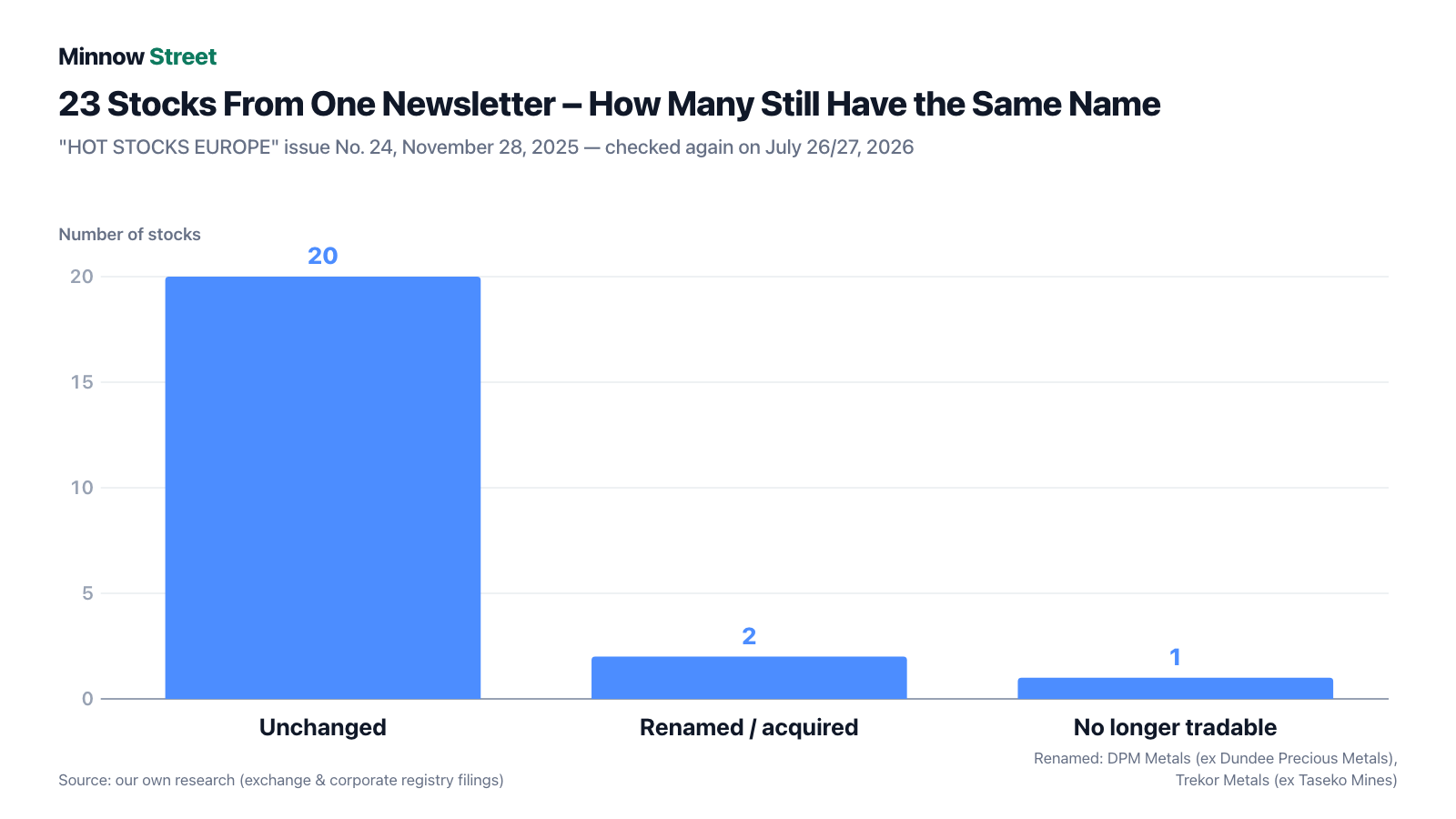
Nearly all the stocks in the issue can still be found under their original name — but the three exceptions are instructive enough to earn two sections of their own.
What Became of SolGold
On November 28, 2025, SolGold plc was the biggest winner in the newsletter's model portfolio: bought on September 5, 2025, at €0.175, quoted in the newsletter at €0.300, a gain of 71.4 percent. The model portfolio is denominated in euros, but the stock traded in London in pence: for the same date the newsletter cites GBp 26, alongside a Canaccord price target of GBp 46 for its Cascabel copper-gold project in Ecuador. Keeping those two units apart is what makes the later cash offer of 28 pence per share readable. Search for "SolGold" today and you will not find the stock — and that is not a snapshot of our own research, it is a closed matter with its own paper trail.
On March 2, 2026, the High Court of Justice of England and Wales sanctioned the Scheme of Arrangement under which Jiangxi Copper (Hong Kong) Investment Company Limited (JCHK) — the overseas arm of the Chinese copper group Jiangxi Copper — acquired SolGold outright. The relevant Regulatory News Service announcement describes the final steps this way:
"The Scheme Record Time for the Scheme will be 6:00 p.m. on Tuesday 3 March 2026 […] It is anticipated that the Effective Date of the Scheme will be Wednesday 4 March 2026 […] Applications have been made to the FCA and the London Stock Exchange in relation to the cancellation of the listing of SolGold Shares on the Official List […] which are each expected to take place at 7:00 a.m. on 5 March 2026."
— Regulatory News Service, "Court Sanction of Scheme of Arrangement," SolGold plc, March 2, 2026 (investegate.co.uk)
The follow-up announcement from March 4, 2026, confirms completion and states the price: 28 pence in cash per share for every shareholder on the register at the Scheme Record Time.
"the Scheme has now become Effective in accordance with its terms and the entire issued and to be issued ordinary share capital of SolGold is now owned by JCHK."
— Regulatory News Service, "Scheme of Arrangement Becomes Effective," SolGold plc, March 4, 2026 (investegate.co.uk)
In numbers: with roughly 3.0 billion shares outstanding, that works out to a takeover value of about £840 million — publicly cited elsewhere at about £867 million (a figure attributed to the advising law firm Fasken). Since 7:00 a.m. on March 5, 2026, SolGold shares have not traded on the London Stock Exchange or anywhere else. The fundamental-data provider we use confirms this independently: the last quoted price, from March 4, 2026, was 27.95 pence — essentially the takeover price — and every price query since then returns "N/A," with the price history ending on that date. The charting database TradingView, too, no longer returns a stock match for the ticker SOLG.
For you as a reader, that means SolGold is the only stock from issue No. 24 with no deep dive of its own — not for lack of time, but because there is nothing left to analyze. There is no share price, no upcoming annual report, no shareholder meeting, and, in the traditional sense, no shareholders left for an analysis to address. The survivorship bias from the opening shows up here in its purest form: if you look eight months later only at the 20 unchanged names and their ongoing share prices, you might miss that the position with the largest reported gain is no longer part of the picture at all — not because it failed, but because it was bought out at a fixed price before anyone could see how the Cascabel story would have played out from here.
Three Names That No Longer Exist As Such
Besides SolGold, two more stocks from the issue now trade under a different name than the newsletter used — in both cases without any change in share price mechanics or a delisting, but with real potential for confusion if you search for the same name eight months later.
DPM Metals Inc. (Toronto Stock Exchange: DPM) was called Dundee Precious Metals Inc. until September 12, 2025 — exactly the name under which the newsletter introduced the stock. The company's own quarterly report documents the change:
"Effective September 12, 2025, DPM changed its name from Dundee Precious Metals Inc. to DPM Metals Inc., and as part of this transition, its subsidiary companies have also adopted corresponding name changes, where applicable, to align with its new brand identity."
— DPM Metals Inc., Fourth Quarter 2025 report (MD&A), section "Our Business," p. 3
The TSX: DPM ticker stayed the same; only the name over the door changed — a pure rebrand triggered by the $1.5 billion acquisition of Adriatic Metals plc completed on September 3, 2025. Adriatic itself, until then independently listed on the London Stock Exchange and the Australian ASX, has not existed as a standalone stock since: the UK High Court sanctioned the relevant Scheme of Arrangement, the deal closed on September 3, 2025 ($441.4 million cash plus 54,935,109 new DPM shares), and the data provider we use shows no ongoing prices for either the London listing (ADT1.LSE) or the Australian CDIs since. Details on that acquisition, including a purchase-price allocation with zero dollars of goodwill, are in our DPM Metals analysis.
Trekor Metals Limited, in turn, was called Taseko Mines Limited until June 25, 2026 — mentioned in the newsletter only in passing, as a chart on page 1, with no ticker or price in the editorial text. The change is documented by two independent sources: the SEC submissions record for the company (CIK 0000878518) lists "Trekor Metals Ltd" as the current name and "TASEKO MINES LTD" under `formerNames`; the company's own press release confirms the date and sequence in detail: shareholders approved the renaming at the annual general meeting; the new name, Trekor Metals Limited, became effective on June 25, 2026. Trading under the new name began on June 29, 2026, on the Toronto Stock Exchange and NYSE American, and on June 30, 2026, on the London Stock Exchange — the ticker symbols themselves (TSX: TKO, NYSE American: TGB, LSE: TKO) stayed the same, while the ISIN (new: CA89472Y1079) and CUSIP (new: 89472Y107) changed (source: "Taseko Annual General Meeting Voting Results and Change of Name," press release, trekormetals.com, June 24, 2026).
What This Series Taught Us About Expectations
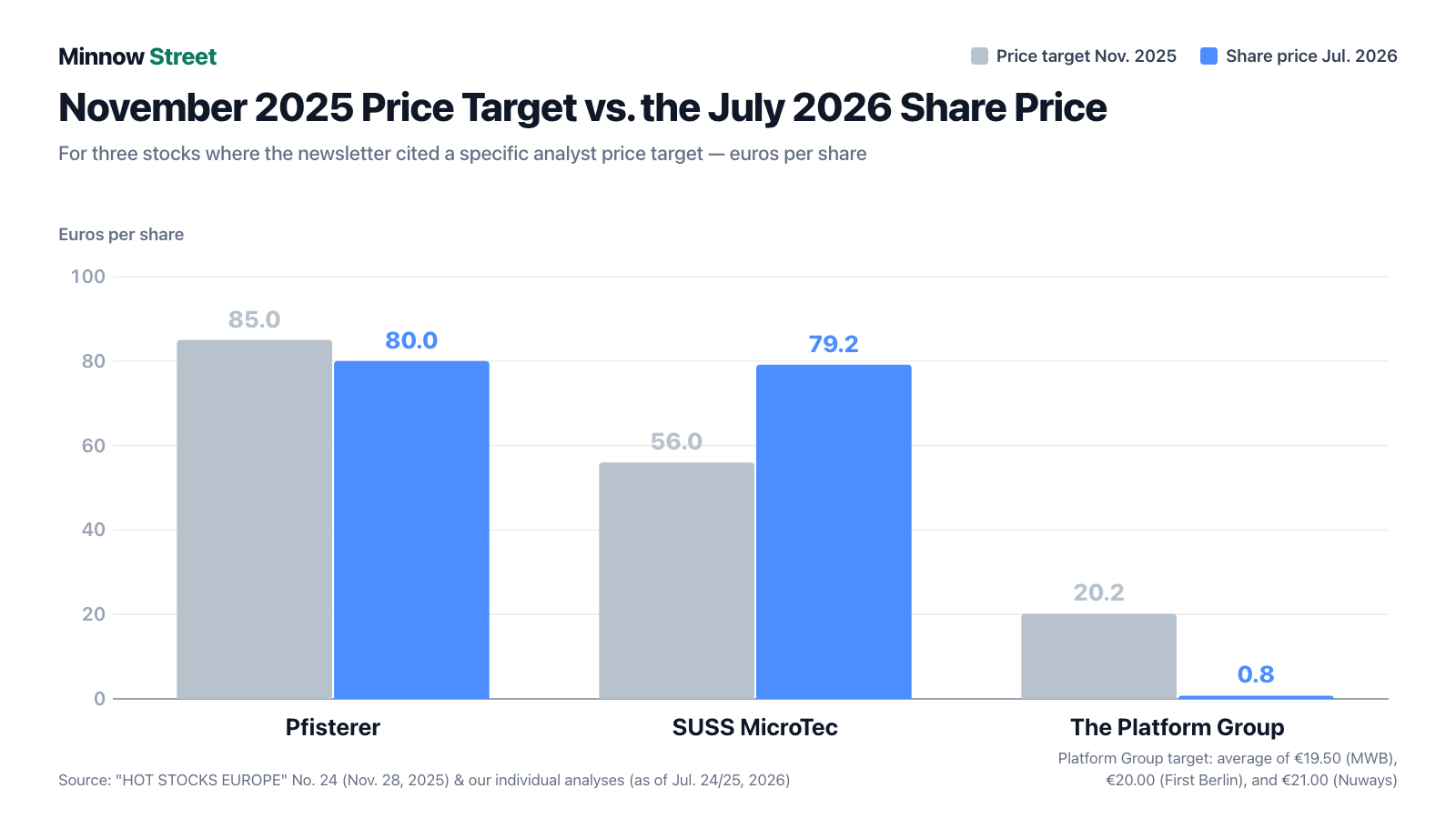
A stock newsletter is a snapshot, not a permanent state — that sounds obvious until you run it against real numbers. That shows up clearly in the three stocks in the chart below – Pfisterer, SUSS MicroTec, and The Platform Group – for which the newsletter cited a specific analyst price target. (R&S Group, Thor Explorations, and Pharming Group also had a concrete price target in the newsletter, and all three are likewise still tradable and already listed with their target in the table above – this section just takes a closer look at the three stocks in the chart.)
The expectation that held up best was, of all things, the one that looked least like a bet: Nokia. The newsletter called the stock "one of the base positions in Europe's AI cycle" and pointed to a new 2028 target of €2.7 to 3.2 billion in comparable operating profit — a target that had barely been announced nine days before the issue went out. Our Nokia analysis shows that Nokia did, in fact, announce exactly that target at its Capital Markets Day on November 19, 2025, documented in its own SEC filing (Form 6-K) — the newsletter's claim was not exaggerated, it was accurately reported. What the newsletter could not show, because it was published eight months before our own reporting cutoff, is how expensive the path to that target already looks in the latest report: in the second quarter of 2026, Nokia's own filing showed both a reported operating loss of €50 million and a comparable profit of €434 million in the very same report. The cited figure was correct; whether it pays off by 2028 is a separate question.
The expectation that broke down most sharply was The Platform Group. The newsletter cited three price targets — €19.50 (MWB Research), €20 (First Berlin), and €21 (Nuways) — against a share price of €6.60, based on the company's own "Vision 2030" (at least €3 billion in revenue). Eight months later, the stock trades at €0.78 — about 88 percent below the newsletter's price and more than 96 percent below the average of the three cited targets. Our Platform Group analysis lays out what happened in between: a media report on cancelled bank loans and a tax claim, and a criminal complaint under review by the Chemnitz public prosecutor's office — allegations the company itself calls "distorted and false claims," with no court ruling yet. Importantly, neither the newsletter nor the analyst firms it cited could have known about this in November 2025. That does not make the price targets dishonest — it makes them exactly what any price target is: a snapshot based on the information known at the time, not a guarantee.
The lesson from both cases together: an eight-month-old price target is neither automatically worthless nor automatically reliable. It pays to read it for exactly what it is — one firm's opinion as of one specific date — and then check for yourself what has happened in the company's own filings since.
A Human Conclusion
Back to the survivorship bias from the opening. A model portfolio checked eight months later never automatically shows you the complete picture — not because anyone meant to deceive, but because reality itself removes some positions from the frame before anyone can look back at them. SolGold was the biggest winner in this issue, and it is nonetheless the only stock with no analysis of its own, because the stock simply no longer exists. Two more stocks now trade under new names, with nothing about the underlying business having changed. And among the three stocks in the price-target chart, eight months were sometimes enough to nearly confirm a target (Pfisterer), sometimes enough to beat it (SUSS MicroTec), and sometimes enough to miss it by more than 96 percent (The Platform Group) — often for reasons that simply were not knowable at the starting point. So the honest question is not "was the newsletter good or bad?" but: do you read a recommendation for what it is — a snapshot with a date stamped on it — or as a promise that automatically keeps applying? What you make of that is your decision. And that is exactly as it should be.
Sources
All original sources used in this overview — for your own reading:
- "HOT STOCKS EUROPE," issue No. 24, dated November 28, 2025, B-Inside International Media GmbH, Freiburg, Germany (author Michael Calivas, editor responsible Arno Ruesch) – a third party's opinion and expectation, not a source for company figures.
- Our 21 published individual analyses of the stocks discussed in issue No. 24 (each linked in the table above) – every figure there checked individually against annual and quarterly reports.
- Regulatory News Service (investegate.co.uk) – "Court Sanction of Scheme of Arrangement," SolGold plc, March 2, 2026 and "Scheme of Arrangement Becomes Effective," SolGold plc, March 4, 2026.
- DPM Metals Inc. – Fourth Quarter 2025 report (MD&A), section "Our Business," p. 3 (dpmmetals.com), already cited in our DPM Metals analysis.
- "Taseko Annual General Meeting Voting Results and Change of Name," press release, trekormetals.com, June 24, 2026; SEC submissions record for CIK 0000878518 (data.sec.gov), field "formerNames."
- Fundamental data (prices, as of July 24-27, 2026), reconciled with the respective annual and quarterly reports.
Transparency & disclaimer: This overview is a journalistic assessment of publicly available information and does not constitute investment advice, a regulated financial analysis, or a solicitation to buy or sell securities. Stock investments carry substantial risk, including total loss. All information is provided without guarantee; the date of each figure is noted in the text. As of publication, the author holds no position in the securities mentioned.
Our Bottom Line at a Glance
- Track record neutral
- Mixed: Nokia's 2028 target was confirmed word for word, and SUSS MicroTec beat its €56 price target by a wide margin (share price €79.15 on 7/24/2026) – while The Platform Group fell from a roughly €20 target to €0.78, and ACG Metals turned an expected $0.48 profit per share into an audited loss of $2.04.
- Accuracy of the cited figures positive
- The historical figures the newsletter cited (for instance, DPM Metals' Q3 EBITDA of $166 million, Pfisterer's nine-month revenue of €327 million) held up against the original filings in all 21 cases we checked. What went wrong was not the cited facts, but the price targets and expectations built on top of them.
- Currency eight months on negative
- Three of 23 stocks (13 percent) are structurally out of date: two renamings (DPM Metals, Trekor Metals) and one complete delisting (SolGold) – changes a reader cannot spot from the issue itself.
- Handling of third-party price targets negative
- Analyst price targets (Berenberg, Canaccord, GBC, MWB, First Berlin, Nuways, Zurich Cantonal Bank, UBS, Jefferies, H.C. Wainwright, Oppenheimer, Quirin Bank, Montega) are cited as fact, with no independent assessment of those firms' historical accuracy or the target's reference point in time.
- Conflict-of-interest and model-portfolio transparency positive
- The conflict-of-interest disclosure (page 8, EU Market Abuse Regulation No. 596/2014) sits in a fixed spot in every issue, and the model portfolio states the purchase date, purchase price, and stop-loss level for every position — publicly verifiable, as our Tharisa and Serviceware analyses show.
Eight months after issue No. 24, the record is mixed: the historical figures the newsletter cited were accurate throughout – the price targets built on them sometimes held up (Pfisterer, SUSS MicroTec) and sometimes missed badly (The Platform Group, ACG Metals). Three of 23 stocks are structurally out of date: two renamings and one complete delisting, on the newsletter's single biggest model-portfolio winner, SolGold. Not investment advice.
Worth Noting
- This article deliberately carries no company quality rating block (no `quality` field): the rating judges the substance of a single company based on its filings – here there is no single company, but an entire newsletter issue covering 23 stocks.
- This series came to our attention through a reader tip: issue No. 24 of "HOT STOCKS EUROPE," dated November 28, 2025. The newsletter is the hook throughout, never a source for company figures – every figure in the 21 linked individual analyses comes from the respective annual and quarterly reports.
- Data as of this overview: July 24-27, 2026. One stock has no analysis of its own: SolGold, delisted since March 2026.
Frequently Asked Questions
Because an eight-month-old recommendation list shows what is left of an expectation once you measure it against real company filings instead of the next headline. Of the 23 stocks discussed in "HOT STOCKS EUROPE" issue No. 24, three no longer exist under the names used, and the biggest model-portfolio winner has vanished from the market entirely — findings that only eight months of distance make visible.
SolGold plc no longer exists as an independent, listed stock. Jiangxi Copper (Hong Kong) Investment Company Limited acquired the company via a Scheme of Arrangement: court sanction on March 2, 2026, effective March 4, 2026, at 28 pence per share in cash, delisted from the London Stock Exchange's Official List on March 5, 2026. There is no deep dive of our own because there is no longer a share price or an annual report for one to reference.
Both are pure renamings with no change in ownership. Dundee Precious Metals Inc. has traded as DPM Metals Inc. since September 12, 2025 (triggered by its acquisition of Adriatic Metals). Taseko Mines Limited has traded as Trekor Metals Limited since June 25, 2026, with a new ISIN and CUSIP but unchanged ticker symbols. Both companies continue to operate exactly as before.
No, that fact alone does not make a stock newsletter untrustworthy — the disclosure is actually required under EU Market Abuse Regulation No. 596/2014, and "HOT STOCKS EUROPE" states it transparently on page 8. In issue No. 24, the field for specifically named long positions was also left blank. The disclosure simply means: read price targets and assessments for what they are — potentially interest-driven opinion, not a neutral company figure.
Two: SolGold plc, because the stock has not existed since March 2026 and there is nothing left to analyze, and Trekor Metals Limited (formerly Taseko Mines), whose analysis is likewise published and will follow. The remaining 21 stocks are each linked individually in the table above.
No, deliberately not. Our quality rating judges the substance of a single company based on its filings. This article instead evaluates a piece of financial journalism — how accurate, current, and transparent a newsletter looks eight months later. It gets its own assessment in the verdict section, but no company quality rating.
The chart on the stock roster is based on our own research against exchange and corporate registry filings (SEC submissions records, press releases, Regulatory News Service announcements). The price-target comparison chart uses the price targets cited in the newsletter itself (dated November 28, 2025) and our own already-published individual analyses (prices as of July 24-25, 2026).
Found an error?
Did you spot a factual error, an outdated number, or a typo in this deep dive? Let us know briefly — your report goes straight to the editorial team.