Pharming Posts Its First-Ever Profit — Right As Its Key Patent Expires in October 2026
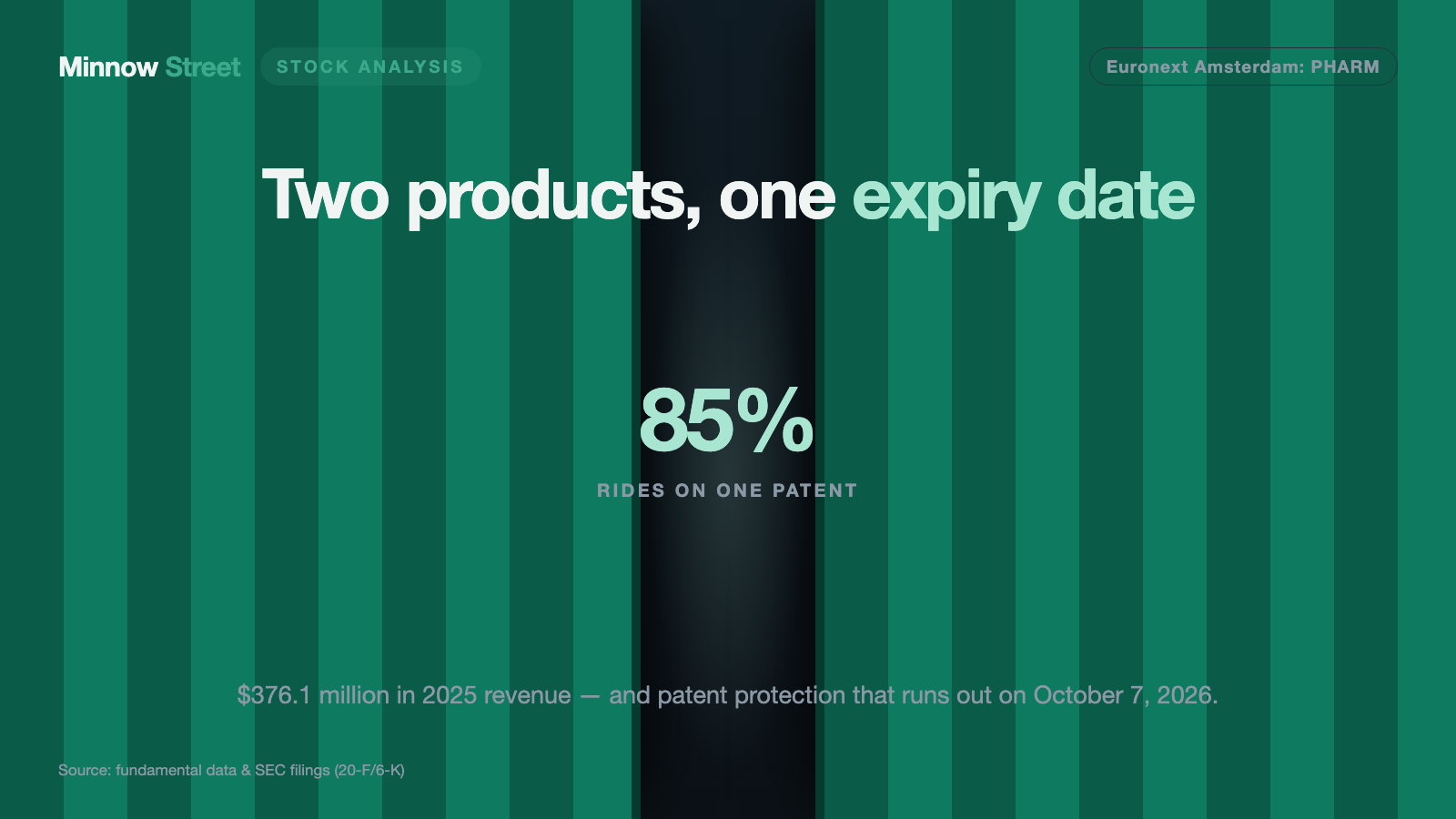
A newsletter carried Pharming Group in its model portfolio back in November 2025, citing price targets from Jefferies, H.C. Wainwright, and Oppenheimer that all expected the stock to double or triple. We checked what the Dutch biopharmaceutical company actually told the U.S. securities regulator, the SEC: a first annual profit in 2025 ($2.5 million), an 85 percent revenue dependency on a single product, and patent protection that expires on October 7, 2026 — the same month the FDA is due to rule on the pediatric label for its second product. Not investment advice — just a calendar with two deadlines on it.
 Thomas Mücke
Founder & Publisher
Thomas Mücke
Founder & Publisher
Chart
Interactive price chart (TradingView).
Note: pure fact-based analysis, not investment advice and not a solicitation to buy or sell. All figures without guarantee.
There's an investor trap that springs exactly when several independent voices say the same thing: the herd effect. Your brain converts agreement into safety — if three investment banks all independently point to the same price jump, surely something is there. That is exactly the picture painted by a newsletter that brought us this analysis: "HOT STOCKS EUROPE" issue 24, dated November 28, 2025, carried Pharming Group N.V. in its model portfolio, bought on June 20, 2025 at EUR 0.91, marked at EUR 1.49 at the time and up 63.7 percent — plus price targets from Jefferies (EUR 1.70, "conservative"), H.C. Wainwright ("a clean doubling"), and Oppenheimer ("nearly a tripling"). Three banks, one direction. On July 24, 2026, eight months later, the stock closed at EUR 1.102 on Euronext Amsterdam — below the newsletter's mark-to-market value and below the "conservative" Jefferies target. So let's make a deal: before you trust the chorus of price targets, let's read together what Pharming itself told the U.S. securities regulator, the SEC — the annual report (Form 20-F) for 2025 and the interim reports (Form 6-K) through June 4, 2026. An SEC filing is honest under penalty of law. In the end, you decide whom to trust more: the chorus, or the calendar.
What Pharming actually does — one drug from rabbit milk, one from a tablet bottle
Pharming Group N.V. of Leiden, Netherlands, employed an average of about 409 people in 2025 and sells, at its core, two products. The first, RUCONEST® (conestat alfa), is an emergency treatment for acute attacks of hereditary angioedema (HAE) — a rare genetic disorder in which sudden, painful swelling can occur under the skin and in the airways, in the worst case life-threatening. The odd part: the active ingredient is not made in a lab flask but harvested from the milk of genetically modified rabbits, then given by infusion. The second product, Joenja® (leniolisib), is an ordinary tablet by comparison — an oral inhibitor that treats APDS, an even rarer genetic immune disorder (roughly one to two people per million worldwide) in which an overactive immune signaling pathway leads to recurring infections and organ damage. Pharming reports to the SEC as a "Foreign Private Issuer" — an annual report on Form 20-F, interim reports on Form 6-K, no 10-K and no 10-Q, because U.S. law reserves those forms for domestic filers. The ordinary shares have traded on Euronext Amsterdam since December 21, 2009 (symbol PHARM, traded in euros); American Depositary Shares have traded on Nasdaq since December 22, 2020 (symbol PHAR, 1 ADS equals 10 ordinary shares, traded in U.S. dollars) — but the company's own filings report every figure in U.S. dollars throughout. That sets up the tension running through this analysis: Pharming turned its first profit in recent history in 2025 — carried almost entirely by a single product whose legal protection expires in the very same weeks that decide the future of the second one.
Where this stock landed on our desk — the newsletter versus the measured reality
This analysis did not come from our in-house stock scanner, but from a reader tip: issue 24 of "HOT STOCKS EUROPE," dated November 28, 2025 (B-Inside International Media GmbH, Freiburg, Germany, author Michael Calivas), eight pages, published twice a month. Its model portfolio described Pharming this way:
"Pharming Group: roughly 30 percent revenue growth, net profit up from $4.1 million to $15.8 million. Buy recommendations from Quirin Bank and Montega. Jefferies price target EUR 1.70 (conservative), H.C. Wainwright expects a clean doubling, Oppenheimer nearly a tripling."
— "HOT STOCKS EUROPE," issue 24, dated November 28, 2025, model portfolio section
That is a third party's expectation as of November 28, 2025 — bank price targets, not company figures — which we now measure against what Pharming itself reported to the SEC. The purchase position itself was marked at EUR 1.49 in the newsletter (bought at EUR 0.91 on June 20, 2025, stop at EUR 1.30, up 63.7 percent since purchase). On July 24, 2026, eight months later, the stock traded at EUR 1.102 on Euronext Amsterdam — not doubled or tripled, but roughly 26 percent below the newsletter's mark-to-market value and below the "conservative" Jefferies target of EUR 1.70. That does not automatically make the three bank opinions wrong — price targets are expectations with a time horizon, not guarantees — but it shows why a chorus alone is no reason to skip your own homework. In fairness, the newsletter's conflict-of-interest notice belongs in this picture too: the publisher discloses that the publisher, the author, or related third parties may hold long positions in stocks discussed and may intend to sell as prices rise (EU Market Abuse Regulation 596/2014).
The numbers over the years — an honest look
First, what genuinely speaks for Pharming — and there is quite a bit. Revenue grew for three straight years: from $245.3 million (2023) to $297.2 million (2024) to $376.1 million (2025), up 27 percent. Pharming raised its own 2025 guidance twice — from $325–340 million to $335–350 million in July 2025, then to $365–375 million in November 2025 — and ultimately beat even that raised range. And for the first time in years, the bottom line was a profit: net income of $2.5 million, after an $11.8 million loss in 2024 and a $10.5 million loss in 2023. Operating cash flow flipped from negative $1.8 million (2024) to positive $54.7 million (2025). How revenue splits between the two products, and where the picture has shifted most recently, is shown below:
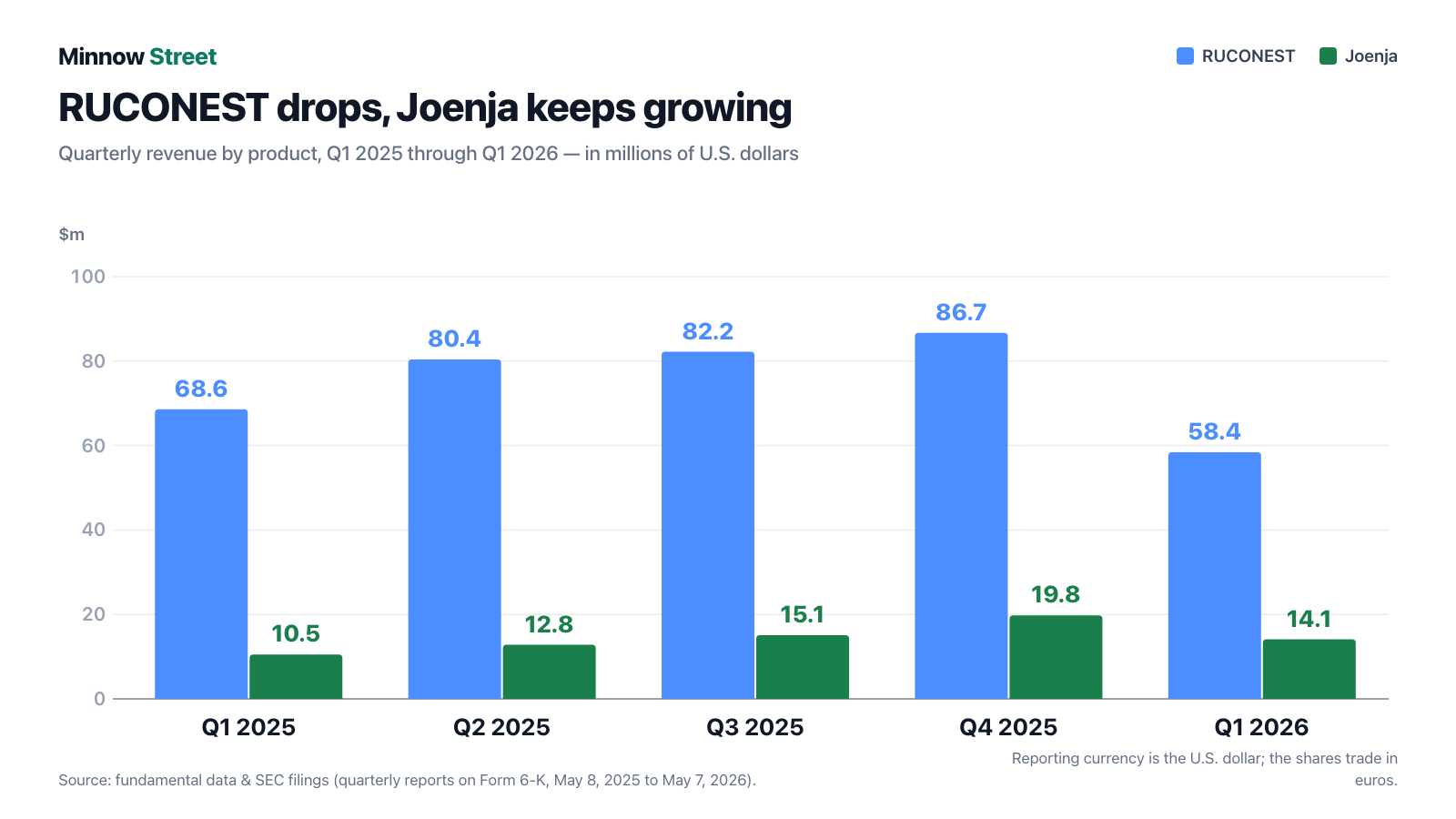
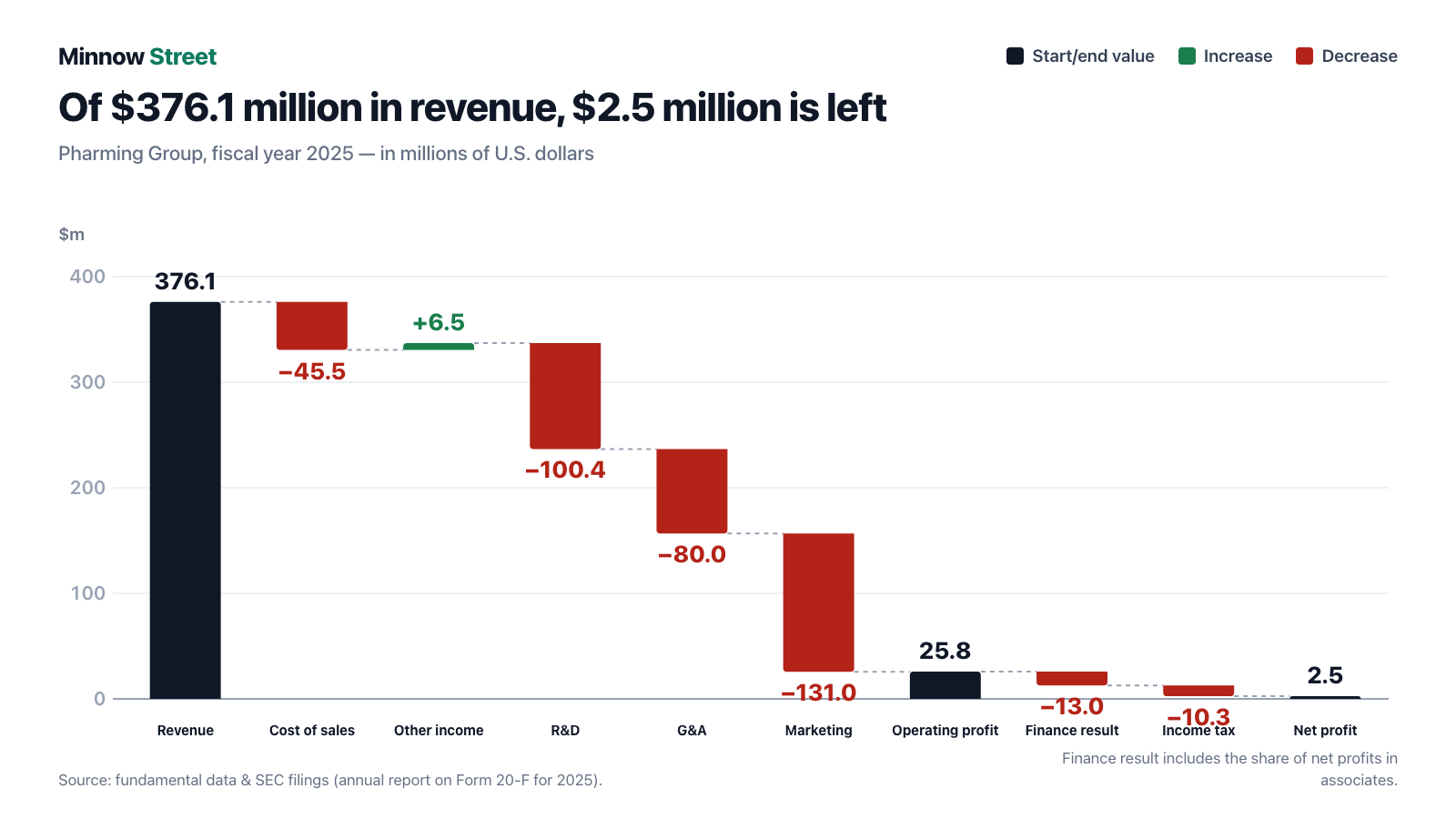
The RUCONEST decline in the first quarter of 2026 has, by the company's own account, three causes: an anticipated inventory drawdown at U.S. wholesale partners, the planned exit from markets outside the United States (decided in 2025), and "competitive market dynamics" — more on that shortly. Of the $376.1 million in 2025 revenue, only a thin slice was left after every cost, tax, and finance charge, as the second chart shows:
Regulatory news for Joenja has also been favorable so far in 2026: approval in Japan (March 2026, patients aged 4 and older), a positive opinion from the European regulator's CHMP committee (March 26, 2026), and marketing authorization from the European Commission on May 22, 2026 for patients aged 12 and older — the first European launch is expected in Germany in the third quarter of 2026. Two Phase II trials in additional immune disorders (including CVID, a substantially larger patient population than APDS) have completed enrollment, with readouts expected in the second half of 2026. That is one side of the coin — real, repeatedly confirmed growth. The other side shows up once you read the filing down to the uncomfortable details.
What the filings reveal — the uncomfortable truths
Uncomfortable truth No. 1: 85 percent of revenue rides on a product whose protection is running out
RUCONEST® is not just an important product at Pharming — it is essentially the business. The annual report on Form 20-F for 2025 puts it plainly:
"We have, to date, been substantially focused on the development and commercialization of RUCONEST®, and we expect to continue to be dependent primarily on revenues from RUCONEST® sales in the near term. Although we have commercialized Joenja® in the United States and the United Kingdom, RUCONEST® sales accounted for approximately 85% of our total revenues in 2025, and we expect it to continue to make up the majority of our revenues for the foreseeable future."
— Pharming Group N.V., Annual report on Form 20-F for 2025, Item 3.D "Risk Factors"

Picture a family business whose revenue depends 85 percent on a single customer. When that customer is doing well, the whole business thrives; when the customer wobbles, the whole company shakes with it. At Pharming, the "customer" is not a company but a legal protection — and that protection is running out right now. The same annual report names two separate deadlines that should not be confused with each other:
"RUCONEST® has patent protection in the United States and European Union until October 7, 2026, and biologics reference product exclusivity in the United States through July 16, 2026."
— Pharming Group N.V., Annual report on Form 20-F for 2025, Item 4.B "Intellectual property and exclusivity"

The distinction matters and is easy to miss: regulatory exclusivity stops a competitor from relying on Pharming's own clinical data to win its own approval — that door opened on July 16, 2026. The patent additionally stops a copycat product from actually being made and sold; per the annual report, that protection remains in force until October 7, 2026. At the same time, RUCONEST is already under real pressure: in the third quarter of 2025, a new oral competitor for acute HAE attacks, Ekterly® (sebetralstat), reached the U.S. market — RUCONEST, by contrast, is given by infusion. Pharming itself cites "competitive market dynamics" as one reason for the RUCONEST decline in the first quarter of 2026. Remember the pattern: an expiring patent hits a business hardest exactly when a new competitor is already standing in the market.
Uncomfortable truth No. 2: two pharmacies carry more than three-quarters of revenue
The second uncomfortable truth is not in the annual report's narrative section, but in the footnotes — exactly where few readers look. It concerns not the product, but the customers who buy it:
"Two U.S. customers represented $290.9 million, or 77%, of our net revenues in 2025, with one representing $156.2 million and the other $134.7 million. In 2024, these two U.S. customers represented $227.7 million, or 77%, of our net revenues, at $134.8 million and $92.9 million, per customer, respectively. These customers are largely specialty pharmacies that are specialized in distribution of pharmaceuticals in our disease area and distribute our product."
— Pharming Group N.V., Annual report on Form 20-F for 2025, Item 5 "Operating and Financial Review"
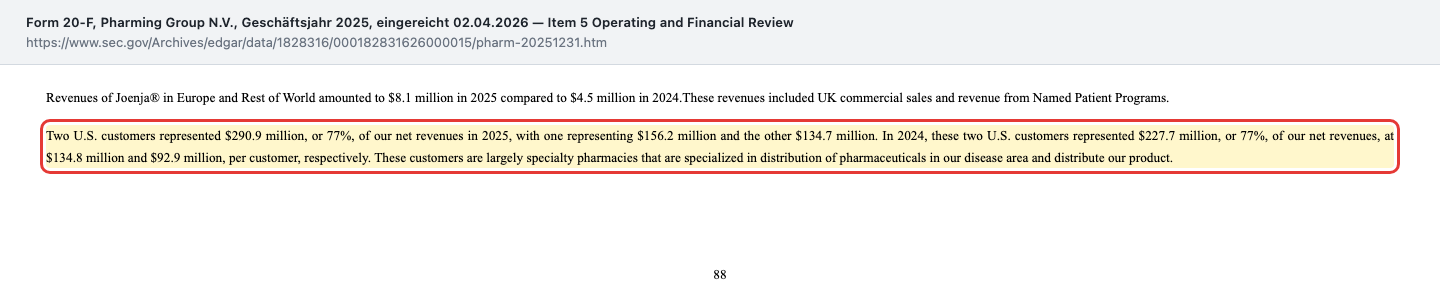
If a neighbor told you their business was thriving, but you learned that two big customers accounted for three-quarters of their orders, wouldn't you pause for a moment? That is customer concentration in a nutshell: it is not the product that fails, but two distribution partners — whose names the filing does not even disclose — that could change terms, adjust inventory, or lose contracts, dragging a large share of revenue down with them. That this concentration held at exactly 77 percent in both 2024 and 2025 shows it is not a one-off, but a structural feature of the business model.
Uncomfortable truth No. 3: the second product's pediatric approval hinges on an FDA date that nearly coincides with the patent cliff
So if RUCONEST could lose ground, how quickly can Joenja fill the gap? For the biggest remaining growth opportunity — U.S. approval for children aged 4 to 11 — 2026 initially brought a setback:
"On January 30, 2026, the FDA issued a Complete Response Letter, or CRL. The CRL requested additional pediatric pharmacokinetic, or PK, data to further support dosing in lower-weight pediatric patients, as well as clarification related to an analytical method used in production batch testing. The FDA did not identify any new safety concerns, and the currently approved indication for patients aged 12 years and older remains unaffected."
— Pharming Group N.V., Annual report on Form 20-F for 2025, Item 4.B
By its own account, Pharming resubmitted the application for the two higher dose strengths (children weighing 27 kg or more) after a Type A meeting with the FDA on March 26, 2026. The agency accepted that resubmission — and set a new decision date at the same time:
"[Pharming] today announced that the U.S. Food and Drug Administration (FDA) has accepted its resubmitted supplemental New Drug Application (sNDA) seeking approval for Joenja® (leniolisib) […] as a treatment for children aged 4 to 11 years with activated phosphoinositide 3-kinase delta syndrome (APDS) […]. The FDA has assigned a Prescription Drug User Fee Act (PDUFA) target action date of October 24, 2026."
— Pharming Group N.V., Form 6-K, filed June 4, 2026
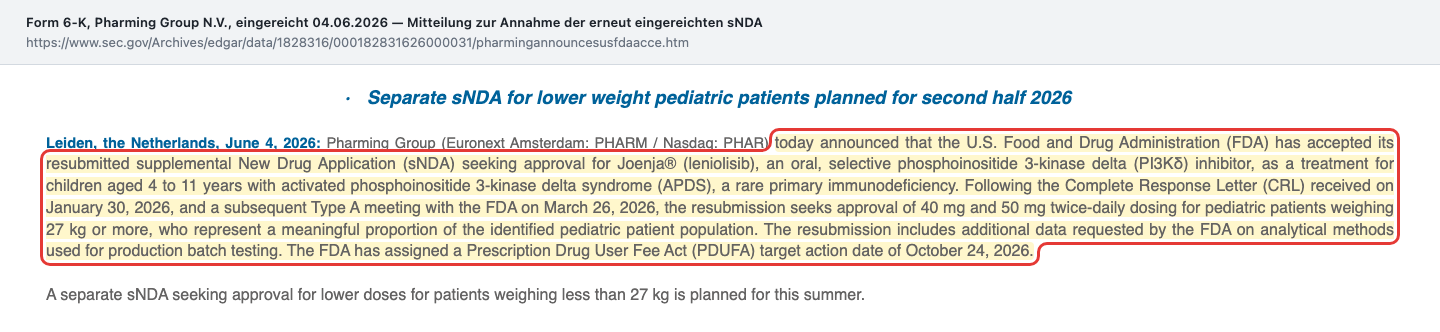
This is where the title of this analysis comes full circle: two clocks run out in October 2026 at the same time. On October 7, the patent protection expires for the product that carries 85 percent of today's revenue. On October 24, the FDA decides whether the second product can reach a much larger patient population — children aged 4 to 11 — after that same agency already rejected the first submission once. Neither event alone is existential: Pharming has just posted its first annual profit, sits on a calculated net cash position (more on that below), and the currently approved adult indication for Joenja is unaffected by the CRL. But the close timing of the two dates means there is little cushion in the coming reports to offset a disappointment on one front with good news on the other before both answers are in.
Valuation: expensive on the earnings multiple, moderate on revenue
With 706,252,300 shares outstanding (as of April 1, 2026, per the annual report on Form 20-F) and a closing price of EUR 1.102 on Euronext Amsterdam on July 24, 2026, market capitalization works out to roughly EUR 778 million, or about $885 million. Measured against trailing-twelve-month revenue ($369.5 million), the price-to-sales ratio comes to roughly 2.1 to 2.3 — not a stretched valuation for a biopharmaceutical company with growing revenue and positive operating cash flow. A price-to-earnings ratio can technically be calculated (roughly 55, on the basis of the tiny $2.5 million annual profit), but it says little: a company that has just crossed from losses into profit does not yet have a track record sturdy enough to hang a multiple on. The price targets cited in the newsletter — Jefferies at EUR 1.70, H.C. Wainwright's "clean doubling" (roughly EUR 2.98 based on the price at the time), Oppenheimer's "nearly a tripling" (roughly EUR 4.30) — date to November 28, 2025 and are third-party opinions with their own time horizon, not facts; on July 24, 2026, the stock at EUR 1.102 traded below all three marks. We have seen how much a valuation can hinge on earnings quality once before, at another European SEC filer with a single approved drug, in our Abivax stock analysis: there too, the valuation rests almost entirely on the future of one product.
Opportunities and risks at a glance
What speaks for Pharming:
- First annual profit in recent history: $2.5 million net income in 2025 (2024: −$11.8 million), operating cash flow turned to +$54.7 million; revenue guidance was raised twice in 2025 and ultimately beaten.
- A genuine second growth engine: Joenja revenue grew 34 percent in the first quarter of 2026, with new approvals in Japan (March 2026) and the EU (May 22, 2026), plus two ongoing Phase II trials in larger patient populations (readouts expected in the second half of 2026).
- Solid balance sheet: under Pharming's own net-debt formula, net cash of $83.0 million as of December 31, 2025 (a calculated ~$73.0 million as of March 31, 2026), despite a convertible bond balance that grew to $98.8 million; no indication of a going-concern issue.
- Previously disclosed material weaknesses in internal controls (from the 2024 annual report) were fully remediated as of December 31, 2025, per the 2025 annual report.
What speaks against it:
- 85 percent revenue dependency on RUCONEST, whose U.S. and EU patent protection expires October 7, 2026; separate U.S. biologics reference product exclusivity had already lapsed on July 16, 2026, while a new oral competitor (Ekterly) has been in the U.S. market since the third quarter of 2025.
- Customer concentration: two U.S. specialty pharmacies accounted for an unchanged 77 percent of net revenue in both 2024 and 2025.
- Regulatory uncertainty on the second product: the FDA initially rejected Joenja's pediatric label on January 30, 2026 via a Complete Response Letter; the new target action date (October 24, 2026) falls in the same weeks as the RUCONEST patent cliff.
- A EUR 100 million convertible bond with a EUR 1.2271 conversion price (up to about 11.5 percent additional shares) — currently out of the money, but a rising stock price is exactly what triggers that dilution.
A human conclusion
Back to the herd effect from the beginning. Three investment banks pointed the same direction in November 2025 — and that alone is not a red flag; it can simply mean several independent analysts saw the same opportunities: a first profitable year, a growing second product, new approvals. The mistake is not that the banks were optimistic, but mistaking their agreement for certainty. Eight months later, the calendar shows something none of the three price targets could have anticipated with this precision back in November 2025: on October 7, 2026, patent protection expires for the product carrying 85 percent of today's revenue, and 17 days later the FDA rules on the future of the second one. The honest question, then, is not "do I follow the chorus of price targets?" but: do you trust Pharming to show more of the substance that produced its first annual profit in the weeks around these two October dates — or would you rather wait until both answers are actually in? If yes, you have a thesis that goes beyond the chorus. If you hesitate, you only had the price targets. What you make of it is your decision — and that's exactly as it should be. Not investment advice.
Sources
All original documents used in this analysis — for further reading:
- Pharming Group N.V. — SEC annual report on Form 20-F for 2025 (filed April 2, 2026)
- Pharming Group N.V. — SEC filing on Form 6-K, first-quarter 2026 results (May 7, 2026)
- Pharming Group N.V. — SEC filing on Form 6-K, FDA acceptance of the Joenja resubmission (June 4, 2026)
- Pharming Group N.V. — SEC filing on Form 6-K, EU marketing authorization for Joenja (May 22, 2026)
- Pharming Group N.V. — SEC filing on Form 6-K, annual meeting and auditor change (May 28, 2026)
- Pharming Group N.V. — SEC filing on Form 6-K, fourth-quarter/full-year 2025 results (March 12, 2026)
- Complete SEC filing history for Pharming Group N.V.: EDGAR overview (sec.gov)
- Fundamental data (price, market capitalization, share-count cross-check; data as of July 24/25, 2026), reconciled against the SEC filings.
- Hook: "HOT STOCKS EUROPE," issue 24, dated November 28, 2025, B-Inside International Media GmbH, Freiburg, Germany (author Michael Calivas) — a third party's opinion and expectation, not a source for company figures; the publisher discloses that the publisher, author, or related third parties may hold long positions (EU Market Abuse Regulation 596/2014).
Transparency & disclaimer: This analysis is a journalistic interpretation of publicly available information and is not investment advice, not a regulated financial analysis, and not a solicitation to buy or sell securities. Stock investments carry substantial risk, including total loss. All information is provided without guarantee; the data's as-of date is noted throughout the text. The author holds no position in Pharming Group shares as of publication.
Our Bottom Line at a Glance
- Earnings quality & trend positive
- First annual profit in recent history in 2025 ($2.5 million after -$11.8 million in 2024), operating cash flow +$54.7 million; revenue guidance was raised twice in 2025 and ultimately beaten. Q1 2026, however, showed a loss again (-$5.2 million).
- Product dependency & patent position negative
- 85 percent of 2025 revenue rides on RUCONEST, whose U.S. biologics exclusivity lapsed on July 16, 2026 and whose patent protection expires October 7, 2026 — alongside a new oral competitor (Ekterly) in the U.S. market since the third quarter of 2025.
- Customer concentration negative
- Two U.S. specialty pharmacies accounted for an unchanged 77 percent of net revenue in both 2024 and 2025 (2025: $290.9 million) — a structural, not merely temporary, concentration risk.
- Regulatory outlook, second product neutral
- Joenja grew 34 percent in the first quarter of 2026 and gained new approvals in Japan and the EU in 2026; the U.S. pediatric label critical to further growth was initially rejected via a Complete Response Letter in January 2026, with a new PDUFA target action date of October 24, 2026.
- Balance sheet & liquidity positive
- Under Pharming's own net-debt formula, net cash of $83.0 million as of December 31, 2025 (a calculated ~$73.0 million as of March 31, 2026), with no indication of a going-concern issue; previously disclosed internal-control weaknesses were remediated by the end of 2025.
- Valuation neutral
- The trailing-twelve-month price-to-sales ratio of roughly 2.1 to 2.3 does not look stretched for a growing, newly profitable biopharmaceutical company; the three bank price targets cited in the November 2025 newsletter (EUR 1.70 to roughly EUR 4.30) all sat above the actual price of EUR 1.102 on July 24, 2026.
Pharming Group posted its first-ever profit in 2025 — carried 85 percent by a single product, RUCONEST, whose U.S. biologics exclusivity lapsed on July 16, 2026 and whose patent protection expires October 7, 2026, while a new oral competitor has stood in the U.S. market since the third quarter of 2025. On October 24, 2026, the FDA is also due to rule on the pediatric label for the second product, Joenja, after rejecting a first submission in January 2026. The balance sheet is solid (net cash under the company's own formula), but the three bank price targets cited in November 2025 all sat above the actual price in July 2026. Not investment advice.
What Our Rating Means
Open questions
The business works in principle, but one material question is open. As long as it stays open, our findings do not carry a quality verdict.
Pharming's operating substance genuinely improved in 2025: a first annual profit, positive operating cash flow, a calculated net cash position rather than net debt, no going-concern issue, and previously disclosed control weaknesses that were remediated. What remains open is a concrete operating question: whether the second product, Joenja, can grow fast enough to offset the 85 percent dependency on RUCONEST before its patent protection expires on October 7, 2026 and a new oral competitor is already in the market — and whether the FDA actually grants the pediatric approval critical to that growth on October 24, 2026, having already rejected a first submission once. No substance-level red flag, no existential question — but also no diversification that has already been proven out. The decision is yours.
A journalistic assessment by our editorial team at the time of the deep dive, based on public sources — not investment advice and not a solicitation to buy or sell. Your personal circumstances (investment goals, risk capacity, taxes) cannot be taken into account. What our levels mean, how verdicts are formed, and what conflicts of interest exist →
Worth Noting
- Pharming landed on our research list via a reader tip: "HOT STOCKS EUROPE" issue 24, dated November 28, 2025, carried the stock in its model portfolio with price targets from Jefferies, H.C. Wainwright, and Oppenheimer. The newsletter is a hook, not a source for company figures — every number in this analysis comes from Pharming's own SEC filings.
- As a "Foreign Private Issuer," Pharming files its own SEC forms (20-F/6-K instead of 10-K/10-Q); a standalone 10-Q does not exist. The trading currency is the euro (Euronext Amsterdam) or U.S. dollar (Nasdaq ADS, 1 ADS = 10 ordinary shares); the reporting currency is the U.S. dollar throughout — do not confuse the two.
- Valuation figures are dated and evergreen: price of EUR 1.102 on July 24, 2026, market capitalization of roughly EUR 778 million, data as of July 24/25, 2026. Analyses are evergreen; daily prices are not a reason to buy. The next report (Q2/H1 2026) was announced by the company for July 30, 2026 and is expected to supersede the Q1 2026 data used here.
Frequently Asked Questions
Pharming Group N.V. of Leiden, Netherlands, is a biopharmaceutical company with two approved products: RUCONEST® (conestat alfa), an infusion drug harvested from the milk of genetically modified rabbits that treats acute attacks of hereditary angioedema (HAE), and Joenja® (leniolisib), a tablet for the rare immune disorder APDS. RUCONEST accounted for about 85 percent of 2025 revenue of $376.1 million.
Pharming qualifies as a "Foreign Private Issuer" with the SEC — a foreign company with a U.S. listing (the Nasdaq ADS, PHAR). Such companies file an annual report on Form 20-F instead of a 10-K, and voluntarily file interim reports on Form 6-K instead of quarterly 10-Qs. Pharming therefore has no standalone 10-Q.
The annual report on Form 20-F for 2025 names two separate deadlines: U.S. biologics reference product exclusivity already lapsed on July 16, 2026, while the actual U.S. and EU patent protection remains in force, per the filing, until October 7, 2026. Since RUCONEST carries about 85 percent of revenue and has faced the oral competitor Ekterly® since the third quarter of 2025, the expiration matters materially for future revenue.
The FDA issued a Complete Response Letter (CRL) on January 30, 2026, requesting additional pharmacokinetic data for lighter-weight children and clarification of a production analytical method. The agency cited no new safety concerns, and the already-approved indication for patients aged 12 and older was unaffected. After a revised submission, the FDA accepted the resubmission on June 4, 2026, with a target action date of October 24, 2026.
One American Depositary Share (ADS) equals ten Pharming Group ordinary shares. The ordinary shares have traded in euros on Euronext Amsterdam (symbol PHARM) since December 21, 2009; the ADS have traded in U.S. dollars on Nasdaq (symbol PHAR) since December 22, 2020. The company's own filings report every figure in U.S. dollars throughout.
Since 2025, for the first time in its recent history: net income of $2.5 million, after an $11.8 million loss in 2024 and a $10.5 million loss in 2023. The first quarter of 2026, however, showed a loss again of $5.2 million (prior-year quarter: $14.9 million), driven partly by lower RUCONEST revenue and higher R&D spending.
Two U.S. specialty pharmacies accounted for an unchanged 77 percent of net revenue in both 2024 and 2025 ($290.9 million of $376.1 million in 2025). That is a customer concentration risk: if either distribution partner changes terms, inventory practices, or contracts, it disproportionately affects total revenue. The annual report does not name the customers.
The convertible bond issued in 2024, worth EUR 100 million, converts into 81,492,951 shares at EUR 1.2271 per share — about 11.5 percent of the 706,252,300 shares outstanding as of April 1, 2026. On July 24, 2026, the stock traded at EUR 1.102, below that level, so the conversion rights were "out of the money." If the price rises sustainably above the conversion price, that dilution becomes real.
Found an error?
Did you spot a factual error, an outdated number, or a typo in this deep dive? Let us know briefly — your report goes straight to the editorial team.