Fermi Inc.: The Tenfold Promise and the Reality of Zero Revenue
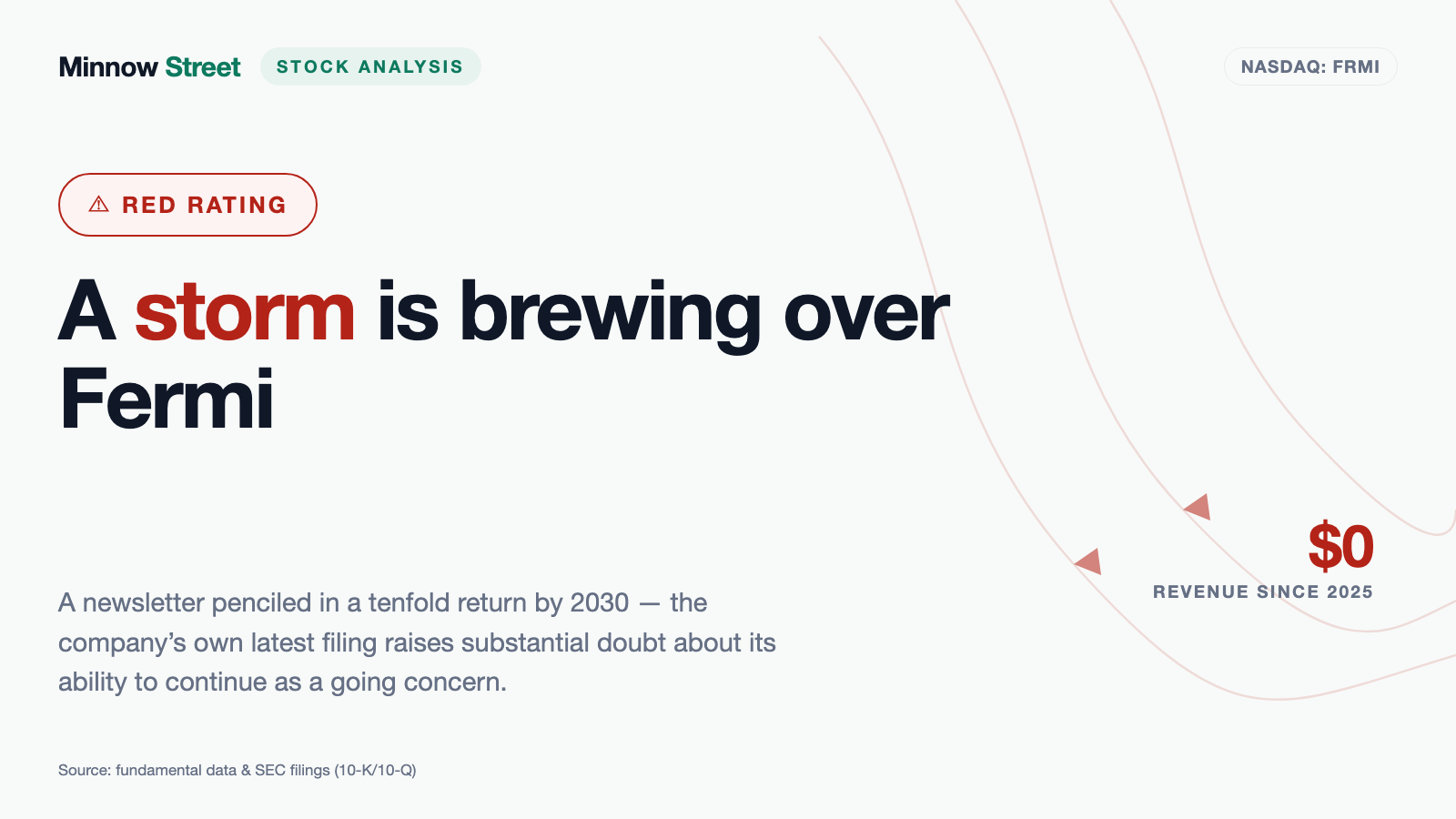
A newsletter called Fermi a hidden gem in November 2025, penciling in a P/E ratio of 1.5 by 2030 and tenbagger potential. Eight months later, the company itself tells the U.S. securities regulator, the SEC, in its own quarterly report that substantial doubt exists about its ability to continue as a going concern, has lost its founder as CEO, and is fighting a class-action lawsuit — all while still reporting zero revenue since its founding in January 2025. We read what has actually happened to that promise so far.
 Thomas Mücke
Founder & Publisher
Thomas Mücke
Founder & Publisher
Chart
Interactive price chart (TradingView).
Note: pure fact-based analysis, not investment advice and not a solicitation to buy or sell. All figures without guarantee.
There is one investing trap that hits hardest with the biggest numbers: anchoring bias. You read a number first — a price target, a P/E ratio, a "tenbagger" — and that first number lodges in your head like an anchor on the seabed. Everything that follows gets measured against that anchor, not against reality. A reader sent us issue 24 of the "Hot Stocks Europe" newsletter, dated November 28, 2025. On Fermi Inc. (Nasdaq: FRMI), an energy and data-center project founded in Amarillo, Texas, in January 2025, the newsletter cited a Berenberg estimate from November 2025: a price-to-earnings ratio of roughly 1.5 by 2030, earnings per share of $11.11 that same year — and, verbatim, at a P/E of 20, "clean tenbagger potential." So let's make a deal: before you adopt that anchor, let's read together what Fermi itself has told the U.S. securities regulator, the SEC, over the past several months — and how much of it still holds eight months later.
What Fermi actually does — a plot of land, a power plant, and a lease that's still missing
Fermi Inc., doing business as "Fermi America," was incorporated on January 10, 2025 — younger, as a company, than most houseplants in your office. The business idea, in plain terms: imagine buying a huge tract of land, building your own power plant on it at your own expense — gas, solar, battery, eventually nuclear too — and then leasing the power and the building shell to a single large customer who runs artificial-intelligence data centers inside it. The project is called "Project Matador" and sits on land Fermi secured through a 99-year ground lease with the Texas Tech University System (10-K for fiscal 2025). Plans call for up to 11 gigawatts of generation capacity, with an option to expand to roughly 17 gigawatts, and up to 15 million square feet of AI-ready data-center space over a multi-decade build-out. For tax purposes Fermi has elected real estate investment trust (REIT) status, retroactive to August 1, 2025 — but that comes with strict rules: at least 90 percent of taxable income must be distributed, at least 75 percent of assets must be real-estate related, and under the charter, shares may not be concentrated in a few hands ("closely held") as of June 30, 2026, or REIT status is at risk. The board includes Rick Perry, the former U.S. Secretary of Energy and Governor of Texas (10-K signature page, dated March 30, 2026) — a prominent name, but a name is not a business model, and that is the central tension of this analysis: a massive, capital-hungry construction project with a headline-grabbing story that fits neatly into the AI boom — set against a company that has never earned a single dollar of revenue and whose own quarterly report openly raises doubt about its ability to continue.
Where this stock landed on our desk — a newsletter with a disclosed conflict of interest
Unlike most of the names on our in-house stock scanner, Fermi didn't reach us through a metrics filter but through a reader who submitted issue 24 of the "Hot Stocks Europe" newsletter, dated November 28, 2025. The newsletter called Fermi an "absolute hidden gem," citing a Berenberg estimate from the same date: net income of $310 million in 2026, rising to $1.06 billion (2027) and $2.7 billion (2028), then above $5 billion (2029) and $6.6 billion (2030) — from which the newsletter derives the earnings-per-share figure of $11.11 quoted above and a P/E of roughly 1.5 for 2030. In fairness: the newsletter itself discloses a conflict of interest at the end of every issue — the publisher, author, or related third parties may hold positions in the securities discussed and intend to sell into rising prices (disclosure under the EU Market Abuse Regulation, MAR No. 596/2014). A price target paired with an intent to sell is not the same thing as a neutral analysis, and an eight-month-old bank estimate is not evidence of a company's condition today. What has actually happened since then isn't in the newsletter — it's in the SEC filings we read below.
The numbers over time — honestly assessed, brief as they are
Fermi listed on the Nasdaq on October 2, 2025 (dual-listed on the London Stock Exchange, both in U.S. dollars) — 32.5 million shares at $21.00 each, plus a fully exercised over-allotment option for 4.875 million additional shares; together, $745.6 million in net IPO proceeds (10-K for fiscal 2025). That is real money that actually went into turbines, substations, and site preparation: as of March 31, 2026, the balance sheet shows $1,430.9 million in net property, plant, and equipment, up from $935.3 million at year-end 2025 — visible, physical growth. What is completely missing at this young company is a revenue line: zero dollars of revenue since inception, across both annual and quarterly reports filed so far. In its first (not-quite-twelve-month) fiscal year 2025, Fermi reported a net loss of $486.4 million — of which only $177.8 million came from ongoing operations (mostly personnel and consulting costs). The bulk of the rest, $312.3 million of "other expense," is almost entirely non-cash: $111.6 million from fair-value remeasurements of embedded derivatives, $23.7 million from an inducement charge tied to the preferred-unit financing — and, the strangest single line item, $173.8 million for a stock donation: on September 18, 2025, two weeks before the IPO, Fermi transferred 11,250,000 Class B units at no cost to the Dechomai Asset Trust, an unrelated, independent 501(c)(3) nonprofit organization, valued at fair value on that date. Anyone reading only the headline "net loss of nearly half a billion" is looking at accounting effects for more than a third of that number, not core-business cash burn. The first quarter of 2026 flipped the mix slightly: $166.2 million operating loss, plus a net $22.4 million of other expense ($24.8 million loss on early debt extinguishment, offset by $2.3 million of interest income) — a $188.7 million net loss in just three months, smaller in absolute terms than the prior period but, without the special items, proportionally more "real." How that burn hit the balance sheet shows up in the financial position:
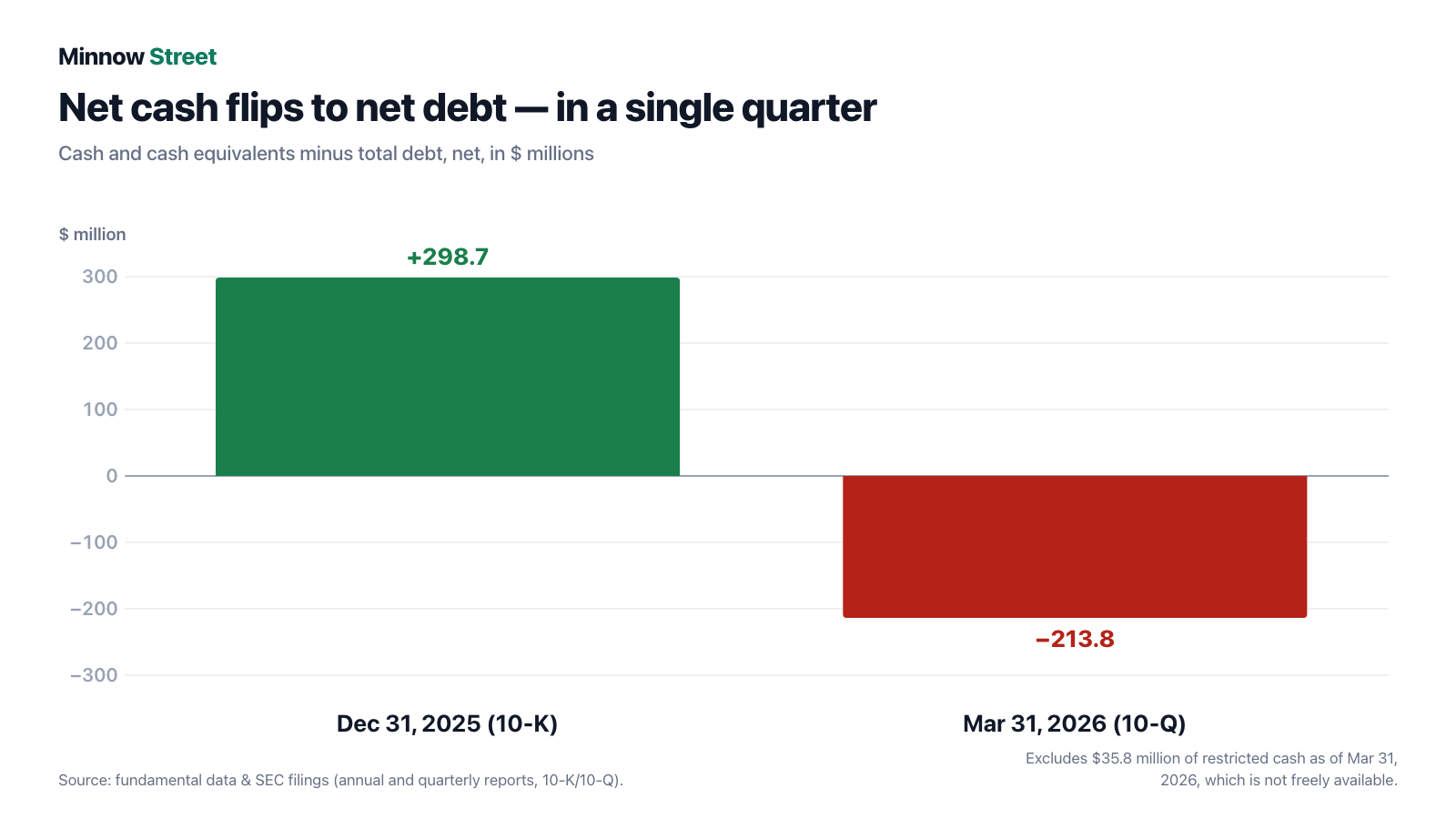
At year-end 2025, Fermi still had a comfortable net cash position of $298.7 million (cash of $408.5 million minus net debt of $109.8 million). Three months later, as of March 31, 2026, that had turned into net debt of $213.8 million (cash of $207.5 million minus net debt of $421.3 million) — a swing of roughly half a billion dollars in a single quarter. Cash itself (including restricted cash) fell from $408.5 million to $243.3 million, a drop of $165.2 million. The Q1 2026 cash bridge shows exactly how that happened:
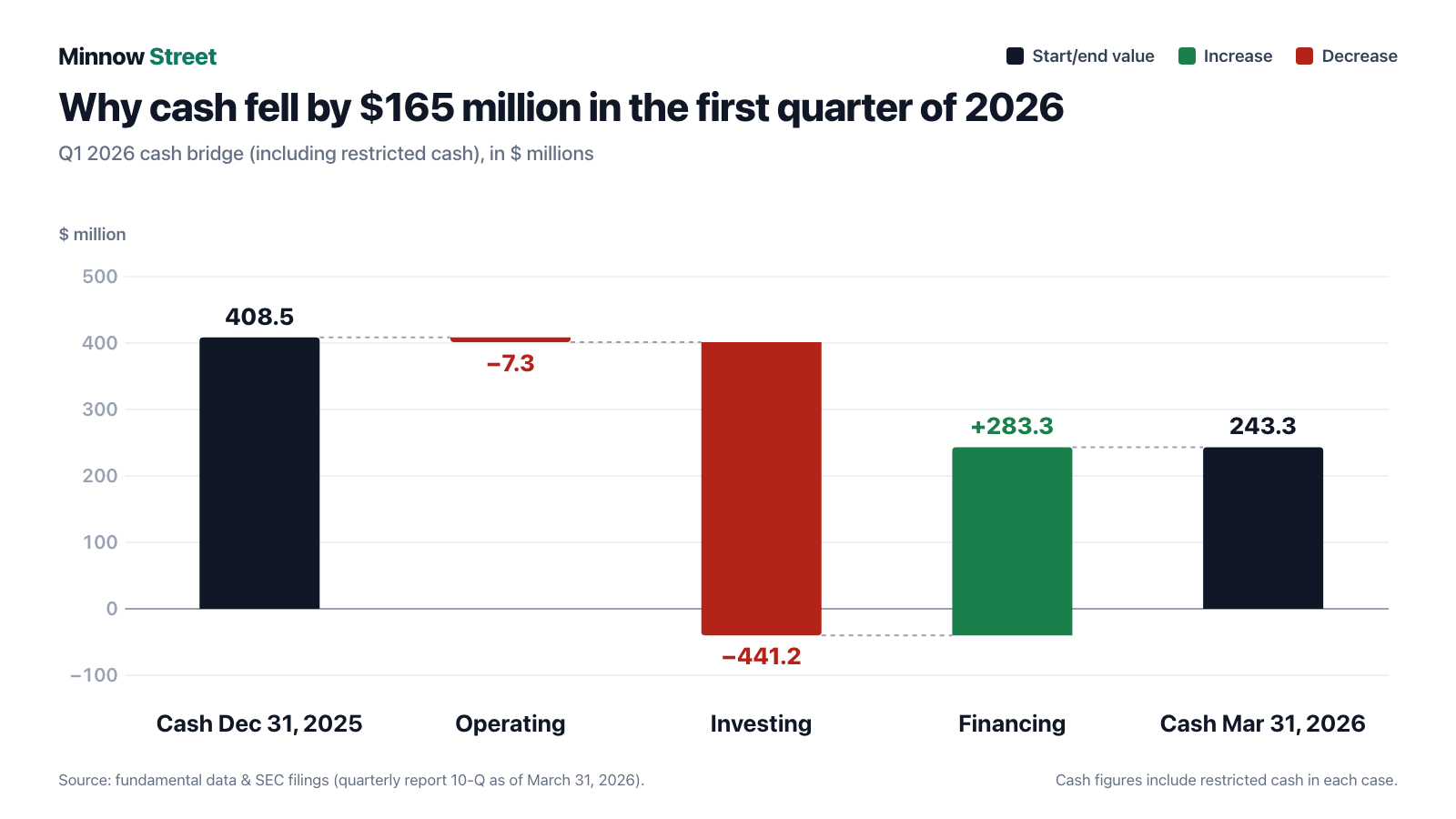
Notably, the core operating business used only $7.3 million of cash in the first quarter of 2026 — the real weight was $441.2 million of investment in turbines, substations, and the construction site. That was funded through a debt swap: on February 10, 2026, Fermi fully repaid its existing loan from Macquarie Equipment Capital (carrying $148.9 million, at an eye-popping effective interest rate of 48.9 percent) and replaced it with a new equipment credit facility from MUFG Bank of up to $500 million (Term SOFR plus 4.0 percentage points, currently around 12.1 percent effective) — a move that retired the punishing rate, but also shows the terms on which a revenue-less construction project can still raise debt at all.
What the latest filing shows — the uncomfortable truths
Uncomfortable truth No. 1: the company itself says there is "substantial doubt" about its ability to continue as a going concern
This is the central figure in this analysis, and it isn't buried in a footnote — it's in Fermi's own words, in the quarterly report as of March 31, 2026:
"Project Matador will require substantial capital investment to achieve commercial operation. As of March 31, 2026, the Company had not generated any revenues, has incurred recurring losses from operations and negative cash flows from operating activities since inception, and has substantial near-term capital expenditure obligations under existing equipment purchase, construction, lease and other project-related commitments. As of March 31, 2026, the Company had cash on hand of $207,501 and restricted cash of $35,792, a portion of which is available to fund defined capital expenditures. When measured against forecasted disbursements under the Company's current operating plan, these resources are not sufficient to satisfy the Company's financial obligations as they become due within one year after the date these unaudited condensed consolidated financial statements are issued. Considered in the aggregate and before consideration of management's plans, these conditions raise substantial doubt about the Company's ability to continue as a going concern within that period."
— Fermi Inc., Form 10-Q as of March 31, 2026, "Liquidity and Going Concern" (dollar figures in thousands as filed)

In plain terms: imagine your neighbor is building a house and calculates that his savings alone won't stretch to completion — but is counting on a credit line and the sale of surplus materials to close the gap. That is exactly what Fermi says about itself — and it draws a conclusion the same quarterly report spells out just as explicitly. As countermeasures, the company cites an undrawn credit line (the "Yorkville Note") of up to $156.3 million, existing equipment-financing facilities, and the possibility of monetizing some of the equipment already acquired (turbines, substations). Right after the passage quoted above, in the same report, Fermi writes:
"Accordingly, management has concluded that its plans alleviate the substantial doubt about the Company's ability to continue as a going concern within that period, and these unaudited condensed consolidated financial statements have been prepared on a going concern basis. There can be no guarantee that the Company's plans will be successfully implemented or, if implemented, that they will mitigate the conditions and events that gave rise to substantial doubt within that period."
— Fermi Inc., Form 10-Q as of March 31, 2026, "Liquidity and Going Concern"
In other words: Fermi itself — contrary to what the bare headline suggests — already classifies the doubt raised in March as alleviated by its own plans, in the very same report; the financial statements were explicitly prepared on a going-concern basis, not with a qualified statement. That said, this is management's own assessment, not a guarantee: the filing itself concedes there is "no guarantee" the plans will be successfully implemented, and it continues to list the original doubt as its own risk factor (Item 1A). Additional money arrived after the quarter-end that this assessment did not yet account for: on July 14, 2026, Fermi raised $431.25 million through convertible notes (5.00 percent coupon, due 2031, conversion price around $9.52 per share), with net proceeds of $416.8 million (Form 8-K dated July 15, 2026) — extra cushion on top of the measures already factored into the May filing. The next quarterly report (expected mid-August 2026) will show whether this assessment holds.
Uncomfortable truth No. 2: more than a billion dollars invested — and still no signed lease
Remember the picture of a power plant that only earns rent once a large tenant moves in? That is exactly the next problem. The quarterly report as of March 31, 2026 states that vertical construction won't begin until a definitive lease is signed — and in the same breath names a capital-need figure that dwarfs everything discussed so far:
"The capital expenditures we expect to incur as we complete the development of Project Matador will be significant. We currently estimate that the incremental capital expenditures we will incur to complete the development of Phase 0 and Phase 1 of Project Matador could exceed $3 billion in the aggregate, of which approximately $2 billion is expected to be incurred in the next twelve months across these two phases, subject to the execution of a definitive lease agreement and alignment with tenant deployment timelines and power delivery requirements. […] however, we currently expect total capital needs across all phases could range from approximately $70 billion to $90 billion […]"
— Fermi Inc., Form 10-Q as of March 31, 2026, Item 2, MD&A

For context: $70 billion to $90 billion is roughly 15 to 19 times Fermi's current market capitalization (see the valuation section below). And part of it — $2 billion in the next twelve months alone — is explicitly "subject to the execution of a definitive lease agreement." How precarious that condition is becomes clear looking back at December 2025: in September 2025, Fermi had signed a non-binding letter of intent with a tenant rated "investment grade," and in November an "Advance in Aid of Construction Agreement" (AICA) followed, under which that first tenant agreed to advance up to $150 million in construction costs. On December 11, 2025, the first tenant terminated that agreement — the exclusivity period under the original letter of intent had expired two days earlier (Form 8-K dated December 12, 2025). Fermi says lease negotiations continue, but as of the most recent quarterly report (March 31, 2026), not a single definitive lease had been signed — with $1,430.9 million in property, plant, and equipment already on the balance sheet. That exact gap between announcement and signature has since become the subject of its own lawsuit (see the next section).
Uncomfortable truth No. 3: the founder is gone, a power struggle rages, and a class action is pending
On April 17, 2026, co-founder Toby Neugebauer left his post as Chief Executive Officer of Fermi (Form 8-K, same date) — with no reason given in the filing. The board set up an "Interim Office of the CEO," led by Chief Operating Officer Jacobo Ortiz and then-board-observer Anna Bofa. What followed is rarely spelled out this openly in an SEC filing: Neugebauer launched a shareholder proxy fight to replace the board and regain control of the company — including a plan for a potential sale or strategic partnership. Fermi itself names this risk in its most recent quarterly report as its own bullet point, right next to the leadership change:
"Our former President and Chief Executive Officer, Toby Neugebauer, is involved in litigation that could cause negative publicity or perception about us and could divert management's attention, particularly if he is successful in gaining control of our Board of Directors."
— Fermi Inc., Form 10-Q as of March 31, 2026, Item 1A, Risk Factors

The power struggle escalated over months: on July 10, 2026, Miles Everson — until then chief financial officer and, as Neugebauer's board designee, also a director — resigned his board seat, citing a dispute over his access to company records and the board's decision to delegate oversight of certain financing negotiations to its own finance committee. On July 3, 2026, Neugebauer said he was suspending his campaign for a special shareholder meeting after the presiding judge recused herself shortly before a scheduled hearing — suspended, not settled. In parallel, a class action has been pending since January 5, 2026, in the U.S. District Court for the Southern District of New York, Lupia v. Fermi Inc. et al., Case No. 1:26-cv-00050:
"On January 5, 2026, a putative securities class action complaint was filed in the U.S. District Court for the Southern District of New York captioned Lupia v. Fermi Inc., et al., Case No. 1:26-cv-00050. The complaint names the Company, certain of our directors and officers, and certain underwriters of our initial public offering as defendants. The complaint purports to be brought on behalf of a class of persons and entities that purchased or otherwise acquired (i) our common stock pursuant and/or traceable to the registration statement and prospectus issued in connection with our initial public offering and/or (ii) our securities between October 1, 2025 and December 11, 2025, inclusive."
— Fermi Inc., Form 10-Q as of March 31, 2026, Item 1, Legal Proceedings

The plaintiffs allege Fermi and the named defendants made misleading statements about tenant demand and financing risk for Project Matador in connection with the IPO — precisely the question that became acute one month later with the first tenant's termination. That is an allegation by the plaintiffs, not a fact established in court; Fermi denies the claims and says it intends to defend itself vigorously. Since July 20/22, 2026, the company has also installed an entirely new executive bench — George Wentz as General Counsel, Anna Bofa as Chief Commercial Officer, Jacobo Ortiz as Chief Operating Officer, and Rob Masson as the new Chief Financial Officer — with Bofa and Ortiz continuing to co-chair the "Interim Office of the CEO." In other words: nine months after its IPO, Fermi still has no permanent CEO.
Valuation: no ratio to hold onto
At a company with no revenue, there is no price-to-earnings or price-to-sales ratio worth the name — both are simply undefined or meaningless. What remains are balance-sheet figures: as of July 26, 2026, Fermi's market capitalization stood at roughly $4.72 billion, and its enterprise value (market cap plus net debt) at roughly $4.99 billion. Book value per share is about $1.70, putting the price-to-book ratio at roughly 4.4 — the stock costs 4.4 times what accounting says stands behind it (fundamental data, as of July 26, 2026). The IPO price was $21.00 per share (October 2, 2025) — the current price sits just under two-thirds below that. The convertible notes placed in July 2026 were priced with a conversion price of about $9.52 — above the then-current price level, but still well under the IPO price; the capped-call hedges struck alongside the notes limit potential dilution up to a cap price of $14.64, a roughly 100 percent premium over the July 9, 2026 closing price of $7.32 (Form 8-K dated July 15, 2026) — the bank's own structure treats a doubling to that level as "possible, not the base case," without attaching a timeframe to it. And what about the Berenberg price target from the newsletter? That was an estimate dated November 28, 2025, built on assumptions that started wobbling just a month later — with the first tenant's termination — and that could not have known about the leadership fight, the class action, or the going-concern doubt that followed. Anyone still using that number as an anchor today hasn't updated it in eight months. For comparison, it's worth reading another stock from the same newsletter where we ran the same gap between expectation and reality: our PFISTERER stock analysis.
Opportunities and risks at a glance
What speaks for Fermi:
- Real, physical substance rather than slide-deck promises: $1,430.9 million in net property, plant, and equipment as of March 31, 2026 (turbines, substations, site infrastructure), funded from $745.6 million of net IPO proceeds plus ongoing equipment loans.
- A 99-year ground lease with the Texas Tech University System secures the site for the long term — no short-notice lease risk on Fermi's own land position.
- Fresh capital after the quarter-end: $416.8 million in net proceeds from the July 14, 2026 convertible notes provide added headroom the May 2026 quarterly report did not yet know about.
- An entirely new, jointly onboarded executive bench — George Wentz, Anna Bofa, Jacobo Ortiz, and Rob Masson — was installed in July 2026 after the founder dispute had absorbed months of attention.
- Structurally growing demand for power to run AI data centers is real — Fermi operates in a market that doesn't have to be invented from scratch.
What speaks against it:
- The company itself states "substantial doubt" about its ability to continue as a going concern in its most recent quarterly report — cash plus restricted cash totaling $243.3 million is not enough for planned spending over the next twelve months.
- As of March 31, 2026, there is still no signed lease; the first prospective tenant terminated its $150 million construction-funding commitment in December 2025. No tenant means no revenue, and no revenue means no REIT in any meaningful sense.
- Total capital needs across all construction phases are estimated by the company itself at $70 billion to $90 billion — 15 to 19 times today's market capitalization.
- Nine months after its IPO, Fermi still has no permanent CEO; its former founder and CEO waged an open proxy fight for control of the board, a director resigned amid the dispute, and a securities class action is pending.
- The reported 2025 net loss ($486.4 million) includes an unusual $173.8 million stock donation to an outside charitable trust two weeks before the IPO — a sign of just how complex and hard to parse this young company's capital structure already is.
A human bottom line
Back to the anchor from the beginning. A P/E of 1.5 by 2030 sounds like a bargain too good to pass up — but it is a chain of assumptions, not a measurement: Berenberg estimated net income of $6.6 billion for 2030 back in November 2025, built on a functioning leasing business that, eight months later, still doesn't exist. The anchor sits firmly in place — the question is whether the seabed underneath it is even still the same. What we found instead: a company that has poured more than a billion dollars into real assets within a year and a half, that publicly states doubt about its own ability to continue, that has lost its founder, that fell out with its first prospective tenant, and that is defending itself in court against the allegation that it wasn't honest about exactly that risk at the time of its IPO. One doesn't rule out the other — the construction project can still succeed, a new management team can still turn things around, and the July 2026 convertible notes could be exactly the bridge that's needed. But that's a bet on the future, not a reading of the present. What you make of this gap between promise and reality is your decision. And that's exactly how it should be.
Sources
All original documents used in this analysis — for your own reading:
- Fermi Inc. — SEC Form 10-Q as of March 31, 2026 (filed May 15, 2026)
- Fermi Inc. — SEC Form 10-K for fiscal 2025 (filed March 30, 2026)
- Fermi Inc. — Form 8-K dated December 12, 2025 (termination of first-tenant funding agreement)
- Fermi Inc. — Form 8-K dated April 17, 2026 (CEO departure)
- Fermi Inc. — Form 8-K dated July 13, 2026 (director resignation)
- Fermi Inc. — Form 8-K dated July 15, 2026 ($431.25 million convertible notes)
- Fermi Inc. — Form 8-K dated July 23, 2026 (new executive bench)
- Full SEC filing history for Fermi Inc.: EDGAR overview (sec.gov)
- Fundamental data (metrics, market capitalization, valuation; data as of July 26, 2026), cross-checked against the SEC filings.
- Hook: "Hot Stocks Europe" newsletter, issue 24, dated November 28, 2025 (B-Inside International Media GmbH) — statements from the newsletter are presented solely as the expectation held at that time, not as a factual claim by this publication.
Transparency & disclaimer: this analysis is a journalistic assessment of publicly available information and is not investment advice, not a regulated financial analysis, and not a solicitation to buy or sell securities. Equity investments carry substantial risk, including total loss, especially at a company that has itself disclosed doubt about its ability to continue as a going concern. All information is provided without guarantee; the date of each figure is noted in the text. As of publication, the author holds no position in Fermi shares.
Our Bottom Line at a Glance
- Going Concern & Liquidity negative
- In its quarterly report as of March 31, 2026, Fermi itself states "substantial doubt" about its ability to continue as a going concern: cash plus restricted cash totaling $243.3 million is not enough to cover planned spending over the next twelve months. The net financial position flipped from +$298.7 million to −$213.8 million within a single quarter (excluding $35.8 million of restricted cash; including it, −$178.0 million). Fermi itself states, in the same report, that its own plans (credit lines, equipment monetization) alleviate this doubt — without a guarantee of execution, and still listed as its own risk factor.
- Project Scale vs. Capital Base negative
- Total capital needs across all of Project Matador's construction phases are estimated by the company itself at $70 billion to $90 billion — 15 to 19 times today's market capitalization of roughly $4.7 billion (07/26/2026). As of March 31, 2026, there is still no signed lease; the first prospective tenant terminated its $150 million funding commitment in December 2025.
- Leadership & Control negative
- Founder and CEO Toby Neugebauer left the company on April 17, 2026, and then waged a — suspended in July 2026 — proxy fight for control of the board; a director he had designated resigned amid the dispute on July 10, 2026. Since July 20/22, 2026, an entirely new executive team has run the company, but still without a permanent CEO.
- Legal Risk negative
- A securities class action, Lupia v. Fermi Inc. (Case No. 1:26-cv-00050, U.S. District Court for the Southern District of New York), has been pending since January 5, 2026, alleging misleading statements about tenant demand at the IPO — an allegation by the plaintiffs, which Fermi denies and says it intends to defend vigorously.
- Fresh Capital & Substance positive
- On July 14, 2026, Fermi raised $431.25 million through convertible notes (net proceeds of $416.8 million), in addition to $745.6 million of net IPO proceeds; against that stand $1,430.9 million of real property, plant, and equipment (turbines, substations) and a 99-year ground lease with the Texas Tech University System. This capital comes on top of the measures Fermi had already cited, in the same quarterly report, as alleviating the going-concern doubt.
- Valuation neutral
- A price-to-earnings ratio doesn't exist without revenue; on a book-value basis, the stock costs roughly 4.4 times equity per share (data as of 07/26/2026), at a price just under two-thirds below the $21.00 IPO price (10/02/2025). The capped-call hedges on the convertible notes treat a doubling to the $14.64 cap price as a possibility, not an expectation — without attaching a timeframe.
Fermi Inc. has poured more than a billion dollars into a real construction project within a year and a half — but still reports zero revenue, has no signed lease, and its own quarterly report states "substantial doubt" about its ability to continue as a going concern — doubt that Fermi, in the same report, says its own plans alleviate, though explicitly without a guarantee of success. On top of that come the founder's departure as CEO, a months-long proxy fight for control of the board, and a pending securities class action. The July 2026 convertible notes provide additional capital on top of management's own plan. Not investment advice.
What Our Rating Means
Substance risk
We found at least one documented issue that threatens the company itself — regardless of how the stock is currently valued.
Red here is not about a valuation question — it reflects a substance finding Fermi has documented itself: the quarterly report as of March 31, 2026 states, in its own words, "substantial doubt" about its ability to continue as a going concern, because available resources do not cover planned spending over the next twelve months — an assessment the company, in the same report, says its own countermeasures alleviate, though explicitly without a guarantee of success and still listed as its own risk factor. On top of that sits a documented leadership crisis: the founder and CEO left the company in April 2026, then waged an open proxy fight for control of the board, a director resigned amid the dispute, and a securities class action alleges the company misled investors at the IPO about exactly the tenant risk that materialized a month later. The July 14, 2026 convertible notes bring real, additional capital on top of the measures already factored into the May filing. Whether the combination is actually enough will only be confirmed by the next report. The decision is yours.
A journalistic assessment by our editorial team at the time of the deep dive, based on public sources — not investment advice and not a solicitation to buy or sell. Your personal circumstances (investment goals, risk capacity, taxes) cannot be taken into account. What our levels mean, how verdicts are formed, and what conflicts of interest exist →
Worth Noting
- The hook for this analysis is issue 24 of the "Hot Stocks Europe" newsletter dated November 28, 2025 (reader submission); every company figure comes from the SEC filings and fundamental data, not from the newsletter. The newsletter itself discloses a conflict of interest: the publisher, author, or related third parties may hold positions in the securities discussed and intend to sell into rising prices (EU Market Abuse Regulation No. 596/2014).
- Data as of: SEC filings through the Form 10-Q as of March 31, 2026 (filed May 15, 2026), plus required disclosures (Form 8-K) through July 23, 2026; market data (market capitalization, price-to-book) as of July 26, 2026.
- Not to be confused: Fermi Inc. trades on the Nasdaq and the London Stock Exchange, each in U.S. dollars (not pence); its German secondary listings (tickers H3V and A41MPN) trade in euros and are outside the scope of this analysis.
Frequently Asked Questions
Fermi Inc. (doing business as "Fermi America") is building a private energy and data center campus called "Project Matador" in Amarillo, Texas, with up to 11 gigawatts of capacity (gas, solar, battery, eventually nuclear) on a 99-year ground lease from the Texas Tech University System. It has elected real estate investment trust (REIT) status for tax purposes and plans to lease the power and buildings to AI data-center operators.
Because no large tenant has signed a definitive lease yet. Its first prospective tenant agreed in November 2025 to advance up to $150 million toward construction costs, then terminated that agreement on December 11, 2025. Per the quarterly report as of March 31, 2026, vertical construction only begins once a definitive lease is signed; Fermi expects first commercial revenue no earlier than 2027.
In its quarterly report as of March 31, 2026, Fermi states that cash plus restricted cash of $243.3 million combined is not enough to cover planned spending over the next twelve months — which raises "substantial doubt" about its ability to continue as a going concern. As countermeasures, the company cites undrawn credit lines and the possible sale of equipment — and concludes, in the same report, that these plans alleviate the doubt; Fermi itself says there is no guarantee they will succeed.
Toby Neugebauer left the chief executive role on April 17, 2026, with no reason given in the filing. He then waged a proxy fight for control of the board, which he said he was suspending on July 3, 2026. An "Interim Office of the CEO," staffed by two managers, has run the company since — nine months after the IPO, Fermi still has no permanent CEO.
In November 2025, Fermi agreed with a tenant rated "investment grade" on an advance of up to $150 million toward construction costs. On December 11, 2025, that tenant terminated the agreement; the exclusivity period under the original letter of intent had expired two days earlier. Fermi says lease negotiations with that party continue.
Per the quarterly report as of March 31, 2026, the first two construction phases alone could cost $3 billion, with about $2 billion needed in the next twelve months — subject to a signed lease. Across all construction phases, Fermi estimates total capital needs at $70 billion to $90 billion, or 15 to 19 times today's market capitalization.
A price-to-earnings ratio cannot be calculated without revenue. On a book-value basis, the stock costs roughly 4.4 times equity per share (data as of July 26, 2026) — no bargain, even at a price just under two-thirds below the $21.00 IPO price. Fermi's own convertible notes treat a doubling to the capped-call ceiling as a possibility, not a base case.
The "Hot Stocks Europe" newsletter dated November 28, 2025 cited a Berenberg estimate for a P/E ratio of roughly 1.5 by 2030. That estimate predates the first tenant's termination, the CEO departure, the proxy fight, and the class action — as a price target, it is not a fact but an opinion with a date, one that could not have known about what followed.
Found an error?
Did you spot a factual error, an outdated number, or a typo in this deep dive? Let us know briefly — your report goes straight to the editorial team.