Serabi Gold: Eleven Strong Numbers, One Ticking Deadline
Record output, revenue up 65 percent, the company's first-ever dividend — and, in the middle of it all, a transitional permit for its most important mine that expires in January 2027. A look at the original filings, without skipping the red box.
 Thomas Mücke
Founder & Publisher
Thomas Mücke
Founder & Publisher
Chart
Interactive price chart (TradingView).
Note: pure fact-based analysis, not investment advice and not a solicitation to buy or sell. All figures without guarantee.
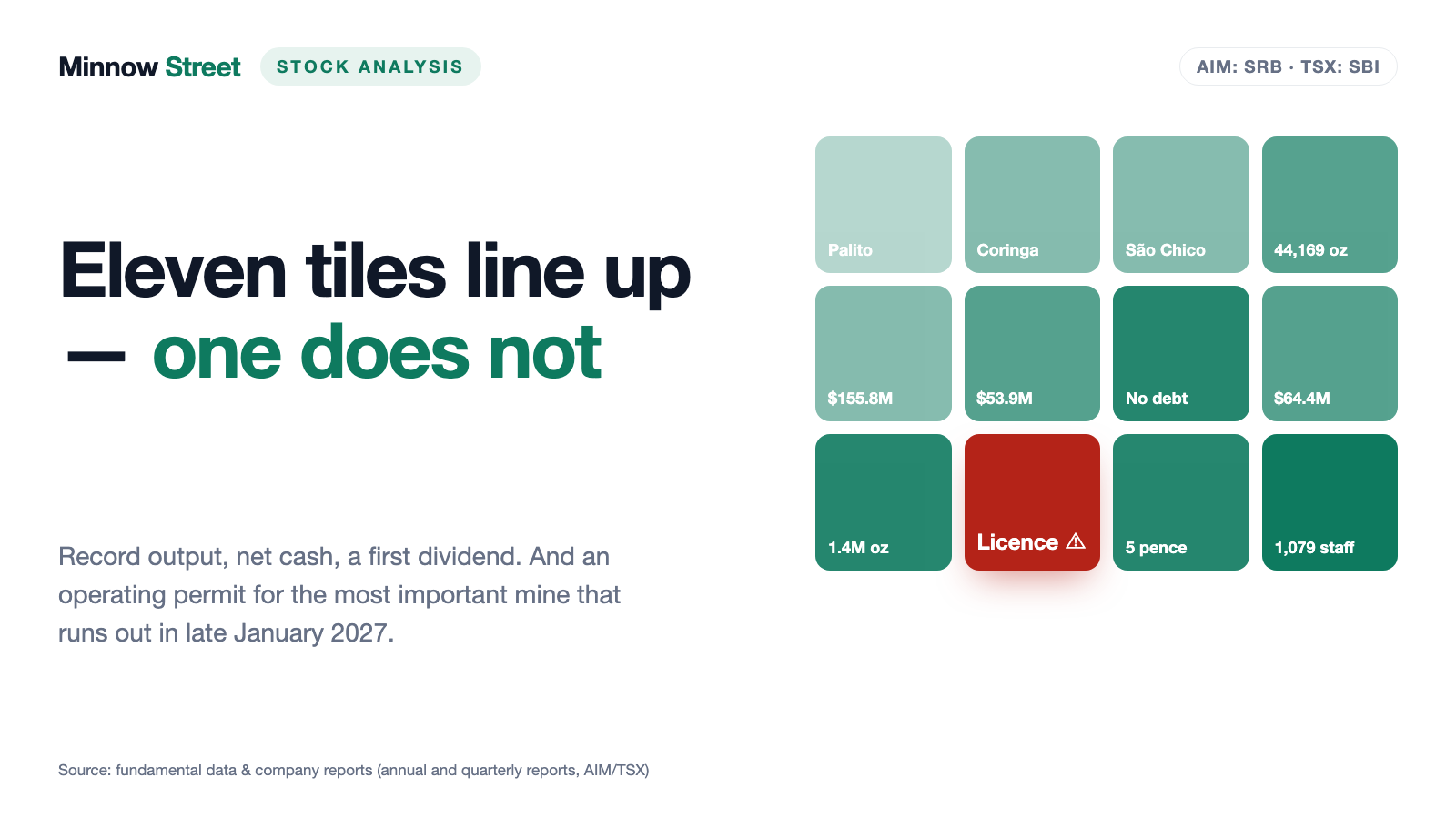
You know that feeling: a scorecard of twelve boxes in front of you, eleven of them green, one red — and your eyes just refuse to linger on the red one? Psychologists call this confirmation bias: we hunt for and weight information that fits what we already want to believe, and we tune out what doesn't. With Serabi Gold plc, the temptation is unusually strong, because the eleven green boxes are genuinely impressive: record production, revenue more than doubled in two years, a practically debt-free balance sheet, the first dividend in company history. The red box is quieter — a government deadline that expires in a few months, for the very mine that now supplies more than half the gold. So let's make a deal: we'll look at both sides together, original filings in hand — not just the eleven boxes that make the easier story.
What Serabi Gold actually does
Serabi Gold plc is a British company — incorporated in England and Wales (company number 5131528), headquartered in London — whose entire operation sits in a single corner of Brazil: the state of Pará, deep in the Amazon, around the town of Itaituba. Picture a London letterbox with a Brazilian mine behind it. Serabi has mined gold there for more than twenty years — underground, in narrow but high-grade veins. In plain terms: instead of vast open pits with a lot of ground and little gold per ton of rock, Serabi digs tight tunnels where each ton of rock carries comparatively more gold, at a higher cost per ton to extract.
Two mines carry production today. The Palito Complex (with the Palito and São Chico veins) has operated for many years under a regular, unrestricted mining licence. The younger Coringa mine has produced gold only since July 2022 and, in 2025, outproduced Palito for the first time. That is exactly where this analysis' central tension sits: Coringa does not yet run on the final, unrestricted licence, but on a time-limited transitional permit — more on that below. Serabi employed an average of 1,079 people during fiscal 2025, overwhelmingly in the Pará region itself.
Why there is no SEC filing here
Serabi Gold is not a U.S. reporting company. Anyone used to reading U.S.-listed stock analyses knows the SEC's strict disclosure regime — the annual report (10-K), the quarterly report (10-Q). Serabi files neither: a ticker search at the SEC returns no result for either SRB or SRBIF, checked independently on July 26, 2026. Instead, Serabi trades on AIM, the London Stock Exchange's growth market for smaller companies, plus a secondary listing on the Toronto Stock Exchange and an over-the-counter line in the U.S. (OTCQX). Its mandatory disclosures — an annual report plus interim reports — go out via the UK's RNS system and the company's own investor-relations site.
This analysis therefore rests primarily on two documents: the Annual Report 2025 (fiscal year ended December 31, 2025, published April 30, 2026) and the Q1 2026 Financial Report (period ended March 31, 2026, published May 29, 2026) — plus an operational update dated July 23, 2026 that already carries second-quarter 2026 production and cash figures, covering the most recent available data. Data attribution throughout: fundamental data & company reports (annual/interim report, AIM/TSX) — not "SEC filings," which simply do not exist here.
How the stock reached us
Honestly: not through our in-house stock scanner. That tool covers primarily U.S.-listed names; a British company quoted in pence on London's AIM does not show up there. Serabi Gold reached our desk because a reader forwarded us an issue of his newsletter: "Hot Stocks Europe," issue 24, dated November 28, 2025 (B-Inside International Media GmbH, Freiburg im Breisgau, Germany; author Michael Calivas). Serabi appears twice in it.
First, in a look back at 2025's top performers: the newsletter cites a recommendation from issue 1/2025 at €1.32, with a peak of €3.50 — a gain of 165 percent. Second, as a live position in the newsletter's model portfolio: bought October 31, 2025 at €2.72 per share (12,500 shares), quoted at €3.00 as of November 28, 2025 (up 10.3 percent, stop-loss at €2.00). Part of the context is the conflict-of-interest notice the newsletter itself prints on page 8: the publisher, the author, or related parties may hold long positions in the securities discussed and intend to sell as prices rise (EU Market Abuse Regulation 596/2014). Both price points are cited here explicitly as a third party's expectation from November 28, 2025, not as a source of our own — every company figure in this analysis comes from Serabi Gold's own filings, not from the newsletter. Unlike some other names in the same issue, the newsletter cites no price target from any brokerage for Serabi, only its price performance.
One technical note that runs through this entire series: the newsletter quotes prices in euros — but Serabi actually trades on the London Stock Exchange in British pence (ticker suffix GBX), not euros and not even British pounds. 262 pence is £2.62, not £262 — a hundredfold difference that regularly trips people up with European small caps. The newsletter's euro prices are therefore already a conversion of a conversion. Our ACG Metals analysis, another London AIM name from the same issue whose price is likewise quoted in pence, shows just how tricky these currency layers can get.
The numbers over the years — honestly assessed
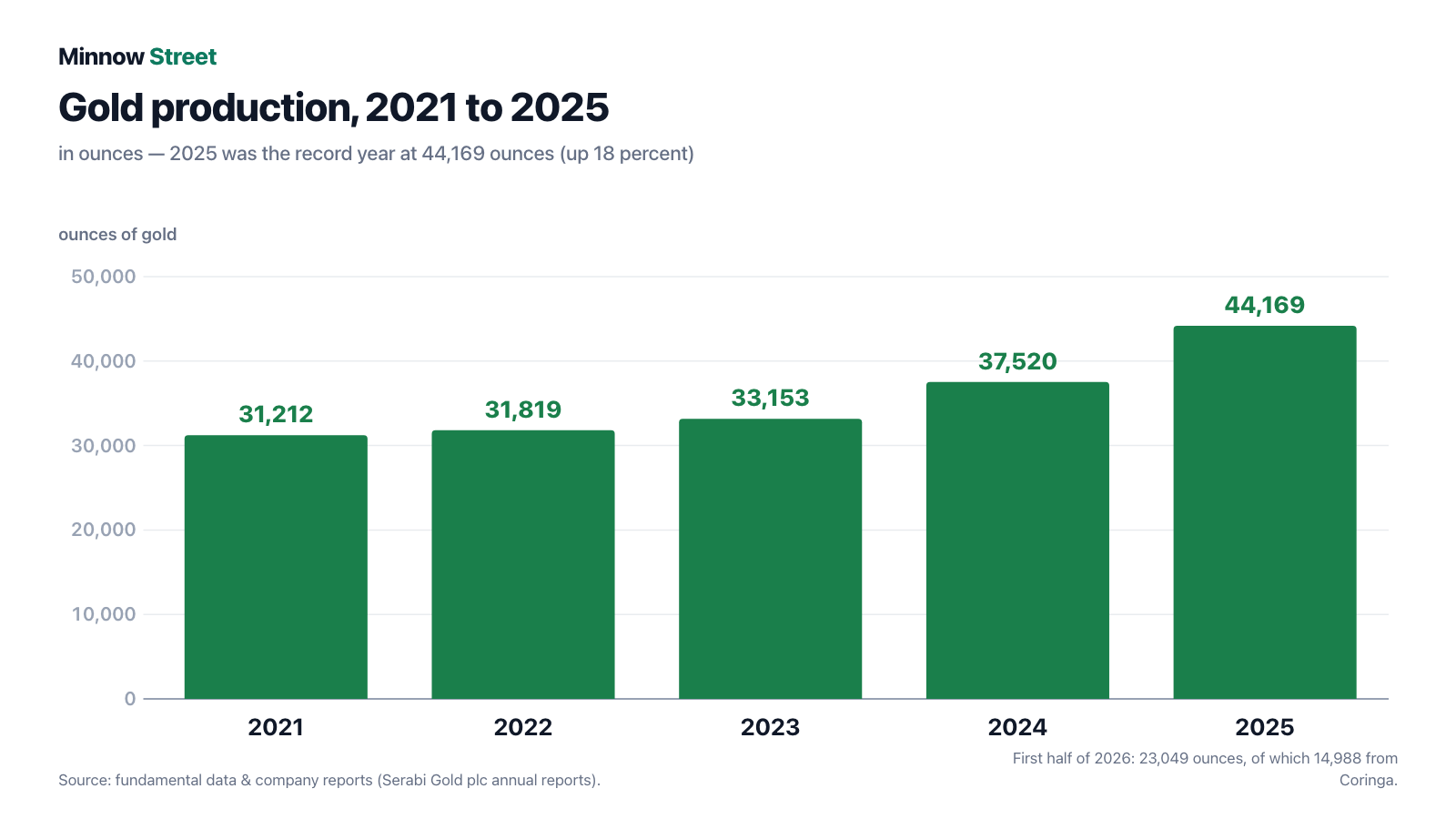
Let's start with what genuinely impresses. Serabi mined more gold in 2025 than in any year in company history: 44,169 ounces, up 18 percent from 2024's 37,520 ounces and the fifth consecutive annual production increase since 2021.
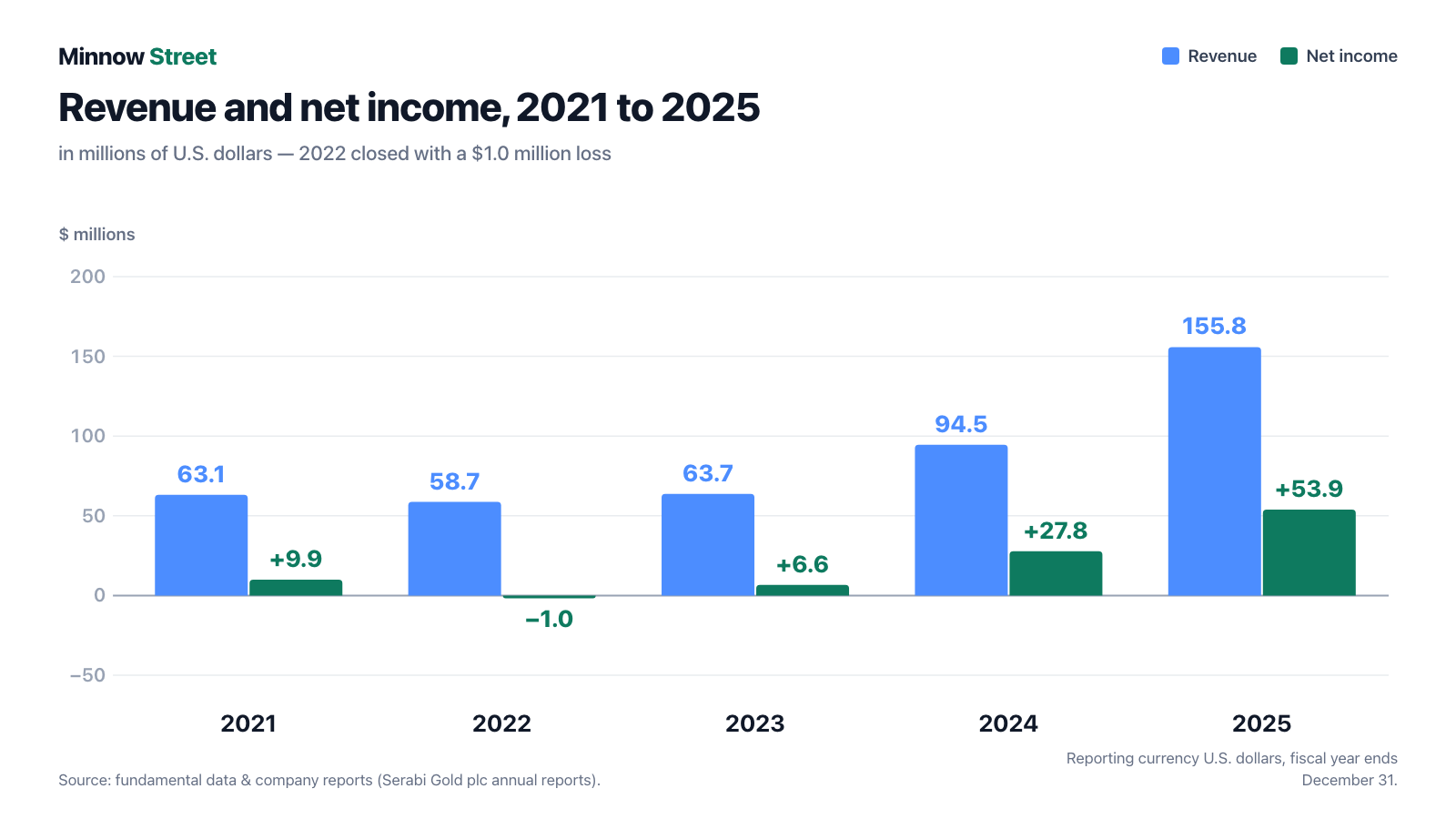
Revenue climbed even faster: from $63.7 million (2023) through $94.5 million (2024) to $155.8 million in 2025 — up 65 percent in a single year. Net profit rose from $27.8 million to $53.9 million, nearly doubling. For comparison, 2022 still carried a $1.0 million loss.

A good part of that jump, though, has a name that has nothing to do with mining: the gold price. Serabi's average realized selling price per ounce rose 45 percent to $3,481 in 2025 — and averaged $4,926 in the first quarter of 2026 alone. Remember this line: a rising gold price lifts nearly every gold miner at once — it is not evidence of superior management. Whether Serabi runs better or worse than its peers shows up in cost per ounce, not in revenue.
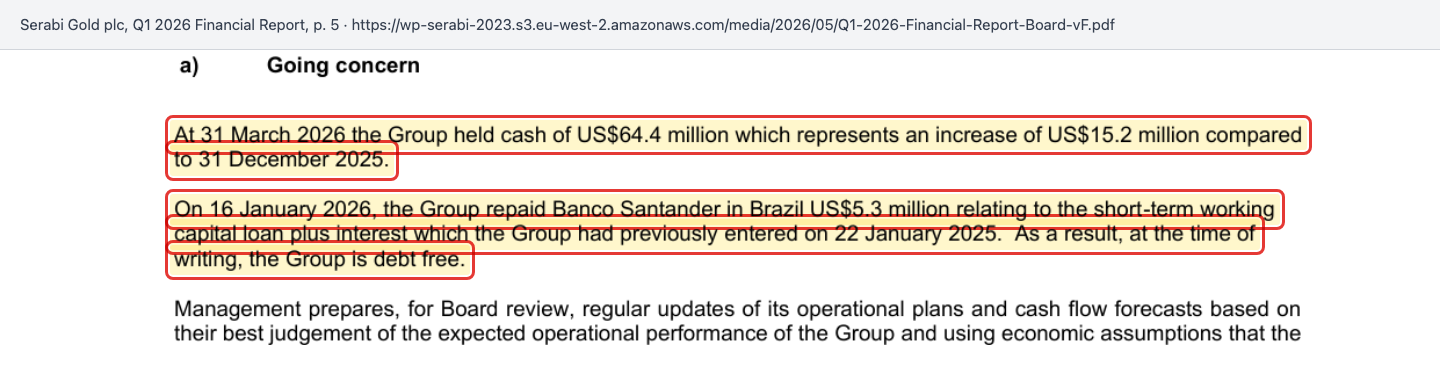
The pace held through the first half of 2026 too: 23,049 ounces of gold (14,988 of them from Coringa), and by June 30, 2026 the group held $65.7 million in cash — up from $64.4 million at March 31, 2026. Part of that came from finally shedding its last short-term bank loan in January 2026:
On costs, though, 2026 is already getting less comfortable, which brings us to the next section.
What the filings show — the uncomfortable truths
Uncomfortable truth No. 1: the most important mine runs on a deadline that expires in January 2027
Coringa produced 24,010 of the 44,169 ounces mined in 2025 — more than half of total group output, ahead of the older Palito Complex (20,158 ounces). Yet that mine does not hold a regular, unrestricted mining licence. It operates under what's called a GU licence (Portuguese Guia de Utilização, a transitional authorization from Brazil's national mining agency, the ANM). The annual report states this plainly:
"In January 2024, the ANM issued a new trial mining licence for the project valid for three years."
— Serabi Gold plc, Annual Report 2025, "Licensing and environmental risk" section, p. 26

Three years from January 2024 means the transitional licence expires on January 29, 2027. The permanent, unrestricted mining licence ("LI") still requires two government sign-offs: a land-use change from Brazil's agrarian-reform agency, INCRA (approved at the state level according to the company, still pending final federal-level sign-off in Brasília), and an Indigenous impact study from the agency FUNAI. That second hurdle has moved recently: according to the company, the study was presented to affected communities in March 2026 and was received positively, and a second on-site visit by those communities to Coringa took place on July 17, 2026 — progress, but not a licence in hand. In its July 23, 2026 operational update, Serabi itself frames this as an assumption, not a fact: its 2026 production guidance of more than 53,000 ounces holds explicitly "based on the assumption that the LI will be awarded by Q4-2026." As a fallback, Serabi is also in talks with the ANM about a possible extension of the existing transitional licence.
What would happen if the deadline passed with no follow-on approval in place? The company does not speculate publicly, but the scale is worth naming: Coringa accounts for well over half of group production. A similar pattern — a granted permit turning out to be less final than it looked — shows up in our DPM Metals analysis, where an already-issued Ecuadorian environmental licence was revoked within four months. The difference here: this isn't a sudden revocation, but a permit that was time-limited from the start, with its successor still pending — a deadline risk, not a surprise risk, but a deadline risk with a real due date.
Uncomfortable truth No. 2: ore grades at the home mine, Palito, are sliding in 2026, and a one-time charge hit the quarter
A second point that's easy to lose among the eleven green boxes: at Palito, the older and supposedly steadier of the two mines, processed ore grade fell noticeably this year — averaging 5.26 grams of gold per tonne year-to-date in 2026, versus more than 6 grams per tonne for full-year 2025. Fewer grams per tonne means less gold from the same amount of rock, unless higher tonnage makes up the difference. Alongside that, Serabi reported a one-time cost item for the second quarter of 2026:
"Despite lower realised gold prices in Q2, development of the Galena and Serra South zone at Coringa and approximately $4 million of one-time G&A and tax charges, Serabi ended the quarter with an increased cash balance of $66 million following record cash generation in Q1 while maintaining a debt-free balance sheet."
— Michael Hodgson, Chief Executive Officer, Serabi Gold, second-quarter 2026 operational update, July 23, 2026
Two things sit inside that one sentence. First: the average realized gold price was lower in the second quarter of 2026 than in the first — for a commodity that had seemed to know only one direction for years, that's a small surprise in itself, even with both quarters still historically high. Second: roughly $4 million in one-time G&A and tax charges is not trivial against a quarterly profit that most recently (Q1 2026) ran $21.0 million — it weighs on the second quarter without anything having changed in the actual mining operation. The 2026 half-year report, likely due in late August, will show how much of that was truly one-off and how much becomes a lasting cost trend.
Uncomfortable truth No. 3: strip out the gold price, and the margin looks a lot thinner
All-in sustaining cost per ounce of gold (AISC — plain terms: everything it actually costs to produce an ounce, including the capital spending needed to keep the mines running) came to $1,816 in 2025 (2024: $1,790) — essentially flat. Over the same period, the realized selling price rose from $2,407 to $3,481. Margin per ounce — realized price minus AISC — therefore grew from roughly $617 to roughly $1,665, more than doubling, without Serabi fundamentally changing its own cost structure. Remember this tension: a large share of the 2025 profit jump is priced-in gold, not proven operating improvement. If the gold price fell back to where it stood two or three years ago (roughly $1,950 to $2,000 an ounce) with costs unchanged, this margin would shrink back to a fraction of today's level — production volumes would hold up, but profit per ounce would fall sharply. That is not a Serabi-specific risk; it applies to practically every gold producer. It still belongs in any honest read of the 2025 numbers.
Valuation — order of magnitude, not a snapshot
On July 24, 2026, Serabi shares closed on London's AIM at 262 pence (£2.62 — not £262, see above). With 75,734,551 shares outstanding (unchanged from December 31, 2025 through March 31, 2026, the most recent document to state a share count), that implies a market capitalization of roughly £198 million, or roughly $264 million converted at a pound-dollar rate of 1.3321 from the same day. The secondary Toronto listing (SBI) and the U.S. over-the-counter line (SRBIF) show a similar value, roughly $267 million to $270 million — a rough cross-check that the figure isn't out of line.
Adding up profit from the four most recently reported quarters (2025's full-year profit of $53.9 million, minus Q1 2025's $8.8 million, plus Q1 2026's $21.0 million) gives roughly $66 million in trailing profit. Against a $264 million market cap, that works out to a price-to-earnings ratio of roughly 4 — a figure that looks cheap at first glance, but carries exactly the gold-price dependency flagged in uncomfortable truth No. 3: part of that profit is gold price, not a permanent state of affairs. Book equity of $198.2 million (March 31, 2026) works out to roughly $2.62 per share. Unlike some other names in the same newsletter issue, it cites no brokerage price target for Serabi itself — so there's no third-party benchmark to weigh here, only our own arithmetic.
Opportunities and risks at a glance
What speaks for Serabi Gold:
- Five straight years of rising production, a 2025 record of 44,169 ounces, and continuation into the first half of 2026 (23,049 ounces).
- A practically debt-free balance sheet since fully repaying its last bank loan on January 16, 2026, a growing cash position ($65.7 million at June 30, 2026), and the first dividend in company history.
- A resource base expanded to 1.4 million ounces (as of January 2026, split into 731,000 ounces measured-and-indicated plus 653,000 ounces inferred per the July 2026 operational update) — more than halfway to the company's own 1.5-to-2.0-million-ounce growth target.
- Progress on the permanent Coringa licence process (the Indigenous impact study received positively, a second site visit in July 2026) and a fallback option via a possible extension of the existing transitional licence.
What speaks against it:
- The Coringa transitional licence — covering more than half of group production — expires January 29, 2027; the permanent licence still awaits two government sign-offs, and the company itself calls a fourth-quarter-2026 award an assumption, not a commitment.
- A meaningful share of 2025's profit growth (realized gold price up 45 percent) came from market conditions, not operating performance; a falling gold price would compress margin per ounce sharply.
- Ore grade at the home mine, Palito, has fallen noticeably so far in 2026, and roughly $4 million in one-time G&A and tax charges hit the second quarter of 2026, per the company.
- A single Brazilian financial investor now holds nearly a quarter of the shares (see side find) — a smaller free float for remaining shareholders and an ownership structure that has shifted substantially in a short time.
A human conclusion
Back to the scorecard from the start: eleven green boxes, one red one. The eleven green ones are real and impressive — record production, revenue more than doubled in two years, a practically debt-free balance sheet, the first dividend in company history. The red box is just as real: a transitional licence for the mine that supplies more than half the gold, with an expiry date in January 2027 and a successor arrangement the company itself describes only as an assumption. Confirmation bias would whisper that the red box probably isn't that important, since everything else is going so well. Maybe it's right — the regulatory progress is real, and an extension of the transitional licence would be a genuine fallback. Maybe it isn't. What you make of that is your decision. And that's exactly how it should be.
Sources
All original documents used in this analysis — for your own reading:
- Serabi Gold plc — Annual Report & Accounts 2025 (fiscal year ended Dec 31, 2025, published Apr 30, 2026)
- Serabi Gold plc — Financial Report and Commentary, three months ended Mar 31, 2026 (published May 29, 2026)
- Serabi Gold plc — Reports Q2-2026 Production & Operational Highlights (Jul 23, 2026)
- Serabi Gold plc — Dividend Information (May 22, 2026)
- Serabi Gold plc — TR-1 Notification (published Feb 11, 2026)
- Serabi Gold plc — Financial reports overview (serabigold.com)
- Fundamental data (metrics, price and market-cap figures; data as of July 24, 2026).
- Hook: "Hot Stocks Europe," issue 24, dated November 28, 2025 (B-Inside International Media GmbH), forwarded by a reader — figures cited exclusively as a third party's expectation from that date, no recommendations adopted.
Transparency & disclaimer: This analysis is a journalistic assessment of publicly available information and is not investment advice, not a regulated financial analysis, and not a solicitation to buy or sell securities. Equity investments carry substantial risk, including total loss. All figures are provided without guarantee; data dates are noted throughout the text. The author holds no position in Serabi Gold shares at the time of publication.
Our Bottom Line at a Glance
- Financial strength positive
- A practically debt-free balance sheet since fully repaying its last bank loan on January 16, 2026, a growing cash position ($65.7 million at June 30, 2026), and the first dividend in company history (5 pence per share, paid July 10, 2026). No going-concern flag, no negative equity.
- Production and earnings growth positive
- A fifth consecutive production record (44,169 ounces in 2025, up 18 percent), revenue up 65 percent, net profit nearly doubling to $53.9 million — continuing into the first half of 2026 (23,049 ounces).
- Regulatory dependency at Coringa negative
- The Coringa mine — more than half of 2025 group production — runs on a transitional licence expiring January 29, 2027. The permanent licence still depends on two outstanding government approvals (INCRA, FUNAI); the company itself calls a fourth-quarter-2026 award an assumption behind its own production guidance, not a settled fact.
- Earnings quality and gold-price dependency neutral
- A significant share of the 2025 profit jump came from a 45 percent rise in the realized gold price, not from falling own costs (AISC essentially flat at roughly $1,816 per ounce). On top of that, ore grade at Palito has fallen so far in 2026, and roughly $4 million in one-time G&A and tax charges hit the second quarter of 2026.
- Valuation neutral
- Market capitalization roughly $264 million (July 24, 2026), price-to-earnings ratio roughly 4 based on the last four reported quarters — a figure that looks cheap at first glance but already bakes in the gold-price dependency of that profit. The triggering newsletter cites no brokerage price target for Serabi itself.
Serabi Gold checks off nearly a dozen green boxes for 2025: record production, sharply higher revenue and profit, a practically debt-free balance sheet, and the first dividend in company history. The catch sits at the mine that now supplies more than half the gold: Coringa runs on a transitional licence expiring in January 2027, and the permanent approval is not yet secured, by the company's own account. Not investment advice.
What Our Rating Means
Open questions
The business works in principle, but one material question is open. As long as it stays open, our findings do not carry a quality verdict.
The business model holds up operationally and financially: five straight years of rising production, a practically debt-free balance sheet, no governance or accounting breach, no existential dependency on a single customer. But there is one significant operational question, openly flagged by the company itself: more than half of group production depends on a transitional licence expiring January 29, 2027, whose permanent successor (the "LI") still awaited two outstanding government approvals at the time of this analysis — Serabi itself frames its own 2026 production guidance explicitly as an assumption, not a settled fact. This is not a substance risk in the sense of a going-concern doubt — the balance sheet is too healthy and the fallback option (a possible extension of the transitional licence) too concrete for that — but it is a real, dated operational uncertainty that should not be papered over by the green tone of the rest of the numbers. Price and P/E play no role in this rating. The decision is yours.
A journalistic assessment by our editorial team at the time of the deep dive, based on public sources — not investment advice and not a solicitation to buy or sell. Your personal circumstances (investment goals, risk capacity, taxes) cannot be taken into account. What our levels mean, how verdicts are formed, and what conflicts of interest exist →
Worth Noting
- Hook: newsletter "Hot Stocks Europe," issue 24, dated Nov 28, 2025 (B-Inside International Media GmbH), forwarded by a reader. It names Serabi twice — as a 2025 top performer and as a model-portfolio holding — and itself flags possible conflicts of interest (long positions held by the publisher/author, EU Market Abuse Regulation 596/2014); none of its figures were adopted as a source, only cited as a third party's expectation from that date.
- Serabi Gold is not an SEC filer: no 10-K, no 10-Q, no 20-F/40-F (checked independently against the SEC filer registry, Jul 26, 2026, both tickers empty). This analysis rests on the Annual Report 2025 (Apr 30, 2026), the Q1 2026 Financial Report (May 29, 2026) and the Q2 2026 operational update (Jul 23, 2026).
- No company record created in our own database: a London AIM stock quoted in pence would distort scanner thresholds built around U.S. dollar and euro listings. Price and market-cap figures kept strictly separate by currency; pence (GBX) is not pounds (GBP) — a hundredfold difference.
Frequently Asked Questions
Serabi Gold is listed on London's AIM market, the London Stock Exchange's segment for smaller companies. Shares there are traditionally quoted in pence (GBX), not pounds: 262 pence equals £2.62, not £262. The stock also trades in Canadian dollars on the Toronto Stock Exchange and over the counter in U.S. dollars (OTCQX); the company reports its accounts throughout in U.S. dollars.
The company does not speculate publicly on that. What is known: the transitional licence (GU) expires January 29, 2027; the permanent licence (LI) still requires two government sign-offs (INCRA, FUNAI); and Serabi itself calls an award by the fourth quarter of 2026 an assumption, not a certainty. As a fallback, the company is in talks with the mining regulator, the ANM, about a possible extension of the existing transitional licence.
Serabi Gold is not registered with the U.S. securities regulator, the SEC; a ticker search returns no result for either SRB or SRBIF. As a British company listed on London's AIM, Serabi instead publishes its mandatory disclosures via the UK's RNS system and its own investor-relations site — an annual report and interim reports instead of a 10-K and 10-Q.
Yes, for the first time in company history as of July 10, 2026: 5 pence per share (about $0.07), totaling roughly $5.41 million, or about 20 percent of 2025 free cash flow according to the company. The board said it intends to distribute 20 to 30 percent of free cash flow going forward, depending on cash levels.
By the company's own account, yes: on January 16, 2026, Serabi fully repaid its last short-term bank loan (roughly $5.3 million, owed to Banco Santander in Brazil). The March 31, 2026 balance sheet still showed about $2.7 million in equipment finance-lease liabilities — no bank loan, but not literally zero liabilities either.
Serabi mined 44,169 ounces of gold in 2025 (a record, up 18 percent), plus another 23,049 ounces in the first half of 2026. Production comes from two mines in the Brazilian state of Pará: the older Palito Complex (regular licence) and the younger Coringa mine (transitional licence until January 2027), which outproduced Palito for the first time in 2025.
Issue 24, dated November 28, 2025, names Serabi as one of 2025's top performers (a recommendation from issue 1/2025 at €1.32, peaking at €3.50, up 165 percent) and as a model-portfolio holding (bought October 31, 2025 at €2.72). These figures are a third party's expectation from that date, not a source for this analysis; the newsletter's euro prices are also a conversion, since the stock actually trades in British pence.
On July 24, 2026, market capitalization stood at roughly $264 million (262 pence per share, 75.7 million shares). Against profit from the last four reported quarters (roughly $66 million), that works out to a price-to-earnings ratio of roughly 4 — a figure that already bakes in today's high gold price, not a recommendation to buy.
Found an error?
Did you spot a factual error, an outdated number, or a typo in this deep dive? Let us know briefly — your report goes straight to the editorial team.