ASML: Nobody Can Build the Machine — Yet Four Customers Account for 61 Percent of Sales
A newsletter's November 2025 model portfolio didn't buy the ASML share - it bought a leveraged knock-out certificate, up 39.3 percent in two months. We read the company's own SEC filings instead: sales guidance raised by more than EUR10 billion in six months, a net cash position of roughly EUR3.9 billion - and two concentration risks the newsletter never mentioned. Not a buy call, just a look at the original filings.
 Thomas Mücke
Founder & Publisher
Thomas Mücke
Founder & Publisher
Chart
Interactive price chart (TradingView).
Note: pure fact-based analysis, not investment advice and not a solicitation to buy or sell. All figures without guarantee.
There is a thinking error that catches even the most attentive investors — the halo effect. It works like this: once a person or a company is spectacularly good at one thing, our brain automatically assumes everything else about them must be just as good. The good-looking colleague is instantly assumed to be competent, without anyone ever checking. ASML Holding N.V. (Euronext Amsterdam: ASML) fits the pattern almost perfectly: not a single competitor in the world today builds machines that focus extreme ultraviolet light precisely enough to print the finest structures on modern computer chips — only ASML can do it, full stop. That monopoly is real, measured and genuinely impressive. But the halo effect quietly whispers something else along with it: if they can already do the impossible, surely the rest of the business is just as bulletproof — a broad customer base, a redundant supply chain, shareholder-friendly control. So let's make a deal: before we buy that extra promise, let's read together what ASML actually told the U.S. securities regulator, the SEC — the annual report (Form 20-F) for 2025 and the quarterly filing (Form 6-K) for the second quarter of 2026. An SEC filing is honest under penalty of law. And this one tells a story of guidance raised massively within six months — and of two concentration risks that come from the very same monopoly. In the end, you decide what the halo effect is doing to you right now.
What ASML Actually Does — the Machine Nobody Else Can Build
ASML builds lithography systems — machines that "print" circuit patterns onto wafer-thin silicon discs, roughly like an extremely precise camera stamping millions of tiny transistors at once onto an area smaller than a fingernail. The finer the light can be focused, the smaller and more powerful the transistors — and with them, the chips in every smartphone, every AI graphics card, every data center. The most demanding class of machine works with extreme ultraviolet light (EUV, a 13.5-nanometer wavelength) — a technology so physically difficult that no other company in the world has mastered it at volume. In 2025, the next generation, High NA EUV (0.55 numerical aperture instead of 0.33), kept advancing: by year-end, customers had run more than 400,000 wafers on High NA systems, and ASML demonstrated the full specification of a TWINSCAN EXE:5200B system at a customer site — an important milestone on the road to volume production.
Revenue splits into two very different halves: new and used systems (2025: EUR24,474.3 million, roughly 75 percent of sales) and Installed Base Management — service, maintenance and field upgrades for the already-installed fleet of machines (2025: EUR8,193.0 million). In everyday terms, the first part is selling the machine, the second is the ongoing maintenance subscription for it — a business that grows automatically with every machine sold. ASML is not alone in the semiconductor-equipment ecosystem: other equipment makers, such as Applied Materials and SUSS MicroTec, supply the same chip factories with other process steps — just not EUV lithography, since that one piece of the puzzle belongs to ASML alone.
How This Stock Landed on Our Desk — a Leveraged Certificate Instead of the Share Itself
This analysis did not come through our in-house stock scanner — ASML had no company row on the platform at the time of research, so a scanner hit was not even possible. The actual trigger was a reader tip: issue 24 of "HOT STOCKS EUROPE," dated November 28, 2025 (B-Inside International Media GmbH, Freiburg i. Br., author Michael Calivas), eight pages, published twice a month. ASML does not appear there as its own stock recommendation, but as the underlying of a position in the newsletter's own model portfolio: an "L&S Turbo certificate on ASML" (WKN LX5PE0), bought on September 19, 2025 at EUR2.80, quoted in the issue as of November 28, 2025 at EUR3.90 — a gain of 39.3 percent in just over two months, on a position worth EUR15,600 (4,000 units) with a stop the newsletter itself set at EUR3.30.
That is a useful distinction to take apart cleanly: a Turbo certificate (also called a knock-out certificate) is not share ownership — it is a leveraged debt-security product issued by a bank. In everyday terms, you are not buying the house, you are buying a credit-financed bet on its value — and the issuer sets a knock-out barrier, usually close to the financing level of the leverage. If the underlying touches that barrier even for a moment, the certificate expires immediately and, as a rule, worthless — regardless of whether the share later recovers. A shareholder who instead holds the ASML share directly knows no such mechanism: the investment can fluctuate in price, but it does not expire just because a price level was touched — only a delisting or an insolvency of the company itself would wipe it out entirely, and neither is anywhere in sight in the filings we reviewed. Remember the tension in this chapter: a leveraged product turns the same company into a completely different risk.
In fairness to the newsletter: the EUR3.30 "stop" listed in the model portfolio is the newsletter's own sell level for its model portfolio — not the certificate's actual knock-out barrier. Exactly where issuer Lang & Schwarz set that technical barrier was not disclosed in our source, and we are not going to invent it. The newsletter's own conflict-of-interest disclosure belongs in this context: on page 8, the publisher discloses that the publisher, the author or related parties may hold long positions in stocks discussed and may intend to sell as prices rise (EU Market Abuse Regulation 596/2014). That does not make the model-portfolio numbers wrong — but it is one more reason to keep a third party's expectation from November 28, 2025 cleanly separate from what ASML itself reports.
The Numbers Over the Years — Honestly Assessed
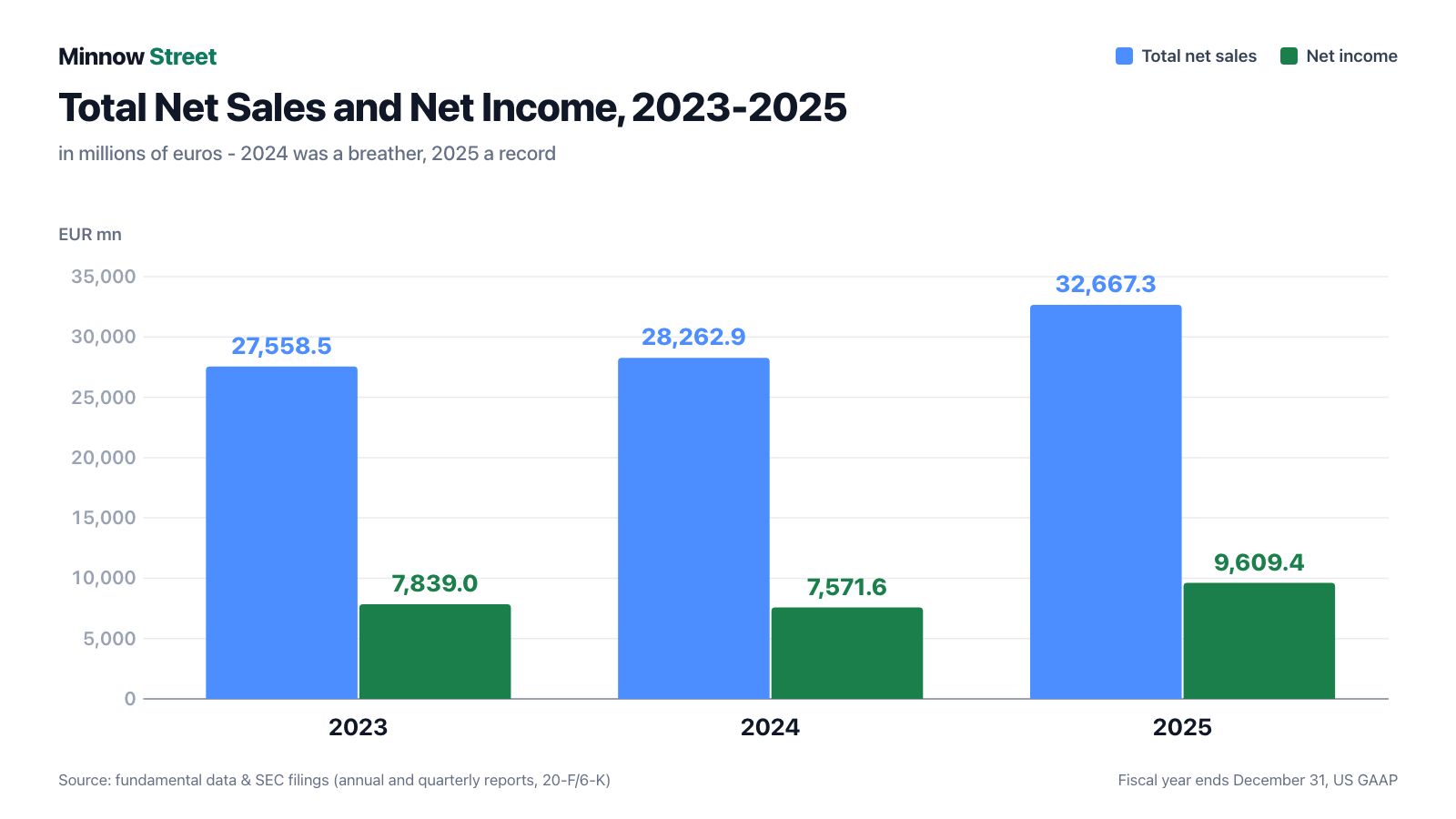
First, what genuinely impresses — with an honest detour along the way. Sales rose from EUR27,558.5 million (2023) to EUR28,262.9 million (2024) to EUR32,667.3 million (2025), a record year with 15.6 percent growth. Net income, however, did not take a straight path: it slipped from EUR7,839.0 million (2023) to EUR7,571.6 million (2024) — a breather year tied to the semiconductor industry's cyclicality — before jumping to EUR9,609.4 million in 2025, up 26.9 percent. Anyone looking only at the sales line misses that dip in earnings.
2026 is accelerating further: the first half brought EUR18,093.4 million in sales and EUR5,674.3 million in net income — EUR9,326.5 million in sales in the second quarter alone, at a 54.0 percent gross margin and diluted earnings per share of EUR7.58 (most recent filing, Form 6-K dated July 15, 2026). The real surprise of the year, though, is the guidance: on January 28, 2026, ASML had pointed to EUR34 to 39 billion in 2026 sales (51-53 percent gross margin). In the filing dated July 15, 2026 — just six months later — there is a new number: EUR43 to 45 billion, with gross margin now 54 to 56 percent. That is an increase of more than EUR10 billion in six months, and CEO Christophe Fouquet gives the reason in the same filing:
"Ongoing AI-related investments and continued progress in AI technologies are driving demand for advanced Logic and Memory chips, further strengthening the semiconductor industry's growth outlook. Our customers, in turn, continue to accelerate their capacity expansion plans. This is translating into customer commitments across our product portfolio, providing ASML with increased visibility into longer-term demand."
— Christophe Fouquet, President & CEO, Form 6-K, Q2 2026 press release, July 15, 2026

Concretely, ASML plans, per the same filing, to add 30 percent to its 2026 low-NA EUV capacity of around 65 systems for 2027 — with another possible 30 percent increase for 2028 under review — and something similar for DUV immersion capacity (2026: around 130 systems). Here is what matters for context: ASML's order intake is famously lumpy. In the third quarter of 2025, net bookings were just EUR5,399 million; in the fourth quarter of 2025 they jumped to EUR13,158 million (of which EUR7,400 million was EUV) — more than double in a single quarter. For full-year 2025, that added up to EUR28,035 million in net bookings (2024: EUR18,899 million) and a backlog of EUR38,797 million as of December 31, 2025. Remember this point: a single strong order quarter at ASML is not a reliable trend — the company itself warns in its risk factors about "fluctuations in orders" and the risk that orders get canceled, delayed or held back under export controls.
What the Filings Reveal — the Uncomfortable Truths
This is exactly where the check on the halo effect begins. The EUV monopoly is real — but it says nothing about how broad the customer base is, how redundant the supply chain really is, or how much control shareholders actually have. The annual report (Form 20-F) for 2025 answers all three questions — and none of the answers is entirely reassuring.
Uncomfortable Truth No. 1: Four Customers Account for 61 Percent of Sales — and Concentration Is Rising
Hearing "chipmakers buy from ASML" might suggest a broad, global customer base. The annual report shows something else:
"In 2025, four customers each individually exceeded 10% of total net sales, totaling €20.0 billion, or 61.2%, of total net sales."
— ASML Holding N.V., SEC Form 20-F for 2025, Note 3 "Segment disclosure"
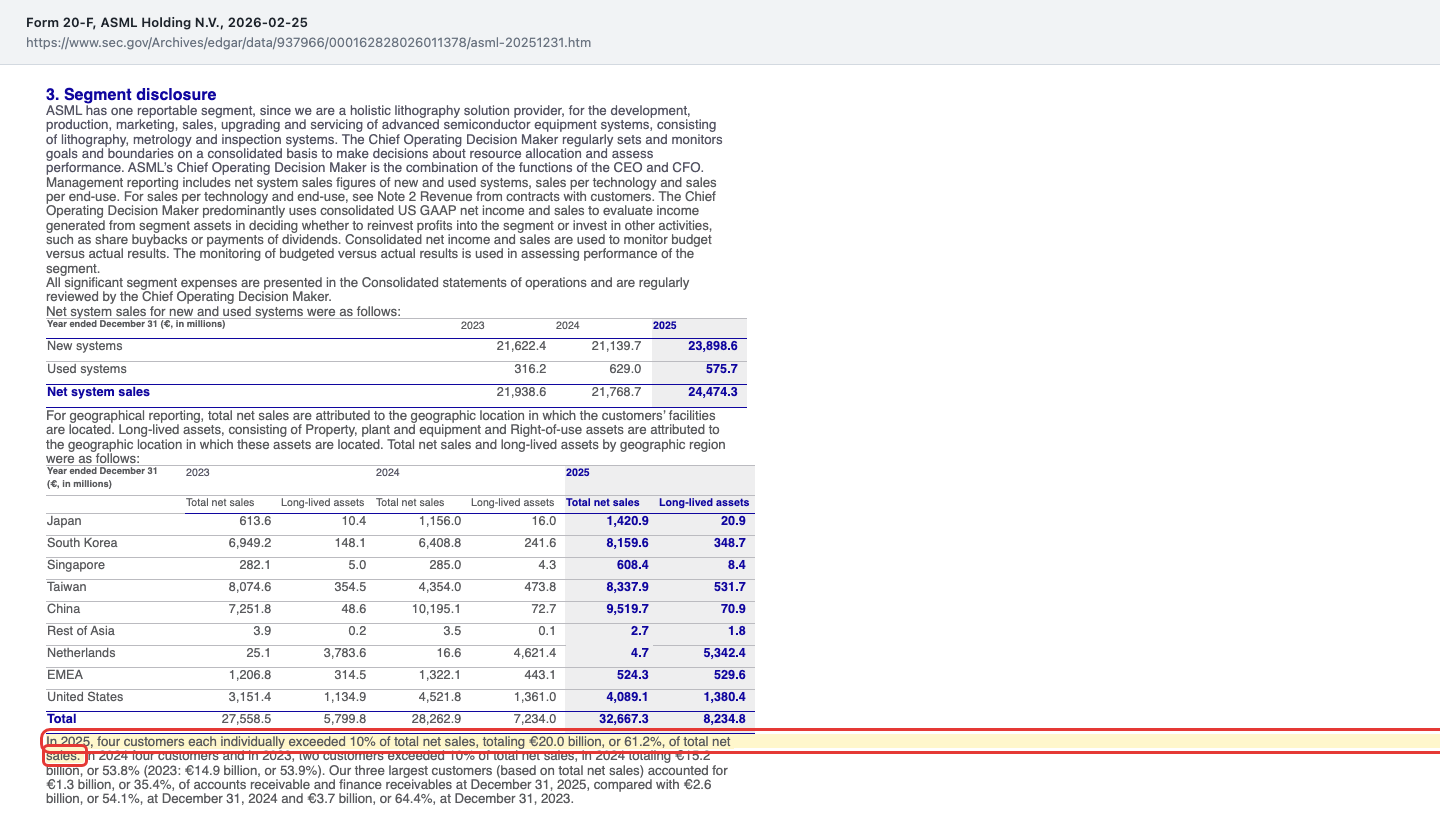
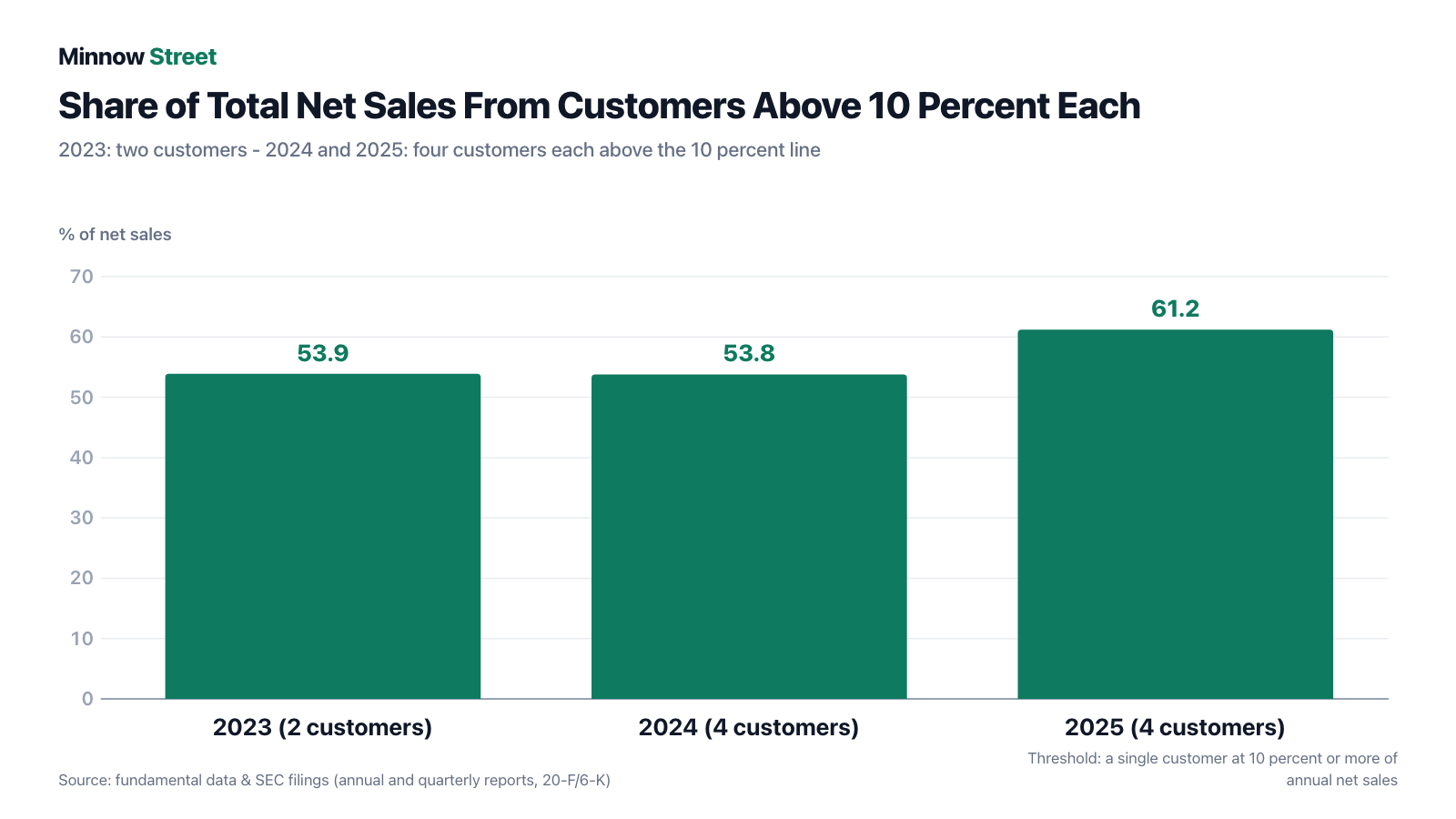
And this concentration is not a one-off — it is a trend: in 2023, only two customers crossed the 10 percent threshold (53.9 percent of sales combined); by 2024, it was already four customers (53.8 percent); in 2025, the same four customers with a higher combined share (61.2 percent).
In everyday terms: picture a bakery whose four biggest customers together make up nearly two-thirds of its revenue — if just one of them shifts a single large order, the whole week's numbers wobble. ASML does not name the four customers, citing confidentiality, but the country breakdown offers a clue. China was the largest single market in 2025 at EUR9,519.7 million (29.1 percent of sales), narrowly ahead of Taiwan (EUR8,337.9 million, roughly 25.5 percent) — in 2024, China had been notably higher at 36.1 percent. That decline is not weaker demand; it is the flip side of the export-control debate: in 2024, Chinese customers had pulled forward purchases of older, non-restricted DUV systems; in 2025, that pattern normalized. Remember the tension: a monopoly on the supply side does not protect against concentration on the demand side — and that concentration is currently rising.
Uncomfortable Truth No. 2: A Single Company Makes Every Lens — With No Alternate Source
If ASML is the only company that can build EUV machines, who builds the critical parts inside those machines? The annual report answers with unusual directness:
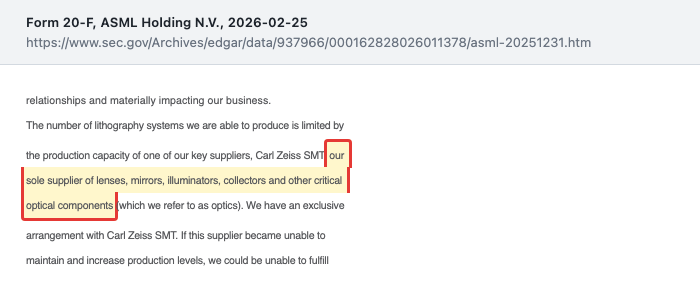
"The number of lithography systems we are able to produce is limited by the production capacity of one of our key suppliers, Carl Zeiss SMT, our sole supplier of lenses, mirrors, illuminators, collectors and other critical optical components (which we refer to as optics). We have an exclusive arrangement with Carl Zeiss SMT."
— ASML Holding N.V., SEC Form 20-F for 2025, Risk Factors
In everyday terms: picture an automaker with unbeatable engine technology, but every single engine block can only be cast at one foundry — if that foundry burns down, the whole plant stops, no matter how good the engine is. ASML has held a 24.9 percent stake in Carl Zeiss SMT Holding GmbH & Co. KG since June 29, 2017 (booked as an equity-method investment), which produced a profit contribution of EUR216.7 million in 2025 (2024: EUR209.8 million) — including EUR322.8 million in pure equity-method profit from Zeiss SMT (2024: EUR216.4 million), up roughly 49 percent. At the same time, the direct R&D funding ASML pays Zeiss SMT for High NA development has fallen from EUR67.6 million (2023) to EUR45.1 million (2024) to just EUR22.5 million (2025) — a sign that the development phase is maturing toward volume production. The stake is financially attractive, but it changes nothing about the structural fact: there is no second source for this optics. Remember the pattern: being the only company that can do something impossible does not automatically make you independent of everything else.
Uncomfortable Truth No. 3: Shareholders Have Less Say Than the Listing Suggests
ASML trades in Amsterdam and, as a depositary share, on the Nasdaq, and it reports to the SEC — which makes it look like a company with Anglo-Saxon-style shareholder democracy. The annual report shows a different reality:
"ASML's Articles of Association provide that it is subject to the provisions of Dutch law applicable to large corporations, called 'structuurregime'. These provisions concentrate control of certain corporate decisions and transactions in the hands of the Supervisory Board (SB). As a result, holders of ordinary shares may have more difficulty in protecting their interests in the face of actions by members of the SB than if we were not subject to the 'structuurregime'."
— ASML Holding N.V., SEC Form 20-F for 2025, Risk Factors
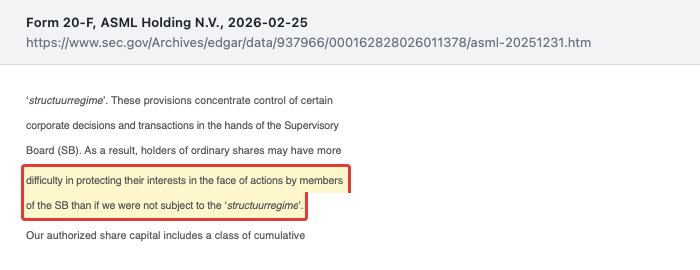
On top of that, the Articles of Association grant a dedicated foundation, the ASML Preference Shares Foundation (Stichting Preferente Aandelen ASML), an option to subscribe to preference shares at a nominal value of EUR0.09 per share. If the foundation exercises that option — per the annual report, for example in the event of a hostile takeover attempt — it would dilute existing ordinary shareholders' voting power by half. That is a classic Dutch-style takeover defense, not unique to ASML — but it shows how little the ownership table has to do with actual control of the company: the largest disclosed shareholders are BlackRock, Inc. at 6.83 percent and Capital Research and Management Company at 5.09 percent, while the Board of Management and Supervisory Board together hold, per the voting-rights table, just 51,095 shares — 0.01 percent of the roughly 385.4 million shares outstanding. In everyday terms: you can co-own a company whose governing board can act in an emergency without a simple shareholder majority being able to stop it immediately.
Valuation: a Price for the Monopoly
How expensive is ASML? The share price alone says little — on July 24, 2026, the shares closed in Amsterdam at EUR1,563.00; with 384.1 million shares outstanding (as of June 28, 2026, per the Statutory Interim Report), that puts market capitalization at roughly EUR600 billion. For earnings-based valuation, the price-to-earnings ratio (P/E) matters: adding up the diluted earnings per share from the four most recent quarters in ASML's own SEC filings — the third and fourth quarters of 2025, plus the first and second quarters of 2026 — comes to roughly EUR27.6 in trailing-twelve-month earnings per share. At a price of EUR1,563.00, that works out to a P/E ratio of roughly 57. That is an order of magnitude in which an investor pays 57 euros for every euro of annual profit — not a bargain price, but a valuation that already prices in a great deal of future growth.
On the "view from the professionals": per fundamental data as of July 27, 2026, 44 analysts covered the stock, leaning heavily bullish — 32 rated it "Strong Buy," 6 "Buy," 4 "Hold," and one each "Sell" and "Strong Sell." That is a clearly bullish tilt, but an analyst consensus is the opinion of many third parties, not a fact — and it says nothing about how the four large customers or the single optics supplier will behave in coming quarters. On the balance sheet, ASML sits on very solid ground: net cash of EUR3,861.8 million as of June 28, 2026 (EUR6,671.9 million in cash and equivalents plus EUR909.6 million in short-term investments, minus EUR1,984.4 million in long-term debt and EUR1,735.3 million in short-term borrowings — for comparison, as of December 31, 2025, net cash stood even higher at EUR8,931.0 million [EUR12,916.0 million in cash and equivalents plus EUR405.9 million in short-term investments, minus EUR2,709.0 million in long-term debt and EUR1,681.9 million in short-term borrowings]; the first-half decline is seasonal and dividend/buyback-related, not a sign of weaker balance-sheet quality), plus a share buyback program of up to EUR12 billion running through the end of 2028 (roughly EUR1.1 billion already used in the second quarter of 2026) and an interim dividend of EUR1.88 per share due August 5, 2026 — following a total dividend of EUR7.50 per share for 2025 (up 17 percent from 2024).
The Case For and Against, at a Glance
What speaks for ASML:
- A genuine technology monopoly in EUV lithography, with no competitive rival — no other manufacturer can print the world's finest chip structures at volume.
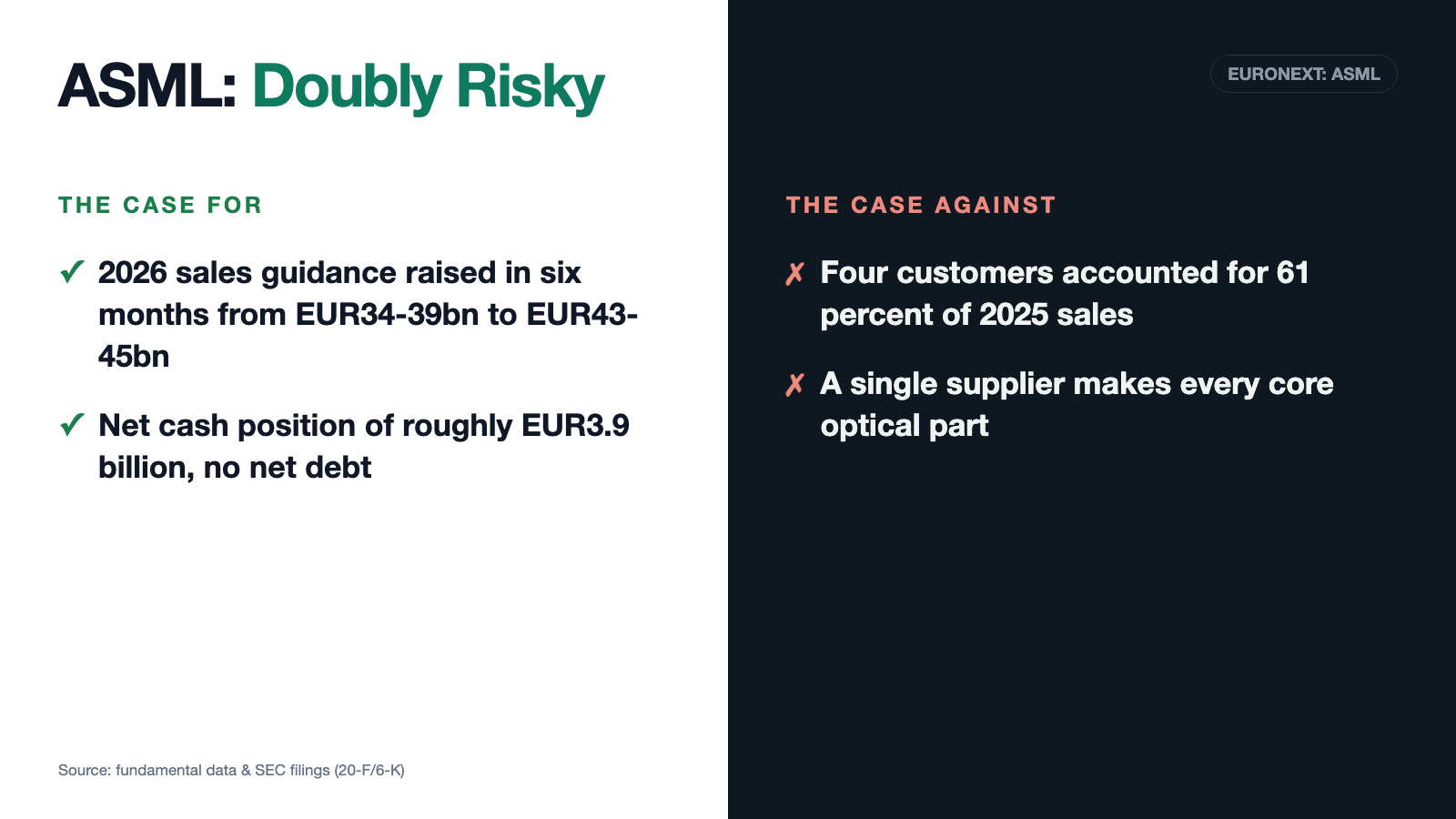
- 2026 sales guidance raised in six months from EUR34-39 billion to EUR43-45 billion (January 28 versus July 15, 2026), explicitly attributed to sustained AI-related demand for Logic and Memory chips.
- A rock-solid balance sheet: net cash of roughly EUR3.9 billion as of June 28, 2026, no net debt, plus a buyback program (up to EUR12 billion through 2028) and a growing dividend (EUR7.50 per share for 2025, up 17 percent).
- A clearly bullish analyst consensus (32 of 44 covering analysts rated "Strong Buy," data as of July 27, 2026) and a backlog of EUR38.8 billion at year-end 2025.
What speaks against it:
- Rising customer concentration: four customers accounted for a combined 61.2 percent of 2025 sales (2024: 53.8 percent with also four customers; 2023: 53.9 percent with only two customers) — climbing, not falling.
- Complete dependence on a single optics supplier (Carl Zeiss SMT) with no alternate source for the lenses, mirrors, illuminators and collectors in every machine.
- The Dutch "structuurregime" plus a preference-share foundation with a dilution option structurally limit ordinary shareholders' actual influence over the Supervisory Board.
- A rich valuation (P/E of roughly 57, our own calculation) that already prices in a great deal of future growth; order intake swings sharply from quarter to quarter (EUR5.4 billion in Q3 2025 versus EUR13.2 billion in Q4 2025).
A Human Conclusion
Back to the halo effect from the opening. Its core problem is not that ASML's monopoly is imagined — it is real, measured and documented in the company's own SEC filings: no competitor in the world ships competitive EUV lithography systems. The thinking error starts only where that one proven strength gets automatically extended into three more that were never checked: a broadly spread customer base, a redundant supply chain, shareholder-friendly control. The annual report for 2025 answers all three questions with a no — four customers instead of many, one supplier instead of several, a Supervisory Board instead of an effective shareholder majority. That does not make ASML a bad company; it makes it a company whose strength and whose vulnerability come from the very same source — concentration on a single, extremely difficult technology. Anyone who bought the newsletter's Turbo certificate in November 2025 also bought a knock-out barrier whose exact level isn't even named in the newsletter itself. So the honest question isn't "can anyone match ASML?" - it's this: do you trust a company with four key customers, one supplier and a powerful Supervisory Board, at a price that already assumes a lot of growth goes right? The decision is yours.
Sources
All original documents used in this analysis — for further reading:
- ASML Holding N.V. — SEC Form 20-F for 2025 (filed February 25, 2026)
- ASML Holding N.V. — SEC Form 6-K, Q2/H1 2026 press release (filed July 15, 2026)
- ASML Holding N.V. — SEC Form 6-K, summary US GAAP figures for Q2 2026 (Exhibit 99.3)
- ASML Holding N.V. — SEC Form 6-K, Q4/FY2025 press release (filed January 28, 2026)
- Full SEC filing history for ASML Holding N.V.: EDGAR overview (sec.gov)
- Fundamental data (price, market capitalization, analyst consensus; data as of July 24-27, 2026), reconciled with the SEC filings.
- Hook: "HOT STOCKS EUROPE," issue 24, dated November 28, 2025, B-Inside International Media GmbH, Freiburg i. Br. (author Michael Calivas) — a model-portfolio position, not a source for company figures.
Transparency & disclaimer: This analysis is a journalistic assessment of publicly available information. It is not investment advice, not a regulated financial analysis and not a solicitation to buy or sell securities or derivatives. Investing in stocks, and especially in leveraged certificates, carries substantial risk, including total loss. All information is provided without guarantee; the as-of date for each figure is noted in the text. As of publication, the author holds no position in ASML shares or related derivatives.
Our Bottom Line at a Glance
- Market Position & Demand positive
- The only manufacturer of competitive EUV lithography systems; 2026 sales guidance raised in six months from EUR34-39 billion to EUR43-45 billion (January 28 versus July 15, 2026), attributed to sustained AI-related demand for Logic and Memory chips.
- Balance Sheet & Capital Returns positive
- Net cash of roughly EUR3.9 billion as of 06/28/2026, no net debt, a buyback program of up to EUR12 billion (2026-2028), and a growing dividend (EUR7.50 per share for 2025, up 17 percent).
- Customer Concentration negative
- Four customers accounted for a combined 61.2 percent of 2025 sales (EUR20.0 billion) - up from 53.8 percent (2024, also four customers) and 53.9 percent (2023, only two customers).
- Supply Chain negative
- Every machine depends on a single optics supplier: Carl Zeiss SMT makes all lenses, mirrors, illuminators and collectors, per the annual report - with no alternate source, despite ASML's 24.9 percent stake since 2017.
- Governance & Control neutral
- The Dutch "structuurregime" concentrates control with the Supervisory Board; a preference-share foundation could dilute ordinary shareholders' voting power by half in an emergency. The Board of Management and Supervisory Board together hold just 0.01 percent of shares.
- Valuation neutral
- A P/E ratio of roughly 57 (our own calculation, TTM through Q2 2026) already prices in substantial future growth; 44 covering analysts lean bullish as of the July 27, 2026 data (32 Strong Buy, 6 Buy, 4 Hold, 1 Sell, 1 Strong Sell).
ASML is the sole supplier of EUV lithography and raised its own 2026 sales guidance by more than EUR10 billion within six months - carried by genuine AI-related demand and a rock-solid balance sheet with roughly EUR3.9 billion in net cash. But the very concentration that makes the monopoly possible also shows up as risk: four customers account for 61.2 percent of sales, a single supplier makes every lens, and the Dutch corporate structure limits ordinary shareholders' control. Not investment advice.
What Our Rating Means
Open questions
The business works in principle, but one material question is open. As long as it stays open, our findings do not carry a quality verdict.
ASML's operating substance ranks among the strongest in the industry: a genuine, numbers-backed technology monopoly, sales guidance raised massively within six months, net cash of roughly EUR3.9 billion, and a running buyback program of up to EUR12 billion. Two structural questions remain open, and both flow directly from the same monopoly: customer concentration is rising (61.2 percent from four customers in 2025) rather than falling, and all optics production sits with a single supplier with no alternative. Add a Dutch corporate structure that limits ordinary shareholders' actual control. Not a substance finding, not an existential question - but not a risk-free monopoly story either. The decision is yours.
A journalistic assessment by our editorial team at the time of the deep dive, based on public sources — not investment advice and not a solicitation to buy or sell. Your personal circumstances (investment goals, risk capacity, taxes) cannot be taken into account. What our levels mean, how verdicts are formed, and what conflicts of interest exist →
Worth Noting
- Hook: newsletter "HOT STOCKS EUROPE" issue 24, dated November 28, 2025, model-portfolio position L&S Turbo certificate on ASML (WKN LX5PE0), not a stock recommendation from the newsletter. Every company figure in this analysis comes from ASML's own SEC filings.
- ASML is a "foreign private issuer" and SEC filer with its own forms (20-F/6-K instead of 10-K/10-Q); a standalone 10-Q does not exist. Data as of: Form 20-F for 2025 (02/25/2026) and Form 6-K for Q2 2026 (07/15/2026); price/market cap as of 07/24/2026.
- No company row existed on the platform as of publication - no in-house scanner hit was possible; this is the platform's first analysis of ASML.
Frequently Asked Questions
ASML Holding N.V. (Euronext Amsterdam: ASML, headquartered in Veldhoven, the Netherlands) builds lithography systems - machines that print circuit patterns onto silicon wafers, making modern computer chips possible in the first place. ASML is the only manufacturer shipping EUV systems at volume; it also sells DUV systems and metrology/inspection systems, plus service for the installed fleet of machines.
The technology is physically demanding to an extreme degree - focusing extreme ultraviolet light at a 13.5-nanometer wavelength precisely enough - and required decades of development. ASML is the only company that has brought this development to volume production; no other supplier ships competitive EUV systems today.
ASML raised guidance on July 15, 2026, from EUR34-39 billion to EUR43-45 billion in sales (gross margin now guided at 54-56 percent), citing sustained AI-related demand. Guidance is management's expectation, not a guarantee: order intake swung between EUR5.4 billion and EUR13.2 billion per quarter in 2025 - the company itself warns of order cancellations and delays.
Four customers accounted for a combined 61.2 percent of ASML's 2025 sales (EUR20.0 billion), up from 53.8 percent in 2024 (also four customers) and 53.9 percent in 2023 (only two customers). If one of these customers delays or cancels a large order, it can noticeably move a quarter's revenue - a risk that stems directly from ASML's market dominance itself.
Carl Zeiss SMT is, per ASML's own annual report, the sole supplier of the lenses, mirrors, illuminators, collectors and other critical optical components in every ASML machine - with no alternate source. ASML has held a 24.9 percent stake in the Zeiss SMT holding company since 2017, which cushions the dependency financially but does not remove it.
No. A Turbo certificate is a leveraged debt-security product with a knock-out barrier set by the issuer: if the share touches that barrier, the certificate expires immediately and usually worthless - regardless of any later recovery. The share itself does not expire from mere price moves; only a delisting or the company's insolvency would wipe it out.
Yes. For 2025, ASML paid a total of EUR7.50 per share (up 17 percent from 2024). For 2026, an interim dividend of EUR1.88 per share has been announced, payable August 5, 2026. ASML also runs a share buyback program of up to EUR12 billion through the end of 2028.
ASML is subject to the Dutch "structuurregime" for large corporations, which concentrates certain decisions with the Supervisory Board. In addition, a foundation (ASML Preference Shares Foundation) can, in an emergency, subscribe to preference shares and dilute ordinary shareholders' voting power by half - a takeover defense that structurally limits how much control shareholders actually have.
Found an error?
Did you spot a factual error, an outdated number, or a typo in this deep dive? Let us know briefly — your report goes straight to the editorial team.