Strickland Metals Stock: The Gold Deposit Is Growing, the Share Price Is Not
A newsletter gave Strickland Metals only a passing mention at the end of 2025 — a year-in-review line about a stock up more than 200 percent — even though this Australian explorer has never earned a single dollar of revenue. What actually happened since then: a gold deposit in Serbia that keeps growing with every report, a clever swap of its second asset for shares in the buyer, and a share price that has already fallen well below the level of its own recent placement. Not a buy or sell recommendation — just the numbers the story can be measured against.
 Thomas Mücke
Founder & Publisher
Thomas Mücke
Founder & Publisher
Chart
Interactive price chart (TradingView).
Note: pure fact-based analysis, not investment advice and not a solicitation to buy or sell. All figures without guarantee.
You know that feeling when a newsletter drops a line like "up more than 200 percent in 2025" and for a second you get that tingle telling you: I could have had that? That tingle is the trap — let's call it what it is: FOMO, the fear of missing out. A reader sent us an issue of a newsletter with exactly that sentence, about a stock called Strickland Metals. The problem: the sentence sits in a page-one year-in-review, with not a single company figure attached. So let's make a deal: before you ask yourself whether you missed something, let's read the actual reports together — the audited annual financial statements, the February 2026 capital raise, and the latest resource announcement from July 2026.
What Strickland Metals actually does
Strickland Metals Limited is an Australian mining company headquartered in Mt Pleasant, Western Australia — and specifically, a company in the pure exploration phase of the mining business. In everyday terms: Strickland is like a truffle hunter systematically probing a patch of forest with drills and geologists to work out how many truffles are really down there — it hasn't sold a single one yet. The flagship is the Rogozna gold and base metals project in the Raška District of southern Serbia, roughly 184 square kilometers, held 100 percent since July 1, 2024 through subsidiary Zlatna Reka Resources d.o.o. Serbia is no stranger to mining: BHP, Vale, Rio Tinto, Kinross Gold and Zijin Mining are all active there too, as the annual report itself notes.
The backstory is worth a moment: Strickland Managing Director Paul L'Herpiniere and Non-Executive Director Dr. Jonathan Hronsky had both been involved in developing Rogozna since 2019 — through their shared connection to private equity firm Ibaera Capital. Only on July 1, 2024, was the project folded into the listed shell Strickland Metals through the acquisition of Betoota Holdings Ltd, with L'Herpiniere and Hronsky moving into management and the board. Besides Rogozna, Strickland holds the smaller Bryah Basin exploration ground in Western Australia (copper, gold, nickel potential, about 460 square kilometers of tenure) — but that's it: a second, once-comparable asset, the Yandal project in Western Australia, was sold off in the summer of 2025. More on that shortly, since that sale delivers one of this analysis's uncomfortable truths.
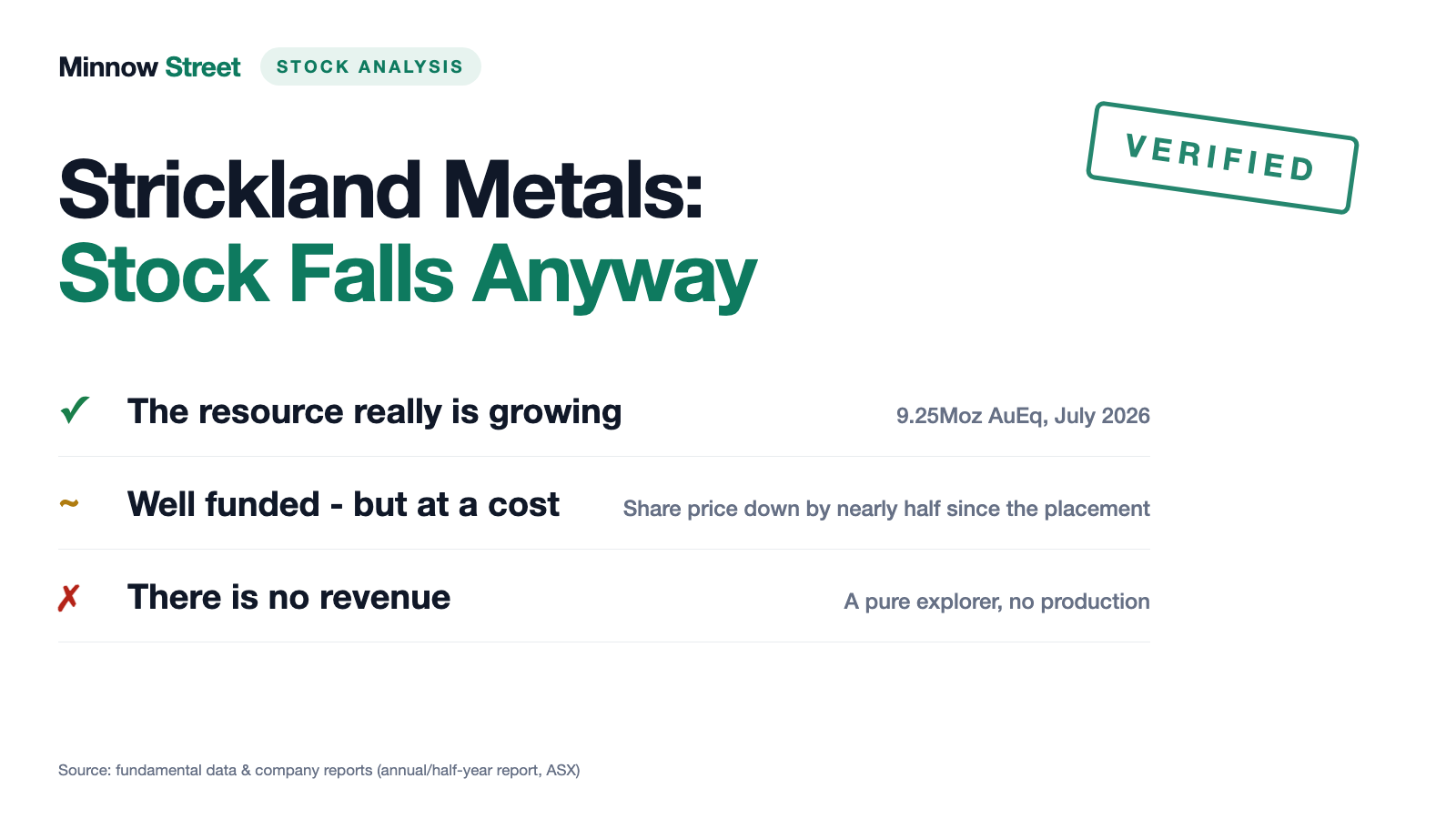
The central tension of this analysis: Strickland Metals has a resource that has demonstrably grown report after report, well-known institutional backers, and a solid cash position — but no revenue whatsoever, and a share price that has fallen sharply since its most recent capital raise. Keep this sentence in mind for the rest of the analysis: a growing resource is a promise, not a result.
Why there is no SEC report here — and where the numbers come from instead
One point first, because it shapes the entire evidence base of this analysis: Strickland Metals files no 10-K, no 10-Q, no 20-F. Searching the U.S. securities regulator's EDGAR database for the ticker STK does return a hit — but it belongs to an entirely different company, a New York Stock Exchange-listed U.S. investment fund called Columbia Seligman Premium Technology Growth Fund. It has nothing to do with the Australian mining explorer. Strickland Metals is not a U.S. reporting company and publishes its mandatory disclosures exclusively through the Australian Securities Exchange (ASX) and its own investor relations site.
This analysis therefore rests on three documents: the audited 2025 annual financial statements (balance date June 30, 2025, published as an ASX announcement on September 30, 2025), the placement announcement of February 4, 2026, and the resource update of July 15, 2026 — all sourced directly from the ASX and read in full. Data provenance throughout: fundamental data & company reports (annual/half-year report, ASX) — not "SEC reports," which simply do not exist here.
One open data gap belongs in this analysis too, for the sake of honesty: according to third-party sources, Strickland published a half-year report for the period ended December 31, 2025, on March 12, 2026. Despite extensive searching — the ASX interface only ever returns a company's five most recent announcements, and the company website's announcement widget offered no historical list either — we could not retrieve this document in full text. Instead we use the most recent actually accessible announcement, from July 15, 2026, which contains an even more current cash balance (as of March 31, 2026) than the half-year report itself — a gap we would rather name than paper over with an estimated figure.
Where the stock landed on our desk — a footnote on page one
The stock did not come through our in-house stock scanner: that universe covers primarily U.S.-listed names, and an Australian-listed explorer trading in Australian dollars doesn't show up there. It landed on our desk because a reader forwarded us an issue of their newsletter: "Hot Stocks Europe," issue 24, dated November 28, 2025 (B-Inside International Media GmbH, Freiburg), a twice-monthly stock letter. Unlike most other names in that issue, the newsletter gave Strickland Metals no dedicated profile — the stock appears only in a page-one year-in-review, in a list of 2025's stock gainers: "Strickland Metals and Thor Explorations: up more than 200 percent." Nothing more — no metric, no price target, no recommendation.
That statement is quoted here explicitly as a third-party expectation dated November 28, 2025, not as our own source — every figure in this analysis comes from the company's own reports. Part of the context is also the conflict-of-interest notice the newsletter itself prints on page 8: the publisher, the author, or related third parties may hold long positions in stocks discussed and may intend to sell as prices rise (EU Market Abuse Regulation 596/2014). Precisely because the newsletter offers no figure of its own on Strickland Metals, the question it doesn't ask is worth asking: what is actually behind this stock gain? The neighbor of this analysis from the same footnote, our Thor Explorations analysis, shows another explorer carrying the same "over 200 percent" label — but with actual production and actual revenue. The contrast is instructive.
The numbers over time - the resource really is growing
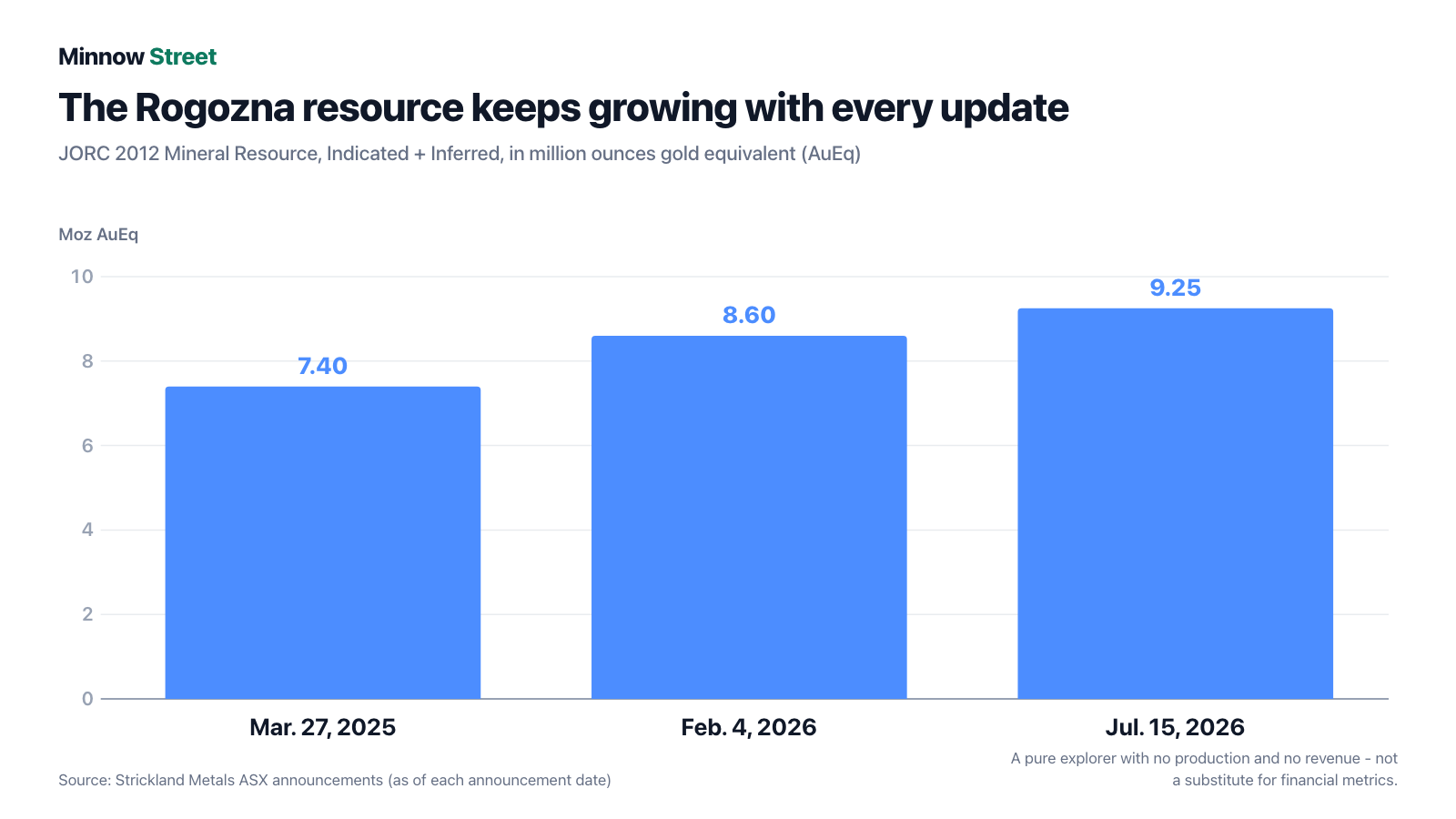
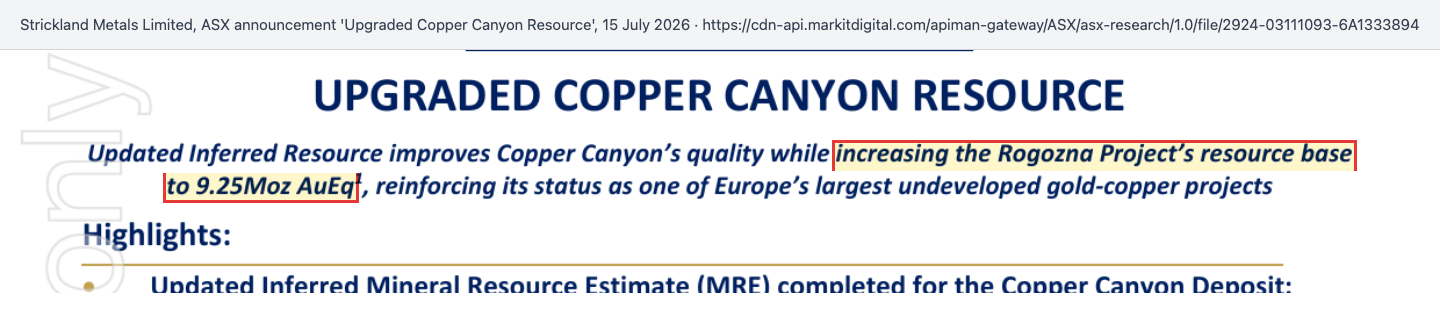
Give credit where it's due first: the Rogozna resource has genuinely grown over the past year and a half — not through a one-off revaluation, but through ongoing drill programs and several independently reviewed resource estimates (JORC 2012, the Australian reporting standard for mineral resources). In March 2025 it stood at 7.40 million ounces of gold equivalent (AuEq — a metric that converts gold, copper, zinc, lead and silver into a single "gold-equivalent" unit so different metals can be compared). By the February 2026 placement it was 8.6 million ounces. With the latest update to the Copper Canyon sub-deposit, announced July 15, 2026, the total resource rose to 9.25 million ounces AuEq — spread across four deposits: Shanac (5.35 Moz), Gradina (1.8 Moz), Medenovac (1.28 Moz) and Copper Canyon (0.82 Moz).
The latest Copper Canyon announcement puts the progress this way:
Context matters here: a mineral resource is not a reserve, and it is certainly not a profit. It says "this much metal is likely in the ground, based on today's knowledge." Whether and at what cost it can ever be mined economically is what the Pre-Feasibility Study (PFS) planned for the first half of 2027 is meant to answer — that is also what the additional 70,000-meter drill program from the February 2026 raise is for. Keep this in mind: a resource estimate is the menu, not the bill.
What the reports show — the uncomfortable truths
Uncomfortable truth No. 1: the data provider got the financial year wrong
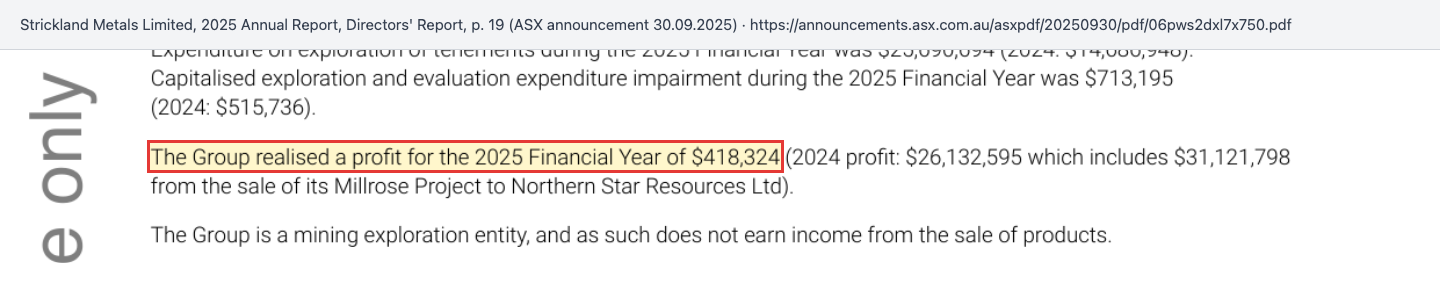
This analysis uncovers a concrete data error, which we disclose rather than paper over: Australian companies typically report to a June 30 balance date, not December 31. Yet the data provider we use labels Strickland Metals' audited annual financial statements with the balance date "December 31, 2024" — even though the figures inside are exactly those the original document reports as the balance sheet as of June 30, 2025. The numbers themselves were carried over correctly; only the label is wrong. The audited financial statements leave no doubt about this:
For you as a reader, this means: if you look up Strickland Metals figures on a financial portal and see a date of "December 31, 2024" attached to the most recent annual financial statements, that's a labeling error — the balance date is actually June 30, 2025. This analysis uses only the correct dates from the original document, not the feed's.
Uncomfortable truth No. 2: the second asset was sold to a company whose CEO sat on Strickland's own executive team until shortly before
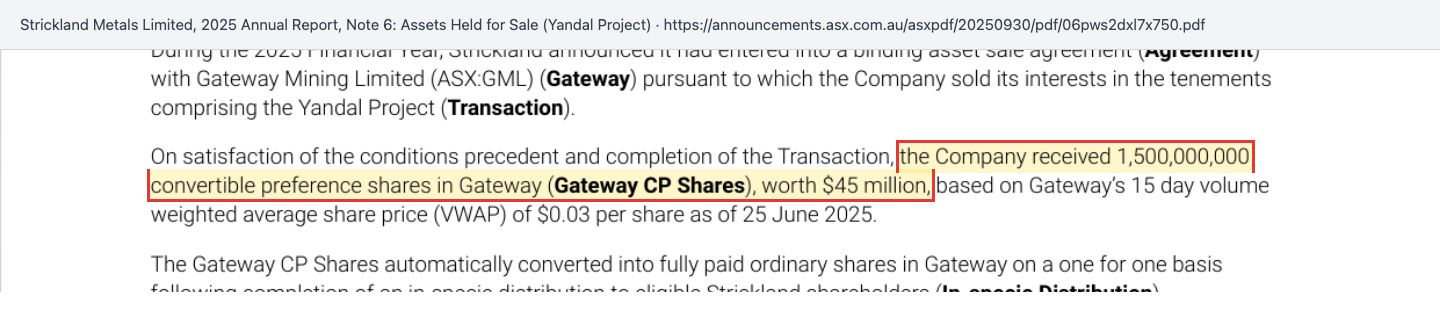
On June 30, 2025, Strickland agreed to sell its Yandal project in Western Australia (including the adjacent Iroquois joint venture) to Gateway Mining Limited (ASX: GML) — consideration: 1.5 billion Gateway convertible preference shares worth A$45 million. The deal closed on August 19, 2025. Of the Gateway shares received, Strickland distributed 1.2 billion via an in-specie distribution to its own shareholders and retained 300 million (about 15.7 percent of Gateway).
"On satisfaction of the conditions precedent and completion of the Transaction, the Company received 1,500,000,000 convertible preference shares in Gateway (Gateway CP Shares), worth $45 million, based on Gateway's 15 day volume weighted average share price (VWAP) of $0.03 per share as of 25 June 2025."
— Strickland Metals Limited, 2025 Annual Report, Note 6 "Current Assets Held for Sale"
The twist, unpacked fully in our side finds: Strickland director Richard Pugh was Executive Technical Director at Strickland until September 1, 2025 — a salaried executive of the seller, right through the negotiation and completion of this deal. Since that same date, he has been Chief Executive Officer of Gateway Mining, the buyer, while also remaining on Strickland's board as a non-executive director. Strickland's own annual report notes that Pugh's independence classification is explicitly tied to "his transition to non-executive director and the sale of the Yandal Project" — disclosed, formally reviewed by the board, but a fact worth knowing before reading this deal as pure good fortune.
Uncomfortable truth No. 3: no revenue, no operating result - the only group profit came from the portfolio, not the mine
As of the June 30, 2025 balance date, Strickland Metals reported a small group profit of A$418,324 from continuing operations. Reading that as proof the company is already earning money from its core business would be a mistake: the profit consists almost entirely of a gain on the sale of financial assets (A$7.9 million), other income and interest income — net of administrative expenses, staff costs, share-based compensation and tax. Operating cash flow was negative at A$2.89 million, as was investing cash flow (A$2.49 million negative, which includes A$25.4 million of exploration spending that was funded by proceeds from selling securities). Total comprehensive income, including a foreign-currency translation effect, was even slightly negative (A$353,856 loss).
That is not a criticism — it is simply the nature of a pure explorer: a company with no mine in production cannot have operating revenue. But it also means that every valuation ratio that assumes revenue or profit — price-to-earnings, price-to-sales, profit margin — simply cannot be built for Strickland Metals. If you're looking for a number that doesn't exist, the next section won't give it to you either — on purpose.
Valuation: no P/E, but a look at who's putting money in
How "expensive" is Strickland Metals? The honest answer: classic ratios can't tell you. With no revenue, there's no price-to-sales ratio; with no operating result, there's no price-to-earnings ratio. What can be quantified: as of July 24, 2026, the share price stood at A$0.079; with roughly 2.64 billion shares outstanding, that puts the market capitalization in the range of roughly A$208 million (fundamental data).
In place of a P/E, there's the "smart money" test: who is actually putting fresh capital in? At the February 4, 2026 placement (A$55 million, 343.2 million new shares at A$0.16), some well-known names participated:
"Strong demand received from both domestic and offshore institutions, including major shareholders (ISIHC Ltd (a subsidiary of Ibaera Capital Fund LP; ("Ibaera")) to participate pro-rata to maintain its shareholding at 16.6% and Zijin Mining Group ("Zijin") to participate for A$5m in the Placement to increase its shareholding from 3.3% to 4.0%."
— Strickland Metals Limited, ASX announcement on the equity placement, February 4, 2026
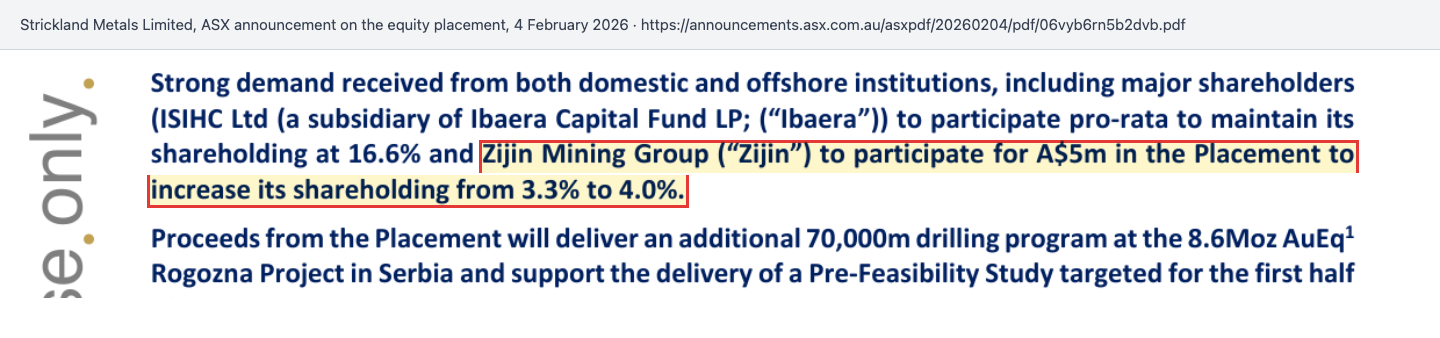
Zijin Mining Group is not just any fund — it is one of the world's largest mining companies, and per Strickland's own annual report is already active in Serbia itself. A major industry player adding capital is a signal — but only a signal, not proof of the Rogozna study's eventual success. On cash: per the latest announcement of July 15, 2026, Strickland held roughly A$81 million in cash and liquids as of March 31, 2026, with practically no financial debt.
And yet the share price has moved differently than the capital inflow alone would suggest.
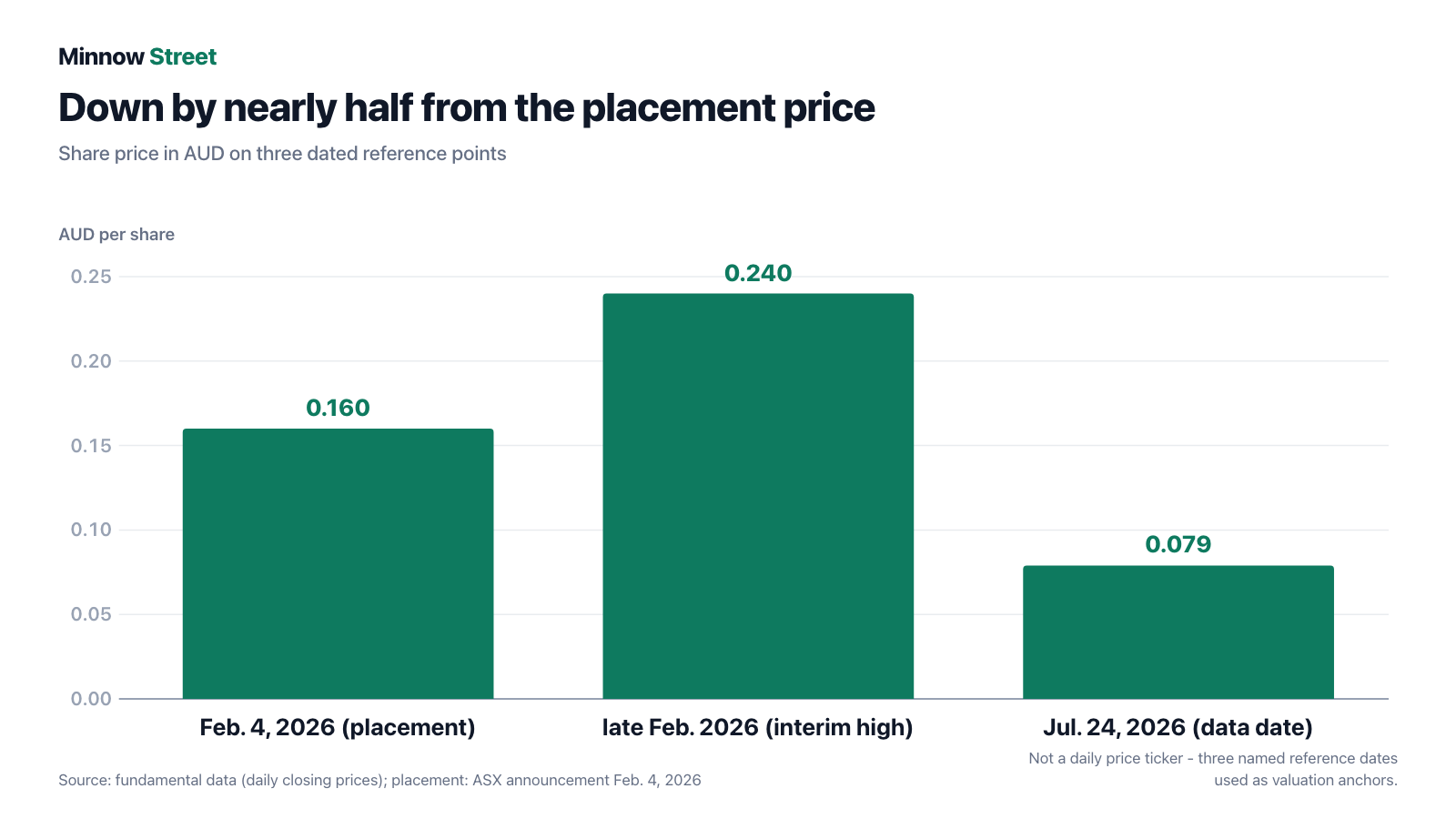
One tempting mechanical explanation does not hold up here: Strickland did pass most of its Gateway Mining shares on to its own shareholders via an in-specie distribution — but according to the audited annual financial statements, that happened on August 25, 2025, more than six months before the February 2026 placement and the late-February 2026 interim high. An ASX announcement dated June 25, 2026 (an Australian Taxation Office Class Ruling) only addresses the tax treatment of that 2025 distribution — it is not a new event that could explain the decline since the interim high. The decline therefore stands without any such accounting offset: anyone who bought at the A$0.16 placement price is sitting on a roughly 50 percent loss at the current data date. Keep this in mind: a placement is a vote of confidence from the subscribers at the time of subscription — not a price guarantee afterward.
Opportunities and risks at a glance
What speaks for Strickland Metals:
- The Rogozna resource has grown, independently reviewed, from 7.40 to 9.25 million ounces gold equivalent (March 27, 2025 to July 15, 2026) — a traceable, repeatedly confirmed progression, not a one-off revaluation.
- Well-known institutional backing: global mining group Zijin Mining Group increased its stake to 4.0 percent in February 2026, and anchor shareholder Ibaera Capital held its stake at 16.6 percent despite its escrow having just expired.
- A solid cash position of roughly A$81 million as of March 31, 2026, with practically no financial debt — enough runway for the ongoing 70,000-meter drill program and the Pre-Feasibility Study (PFS) planned for the first half of 2027.
- The Yandal sale delivered A$45 million of value without a classic cash call on shareholders and without the additional dilution of a pure equity raise.
What speaks against it:
- No revenue, no operating result: Strickland Metals is a pure explorer. The only group profit in 2025 (A$418,324) came from financial assets and interest income, not from mining.
- The share price fell from an interim high of A$0.24 in late February 2026 to A$0.079 on July 24, 2026 — roughly two-thirds below the interim high, and about half below the company's own placement price.
- Concentrated ownership: the largest shareholder (Ibaera Capital, 16.6 percent) is closely intertwined with management and the board — CEO Paul L'Herpiniere co-founded the fund.
- Governance overlap: director Richard Pugh was a Strickland executive until September 2025 and has since simultaneously served as CEO of Gateway Mining, the buyer of the Yandal project — disclosed, but notable.
- A single important project (Rogozna in Serbia) effectively carries the entire future company value; without a confirming 2027 feasibility study, the valuation remains pure expectation.
A human conclusion
Back to that tingle from the opening. "Up more than 200 percent" is a number engineered to trigger FOMO — and that was exactly the point of the one line in the newsletter, nothing more. What we found together is both more honest and more complicated: a company with a genuinely growing gold deposit in Serbia, backed by one of the world's largest mining groups, financially solid — but without a single dollar of revenue, with a share price that has already fallen well below its own recent placement, and with an ownership and governance structure more tightly intertwined than the headline stock-gain number would suggest. The honest question for you, then, isn't "did I miss this gain?" but: do you trust a company with no revenue to eventually turn a growing resource into an economically viable mine — and do you trust yourself to wait as long as that takes? What you make of that is your decision. And that's a good thing.
Sources
All original documents used in this analysis — for you to read yourself:
- Strickland Metals Limited — Audited 2025 Annual Report (balance date 30.06.2025, ASX announcement 30.09.2025)
- Strickland Metals Limited — Placement announcement "Strickland Successfully Completes A$55 Million Placement" (04.02.2026)
- Strickland Metals Limited — ASX announcement "Upgraded Copper Canyon Resource" (15.07.2026)
- Strickland Metals Limited — ASX announcements overview (stricklandmetals.com.au)
- Fundamental data (metrics, price and market capitalization figures; data as of July 24, 2026).
- Hook: "Hot Stocks Europe," issue 24, dated November 28, 2025 (B-Inside International Media GmbH), forwarded by a reader — quoted statement classified strictly as a third-party mention from that date, with no recommendation adopted.
Transparency & disclaimer: This analysis is a journalistic review of publicly available information and does not constitute investment advice, a regulated financial analysis, or a solicitation to buy or sell securities. Stock investments, especially in pre-revenue exploration companies, carry substantial risk, including total loss. All figures are provided without guarantee; the data date is noted in the text throughout. The author holds no position in Strickland Metals stock at the time of publication.
Our Bottom Line at a Glance
- Resource growth positive
- The Rogozna resource grew, independently reviewed, from 7.40 to 9.25 million ounces gold equivalent between March 27, 2025 and July 15, 2026 - carried by several staged drill programs, most recently a Copper Canyon estimate upgraded by 290,000 ounces of gold versus 2021.
- Financing & institutional shareholders positive
- A$55 million of fresh capital in February 2026, backed in part by global mining group Zijin Mining Group (stake raised to 4.0 percent); roughly A$81 million in cash as of March 31, 2026, with practically no financial debt.
- No revenue negative
- Strickland Metals is a pure explorer with no operating revenue and no result from the mining business itself. The reported 2025 group profit (A$418,324) came entirely from financial-asset sales and interest income.
- Yandal/Gateway governance overlap negative
- Director Richard Pugh was Strickland's Executive Technical Director until September 1, 2025, and has since been a non-executive director at Strickland AND Chief Executive Officer of Gateway Mining, the buyer of the Yandal project - formally reviewed and classified as independent by Strickland's own board, but a fact every investor should know.
- Share price negative
- The share price fell from an interim high of A$0.24 (late February 2026) to A$0.079 (July 24, 2026) - roughly two-thirds below the interim high, and about half below the company's own February 2026 placement price.
- Valuation neutral
- Market capitalization roughly A$208 million (July 24, 2026); with no revenue and no operating result, no price-to-earnings or price-to-sales ratio can be built - the market's valuation rests almost entirely on the resource estimate and confidence in the feasibility study planned for 2027.
Strickland Metals is an honest explorer story: a demonstrably growing resource in Serbia, backed by well-known mining investors such as Zijin Mining Group - but with no revenue whatsoever, and a share price that has lost roughly half its value since the company's own placement. If the newsletter line "up more than 200 percent" caught your attention, know this: that was the look back at 2025, not today's state. Not investment advice.
What Our Rating Means
Open questions
The business works in principle, but one material question is open. As long as it stays open, our findings do not carry a quality verdict.
A credible explorer profile with a resource that is growing and independently estimated under JORC 2012, backed by well-known institutional investors, but with no operating earnings base whatsoever: no revenue, no start of production, a valuation resting entirely on confidence in future studies. Add to that a disclosed but notable governance overlap between the company's own board and the buyer of the Yandal project, and a concentrated ownership structure centered on the CEO himself. No solvency risk of the kind seen at a heavily indebted or going-concern-challenged company - but also no earnings base solid enough to justify green.
A journalistic assessment by our editorial team at the time of the deep dive, based on public sources — not investment advice and not a solicitation to buy or sell. Your personal circumstances (investment goals, risk capacity, taxes) cannot be taken into account. What our levels mean, how verdicts are formed, and what conflicts of interest exist →
Worth Noting
- Hook: newsletter "Hot Stocks Europe," issue 24, dated 28.11.2025 (B-Inside International Media GmbH), forwarded by a reader. The newsletter mentioned Strickland Metals only in a year-in-review of 2025 gainers ("over 200 percent"), with no company figures of its own and no buy recommendation; it discloses its own potential conflicts of interest (long positions held by the publisher/author, EU Market Abuse Regulation 596/2014).
- Strickland Metals is not a SEC filer: no 10-K/10-Q/20-F/40-F. This analysis rests on the audited 2025 annual financial statements (balance date 30.06.2025), the placement announcement of 04.02.2026, and the resource update of 15.07.2026, all via ASX announcements. The half-year report for the period ended 31.12.2025 (reportedly announced 12.03.2026) could not be retrieved in full text despite repeated attempts; the announcement used instead, dated 15.07.2026, is more current as of 31.03.2026.
- No company row was created in our own data set: an ASX-listed explorer trading in Australian dollars would distort scanner thresholds built for U.S. listings. Data provider error named rather than carried over: the feed labels the audited financial statements as of 30.06.2025 with the incorrect date 31.12.2024.
Frequently Asked Questions
Strickland Metals is an Australian mining explorer with no production of its own. Its flagship is the Rogozna gold and base metals project in southern Serbia, held 100 percent through subsidiary Zlatna Reka Resources d.o.o. since the July 2024 acquisition. The company also holds the smaller Bryah Basin exploration ground in Western Australia.
Strickland Metals is an Australian company listed exclusively on the Australian Securities Exchange and publishes its mandatory disclosures through the ASX. A search for the ticker STK at the U.S. securities regulator, the SEC, leads to an entirely different company, a U.S. investment fund. No 10-K, 10-Q, or 20-F/40-F exists.
With the Copper Canyon sub-resource update announced July 15, 2026, the total resource rose to 9.25 million ounces gold equivalent (Indicated plus Inferred, four deposits). In March 2025 it stood at 7.40 million ounces — an increase of roughly a quarter in just over a year.
Strickland sold its Western Australian Yandal project on June 30, 2025, for the equivalent of A$45 million in Gateway Mining Limited shares, with the deal closing on August 19, 2025. Notably, Strickland director Richard Pugh moved from an executive role at Strickland to Chief Executive Officer of Gateway Mining over that same period.
Australian companies typically report to a June 30 balance date, not December 31. The data provider we use labels Strickland Metals' audited financial statements for the year ended June 30, 2025, with the balance date December 31, 2024 — a pure date error that does not change the figures themselves, but invites confusion.
No. As a pure explorer with no production, Strickland generated no operating revenue in fiscal year 2025. The reported group profit of A$418,324 came from the sale of financial assets and interest income, not from the mining business.
The largest single shareholder is ISIHC Ltd, a subsidiary of private equity firm Ibaera Capital, holding 16.6 percent after the February 2026 placement. Strickland CEO Paul L'Herpiniere co-founded Ibaera Capital. Chinese mining group Zijin Mining Group holds 4.0 percent.
The primary listing is on the Australian Securities Exchange in Australian dollars (ticker STK). The stock also trades in Frankfurt/gettex under the ticker A8F in euros. Revenue, profit and the balance sheet are reported exclusively in Australian dollars.
Found an error?
Did you spot a factual error, an outdated number, or a typo in this deep dive? Let us know briefly — your report goes straight to the editorial team.