Trekor Metals: The Old Name Taseko Mines Is Gone – Record Revenue Still Produced a Loss
Since June 25, 2026, Taseko Mines has officially been Trekor Metals, with a new ISIN and a new German securities code — type in the old identifiers and you find nothing, or land on a different company entirely. Behind the new name sits a copper producer that generated C$672.9 million in revenue in 2025, more than ever before, and still reported a loss of C$30.1 million because the rising copper price turned its own hedges against it. In the first quarter of 2026 the company returned to profit with C$16.8 million, while a second operating leg, Florence Copper in Arizona, comes online. A look at the SEC filings before the new name causes the next mix-up.
 Thomas Mücke
Founder & Publisher
Thomas Mücke
Founder & Publisher
Chart
Interactive price chart (TradingView).
Note: pure fact-based analysis, not investment advice and not a solicitation to buy or sell. All figures without guarantee.
There is an investor trap that has nothing to do with greed and everything to do with recognition — call it the familiarity trap. You know the feeling: a name feels familiar, you have heard it before, maybe even researched it once — and that familiarity feels like safety, even though it says nothing about the company as it exists today. Picture a friend handing you an eight-month-old stock newsletter with a chart on the cover page, labeled "Taseko Mines" and German securities code (WKN) 866869. You type both into a search. The WKN leads nowhere. The ticker TKO on the New York Stock Exchange takes you to a wrestling and mixed-martial-arts holding company that has nothing to do with mining. The company you are looking for simply no longer exists under that name or that identifier. So let's make a deal: before you write this off as a dead investment, let's read together what Trekor Metals Limited — its name since June 25, 2026 — actually reported to the U.S. securities regulator, the SEC: the annual report on Form 40-F for 2025 filed March 31, 2026, the interim report as of March 31, 2026 furnished May 7, 2026, and the releases since, most recently July 14, 2026. A filing to the SEC is honest under penalty of law. And this one tells of a company that generated more revenue in 2025 than ever before — and still reported a loss, caused by the very same rising copper price that should have been the good news. In the end you decide.
What Trekor Metals actually does — one mine, one construction site, one commodity
Trekor Metals is a pure-play copper producer headquartered in Vancouver, British Columbia, with two operating legs:
- Gibraltar, in central British Columbia — 100 percent company-owned, Canada's second-largest open-pit copper mine. Proven and probable reserves of 587 million tons of ore at a grade of 0.25 percent copper give the mine, according to the annual report, a remaining life of at least 19 years. Mill capacity runs at 85,000 tons per day. In 2025, Gibraltar produced 98.1 million pounds of copper plus 1.9 million pounds of molybdenum as a byproduct.
- Florence Copper, in Arizona — an in-situ copper recovery ("ISCR") operation: instead of blasting and milling ore in an open pit, a mildly acidic solution is pumped through the ore body underground, chemically dissolving the copper; the solution is pumped back to the surface and the copper is plated into finished cathodes through electrowinning (SX/EW). No conventional open pit, minimal surface disturbance. Construction cost about $275 million and was completed on time and largely on budget in the fourth quarter of 2025; the first cathodes were produced in mid-February 2026. Target at full capacity: 85 million pounds of copper per year.
Beyond that, Trekor holds three smaller, undeveloped projects in British Columbia — Yellowhead (copper, with a formal environmental assessment launched in July 2025), New Prosperity (copper-gold, more on that below) and Aley (niobium) — plus the small Harmony gold project.
The business model is simple: pull copper out of the ground and sell it at a price the company itself can barely influence — the London Metal Exchange (LME) copper price. When it rises, revenue rises. And that is exactly where the central tension of this analysis begins, running through every chapter: the copper price was Trekor's best friend in 2025 and, at the same time, the reason for a loss — depending on which line of the balance sheet you read.
Where this stock landed on our desk
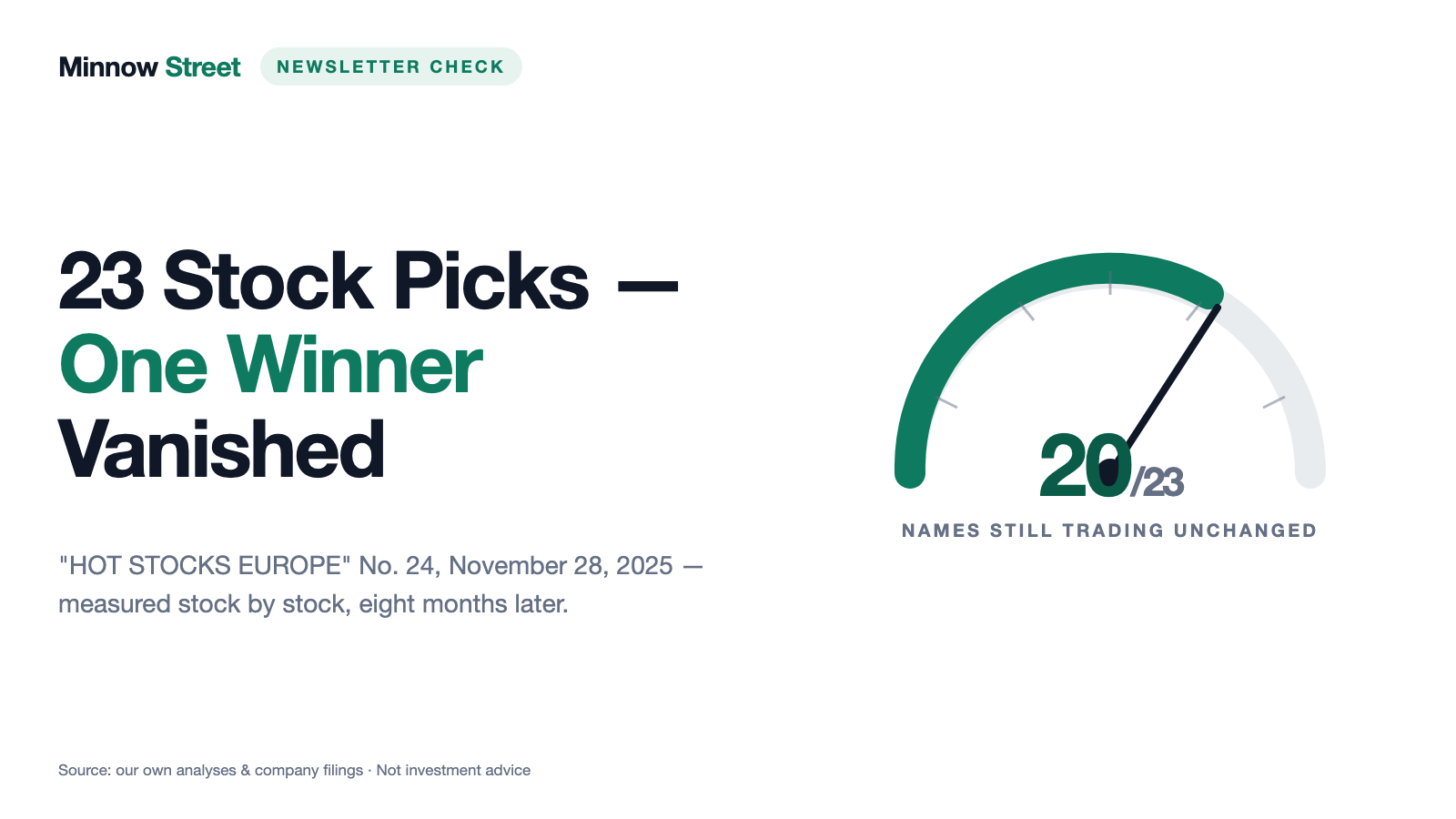
This analysis did not start with a hit in our in-house stock scanner — Trekor Metals trades in Canada and, as of this research (July 24, 2026), was not a company row in our database at all, let alone a ranking entry. The hook is honestly thin: a reader sent us Issue 24 of the "Hot Stocks Europe" newsletter, dated November 28, 2025. In it, the stock appears exactly once — as a chart under the "top performers of 2025" on page one, with no figures and no analysis, under its then-name "Taseko Mines." The newsletter itself discloses, under conflicts of interest, that the publisher, author or related parties may hold long positions in stocks discussed and intend to sell into rising prices (EU Market Abuse Regulation No. 596/2014) — a disclosure worth reading alongside any stock tip from a newsletter.
The real hook, then, is not the chart itself but what the chart leaves out: the newsletter names a company and a securities identifier that, eight months later, no longer exist. That alone does not make an analysis — but it does raise the question of what changed behind the new name, and what did not.
From the old name to the new one — what actually changed on June 25, 2026
On June 24, 2026, shareholders at the annual general meeting in Vancouver voted, with 216,723,190 shares cast (59.3 percent of all shares entitled to vote), to rename Taseko Mines Limited to Trekor Metals Limited. The filing to the SEC spells out the details:
"The Company's common shares will commence trading under the new name on the Toronto Stock Exchange and New York Stock Exchange at the start of trading on June 29, 2026 and on the London Stock Exchange on June 30, 2026. The ticker symbol for the Company's common shares will remain unchanged (TSX: TKO; NYSE American: TGB; LSE: TKO). Further to the name change, the new CUSIP number for the Company's common shares will be 89472Y107, effective June 25, 2026. The Company's ISIN will also change from CA8765111064 to CA89472Y1079 with effect from June 30, 2026."
— Trekor Metals Limited, 6-K filing, June 24, 2026, Exhibit 99.1
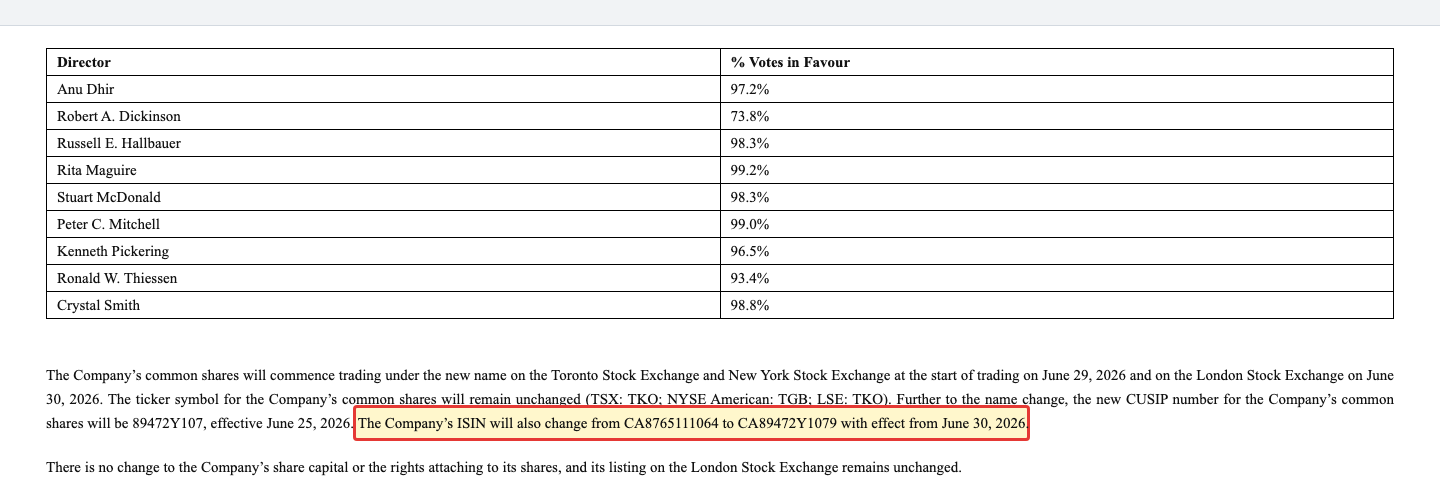
What did not change: the tickers (TSX: TKO, NYSE American: TGB, LSE: TKO stayed identical), the share capital, shareholder rights and the listings themselves. What did change: the name, the CUSIP number, the international securities identifier (ISIN) — and with it the German WKN, which moved from 866869 to A42D8P. Anyone still carrying a position from before late June 2026 under the old name in a brokerage statement owns economically the exact same share. Anyone searching fresh finds nothing under the old name — and, as described above, risks landing on a completely unrelated company if they search the bare ticker TKO on the New York Stock Exchange.
The numbers over the years — record revenue, a second straight loss year
First, what genuinely impresses: revenue climbed to C$672.9 million in 2025, up from C$608.1 million in 2024 and C$525.0 million in 2023 — a third straight year of growth, up 10.7 percent in the most recent year alone. That was driven by a higher average realized price ($4.61 per pound of copper on average for the year, already $5.13 in the fourth quarter) on copper production from Gibraltar of 98.1 million pounds. The core operating measure — "earnings from mining operations," revenue minus production costs and depletion — rose from C$124.8 million to C$152.0 million.
And yet: the bottom line for 2025 was a net loss of C$30.1 million (2024: a loss of C$13.4 million; 2023, by contrast, a profit of C$82.7 million). A second straight loss year — while revenue grew for a third straight year. That gap is the core of this analysis, and the next chapter explains it.
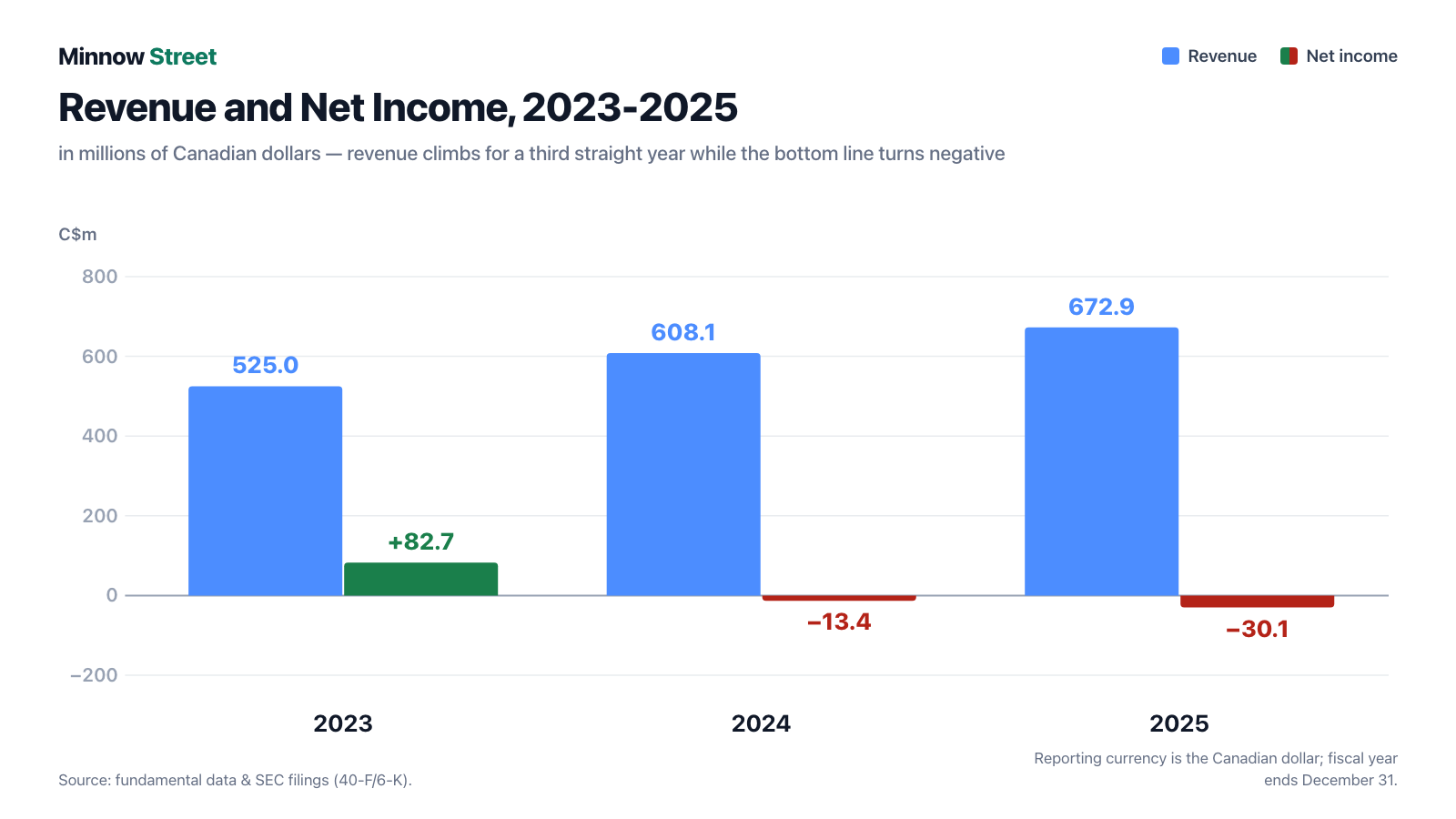
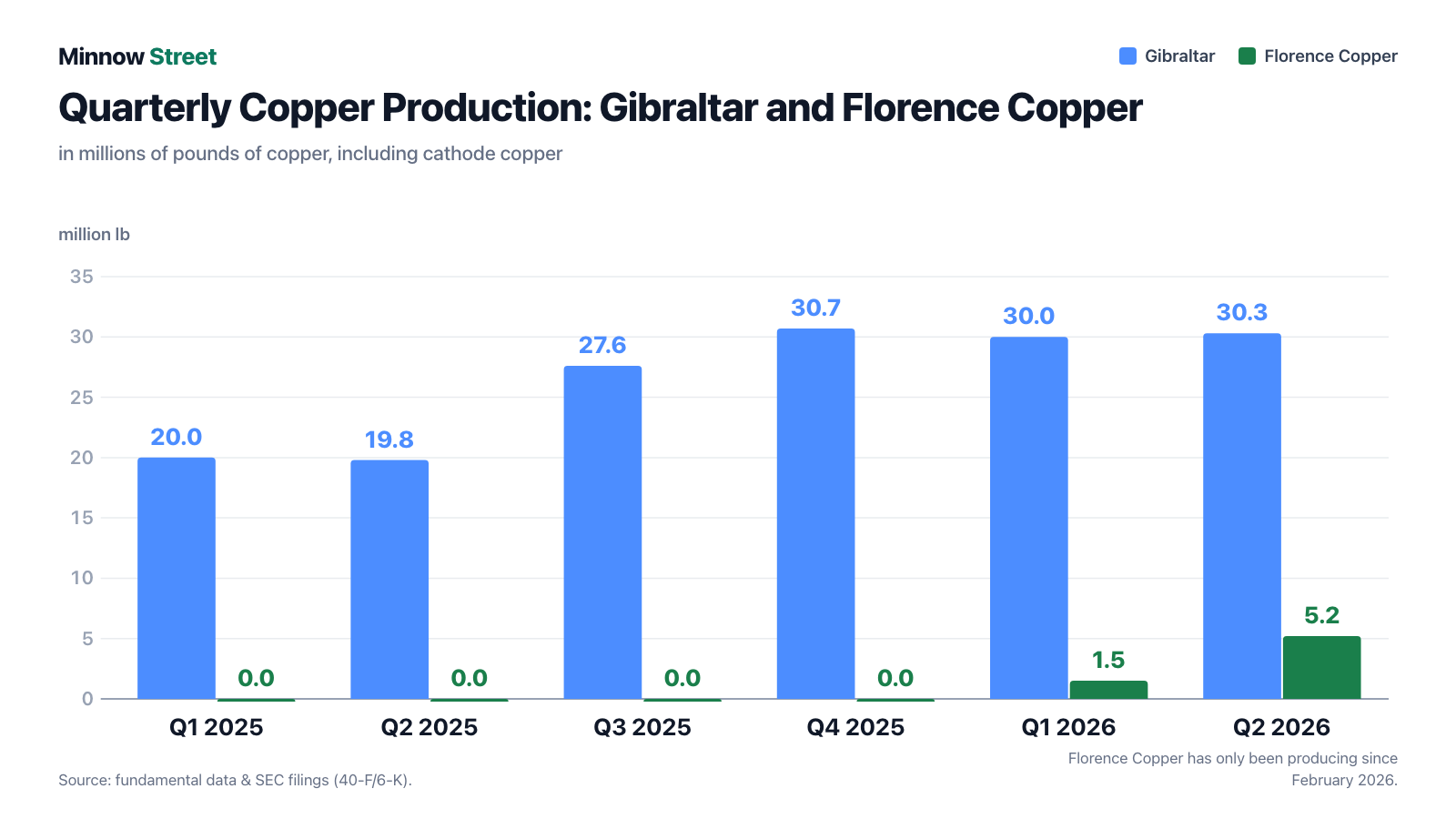
In the first quarter of 2026, the picture turned around: revenue of C$237.1 million (Q1 2025: C$139.1 million), net income of C$16.8 million (Q1 2025: a loss of C$28.6 million) — a return to profit, helped by Gibraltar's copper production rising from 20.0 million pounds in the first quarter of 2025 through 19.8 million (Q2 2025), 27.6 million (Q3 2025) and 30.7 million pounds (Q4 2025) to 30.0 million pounds in the first quarter of 2026. On July 14, 2026, Trekor furnished a 6-K with second-quarter 2026 production figures, ahead of the full financial report: Gibraltar produced 30.3 million pounds of copper plus 559,000 pounds of molybdenum, while Florence Copper delivered 5.2 million pounds of cathode copper — full-year 2026 production guidance (110 to 115 million pounds at Gibraltar, 30 to 35 million pounds at Florence) remained unchanged according to that release.
What the filings say — the uncomfortable truths
Uncomfortable truth no. 1: the copper price that carried revenue is the same copper price that created the loss
This is the central punchline of this analysis. The 2025 financial statements carry a line that barely registers in most copper-mining write-ups but weighs C$91.0 million here: "changes in derivatives and other fair value instruments." That line added C$4.8 million to earnings in 2024; in 2025 it pulled results down by C$91.0 million. "Income before financing costs and income taxes" — the IFRS line closest to an EBIT figure — fell from C$103.7 million in 2024 to just C$19.9 million in 2025; strip out that one fair-value item and the 2025 figure would have been about C$110.9 million, higher than the year before.
The reason: Trekor hedges part of its future copper production through collars — a price band built from a purchased floor (a put option) and a sold ceiling (a call option) that locks the sale price into a corridor. The company put these in place in 2024 to secure a minimum price and predictable cash flow during the expensive construction phase of Florence Copper. In practice: if the copper price falls below the floor, Trekor still gets the floor price. If it rises above the ceiling — exactly what happened in 2025 — Trekor must hand the difference to the counterparty, and the not-yet-settled portion of that obligation sits on the balance sheet as a liability whose value grows with every further price increase. The management discussion and analysis puts it this way:
"Unrealized loss on derivatives was $52.2 million in 2025, compared to an unrealized gain on derivatives of $21.0 million in 2024, driven by increasing prevailing copper prices, which closed the year at US$5.67 per pound, and the impact on changes in fair value of the Company's outstanding copper collar positions with a floor of US$4.00 per pound and a ceiling of US$5.40 per pound."
— Trekor Metals Limited, management's discussion and analysis for fiscal 2025, Form 40-F, filed March 31, 2026

In fairness: that C$52.2 million is only part of the C$91.0 million. Another C$20.3 million came from remeasuring the so-called Florence Copper stream — a pre-sale of future copper production to an outside financier, whose contractually fixed, low purchase price also looks more expensive as the market price rises, without a single dollar of cash changing hands. And C$13.1 million came from remeasuring the still-open, copper-price-linked purchase-price installments from the Gibraltar acquisition (more on that below). Remember the pattern: when a commodity producer hedges against falling prices, a rising price becomes a paper burden — even though nothing is actually lost operationally. Cash flow from operations, meanwhile, stayed solidly positive in 2025 at C$219.6 million (2024: C$232.6 million). What matters going forward: part of the hedge book is already extended — a $5.40-per-pound ceiling still applies to 54 million pounds of production in the first half of 2026, and a higher ceiling of between $7.50 and $8.50 applies to 24 million pounds in the third quarter of 2026. As long as the copper price stays elevated, this line will keep talking in 2026 too.
Uncomfortable truth no. 2: 60.9 million new shares arrived in 15 months
Anyone holding a stock for the long run should know how much smaller their slice of the pie gets when new slices keep getting cut. At Trekor, that was substantial in 2025: shares outstanding rose from 304.7 million (end of 2024) to 361.1 million (end of 2025) — up 18.5 percent in twelve months — and further to 365.6 million as of March 31, 2026. Most of that traces back to a single transaction:
"In October 2025, the Company entered into and closed an equity offering with a syndicate of underwriters for the issuance of 42,665,000 common shares at a price of US$4.05 per share."
— Trekor Metals Limited, fiscal 2025 financial statements, Note 21c, Form 40-F, filed March 31, 2026

The offering raised roughly C$229.0 million ($163.6 million) net — and, per the MD&A, was used mostly to repay the revolving credit facility that had previously financed Florence Copper's construction. On top of that came a smaller, ongoing at-the-market program running since May 2023, under which a further 22,627,320 shares went to the market at an average price of $2.21 before it wrapped up in the first quarter of 2025. The good news: the money went mostly toward paying down debt and finishing the nearly complete Florence Copper build, not into ongoing losses. The sober news: anyone who held the stock at the end of 2024 now owns a slice of the same company about one-sixth smaller.
Uncomfortable truth no. 3: C$75 million shows up nowhere in net income
On June 5, 2025, Trekor reached an agreement with the Tsilhqot'in Nation and the Province of British Columbia that defuses one of the oldest disputes in Canadian mining: the New Prosperity copper-gold project, rejected twice (2010 and 2014) by the federal government over concerns for the sacred Fish Lake, known as Teztan Biny. Trekor transferred its New Prosperity mineral tenures into a subsidiary and handed 22.5 percent of that subsidiary's shares to a trust for the benefit of the Tsilhqot'in Nation. In exchange, Trekor received a payment — funded by the Province — and agreed not to act as the project's proponent going forward:
"In exchange, the Company received $75,000 in cash, funded by a contribution from the Province to the Trust."
— Trekor Metals Limited, fiscal 2025 financial statements, Note 22, Form 40-F, filed March 31, 2026

Trekor also agreed to pay C$6 million to the Tsilhqot'in Nation for community and land-use planning (C$3 million at closing, then three annual installments of C$1 million), and continues to hold 77.5 percent of the project entity. The resulting gain of C$68.4 million was booked directly to equity — not through the income statement. Anyone looking only at net income (a loss of C$30.1 million for 2025) never sees this event at all, even though it is larger than the reported annual loss itself. That treatment is correct under the accounting rules, because it is a transaction with a non-controlling interest that does not involve a loss of control — but it is still a figure worth knowing before drawing conclusions from net income alone.
Valuation: an order of magnitude, not a daily quote
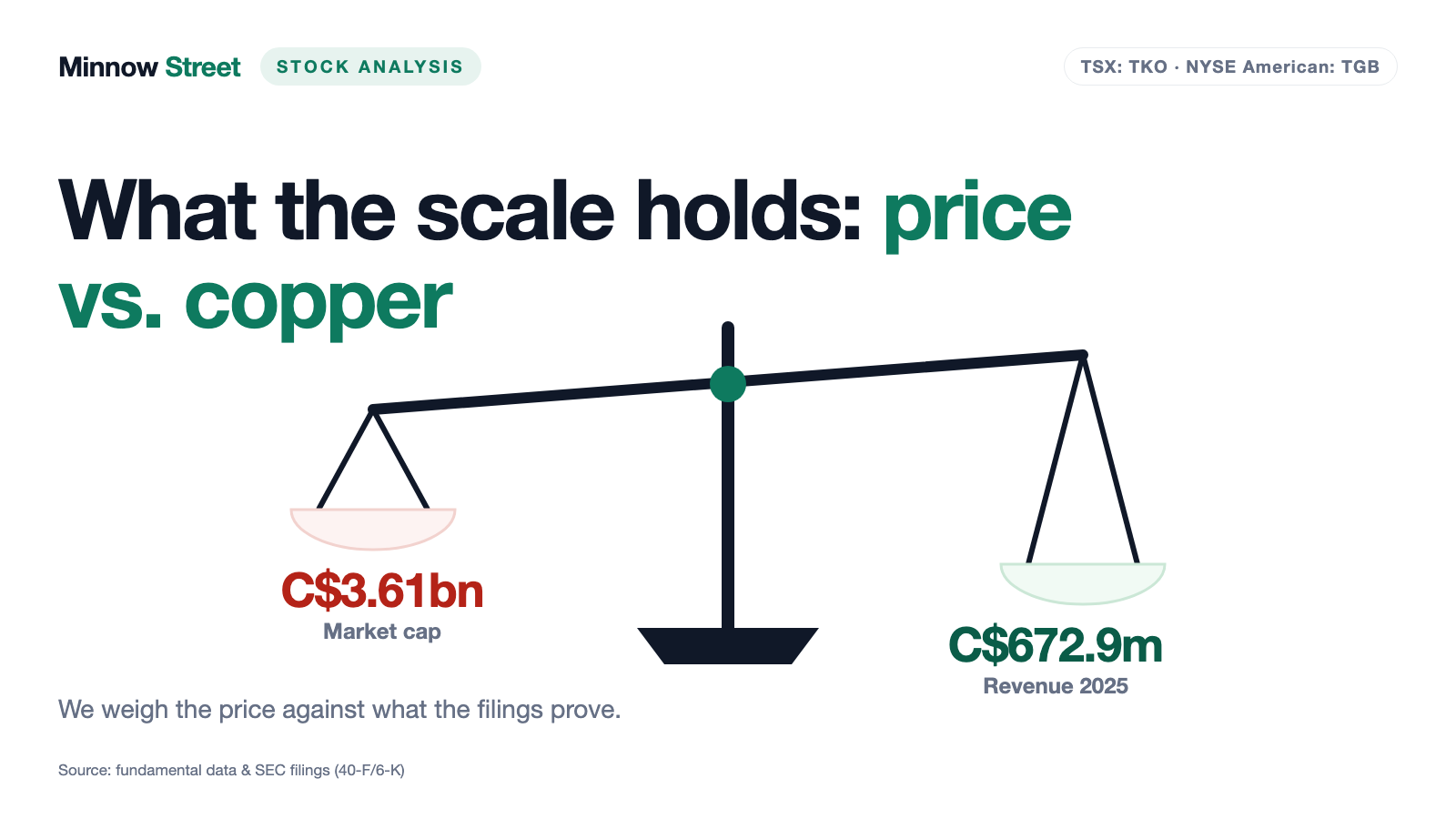
On July 24, 2026, the stock closed at C$9.88 on the Toronto Stock Exchange (parallel to $7.00 on NYSE American) — with 365.65 million shares outstanding, that implies a market capitalization of roughly C$3.61 billion. Measured against 2025 revenue (C$672.9 million), that is a price-to-sales ratio of about 5.4 — not a bargain for a growing, producing copper miner with nearly two decades of reserves, but not an overreach either.
A classic price-to-earnings ratio is a trap here rather than a guide. Adding the four most recently reported quarters (Q2 2025 through Q1 2026) yields a positive but tiny net income of roughly C$15.3 million — a P/E built on that number would sit in the triple digits and would say nothing meaningful, because the earnings base sits close to zero and, as shown above, is dominated by a single balance-sheet line unrelated to operations. More telling is the metric Trekor itself highlights: adjusted EBITDA of C$230.4 million for 2025 — against that, enterprise value (market cap plus net debt of C$583.9 million as of March 31, 2026, the most recently reported figure) works out to roughly 18 times. Two similarly positioned copper and gold miners from the same research series show how differently this story can play out: at DPM Metals, a debt-free balance sheet carries the outlook, while at Endeavour Mining the very same gold-price rally that drives revenue is partly clawed back through royalties and the company's own hedges — the same pattern that, at Trekor, explains the gap between operating success and the reported bottom line. All figures as of July 24, 2026; this analysis is deliberately evergreen, and a single day's price is not a reason to buy.
Opportunities and risks at a glance
What speaks for Trekor Metals:
- Two genuine, cash-generating operating legs: Gibraltar with at least 19 years of reserves and stable production, Florence Copper ramping up commercially since February 2026 (5.2 million pounds of cathode copper already in Q2 2026, full-year 2026 guidance unchanged at 30 to 35 million pounds).
- Operating cash flow stays robust: C$219.6 million in 2025, C$93.9 million in the first quarter of 2026 alone — despite two straight net-loss years on the income statement.
- A return to profit: C$16.8 million in net income in the first quarter of 2026, driven by 50 percent higher Gibraltar production compared with the same quarter a year earlier.
- A decades-old dispute has been defused: the New Prosperity settlement with the Tsilhqot'in Nation and the Province of British Columbia brings C$75 million in cash and legal clarity, without Trekor having to advance the contested project itself.
- Capital-markets access works: the October 2025 offering and the at-the-market program raised enough capital to finance Florence Copper's construction and pay down debt.
What speaks against it:
- Two straight net-loss years (2024: a loss of C$13.4 million; 2025: a loss of C$30.1 million), even though both are driven mostly by non-cash fair-value swings.
- Meaningful dilution: 18.5 percent more shares in 2025 alone (304.7 to 361.1 million), rising further to 365.6 million as of March 31, 2026.
- Real debt with real dates: $500 million in senior notes at 8.25 percent interest (maturing 2030), plus copper-price-linked purchase-price installments from the Gibraltar acquisition, whose first ten-year repayment began in April 2026 and can range between C$5.0 million and C$15.25 million a year depending on the copper price.
- The hedge book still caps part of the upside: a $5.40-per-pound ceiling applies to 54 million pounds of production in the first half of 2026.
- As a Canadian MJDS filer, Trekor publishes no audited quarterly reports (10-Q) — only one audited annual report (Form 40-F) and three unaudited interim releases (6-K) per year; the auditor also changed in 2025, from KPMG to PricewaterhouseCoopers.
A human conclusion
Back to the familiarity trap from the opening. Its core point is not that a new name automatically deserves distrust — renamings are nothing unusual in mining, and Trekor Metals has documented, clearly and traceably, what changed and what did not. Its core point is that familiarity and currency are two different things. Reading eight-month-old numbers under an eight-month-old name gets you neither right: the company now goes by a different name, carries a different securities identifier — and has since brought a second operating leg online that, back in November 2025, was still a construction site. What the filings actually show is a company with a solid, decades-old mine, a freshly commissioned second leg, real operating cash flow — and an income statement distorted by exactly the copper price that was supposed to be working in its favor. Whether that distortion fades into a footnote in 2026 once the old collars roll off, or whether new hedges keep the pattern going, the next quarterly release will tell you sooner than anything else. What you make of it is your decision. And that is exactly as it should be.
Sources
All original documents used in this analysis — for your own reading:
- Trekor Metals Limited — SEC annual report on Form 40-F for fiscal 2025 (filed March 31, 2026)
- Trekor Metals Limited — Audited fiscal 2025 financial statements under IFRS (40-F Exhibit 99.2, auditor PricewaterhouseCoopers LLP)
- Trekor Metals Limited — Management's discussion and analysis for fiscal 2025 (40-F Exhibit 99.3)
- Trekor Metals Limited — Annual Information Form for fiscal 2025 (40-F Exhibit 99.1)
- Trekor Metals Limited — Unaudited interim financial statements as of March 31, 2026 (6-K Exhibit 99.1, furnished May 7, 2026)
- Trekor Metals Limited — Management's discussion and analysis for the first quarter of 2026 (6-K Exhibit 99.2, furnished May 7, 2026)
- Trekor Metals Limited (as Taseko Mines Limited) — Release announcing the proposed name change (6-K Exhibit 99.1, May 25, 2026)
- Trekor Metals Limited — Release on the annual meeting, name change and new ISIN (6-K Exhibit 99.1, June 24, 2026)
- Trekor Metals Limited — Release on second-quarter 2026 production figures (6-K Exhibit 99.1, July 14, 2026)
- Complete SEC filing history: EDGAR company page (sec.gov)
- "Hot Stocks Europe," Issue 24, November 28, 2025 (B-Inside International Media GmbH, Freiburg, Germany) — the hook for this analysis, not a source for company figures
- Fundamental data (metrics, share price; data as of July 24, 2026), reconciled against SEC filings (40-F/6-K, CIK 878518).
Transparency & disclaimer: This analysis is a journalistic contextualization of publicly available information and is not investment advice, not a regulated financial analysis, and not a solicitation to buy or sell securities. Equity investments carry substantial risk, including total loss. All figures are provided without guarantee; the data date for each figure is noted in the text. The author holds no position in Trekor Metals shares at the time of publication.
Our Bottom Line at a Glance
- Identity & renaming neutral
- Taseko Mines Limited legally became Trekor Metals Limited on June 25, 2026, with trading under the new name starting June 29/30, 2026; tickers unchanged (TSX: TKO, NYSE American: TGB, LSE: TKO), but the ISIN and German securities code both changed. Economically the same stock, but under a new identifier — anyone using old identifiers may no longer find the company.
- Operating business positive
- Gibraltar delivers steadily (98.1 million pounds of copper in 2025, at least 19 years of reserves), and Florence Copper has been ramping up since February 2026, already delivering 5.2 million pounds of cathode copper in the second quarter of 2026. Revenue hit a record C$672.9 million in 2025, and operating cash flow stayed robust at C$219.6 million.
- Earnings quality negative
- Two straight GAAP loss years (2024: -C$13.4 million; 2025: -C$30.1 million), caused to the tune of C$91.0 million by fair-value changes on the company's own copper collars, the Florence Copper stream, and copper-price-linked purchase-price installments — triggered by the rising copper price itself, not by the operating business. Strip out that item and income before financing costs and taxes in 2025 would have been about C$110.9 million instead of C$19.9 million.
- Balance sheet & dilution negative
- Funded debt of C$752.5 million (including $500 million in senior notes at 8.25 percent, maturing 2030), plus copper-price-linked purchase-price installments whose first ten-year installment, due since April 2026, can range between C$5.0 and C$15.25 million. On top of that, 20 percent dilution in 15 months (304.7 to 365.6 million shares), mostly to repay Florence Copper construction costs.
- New Prosperity special item neutral
- The June 5, 2025 settlement with the Tsilhqot'in Nation and the Province of British Columbia brought C$75 million in cash and legal clarity for a decades-old dispute project. The resulting C$68.4 million gain was booked directly to equity and does not show up in net income — a transparency issue more than a substance risk.
Trekor Metals (Taseko Mines until June 25, 2026) tells two stories in one balance sheet for 2025: operationally, a record year with C$672.9 million in revenue, robust cash flow and a second operating leg coming online in Arizona — and an income statement dragged down by the very same rising copper price that carried revenue, through the company's own hedges. Add meaningful dilution and real debt with copper-price-linked repayments. Not investment advice.
What Our Rating Means
Open questions
The business works in principle, but one material question is open. As long as it stays open, our findings do not carry a quality verdict.
Trekor Metals runs Gibraltar, a decades-old, cash-generating mine with nearly two decades of reserves, and has brought a second operating leg, Florence Copper, into production — no going-concern flag, no negative equity, no existential dependence on a single customer or site. What keeps this short of a clear green is real financial complexity: two straight GAAP loss years, 20 percent dilution in 15 months, high-yield notes at 8.25 percent, and a second, copper-price-linked debt from the company's own history whose size can triple year to year. These are real reasons to read the numbers carefully, not signs of a shaky company — but also not the debt-free, uncomplicated balance sheet that a green rating would require. That justifies yellow, not a judgment on whether the stock is cheap or expensive — price is not a quality attribute.
A journalistic assessment by our editorial team at the time of the deep dive, based on public sources — not investment advice and not a solicitation to buy or sell. Your personal circumstances (investment goals, risk capacity, taxes) cannot be taken into account. What our levels mean, how verdicts are formed, and what conflicts of interest exist →
Worth Noting
- The hook for this analysis is the "Hot Stocks Europe" Issue 24 newsletter of November 28, 2025, which shows the stock only as a chart under its then-name "Taseko Mines," without any figures of its own. The real, stronger hook is the renaming itself: searching for "Taseko Mines" or WKN 866869 today turns up nothing, and the bare ticker TKO on the New York Stock Exchange leads to a completely unrelated company (TKO Group Holdings, WWE/UFC). As of this research (July 24, 2026), Trekor Metals was not a company row in our database and therefore not part of our in-house stock scanner.
- EDGAR access only works via the ticker TGB or CIK 878518 — searching the ticker TKO at the SEC returns a different company. Trekor is a Canadian MJDS filer: there is no 10-K and no 10-Q, only the annual, audited Form 40-F and unaudited 6-K interim releases. Reporting is under IFRS in Canadian dollars; the stock additionally trades in U.S. dollars (NYSE American), British pence (LSE) and euros (Frankfurt/Stuttgart) — every price figure in the article names its listing.
- Valuation figures are dated and evergreen: market capitalization, price-to-sales, and enterprise value/EBITDA are based on the July 24, 2026 share price (C$9.88 on the TSX) and serve as an order of magnitude, not a buy signal. All balance-sheet and earnings figures carry their own reporting date (12/31/2025 or 03/31/2026).
Frequently Asked Questions
Shareholders voted at the annual general meeting on June 24, 2026 to rename Taseko Mines Limited to Trekor Metals Limited. The change became legally effective on June 25, 2026, and trading under the new name began June 29, 2026 (Toronto and New York) and June 30, 2026 (London). The tickers (TSX: TKO, NYSE American: TGB, LSE: TKO) stayed unchanged.
Effective June 30, 2026, the ISIN changed from CA8765111064 to CA89472Y1079, alongside a new CUSIP number, 89472Y107 (effective June 25, 2026). The German securities code (WKN) moved from the old Taseko identifier 866869 to A42D8P. Anyone still using the old identifiers may find nothing, or land on a different company entirely.
Trekor Metals is a Canadian copper producer headquartered in Vancouver. The wholly owned Gibraltar mine in British Columbia is Canada's second-largest open-pit copper mine and produced about 98.1 million pounds of copper in 2025. Trekor also operates the Florence Copper in-situ recovery project in Arizona, producing its first cathodes since mid-February 2026.
Revenue climbed to C$672.9 million in 2025, but a single balance-sheet line — "changes in derivatives and other fair value instruments" — pulled results down by C$91.0 million. The cause was the rising copper price itself: it pushed the fair-value measurement of the company's own copper hedges, the Florence Copper stream, and copper-price-linked purchase-price installments into negative territory, even though nothing was lost operationally.
Florence Copper is a roughly $275 million project in Arizona that recovers copper via in-situ recovery: a mildly acidic solution is pumped through the ore body underground and chemically dissolves the copper, instead of mining it in an open pit. Construction was completed in the fourth quarter of 2025, and the first copper cathodes were produced in mid-February 2026. Trekor guides for 30 to 35 million pounds of production in 2026, rising to 85 million at full capacity.
Shares outstanding rose from 304.7 million (end of 2024) to 365.6 million (March 31, 2026) — up roughly 20 percent in 15 months. The largest single step was an October 2025 offering of 42.665 million new shares at $4.05, whose proceeds went mostly toward repaying debt tied to Florence Copper's construction.
On June 5, 2025, Trekor settled with the Tsilhqot'in Nation and the Province of British Columbia over the decades-old, twice-rejected New Prosperity copper-gold project. Trekor received C$75 million from the Province and, in exchange, handed 22.5 percent of a project entity to a trust for the benefit of the Tsilhqot'in Nation. The resulting C$68.4 million gain was booked directly to equity, not to net income.
Because Trekor is a Canadian issuer reporting to the SEC under the Multijurisdictional Disclosure System (MJDS). Such companies file no 10-K and no 10-Q: the audited annual report is filed as Form 40-F (for fiscal 2025, filed March 31, 2026), and interim figures are furnished only as an unaudited exhibit to Form 6-K. Reporting is under IFRS in Canadian dollars.
Found an error?
Did you spot a factual error, an outdated number, or a typo in this deep dive? Let us know briefly — your report goes straight to the editorial team.