DPM Metals Stock: A New Name, a Record Profit — and an Ecuador Permit Revoked After Four Months
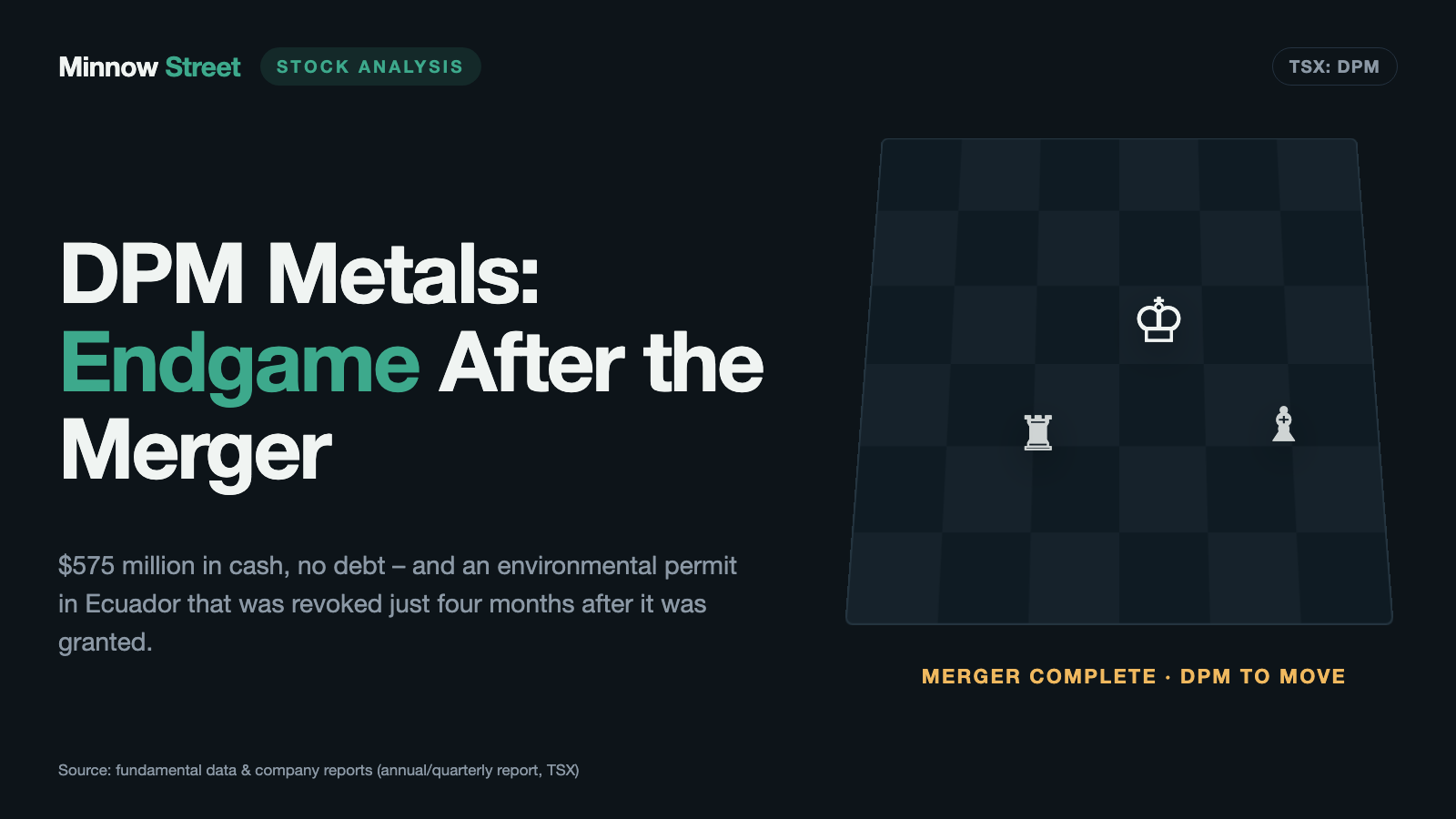
A newsletter praised "Dundee Precious Metals" for a strong third quarter back in November 2025. Since then, the company has changed its name, closed a $1.5 billion acquisition, and grown annual profit to $369.2 million — debt-free, with $575.5 million in cash. At the same time, Ecuador revoked an environmental permit for one of its growth projects just four months after granting it. Not investment advice — just the question of how much of this story is actually within the company's own control.
 Thomas Mücke
Founder & Publisher
Thomas Mücke
Founder & Publisher
Chart
Interactive price chart (TradingView).
Note: pure fact-based analysis, not investment advice and not a solicitation to buy or sell. All figures without guarantee.
There is a trap that catches especially loyal readers: the anchoring trap. You read something about a stock months ago — a name, a price, a metric — and that first impression sticks like an anchor everything later gets measured against, even after reality has moved on. A reader sent us exactly that case: issue 24 of a newsletter called "Hot Stocks Europe," dated November 28, 2025, with a short profile of "Dundee Precious Metals Inc." — strong quarterly numbers, a price of €23.50, no debt. Type that company name into a search engine today and you won't find it anymore: the company now goes by a different name, has closed a billion-dollar acquisition, and lost an environmental permit in Ecuador that it had received only months earlier. So let's make a deal: before that old anchor holds any longer, let's read the current reports together — the quarterly report as of March 31, 2026, and the 2025 annual financial statements.
What DPM Metals actually does — and why the name is different now
DPM Metals Inc. is an internationally operating, Canadian-based gold mining company headquartered in Toronto. In everyday terms: a company that digs where gold, copper, silver, lead and zinc sit in the rock, and turns it into sellable concentrate. The core business runs two producing mines in Bulgaria — Chelopech (gold, copper, silver, east of Sofia) and Ada Tepe (gold, near Krumovgrad) — plus, since September 3, 2025, the Vareš mine in Bosnia and Herzegovina (silver, lead, zinc, gold), which is moving from construction into full production and is expected to reach commercial production by the end of 2026. Development projects continue in Serbia (Čoka Rakita and Timok, gold-copper) and in Ecuador (Loma Larga and Tierras Coloradas) — more on the latter shortly, since that's where one of this analysis's uncomfortable truths lives.
And then there's the name: until September 12, 2025, the company was called Dundee Precious Metals Inc. — the name under which the newsletter forwarded to us still knows it. The current quarterly report spells out the change explicitly:
"Effective September 12, 2025, DPM changed its name from Dundee Precious Metals Inc. to DPM Metals Inc., and as part of this transition, its subsidiary companies have also adopted corresponding name changes, where applicable, to align with its new brand identity."
— DPM Metals Inc., Fourth Quarter 2025 Report (MD&A), "Our Business" section, p. 3
Important for you as a reader: this is not a rebrand following bankruptcy or a change of control — it's a pure name change at the same company, triggered, as the next section shows, by the Adriatic Metals acquisition. The ticker TSX: DPM stayed the same; only the name on the door is new. One central tension runs through the rest of this piece from here: DPM Metals is a financial fortress — yet the two things that shape the outlook the most, the gold price and a foreign environmental regulator, sit largely outside the company's own control.
Why there is no SEC filing here — and where the numbers come from instead
One point first, because it shapes the entire evidence trail of this analysis: there is no 10-K, no 10-Q, no 20-F for DPM Metals. An EDGAR company search for "Dundee Precious Metals" does return a hit (CIK 0001212233) — but every filing under it is a beneficial-ownership disclosure (SC 13G/SC 13D) on other companies, not a single own annual or quarterly report. DPM Metals is not a U.S. reporting company. As a Canadian company listed on the Toronto Stock Exchange, it publishes its mandatory disclosures through SEDAR+ and its own investor relations site instead.
Two documents carry this analysis, then: the First Quarter 2026 Report (balance sheet date March 31, 2026, published May 6, 2026) and the Fourth Quarter 2025 Report, which doubles as the audited annual financial statements (balance sheet date December 31, 2025, published February 11, 2026) — both retrieved as PDFs from dpmmetals.com/investors/financial-reports/. Data provenance throughout, then: fundamental data & company reports (annual/quarterly report, TSX) — not "SEC filings," which simply don't exist here.
How the stock landed on our desk — an eight-month-old newsletter
DPM Metals never showed up in our in-house stock scanner: the scanner universe is built primarily around U.S.-listed names, and a stock trading in Canadian dollars on the Toronto exchange simply doesn't appear there. The stock landed on our desk because a reader forwarded us an issue of their newsletter: "Hot Stocks Europe," issue 24, dated November 28, 2025 (B-Inside International Media GmbH, Freiburg), a twice-monthly publication. In it, under the company's then-current name Dundee Precious Metals: a strong third quarter of 2025 with 63,638 ounces of gold at total cost of $1,168 per ounce, EBITDA of $166 million, net earnings per share of $0.73 (the newsletter called it "20 percent above consensus"), liquidity that had grown to $414 million from $332 million, and free cash flow of $148 million for the quarter. The newsletter also briefly mentioned, just before going to press, the acquisition of Adriatic Metals and its Vareš project, completed "in early September" — without, of course, knowing that the company would change its name ten days later.
Those figures come from the newsletter and are cited here explicitly as a third party's expectation as of November 28, 2025, never as our own source — every number in this analysis is drawn from the company's own reports. Context also requires the conflict-of-interest notice the newsletter itself prints on page 8: the publisher, author, or related parties may hold long positions in stocks discussed and intend to sell as prices rise (EU Market Abuse Regulation 596/2014). The newsletter carried no specific price target or buy recommendation for this stock, only the production and earnings figures cited above — reason enough, eight months later, to honestly check what became of them. A neighbor from the same issue: as our PFISTERER stock analysis from the same issue shows, an eight-month-old newsletter is often a photograph from another time, not a current map.
The numbers over the years — honestly appraised
First, what genuinely impresses. Revenue rose 57 percent in 2025 to $950.5 million (2024: $607.0 million), net income rose 52 percent to $369.2 million (2024: $243.2 million), and adjusted EBITDA rose 79 percent to $585.6 million. Free cash flow climbed 66 percent to $504.9 million. The first quarter of 2026 kept the pace: revenue of $310.4 million (Q1 2025: $144.1 million, more than double), net income of $165.9 million (Q1 2025: $33.5 million), earnings per share of $0.75 (Q1 2025: $0.19).
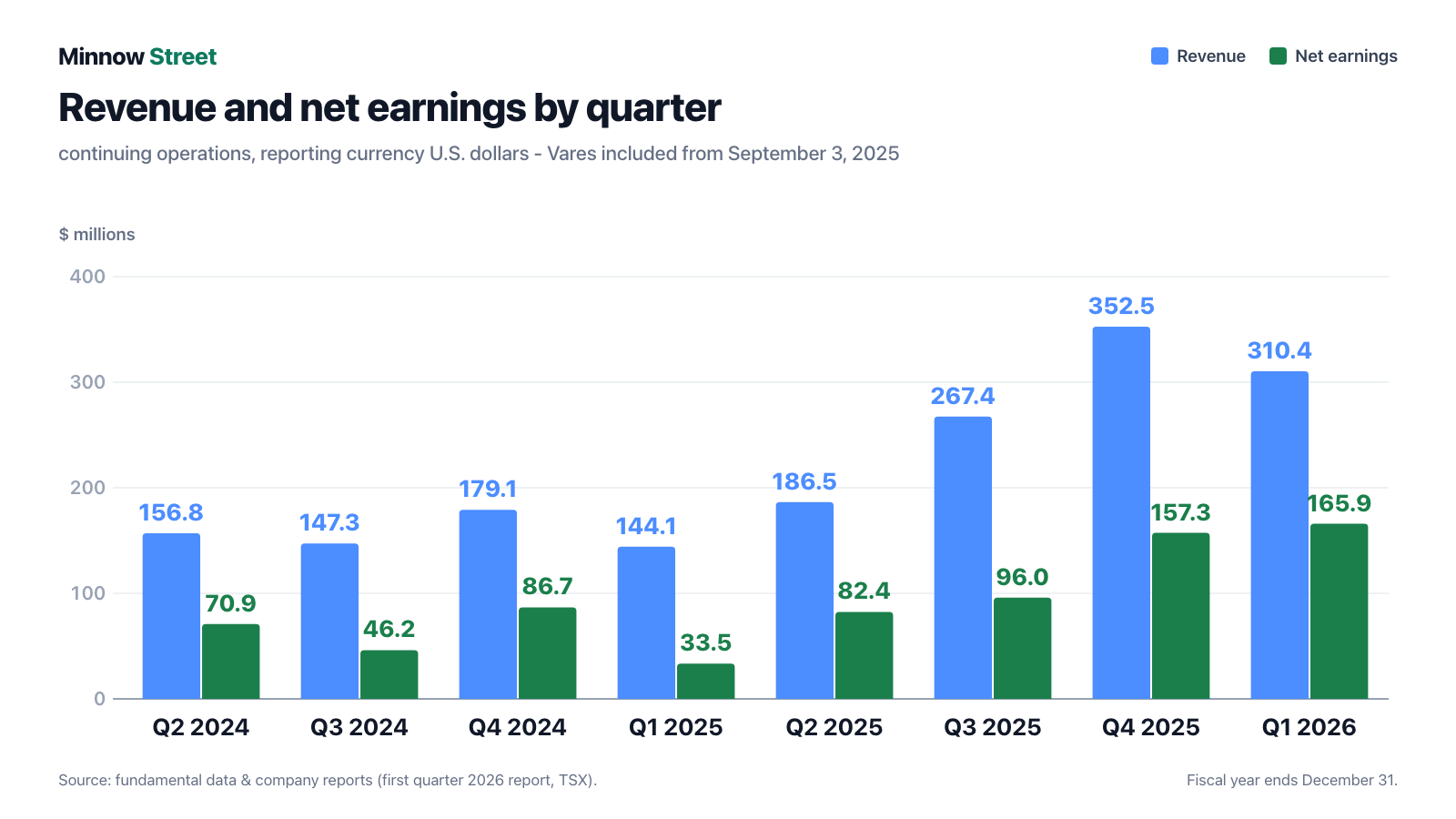
But a good part of that curve carries a name that has nothing to do with the mines: the gold price. DPM's realized gold price per ounce rose 49 percent in 2025 to $3,632, and by the first quarter of 2026 the quarterly average had already reached $4,955 — more than double the $2,369 seen back in the second quarter of 2024.
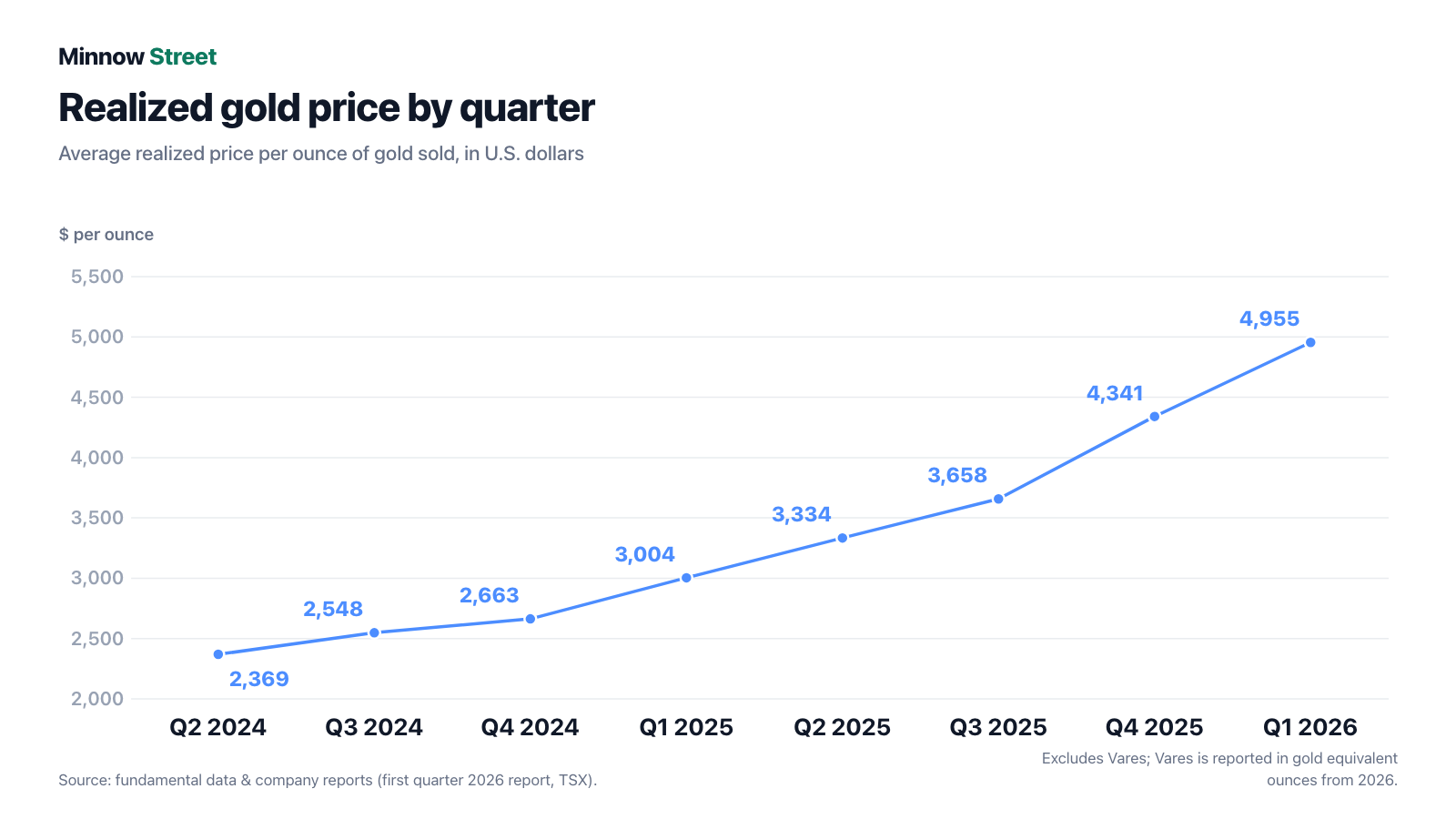
Remember this image: a rising gold price lifts nearly every gold miner at once — it is not proof of superior management. Whether DPM Metals is executing better or worse than its peers shows up in costs, not revenue. And that's exactly where it gets interesting.
The Adriatic acquisition: how two companies became one
Adriatic Metals plc was, until early September 2025, an independent company listed in London and on Australia's ASX, built around a single major asset: the Vareš silver-lead-zinc-gold mine in Bosnia and Herzegovina. On September 3, 2025, DPM (still Dundee Precious Metals at the time) completed the acquisition through a scheme of arrangement sanctioned by a UK court: $441.4 million in cash (converted from £321.3 million) plus 54,935,109 newly issued DPM shares at $19.33 each — $1,062.2 million in stock, for a combined purchase price of $1,503.5 million. Adriatic Metals no longer trades as an independent stock; its final standalone figures (fiscal 2024: $27.6 million revenue, $62.5 million net loss) are history as of the closing date.
For DPM itself, Vareš was profitable from day one: between September 3 and December 31, 2025, the mine contributed $93.7 million in revenue and $28.0 million in net earnings to the consolidated results. The annual report also runs a pro forma comparison:
"The Company recognized post-acquisition revenue and net earnings of $93.7 million and $28.0 million, respectively, from the pre-commercial production of the Vareš operation in the consolidated statements of earnings (loss) for the period between September 3 and December 31, 2025. Had Vareš been consolidated from January 1, 2025, the Company would have reported revenue and a net loss related to Vareš of $206.6 million and $44.5 million, respectively, in its consolidated statements of earnings (loss) for the year ended December 31, 2025."
— DPM Metals Inc., Fourth Quarter 2025 Report, Note 3 "Acquisition of Adriatic", p. 92
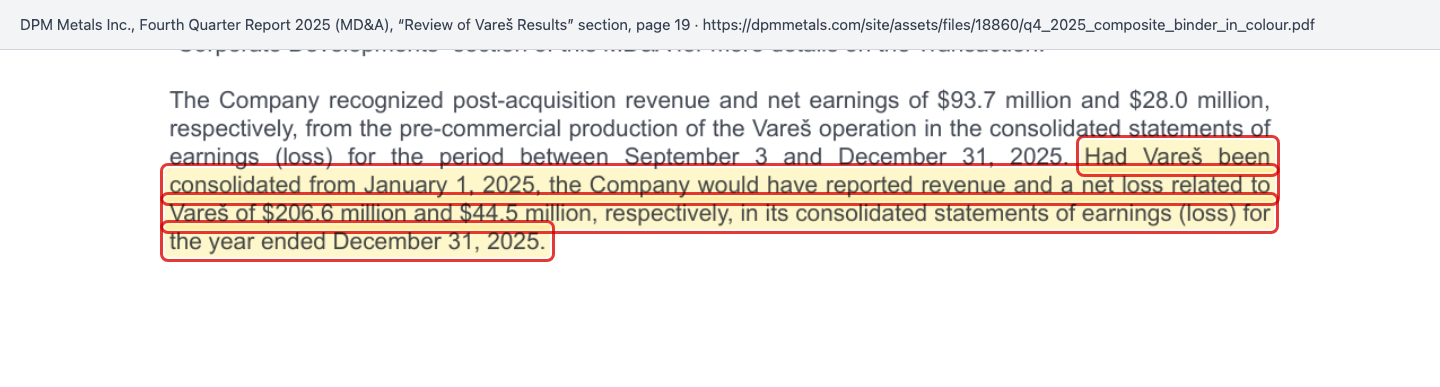
Put those two numbers together and they tell the real story: on its own, Adriatic would in all likelihood have posted another loss in 2025 — just as it had in each of the two years before. Under DPM's roof, with its balance sheet, regional mining expertise, and ongoing restructuring, the same mine turned into a profit contributor within four months. That's one of the strongest justifications for the deal — and exactly why the next uncomfortable truth carries so much weight.
What the reports show — the uncomfortable truths
Uncomfortable truth no. 1: the cost metric missed its own guidance — because DPM's own stock price rose
All-in sustaining cost per ounce of gold (AISC — everything it really costs to produce an ounce of gold, including sustaining capital) came in at $1,121 in 2025 — 25 percent above the top of the original full-year guidance range of $780 to $900, published back in February 2025. That looks, at first glance, like an operating setback. The quarterly report names a specific, quantified cause instead:
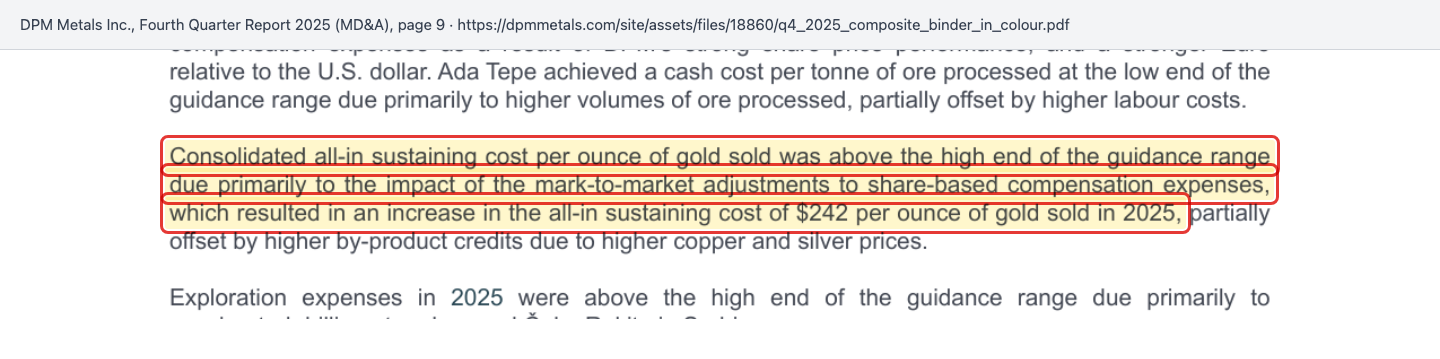
In everyday terms: part of executive compensation is tied to the stock price. When the price rises, the accounting value of that compensation rises with it — and because that increase flows through inventory and cost accounts, it becomes part of reported cost per ounce. A capital gain for shareholders shows up as an apparently worse cost metric for the company. Applied to the 219,039 ounces of gold sold in 2025 (excluding Vareš), this single effect adds up to roughly $53 million — about 14 percent of full-year net income. Remember the sentence: a cost metric is only as meaningful as what gets booked into it — and a stock price that takes off can inflate a cost figure without a single thing at the mines actually getting more expensive.
Uncomfortable truth no. 2: an environmental permit, granted in spring, revoked in fall
The Loma Larga development project in Ecuador is financially small compared with the Bulgarian and Bosnian mines — $14.7 million was spent there in 2025, with only about $5 million planned for 2026. Still, it's worth a look, because it shows how quickly a regulatory environment can turn. The quarterly report describes both events back to back:
"The environmental licence for the Loma Larga project was issued during the second quarter of 2025. This was the result of a rigorous process by the government of Ecuador to ensure high Ecuadorian standards are applied in the development of Loma Larga. […] In October 2025, the Company received notification from the Ministry of Environment and Energy that it revoked the environmental licence. DPM is considering all its options to preserve value and optionality for shareholders, including evaluation of all legal avenues."
— DPM Metals Inc., First Quarter 2026 Report, "Loma Larga Project" section, p. 18
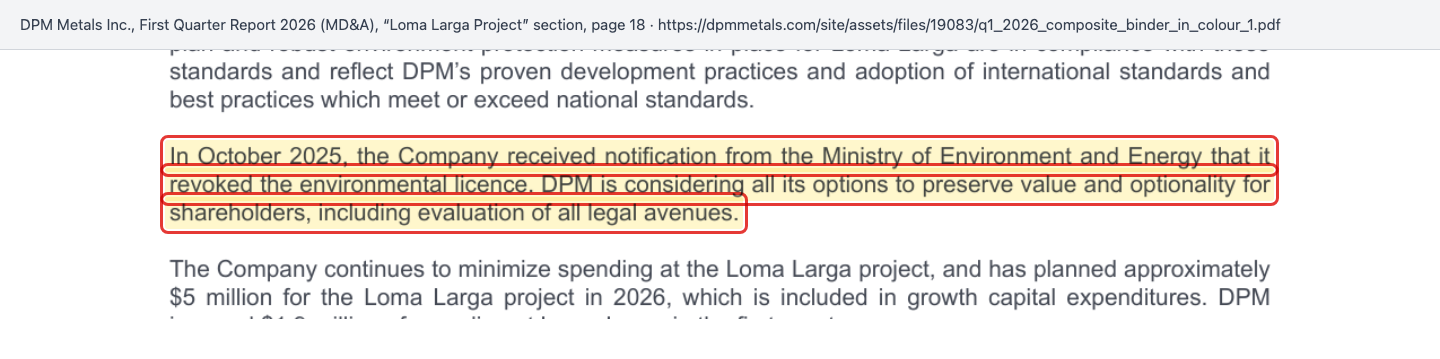
For DPM itself, Loma Larga is financially manageable — the company has already cut spending and is waiting things out. But for the broader idea that a once-approved mining project is afterward simply a matter of execution, the case is instructive: as our Orezone Gold stock analysis shows for a different West African example, political and regulatory risk in resource-rich countries is not a niche concern limited to unusually unstable jurisdictions — it's a variable that can flip within a matter of months, regardless of how "rigorous" the original approval process was.
Uncomfortable truth no. 3: the Adriatic acquisition left no goodwill buffer — the entire purchase price sits in the mine itself
Read about a $1.5 billion acquisition and you'd usually expect part of it to be booked as goodwill — a separate balance-sheet line for the portion of the purchase price above the pure hard-asset value (brand, expected synergies, future upside). Not here: the purchase price allocation in the annual report assigns the full $1,503.5 million purchase price precisely to identifiable assets and liabilities — not a single dollar of goodwill. By far the largest single line: $1,704.4 million for "mine properties," meaning the Vareš mine itself as a hard asset, net of assumed debt and deferred taxes.
That sounds technical, but it has a concrete consequence: a goodwill line often acts as a kind of shock absorber — it's typically the first thing written down when news turns bad, while the underlying hard asset (the mine) stays mathematically intact. Without that buffer, any future impairment — say, from a sharp drop in metal prices or a delayed Vareš ramp — would hit the single largest hard asset on the entire consolidated balance sheet directly. That's not a criticism of the accounting, which follows applicable IFRS rules — it's a reminder of how much of the deal actually sits in operating assets, and how little "air" there is between the purchase price and what happens if things don't go smoothly.
Valuation: a cash fortress, deliberately without a single P/E ratio
How expensive is DPM Metals? Here we run into the same currency mismatch that runs through this entire series of European and Canadian names: the stock trades in Canadian dollars on the Toronto Stock Exchange (CAD 52.45 on July 24, 2026, for a market capitalization of roughly CAD 11.6 billion on 221.0 million shares outstanding), while revenue, net income and the balance sheet are reported throughout in U.S. dollars. A price-to-earnings or price-to-sales ratio would require converting between the two currencies — and we have no independently verified CAD/USD rate for July 24, 2026. Rather than invent a conversion, we'd rather name that gap honestly: we deliberately build no single P/E or P/S ratio here.
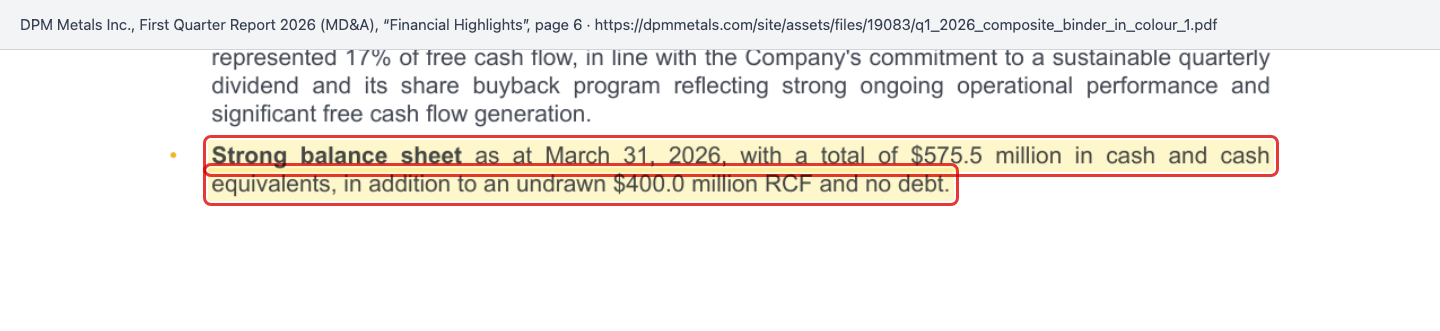
What can be described cleanly, each in its own currency, is that the balance sheet is spotless. As of March 31, 2026, DPM held $575.5 million in cash and a fully undrawn revolving credit facility of $400 million, running through February 2030, against essentially no financial debt.
"Strong balance sheet as at March 31, 2026, with a total of $575.5 million in cash and cash equivalents, in addition to an undrawn $400.0 million RCF and no debt."
— DPM Metals Inc., First Quarter 2026 Report, MD&A, financial highlights, p. 6
That cash fortress is already flowing back to shareholders: DPM pays a flat $0.04 quarterly dividend per share ($29.4 million in total dividends for 2025) and renewed its buyback program in March 2026 — up to 11 million shares, about 4.96 percent of shares outstanding at the time, running through March 17, 2027. How fast the price for those buybacks has moved tells its own story: in the first quarter of 2025, DPM bought back shares at an average of $11.05 (CAD 15.86); by the first quarter of 2026, that average had risen to $36.29 (CAD 49.75) — more than triple in twelve months, another company-documented data point for the sharp run-up in the stock. On the gold-price outlook itself: the company's own three-year plan deliberately assumes falling gold prices ($4,200 in 2026, $3,900 in 2027, $3,600 in 2028) — noticeably more conservative than some market commentary in late 2025 that spoke of a consolidation "around $4,000."
Opportunities and risks at a glance
What speaks for DPM Metals:
- A debt-free balance sheet with $575.5 million in cash and a fully undrawn $400 million credit facility (running through February 2030) — room for further growth without pressure from lenders.
- The Adriatic acquisition is already paying off: $93.7 million in revenue and $28.0 million in net earnings in just the first four months under DPM's management, with the ramp toward full commercial production by the end of 2026 on schedule.
- A growth pipeline spread across three countries (Serbia, further Bulgarian exploration, Ecuador), plus a newly discovered high-grade porphyry mineralization right next to the existing Chelopech mine.
- Consistent capital return: an ongoing dividend plus a buyback program now covering roughly 5 percent of shares, funded by free cash flow that rose 66 percent in 2025.
What speaks against it:
- A significant share of 2025's profit growth (gold price +49 percent to $3,632 per ounce) reflects market conditions, not the company's own operating performance — that tailwind would reverse if the gold price fell.
- All-in sustaining cost ran 25 percent above original guidance in 2025, largely because of the company's own stock price (mark-to-market effect on share-based compensation, adding $242 per ounce) — a metric that would fall again if the stock cooled off, but one that undercuts confidence in the company's own guidance in the meantime.
- The Ecuador project Loma Larga shows how quickly a granted permit can be taken away — a pattern that could in principle repeat at other foreign projects, even though the current financial exposure is small.
- No goodwill buffer from the Adriatic deal: $1,704.4 million sits directly in the "mine properties" line for Vareš — any future write-down would hit operating assets immediately.
- Price and metric comparisons are complicated by the two currencies involved (CAD on the exchange, USD in the reports) — anyone looking for a simple P/E ratio here has to supply a current exchange rate themselves.
A human conclusion
Back to the anchoring trap from the opening. Read issue 24 of "Hot Stocks Europe" today and you're holding a snapshot from another time: a company with a different name, without Vareš at the core of the business, with an Ecuador environmental permit that still existed back then. Eight months later, that company has become noticeably larger, debt-free, and more profitable — but also one whose profit leans heavily on the gold price, and whose overseas projects show that a granted permit is no final checkmark. So the honest question isn't "Is this still the Dundee Precious Metals stock I read about?" but rather: do you trust a company with a financial fortress at its back to handle the exact variables it doesn't control — the gold price, the copper price, foreign permitting authorities? What you make of it is your decision. And that is exactly as it should be.
Sources
All original documents used in this analysis — to read for yourself:
- DPM Metals Inc. — First Quarter 2026 Report (balance sheet date 31.03.2026, published 06.05.2026)
- DPM Metals Inc. — Fourth Quarter 2025 Report / annual financial statements (balance sheet date 31.12.2025, published 11.02.2026)
- DPM Metals Inc. — Financial reports overview (dpmmetals.com)
- DPM Metals Inc. — NCIB renewal release (16.03.2026)
- DPM Metals Inc. — Dividend declaration release (05.05.2026)
- Fundamental data (metrics, share price and market cap figures; data as of July 24, 2026).
- Hook: "Hot Stocks Europe," issue 24, dated November 28, 2025 (B-Inside International Media GmbH), forwarded by a reader — figures cited exclusively as a third party's expectation as of that date, no buy recommendations adopted.
Transparency & disclaimer: This analysis is a journalistic contextualization of publicly available information and is not investment advice, not a financial analysis in the regulatory sense, and not a solicitation to buy or sell securities. Stock investments carry substantial risks up to total loss. All information without guarantee; the data cut-off is noted in the text in each case. The author holds no position in DPM Metals stock at the time of publication.
Our Bottom Line at a Glance
- Financial strength positive
- A debt-free balance sheet with $575.5 million in cash and a fully undrawn $400 million credit facility (running through February 2030) as of March 31, 2026; 2025 net income up 52 percent to $369.2 million, free cash flow up 66 percent to $504.9 million. One of the strongest balance sheets across this entire sector series.
- Earnings quality neutral
- A significant share of profit growth (gold price +49 percent to $3,632 per ounce in 2025) reflects market conditions rather than the company's own operating performance. At the same time, all-in sustaining cost ran 25 percent above guidance — mainly a mark-to-market effect from the company's own sharply higher stock price, not an operating cost problem.
- Adriatic Metals integration positive
- The acquisition closed September 3, 2025 is already paying off: $93.7 million in revenue and $28.0 million in net earnings in just four months. No goodwill resulted — the entire $1,503.5 million purchase price sits in identifiable assets, with $1,704.4 million in the Vareš mine itself, concentrating any future write-down risk in operating assets rather than a separate buffer.
- Regulatory risk abroad negative
- The environmental license for the Loma Larga development project in Ecuador, granted in the second quarter of 2025, was revoked by the environment ministry as soon as October 2025; DPM is reviewing legal options. The project is financially small, but the pattern shows how quickly a vetted approval process can reverse — a risk that could in principle recur at other foreign projects.
- Valuation neutral
- Market capitalization roughly CAD 11.6 billion (July 24, 2026); a single price-to-earnings or price-to-sales ratio cannot be responsibly built without a verified CAD/USD daily rate. Consistent capital return through dividends and a buyback program now covering roughly 5 percent of shares, at a repurchase price that has more than tripled in twelve months.
DPM Metals is a financial fortress — debt-free, with record profit and an acquisition that is paying off faster than expected — but the two variables shaping the outlook the most sit largely outside its own control: the gold price, which drove much of 2025's profit growth, and an Ecuadorian environmental regulator that revoked a granted permit within four months. If you still know this stock under its old name, Dundee Precious Metals, know that the company behind it has changed substantially since. Not investment advice.
What Our Rating Means
Quality confirmed
Business model, numbers and balance sheet hold up to our review. Whether the current price supports an entry is a separate question — it hangs on the price, not on the company.
The business model carries broadly: two established, profitable mines in Bulgaria, a third (Vareš) already profitable within four months under new ownership, a debt-free balance sheet with $575.5 million in cash, and no sign of a substance risk — no going-concern flag, no negative equity, no existential dependence on a single customer or site. The open questions in this analysis (profit growth's reliance on the gold price, the revoked Ecuador permit, the missing goodwill buffer) are real, named risks — but none of them threatens the company's substance itself. Loma Larga is financially small and already scaled back, and the cost metric is an accounting effect without an operating cause. That earns green — it does not mean the stock itself is cheap or a buying opportunity; price is not a quality criterion. The decision is yours.
A journalistic assessment by our editorial team at the time of the deep dive, based on public sources — not investment advice and not a solicitation to buy or sell. Your personal circumstances (investment goals, risk capacity, taxes) cannot be taken into account. What our levels mean, how verdicts are formed, and what conflicts of interest exist →
Worth Noting
- Hook: newsletter "Hot Stocks Europe," issue 24, dated 28.11.2025 (B-Inside International Media GmbH), forwarded by a reader, still under the name Dundee Precious Metals at the time. The newsletter itself flags possible conflicts of interest (long positions held by the publisher/author, EU Market Abuse Regulation 596/2014); none of its figures were adopted as our own source, only cited as a third party's expectation as of that date.
- DPM Metals is not a SEC filer: no 10-K, no 10-Q, no 20-F/40-F. This analysis is based on the First Quarter 2026 Report (06.05.2026) and the Fourth Quarter 2025 Report/annual financial statements (11.02.2026); mandatory filings run through SEDAR+. Quotes were verified verbatim against the original PDFs.
- No company row created in our own data set: a stock trading in Canadian dollars on the Toronto Stock Exchange would distort scanner thresholds built for U.S.-dollar listings. Deliberately no single P/E or P/S ratio built: market cap in CAD, earnings in USD, no verified daily exchange rate available for 24.07.2026 — that gap is named here, not papered over with an unverified conversion.
Frequently Asked Questions
Effective September 12, 2025, the company changed its name from Dundee Precious Metals Inc. to DPM Metals Inc.; subsidiaries were renamed accordingly. It is a pure rebrand with no change of ownership, announced shortly after the September 3, 2025 acquisition of Adriatic Metals plc closed. The ticker TSX: DPM stayed unchanged.
Adriatic Metals plc was acquired by DPM Metals (then Dundee Precious Metals) on September 3, 2025, and no longer trades as an independent stock. Consideration: $441.4 million in cash plus 54,935,109 new DPM shares, totaling $1,503.5 million. Adriatic's sole major asset, the Vareš mine in Bosnia and Herzegovina, is now a reporting segment of DPM Metals.
The environmental license for the Loma Larga development project was granted in the second quarter of 2025 and revoked by Ecuador's Ministry of Environment and Energy in October 2025. DPM Metals says it is reviewing all options, including legal avenues, and has cut planned 2026 spending on the project to about $5 million.
All-in sustaining cost (AISC) per ounce of gold was $1,121 in 2025, 25 percent above the top of the original guidance range ($780 to $900). The company attributes the bulk of that to a mark-to-market adjustment on share-based compensation (adding $242 per ounce), driven by its own sharply higher stock price — not an operating problem at the mines themselves.
Net income rose 52 percent in 2025 to $369.2 million, and reached $165.9 million in the first quarter of 2026 alone. As of March 31, 2026, DPM held $575.5 million in cash, a fully undrawn $400 million credit facility, and essentially no financial debt.
The primary listing trades in Canadian dollars on the Toronto Stock Exchange (ticker TSX: DPM). The stock has also traded as a Chess Depositary Interest on Australia's ASX (in Australian dollars) since September 18, 2025, and over the counter in the U.S. as DPMLF (in U.S. dollars). Revenue, net income and the balance sheet, however, are reported throughout in U.S. dollars.
Yes — a flat quarterly dividend of $0.04 per share (total 2025 dividends: $29.4 million), with the next payment scheduled for July 15, 2026. The company also buys back and cancels its own shares under a normal course issuer bid renewed in March 2026.
Found an error?
Did you spot a factual error, an outdated number, or a typo in this deep dive? Let us know briefly — your report goes straight to the editorial team.