RB Global: The Perennial Runner-Up Is Beating Copart — but the Win Runs on Borrowed Money
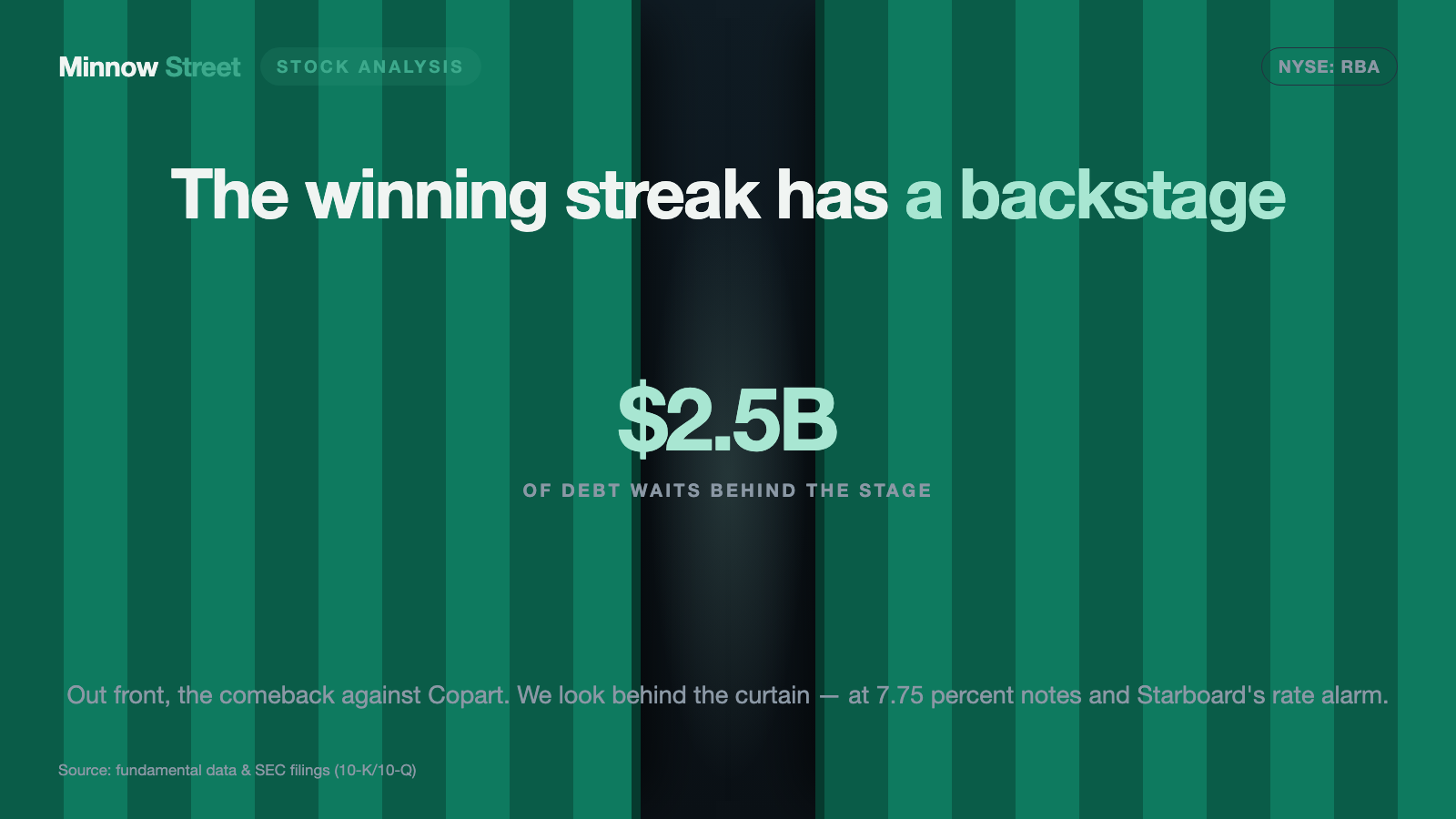
For five straight quarters RB Global's salvage business has outgrown the market, the share of insurance giant Progressive's total-loss volume sits at roughly 90 percent per analysts, and 2026 guidance was just raised. Yet the hunter of the salvage duopoly carries a heavy pack: $2,471.5 million of debt from the IAA acquisition, bonds at 6.75 and 7.75 percent, and preferred shares held by hedge fund Starboard with a built-in rate alarm set for February 1, 2027 — while archrival Copart sits on $4.2 billion of liquidity. Not investment advice — just the counter-bill for who ultimately pays for this winning streak.
 Thomas Mücke
Founder & Publisher
Thomas Mücke
Founder & Publisher
Chart
Interactive price chart (TradingView).
Note: pure fact-based analysis, not investment advice and not a solicitation to buy or sell. All figures without guarantee.
The form-table trap: when five good quarters outshine five hard years
There is an investor trap that loves to snap shut during comeback stories: recency bias. Our brains weight what we saw last far more heavily than everything before it — in sports they call it form. A club that finished second for years wins five matches in a row, and suddenly everyone talks about a changing of the guard. That the record champion has dominated the league for decades, that the challenger bought its new stars on credit — the form table blends all of that out. The same reflex fires in markets: "they're winning right now. So they'll win from now on." Maybe. But the form table never answers the only question that matters: is the streak a structural power shift — or an expensively financed run?
RB Global (NYSE and Toronto: RBA) is the perfect test case for that reflex. The company, called Ritchie Bros. Auctioneers until May 2023, spent years losing market share to archrival Copart through its salvage unit IAA — and that unit has now outgrown the market for five straight quarters, while the group has secured roughly 90 percent of insurance giant Progressive's total-loss volume per industry reports, and raised its full-year guidance. The stock trades 6.3 percent below its record close, while Copart sits 56 percent below its own (as of July 24, 2026). So let's make a deal: we hang the form table on the coat rack and read together what RB Global itself reported, under penalty of law, to the U.S. securities regulator, the SEC — the annual report (10-K) for 2025, the quarterly report (10-Q) as of March 31, 2026, and the current reports (8-K) of recent months. In the end you decide for yourself whether a new champion is emerging here — or a challenger that financed its winning streak on credit.
What this analysis covers
- What RB Global actually does — and why $16 billion is not $16 billion of revenue
- How the stock landed on our desk
- The numbers over the years — honestly appraised
- Uncomfortable truth no. 1: the win was bought for $6.6 billion — and the bill is still running
- Uncomfortable truth no. 2: the quiet preferred bill to Starboard — with a rate alarm set for February 1, 2027
- Uncomfortable truth no. 3: 23 percent of revenue hangs on three customers — cancelable on 30 to 90 days' notice
- Valuation: the market pays a premium of a good half for the winner
- Opportunities and risks at a glance
- A human conclusion
- Sources
What RB Global actually does — and why $16 billion is not $16 billion of revenue
RB Global is an auction house — by its own description in the annual report, the world's largest for commercial assets and vehicles: trucks, construction and agricultural machinery, and cars. The business stands on two legs. Leg one is the old Ritchie Bros., founded as an auctioneer in 1958: it sells excavators, cranes, trucks and farm equipment — for construction firms, fleet operators and dealers, online and on its own auction yards. Leg two is IAA, acquired in March 2023 for roughly $6.6 billion: the second-largest U.S. auctioneer of wrecked and totaled vehicles that insurers write off after a crash. Together: 333 locations (250 of them in the United States), buyers in about 170 countries, roughly 8,000 full-time and 700 part-time employees (all figures: annual report for 2025, as of December 31, 2025). The company is incorporated in Ontario, Canada, but reports to the SEC like a U.S. issuer (10-K/10-Q) and in U.S. dollars; the stock is dual-listed — on the New York Stock Exchange and the Toronto Stock Exchange, both under the ticker RBA. The old name did not vanish quietly, either: with the IAA closing, Ritchie Bros. Auctioneers was renamed RB Global in May 2023 — the auction brands Ritchie Bros. and IAA live on under the new corporate roof.
Before we judge a single number, you need the most important vocabulary of this business model — otherwise you will misread every balance sheet. An auction house mostly sells other people's goods. Gross transaction value (GTV) is the total value of everything that changes hands across the platforms: $16,201.9 million in 2025. Revenue is much smaller: $4,590.7 million — because of every excavator auctioned, RB Global owns only the fee, not the excavator. Of that, $3,502.2 million was service revenue (seller and buyer fees, transport, inspection, financing), and $1,088.5 million came from inventory the company buys outright and resells at its own risk — only in these inventory deals does the full sale price land in the books as revenue. In everyday terms: the real-estate broker who sells your house for $500,000 does not have $500,000 of revenue — he has his commission. But if he buys the house himself and flips it, the full price suddenly shows up in his accounts. Remember the split: GTV measures market power, service revenue measures the actual business — whoever mixes the two is comparing commissions with house prices. GTV splits into three sectors: automotive — at its core IAA — stood for $8,659.1 million in 2025 (53 percent), the cyclical commercial construction and transportation business (CC&T) for $5,663.6 million (35 percent), and other — from farm equipment to government fleets — for $1,879.2 million.
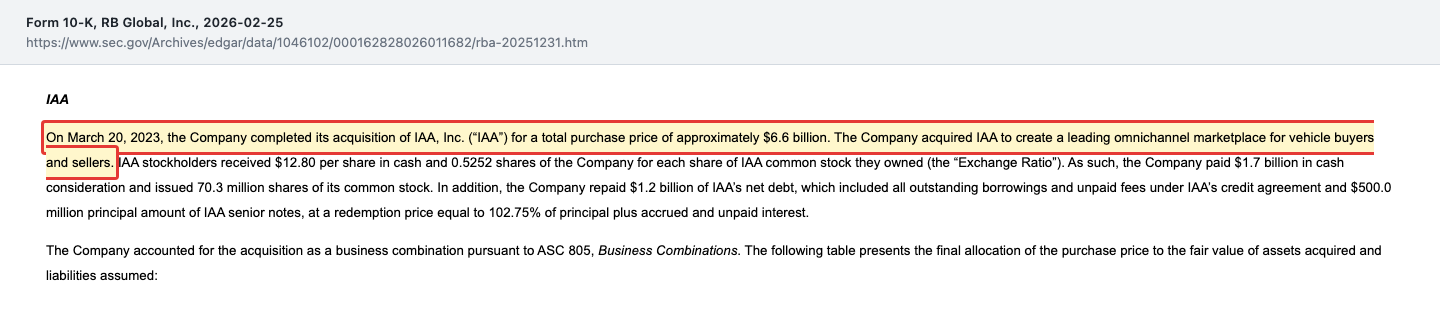
How the name change came about, the annual report records in one sentence that also documents the most expensive decision in company history:
"On March 20, 2023, the Company completed its acquisition of IAA, Inc. (“IAA”) for a total purchase price of approximately $6.6 billion. The Company acquired IAA to create a leading omnichannel marketplace for vehicle buyers and sellers."
— RB Global, Inc., SEC annual report 10-K for 2025, Note 3 "Business Combination"
The U.S. market for salvage auctions is a duopoly: Copart processes about 4 million vehicles a year, IAA about 2.5 million — and behind them, nothing for a long stretch. The structural tailwind belongs to both: cars keep getting more complex and more expensive to repair, and the total-loss rate of the U.S. claims industry hit a record of roughly 23 percent of reported claims in 2025 (data from claims specialist CCC, which we analyzed in detail here). That names the central tension of this analysis, and it runs through every chapter: the duopoly's perennial loser is suddenly winning — but it wins as a leveraged company against a debt-free rival. Is that a power shift or an expensively bought run?
How the stock landed on our desk
This time the path led not through a scanner but through our own research: today we published our Copart analysis — the story of an exceptional company in its deepest drawdown in more than 20 years. Whoever reads the evidence there inevitably runs into the name of the opponent that currently seems to be doing everything right. So we examined the other side with the same yardsticks. The price contrast could hardly be sharper (adjusted closes, as of July 24, 2026): RB Global traded at $111.59 — 6.3 percent below its record close of $119.14 (February 10, 2026) and up 8.5 percent year to date. Copart closed the same day 56.2 percent below its record. Since the IAA closing on March 20, 2023, RB Global's stock has more than doubled (up 111.4 percent); Copart lost a fifth over the same stretch. When two companies in the same duopoly diverge like this, there are two possibilities: the market has recognized a power shift — or it is extrapolating a form table. Let's find out which.
The numbers over the years — honestly appraised
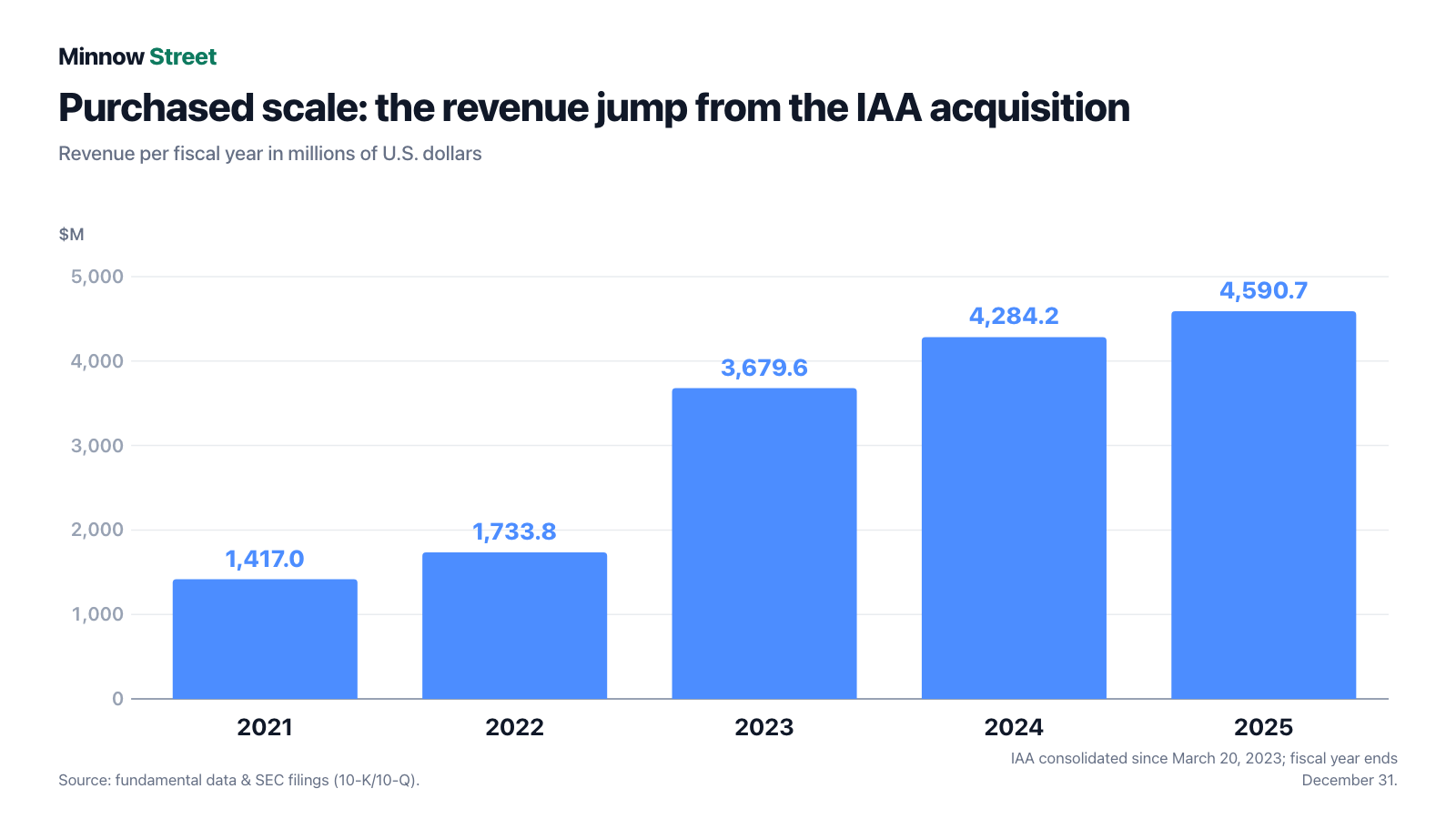
First, what genuinely impresses. The old Ritchie Bros. was a solid but modest auction house: $1,417.0 million of revenue in 2021, $1,733.8 million in 2022. Then came IAA — and with consolidation from March 20, 2023, revenue jumped to $3,679.6 million (2023), $4,284.2 million (2024) and $4,590.7 million in 2025 (up 7 percent). Important context: that jump is purchased scale, not an organic miracle. But what the combined company makes of it is respectable — net income doubled from $206.5 million (2023) via $412.8 million (2024) to $427.6 million (2025), adjusted EBITDA rose to $1,399.7 million (up 7 percent), operating cash flow to $978.2 million. Adjusted earnings per share climbed 15 percent to $4.00 in 2025 — though after merger costs, restructuring and an expensive arbitration award (more on that later), only $2.04 remained on a reported basis. That belongs to the honest picture too: since the acquisition, the gap between "adjusted" and "reported" at this company has been nearly half.
And now the form curve that has the market electrified. In the first quarter of 2026 (through March 31, 2026), gross transaction value grew 13 percent to $4,340.9 million, revenue 11 percent to $1,234.6 million, net income 20 percent to $135.6 million, adjusted earnings per share 13 percent to $1.01. The automotive business — at its core IAA — outgrew the broader market for the fifth consecutive quarter, per management; average selling prices in the U.S. insurance business rose about 10 percent. Even the long-sluggish construction and transportation segment turned: GTV up 27 percent, a good half of it organic — management spoke cautiously of early signs that pent-up supply is returning to the market. Full-year guidance was raised: 6 to 9 percent GTV growth instead of 5 to 8, adjusted EBITDA of $1,485 to $1,545 million (earnings call, May 4, 2026). And the driver behind the automotive run has a name RB Global itself never speaks: Progressive. On the year-end call (February 17, 2026) the company reported a new multiyear agreement with one of its "two largest partners" and an agreement in principle with the other; by the May call, that one was "fully executed" as well. The attribution to insurer Progressive comes from analysts: per Bank of America work (cited by Transportation Today, December 15, 2025), RB Global expanded its share of Progressive's total-loss volume from about 75 percent in early 2025 to about 90 percent. One quarter does not make a summer — but five quarters are a statement. The question is what they cost.
Uncomfortable truth no. 1: the win was bought for $6.6 billion — and the bill is still running
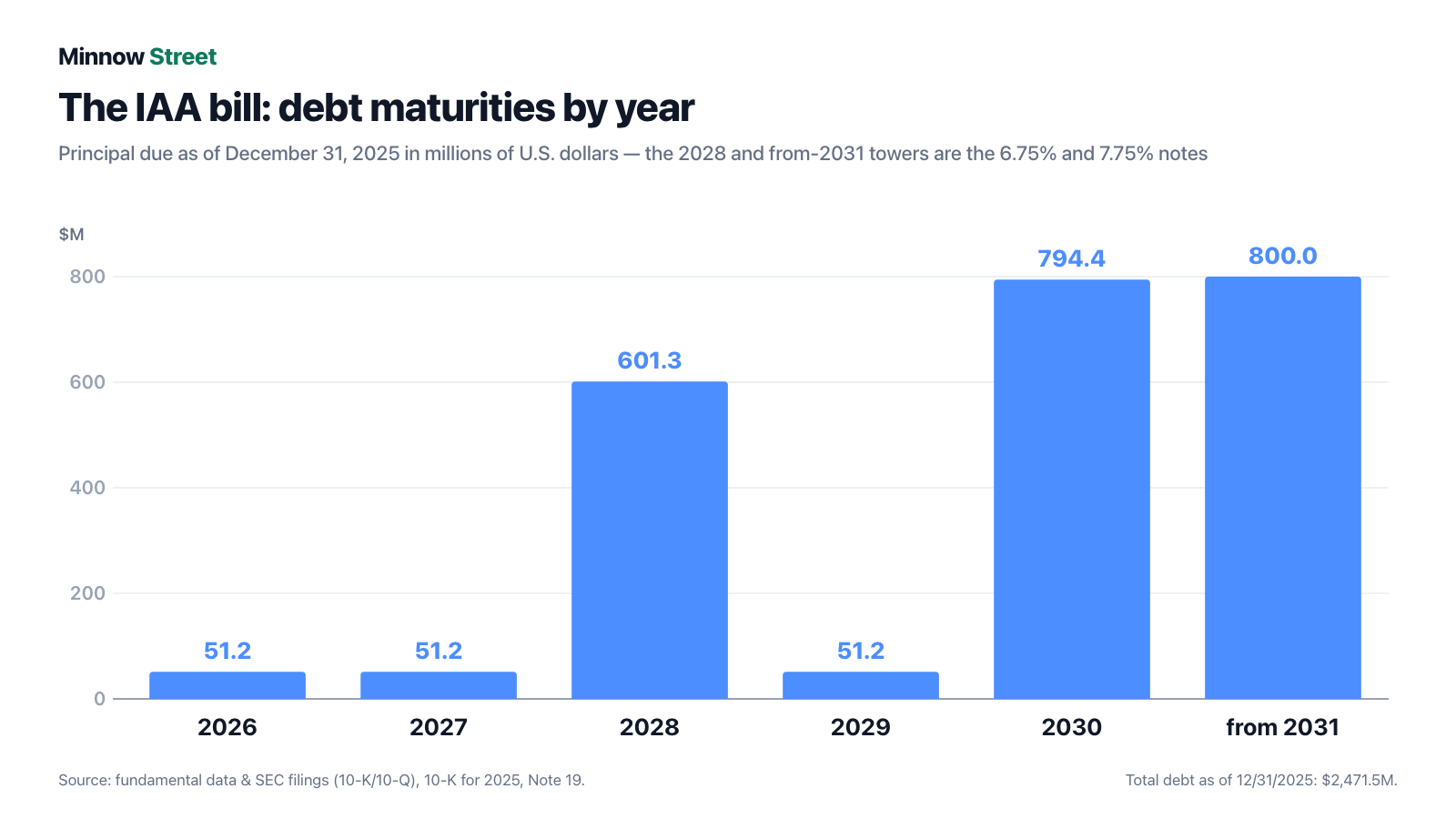
The IAA acquisition was a size too big for the old Ritchie Bros. to pay out of pocket: roughly $6.6 billion — $1,714.2 million in cash, 70.3 million new shares worth $3,712.9 million, plus the repayment of $1,157.1 million of IAA net debt. It was financed with the heaviest tools the capital market knows: on March 15, 2023 the company issued $550 million of 6.75 percent senior secured notes due March 15, 2028 and $800 million of 7.75 percent senior unsecured notes due March 15, 2031, plus bank term loans. As of December 31, 2025 the balance sheet carried $2,471.5 million of total debt against $531.5 million of cash; adjusted net debt stood at 1.4 times adjusted EBITDA (prior year: 1.6). The annual report itself lists the leverage as a stand-alone risk factor ("We have substantial indebtedness"). Honesty cuts both ways: 1.4 times EBITDA is not a threatening debt load — companies with stable fee revenue often carry more. But it is expensive (the bank term loans carried between 4.06 and 5.32 percent as of December 31, 2025, the notes 6.75 and 7.75 percent — a weighted average of roughly 6.4 percent across all tranches) and it has deadlines: $51.2 million comes due in each of 2026 and 2027, then $601.3 million in 2028, $51.2 million again in 2029, a full $794.4 million in 2030 and after that — in 2031 — the $800.0 million from the high-coupon bond. On the plus side: the credit agreement was reworked on better terms in April 2025 (revolver enlarged to $1,300 million, maturity extended to April 2030), and all covenants were met.
Why do we keep hammering on this? Because of the opponent. Copart — the rival RB Global is currently taking share from — sits on $4.2 billion of liquidity with zero bank and bond debt (as of April 30, 2026) and can fight any price, service or acquisition battle out of petty cash. RB Global, meanwhile, services its shareholders alongside the debt: $223.3 million of common dividends flowed in 2025 (currently $0.31 per quarter), and in March 2026 a new share repurchase program of up to $500 million was added. Dividend, buybacks, acquisitions like BigIron (roughly $350 million, closed May 18, 2026) and Blackmon Auctions — all at once, all next to $2.5 billion of debt. That can work as long as the business grows. Remember the image: the hunter runs faster — but he runs with a backpack, and the hunted runs without one.
Uncomfortable truth no. 2: the quiet preferred bill to Starboard — with a rate alarm set for February 1, 2027
Besides banks and bondholders, a third financier sits at the table, and he has the best terms: activist hedge fund Starboard Value. In January 2023 — in the middle of the shareholder fight over the IAA deal — RB Global secured $500 million from Starboard: $485 million as Series A preferred shares plus $15 million in common stock; Starboard chief Jeffrey Smith joined the board. The terms of those preferreds are spelled out in the quarterly report:
"The Series A Senior Preferred Shares carry a 5.5% preferred dividend, which is payable quarterly, in cash or in shares at the Company's option, and are entitled to participate on an as-converted basis in the Company's regular quarterly common share dividends, subject to a $0.27 per share per quarter floor."
— RB Global, Inc., SEC quarterly report 10-Q as of March 31, 2026, note on the Series A Senior Preferred Shares

Collecting twice, in other words: 5.5 percent fixed plus participation in the common dividend with a guaranteed floor. In 2025 that cost $34.8 million in cash — roughly 8 percent of net income, year after year, before a common shareholder sees a cent. Major shareholder Luxor Capital branded the Starboard deal "a completely unnecessary financing" built on an "off-market security" at the time and calculated that the board had transferred more than $145 million of value to Starboard (open letter, January 2023) — the deal went through anyway. And now the part almost nobody has on their radar: from the fourth anniversary of issuance — February 1, 2027 — holders have the right to increase the preferred dividend to 7.5 percent; from the ninth anniversary, to the greater of SOFR plus 600 basis points or 10.5 percent. RB Global can redeem the shares at each step — but would need to come up with $485 million while $601.3 million of debt already comes due in 2028. The preferreds are also convertible (conversion price $71.58 as of March 31, 2026) — with the stock above $111, conversion is deep in the money and would mean about 6.8 million additional common shares, roughly 3.5 percent of the votes. Dilution, translated: your slice of the cake shrinks when Starboard swaps its preferred paper for common shares. How the company handles this alarm clock — redeem, let convert, or accept 7.5 percent — is one of the most interesting capital-structure questions of 2026.
Uncomfortable truth no. 3: 23 percent of revenue hangs on three customers — cancelable on 30 to 90 days' notice
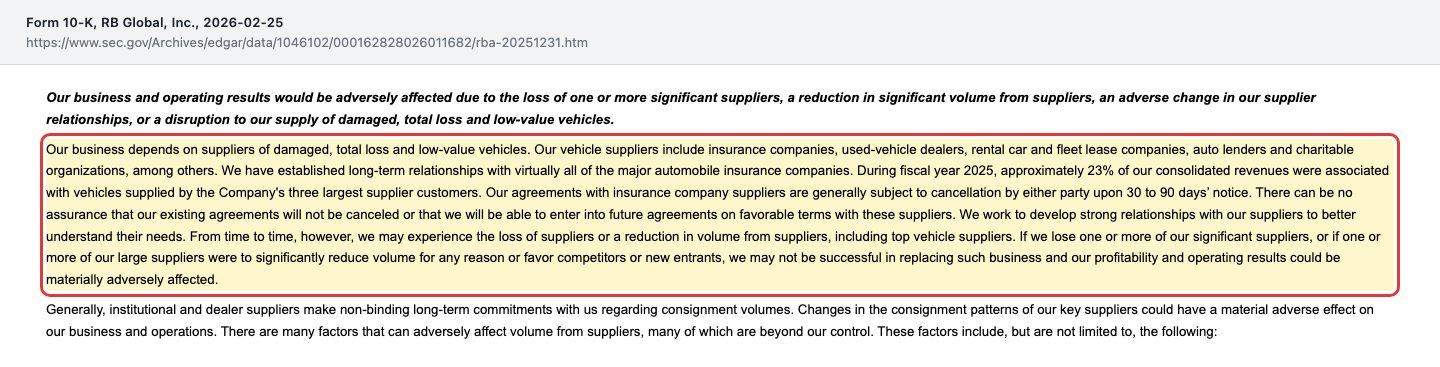
The irony of the Progressive story: what was the loser's risk in our Copart analysis is the winner's risk here. Whoever wins 90 percent of a major client's volume now houses exactly the concentration risk that used to sit with the competitor. RB Global names it in its own annual report — without names, but with a number:
"During fiscal year 2025, approximately 23% of our consolidated revenues were associated with vehicles supplied by the Company's three largest supplier customers. Our agreements with insurance company suppliers are generally subject to cancellation by either party upon 30 to 90 days' notice."
— RB Global, Inc., SEC annual report 10-K for 2025, Item 1A "Risk Factors"
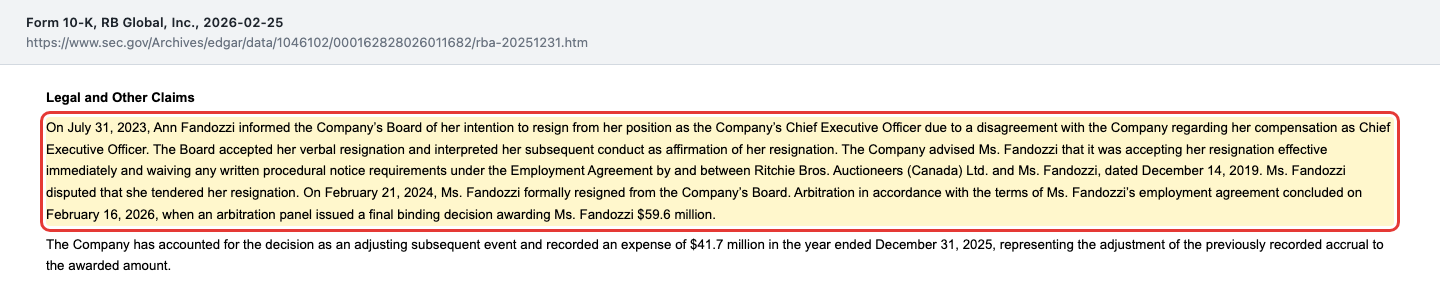
A year earlier the figure was about 22 percent — the concentration rises with every Progressive percentage point won. And the contracts cut both ways: 30 to 90 days' notice means the volume can shift back as quickly as it came. That has already happened once — just in the other direction: per industry accounts, Progressive has always deliberately run a two-vendor strategy and moved the weights massively within 18 months. Whoever believes such a pendulum swings only one way has not understood pendulums. On top of that, the opponent fights back with money, not words: since October 2023 Copart has owned the majority of Purple Wave — a push into Ritchie Bros.' own construction and farm equipment heartland (GTV recently growing more than 25 percent) — it is diversifying into non-insurance business, and it repurchased more than $1.6 billion of its own stock in nine months. The overhaul also left a governance epilogue: former CEO Ann Fandozzi departed in August 2023 in a dispute over her pay package ("Ms. Fandozzi disputes that she tendered her resignation," 8-K of August 4, 2023) — an arbitration panel awarded her $59.6 million on February 16, 2026, of which RB Global booked $41.7 million as a 2025 expense. Since August 2023 Jim Kessler, the former operating chief, has run the company — the comeback began under him, and the annual meeting re-elected him to the board on April 30, 2026.
Valuation: the market pays a premium of a good half for the winner
So what does the winner cost? On July 24, 2026 the stock closed at $111.59, for a market value of about $20.8 billion (186.3 million shares per the quarterly report times the anchor price; all valuation figures: data as of July 27, 2026, prices through July 24, 2026 — dated anchors, not daily-price arguments). The reported trailing price-to-earnings ratio is about 52 — distorted by merger and one-off costs and therefore of little use. The more honest math uses the analyst consensus for 2026 adjusted earnings of $4.43 per share: that works out to about 25 times earnings. Enterprise value to trailing EBITDA stands at about 17.6 — slightly above the company's own historical average. For comparison, from the same source with the same math: Copart costs 11.3 — the market pays a good 50 percent more per EBITDA dollar for momentum winner RB Global than for the fallen champion, even though RB Global's enterprise value contains $3.4 billion of net debt (the broad enterprise-value definition, including lease liabilities among other items — the narrow filing math, debt minus cash, comes to about $2 billion) while Copart brings more than $4 billion of net liquidity. The dividend yield: 1.1 percent ($1.24 per year). Trailing free cash flow of roughly $750 million works out to a yield of about 3.6 percent on the market value. The professionals' view (as of July 2026): of 10 analysts, 7 rate the stock a buy (3 of them "strong buy"), 2 a hold and one an emphatic sell; the mean price target of $127.91 sits about 15 percent above the anchor. Analyst targets are opinions, not entitlements — what stands out is the tilt: for most of the professionals the power shift is a done deal, with a single voice calling for the exit. Which is exactly when the counter-question pays: what happens to a 25-times earnings multiple if the form curve reverts to normal form for even one quarter?
Opportunities and risks at a glance
What speaks for RB Global:
- Documented momentum in the duopoly: the automotive business outgrew the market for the fifth straight quarter in Q1 2026, group GTV rose 13 percent, and full-year guidance was raised to 6 to 9 percent GTV growth (May 4, 2026); analysts put the Progressive share at about 90 percent (December 2025), backed by new multiyear agreements with both largest partners.
- Two legs with a shared tailwind: the U.S. insurers' total-loss rate hit a record of roughly 23 percent in 2025 (CCC), and in construction and transportation (GTV up 27 percent in Q1 2026) pent-up supply may be returning after years of drought.
- Growing earnings power: adjusted EBITDA of $1,399.7 million in 2025 (up 7 percent), operating cash flow of $978.2 million, adjusted earnings per share up 15 percent to $4.00; leverage fell from 1.6 to 1.4 times adjusted EBITDA within a year.
- Acquisitions broaden the base: BigIron (U.S. agricultural online marketplace, roughly $350 million, closed May 18, 2026), Blackmon Auctions, the exclusive Suncorp partnership in Australia (an estimated 65,000 units annually) and the expanded GSA government contract.
- Shareholder returns despite the debt: a $0.31 quarterly dividend (last raised in Q3 2025) plus a repurchase program of up to $500 million since March 2026.
What speaks against it:
- The winner's capital structure: $2,471.5 million of debt (December 31, 2025) with notes at 6.75 and 7.75 percent and maturity towers of $601.3 million (2028) and $794.4 plus $800.0 million (2030/2031) — against a competitor with $4.2 billion of liquidity and zero bank debt.
- The Starboard preferreds: $485 million at 5.5 percent plus dividend participation ($34.8 million cash in 2025), a holder right to 7.5 percent from February 1, 2027, and a conversion option over about 6.8 million shares (3.5 percent of the votes).
- The concentration risk it just won: 23 percent of revenue hangs on the three largest suppliers, and the contracts are cancelable on 30 to 90 days' notice — the same Progressive shift that hit Copart can swing back.
- Reported versus adjusted reality: $2.04 reported against $4.00 adjusted earnings per share in 2025 — the gap is filled by merger, restructuring and legal costs such as the $59.6 million arbitration award to former CEO Fandozzi; a Canadian tax dispute over C$79.1 million (contested) is also simmering.
- The valuation already prices in the win: about 25 times 2026 adjusted consensus earnings and 17.6 times EBITDA — a good 50 percent more per EBITDA dollar than Copart (11.3), on a thinner balance sheet and with no margin of safety for the streak ending (as of July 27, 2026).
A human conclusion
Back to the form table from the opening. It is real: five quarters above market, roughly 90 percent at Progressive, raised guidance, falling leverage — whoever wrote RB Global off as the eternal runner-up two years ago has been corrected by the filings quarter after quarter. But recency bias lives on blending out the bill behind the streak. The honest inventory from the filings reads: this win was paid for with a $6.6 billion acquisition, $1,350 million of high-coupon bonds, $485 million of hedge-fund preferreds and a $59.6 million arbitration award — and the client carrying the streak can cancel on 30 to 90 days' notice. On the other side of the duopoly sits an opponent that is only just starting to use its $4.2 billion war chest. Whether you follow the streak therefore depends not on the form table but on your answer to a single question: is the Progressive win a structural power shift — or a service-level lead that a debt-free competitor can buy back with money and patience? The next test is already on the calendar: on August 4, 2026 RB Global reports its second quarter — with the streak's sixth quarter at stake, the first BigIron months, and perhaps a hint of what happens to Starboard's rate alarm on February 1, 2027. What you make of it is your decision. And that is exactly as it should be.
Sources
All original documents used in this analysis — for your own reading:
- RB Global, Inc. — SEC quarterly report 10-Q as of March 31, 2026 (filed May 4, 2026) — most recent periodic report, fully reviewed
- RB Global, Inc. — SEC annual report 10-K for 2025 (filed February 25, 2026)
- RB Global, Inc. — SEC annual report 10-K for 2024 (filed February 26, 2025)
- RB Global, Inc. — SEC current report 8-K on the Fandozzi/Kessler CEO change (filed August 4, 2023) and 8-K on Ann Fandozzi's board resignation (filed February 23, 2024)
- RB Global, Inc. — SEC current report 8-K on the $500 million repurchase program (filed March 9, 2026) and 8-K on the $0.31 quarterly dividend (filed January 20, 2026)
- RB Global, Inc. — SEC current report 8-K on the BigIron agreement (filed March 4, 2026) and 8-K on the BigIron closing (filed May 18, 2026)
- Complete SEC filing history of RB Global, Inc.: EDGAR overview (sec.gov)
- Fundamental data (metrics, analyst consensus, price history; data as of July 27, 2026, prices through July 24, 2026), cross-checked against the SEC filings.
- Industry sources, each dated in the text: RB Global earnings call transcripts (February 17 and May 4, 2026, The Motley Fool), Transportation Today on the Progressive shift (December 15, 2025, based on Bank of America analysis), Luxor Capital statements on the IAA deal (January/February 2023, GlobeNewswire), IAA closing announcement (March 20, 2023, PRNewswire), CCC total-loss data (Crash Course 2025/2026).
Transparency & disclaimer: This analysis is a journalistic contextualization of publicly available information and is not investment advice, not a financial analysis in the regulatory sense, and not a solicitation to buy or sell securities. Stock investments carry substantial risks up to and including total loss. All information without guarantee; the data cut-off is noted in the text. The author holds no position in RB Global or Copart shares at the time of publication.
Our Bottom Line at a Glance
- Market position & momentum positive
- Number two in the U.S. salvage duopoly and world market leader in machinery auctions — with a documented run: automotive outgrew the market for the fifth straight quarter in Q1 2026, group GTV rose 13 percent to $4,340.9 million, and guidance was raised to 6 to 9 percent GTV growth (May 4, 2026). Per analysts, RB Global holds about 90 percent of Progressive's total-loss volume (December 2025), backed by new multiyear agreements with both largest partners.
- Earnings power & integration neutral
- Adjusted EBITDA of $1,399.7 million (up 7 percent) and adjusted EPS of $4.00 (up 15 percent) in 2025 show the IAA integration delivering operationally — but only $2.04 per share remained on a reported basis: the gap is filled by merger, restructuring and legal costs such as the $59.6 million arbitration award to former CEO Fandozzi (February 16, 2026). The cyclical construction and transportation segment shrank 2 percent in 2025 but turned to +27 percent in Q1 2026.
- Balance sheet & capital structure negative
- $2,471.5 million of debt (December 31, 2025) with notes at 6.75 and 7.75 percent and maturity towers in 2028 ($601.3 million) and 2030/2031 ($794.4 plus $800.0 million), plus $485 million of Starboard preferreds with a holder right to 7.5 percent from February 1, 2027 and a conversion option over roughly 3.5 percent of the votes. 1.4 times adjusted EBITDA is manageable — but direct rival Copart fights with $4.2 billion of liquidity and zero bank debt.
- Customer concentration negative
- About 23 percent of 2025 consolidated revenue hung on the three largest suppliers (prior year: about 22 percent), and the insurer agreements are cancelable by either party on 30 to 90 days' notice per the annual report. The Progressive win that carries the streak is thus also the single biggest risk — the pendulum that swung to RB Global can swing back.
- Valuation neutral
- About 25 times 2026 adjusted consensus earnings ($4.43 per share) and 17.6 times EBITDA — a good 50 percent more per EBITDA dollar than Copart (11.3), on net debt instead of net liquidity (data as of July 27, 2026). 7 of 10 analysts rate the stock a buy, mean target $127.91. The market has priced in the power shift; a margin of safety for the streak ending is not in the price.
RB Global is the test case for recency bias: the perennial number two of the salvage duopoly is delivering a genuine streak — five quarters above market, roughly 90 percent of Progressive per analysts, raised guidance, leverage down from 1.6 to 1.4 times EBITDA. The run was paid for with the $6.6 billion IAA acquisition: notes at 6.75 and 7.75 percent, Starboard preferreds with a rate alarm set for February 1, 2027, and a concentration risk of 23 percent of revenue on three customers with 30-to-90-day notice periods — while Copart lines up its counterattack with $4.2 billion of liquidity. Whether power shift or expensive run, the next quarters decide, starting August 4, 2026. Not investment advice.
What Our Rating Means
Open questions
The business works in principle, but one material question is open. As long as it stays open, our findings do not carry a quality verdict.
The operating picture is strong: a duopoly position plus world leadership in machinery auctions, growing service revenue, $1,399.7 million of adjusted EBITDA and $978.2 million of operating cash flow in 2025, falling leverage — no threat to the substance, hence no red. Three things stand between here and green: a capital structure with high-coupon bonds and hedge-fund preferreds including a step-up date (February 1, 2027), a self-documented concentration risk of 23 percent of revenue on three cancelable major customers, and an earnings quality where nearly half sat between reported ($2.04) and adjusted ($4.00) earnings per share in 2025. Only when streak and deleveraging hold for another year is the power shift proven rather than extrapolated. The decision is yours.
A journalistic assessment by our editorial team at the time of the deep dive, based on public sources — not investment advice and not a solicitation to buy or sell. Your personal circumstances (investment goals, risk capacity, taxes) cannot be taken into account. What our levels mean, how verdicts are formed, and what conflicts of interest exist →
Worth Noting
- Hook: counterpart to the Copart analysis of July 27, 2026 — both sides of the same duopoly, examined with the same yardsticks. No scanner hit claimed as the source.
- The Progressive attribution (~90 percent share) comes from industry reports (Transportation Today, December 15, 2025, based on Bank of America analysis) — RB Global names no customers in filings or calls; documented in the filings are the concentration disclosure (23 percent/top 3) and the new partner agreements from the earnings calls (February 17 and May 4, 2026, The Motley Fool).
- Data status: 10-Q as of March 31, 2026 (filed May 4, 2026) fully reviewed as the most recent periodic report; all filings after it checked (8-K of May 18, 2026 on the BigIron closing, Schedule 13G/A of May 6, 2026 — FIL Ltd below 5 percent —, Form 4/144; no 424B*, S-3, SC 13D, Form 25/15). Share count of 186.3 million from the 10-Q cover (April 27, 2026); market-value cross-check 186.3M × $111.59 = $20.8 billion passed. Analyses are evergreen; daily prices are not a buy argument.
- Confusion warning: RB Global (RBA) is the former Ritchie Bros. Auctioneers — not to be confused with rival Copart (CPRT) or the formerly stand-alone IAA stock (until March 2023). The fiscal year matches the calendar year; the TSX listing trades in Canadian dollars, all figures in this analysis are in U.S. dollars.
- The traffic light of this analysis judges the company, not the entry point.
Frequently Asked Questions
RB Global, Inc. (NYSE and Toronto: RBA) is, by its own account, the world's largest auctioneer of commercial assets and vehicles — with two legs: Ritchie Bros. auctions construction machinery and trucks, while IAA, acquired in 2023, auctions wrecked and totaled vehicles for insurers. In 2025, goods worth $16,201.9 million changed hands across the platforms (GTV); revenue was $4,590.7 million. The company runs 333 locations with buyers in about 170 countries.
With the acquisition of salvage auctioneer IAA for roughly $6.6 billion (closed March 20, 2023), Ritchie Bros. Auctioneers was renamed RB Global, Inc. in May 2023. The new name is the corporate roof over both auction brands — Ritchie Bros. for machinery, IAA for salvage vehicles. The ticker (RBA), the dual listing on the NYSE and the Toronto Stock Exchange, and the U.S. dollar reporting currency stayed unchanged.
Gross transaction value (GTV) measures the total value of everything sold across the platforms — $16,201.9 million in 2025. But RB Global books only its own proceeds as revenue: $3,502.2 million of service revenue (fees, transport, inspection) plus $1,088.5 million from inventory it buys and resells, together $4,590.7 million. Mixing GTV and revenue means comparing house prices with broker commissions.
The documented numbers say yes: the automotive business (IAA) outgrew the market for the fifth consecutive quarter in Q1 2026 per management, and RB Global reported new multiyear agreements with its two largest partners (as of May 4, 2026). Industry reports (Transportation Today, December 15, 2025, based on Bank of America analysis) put RB Global's share of Progressive's total-loss volume at about 90 percent — Copart reported mirror-image declines in U.S. volume. RB Global itself names no customers.
As of December 31, 2025 the balance sheet carried $2,471.5 million of debt, including $550 million of 6.75 percent secured notes due 2028 and $800 million of 7.75 percent unsecured notes due 2031 from the IAA financing. Adjusted net debt stood at 1.4 times adjusted EBITDA (prior year: 1.6). On top sit $485 million of Starboard preferred shares, serviced with $34.8 million in cash in 2025. For comparison: Copart has zero bank and bond debt.
To finance the IAA deal, hedge fund Starboard Value received $485 million of preferred shares in February 2023: a 5.5 percent preferred dividend plus participation in the common dividend with a floor of $0.27 per quarter. From the fourth anniversary of issuance — February 1, 2027 — holders may raise the rate to 7.5 percent; RB Global can redeem the shares. The preferreds are also convertible (conversion price $71.58 as of March 31, 2026) into about 6.8 million shares — roughly 3.5 percent of the votes.
Measured on reported earnings it looks very expensive (trailing P/E about 52, distorted by one-off costs); on the 2026 analyst consensus for adjusted earnings ($4.43 per share) it costs about 25 times. EV to EBITDA stands near 17.6 — a good 50 percent above Copart (11.3), even though RB Global carries net debt while Copart holds net liquidity. The mean analyst price target: $127.91, about 15 percent above the anchor price of $111.59 (July 24, 2026).
Found an error?
Did you spot a factual error, an outdated number, or a typo in this deep dive? Let us know briefly — your report goes straight to the editorial team.