Iridium: 66 Satellites, a Rocket Lab Takeover — and a Rally That Is Not One
Iridium runs a global network of 66 low-earth-orbit satellites and earns three out of every four dollars from recurring service revenue. In our scanner the stock lights up as a momentum rocket, up roughly 216 percent in six months — but that move has a name. At the end of June 2026 Iridium signed a takeover offer from Rocket Lab: $27.00 in cash plus stock. We read the annual and quarterly reports and took the uncomfortable parts with us: $1.77 billion of debt, a government contract worth 29 percent of revenue expiring in September 2026, and SpaceX as a new rival in orbit. A takeover offer is not a business model — and not investment advice.
 Thomas Mücke
Founder & Publisher
Thomas Mücke
Founder & Publisher
Chart
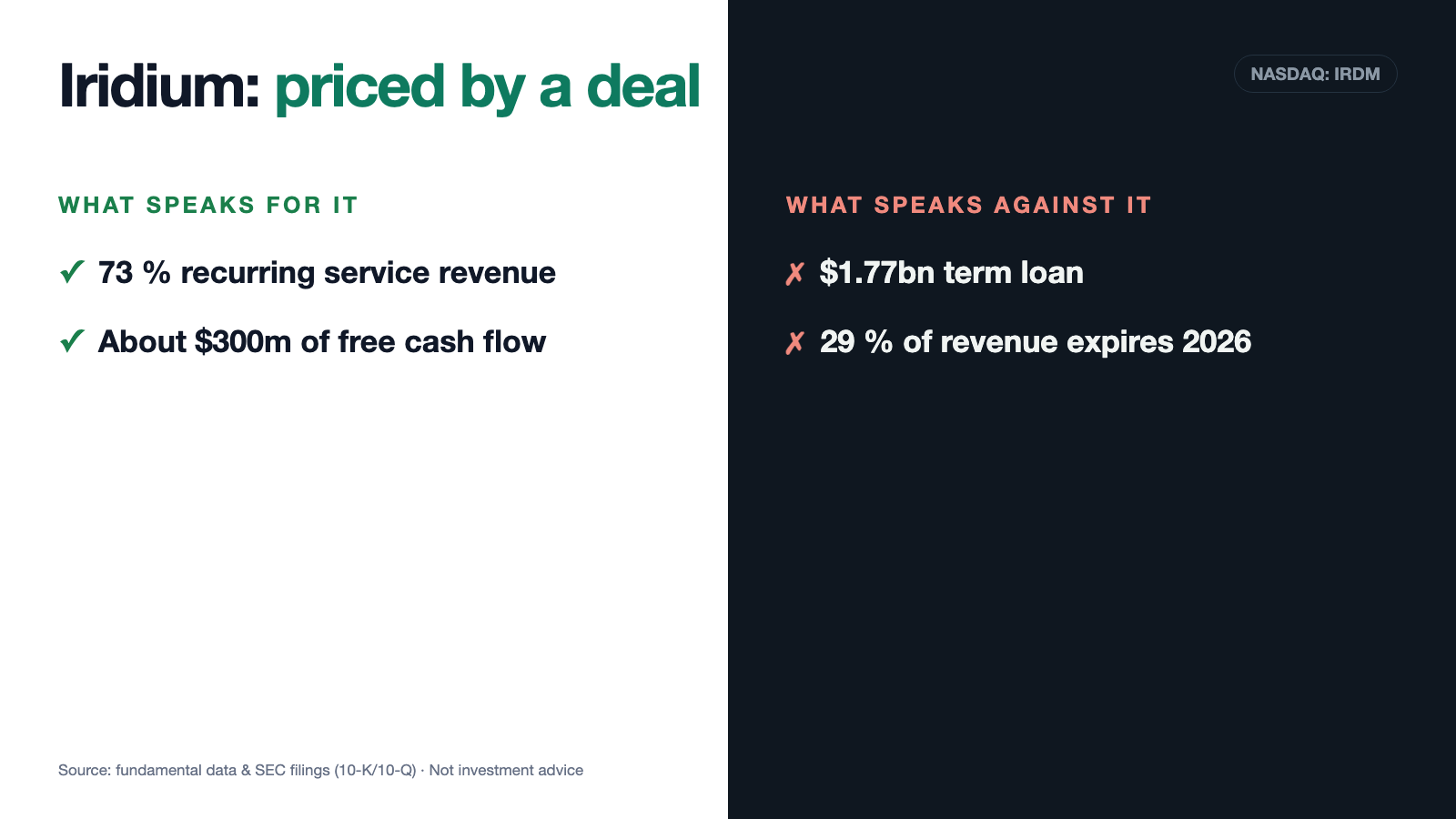
Interactive price chart (TradingView).
Note: pure fact-based analysis, not investment advice and not a solicitation to buy or sell. All figures without guarantee.
There is an impulse that catches even experienced investors: a share price shoots up — at Iridium (NASDAQ: IRDM) by roughly 216 percent in six months — and a voice in your gut says "something is burning there, you need to be in". Call it the bandwagon trap: the reflex to jump on a fast-moving train because it is moving fast, without asking why it moves. A price jump never explains itself. At Iridium it comes from a single, very concrete source: at the end of June 2026 the company signed a takeover offer from Rocket Lab — $27.00 in cash per share, plus stock in the buyer. The train is moving because a buyer jumped on, not because the business suddenly exploded. So let us make a deal: before you chase momentum, we read together what the filings say to the U.S. Securities and Exchange Commission — the solid business and the three places where it grinds. An annual report is honest under penalty of law. You decide at the end.
So you know where we are heading, here is the tension of this analysis: operationally Iridium is a fundamentally sound business — a global satellite network earning three out of four dollars from recurring revenue and throwing off a lot of cash. But right now the stock is not a fundamentals case, it is a deal case: what you buy today is less a bet on Iridium's future than on the merger closing and on Rocket Lab's share price. And underneath sits a balance sheet carrying $1.77 billion of debt. Remember this sentence: a price jump is not a business model — you always need to know who is pulling the train.
What Iridium actually does
Iridium runs something most people have never consciously seen but many have used without knowing: a network of 66 low-earth-orbit satellites (LEO — satellites circling comparatively low, roughly 780 kilometres up, on fast orbits rather than parked far out in geostationary positions). Because those 66 satellites cover the entire globe seamlessly across six orbital planes — including oceans, poles and deserts where no mast stands — Iridium works exactly where normal networks stop. Think of it as a mobile network for the blank spaces on the map.
Who pays for it? Four groups. First, people with satellite phones — sailors, mountaineers, disaster responders, war correspondents. Second, and this is the growth engine, IoT tracking: small, cheap radios that report from anywhere where a container, commercial vehicle, buoy or pipeline is and how it is doing. Third, maritime and aviation — broadband for ships and aircraft. And fourth, by far the largest single customer, the U.S. government: under a dedicated contract (EMSS), tens of thousands of soldiers and agency devices communicate over Iridium. The beauty of this business is that customers pay a fee month after month, much like a phone contract. Such recurring revenue — money that flows again every year without having to win the customer anew — is what investors love: predictable and high-margin.
The takeover that overshadows everything
Before we judge a single metric, the elephant has to go on the table, because it changes the whole calculation. On June 28, 2026 Iridium signed a merger agreement with Rocket Lab Corporation, a listed space and rocket company. Iridium shareholders are to receive $27.00 in cash per share plus a set number of new Rocket Lab shares. The board approved unanimously and all directors committed their votes. It stands in the mandatory filing:
„each issued and outstanding share of common stock of Iridium … will be converted into the right to receive (i) $27.00 in cash (the Cash Consideration) and (ii) a number of shares … of Rocket Lab's common stock … equal to the Exchange Ratio.“
— Iridium Communications Inc., SEC current report on Form 8-K dated June 29, 2026, Item 1.01
What does that mean for you? Three things. First: the rally is the premium. Buyers in takeovers almost always pay a mark-up on the prior price — that mark-up is what lifted the stock roughly 216 percent over six months. It is not a sign that Iridium's business suddenly grows faster. Second: the deal can still fail. Shareholders and antitrust authorities must approve, the outside date runs into 2027, and a termination fee of $223.6 million was agreed. Third, and most importantly: part of the price is not cash at all, but a Rocket Lab share. Anyone buying Iridium today is indirectly betting on the future price of Rocket Lab — a very different, considerably more speculative company. Remember: whoever buys a takeover offer buys part of somebody else's future.
Where the stock shows up in our scanner
We run thousands of stocks through our in-house stock scanner every day. Iridium lights up there conspicuously — and it is almost entirely the momentum and trend-following filters: relative-strength leadership, stage-2 trend systems, price above the rising 50- and 200-day averages, institutional accumulation.
Now the honest part that the bandwagon trap likes to skip: these scanners measure the price move, not its reason. A filter reporting "strong momentum" cannot distinguish between a business firing on all cylinders and a buyer putting a takeover premium on the table. At Iridium it is the latter: almost all of the recent strength is the Rocket Lab premium. That is no flaw in the scanner — it does exactly what it is built to do — but an invitation to look behind the signal. Which is what we do now: first the solid numbers, then the small print.
The numbers over the years
Start with what is genuinely solid. Iridium's revenue has grown steadily: from $721.0 million (2022) through $790.7 million (2023) and $830.7 million (2024) to $871.7 million (2025), a gain of 5 percent a year. The important part sits in the structure of that revenue: $634.0 million — roughly 73 percent — is recurring service revenue, the monthly fees of subscribers. Only a smaller remainder comes from selling devices ($81.1 million, declining) and engineering services ($156.6 million, growing strongly on government projects). A business whose revenue returns predictably three quarters of the time is a good business.
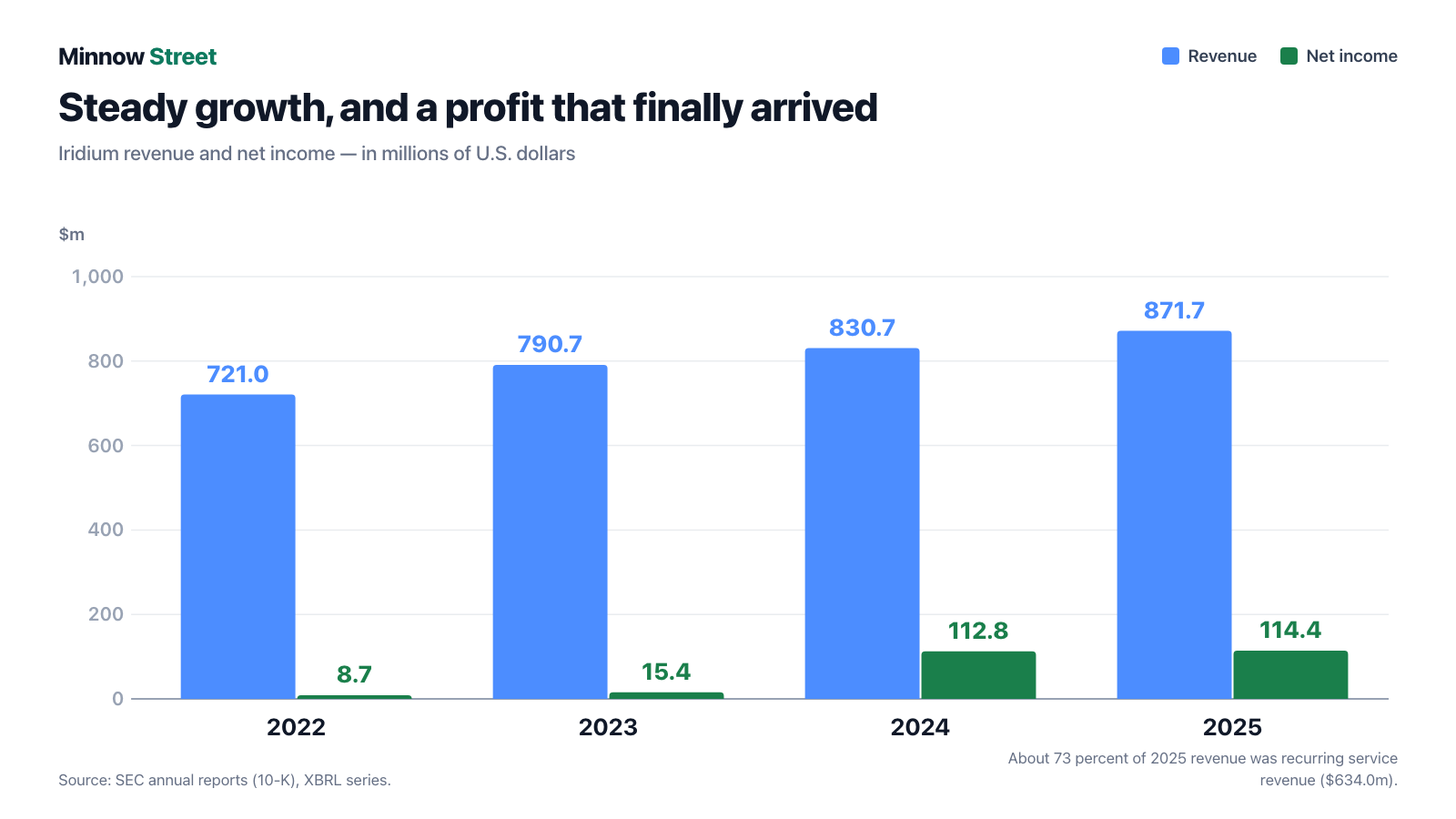
Where does the growth come from? Almost entirely from the IoT business — the small trackers. Their number rose to 1.998 million subscribers (up 6 percent) and revenue to $181.4 million (up 9 percent). Of all 2.537 million subscribers, roughly 79 percent are now IoT. The satellite phone business (voice and data) is shrinking slightly in user numbers but holding revenue. And because the network is already in orbit and only needs operating, Iridium earns well: operating income was $236.0 million in 2025 (a 27 percent margin) and EBITDA roughly $446 million — the large gap is explained by the enormous depreciation on the satellites. Free cash flow came to roughly $300 million. So much for the sunny side. Now the small print.
The uncomfortable truths
Iridium is neither a lossmaker nor a fraud — the uncomfortable truths are therefore quieter, but they decide the risk and reward. Three things: a balance sheet tapped for years to fund buybacks; a powerful new rival in orbit; and a government contract about to expire.
Uncomfortable truth no. 1: heavy debt — and equity that the buybacks nearly consumed
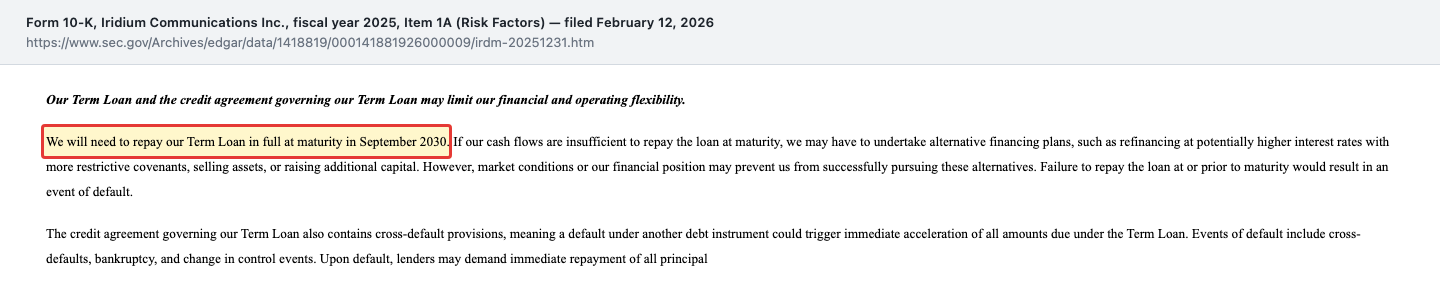
Iridium carries a large loan, a so-called term loan (a bullet bank loan) of $1.77 billion. Measured against operating earnings before depreciation, net debt sits at roughly 3.8 times — bearable for a business with such predictable revenue, but sporty. The catch: the loan falls due in one piece, and Iridium spells out what that means if the cash is not there:
„We will need to repay our Term Loan in full at maturity in September 2030. If our cash flows are insufficient to repay the loan at maturity, we may have to undertake alternative financing plans, such as refinancing at potentially higher interest rates with more restrictive covenants, selling assets, or raising additional capital.“
— Iridium Communications Inc., SEC annual report on Form 10-K, fiscal year 2025, Item 1A Risk Factors
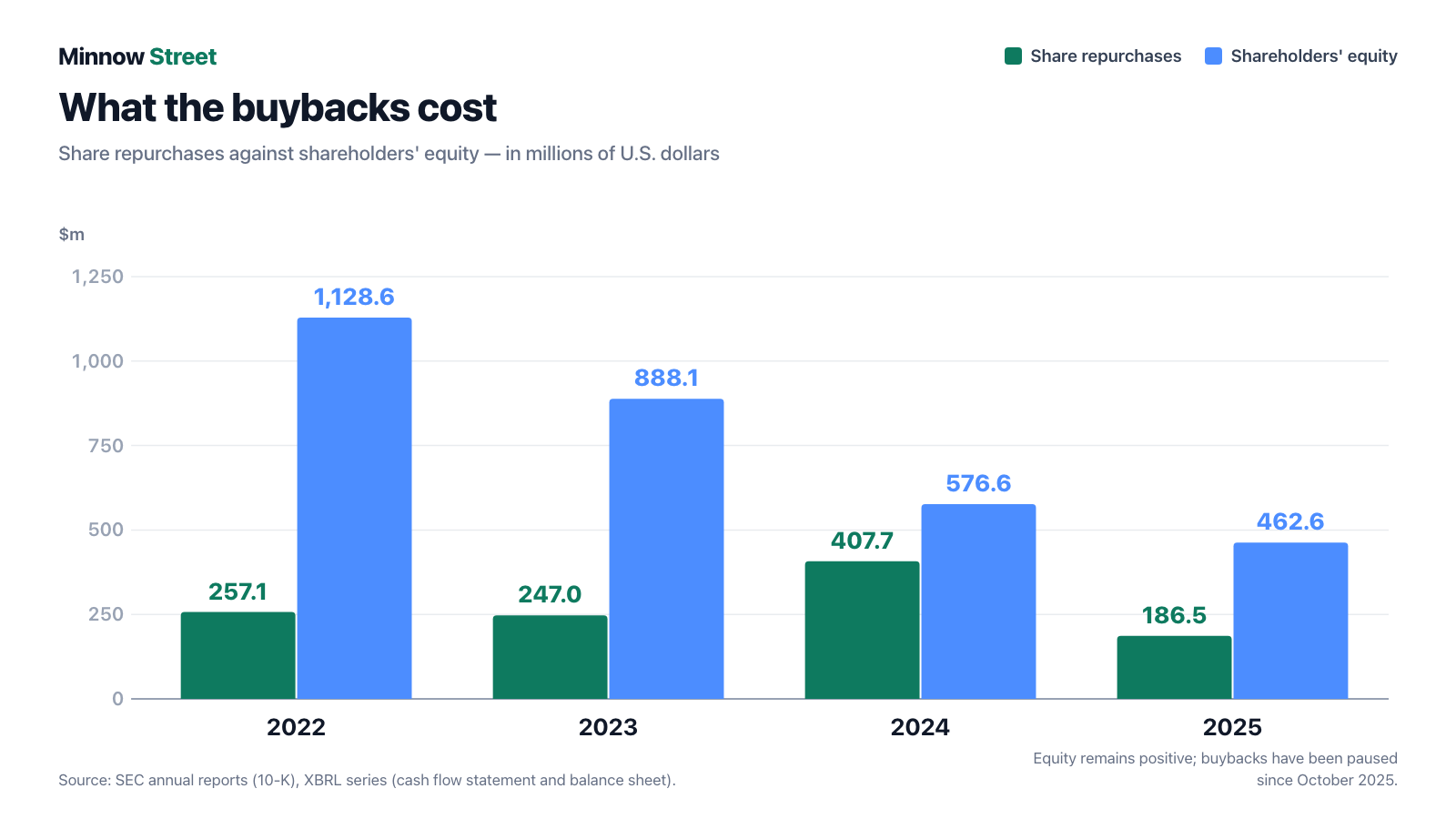
Then a second number you have to understand before taking fright. Iridium has bought back its own shares for years — $186.5 million in 2025 alone, well over a billion cumulatively. That is good for the remaining shareholders, but it has a side effect: shareholders' equity shrank from $1,128.6 million (end of 2022) to $462.6 million (end of 2025), and retained earnings show an accumulated deficit of $418.6 million. Unlike some buyback champions, Iridium's equity is still positive. That matters: it is not an insolvency signal but the arithmetic consequence of returning more money to shareholders than was retained in profits. But the cushion has become thin — which is exactly why Iridium has paused buybacks since October 2025, expressly "to increase financial flexibility". An honest admission that the balance sheet cannot take another bleed. The same pattern of payouts running ahead of the cash that funds them shows up in our analysis of Smith & Wesson.
Uncomfortable truth no. 2: SpaceX and Starlink are pushing into orbit — straight onto the handset
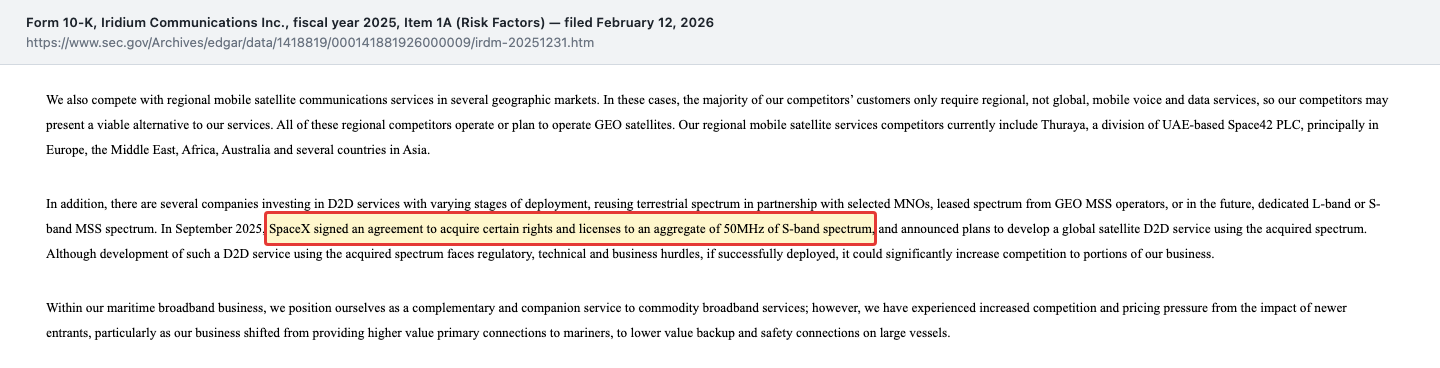
Iridium's moat was long physics: you do not build a global satellite network overnight. That is precisely what is changing. The newcomer is SpaceX with its Starlink network, and the threat has a technical name: direct-to-device (D2D) — satellites talking straight to an ordinary phone, with no special hardware. Iridium names the danger explicitly in the risk section of its annual report:
„Current and new competitors may develop new technologies, or new equipment, including new and proposed LEO constellations and satellite direct-to-device (D2D) services, that could successfully compete with our offerings. For example, in September 2025, SpaceX signed an agreement to acquire certain rights and licenses to an aggregate of 50MHz of S-band spectrum, and announced plans to develop a global satellite D2D service using the acquired spectrum.“
— Iridium Communications Inc., SEC annual report on Form 10-K, fiscal year 2025, Item 1A Risk Factors
How heavily does that weigh? Two things belong alongside it. First, Iridium is not sitting still. It is building its own answer with Iridium NTN Direct — a direct-to-device service based on mobile standards (3GPP) running off the existing network, with commercial launch from 2026. And its strength remains the niche where reliability decides: military, seafaring, industry. Second, honestly: SpaceX has capital, rockets and reach on a scale against which Iridium is small. The satellite-to-handset market could be contested within a few years where Iridium is nearly unchallenged today. That is not an existential risk for tomorrow — but it is the reason a buyer like Rocket Lab wants Iridium precisely now, and why going it alone as a small operator has become riskier.
Uncomfortable truth no. 3: the largest customer is the U.S. government — and the contract expires soon
Iridium's single biggest customer is the U.S. government: directly and indirectly it accounts for roughly $257 million, or 29 percent of group revenue (2025). The centrepiece is the EMSS contract — a fixed annual fee of $110.5 million, regardless of how many government devices actually transmit. A dream of predictability, with an expiry date. Iridium writes it itself:
„The EMSS contract expires in September 2026 … We have begun discussions with the U.S. government on a new EMSS contract, which we expect to enter into later in 2026 or in 2027, prior to expiration of the existing EMSS contract.“
— Iridium Communications Inc., SEC quarterly report on Form 10-Q, Q1 2026
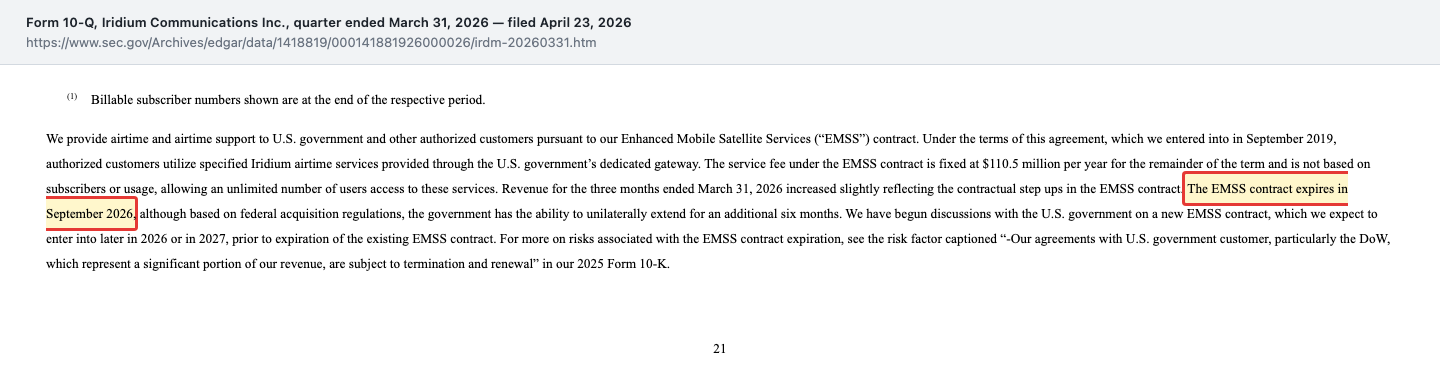
How heavily does that weigh? Iridium has been the U.S. Department of Defense's communications partner for over a decade; a total loss would be a major surprise. An extension is more likely — but on what terms is open, and that is exactly where the risk sits: a new contract could be cheaper for the government and thinner for Iridium. Between a fifth and nearly a third of revenue hangs on a single signature that has not yet been given. Not an existential risk, but a reason not to confuse this revenue quality with that of a broadly spread subscription business.
Valuation — what Iridium costs when the deal makes the price
Now the core question, and at Iridium it has an unusual answer, because the price is currently set not by the market but by the takeover offer. On fundamentals alone Iridium was worth roughly $5.4 billion on the market in mid-2026; adding net debt gives an enterprise value of roughly $7.0 billion. That is about 16 times operating earnings before depreciation (EV/EBITDA) and a price-to-earnings ratio of roughly 44. The free cash flow yield is around 5.5 percent, the dividend $0.60 per share a year (roughly 1.2 percent).
How to read that? On its own it is not cheap — a price-to-earnings ratio of 44 prices in a fair amount of confidence. What matters more is that these metrics are currently secondary: as long as the Rocket Lab offer stands, the share price orients itself on $27.00 in cash plus the value of the Rocket Lab shares, not on EV/EBITDA. For you that means: buying today is not a classic valuation bet but a deal bet — on the merger completing and on Rocket Lab's share price. If the deal fails, the price falls back to what the business justifies fundamentally — and then debt, the EMSS contract and competition matter again. Two very different worlds in one stock. A balance sheet reshaped by financial engineering rather than by earnings is a pattern we also took apart at BRC Group.
Opportunities and risks at a glance
What speaks for Iridium:
- Solid, predictable business: 73 percent recurring service revenue, growing IoT (1.998 million subscribers, revenue up 9 percent), a 27 percent operating margin and roughly $300 million of free cash flow in 2025.
- The takeover offer as a price anchor: Rocket Lab is offering $27.00 in cash plus stock; the board approved unanimously and the directors are bound by voting agreements.
- Its own answer to the D2D threat: Iridium NTN Direct, a standards-based direct-to-device service off the existing network, launching from 2026; a strong niche in military, maritime and industrial use.
- Constellation paid for: the 66 satellites were replaced between 2017 and 2019 and are depreciated over 17.5 years — the big investment cycle is behind the company and ongoing capital needs are moderate.
What speaks against it:
- Deal dependence: the rally is the takeover premium; if the merger fails (shareholders, antitrust, an outside date in 2027, a $223.6 million termination fee), the price falls back to fundamentals. Part of the price is also a Rocket Lab share — a second, more speculative investment.
- Heavy debt: a $1.77 billion term loan due September 2030, net debt roughly 3.8 times EBITDA; equity has been shrunk by buybacks to $462.6 million (positive but thin; buybacks paused).
- Government concentration: 29 percent of revenue from the U.S. government, and the EMSS contract ($110.5 million a year) expires in September 2026 with open terms.
- New competition: SpaceX and Starlink are pushing satellite-to-handset services into parts of Iridium's market, with capital and reach on a far larger scale.
A human conclusion
Remember the bandwagon trap from the start — the reflex to jump on a fast-moving train without asking why it moves? After reading the filings you now know why it is especially treacherous here. The train is not moving because the business suddenly caught fire, but because a buyer jumped on. The 216 percent gain is essentially the Rocket Lab premium — a one-off event, not a sustained run.
And the other half of the truth is just as real: underneath lies a fundamentally sound business with three of every four dollars recurring and decent cash flow — but also $1.77 billion of debt, an equity cushion worn thin, a government contract covering 29 percent of revenue heading into renegotiation, and an overpowering new rival in orbit. None of these on its own is an existential risk. Together they produce the sober conclusion that this stock is currently not a quiet fundamental choice but a special situation: a bet on whether, and on what terms, the takeover succeeds.
What you make of it is your decision. And that is exactly as it should be. What matters is only that you know what you are betting on: not a business suddenly catching fire, but a deal and the shares of another company. A price jump is not a business model — and whoever understands the train before jumping on falls off less often.
Sources
- Iridium Communications Inc. — SEC annual report on Form 10-K, fiscal year 2025 (filed February 12, 2026)
- Iridium Communications Inc. — SEC quarterly report on Form 10-Q, Q1 2026 (filed April 23, 2026)
- Iridium Communications Inc. — SEC current report on Form 8-K dated June 29, 2026 (merger agreement with Rocket Lab Corporation); plus the 8-K dated July 7, 2026 on the increased Aireon stake.
- XBRL company-concept series from the SEC (revenue, net income, shareholders' equity, share repurchases, operating cash flow) for the four-year charts.
- Fundamental data (metrics, valuation, share count series); in-house stock scanner.
Disclaimer: this article is journalism and editorial context, not investment advice. It contains no buy or sell recommendation and cannot take personal circumstances into account. Share prices fluctuate and total loss is possible. Make your investment decisions on your own responsibility and seek independent advice if in doubt.
Our Bottom Line at a Glance
- Business model & recurring revenue positive
- A fundamentally sound network business: 66 low-earth-orbit satellites with global coverage, 73 percent recurring service revenue ($634.0 million), a growing IoT business (1.998 million subscribers, revenue up 9 percent), a 27 percent operating margin and roughly $300 million of free cash flow. Revenue that returns predictably three quarters of the time.
- Rocket Lab takeover (special situation) neutral
- The dominant special situation: a merger agreement signed June 28, 2026 with Rocket Lab ($27.00 cash plus Rocket Lab stock, board unanimous, termination fee $223.6 million, outside date in 2027). The roughly 216 percent gain is essentially that premium. Opportunity and risk at once: the deal sets a price anchor but can fail, and part of the price is a more speculative Rocket Lab share.
- Debt & equity negative
- Term loan $1.77 billion (due September 2030), net debt roughly 3.8 times EBITDA. Years of buybacks shrank equity from $1,128.6 million (2022) to $462.6 million (2025), with an accumulated deficit of $418.6 million in retained earnings. Equity is still positive (no insolvency signal) but thin — buybacks paused since October 2025.
- Government concentration & competition negative
- Two structural findings: the U.S. government accounts for 29 percent of revenue, and the EMSS contract ($110.5 million a year) expires in September 2026 with terms still open. At the same time SpaceX and Starlink are pushing satellite-to-handset (D2D) services into parts of the market, with far greater capital and reach — even though Iridium counters with NTN Direct.
- Valuation & price neutral
- Not cheap on fundamentals: EV/EBITDA around 16, price-to-earnings around 44, free cash flow yield roughly 5.5 percent, dividend about 1.2 percent (mid-2026). But the metrics are secondary while the offer stands: the price orients on $27.00 in cash plus the value of the Rocket Lab shares. Entering is a deal bet, not a classic valuation bet.
Operationally Iridium is a fundamentally sound satellite business: 66 low-earth-orbit satellites, 73 percent recurring service revenue, a growing IoT business and roughly $300 million of free cash flow. But the stock is currently not a fundamentals case, it is a takeover case: on June 28, 2026 Iridium signed an offer from Rocket Lab ($27.00 cash plus stock) — the roughly 216 percent rally is essentially that premium. Underneath sit $1.77 billion of debt, equity shrunk by buybacks to $462.6 million (still positive), a government contract covering 29 percent of revenue heading into renegotiation, and SpaceX and Starlink as a new rival. A takeover offer is not a business model. Not investment advice.
What Our Rating Means
Open questions
The business works in principle, but one material question is open. As long as it stays open, our findings do not carry a quality verdict.
The operating business is robust: $871.7 million of revenue in fiscal 2025 (up 5 percent), $114.4 million of net income, and with $634.0 million of recurring service revenue 73 percent of sales come from standing contracts; commercial IoT keeps growing with 1.998 million subscribers. Nothing supports red: equity is positive at $462.6 million, there is no going-concern doubt, and the term loan does not mature until September 2030. Three things rule out green. First, leverage: a $1.77 billion term loan and net debt at roughly 3.8 times operating earnings before depreciation. Second, the hollowed-out balance sheet: years of buybacks — $186.5 million in 2025 alone, paused since October 2025 — shrank equity from $1,128.6 million in 2022 to $462.6 million, with an accumulated deficit of $418.6 million in retained earnings. Third, two open structural questions: the EMSS government contract worth $110.5 million a year expires in September 2026 and is being renegotiated, and SpaceX acquired spectrum in 2025 for a competing satellite-to-handset service.
A journalistic assessment by our editorial team at the time of the deep dive, based on public sources — not investment advice and not a solicitation to buy or sell. Your personal circumstances (investment goals, risk capacity, taxes) cannot be taken into account. What our levels mean, how verdicts are formed, and what conflicts of interest exist →
Worth Noting
- Correction carried over in this re-edition: the German chart plotted shareholders' equity of $1,124.6 million against the 2023 label. The SEC XBRL series gives $1,128.6 million for 2022 and $888.1 million for 2023 — the German figure matched neither year. Both language versions now use the XBRL series for 2022 to 2025, so every bar traces back to a filed annual report.
- Price and valuation figures are dated to mid-2026 (market capitalisation ~$5.4bn, EV ~$7.0bn, EV/EBITDA ~16, P/E ~44); annual figures refer to fiscal 2025 and quarterly figures to Q1 2026. Analyses are evergreen and daily prices are not a buying argument. The roughly 216 percent gain over six months is essentially the takeover premium, not operating momentum.
- Special-situation screening: the pending Rocket Lab takeover (merger agreement June 28, 2026, 8-K dated June 29, 2026) is the dominant special situation; in addition an 8-K dated July 7, 2026 covers the increased Aireon stake and related debt. Otherwise no material litigation, no material weakness and no current activist — only passive SC 13G holders (BlackRock 12.4 percent, Baralonco 9.9 percent).
- AI classification: neutral (documented negative finding). Iridium mentions artificial intelligence only defensively, as a generic competitive and adaptation risk in Item 1A — the company must integrate AI into processes and products as well as competitors do — with no concrete AI revenue source and no documented operational AI use. That is enough for neither "sells" nor "uses" nor "threatened".
Frequently Asked Questions
Iridium operates a global satellite network of 66 low-earth-orbit satellites for voice and data where no mobile network reaches: satellite phones, IoT tracking of vehicles and containers, broadband for ships and aircraft, and communications for the U.S. government. Roughly 73 percent of revenue is recurring service fees. It is based in McLean, Virginia, with about 975 employees; the fiscal year ends December 31.
Mainly because of a takeover. On June 28, 2026 Iridium signed a merger agreement with Rocket Lab providing for $27.00 in cash per share plus Rocket Lab stock. Takeovers are almost always paid at a premium — that premium explains the gain of roughly 216 percent over six months. It is a takeover premium, not a business suddenly growing faster.
No. Shareholders' equity is positive but has shrunk sharply through years of buybacks — from $1,128.6 million at the end of 2022 to $462.6 million at the end of 2025, with an accumulated deficit of $418.6 million in retained earnings. That is not an insolvency signal but the consequence of returning more money to shareholders than was retained in profits. The real burden is the term loan of $1.77 billion. Buybacks have been paused since October 2025.
Iridium carries a term loan (a bullet bank loan) of roughly $1.77 billion due in September 2030 at a floating rate (reference rate plus 2.25 percent). Net debt equals roughly 3.8 times operating earnings before depreciation (EBITDA). For a business with such predictable revenue that is bearable but sporty — and the loan has to be repaid or refinanced in one piece in 2030.
Prospectively yes. SpaceX acquired spectrum in 2025 to build a worldwide satellite-to-handset service (direct-to-device) with Starlink — Iridium names this explicitly as a competitive risk in its annual report. Iridium counters with its own service (Iridium NTN Direct, launching from 2026) and is strong in niches such as military and maritime. But SpaceX's capital and reach are far larger, and the market is likely to become more contested.
It turns the stock into a special situation. Buying today is less a bet on Iridium's fundamentals than on the merger completing and on Rocket Lab's share price, since its stock is part of the offer. The deal needs shareholder and antitrust approval, the outside date runs into 2027, and a termination fee of $223.6 million applies. If it fails, the price reorients on the fundamental numbers.
Found an error?
Did you spot a factual error, an outdated number, or a typo in this deep dive? Let us know briefly — your report goes straight to the editorial team.