Zegona Communications: 69 Percent of Its Shares Wiped Out, Equity Flipped Negative
A British telecom holding company trades at a market capitalization of roughly £3.4 billion — and, in the very same annual report, discloses negative consolidated group equity of EUR 869 million. Not an accounting error, but the result of one of the largest capital returns a company this size has pulled off in a short span: EUR 1.6 billion paid to shareholders, 69 percent of all shares cancelled — with a former seller who was, for two years, effectively the majority shareholder himself, sitting in the middle of it. We read the annual report and the latest quarterly update, held one balance sheet against the other, and explain why the company is nonetheless not an emergency. Not investment advice — just the question of which balance sheet actually counts here.
 Thomas Mücke
Founder & Publisher
Thomas Mücke
Founder & Publisher
Chart
Interactive price chart (TradingView).
Note: pure fact-based analysis, not investment advice and not a solicitation to buy or sell. All figures without guarantee.
Picture this: you're flipping through a group balance sheet and you stumble on a single line: "Total equity: minus EUR 869 million." What happens in your head? For most people, an alarm goes off instantly — minus sign plus big number equals emergency, equals get out now. Call this the red-ink reflex: a single negative sign hijacks your judgment before you've even read the next line. So let's make a deal: before we let that one sign tell us what to think, we read the full annual report together — balance sheet against balance sheet, line against line. The stock is Zegona Communications plc (London Stock Exchange: ZEG), and here's the headline up front, because it carries the whole story: yes, consolidated group equity really is negative. And no, that doesn't mean what your first reflex is telling you.
What Zegona actually does — a corporate shell around a Spanish telecom network
Zegona Communications plc (incorporated in England and Wales, company number 09395163) is not itself a telecom operator, but a holding company founded in 2015 — run by Eamonn O'Hare (Chairman & CEO) and Robert Samuelson, both previously executives at Virgin Media. Its stated business model: buy European telecom, media, and technology businesses, improve them operationally, then sell or distribute the proceeds at a profit. Before Vodafone Spain, the same team had already run this playbook twice in Spain — with Telecable (sold in 2017) and Euskaltel (built up, then acquired by MasMovil in 2021). Buying the stock, in other words, is not primarily buying a network — it's buying a management promise: "We buy undervalued telecom assets and turn them around profitably."
In June 2024, Zegona executed that promise on its largest scale yet: the acquisition of Vodafone Spain (legally Vodafone Holdings Europe, S.L.U. and the operating Vodafone España entities) from Vodafone Group. Since then, the group has run Spain's fixed-line, fiber, and mobile business under the Vodafone and Lowi (the cheaper second brand) names — as of June 30, 2026, with 2,592,000 broadband connections and 12,864,000 mobile connections. That is the same market in which Spanish rival MasOrange and other operators compete for share — a fiercely contested, but also large and mature market.
Network operators like Vodafone Spain need constant fresh capital for fiber build-out — over the past two years, Zegona has taken an unusual route to fund it. Instead of financing the network alone, the group folded it into two joint ventures with financial investors, so-called "FiberCos." Picture a landlord who sells a stake in the building to a fund and collects a large sum up front in exchange, rather than gathering rent month by month: FiberPass (with Telefónica and insurer AXA) and PremiumFiber (with Spanish rival MasOrange and Singapore's sovereign-wealth vehicle GIC) together brought Vodafone Spain EUR 1.8 billion in upfront payments — and that money is the starting point for everything else in this analysis. A network operator that also plays a role in our Nokia stock analysis from the same newsletter volume — there as network equipment supplier, here as network operator: two different ends of the same telecom-infrastructure story.
Why there is no SEC filing here — and where the numbers come from instead
One point first, because it shapes the entire evidence base of this analysis: Zegona files no 10-K, no 10-Q, no 20-F. A search of the U.S. securities regulator's EDGAR company database, the SEC, for "Zegona" returns no result at all — the company is not a U.S. reporting entity. Zegona is listed on the Main Market of the London Stock Exchange and falls under UK capital-markets rules: mandatory disclosures run through the UK Financial Conduct Authority's National Storage Mechanism and the RNS news service, alongside the audited annual report itself.
This analysis rests primarily on the audited Annual Report 2026 (fiscal year April 1, 2025 to March 31, 2026), signed by Ernst & Young LLP and published on June 16, 2026 — plus the FY27 Quarter 1 results of July 15, 2026, the most recently published interim update, and the results presentation for the fourth quarter of fiscal 2026. Data attribution throughout this piece therefore reads: fundamental data & company reports (annual/interim report, London Stock Exchange) — not "SEC filings," which simply do not exist here.
How this stock reached our desk — a reader's tip, not a scanner hit
Honesty first: our in-house stock scanner does not know Zegona — and it could not. The scanner's universe is built primarily around U.S.-listed names; a holding company priced in British pence on the London Stock Exchange simply does not appear there. No Piotroski score, no momentum signal — not because the stock is uninteresting, but because our radar does not cover this water.
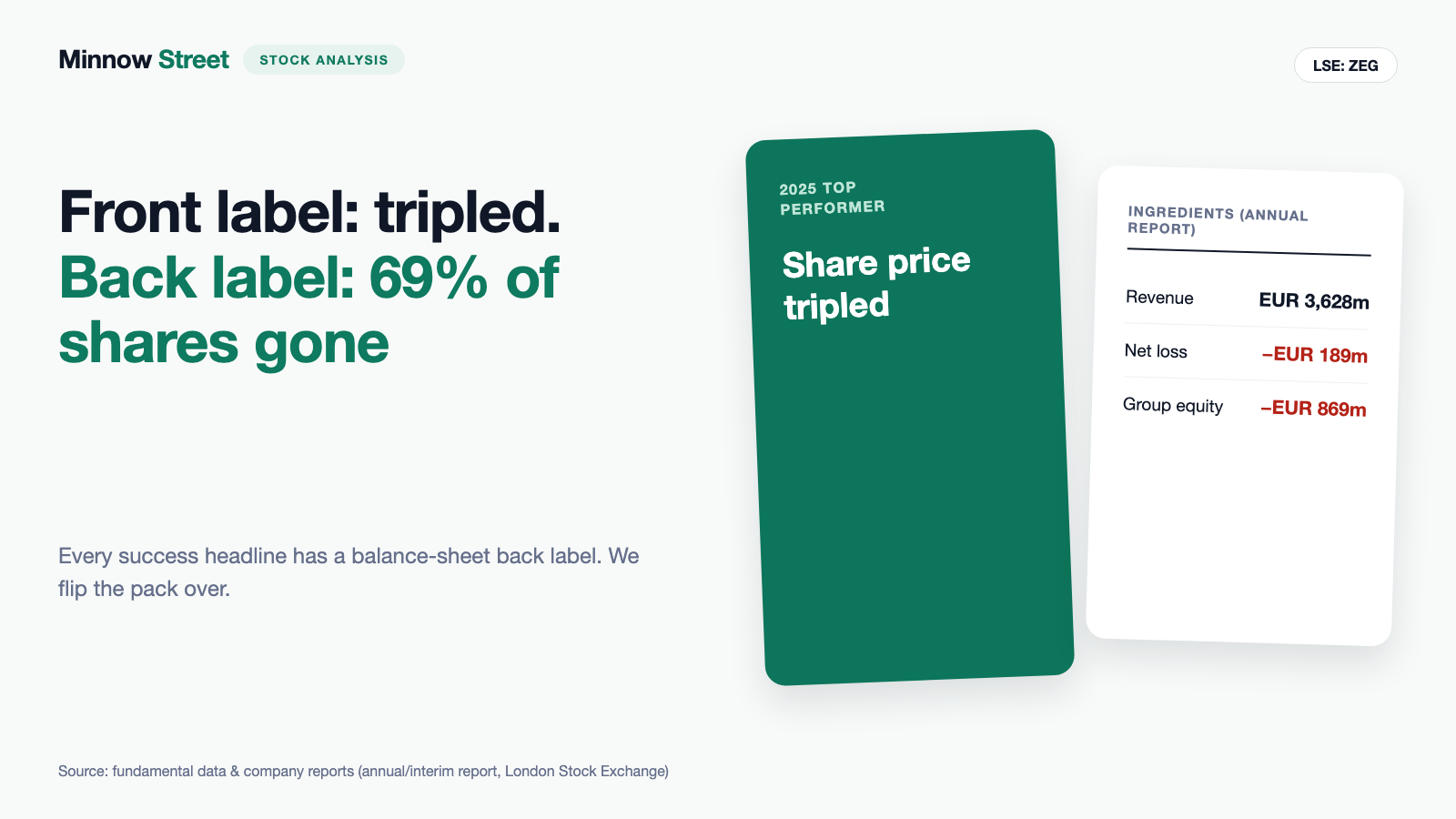
Instead, Zegona reached our desk because a reader forwarded us an issue of a newsletter he subscribes to: "Hot Stocks Europe," issue 24, dated November 28, 2025 (B-Inside International Media GmbH, Freiburg, Germany). On page 1, in the year-end review "2025 Top Performers," Zegona appears in a single line: "Zegona Communications: share price tripled." No metric, no quarterly figure, no analyst commentary — just that one line, listed alongside other 2025 success stories such as Steyr Motors (up 1,256 percent after a short squeeze) and Nebius. The newsletter cites not a single company figure for Zegona; every number in this analysis comes from the annual report and the company's own interim announcements, not from the newsletter.
Part of putting this in context is the conflict-of-interest notice the newsletter itself prints on page 8: the publisher, the author, or related parties may hold long positions in stocks discussed and may intend to sell as prices rise (EU Market Abuse Regulation 596/2014). We are not adopting any recommendation from that newsletter — not even a single metric — just the nudge to look closer. And a closer look shows: the real story only started after November 28, 2025. On December 11, 2025, Zegona announced a share-buyback program; on January 7, 2026, a EUR 1.4 billion special dividend followed, together with the cancellation of 69 percent of all shares — events the newsletter could not have known about yet. For long-term context: since a capital raise in September 2023 at £1.50 per share, the stock price had, according to management's own account in the annual report, risen more than elevenfold by March 31, 2026 — a scale that lines up with the newsletter's "tripled" if you measure only calendar year 2025, but is just one stretch of the full run.
The numbers over the years — what genuinely impresses
Credit where it's due first. Because Zegona only acquired Vodafone Spain in June 2024, the group's statutory prior-year income-statement comparison covers 15 months to March 31, 2025 (only 10 of them with Vodafone Spain) — not a clean twelve-month comparison. The company therefore also publishes a separate twelve-month operating comparison for the Spanish core business, which we use here because it genuinely compares year against year. This mismatched fiscal year — Zegona's financial year runs April 1 through March 31, not the calendar year — is itself worth flagging: every "fiscal 2026" figure in this piece means the twelve months to March 31, 2026, not the 2026 calendar year.
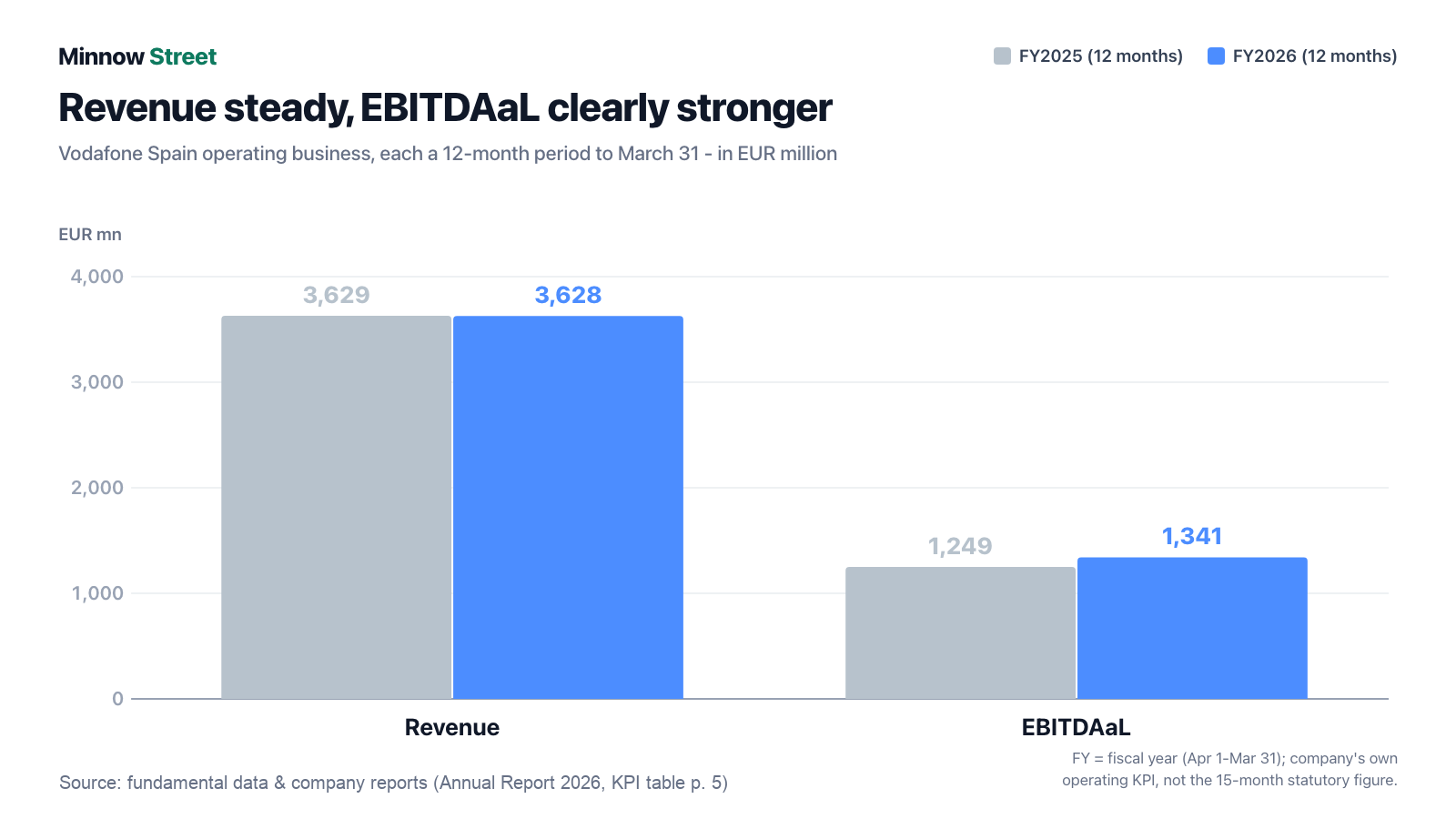
Revenue held nearly flat at EUR 3,628 million (prior year EUR 3,629 million) — but operating profit measure EBITDAaL (EBITDA after leasing costs: operating profit before interest, tax, and depreciation, but after network lease costs — the metric the company itself emphasizes most) rose from EUR 1,249 million to EUR 1,341 million, up 7.4 percent. Even more telling is the trend in revenue itself: after several flat-to-declining quarters, revenue grew year-over-year again for the first time in the third quarter of fiscal 2026 (EUR 923 million versus EUR 913 million, up 1.1 percent), by 2.0 percent in the fourth quarter (EUR 915 million versus EUR 897 million) — and again by roughly 2 percent in the first quarter of the new fiscal 2027 (three months to June 30, 2026), to EUR 916 million. Three consecutive quarters of growth, after two years of stagnation: that's the evidence that something is genuinely turning in the customer business, not just in the capital structure.
Debt also moved the right way in fiscal 2026. Net debt fell from EUR 3.7 billion to EUR 3.2 billion, and leverage (net debt relative to EBITDAaL) from 2.9x to 2.4x. On July 14, 2026, the group completed a EUR 3.7 billion refinancing — by its own account saving roughly EUR 60 million a year in interest. Interest costs fell accordingly, from roughly EUR 294 million at the time of the acquisition (2024) through EUR 230 million (as of March 2026) to a projected roughly EUR 170 million a year going forward. Operating cash flow for fiscal 2026 came in at EUR 2,477.2 million (prior year, 15-month basis: EUR 1,421.4 million) — an impressive figure that, as the next section shows, is not quite what it first appears to be.
What the annual report shows — the uncomfortable truths
Uncomfortable truth #1: consolidated group equity is negative — because the company returned EUR 1.6 billion to shareholders
Here is the line that triggers the red-ink reflex. The audited consolidated accounts show total equity of minus EUR 869.1 million as of March 31, 2026 — as of March 31, 2025, it was still plus EUR 816.6 million. A decline of EUR 1.69 billion in twelve months.

The reason is not an operating downturn, but a deliberate decision: in fiscal 2026, Zegona paid a special dividend of EUR 1.4 billion (funded from the FiberCo upfront payments) and ran a share-buyback program of up to EUR 200 million — together the EUR 1.6 billion of capital return the company itself cites. Tied to that was the cancellation of 523,240,603 shares, 69 percent of all shares previously outstanding.
"In FY26 we returned €1.6b to shareholders. This included a €1.4b special dividend paid in January 2026, resulting in the cancellation of 523 million Zegona ordinary shares (a 69% reduction in the share count), the full repayment of the Vodafone Group financing, and a €440m cash distribution to the remaining shareholders (£1.62/share)."
— Zegona Communications plc, Annual Report 2026, Business and Financial Review, p. 7
A capital return of this scale inevitably eats into equity — whenever a company pays out more to shareholders than it earns over the same period, book equity falls, entirely independent of how well the operating business is doing. At Zegona, it even flipped the sign completely, because the payout (EUR 1.6 billion) far exceeded existing retained profit. Remember this: negative equity tells you how much a company has paid out, not necessarily how it's doing.
And this is exactly where the second look helps — the one the red-ink reflex prevents. For a UK public company, it is not the consolidated group balance sheet that legally governs whether a distribution can be made at all, but the standalone accounts of the parent company, Zegona Communications plc itself. And that tells a completely different story: equity of EUR 1,151.1 million as of March 31, 2026 (prior year: EUR 1,352.3 million) — clearly positive, despite the same EUR 1.6 billion payout, because the parent carries its investment in subsidiaries at cost rather than consolidating their entire (debt-financed) asset and liability structure.
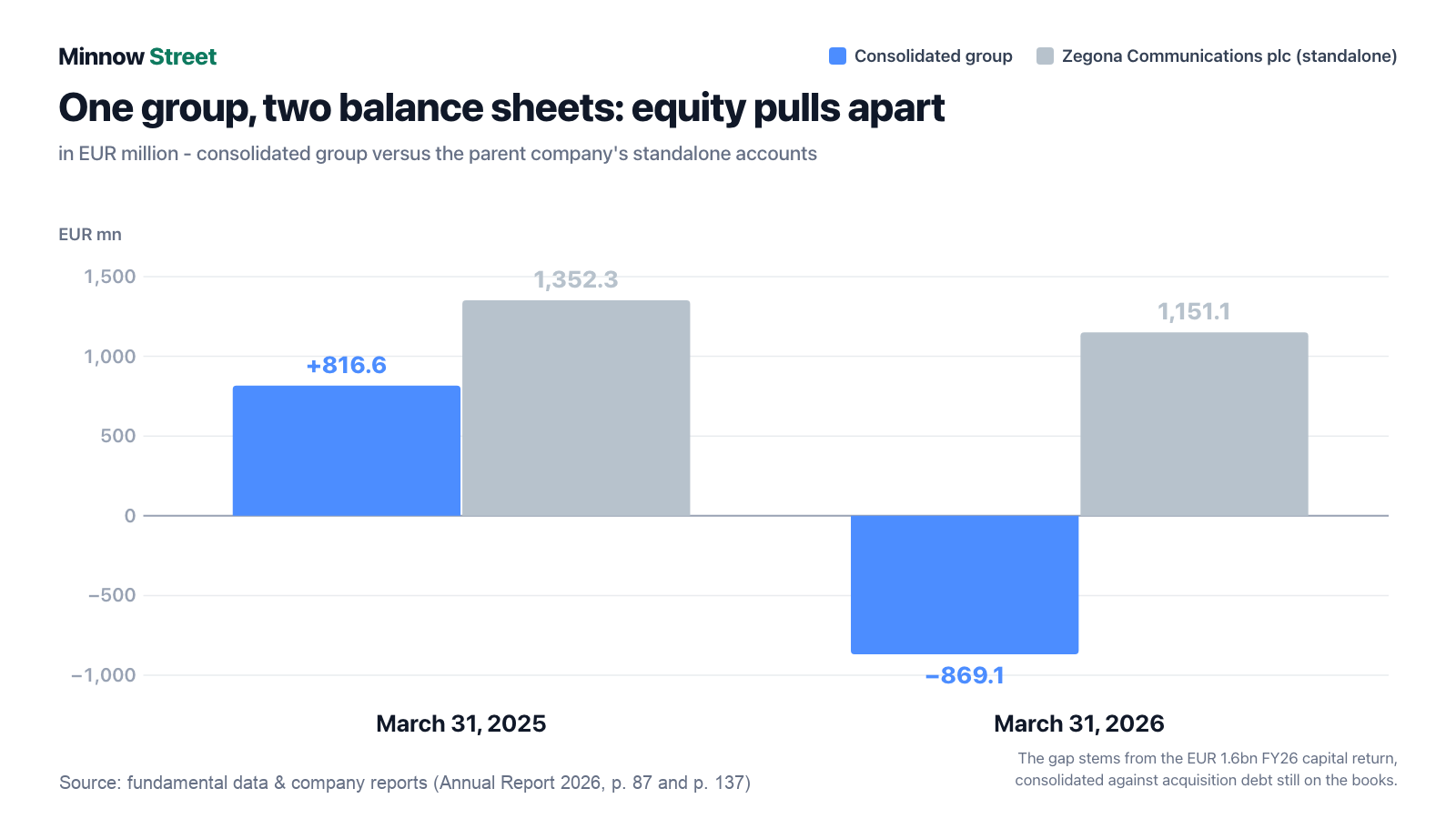
Important for context: auditor Ernst & Young raised no going-concern doubt despite the negative consolidated equity — including a "reverse stress test" that checks how far results would need to deteriorate before lending covenants would be breached. Management sees "significant headroom" through at least December 31, 2027. Negative consolidated equity is, in other words, a real, reportable balance-sheet fact — but not a crisis signal, as long as you don't confuse it with the standalone accounts that actually govern distributions.
Uncomfortable truth #2: the seller was itself effectively Zegona's majority shareholder for two years
Trace the 523.2 million cancelled shares further back and you run into a structure few would expect at first glance: those shares belonged, until January 7, 2026, to a company called EJLSHM Funding Ltd. In October 2023, that entity had subscribed for new Zegona shares worth EUR 900 million — money that went directly into the Vodafone Spain acquisition (labeled "Vodafone Financing" in the annual report). In plain terms: a significant part of the purchase price for Vodafone Spain was financed through an equity stake that ultimately amounted to 69 percent of the entire share capital — controlled through a financing vehicle connected to the seller.
"The special dividend payable in respect of the shares held by EJLSHM Funding, an amount of €974m, was paid directly to Vodafone Consolidated Holdings Limited in order to facilitate the redemption of the special shares issued by EJLSHM Funding and payment of the contractual coupon rate. Upon redemption these shares were subsequently cancelled."
— Zegona Communications plc, Annual Report 2026, Note 20, "Dividends," p. 122
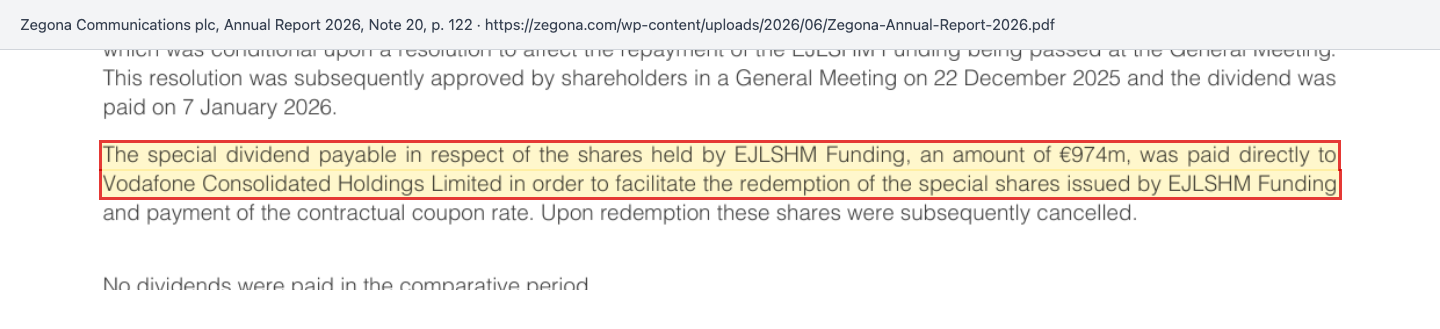
The annual report confirms the sequence explicitly elsewhere by name: on January 7, 2026, the "Vodafone Financing" was fully repaid; on January 8, 2026, the 523,240,603 shares held by EJLSHM Funding Ltd were converted into deferred shares carrying no material economic rights, then bought back for a nominal one British pound and cancelled. Economically speaking, then, Vodafone was not just the seller of the Spanish business, but — through this structure — was also, for two years, effectively holding a majority stake in Zegona itself. That fact never shows up on any share-price chart, but it explains why the company had to return so much capital in fiscal 2026: part of that payout was simply unwinding this seller financing, not purely a gift to independent shareholders.
Uncomfortable truth #3: the shiny operating cash flow is largely prepaid network rent, not pure customer revenue
Operating cash flow of EUR 2,477.2 million against group EBITDAaL of EUR 1,325 million looks unusual at first glance — operating cash flow normally sits below EBITDAaL, not almost double it. The reason sits in the same balance-sheet item that already carries the FiberCo story: "contract liabilities" rose from EUR 505 million (March 31, 2025) to EUR 2,011.7 million (March 31, 2026) — an increase of roughly EUR 1.5 billion.
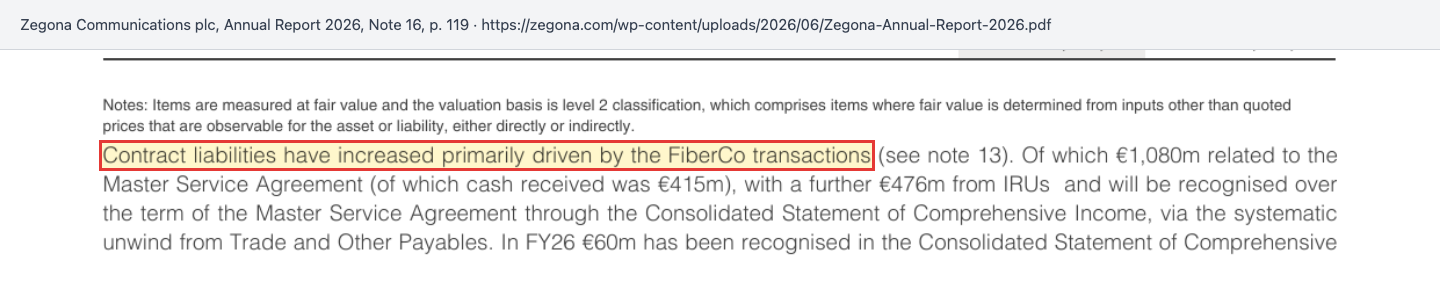
"Of which €1,080m related to the Master Service Agreement (of which cash received was €415m), with a further €476m from IRUs and will be recognised over the term of the Master Service Agreement through the Consolidated Statement of Comprehensive Income, via the systematic unwind from Trade and Other Payables. In FY26 €60m has been recognised in the Consolidated Statement of Comprehensive Income."
— Zegona Communications plc, Annual Report 2026, Note 16, "Trade and Other Payables," p. 119
In plain terms: the FiberCo partners didn't just buy a stake in Vodafone Spain — they also prepaid decades of network-access rights up front, like a tenant wiring over ten years of rent in a single transfer. On the books, that money is not yet revenue but a liability, which only "thaws" year by year and then appears as revenue: of roughly EUR 2 billion of contract liabilities, just EUR 60 million was booked as revenue in fiscal 2026. For the cash flow statement, though, the cash inflow already counts as operating cash flow today — hence the unusually high figure. This is not an accounting trick (the disclosure is complete and transparent), but it does mean: anyone who simply extrapolates fiscal 2026's operating cash flow as "sustainable annual earning power" is overstating it — a substantial part of it is a one-time upfront cash receipt that will not repeat at this scale every year.
Valuation — two currencies, one price
Zegona trades in British pence (GBX) but reports in euros — a combination worth watching closely when you do the math. As of the July 24, 2026 close, the stock traded on the London Stock Exchange at 1,500 GBX, or GBP 15.00. Against 225,503,802 shares (fundamental-data feed, as of July 24, 2026 — close to the 226,163,802 shares the annual report itself cites as of May 29, 2026, the gap explained by the ongoing buyback program), that implies a market capitalization of roughly GBP 3.38 billion.
Converted at the European Central Bank's reference rate of July 24, 2026 (1 euro = 0.85388 British pounds), that works out to roughly EUR 3.96 billion. Add the most recently reported net debt (EUR 3.214 billion as of March 31, 2026, converted at the same rate to roughly GBP 2.74 billion), and enterprise value comes to roughly EUR 7.18 billion, or GBP 6.13 billion — against group-wide EBITDAaL for fiscal 2026 (EUR 1,325 million), a multiple of roughly 5.4. Measured against revenue (EUR 3,628 million, or roughly GBP 3.10 billion), the price-to-sales ratio is roughly 1.1 — not a conspicuously cheap valuation for an established, margin-strong telecom operator, but not a stretched one either. A price-to-earnings ratio can't be meaningfully calculated given the group's net loss (EUR 189.4 million in fiscal 2026).
Management itself describes the stock, in its investor presentation, as "significantly undervalued" relative to comparable telecom names, measured on enterprise value to operating cash flow — an assessment that, naturally, comes from the company itself and is no substitute for an independent analyst view. We are not aware of any more recent independent price target than the "share price tripled" note from the newsletter cited at the top of this piece, dated November 28, 2025. Since February 27, 2026, the stock has been part of the MSCI United Kingdom Index, and since March 23, 2026, the FTSE Global Equity Index Series (Developed Europe) — both inclusions that typically trigger automated buying from index funds and confirm the stock's higher market capitalization, but are likewise not a valuation call.
Opportunities and risks at a glance
What speaks for Zegona:
- Three consecutive quarters of revenue growth after two years of stagnation (Q3 FY2026 up 1.1 percent, Q4 FY2026 up 2.0 percent, Q1 FY2027 up roughly 2 percent), alongside a rising EBITDAaL margin at the Spanish core business (from 34.4 percent to 37.0 percent year over year).
- Falling debt and falling interest costs: net debt down from EUR 3.7 billion to EUR 3.2 billion, leverage down from 2.9x to 2.4x EBITDAaL, plus a EUR 3.7 billion refinancing completed on July 14, 2026 that saves roughly EUR 60 million a year in interest.
- Two monetized fiber joint ventures (FiberPass, PremiumFiber) give Vodafone Spain, by the company's own account, permanent access to a 100-percent-fiber network reaching roughly 16 million homes passed, without the group having to fund the entire build-out on its own.
- EUR 5.6 billion of unrecognized Spanish tax-loss carryforwards should keep the actual tax bill low for years to come (group tax paid in fiscal 2026: just EUR 1.1 million).
- A going-concern confirmation from auditor Ernst & Young despite negative consolidated equity, including a reverse stress test the company says shows "significant headroom" through at least the end of 2027; the parent company's standalone accounts remain solidly positive at EUR 1.15 billion of equity.
What speaks against it:
- Consolidated group equity of minus EUR 869.1 million as of March 31, 2026 is a real, reportable balance-sheet fact — even though it is a consolidation effect rather than a crisis signal, it could still influence lenders, rating agencies, or future counterparties.
- Absolute net debt remains substantial at EUR 3.2 billion, at a group concentrated on a single country (Spain) and essentially a single operating business.
- The unusually high operating cash flow for fiscal 2026 (EUR 2,477.2 million) is substantially driven by one-time FiberCo upfront payments, not ongoing customer revenue — a repeat at this scale is not to be expected.
- A complex, historically seller-entangled ownership structure: until January 2026, a financing vehicle connected to seller Vodafone held 69 percent of the shares — a structure that has since been unwound, but shows how dependent the prior capital structure was on this single arrangement. We dissected a similarly interlocking structure with a dominant anchor shareholder in our Biglari stock analysis.
- No recent independent analyst estimate is known to us; the "tripled" observation cited by the newsletter carries no supporting figures and is several months old.
A human conclusion
Back to the red-ink reflex from the opening. A negative sign in front of a big number always feels like an emergency — and sometimes it is. At Zegona, it wasn't: the minus EUR 869.1 million of consolidated group equity is the arithmetic result of one of the largest capital returns a company this size has pulled off within a single year, entangled with unwinding a two-year-old seller financing that had made former owner Vodafone effectively the majority shareholder itself. The operating business behind it — a Spanish telecom operator with three consecutive quarters of growth, falling debt, and a refinancing just completed on better terms — looks considerably calmer than the balance-sheet line that catches the eye first.
That doesn't mean everything is fine: EUR 3.2 billion of net debt, a single core country, and an operating cash flow partly built on upfront payments are real, sober risks worth weighing — not a reason to sound the all-clear, but no reason to panic either. What you make of all this is your decision. And that is exactly as it should be.
Sources
All original documents used in this analysis — for your own further reading:
- Zegona Communications plc — Annual Report 2026 (audited consolidated and standalone accounts, signed by Ernst & Young LLP, published June 16, 2026)
- Zegona Communications plc — FY27 Quarter 1 results (three months to June 30, 2026, published July 15, 2026)
- Zegona Communications plc — Q4 FY26 Results Presentation (June 2026)
- Zegona Communications plc — EUR 3.7bn Refinancing Delivers EUR 60m Savings (June 26, 2026)
- Zegona Communications plc — Zegona promoted into the FTSE Global Equity Index Series (March 24, 2026)
- Zegona Communications plc — Zegona promoted into the MSCI United Kingdom Index (February 27, 2026)
- SEC EDGAR — Company search for "Zegona": no SEC filer
- "Hot Stocks Europe," issue 24, dated November 28, 2025 (B-Inside International Media GmbH) — this analysis's starting point, not a source for company figures.
- Fundamental data (price and market data as of July 24, 2026), cross-checked against Zegona's original company reports; European Central Bank EUR/GBP reference rate of July 24, 2026 for the valuation currency conversion.
Transparency & disclaimer: This analysis is journalistic commentary on publicly available information. It is not investment advice, not a regulated financial analysis, and not a solicitation to buy or sell any security. Equity investments carry substantial risk, including total loss. Details on refinancing, the share-buyback program, and future capital-allocation policy may change at any time. All figures are provided without guarantee; the as-of date for each figure is noted in the text. The author holds no position in Zegona Communications shares as of publication. The newsletter used here as this piece's starting point, "Hot Stocks Europe," itself discloses a potential conflict of interest: the publisher, the author, or related parties may hold long positions in stocks discussed and may intend to sell as prices rise (EU Market Abuse Regulation 596/2014).
Our Bottom Line at a Glance
- Operating business & trend positive
- Vodafone Spain shows three consecutive quarters of revenue growth after two years of stagnation (Q3 FY2026 +1.1%, Q4 FY2026 +2.0%, Q1 FY2027 roughly +2%), and the EBITDAaL margin rose year over year from 34.4 to 37.0 percent. Two monetized FiberCo joint ventures secure permanent access to a 100-percent-fiber network without the group having to fund the entire build-out on its own.
- Consolidated equity & balance-sheet picture neutral
- Consolidated group equity fell to minus EUR 869.1 million as of March 31, 2026 (prior year +EUR 816.6 million) - the result of a EUR 1.6 billion capital return, not an operating downturn. The parent company's standalone accounts, which govern distributions, remain clearly positive at EUR 1,151.1 million, and the auditor still confirmed going-concern status. It remains a real, reportable fact nonetheless.
- Debt & refinancing positive
- Net debt fell from EUR 3.7 billion to EUR 3.2 billion, leverage from 2.9x to 2.4x EBITDAaL. The EUR 3.7 billion refinancing completed July 14, 2026 cuts annual interest costs by roughly EUR 60 million. Absolute net debt of EUR 3.2 billion remains substantial, though, for a group concentrated on a single country.
- Cash flow quality negative
- Fiscal 2026 operating cash flow (EUR 2,477.2 million) is substantially driven by prepaid FiberCo network-access rights (contract liabilities rose by roughly EUR 1.5 billion, of which only EUR 60 million was recognized as revenue in 2026) - a repeat at this scale is not to be expected. Anyone who extrapolates this figure unadjusted overstates sustainable earning power.
- Ownership structure & governance neutral
- Until January 2026, a financing vehicle connected to seller Vodafone (EJLSHM Funding Ltd) held 69 percent of the shares - unwound via the special dividend, but a clear sign of how dependent the prior capital structure was on this single arrangement. Today, the founder duo (roughly 23 percent combined) and institutional investors (Thornburg, Fidelity, Alken) together hold roughly 59 percent, fully disclosed under UK notification rules (DTR 5).
- Valuation & tax position neutral
- Market capitalization of roughly EUR 3.96 billion, a price-to-sales ratio of roughly 1.1, enterprise value/EBITDAaL of roughly 5.4 (own calculation) - not a conspicuously cheap valuation for a growing, margin-strong telecom operator, but not a stretched one either. An additional cushion invisible in any standard ratio: EUR 5.6 billion of unrecognized tax-loss carryforwards likely to keep the actual tax bill low for years.
Zegona is the red-ink reflex as a case study: a newsletter celebrated a "tripled" share price in November 2025 - the Annual Report 2026 shows, not long after, negative consolidated group equity of EUR 869.1 million. Both trace back to the same source: a EUR 1.6 billion capital return that included cancelling 69 percent of all shares, entangled with unwinding a two-year-old seller financing. Operationally, the Spanish core business is growing again, debt is falling, and the parent company's standalone accounts remain clearly positive - but EUR 3.2 billion of net debt and a cash-flow-distorting upfront effect remain real, open questions. Not investment advice.
What Our Rating Means
Open questions
The business works in principle, but one material question is open. As long as it stays open, our findings do not carry a quality verdict.
No going-concern doubt, no breached lending covenant, falling rather than rising debt, and the parent company's standalone accounts, which actually govern distributions, are clearly positive - the negative consolidated group equity is documented and explainable, not a solvency alarm. What remains open is how much of the shiny operating cash flow repeats once the FiberCo upfront effect runs its course, and whether absolute net debt of EUR 3.2 billion at a single-country business in a fiercely contested market keeps falling. An explainable but unusual balance-sheet position plus real residual debt is yellow, not green. The decision is yours.
A journalistic assessment by our editorial team at the time of the deep dive, based on public sources — not investment advice and not a solicitation to buy or sell. Your personal circumstances (investment goals, risk capacity, taxes) cannot be taken into account. What our levels mean, how verdicts are formed, and what conflicts of interest exist →
Worth Noting
- Starting point: newsletter "Hot Stocks Europe," issue 24, dated November 28, 2025 (B-Inside International Media GmbH), forwarded by a reader. The newsletter cites no company figure for Zegona at all, only the observation "share price tripled" in its year-end review "2025 Top Performers." The newsletter itself discloses possible conflicts of interest (long positions held by publisher/author, EU MAR 596/2014); no assessment stated there was adopted.
- Zegona is not an SEC filer: no 10-K, no 10-Q, no 20-F. This analysis is based on the audited Annual Report 2026 (Ernst & Young LLP, June 16, 2026) and the FY27 Q1 update (July 15, 2026); mandatory disclosures run through the UK FCA National Storage Mechanism. Quotes were checked verbatim against the original PDF.
- No company record was created in our own database: a European stock quoted in British pence would distort scanner thresholds built around U.S.-dollar listings. Market capitalization and enterprise value were converted once, for this analysis, between GBP and EUR at the ECB reference rate of July 24, 2026, because the trading currency and the reporting currency differ.
Frequently Asked Questions
Zegona Communications plc (London Stock Exchange: ZEG) is a British holding company that has owned Spanish telecom operator Vodafone Spain (brands Vodafone and Lowi, fixed-line/fiber and mobile) since June 2024. The same management team had previously built up Spanish cable operators Telecable (sold 2017) and Euskaltel (acquired by MasMovil in 2021).
Because the group returned roughly EUR 1.6 billion to shareholders in fiscal 2026 — a EUR 1.4 billion special dividend plus a share-buyback program — more than it earned over the same period. Consolidated group equity fell as a result from plus EUR 816.6 million to minus EUR 869.1 million (as of March 31, 2026), a pure balance-sheet effect of the capital return, not an operating downturn.
Not based on the available figures: auditor Ernst & Young confirmed going-concern status despite the negative consolidated equity, including a reverse stress test showing "significant headroom" through at least the end of 2027. The standalone accounts of parent company Zegona Communications plc itself, which govern distributions under UK law, remain clearly positive at EUR 1,151.1 million.
As part of the 2026 capital return, Zegona cancelled 523,240,603 shares — 69 percent of all shares then outstanding. Those shares belonged to a financing vehicle called EJLSHM Funding Ltd, through which part of the 2023 Vodafone Spain acquisition had been financed; once that financing was repaid in January 2026, the shares were rendered economically worthless and subsequently cancelled.
Economically speaking: yes, for two years. The EUR 900 million that EJLSHM Funding Ltd subscribed for Zegona shares in 2023 flowed directly into the Vodafone Spain acquisition. When that financing was repaid in January 2026, EUR 974 million of the special dividend went, per the annual report, directly to Vodafone Consolidated Holdings Limited — meaning the seller was, through this structure, itself holding 69 percent of Zegona.
Because Zegona is not a U.S. reporting company: the stock trades exclusively on the London Stock Exchange, and an EDGAR search for "Zegona" returns nothing. This analysis rests on the audited Annual Report 2026 (signed by Ernst & Young LLP, June 16, 2026) and mandatory disclosures via the UK FCA National Storage Mechanism. Zegona's fiscal year runs April 1 through March 31, not the calendar year, so "fiscal 2026" means the twelve months to March 31, 2026.
Net debt fell from EUR 3.7 billion (March 31, 2025) to EUR 3.2 billion (March 31, 2026), and leverage from 2.9x to 2.4x EBITDAaL. On July 14, 2026, the group completed a EUR 3.7 billion refinancing that, by its own account, saves roughly EUR 60 million a year in interest, cutting interest costs from roughly EUR 294 million (2024) toward a projected roughly EUR 170 million a year going forward.
The newsletter "Hot Stocks Europe" cited Zegona on November 28, 2025 in its year-end review as a stock whose "share price tripled," without giving any figures. According to management's own account in the annual report, the stock actually rose more than elevenfold from a September 2023 capital raise (£1.50 per share) through March 31, 2026 — a scale that lines up with the newsletter's observation if measured only over calendar year 2025, but covers a considerably longer stretch than that.
Found an error?
Did you spot a factual error, an outdated number, or a typo in this deep dive? Let us know briefly — your report goes straight to the editorial team.