Serviceware: The Stock Fell Below a Newsletter's Stop-Loss — the Books Show the First Profit in Three Years
Serviceware SE sells enterprise software that puts artificial intelligence to work on IT cost control — and it was the only losing position in the model portfolio of the German newsletter "Hot Stocks Europe": bought on October 31, 2025 at EUR 18.50, already down to EUR 16.10 four weeks later (minus 13.0 percent), with no explanation anywhere in the text. What the newsletter never showed: in fiscal 2024/2025 (ending November 30), Serviceware posted its first positive operating profit in three fiscal years, EBIT of EUR 971,141 after a loss of nearly EUR 4.0 million two years earlier, and the order backlog kept growing to EUR 117.1 million (May 31, 2026). The stock still fell clean through the newsletter's own stop-loss of EUR 15.50, hitting an intraday low of EUR 10.00 on May 15, 2026, before recovering to EUR 14.55 (July 24, 2026). Not investment advice — just the gap between what a newsletter bought and what the actual filings show.
 Thomas Mücke
Founder & Publisher
Thomas Mücke
Founder & Publisher
Chart
Interactive price chart (TradingView).
Note: pure fact-based analysis, not investment advice and not a solicitation to buy or sell. All figures without guarantee.
There is a reflex that works with particular reliability on software stocks: when an entire sector comes under pressure, plenty of investors sell their own position right along with it, whether or not that specific company is actually affected. Call it the herd-behavior reflex. Between December 2025 and May 2026, the DAXsector All Software, Deutsche Börse's benchmark for German software companies, lost around 24 percent of its value, driven by a debate over whether artificial intelligence is destroying the business models of traditional software vendors. Caught in the middle: Serviceware SE (Xetra: SJJ) of Idstein, Germany, a company that rebuilt its entire platform as "AI-native" starting in 2024 — by its own description, exactly the kind of company that should benefit from the AI wave rather than suffer from it.
A reader sent us issue 24 of the German-language newsletter "Hot Stocks Europe," dated November 28, 2025 (B-Inside International Media GmbH, Freiburg, Germany, author Michael Calivas). Serviceware appears exactly once in it: in the model-portfolio table, bought on October 31, 2025 at EUR 18.50, already sitting at EUR 16.10 (down 13.0 percent) by the issue date — the only position in the entire portfolio showing a loss. Not a single sentence in the running text explains why the stock was added at all. So let's make a deal: we read the Annual Report 2024/2025 and both 2025/2026 interim reports ourselves, and see what became of that silent position. The decision at the end is yours.
What Serviceware actually does — the cost center behind the IT department
Picture a large company as a small town: every department — IT, HR, facilities — runs its own front desk, its own forms, its own queue for "I need a new laptop" or "the license is about to expire." Serviceware builds the central front desk for exactly that: a software platform that digitizes and automates those requests — and, crucially, makes visible what each department actually costs. That discipline is called "Enterprise Service Management" (ESM). A closely related core business is "IT Financial Management" (also known as Technology Business Management, or TBM): many chief information officers do not actually know what a single cloud application really costs once servers, licenses, support, and downtime are added up. Serviceware makes that cost visible and calculable. On top of that come modules for Knowledge Management, Corporate Performance Management, and Field Service Management — usable individually or connected into a single platform.
Serviceware has run its own AI competence center in cooperation with the Technical University of Darmstadt since 2019 and made the strategic decision in 2023 to rebuild its entire platform as "AI-native" rather than bolt third-party AI features onto an existing system. The company does not build its own models: it deliberately integrates models from specialized providers and connects them to customers' own structured data. As of May 31, 2026, the group employed 424 people across 14 international locations and served, by its own account, more than 1,100 customers worldwide — including 18 DAX-listed companies and 5 of the 7 largest German companies. That spread is a genuine strength: unlike some other software companies, no single large customer accounts for a fifth of revenue here.
Important for everything that follows: Serviceware's fiscal year does not track the calendar year — it runs from December 1 through November 30. "Fiscal 2024/2025" therefore means the period from December 1, 2024 through November 30, 2025 — not calendar 2024 and not calendar 2025 alone. Every year figure in this analysis carries that dual-year label for this reason.
Why there is no SEC filing here — and where the numbers come from instead
One point first, because it shapes the entire evidence base of this analysis: there is no 10-K, no 10-Q for Serviceware. An EDGAR search for the ticker SJJ returns no CIK, no filings — the company is not a US filer. Serviceware has traded since 2018 on the Regulated Market (Prime Standard) of the Frankfurt Stock Exchange — a stricter disclosure tier than the Scale segment where, for instance, series peer PFISTERER trades (see our Pfisterer stock analysis). Requirements include an audited IFRS consolidated annual report and a half-year financial report under Section 115 of the German Securities Trading Act (WpHG) — complete with a full balance sheet, income statement, and cash flow statement, considerably more extensive than a Scale-segment quarterly statement. The catch: even that half-year report is explicitly unaudited. The interim report as of May 31, 2026 states this itself:
"The condensed interim consolidated financial statements as of May 31, 2026 and the interim Group management report have not been audited or reviewed by an external auditor."
— Serviceware SE, Interim Financial Report Q2 2025/2026, Section 7.1 "General Information," page 20
What does that mean for you as a reader? Every figure in this analysis is therefore attributed as "Source: fundamental data & annual/interim reports (Prime Standard, Frankfurt Stock Exchange)" rather than "SEC filings." The audited annual report is a document that carries liability, signed off by an independent auditor; the two 2025/2026 interim reports, by contrast, are unaudited management disclosures, even though they follow the same IFRS framework. We read the originals, marked the key passages, and cited the page numbers.
How this stock landed on our desk — and what to keep in mind
Honesty first: Serviceware did not come to us through our in-house stock scanner, which primarily covers US-listed names — a pure Xetra listing with no US cross-listing does not show up there. Instead, a reader sent us issue 24 of "Hot Stocks Europe," dated November 28, 2025, which discussed seven other European names alongside Serviceware. Seven of those get extended, multi-paragraph write-ups in the issue — SÜSS MicroTec, for one (see our SÜSS MicroTec stock analysis), complete with its own price targets from UBS and MWB Research. Serviceware, by contrast, appears only in the model-portfolio table: country Germany, security ID A2G8X3, purchase date October 31, 2025, 1,000 shares at EUR 18.50, price as of the issue date EUR 16.10, stop-loss EUR 15.50, change minus 13.0 percent, position value EUR 16,100 — the only position in the entire portfolio marked with a minus sign. No explanation for the purchase — no event, no metric, no analyst note — appears anywhere in the newsletter.
Those table figures are a third party's expectation as of November 28, 2025 — not a source for this analysis; every company figure that follows comes from the Annual Report 2024/2025 or the two 2025/2026 interim reports. Context also requires the conflict-of-interest notice the newsletter itself discloses on page 8: as a matter of general policy, the publisher, the author, or related third parties may hold long positions in securities discussed and intend to sell as prices rise (a potential conflict under EU Market Abuse Regulation 596/2014) — for issue 24 specifically, the newsletter states the opposite in explicit terms: "Publisher, author, or related third parties hold long positions in the following securities named in this issue: -."
What actually became of that silent position is the subject of the next section.
The numbers over the years — an honest look
First, what genuinely impresses. Serviceware has grown at a double-digit rate for years: revenue of EUR 91.5 million (2022/2023), EUR 103.3 million (2023/2024, up 12.8 percent), EUR 115.3 million (2024/2025, up 11.7 percent). The driver remains the shift from one-off license sales toward recurring SaaS and service revenue: the SaaS/service share of total revenue rose from 67.7 percent (2023/2024) to 77.7 percent (2024/2025) and most recently to 80.8 percent in the first half of fiscal 2025/2026 (prior-year half: 77.1 percent). Customer retention behind that shift is solid: the churn rate for SaaS and maintenance contracts stood at a low 3.5 percent in 2024/2025 (prior year: 3.2 percent).
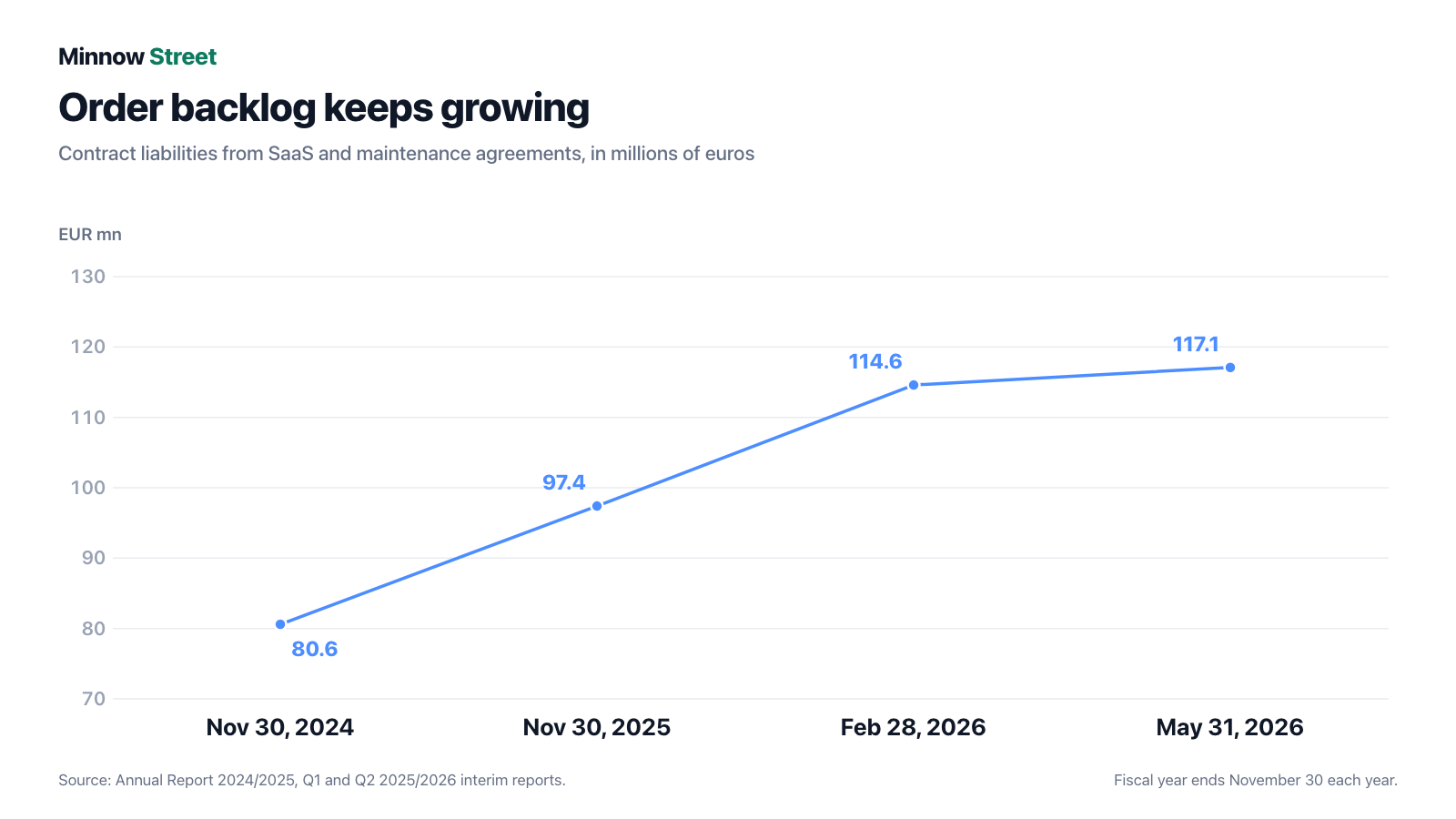
Even more telling than revenue is the order backlog — advance payments already contractually secured, but not yet recognized as revenue, under SaaS and maintenance contracts with terms of up to 60 months. It is not just growing; it is accelerating: from EUR 80.6 million (November 30, 2024) through EUR 97.4 million (November 30, 2025) and EUR 114.6 million (February 28, 2026) to EUR 117.1 million as of May 31, 2026 — up 20.2 percent in half a year.
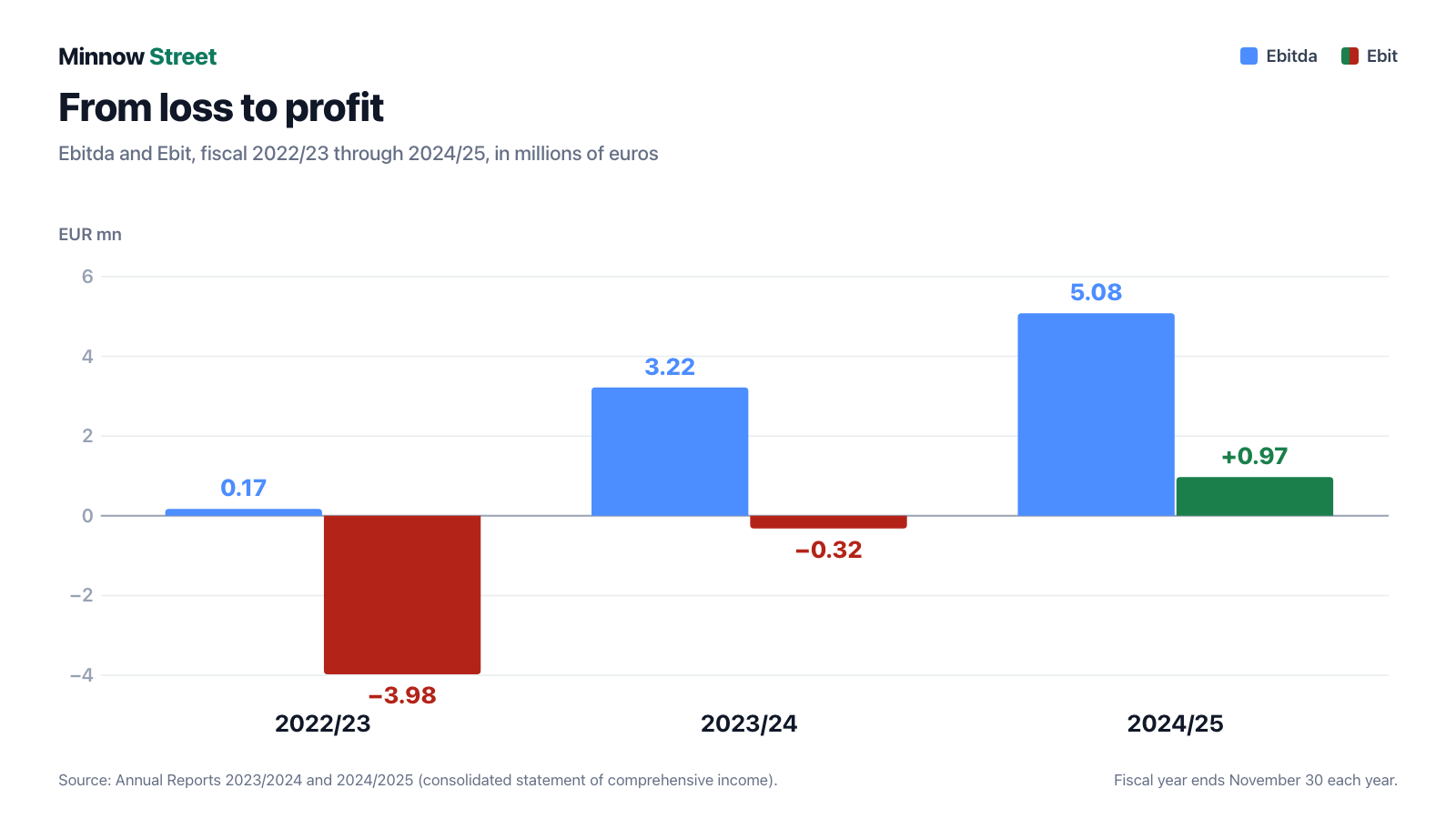
On the earnings side, the real turnaround shows up: after years of deep losses, EBIT climbed from a loss of EUR 3,979,982 (2022/2023) through a loss of EUR 315,275 (2023/2024) to a profit of EUR 971,141 (2024/2025) — the first positive annual result in at least three fiscal years. EBITDA multiplied roughly thirtyfold over the same period, from EUR 169,104 to EUR 5,080,531. Net income for 2024/2025 came in at EUR 1,845,917 (of which EUR 1,818,543 attributable to Serviceware SE shareholders, earnings per share EUR 0.17) — following a loss of EUR 71,784 a year earlier and a loss of EUR 3,943,720 two years before that.
And the first half of fiscal 2025/2026 confirms the trend: revenue of EUR 62.7 million (up 13.0 percent from EUR 55.5 million a year earlier), EBITDA of EUR 2.00 million (up 4.5 percent), EBIT of EUR 174,536 (prior year: EUR 23,382). So far, this reads like a clean, unbroken turnaround — the opposite of what a sector-wide sell-off suggests. The next section shows exactly where the filings themselves raise questions.
What the filings show — the uncomfortable truths
Uncomfortable truth No. 1: the stock fell clean through the newsletter's own stop-loss
The newsletter set a stop-loss of EUR 15.50 for its Serviceware position — 16.2 percent below the entry price of EUR 18.50. Anyone who followed that stop mechanically would have been out long before the stock hit its low. The interim report as of May 31, 2026 documents the first-half price range itself:
"Serviceware shares reached their low for the first half of the year on May 15, 2026, at EUR 10.00 (intraday), and their high on January 27, 2026, at EUR 19.20 (intraday)."
— Serviceware SE, Interim Financial Report Q2 2025/2026, Investor Relations chapter, page 14
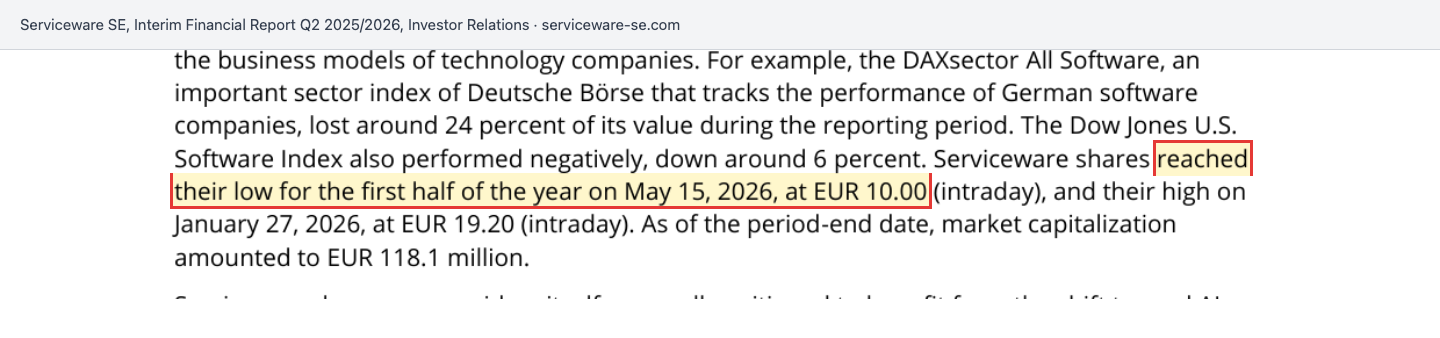
For perspective: EUR 10.00 sits 45.9 percent below the newsletter's entry price and well below its own stop-loss of EUR 15.50. The trigger was not primarily company-specific — the stock fell in step with the broader software sector, as the DAXsector All Software lost around 24 percent over the same half-year and the Dow Jones U.S. Software Index fell about 6 percent. Only after that did the stock recover: half-year close of EUR 11.25 (May 29, 2026), most recently EUR 14.55 (July 24, 2026) — still 21.4 percent below the newsletter's entry price. Keep this image in mind: a stop-loss printed in a newsletter table only protects you if you actually execute it — as a number on a page, it is worthless.
Uncomfortable truth No. 2: a fifth of the first-half earnings jump was staff cuts, not core business
A pre-tax half-year profit of EUR 246,435 sounds like a clean turnaround. The quarterly sequence behind it is messier: the first quarter of fiscal 2025/2026 (December 2025 through February 2026) closed with a pre-tax loss of EUR 662,000 — worse than the prior-year figure of minus EUR 270,000. Only the second quarter turned the entire half-year figure positive. And the report itself names a one-off item behind that swing:
"The second quarter's result was burdened by one-off expenses of kEUR 386 in connection with personnel measures."
— Serviceware SE, Interim Financial Report Q2 2025/2026, Section 1.5.3 "Operating Result (EBITDA/EBIT)," page 7
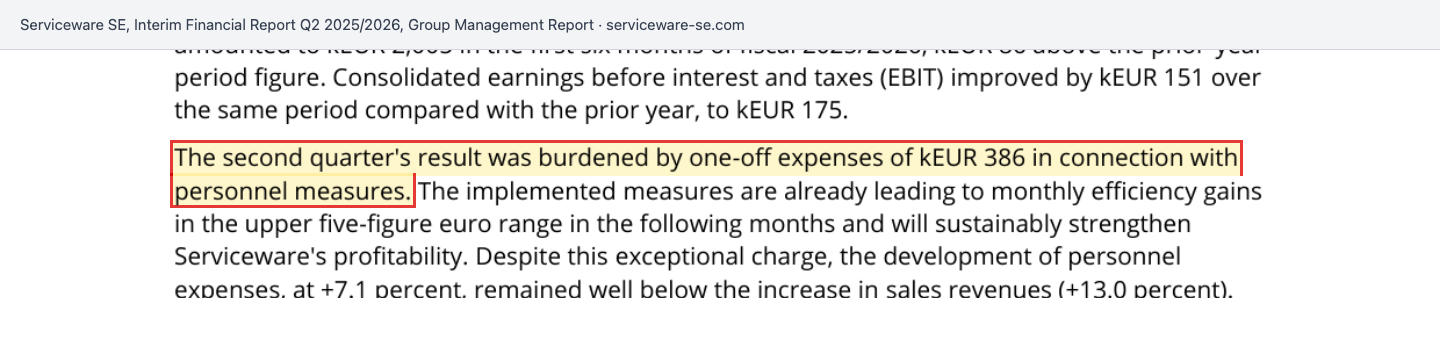
Strip out the EUR 386,000 and the second quarter would have earned roughly EUR 1,294,000 rather than EUR 908,000 before tax — a good 42 percent larger profit without the one-off item. The staff cuts are not a one-time event but part of a longer trend: headcount fell from 472 (November 30, 2024) through 456 (May 31, 2025) and 444 (November 30, 2025) to 424 (May 31, 2026) — a drop of 10.2 percent in eighteen months, even as revenue kept growing at a double-digit pace over the same period. That is economically understandable, but it also means a share of the celebrated earnings jump is the fruit of job cuts rather than additional business.
Uncomfortable truth No. 3: two people control more votes than the entire free float
Anyone buying Serviceware shares is, above all, making a bet on two people. The interim report as of May 31, 2026 describes the shareholder structure this way:
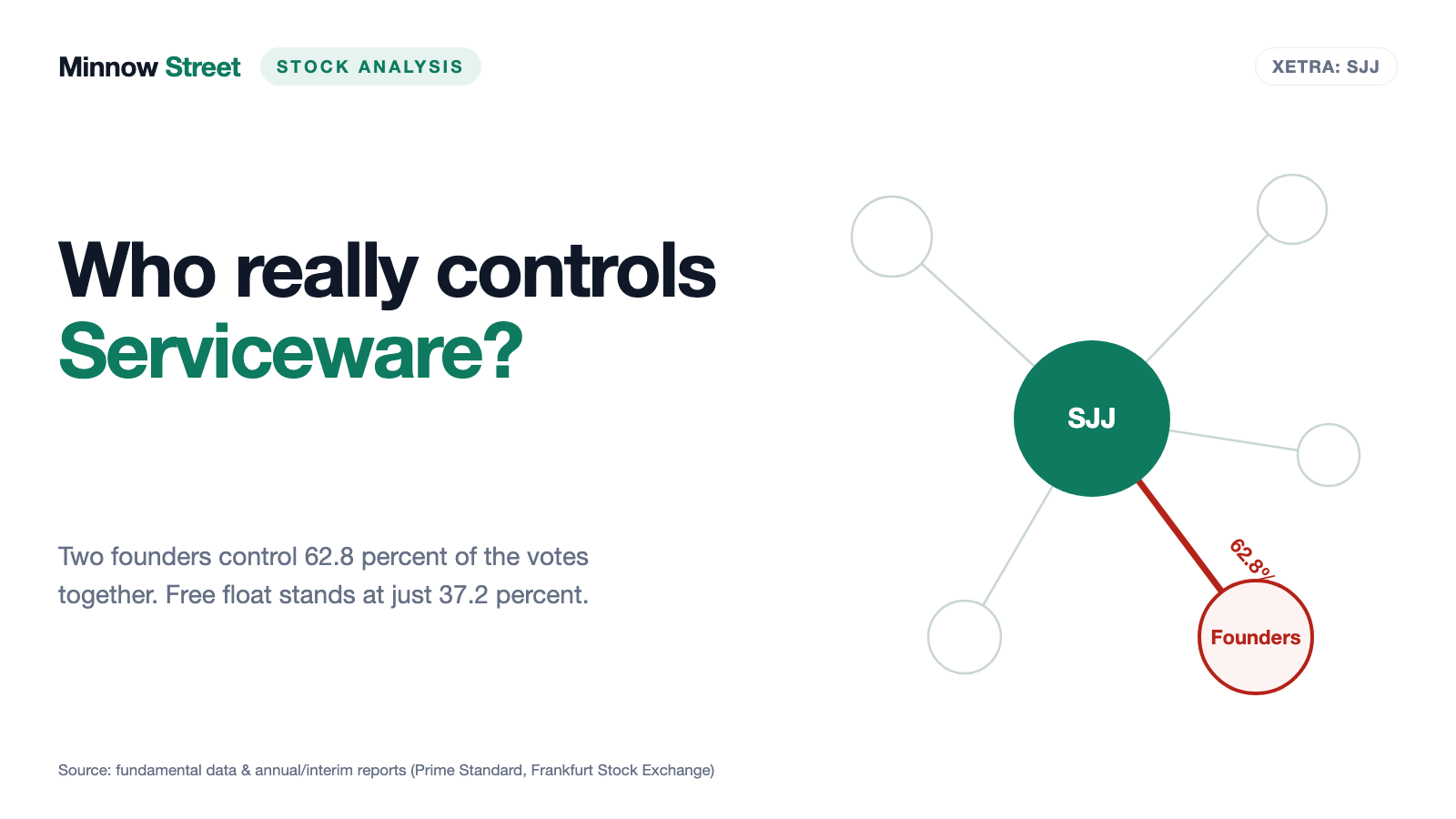
"The anchor investors of Serviceware continue to be the founders Dirk K. Martin (CEO) and Harald Popp (CFO), whose shareholdings remain unchanged at around 31.4 percent each. The free float is around 37.2 percent."
— Serviceware SE, Interim Financial Report Q2 2025/2026, Investor Relations chapter, page 14
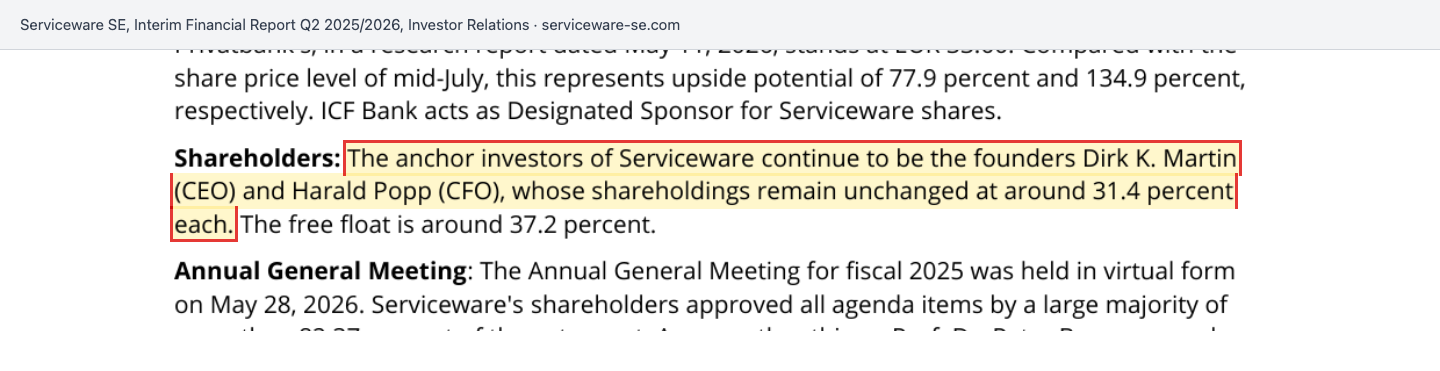
In concrete terms: CEO Dirk K. Martin holds 3,296,545 shares through aventura Management GmbH, and CFO Harald Popp holds the same number, 3,296,545 shares, through dreifff Management GmbH — 31.40 percent each, 62.8 percent combined. Free float amounts to 3,906,910 shares (37.20 percent). None of this is hidden; the investor relations page discloses it openly. But it deserves to be named: unlike a widely held large-cap, two people effectively decide the company's direction here. At the Annual General Meeting on May 28, 2026, more than 82.37 percent of votes cast approved every agenda item — a result that comes as little surprise given this ownership structure. Trading is also thin: fundamental-data calculations put average daily volume at around 5,900 shares recently, roughly EUR 86,000 in daily turnover — a stock for patient investors, not for quick entries and exits.
Valuation: cheap on revenue, expensive on earnings
At a price of EUR 14.55 (July 24, 2026) and 10.5 million shares outstanding, market capitalization works out to roughly EUR 152.8 million. Measured against fiscal 2024/2025 revenue of EUR 115.3 million, that is a price-to-sales ratio of roughly 1.3 — reasonably cheap for a growing SaaS business with an accelerating order backlog. Measured against that same year's net income attributable to shareholders (EUR 1.82 million), it works out to a price-to-earnings ratio of roughly 84 — high, but also a metric that is unusually sensitive to small swings in a still razor-thin absolute profit (EBIT margin for 2024/2025: 0.84 percent). Both figures are true, and both describe the same company from different angles: cheap when you look at revenue, expensive when you look at a profit that is still small.
Two research firms cover the stock, both with buy ratings: Montega sees a price target of EUR 25.00 in a study dated July 6, 2026, and Quirin Privatbank sees EUR 33.00 in a study dated May 11, 2026 — according to the interim report, that implies upside of 77.9 percent and 134.9 percent, respectively, versus the mid-July 2026 price level. ICF Bank acts as Designated Sponsor. For context: two research houses is thin coverage — series peer PFISTERER, for instance, is followed by five. The fewer independent voices back a price target, the more caution any single target deserves.
Opportunities and risks at a glance
What speaks for Serviceware:
- First positive annual result in at least three fiscal years: EBIT moved from a loss of EUR 3.98 million (2022/2023) to a profit of EUR 0.97 million (2024/2025), EBITDA grew roughly thirtyfold to EUR 5.08 million.
- The SaaS transformation is clearly working: SaaS/service share rose from 67.7 to 77.7 percent (2023/2024 to 2024/2025) and most recently to 80.8 percent (first half of 2025/2026), with a low churn rate of 3.5 percent.
- The order backlog keeps accelerating: from EUR 80.6 million (November 2024) to EUR 117.1 million (May 2026) — a solid lead indicator for future revenue.
- Balance sheet free of financial debt (fully repaid in fiscal 2024/2025), EUR 24.3 million in cash and cash equivalents (May 31, 2026), and 90.7 percent of receivables not yet due.
- A broad customer base of more than 1,100 customers, including 18 DAX-listed companies and 5 of the 7 largest German companies — low concentration risk on any single customer.
What speaks against it:
- An extremely volatile, thinly traded stock: a range of EUR 10.00 to EUR 19.20 in the first half of fiscal 2025/2026 alone, with average daily volume of only around 5,900 shares.
- Two founders jointly control 62.8 percent of the votes through their own holding companies; free float stands at 37.2 percent.
- A razor-thin EBIT margin (0.84 percent in fiscal 2024/2025); the first quarter of 2025/2026 turned negative again at minus EUR 694,000, and EUR 386,000 of the half-year profit stems from one-off comparison effects tied to staff cuts.
- A declining equity ratio: from around 29.9 percent (November 2024) to 27.9 percent (November 2025) and 25.0 percent (May 2026), as the balance sheet total grows faster than equity on rising contract liabilities.
- An accumulated deficit of EUR 11.5 million (November 30, 2025) not yet offset by recent profits; only two research houses cover the stock.
A human conclusion
Back to the herd-behavior reflex from the opening. In this case, it caught two different kinds of investors: the newsletter reader whose position slipped into the red without any explanation at all, and anyone who wrote off a software stock in the first half of fiscal 2025/2026 as a blanket AI casualty without ever checking that particular company's own numbers. Both reflexes are entirely human — and in this case, both would have obscured what the filings actually show: the first positive annual result in three fiscal years, an accelerating order backlog, but also a razor-thin margin, an earnings jump padded by a one-off item, and two founders who control more votes than the entire free market. Both are true, and both belong in the same analysis. The honest question for you, then, is not "is the stock cheap now that it has fallen?" but this: do you trust two people who together hold 62.8 percent of the votes to turn a still razor-thin margin into real substance — regardless of what the rest of the software sector happens to be doing? What you make of that is your decision. The decision is yours.
Sources
All original documents used in this analysis — for you to check yourself:
- Serviceware SE — Annual Report 2024/2025 (published March 27, 2026)
- Serviceware SE — Annual Report 2023/2024 — source of the 2022/2023 and 2023/2024 comparatives
- Serviceware SE — Quarterly Report Q1 2025/2026 (published April 24, 2026)
- Serviceware SE — Interim Financial Report Q2 2025/2026 (published July 24, 2026) — most recent available report, source of the price range, the shareholder structure, and the one-off item
- Serviceware SE — Investor Relations page: financial reports, shareholder structure, analyst price targets
- Fundamental data (metrics, valuation, trading volume; data as of July 24, 2026), cross-checked against the filings.
- Hook: newsletter "Hot Stocks Europe," issue 24, November 28, 2025 (B-Inside International Media GmbH, Freiburg, Germany) — cited only as a third party's expectation, never used as a source for company figures.
Transparency & disclaimer: This analysis is journalistic coverage of publicly available information, not investment advice, not a regulated financial analysis, and not a solicitation to buy or sell securities. Equity investments carry substantial risk, including total loss. All figures are provided without guarantee; the date of each figure is noted in the text. The author holds no position in Serviceware shares as of publication.
Our Bottom Line at a Glance
- Growth and the SaaS transformation positive
- Revenue for fiscal 2024/2025 rose 11.7 percent to EUR 115.3 million, the SaaS/service share climbed from 67.7 to 77.7 percent and most recently reached 80.8 percent (first half of 2025/2026). The order backlog is accelerating: from EUR 80.6 million (November 2024) to EUR 117.1 million (May 2026).
- An operating turnaround, but a razor-thin margin neutral
- EBIT turned positive in 2024/2025 for the first time in three fiscal years (EUR 0.97 million after a loss of EUR 3.98 million two years earlier), yet the EBIT margin sits at just 0.84 percent. The first quarter of 2025/2026 turned negative again at minus EUR 694,000; only the second quarter pulled the half-year into positive territory.
- Earnings quality negative
- EUR 386,000 of the half-year profit would have been higher without one-off personnel-measure costs booked in the second quarter — a good 42 percent larger quarterly profit without that item. Headcount fell 10.2 percent over eighteen months (472 to 424), even as revenue kept growing at a double-digit pace.
- Balance sheet and liquidity neutral
- No financial debt, EUR 24.3 million in cash, and 90.7 percent of receivables not yet due. Still, the equity ratio slid from around 29.9 percent (November 2024) to 25.0 percent (May 2026), as the balance sheet total grew faster than equity on rising contract liabilities; an accumulated deficit of EUR 11.5 million remains on the books.
- Ownership structure and tradability negative
- CEO Dirk K. Martin and CFO Harald Popp jointly control 62.8 percent of the votes through their own holding companies; free float stands at 37.2 percent. Trading is thin (around 5,900 shares per day), and the stock swung between EUR 10.00 and EUR 19.20 in the first half of fiscal 2025/2026 alone.
- Valuation neutral
- A price-to-sales ratio around 1.3 (cheap) versus a price-to-earnings ratio around 84 (expensive, because absolute profit is still small). Two research houses see price targets of EUR 25.00 and EUR 33.00 against a price of EUR 14.55 — thin coverage compared with other names in this series.
Serviceware posted a positive EBIT in fiscal 2024/2025 for the first time in three fiscal years, the order backlog is accelerating toward EUR 117.1 million, and the balance sheet carries no financial debt. Yet the EBIT margin remains razor-thin, a good fifth of the half-year profit stems from one-off comparison effects tied to staff cuts, and two founders control 62.8 percent of the votes through their own holding companies against a thinly traded free float. Not investment advice.
What Our Rating Means
Open questions
The business works in principle, but one material question is open. As long as it stays open, our findings do not carry a quality verdict.
Yellow here is not about an existential question — the balance sheet carries no financial debt, 90.7 percent of receivables are not yet due, and fiscal 2024/2025 closed with a positive EBIT for the first time in three years. Yellow reflects three open questions that the stock's collapse in the first half of fiscal 2025/2026 pushed into the background: first, the EBIT margin at 0.84 percent is thin enough that small swings can flip the sign — exactly what happened in the first quarter of 2025/2026. Second, a meaningful share of the half-year profit comes from one-off comparison effects tied to ongoing staff cuts, not additional business. Third, two founders control 62.8 percent of the votes through their own holding companies against a thinly traded free float of 37.2 percent — governance questions here are effectively decided between two people. The business model itself (a broad customer base, a growing order backlog, a structurally rising SaaS share) clearly holds up. Whether the operating turnaround holds without one-off effects will show up, at the earliest, in the quarterly statement due October 23, 2026.
A journalistic assessment by our editorial team at the time of the deep dive, based on public sources — not investment advice and not a solicitation to buy or sell. Your personal circumstances (investment goals, risk capacity, taxes) cannot be taken into account. What our levels mean, how verdicts are formed, and what conflicts of interest exist →
Worth Noting
- The hook for this analysis is issue 24 of the newsletter "Hot Stocks Europe," dated November 28, 2025 (B-Inside International Media GmbH, Freiburg, Germany), whose model portfolio bought Serviceware on October 31, 2025 at EUR 18.50 without ever mentioning or explaining the position in the running text. As a matter of general policy, the newsletter discloses on page 8 that the publisher, the author, or related third parties may hold long positions in securities discussed and intend to sell as prices rise (a potential conflict under EU Market Abuse Regulation 596/2014) — for issue 24 specifically, the newsletter states the opposite in explicit terms: "Publisher, author, or related third parties hold long positions in the following securities named in this issue: -."
- All company figures come from the Annual Report 2024/2025 (published March 27, 2026) and the Q1 (April 24, 2026) and Q2 2025/2026 (July 24, 2026) interim reports, not from the newsletter. Valuation figures are dated July 24, 2026.
- A note on naming: the shorthand SJJ.DE used in this analysis simply denotes "Serviceware, listed in Germany" — it is not an official exchange code. The stock trades under Xetra: SJJ, as well as on Tradegate, Frankfurt, and Gettex.
Frequently Asked Questions
Serviceware SE, headquartered in Idstein near Wiesbaden, Germany, builds an "AI-native" software platform for enterprise service management and IT cost control (IT Financial Management, also known as Technology Business Management). More than 1,100 customers worldwide use the platform, including 18 DAX-listed companies and 5 of the 7 largest German companies. Additional modules cover Knowledge Management, Corporate Performance Management, and Field Service Management.
The stock fell along with an industry-wide sell-off: the DAXsector All Software lost around 24 percent between December 2025 and May 2026, driven by a debate over whether artificial intelligence threatens software business models. Serviceware fell to a half-year low of EUR 10.00 (May 15, 2026, intraday) and has since recovered to EUR 14.55 (July 24, 2026).
Serviceware's books run from December 1 through November 30 each year. "Fiscal 2024/2025" therefore means the period from December 1, 2024 through November 30, 2025 — not the calendar year. This is not unusual among European software companies and appears the same way in every one of the company's own annual reports.
CEO Dirk K. Martin (through aventura Management GmbH) and CFO Harald Popp (through dreifff Management GmbH) each hold 31.40 percent of the shares (3,296,545 each) as of the Q2 2025/2026 interim report — 62.8 percent of the votes combined. Free float stands at 37.2 percent (3,906,910 shares).
Serviceware trades on the Regulated Market (Prime Standard) of the Frankfurt Stock Exchange, not in the United States — there is no 10-K, no 10-Q, no SEC registration. Requirements are an audited IFRS annual report and a half-year financial report under Section 115 of the German Securities Trading Act (WpHG), the latter explicitly unaudited by the company's own account. This analysis relies on the Annual Report 2024/2025 and the two 2025/2026 interim reports.
No. The Annual Report 2024/2025 states outright: "The Group has no formal dividend policy." As of November 30, 2025, an accumulated deficit of EUR 11.5 million still sat on the books, only partly offset so far by recent profits.
Issue 24, dated November 28, 2025, added Serviceware to its model portfolio on October 31, 2025 at EUR 18.50 — without ever mentioning or explaining the position in the running text. By the issue date it already sat at EUR 16.10 (down 13.0 percent, stop-loss EUR 15.50) — the only losing position in the entire portfolio.
Two research firms rate it a buy: Montega with a EUR 25.00 target (study dated July 6, 2026) and Quirin Privatbank with EUR 33.00 (study dated May 11, 2026) — implying upside of 77.9 and 134.9 percent, respectively, versus the mid-July 2026 price level per the interim report. On revenue, the stock looks cheap with a price-to-sales ratio around 1.3; on earnings, it looks expensive with a price-to-earnings ratio around 84 — only two firms cover the name.
Found an error?
Did you spot a factual error, an outdated number, or a typo in this deep dive? Let us know briefly — your report goes straight to the editorial team.