Thor Explorations: Best Year Ever, Stock Below Its Pre-Record Level
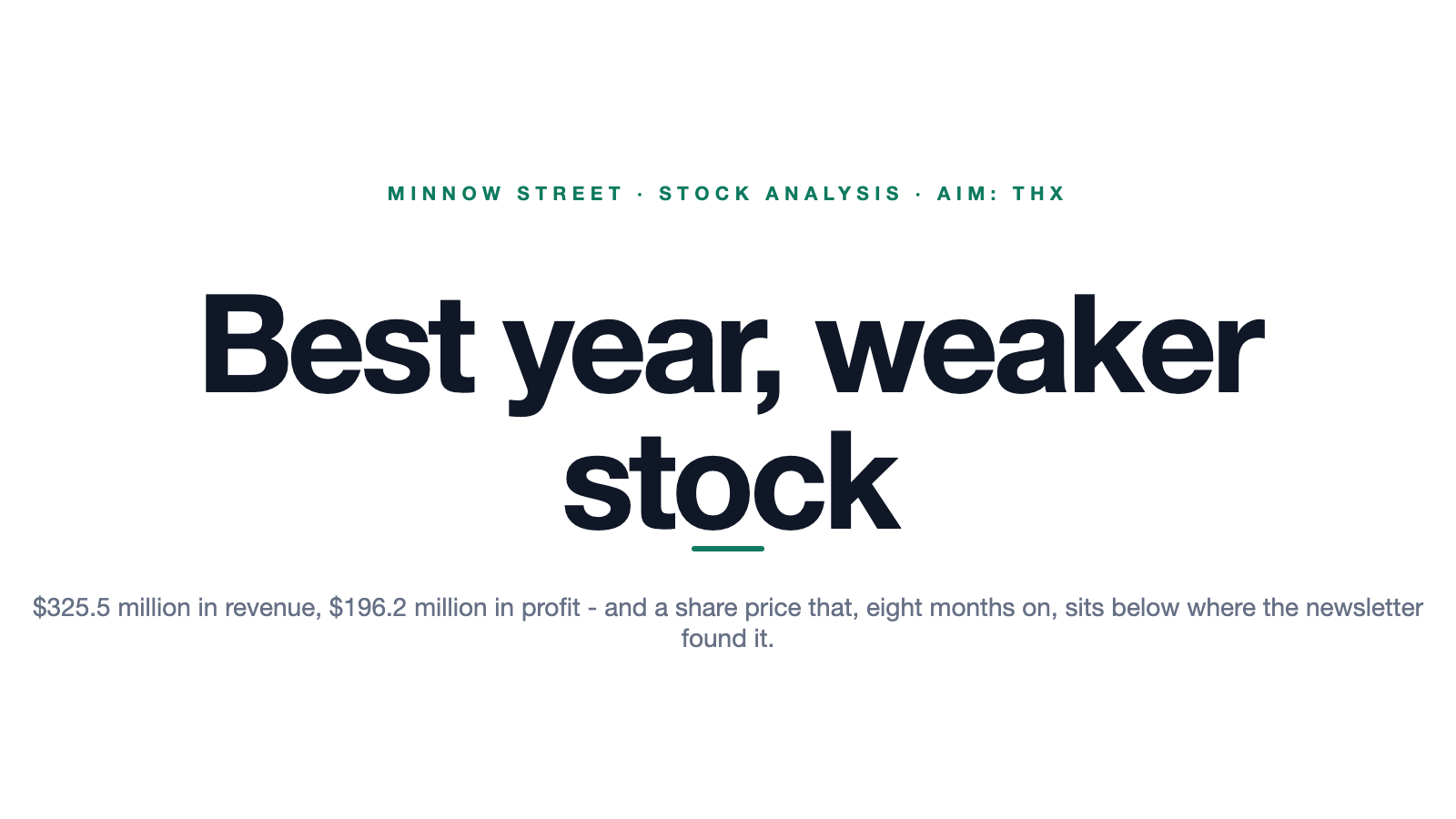
A newsletter praised a strong quarter in November 2025 and cited an 89-pence price target. Eight months later, Thor Explorations has logged the best fiscal year in its history - $325.5 million in revenue, $196.2 million in net income, essentially debt-free - and the stock still trades below where it stood on the day the newsletter came out. We read the annual report and the latest quarterly filing for the single mine nearly everything depends on.
 Thomas Mücke
Founder & Publisher
Thomas Mücke
Founder & Publisher
Chart
Interactive price chart (TradingView).
Note: pure fact-based analysis, not investment advice and not a solicitation to buy or sell. All figures without guarantee.
There is an investor fear almost everyone recognizes: the fear of missing out, FOMO. A reader sent us issue 24 of the newsletter "Hot Stocks Europe," dated November 28, 2025, which included a short profile of Thor Explorations Ltd.: a share price that had climbed from 10 to as high as 76 British pence in 18 months, a strong third quarter 2025 with roughly $70 million in revenue and $43 million in net income, and an analyst at Canaccord citing a price target of 89 pence - about 50 percent upside from the level at the time. Exactly the kind of numbers that make the FOMO devil whisper on your shoulder: buy now, or you'll miss the next leg up. What actually happened? The stock did keep climbing at first, reaching 98 pence on January 28, 2026 - and has since fallen to 59 pence. So let's make a deal: before you listen to the FOMO devil, or dismiss it too quickly, let's read the company's actual reports together - the 2025 annual financial statements and the interim report for the quarter ended March 31, 2026.
What Thor Explorations actually does
Thor Explorations Ltd. is a Canadian gold company headquartered in Vancouver - but nearly all of its operating business happens in West Africa. In everyday terms: a company that pulls gold out of the ground, turns it into sellable bars, and sells it to buyers who process it further or hold it as a reserve. The only producing asset is the Segilola gold mine in Osun State, Nigeria, operated through the wholly owned subsidiary Segilola Resources Operating Limited; commercial production has run since October 5, 2021, with first gold poured as early as July 2021.
Beyond that there are two building blocks that don't yet sell any gold: the development project Douta in eastern Senegal, which Thor brought into full ownership in January 2026 (more on that below), and a portfolio of early-stage exploration licenses in Côte d'Ivoire (Guitry at 100 percent, plus options on up to 80 percent of the Boundiali and Marahui licenses). Two terms that keep coming up throughout this analysis and are worth translating up front: all-in sustaining cost per ounce (AISC) is a kind of full-cost accounting - everything it genuinely costs to pull an ounce of gold out of the ground and make it sellable, including the ongoing capital spending needed to keep the mine running. Mineral reserve is the amount of gold in the ground that meets strict, externally reviewed criteria for economic extraction - it is not a loose estimate of "gold somewhere in the rock," but the number a mine's remaining life is actually measured against. That number matters a great deal in the uncomfortable truths further down.
Why there is no SEC filing here — and where the numbers come from instead
One point first, because it shapes the entire evidence base of this analysis: there is no 10-K, no 10-Q, no 20-F for Thor Explorations. EDGAR's company search does return a hit (CIK 0001753512) - but the filing list there contains exactly one document: a Form D dated September 18, 2018, the formal notice of a private placement. Not a single annual or quarterly report. Thor Explorations is not a U.S. reporting company. As a company listed on the AIM segment of the London Stock Exchange and on the Canadian TSX Venture Exchange, it publishes its mandatory reports instead through SEDAR+ (the Canadian filing system) and its own investor relations site, which doubles as its "AIM Rule 26" page - a mandatory disclosure page for AIM-listed companies.
Four core reports carry this analysis, each published as its own PDF: the 2025 annual financial statements and the separately published Management's Discussion and Analysis (MD&A) 2025 (balance sheet date December 31, 2025, updated versions dated April 9 and 10, 2026), plus the interim financial statements for the first quarter of 2026 and the accompanying MD&A for Q1 2026 (balance sheet date March 31, 2026, published May 19, 2026) - all four from thorexpl.com/investors/financial-statements. Add to that the most recent operating update for the second quarter of 2026, dated July 16, 2026. Data provenance throughout, therefore: fundamental data & company reports (annual/quarterly report, AIM/TSX-V) - not "SEC filings," which simply don't exist here.
How the stock landed on our desk — an eight-month-old newsletter
Thor Explorations did not come through our in-house stock scanner: that scanner universe primarily covers U.S.-listed names, and a stock trading in pence on London's AIM doesn't show up there. It landed on our desk because a reader forwarded an issue of a newsletter: "Hot Stocks Europe," issue 24, dated November 28, 2025 (B-Inside International Media GmbH, Freiburg), a twice-monthly stock-tip publication. For Thor Explorations, then trading around €0.75 (converted), the newsletter cited a share-price rise "from 10 to as high as 76 pence in 18 months," a third quarter 2025 with 22,600 ounces of gold produced and 19,700 ounces sold, $70 million in revenue and $43 million in net income - and, citing the research house Canaccord, an EBITDA expectation of "over $238 million" for the full year, a price target of 89 pence (roughly 50 percent upside) and a dividend yield of 4.5 percent. The same issue also listed Thor Explorations, in a year-end retrospective, among the 2025 top performers with a gain of "over 200 percent."
Those figures come from the newsletter and are cited here explicitly as a third party's expectation as of November 28, 2025, never as our own source - every figure in this analysis comes from the company's own reports. Context also includes the conflict-of-interest notice the newsletter itself prints on page 8: the publisher, author, or related parties may hold long positions in stocks discussed and may intend to sell as prices rise (EU Market Abuse Regulation 596/2014). What became of the price target? The stock did keep climbing after November 28, 2025 (closing price 65 pence that day) - reaching an interim high of 98 pence on January 28, 2026, closer to the Canaccord target of 89 pence than the newsletter itself dared hope. Since then, the price has fallen to 59.0 pence (closing price July 24, 2026) - nine percent below the level on the day of the newsletter and roughly 40 percent below the interim high. The Canaccord price target has not been reached so far. A neighbor from the same issue that raises a similar question: our ACG Metals stock analysis, also a London-listed commodity name from issue 24, shows a comparable gap between the analyst expectation cited in November 2025 and the audited numbers.
The numbers over the years — honestly appraised
First, what genuinely impresses. Revenue rose 68.5 percent in 2025 to $325.5 million (2024: $193.1 million), and net income rose 115.2 percent to $196.2 million (2024: $91.2 million) - both record figures in the company's history. The first quarter of 2026 kept the pace: revenue of $74.3 million (Q1 2025: $64.1 million, up 16.0 percent), net income of $46.8 million (Q1 2025: $34.5 million, up 35.6 percent). For comparison, the two years before that, when heavy interest expense still ate up most of the profit: 2022 revenue was $165.2 million (net income $38.8 million), and 2023 revenue fell to $141.2 million (net income collapsed to $10.9 million).
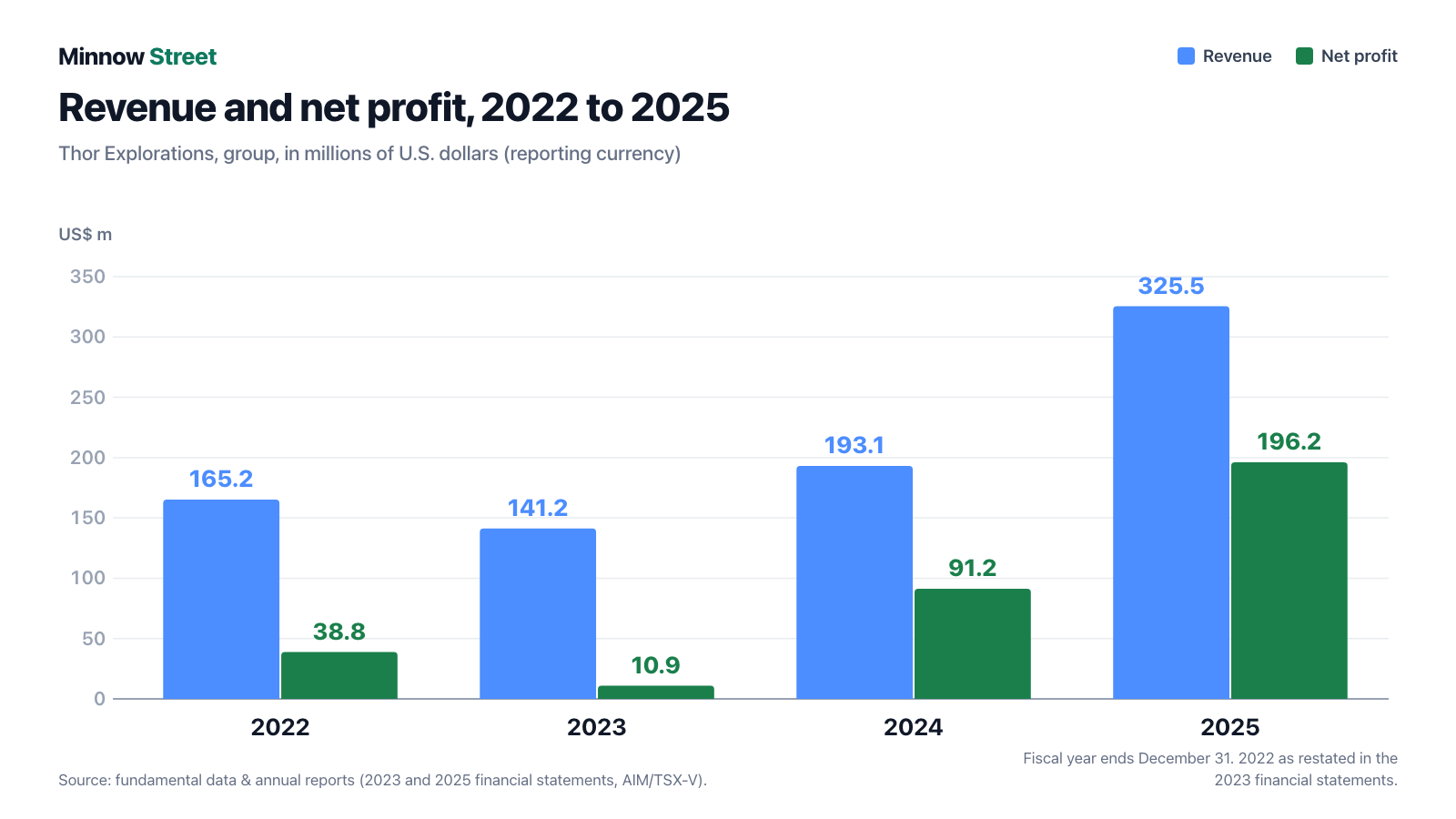
The dip in net income in 2023 has a specific name: interest expense. Thor Explorations had financed the Segilola mine partly through a gold pre-sale arrangement with the Africa Finance Corporation (AFC), and the resulting interest expense ate up most of operating profit in 2022 and 2023: $14.6 million in interest expense in 2022, $13.1 million in 2023 - on top of which 2023's operating profit took a one-off hit (a $3.2 million charge to buy out an option on the gold sale agreement). Only once the AFC financing was fully repaid at the end of 2024 did interest expense fall to $5.5 million (2024) and then to just $0.455 million (2025, now essentially only interest on lease liabilities). That is exactly why net income grew so much faster than revenue in 2024 and 2025: a debt-free company passes rising revenue through to shareholders almost unimpeded.
A good part of the revenue and profit growth also carries a name that has nothing to do with the company's own performance: the gold price. Thor's realized gold price per ounce rose from $2,288 (2024) to $3,422 (2025, up 49.6 percent) and had already reached $4,820 in the first quarter of 2026. All-in sustaining cost rose far more slowly over the same period: $882 (2024), $927 (2025), $936 (Q1 2026) - the gap between those two lines is the margin per ounce sold, and it has more than tripled since 2024.
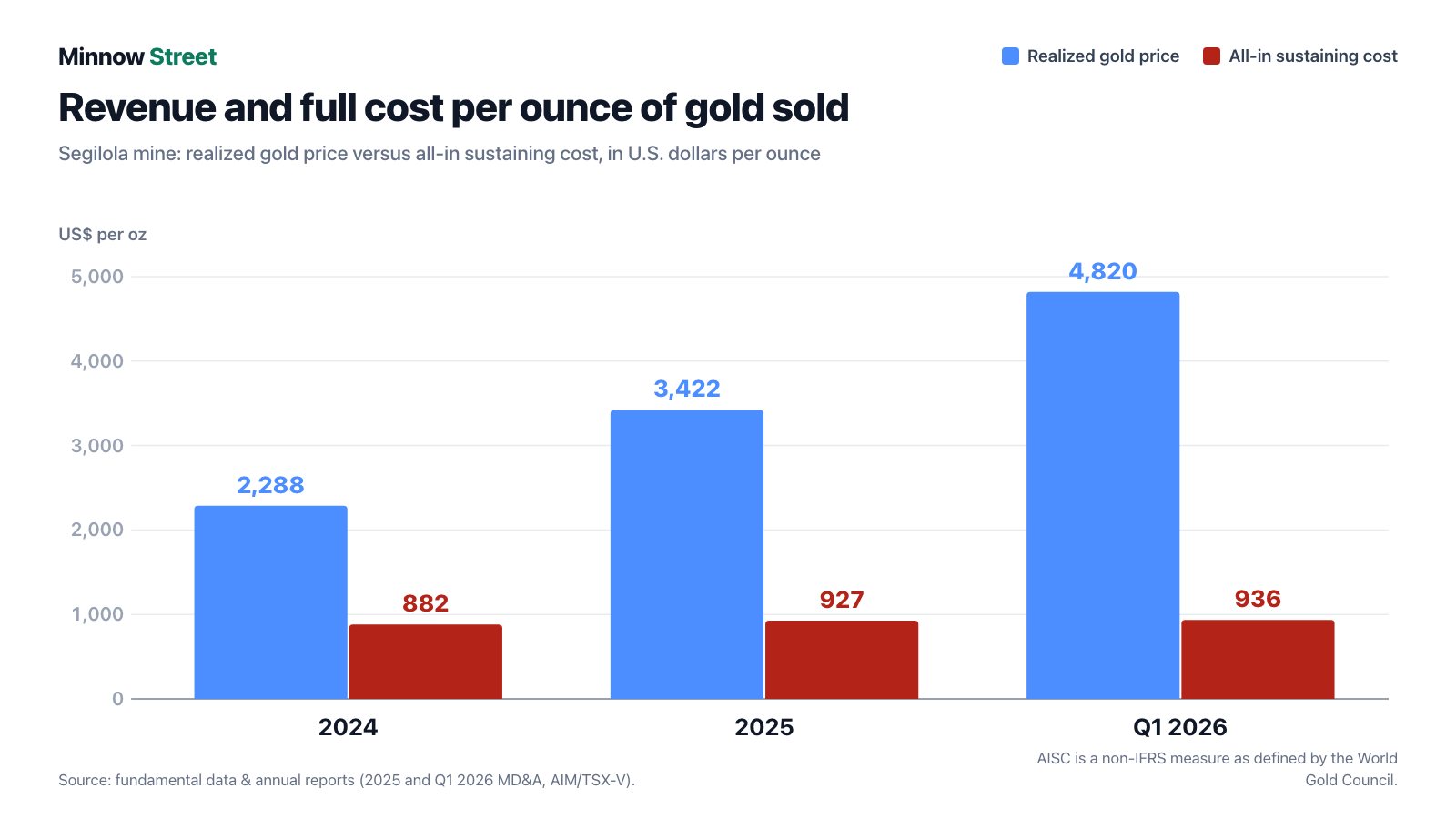
Remember this image: a rising gold price lifts nearly every gold miner at once - it is not proof of superior management. What genuinely is Thor's own achievement is keeping the cost line flat while revenue explodes. What isn't in the company's own hands shows up in the next section.
Douta in Senegal, and the bet on a second mine
So far, Thor Explorations sells gold from a single mine only. The obvious next step - going from a one-mine to a multi-mine producer - runs through the Douta project in eastern Senegal. Until 2025, Thor owned only part of the relevant licenses; in September 2025 the company paid $3.0 million to buy out the remaining 30 percent of one Douta license from its former partner, International Mining Company SARL, and in January 2026 it paid $1.5 million (plus a further $3.5 million tied to a future construction decision) to buy out the remaining 30 percent of the second license from its partner, Birima Resources SARL. Since January 2026, Douta has been 100 percent owned by Thor Explorations.
The preliminary feasibility study (PFS) presented in the 2025 annual report paints a promising, but still unfinished, picture: a probable reserve of 1.2 million ounces of gold at 1.03 grams per tonne, a total resource of 1.97 million ounces, initial capital of $254 million, and a pre-tax net present value (at a 5 percent discount rate) of $908 million (post-tax: $633 million) - based, however, on a long-term gold price assumption of $3,500 per ounce, below the level actually realized today. A final investment decision isn't expected before the second half of 2026 at the earliest, permitting is still ongoing, and management says it intends to fund the project "without shareholder dilution." There's still a long road to the first ounce of gold out of Douta - Segilola remains the only source of cash flow for the time being. In Côte d'Ivoire the company is a step earlier still: pure early-stage exploration across three licenses with no known resource yet, with a stated goal of delivering a first standalone resource estimate in 2026.
What the reports show — the uncomfortable truths
Uncomfortable truth no. 1: the company's own 2026 guidance points down for the first time - less gold, at a higher cost
After a record year, you'd expect an optimistic outlook. Thor Explorations delivers the opposite: for 2026, the company guides to 75,000 to 85,000 ounces of gold production - noticeably below the 91,910 ounces actually produced in 2025. At the same time, 2026 cost guidance (AISC) sits at $1,000 to $1,200 per ounce, well above the actual 2025 figure of $927. The first-quarter 2026 report confirms both figures unchanged:
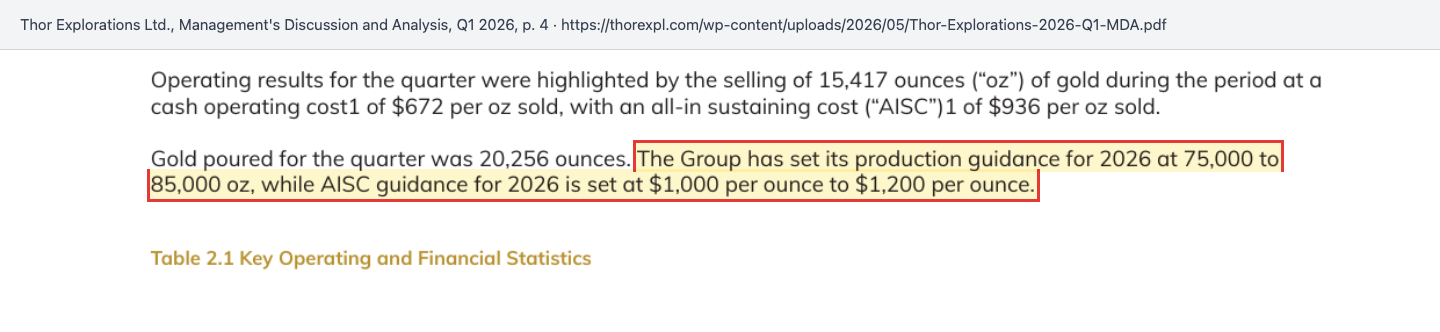
The first two quarters at least confirm the guidance isn't being missed: 20,256 ounces poured in the first quarter, 19,153 in the second (per the July 16, 2026 operating update) - 39,409 ounces combined at the halfway point of the year, on an annualized pace that sits within the guidance range. That doesn't change the core message, though: after several years of growing output, the company itself expects less gold at a higher unit cost in 2026 than in the record year 2025 - just as a dividend introduced and expanded only in 2025 keeps growing. The Canaccord EBITDA estimate cited in the newsletter, "over $238 million" for the full year 2025, is also worth revisiting here: unlike in many similar cases, Thor Explorations does report an EBITDA figure of its own - the 2025 MD&A's "Key Operating and Financial Statistics" table shows $243.7 million for fiscal 2025 (roughly consistent with operating profit of $199.7 million plus total depreciation and amortization of $42.7 million, not just the $0.6 million "other assets" sub-line). That reported figure sits above, not below, the eight-month-old analyst estimate - just as net income rose 115 percent over the same year.
Uncomfortable truth no. 2: the entire cash flow rests on a 518,000-ounce mineral reserve - and extending it is not yet proven
The probable reserve reported for the Segilola mine in the 2025 annual report is 518,000 ounces of gold (4.0 million tonnes at 4.02 grams per tonne). At an annual production rate of roughly 90,000 to 92,000 ounces, that works out to about five to six years of mine life - at the single mine that supplies nearly all of the company's cash flow. The company knows this as well as anyone: the chairman names extending that mine life as the central task for 2026, via a source that is not yet proven - additional underground and satellite deposits:
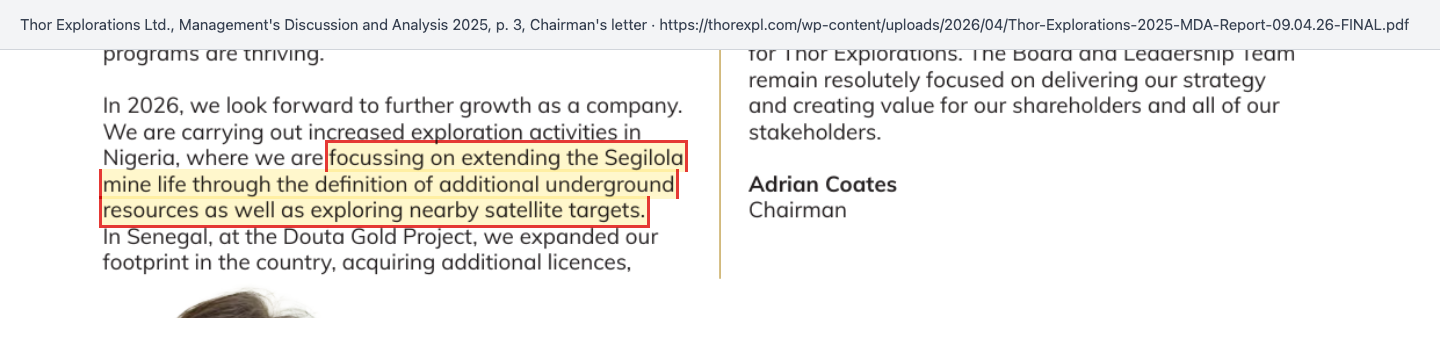
For context: beyond the mineable reserve, the annual report lists additional resources not yet converted into reserve - among them 76,000 ounces in the "Indicated" category and 65,000 ounces "Inferred" from an as-yet-undeveloped underground deposit beneath the existing open pit. These figures are real, but they are not reserve: "Indicated" and "Inferred" mean lower geological confidence and no confirmed economics yet. Whether they actually turn into additional years of production depends on the success of exploration still underway - the exact exploration the chairman himself flags as an unfinished priority. This isn't a substance risk in the sense of an acute threat (the company is debt-free and cash-rich, see the valuation section), but it is a material, open operating question: the company's entire current cash flow rests on a single mine with a reserve life that, on paper, is limited - though replenished every year so far by new exploration - while the only concrete growth project (Douta) has not yet reached an investment decision.
Uncomfortable truth no. 3: Nigeria country risk is real - even though this particular episode ended well
Betting on a single mine in a West African country means betting on that country's regulators too. How real that risk is shows up in an episode the 2025 annual report describes directly: Thor's Nigerian subsidiary, Segilola Resources Operating Limited, was in dispute with the government of Osun State; an inter-ministerial fact-finding committee delivered its final report in March 2025.
"We were pleased in March 2025 to receive a copy of the report of the Inter-Ministerial Fact-Finding Committee on the dispute between Segilola Resources Operating Limited and the Osun State Government. This report affirmed our compliance with all our legal and regulatory obligations."
— Adrian Coates, Chairman, Thor Explorations Ltd., 2025 Management's Discussion and Analysis, p. 3
According to media reports (including MarketScreener and Mining.com, March/May 2025), the dispute centered on a state tax claim worth roughly $2.1 million and environmental allegations; the committee largely rejected both and recommended a much smaller tax figure be reconciled amicably instead. For Thor Explorations, the episode ended well - that's the good news within this uncomfortable truth. But it also shows that "country risk" is not an abstract textbook phrase here: it's an episode that genuinely happened, triggered real scrutiny from real authorities, and was only resolved after a dedicated fact-finding committee was convened. A future dispute with a less favorable outcome hasn't become more or less likely as a result - but unlike a stock with broad geographic diversification, this is a risk concentrated on a single mine in a single country.
Valuation: four currencies on a single stock
How expensive is Thor Explorations? That question can only be answered honestly once you first admit how many currency layers sit on this one stock. The share trades on London's AIM in British pence (closing price 59.0 GBp, or £0.59, on July 24, 2026) and, in parallel, on the Canadian TSX Venture Exchange in Canadian dollars. Revenue, net income and the balance sheet are reported throughout in U.S. dollars. And the dividend paid since 2025 - the one line item in the entire numbers set - is declared exclusively in Canadian dollars per share, regardless of which of the two exchanges an investor holds the stock on. Four currency layers, one stock; every figure in this analysis therefore carries its own currency consistently.
Market capitalization checks out cleanly: 666,573,136 shares outstanding (as of March 31, 2026) times £0.59 works out to roughly £393.3 million - exactly the figure reported by the fundamental data provider. Converted at the July 26, 2026 exchange rate (£1 = $1.3321), that's roughly $523.9 million. Set against net income for the trailing four quarters ($196.2 million for 2025, minus $34.5 million for the first quarter of 2025, plus $46.8 million for the first quarter of 2026, for $208.5 million), that works out to a price-to-earnings ratio on the order of roughly 2.5 - a strikingly low figure even for a West African gold producer. One note of caution: the earnings-per-share figure some fundamental data providers publish differs noticeably from the figures used here, which come directly from the financial statements; we rely exclusively on the latter.
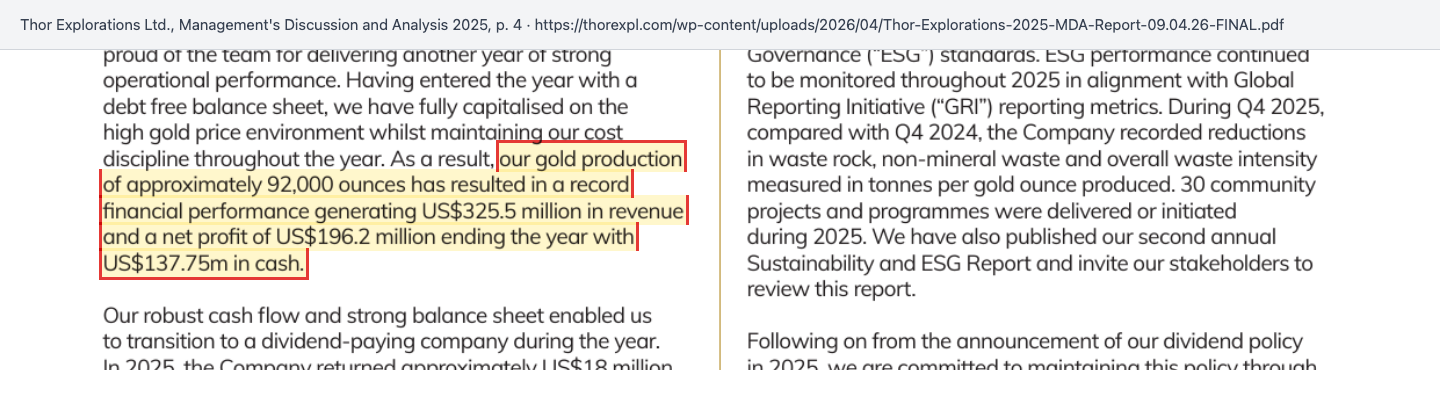
By March 31, 2026, cash had already grown to $159.5 million, against total assets of $444.3 million and equity of $415.1 million; financial debt is essentially gone (just $1.4 million in lease liabilities), for net cash of roughly $158.1 million. Some of that cash pile has been flowing back to shareholders since 2025 for the first time:
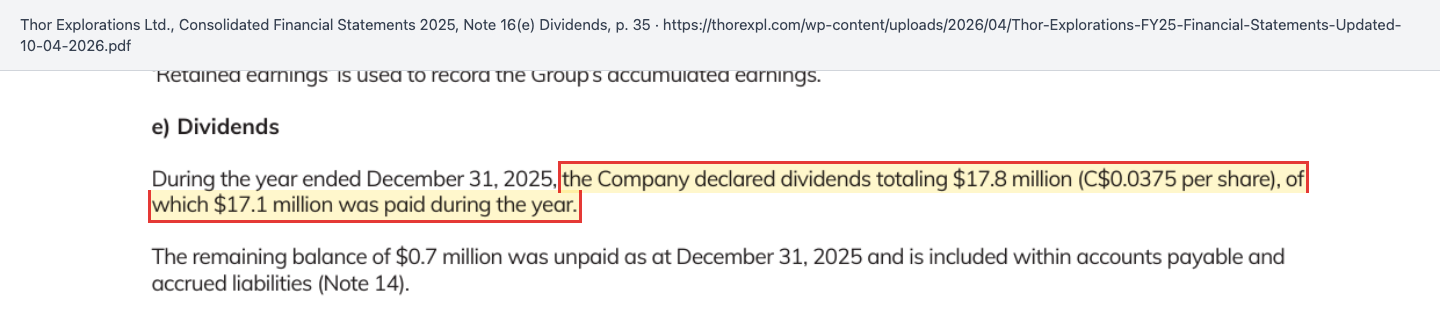
A one-off special dividend of C$0.015 per share followed in January 2026 (paid alongside the regular C$0.0125 dividend, together C$0.0275, on February 13, 2026); on April 9, 2026 the board confirmed the ongoing regular rate of C$0.0125 per share per quarter, paid May 15, 2026. Annualized (C$0.05) and converted at the July 26, 2026 exchange rate (£1 = C$1.8777), that comes out to roughly 2.7 British pence per share - against a 59.0-pence share price, a dividend yield on the order of roughly 4.5 percent based on the ongoing regular rate, excluding the one-off special dividend. One note of caution: some data providers divide the raw Canadian-dollar dividend figure by the pence share price without converting currencies, arriving at a higher but methodologically unsound yield figure - one more example of how easily currency layers get mixed on this particular stock if you're not careful.
Opportunities and risks at a glance
What speaks for Thor Explorations:
- An essentially debt-free balance sheet with $159.5 million in cash as of March 31, 2026 and net cash of roughly $158.1 million - interest expense has fallen from $14.6 million in 2022 to just $0.455 million in 2025.
- A record fiscal 2025 with $325.5 million in revenue (up 68.5 percent) and $196.2 million in net income (up 115.2 percent); the first half of 2026 stayed within the company's own guidance at 39,409 ounces of gold.
- A regular dividend for the first time since 2025 (regular rate C$0.0125 per share per quarter, confirmed April 9, 2026), plus an already-paid special dividend - a form of capital return that simply didn't exist before 2025.
- A growth option beyond Segilola: Douta in Senegal, wholly owned since January 2026, with a feasibility study showing a pre-tax net present value of $908 million (at a $3,500 gold-price assumption) - well below the price level actually realized today.
What speaks against it:
- Nearly all cash flow rests on a single mine with a reported reserve of 518,000 ounces (roughly five to six years at the current production rate); extending that mine life through underground and satellite exploration is named by the company itself as an open priority for 2026, not a settled fact.
- The company's own 2026 guidance shows falling production for the first time since production began (75,000 to 85,000 ounces versus the 2025 record of 91,910), alongside rising cost guidance ($1,000 to $1,200 per ounce versus $927 in 2025).
- The Douta growth project has not yet reached a final investment decision (second half of 2026 at the earliest) and delivers no cash flow for the foreseeable future - Segilola remains the only game in town.
- Country risk in Nigeria is not theoretical: a tax and environmental dispute with the government of Osun State was only resolved in the company's favor in March 2025.
- Four currency layers on a single stock (pence on AIM, Canadian dollars on the TSX-V and for the dividend, U.S. dollars in the financial statements) make simple metric comparisons error-prone, as the differing yield figures from some data providers show.
A human conclusion
Back to the FOMO devil from the opening. What would it have told you to do? Buy immediately after reading the newsletter on November 28, 2025 - and at first, it would have been right: the stock climbed to 98 pence by late January 2026, closer to the Canaccord price target than the newsletter itself dared hope. But anyone who bought only after that, purely out of fear of missing the next leg up, would today be sitting on a loss of roughly 40 percent - despite a company that, over the same period, delivered the best fiscal year in its history, paid off its debt, and started paying a dividend for the first time. The honest question, then, isn't "did I miss the boat?" but: do you trust a financially solid, single-mine company in Nigeria to solve its own most important task for 2026 - extending the life of its only mine through exploration that hasn't yet proven itself, before its second mine in Senegal has even reached an investment decision? What you make of it is your decision. And that is exactly as it should be.
Sources
All original documents used in this analysis — to read for yourself:
- Thor Explorations Ltd. — 2025 annual financial statements (balance sheet date 31.12.2025, updated version dated 10.04.2026)
- Thor Explorations Ltd. — Management's Discussion and Analysis (MD&A) 2025 (09.04.2026)
- Thor Explorations Ltd. — Interim financial statements for Q1 2026 (balance sheet date 31.03.2026, published 19.05.2026)
- Thor Explorations Ltd. — Management's Discussion and Analysis, Q1 2026 (19.05.2026)
- Thor Explorations Ltd. — Q2 2026 operating update (16.07.2026)
- Thor Explorations Ltd. — Financial statements overview (thorexpl.com)
- Fundamental data (metrics, share price and exchange rate figures; data as of July 24–26, 2026).
- Hook: "Hot Stocks Europe," issue 24, dated November 28, 2025 (B-Inside International Media GmbH), forwarded by a reader — figures cited exclusively as a third party's expectation as of that date, no buy recommendations adopted.
Transparency & disclaimer: This analysis is a journalistic contextualization of publicly available information and is not investment advice, not a financial analysis in the regulatory sense, and not a solicitation to buy or sell securities. Stock investments carry substantial risks up to total loss, and commodity producers operating in a single country carry additional political and regulatory risk. All information without guarantee; the data cut-off is noted in the text in each case. The author holds no position in Thor Explorations stock at the time of publication.
Our Bottom Line at a Glance
- Financial strength positive
- Essentially debt-free as of March 31, 2026 (just $1.4 million in lease liabilities), $159.5 million in cash, net cash of roughly $158.1 million. Interest expense fell from $14.6 million in 2022 to $0.455 million in 2025 after the Africa Finance Corporation facility was fully repaid at the end of 2024. A record fiscal 2025 with $196.2 million in net income (net margin roughly 60 percent).
- Single-asset concentration negative
- Nearly all cash flow rests on one mine (Segilola) with a reported probable reserve of 518,000 ounces (roughly five to six years at the current production rate). 2026 guidance of 75,000 to 85,000 ounces sits below the prior year (91,910 ounces) for the first time since production began, while cost guidance sits above it. The priority the chairman himself names - extending mine life through still-unproven exploration - is an open operating question, not a settled fact.
- Douta growth option (Senegal) neutral
- Wholly owned since January 2026; the 2025 feasibility study shows solid project economics (pre-tax net present value $908 million at a $3,500/oz assumption, post-tax $633 million; probable reserve 1.2 million oz), but a final investment decision isn't expected before the second half of 2026 at the earliest. Until then, the project delivers no cash flow and no diversification away from Segilola.
- Capital return positive
- A maiden dividend policy since 2025, declared exclusively in Canadian dollars per share (regular rate since 04/09/2026: C$0.0125 per quarter), plus an already-paid special dividend in January 2026. A still-young but genuinely started capital return that didn't exist before 2025.
- Nigeria country risk negative
- A tax and environmental dispute between the Nigerian subsidiary and the government of Osun State was only resolved in the company's favor in March 2025, following a dedicated fact-finding committee. The outcome was favorable, but the episode itself shows that country risk at this single production site is real, not just theoretical.
- Valuation neutral
- P/E ratio on the order of roughly 2.5 (as of July 24-26, 2026) - strikingly low even for a West African gold producer. The share price still sits below its level from the newsletter date (November 28, 2025, 65 pence) at 59.0 pence today, despite net income rising 115 percent over the same period.
Thor Explorations delivered the best fiscal year in its history in 2025 - $325.5 million in revenue, $196.2 million in net income, essentially debt-free, a dividend for the first time. And yet the share price sits below where it was on the day of the newsletter eight months ago, because the company itself now guides to lower production for 2026 for the first time, and because nearly all of its cash flow rests on a single mine with a reserve that, on paper, works out to five to six years - and whose extension the chairman calls an open task for 2026. If you got to know this stock through the newsletter, know this: the company behind it is financially far stronger today than it was in November 2025 - but its most important operating question is still unanswered. Not investment advice.
What Our Rating Means
Open questions
The business works in principle, but one material question is open. As long as it stays open, our findings do not carry a quality verdict.
Financial substance is beyond question: debt-free, cash-rich, a record year with roughly 60 percent net margin, no going-concern flag, no negative equity, no balance-sheet or governance red flag. That still doesn't earn green, because a material operating question remains open: nearly all cash flow rests on a single mine with a reported reserve of just 518,000 ounces, the company itself guides to lower 2026 production at a higher unit cost for the first time, and the chairman's own priority - extending mine life through underground and satellite exploration - is not yet proven out. The one concrete growth project (Douta) also hasn't reached an investment decision yet. That is an open operating point, not a substance risk - there is no governance breach and no cash runway under four quarters here. The benefit-of-the-doubt rule still applies: as long as the mine-life question is unproven, this stays yellow rather than green. The strikingly low share price plays no role whatsoever in this rating - price is not a quality criterion. The decision is yours.
A journalistic assessment by our editorial team at the time of the deep dive, based on public sources — not investment advice and not a solicitation to buy or sell. Your personal circumstances (investment goals, risk capacity, taxes) cannot be taken into account. What our levels mean, how verdicts are formed, and what conflicts of interest exist →
Worth Noting
- Hook: newsletter "Hot Stocks Europe," issue 24, dated November 28, 2025 (B-Inside International Media GmbH), forwarded by a reader. The newsletter itself flags possible conflicts of interest (long positions held by the publisher/author, EU Market Abuse Regulation 596/2014); none of its figures were adopted as our own source, only cited as a third party's expectation as of that date.
- Thor Explorations is not a SEC filer: no 10-K, no 10-Q, no 20-F/40-F, only a Form D from 2018. This analysis rests on the 2025 annual financial statements (updated version 04/10/2026) and the interim report for the first quarter of 2026 (05/19/2026); mandatory filings run through SEDAR+. Quotes were verified verbatim against the original PDFs.
- No company row created in our own data set: a stock priced in pence on London's AIM would distort scanner thresholds built for U.S.-dollar listings. Dividend yield and P/E ratio are stated as orders of magnitude (exchange rates as of 07/26/2026), because no independently verified intraday rate exists for 07/24/2026 - that gap is named here, not papered over with an unverified conversion.
Frequently Asked Questions
Thor Explorations Ltd. is a Canadian gold company (headquartered in Vancouver) whose only producing mine sits in Nigeria: the Segilola gold mine in Osun State, in commercial production since October 5, 2021. The company has also owned 100 percent of the Douta development project in Senegal since January 2026, plus early-stage exploration licenses in Côte d'Ivoire.
Thor Explorations is not a U.S. reporting company. Its only EDGAR filing is a Form D dated September 18, 2018 (a private placement notice), not a periodic report. As a company listed on London's AIM and Canada's TSX Venture Exchange, Thor publishes its mandatory reports through SEDAR+ and its own investor relations site instead.
The company guides to 75,000 to 85,000 ounces of gold for 2026, against 91,910 ounces actually produced in 2025 - confirmed unchanged in the Q1 2026 MD&A. At the same time, cost guidance (AISC) rises from an actual $927 in 2025 to $1,000 to $1,200 per ounce. The reports don't give an explicit reason for the lower figure; it coincides with the company's own stated priority of defining additional reserves from new underground and satellite discoveries.
The 2025 annual report shows a probable reserve of 518,000 ounces of gold (4.0 million tonnes at 4.02 grams per tonne). At an annual production rate of roughly 90,000 to 92,000 ounces, that works out to about five to six years. The chairman names extending that mine life through additional underground and satellite exploration as a priority for 2026; whether it succeeds remains open.
Exclusively in Canadian dollars per share - regardless of whether a shareholder holds the stock on London's AIM (priced in pence) or Canada's TSX Venture Exchange (priced in Canadian dollars). The regular rate confirmed on April 9, 2026 is C$0.0125 per share per quarter; a one-off special dividend of C$0.015 was added in January 2026.
The newsletter cited a share-price rise from 10 to as high as 76 pence in 18 months, a strong third quarter 2025 ($70 million in revenue, $43 million in net income), and, citing Canaccord, a price target of 89 pence plus an EBITDA expectation of over $238 million for 2025. The stock reached an interim high of 98 pence on January 28, 2026, but then fell to 59.0 pence (July 24, 2026) - below the level on the day of the newsletter. The price target has not been reached so far.
Douta is a gold development project in eastern Senegal, wholly owned by Thor Explorations since January 2026. The 2025 preliminary feasibility study shows a probable reserve of 1.2 million ounces of gold, a pre-tax net present value of $908 million (at a $3,500 gold-price assumption), and initial capital of $254 million. A final investment decision isn't expected before the second half of 2026 at the earliest - until then, the project delivers no cash flow.
As of March 31, 2026, Thor Explorations held $159.5 million in cash against total assets of $444.3 million and equity of $415.1 million. Financial debt is essentially gone (just $1.4 million in lease liabilities), for net cash of roughly $158.1 million - after the Africa Finance Corporation facility was fully repaid at the end of 2024.
Found an error?
Did you spot a factual error, an outdated number, or a typo in this deep dive? Let us know briefly — your report goes straight to the editorial team.