PFISTERER: The Stock Has Tripled Since Its IPO — the Record Order Book Has Not
PFISTERER Holding SE insulates and connects the critical interfaces of the power grid — and has been one of the quietest rockets in Scale-segment history since its May 2025 IPO: from €27 to €80.00 (July 24, 2026) in 14 months. The 2025 annual report shows why: revenue up 17.4 percent to €449.9 million, net profit up 53.2 percent to €51.7 million, and €63.7 million of net debt turned into €19.2 million of net cash. But €6.3 million of that — a good eight percent of EBITDA — came from an insurance payout after a fire, not from the core business, and the "record order book" of €339 million a stock newsletter celebrated in November 2025 has not grown since. Not a buy or sell recommendation — just the numbers the newsletter did not show.
 Thomas Mücke
Founder & Publisher
Thomas Mücke
Founder & Publisher
Chart
Interactive price chart (TradingView).
Note: pure fact-based analysis, not investment advice and not a solicitation to buy or sell. All figures without guarantee.
There is an investor trap that catches attentive readers especially, because one single word in it sounds so reliable: record. A stock newsletter writes "record order book," and your mind instantly draws a straight line pointing further up. Call it the record trap: a record is, by definition, a peak — and a peak sits, statistically, closer to a turning point than to the start of a move, precisely because it is the highest value reached so far. Exactly such a record sits at the center of this analysis. A reader sent us issue 24 of the "Hot Stocks Europe" newsletter dated November 28, 2025 (B-Inside International Media GmbH, Freiburg, Germany; author Michael Calivas). In it: PFISTERER Holding SE (Xetra: PFSE), a Stuttgart-based technology company for the power grid's critical interfaces, with a "record order book of €339 million (+46 percent)" and a price target GBC Research had just raised from €48 to €85. Sounds like a line that only knows one direction. So let's make a deal: we read the 2025 annual report (published April 15, 2026) and the quarterly statement as of March 31, 2026 (May 19, 2026) — and check what became of the record. In the end, the decision is yours.
What PFISTERER actually does — more than a lightning rod
The business model fits in one sentence: PFISTERER develops, manufactures and sells insulation and connection technology for electrical power grids across all voltage levels up to 1,100 kilovolts — from generation through transmission to distribution. In everyday terms: if a power grid were a nervous system, PFISTERER builds the synapses — the points where a cable meets a pylon, a transformer gets connected, or an overhead line transitions into an underground one. The most expensive failures happen exactly at these interfaces, which is why one thing matters above all: reliability. The company describes itself as "manufacturer-independent" — compatible with all standard cables and conductors, which makes PFISTERER a preferred partner to international cable manufacturers rather than a competitor. The company looks back on more than 100 years of history, as the annual report itself states.
The business splits into five segments: overhead lines (OHL, insulators and fittings for high-voltage pylons), high-voltage cable accessories (HVA, joints and terminations up to 550 kV, including subsea cable applications since the full acquisition of UK partner Power CSL in April 2025), medium-voltage cable accessories (MVA, 12 to 52 kV), low-voltage connection technology (COM, screw connectors) and newly high-voltage direct current (HVD, HVDC technology up to 525 kV) — where PFISTERER says it became the world's first independent provider to complete type testing of a 320 kV HVDC cable system, a milestone for a new growth field. The company's own growth strategy names three drivers: decarbonization and energy independence (especially Europe), rising electricity demand from data centers and AI infrastructure (especially the U.S.), and the renewal of aging grid infrastructure worldwide — a point PFISTERER's own growth strategy explicitly calls out as "aging grids" for Europe and the Americas. As of March 31, 2026, the group employed 1,477 people (December 31, 2025: 1,378, up 11.2 percent year on year).
Why there is no SEC filing here — and where the numbers come from instead
One point first, because it shapes the entire evidence base of this analysis: there is no 10-K, no 10-Q for PFISTERER. The company is not a U.S. reporting company — an EDGAR search for the ticker PFSE returns no CIK, no filings. PFISTERER's mandatory disclosures live elsewhere: PFISTERER Holding SE has been listed on the Scale segment of the Frankfurt Stock Exchange since May 14, 2025, the segment for small and mid-sized growth companies with reduced but clearly defined disclosure requirements. Mandatory are an audited consolidated annual report (the 2025 edition runs 127 pages, published April 15, 2026), a half-year report, and short quarterly statements without a complete audited interim balance sheet — unlike a U.S. 10-Q, there is no audited quarter-end balance sheet, only an unaudited short-form update with key figures.
What does that mean for you as a reader? The narrative logic we usually lean on — "a filing to the SEC is honest under penalty of law" — applies in spirit to the audited annual report too: an IFRS consolidated statement signed off by an auditor is a liability-bearing document. But two things differ. First, the source: every figure in this analysis is therefore captioned "Source: fundamental data & company reports (annual/quarterly report, Xetra Scale segment)", not "SEC filings." Second, the level of scrutiny: the quarterly statements are explicitly "unaudited" and carry thinner evidence than a full IFRS interim report. We read the originals, marked the decisive passages and cited the page. This kind of thinner disclosure is not unique to PFISTERER among European growth stocks: our Helios Towers analysis — also not an SEC filer — ran on original company reports alone.
Where the stock showed up — and what to keep in mind about it
Honesty first: PFISTERER did not land on our research list through our in-house stock scanner — that covers primarily U.S.-listed names, and a Xetra Scale listing without a U.S. listing simply does not show up there. Instead, a reader sent us issue 24 of the "Hot Stocks Europe" newsletter dated November 28, 2025, in which PFISTERER was featured alongside six other European names. The newsletter cited — as of November 28, 2025 — nine-month 2025 figures (revenue +15 percent to €327 million, EBITDA +28 percent to €61 million, net profit +67 percent to €35 million), a third quarter with 26 percent revenue growth to €113 million, and that "record order book of €339 million (+46 percent)," plus a GBC Research price target just raised from €48 to €85, with the stock quoted at €73.70 in the newsletter. These figures are a third party's expectation dated November 28, 2025 — not a source for this analysis; every company figure below comes from the 2025 annual report or the quarterly statement as of March 31, 2026. Part of the proper context is the conflict-of-interest notice the newsletter itself discloses on page 8: publisher and author may hold long positions in stocks discussed and intend to sell into rising prices (EU Market Abuse Regulation No. 596/2014) — a disclosure worth keeping in mind whenever you read any stock newsletter.
What actually became of that "record" is the subject of the next section.
The numbers over the years — honestly appraised
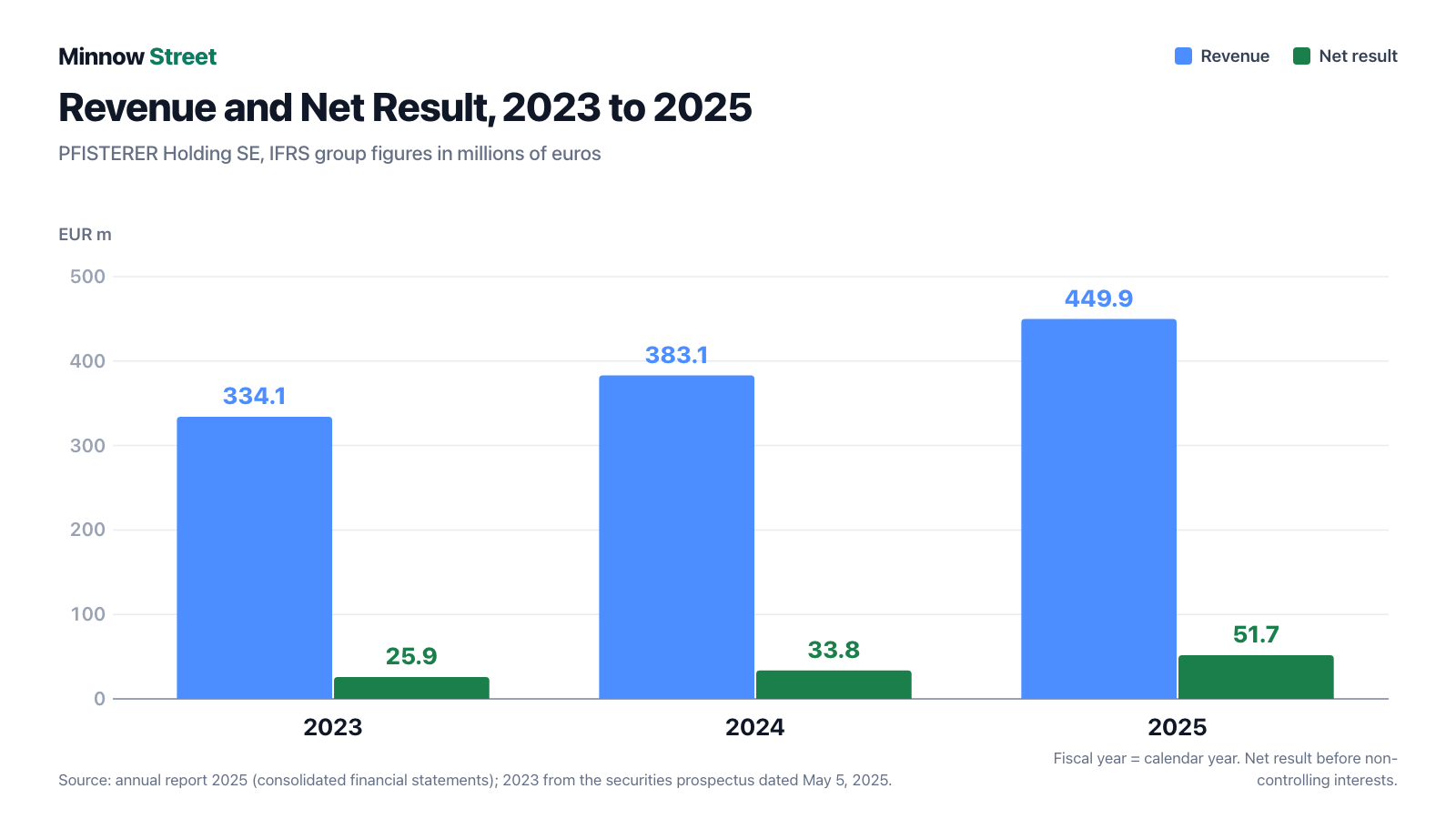
First, what genuinely impresses — and there is plenty. PFISTERER has grown at double-digit rates for years: revenue €334.1 million (2023), €383.1 million (2024), €449.9 million (2025), up 17.4 percent last year. Net profit for the period kept pace: €25.9 million (2023), €33.8 million (2024), €51.7 million (2025) — up 53.2 percent. Gross margin improved from 39.6 to 40.6 percent, and earnings per share rose from €2.21 to €3.04 (on a weighted average share count of 16.832 million in 2025 versus 14.595 million in 2024 — the dilution from the IPO capital increase is already baked into that figure).
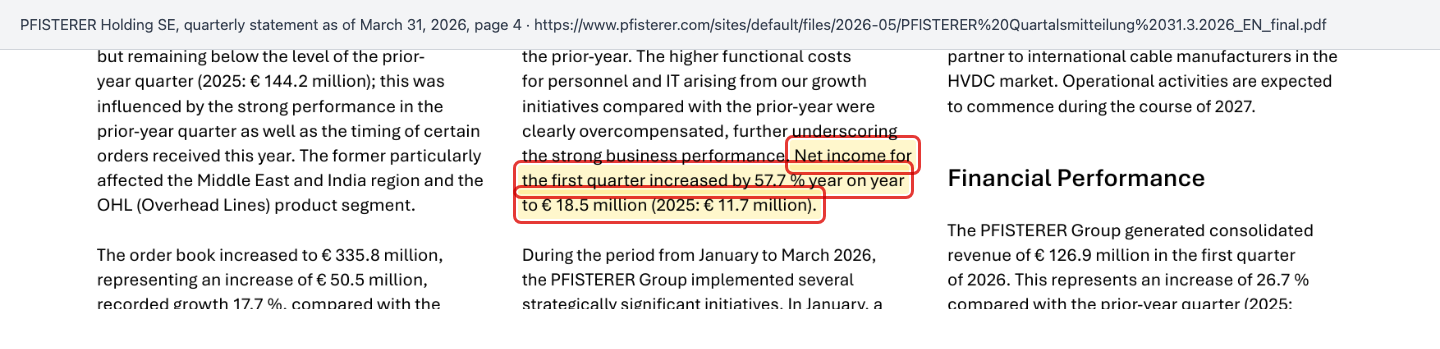
And the first quarter of 2026 confirms the trend rather than breaking it: revenue €126.875 million (up 26.7 percent from €100.126 million in the prior-year quarter), EBITDA €27.168 million (up 37.7 percent), net profit for the period €18.481 million (up 57.7 percent) — of which €17.788 million was attributable to the owners of PFISTERER Holding SE (Q1 2025: €11.528 million) and €0.693 million to non-controlling interests. The quarterly statement puts it plainly:
"Net income for the first quarter increased by 57.7 % year on year to € 18.5 million (2025: € 11.7 million)."
— PFISTERER Holding SE, quarterly statement as of March 31, 2026, page 4
Up to this point, everything looks like a clean, unbroken growth line — exactly the picture the newsletter painted in November 2025. Now to the places where the original reports themselves put a kink in that line.
What the filings say — the uncomfortable truths
Uncomfortable truth no. 1: an eighth of the EBITDA record came from a fire, not from the business
In September 2024, a fire broke out at Pfisterer Insulators Wunsiedel GmbH; production of silicone insulators had to move to Kadaň in the Czech Republic, while sales and technology stayed at a new site in Wunsiedel. Two fiscal years later, the incident is still visible in the accounts — just on the positive side. The 2025 annual report explains part of the celebrated EBITDA record of €76.2 million like this:
"This includes € 6.3 million in insurance payments for expenses incurred in connection with the fire damage at Pfisterer Insulators Wunsiedel GmbH."
— PFISTERER Holding SE, 2025 annual report, management report section 2.5.2 "Results of operations," page 10
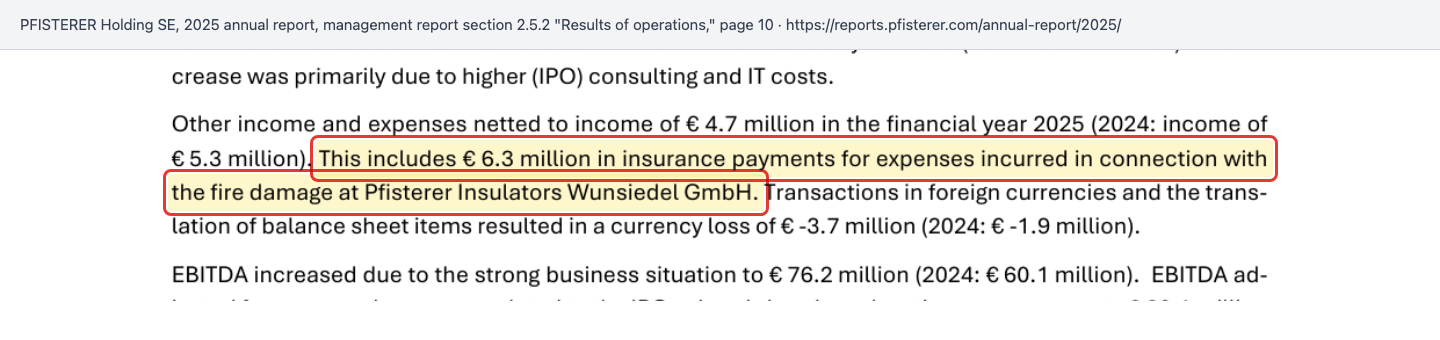
To be precise, the notes put it at €6.324 million in insurance income (2024: €2.450 million) — a good 8 percent of total EBITDA of €76.2 million. That is not a rounding error, and it is not hidden either — the company discloses it openly. The uncomfortable truth sits elsewhere: PFISTERER also communicates an "adjusted EBITDA" of €80.1 million (margin 17.8 percent, versus 16.9 percent the prior year) as the headline metric behind its margin-improvement story. That adjustment, however, strips out only the personnel expense from the IPO-related virtual stock option program (VSOP) — not the one-off insurance gain from the fire. In everyday terms: a small business owner gets an insurance payout after a burst pipe and books it as operating profit — the numbers then look better than the actual craft underneath. Strip out the €6.3 million and 2025 adjusted EBITDA comes to roughly €73.8 million instead of €80.1 million — a margin of about 16.4 percent instead of 17.8 percent, closer to the prior-year figure than to the celebrated improvement.
Uncomfortable truth no. 2: the record order book from November 2025 was already the peak
Here the record trap gets concrete. The order book — the leading indicator for tomorrow's revenue — did rise impressively: from €234.9 million (end of 2024) through €285.3 million (Q1 2025) and €312.5 million (Q2 2025) to €338.7 million at the end of the third quarter of 2025 — exactly the figure the newsletter celebrated in November 2025 as a "record … up 46 percent." Since then: €334.4 million at year-end 2025 — a decline from the Q3 record — and €335.8 million as of March 31, 2026. For three straight quarters the figure has effectively moved sideways, while revenue over the same period kept growing at double-digit rates. Quarterly revenue traces a clear upward line over the same period: €98.0 million (Q4 2024), €100.1 million (Q1 2025), €113.4 million (Q2 2025), €113.1 million (Q3 2025), €123.3 million — a record high at the time — (Q4 2025), and €126.9 million (Q1 2026).
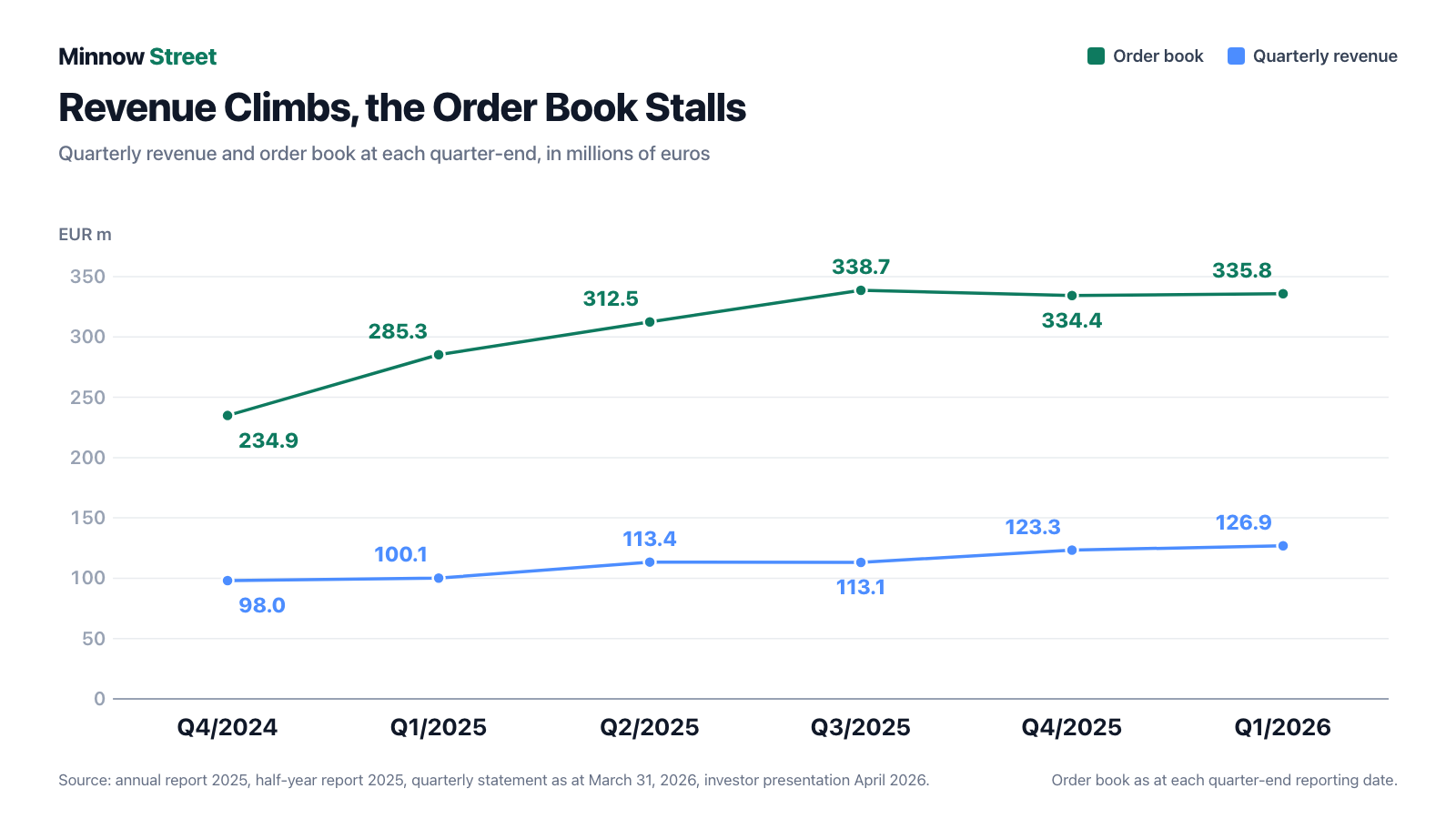
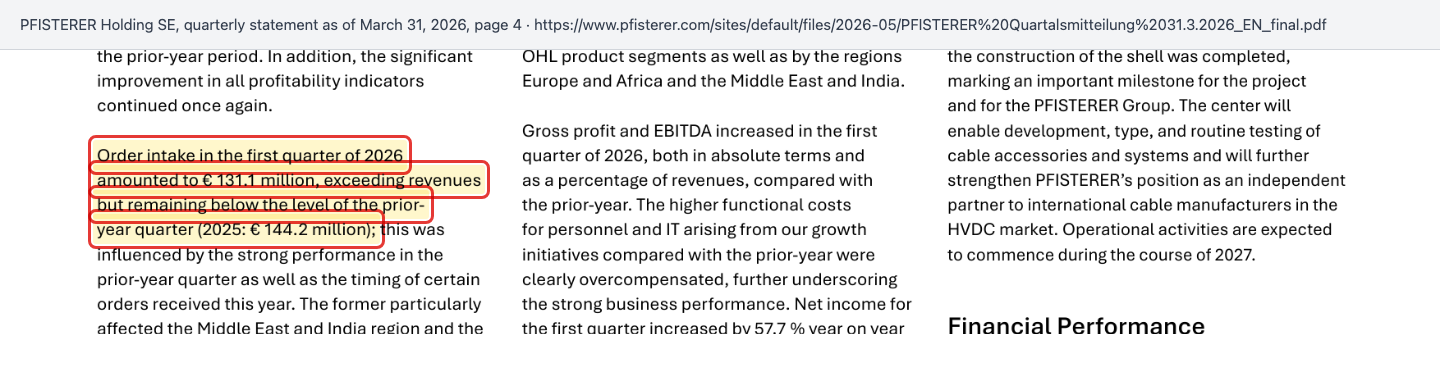
The reason for the stall shows up in order intake, not just the backlog. In the first quarter of 2026, PFISTERER booked €131.1 million in new orders — 9.1 percent less than the unusually strong prior-year quarter (€144.2 million). The quarterly statement explains it this way:
"Order intake in the first quarter of 2026 amounted to € 131.1 million, exceeding revenues but remaining below the level of the prior-year quarter (2025: € 144.2 million); this was influenced by the strong performance in the prior-year quarter as well as the timing of certain orders received this year."
— PFISTERER Holding SE, quarterly statement as of March 31, 2026, page 4
Management does confirm the outlook of "a continuation of the projected development in order intake and revenues" for full-year 2026 and attributes the decline to base effects and the timing of individual large orders — a plausible explanation, but one that cannot be independently verified. What adds to the picture: net working capital grew faster than profit in the first quarter of 2026 — from €99.9 million to €126.1 million (22.2 to 26.4 percent of revenue) — as inventories and receivables kept pace with the revenue growth. The result: operating cash flow was negative in the first quarter of 2026 despite record profit (minus €0.9 million, after minus €5.7 million in the prior-year quarter — an improvement, but still an outflow), and the net cash position that still looked comfortable at year-end 2025 shrank in a single quarter from €19.2 million to €7.6 million. Remember the picture: a record is a snapshot, not a forecast — and a growing business eats its own cash before it fills it back up.
Uncomfortable truth no. 3: a family holds the majority, free float is small, and the trading history is not yet 15 months old
Despite the IPO, PFISTERER has remained a family company. The company's investor relations page states the shareholder structure as of June 11, 2026 (the date of the 2026 annual general meeting in Schorndorf) as follows: Karl-Heinz Pfisterer 46 percent, Anna Dorothee Stängel 10 percent — 56 percent combined — management and supervisory board 2 percent, and free float of only 43 percent. That is no surprise for a company with more than 100 years of history that only recently went public — but it also means institutional and retail investors together hold less than half the voting rights, and the stock is correspondingly thin.
Add to that the sheer amount of time elapsed: the IPO took place on May 14, 2025, not even 15 months before this analysis. That means every publicly traded price reaction so far — including the near-tripling of the stock — comes from a period of consistently good news. Nobody has yet seen how the stock reacts to a weaker quarter. And the annual report itself names a risk that fell right into the gap between the balance sheet date and publication:
"Nevertheless, following the fiscal year-end on December 31, 2025, there was a massive escalation of the military conflict with Iran and in the surrounding region. We are continuously monitoring the impact on our logistics routes, including the resulting rerouting of exports to the region (the Suez Canal, the Red Sea, and the Strait of Hormuz)."
— PFISTERER Holding SE, 2025 annual report, note 17 "Events after the reporting date," page 94
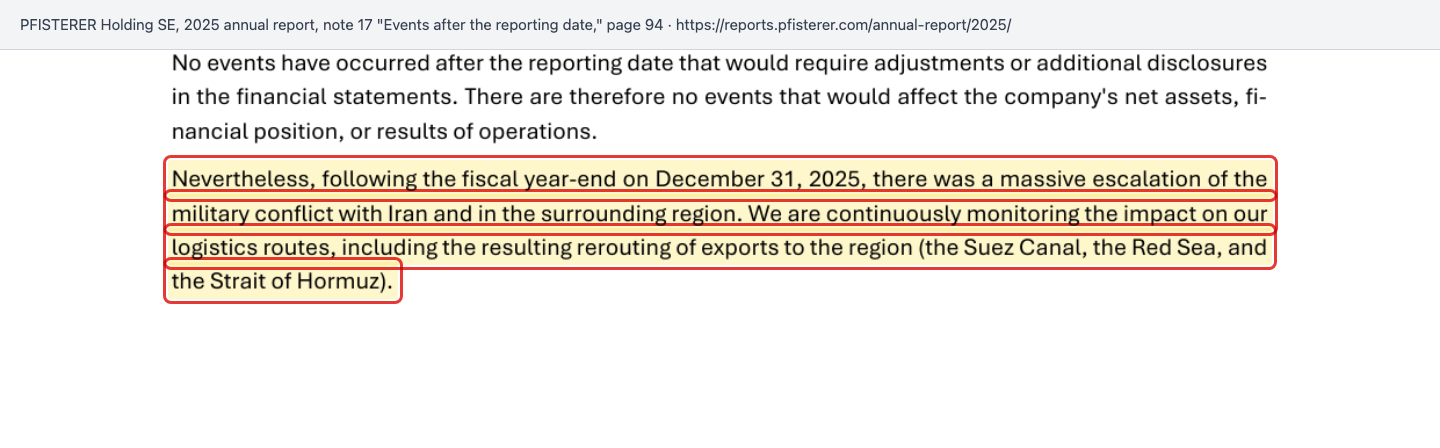
The report explicitly does not treat this as a balance-sheet-relevant event — but the company's own quarterly statement as of March 31, 2026 ties the entire 2026 outlook to exactly this condition: "no further escalation of the geopolitical situation" in the Middle East. A group with worldwide supply chains that has been public for only 14 months, and whose own outlook is conditioned on a geopolitical if-clause, carries a risk that goes beyond the pure business figures.
Valuation: between €80 and €114, but every analyst has only lived through one cycle
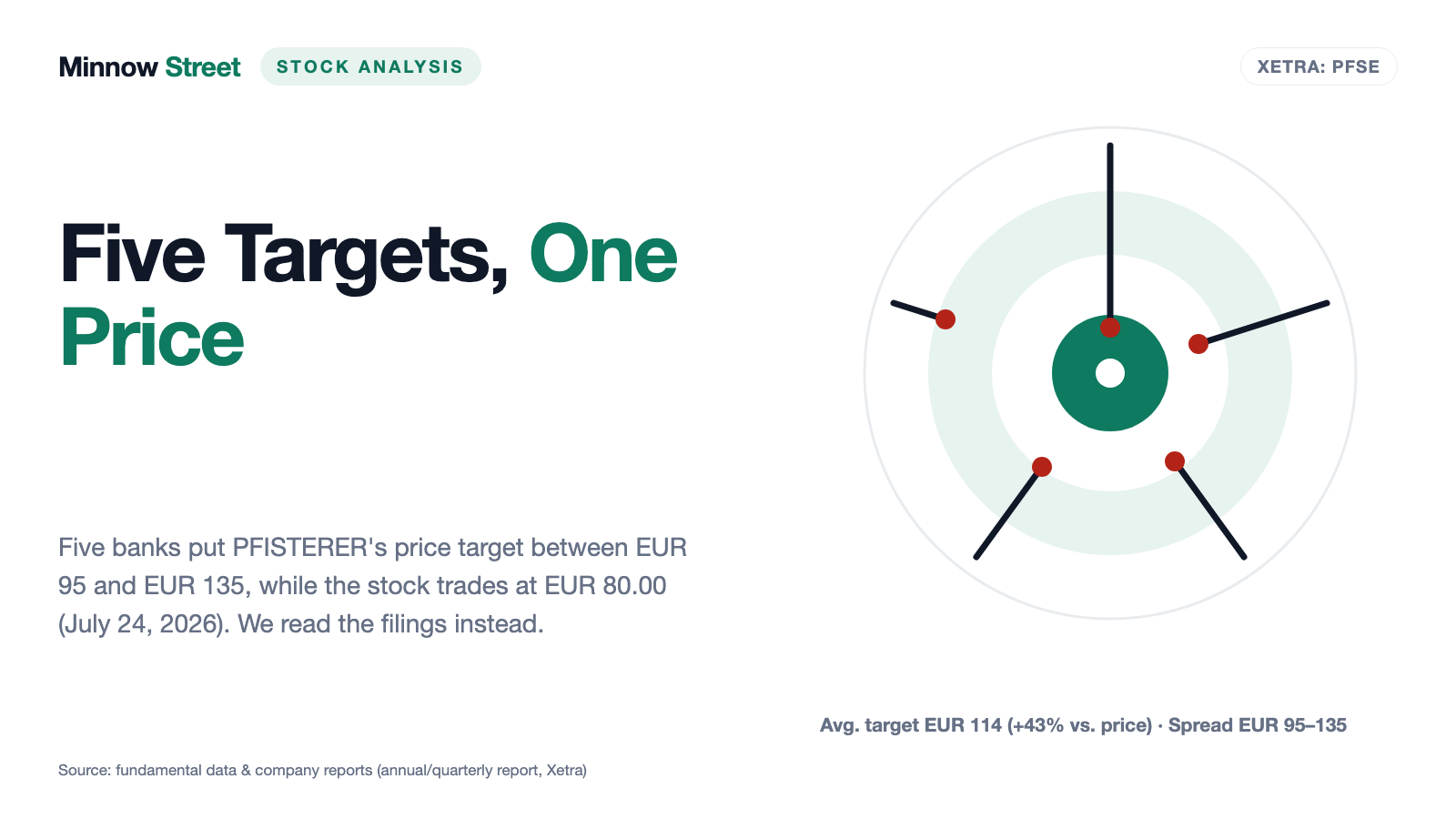
On the basis of 2025 earnings (€3.04 per share) and a share price of €80.00 (July 24, 2026), the price-to-earnings ratio comes to roughly 26. Five banks cover the stock and see the price target higher: Berenberg (Yasmin Steilen) €117, GBC AG (Cosmin Filker) €115, Landesbank Baden-Württemberg (Volker Stoll) €110, Metzler Research (Nikolas Demeter, Guido Hoymann) €135, and ODDO BHF (Adrian Pehl, Jean-François Granjon) €95 (all figures: investor relations page pfisterer.com, retrieved July 26, 2026) — the arithmetic mean of these five targets is about €114, a mathematical upside of 43 percent. For context: GBC itself named a price target of just €85 in the newsletter dated November 28, 2025 (raised from €48), with the stock quoted at €73.70; eight months later, the same house's price target stands at €115 — the analysts have already revised their own expectations sharply upward, with the share price catching up afterward.
Analyst consensus for fiscal 2026 (as of April 27, 2026, four estimates, source: investor relations page) calculates revenue of €516 million (range €513 to €519), adjusted EBITDA of €95.6 million (€92.4 to €101.0), a price-to-earnings ratio of 28.9 (26.1 to 30.8), earnings per share of €3.30 (€3.07 to €3.51) and a dividend of €0.95 per share (€0.90 to €0.98) — the latter matches the company's own dividend policy of paying out about 30 percent of consolidated net income (subject to distributable profit and liquidity; for fiscal 2024, a total of €11.676 million was paid to shareholders of the parent company in 2025). Important context: all five analyst firms have covered the stock only since the 2025 IPO — none of them has accompanied the company through a weaker quarter, let alone a downturn in the grid-buildout cycle. That does not make the price targets wrong, but it explains why they have so far known only one direction.
Opportunities and risks at a glance
What speaks for PFISTERER:
- A structural tailwind: decarbonization, rising electricity demand from data centers and AI, and the renewal of aging power grids drive, per the company's own growth strategy, a structurally growing global market for grid technology — independent of short-term business cycles.
- Double-digit growth across the board: 2025 revenue up 17.4 percent to €449.9 million, earnings per share from €2.21 to €3.04, and in the first quarter of 2026 revenue up another 26.7 percent with profit up 57.7 percent.
- A balance sheet flipped by the IPO: €63.7 million of net debt (2024) turned into a net cash position, the equity ratio rose from 34 to 60.5 percent (March 31, 2026); additional financing headroom from a €150 million loan through 2030 and a not-yet-drawn €25 million loan for the HVDC test lab.
- Technology leadership in a growing niche: the company says it became the world's first independent provider to type-test a 320 kV HVDC cable system, plus expansion in Saudi Arabia (training center in Riyadh, opened January 2026) and the U.S. (Rochester).
- An owner family with real skin in the game: Karl-Heinz Pfisterer and Anna Dorothee Stängel together hold 56 percent of the shares — an alignment of interest many freshly listed growth stocks do not offer.
What speaks against it:
- Earnings quality with a question mark: €6.3 million of 2025 EBITDA (a good 8 percent) came from an insurance payout following the Wunsiedel fire, which the communicated "adjusted EBITDA" does not strip out.
- The celebrated order-book record of €338.7 million (Q3 2025) has not grown since (€334.4 million at year-end 2025, €335.8 million at the end of Q1 2026), and order intake fell 9.1 percent year on year in the first quarter of 2026.
- The net cash position is already declining again: from €19.2 million (December 31, 2025) to €7.6 million (March 31, 2026), with operating cash flow negative in the first quarter of 2026 despite record profit, as working capital grew disproportionately.
- A very short trading history (since May 2025) with a narrow free float (43 percent) — no observation period through a weak quarter yet, and all five analyst firms know the company only from its growth phase.
- A geopolitical risk the group itself disclosed after the balance sheet date: a "massive escalation" of the Iran conflict with possible consequences for global logistics routes, to which the 2026 outlook is explicitly tied.
A human conclusion
Back to the record trap from the start. Its core is not that the record was fabricated — the €338.7 million order book in the third quarter of 2025 was real, audited-adjacent, genuine. Its core is that a record grammatically speaks of the past while it feels like a promise for the future. The newsletter dated November 28, 2025 was right about every single figure it cited — and yet, looking at the original reports five months later, a more nuanced picture emerges: a business that is growing structurally and whose balance sheet has fundamentally improved, but also an EBITDA that is one-eighth built on an insurance payout, and an order book that has not moved since that very record was celebrated. Both are true, and both belong in the same analysis. The honest question for you is therefore not "Is the record real?" but: are you buying the straight line a single peak draws in your head — or the company behind it, with everything the next report on August 19, 2026, will still show? What you make of it is your decision. And that is exactly as it should be.
Sources
All original documents used in this analysis — to read for yourself:
- PFISTERER Holding SE — Annual report 2025 (online report, published April 15, 2026)
- PFISTERER Holding SE — Consolidated financial statements 2025 (PDF download)
- PFISTERER Holding SE — Quarterly statement as of March 31, 2026 (published May 19, 2026)
- PFISTERER Holding SE — Quarterly statement as of September 30, 2025 (published November 19, 2025) — source of the €338.7 million order-book record (+46.0 percent)
- PFISTERER Holding SE — Half-year report 2025 (published August 19, 2025)
- PFISTERER Holding SE — Investor presentation, as of April 2026 — source of the quarterly order-book and revenue series in the order-book chart
- PFISTERER Holding SE — Securities prospectus dated May 5, 2025 (prospectus summary) — source of the 2023 comparison figures in the revenue chart
- PFISTERER Holding SE — Investor relations page: shareholder structure, analyst price targets, financial calendar
- Fundamental data (metrics, valuation; data as of July 26, 2026), reconciled with the annual reports.
- Hook: "Hot Stocks Europe" newsletter, issue 24, dated November 28, 2025 (B-Inside International Media GmbH, Freiburg, Germany) — cited as a third party's expectation, not used as a source for company figures.
Transparency & disclaimer: this analysis is a journalistic contextualization of publicly available information and is not investment advice, not a regulated financial analysis and not a solicitation to buy or sell securities. Equity investments carry substantial risk up to and including total loss. All figures without warranty; the as-of date of every data point is stated in the text. The author holds no position in PFISTERER shares at the time of publication.
Our Bottom Line at a Glance
- Growth and margin positive
- 2025 revenue up 17.4 percent to €449.9 million, gross margin up from 39.6 to 40.6 percent, net profit up 53.2 percent to €51.7 million. The first quarter of 2026 kept it up: revenue +26.7 percent, profit +57.7 percent. Structurally, the global grid buildout (decarbonization, data centers, renewal of aging grids) carries the business.
- Earnings quality negative
- €6.3 million of 2025 EBITDA (a good 8 percent) came from an insurance payout following the Wunsiedel fire, not from operations. The reported "adjusted EBITDA" (€80.1 million, margin 17.8 percent) strips out only IPO stock-option expense, not this one-off effect — the communicated margin improvement is therefore partly not genuine.
- Order dynamics neutral
- The order-book record of €338.7 million celebrated in November 2025 (Q3 2025) has only reached €335.8 million by March 31, 2026, and order intake fell 9.1 percent year on year in the first quarter of 2026. Management attributes this to base effects and confirms its unchanged outlook for 2026.
- Balance sheet and liquidity positive
- Equity ratio 60.5 percent (March 31, 2026); €63.7 million of net debt (2024) turned into a net cash position; a €150 million syndicated loan through 2030 and a not-yet-drawn €25 million subsidized loan provide further headroom. However, the net cash position already shrank again in the first quarter of 2026, from €19.2 million to €7.6 million, as operating cash flow stayed negative despite record profit (minus €0.9 million).
- Ownership structure and trading history neutral
- The Pfisterer family still controls 56 percent of the shares, with free float at 43 percent; that is a very short trading history — a good 14 months after the IPO — for reliable market-reaction patterns. After the balance sheet date, the annual report itself reports a "massive escalation" of the military conflict with Iran, with possible consequences for logistics routes via the Suez Canal, the Red Sea and the Strait of Hormuz.
- Valuation neutral
- Five analyst firms put the price target between €95 and €135 (average about €114, the arithmetic mean of the five individual targets) against a share price of €80.00 — all five have covered the company only since its 2025 IPO. Consensus 2026 P/E stands at 28.9; based on 2025 earnings it is roughly 26.
PFISTERER delivers what a growth stock is supposed to deliver: revenue and profit rise at double-digit rates, the balance sheet has flipped from net debt to net cash since the IPO, and the equity ratio stands at 60.5 percent. But the order-book record a stock newsletter celebrated in November 2025 has not grown since, order intake fell in the first quarter of 2026, and a good eight percent of the 2025 EBITDA record came from an insurance payout, not from the core business. Not investment advice.
What Our Rating Means
Open questions
The business works in principle, but one material question is open. As long as it stays open, our findings do not carry a quality verdict.
Yellow here is not about an existential question — the balance sheet, with a 60.5 percent equity ratio and net cash, is fundamentally healthy, and there is no governance or accounting breach. Yellow stands because two operating questions remain open that the November 2025 newsletter's enthusiasm did not show: first, the 2025 EBITDA record sold as "adjusted" still contains a €6.3 million insurance payout (a good 8 percent) that has nothing to do with the actual business. Second, the order-book record of €338.7 million celebrated back then has not grown since the third quarter of 2025, and order intake actually fell year on year in the first quarter of 2026 — alongside a shrinking net cash position. The business model itself (manufacturer-independent technology at critical grid interfaces, a structurally growing market, more than 100 years of experience) is visibly carrying the company. Whether the growth momentum of the first IPO quarters continues, or whether the third quarter of 2025 really was the peak, will be shown at the earliest by the half-year report on August 19, 2026.
A journalistic assessment by our editorial team at the time of the deep dive, based on public sources — not investment advice and not a solicitation to buy or sell. Your personal circumstances (investment goals, risk capacity, taxes) cannot be taken into account. What our levels mean, how verdicts are formed, and what conflicts of interest exist →
Worth Noting
- The hook for this analysis is issue 24 of the "Hot Stocks Europe" newsletter dated November 28, 2025 (B-Inside International Media GmbH, Freiburg, Germany), which featured PFISTERER at a then-price of €73.70 and a GBC price target just raised from €48 to €85. On page 8, the newsletter carries a standard disclosure that the publisher, author, or related third parties may have taken long positions in securities discussed and intend to sell into rising prices (EU Market Abuse Regulation No. 596/2014) — but for issue 24 itself, the newsletter explicitly denies holding any: "Publisher, author, or related third parties hold long positions in the following securities named in this issue: -." A possible conflict of interest that this specific issue rules out.
- All company figures come from the 2025 annual report (published April 15, 2026) and the quarterly statement as of March 31, 2026 (May 19, 2026), not from the newsletter. Valuation metrics and analyst targets are as of July 26, 2026.
- Potential for confusion: the PFSE.DE label used in this analysis is simply shorthand for "PFISTERER, listed in Germany" — not an official exchange code. The stock actually trades as Xetra: PFSE, and also on Tradegate, Frankfurt, and Gettex.
Frequently Asked Questions
PFISTERER Holding SE, headquartered in Winterbach near Stuttgart, develops and manufactures insulation and connection technology for electrical power grids across all voltage levels up to 1,100 kilovolts — manufacturer-independent and compatible with all standard cables and conductors. The business splits into five segments: overhead lines (OHL), high-voltage cable accessories (HVA), medium-voltage cable accessories (MVA), low-voltage connection technology (COM) and newly high-voltage direct current (HVD).
The share price climbed from the €27.00 offer price (May 2025) to €80.00 (July 24, 2026) because revenue and profit grew strongly (2025 revenue up 17.4 percent, profit up 53.2 percent) and the IPO proceeds turned €63.7 million of net debt into €19.2 million of net cash on the balance sheet. Analysts see further upside between €95 and €135.
Yes. Per the investor relations page (as of June 11, 2026), Karl-Heinz Pfisterer holds about 46 percent of the shares and Anna Dorothee Stängel another 10 percent — 56 percent combined. Free float stands at 43 percent, with management and the supervisory board holding 2 percent. The family therefore still controls the company after the IPO.
PFISTERER is listed on the Scale segment of the Frankfurt Stock Exchange, not in the U.S. — there is no 10-K, no 10-Q, no SEC registration. Requirements are an audited annual report, a half-year report and short, unaudited quarterly statements without a complete interim balance sheet. This analysis relies on the 2025 annual report and the quarterly statement as of March 31, 2026.
€6.3 million of the reported €76.2 million EBITDA (a good 8 percent) came from an insurance payout following the fire at Pfisterer Insulators Wunsiedel GmbH in September 2024. The €80.1 million "adjusted EBITDA" the company communicates strips out only the IPO-related stock-option expense, not this one-off gain.
Order intake fell 9.1 percent to €131.1 million in the first quarter of 2026 versus an unusually strong prior-year quarter. The order book has stalled at roughly €335 million since the €338.7 million record in the third quarter of 2025. Management nonetheless confirms its outlook for rising revenue and order intake for full-year 2026.
The dividend policy targets about 30 percent of consolidated net income, subject to distributable profit and liquidity. For fiscal 2024, a total of €11.676 million was paid to shareholders of the parent company in 2025. Analyst consensus for 2026 (as of April 27, 2026) expects €0.95 per share — about 1.2 percent yield at €80.00.
Five banks put the price target between €95 (ODDO BHF) and €135 (Metzler Research), the arithmetic mean of which is about €114 — a mathematical upside of roughly 43 percent at a share price of €80.00. Analyst consensus for 2026 calculates a price-to-earnings ratio of 28.9; based on 2025 earnings (€3.04), the current P/E is roughly 26.
Found an error?
Did you spot a factual error, an outdated number, or a typo in this deep dive? Let us know briefly — your report goes straight to the editorial team.