R&S Group Stock: Revenue Up 47 Percent, Profit Up 41 Percent — and Equity Worth 12.2 Percent of Total Assets
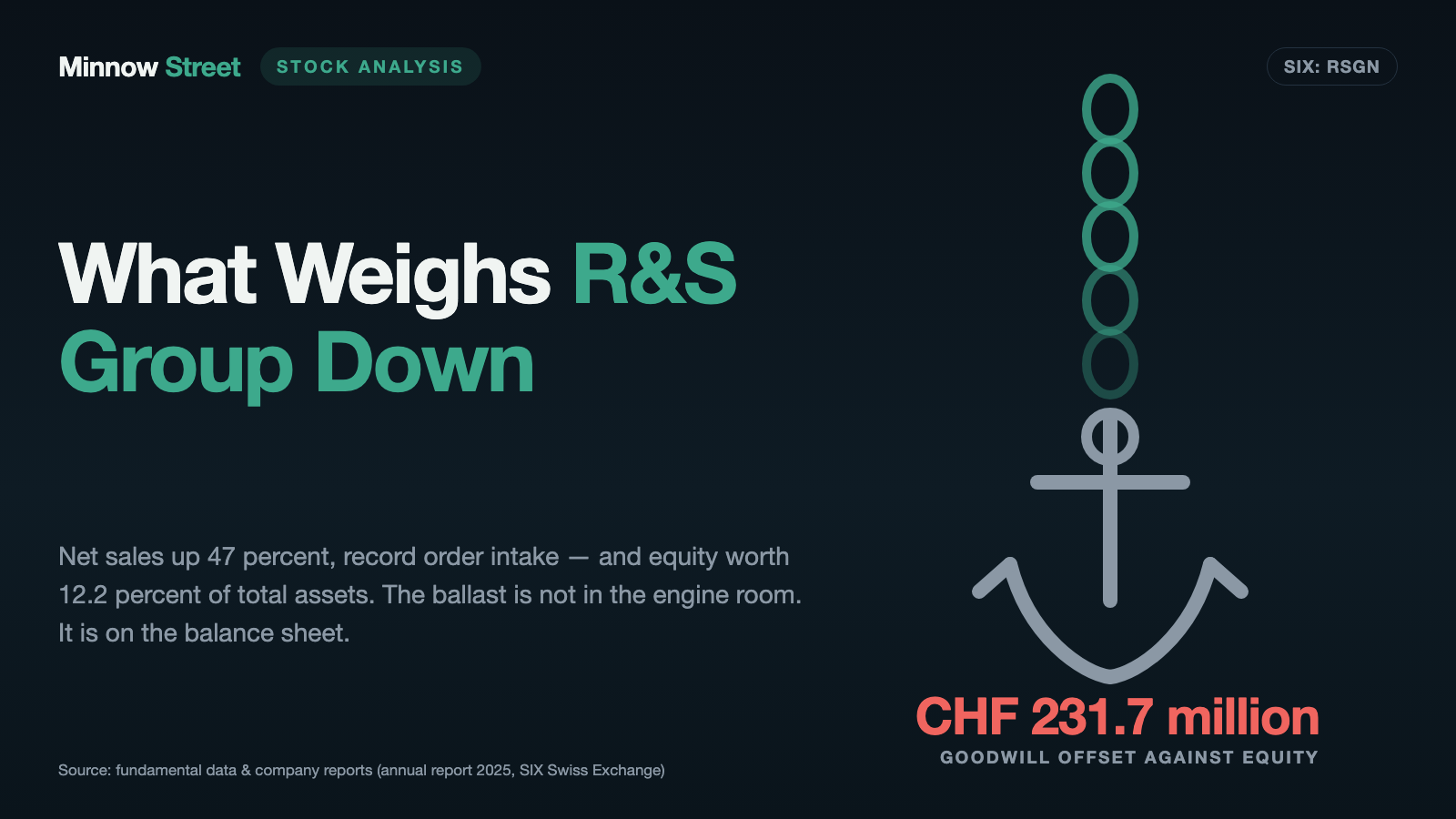
R&S Group, based in Sissach, Switzerland, builds transformers for aging power grids — and just delivered a record year: revenue of CHF 414.8 million (up 47 percent), profit of CHF 58.1 million (up 41 percent), record order intake and backlog. The catch sits in the notes: CHF 231.7 million of goodwill is offset directly against equity under Swiss GAAP FER, leaving equity at just 12.2 percent of total assets — a year earlier it was negative. Not investment advice — just the arithmetic that lives in the annual report and rarely makes it into anyone's portfolio summary.
 Thomas Mücke
Founder & Publisher
Thomas Mücke
Founder & Publisher
Chart
Interactive price chart (TradingView).
Note: pure fact-based analysis, not investment advice and not a solicitation to buy or sell. All figures without guarantee.
Psychologist Daniel Kahneman coined a shorthand for it: WYSIATI — What You See Is All There Is. Our minds automatically build a coherent, convincing story out of whatever information is currently visible, and never stop to ask what sits outside the frame. For a stock, that frame is usually revenue, profit, maybe the order backlog. For R&S Group Holding AG (SIX: RSGN), a Swiss transformer manufacturer based in Sissach, that frame is dazzling: revenue up 47 percent in 2025, profit up 41 percent, order intake at a record. A reader sent us issue 24 of the newsletter "Hot Stocks Europe," dated November 28, 2025 (B-Inside International Media GmbH, Freiburg i. Br., author Michael Calivas), which presented R&S Group alongside six other European names as a bet on aging power grids. So let's make a deal: we read the full 2025 annual report (published April 8, 2026) — including the notes almost nobody opens. That is exactly where the part of the picture WYSIATI hides from you sits. In the end, the decision is yours.
What R&S Group Actually Does — a Gearbox for the Power Grid
The business model fits in one image: a transformer is essentially a gearbox for electricity — it converts voltage from one level to another without changing the energy itself, the way a bicycle's gears translate the force of your legs into different speeds. Without that gearbox, no electricity gets from a power plant or wind farm to a wall socket. R&S Group builds exactly those gearboxes: oil-immersed and cast-resin distribution transformers, power transformers up to 220 kilovolts and 160 MVA, and instrument transformers — under four brands, each with its own product focus: Rauscher & Stoecklin (Switzerland, power transformers), Kyte Powertech (Cavan, Ireland, distribution transformers for British and Irish network operators), Tesar (Italy, a pioneer in cast-resin transformers, more than 100,000 units delivered) and ZREW (Poland, distribution transformers, with a new power-transformer plant under construction in Łódź). As of December 31, 2025 the group employed 1,328 people across eight manufacturing sites in five countries — Switzerland, Italy, Poland, Ireland and the United Arab Emirates.
The market story behind the stock is not a hype narrative but a sober infrastructure bet: Europe's power grids are old, and electrification, data centers and renewables all need more of them. About 30 percent of Europe's power grids are already older than 40 years, a share expected to reach roughly 50 percent by 2030 — more than 60 percent of distribution transformers are already over 30 years old. On top of that comes genuine demand from new applications: battery energy storage systems (BESS), e-mobility, and data centers — including those that, according to an International Energy Agency study cited in the annual report itself, could push global data-center electricity demand to 4.4 percent of total consumption by 2035 on the back of AI-driven growth. R&S Group does not sell AI — it sells the steel and copper every data center needs to get electricity in the first place, regardless of how much AI it runs. R&S Group shares that bet on renewing aging grids with other names in the same market, including our PFISTERER analysis, another supplier of critical power-grid interfaces. Sounds like a sure thing? Not quite — because growing faster also means burning through capital faster, as the rest of this analysis shows.
Why There Is No SEC Filing From R&S Group — and Where the Numbers Come From Instead
One point first, because it shapes the entire evidence base of this analysis: there is no 10-K, no 10-Q from R&S Group. The company is not a U.S. reporting entity — an EDGAR search for the ticker RSGN returns no CIK, no filings. R&S Group's mandatory reports live elsewhere: the stock has traded on the SIX Swiss Exchange since December 2023 and reports under Swiss GAAP FER — a Swiss accounting standard deliberately leaner than U.S. GAAP or IFRS. Required are an audited consolidated annual report (2025 edition published April 8, 2026) and a half-year report; there are no quarterly reports in the U.S. sense, only occasional trading updates.
What does that mean for you as a reader? The narrative logic we usually lean on — "a filing to the SEC is honest under penalty of law" — applies in spirit to the audited Swiss GAAP FER statements too: a consolidated report signed off by an independent auditor is a liability-bearing document. But two things differ. First, the source: every figure in this analysis is therefore captioned "Source: fundamental data & company reports (annual report, SIX Swiss Exchange)", not "SEC filings." Second, the accounting standard itself — and this is not a footnote: Swiss GAAP FER permits a treatment of goodwill (the premium a buyer pays above a target's pure asset value) on acquisitions that does not exist in this form under U.S. GAAP or IFRS — more on that shortly. We read the original report, marked the decisive passages and documented them with page numbers.
Where This Stock Landed on Our Desk — and What the Newsletter Itself Gets Tangled Up In
Honesty first: R&S Group did not come to our attention through our in-house stock scanner — that scanner covers primarily U.S.-listed names, and a pure SIX listing with no U.S. presence simply does not appear in it. Instead, a reader sent us issue 24 of the newsletter "Hot Stocks Europe," dated November 28, 2025. The newsletter described R&S Group at the time as a "full-service provider of transformer solutions" with six production sites and an order backlog of about CHF 320 million, cited a guidance cut in revenue growth to "8 to 13 percent per year" (from 10 to 13 percent), and quoted Zürcher Kantonalbank with a more skeptical estimate: a 2026 operating margin of only about 17 percent, earnings per share roughly 20 percent below consensus. Alongside that stood a considerably more optimistic calculation from Berenberg Research: revenue rising from CHF 217 million (2023) to CHF 490 million (2027), net profit of CHF 64 million (CHF 1.73 per share), a dividend climbing to CHF 0.80 by 2027, a single-digit 2027 P/E, and a price target of CHF 35.
Two things stand out on checking. First: at the start of its R&S Group section, the newsletter cites a "price in the newsletter of EUR 17.40" — confusing the reporting currency, Swiss francs, with euros, since R&S Group trades exclusively in Swiss francs on the SIX; elsewhere in the same text it correctly says "around CHF 16." That is not deliberate deception, just a reminder why you never take a newsletter's numbers at face value — the newsletter, too, is written by a person working fast. Second: the guidance cut R&S Group itself communicated on November 6, 2025 actually reads 8 to 12 percent revenue growth (not 13 percent) at an EBITDA margin of 19 to 21 percent — a small but real discrepancy from the newsletter's number. These figures are a dated third-party expectation from November 28, 2025 — not a source for this analysis; every company figure below comes from the 2025 annual report or the November 6, 2025 ad hoc release itself. Part of the proper context is also the conflict-of-interest notice the newsletter discloses on page 8: the publisher and author may hold long positions in the names discussed and intend to sell as prices rise (EU Market Abuse Regulation No. 596/2014). A remarkably similar pattern — a third-party number that does not hold up on checking — shows up in another name from the same newsletter issue: our ACG Metals analysis found an audited loss where an analyst had previously seen a profit.
The Numbers Over the Years — Honestly Appraised
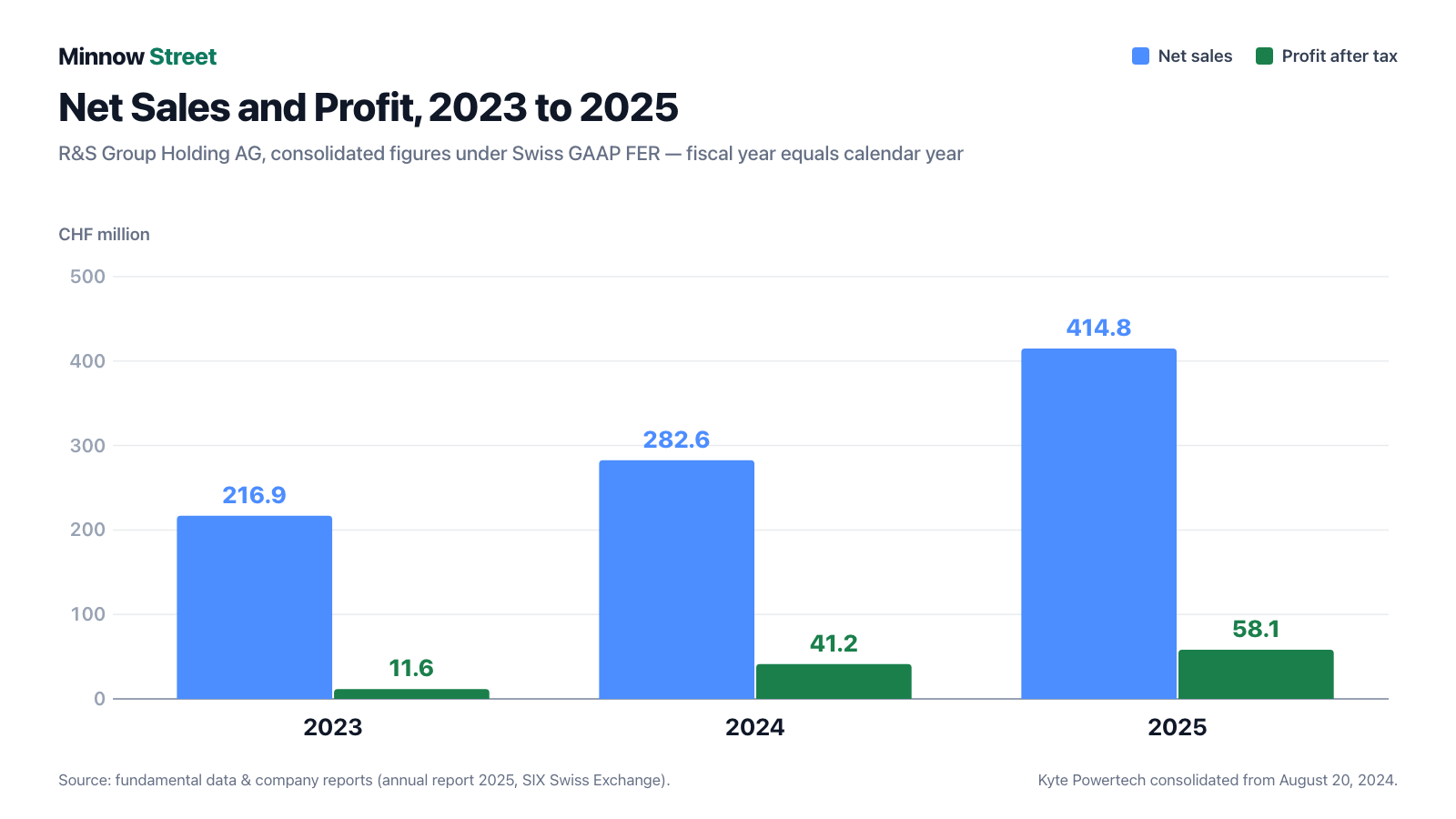
First what genuinely impresses — and there is a lot of it. R&S Group is growing at a pace you would not expect from a transformer maker: revenue of CHF 216.9 million (2023), CHF 282.6 million (2024), CHF 414.8 million (2025) — up 46.8 percent in the last year, 8.6 percent organically (stripping out acquisitions and currency effects). Net profit does not just keep pace, it accelerates: CHF 11.6 million (2023), CHF 41.2 million (2024), CHF 58.1 million (2025), up 41 percent, earnings per share of CHF 1.56 (2024: CHF 1.31).
The leading indicator for coming years looks just as strong. The annual report puts it this way:
"Order intake remained strong throughout most of 2025, culminating in a record figure of CHF 476.8 million (FY2024: CHF 305.5 million), supporting the good future visibility of our business."
— R&S Group Holding AG, Annual Report 2025, Business Development chapter, p. 21
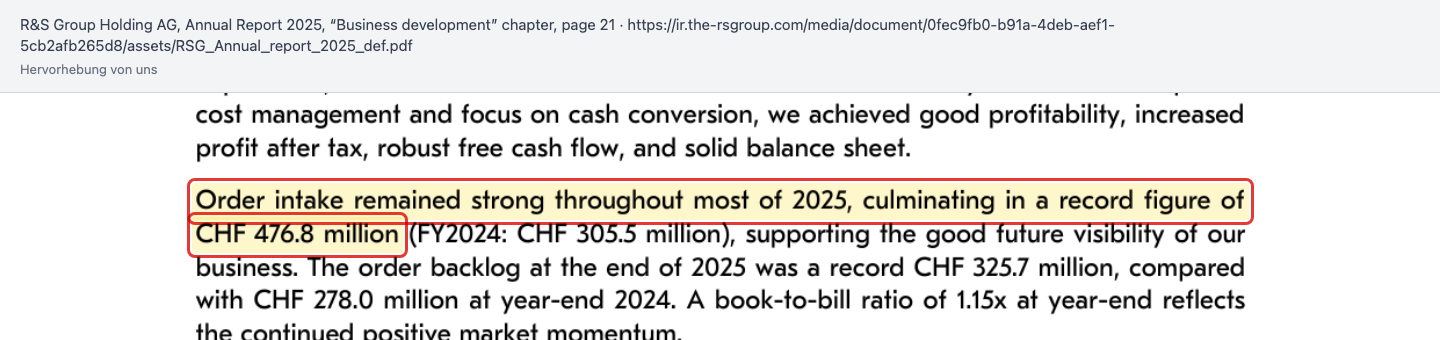
The order backlog at year-end 2025 also hit a record of CHF 325.7 million (2024: CHF 278.0 million, up 17 percent), and the book-to-bill ratio (new orders relative to revenue) stood at 1.15 — every franc of revenue was replaced by CHF 1.15 of new orders. Converted, that backlog already covers roughly 9.4 months of 2025 revenue under contract. The operating picture is just as convincing: net financial debt fell from CHF 91.3 million to CHF 62.9 million (leverage 0.7 times EBITDA), operating cash flow rose from CHF 48.7 million to CHF 65.9 million, and free cash flow stayed clearly positive at CHF 48.1 million (2024 adjusted: CHF 44.9 million — the reported raw 2024 figure of minus CHF 176.2 million is explained entirely by the cash purchase price for Kyte Powertech). Up to this point everything looks like a clean growth line — exactly the picture a quick glance at revenue and profit paints. Now to the part of the picture WYSIATI hides from you.
What the Annual Report Says — the Uncomfortable Truths
Uncomfortable Truth No. 1: Equity Is Thin Because CHF 231.7 Million of Goodwill Simply Is Not on the Balance Sheet
Despite the record profit, equity at December 31, 2025 stands at just CHF 34.957 million against total assets of CHF 286.1 million — that is 12.2 percent. For context: a year earlier the figure was still negative (minus CHF 5.3 million). The annual report explains the jump into positive territory itself — and, in the same sentence, names the reason equity is so thin:
"Equity is back to a positive number at CHF 35.0 million versus a negative CHF 5.3 million at the end of 2024, owing to goodwill of CHF 180.7 million from the Kyte acquisition in August 2024 offset against equity in accordance with the Group's accounting policy and Swiss GAAP FER."
— R&S Group Holding AG, Annual Report 2025, Business Development chapter, p. 22
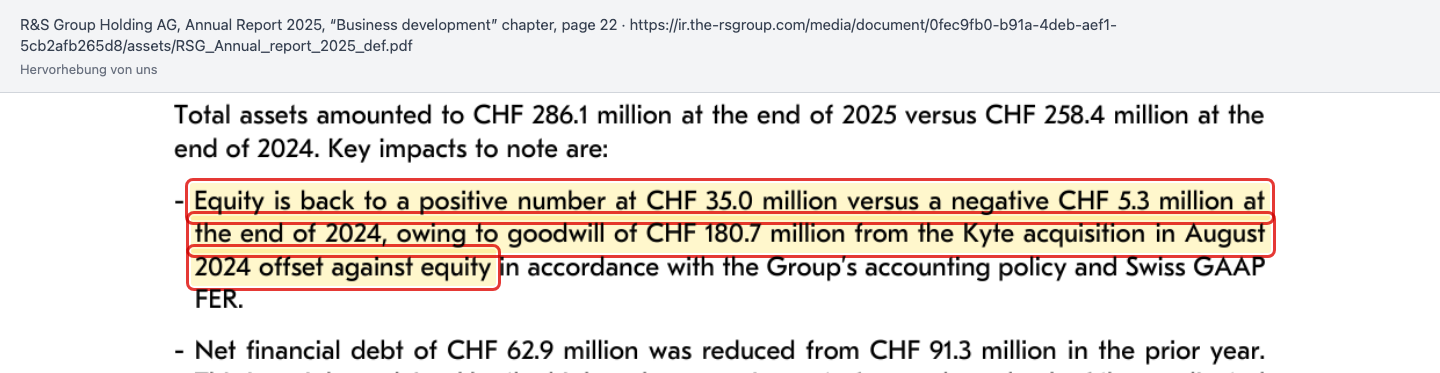
What is happening here is legal and openly disclosed under Swiss GAAP FER — but unusual by international standards. Under U.S. GAAP or IFRS, R&S Group would have to capitalize goodwill (the premium paid above a target's pure asset value) as an asset on the balance sheet and test it for impairment every year. Swiss GAAP FER instead permits writing it off immediately and in full against equity — and R&S Group has chosen exactly that path for every acquisition to date: CHF 17.7 million at the formation of the holding company in late 2023, CHF 180.7 million for Kyte Powertech in August 2024, plus smaller amounts for ZREW and Tesar. Together: CHF 231.695 million — more than 30 percent of the current market value of CHF 752.7 million (price CHF 20.26, July 24, 2026) — that simply no longer exists on the reported balance sheet.
The consequence for two popular metrics: book value per share sits at just CHF 0.94 — the stock trades at roughly 21.5 times book value. And return on equity (profit relative to equity) looks sensational at first glance, around 39 percent. Remember this image: a 39 percent return on equity is not proof of extraordinary capital efficiency when the denominator you divide by has been made artificially small — it is a computational artifact of an accounting choice, not a quality seal. Both metrics — price-to-book and return on equity — are therefore practically meaningless at R&S Group unless you know the reason behind them.
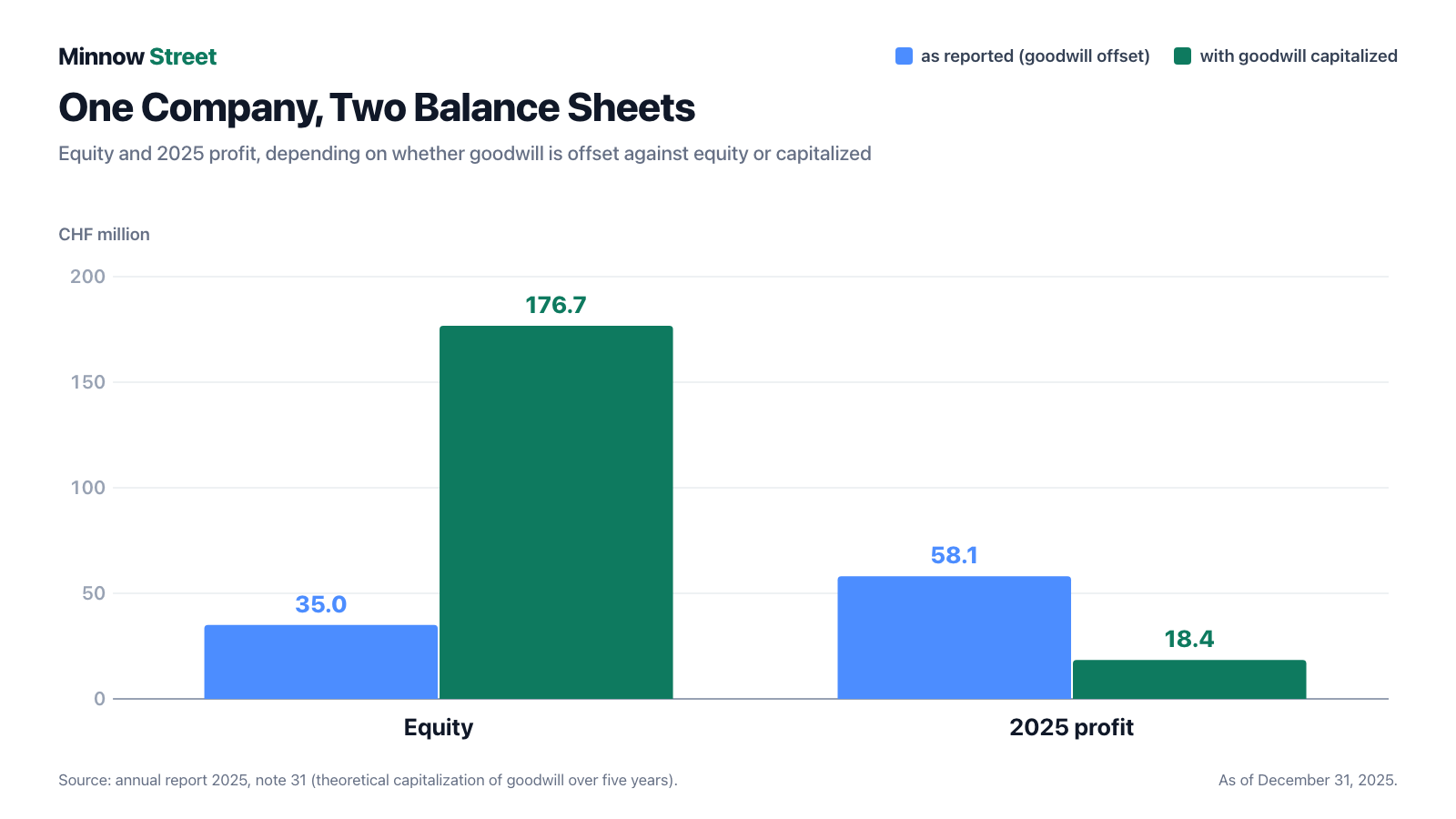
The annual report itself provides this counter-calculation, as a mandatory disclosure under Swiss GAAP FER: if the entire goodwill were instead capitalized and amortized over five years, equity would not stand at CHF 35.0 million but at CHF 176.7 million — and 2025 net profit would not be CHF 58.1 million but, after deducting CHF 39.675 million of theoretical amortization, only CHF 18.4 million. Two balance-sheet pictures of the same company, the same underlying numbers, differing only in one accounting choice — with more than a threefold difference in reported profit. Which picture is "right" is the wrong question. The right question is: do you know which one you are looking at?
Uncomfortable Truth No. 2: A Goodwill Impairment Would Never Show Up in Earnings
The second consequence of that same accounting choice is even less well known, but just as real. Because the goodwill has already been fully offset against equity, it can no longer be written down through the income statement either, should one of the acquisitions turn out to have been overpaid for. The annual report says so explicitly:
"As goodwill is fully offset against equity at the date of acquisition, an impairment of goodwill will not affect income, but will only be disclosed in the notes to the consolidated financial statements."
— R&S Group Holding AG, Annual Report 2025, accounting policies (impairment)
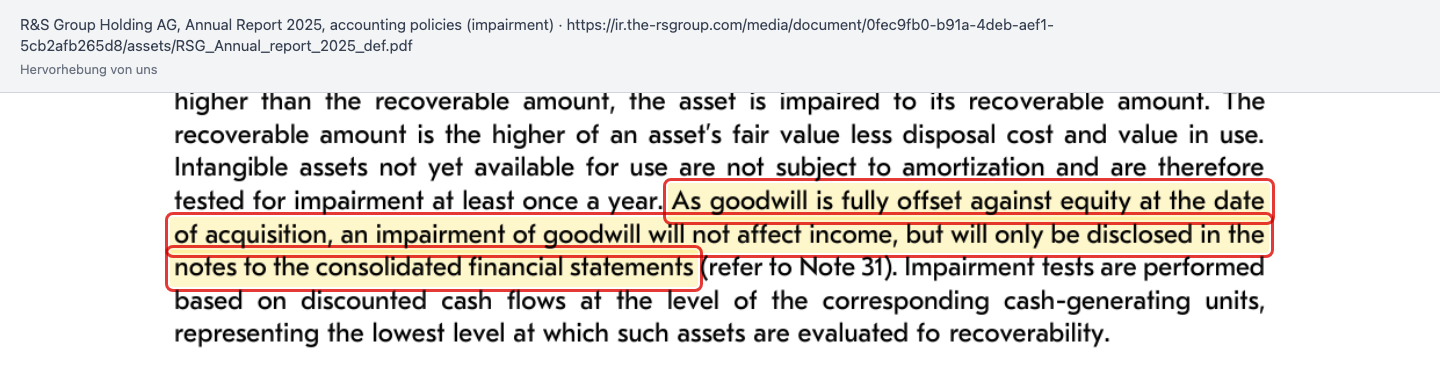
Picture it this way: imagine you paid a premium for a used car above its pure material value because you believed in the brand — and you paid that premium straight out of your savings account instead of booking it as an asset. If it later turns out the premium was not justified, that loss never shows up in any of your monthly expense summaries — it is already gone. The same is true for R&S Group: the only place a poorly performing acquisition would show up is the annual impairment test in the notes themselves — a line of text, not a drop in profit. Anyone reading EBITDA and net income as an early-warning system for a failed integration is looking exactly past the spot where a problem would first appear. That is the core of this analysis's side-find (see the "Beifang" box on this page): not an accusation against the company, but a gap in most readers' own early-warning system.
Uncomfortable Truth No. 3: The Company's Own Guidance Confirms That Growth Is Costing Margin
Even setting the goodwill question aside, the report itself shows that the record growth is not coming for free. Gross margin fell from 50.9 to 46.2 percent, the EBITDA margin from 23.9 to 20.9 percent, the operating margin from 22.2 to 19.1 percent — R&S Group itself attributes this to Kyte Powertech's "different margin profile" relative to the legacy business. On November 6, 2025, three weeks before the newsletter, management accordingly cut its own mid-term guidance: revenue growth now targeted at 8 to 12 percent per year (previously 10 to 13 percent), profitability reframed as an EBITDA margin of 19 to 21 percent instead of a prior operating-margin target of around 20 percent — and free-cash-flow guidance was suspended altogether. The company itself calls 2026 the "year of investment." The annual report dated April 7, 2026 reaffirms these targets word for word, unchanged.
The same friction shows up in free cash flow: it stayed positive in 2025 at CHF 48.1 million, even slightly above the prior year's adjusted figure (CHF 44.9 million) — but the margin fell from 15.9 to 11.6 percent, because CHF 17.8 million went into growth projects such as the new power-transformer plant in Łódź. Remember this pattern: a company growing faster than its market almost always pays for that pace with either margin or capital — usually both. That R&S Group states this so openly and adjusts its own guidance accordingly reads more as honesty than weakness — but it contradicts the pure record narrative under which the newsletter introduced the stock.
Valuation: a P/E of 13 or of 41 — Depending on Which Profit You Trust
At a price of CHF 20.26 (July 24, 2026) and 37.15 million shares outstanding, market value comes to roughly CHF 752.7 million. Measured against 2025 revenue (CHF 414.8 million), that is a price-to-sales ratio of about 1.8 — unremarkable for an industrial manufacturer growing at this pace. The price-to-earnings ratio is where it gets interesting: based on reported profit (CHF 58.1 million), it stands at roughly 13 — based on the theoretical profit after goodwill amortization (CHF 18.4 million, see above), roughly 41. Both figures are correctly calculated from the same underlying data; which one is "right" depends on whether you treat the Swiss GAAP FER immediate write-off as final and done or as a deferred charge. Own calculation of enterprise value (market cap plus net financial debt of CHF 62.9 million): roughly CHF 815.6 million, nine times reported EBITDA of CHF 86.7 million.
The analyst opinions cited in the November 28, 2025 newsletter are eight months old and should be read with that in mind. Berenberg Research at the time projected revenue climbing from CHF 217 million to CHF 490 million by 2027, net profit of CHF 64 million (CHF 1.73 per share), and a price target of CHF 35 — notably, even that optimistic 2027 forecast (CHF 1.73) sits only moderately above the CHF 1.56 per share R&S Group already delivered in 2025, consistent with the company's own guidance cut. Zürcher Kantonalbank was more skeptical, expecting a 2026 operating margin of only about 17 percent (not directly comparable to the company's new EBITDA-margin range of 19 to 21 percent) and earnings per share roughly 20 percent below consensus. Both assessments date from November 28, 2025 and are opinion, not a statement about the present.
Opportunities and Risks at a Glance
What speaks for R&S Group:
- A structural tailwind: Europe's aging power grids (about 30 percent already over 40 years old, rising to roughly 50 percent by 2030), plus demand from battery storage, e-mobility and data centers — independent of short-term economic cycles.
- Record order book: order intake of CHF 476.8 million (up 56 percent), backlog of CHF 325.7 million (book-to-bill 1.15) — already covering about 9.4 months of 2025 revenue.
- Deleveraging despite growth investment: net financial debt fell from CHF 91.3 million to CHF 62.9 million, leverage at 0.7 times EBITDA, free cash flow still positive (CHF 48.1 million).
- Wider free float: former majority owner CGS III (Jersey) L.P. sold its remaining 6.8 percent stake in full via a block trade in May 2025; free float rose from 83 to roughly 90 percent as a result — no known large shareholder is still waiting to exit.
- Dividend confirmed despite the investment phase: CHF 0.50 per share for fiscal 2025, approved May 7, 2026 and paid May 13, 2026, from tax-exempt capital contribution reserves.
What speaks against it:
- Equity of just 12.2 percent of total assets (CHF 34.957 million), because CHF 231.7 million of goodwill was offset directly against equity under Swiss GAAP FER — as recently as the end of 2024 the figure was negative. A future impairment of that goodwill would never touch reported earnings (see Uncomfortable Truth No. 2).
- Margins under pressure: gross margin down from 50.9 to 46.2 percent, EBITDA margin down from 23.9 to 20.9 percent — the company's own guidance cut on November 6, 2025 confirms this trend as structural, not a one-off.
- Free-cash-flow guidance for 2026 suspended entirely, while the company itself calls it a "year of investment" — without a target, it is hard to check whether capital spending stays on track.
- A very short trading history (December 2023) for a group that has since grown through two significant acquisitions (Kyte Powertech, the ZREW/Tesar integration) — a full economic cycle including a weaker year has yet to be observed.
- Governance change: board member Dr. Beatrix Natter resigned effective June 30, 2026 for personal reasons; a successor is not expected to be elected until the next annual general meeting, likely April 2027.
A Human Conclusion
Back to WYSIATI from the opening. The frame a quick glance at R&S Group shows is not wrong: revenue up 47 percent, profit up 41 percent, record order intake — every one of those numbers is real, audited, and traceable in the annual report. What WYSIATI hides from you is the part of the picture outside that frame: equity that is positive only because CHF 231.7 million of goodwill no longer sits on the balance sheet at all, and a future impairment of that goodwill that would never become visible in earnings. Both are true, and both belong in the same analysis. The honest question for you is therefore not "is the growth real?" but: Is the frame of revenue and profit enough for you — or do you also look where the company's own annual report says a problem would first appear: in the notes, not the income statement? What you make of it is your decision. And that is exactly as it should be.
Sources
All original documents used in this analysis — for your own reading:
- R&S Group Holding AG — Annual Report 2025 (PDF, published April 8, 2026)
- R&S Group Holding AG — Investor relations page: annual and semi-annual reports
- R&S Group Holding AG — Ad hoc release "R&S Group refines mid-term guidance and structure" (November 6, 2025)
- R&S Group Holding AG — Ad hoc release on the publication of the 2025 annual report (April 8, 2026)
- R&S Group Holding AG — Annual general meeting results, May 7, 2026 (dividend approved, paid May 13, 2026)
- R&S Group Holding AG — Resignation of Dr. Beatrix Natter from the board (release, effective June 30, 2026)
- Fundamental data (metrics, price, market capitalization; data as of July 26, 2026), reconciled against the annual report.
- Hook: newsletter "Hot Stocks Europe" issue 24, dated November 28, 2025 (B-Inside International Media GmbH, Freiburg i. Br.) — cited as a dated third-party expectation, not used as a source for company figures.
Transparency & disclaimer: this analysis is a journalistic contextualization of publicly available information and is not investment advice, not a regulated financial analysis, and not a solicitation to buy or sell securities. Equity investments carry substantial risk, including total loss. All figures are provided without guarantee; the data cutoff for each figure is noted in the text. The author holds no position in R&S Group shares at the time of publication.
Our Bottom Line at a Glance
- Growth positive
- Revenue up 46.8 percent to CHF 414.8 million in 2025 (8.6 percent organic), net profit up 41 percent to CHF 58.1 million. Structurally, Europe-wide grid renewal (aging transformers, data centers, battery storage, e-mobility) supports the business for years to come.
- Order book positive
- Order intake of CHF 476.8 million (record, up 56 percent), order backlog of CHF 325.7 million (record, book-to-bill 1.15) — already covering roughly 9.4 months of 2025 revenue under contract.
- Equity and goodwill negative
- Equity is only 12.2 percent of total assets (CHF 34.957 million) because CHF 231.695 million of goodwill was offset directly against equity under Swiss GAAP FER — the figure was still negative at the end of 2024. A future impairment of that goodwill would never touch reported earnings, only appearing in the notes.
- Margin trend neutral
- Gross margin fell from 50.9 to 46.2 percent, EBITDA margin from 23.9 to 20.9 percent. The company's own mid-term guidance cut on November 6, 2025 (revenue growth now 8 to 12 instead of 10 to 13 percent, EBITDA margin 19 to 21 instead of a prior roughly 20 percent operating margin, free-cash-flow guidance suspended) confirms this trend is structural.
- Debt and liquidity positive
- Net financial debt cut from CHF 91.3 million to CHF 62.9 million (leverage 0.7x EBITDA), operating cash flow up from CHF 48.7 million to CHF 65.9 million, free cash flow still positive despite higher growth investment (CHF 48.1 million, even if at a lower margin).
- Valuation neutral
- Price-to-earnings roughly 13 on a reported-profit basis, roughly 41 on a theoretical profit basis after goodwill amortization; price-to-sales roughly 1.8 (as of July 24, 2026). The analyst views cited in November 2025 (Berenberg more optimistic, Zürcher Kantonalbank more skeptical) are eight months old.
R&S Group delivered a record year: revenue up 46.8 percent, profit up 41 percent, order intake and backlog both at records, net debt falling. But equity stands at just 12.2 percent of total assets because CHF 231.7 million of goodwill was offset directly against equity under Swiss GAAP FER — a future impairment would never become visible in earnings. The company's own mid-term guidance cut from November 6, 2025 also confirms that growth is costing margin. Not investment advice.
What Our Rating Means
Open questions
The business works in principle, but one material question is open. As long as it stays open, our findings do not carry a quality verdict.
Yellow here is not about an existential question: equity is thin but positive, financial liabilities are falling (leverage only 0.7 times EBITDA), operating cash flow is healthy, and the annual report explicitly reaffirms the going-concern basis — there is no talk of over-indebtedness, interest coverage below one, or an acute liquidity squeeze. Yellow applies because two operating questions remain open that a quick glance at revenue and profit does not reveal: first, the Swiss GAAP FER immediate write-off of goodwill (CHF 231.7 million, more than 30 percent of market value) structurally thins the equity base and would leave a future impairment invisible in earnings — not a balance-sheet breach, but a balance-sheet structure that shows unusually little buffer by international standards. Second, management itself cut its mid-term guidance on November 6, 2025 (revenue growth now 8 to 12 instead of 10 to 13 percent, a new EBITDA-margin range of 19 to 21 percent) and suspended free-cash-flow guidance entirely for the 2026 "year of investment" — whether the capital intensity of growth stays on track will be visible at the earliest in the first-half 2026 trading update on August 5, 2026. The business model itself (a structurally growing market for grid infrastructure, a record order backlog, falling net debt) clearly holds up.
A journalistic assessment by our editorial team at the time of the deep dive, based on public sources — not investment advice and not a solicitation to buy or sell. Your personal circumstances (investment goals, risk capacity, taxes) cannot be taken into account. What our levels mean, how verdicts are formed, and what conflicts of interest exist →
Worth Noting
- This analysis is hooked on issue 24 of the newsletter "Hot Stocks Europe," dated November 28, 2025 (B-Inside International Media GmbH, Freiburg), which introduced R&S Group at a price described as "around CHF 16" and, elsewhere in the same text, incorrectly as "EUR 17.40" — R&S Group trades exclusively in Swiss francs. Per its own disclosure (p. 8), the publisher and author may hold long positions in the names discussed and intend to sell as prices rise (EU Market Abuse Regulation No. 596/2014).
- Every company figure comes from the 2025 Annual Report (published April 8, 2026) and the November 6, 2025 ad hoc release, not from the newsletter. Valuation metrics are dated July 26, 2026.
- Data-vendor trap: the "FiscalYearEnd" field in the feed is set to "April," but R&S Group's fiscal year is in fact the calendar year (ending December 31) — every figure in this analysis comes from the annual report, not from the feed label.
- No company record exists on production (checked July 26, 2026): the AI dossier for R&S Group is therefore filed as a pending fragment, not merged into the regular file.
Frequently Asked Questions
R&S Group Holding AG, based in Sissach, Switzerland, designs and manufactures transformers for electrical power grids — oil-immersed and cast-resin distribution transformers, power transformers up to 220 kilovolts, and instrument transformers — under the Rauscher & Stoecklin, Kyte Powertech (Ireland), Tesar (Italy) and ZREW (Poland) brands. The group employed 1,328 people across eight manufacturing sites in five countries as of December 31, 2025.
Because under Swiss GAAP FER, R&S Group offsets goodwill from acquisitions — a total of CHF 231.7 million, mostly from the 2024 acquisition of Kyte Powertech — immediately and fully against equity instead of capitalizing it as an asset. Equity was actually negative at the end of 2024 (minus CHF 5.3 million) and stands at just 12.2 percent of total assets at the end of 2025, despite a record profit of CHF 58.1 million.
Not in earnings. The 2025 annual report explicitly states that an impairment of the goodwill already offset against equity would not affect the income statement, only appearing as a disclosure in the notes. A problem would therefore surface at the earliest in the annual impairment test in the notes — not in revenue, EBITDA or net income.
R&S Group trades on the SIX Swiss Exchange, not in the United States — there is no 10-K, no 10-Q, no SEC registration. The company reports under Swiss GAAP FER and publishes an audited annual report plus a half-year report. This analysis relies on the 2025 Annual Report (published April 8, 2026) and the November 6, 2025 ad hoc release.
Issue 24, dated November 28, 2025, celebrated an order backlog of roughly CHF 320 million and cited a guidance cut to "8 to 13 percent" revenue growth. The actual range R&S Group itself communicated on November 6, 2025 is 8 to 12 percent at a 19 to 21 percent EBITDA margin; the newsletter also confused the reporting currency, francs, with euros in one spot. Both inaccuracies are minor, but they show why numbers from newsletters always need checking against the original source.
Yes. For fiscal 2024, CHF 0.50 per share was paid out (June 2025); for fiscal 2025, another CHF 0.50 per share was approved by the annual general meeting on May 7, 2026 and paid on May 13, 2026, from tax-exempt capital contribution reserves. At a price of CHF 20.26 (July 24, 2026), that is a yield of roughly 2.5 percent.
That depends on which profit you trust. Based on reported 2025 profit (CHF 58.1 million), the price-to-earnings ratio is roughly 13 — based on the theoretical profit after goodwill amortization (CHF 18.4 million), it is roughly 41. The price-to-sales ratio is about 1.8 (price CHF 20.26, market value CHF 752.7 million, as of July 24, 2026).
Found an error?
Did you spot a factual error, an outdated number, or a typo in this deep dive? Let us know briefly — your report goes straight to the editorial team.