ACG Metals: A Newsletter Saw 48 Cents of Profit — the Audited Accounts Show a $2.04 Loss Per Share
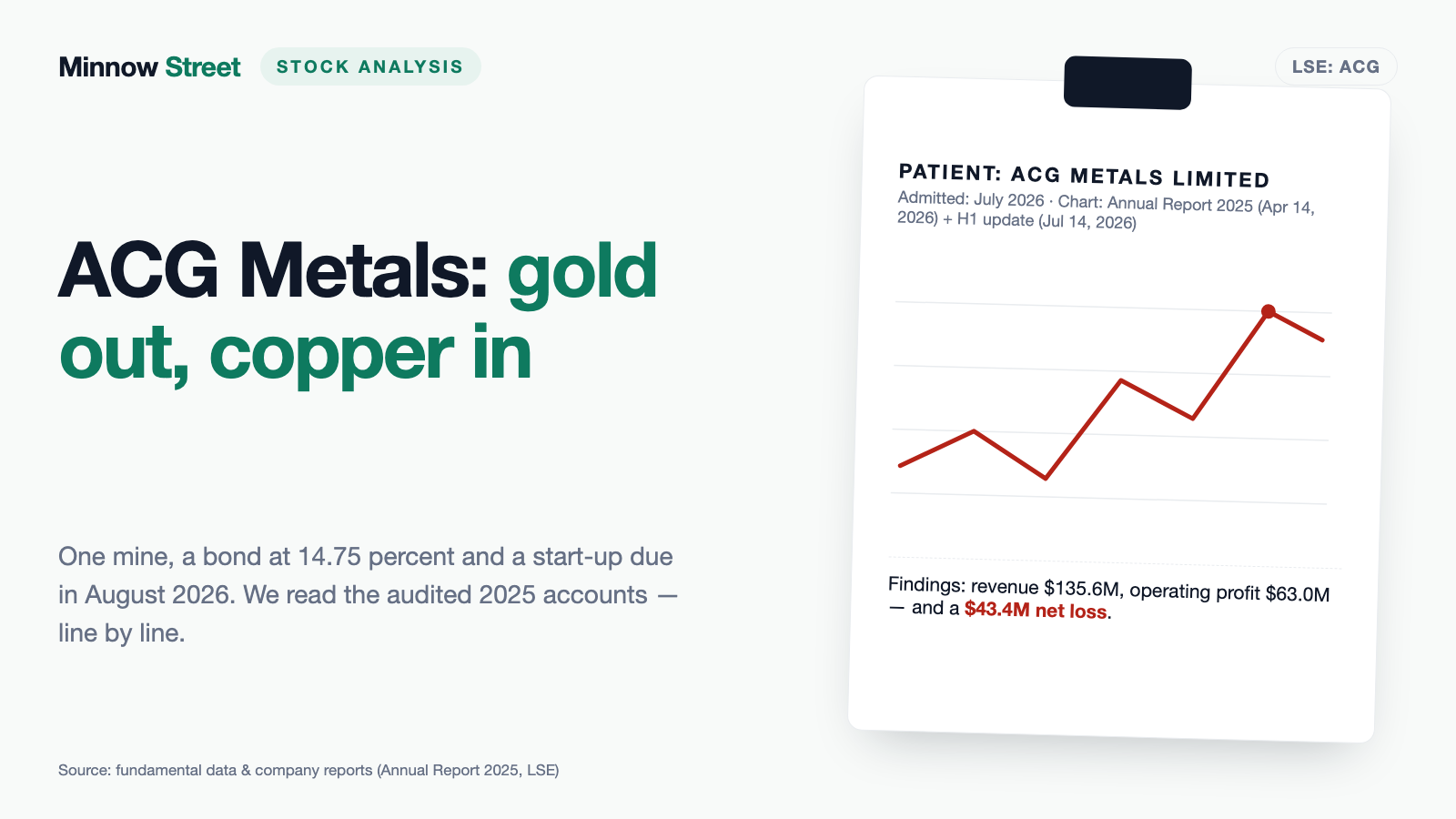
A mine in western Turkey, a bond charging 14.75 percent, and a switch from gold to copper due to start in August 2026: ACG Metals Limited grew revenue 135 percent in 2025 and posted a 56 percent EBITDA margin — yet the annual report still shows a $43.4 million net loss, because the CFO says $81.7 million of it came from fair value swings on warrants and a copper-price bonus clause alone. A newsletter had expected 48 cents of profit per share back in November 2025; the audited result was a $2.04 loss instead. Not investment advice — just the question of what a stranger's earnings estimate is worth once you check the math yourself.
 Thomas Mücke
Founder & Publisher
Thomas Mücke
Founder & Publisher
Chart
Interactive price chart (TradingView).
Note: pure fact-based analysis, not investment advice and not a solicitation to buy or sell. All figures without guarantee.
Picture this: a friend forwards you an issue of a newsletter he subscribes to, with the note "You have to read this, there's a copper stock in here that really moves the needle." Inside is a clean, precise number: a Canadian brokerage projects earnings per share turning to 48 cents this year, on revenue that is set to double. A recognizable name, a confident decimal point — and the authority trap snaps shut: if a professional puts a number that precise on it, there must be something to it. We trust a stranger's number simply because it carries a credential, and we stop doing our own math.
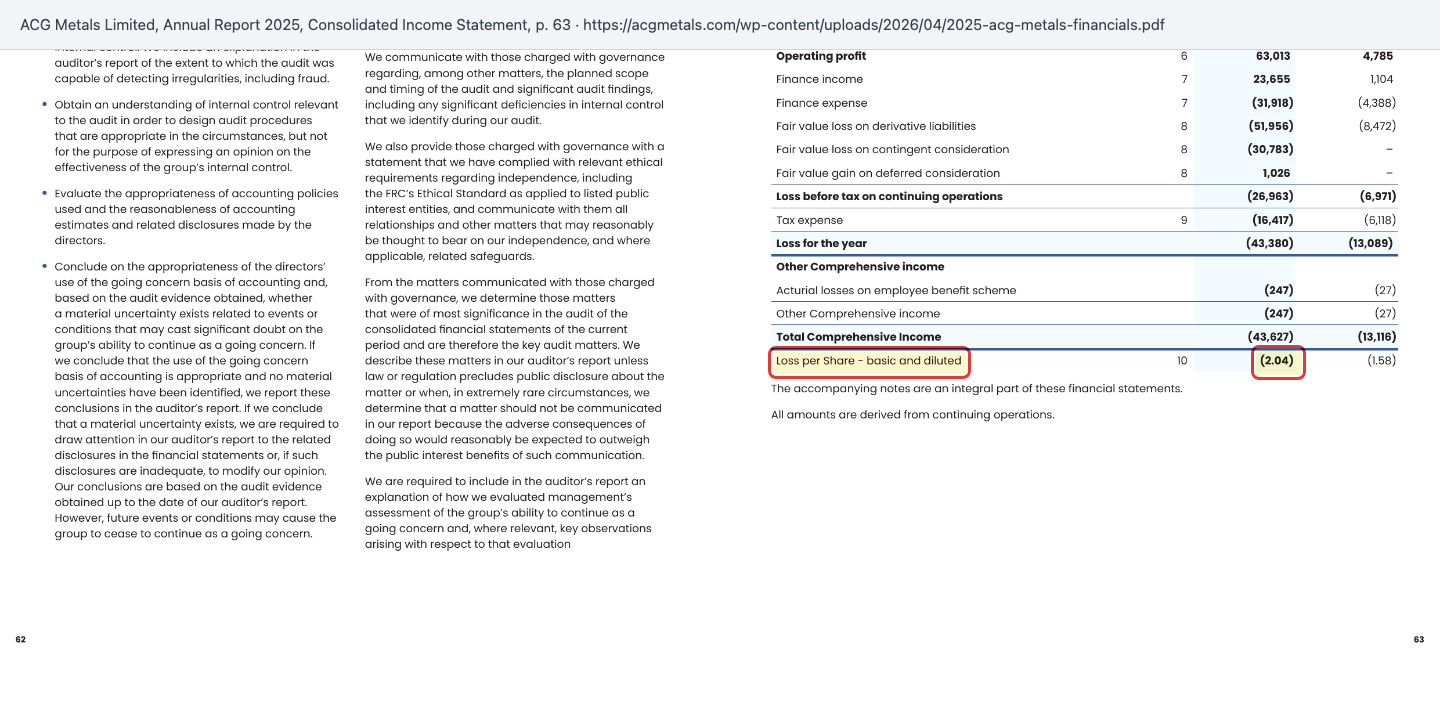
So let's make a deal: before we hand this number a single cent of trust, we read the audited annual report ourselves, line by line. The stock is ACG Metals Limited (London Stock Exchange: ACG), a mining company incorporated in the British Virgin Islands with a single operating mine in Turkey. And here is the headline result, because it carries the whole story: the 48 cents of profit projected in November 2025 turned into a net loss of $2.04 per share. By the end of this piece, you decide what a stranger's earnings estimate is worth once you check the math yourself.
What ACG Metals actually does — four countries, one stock
ACG Metals Limited is incorporated in the British Virgin Islands (company number 2067083, registered office Craigmuir Chambers, Road Town, Tortola), administered out of London, and listed on the London Stock Exchange — yet its entire operation sits in Turkey. The group's only producing asset is the Gediktepe mine near Balıkesir in western Anatolia, held through the Turkish subsidiary Polimetal Madencilik. Four countries for one stock: a British corporate registry, U.S.-dollar accounting, a share price quoted in British pence, and mining operations in Turkey. Buying the stock on the London Stock Exchange technically means buying a Depositary Interest — a receipt representing the underlying share of the BVI company. It sounds complicated because it is, a little; what matters for this analysis is what ends up in the consolidated accounts.
The company itself is young. As "ACG Acquisition Company Limited," it listed on October 7, 2022 as a special-purpose acquisition company (SPAC) — issuing 3,125,000 founder shares at $0.01 each and 13,348,750 sponsor warrants at $1 per warrant. On September 3, 2024, it completed its actual purpose: acquiring Polimetal Madencilik, and with it the Gediktepe mine, from Turkish group Lidya Madencilik for total consideration of roughly $166 million to $179 million (cash, shares, and assumed debt). Fiscal 2025 is therefore the first full year under ACG ownership — an important caveat for every year-over-year comparison in this piece.
Gediktepe has so far been a classic precious-metals mine, producing gold and silver from oxide ore sold to a domestic Turkish refinery and the Turkish central bank. That is changing fundamentally right now. Alongside ongoing oxide mining, ACG has been building the "Sulphide Expansion" since 2024 — a plant designed to turn the same mountain into a copper and zinc concentrate producer instead. Long-term offtake agreements covering the entire mine life are already in place: with commodity trader Glencore for copper concentrate, and with Traxys for zinc concentrate. At the helm is Artem Volynets as Chairman and CEO — a 30-year mining veteran who was CEO of En+ Group (2010–2013) and held a corporate strategy role at Rusal (2007–2010). Since January 2026, Michael R. Pompeo, the former U.S. Secretary of State, has sat on the board as an independent non-executive director — a name that signals the kind of political network the company is drawing on for its international growth story.
Why there is no SEC filing here — and where the numbers come from instead
One point first, because it shapes the entire evidence base of this analysis: ACG Metals files no 10-K, no 10-Q, no 20-F. A search of the SEC's EDGAR company database for "ACG Metals" and "ACG Acquisition" returns no result at all — the company is not a U.S. reporting entity. ACG Metals is listed on the London Stock Exchange (Main Market) and falls under UK capital-markets rules: mandatory disclosures run through the UK Financial Conduct Authority's National Storage Mechanism and the RNS news service, alongside the audited annual report itself.
One document anchors this analysis above all: the audited Annual Report 2025 (fiscal year ended December 31, 2025), signed off by RSM UK Audit LLP on April 13, 2026 and published April 14, 2026 — an unqualified opinion with no going-concern uncertainty flagged. It is supplemented by two unaudited but exchange-published operational updates: the "Q1 2026 Operations and Capital Structure Update" of April 21, 2026, and the "H1 2026 Operations Update" of July 14, 2026 — both explicitly labeled here for what they are: current operating figures without an audit. Data attribution throughout this piece therefore reads: fundamental data & company reports (annual/interim report, London Stock Exchange) — not "SEC filings," which simply do not exist here.
How this stock reached our desk — no scanner hit, a reader's tip instead
Honesty first: our in-house stock scanner does not know ACG Metals — and it could not. The scanner's universe is built primarily around U.S.-listed names; a British-Virgin-Islands company priced in British pence on the London Stock Exchange simply does not appear there. No Piotroski score, no momentum signal, no multi-filter confluence — not because the stock is uninteresting, but because our radar does not cover this water.
Instead, ACG Metals reached our desk because a reader forwarded us an issue of a newsletter he subscribes to: "Hot Stocks Europe," issue 24, dated November 28, 2025 (B-Inside International Media GmbH, Freiburg, Germany), a twice-monthly stock-tip publication. It carried a brief profile: "One producing asset: the Gediktepe mine, Turkey … listed on the London Stock Exchange." And the number that set everything in motion — a forecast from brokerage Canaccord Genuity, as cited by the newsletter as of November 28, 2025: revenue doubling from $57.7 million to roughly $122 million, earnings of 48 cents per share for the current fiscal year, a "price-to-earnings ratio deep in the single digits." The newsletter also quoted CEO Volynets as seeing "probably still 200 to 300 percent upside" — a statement we reproduce here for exactly what it is: management's own November 2025 self-assessment, not an independently verified fact.
Part of putting this in context is the conflict-of-interest notice the newsletter itself prints on page 8: the publisher, the author, or related parties may hold long positions in stocks discussed and may intend to sell as prices rise (EU Market Abuse Regulation 596/2014). We are not adopting a buy recommendation from that newsletter — we are taking the number it put into the world and checking it against what the company itself later had audited. One preview: revenue actually came in slightly above the Canaccord estimate ($135.6 million versus $122 million) — but on earnings per share, the 48 cents forecast and the 204 cents of actual loss were $2.52 apart. How that gap comes about is the thread running through this whole piece.
The numbers over the years — what genuinely impresses
Credit where it is due first. In its first full fiscal year under ACG ownership, revenue climbed from $57.7 million to $135.6 million — up 135 percent. Adjusted EBITDA reached $76.3 million, a 56.2 percent margin; operating cash flow was $65.4 million (a 48.2 percent margin). By almost any measure, that is a highly profitable mine. The year was carried by strong precious-metals prices: realized gold prices rose 39 percent to $3,321 per ounce, realized silver 32 percent to $37.69 — even as unit costs fell (C1 cash costs down 18 percent to $499 per gold-equivalent ounce). Gediktepe produced 39,200 gold-equivalent ounces in 2025 and sold 39,400 ounces, at all-in sustaining costs (AISC) of $1,244 per ounce — up 9 percent, because higher metal prices also lifted sliding-scale royalty payments. Safety performance was strong: 1.6 million man-hours worked in 2025 at a lost-time injury frequency (LTIF) of 0.66.
The balance sheet was cleaned up too: in 2025, ACG fully repaid the sponsor loans, the acquisition facility, and the Traxys working-capital debt left over from the 2024 Lidya acquisition. That was funded through a new $200 million bond (more on that shortly) and a November 2025 equity raise netting $15 million. In short: the operating business is real, profitable, and growing fast. That is exactly why the second look matters — because the bottom line still showed a loss.
What the filings show — the uncomfortable truths
Uncomfortable truth #1: the record loss is largely a mirror image of good news
Here is the answer to the Canaccord question from the opening. The 2025 income statement shows operating profit of $63.0 million — a strong operating result. Then the math turns: net finance result minus $8.3 million, fair value loss on warrants of minus $50.4 million, fair value loss on a copper-price bonus clause of minus $30.8 million, a small fair value gain on a deferred purchase-price obligation of plus $1.0 million, a fair value loss on a gold-price hedge of minus $1.6 million, tax of minus $16.4 million. The result: a net loss of $43.4 million, or minus $2.04 per share.
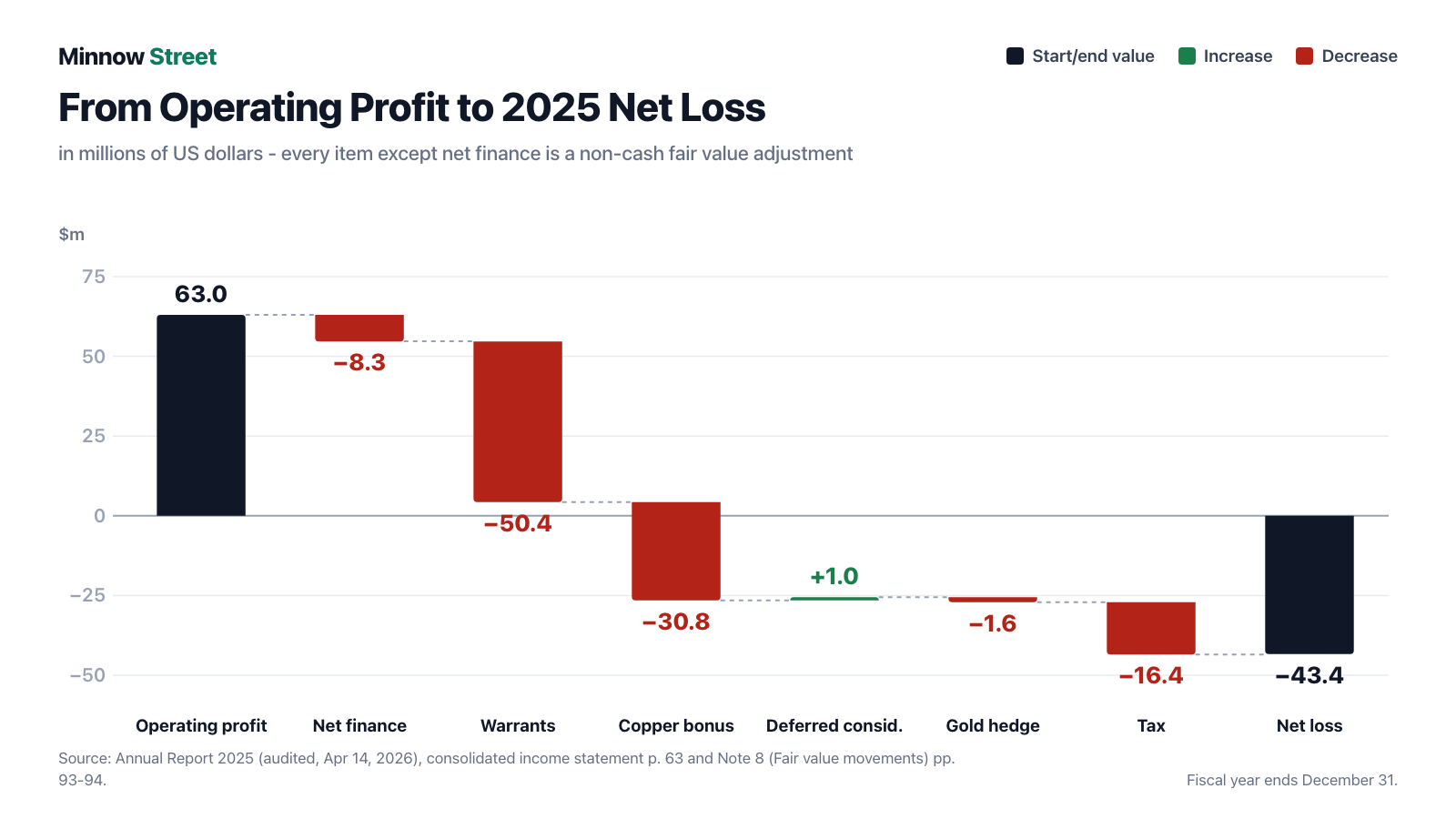
Why does this behave so paradoxically? Warrants are a company's promise to issue shares in future at a fixed price. When the share price rises, that very promise becomes more valuable to the holder — and, on the books of the company that issued it, a liability grows in step. A share-price gain for shareholders shows up on the income statement as a loss for the company. At ACG Metals, the fair value per outstanding warrant rose in 2025 from $0.38 to $4.38 — more than eleven times over. Across 11.68 million outstanding warrants (more on that count shortly), that alone produces roughly $50 million of accounting loss, triggered by a rising share price.
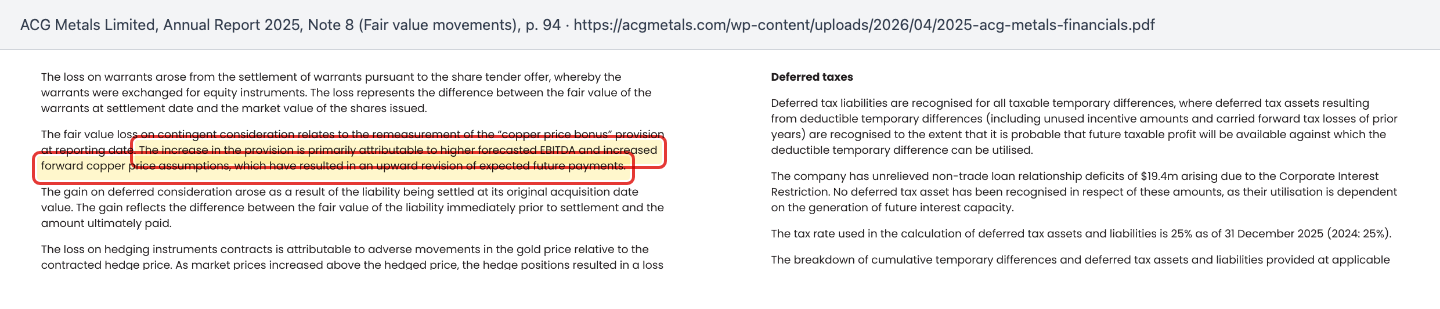
Much the same applies to the second large item, the copper-price bonus clause. When it bought the mine in 2024, ACG promised seller Lidya an additional payment if the copper price and the mine's future earnings developed beyond a certain threshold — an earn-out, essentially. As ACG's own copper forecasts turned more optimistic during the year, the liability owed to Lidya automatically grew — another accounting loss, triggered by good news. The annual report puts it this way:
"The fair value loss on contingent consideration relates to the remeasurement of the 'copper price bonus' provision at reporting date. The increase in the provision is primarily attributable to higher forecasted EBITDA and increased forward copper price assumptions, which have resulted in an upward revision of expected future payments."
— ACG Metals Limited, Annual Report 2025, Note 8, "Fair value movements," p. 94
The CFO himself puts the scale in context and stresses that none of it touched cash:
"In total, the $81.7 million fair value adjustments had no impact on the Group's underlying cash generation or ability to continue funding operations and growth."
— Patrick Henze (CFO), ACG Metals Limited, Annual Report 2025, CFO Statement, p. 9
That is a fair and, at its core, accurate framing — not a single dollar of that $81.7 million actually left the till. But it also explains why the November 2025 Canaccord estimate missed: anyone simply extrapolating revenue and operating margin never sees this fair-value mechanic coming. Remember this: earnings per share are only as good as what happens between operating profit and net income — and at a young mining company with fresh warrants outstanding and an earn-out clause on the books, quite a lot can happen in between.
Uncomfortable truth #2: the capital cushion is thin — and net debt has nearly doubled since year-end
As of December 31, 2025, total assets of $434.8 million were matched by equity of just $49.8 million — an equity ratio of just over 11 percent. A solidly capitalized company typically runs at 30 percent or more. On the asset side: $145.1 million in cash. On the liability side: financial debt of $208.4 million — for net debt of $63.3 million at year-end, a seemingly moderate figure on its own.
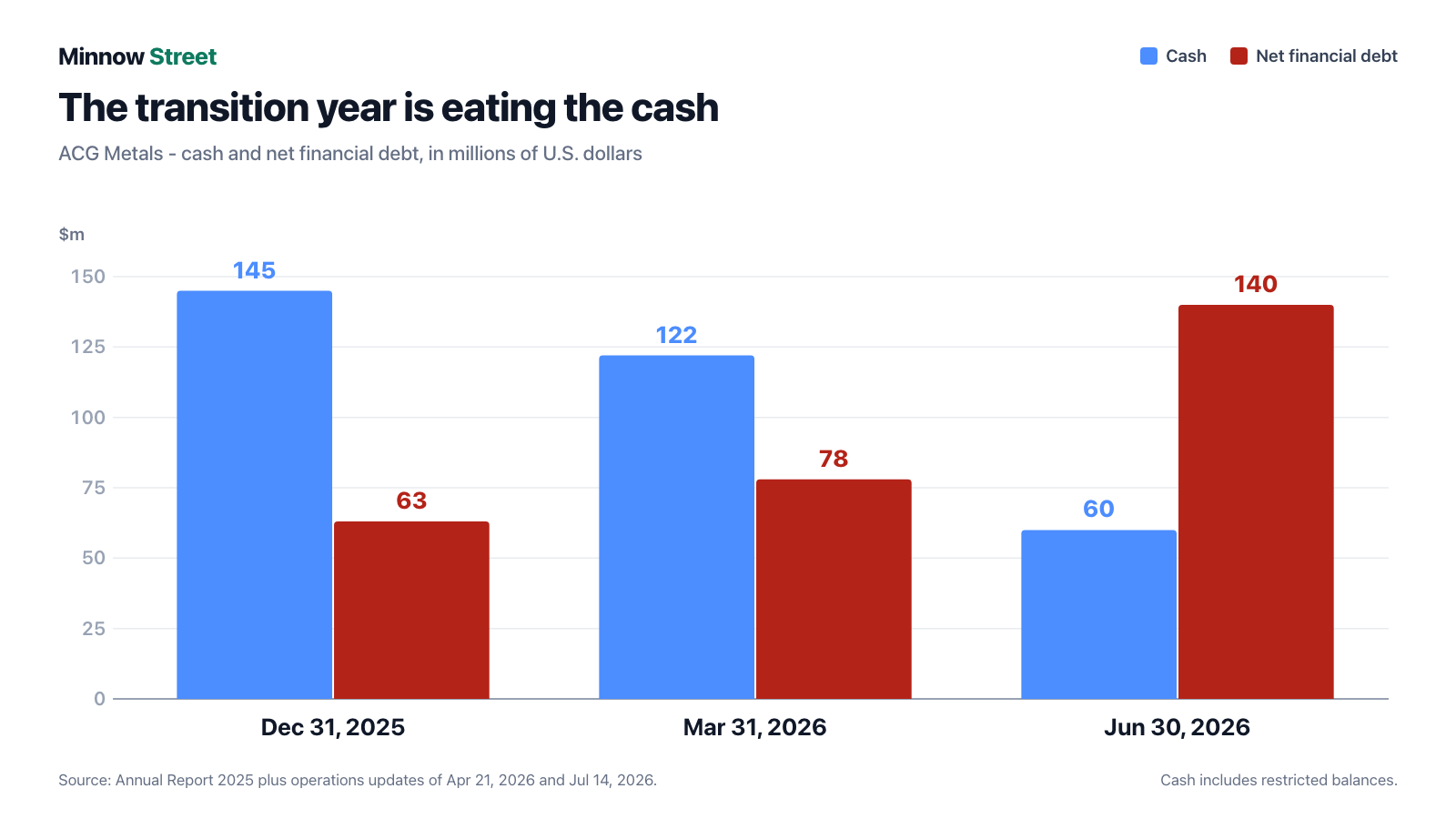
Since then, the picture has tightened sharply. The company's two unaudited operational updates draw a clear line: as of March 31, 2026, cash stood at $122 million against net debt of $78 million; by June 30, 2026, cash had fallen to just $60 million ($28 million of it restricted) against net debt of $140 million — net debt effectively doubling in six months. The reason is known and self-disclosed: construction of the Sulphide plant, which the company says was 87.2 percent complete as of June 30, 2026, with roughly $101 million of the $146 million construction program already spent (as of end-March 2026). At the same time, costs on the winding-down oxide operation are climbing: all-in sustaining cost per gold-equivalent ounce (AISC) jumped 52 percent to $1,609 in the first half of 2026, as ore grows scarcer and royalties rise with high metal prices.
The construction program is funded primarily through a $200 million bond issued in January 2025, carrying a coupon of 14.75 percent per year, payable semi-annually, maturing January 13, 2029. A coupon that high is not an accident — it reflects the risk premium bond investors demand for a young, single-mine company. The bond is tested quarterly against financial covenants (a maximum net leverage ratio and a minimum liquidity requirement); as of December 31, 2025, the company reported full compliance with all covenants.
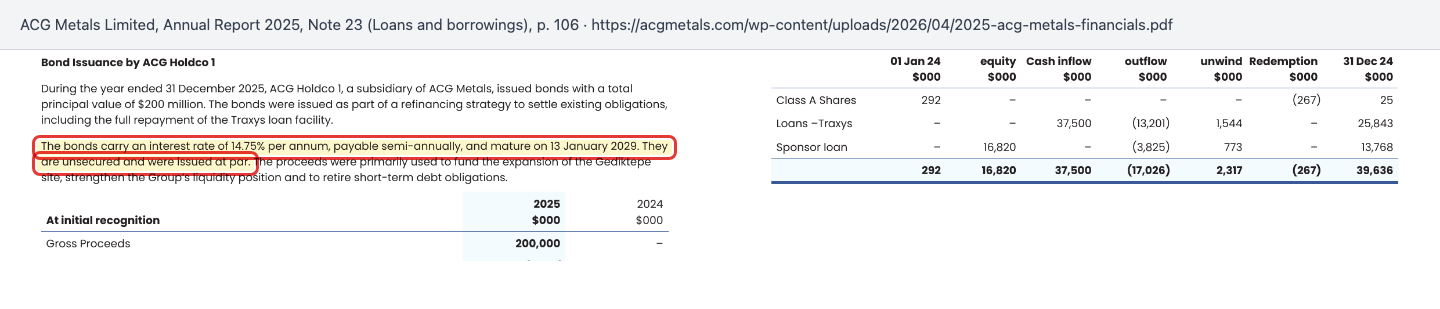
And this is exactly where it pays to compare two passages within the same annual report: the strategic report and the CFO consistently call it the "senior secured Nordic bond" — a bond ranking ahead of other claims and backed by collateral. The technical note quoted above, by contrast, states in writing that the bond is "unsecured." We are not trying to manufacture a scandal here; such wording mismatches between a strategic narrative and a technical note do occur and could reference different levels of the corporate structure. But it is exactly the kind of detail a headline never mentions and a footnote sometimes states inconsistently — bondholders who care about the exact security package should clarify directly with the issuer or the bond trustee rather than rely on either wording alone.
Uncomfortable truth #3: roughly half of the future share count is already spoken for
Beyond the income-statement effect covered in truth #1, the warrant position carries a second, independent consequence: dilution. As of December 31, 2025, 11,684,784 warrants were outstanding against 22,785,305 Class A ordinary shares issued at that date — roughly half of the existing share count. Picture this: for every two shares you hold today, one more could, in the extreme, be created — not through anything you did, but because the company itself has that many conversion rights outstanding.
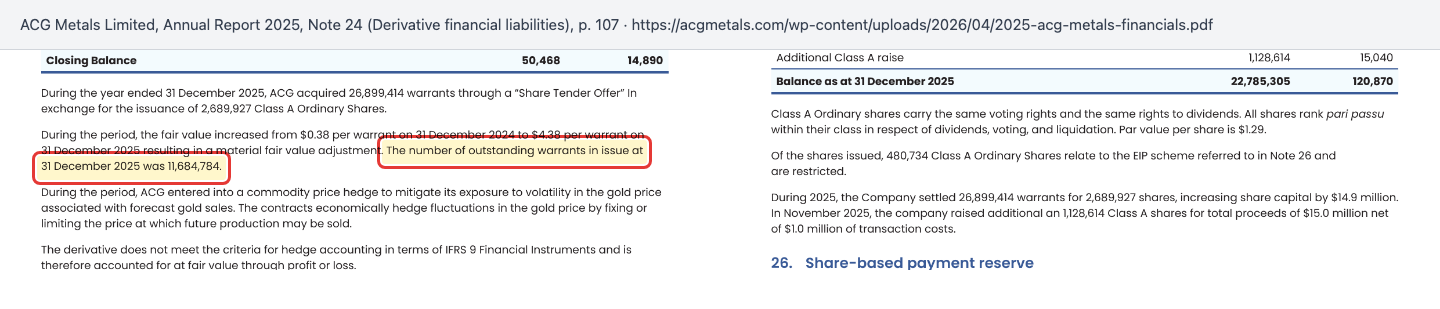
To be fair, this overhang used to be considerably larger. During 2025, ACG exchanged 26,899,414 warrants for 2,689,927 new shares through a "share tender offer" — a ratio of roughly ten warrants per new share, which meaningfully shrank the overhang. The annual report itself even lists "the removal of warrant dilution" as one of three reasons for its own share-price performance. That is a genuine improvement — but it does not change the fact that, at year-end, close to half as many warrants as shares were still outstanding, at a fair value that had grown more than elevenfold during the year ($0.38 to $4.38 per warrant).
And the report itself already discloses further dilution realized after the balance-sheet date: after December 31, 2025, a further 106,453 warrants were settled for 85,104 shares, and the remuneration committee approved 1,512,493 shares for the first measurement period of a long-term incentive plan (the VCP) plus 12,665 shares under an employee incentive plan (the EIP) — roughly 1.6 million additional shares in total, all listed by the annual report itself under "post balance sheet events." Anyone taking the 22.8 million share count at face value is working off a figure that was already out of date by the time the report was published.
Valuation — between a $440 million reality and a $3-to-5-billion ambition
As of July 24, 2026, the stock traded on the London Stock Exchange at 19.30 British pounds (1,930 pence — note the quotation currency is pence, not pounds: one pound equals 100 pence). Against the 22,785,305 shares issued at year-end 2025, that implies a market capitalization of roughly £440 million — a figure that lines up with an independent source (lse.co.uk, as of July 24, 2026). Converted through the stock's parallel U.S.-dollar-denominated over-the-counter line (ticker ACGAF, $26.50 the same day), that works out to a dollar-equivalent value of roughly $604 million — the two figures cross-check each other at an implied exchange rate of about $1.37 per British pound.
Against fiscal 2025 revenue of $135.6 million, that implies a price-to-sales ratio of roughly 4.4. A price-to-earnings ratio cannot be meaningfully calculated given the net loss. Enterprise value — market capitalization plus the most recently reported net debt of $140 million as of June 30, 2026 — against the most recently reported annual EBITDA ($76.3 million, fiscal 2025) works out to a multiple of roughly 9.7: not extremely expensive for a growing resources producer, but not a bargain either, especially since that EBITDA base still comes from the winding-down oxide operation, while the future copper EBITDA has yet to materialize.
More striking than any ratio is the yardstick the company sets for itself. In the Going Concern and Viability section of the annual report, the board states a target worth reading twice:
"ACG is pursuing a strategy to consolidate the copper sector and aims to grow its market capitalisation from US$343.8 million on 31 December 2025 to US$3–5 billion over the next 3–5 years. In 2024, the Group's market capitalisation was US$93.7 million. The 267% increase achieved since then is underpinned by a stronger share price, the removal of warrant dilution, and the successful US$200 million bond raise […]"
— ACG Metals Limited, Annual Report 2025, Going Concern and Viability, pp. 21–22
So a company that, in the very same annual report, discloses a net loss of $43.4 million is publicly stating a goal of growing its own market capitalization nine to fourteenfold within three to five years. For a sense of just how large that ambition is: U.S. copper major Freeport-McMoRan, which we broke down in detail in our Freeport-McMoRan stock analysis, today carries a market value in the mid-tens-of-billions range — meaning ACG would not just need to grow, but to climb into the league of established industry heavyweights. That is not an impossible ambition for a resources producer riding a copper supercycle, but it is a management statement, not an independently audited forecast — and it comes from the same document that shows how quickly the capital cushion can come under pressure. We are not aware of any independent price target more recent than the Canaccord estimate of November 28, 2025 cited at the top of this piece.
Opportunities and risks at a glance
What speaks for ACG Metals:
- A genuinely producing, highly profitable mine: $135.6 million in revenue (2025, up 135 percent), a 56.2 percent EBITDA margin, $65.4 million of operating cash flow — not an exploration project, but ongoing production generating real cash.
- The transition to higher-value copper and zinc concentrate is well advanced (87.2 percent complete as of June 30, 2026) and locked in by long-term offtake agreements (Glencore for copper, Traxys for zinc) covering the entire mine life; first production guided for August 2026, with a 2026 target of 20,000 to 22,000 tonnes of copper equivalent.
- In 2025, all legacy acquisition-related debt (sponsor loans, acquisition facility, Traxys working-capital loan) was fully repaid; an additional, fully undrawn $15 million credit facility and a $7 million equity backstop commitment from major shareholder Argentem Creek Partners remain available.
- Experienced management (CEO Artem Volynets, previously CEO of En+ Group among other roles) and an internationally staffed board, including former U.S. Secretary of State Michael R. Pompeo as an independent director since January 2026.
- An additional portfolio option at no exploration cost of its own: in October 2025, subsidiary Polimetal secured a 2 percent net-smelter-return royalty over a mining licence area in Niğde Province.
What speaks against it:
- Extreme concentration on a single mine in a single country: if Gediktepe goes offline for any reason — technical, political, or regulatory — there is no second producing asset. The annual report itself names Turkey as a region subject to "ongoing political" uncertainty — a concentration risk we dissected in similar form in our TRX Gold stock analysis, another single-mine producer operating in just one country.
- A thin capital cushion: an equity ratio of just over 11 percent as of December 31, 2025, net debt effectively doubling from $63.3 million to $140 million within six months, and cash falling from $145.1 million to $60.0 million over the same period — against a high-coupon bond charging 14.75 percent.
- Substantial dilution potential: 11.68 million outstanding warrants (roughly half the share count) plus roughly 1.6 million additional shares already realized after the balance-sheet date from warrant settlements and incentive plans.
- Concentrated ownership: the two largest shareholders, former mine seller Lidya Madencilik (31 percent of voting rights) and financial investor Argentem Creek Partners (30 percent), together control 61 percent — the latter simultaneously a lender and a board-seat holder, a classic conflict of interest between debt and equity providers in one party.
- Rising production costs during the transition: all-in sustaining cost per gold-equivalent ounce rose 52 percent in the first half of 2026, while the Sulphide plant has yet to contribute any revenue — until August 2026, costs and capital tied up keep running without the new revenue stream.
A human conclusion
Back to the authority trap from the opening. The newsletter dated November 28, 2025 delivered a clean number — 48 cents of profit per share — sourced from a respected brokerage and therefore sounding credible. Measured against the audited result, it missed by $2.52 per share — not because the operating business disappointed (revenue actually beat the estimate), but because two accounting mechanics that no revenue-times-margin model captures made the difference: the fair value of warrants and of a copper-price bonus clause. The lesson here is not "ACG Metals is a bad stock" — the operating business is, honestly assessed, highly profitable, and the copper conversion is well underway. The lesson is: a stranger's earnings estimate is only as good as what it fails to see — and at a young, heavily indebted mining company with a warrant overhang and an earn-out clause owed to its seller, quite a lot can sit between operating profit and net income.
What remains is a mine that makes real operating money, a balance sheet growing thinner during its transition year, and management publicly targeting a tenfold-plus rise in market value while net debt doubles. Both are true, at the same time. What you make of that is your decision. And that is exactly as it should be.
Sources
All original documents used in this analysis — for your own further reading:
- ACG Metals Limited — Annual Report 2025 (audited consolidated financial statements, signed off by RSM UK Audit LLP on April 13, 2026, published April 14, 2026)
- ACG Metals Limited — Q1 2026 Operations and Capital Structure Update (April 21, 2026)
- ACG Metals Limited — H1 2026 Operations Update (July 14, 2026)
- UK Financial Conduct Authority — National Storage Mechanism, entry NI-000130003
- ACG Metals Limited — Investor relations overview (all reports and announcements)
- SEC EDGAR — Company search for "ACG Metals": no SEC filer
- "Hot Stocks Europe," issue 24, dated November 28, 2025 (B-Inside International Media GmbH) — this analysis's starting point, not a source for company figures.
- Fundamental data (price and market data as of July 24, 2026), cross-checked against ACG Metals' original company reports.
Transparency & disclaimer: This analysis is journalistic commentary on publicly available information. It is not investment advice, not a regulated financial analysis, and not a solicitation to buy or sell any security. Equity investments carry substantial risk, including total loss; with ownership as concentrated as it is here (61 percent of voting rights held by two anchor shareholders), there is an added risk that prices move sharply on low trading volume. Details on the Sulphide plant's construction progress and production start-up may change at any time. All figures are provided without guarantee; the as-of date for each figure is noted in the text. The author holds no position in ACG Metals shares as of publication. The newsletter used here as this piece's starting point, "Hot Stocks Europe," itself discloses a potential conflict of interest: the publisher, the author, or related parties may hold long positions in stocks discussed and may intend to sell as prices rise (EU Market Abuse Regulation 596/2014).
Our Bottom Line at a Glance
- Operating substance & growth positive
- A genuinely producing, highly profitable mine: 2025 revenue up 135 percent to $135.6 million, a 56.2 percent EBITDA margin, $65.4 million of operating cash flow. All legacy acquisition debt was fully repaid in 2025. The conversion to copper/zinc concentrate is 87.2 percent complete (Jun 30, 2026) and locked in by long-term offtake agreements with Glencore and Traxys covering the entire mine life.
- Quality of earnings negative
- The reported $43.4 million net loss for 2025 arises from $81.7 million of non-cash fair value losses on warrants and a copper-price bonus clause — both, paradoxically, a mirror image of good news (a rising share price, more optimistic copper forecasts). The operating result ($63.0 million profit) is real, but hard for outside observers — including the analyst estimate cited in November 2025 — to see without reading the notes.
- Balance sheet & debt negative
- Equity ratio of just over 11 percent as of Dec 31, 2025; net debt effectively doubled from $63.3 million to $140 million within six months, cash fell from $145.1 million to $60.0 million over the same period. Financed via a bond carrying a 14.75 percent coupon — a rate that reflects the risk premium of a young single-mine company. No going-concern flag, covenants reportedly in compliance, but the capital cushion is thin and thinning during the transition year.
- Dilution & capital structure negative
- 11.68 million outstanding warrants equal roughly half the share count; their fair value rose more than elevenfold in 2025. A further roughly 1.6 million shares were already realized after the balance-sheet date from warrant settlements and incentive plans. A 2025 tender offer already meaningfully reduced the overhang — but the dilution risk remains real, and larger than the raw share count suggests.
- Ownership & governance neutral
- Two anchor shareholders (Lidya Madencilik 31%, Argentem Creek Partners 30%) together control 61 percent of voting rights — fully disclosed under UK notification rules. Argentem Creek is simultaneously the lender behind an additional equity facility and holds a board seat, a structural conflict between debt and equity providers in one party. The board is internationally staffed, including former U.S. Secretary of State Michael R. Pompeo as an independent director since January 2026.
- Valuation & ambition neutral
- Market capitalization of roughly £440 million, or roughly $604 million (Jul 24, 2026), a price-to-sales ratio of roughly 4.4, and enterprise value/EBITDA of roughly 9.7 — not an extreme valuation for a growing resources producer. The company itself, however, targets growing market cap from $343.8 million to $3-5 billion within three to five years — a management statement, not an independently audited forecast, and we are not aware of any independent price target more recent than the one cited from Nov 28, 2025.
ACG Metals is the authority trap as a case study: a newsletter cited a Nov 2025 analyst estimate of 48 cents of profit per share; the audited accounts show a $2.04 loss instead — not because the operating business disappointed (revenue actually beat the estimate), but because fair value losses on warrants and a copper-price bonus clause cost $81.7 million. The mine is genuinely profitable and the copper conversion well advanced — but the capital cushion is thin, net debt has doubled in six months, and roughly half the future share count is already spoken for through warrants. Not investment advice.
What Our Rating Means
Open questions
The business works in principle, but one material question is open. As long as it stays open, our findings do not carry a quality verdict.
The business works: Gediktepe is a genuinely producing, highly profitable mine with a 56.2 percent EBITDA margin and positive operating cash flow, there is no going-concern flag, no negative equity, and with interest coverage of roughly twice EBIT there is no acute solvency threat. What remains open is the decisive operating question: whether the transition from gold to copper succeeds before the thin capital cushion (equity ratio around 11 percent) and net debt that doubled in six months become a real problem. First copper production is only guided for August 2026 and therefore still unproven — much like a group result hinging on a single unproven event, that is yellow, not green. Our view that a 14.75 percent bond coupon is expensive and a $3-5 billion market-cap ambition is a stretch does not change that colour: price is not a quality attribute. The decision is yours.
A journalistic assessment by our editorial team at the time of the deep dive, based on public sources — not investment advice and not a solicitation to buy or sell. Your personal circumstances (investment goals, risk capacity, taxes) cannot be taken into account. What our levels mean, how verdicts are formed, and what conflicts of interest exist →
Worth Noting
- Starting point: newsletter "Hot Stocks Europe," issue 24, dated Nov 28, 2025 (B-Inside International Media GmbH), forwarded by a reader. Cited analyst estimate: Canaccord Genuity, as of Nov 28, 2025 (2025 revenue and profit forecast). The newsletter itself discloses possible conflicts of interest (long positions held by publisher/author, EU MAR 596/2014); none of the price targets or recommendations stated there were adopted.
- ACG Metals is not an SEC filer: no 10-K, no 10-Q, no 20-F. This analysis is based on the audited Annual Report 2025 (signed by RSM UK Audit LLP, Apr 13, 2026) and the Q1/H1 2026 operations updates (Apr 21 and Jul 14, 2026); mandatory disclosures run through the UK FCA National Storage Mechanism. Quotes were checked verbatim against the original PDF.
- No company record was created in our own database: a European stock quoted in British pence would distort scanner thresholds built around U.S.-dollar listings. The fundamental-data feed also still lists the London listing partly under its former SPAC name and shows quarterly lines as duplicated half-year figures — both data gaps were worked around by citing only the annual report and the original operations updates.
Frequently Asked Questions
ACG Metals Limited (London Stock Exchange: ACG) is a British Virgin Islands-registered mining company with a single producing mine: Gediktepe, near Balıkesir, Turkey. It has so far produced gold and silver from oxide ore; since 2024, ACG has been building the "Sulphide Expansion" alongside it, converting the operation to copper and zinc concentrate — first production guided for August 2026.
Because ACG Metals is not a U.S. reporting company: the stock trades exclusively on the London Stock Exchange. There is no 10-K, no 10-Q, and no 20-F; an EDGAR search for "ACG Metals" returns nothing. This analysis is based on the audited Annual Report 2025 (signed by RSM UK Audit LLP on April 13, 2026) and mandatory disclosures via the UK FCA National Storage Mechanism; the reporting currency is the U.S. dollar.
Operating profit for 2025 was $63.0 million. Three non-cash fair value items then pulled the result negative: a $50.4 million loss from remeasuring outstanding warrants (whose value automatically rises with the share price), a $30.8 million loss from a copper-price bonus clause owed to the former mine seller and a $1.6 million loss on a gold-price hedge. The bottom line was a net loss of $43.4 million, or $2.04 per share.
As of Dec 31, 2025, financial debt of $208.4 million was matched by $145.1 million of cash — net debt of $63.3 million. By June 30, 2026, the company's own operations update put net debt at $140 million while cash had fallen to $60.0 million — the result of building the Sulphide plant. The core financing is a $200 million bond issued in January 2025, carrying a 14.75 percent annual coupon, maturing January 13, 2029.
ACG has been converting the Gediktepe mine from a gold/silver operation into a copper and zinc concentrate producer since 2024. As of June 30, 2026, the "Sulphide Expansion" was 87.2 percent complete, first production is guided for August 2026, and the 2026 target is 20,000 to 22,000 tonnes of copper equivalent. Until then, high construction costs and falling oxide output run in parallel — the new copper story still has to deliver its numbers.
As of Dec 31, 2025, 11,684,784 warrants were outstanding — roughly half of the 22,785,305 shares issued. Their fair value rose in 2025 from $0.38 to $4.38 per warrant. The annual report itself lists a further roughly 1.6 million shares already realized in 2026 from warrant settlements and employee incentive plans (VCP/EIP) as "events after the reporting period."
Two anchor shareholders together control 61 percent of voting rights: former mine seller Lidya Madencilik (31 percent, 7,112,072 shares) and financial investor Argentem Creek Partners via ACP II Trading LLC (30 percent, 6,577,969 shares) — the latter also the lender behind an additional $7 million equity backstop facility and represented on the board. Since January 2026, former U.S. Secretary of State Michael R. Pompeo has also sat on the board as an independent director.
Yes, alongside its primary London listing (ticker ACG, quoted in British pence), ACG Metals also trades on the U.S. over-the-counter market under the symbol ACGAF, in U.S. dollars — an unregulated line with thin liquidity outside London trading hours. ISIN VGG0056A1030.
Found an error?
Did you spot a factual error, an outdated number, or a typo in this deep dive? Let us know briefly — your report goes straight to the editorial team.