Hensoldt Stock: The Order Backlog Keeps Climbing, the Share Price Has Stopped Following
Hensoldt builds radar, optronics and electronic-warfare systems for the battlefield — and its order backlog has grown from €5.53 billion (end of 2023) to €9.80 billion (March 31, 2026). A stock newsletter celebrated the stock in a November 2025 look-back for share-price gains of 100 to 300 percent the year before — yet today the stock trades roughly a third below its own all-time high from October 2025, and reported net income fell 17.6 percent in 2025 even as revenue grew 9.6 percent and adjusted EBITDA grew by double digits. Not a buy or sell recommendation — just the reports, which a look back at old gains cannot replace.
 Thomas Mücke
Founder & Publisher
Thomas Mücke
Founder & Publisher
Chart
Interactive price chart (TradingView).
Note: pure fact-based analysis, not investment advice and not a solicitation to buy or sell. All figures without guarantee.
There is an investor trap that catches the best-humored readers of all: looking in the rearview mirror. A stock newsletter celebrates last year's spectacular gains, and your mind instantly assumes the ride continues unchanged. Call it the rearview-mirror trap: what lies behind you says nothing about what lies ahead, but it feels reliable because it already happened once. A reader sent us issue 24 of the "Hot Stocks Europe" newsletter dated November 28, 2025 (B-Inside International Media GmbH, Freiburg, author Michael Calivas). On page 1, in a look back at the top performers of 2025, one single sentence mentions today's company: "Hensoldt and Renk: share-price gains of 100 to 300 percent." That is the entire hook - no company figure, no forecast, just a price range from the past. So let's make a deal: we leave that price range exactly where it belongs - in the past - and instead read the 2025 annual report (published March 26, 2026) and the quarterly statement as of March 31, 2026 (May 6, 2026). By the end, one word missing from any look-back becomes obvious: "since" - because a good deal has happened since the stock's all-time high in October 2025.
What Hensoldt actually does - sensors and software for the battlefield
Hensoldt AG, headquartered in Taufkirchen near Munich, is a specialized provider of electronic sensor solutions for defense and security. Picture it this way: if a modern battlefield were a nervous system, Hensoldt builds the sense organs - radar, electronic warfare, avionics and optronics that tell a fighter jet, a frigate or an infantry fighting vehicle what is happening around it before it can see it directly. The company is a manufacturer-agnostic system integrator: it supplies sensor technology for platforms from different manufacturers - fighter jets, unmanned aerial vehicles, helicopters, ships and submarines, armored vehicles and satellites - to governments and supranational organizations such as NATO, either directly or through consortia such as Euroradar, which develops the Eurofighter's nose radar.
Reporting runs across two segments: Sensors (radar and electronic warfare, multi-domain solutions, services and training) and Optronics (optronics - sighting systems, periscopes, thermal imagers - complemented by radar and services). Well-known products include the TRML-4D radar (part of the IRIS-T SLM air-defense system, also deployed in Ukraine since the start of the war), the Eurofighter's ECRS Mk1 nose radar, the Spexer radar (offered as a naval solution against drones since 2025), and the PEGASUS signals-intelligence platform, where Hensoldt acts as consortium leader. With its new MDOcore software suite - launched in 2025 - Hensoldt is also positioning itself as a provider of software-defined defense solutions, aiming to network sensor and effector systems across domains for the first time. As of December 31, 2025, the group employed 9,362 people (prior year 8,986, including 874 trainees and interns), about 7,700 of them in Germany.
Why there is no SEC filing here - and where the numbers come from instead
One point up front, because it shapes the entire evidence chain of this analysis: Hensoldt files no 10-K, no 10-Q. The company is not a U.S. registrant - an EDGAR search for the tickers HAG and HAGHY returns no usable filing. The one linked SEC identifier (CIK 0001856488, under the name "Hensoldt AG/ADR") contains nothing but F-6 forms, through which a depositary bank registers an American Depositary Receipt - not a single periodic report. Hensoldt's mandatory disclosures instead run through the regulated market (Prime Standard) of the Frankfurt Stock Exchange: an audited IFRS annual report, a half-year report, and short, unaudited quarterly statements without a full audited interim financial statement. Every figure in this analysis therefore carries "Source: fundamental data & company reports (annual/quarterly report, Frankfurt Stock Exchange)", not "SEC filings" - the same narrative logic ("a filing made under penalty of law is honest") still applies to an audited IFRS statement, just under German and European capital-markets law (Section 114 WpHG) rather than U.S. law.
This combination - MDAX member, yet not an SEC filer - is one Hensoldt shares with a number of other German industrial names. Our analysis of PFISTERER, also Xetra-listed and also without a 10-K or 10-Q, ran its entire evidence chain through the company's own annual and quarterly reports rather than sec.gov.
How the stock landed on our desk
Honesty first: the hook for this analysis is about as thin as it gets. A reader sent us issue 24 of the "Hot Stocks Europe" newsletter dated November 28, 2025 - Hensoldt does not appear there as a standalone pick, only in the editorial look-back on page 1: "Hensoldt and Renk: share-price gains of 100 to 300 percent" in 2025. No company figure, no forecast, no analyst price target - just a price range from the past, in an issue that is already eight months old by the time we read it. That same issue featured Nokia in its main editorial section, as a position in the European AI and defense cycle.
Context matters here too: the newsletter itself discloses a conflict-of-interest note on page 8 - the publisher and author may hold long positions in securities discussed and intend to sell into rising prices (EU Market Abuse Regulation No. 596/2014) - a note worth keeping in mind with any stock newsletter, even when Hensoldt shows up only in a look-back. What became of that celebrated price range since the newsletter wrote it down is the subject of the rest of this analysis.
The numbers over the years - honestly appraised
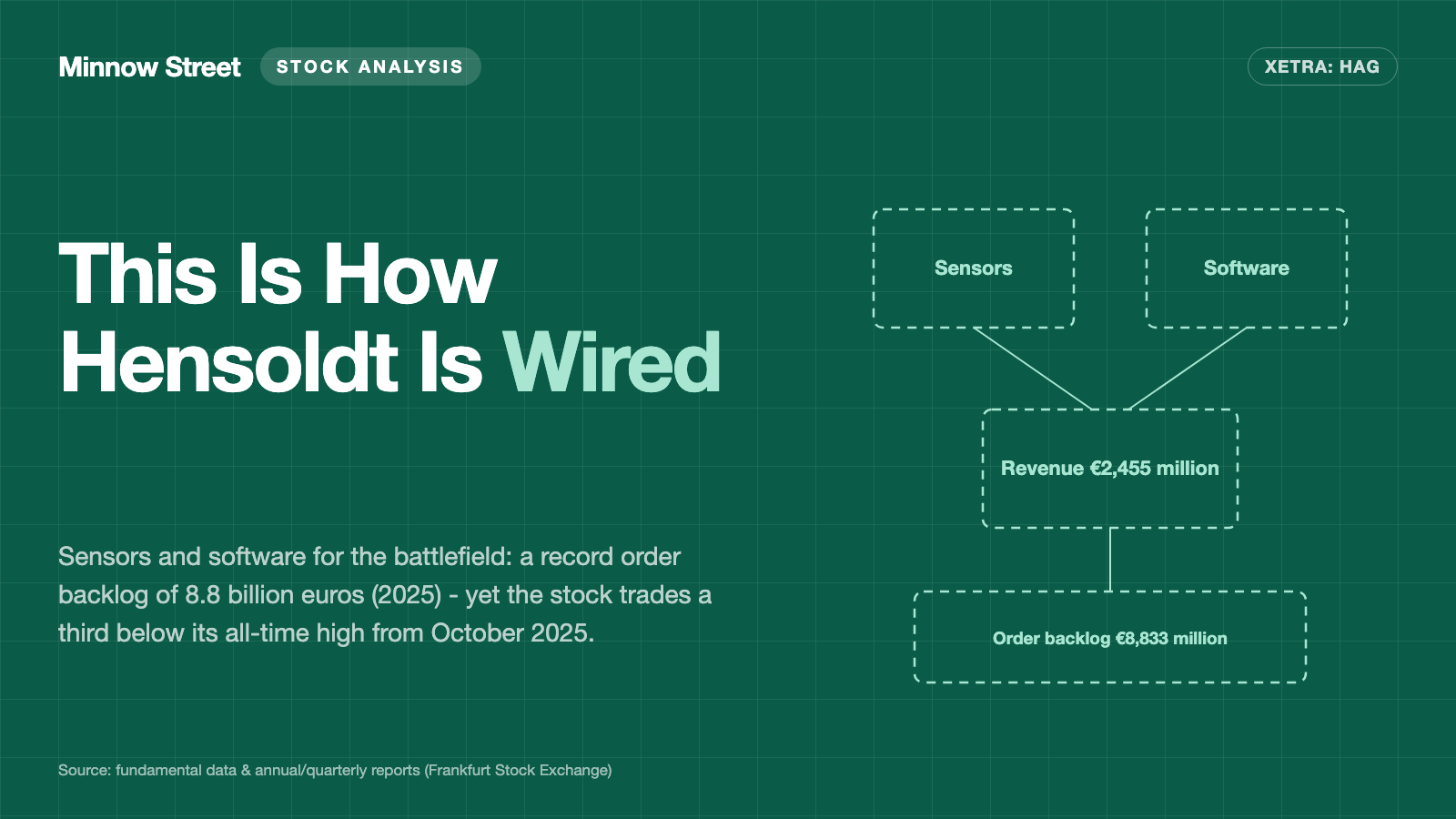
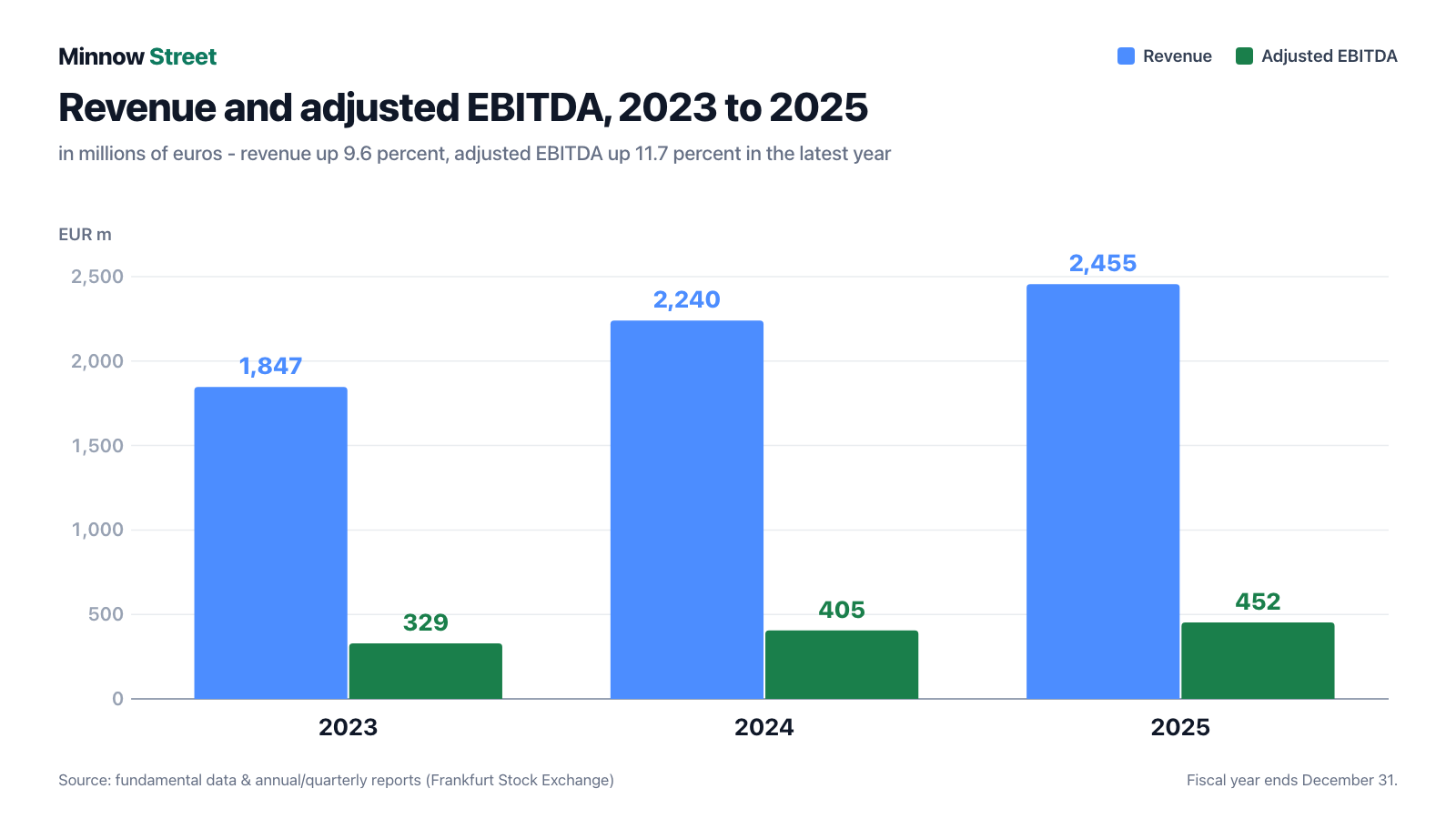
First, what genuinely impresses - and there is plenty of it. Hensoldt has grown for years: revenue of €1,847 million (2023), €2,240 million (2024), €2,455 million (2025), up 9.6 percent in the most recent year. Adjusted EBITDA - Hensoldt's own definition: EBIT before depreciation, purchase-price-allocation effects and special items - grows by double digits: €329 million (2023), €405 million (2024), €452 million (2025), up 11.7 percent; the margin climbed from 18.1 to 18.4 percent.
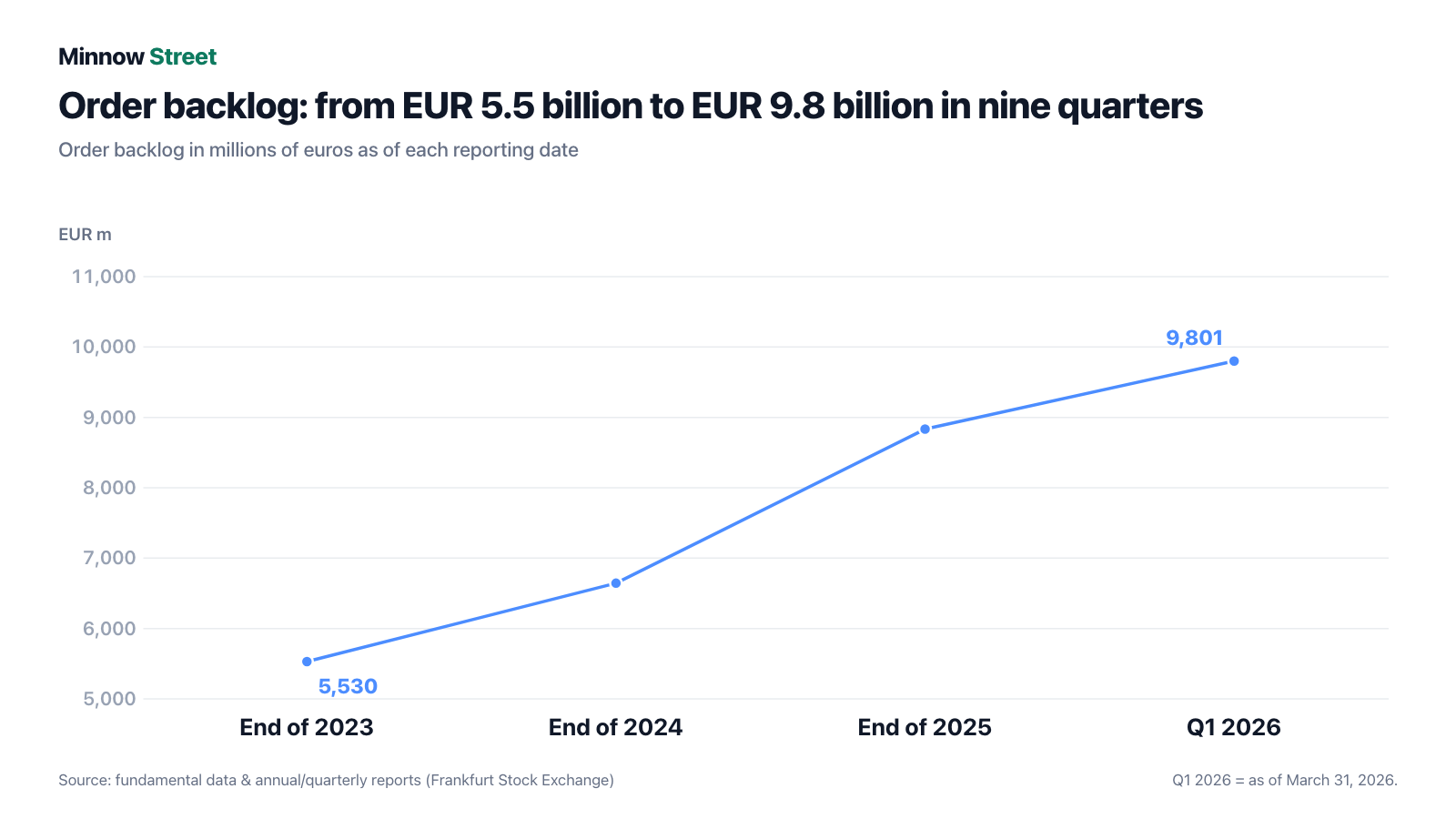
The order picture is even more impressive. Order intake jumped 62.2 percent in 2025 to €4,710 million (2024: €2,904 million), and the book-to-bill ratio rose from 1.3x to 1.9x - mainly because the Optronics segment booked billion-euro orders in the fourth quarter of 2025 to equip the Puma and Leopard 2 infantry fighting vehicles. The resulting order backlog grew from €5,530 million (end of 2023) through €6,644 million (end of 2024) to €8,833 million (end of 2025, up 32.9 percent) - and climbed further to €9,801 million in the first quarter of 2026 alone, at a book-to-bill ratio of 3.0x.
The first quarter of 2026 confirms the trend in revenue and adjusted EBITDA, but not in reported net income: revenue of €496 million (up 25.4 percent from €395 million a year earlier), adjusted EBITDA of €44 million (up 46.7 percent) - but a net loss of €20 million (prior-year quarter: minus €31 million). That is seasonally normal for Hensoldt: the first quarter is traditionally the weakest, because billing and cash receipts concentrate heavily toward year-end - not an outlier, then, but not a straight line upward either, the kind a look back at 2025 alone might suggest. Exactly where that curve gets kinks is the subject of the next three uncomfortable truths.
What the filings say - the uncomfortable truths
Uncomfortable truth no. 1: two-thirds of revenue depends on a single customer - the company's own government
Hensoldt sells to many armed forces worldwide - but the weighting is far from balanced. The 2025 annual report states it plainly:
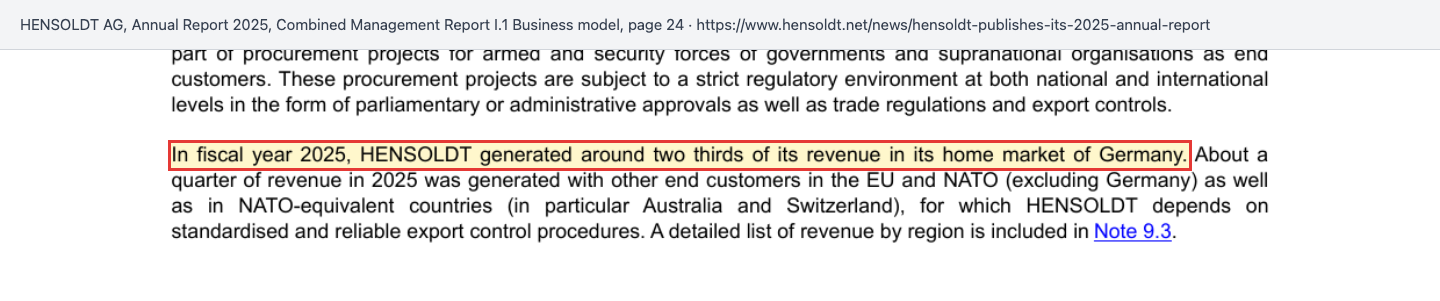
"In fiscal year 2025, HENSOLDT generated around two thirds of its revenue in its home market of Germany."
— HENSOLDT AG, Annual Report 2025, Combined Management Report I.1 "Business model," page 24
Roughly another quarter of 2025 revenue came from other EU and NATO countries plus NATO-equivalent states such as Australia and Switzerland - and every one of those orders runs through the same mechanisms: parliamentary approvals, export controls, defense budgets. Picture it this way: if a neighbor told you their small business was thriving, but two-thirds of revenue came from a single customer who decides on a fresh budget every year - would you pause? That is exactly the structure behind the record order backlog: it is real, audited, valuable - but it depends overwhelmingly on a single political decision, the German defense budget.
That this risk is not merely theoretical showed up right in the window between the last quarterly report and this analysis: on June 30, 2026, Hensoldt announced that Germany's Federal Ministry of Defence had cancelled the F126 frigate program and launched a MEKO A-200-class procurement instead (subject to approval by the Bundestag's Budget Committee). Hensoldt supplied the TRS-4D naval radar for F126 - a contract worth, per the company's own statement, more than €200 million, of which more than a third had already been booked as revenue at the time of cancellation. CEO Oliver Dörre said the company was working out the contractual settlement together with its partner Thales Netherlands, and still expected revenue from the program in the "low double-digit millions" for the current fiscal year 2026 - with no impact, in the company's own words, on the short- or medium-term outlook, partly because the same TRS-4D radar is already deployed on the F125 frigate, the K130 corvette, and internationally on Brazil's Tamandaré-class frigates. The scale of this one contract stays modest against a €9.8 billion order backlog - but as proof that even a years-long, already revenue-generating program can end with a single government decision, the case is instructive.
Uncomfortable truth no. 2: reported profit is falling while revenue and adjusted EBITDA grow
Here the numbers get interesting. While revenue (up 9.6 percent) and adjusted EBITDA (up 11.7 percent) both grew in 2025, IFRS net income attributable to Hensoldt AG shareholders fell from €108 million to €89 million - down 17.6 percent. Earnings per share fell accordingly from €0.93 to €0.77 (down 17.8 percent). The gap between adjusted EBITDA and net income comes down to three items: depreciation and amortization rose to €181 million in 2025 (prior year €163 million) - partly because Hensoldt had to recognize right-of-use assets under IFRS 16 for the first time, for the new Oberkochen site. The financial result worsened from minus €68 million to minus €94 million, mainly due to higher interest expense from those same new lease arrangements plus foreign-exchange effects. And the tax charge rose from €12 million to €41 million, because German loss carryforwards that had cushioned the prior year's result were used up.
For you as an investor, that means: whoever values the stock purely on a price-to-earnings ratio based on reported profit sees a very expensive stock - at a price of €79.80 (July 24, 2026) and earnings per share of €0.77, the P/E works out to about 104. That is not unusual for defense electronics with heavy investment and growing lease obligations, but it is still a P/E where a single wobbly earnings year hits the valuation disproportionately hard. Remember this: a company can grow operationally faster than its reported profit shows - but the reverse is just as true: a single year of heavy depreciation or taxes can depress profit without anything having gone wrong in the underlying business.
Uncomfortable truth no. 3: free cash flow slid deep into negative territory again in the first quarter of 2026
The cash picture shows a break, too, that a look back at 2025 alone could not reveal. For the full year 2025, operations still looked solid: adjusted free cash flow rose 39.3 percent to €347 million, and cash and cash equivalents grew from €733 million to €933 million. But the first quarter of 2026 flipped the picture - the quarterly statement says so directly:
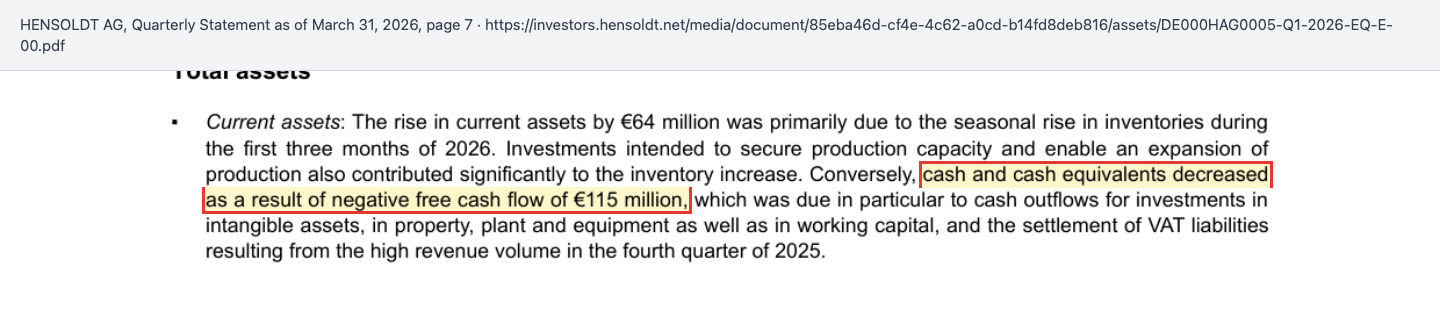
"… cash and cash equivalents decreased as a result of negative free cash flow of €115 million, which was due in particular to cash outflows for investments in intangible assets, in property, plant and equipment as well as in working capital, and the settlement of VAT liabilities resulting from the high revenue volume in the fourth quarter of 2025."
— HENSOLDT AG, Quarterly Statement as of March 31, 2026, page 7
Cash and cash equivalents fell as a result from €933 million to €820 million (down 12.1 percent) - an improvement on the even weaker prior-year quarter (free cash flow of minus €134 million), but still not a positive cash flow. Adding financing liabilities and lease liabilities together and subtracting cash - a broader measure than the €297 million "net debt" the notes to the accounts report (as of December 31, 2025, excluding leases; 2024: €447 million) - this figure including lease liabilities comes to €701 million as of December 31, 2025 and already €833 million as of March 31, 2026. That is a €132 million increase in a single quarter - while order intake set a record over the same period. Both things are true, and both belong in the same analysis: a growing defense business consumes cash first, because advance spending, inventories and investment run ahead of order growth - revenue and cash receipts arrive only with a lag. Whether that reverses in the second quarter of 2026 will not be clear before the half-year report on July 31, 2026.
Valuation: between €62 and €94 - and a third below its own high
Now back to the price range from the newsletter. "Share-price gains of 100 to 300 percent" in 2025 - is that accurate? Yes, and the annual report itself supplies the numbers that were not yet known in November 2025:
"… at one point reaching a new all-time high of €117.70. At the end of 2025, the shares were trading at €73.40, 112.8% above the €34.50 share price at the end of the previous year."
— HENSOLDT AG, Annual Report 2025, chapter "HENSOLDT on the Capital Market," page 11
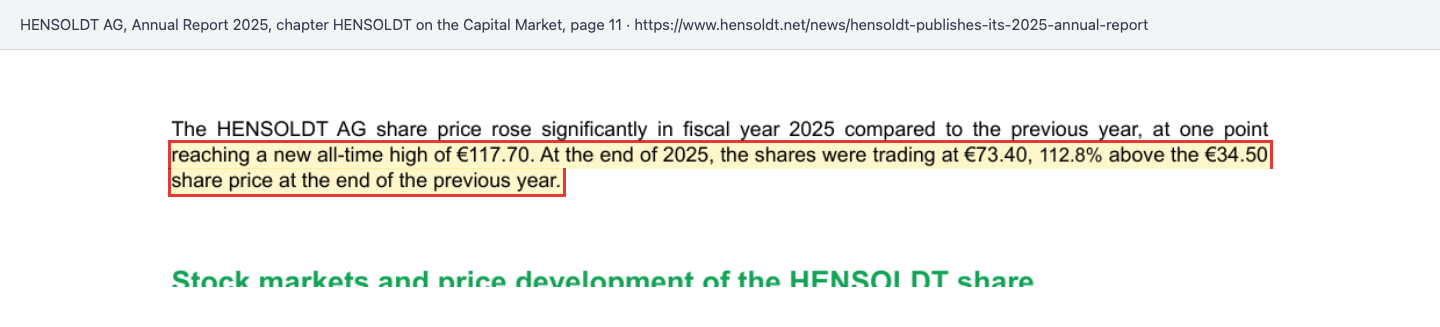
The 100-to-300-percent range from the newsletter holds up well: 112.8 percent to the year-end close, and, according to the annual report, "over 200 percent" at one point to the all-time high of €117.70 on October 6, 2025 - driven by the 2025 German defense budget and the prospect of NATO's target of spending 3.5 percent of GDP on defense by 2029. But that is exactly the part a look back at "2025" cannot show: since that October all-time high, the stock has fallen back - through a correction starting in mid-October, deepened by the resumption of Ukraine peace talks in November, down to a 52-week low of €63.12 on June 26, 2026. On July 24, 2026 the stock trades at €79.80 - roughly a third below its own all-time high, even though that is about 8.7 percent above the 2025 year-end close, and the market capitalization of about €9.22 billion remains well above average for the sector.
Analysts, meanwhile, have moved from consensus to clear disagreement. At the end of 2025, 16 banks named in the annual report put the average price target at €88.44 (4 "buy," 9 "hold," 3 "underweight"/"sell") - a theoretical 20.5 percent upside from the price at the time. By mid-July 2026, the spread had widened further: Jefferies (Chloe Lemarie) reaffirmed its buy rating on July 10, 2026 and raised the price target from €90 to €94, pointing to Hensoldt's position "exactly where modern warfare takes place today." A day earlier, on July 9, 2026, mwb Research downgraded the stock from "hold" to "sell" with a €62 target - citing concern that NATO budgets are shifting from traditional land systems toward air defense and drone countermeasures. Between €62 and €94 sits almost the entire current price range of the stock - a sign of how differently professional observers are reading the same numbers right now. Based on 2025 adjusted EBITDA (€452 million) and net financial debt including lease liabilities of €701 million (as of December 31, 2025), enterprise value comes to about €9.9 billion and EV/EBITDA to about 22x - an order of magnitude that prices in structural growth but leaves little room for disappointment.
Opportunities and risks at a glance
What speaks for Hensoldt:
- A structural tailwind theme: order intake up 62.2 percent in 2025 to €4.71 billion, the order backlog nearly doubling from €5.53 billion (end of 2023) to €9.80 billion (March 31, 2026) - carried by German and European defense budgets and NATO's 3.5-percent-of-GDP target through 2029.
- Revenue and adjusted EBITDA have both grown for years (2025: up 9.6 and 11.7 percent respectively, the latter by double digits); the adjusted EBITDA margin also improved sharply in the lower-margin Optronics segment, from 6.9 to 13.8 percent.
- Solid capitalization: €933 million in cash and cash equivalents at year-end 2025, the dividend for 2025 raised 10 percent to €0.55 per share and approved with 99.99 percent support at the annual general meeting on May 22, 2026.
- Broad institutional anchoring: the German government (via KfW) and Leonardo S.p.A. together hold nearly half the shares, plus MDAX membership since 2023 with correspondingly wide analyst coverage (16 banks).
- A growing software layer (MDOcore) and capacity expansion: the new, roughly €300 million Optronics campus in Oberkochen (opened July 23, 2026, capacity for about 900 employees) expands Optronics production; in the Sensors segment, Hensoldt has already expanded TRML-4D and Spexer radar production capacity 8.5x and 6.3x, respectively, versus 2021.
What speaks against it:
- Two-thirds of 2025 revenue depends on the German home market, with another quarter on other EU/NATO states - the June 2026 cancellation of the F126 frigate program shows that even ongoing, revenue-generating contracts can end with a single political decision.
- Reported net income fell 17.6 percent in 2025 to €89 million even as revenue grew 9.6 percent and adjusted EBITDA grew by double digits - at a P/E of about 104 on that basis, the valuation is sensitive to earnings swings.
- Free cash flow turned sharply negative again in the first quarter of 2026 (minus €115 million), and net financial debt including lease liabilities rose from €701 million to €833 million in a single quarter.
- The stock trades roughly a third below its October 2025 all-time high despite a record order backlog, and analyst opinions - price targets between €62 and €94 as of July 2026 - diverge more than usual.
- The equity ratio of about 18.5 percent (December 31, 2025) is on the low side for the sector, even though there is no sign of a covenant breach or liquidity strain.
A human conclusion
Back to the rearview-mirror trap from the opening. The newsletter was not wrong about its price range - 112.8 percent to the 2025 year-end close, over 200 percent at one point to the all-time high, that is a fair match for "100 to 300 percent." What a look back at a single year naturally cannot show is everything that has happened since: a stock that has given back a third of its all-time high, a reported profit that fell even as the core business grew, a free cash flow that slid negative again in the first quarter of 2026, and a cancelled frigate program as a reminder of exactly what two-thirds of this business depends on. None of that disproves the growth story - the €9.8 billion order backlog is just as real as the 2025 share-price gain. But a look in the rearview mirror only shows you how fast you were going, not what is around the next bend. What you make of it is your decision. And that is exactly as it should be.
Sources
All original documents used in this analysis - for your own reading:
- HENSOLDT AG - 2025 Annual Report (published March 26, 2026)
- HENSOLDT AG - Quarterly Statement as of March 31, 2026 (published May 6, 2026)
- HENSOLDT AG - Press release on the F126 program cancellation (June 30, 2026)
- HENSOLDT AG - Annual general meeting release (May 22, 2026, dividend approval)
- HENSOLDT AG - Fiscal-year-2023 press release - source of the 2023 comparison figures in the charts
- Investor relations page investors.hensoldt.net - publications, financial calendar, analyst consensus
- Analyst notes from Jefferies (July 10, 2026) and mwb Research (July 9, 2026), summarized via boerse-global.de (retrieved July 26, 2026)
- Fundamental data (metrics, valuation; data as of July 26, 2026), reconciled with the annual/quarterly reports.
- Hook: "Hot Stocks Europe" newsletter, issue 24, dated November 28, 2025 (B-Inside International Media GmbH, Freiburg) - cited as a third party's expectation, not used as a source for company figures.
Transparency & disclaimer: This analysis is a journalistic contextualization of publicly available information and is not investment advice, not a regulated financial analysis, and not a solicitation to buy or sell securities. Equity investments carry substantial risk, including total loss. All information is provided without warranty; the data cutoff for each figure is noted in the text. The author holds no position in HENSOLDT shares at the time of publication.
Our Bottom Line at a Glance
- Growth and order picture positive
- Revenue up 9.6 percent to €2,455 million in 2025, adjusted EBITDA up 11.7 percent to €452 million. The order backlog has nearly doubled, from €5,530 million (end of 2023) to €9,801 million (March 31, 2026), carried by German and European defense budgets.
- Earnings quality negative
- Net income attributable to shareholders fell 17.6 percent in 2025 to €89 million even as revenue grew 9.6 percent and adjusted EBITDA grew 11.7 percent — due to higher depreciation (new IFRS 16 right-of-use assets for Oberkochen), a higher financial expense and a tripled tax charge. The P/E on that basis is about 104.
- Cash flow and balance sheet negative
- Free cash flow slid back to minus €115 million in the first quarter of 2026, and net financial debt including lease liabilities rose from €701 million to €833 million in a single quarter. The equity ratio of about 18.5 percent (Dec. 31, 2025) is on the low side, though without any sign of a covenant breach or liquidity strain.
- Customer concentration neutral
- About two-thirds of 2025 revenue came from the German home market. The June 30, 2026 cancellation of the F126 frigate program (contract value above €200 million, of which more than a third already booked as revenue) shows this risk is real - though the company says the financial effect this time stays modest.
- Share price and valuation neutral
- The stock trades at €79.80 on July 24, 2026, roughly a third below its all-time high of €117.70 from October 6, 2025. Analysts disagree: Jefferies raised its target to €94 on July 10, 2026, while mwb Research cut its target to €62 a day earlier.
- Ownership structure positive
- The German government (via KfW) and Leonardo S.p.A. together hold 47.9 percent of the shares, with free float at 52.1 percent (Dec. 31, 2025). MDAX membership since 2023 ensures broad institutional coverage and liquidity.
Hensoldt delivers operationally what a defense-electronics growth story should: revenue grows a solid 9.6 percent, while adjusted EBITDA and the order backlog grow by double digits to near-doubling. Yet reported net income fell 17.6 percent in 2025, free cash flow turned deeply negative again in the first quarter of 2026, and the stock trades a third below its own all-time high from October 2025 despite a record order backlog. Not investment advice.
What Our Rating Means
Open questions
The business works in principle, but one material question is open. As long as it stays open, our findings do not carry a quality verdict.
Yellow is not about an existential question here - cash on hand is a healthy €820 million (March 31, 2026), there is no going-concern note, no covenant breach and no negative-equity situation. Yellow stands because several operating questions remain open that a look back at 2025's share-price gains does not reveal: first, reported net income is falling even as the core business grows, because depreciation, financial expense and taxes are rising faster than operating profit. Second, free cash flow turned deeply negative again in the first quarter of 2026, and net financial debt including lease liabilities keeps climbing while the market focuses on the record order backlog. Third, two-thirds of revenue depends on a single political decision - the German defense budget - and the June 2026 cancellation of the F126 program shows that risk is real, even though the financial effect stayed modest this time. The business model itself (manufacturer-agnostic sensor technology for a structurally growing defense budget, a €9.8 billion order backlog) clearly holds up. Whether the earnings and cash-flow questions resolve over the rest of the year will not be clear before the half-year report on July 31, 2026.
A journalistic assessment by our editorial team at the time of the deep dive, based on public sources — not investment advice and not a solicitation to buy or sell. Your personal circumstances (investment goals, risk capacity, taxes) cannot be taken into account. What our levels mean, how verdicts are formed, and what conflicts of interest exist →
Worth Noting
- The hook for this analysis is issue 24 of the "Hot Stocks Europe" newsletter dated November 28, 2025 (B-Inside International Media GmbH, Freiburg), which mentions Hensoldt only in a page-1 editorial look-back ("share-price gains of 100 to 300 percent" in 2025) - no company figure, no price target. The newsletter carries a standard conflict-of-interest note on page 8: the publisher, author or related third parties may hold long positions in securities discussed and intend to sell into rising prices (EU Market Abuse Regulation No. 596/2014).
- All company figures come from the 2025 annual report (published March 26, 2026) and the quarterly statement as of March 31, 2026 (May 6, 2026), not from the newsletter. Data cutoff for price, valuation and analyst figures: July 26, 2026.
- Possible confusion: the ticker shorthand HAG.DE used in this analysis is simply a platform convention for "Hensoldt, listed in Germany" - not an official exchange code. The stock trades under Xetra: HAG as well as on Tradegate, Frankfurt and Gettex.
Frequently Asked Questions
Hensoldt AG, headquartered in Taufkirchen near Munich, develops and manufactures electronic sensor solutions for defense and security: radar, electronic warfare, avionics and optronics. The company is a manufacturer-agnostic system integrator for fighter jets, ships, armored vehicles and satellites, and employed about 9,362 people as of December 31, 2025 across its two segments, Sensors and Optronics.
Hensoldt is listed on the Prime Standard of the Frankfurt Stock Exchange, not in the United States - there is no 10-K, no 10-Q, no SEC registration. It must publish an audited IFRS annual report, a half-year report, and short, unaudited quarterly statements. This analysis draws on the 2025 annual report and the quarterly statement as of March 31, 2026.
The stock hit an all-time high of €117.70 on October 6, 2025, driven by the German defense budget. It has since corrected - deepened by the resumption of Ukraine peace talks - down to a 52-week low of €63.12 on June 26, 2026. On July 24, 2026 the stock trades at €79.80, roughly a third below the high.
About two-thirds of 2025 revenue came from the German home market, per the annual report, with another quarter from other EU/NATO countries. The €8.83 billion order backlog (end of 2025) therefore depends overwhelmingly on a single political decision: the German defense budget and its medium-term planning.
Germany's Federal Ministry of Defence cancelled the F126 program on June 30, 2026 and is procuring MEKO A-200-class frigates instead. Hensoldt's contract for the TRS-4D naval radar was worth more than €200 million, of which more than a third had already been booked as revenue. Hensoldt still expects revenue from the program in 2026 in the low double-digit millions, with no impact on guidance.
Yes. For fiscal 2025, the annual general meeting approved a dividend of €0.55 per share (prior year €0.50) with 99.99 percent support on May 22, 2026, totaling about €63.5 million. At a price of €79.80, that works out to a dividend yield of roughly 0.7 percent.
Based on 2025 earnings per share (€0.77) and a price of €79.80, the P/E works out to about 104 - high, partly because reported profit fell 17.6 percent in 2025. On an adjusted-EBITDA basis, enterprise value works out to about 22 times - a rich but not unusual order of magnitude for structural growth.
As of December 31, 2025, the Federal Republic of Germany held 25.1 percent of the shares through KfW, and Leonardo S.p.A. of Italy held 22.8 percent. Free float stood at 52.1 percent. Hensoldt has been a member of the TecDAX since June 2022 and the MDAX since March 2023.
Found an error?
Did you spot a factual error, an outdated number, or a typo in this deep dive? Let us know briefly — your report goes straight to the editorial team.