Steyr Motors Stock: Up 1,256 Percent — Then the Margin Was Nearly Cut in Half
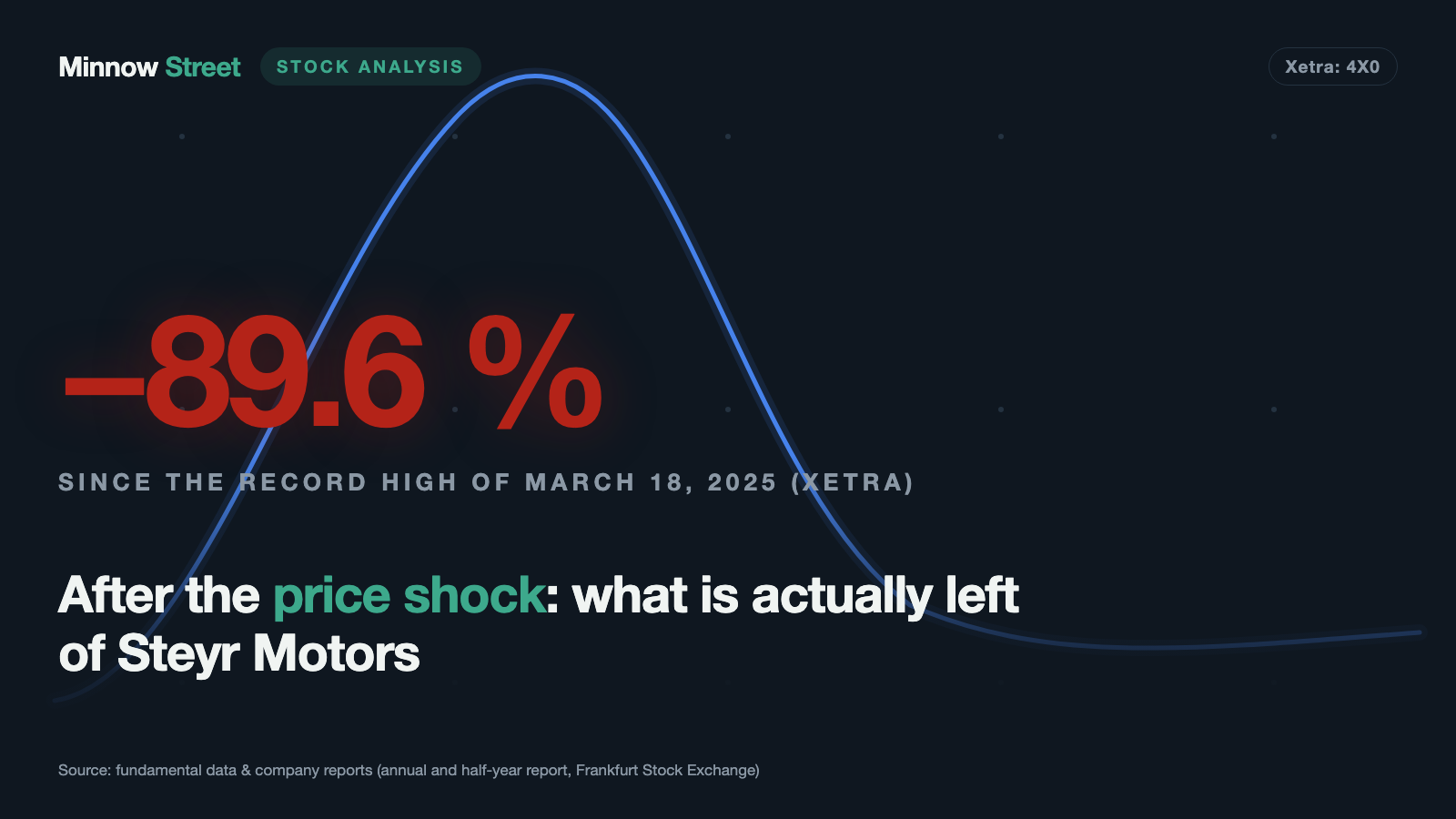
Newsletter issue 6 of "Hot Stocks Europe" recommended Steyr Motors in early March 2025 at €31.40. Within days the stock hit an official Xetra high of €384.00 — the newsletter itself claims a peak of €426, a gain of 1,256 percent. 16 months later the stock trades around €40, nearly 90 percent below that record — and the 2025 annual report shows an EBIT margin that fell from 24.3 to 14.5 percent, while net cash turned into €6.2 million in net debt. Not investment advice — just the question of what is left of the rocket ship once you read the annual report.
 Thomas Mücke
Founder & Publisher
Thomas Mücke
Founder & Publisher
Chart
Interactive price chart (TradingView).
Note: pure fact-based analysis, not investment advice and not a solicitation to buy or sell. All figures without guarantee.
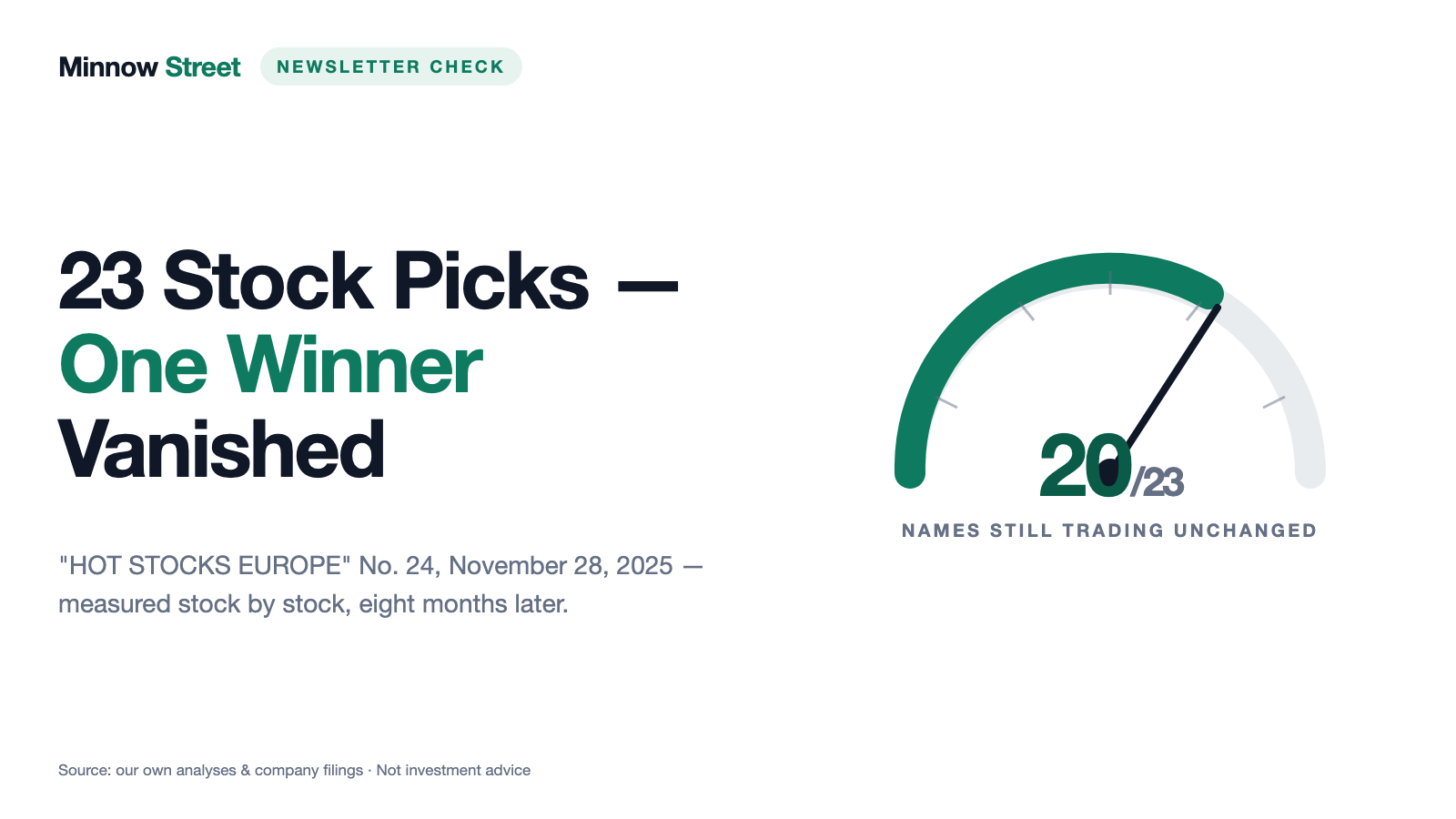
There is a trick your brain plays on you without ever asking permission: once it has seen an extreme number, that number becomes the yardstick for everything that follows. Behavioral economists call this anchoring. A price tag of $1,000 makes a price tag of $400 look like a bargain — even if $400 is still far too much. Stocks work the same way: once you have read that a share jumped 1,256 percent, every later price feels "cheap" as long as it sits below that record. A reader sent us exactly that anchor: issue 24 of the newsletter "Hot Stocks Europe," dated November 28, 2025 (B-Inside International Media GmbH, Freiburg, author Michael Calivas), looks back at the stock-market year and writes about Steyr Motors AG (Xetra: 4X0): a recommendation in issue 6 in early March 2025 at €31.40, then "driven by good company news and a short squeeze" a price spike within days to as much as €426 — up 1,256 percent. So let's make a deal: we set the anchor aside and look instead at what Steyr Motors itself has published — the 2025 annual report, the 2025 half-year report, and the latest company announcements. By the end, you decide whether that old anchor still has anything to do with today's company.
What Steyr Motors actually does
Steyr Motors AG, headquartered in Steyr-Gleink, Austria, builds something that sounds like nothing out of a glossy prospectus but is genuinely hard to copy: high-performance diesel engines with extreme power density — for heavy-duty vehicles, boats, and auxiliary power units. Translated into an everyday picture: an ordinary truck engine delivers around 35 kilowatts per liter of displacement; a Steyr engine delivers up to 70 — double the power from the same block size, which matters wherever space and weight are scarce: in main battle tanks, wheeled armored vehicles, naval boats, locomotives. The business splits into two segments: Defense (vehicle and boat manufacturers in the military space) and Civil (marine distributors, civilian vehicle makers, mostly locomotives). On top come digital engine-control solutions and a spare-parts and service business spanning the entire product life cycle.
On the stock market, the company is barely two years old: IPO on October 30, 2024 in the Scale segment of the Frankfurt Stock Exchange, at an issue price of €14.00. Since February 2025 the stock has also traded on the "direct market plus" of the Vienna Stock Exchange — fitting, since Vienna is the home exchange of an Austrian company, even though Frankfurt/Xetra remains by far the more liquid venue. On the capital markets, Steyr Motors arrived in 2025 in a role that matches its product: as a defense stock. And that is exactly where — in the defense-sector chapter of a stock newsletter — the stock first surfaces in our source.
Where the stock landed on our desk: a reader, a look-back, an anchor
A reader sent us issue 24 of the newsletter "Hot Stocks Europe" — a twice-monthly publication, dated November 28, 2025, reviewing the stock-market year. As part of a defense-sector analysis, the newsletter had already recommended Steyr Motors to its readers in issue 6 in early March 2025, "urgently recommended at the recommended price of €31.40." What happened next, in the newsletter's own words: "Driven by good company news and a short squeeze, the share price then exploded within a few days, at its peak reaching as much as €426 — an incredible 1,256 percent. Through an alert release we were able to lock in a large part of the spectacular gains with a sell recommendation." Other defense stocks reportedly saw "gains of between 100 and 300 percent" following the same recommendation — the newsletter explicitly names Hensoldt and Renk. What those gains looked like once measured against the actual numbers is covered in our Hensoldt analysis and our Renk analysis.
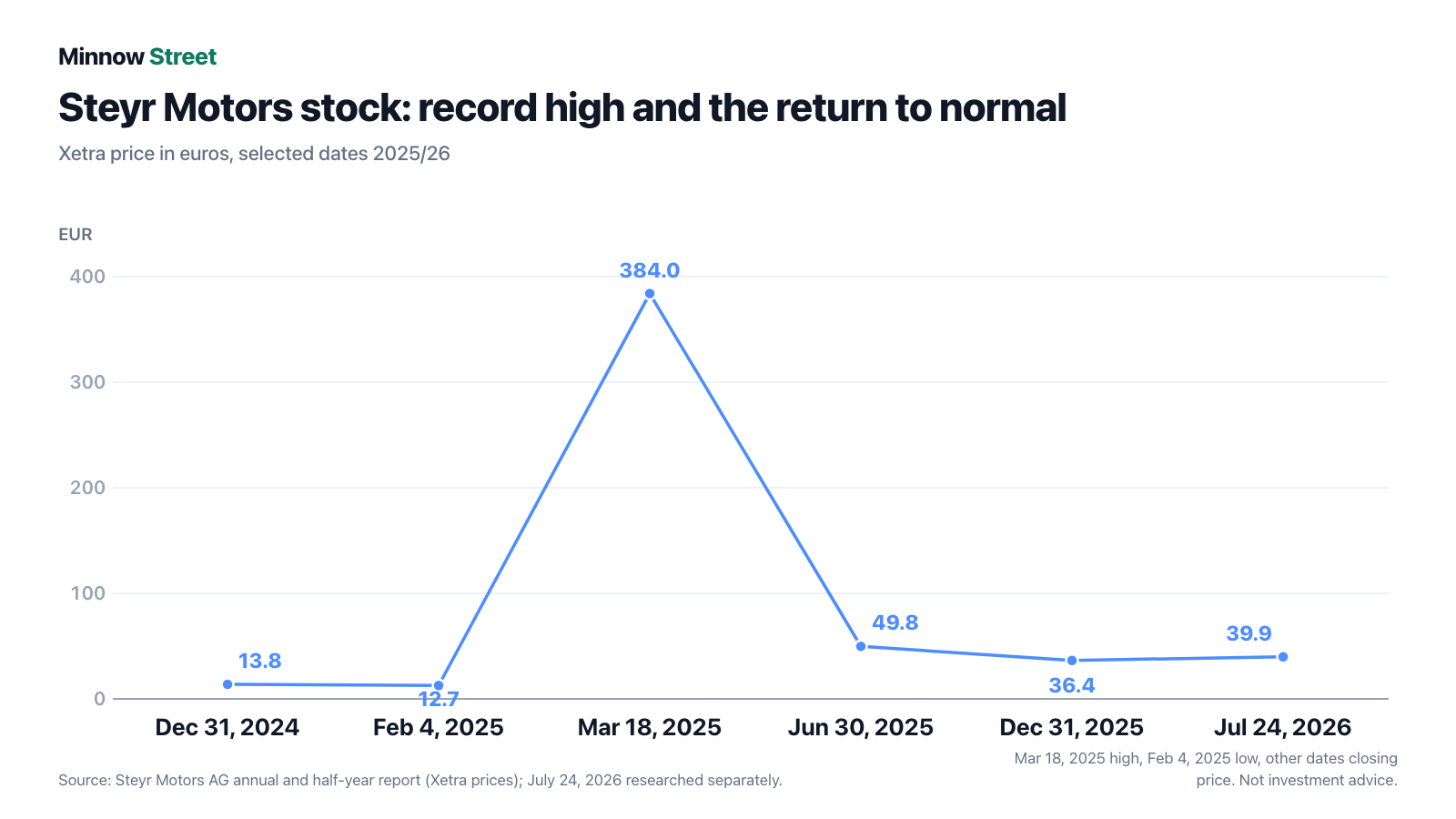
Important context: the newsletter is dated November 28, 2025, and even then was already looking back nine months — everything in it is a snapshot from that point in time, not a description of the present. Independent research lets us reconstruct the sequence: the rally was triggered by a cooperation agreement with Rheinmetall on tank drivetrain development, a framework order from Brazil, and the German parliament's positive vote on the defense package — landing on what press reports describe as a very thin free float at the time, thin enough that even small buy orders could move the price. The company's own annual report confirms the scale with official Xetra data: the stock closed 2024 at €13.80, fell to a yearly low of €12.70 on February 4, 2025 — and hit an official Xetra yearly high of €384.00 on March 18, 2025. The €426 peak the newsletter cites sits above that; with the data available to us, the gap cannot be fully resolved — a plausible explanation is an intraday spike or a print on one of the secondary venues (Berlin, Stuttgart, Tradegate) that the official Xetra close does not capture. For our analysis, the verified order of magnitude matters more than the last decimal: the price genuinely multiplied roughly tenfold within two weeks — and crashed back down just as fast, according to press reports losing more than half its value within a single day, with an intraday low of around €81. The 2025 half-year report documents an official Xetra closing price of €49.80 as of the balance-sheet date of June 30, 2025 — more than half of the record high had already melted away by then, even though the price was still more than three times the €14.00 issue price.
A word on the conflict-of-interest notice that comes attached to every newsletter quote we use: "Hot Stocks Europe" discloses that the publisher, the author, or related third parties may hold long positions in stocks discussed and may intend "to sell the shares when prices rise" — a conflict of interest under the EU Market Abuse Regulation (MAR, EU No. 596/2014). Whether that applied to Steyr Motors specifically, the newsletter does not say; what matters is that a buy recommendation in a stock newsletter is never structurally free of assumptions. Our in-house stock scanner covers only US-listed names and therefore does not know an Austrian, Frankfurt-listed stock like Steyr Motors — the stock reached our desk through a reader tip, not through a scanner hit.
Why there is no SEC filing here — and where the numbers come from instead
One point first, because it shapes the entire evidence base of this analysis: there is no 10-K, no 10-Q for Steyr Motors. The company is not a US reporting company — an EDGAR search for the ticker 4X0 returns nothing. Steyr Motors' mandatory disclosures live elsewhere: the stock has traded since October 30, 2024 in the Scale segment of the Frankfurt Stock Exchange — the open-market segment for smaller and mid-sized growth companies, with reduced but clearly defined disclosure obligations — and since February 2025 additionally on the "direct market plus" of the Vienna Stock Exchange. Required are an audited annual financial statement (the 2025 edition: 72 pages, IFRS standalone accounts, auditor's report dated February 13, 2026), a half-year report, and brief quarterly statements without a full audited interim balance sheet.
What does that mean for you as a reader? The narrative logic we usually invoke — "a filing to the SEC is honest under penalty of law" — applies in substance to the audited annual statement too: an IFRS financial statement signed off by an auditor is a document with legal liability attached. Every figure in this analysis therefore carries the line "Source: fundamental data & company reports (annual and half-year report, Frankfurt Stock Exchange)", not "SEC filings." This darkness — no 10-K, no mandatory analyst calls, no audited quarterly balance sheet — is no exception among European Scale-segment names; our PFISTERER analysis, also a Frankfurt Scale-segment stock, likewise had to rely solely on the company's own reports. We read the 2025 annual report and the 2025 half-year report ourselves, marked the key passages, and cited them by page number.
The numbers over the years — honestly appraised
First, what genuinely impresses. Steyr Motors is growing: revenue rose from €38.41 million (2023, fundamental data) through €41.657 million (2024) to €48.480 million in fiscal year 2025 — up 16.4 percent, with both segments contributing: Civil (mostly marine distributors and locomotive manufacturers) grew 22.3 percent to €19.635 million, Defense grew 12.7 percent to €28.846 million. Worth noting: in 2025 it was the civilian segment that grew faster than Defense, even though the entire newsletter hook behind this analysis is a pure defense-sector frame.
The order backlog impresses too: as of the 2025 balance-sheet date it stood "above €300 million for the period through the end of 2030" — the company now states it precisely at €308 million (as of May 20, 2026). New framework agreements with Rheinmetall Landsysteme GmbH, Laborde Products Inc. (USA), and — agreed in March 2026 — a long-term framework agreement with KNDS through 2034 covering roughly 500 engine-generator units all underline that this is not a one-off. On April 7, 2026, Steyr Motors also completed the acquisition of the Danish marine-engine specialist BUKH A/S (SOLAS-certified engines for lifeboats, founded in 1899) — the group's power range grows from 120–300 hp to 24–700 hp, consolidated from the second quarter of 2026. That is one side of the story. The other side sits in the very same annual report, just one table further — and it is why we look at the margin more closely.
What the reports say — the uncomfortable truths
Uncomfortable truth No. 1: The company's own guidance was missed by a wide margin — and the margin itself was nearly cut in half in a single year
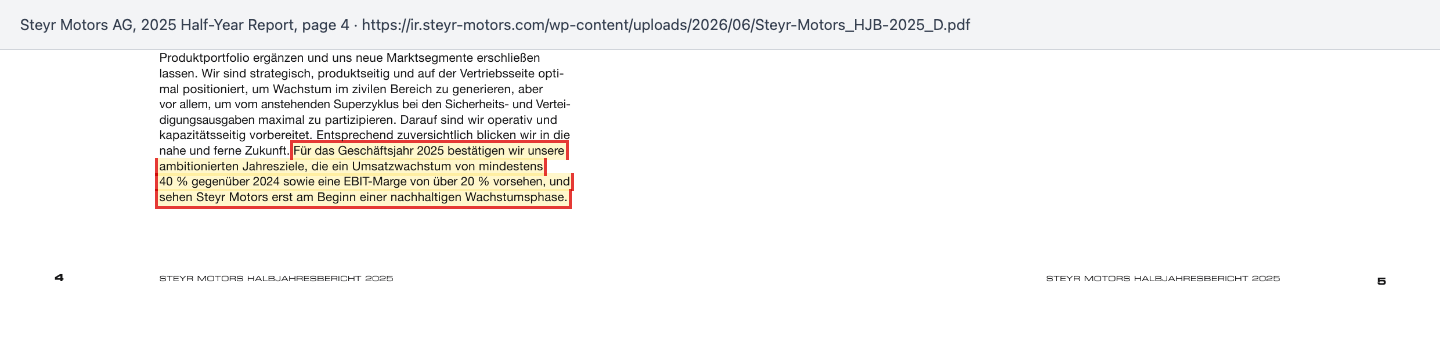
As late as August 2025, in the middle of the aftershock of the price spike, management confirmed its full-year targets for 2025 in the half-year report in these exact words:
„Für das Geschäftsjahr 2025 bestätigen wir unsere ambitionierten Jahresziele, die ein Umsatzwachstum von mindestens 40 % gegenüber 2024 sowie eine EBIT-Marge von über 20 % vorsehen, und sehen Steyr Motors erst am Beginn einer nachhaltigen Wachstumsphase.“
Translation: "For fiscal year 2025 we confirm our ambitious annual targets, which call for revenue growth of at least 40% over 2024 and an EBIT margin above 20%, and we see Steyr Motors only at the beginning of a sustained growth phase."
— Steyr Motors AG, 2025 Half-Year Report, Letter to Shareholders, page 4
That guidance was cut in the fourth quarter of 2025 — the 2025 annual report refers to the "guidance adjusted in November." What actually came out: 16.4 percent revenue growth instead of at least 40 percent. And the margin decline is even starker, because it is measured not just against the company's own guidance but against the prior year's result. The 2025 annual report lays out the full bridge between reported and "adjusted" EBIT:
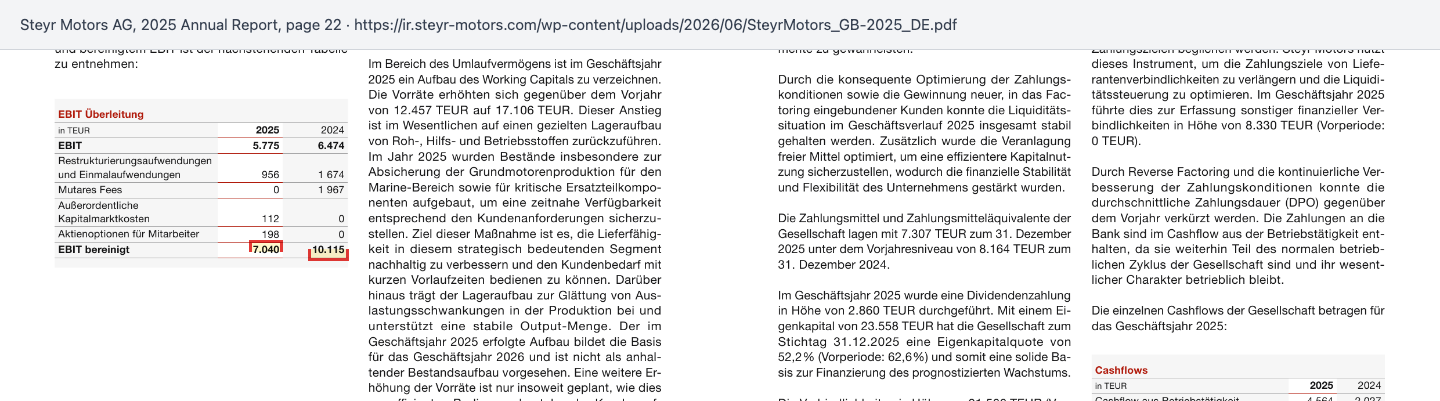
Read that table twice, because it overturns two expectations at once. Reported EBIT fell from €6.474 million to €5.775 million — the margin dropped from 15.5 to 11.9 percent. And adjusted EBIT — the figure management itself highlights as a "financial performance indicator" — fell from €10.115 million to €7.040 million, with the adjusted margin dropping from 24.3 to 14.5 percent. The reason for the big gap between the two years: in 2024 the company was allowed to strip out a hefty €1,967,000 in "Mutares fees" (costs tied to the restructuring under the former majority owner) plus €1,674,000 in other one-off expenses — in 2025 the comparable items totaled a much smaller €1,266,000 (restructuring, capital-markets costs, employee stock options). In other words: 2024 looked especially good thanks to generous add-backs; 2025 did not get the same treatment — and even on an adjusted basis, the margin nearly halved in a single year.
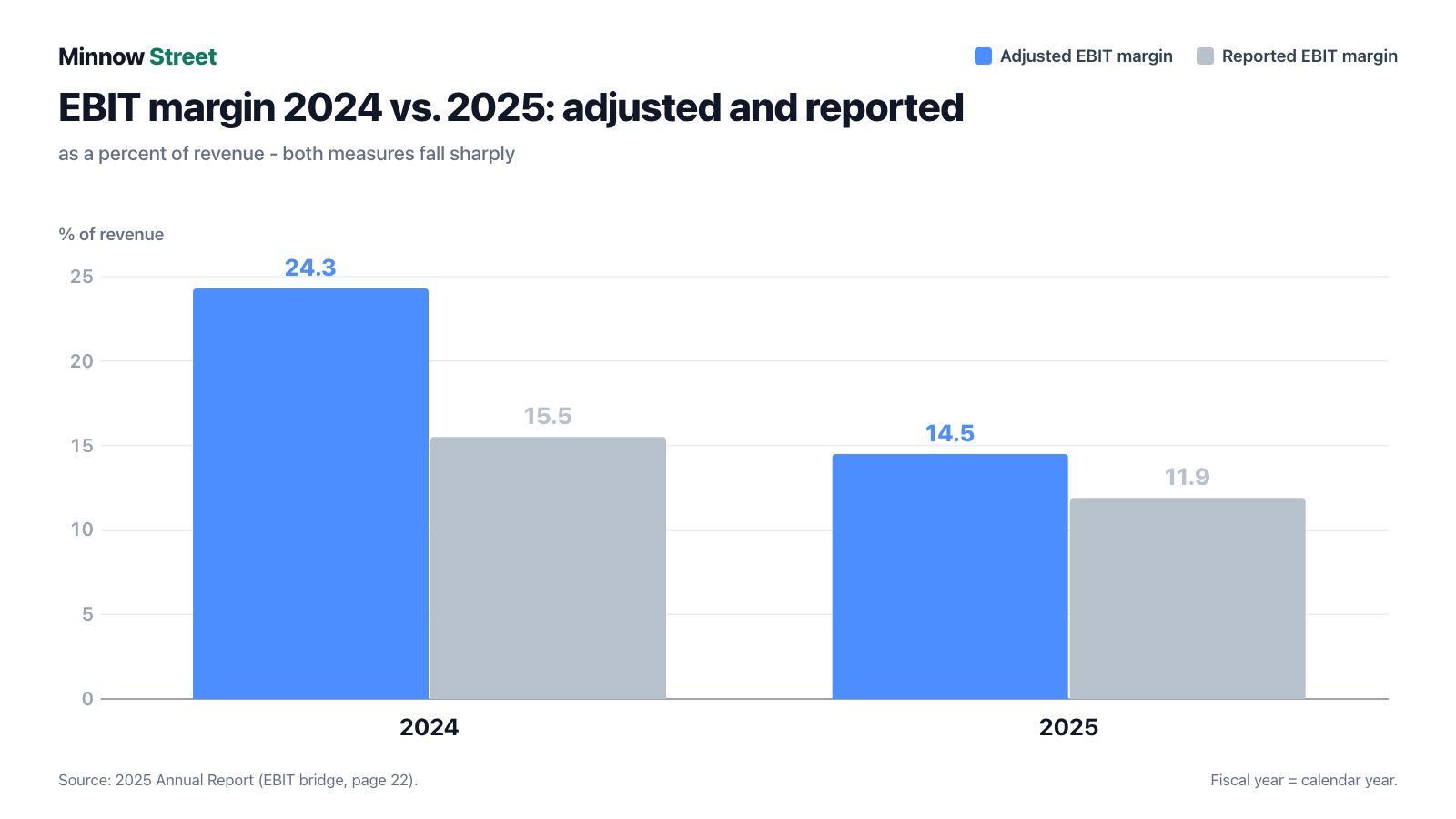
Remember the image: growth paid for with a shrinking margin is a different business than growth that pulls the margin along with it. Steyr Motors itself cites reasons that should not be waved off as excuses — targeted headcount growth (average headcount rose from 104 to 122 full-time equivalents), capacity expansion, an inventory build from €12.457 million to €17.106 million to secure marine-engine production, and license revenue, normally high-margin, that shifted past the cutoff date. Those are plausible growing pains. But none of it changes the fact that the August 2025 guidance was missed by a wide margin — and that anyone still watching this stock because of last year's rally finds, one year on, a very different earnings picture than the one promised that summer.
Uncomfortable truth No. 2: Net cash turned into net debt — mostly because of a brand-new financing line
The second uncomfortable number sits near the very end of the report, in the capital-structure table prepared for shareholders — and it is easy to miss, because it is just one line:

As of December 31, 2024, Steyr Motors still had €2.934 million in net cash — more cash than debt. A year later that had turned into €6.208 million in net debt — a swing of a little over €9 million within a single year. Where does that come from? Not primarily from classic bank loans: the confirmed €12 million credit line remains fully available and is "currently unused." The real driver is a new line item called "other financial liabilities," which jumped from €531,000 (2024) to €9.065 million (2025). The notes explain what is behind it: €8.33 million in obligations from a reverse-factoring program used for the first time in 2025 — an instrument under which a financial services provider pre-finances supplier invoices, giving Steyr Motors more time to pay its suppliers. That is a perfectly ordinary working-capital tool for a growing industrial company, not an alarm bell on its own — but it does mean that part of the "debt" line on the balance sheet is not classic interest-bearing debt, but extended payment terms toward suppliers, made visible in accounting terms only as a "liability." Anyone reading only the headline "net debt" misses that distinction.
Context also requires the second figure from the same balance sheet: the equity ratio fell from 62.6 to 52.2 percent — still solid for a growing industrial company, but a clear decline. And the timing is no coincidence: in 2025 Steyr Motors actively built up working capital (inventories rose from €12.457 million to €17.106 million) and stood on the eve of the strategically significant BUKH acquisition, which closed in April 2026. The next half-year report (expected around August/September 2026) will show for the first time how the balance sheet develops after BUKH is consolidated — and whether the €8.33 million factoring liability was a one-off build-up or the start of a trend.
Uncomfortable truth No. 3: A third of the "€308 million order backlog" is not legally binding — and the first quarter of 2026 already shows how long that fuse can burn
"Order backlog above €300 million through 2030" sounds like a number you can simply divide by the years and book as guaranteed revenue. That is not quite right. The company's own announcement dated May 20, 2026, on first-quarter 2026 results, is more precise: "total order backlog of €308 million, of which about €200 million legally binding." Turn that around and roughly €108 million — more than a third — consists of non-binding sales commitments and framework agreements without a firm off-take obligation. Not worthless, but also not as secure as a signed delivery contract.
And the same release provides the proof that "high visibility" does not automatically mean "fast pace." In the first quarter of 2026, Steyr Motors generated revenue of €11.7 million — just 1.7 percent above the prior-year quarter (€11.5 million), and even that small increase already includes about €1.7 million in third-party revenue from the newly acquired BUKH A/S, which was not yet formally consolidated. Adjusted EBIT collapsed from €2.1 million to €0.9 million — a decline of 57 percent. CEO Julian Cassutti explained it this way:
„Die zeitlichen Verschiebungen größerer Auftragsvolumina aus Indien und dem Mittleren Osten belasteten die Geschäftsentwicklung im ersten Quartal. Dennoch bilden der hohe Auftragsbestand, die zunehmende Dynamik im Bereich unbemannter Systeme (USV) sowie zusätzliche Impulse aus europäischen Defense-Programmen eine solide Grundlage für eine deutliche Beschleunigung der Geschäftsentwicklung im zweiten Halbjahr.“
Translation: "The timing shifts of larger order volumes from India and the Middle East weighed on business performance in the first quarter. Nevertheless, the high order backlog, the growing momentum in unmanned surface vehicles (USVs), and additional impulses from European defense programs form a solid basis for a marked acceleration of business performance in the second half of the year."
— Julian Cassutti, CEO of Steyr Motors AG, company announcement, May 20, 2026
That may well be true — timing shifts in order volumes from geopolitically tense regions are plausible, and management nonetheless confirmed its 2026 full-year guidance (revenue of €75 million to €95 million, EBIT margin of at least 15 percent). But that is exactly the point: between a large, partly non-binding order book and the money actually invoiced and earned in a given quarter lies a fuse whose length nobody outside the company knows. Anyone who bet on "€308 million of visibility through 2030" back in March 2025 would still have watched adjusted EBIT collapse in the first quarter of 2026.
Valuation: what the market pays today — and for what
As of July 24, 2026, the Steyr Motors stock cost €39.92. With 5,200,000 shares outstanding as of the 2025 balance-sheet date (the data vendor lists a slightly different figure of 5,251,261, presumably including exercised options), that puts market capitalization at roughly €207.6 million by our own calculation, or €209.6 million per the data vendor — for comparison, the annual report put market capitalization officially at €189.3 million at the end of 2025. Measured against 2025 net income of €3.882 million, that works out to a P/E ratio of around 53 — a figure that prices in far less of the 2025 results than it does the company's own 2026 guidance (€75 million to €95 million in revenue, an EBIT margin of at least 15 percent) and the additional upside from the BUKH integration. The price-to-sales ratio sits around 4.3 — a premium, for an industrial company currently running a single-digit to low-double-digit EBIT margin, that prices in growth expectations rather than an established earnings base.
The "view from the professionals" is considerably more optimistic than the market: per the 2025 annual report (as of February 13, 2026), four research houses rate the stock a buy — AlphaValue/Baader (Buy, price target €65.90), Cantor Fitzgerald (Overweight, €62.00), NuWays (Buy, €59.00), and Oddo BHF (Outperform, €75.00) — for an average price target of €65.48. That would be roughly 80 percent upside versus the year-end 2025 close of €36.40, and still around 64 percent versus the current price of €39.92. Important context: those price targets predate the disappointing first-quarter 2026 numbers and the final closing of the BUKH acquisition — they are opinion, with a house and a date attached, not fact, and have not yet been updated for the latest quarterly results.
Opportunities and risks at a glance
What speaks for Steyr Motors:
- Genuine, double-digit revenue growth in a structurally growing market: up 16.4 percent to €48.48 million in 2025, driven by rising defense budgets across Europe, the US, and Asia, plus a growing civilian marine-engine business.
- An order backlog of €308 million through 2030 (of which about €200 million legally binding), backed by new framework agreements with Rheinmetall Landsysteme, Laborde Products, and a KNDS framework agreement through 2034 covering roughly 500 engine-generator units.
- Strategic expansion through the BUKH acquisition (closed April 7, 2026): power range grows from 120–300 hp to 24–700 hp, roughly quadrupling SOLAS marine-engine volume, plus a second European manufacturing site.
- The former majority owner, Mutares SE & Co. KGaA, has sold out completely — free float rose from 57 percent (June 30, 2025) to 80 percent (December 31, 2025), making the stock considerably more tradable and far less exposed to the thin-float mechanics that drove the March 2025 spike.
- A solid balance-sheet base: an equity ratio still at 52.2 percent, an unused €12 million credit line, and positive operating cash flow (€4.469 million in 2025).
What speaks against it:
- The company's own 2025 full-year guidance (at least 40 percent revenue growth, above 20 percent EBIT margin, still confirmed in August 2025) was missed by a wide margin; adjusted EBIT fell from €10.115 million to €7.040 million, with the adjusted margin dropping from 24.3 to 14.5 percent.
- Net cash of €2.934 million turned into net debt of €6.208 million — mostly because of a new €8.33 million reverse-factoring liability; the equity ratio fell from 62.6 to 52.2 percent.
- About a third of the widely cited order backlog is not legally binding; in the first quarter of 2026, adjusted EBIT collapsed 57 percent despite stable revenue.
- A valuation with a P/E ratio around 53 and a price-to-sales ratio around 4.3 already prices in much of the 2026 guidance and the BUKH synergies — leaving room for disappointment if the margin comeback promised for the second half of 2026 fails to arrive.
- The purchase price for the BUKH acquisition was never disclosed; the first consolidated figures arrive at the earliest with the 2026 half-year report.
A human conclusion
Back to the anchoring bias from the opening. The number 1,256 percent is true — and still the worst possible number to keep in mind for a buying decision today. It describes a market mechanism: a thin free float meeting two pieces of good news, in a sector everyone wanted to own in 2025. It does not describe what Steyr Motors has delivered as a company since then — and that picture is mixed: genuine growth, but a margin that has been nearly cut in half; a large order backlog, a third of which is still non-binding; a strategically sound acquisition, financed in part with new debt that was, until now, barely visible. The anchor of €426 (or even the official €384.00) tells you nothing about whether €39.92 is expensive or cheap today — that is decided by the €200 million in legally binding backlog, by a margin that would actually need to recover in the second half of 2026, and by a BUKH integration whose first real numbers are still to come. What you make of it is your decision. And that is exactly how it should be.
Sources
All original documents used in this analysis — for your own reading:
- Steyr Motors AG — 2025 Annual Report (published March 6, 2026)
- Steyr Motors AG — 2025 Half-Year Report
- Steyr Motors AG — "Q1 2026" company announcement (May 20, 2026)
- Steyr Motors AG — Company announcement on the BUKH closing (April 7, 2026)
- Steyr Motors AG — Company announcement on the BUKH agreement (February 25, 2026)
- Steyr Motors AG — Company announcement on the KNDS framework agreement (March 2, 2026)
- Finanznachrichten.de — Press coverage of the March/April 2025 price action (German-language)
- Newsletter "Hot Stocks Europe" issue 24, dated November 28, 2025, B-Inside International Media GmbH, Freiburg (the hook for this analysis, not a source for company figures)
- Fundamental data (metrics, price series; data as of July 24–26, 2026), reconciled against the annual and half-year reports.
Transparency & disclaimer: This analysis is a journalistic contextualization of publicly available information and is not investment advice, not a financial analysis in the regulatory sense, and not a solicitation to buy or sell securities. Equity investments — particularly in stocks with low trading volume or from the open-market segment — carry substantial risk, including total loss. All information is provided without guarantee; the data cutoff is noted throughout the text. The author holds no position in Steyr Motors shares at the time of publication.
Our Bottom Line at a Glance
- Revenue growth vs. margin negative
- Revenue grew 16.4 percent to €48.48 million in 2025 — far short of the company's own guidance of at least 40 percent, still confirmed in August 2025. The adjusted EBIT margin fell from 24.3 to 14.5 percent, the reported margin from 15.5 to 11.9 percent (2025 Annual Report).
- Balance sheet & debt negative
- Net cash of €2.934 million (2024) turned into net debt of €6.208 million (2025) — driven by a new reverse-factoring liability of €8.33 million; the equity ratio fell from 62.6 to 52.2 percent.
- Order backlog & visibility neutral
- A €308 million order backlog through 2030 sounds secure, yet only about €200 million (65 percent) is legally binding (as of May 20, 2026); adjusted EBIT still collapsed 57 percent in the first quarter of 2026.
- Tradability & market mechanics positive
- The former majority owner, Mutares SE & Co. KGaA, has fully exited; free float rose from 57 to 80 percent (June 30 to December 31, 2025) — the stock is now considerably more liquid and far less exposed to the thin-float mechanics that enabled the March 2025 spike in the first place.
- Strategic expansion (BUKH) neutral
- The BUKH A/S acquisition, closed April 7, 2026, roughly quadruples SOLAS marine-engine volume and extends the power range to 24–700 hp — the purchase price was never disclosed, and the first consolidated figures arrive only with the 2026 half-year report.
- Valuation neutral
- At €39.92 (July 24, 2026), the P/E ratio is around 53 on 2025 earnings and the price-to-sales ratio around 4.3 — mostly pricing in the 2026 guidance and BUKH synergies. Four research houses see 64 percent upside on average, but their price targets predate the weak Q1 2026 numbers.
Steyr Motors is a defense and marine-engine manufacturer with genuine, double-digit revenue growth — but the 2025 rocket ship (up to 1,256 percent per the newsletter) says almost nothing about that growth: it was above all market mechanics, a thin free float meeting good news. The business numbers themselves show an EBIT margin nearly cut in half within a year, a swing from net cash to net debt, and an order backlog a third of which remains non-binding. Not investment advice.
What Our Rating Means
Open questions
The business works in principle, but one material question is open. As long as it stays open, our findings do not carry a quality verdict.
The operating business is genuinely growing: revenue rose 16.4 percent to €48.48 million in 2025, the order backlog stands at €308 million through 2030 (about €200 million legally binding), there is no indication of going-concern risk, and the confirmed €12 million credit line remains fully unused. But the company's own full-year guidance, still confirmed in August 2025 (at least 40 percent revenue growth, above 20 percent EBIT margin), was missed by a wide margin: the adjusted EBIT margin fell from 24.3 to 14.5 percent, net cash of €2.934 million turned into €6.208 million in net debt, and in the first quarter of 2026 adjusted EBIT collapsed 57 percent despite stable revenue. As long as the margin recovery promised for the second half of 2026 has not materialized and the first consolidated BUKH figure is still outstanding, that is yellow, not green.
A journalistic assessment by our editorial team at the time of the deep dive, based on public sources — not investment advice and not a solicitation to buy or sell. Your personal circumstances (investment goals, risk capacity, taxes) cannot be taken into account. What our levels mean, how verdicts are formed, and what conflicts of interest exist →
Worth Noting
- The hook for this analysis is the newsletter "Hot Stocks Europe" issue 24, dated November 28, 2025 (a reader submission) — Steyr Motors appears there only in the year-end look-back on page 1, alongside the publisher's own conflict-of-interest disclosure (long positions possible, MAR EU No. 596/2014). No company figure in this analysis comes from the newsletter.
- Data cutoff: the 2025 annual and half-year reports plus company announcements through May 20, 2026; price and valuation figures as of July 24, 2026. Analyses are evergreen — the daily price is not a buy argument.
- Possible confusion: the ticker 4X0.DE used in this analysis is shorthand for "Steyr Motors, listed in Germany" — not an official exchange code; the stock trades under Xetra: 4X0 as well as on Frankfurt, Berlin, Düsseldorf, Munich, Stuttgart, Tradegate, and the Vienna Stock Exchange. The data vendor incorrectly flags the Vienna listing (4X0.VI) as the primary listing, even though Xetra is the more liquid venue.
Frequently Asked Questions
Steyr Motors AG (Xetra: 4X0, headquartered in Steyr-Gleink, Austria) develops and produces high-performance diesel engines with extreme power density (up to 70 kW per liter of displacement) for heavy-duty vehicles, boats, main battle tanks and armored vehicles, plus auxiliary power units. The business splits into Defense (€28.846 million revenue in 2025) and Civil (€19.635 million), plus spare parts, service, and digital engine control. Since April 2026 the group also includes the Danish marine-engine specialist BUKH A/S.
Press reports point strongly in that direction: a cooperation agreement with Rheinmetall on tank drivetrain development, a Brazilian framework order, and the German parliament's vote on the defense package landed in March 2025 on a very thin free float, because the former majority owner Mutares SE & Co. KGaA still held most of the shares. Official Xetra data show the stock rising from €12.70 (February 4, 2025) to a yearly high of €384.00 (March 18, 2025), then falling back below €50 within days. Steyr Motors itself never uses the term "short squeeze," but the market mechanics of a thin float meeting good news are documented across multiple sources.
The 2025 annual report discloses two figures: a reported EBIT margin of 11.9 percent (2024: 15.5 percent) and an "adjusted" margin of 14.5 percent (2024: 24.3 percent), which strips out restructuring costs, former Mutares fees, and capital-markets costs. Both figures fell sharply from 2024 to 2025 — the original full-year guidance of above 20 percent (still confirmed in August 2025) was cut in November 2025.
At the end of 2024, Steyr Motors still had €2.934 million more cash than debt. By the end of 2025 that had turned into €6.208 million in net debt — mainly because €8.33 million from a newly introduced reverse-factoring program (extended payment terms toward suppliers) appears as a liability for the first time. The equity ratio fell from 62.6 to 52.2 percent, though it remains solid.
About €200 million (roughly 65 percent) is legally binding, per the company's May 20, 2026 announcement; the rest consists of non-binding framework agreements and sales commitments through 2030. That a large backlog does not automatically mean fast growth showed up in the first quarter of 2026: revenue rose just 1.7 percent, while adjusted EBIT collapsed 57 percent.
BUKH A/S is a Danish specialist, founded in 1899, in SOLAS-certified marine engines for lifeboats. The acquisition (agreement February 25, 2026, closing April 7, 2026, consolidated from Q2 2026) extends Steyr Motors' power range from 120–300 hp to 24–700 hp and is expected to roughly quadruple SOLAS marine-engine volume. The purchase price was never disclosed.
The former majority owner, Mutares SE & Co. KGaA, fully sold its stake over the course of 2025; per the 2025 annual report, the company is "no longer part of a group relationship" with Mutares. The new anchor shareholder is B & C Holding Österreich GmbH with 20 percent, with free float at 80 percent as of December 31, 2025 (including management and employee holdings).
Measured against the record high, yes; measured against the fundamentals, not clearly: at €39.92 (July 24, 2026), the P/E ratio is around 53 on 2025 earnings, and the price-to-sales ratio is around 4.3 — figures that mostly price in the company's own 2026 guidance (€75 to €95 million in revenue) and the BUKH integration, not the results already delivered. Four research houses see 64 to 80 percent upside on average — but their price targets predate the weak first-quarter 2026 numbers.
Found an error?
Did you spot a factual error, an outdated number, or a typo in this deep dive? Let us know briefly — your report goes straight to the editorial team.