Endeavour Mining: Gold Doubled the Stock – Its Own Hedges Cost 204 Million Dollars
A newsletter celebrated Endeavour Mining in November 2025 with a single line: "share price doubling." What it did not say: the 2025 annual report shows a swing from a loss year to 679.2 million dollars in profit – but also a $204.4 million loss on the company's own gold-price hedges, a royalty bill growing faster than revenue, and a celebrated cash reserve that was already half spent by the time the quarterly report was published. Not investment advice – just a look behind the shine of a doubler.
 Thomas Mücke
Founder & Publisher
Thomas Mücke
Founder & Publisher
Chart
Interactive price chart (TradingView).
Note: pure fact-based analysis, not investment advice and not a solicitation to buy or sell. All figures without guarantee.
There is a bias that gets most dangerous in the most successful market years: the halo effect. See a stock that has doubled, and you automatically assume it must also be good at everything else — cost discipline, smart capital allocation, a solid balance sheet — without checking any of it individually. The glow of one success radiates onto everything else. A reader sent us issue 24 of the newsletter "Hot Stocks Europe," dated November 28, 2025. Endeavour Mining shows up in it exactly once, in the year-end recap of 2025's top performers: "Endeavour Mining and DPM Metals: share price doubling." Nothing more — no metrics snapshot, no forecast, just the glow of a winner. That glow is exactly the trap. So let's make a deal: before we hand Endeavour Mining the halo that a doubled share price so easily grants, let's read the 2025 annual report and the first-quarter 2026 report together — every number, including the uncomfortable ones.
What Endeavour Mining Actually Does
Endeavour Mining plc is the largest gold producer in West Africa — in plain terms, a company that digs gold out of the ground at five sites in three countries, turns it into sellable bullion, and sells it. The five producing mines: Houndé and Mana in Burkina Faso, Ity and Lafigué in Côte d'Ivoire, Sabodala-Massawa in Senegal. Add two development projects that don't sell gold yet: Assafou in Côte d'Ivoire — more on that shortly, since it was 2026's biggest piece of news — and Kalana in Mali.
The group is dual-listed on the London Stock Exchange and the Toronto Stock Exchange, both under the ticker EDV, plus over the counter in the US as OTCQX: EDVMF. The parent company is headquartered in London: Endeavour Mining plc, Companies House No. 13280545, incorporated on March 21, 2021, registered office at 5 Young Street, London W8 5EH — both verifiable in the UK's public company register. Chief Executive Officer is Ian Cockerill. The group employed an average of 5,381 people in 2025 (2024: 5,659) — the operating base behind the numbers that follow.
A central tension runs through this entire analysis: the gold price handed Endeavour one of the best years in its history in 2025 — but that same gold price is also the channel through which a good chunk of the gain evaporates again: through royalties that flow to West African governments and automatically grow with the gold price, through taxes that fall due country by country regardless of the consolidated group result, and through a hedging programme that became expensive at the exact moment the gold price broke through the roof.
Why There Is No SEC Filing for Endeavour Mining
One point up front, because it shapes the entire evidence base of this analysis: there is no 10-K, no 10-Q, no 20-F for Endeavour Mining. A company search at the U.S. securities regulator, the SEC, returns no hit with an own annual or quarterly report for "Endeavour Mining" — neither under the ticker EDV nor under the U.S. over-the-counter listing EDVMF. Endeavour Mining is not a U.S. reporting company. As a UK plc with a secondary listing in Toronto, it publishes its mandatory reports instead through the UK National Storage Mechanism and, because of the Canadian secondary listing, additionally through SEDAR+ — plus its own investor-relations site.
This analysis therefore relies on three documents: the 2025 Annual Report (balance sheet date December 31, 2025), the Q1 2026 condensed interim consolidated financial statements and management report (balance sheet date March 31, 2026, published April 29-30, 2026), and the company announcement dated June 1, 2026 on a fatal accident at the Lafigué mine. Data provenance therefore throughout: fundamental data & company reports (annual/quarterly report, LSE/TSX) — not "SEC filings," which simply do not exist here. The next report, the H1-2026 half-year results, is scheduled for July 30, 2026 — three days after this analysis was published; where that could change anything discussed here, it is flagged as an open question below, not glossed over.
Where We Found the Stock — a Single Line in an Eight-Month-Old Newsletter
Endeavour Mining did not turn up on our in-house stock scanner: the scanner universe primarily covers U.S.-listed stocks, and a name priced in British pence on the London Stock Exchange does not appear there. We found the stock because a reader forwarded us an issue of a newsletter: "Hot Stocks Europe," issue 24, dated November 28, 2025 (B-Inside International Media GmbH, Freiburg, Germany). Unlike most other names in that issue, the newsletter gives Endeavour Mining no dedicated writeup — the company appears only in the page-one recap of "2025's top performers," in a single line: "Endeavour Mining and DPM Metals: share price doubling." No metrics snapshot, no price target, no forecast — just the bare fact of a doubled share price, sandwiched between other success stories such as Steyr Motors (up 1,256 percent) and Zegona Communications (a tripled share price).
For market-environment context, the same newsletter elsewhere cites the gold price: Société Générale reportedly estimates that China's actual gold purchases exceed the official figures by a factor of ten, the Chinese central bank reportedly holds more than 2,300 tonnes of official gold reserves, and the gold price was said to be consolidating "in the region of $4,000" per ounce — as of November 28, 2025. That is market-environment context, not a company-specific claim, and it is explicitly dated to that day. What became of it is shown in the next section: the gold price Endeavour actually realized in the first quarter of 2026 was already $4,810 per ounce — well above the "consolidation around $4,000" the newsletter described eight months earlier. The newsletter's own conflict-of-interest disclosure (page 8) belongs in this context: the publisher, the author, or related parties may hold long positions in stocks discussed and may intend to sell as prices rise (EU Market Abuse Regulation No. 596/2014) — though for Endeavour Mining specifically, the newsletter issues no recommendation of its own, only the retrospective mention as a share-price doubler. Two neighbors from the same issue, also gold producers navigating a similar tension between gold-price tailwind and their own cost base: our DPM Metals analysis and our Thor Explorations analysis.
The Numbers Over the Years — From a Loss Year to a Record Quarter
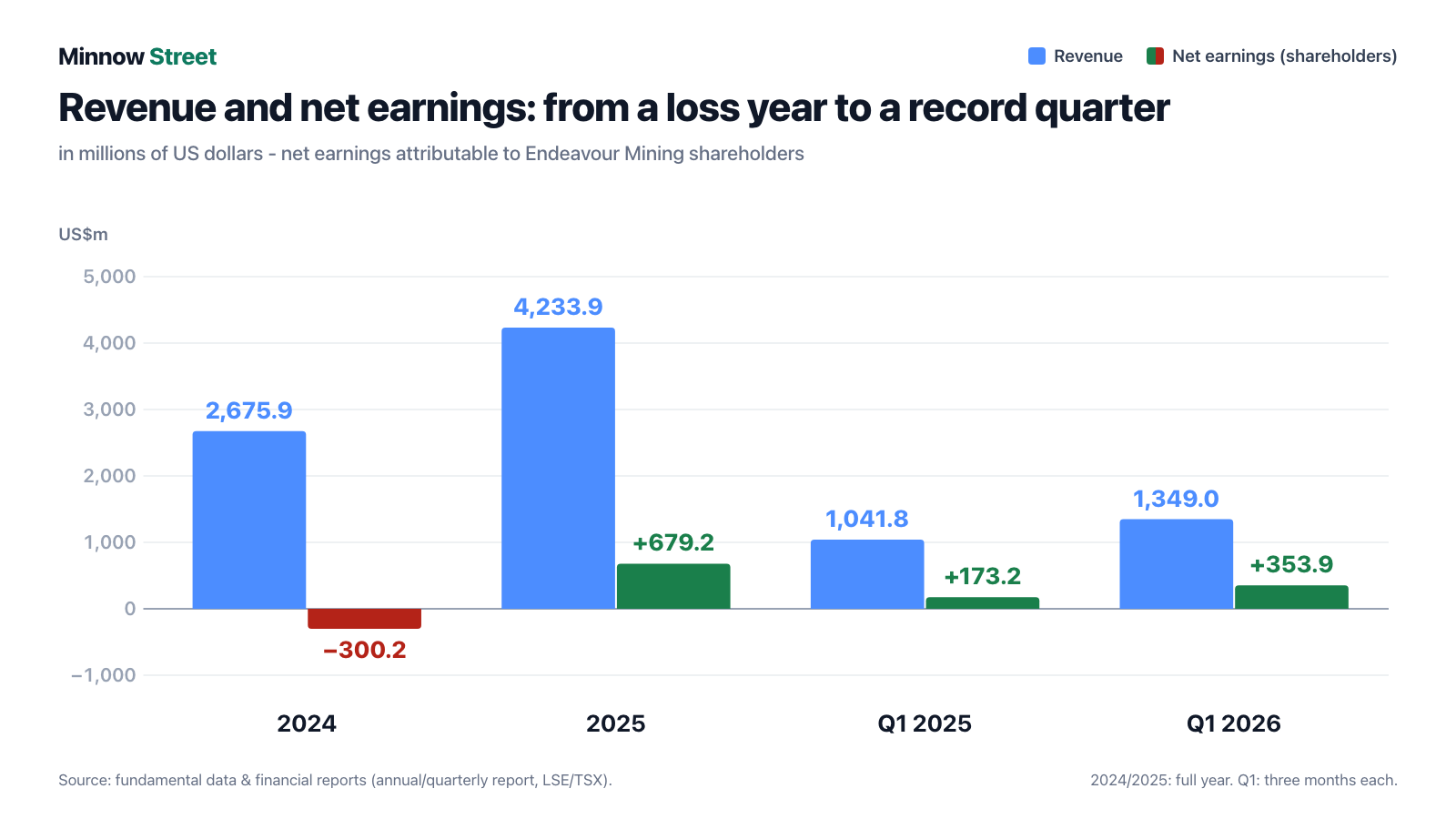
First, what genuinely impresses. 2024 was a year with a red bottom line for Endeavour Mining: despite a positive $113.9 million in earnings before taxes, the company ended up with a net loss of $300.2 million attributable to shareholders — because the year's tax expense of $348.5 million exceeded the pre-tax result (more on that in the second uncomfortable truth). 2025 flipped the picture entirely: revenue rose 58 percent to $4,233.9 million (2024: $2,675.9 million), earnings before taxes grew twelvefold to $1,343.3 million, and the bottom line came in at a net profit of $679.2 million for shareholders. Adjusted net earnings — the non-GAAP measure that strips out items such as hedging losses and impairments and is usually used for year-over-year comparisons — shows that the underlying business was not nearly as weak in 2024 as the GAAP figure suggests: $227.3 million in adjusted profit in 2024, then up 244 percent to $781.9 million ($3.23 per share) in 2025.
The first quarter of 2026 kept up the pace: revenue $1,349.0 million (Q1 2025: $1,041.8 million), net earnings attributable to shareholders $353.9 million (Q1 2025: $173.2 million) — up 104 percent year over year.
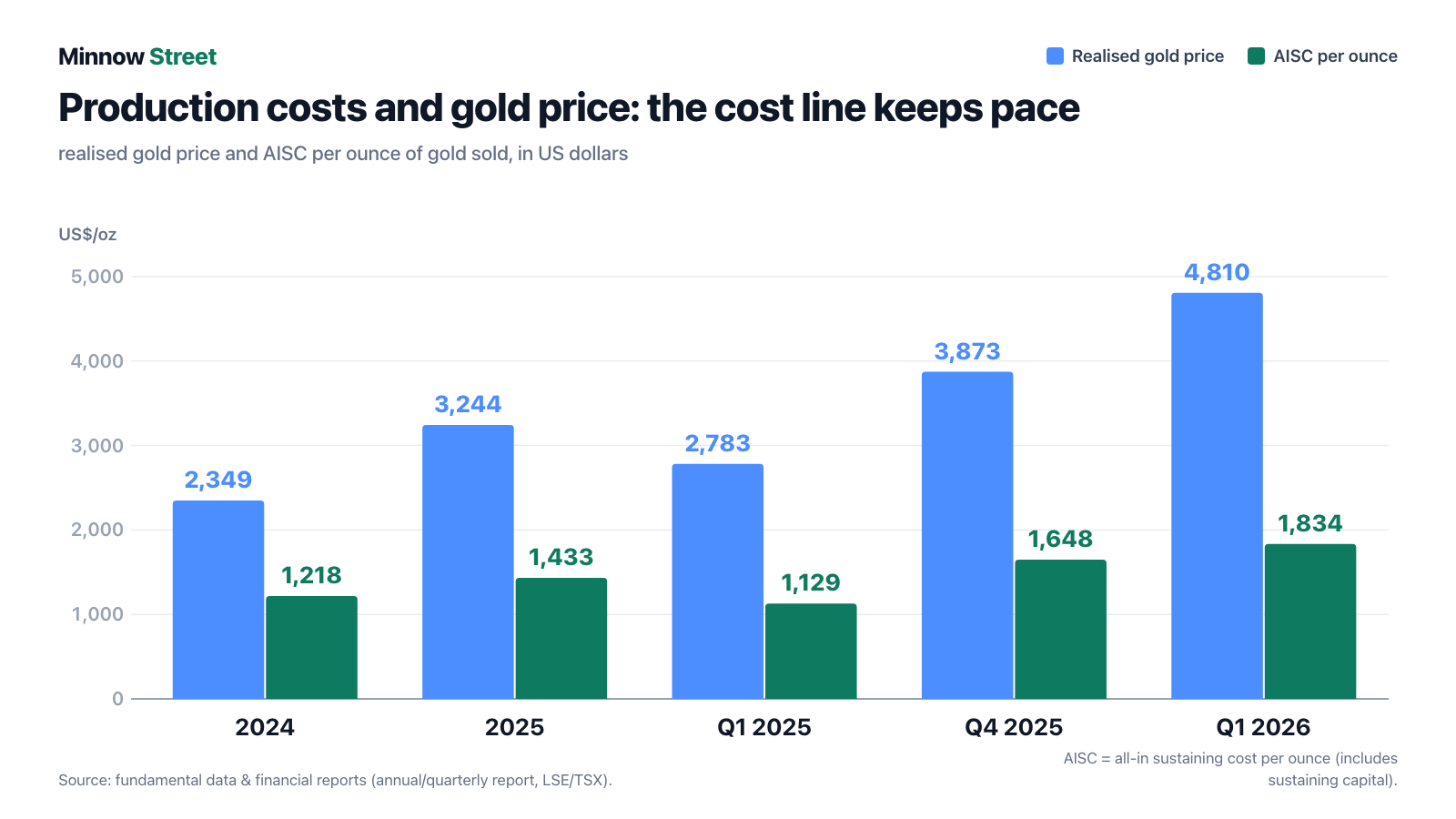
Part of that curve — how much exactly, the next section shows — has a name that has nothing to do with the mines themselves: the gold price. The gold price Endeavour realized (including the effects of its own hedges and the Sabodala-Massawa stream) rose 38 percent in 2025 to $3,244 per ounce (2024: $2,349) — within the year itself, the real tailwind only built up toward year-end: from $2,783 in the first quarter of 2025 to $3,873 in the fourth quarter of 2025 — and in the first quarter of 2026 it already stood at $4,810 — roughly three-quarters above where it stood at the start of 2025.
The growth side of the story also includes 2026's biggest piece of news: on April 23, 2026, Endeavour announced the construction decision for the Assafou project on the Tanda-Iguela property in Côte d'Ivoire, following completion of the Definitive Feasibility Study (DFS). The headline numbers are unusually strong for a project this size: 320,000 ounces of annual production over the first eight years of a 16-year mine life, at an all-in sustaining cost of $1,026 per ounce — a "first quartile" figure by the company's own description, meaning cheaper than three-quarters of comparable mines worldwide. Proven and probable reserves: 4.4 million ounces of gold. Post-tax net present value (NPV, 5 percent discount rate): $2.06 billion at an assumed gold price of $2,500 per ounce — rising to $5.1 billion at $4,000 per ounce. CEO Ian Cockerill put the scale of it in his own words:
"Assafou was discovered for $13 million in 2022 and only four years later has a value of $5.1 billion at a $4,000/oz gold price."
— Ian Cockerill, Chief Executive Officer, Endeavour Mining plc, company announcement on the DFS results, April 23, 2026
The final investment decision (FID) is targeted before the end of 2026, with 24 to 30 months of construction to follow. Together with the five existing mines, Assafou is meant to help lift group production to 1.5 million ounces of gold per year by 2030 — while, per the company's own target, keeping costs in the industry's first quartile. That is the side that genuinely impresses. What the reports show alongside it is more nuanced.
What the Reports Show — the Uncomfortable Truths
Uncomfortable Truth No. 1: The Company's Own Gold-Price Hedges Cost $204 Million – in the Best Gold Year on Record
A gold producer whose profit largely tracks the gold price should, in theory, benefit fully from a gold-price boom. For Endeavour Mining, that was only partly true in 2025 — because the company had hedged part of its future gold sales against falling prices years earlier, including with a gold collar (in plain terms: a band with a floor and a ceiling, within which the sale price for a fixed quantity of gold is locked in) with a price ceiling of $2,400 per ounce for 2025. When the actual gold price left that ceiling far behind over the course of the year, Endeavour still sold the hedged ounces at no more than $2,400 — while the rest of production benefited from the much higher market price. The annual report puts a number on the effect:
"The loss on financial instruments amounted to $193.3 million in 2025 compared to $142.7 million in 2024. The loss in 2025 increased primarily due to the adverse impact of losses on the revenue protection programme of $204.4 million compared to $112.9 million in 2024 driven by the higher gold price environment [...]."
— Endeavour Mining plc, 2025 Annual Report, Financial Review, p. 33
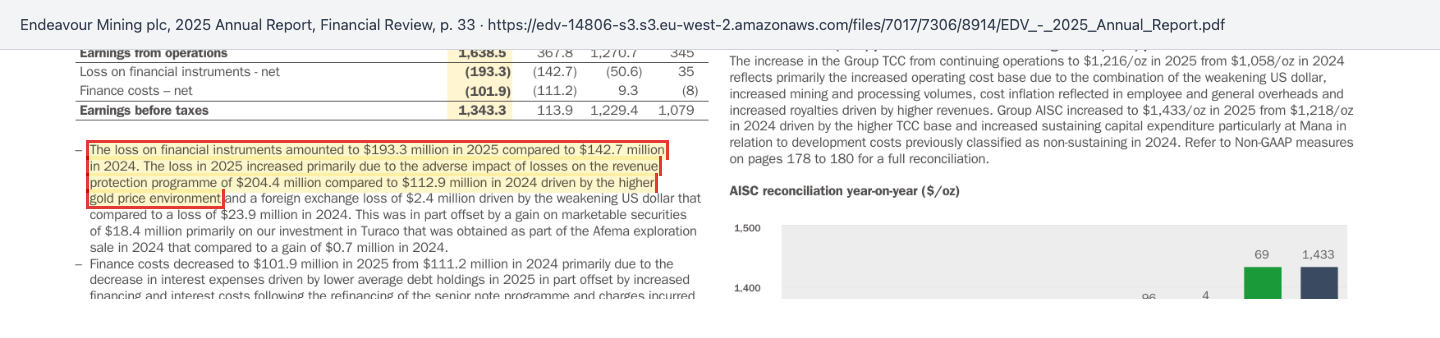
To keep the two figures straight: the $204.4 million is the loss on the hedging programme itself ($182.4 million from the gold collar, a further $22.0 million from a now-discontinued intraday averaging arrangement with the London Bullion Market Association). The $193.3 million is the net line in the income statement, in which an $18.4 million gain on marketable securities partly offsets the pure hedging loss. Throughout this analysis, "hedging loss" refers to the specific $204.4 million figure. The good news going forward: as of December 31, 2025, all collar and forward-contract positions had been closed out — Endeavour has been unhedged and fully exposed to the gold price, in both directions, ever since.
Uncomfortable Truth No. 2: When the Gold Price Rises, the Bill to Host Governments Rises With It
All-in sustaining costs (AISC) per ounce of gold — plain-English translation: everything it really costs to pull an ounce of gold out of the ground and make it sellable, including ongoing sustaining capital — stood at $1,834 per ounce in the first quarter of 2026, 62 percent above the year-ago quarter ($1,129) and 11 percent above the prior quarter ($1,648). On a full-year basis, the 2025 increase was more moderate at 18 percent ($1,433 versus $1,218 per ounce in 2024) — so the recent acceleration is new. A key driver sits not in the mines but in host-country tax and royalty law: royalties rose 71 percent in 2025 to $326.6 million — faster than revenue, up 58 percent. The Q1 2026 management report cites two concrete reasons this is continuing:
"The increase compared to Q1-2025 and Q4-2025 is further driven by higher royalty rates in Burkina Faso applicable on the higher average gold prices realised in Q1-2026 and the impact of the 2% incremental royalty increase from the Government of Côte d'Ivoire at both Lafigué and Ity that was agreed in Q4-2025."
— Endeavour Mining plc, Q1 2026 Management Report, p. 8
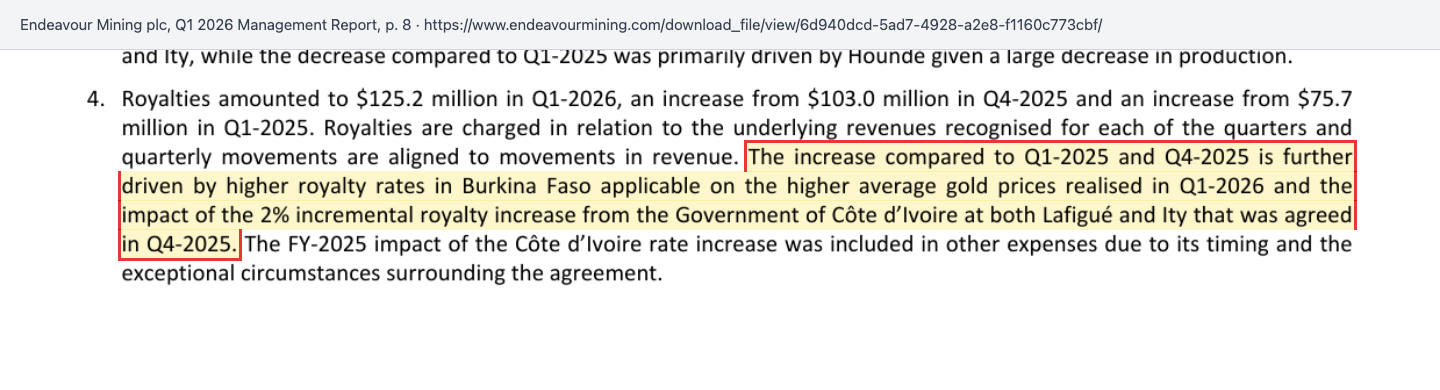
Two mechanisms are compounding here, and Endeavour controls neither: first, Burkina Faso's royalty rates are tied to the gold price on a sliding scale — as the price rises, the percentage rate itself rises, not just the dollar amount owed. Second, the government of Côte d'Ivoire raised the royalty at the Lafigué and Ity sites, retroactive to the first quarter of 2025, from 6 to 8 percent — a $36.6 million catch-up payment agreed in the fourth quarter of 2025 that the annual report books separately in other expenses as an "exceptional circumstance." The annual report itself signals this may not be the last such increase: the chamber of mines and the government are said to be continuing to negotiate a fair and equitable framework for royalty payments in a high gold price environment — in plain terms, further demands from host governments should be expected as long as gold prices stay elevated, not just this one increase. Endeavour has already priced some of this into its 2026 guidance: the full-year AISC range is $1,600 to $1,800 per ounce — explicitly, by the company's own account, because of rising gold prices, royalties and stripping-related sustaining capital, above the already-elevated 2025 figure.
For further context, since taxes and royalties bite hard elsewhere in these reports too: 2024 ended in a net loss even though earnings before taxes were a positive $113.9 million — because the year's tax expense of $348.5 million was more than three times the pre-tax result. The reason: Endeavour pays income tax country by country under each jurisdiction's own tax regime, regardless of how the consolidated group result looks after hedging losses and other special items. In 2025, the tax rate was around 34 percent ($454.2 million tax expense on $1,343.3 million pre-tax earnings) — markedly milder, but in the first quarter of 2026 the effective rate climbed back to 40.3 percent ($285.0 million tax expense on $706.9 million pre-tax earnings), versus 35.6 percent in the year-ago quarter. Royalties and taxes together are therefore not a footnote but a structural deduction from gross profit that grows right alongside the gold price.
Uncomfortable Truth No. 3: Assafou Shines – Kalana Gets Impaired for a Second Straight Year
A growth project can deliver brilliant DFS metrics and still not be the only development project in the portfolio that needs attention right now. Alongside Assafou, Endeavour carries a second development project, Kalana in Mali — and that is exactly the project that has been impaired in each of the past two annual reports. The 2025 annual report puts the year's total impairment charge at $193.4 million (2024: $199.5 million) and names Kalana as one of the individual items:
"[...] a charge of $9.5 million on the Kalana property due to changes in management assumptions relating to risk and resource conversion used in an updated valuation model. The charge in 2024 primarily comprised a $122.6 million charge on the Kalana development project due to changes in the in-situ multiple valuation [...]."
— Endeavour Mining plc, 2025 Annual Report, Financial Review, p. 32
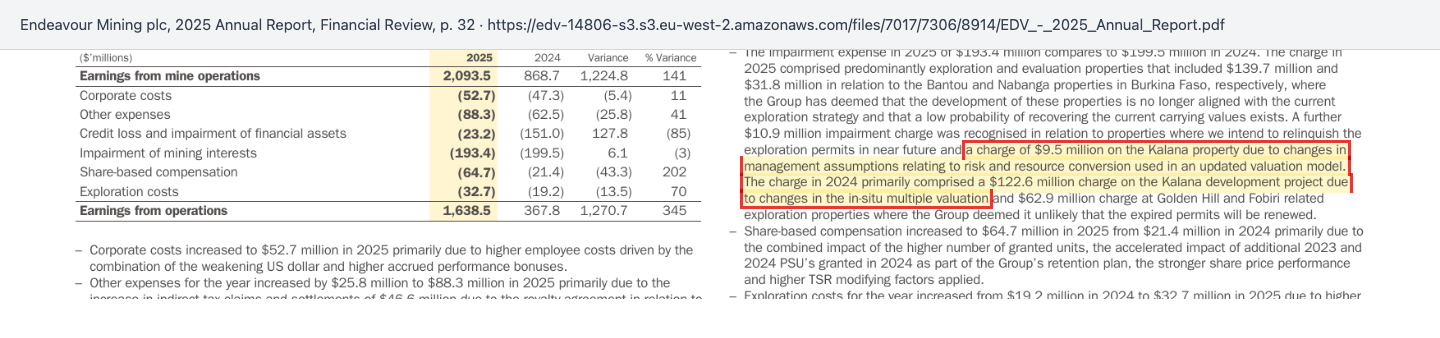
Together that is $132.1 million written down against one and the same development project within two years – a project officially carried in the portfolio alongside Assafou as the second growth pillar. That does not undo the strong Assafou metrics discussed above, but it does show that "development project" is no guarantee of rising value; it is a valuation assumption that can be re-adjusted with every report, in either direction. The rest of 2025's impairments fell mainly on exploration properties in Burkina Faso ($139.7 million at Bantou, $31.8 million at Nabanga), where Endeavour itself states that further development of these properties no longer fits its current exploration strategy – a strategic choice, not a pure valuation effect.
Uncomfortable Truth No. 4: The Celebrated Cash Fortress Was Already Half Spent by the Time the Report Was Published
As of March 31, 2026, Endeavour reported a net-cash position of $405.4 million — calculated as cash of $1,089.5 million less an outstanding debt principal of $684.1 million. That is a spectacular turnaround from the year-ago quarter, when the group was still net indebted by $377.7 million — a roughly $783 million swing within twelve months. For readers who prefer the fuller balance-sheet view: adding lease liabilities of $85.1 million ($680.0 million of on-balance-sheet debt plus $85.1 million of leases equals $765.1 million) produces a slightly more conservative net liquidity figure of roughly $324 million ($1,089.5 million minus $765.1 million). Both figures describe the same underlying reality with a different cut of "debt" — this analysis uses, throughout, the figure the company itself relies on for its going-concern assessment: $405.4 million.
What the report itself discloses considerably tempers the celebration, though: the very same quarterly report, published April 29-30, 2026, contains a "subsequent events" note that all but overtakes the balance-sheet-date picture:
"Subsequent to 31 March 2026 there has been an additional draw downs on the RCF of $245.0 million, leaving a total drawn position of $330.0 million as at 29 April 2026."
— Endeavour Mining plc, Q1 2026 condensed interim consolidated financial statements, Subsequent Events (Note 18), p. 29
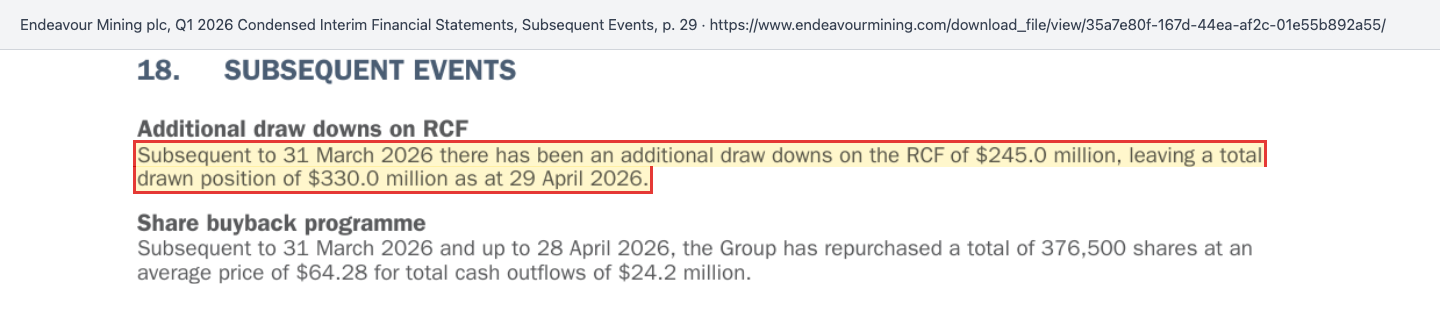
In four weeks, Endeavour drew nearly three times the credit-facility balance outstanding at quarter-end — to fund several things at once: the Assafou construction start (April 23, 2026), the payment of the second 2025 interim dividend of $200.3 million (April 14, 2026), further share buybacks ($24.2 million through April 28), and two new minority stakes in young exploration companies: 19.9 percent of Canada's Koulou Gold Corp., which explores in Côte d'Ivoire right next to Assafou itself (8.1 of a total 35.7 million newly issued shares in a $30.0 million private placement), and 9.9 percent of ASX-listed Altair Minerals Limited, which explores for gold in Guyana — outside West Africa entirely (roughly 656 million shares at AUD 0.043 each).
None of this is inherently a red flag — a gold producer investing in its best growth project, sharing a record year with shareholders, and taking a cheap stake in nearby exploration is, on its face, plausible behavior. The lesson for you as a reader lies elsewhere: a cash position "celebrated" at a balance-sheet date is a snapshot, not a permanent state — four weeks later, a good chunk of it can already be committed elsewhere. Whether the capital allocation pays off is something only the next report will show, once it becomes clear how much of the credit facility has been paid back down and whether leverage stays under the company's own 0.50x net-debt-to-adjusted-EBITDA ceiling, above which supplemental dividends and buybacks are subject to conditions under its own capital-returns policy.
One more point belongs here, even though it cannot be captured on any balance sheet: on June 1, 2026, Endeavour announced that on May 29, 2026, a contractor employee died in an accident involving heavy mining equipment during water-drainage work at the Lafigué mine. The company launched an investigation, notified the relevant authorities, and paused the affected contractor activities while processing continued uninterrupted. Endeavour stated: "The health, safety and welfare of our colleagues remain our top priority." As much as metrics, royalties and credit facilities dominate this analysis — gold mining in West Africa is also a business with real human risk, regardless of what the balance sheet looks like.
Valuation: Two Share Prices, Two Currencies, One Dollar Balance Sheet
How expensive is Endeavour Mining? Here we run into the same currency mismatch that runs through this entire series on European stocks — only this time twice over: the shares trade on the London Stock Exchange in British pence (closing price 3,607 pence = £36.07 on July 24, 2026) and on the Toronto Stock Exchange in Canadian dollars (CAD 67.02, same date) — while revenue, earnings and the balance sheet are reported throughout in US dollars. Market capitalization as of July 24, 2026: £8.694 billion (241,044,222 shares) on the London listing, or CAD 16.155 billion on the Toronto listing. A price-to-earnings or price-to-sales ratio would require converting between pounds or Canadian dollars and US dollars — for July 24, 2026, we do not have an independently verified exchange rate. Rather than invent a conversion, we would rather name that gap honestly: we deliberately do not form a single P/E or P/S ratio here, and for the same reason no enterprise value either — that would require converting the US-dollar net-cash position against the pound-denominated market capitalization, which is exactly the conversion we are deliberately not inventing.
What can be described cleanly, because it stays within its own currency: the share count is net lower — from 241,331,005 as of December 31, 2025, through 242,362,242 as of March 31, 2026 (the slight increase in between comes from employee-plan share issuances), down to 241,044,222 as of July 24, 2026, once ongoing buybacks more than offset the interim issuances. Capital returns themselves are substantial: for fiscal 2025, Endeavour returned $435.3 million to shareholders ($350.0 million in dividends, $85.3 million in buybacks). Since the first quarter of 2021, the group has returned more than $1.6 billion to shareholders in total — $730.3 million, or 83 percent above its own minimum commitment for that period, by its own account.
For 2026 through 2028, Endeavour has committed to further minimum dividends totaling roughly $1.0 billion (300.0 million in 2026, 325.0 million in 2027, 350.0 million in 2028) — but explicitly only provided the realised gold price over the dividend period exceeds $3,000 per ounce, and as long as leverage stays under the company's target of 0.50x net debt to adjusted EBITDA. Both conditions are comfortably met as of the balance-sheet date — the ratio stood at 0.16x as of March 31, 2026, on the net-cash side — but they are conditions, not unconditional promises.
Opportunities and Risks at a Glance
What speaks for Endeavour Mining:
- The largest gold producer in West Africa, with five established, producing mines across three countries — a markedly broader operating base than most single-mine stocks in this article series.
- A financial turnaround completed: from a $300.2 million net loss (2024) to a $679.2 million net profit (2025), continuing with a 104 percent year-over-year increase in the first quarter of 2026.
- A strong, externally reviewed growth pipeline: the Assafou mine approved on April 23, 2026 is expected to deliver 320,000 ounces of annual production over its first eight years at top-tier costs, with a post-tax net present value of $2.06 to $5.1 billion depending on the gold-price assumption.
- Consistent capital returns: $435.3 million to shareholders in 2025, cumulatively more than $1.6 billion since the first quarter of 2021 (83 percent above minimum commitment), further minimum dividends of roughly $1.0 billion committed for 2026 through 2028.
What speaks against it:
- A significant share of the 2025 profit jump is owed to the gold price (realised price up 38 percent to $3,244/oz), not solely to operating performance — the effect would reverse if the gold price fell.
- The company's own gold-price hedges cost $204.4 million in realized losses in 2025 – in the best gold year in company history, of all years; the positions were closed out by the end of 2025, but the money is gone regardless.
- Production costs and royalties rise structurally with the gold price (AISC up 62 percent year over year in Q1 2026), amplified by politically negotiated royalty increases at individual host countries – with the annual report itself stating that a broader framework for royalty payments at high gold prices remains under negotiation.
- Despite record profit, $193.4 million of mining and exploration assets were written down in 2025, including, for a second straight year, the Kalana development project in Mali.
- The net-cash position celebrated as of March 31, 2026 was already largely redeployed by the time the report was published – a credit-facility drawdown, dividend, buybacks and two new minority stakes, all within four weeks.
- On May 29, 2026, a contractor employee died in an accident at the Lafigué mine – a reminder of the real operational risks of gold mining in West Africa.
A Human Verdict
Back to the halo effect from the opening. Read the single line from "Hot Stocks Europe" — "Endeavour Mining and DPM Metals: share price doubling" — and you get an impression that is accurate and explains nothing at the same time. Yes, the share price doubled. Yes, profit exploded, from a loss year to a record $679.2 million. But in that very same best year, the company lost $204.4 million on its own bet against the gold price, handed a growing share of the gain to West African governments via royalties, wrote down one of its two growth projects for a second straight year, and had already redeployed much of its celebrated cash reserve within four weeks. None of this turns a doubled share price into a bad investment — but each point shows that the glow of a winner does not automatically rub off on every single metric. The honest question for you is therefore not "Is this the next doubler?" but: do you trust a company with a genuinely strong growth story to handle the things it does not control — the gold price, royalty rates, on-the-ground operational risk? What you make of that is your decision. And that's exactly as it should be.
Sources
All original documents used in this analysis — for you to read yourself:
- Endeavour Mining plc — 2025 Annual Report (balance sheet date 31.12.2025)
- Endeavour Mining plc — Q1 2026 condensed interim consolidated financial statements (balance sheet date 31.03.2026, published 30.04.2026)
- Endeavour Mining plc — Q1 2026 Management Report
- Endeavour Mining plc — Company announcement on the Assafou DFS results (23.04.2026)
- Endeavour Mining plc — Announcement on the fatal accident at the Lafigué mine (01.06.2026)
- Companies House (UK company register) — Register extract, Endeavour Mining plc, No. 13280545
- Fundamental data (metrics, share price and market-capitalization figures; data as of July 24, 2026).
- Hook: "Hot Stocks Europe," issue 24, dated November 28, 2025 (B-Inside International Media GmbH), forwarded by a reader — cited statements treated strictly as a third party's expectation as of that date, no recommendations adopted (the newsletter issues no recommendation of its own for Endeavour Mining anyway).
Transparency & disclaimer: This analysis is a journalistic assessment of publicly available information. It is not investment advice, not a regulated financial analysis, and not a solicitation to buy or sell securities. Equity investments carry substantial risk, including total loss. All figures are provided without guarantee; the date of each figure is noted in the text. The author holds no position in Endeavour Mining shares at the time of publication.
Our Bottom Line at a Glance
- Financial turnaround positive
- Net earnings swung from a $300.2 million loss (2024) to a $679.2 million profit (2025); Q1 2026 confirms the trend with a 104 percent year-over-year increase to $353.9 million. Adjusted earnings show the underlying business was already sturdier in 2024 than the GAAP figure suggested.
- Earnings quality neutral
- A significant share of the 2025 profit jump comes from the gold price (realised price up 38 percent to $3,244/oz), not solely from operating performance. At the same time, the company's own gold-price hedges cost $204.4 million in realized losses – now fully closed out, but genuinely booked.
- Cost and government-take pressure negative
- Production costs (AISC) rose 62 percent year over year in Q1 2026 to $1,834/oz, and royalties grew faster than revenue in 2025 (up 71 percent versus 58 percent). Côte d'Ivoire retroactively raised its royalty, Burkina Faso ties its rate to the gold price, and the annual report itself says a further royalty framework is under negotiation at high gold prices.
- Growth pipeline neutral
- The Assafou mine approved on April 23, 2026 impresses with strong metrics (320,000 oz/year, post-tax NPV of $2.06 to $5.1 billion) – but Kalana, the second development project, was impaired in both 2024 and 2025 ($122.6 million and $9.5 million, respectively).
- Capital allocation neutral
- The $405.4 million net-cash position reported as of March 31, 2026 was already largely redeployed by the time the report was published on April 29, 2026: an additional credit-facility drawdown, dividend, buybacks and two new minority stakes within four weeks. The dividend framework itself remains conditional on a gold price above $3,000/oz and leverage below 0.50x.
- On-the-ground operational reality negative
- On May 29, 2026, a contractor employee died in an accident involving heavy mining equipment at the Lafigué mine. A reminder that gold mining in West Africa carries real human risk, independent of the group's financial position.
Endeavour Mining pulled off a spectacular financial turnaround in 2025 and delivered a strong growth story with the 2026 Assafou construction decision – but the gold price that drives much of it is also the channel through which royalties, taxes and the company's own hedges claw back part of the gain. The cash position celebrated at quarter-end was already largely redeployed by the time the report was published. Not investment advice.
What Our Rating Means
Quality confirmed
Business model, numbers and balance sheet hold up to our review. Whether the current price supports an entry is a separate question — it hangs on the price, not on the company.
Endeavour Mining is broadly diversified with five producing mines across three countries and an externally reviewed growth pipeline (the Assafou DFS), has posted consistently positive results through 2025 and Q1 2026, and has confirmed going-concern status through at least the end of March 2027 – no negative equity, no existential dependence on a single site. The open points in this analysis (the hedging loss, rising royalties/taxes, the repeated Kalana impairment, the rapid re-leveraging after quarter-end, the fatal accident at the Lafigué mine) are real, named risks, but none of them threatens the substance of the company — they are reasons for care in reading the numbers, not signs of a shaky business. That justifies green, not a claim that the stock itself is cheap or a buying opportunity — price is not a quality trait.
A journalistic assessment by our editorial team at the time of the deep dive, based on public sources — not investment advice and not a solicitation to buy or sell. Your personal circumstances (investment goals, risk capacity, taxes) cannot be taken into account. What our levels mean, how verdicts are formed, and what conflicts of interest exist →
Worth Noting
- Hook: newsletter "Hot Stocks Europe," issue 24, dated 28.11.2025 (B-Inside International Media GmbH), forwarded by a reader. The newsletter mentions Endeavour Mining in a single line in its 2025 top-performer recap ("share price doubling"), without a dedicated writeup or recommendation; none of the figures mentioned there were adopted as a source in this analysis.
- Endeavour Mining is not a SEC filer: no 10-K, no 10-Q, no 20-F. This analysis relies on the 2025 Annual Report and the Q1 2026 condensed interim consolidated financial statements plus management report (published 29./30.04.2026); mandatory filings run through the UK National Storage Mechanism and SEDAR+. Quotes were verified verbatim against the original PDFs.
- No company row was created in our own database: a stock priced in British pence on the London Stock Exchange would distort scanner thresholds built for U.S.-listed names. Deliberately no single P/E or P/S ratio formed: share-price currency GBX/CAD, balance-sheet currency USD, no independently verified exchange rate available for 24.07.2026 — that gap is named, not papered over with an unverified conversion.
Frequently Asked Questions
Endeavour Mining plc is the largest gold producer in West Africa, with five producing mines: Houndé and Mana in Burkina Faso, Ity and Lafigué in Côte d'Ivoire, and Sabodala-Massawa in Senegal. Two development projects add to that pipeline, Assafou in Côte d'Ivoire and Kalana in Mali. The shares are dual-listed on the London Stock Exchange and the Toronto Stock Exchange, and the parent company is headquartered in London.
Endeavour Mining is a UK plc with a secondary listing in Toronto and is not a U.S. reporting company – a company search at the U.S. securities regulator, the SEC, returns no hit with an own annual or quarterly report. Mandatory filings instead run through the UK National Storage Mechanism and, because of the Canadian secondary listing, additionally through SEDAR+.
All-in sustaining costs (AISC) per ounce stood at $1,834 in the first quarter of 2026, up 62 percent year over year. A key reason: royalties grew 71 percent to $326.6 million in 2025, because Burkina Faso ties its royalty rates to the gold price and Côte d'Ivoire retroactively raised the royalty at two mines from 6 to 8 percent.
A gold collar with a $2,400/oz price ceiling, plus an averaging arrangement, produced a realized loss of $204.4 million in 2025 (2024: $112.9 million total hedging-programme loss, of which $75.9 million was realized) – because the actual gold price far exceeded the ceiling. All positions were closed out by December 31, 2025.
The 2025 annual report shows $193.4 million in impairments (2024: $199.5 million) – mostly at Burkina Faso exploration properties whose further development no longer fits the company's strategy, plus $9.5 million at the Kalana development project in Mali, impaired for a second straight year (2024: $122.6 million).
Assafou is a gold project on the Tanda-Iguela property in Côte d'Ivoire, for which Endeavour announced the construction decision on April 23, 2026 after completing its feasibility study: a 16-year mine life, 320,000 ounces of annual production over the first eight years, and a post-tax net present value of $2.06 to $5.1 billion depending on the gold-price assumption. A final investment decision is targeted before the end of 2026.
Yes. For 2025, Endeavour paid $350.0 million in dividends plus $85.3 million in share buybacks. For 2026 through 2028, it has committed to further minimum dividends totaling roughly $1.0 billion – but only as long as the realised gold price stays above $3,000 per ounce and leverage stays under 0.50x net debt to adjusted EBITDA.
The primary listing trades on the London Stock Exchange in British pence (ticker LSE: EDV), with an additional listing on the Toronto Stock Exchange in Canadian dollars (TSX: EDV) and an over-the-counter U.S. listing as OTCQX: EDVMF in US dollars. Revenue, earnings and the balance sheet, however, are reported throughout in US dollars.
Found an error?
Did you spot a factual error, an outdated number, or a typo in this deep dive? Let us know briefly — your report goes straight to the editorial team.