Nokia Reports a Loss and an 18 Percent Profit Jump for the Same Quarter — Both Numbers Are Real
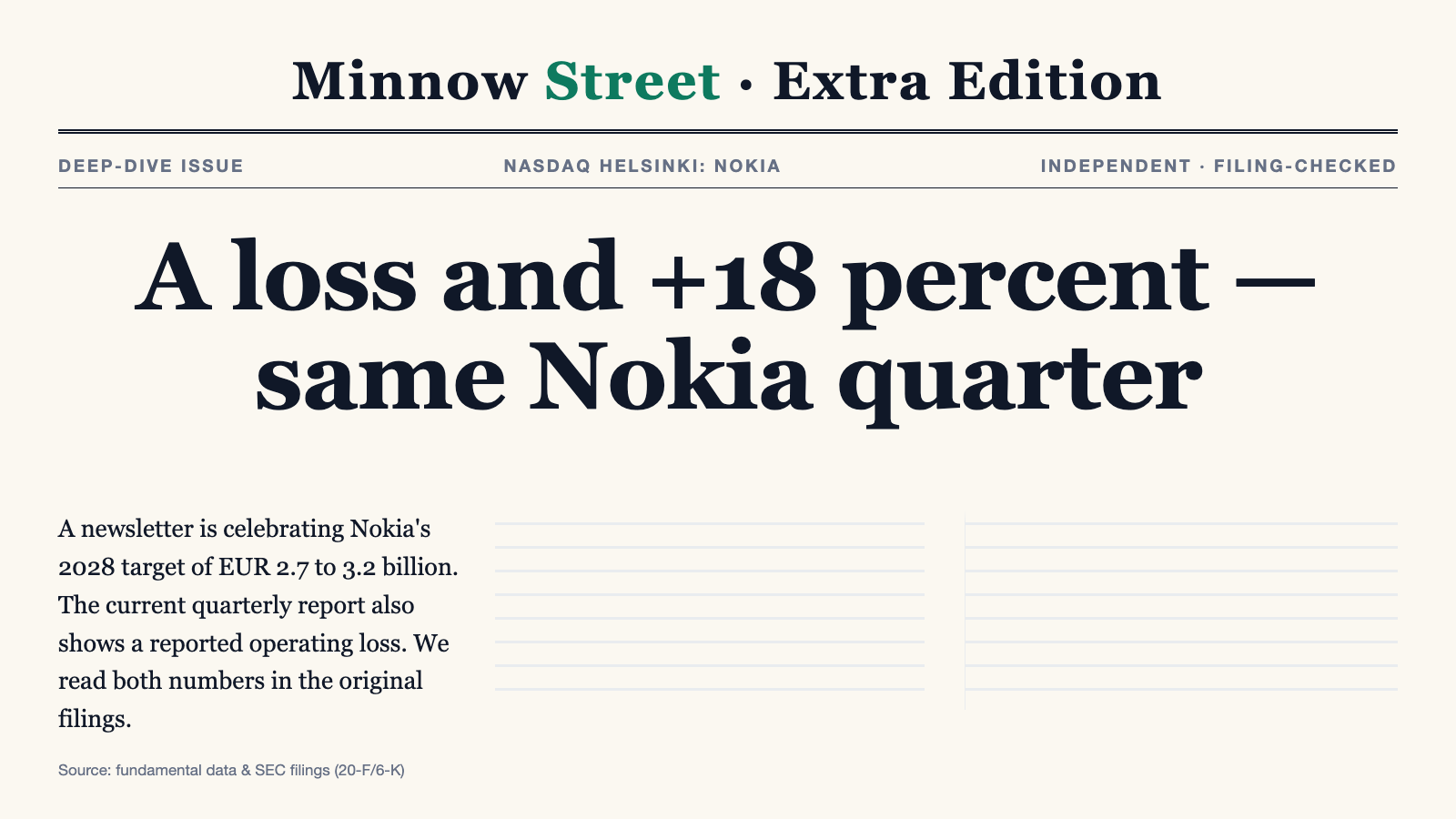
A newsletter praised Nokia in November 2025 as a "base position in Europe's AI cycle," pointing to a 2028 target of EUR 2.7 to 3.2 billion in operating profit. We checked what the network equipment maker actually told the U.S. securities regulator, the SEC: for the second quarter of 2026, a reported operating loss of EUR 50 million — and in the same filing, a "comparable" profit of EUR 434 million, up 18 percent. Add a $1 billion capital injection from Nvidia, a reorganization into two main segments, and restructuring costs set to climb to EUR 800 million in 2026. Not investment advice — just two numbers for the same quarter, from the same report.
 Thomas Mücke
Founder & Publisher
Thomas Mücke
Founder & Publisher
Chart
Interactive price chart (TradingView).
Note: pure fact-based analysis, not investment advice and not a solicitation to buy or sell. All figures without guarantee.
There is an investor trap that catches well-informed readers especially hard — because it feels like knowledge: anchoring bias. Someone hands you a big, round number first — "EUR 2.7 to 3.2 billion by 2028" — and from then on your brain measures every new piece of news against that anchor, not against what is actually happening right now. That is exactly what a newsletter did that brought this stock to our desk: "HOT STOCKS EUROPE" issue 24, dated November 28, 2025, calls Nokia Oyj a "base position in Europe's AI cycle" and points to a new corporate target — more on that shortly. The anchor is set. What the newsletter does not show you is the filing Nokia handed the U.S. Securities and Exchange Commission nine weeks later. It shows, for the second quarter of 2026, a reported operating loss of EUR 50 million — in the very same report, in the very same table, right next to a "comparable" result of EUR 434 million, up 18 percent. So let's make a deal: before you lean on the 2028 anchor, we read Nokia's own SEC filings together — the annual report (Form 20-F) for 2025 and the report (Form 6-K) for the second quarter and first half of 2026. A filing to the SEC is honest under penalty of law. By the end, you decide which of the two results you trust more.
What Nokia Actually Does — From Phone Giant to AI-Supercycle Network Builder
Nokia Oyj, based in Espoo, Finland, employed about 78,005 people on average in 2025 across roughly 130 countries, and reports to the SEC as a "foreign private issuer" — an annual Form 20-F, an interim Form 6-K, no 10-K and no 10-Q, because U.S. law reserves those forms for domestic filers. In everyday terms: Nokia no longer primarily builds the phones that made it famous 20 years ago (that business was sold off long ago) — it builds the infrastructure behind the scenes, the technology that moves data through fiber, cell towers, and data centers. Since January 1, 2026, Nokia has bundled these activities into two main segments: Network Infrastructure (Optical Networks, IP Networks, Fixed Networks — led by David Heard), positioned for the data-center and AI build-out, and Mobile Infrastructure (core network, radio network, and licensing technology, co-led for now by CEO Justin Hotard; new President Emma Falck, previously of Siemens, takes over September 1, 2026). The most recent quarterly report also shows a smaller third segment, Portfolio Businesses — essentially what remains while it is being sold off (more on that shortly). Through 2025 the structure was different still: four segments (Network Infrastructure, Cloud and Network Services, Mobile Networks, Nokia Technologies). Justin Hotard has been CEO since April 1, 2025, succeeding Pekka Lundmark. That sets up the tension running through this whole analysis: Nokia shows you two versions of the same quarter's numbers — a "reported" figure under IFRS and a "comparable" figure that strips out special items — and both are true, they just answer different questions.
Where This Stock Landed on Our Desk — the Newsletter and the Measured Reality
This analysis did not come through our in-house stock scanner — it came from a reader tip: issue 24 of "HOT STOCKS EUROPE," dated November 28, 2025 (B-Inside International Media GmbH, Freiburg, Germany, author Michael Calivas), an eight-page, twice-monthly newsletter. On Nokia, it wrote, in translation from the German original:
"NOKIA has presented the market with a leaner, AI-optimized corporate vision through 2028 and intends to grow operating profit to a range of about EUR 2.7 billion to EUR 3.2 billion, an increase of up to 60 percent. To achieve this goal, NOKIA will concentrate its structure into two main business segments starting in 2026 and will, alongside mobile networks, focus increasingly on network infrastructure for AI-related data centers. […] NOKIA will increasingly work with customers that operate more and more like hyperscalers and less like traditional telecommunications companies, and it belongs among the base positions in Europe's AI cycle!"
— "HOT STOCKS EUROPE," issue 24, November 28, 2025, page 2 (translated from German)
That is a third party's expectation as of November 28, 2025 — not a company figure, but a framing we now check against what Nokia itself told the SEC. The surprise: in this case, the core claim holds up. Nine days before that issue, on November 19, 2025, Nokia had in fact announced exactly this target at a Capital Markets Day, documented in its own Form 6-K to the SEC:
"Nokia is introducing a new long-term financial target to achieve comparable operating profit of EUR 2.7 billion to EUR 3.2 billion by 2028, an increase from the EUR 2.0 billion generated in the last 12 months (Q4'24-Q3'25)."
— Nokia Corporation, Form 6-K, Capital Markets Day, November 19, 2025

The second half of the newsletter's claim checks out too: the reorganization into two main segments did take effect on January 1, 2026, and the "separation from underperforming business units" is already underway — more on that in the uncomfortable-truths section below. What the newsletter could not say, since it was published eight months before our editorial deadline, is how expensive that transformation already looks in the most recent filing. The newsletter's conflict-of-interest disclosure is worth noting in fairness — on page 8, the publisher acknowledges that the publisher, author, or related parties may hold long positions in stocks discussed and may intend to sell into rising prices (EU Market Abuse Regulation 596/2014). That does not make the newsletter's numbers wrong — but it is one more reason not to take them at face value.
The Numbers Over the Years — Honestly Appraised
First, what genuinely speaks for Nokia. Net sales reached EUR 19,889 million in 2025 (2024: EUR 19,220 million; 2023: EUR 21,138 million) — growing again, modestly, after two lean years. Research and development spending rose to EUR 4,855 million (24.4 percent of net sales), unusually high for an equipment maker this size and a sign of how much Nokia is plowing into the next technology generation. The second quarter of 2026 shows exactly where the growth is coming from: net sales rose 8 percent to EUR 4,815 million (up 9 percent at constant currency), carried by the Network Infrastructure segment, up 12 percent to EUR 2,037 million — driven by Optical Networks (+20 percent) and IP Networks (+16 percent), both directly tied to data-center and AI demand.
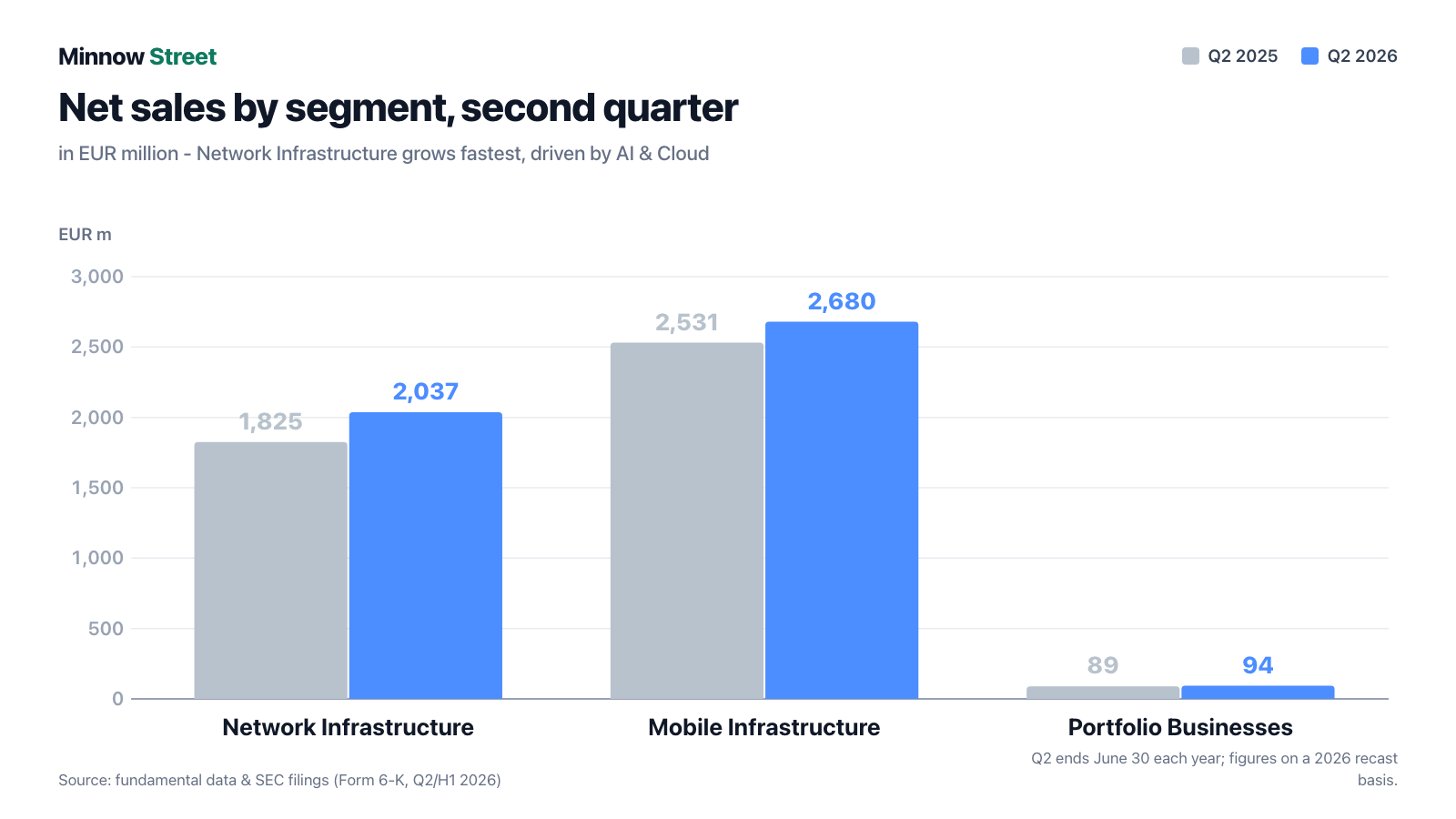
The AI story shows up most clearly in order intake. CEO Justin Hotard put it this way in the second-quarter 2026 report:
"In Q2, our AI & Cloud order intake was EUR 2.8 billion, while sales more than doubled year-on-year. The strength was broad-based, as we secured long-term orders in both Optical Networks and IP Networks. We expect around half of these orders to convert to revenue over the next twelve months."
— Justin Hotard, President & CEO, Form 6-K, Report for Q2 and Half Year 2026, July 23, 2026

The capital spending fits the story too: Nokia is expanding its U.S. optical-component manufacturing (a new San Jose fab due to begin ramping in late 2026) and is also acquiring NXP's Chandler semiconductor fabrication campus in Arizona. And in October/November 2025, Nokia landed a headline-grabbing anchor investor: NVIDIA Corporation — whose own balance sheet we broke down in our Nvidia stock analysis — subscribed for $1.0 billion in new Nokia shares as part of a strategic AI partnership (joint development of "AI-RAN," AI-powered mobile networks, with an eye on 6G). That is one side of the coin — real, growing AI-driven demand. The other side only shows up once you read all the way down to the bottom line.
What the Filings Say — the Uncomfortable Truths
Uncomfortable Truth No. 1: A Reported Loss and an 18 Percent Comparable Jump, Same Quarter
This is the heart of this analysis. For the second quarter of 2026, Nokia reports two operating results at once: an IFRS loss of EUR 50 million (margin −1.0 percent, down 430 basis points year on year), and, on a "comparable" basis, a profit of EUR 434 million (margin 9.0 percent, up 70 basis points). Nokia itself names the reason for the gap in the same sentence:
"Q2 comparable operating margin increased 70bps y-o-y to 9.0%. Reported operating margin declined 430bps to (1.0)% due to a faster pace of restructuring."
— Nokia Corporation, Form 6-K, Report for Q2 and Half Year 2026, July 23, 2026

Picture it this way: a contractor is renovating their own workshop right now — new machines in, old ones out, severance for staff no longer needed. The renovation costs very real cash this month, out of the till. The owner still says: "Strip out the renovation, and I'm earning more than last year." That can even be true — but the till itself still shows a shortfall this month. For Nokia, the same math applies at scale for full-year 2025: EUR 885 million reported operating profit versus EUR 2,024 million "comparable" — a gap of EUR 1,139 million, of which EUR 478 million is restructuring, EUR 444 million is amortization from acquisitions (mostly the Infinera deal closed in 2025), and the remaining EUR 217 million is a collection of smaller other adjustments.
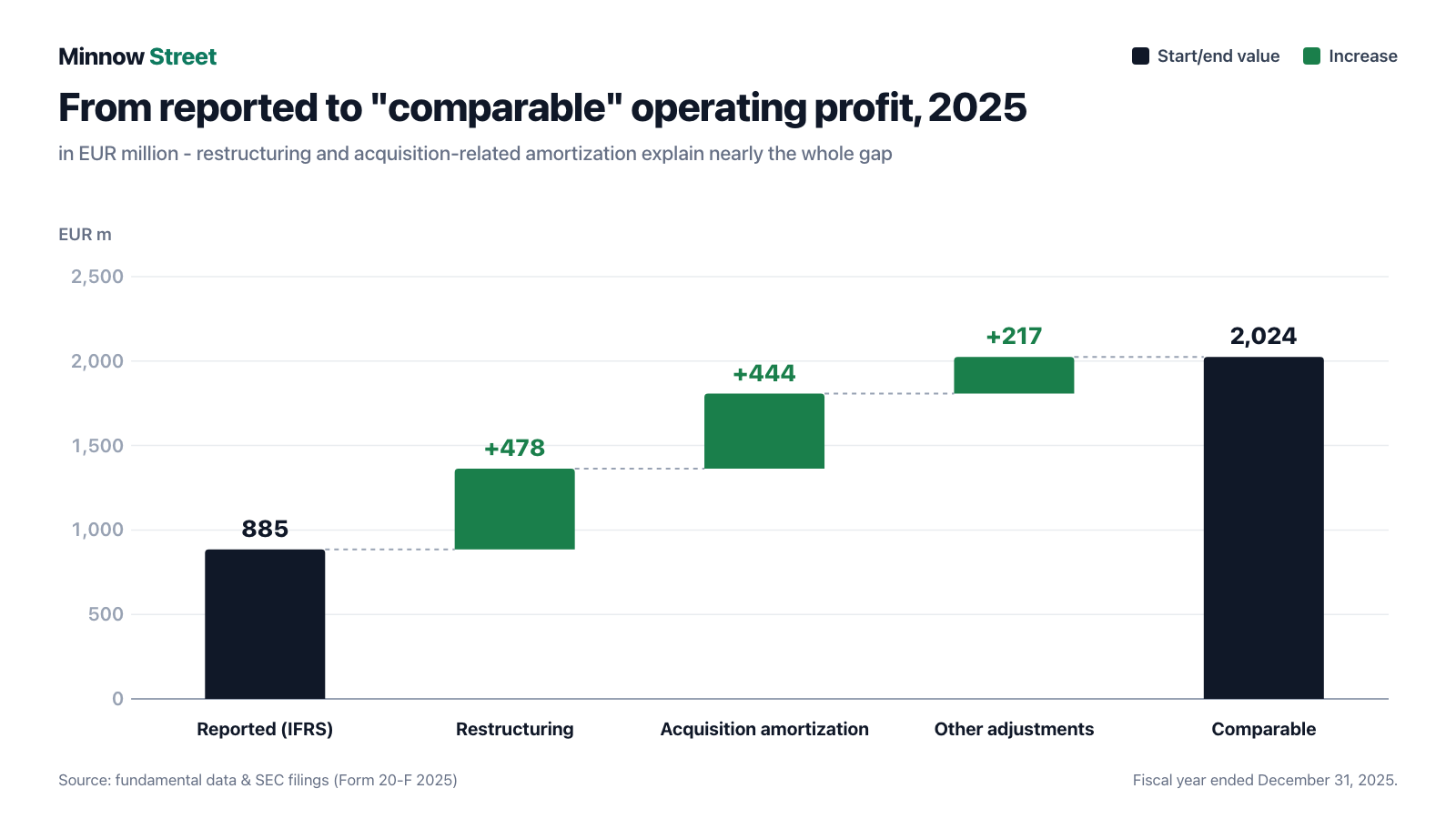
Neither number is wrong or improper — "comparable operating profit" is a disclosed, commonly used measure in Europe, and Nokia publishes the full reconciliation in its annual report. But it is also the number that Nokia's own executive pay is tied to, and the one the newsletter's 2028 target is built on. Remember the pattern: when a company frames its future target in an adjusted metric, it pays to check how large that adjustment already is in the most recent filing.
Uncomfortable Truth No. 2: Two Share Counts That Measure Different Things — and a Real Capital Raise From Nvidia
Second trap, smaller but easy to trip over: Nokia's own filing lists two different share counts for the second quarter of 2026 that are easily confused. The balance sheet shows 5,598,645,000 shares outstanding (excluding treasury shares) as of June 30, 2026 — the actual number of shares in the market. For diluted earnings per share, the same filing instead uses a weighted average of 5,801,886,000 shares — a different metric with a different purpose (it includes, among other things, treasury shares earmarked for employee plans). Whoever mistakes the second figure for "the share count" and derives a market cap or a per-share metric from it is off by roughly 200 million shares.
The real reason share count has grown since mid-2025 is simple and genuine: NVIDIA Corporation bought into Nokia. The 2025 annual report describes it this way:
"In October 2025, under the authorization granted to the Board of Directors by the Annual General Meeting 2025, the Board of Directors resolved on a directed share issuance of 166,389,351 new shares to enable NVIDIA Corporation to make a USD 1.0 billion equity investment in Nokia. The new shares were delivered to NVIDIA Corporation in the form of American Depositary Shares in November 2025."
— Nokia Corporation, Form 20-F for 2025, "Shares and shareholders" section
The subscription price was $6.01 per share (EUR 5.16) — net proceeds to Nokia totaled about EUR 850 million. That lifted the share count (excluding treasury) from roughly 5,379 million (June 30, 2025) to 5,583 million (December 31, 2025) — an increase of about 3 percent that did not come from operations, but from a directed capital raise for a strategic investor. In plain terms: existing shareholders' slice of the pie got about 3 percent thinner — in exchange for a headline partner and EUR 850 million in fresh capital. Whether that trade pays off depends on what actually comes out of the AI partnership — a question only future filings can answer.
Uncomfortable Truth No. 3: The "Raised" Guidance Is Half Bookkeeping, Not Growth
In the same second-quarter 2026 filing, Nokia raises its full-year 2026 outlook for comparable operating profit — from EUR 2.0-2.5 billion to EUR 2.1-2.6 billion. That sounds like good news. The reason, though, is not better business performance — it is a reclassification:
"In Q2 2026, Nokia classified its Fixed Wireless Access CPE and Enterprise Campus Edge businesses as discontinued operations. Nokia reached an agreement to sell its Fixed Wireless Access CPE business to Inseego and Nokia also deems it highly probable it will reach an agreement to sell Enterprise Campus Edge business. […] If Nokia had not treated these businesses as discontinued operations in Q2 2026, net sales would have been EUR 66 million higher and comparable operating profit would have been EUR 13 million lower."
— Nokia Corporation, Form 6-K, Report for Q2 and Half Year 2026, July 23, 2026

Nokia itself calls this a "technical revision," not an operating improvement — the same paragraph states the operational outlook is unchanged. This is exactly the "separation from underperforming business units" the newsletter flagged — but it also costs something: full-year 2026 restructuring charges were raised in the same filing to EUR 800 million (cash outflows of EUR 700-800 million), fed by three programs — the ongoing 2023-2026 program, the accelerated integration of the China business (now compressed into two years instead of two to three), and a new, mostly European restructuring program. The order backlog has also fallen, from EUR 22.0 billion (2023) through EUR 20.0 billion (2024) to EUR 19.5 billion (2025) — not an alarm bell on its own, but a counterweight to the pure growth narrative.
Valuation: Expensive by One Number, Moderate by the Other
Nokia shares cost about EUR 8.22 on July 24, 2026, which at 5,582,534,171 shares (as of December 31, 2025, per fundamental data) works out to a market capitalization of roughly EUR 45.9 billion — close to our own balance-sheet cross-check (5,598,645,000 shares as of June 30, 2026 times EUR 8.22 comes to about EUR 46.0 billion, a low-single-digit-percent difference). On a reported-earnings basis the stock looks expensive: a price-to-earnings ratio of roughly 68 (fundamental data, as of July 24/25, 2026) is ambitious for an equipment maker growing sales 6 to 9 percent — but that very P/E is distorted by the EUR 1,139 million of adjustments from Uncomfortable Truth No. 1: a company in the thick of restructuring always looks more expensive on reported earnings than it "really" is. Using enterprise value instead (market cap of EUR 45.9 billion less EUR 2,776 million in net cash as of June 30, 2026, or roughly EUR 43.1 billion) against 2025's "comparable" operating profit of EUR 2,024 million yields a multiple of about 21 — and against the midpoint of the 2028 target (EUR 2.95 billion), about 14.6. Both multiples are orders of magnitude, not precision figures, and both assume Nokia keeps calculating "comparable" the same way going forward. Getting from 2025's comparable level (EUR 2.024 billion) to the midpoint of the 2028 target (EUR 2.95 billion) requires roughly 46 percent growth over three years — while the most recent quarterly filing, on a reported basis, shows a loss. That is achievable, but it is not a given.
Opportunities and Risks at a Glance
What speaks for Nokia:
- Real, broad-based AI demand: EUR 2.8 billion in AI & Cloud order intake in the second quarter of 2026, with sales in that area more than doubling; Network Infrastructure grew 12 percent in the same quarter, carried by Optical Networks (+20 percent) and IP Networks (+16 percent).
- A headline strategic investor: NVIDIA Corporation subscribed for $1.0 billion in new shares in fall 2025 and is a partner on AI-powered mobile networks (AI-RAN) with an eye on 6G.
- A solid balance sheet: EUR 2,776 million in net cash as of June 30, 2026, an equity ratio of about 57 percent, and no single customer above 10 percent of net sales from 2023 through 2025.
- A clear, repeatedly confirmed 2028 target (EUR 2.7-3.2 billion comparable operating profit) and a simplified segment structure since January 1, 2026, with named leadership (David Heard, and Emma Falck starting September 1, 2026).
What speaks against it:
- The reported operating loss in the second quarter of 2026 (−EUR 50 million, margin −1.0 percent) shows the transformation is costing real money right now — full-year 2026 restructuring charges were raised to EUR 800 million (2025: EUR 478 million).
- The gap between reported and "comparable" profit is substantial at EUR 1,139 million (2025, 5.7 percent of net sales), which ties the 2028 target to how that adjustment keeps being calculated.
- Roughly 3 percent more shares outstanding since mid-2025 from the Nvidia capital raise — real dilution for existing shareholders, even with fresh capital and a strategic partner as the trade-off.
- A shrinking order backlog (EUR 22.0 billion in 2023 down to EUR 19.5 billion in 2025) and a reported P/E of roughly 68 — leaving little margin of safety for the roughly 46 percent comparable-basis growth needed by 2028 if the restructuring drags on longer than planned.
A Human Conclusion
Back to the anchoring bias from the opening. The newsletter gave you a number — EUR 2.7 to 3.2 billion by 2028 — and that number even checks out, word for word, in Nokia's own SEC filing. The mistake is not in the number; it is in treating it as already achieved. The most recent filing Nokia has handed the SEC shows a reported loss for the second quarter of 2026 — and in the same breath, a "comparable" result that grew 18 percent. Both numbers are real, both sit in the same document, and both answer a different question: one, how much cash actually stayed in the till this quarter. The other, what the business would look like if you stripped out the transformation currently under way. So the honest question for you is not "do I believe the 2028 target?" but: do you trust Nokia to push through an expensive rebuild — EUR 800 million in restructuring costs in 2026 alone — before investor patience, and the 46 percent of growth still needed by 2028, run out? If yes, you have a thesis that goes beyond the anchor. If you hesitate at the second number, you only had the anchor. What you make of it is your decision. And that is exactly as it should be.
Sources
All original documents used in this analysis — for your own reading:
- Nokia Corporation — SEC annual report Form 20-F for 2025 (filed March 5, 2026)
- Nokia Corporation — SEC Form 6-K, "Report for Q2 and Half Year 2026" (July 23, 2026)
- Nokia Corporation — SEC Form 6-K, "Capital Markets Day" (November 19, 2025)
- Full SEC filing history for Nokia Corporation: EDGAR overview (sec.gov)
- Fundamental data (price, market capitalization, share-count cross-check; data as of July 24/25, 2026), reconciled against the SEC filings.
- Hook: "HOT STOCKS EUROPE," issue 24, dated November 28, 2025, B-Inside International Media GmbH, Freiburg, Germany (author Michael Calivas) — a third party's opinion and expectation, not a source for company figures; the publisher discloses that the publisher, author, or related parties may hold long positions (EU Market Abuse Regulation 596/2014).
Transparency & disclaimer: This analysis is a journalistic contextualization of publicly available information and is not investment advice, not a regulatory financial analysis, and not a solicitation to buy or sell securities. Stock investments carry substantial risk, including total loss. All information is provided without guarantee; data dates are noted in the text. The author holds no position in Nokia stock as of publication.
Our Bottom Line at a Glance
- Demand & Business Model positive
- AI & Cloud order intake reached EUR 2.8 billion in the second quarter of 2026, with sales in that area more than doubling; the Network Infrastructure segment grew 12 percent in the same quarter (Optical Networks up 20 percent, IP Networks up 16 percent). No single customer accounted for more than 10 percent of net sales from 2023 through 2025.
- Earnings Quality negative
- For 2025, reported operating profit (EUR 885 million) and "comparable" operating profit (EUR 2,024 million) diverge by EUR 1,139 million, 5.7 percent of net sales; in the second quarter of 2026, a EUR 434 million "comparable" profit sat next to a reported operating loss of EUR 50 million.
- Balance Sheet & Liquidity positive
- Net cash of EUR 2,776 million as of June 30, 2026, an equity ratio of about 57 percent, no signs of covenant or refinancing pressure - a solid base for a multi-year restructuring.
- Transformation Costs negative
- Restructuring charges were raised to EUR 800 million for 2026 (2025: EUR 478 million), fed by three parallel programs; the order backlog fell from EUR 22.0 billion (2023) to EUR 19.5 billion (2025).
- Strategic Backing & Capital Structure neutral
- NVIDIA Corporation subscribed for $1.0 billion in new shares in fall 2025 (roughly 3 percent additional shares) as part of an AI partnership - real dilution in exchange for a headline partner and fresh capital. New segment leadership (David Heard, Emma Falck from Sept. 1, 2026) is still unproven.
- Valuation neutral
- P/E on a reported basis of roughly 68 (distorted by restructuring), enterprise value against 2025 "comparable" operating profit of roughly 21 - more moderate, but still no bargain. The 2028 target requires roughly 46 percent growth in the comparable metric over three years.
Nokia shows two real results for the same quarter: a reported operating loss of EUR 50 million and a "comparable" profit of EUR 434 million. Both figures come from the same SEC filing, and both are true - they just answer different questions. The 2028 target the newsletter cited (EUR 2.7 to 3.2 billion) is one Nokia genuinely announced, backed by real AI demand (EUR 2.8 billion in quarterly order intake) and a $1 billion capital injection from Nvidia. But getting there costs real money - EUR 800 million in restructuring in 2026 alone - and requires roughly 46 percent growth in the adjusted metric by 2028. Not investment advice.
What Our Rating Means
Open questions
The business works in principle, but one material question is open. As long as it stays open, our findings do not carry a quality verdict.
Nokia's operating substance is not the problem: a solid balance sheet with EUR 2.776 billion in net cash, a broad customer base with no concentration risk, real AI demand (EUR 2.8 billion in quarterly order intake), and a headline new shareholder in Nvidia. What is open is the operating question of whether the ongoing transformation - two new main segments, separation from peripheral businesses, EUR 800 million in restructuring costs in 2026 alone - turns the reported result positive faster than it builds up costs and share count (roughly 3 percent dilution from the Nvidia capital raise). Not a substance finding, not an existential question - but not a proven turnaround either. The decision is yours.
A journalistic assessment by our editorial team at the time of the deep dive, based on public sources — not investment advice and not a solicitation to buy or sell. Your personal circumstances (investment goals, risk capacity, taxes) cannot be taken into account. What our levels mean, how verdicts are formed, and what conflicts of interest exist →
Worth Noting
- This stock landed on our desk via a reader tip: "HOT STOCKS EUROPE" issue 24, dated November 28, 2025, calls Nokia a "base position in Europe's AI cycle." The newsletter is a hook, not a source for company figures - every number in this analysis comes from Nokia's own SEC filings.
- As a "foreign private issuer," Nokia files its own SEC forms (20-F/6-K instead of 10-K/10-Q); a standalone 10-Q does not exist. Both the trading and reporting currency are euros (primary listing on Nasdaq Helsinki); the parallel ADR listing on the NYSE (NOK) trades in U.S. dollars.
- Valuation figures are dated and evergreen: price EUR 8.22 on July 24, 2026, market capitalization roughly EUR 45.9 billion, data as of July 24/25, 2026. Analyses are evergreen; daily prices are not a buy argument. Do not confuse the two share counts: 5,801,886,000 is the weighted average used in the earnings-per-share denominator, not the balance-sheet share count (5,598,645,000 as of June 30, 2026).
Frequently Asked Questions
Nokia publishes two operating results: a "reported" figure under IFRS and a "comparable" figure that strips out restructuring charges, acquisition-related amortization, and other special items. For the second quarter of 2026, the reported result was a loss of EUR 50 million (margin -1.0 percent), while the "comparable" result was a profit of EUR 434 million (margin 9.0 percent, up 18 percent year on year). Nokia itself names a faster pace of restructuring as the reason for the gap.
In October 2025, Nokia's board approved a directed issuance of 166,389,351 new shares to enable NVIDIA Corporation to invest $1.0 billion ($6.01 per share); the shares were delivered in November 2025 as American Depositary Shares. The two companies are partnering on AI-powered mobile networks (AI-RAN) with an eye on 6G. The capital raise amounted to roughly 3 percent additional shares.
Yes - Nokia did announce this target, at its Capital Markets Day on November 19, 2025, documented in its own SEC filing (Form 6-K). The base is a "comparable" operating profit of EUR 2.0 billion over the twelve months through the third quarter of 2025. For full-year 2025 the figure was EUR 2.024 billion; reaching the target midpoint of EUR 2.95 billion requires roughly 46 percent growth by 2028.
As of June 30, 2026, 5,598,645,000 shares were outstanding excluding treasury shares (December 31, 2025: 5,582,534,171). Nokia's filing separately cites a weighted average of 5,801,886,000 shares for diluted earnings per share - a different metric for a different purpose that should not be confused with the actual shares outstanding.
Nokia is a "foreign private issuer" - a non-U.S. company with a U.S. listing (American Depositary Shares on the NYSE under the ticker NOK). Such companies file an annual Form 20-F with the SEC instead of a 10-K, and voluntary interim Form 6-K filings instead of a 10-Q. A standalone 10-Q therefore does not exist for Nokia.
By reported earnings, it looks that way: a price-to-earnings ratio of roughly 68 (data as of July 24/25, 2026). That figure is distorted by EUR 1.139 billion in 2025 restructuring and amortization charges. Against 2025's "comparable" operating profit (EUR 2.024 billion), an enterprise value of about EUR 43.1 billion yields a multiple of roughly 21 - more moderate, but still no bargain.
Since January 1, 2026, Nokia reports in two main segments: Network Infrastructure (Optical, IP, and Fixed Networks, led by David Heard) and Mobile Infrastructure (core network, radio network, and licensing technology; led by Emma Falck starting September 1, 2026). The current quarterly report also shows a smaller "Portfolio Businesses" segment for activities being sold off - such as Fixed Wireless Access CPE, which is being sold to Inseego.
Yes. The Annual General Meeting on April 9, 2026 authorized the board to distribute up to EUR 0.14 per share for fiscal year 2025 in up to four installments. On July 23, 2026, the board resolved to distribute EUR 0.04 per share (record date July 28, 2026, payment August 6, 2026); after that, a maximum of EUR 0.06 per share of the total authorization remains.
Found an error?
Did you spot a factual error, an outdated number, or a typo in this deep dive? Let us know briefly — your report goes straight to the editorial team.