Smith & Wesson: What Is Left of the Cash Machine When the Crisis Boom Fades
In the COVID and unrest year of fiscal 2021, Smith & Wesson sold $1,059 million worth of firearms and earned $252 million. The business has since fallen back to roughly half that — and the share price has still more than doubled off its low. We read the annual report: a solid balance sheet, a real dividend plus buybacks, but demand that hangs on headlines, and a payout that in fiscal 2025 exceeded the cash flow entirely. Not investment advice — just the sober question of what a business is worth when nobody can schedule its next wave of demand.
 Thomas Mücke
Founder & Publisher
Thomas Mücke
Founder & Publisher
Chart
Interactive price chart (TradingView).
Note: pure fact-based analysis, not investment advice and not a solicitation to buy or sell. All figures without guarantee.
There is a thought that creeps up on almost every investor looking at a gun maker: "The world only gets less safe — crises, elections, debates about tougher laws. Demand for handguns and rifles can really only go up." Call that reflex the crisis reflex: the conviction that a firearms company is a one-way bet on an ever more fearful world, with a fat dividend as a cushion on top. The problem is that reality runs the other way. Demand spikes in moments of fear and falls back afterwards — and the last great surge, COVID plus the unrest of the summer of 2020, drained away years ago. So let us make a deal: before you touch a single share of Smith & Wesson Brands (Nasdaq: SWBI), we read together what the company tells the U.S. Securities and Exchange Commission. An annual report is honest under penalty of law. You decide at the end. And to say it plainly up front: this is not a moral judgement, it is a sober financial analysis of a legal, regulated business.
So you know where we are heading, here is the tension straight away: Smith & Wesson is financially remarkably sound — barely any debt, a real dividend, years of buybacks, and growth again in the last fiscal year. At the same time the engine of this business, firearms demand, hangs on headlines nobody can plan. Remember this sentence: with a cyclical company the question is not whether there is substance, but how much you pay for a cycle whose next swing nobody can schedule.
What Smith & Wesson actually does
Smith & Wesson is an American icon. For more than 170 years the company has built handguns and long guns — from the classic revolver to the modern pistol and the semi-automatic sporting rifle. It does not sell to the end customer directly but through a handful of large distributors, who pass the goods on to the many gun shops across the country. Think of it as a branded manufacturer of durable consumer goods — except the product is tightly regulated and demand arrives in waves. In 2020 the group reorganised itself: the outdoor and accessories division was spun off as a separate company, American Outdoor Brands, and the rest moved into a new plant in Maryville, Tennessee. Since then Smith & Wesson has been a pure firearms maker — more focused, but also fully exposed to the ups and downs of the gun market.
And those ups and downs have a thermometer: the NICS numbers. NICS stands for the National Instant Criminal Background Check System — the database that runs a background check on the buyer, in seconds, before every over-the-counter gun sale in the United States. The number of those checks is the best public proxy for how many firearms are actually crossing the counter. When fear rises — of crime, of unrest, of stricter laws — NICS checks rise; when things calm down, they fall. That is exactly why firearms demand is not a steady stream but a sequence of waves. Keep those two ideas: the demand cycle, and the NICS number as its thermometer. Between them they explain nearly everything that follows. One practical note: Smith & Wesson's fiscal year ends on April 30, so "fiscal 2026" means May 2025 through April 2026.
Where the stock shows up in our scanner
We run thousands of stocks through our in-house stock scanner every day. Smith & Wesson trips 12 filters, and the mix tells you immediately what is going on: they are almost entirely trend and strength filters — Weinstein Stage 2, the 21-day EMA trend, price above the rising 50- and 200-day averages, and institutional accumulation. Translated: the stock is clearly in an uptrend, sits above its rising moving averages, and large institutions are buying. Relative strength against the broad market is very high on a weekly view.
That is an honest but important qualification: those hits describe what has been. The stock has more than doubled from its 52-week low, a classic turnaround chart that triggers exactly these momentum filters. What the scanner cannot know is whether the next demand cycle carries earnings further, or whether the recovery is already in the price. Now let us look at what sits behind the chart — the numbers.
The numbers over the years
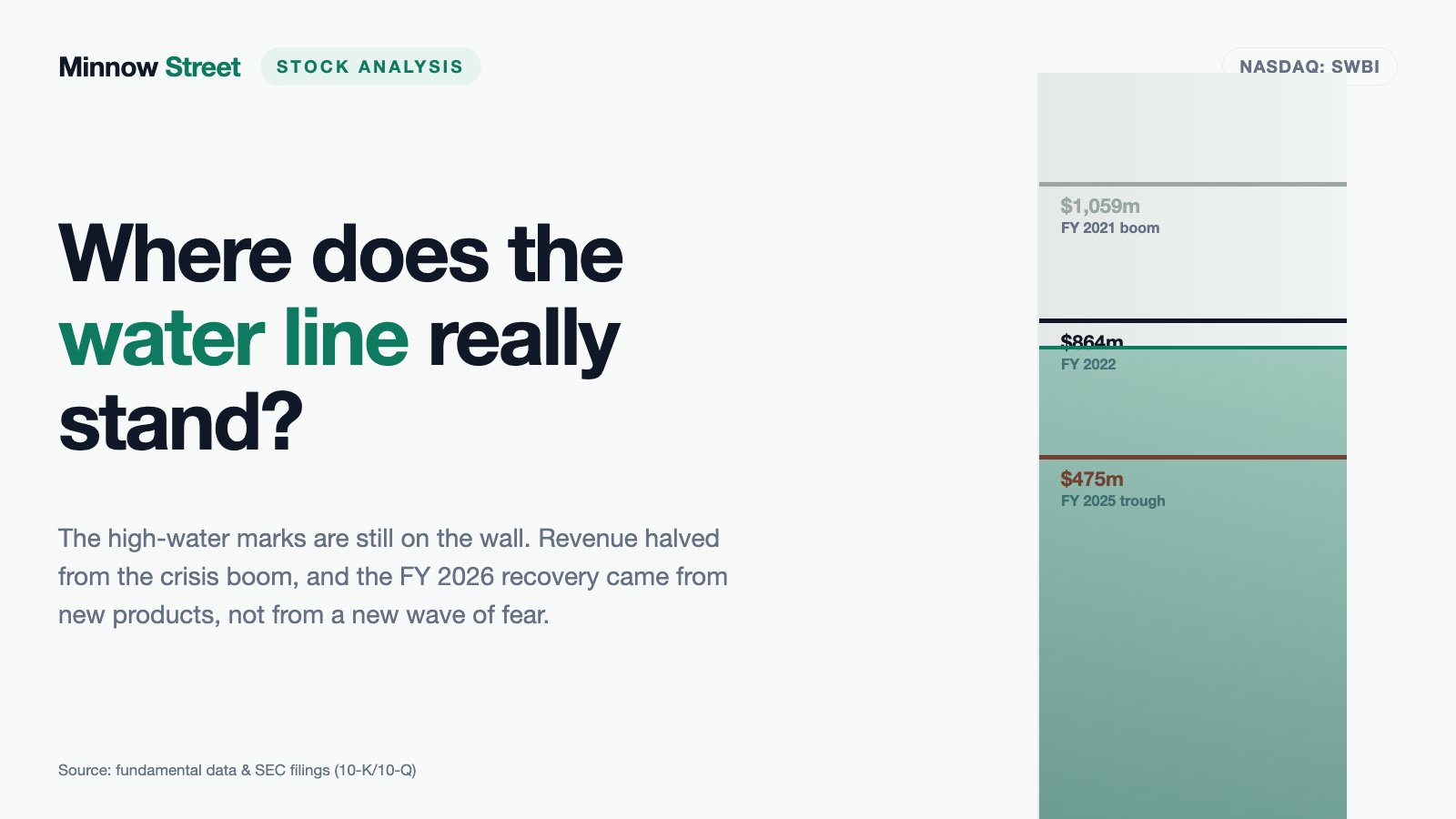
Start with what you have to understand to read Smith & Wesson correctly: this business breathes with the fear cycle. In fiscal 2021 — the year of COVID and the unrest of summer 2020 — the company sold $1,059.2 million worth of firearms and earned $252.0 million. That was a historic exception, not a normal state. Demand then normalised, and revenue fell to $864.1 million (fiscal 2022), $479.2 million (2023), $535.8 million (2024) and $474.7 million (2025), with net income shrinking to a meagre $13.4 million. Only fiscal 2026 brought a recovery: revenue up 10.4 percent to $523.8 million, net income $18.5 million ($0.41 per share). The chart shows the whole rollercoaster.
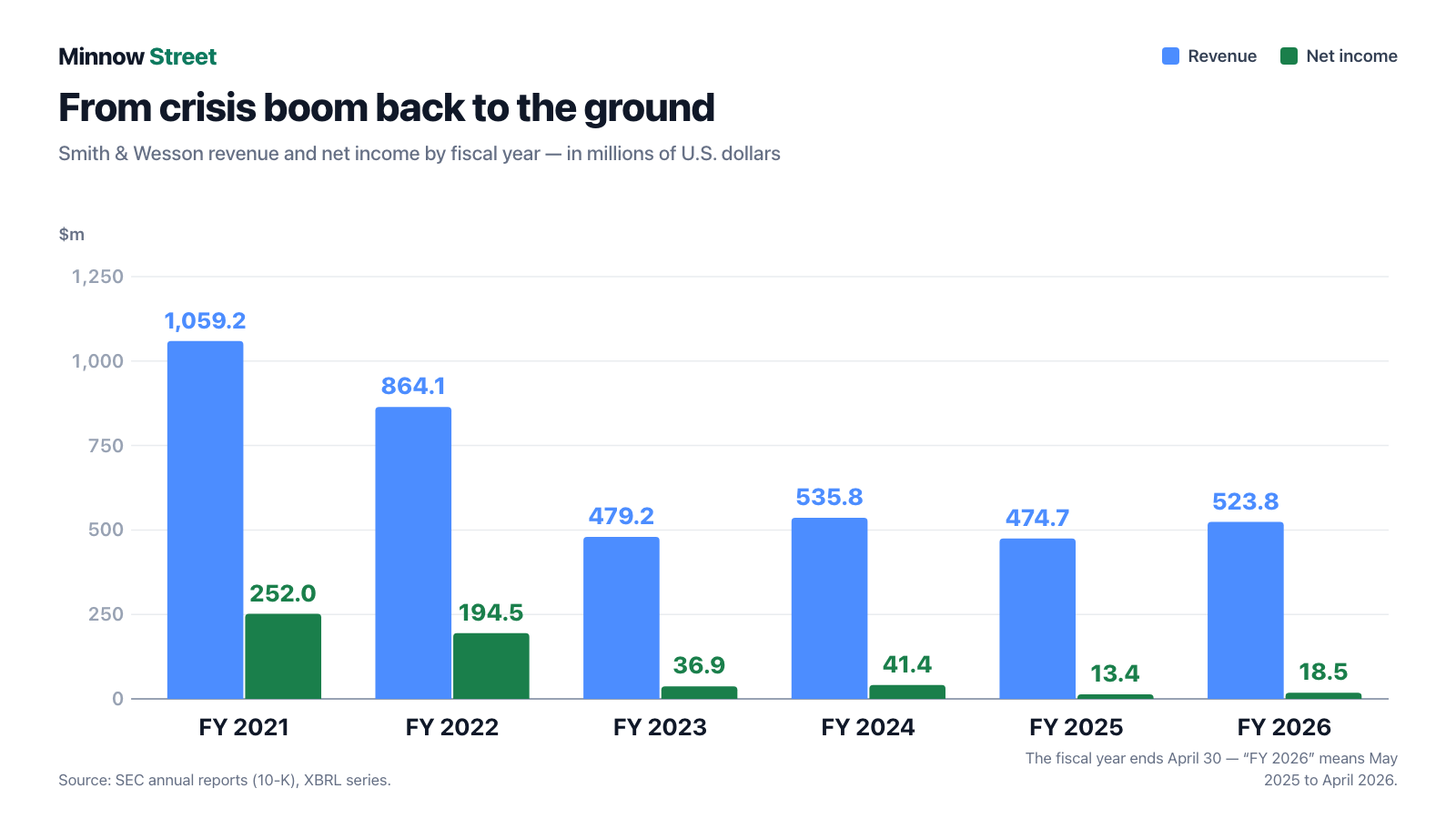
What matters is where the 2026 recovery came from. Not from a new wave of fear, but from the product shelf: revenue from handguns rose 18.8 percent (up $62.5 million) as new pistol models landed — 43.6 percent of pistol revenue came from products that did not exist a year earlier. At the same time long gun revenue fell 13 percent. And underlying market demand, measured by NICS checks, was flat to slightly down. Hold on to that, because it is the core of the first uncomfortable truth: the growth in fiscal 2026 was hand-made, not carried by the market.
The uncomfortable truths
At a solid, profitable company the uncomfortable truths are quieter than at a lossmaker — but you need them to understand the price. Three things are worth reading before any thought about that attractive dividend.
Uncomfortable truth no. 1: the boom is the exception, not the base
Anyone carrying the crisis reflex tends to read the record numbers of fiscal 2021 as the company's "true" potential. The annual report corrects that view with notable candour — it calls the boom a temporary exception in so many words:
„For example, we experienced historic levels of demand for our products in parts of fiscal 2022 and 2021 as a result of the impact of COVID-19 and the social unrest experienced in the United States during the summer of 2020, with demand for our products subsequently returning to more normalized levels.“
— Smith & Wesson Brands, Inc., SEC annual report on Form 10-K, fiscal 2026, Item 1A (Risk Factors)
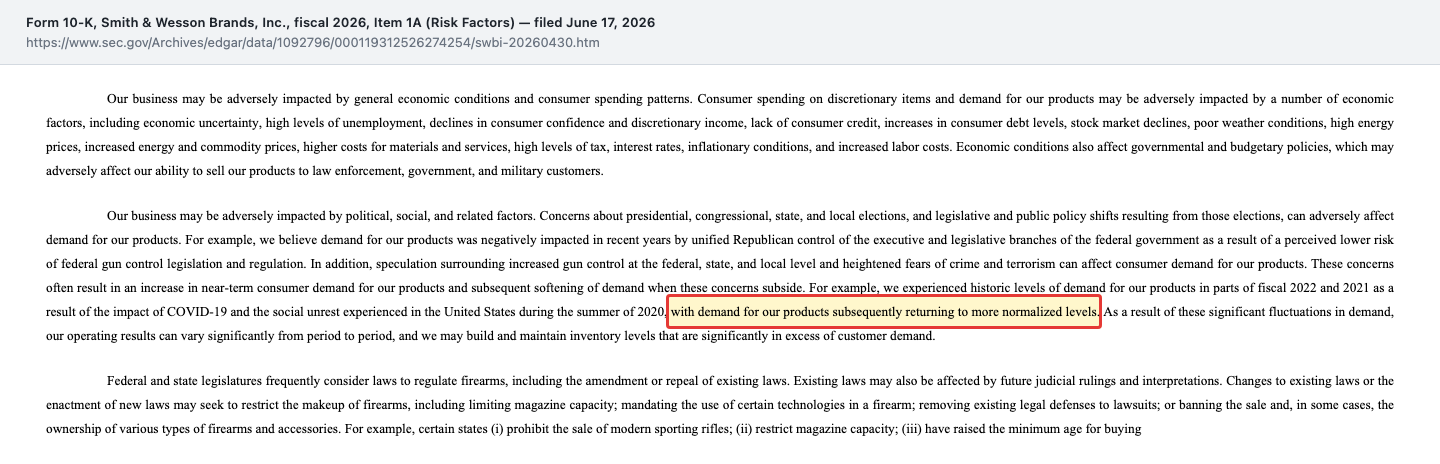
Do the arithmetic: from the revenue peak of $1,059.2 million the company fell to roughly half, and from the earnings peak of $252.0 million to a twentieth at the trough. That is not a failure of management, it is the nature of the business. Buying today is therefore not a bet on a calm growth path but on the next wave of fear arriving eventually — or on Smith & Wesson putting out enough new products to bridge the lull.
Uncomfortable truth no. 2: lawsuits are part of the business model — though the biggest one just fell away
A gun maker gets sued. That is not an exception, it is part of the job. Smith & Wesson states its pending product liability cases openly:
„We are a defendant in three product liability cases and are aware of six other product liability claims, primarily alleging defective product design, defective manufacturing, or failure to provide adequate warnings.“
— Smith & Wesson Brands, Inc., SEC annual report on Form 10-K, fiscal 2026, Note 14 (Commitments and Contingencies)
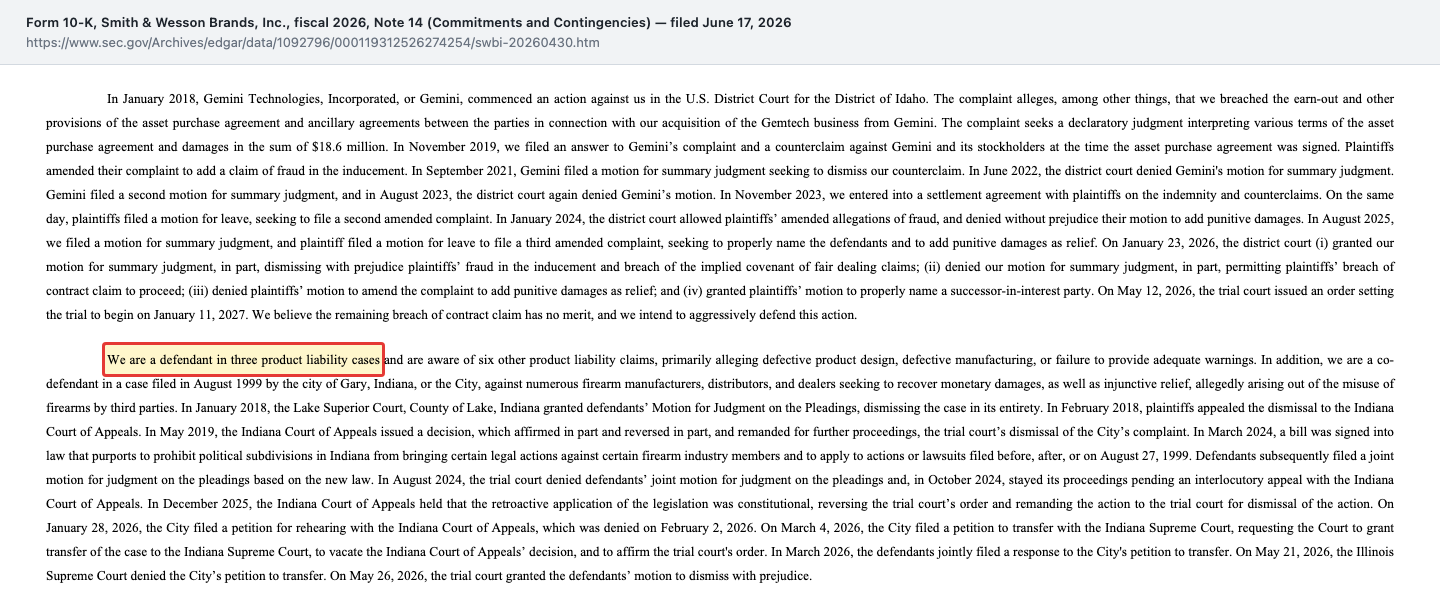
To put it fairly: the only quantified dispute is a contract case arising from an earlier acquisition (Gemtech/Gemini) seeking $18.6 million in damages, with trial set to begin on January 11, 2027; the company considers the remaining claim to be without merit. For the many product liability cases no material provision is reported — protection comes above all from a federal statute, the PLCAA, which shields manufacturers from liability when their lawfully built and lawfully sold products are later criminally misused. The decisive point for valuation: the largest legal item has just fallen away. The Mexican government's suit against several U.S. gun makers, estimated at up to double-digit billions, was dismissed unanimously by the U.S. Supreme Court in June 2025 — precisely on PLCAA grounds. The legal risk is real and permanent, but it is bounded, and right now it has grown smaller rather than larger.
Uncomfortable truth no. 3: the dividend is real — but it also flowed when no money came in
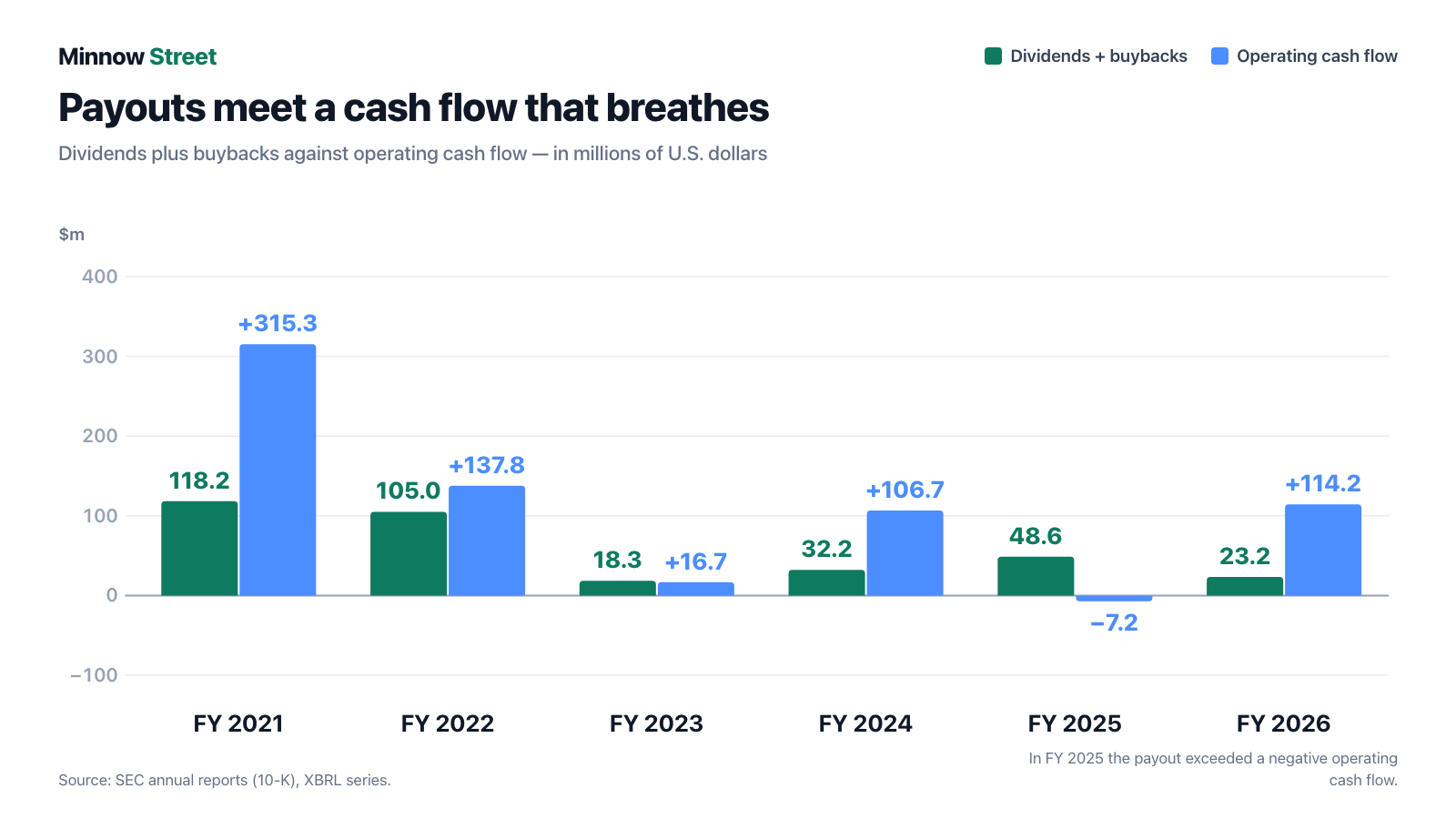
Now to the cushion from the crisis reflex: the dividend. It is genuine, paid every quarter since 2020, and Smith & Wesson buys back stock on top. But a payout is only as reliable as the cash flow behind it — and that cash flow swings with the cycle. Fiscal 2025 showed this starkly: operating cash flow was negative while the company kept paying and repurchasing. The report puts a number on the swing:
„Cash provided by operating activities was $114.2 million in fiscal 2026 compared with $7.2 million of cash used in fiscal 2025.“
— Smith & Wesson Brands, Inc., SEC annual report on Form 10-K, fiscal 2026, Item 7 (MD&A, Liquidity)
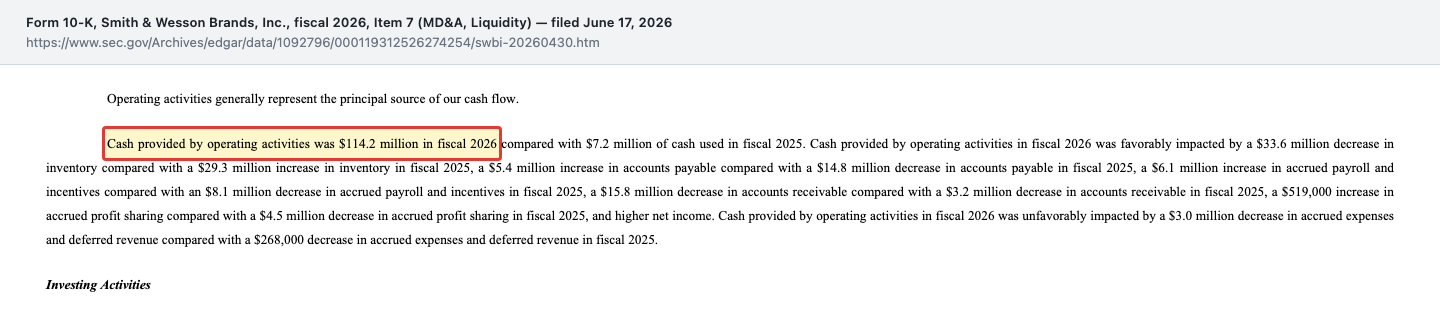
Look at the second chart. In fiscal 2025 Smith & Wesson returned $48.6 million to shareholders in total ($23.1 million of dividends plus $25.5 million of buybacks) against operating cash flow of minus $7.2 million. The money came from the credit line, which was repaid by $60 million the following year once cash flow returned. This is not an alarm: the balance sheet carries it comfortably, and capital returns over the years have been substantial. But it exposes the crisis-reflex fallacy: the dividend is not an interest-like certainty, it hangs on the same cycle as everything else.
Valuation — expensive or cheap depends on where you stand in the cycle
Now the price question, and here sits a neat trap. Smith & Wesson's price-to-earnings ratio is around 38. That sounds expensive. But those earnings are a cyclical trough, which is exactly why the multiple overstates the expense. The other yardsticks put it in perspective: the forward price-to-earnings ratio is around 12 (the market expects clearly higher profits), enterprise value is about 11.6 times operating earnings, price-to-sales around 1.3 and price-to-book around 1.8. That is a long way from stretched — but it is no bargain either. Remember: with a cyclical company a high multiple at the trough is often less bad than it looks, and a low one at the peak less good.
The catch sits elsewhere. The price has run well ahead of the recovery. The stock has more than doubled from its 52-week low and trades only about ten percent below its yearly high. Buying today means buying a recovery that is already priced in — and paying full price for the next demand cycle, which nobody can schedule. The dividend yield of roughly 3.4 percent is a pleasant addition, but after the third uncomfortable truth you know it is not a foundation.
Opportunities and risks at a glance
What speaks for Smith & Wesson:
- Solid balance sheet: about $28.2 million of cash plus $5.2 million of securities, the credit line reduced by $60 million in fiscal 2026, and $114.2 million of operating cash flow with roughly $90 million of free cash flow.
- Real capital returns: a quarterly dividend paid without interruption since 2020 (about $0.52 per share a year, yielding roughly 3.4 percent) plus ongoing buybacks that have meaningfully shrunk the share count.
- Strong brand and product power: the fiscal 2026 recovery (revenue up 10.4 percent, handguns up 18.8 percent) came from new models rather than a wave of fear — evidence the company can win share in a flat market; gross margin steady at 26.9 percent.
- Legal picture easing: the Mexican government's multi-billion-dollar suit was dismissed by the U.S. Supreme Court in June 2025, and the PLCAA remains the essential liability shield.
What speaks against it:
- Pure demand cyclicality: revenue fell from the boom peak of $1,059.2 million to roughly half and earnings briefly to a twentieth; underlying NICS demand was recently flat to declining.
- Capital returns above cash flow: in fiscal 2025 the payout of $48.6 million exceeded a negative operating cash flow of minus $7.2 million, funded from the credit line — the dividend is not an interest-like certainty.
- Permanent legal and reputational risk: pending product liability cases, a quantified contract dispute ($18.6 million, trial January 2027), political headwind and ESG exclusions come with the business.
- Customer concentration and price: two customers accounted for 24.7 percent of fiscal 2026 revenue and the top five distributors for 46 percent — and the share price has already more than doubled off its low.
A human conclusion
Remember the crisis reflex from the start — the conviction that a gun maker is a one-way bet on an ever less safe world, with a safe dividend on top? After reading the filings you now know why that reflex misleads. Demand is not a one-way street upward but a sequence of waves; the last great surge has drained away, and the fiscal 2026 recovery came from the product shelf, not from a new wave of fear. And the dividend flowed even in a year when no money came in from operations — it hangs on the same cycle as everything else.
And yet that is not the whole story, or it would be unfair. What remains once you subtract the reflex is a surprisingly solid core: a low-debt balance sheet, a strong brand with genuine product power, roughly $90 million of free cash flow last year, a real payout — and a legal risk that after the Supreme Court ruling has grown smaller rather than larger. The findings here are price risks (cyclicality, a payout that in the trough year ran past cash flow, a full price after the doubling), not existential questions. No looming default, no concentration risk that brings the house down.
What you make of it is your decision. And that is exactly as it should be. Weighing the findings honestly, there is no reason for caution — but no clear margin of safety either after the share price doubled. A sound, cash-returning cyclical whose fate hangs on demand nobody can schedule. Anyone who understands the firearms cycle, and does not look for an entry right after a doubling, will find substance here. Just not a one-way bet on fear.
Sources
- Smith & Wesson Brands, Inc. — SEC annual report on Form 10-K, fiscal 2026 (to April 30, 2026, filed June 17, 2026)
- Smith & Wesson Brands, Inc. — SEC annual report on Form 10-K, fiscal 2025 (multi-year cycle comparison)
- Smith & Wesson Brands, Inc. — SEC quarterly report on Form 10-Q (quarter ended January 31, 2026, filed March 5, 2026)
- XBRL company-concept series from the SEC (revenue, net income, dividends, share repurchases, operating cash flow) for the six-year charts.
- Fundamental data (metrics, valuation); in-house stock scanner.
Disclaimer: this article is journalism and editorial context, not investment advice. It contains no buy or sell recommendation and treats a legal, regulated business without moral judgement. Share prices fluctuate and total loss is possible. Make your investment decisions on your own responsibility and seek independent advice if in doubt.
Our Bottom Line at a Glance
- Balance sheet & substance positive
- Low debt: about $28.2 million of cash plus $5.2 million of securities, the credit line reduced by $60 million in fiscal 2026. Operating cash flow back to $114.2 million with roughly $90 million free. Profitable across the whole cycle. A solid base that carries the downturn.
- Capital returns positive
- An uninterrupted quarterly dividend since 2020 (about $0.52 per share a year, yielding roughly 3.4 percent) plus ongoing buybacks that have meaningfully shrunk the share count. Real and shareholder-friendly — but in the trough year of fiscal 2025 funded past a negative operating cash flow, so it is tied to the cycle.
- Demand cyclicality negative
- The core reservation: revenue fell from the COVID and unrest boom ($1,059.2 million in fiscal 2021) to roughly half, and earnings briefly to a twentieth. The fiscal 2026 recovery (+10.4 percent) came from new products while underlying NICS demand was flat to declining. A politics- and event-driven cycle nobody can schedule.
- Law & reputation neutral
- Lawsuits come with the business: three product liability cases plus six further claims, and a quantified contract dispute ($18.6 million, trial January 2027). But the biggest item fell away — the Mexican government's multi-billion-dollar suit was dismissed by the U.S. Supreme Court in June 2025, and the PLCAA remains the essential liability shield. Real, but bounded.
- Valuation & price neutral
- The price-to-earnings ratio of around 38 overstates the expense (earnings trough); a forward multiple around 12, EV/EBITDA around 11.6 and price-to-sales around 1.3 are moderate but no bargain. The price has run ahead of the recovery: more than doubled from the 52-week low, near the yearly high.
Smith & Wesson is a fundamentally sound, low-debt firearms maker with a strong brand, a real dividend and ongoing buybacks — but the engine of this business, firearms demand, is strongly cyclical and driven by politics and events. From the COVID and unrest boom ($1,059.2 million of revenue in fiscal 2021) the company has fallen back to roughly half; the fiscal 2026 recovery (+10.4 percent) came from new products, not from a new wave of fear. Capital returns in fiscal 2025 even ran past a negative cash flow. The share has more than doubled off its low and leads the recovery. A solid, cash-returning cyclical without a clear margin of safety — no reason for caution, but no bargain either. Not investment advice.
What Our Rating Means
Open questions
The business works in principle, but one material question is open. As long as it stays open, our findings do not carry a quality verdict.
The substance holds: a low-debt balance sheet with $28.2 million of cash plus $5.2 million of securities, the credit line reduced by $60 million in fiscal 2026, $114.2 million of operating and roughly $90 million of free cash flow, a steady 26.9 percent gross margin and a brand with 170 years of history. Nothing supports red: no going-concern doubt, no over-indebtedness, and the largest legal risk fell away when the U.S. Supreme Court dismissed the Mexican suit in June 2025. Three things rule out green. First, demand cyclicality: revenue fell from the boom peak of $1,059.2 million in fiscal 2021 to $474.7 million in fiscal 2025 and earnings briefly to a twentieth; underlying NICS demand was recently flat to declining, and the 2026 recovery came from new products rather than from the market. Second, capital returns: in fiscal 2025 $48.6 million flowed to shareholders while operating cash flow was negative at minus $7.2 million — funded from the credit line. Third, customer concentration: two customers accounted for 24.7 percent of revenue and the top five distributors for 46 percent.
A journalistic assessment by our editorial team at the time of the deep dive, based on public sources — not investment advice and not a solicitation to buy or sell. Your personal circumstances (investment goals, risk capacity, taxes) cannot be taken into account. What our levels mean, how verdicts are formed, and what conflicts of interest exist →
Worth Noting
- Identity and legal form: Smith & Wesson Brands, Inc. — incorporated in Nevada, operating headquarters in Maryville, Tennessee (CIK 0001092796, ISIN US8317541063). A pure firearms maker since the outdoor division (American Outdoor Brands) was spun off in August 2020. The fiscal year ends April 30. Demand proxy: NICS background checks.
- Special-situation screening (EDGAR full index, CIK 1092796): no pending takeover, no strategic review, no rights plan, no active 13D campaign (only passive SC 13G/A); routine 8-K, Form 3/4 and exempt solicitations (ESG activism, common at firearms makers). Insiders hold about 2.3 percent, institutions about 58 percent.
- Price and valuation figures are dated to mid-July 2026; analyses are evergreen and daily prices are not a buying argument. The market capitalisation of roughly $690 million refers to about 44.7 million shares outstanding.
- The six-year charts are built from the SEC XBRL company-concept series (revenue, net income, dividends paid, share repurchases, operating cash flow), so every bar can be traced back to a filed annual report.
- AI classification: neutral. No material AI reference in the filings reviewed; the only mention is a generic risk factor on internal AI use (Item 1A of the fiscal 2026 10-K) with no specific link to the firearms business — no AI revenue source, no operational AI use, no concrete AI threat to the demand model.
Frequently Asked Questions
Smith & Wesson Brands (Nasdaq: SWBI) is an American firearms maker with more than 170 years of history — handguns (pistols, revolvers) and long guns. It sells through a small number of large distributors to gun shops across the country. Since the 2020 spin-off of its outdoor division (American Outdoor Brands) it has been a pure firearms company, headquartered in Maryville, Tennessee.
U.S. firearms demand rises in crises and ahead of feared tightening of the law, and falls when things calm down. A good proxy is the number of FBI background checks (NICS). The COVID and unrest boom of 2020/21 drove revenue to $1,059.2 million; it then normalised to roughly half that.
It was a recovery: revenue rose 10.4 percent to $523.8 million, net income to $18.5 million ($0.41 per share), and the gross margin held at 26.9 percent. The driver was sales of new pistol models (handguns up 18.8 percent) while underlying market demand measured by NICS was flat to slightly down.
The quarterly dividend (about $0.52 per share a year, yielding roughly 3.4 percent) has been paid since 2020, but it is not an interest-like foundation. In fiscal 2025 the company paid dividends and bought back stock even though operating cash flow was negative at minus $7.2 million; the money came from the credit line. The payout therefore hangs on the same demand cycle as earnings.
The suit against several U.S. gun makers, estimated at up to double-digit billions of dollars, was dismissed unanimously by the U.S. Supreme Court in June 2025 — on the basis of the PLCAA, the federal statute that shields manufacturers from liability when their lawfully built and lawfully sold products are later criminally misused. The largest legal item has therefore fallen away, though pending product liability cases remain part of the business.
Mixed. The price-to-earnings ratio of around 38 looks expensive but measures a cyclical earnings trough; the forward multiple is around 12, enterprise value about 11.6 times operating earnings and price-to-sales around 1.3. That is moderate but no bargain — especially as the stock has already more than doubled from its 52-week low and trades near its yearly high.
Found an error?
Did you spot a factual error, an outdated number, or a typo in this deep dive? Let us know briefly — your report goes straight to the editorial team.