Nebius: How a $128 Million Operating Loss Turns Into a $621 Million Quarterly Profit
German newsletter "Hot Stocks Europe" celebrated Nebius in hindsight as a top performer of 2025 - from EUR 44.50 to a peak of EUR 118 on the thinly traded German secondary market. We read the annual report (Form 20-F) and the latest quarterly report (Form 6-K) instead: revenue grew 684 percent to $399 million in the first quarter of 2026, and the company reported net income of $621 million - almost entirely from the revaluation of one stake, while the actual AI cloud business's operating loss grew to $128 million. Not investment advice, just a look behind two very different numbers wearing the same name.
 Thomas Mücke
Founder & Publisher
Thomas Mücke
Founder & Publisher
Chart
Interactive price chart (TradingView).
Note: pure fact-based analysis, not investment advice and not a solicitation to buy or sell. All figures without guarantee.
You know the rearview-mirror trap. You see a stock chart climbing steeply, and your brain quietly turns that into a forecast: "This will keep going." But a rearview mirror only shows where you've been, not where the road goes next. That's exactly the trap the German newsletter "Hot Stocks Europe" sets, without meaning to, in its issue 24 from November 28, 2025. Looking back at the "top performers of 2025," it celebrates Nebius Group N.V. for a price run "from EUR 44.50 to a peak of EUR 118" - on the thinly traded German secondary listing under the old ticker YDX, a leftover from the company's Yandex days. Let's make a deal: we'll leave the rearview mirror alone and read what Nebius actually told the U.S. securities regulator, the SEC, under penalty of law - the annual report (Form 20-F) for 2025 and the latest quarterly report (Form 6-K) as of March 31, 2026. What's in there is more complicated than any price chart: a company that grew revenue 684 percent in the first quarter of 2026 - and in that same quarter reported net income of $621.2 million, even as its actual operating business sank deeper into the red than a year earlier. The entire profit, and then some, came from a single line item: the revaluation of a company stake.
What Nebius Actually Does - and Where It Came From
Nebius calls itself a "global AI cloud platform." In plain terms: Nebius rents out computing power - racks full of high-performance graphics chips (GPUs), plus storage, networking, and software - to companies that want to train or run their own AI models but can't or don't want to build data centers themselves. The annual report puts it this way:
"Nebius, a global AI cloud platform, delivers a unified full-stack AI cloud that spans the complete AI journey – from compute capacity to software and services that enable fast and efficient training and inference at scale. Founded around deep in-house technological expertise, Nebius offers a comprehensive and integrated suite of AI and ML cloud solutions, including both hardware and software built in-house. This combination of AI-optimized hardware and software enables us to deliver high-performance GPU compute clusters, storage, managed services, and advanced tools for AI model training and inference at enterprise-scale."
— Nebius Group N.V., SEC annual report, Form 20-F for 2025, Item 4 "Information on the Company"

Besides its core AI cloud business, the group holds two smaller, independently run units: Avride (self-driving vehicles and delivery robots) and TripleTen (an edtech platform that reskills people for tech careers). It also holds minority stakes in two former subsidiaries that have since become independent companies: database maker ClickHouse and crowd-work platform Toloka. Both stakes matter a great deal to the rest of this analysis.
The backstory: how Yandex N.V. became Nebius
Anyone reading this ticker for the first time needs the backstory, because it's baked deep into the balance sheet. Nebius Group N.V. was called Yandex N.V. until August 16, 2024 - the Dutch holding company sitting above the Russian internet conglomerate Yandex (search, ride-hailing, advertising). Following Russia's invasion of Ukraine, the holding company fully separated from its Russian business in 2024, in two steps: on May 17, 2024, it sold a 68 percent controlling stake, and on July 12, 2024, the remainder. All Russian and Russia-linked international operations passed to a new set of owners. The annual report puts the resulting loss at $784.6 million (a $501.7 million impairment, a $270.4 million deconsolidation effect, and $12.5 million in transaction costs). What remained was a debt-free, cash-rich shell holding the non-Russian assets - chiefly the data centers and GPU fleet that had previously been built for the international cloud unit. Within months, management turned that shell into a new company with a new name and a new story: a pure-play AI infrastructure business. That history explains two quirks you'll run into in the numbers below: the 2023 and 2024 comparison years still carry the aftereffects of the split (results from "discontinued operations"), and the German secondary market still trades Nebius under the old YDX ticker to this day - a euro-denominated sideshow, while the real, liquid listing trades on Nasdaq in U.S. dollars.
How the Stock Showed Up on Our Desk
Nebius didn't reach our research list through our in-house stock scanner - it can't, because it doesn't yet have its own company record on our platform, so it can't show up in any scanner metric at all. Instead, it arrived through a reader submission: the same issue 24 of "Hot Stocks Europe" dated November 28, 2025 (B-Inside International Media GmbH, Freiburg, Germany; author Michael Calivas). Looking back at 2025, the newsletter names Nebius alongside names like Steyr Motors, Hensoldt, and Renk as one of the year's standout gainers, with the price run quoted above. Important context: this newsletter offers nothing but a third party's opinion and hindsight review dated November 28, 2025 - not a single company figure in this analysis comes from it. Every number below comes from Nebius's own annual report (Form 20-F) or quarterly reports (Form 6-K), or from fundamental data we checked against those filings. The newsletter itself discloses a conflict of interest: the publisher, author, or related parties may hold positions in stocks it covers and intend to sell as prices rise (a disclosure required under EU Market Abuse Regulation 596/2014) - worth keeping in mind whenever you read any stock newsletter.
The Numbers Over the Years - Honestly Appraised
Let's start with what genuinely impresses: Nebius is growing at a speed rarely seen in established industries. Revenue from continuing operations (excluding the now-independent Toloka stake in every year shown) rose from just $9.8 million in 2023 to $91.5 million in 2024 and $529.8 million in 2025 - more than a 54-fold increase in two years. The core Nebius AI cloud segment alone grew 603 percent in 2025 versus 2024. But looking at revenue alone tells only half the story. The chart below tells the other half:
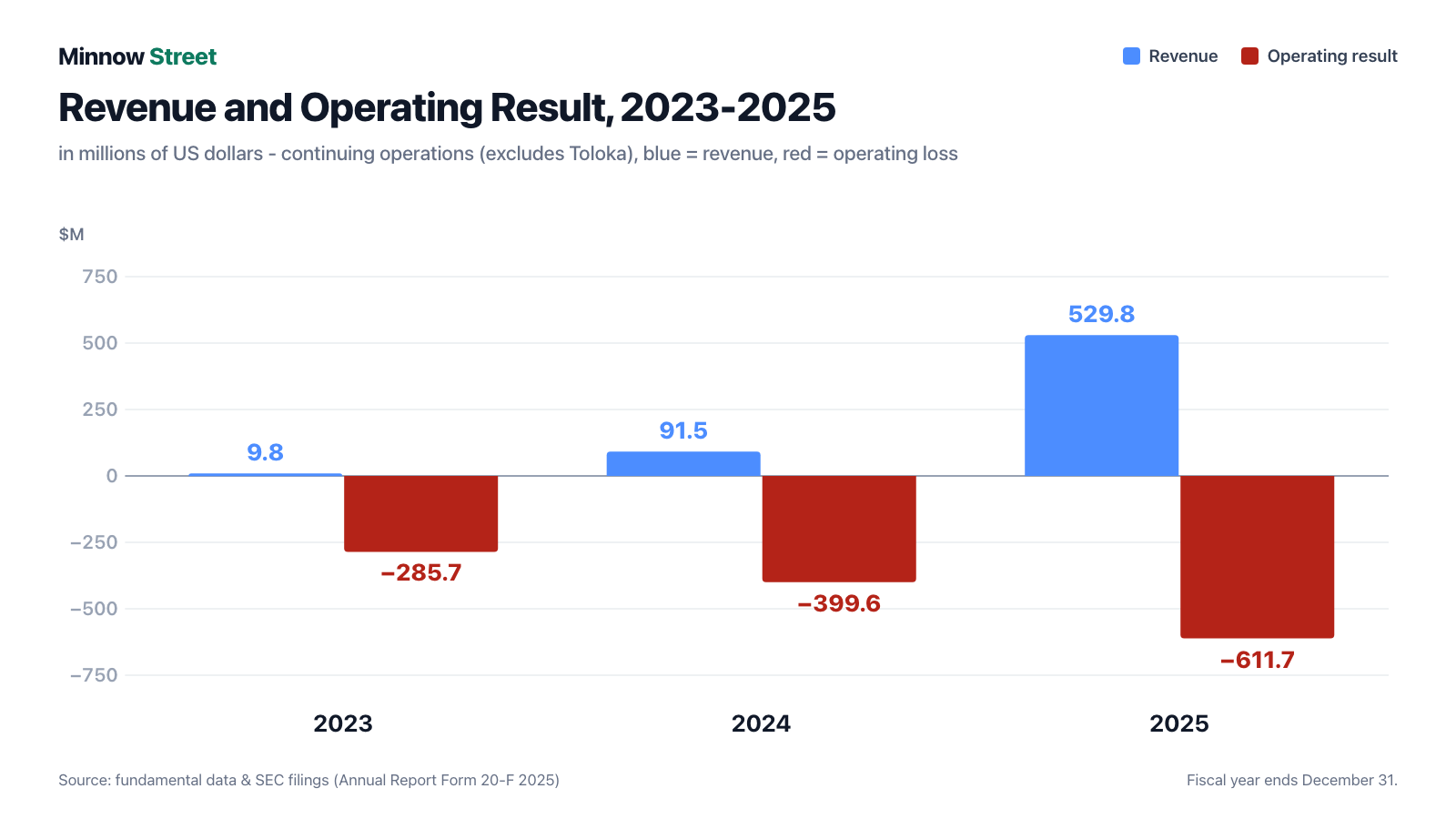
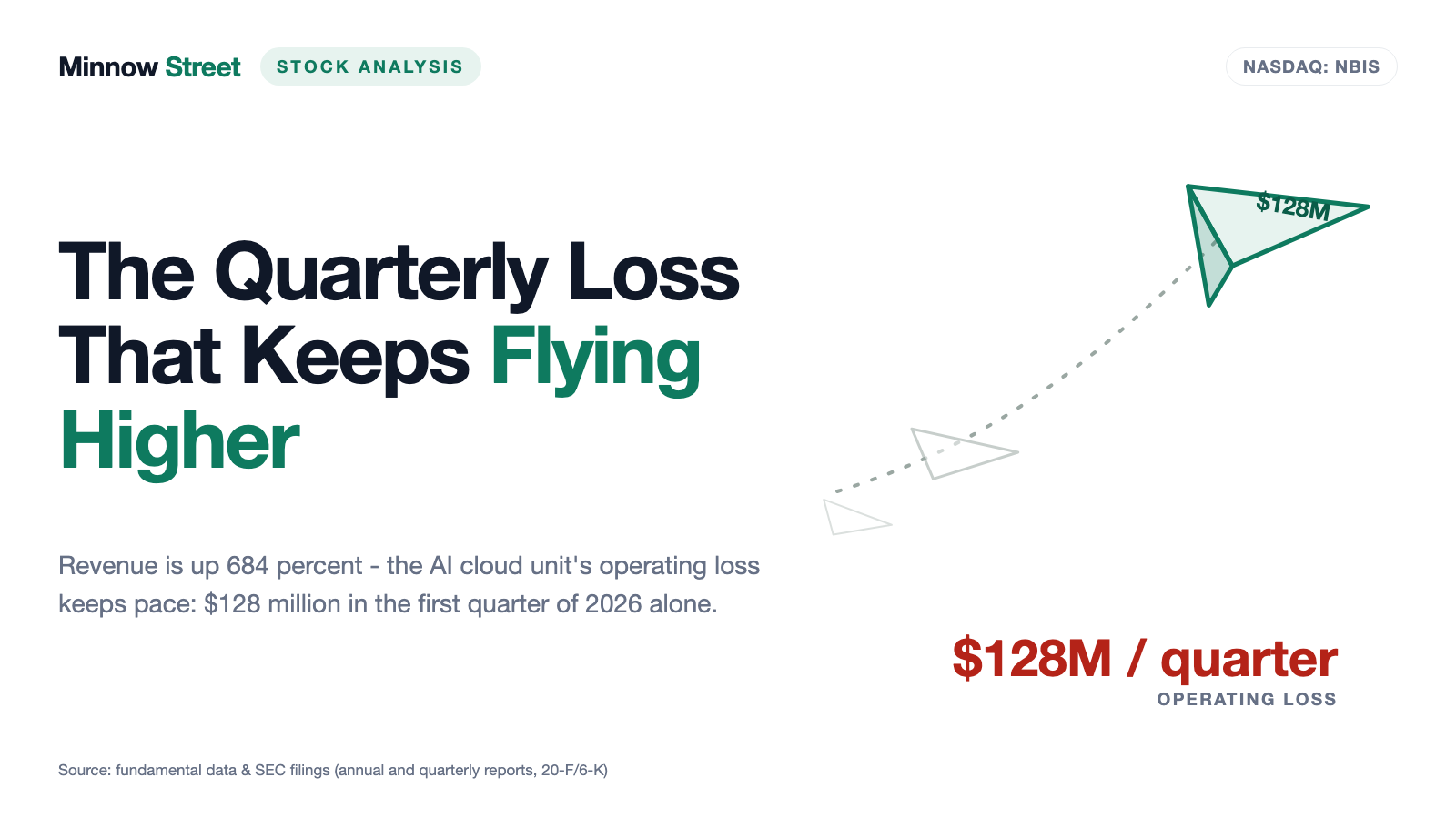
So the operating loss isn't a footnote - it grows at the same pace as revenue, a pattern that continued into the first quarter of 2026: revenue climbed from $50.9 million (Q1 2025) to $399.0 million (Q1 2026), up 684 percent. The core Nebius AI cloud segment grew even faster, up 841 percent (from $41.4 million to $389.7 million), while the smaller units TripleTen (+10 percent, driven by roughly 5,000 new student enrollments) and Avride barely move the needle. And there's a genuinely good piece of news Nebius deserves credit for: cost of revenue fell from 49 percent to 26 percent of revenue - a clear sign of operating leverage. On an adjusted basis (before depreciation, interest, taxes, and stock-based compensation), the core Nebius AI cloud segment swung from -$27.4 million to +$174.0 million - a genuine improvement in its own right. The catch: at the group level, less of that survives, because the side units Avride (-$34.1 million) and TripleTen (-$10.4 million) eat into it, leaving a group-wide adjusted figure of $129.5 million (Q1 2025: -$53.7 million). And the official GAAP number - loss from operations, before any of those adjustments - stayed deep in the red at $128.0 million, actually a bit worse than the year-earlier quarter's $120.3 million loss. Why the headlines still showed net income of $621.2 million is the subject of the next chapter.
What the Filings Say - the Uncomfortable Truths
Uncomfortable truth no. 1: the profit isn't coming from the cloud - it's coming from a stake
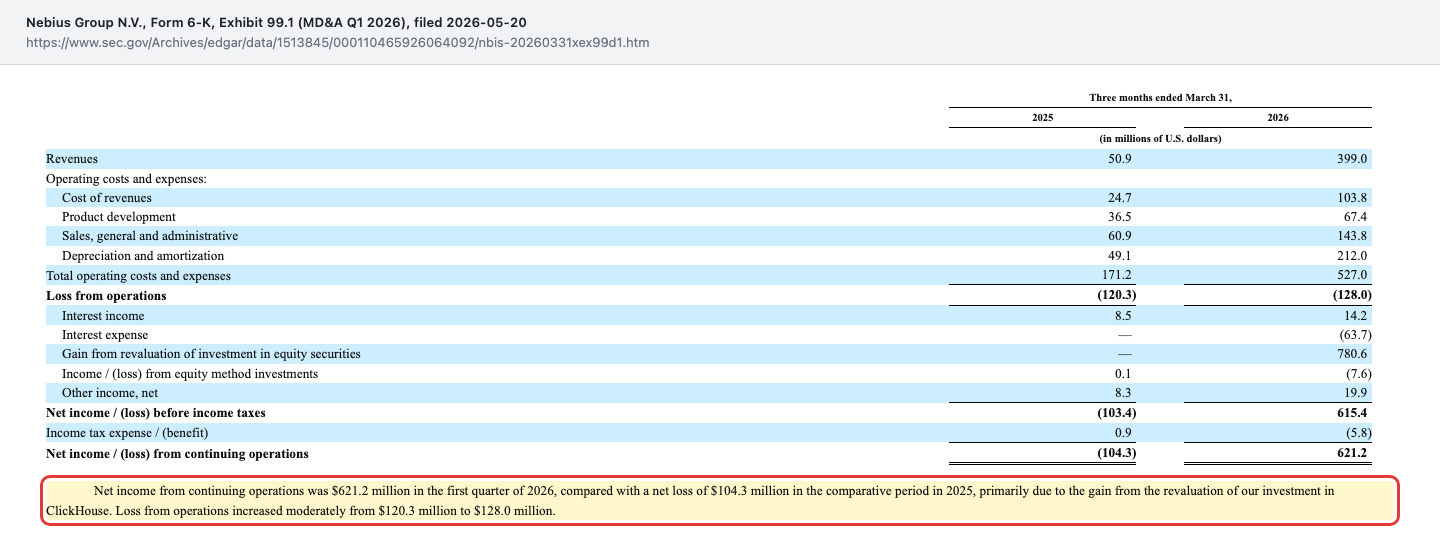
Here's the core tension of this analysis. Nebius reported net income of $621.2 million for the first quarter of 2026, versus a net loss of $104.3 million a year earlier. That sounds like a massive operating turnaround. It isn't. The company explains the swing itself:
"Net income from continuing operations was $621.2 million in the first quarter of 2026, compared with a net loss of $104.3 million in the comparative period in 2025, primarily due to the gain from the revaluation of our investment in ClickHouse. Loss from operations increased moderately from $120.3 million to $128.0 million."
— Nebius Group N.V., SEC report, Form 6-K filed May 20, 2026, Exhibit 99.1 (Operating and Financial Review, Q1 2026)
To show you exactly how the pieces fit together, we rebuilt the full bridge:
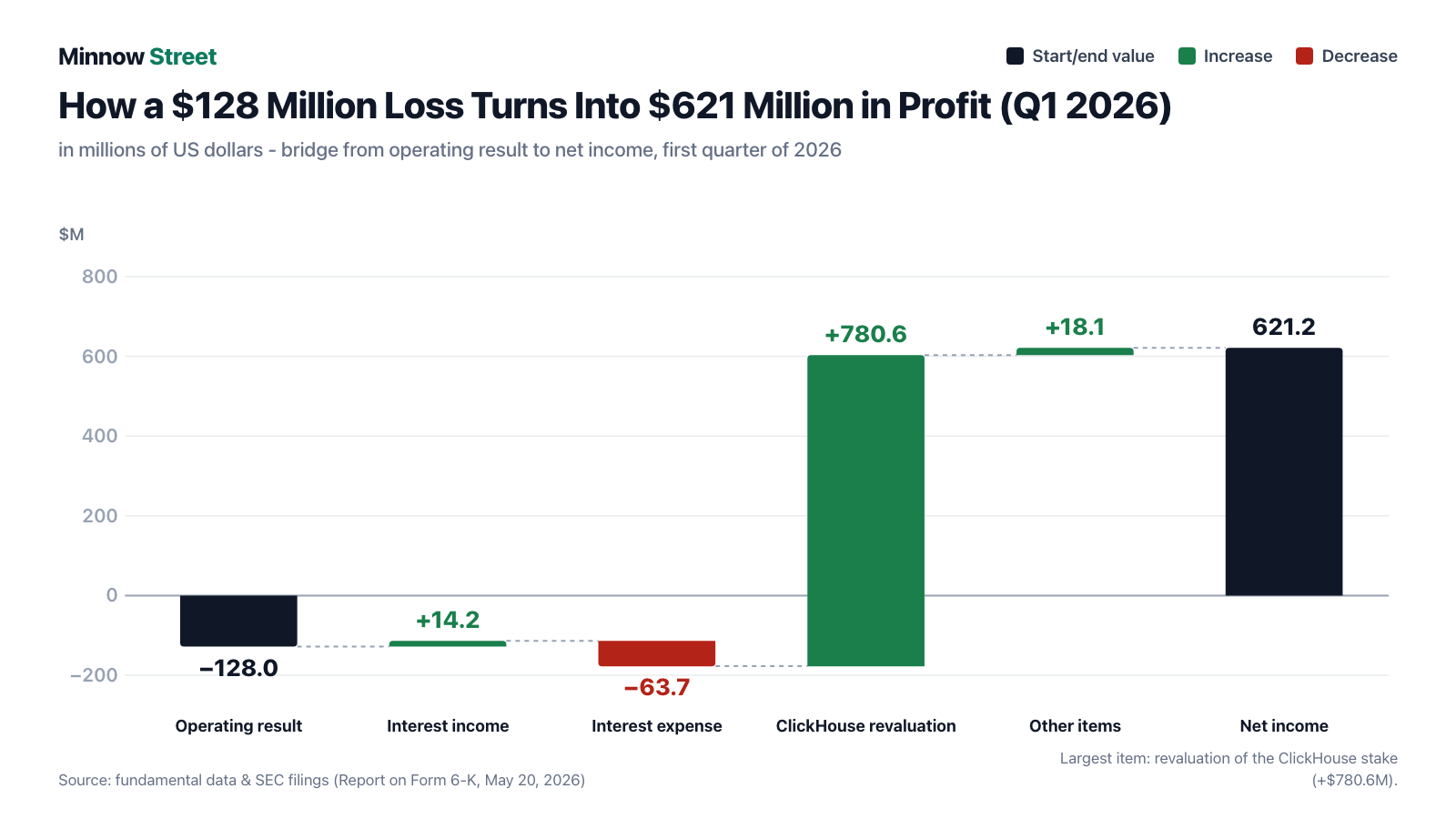
Where does this revaluation gain come from? Nebius holds a minority stake in database maker ClickHouse, which closed a so-called Series D financing round in January 2026: outside investors put in $400 million at a reported valuation of roughly $15 billion. Because U.S. accounting rules require equity stakes to be remeasured against such observable third-party price changes, Nebius had to mark up the carrying value of its ClickHouse stake accordingly - and that flows through the income statement as a gain, even though not a single dollar actually changed hands into Nebius's pocket. It's important not to misread this: the accounting is correct and fully disclosed, not manipulation. But it's also not evidence that the cloud business has become profitable. And this isn't the first time: the exact same line item showed up for full-year 2025 too - a $598.9 million gain from revaluation of investments in equity securities, of which $597.4 million was, again, the same ClickHouse stake, following an earlier third-party financing round that year. Combined with a further $85.9 million gain from the sale of the Toloka stake, that produced total net income of $82.5 million for 2025 - against an operating loss of $611.7 million in the core business that same year. Strip out those two revaluation and disposal gains, and the group would have posted a steep loss for 2025. Remember the pattern: in every single period since the restructuring in which Nebius reported a profit, that profit came from selling or revaluing a stake - twice from the very same ClickHouse position - not from the operating AI cloud business. Looking at the headline "net income" number alone won't tell you that.
Uncomfortable truth no. 2: one man controls roughly half the votes - with a tenth of the economic stake
Nebius trades on a public market, but it isn't run democratically. The company has three share classes: Class A (one vote per share, traded on Nasdaq), Class B (ten votes per share, not publicly traded), and Class C (zero shares currently outstanding). Founder Arkady Volozh holds Class B shares through a family trust that, according to the annual report, gives him control:
"Our Class A shares are listed on the Nasdaq Global Select Market, and our Board relies upon the listing requirements and rules of the Nasdaq Stock Market to assist it in its determinations of director independence. Because Mr. Volozh beneficially holds approximately 52% of the voting control as of March 31, 2026 and holds greater than 50% of the voting power for election of directors, Nebius is a "Controlled Company" as defined by Rule 5615 of the Nasdaq Stock Market rules. As a Controlled Company, we may elect not to comply with certain corporate governance requirements of the Nasdaq Stock Market, including:"
— Nebius Group N.V., SEC annual report, Form 20-F for 2025, Item 3.D "Risk Factors"

The key number sits right next to it in the same filing: Mr. Volozh's family trust holds Class B shares representing roughly 52 percent of the voting power - against an economic stake in the company of only about 11 percent. Together with the CEO, other directors, employees, and other pre-IPO holders, insiders control roughly 59 percent of the vote. Picture a thousand-member club where, by charter, one single member gets ten times as many votes as everyone else - and that one member owns only a small slice of the club's treasury, yet can win any vote alone. That's exactly the consequence of "Controlled Company" status: Nebius can legally opt out of Nasdaq rules that would otherwise require a majority-independent board. That's not unusual for a company that grew out of a founder-led structure, and it's fully disclosed - but for you as a minority shareholder, it means that on anything a shareholder meeting decides, you have, mathematically, no decisive say.
Uncomfortable truth no. 3: one customer, up to $27 billion - financed with freshly raised debt
The third point links two things that don't look related at first glance: how fast Nebius is taking on debt, and how large the contracts are that this debt is riding on. The balance sheet first: as of March 31, 2026, cash and cash equivalents of $9,298.2 million stood against total debt of $8,450.4 million ($18.4 million current, $8,432.0 million non-current) - a net cash position of roughly $847.8 million, computed directly from the balance sheet. At year-end 2025, the relationship was reversed: $3,678.1 million in cash against $4,127.7 million in total debt, a net debt position of roughly $449.6 million. The reason for the swing: in the first quarter of 2026 alone, Nebius raised $4,337.5 million gross through convertible notes (including a March 2026 tranche carrying 1.250 percent interest through 2031) and sold an additional $2,000 million of pre-funded warrants to NVIDIA Corporation - functionally close to a stock sale, since the exercise price is just $0.0001 per share. That balance-sheet structure shifts dramatically from quarter to quarter, and it's only half the story. After that reporting date, on July 10, 2026, a subsidiary (Nebius Compute II LLC in the U.S. and Nebius Compute II Oy in Finland) signed the company's first-ever secured credit facility, worth roughly $775 million - secured by already-deployed GPU infrastructure and the contracted payments of a single investment-grade customer. How large this framework could get, in the company's own words:
"The transaction enables Nebius to convert an operational infrastructure asset into growth capital, providing a framework for Nebius to secure asset-level financing on other long-term customer deployments. With more than $40 billion of additional contracted revenue from investment-grade customers such as Microsoft and Meta already in place, Nebius expects to raise more capital at similarly attractive terms. Nebius recently delivered the latest planned capacity tranche to Microsoft, and remains on track to deliver the remaining tranches consistent with the terms of the contracted schedule."
— Nebius Group N.V., SEC report, Form 6-K/A filed July 17, 2026, Exhibit 99.1 (press release)

How large a single one of these contracts can get shows up in an agreement with Meta Platforms, Inc. dated March 13, 2026: several five-year orders for GPU capacity with a combined contract value of $12 billion, plus a further order with a potential contract value of up to $15 billion - under which Meta must itself buy any capacity Nebius can't sell to someone else. Taken together, a single customer could account for up to $27 billion - against a Nebius market capitalization of roughly $47.7 billion (more on that shortly) and full-year 2025 revenue of just $529.8 million. The company states the risk plainly: it has "limited experience" delivering contracts this large and this long. Remember the picture: Nebius is increasingly financing its buildout directly against the payment promises of a handful of very large customers - a clever lever if it works, and a highly concentrated risk if a contract slips or gets canceled.
Valuation: Order of Magnitude, Not a Daily Price
How expensive is Nebius stock? At Friday's close on July 24, 2026, a Class A share traded at $187.77 on Nasdaq. Multiplied by the 253,898,194 shares outstanding as of March 31, 2026 (Class A and Class B combined, from the balance sheet in the quarterly report), that's a market capitalization of roughly $47.7 billion. A price-to-earnings ratio can technically be calculated - trailing twelve-month diluted earnings per share of $2.59 works out to a P/E of about 72.5 - but by now you know that profit is almost entirely one-off gains. A P/E on that basis tells you nothing about actual operating earnings power. The price-to-sales ratio is more informative: based on trailing twelve-month revenue of $877.9 million (added up from the annual and quarterly reports), it comes to roughly 54 - a level that already prices in a great deal of future growth. Book value per share (equity of $7,240.9 million as of March 31, 2026, divided by shares outstanding) works out to roughly $28.5, putting the stock at about 6.6 times book. The "professionals' view": three analysts cover the stock (data as of July 24/27, 2026), two rating it "Strong Buy" and one "Buy," none at "Hold" or "Sell," with an average price target of roughly $258. That's a very thin sample - three opinions aren't a market consensus in any meaningful sense, just the view of a handful of houses that have started covering this very young, very volatile stock at all.
Opportunities and Risks at a Glance
What speaks for Nebius:
- The core Nebius AI cloud business is growing extremely fast (+841 percent in the first quarter of 2026) and is already solidly profitable on an adjusted basis ($174.0 million adjusted EBITDA versus -$27.4 million a year earlier).
- Real operating leverage is measurable: cost of revenue fell from 49 percent to 26 percent of revenue within a single year.
- Blue-chip, investment-grade customers (Microsoft, Meta) are locking in multi-year contracts worth billions - Meta alone potentially up to $27 billion in total contract value.
- Despite the rapid debt buildup, the balance sheet still showed a net cash position of roughly $847.8 million as of March 31, 2026, further backed by NVIDIA Corporation as a strategic investor.
- The first secured asset-level financing (July 10, 2026) opens, in the company's own telling, a repeatable framework for funding further buildout cheaply, without issuing additional shares.
What speaks against it:
- Every profitable period since the restructuring has been driven by one-off gains (the Russia exit in 2024, the Toloka sale in 2025, the ClickHouse revaluation in Q1 2026) - meanwhile the core business's operating loss keeps growing in absolute dollar terms, most recently to $128.0 million per quarter.
- Governance risk: founder Arkady Volozh controls roughly 52 percent of the vote through a family trust while holding only about 11 percent of the economic interest; as a "Controlled Company," Nebius is exempt from key Nasdaq governance rules.
- Very rich valuation: a price-to-sales ratio of roughly 54 based on the trailing four quarters already prices in enormous future growth; a P/E can barely be constructed meaningfully given the one-off-driven profits.
- Extreme customer concentration: a single customer (Meta) could account for up to $27 billion in contract value, at a company that itself admits "limited experience" delivering contracts this large and this long.
- The balance-sheet structure swings dramatically quarter to quarter (from net debt to net cash and back), a pattern now compounded by the new customer-linked, asset-secured debt taken on since July 2026.
A Human Conclusion
Back to the rearview mirror from the opening. The newsletter got one thing right: the growth behind the price run it quoted for 2025 (EUR 44.50 to EUR 118 - a claim of the newsletter's that we haven't independently verified) is real and impressive - 841 percent revenue growth in a single quarter is not a small thing, and the operating leverage showing up in cost of revenue is a genuinely good sign. But the rearview mirror doesn't show you that the net income filling the headlines came, in every single period so far, from a source that has nothing to do with the actual cloud business - the revaluation of one stake, the sale of another. It doesn't show you that a single man controls roughly half the votes while owning only a tenth of the company economically. And it certainly doesn't show you that the company swung from a net-debt to a net-cash position within a single quarter, only to start moving back toward leverage with its first secured credit facility - financed against the payment promises of a small handful of very large customers. None of this makes Nebius a bad company. It makes it one whose stock price rests on a bet that reaches far beyond the core business: whether the revaluation gains eventually get replaced by real operating profits before the customer concentration or the governance structure become a genuine problem. What you make of it is your decision. And that is exactly as it should be.
Sources
All original documents used in this analysis - for you to check yourself:
- Nebius Group N.V. — SEC annual report, Form 20-F for 2025 (filed April 30, 2026)
- Nebius Group N.V. — SEC report, Form 20-F/A (Amendment No. 1, filed May 22, 2026, solely to add the clawback policy exhibit)
- Nebius Group N.V. — SEC report, Form 6-K for the first quarter of 2026 (filed May 20, 2026), with Exhibit 99.1 (Operating and Financial Review) and Exhibit 99.2 (unaudited interim financial statements)
- Nebius Group N.V. — SEC report, Form 6-K filed March 20, 2026 (indenture for the 2031 convertible notes)
- Nebius Group N.V. — SEC report, Form 6-K filed July 17, 2026 (roughly $775 million secured credit facility) and Form 6-K/A filed the same day, Exhibit 99.1 (press release)
- Full SEC filing history for Nebius Group N.V.: EDGAR overview (sec.gov)
- Fundamental data (price, market capitalization, ratios; data as of July 24/27, 2026), reconciled against the SEC filings.
- Hook: newsletter "Hot Stocks Europe," issue 24 dated November 28, 2025, B-Inside International Media GmbH, Freiburg, Germany (author Michael Calivas) - a third party's opinion and hindsight review, not a source for company figures.
- Further reading: our analyses of Fermi Inc. and Nokia Oyj - two more names from the same "Hot Stocks Europe" issue, tied to the same AI-data-center theme.
Transparency & disclaimer: This analysis is a journalistic contextualization of publicly available information and is not investment advice, not a regulated financial analysis, and not a solicitation to buy or sell securities. Stock investments carry substantial risk, including total loss. All figures are provided without guarantee; data dates are noted in the text. The author holds no position in Nebius shares at the time of publication.
Our Bottom Line at a Glance
- Core business growth positive
- The AI cloud segment grew 841 percent to $389.7 million in the first quarter of 2026 and swung from -$27.4 million to +$174.0 million on an adjusted basis - real operating progress, not an accounting trick.
- Earnings quality negative
- Every profitable period since the 2024 restructuring has been driven by one-off gains (revaluations, stake sales) - the operating loss instead kept growing in absolute dollars, most recently to $128.0 million per quarter, worse than a year earlier.
- Governance & control negative
- Founder Arkady Volozh controls roughly 52 percent of the vote while holding only about 11 percent of the economic interest (as of March 31, 2026); as a "Controlled Company," Nebius is exempt from key Nasdaq governance rules.
- Customer concentration negative
- A single customer, Meta Platforms, could account for up to $27 billion under a March 13, 2026 agreement; Nebius itself admits "limited experience" delivering contracts this large and this long.
- Balance sheet & capital structure neutral
- Still a net cash position of roughly $847.8 million as of March 31, 2026, but the debt buildup is rapid: the first quarter of 2026 alone added $4,337.5 million from convertible notes plus $2,000 million from NVIDIA, followed in July 2026 by the first secured credit facility.
- Valuation negative
- A price-to-sales ratio of roughly 54 (data as of July 24/27, 2026) already prices in a great deal of future growth; a P/E of roughly 72.5 is barely meaningful given the one-off-driven profits.
Nebius shows two faces: a core business that genuinely impresses, with 841 percent growth and a swing to positive adjusted margins - and a group balance sheet whose reported profit, in every single profitable period so far, came from revaluations or stake sales while the operating loss kept growing. Add to that voting control of roughly 52 percent resting on just an 11 percent economic stake, and a concentration risk of up to $27 billion tied to a single customer. Not investment advice.
What Our Rating Means
Open questions
The business works in principle, but one material question is open. As long as it stays open, our findings do not carry a quality verdict.
The core business carries real weight: the AI cloud segment grew 841 percent in the first quarter of 2026 and swung from -$27.4 million to +$174.0 million on an adjusted basis, cost of revenue fell from 49 to 26 percent of revenue within a single year, there is no going-concern flag, and the balance sheet still showed a net cash position of roughly $847.8 million as of March 31, 2026. But every single profitable period since the 2024 restructuring came exclusively from one-off gains (the Russia exit, the Toloka sale, twice from the very same ClickHouse revaluation) - the actual cloud business's operating loss kept growing instead, most recently to $128.0 million per quarter. Add to that the founder's voting control of roughly 52 percent against only about 11 percent economic interest, and a customer concentration of up to $27 billion tied to a single customer the company itself admits having only "limited experience" delivering for. As long as the operating loss isn't shrinking and the governance and concentration risks remain, that's yellow, not green.
A journalistic assessment by our editorial team at the time of the deep dive, based on public sources — not investment advice and not a solicitation to buy or sell. Your personal circumstances (investment goals, risk capacity, taxes) cannot be taken into account. What our levels mean, how verdicts are formed, and what conflicts of interest exist →
Worth Noting
- This analysis was prompted by issue 24 of the German newsletter "Hot Stocks Europe," dated November 28, 2025, which named Nebius a top performer of 2025 in hindsight (a price run from EUR 44.50 to EUR 118 on the thinly traded German secondary market under the legacy YDX ticker) - not a source for any company figure in this analysis.
- Data as of: balance-sheet and results figures as of December 31, 2025 and March 31, 2026 (Q1 2026); price, market cap, and analyst consensus data as of July 24/27, 2026. Analyses are evergreen; daily prices are not a buy argument.
- Not to be confused: the German secondary-market price under YDX in euros (a Yandex-era leftover) and the primary Nasdaq price under NBIS in US dollars are two different, barely liquidity-comparable listings of the same stock.
Frequently Asked Questions
Nebius Group N.V. (Nasdaq: NBIS) runs a "full-stack AI cloud": data centers full of high-performance graphics chips (GPUs), plus storage, networking, and software, rented out to companies like Microsoft and Meta to train and run their own AI models. The group also holds smaller units Avride (self-driving vehicles) and TripleTen (tech reskilling).
Nebius Group N.V. was the Dutch holding company sitting above Russian internet conglomerate Yandex until August 16, 2024. Following Russia's invasion of Ukraine, the holding company sold its entire Russian business in 2024 in two steps (May 17 and July 12, 2024), and has since operated under a new name as a pure-play AI infrastructure company.
Almost entirely from a revaluation: the stake in database maker ClickHouse had to be marked up by $780.6 million on the books after ClickHouse's January 2026 financing round ($400 million raised at roughly a $15 billion valuation). The operating cloud business itself stayed deep in the red, with a $128.0 million loss.
Founder Arkady Volozh controls roughly 52 percent of the vote (as of March 31, 2026) through a family trust holding Class B shares with ten votes each - against only about 11 percent of the economic interest. That makes Nebius a "Controlled Company," exempt from certain Nasdaq governance rules.
Very. An agreement with Meta Platforms dated March 13, 2026 covers five-year orders worth $12 billion plus an option for up to $15 billion more - up to $27 billion from a single customer. Microsoft is another long-term customer whose capacity tranches Nebius is contractually obligated to deliver.
By classic measures, yes: the price-to-sales ratio is roughly 54 (data as of July 24/27, 2026, trailing four quarters of revenue). A price-to-earnings ratio can technically be calculated (roughly 72.5), but it says little about actual operating earnings power given that profits are driven by one-off gains.
Found an error?
Did you spot a factual error, an outdated number, or a typo in this deep dive? Let us know briefly — your report goes straight to the editorial team.