Tharisa's Vault: $198.8 Million in Cash, Only $10.7 Million Left
A newsletter bought Tharisa for its model portfolio on July 18, 2025, at GBP 1.06 and was stopped out at that exact same price — a trade that produced no gain at all, while the stock now trades higher. We open the real vault instead: $198.8 million in cash, $188.1 million in debt, and net cash that melted from $54.0 million to just $10.7 million in a single quarter. Not investment advice, just a balance sheet that moves faster than any headline.
 Thomas Mücke
Founder & Publisher
Thomas Mücke
Founder & Publisher
Chart
Interactive price chart (TradingView).
Note: pure fact-based analysis, not investment advice and not a solicitation to buy or sell. All figures without guarantee.
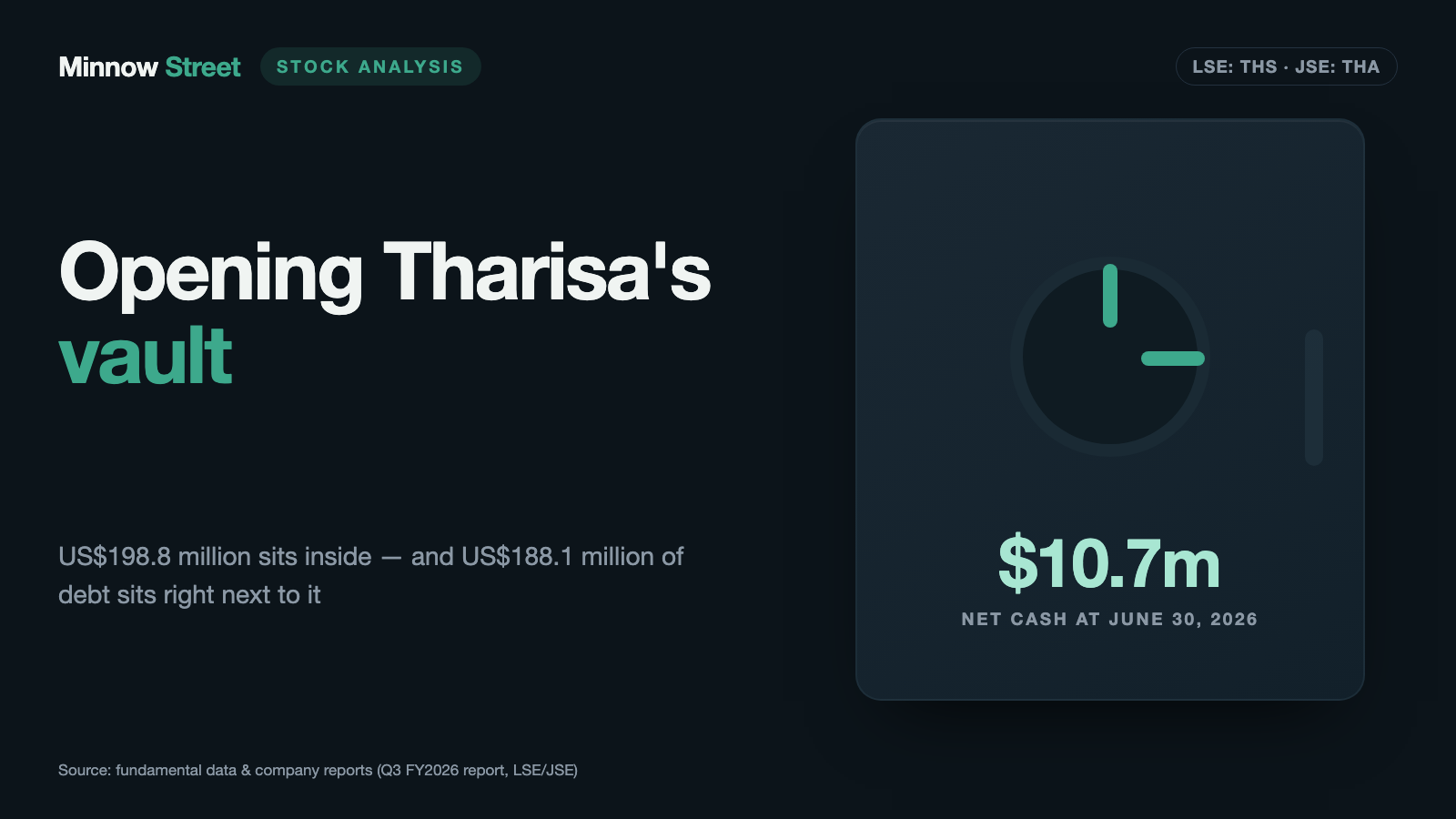
Do you know the anchoring effect? The first number we see shapes our whole judgment — everything after gets measured against it. Read this sentence from a production report: "cash on hand of $198.8 million." Sounds like a well-stocked vault, doesn't it? That is exactly the trap. Right next to it sits a second sentence our eyes love to skip: "debt of $188.1 million." Net the two together and this vault holds just $10.7 million in real net cash — and only three months earlier, it held $54.0 million.
So let's make a deal: before we let the first number impress us, we open the vault together and count both sides. The stock is Tharisa plc (London Stock Exchange: THS, Johannesburg Stock Exchange: THA), a Cyprus-registered mining group with its core operation in South Africa. And one more thing up front, because honesty matters here: a newsletter held this stock in its own model portfolio — and was stopped out at the exact price it paid going in. By the end of this piece, you decide what any of that means for you.
What Tharisa Actually Does — and Why "UK" on the Label Is Misleading
Tharisa plc is registered in the Republic of Cyprus (company registration number HE223412, registered office in Paphos) — not a British company, even though some newsletter listings tag it "GB." That tag comes solely from its secondary listing on the London Stock Exchange; operationally, Tharisa has nothing to do with the United Kingdom. The core business sits in South Africa: the Tharisa Mine, on the south-western limb of the Bushveld Complex, co-produces platinum group metals (platinum, palladium, rhodium — together called "PGMs") and chrome concentrate from the same ore, using what the company calls a "co-product business model." That's the real trick of the business: when platinum prices soften, chrome often carries the load, and vice versa.
Since March 31, 2026, a second growth leg has joined the same site: that day, Tharisa fired the first blast at the "Apollo portal" — the start of a transition from open-pit to underground mining meant to extend the mine's life well beyond its current open-pit phase. In parallel, subsidiary Karo Mining Holdings plc is building the Karo Platinum Project on the Great Dyke in Zimbabwe, a tier-one PGM asset in which Tharisa most recently raised its stake to 78.81 percent (as of March 31, 2026, up from 78.17 percent at the September 30, 2025 fiscal year-end). Rounding out the group is Redox One, a small but notable diversification: a subsidiary developing iron-chromium redox flow batteries for long-duration energy storage — literally using the same commodities Tharisa mines.
At the top sits the founding Pouroulis family: Loucas Pouroulis as Executive Chairman, his son Phoevos Pouroulis as Chief Executive Officer. That family-held dual leadership structure is about to run into new rules (more on that later). The Chief Finance Officer, Michael Jones, is retiring on July 31, 2026 after 13 years; his successor is Jacques Breytenbach, previously CFO of diamond producer Petra Diamonds for eight years.
Why There Is No SEC Filing Here
One point up front, because it shapes the whole evidence base of this analysis: Tharisa has no 10-K, no 10-Q, no 20-F. The U.S. securities regulator, the SEC, lists Tharisa under CIK 0002133810 — but the only documents on file there are a Form F-6 dated May 22, 2026 and its effectiveness notice (EFFECT) dated June 3, 2026. That is not a reporting obligation; it is the pure registration of a newly established Level 1 American Depositary Receipt programme (ADR code THARY, depositary bank J.P. Morgan) — an instrument that makes it easier for U.S. investors to buy the stock but does not trigger SEC reporting duties. An older, unsponsored OTC line also exists under the ticker TIHRF.
Tharisa's primary listing is on the Johannesburg Stock Exchange (ticker THA), its secondary listing on the London Stock Exchange (ticker THS, in the "Equity Shares (Transition) Category" — a transitional listing tier, not a full premium listing), plus a line on South Africa's alternative exchange, A2X. Mandatory disclosures run through the JSE's SENS system and the LSE's RNS service. This analysis is built on the interim financial statements for the six months ended March 31, 2026, reviewed by BDO Limited (unmodified review conclusion), and the audited annual financial statements for the year ended September 30, 2025 — both IFRS statements. Data attribution throughout is therefore fundamental data & company reports (interim/annual report, LSE/JSE) — not "SEC filings," which simply do not exist here.
Another stock in this series runs into the same issue: in our ACG Metals stock analysis, a copper and precious-metals producer also trades on the London Stock Exchange in British pence, with no SEC reporting obligation at all — a pattern that is closer to the rule than the exception among European and African commodity stocks.
Where This Stock Landed on Our Desk — a Recommendation That Went Nowhere
Honesty first: our in-house stock scanner does not know Tharisa — the scanner universe covers U.S.-listed stocks first and foremost, and a Cyprus-registered company listed in London and Johannesburg does not show up there. Instead, this stock landed on our desk via a reader tip: issue 24 of the German-language newsletter "Hot Stocks Europe", dated November 28, 2025 (B-Inside International Media GmbH, Freiburg, Germany). The newsletter itself discloses in its fine print that the publisher, the author, or related parties may hold long positions in stocks covered and may intend to sell as prices rise (EU Market Abuse Regulation, No. 596/2014) — a conflict-of-interest disclosure we pass along here explicitly.
In the newsletter's model portfolio (started December 13, 2024 with EUR 100,000), Tharisa appears with this line: bought on July 18, 2025 at GBP 1.06 per share (20,000 shares), stop price also set at GBP 1.06 — marked "stopped out" as of November 28, 2025. Unlike the model portfolio's winners in the same issue (Pharming Group up 63.7 percent, SolGold up 71.4 percent), this position delivered exactly zero: no gain, no loss, just a position that hit its stop after presumably rising first and having that stop trailed up to breakeven. That is, frankly, the least interesting outcome a model portfolio can produce — and precisely for that reason, the most honest one: as of this analysis's valuation date (July 24, 2026), Tharisa trades on the London Stock Exchange at GBP 1.13 — roughly 6.6 percent above that original entry price. Anyone who had simply stayed the course would be modestly ahead today; anyone who followed stop-loss discipline avoided a loss but also missed the later recovery. Both are legitimate strategies — just not the success story the newsletter itself markets elsewhere in the same issue.
For context on what kind of publication this is: the same issue also covered DPM Metals (known as Dundee Precious Metals until September 2025), another commodity stock with no SEC reporting obligation that we already covered in our DPM Metals stock analysis. There too, the newsletter supplied the hook, never the numbers.
One Stock, Three Currencies: Pence, Rand Cents, and U.S. Dollars
Before we get to the numbers, a warning that matters especially here: this stock trades on the London Stock Exchange in British pence (GBX), on the Johannesburg Stock Exchange in South African rand cents (ZAC) — and reports its financial results in a third currency, U.S. dollars. As of the July 24, 2026 valuation date, the stock closed in London at 113.00 pence (GBP 1.13); on the Johannesburg exchange, the last available close (July 23, 2026) was 2,450 rand cents (ZAR 24.50); an older, unsponsored OTC dollar line (TIHRF) closed at $1.48 on July 24, 2026.
With 296,290,377 voting shares outstanding (as of March 31, 2026, out of 302,596,743 total shares issued, the remainder held in treasury), that produces three market capitalizations that broadly confirm each other: roughly GBP 334.8 million (London), roughly ZAR 7.26 billion (Johannesburg), and roughly $438.5 million (the OTC dollar line). After conversion, all three sit within a few percent of each other — itself a small confidence check: a stock with three listings can easily let a stale or mis-converted figure slip through unnoticed.
The Numbers Over the Years — What Genuinely Impresses
First, what genuinely impresses: for the six months ended March 31, 2026, Tharisa reported revenue of $359.4 million (prior-year period: $280.8 million), up 28.0 percent. That was driven mainly by the average PGM basket price, which rose 85.3 percent to $2,599 per ounce, alongside a 17.2 percent increase in ounces produced (73.1 thousand ounces). Gross profit climbed from $39.9 million to $108.9 million (margin up from 14.2 to 30.3 percent), and EBITDA more than doubled to $104.3 million. The bottom line showed net profit of $46.6 million (up 468.3 percent) and earnings per share of 15.8 US cents (up 532.0 percent).
The two segments contributed very differently: the PGM segment delivered $169.6 million in revenue (up 130.9 percent) with gross margin jumping from a thin 6.2 percent to a healthy 36.6 percent — the year's PGM price surge flowed straight through here. The chrome segment delivered $186.5 million in revenue (down 3.3 percent on lower tonnes sold) but still improved margin from 17.4 to 24.6 percent. Operating cash flow nearly tripled to $96.4 million. The board raised the interim dividend from 1.5 to 2.5 US cents per share (up 66.7 percent), paid on June 24, 2026.
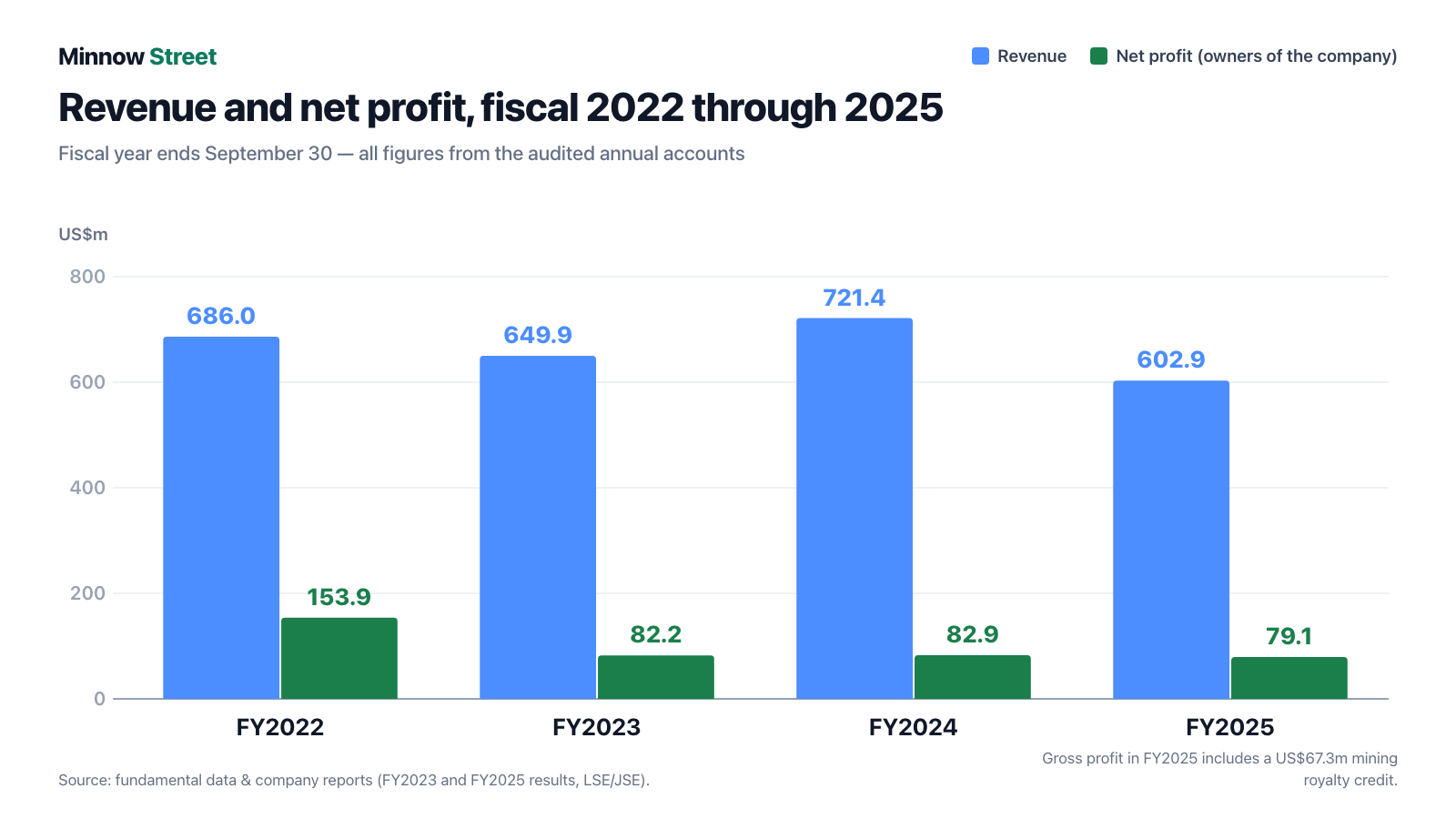
Over the multi-year run, fiscal 2022 stands out as the record year (revenue $686.0 million, net profit $153.9 million, in an unusually strong commodity year), after which revenue and profit normalized to a lower but steady level around $80 million in annual net profit. Fiscal 2025 stands out again — not because operations suddenly performed so much better, but for a reason we'll examine closely next.
What the Filings Actually Show — the Uncomfortable Truths
Uncomfortable Truth No. 1: The Vault Is Emptying Faster Than It Fills
Back to the anchoring effect from the opening. In its production report for the third quarter of fiscal 2026 (the quarter ended June 30, 2026, published July 14, 2026), Tharisa states: cash on hand of $198.8 million (March 31, 2026: $184.3 million), debt of $188.1 million (March 31, 2026: $129.6 million), resulting in a net cash position of just $10.7 million (March 31, 2026: $54.7 million). For comparison, the reviewed interim financial statements themselves show net cash of $54.0 million as of March 31, 2026 ($54,025 thousand exactly) — a small $0.7 million gap versus the company's own, unaudited comparative figure in the later report, one we cannot resolve further but one that doesn't change the overall picture.
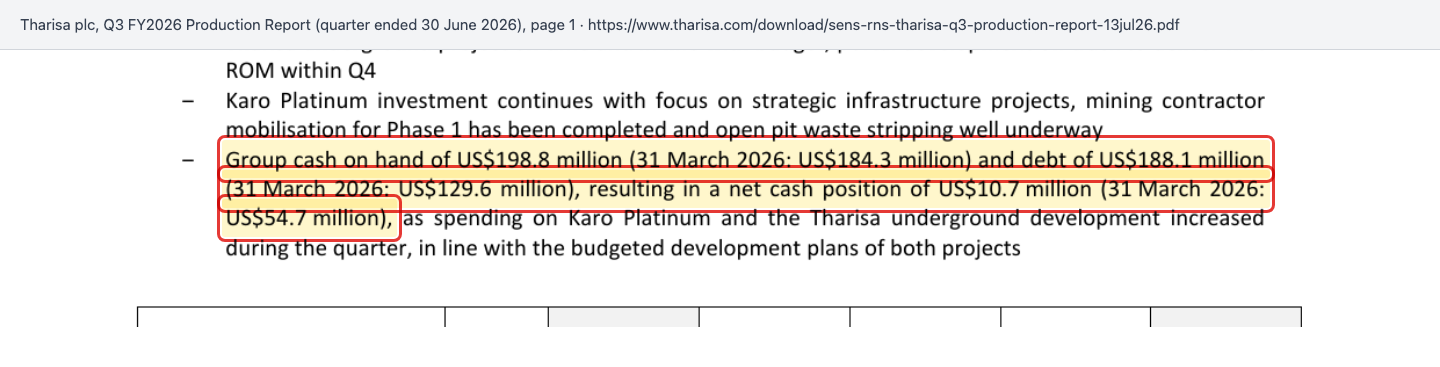
What makes these numbers so instructive: cash actually grew during the quarter (from $184.3 million to $198.8 million) — anyone reading only that one line sees a company doing splendidly. Debt grew even faster over the same period (from $129.6 million to $188.1 million), because, per the company, a previously agreed $80 million loan for the new underground mine was drawn down while spending on Karo Platinum and the underground development simultaneously accelerated. Neither project is anywhere near finished — more on that shortly. Remember this one: a growing cash line is only half the balance sheet — the debt line right next to it decides whether the vault is filling up or draining out.
Uncomfortable Truth No. 2: A Large Share of the 2025 "Record" Year Is a Court Ruling, Not Mining
Gross profit for fiscal 2025 (year ended September 30, 2025) came to $191.3 million on revenue of $602.9 million and cost of sales of $478.9 million. That looks like a solid 31.7 percent margin — until you look inside the income statement and find a line item that has no business appearing in a mining company's accounts: "Mining royalty reversal," plus $67.3 million.
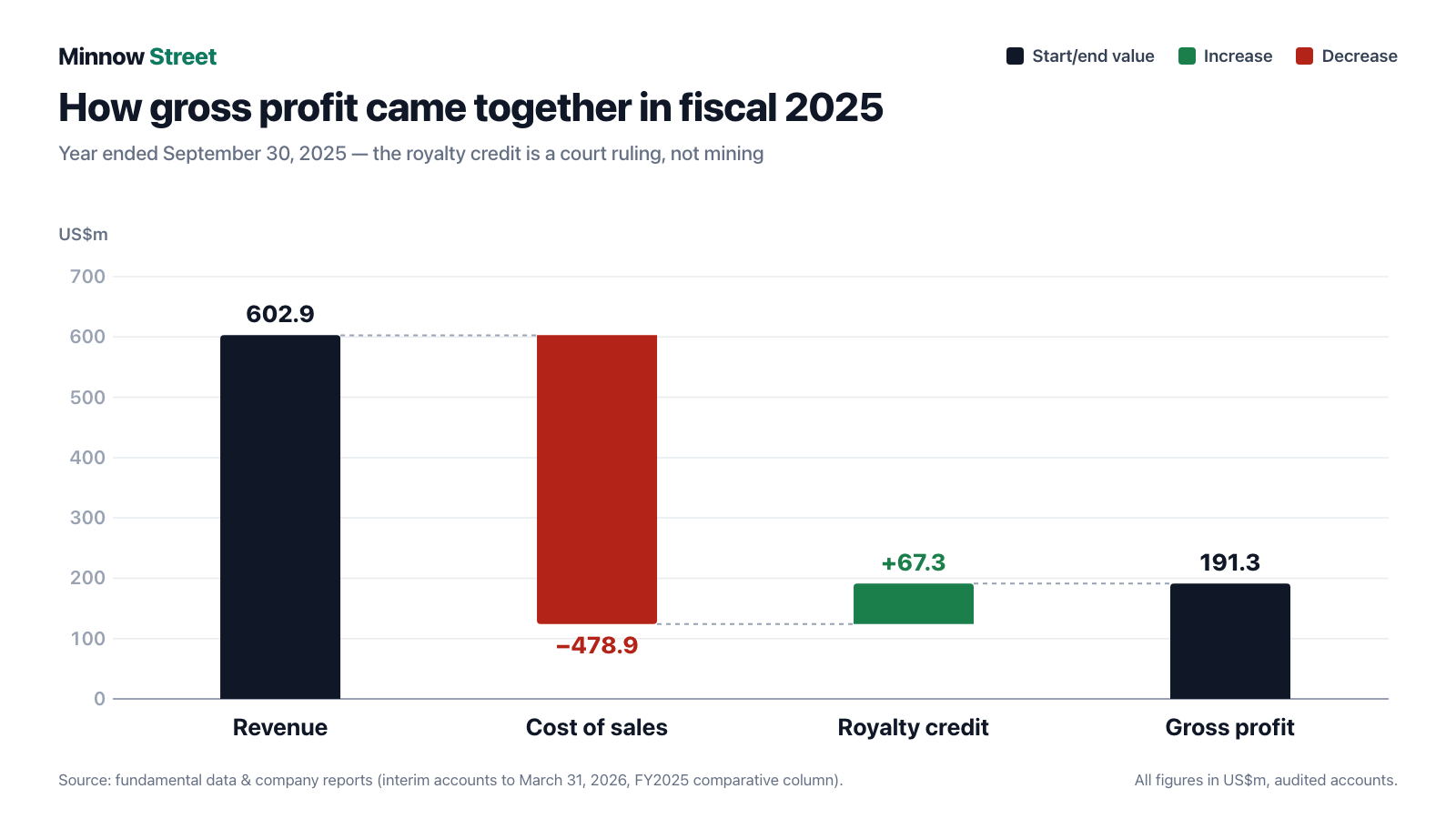
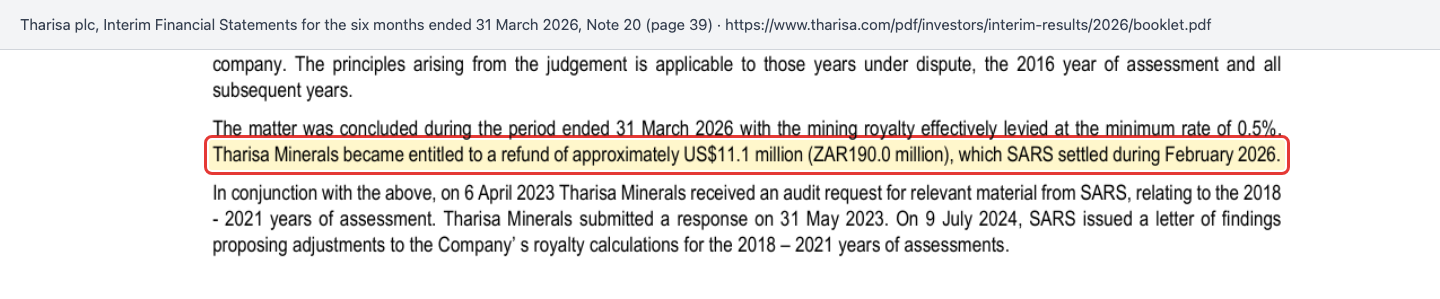
What happened? Subsidiary Tharisa Minerals had challenged tax assessments from South Africa's revenue service, SARS, for the 2015 and 2017 tax years — a dispute over the calculation method for a mining-specific royalty on platinum group metals. On September 8, 2025, South Africa's Tax Court ruled in Tharisa Minerals' favor and ordered SARS to redetermine its methodology by accounting for the "operational realities on recoveries and related costs." As a result, Tharisa fully reversed a previously raised $56.8 million provision and booked a slightly larger $67.3 million net credit to income — including an actual cash refund of roughly $11.1 million that SARS settled in February 2026.
"Tharisa Minerals became entitled to a refund of approximately US$11.1 million (ZAR190.0 million), which SARS settled during February 2026."
— Tharisa plc, H1 FY2026 interim financial statements, Note 20 "Provisions," p. 39
That is a real, documented cash payment — not accounting cosmetics. But it is also a one-off event tied to a court case, not a recurring operational improvement. Without it, fiscal 2025 gross profit would have been roughly $124.0 million (a 20.6 percent margin, not the reported 31.7 percent) — closer to prior years than the headline number suggests. And the story is not over: in the same note, Tharisa discloses that SARS has already opened a second, larger review round for the 2018-2021 tax years, using the same disputed calculation principles — the prescription period for that round was most recently extended to August 31, 2026, and a response is still pending.
Uncomfortable Truth No. 3: Karo Platinum Still Needs Roughly $59 Million Nobody Has Committed
In the financial review of its interim results, Tharisa describes the state of the Karo Platinum Project in Zimbabwe this way:
"The Group remains committed to the development of the Karo Platinum Project having invested a total of US$241.0 million. The funding required for project completion – being measured as first ore in mill – is approximately US$300.0 million."
— Tharisa plc, H1 FY2026 interim financial statements, Financial Review, "Karo Mining Holdings," p. 9
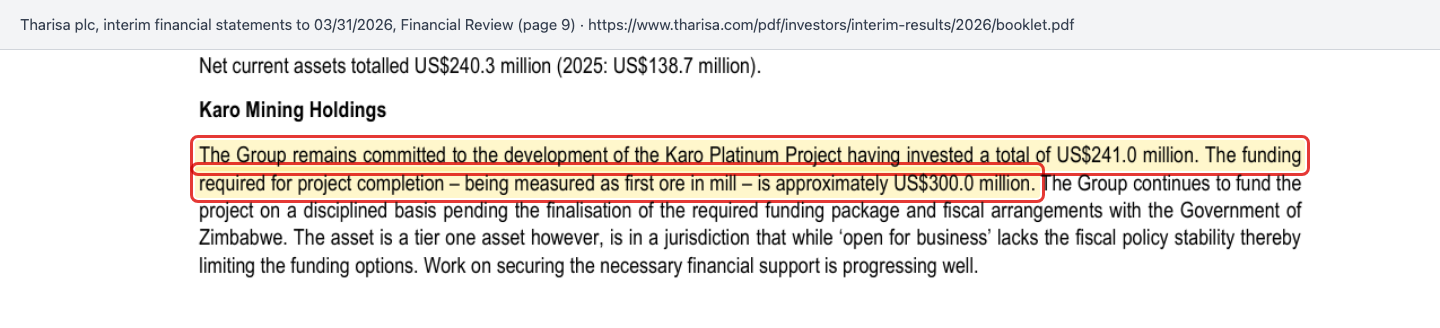
Do the math: $300.0 million minus $241.0 million leaves an open funding gap of roughly $59 million — at a group whose own net cash most recently stood at just $10.7 million (see Uncomfortable Truth No. 1). Tharisa itself names two open items standing between here and that money flowing: a not-yet-finalized funding package and a not-yet-signed fiscal arrangement with the government of Zimbabwe. Worth noting the company's own choice of words: it describes Zimbabwe as a location that is "open for business" but lacking fiscal policy stability — a remarkably candid admission for a country that has already absorbed more than a quarter of the group's entire balance sheet.
Added complexity: the Karo entities were initially awarded a Special Economic Zone licence (a 15 percent corporate tax rate instead of the standard 24.72 percent) — before Zimbabwe changed the law to exclude mining companies from that benefit. Tharisa obtained legal advice that the change cannot apply retroactively, continues to apply the 15 percent rate, and expects a favorable resolution; in parallel, an application is pending to convert the existing Mining Lease into a 25-year "Special Mining Lease" that would lock in the same favorable tax rate for the full term — already gazetted, but not yet finalized with the government.
Valuation — Cheap on Paper, With Two Open Bills
On a trailing-twelve-month basis (H1 FY2026 interim figures plus FY2025 full-year figures minus H1 FY2025 interim figures), Tharisa's rolling revenue comes to roughly $681.5 million and rolling earnings per share to roughly 40.0 US cents. At a price of $1.48 (the OTC dollar line, July 24, 2026), that implies a price-to-earnings ratio of roughly 3.7 and a price-to-sales ratio of roughly 0.6 — on the surface, a very cheap valuation for a growing commodity producer. Dividing enterprise value (market cap minus net cash of $10.7 million) by rolling EBITDA of roughly $247.8 million produces a multiple of only about 1.7 — unusually low for a growing, largely debt-manageable company.
That cheapness comes with context, though: the total fiscal 2025 dividend of 3.0 US cents per share was a third below the prior year's 4.5 US cents — a sign that the market, and apparently the company itself, is pricing in more caution than two years ago, when fiscal 2022 still paid out a total of 7.0 US cents. The three brokers accompanying Tharisa — Peel Hunt, BMO Capital Markets, and Berenberg — are paid corporate joint brokers, not independent research houses; we are not aware of any current, independent price target for Tharisa itself. The newsletter that served as this analysis's hook doesn't name a price target for Tharisa either, only the stop-out already described.
Opportunities and Risks at a Glance
What speaks for Tharisa:
- A real, growing business: H1 FY2026 revenue up 28.0 percent, EBITDA margin doubled from 15.6 to 29.0 percent, operating cash flow nearly tripled to $96.4 million — driven by a higher PGM basket price, but also by genuine operational improvement in both segments.
- A solid capital structure despite rising debt: an equity ratio of roughly 65.9 percent (March 31, 2026), interest coverage from operating profit above twelve times, no going-concern warning, no negative equity.
- Two independent growth projects at the same site: the new underground mine (first blast March 31, 2026, fully funded according to the company) extends the existing Tharisa Mine's life well beyond its current open-pit phase.
- A won tax case with a real cash refund ($11.1 million in February 2026) and a favorable precedent for future royalty calculations.
- Three mutually confirming market capitalizations (London, Johannesburg, OTC dollar trading) suggest a liquid, actively traded stock without an obvious mispricing across venues.
What speaks against it:
- Net cash melted from $54.0 million to $10.7 million within a single quarter while two capital-intensive megaprojects (the underground mine, Karo Platinum) run simultaneously — a thin buffer for unexpected cost overruns or a commodity price downturn.
- Karo Platinum still needs roughly $59 million to reach first ore in mill, according to the company — neither fully financed nor tax-secured with the government of Zimbabwe, a country Tharisa itself says lacks "fiscal policy stability."
- A significant share of the reported fiscal 2025 record result ($67.3 million of $191.3 million gross profit) came from a one-off court ruling, not ongoing operations — and a second, potentially larger tax dispute for 2018-2021 remains open.
- Concentrated operational risk: practically all cash flow comes from a single South African mine, while the largest growth project sits in a neighboring country the company itself describes as fiscally and politically unstable.
- A governance overhaul is coming: under a new Johannesburg Stock Exchange rule, Tharisa must dissolve its "Executive Chairman" dual role (currently held by the company's founder) by December 31, 2026 — on top of an already-underway CFO transition.
A Human Conclusion
Back to the anchoring effect from the opening, and to the model-portfolio position that went nowhere. A newsletter bought Tharisa, got stopped out at its own entry price — and the stock kept climbing afterward without the position benefiting at all. Anyone reading only the headline "$198.8 million in cash" today falls into the same trap as anyone who only sees the first number: the second line — $188.1 million in debt — belongs right alongside it, and in the end only $10.7 million of genuine reserve remains.
What's left is a company with a functioning, growing core business and a fundamentally solid balance sheet — plus two open items (a funding gap in Zimbabwe, a second tax dispute in South Africa) that could each take years to resolve. Both things are true at once. What you make of that is your decision. And that's exactly as it should be.
Sources
All original documents used in this analysis, for you to check yourself:
- Tharisa plc — interim financial statements for the six months ended March 31, 2026 (review conclusion BDO Limited, May 20, 2026, published May 21, 2026)
- Tharisa plc — short-form H1 FY2026 interim results announcement (May 21, 2026)
- Tharisa plc — Q3 FY2026 production report, quarter ended June 30, 2026 (July 14, 2026)
- Tharisa plc — audited annual results for the year ended September 30, 2025 (published December 1, 2025) and for the year ended September 30, 2023, both via tharisa.com/reporting-and-results.php
- Tharisa plc — SENS/RNS: mining royalty Tax Court judgment (October 6, 2025)
- Tharisa plc — SENS/RNS: Nedbank funding facility for the underground mine (June 25, 2026), CFO succession announcement (April 22, 2026), and voting rights notification (April 1, 2026), all via tharisa.com/investors.php
- SEC EDGAR — CIK 0002133810: Form F-6 (05/22/2026) and EFFECT notice (06/03/2026), no reporting obligation
- "Hot Stocks Europe," issue 24, dated November 28, 2025 (B-Inside International Media GmbH) — the hook for this analysis, not a source for company figures.
- Fundamental data (price and market data; data as of July 23-24, 2026), cross-checked against Tharisa's original company reports.
Transparency & disclaimer: This analysis is journalistic commentary on publicly available information. It is not investment advice, not a regulated financial analysis, and not a solicitation to buy or sell securities. Equity investments carry substantial risk, including total loss; a stock listed on three exchanges in three different currencies carries additional currency risk. Details on the progress of the Karo Platinum Project and the outcome of ongoing tax disputes can change at any time. All information is provided without guarantee; the date of each data point is noted in the text. The author holds no position in Tharisa plc shares as of publication. The newsletter used as this analysis's hook, "Hot Stocks Europe," itself discloses possible conflicts of interest: the publisher, the author, or related parties may hold long positions in stocks covered and may intend to sell as prices rise (EU Market Abuse Regulation, No. 596/2014).
Our Bottom Line at a Glance
- Operating momentum positive
- H1 FY2026 revenue (six months ended 03/31/2026) up 28.0 percent to $359.4 million, EBITDA margin doubled from 15.6 to 29.0 percent, operating cash flow nearly tripled to $96.4 million. Both segments (PGMs, chrome) improved gross margin significantly, driven by an 85.3 percent rise in the PGM price but also by genuine operational improvement.
- FY2025 earnings quality negative
- Of the reported fiscal 2025 gross profit ($191.3 million), $67.3 million came from a one-off provision reversal after a won tax case (mining royalty dispute for 2015/2017), not from ongoing mining operations. Without it, gross profit would have been roughly $124.0 million. A second, potentially larger tax dispute for the 2018-2021 tax years remains unresolved with SARS (extended to 08/31/2026).
- Balance sheet & liquidity trend neutral
- The equity ratio is solid at roughly 65.9 percent (03/31/2026), with no going-concern warning and no governance breaches. Within a single quarter, however, net cash fell from $54.0 million to just $10.7 million (06/30/2026) as debt grew faster than cash — an open operational question whether this trend continues as the two ongoing megaprojects keep absorbing capital.
- Karo Platinum funding gap negative
- Of the roughly $300.0 million total needed to reach first ore in mill, only $241.0 million has been invested; the remaining roughly $59 million is neither fully financed nor is the fiscal arrangement with the government of Zimbabwe signed. Tharisa itself describes Zimbabwe as lacking fiscal policy stability.
- Valuation neutral
- Trailing price-to-sales of roughly 0.6, price-to-earnings of roughly 3.7, enterprise value to EBITDA of roughly 1.7 — cheap on paper for a growing commodity producer. Total dividends fell, though, from 7.0 US cents (FY2022) over several years to 3.0 US cents (FY2025); we are not aware of a current independent price target, and the accompanying brokers are paid corporate advisers, not neutral research houses.
- Governance & ownership neutral
- The founding family's dual leadership (Executive Chairman Loucas Pouroulis, CEO Phoevos Pouroulis) must be dissolved by 12/31/2026 under a new JSE rule; in parallel, an already-announced, orderly CFO transition is underway (Michael Jones retiring after 13 years, successor Jacques Breytenbach from 08/01/2026) — both disclosed, scheduled processes with no sign of a breakdown.
Tharisa is the anchoring effect in its purest form: read only the headline "$198.8 million in cash" and you miss the $188.1 million in debt sitting right next to it — in the end, just $10.7 million of genuine net reserve remains, down from $54.0 million a single quarter earlier. The operating business is growing and genuinely profitable, but a large share of the fiscal 2025 record came from a one-off tax ruling, and the Zimbabwe growth project still needs roughly $59 million in unsecured funding. Not investment advice.
What Our Rating Means
Open questions
The business works in principle, but one material question is open. As long as it stays open, our findings do not carry a quality verdict.
The core business holds up: the Tharisa Mine is genuinely profitable, the equity ratio of roughly 65.9 percent is solid, there is no going-concern warning, no negative equity, and no governance or accounting breach. Two material operational questions remain open, though: whether net cash, which fell to $10.7 million within a single quarter, stabilizes as two capital-intensive megaprojects keep running, and whether the roughly $59 million funding gap for Karo Platinum gets closed in a country the company itself describes as fiscally unstable. Both are solvable but unproven operational questions — not a substance finding that threatens the group's existence. That is precisely the definition of yellow, not green. That the one-off tax credit flattered the fiscal 2025 picture doesn't change that call, but it does change the right comparison base for future years. The decision is yours.
A journalistic assessment by our editorial team at the time of the deep dive, based on public sources — not investment advice and not a solicitation to buy or sell. Your personal circumstances (investment goals, risk capacity, taxes) cannot be taken into account. What our levels mean, how verdicts are formed, and what conflicts of interest exist →
Worth Noting
- Hook: newsletter "Hot Stocks Europe," issue 24, dated 11/28/2025 (B-Inside International Media GmbH), forwarded by a reader. Model-portfolio position: bought 07/18/2025 at GBP 1.06, stopped out at GBP 1.06 (as of 11/28/2025) — neither gain nor loss. The newsletter itself discloses possible conflicts of interest (long positions held by the publisher/author, EU Market Abuse Regulation No. 596/2014); no price target from the newsletter was adopted, because none was given for Tharisa itself.
- Tharisa is not an SEC filer: no 10-K, no 10-Q, no 20-F. This analysis rests on the reviewed interim financial statements as of 03/31/2026 (review conclusion BDO Limited, 05/20/2026), the audited FY2023 and FY2025 annual results, and the unaudited Q3 FY2026 production report (07/14/2026, a directors' responsibility). Quotes were checked verbatim against the original PDFs.
- No company row was added to our own database: a stock outside the U.S. scanner universe, trading in three currencies (pence, rand cents, U.S. dollars), would distort scanner thresholds built for U.S.-dollar listings. The three market capitalizations (London, Johannesburg, OTC dollar trading) were cross-checked against each other and confirm one another within a few percent.
Frequently Asked Questions
Tharisa plc (London Stock Exchange: THS, Johannesburg Stock Exchange: THA) is a Cyprus-registered mining group that co-produces platinum group metals (platinum, palladium, rhodium) and chrome concentrate at the Tharisa Mine in South Africa's Bushveld Complex. It is also building the Karo Platinum Project in Zimbabwe through subsidiary Karo Mining Holdings, and developing iron-chromium redox flow batteries through subsidiary Redox One.
No. Tharisa plc is registered in the Republic of Cyprus (company registration number HE223412, registered office in Paphos). The "GB" tag seen on some newsletter listings comes solely from its secondary listing on the London Stock Exchange; operations are entirely in South Africa (mining) and Zimbabwe (the Karo Platinum Project under construction). The stock's primary listing is on the Johannesburg Stock Exchange.
Because Tharisa is not a U.S. reporting company. The only documents on file with the U.S. securities regulator, the SEC (Form F-6 dated May 22, 2026, effective June 3, 2026), register a new Level 1 ADR programme for U.S. investors without triggering reporting obligations. This analysis instead relies on the reviewed interim financial statements and audited annual accounts, published via the mandatory disclosure systems SENS (Johannesburg) and RNS (London).
Between March 31, 2026 and June 30, 2026, gross cash actually rose from $184.3 million to $198.8 million, but debt rose even faster, from $129.6 million to $188.1 million — mainly because a previously agreed $80 million loan for the new underground mine was drawn down while spending on the Karo Platinum Project accelerated. Net cash fell to just $10.7 million as a result.
A South African Tax Court ruled in favor of Tharisa Minerals on September 8, 2025, in a dispute with the revenue service, SARS, over the calculation of a mining royalty for the 2015 and 2017 tax years. Tharisa then fully reversed a provision, booked a net $67.3 million credit to income, and received an $11.1 million cash refund in February 2026. A second, still-unresolved review round with SARS is already underway for the 2018-2021 tax years.
As of March 31, 2026, Tharisa had invested $241.0 million in Karo Platinum. Total funding needed to reach first ore in mill is approximately $300.0 million, per the company — the remaining roughly $59 million is neither fully financed nor is the fiscal arrangement with the government of Zimbabwe finalized.
Three, actually: British pence (GBX) on the London Stock Exchange (113.00 pence on 07/24/2026), South African rand cents (ZAC) on the Johannesburg Stock Exchange (2,450 rand cents on 07/23/2026), and U.S. dollars over the counter ($1.48 on 07/24/2026). The company reports its financial results entirely in U.S. dollars.
The newsletter bought Tharisa on 07/18/2025 at GBP 1.06 per share and, as of 11/28/2025, was stopped out at that exact same price — no gain, no loss. As of this analysis's valuation date (07/24/2026), the stock trades in London at GBP 1.13, roughly 6.6 percent above that original entry price.
Found an error?
Did you spot a factual error, an outdated number, or a typo in this deep dive? Let us know briefly — your report goes straight to the editorial team.