SUSS MicroTec: Promoted to the MDAX the Same Quarter Its Profit Fell 84 Percent
SUSS MicroTec moved up to the MDAX for the first time on June 22, 2026 — a promotion that index provider STOXX explicitly attributed to the strong share-price performance, not to the operating business. That business told a different story in the very same quarter: operating profit (EBIT) collapsed 83.6 percent to €3.7 million in the first quarter of 2026, while order intake hit a record of €149.3 million. Fiscal 2025 had already closed with record revenue but falling profit, and the company's own outlook for 2026 points to a further decline in both sales and margin. Not a buy or sell recommendation — just two numbers from the same report pointing in opposite directions.
 Thomas Mücke
Founder & Publisher
Thomas Mücke
Founder & Publisher
Chart
Interactive price chart (TradingView).
Note: pure fact-based analysis, not investment advice and not a solicitation to buy or sell. All figures without guarantee.
You know the feeling, maybe from soccer: a club gets promoted to a higher league, and your gut immediately assumes it must now be a better team — even though the roster often hasn't changed much, only the standings have. Call it the promotion illusion, and it's exactly what a lot of investors in SUSS MicroTec SE experienced on June 22, 2026, when the stock moved into the MDAX for the first time in its history — Germany's second tier of blue-chip stocks, one rung below the DAX 40. Index provider STOXX was fairly blunt about why: SUSS MicroTec entered the index under the "Fast Entry" rule, outside the regular review cycle, purely because of the strong share-price performance of recent months. That has nothing to do with a better operating picture, at least not on its own. And at almost exactly the same time, the company itself published numbers pointing the other way. So let's make a deal: we'll read the 2025 annual report and the interim statement as of March 31, 2026 together — and see what's left of the promotion once you look at the numbers behind it. In the end, the decision is yours.
What SUSS MicroTec Actually Does — Tools for the Factories Behind the Chips
SUSS MicroTec SE, headquartered in Garching near Munich (Xetra: SMHN, ISIN DE000A1K0235, WKN A1K023), doesn't build chips itself — it builds the machines other companies use to build chips. Picture a modern chip factory as a giant industrial kitchen: SUSS MicroTec doesn't supply the ingredients, it supplies some of the specialized equipment the cooks use — from tools that apply hair-thin protective coatings to machines that glue two silicon wafers together with micrometer precision.
The business is organized into two segments. Advanced Backend Solutions combines three product lines: "Imaging Systems" (mask aligners and UV projection scanners — essentially high-precision exposure tools that project a circuit pattern onto a wafer, like a slide projector with nanometer accuracy), "Coating Systems" (coating equipment, including inkjet coating — an inkjet-printer-style process that deposits functional protective layers instead of ink), and "Bonding Systems" (temporary and permanent bonders that join two wafers together permanently or temporarily — the gluing technology behind so-called hybrid bonding, used to stack modern memory chips on top of each other). The second segment, Photomask Solutions, cleans and processes photomasks — the "stencils" used to project the circuit pattern onto the wafer in the first place. A single speck of dust on such a stencil can ruin an entire downstream production batch, which makes SUSS MicroTec's cleaning tools a nanometer-precision business in their own right.
As of March 31, 2026, the group employed 1,484 people (December 31, 2025: 1,497). CEO is Burkhardt Frick, whose contract was extended to the end of 2030 in January 2026; CFO is Dr. Cornelia Ballwießer (contract through June 30, 2028), and COO is Dr. Thomas Rohe. The supervisory board is chaired by Dr. David Dean.
Why There's No SEC Filing Here — and Where the Numbers Come From Instead
One point first, because it shapes the entire evidence base of this analysis: there is no 10-K, no 10-Q for SUSS MicroTec. The company is not a U.S. reporting company — an EDGAR search returns no central index number (CIK) or filings under the ticker SMHN, the name SUSS, or the OTC symbol SESMF. SUSS MicroTec's mandatory reports live elsewhere: the stock trades on the Prime Standard of the Frankfurt Stock Exchange, and it was a member of the SDAX until June 21, 2026, before additionally moving into the MDAX on June 22, 2026; per the investor relations page, SUSS MicroTec remains listed on the TecDAX as well. Required disclosures are an audited IFRS consolidated financial statement (Annual Report 2025, published March 30, 2026) and unaudited interim statements with key figures — unlike the U.S. 10-Q, there is no audited balance sheet at quarter-end.
What does that mean for you as a reader? An IFRS annual report signed off by an independent auditor is a document with real legal liability behind it — the same logic that "an audited report is honest under penalty of law" applies here too, roughly speaking. But two things differ. First, the sourcing: every figure in this analysis is tagged "Source: fundamental data & company reports (annual/quarterly report, Prime Standard, Xetra)", not "SEC filings." Second, the level of scrutiny: the interim statements are explicitly labeled "unaudited" and carry less assurance than the full annual report. We read the originals ourselves, marked the key passages, and cited the page. A similar case in our own coverage is the PFISTERER Holding stock analysis — another German Xetra name with no SEC registration, and from the very same newsletter issue.
Where This Stock Landed on Our Desk — a Newsletter, a Price Target, and an Index Switch
Full disclosure first: SUSS MicroTec didn't come from our in-house stock scanner — that tool covers primarily U.S.-listed names. Instead, a reader sent us issue 24 of the "Hot Stocks Europe" newsletter dated November 28, 2025 (B-Inside International Media GmbH, Freiburg, author Michael Calivas), which featured SUSS MicroTec alongside six other European names. The newsletter cited the company's "2030 target" at the time — annual sales growth of 9 to 13 percent to €750–900 million, gross margin of 43–45 percent, EBIT margin of 20–22 percent — plus a "2025 expectation" of €470–510 million in sales at an 11–13 percent EBIT margin, and an mwb Research price target just raised from €48 to €56, at a newsletter-quoted share price of €32.90. UBS reportedly called the targets "bold targets" — a judgment that, as you'll see, held up at least partially in hindsight.
Those figures are a third party's expectation dated November 28, 2025 — not a source for this analysis; every company figure below comes from the 2025 annual report or the interim statement as of March 31, 2026. The company's own annual report largely confirms the newsletter's 2025 forecast: actual 2025 sales of €503.2 million landed in the top third of that range, and the 13.1 percent EBIT margin came in at the upper edge — though only after the company cut its own guidance twice during the year (more on that below). On the 2030 target, the annual report diverges slightly from the newsletter: based on actual 2025 sales, SUSS MicroTec itself now calculates a compound annual growth rate of only 8 to 12 percent through 2030, not 9 to 13 percent as the November 2025 newsletter had it — likely because the newsletter was still working from a lower, not-yet-final sales base. Also worth noting is the conflict-of-interest disclosure the newsletter itself makes on page 8: the publisher and author may hold long positions in stocks discussed and intend to sell as prices rise (EU Market Abuse Regulation No. 596/2014).
And analyst opinion? It has swung dramatically since. UBS initiated coverage in early January 2025 with a "Sell" rating and a €40.30 price target (starting share price then: €53.00) — by the company's own account, that rating had already flipped to "Buy" during 2025, and as of July 10, 2026, UBS carries a €105.50 price target. Eleven analyst houses saw a consensus price target of €99.32 as of July 10, 2026 — up from just €44.91 as of December 31, 2025, more than doubling in a little over six months. That fits our opening theme in another way, too: the November 28, 2025 newsletter framed the European AI cycle mostly around Nokia and data-center infrastructure — SUSS MicroTec's own interim statement as of March 31, 2026 now names "high-bandwidth memory (HBM) for AI chip modules" explicitly as a driver of its own bonding-tool demand (more on that below). For how another name from the same newsletter issue is positioned to benefit from that same cycle, see our Nokia stock analysis.
Then came June 4, 2026: SUSS MicroTec announced in a press release that STOXX had informed the company the evening before — June 3, 2026 — that it would join the MDAX "outside the regular review cycle under the Fast Entry rules" because of the strong share-price performance — first trading day in the index: June 22, 2026. CEO Burkhardt Frick commented:
"The significantly increased valuation of SUSS in recent months underscores the capital market's confidence in our strategic decisions, our Ambition 2030, and the positioning of our company."
— Burkhardt Frick, CEO, SUSS MicroTec SE, press release, June 4, 2026
Worth noting: the CEO himself frames the index promotion around "valuation," not operating figures. What happened to the operating business over that same period is the subject of the next sections.
The Numbers Over the Years — Given Their Due
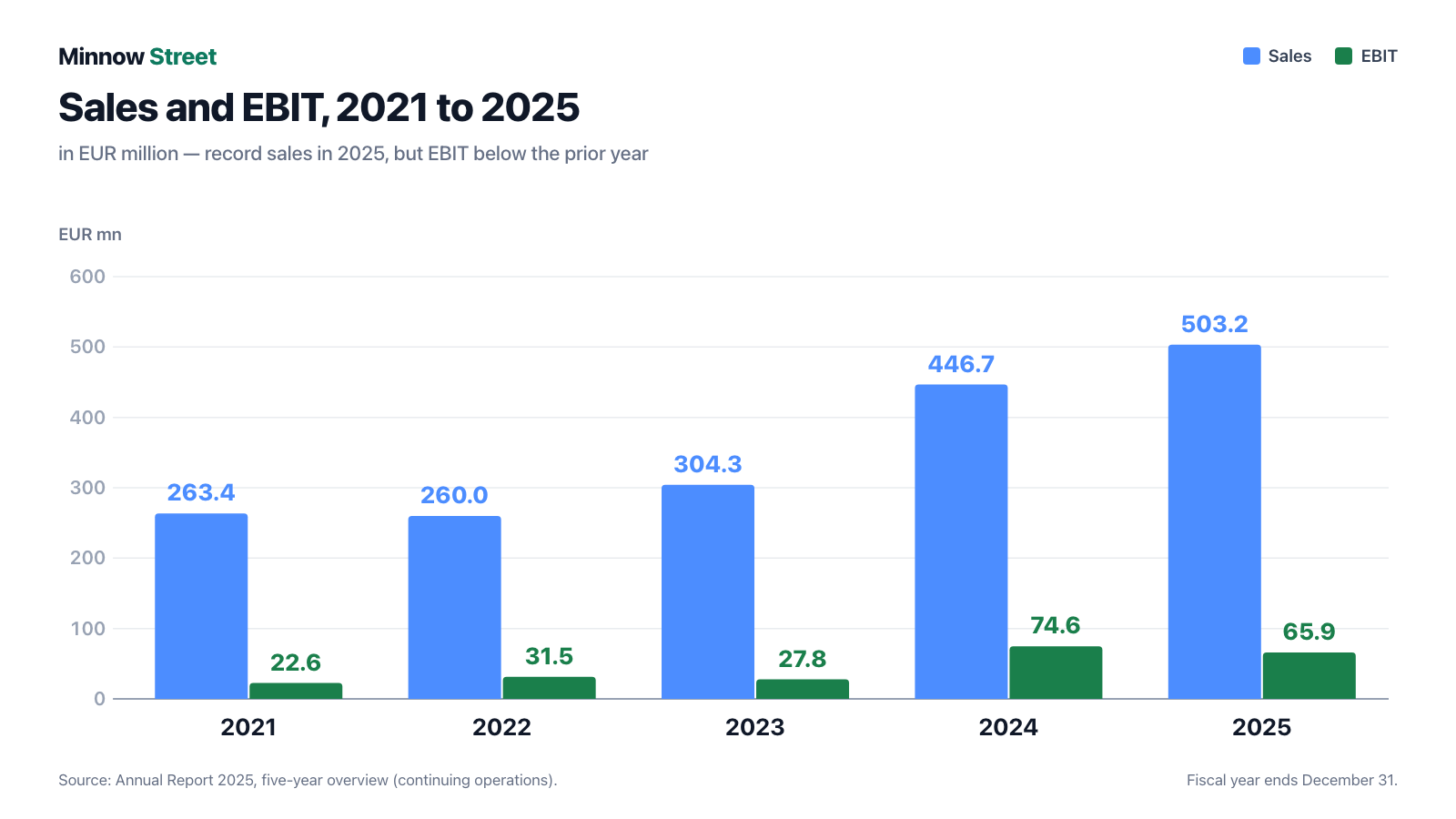
First, what's genuinely impressive: SUSS MicroTec has been growing for years, and 2025 marked a real milestone. Sales climbed from €263.4 million (2021) through €260.0 million (2022) and €304.3 million (2023) to €446.7 million (2024) and finally €503.2 million in 2025 — crossing half a billion euros for the first time, "the highest level in the company's history," as the annual report itself puts it. EBIT tells a less straight-line story: €22.6 million (2021), €31.5 million (2022), €27.8 million (2023), a jump to € 74.6 million (2024) — and then a decline to € 65.9 million in the record year of 2025. Despite the highest revenue in company history, EBIT actually fell year over year.
Net profit is worth a multi-year look too — and a clarification that trips up even some data feeds. In 2024, SUSS MicroTec reported net profit of €110.0 million, well above the €51.7 million earned from continuing operations. The reason isn't a tax effect — it's the sale of the MicroOptics division to Focuslight Technologies (Hong Kong): the result from discontinued operations came to €58.3 million in 2024 and included the gain from that sale. In 2025, it ran the other way: because of disagreements over certain disclosure obligations from that sale, SUSS MicroTec paid a €3.4 million settlement — the discontinued operation therefore showed a €3.4 million loss in 2025. The €46.1 million net profit for 2025 accordingly breaks down into €49.5 million from continuing operations and minus €3.4 million from the MicroOptics aftermath.
What the Reports Show — the Uncomfortable Truths
Uncomfortable Truth No. 1: Record 2025 Sales Came With Two Guidance Cuts and a Falling Margin
SUSS MicroTec started 2025 with high ambitions: the original guidance from March 27, 2025 called for a gross margin of 39–41 percent and an EBIT margin of 15–17 percent. On July 28, 2025, the company cut both ranges to 37–39 percent and 13–15 percent respectively; on October 27, 2025, it cut them again, to 35–37 percent and 11–13 percent. It ultimately landed at 35.7 percent gross margin and 13.1 percent EBIT margin — "slightly above our forecast made in October," as the annual report itself concedes, but well below what had been promised at the start of the year. The annual report describes the result this way:
"EBIT amounted to € 65.9 million in the reporting year as a result of only a moderate increase in gross profit from sales and a simultaneous rise in costs for research and development and administration (previous year: € 74.6 million). Accordingly, the EBIT margin was 13.1% (previous year: 16.7%)."
— SUSS MicroTec SE, Annual Report 2025, Combined Management Report, "Earnings Position," page 37

The report cites one-off effects including the build-out of the new Zhubei (Taiwan) production site, ramp-up costs for higher UV projection scanner output, the termination of a non-strategic development project, and a less favorable customer and product mix. Keep this picture in mind: record revenue says nothing about whether more, or less, actually falls to the bottom line.
Uncomfortable Truth No. 2: The Company's Own 2026 Guidance Calls for a Further Decline — and Q1 Already Delivered
This is where things get uncomfortable for the MDAX promotion narrative. The annual report frames its own expectation for the current year this way:
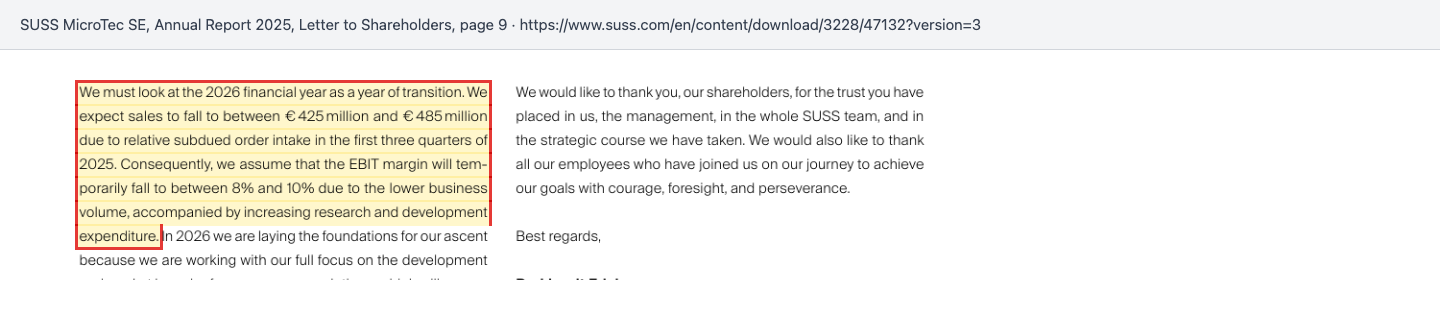
"We must look at the 2026 financial year as a year of transition. We expect sales to fall to between € 425 million and € 485 million due to relative subdued order intake in the first three quarters of 2025. Consequently, we assume that the EBIT margin will temporarily fall to between 8% and 10% due to the lower business volume, accompanied by increasing research and development expenditure."
— SUSS MicroTec SE, Annual Report 2025, Letter to Shareholders, page 9
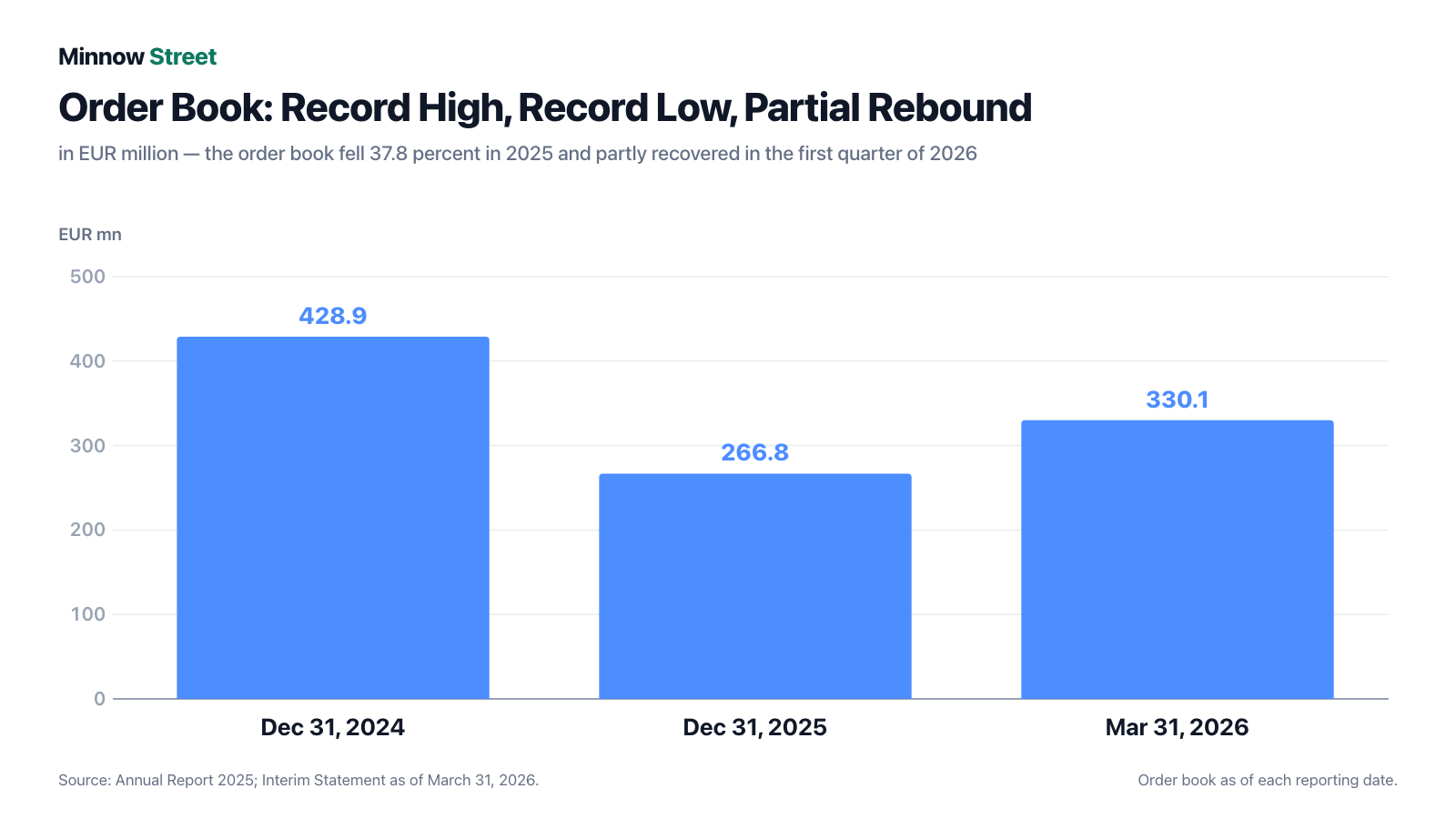
That guidance is dated March 30, 2026 — and the interim statement as of March 31, 2026 (published May 7, 2026) didn't just confirm it, it delivered the first proof. The order book had already fallen from €428.9 million (2024) to €266.8 million by year-end 2025 — a 37.8 percent drop, driven by weak order intake in the second and third quarters of 2025. That dent in the order book reached sales in the first quarter of 2026: €86.5 million, down 30.7 percent year over year.
And EBIT? It fell even harder than sales. The interim statement puts it bluntly:
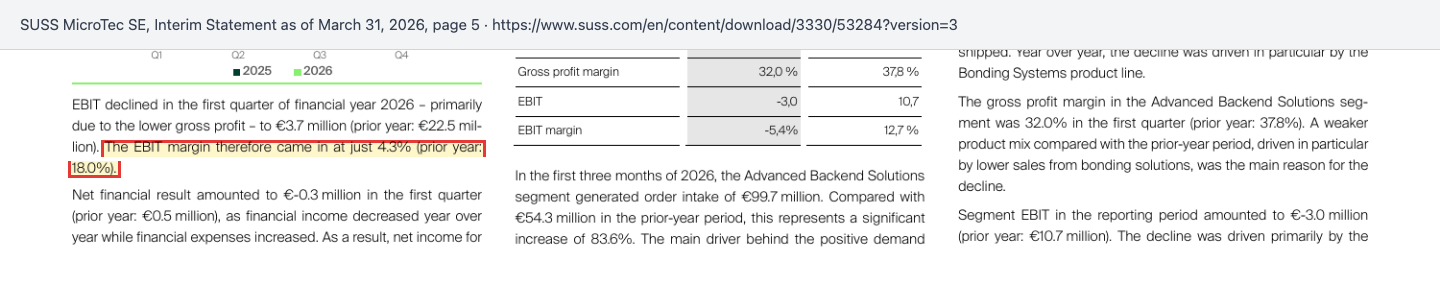
"EBIT declined in the first quarter of financial year 2026 – primarily due to the lower gross profit – to €3.7 million (prior year: €22.5 million). The EBIT margin therefore came in at just 4.3% (prior year: 18.0%)."
— SUSS MicroTec SE, Interim Statement as of March 31, 2026, page 5
Net profit in the first quarter of 2026: €2.5 million, down 84.9 percent from €16.6 million a year earlier; earnings per share fell from €0.87 to €0.13. One bright spot: free cash flow turned positive at €23.2 million in the first quarter of 2026 (prior-year quarter: €8.9 million) — after the full 2025 fiscal year had closed with negative free cash flow of €22.6 million (continuing operations). The company itself reaffirmed its full-year guidance unchanged despite the weak quarter, leaning on the record order intake described below.
Uncomfortable Truth No. 3: The Record Order Intake Depends on a Single Region for 82 Percent of It
What's carrying the outlook is genuinely impressive — but also concentrated in one place. The interim statement reports:
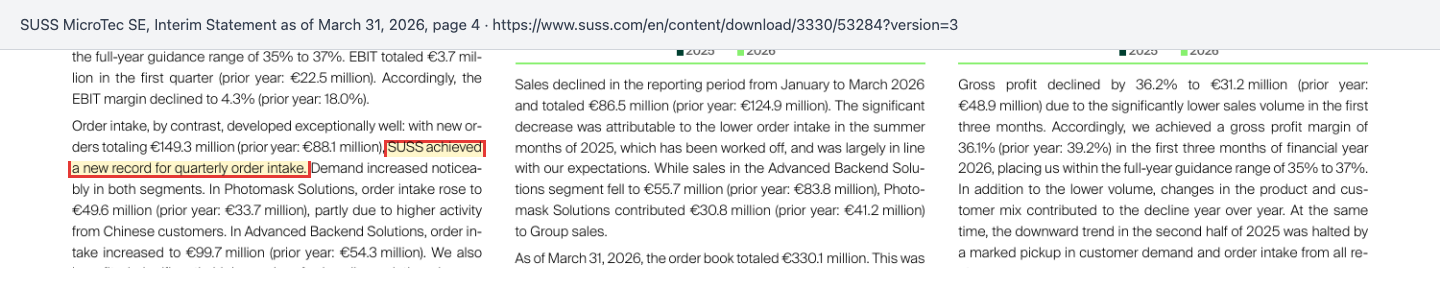
"Order intake, by contrast, developed exceptionally well: with new orders totaling €149.3 million (prior year: €88.1 million), SUSS achieved a new record for quarterly order intake."
— SUSS MicroTec SE, Interim Statement as of March 31, 2026, page 4
CEO Frick put it this way: the company secured "significantly more solutions with the world's leading semiconductor manufacturers, to be deployed in the value chain for AI chip modules." Concretely, demand for temporary bonders and debonders for so-called high-bandwidth memory (HBM) — high-performance memory used in AI accelerators — pushed order intake in the Advanced Backend Solutions segment to €99.7 million (prior year: €54.3 million). This is the very same AI data-center cycle the November 28, 2025 newsletter described mostly around Nokia and European data-center infrastructure — showing up here, independently of the newsletter, straight from SUSS MicroTec's own report, as a hard order driver.
The flip side: of the €149.3 million in order intake in the first quarter of 2026, €121.9 million, or 81.6 percent, came from the Asia-Pacific region (prior-year quarter: 78.8 percent) — EMEA contributed €15.8 million (10.6 percent), North America €11.6 million (7.8 percent). Sales show the mirror image: Asia-Pacific sales fell to €56.2 million in the first quarter of 2026 (prior-year quarter: €105.2 million), while North America nearly doubled to €16.8 million and EMEA grew 21.8 percent to €13.5 million. Put in everyday terms: when eight out of ten new orders come from the same world region — and that region is itself dominated by a handful of very large semiconductor makers — a substantial part of the celebrated record depends on the investment mood of a small group of customers in a single time zone. The order book by segment shows a similar concentration: the Advanced Backend Solutions order book jumped from €185.4 million to €229.8 million in a single quarter (book-to-bill ratio 1.79), and the Photomask Solutions order book rose from €81.4 million to €100.4 million (book-to-bill 1.61) — both comfortably above one, but both also heavily dependent on the current AI investment wave in Asia continuing.
Valuation: The Stock Has Tripled Since Its Low, Analyst Consensus Is Only Now Catching Up
Based on 2025 earnings per share (€2.41, including the MicroOptics aftermath) and a share price of €79.15 (July 24, 2026), the price-to-earnings ratio works out to roughly 33 — on a market capitalization of about €1.51 billion (19,115,538 shares), that puts the price-to-sales ratio at roughly 3.0 based on 2025 revenue. Eleven analyst firms saw a consensus price target of €99.32 as of July 10, 2026 — eight buy ratings, two holds and one sell, with individual targets ranging from €50.00 (Van Lanschot Kempen, unchanged since it initiated coverage in November 2025 — arithmetically the only one of the eleven targets below the current share price) to €125.00 (Berenberg). For comparison: as of December 31, 2025, analyst consensus stood at just €44.91 — meaning the consensus target has more than doubled in a little over six months, with the share price itself having led the way.
The price chart itself reads like a roller coaster: from an opening price of €48.85 (January 2, 2025), the stock first rose to its 2025 high of €53.00 (January 6, 2025), then fell — hit in part by the announcement of cheaper AI models out of China and uncertainty around the U.S. "Liberation Day" tariff policy in April — to as low as €27.00, recovered over the summer, dropped again after the first guidance cut at the end of July 2025, and hit its 2025 low of €24.04 on September 2, 2025. A second guidance cut at the end of October 2025 wiped out an interim recovery; the stock closed 2025 at €39.14 — a 19.5 percent decline for the full year 2025, after a 75.6 percent gain the year before. Since its low on September 2, 2025, the stock has more than tripled by July 24, 2026 (a factor of 3.3).
The actual price peak landed almost exactly on the day of the MDAX promotion: on June 19, 2026 — three trading days before the effective date — the stock closed at €111.70, its high for the year to that point, on trading volume of 579,879 shares (more than four times the 2025 average daily volume of 134,000 shares reported in the annual report). Volume spikes like that right before an effective date are typical when index funds have to rebalance their portfolios to match the new index composition — regardless of what those funds think about the company's operating business. Since then, the stock has fallen back more than a quarter, to the €79.15 mentioned at the outset. Whether the first quarter's record order intake actually turns into a lasting profit recovery, or whether 2026 ends up as the "year of transition" the company itself calls it, will be shown at the earliest by the half-year report on August 6, 2026.
Opportunities and Risks at a Glance
What speaks for SUSS MicroTec:
- A direct beneficiary of the AI investment cycle: the company's own interim statement explicitly names rising bonding orders for high-bandwidth memory (HBM) chips used in AI modules as the driver behind the first quarter 2026 record order intake (€149.3 million, up 69.5 percent).
- A solid balance sheet with extra financing headroom: a 60.7 percent equity ratio (March 31, 2026), €72.0 million in net cash, plus a syndicated credit facility increased to €115 million (from €76 million) since February 2026 that remains undrawn.
- Ambitious but concretely quantified mid-term targets: "Ambition 2030" calls for sales of €750–900 million, a gross margin of 43–45 percent and an EBIT margin of 20–22 percent, backed by planned R&D spending of €360–380 million between 2026 and 2030.
- First-time inclusion in the MDAX (June 22, 2026) raises visibility with institutional investors and can draw structural demand from index-tracking funds.
What speaks against it:
- The company's own guidance for 2026 points to a further decline: sales of €425–485 million (below the 2025 record of €503.2 million) and an EBIT margin of just 8–10 percent (2025: 13.1 percent) — and the first quarter of 2026 already delivered an 83.6 percent EBIT collapse.
- Heavy regional concentration: 81.6 percent of first-quarter 2026 order intake came from the Asia-Pacific region — a pullback in investment appetite there would quickly deflate the celebrated record.
- 2025 profit guidance was cut twice within a single year (July 28 and October 27, 2025); a track record of guidance reliability still has to be rebuilt.
- Because of negative free cash flow in 2025 (minus €22.6 million, continuing operations), management proposes a dividend of just €0.04 per share, down from €0.30 the year before — an 87 percent cut.
- Analyst consensus only caught up with the share price after the fact (€44.91 at the end of 2025 versus €99.32 in July 2026); one house's price target (Van Lanschot Kempen, €50.00) still sits below the current share price.
A Human Conclusion
Back to the promotion illusion from the start. Its core problem isn't that the MDAX inclusion was somehow wrong or invented — SUSS MicroTec genuinely moved into the index on June 22, 2026, based on real, market-cap-based rules. The core problem is that a promotion like this — just like a soccer club moving up a league — describes the recent price action, not automatically the operating quality of the team behind it. The index provider said so itself: STOXX explicitly named the share-price performance as the reason, not revenue or profit. And while the share price peaked almost exactly on the day of the promotion, the operating business in that very quarter showed EBIT collapsing 83.6 percent — on record order intake that depends 82 percent on a single world region. Both things are true, and both belong in the same analysis. So the honest question for you isn't "Does SUSS MicroTec belong in the MDAX?" It's: are you buying the promotion — or the company behind it, with everything the half-year report on August 6, 2026 still has to show? What you make of that is your decision. And that's exactly how it should be.
Sources
All original documents used in this analysis, for you to read yourself:
- SUSS MicroTec SE — Annual Report 2025 (PDF, published March 30, 2026)
- SUSS MicroTec SE — Interim Statement as of March 31, 2026 (PDF, published May 7, 2026)
- SUSS MicroTec SE — Press release: MDAX inclusion (June 4, 2026)
- SUSS MicroTec SE — Investor relations page: analyst price targets and shareholder structure (retrieved July 10/23/26, 2026)
- SUSS MicroTec SE — Financial calendar — half-year report 2026 due August 6, 2026
- Fundamental data (key figures, Xetra price data; as of July 24–26, 2026), reconciled against the annual and interim reports.
- Hook: "Hot Stocks Europe" newsletter, issue 24, dated November 28, 2025 (B-Inside International Media GmbH, Freiburg) — cited as a third party's expectation, not used as a source for company figures.
Transparency & disclaimer: this analysis is a journalistic assessment of publicly available information and is not investment advice, not a financial analysis in the regulatory sense, and not a solicitation to buy or sell securities. Equity investments carry substantial risk, including total loss. All figures are provided without guarantee; the data date is noted in the text where relevant. The author holds no position in SUSS MicroTec shares at the time of publication.
Our Bottom Line at a Glance
- Growth and order momentum neutral
- Record 2025 sales (EUR 503.2 million, up 12.6 percent) and record Q1 2026 order intake (EUR 149.3 million, up 69.5 percent) sit alongside an order book that fell 37.8 percent in 2025 and has only partly recovered since.
- Profitability negative
- The EBIT margin fell from 16.7 to 13.1 percent in 2025, after two guidance cuts during the year. The company's own 2026 guidance points to a further drop to 8-10 percent; the first quarter of 2026 already delivered an 83.6 percent EBIT collapse to EUR 3.7 million.
- Customer concentration and the AI cycle neutral
- 81.6 percent of Q1 2026 order intake came from the Asia-Pacific region, driven by bonding solutions for AI-chip memory (HBM) at a handful of large semiconductor manufacturers. That's a strong tailwind as long as the cycle lasts, but also a significant concentration.
- Balance sheet and financing positive
- A 60.7 percent equity ratio (March 31, 2026), EUR 72.0 million in net cash, no governance or accounting red flags. Since February 2026, an additional syndicated credit line increased to EUR 115 million remains available and undrawn.
- Dividend and cash flow negative
- Because of negative free cash flow in 2025 (minus EUR 22.6 million, continuing operations), management proposes just EUR 0.04 per share in dividends, an 87 percent cut from EUR 0.30 the year before. The first quarter of 2026 at least showed a turnaround, with free cash flow of plus EUR 23.2 million.
- Valuation and the MDAX promotion neutral
- Analyst consensus raised its target from EUR 44.91 (Dec. 31, 2025) to EUR 99.32 (Jul. 10, 2026) only after the share price had already run up; the index provider itself attributed the June 22, 2026 MDAX inclusion to share-price performance, not operating metrics.
SUSS MicroTec delivered record 2025 sales but a declining EBIT, and its own 2026 guidance points to a further drop in both sales and margin — confirmed by an 83.6 percent EBIT collapse in the first quarter. At the same time, record order intake from the AI-chip cycle, concentrated 82 percent in a single world region, carries the optimistic side of the story. The balance sheet is solid, and the June 2026 MDAX inclusion was, by the index provider's own account, driven by the share price rather than operations. Not investment advice.
What Our Rating Means
Open questions
The business works in principle, but one material question is open. As long as it stays open, our findings do not carry a quality verdict.
Yellow here is not about an existential question — the balance sheet, with a 60.7 percent equity ratio, net cash, and a freshly enlarged credit line, is fundamentally healthy, and there is no governance or accounting breach. Yellow stands because two operating questions remain open. First, profitability is genuinely volatile: the EBIT margin already fell from 16.7 to 13.1 percent in 2025, the company's own 2026 guidance points to a further drop to 8-10 percent, and the first quarter of 2026 already delivered an 83.6 percent collapse. Second, the celebrated record order intake depends 81.6 percent on the Asia-Pacific region and therefore on a handful of very large semiconductor manufacturers — a structural customer concentration without immediate existential risk, but without broad diversification either. The business model itself (specialized equipment for chip factories, double-digit sales growth over several years, concretely quantified mid-term targets through 2030) is visibly carrying the company. Whether the self-declared 2026 "year of transition" actually leads into the margin recovery outlined at the Capital Markets Day will be shown at the earliest by the half-year report on August 6, 2026.
A journalistic assessment by our editorial team at the time of the deep dive, based on public sources — not investment advice and not a solicitation to buy or sell. Your personal circumstances (investment goals, risk capacity, taxes) cannot be taken into account. What our levels mean, how verdicts are formed, and what conflicts of interest exist →
Worth Noting
- The hook for this analysis is issue 24 of the "Hot Stocks Europe" newsletter dated November 28, 2025 (B-Inside International Media GmbH, Freiburg), which featured SUSS MicroTec at a share price of EUR 32.90 and an mwb Research price target just raised from EUR 48 to EUR 56. The newsletter discloses a potential conflict of interest on page 8: the publisher, author or related parties may hold long positions in stocks discussed and intend to sell as prices rise (EU Market Abuse Regulation No. 596/2014).
- All company figures come from the 2025 annual report (published March 30, 2026) and the interim statement as of March 31, 2026 (May 7, 2026), not from the newsletter. Data date for valuation metrics, analyst targets and shareholder structure: July 24-26, 2026.
- Possible confusion about the symbol: the stock trades as SMHN on Xetra and on the Frankfurt, Stuttgart, Munich, Düsseldorf and Hamburg exchanges. Spellings such as "SMHN.DE" are data-vendor shorthand for "SMHN, listed in Germany" and not an official exchange code.
Frequently Asked Questions
SUSS MicroTec SE, based in Garching near Munich, doesn't make chips — it makes the machines used inside chip factories: exposure, coating and bonding equipment (Advanced Backend Solutions segment), plus cleaning and processing equipment for photomasks (Photomask Solutions segment). As of March 31, 2026, the group employed 1,484 people.
Index provider STOXX added the stock to the MDAX on June 22, 2026 under its "Fast Entry" rule, outside the regular review cycle — explicitly because of the strong share-price performance of recent months, not a better operating picture. Before that, the stock was listed on the SDAX; its TecDAX membership continues unchanged, per the investor relations page, since TecDAX and MDAX membership — unlike SDAX and MDAX — are not mutually exclusive.
Revenue and profit in the first quarter of 2026 reflect the weak order intake from mid-2025, which fed through with a time lag into fewer tools shipped. EBIT accordingly fell 83.6 percent to €3.7 million, while order intake — a leading indicator for future sales — hit a record €149.3 million.
The company's own annual report calls 2026 a "year of transition" and expects sales to fall to €425–485 million, with the EBIT margin temporarily dropping to 8–10 percent (2025: 13.1 percent), even as research spending rises to support its targets through 2030.
Because free cash flow was clearly negative in 2025 (minus €22.6 million, continuing operations), management is proposing a dividend of just €0.04 per share for fiscal 2025 — an 87 percent cut from the €0.30 paid out for 2024.
In the first quarter of 2026, 81.6 percent of order intake (€121.9 million of €149.3 million) came from the Asia-Pacific region, which is dominated by a handful of very large semiconductor manufacturers. Europe accounted for 10.6 percent and North America 7.8 percent of order intake.
At its Capital Markets Day on November 17, 2025, the company outlined sales targets of €750–900 million by 2030 (an 8 to 12 percent annual growth rate based on actual 2025 sales), a gross margin of 43–45 percent and an EBIT margin of 20–22 percent, backed by planned R&D spending of €360–380 million between 2026 and 2030.
SUSS MicroTec trades on the Prime Standard of the Frankfurt Stock Exchange and is not a U.S. reporting company — there is no 10-K, no 10-Q, no SEC registration. It must publish an audited annual report and unaudited interim statements. This analysis draws on the 2025 annual report and the interim statement as of March 31, 2026.
Found an error?
Did you spot a factual error, an outdated number, or a typo in this deep dive? Let us know briefly — your report goes straight to the editorial team.