AMD Stock: $7.7 Billion in Segment Profit — and $3.7 Billion Arrives
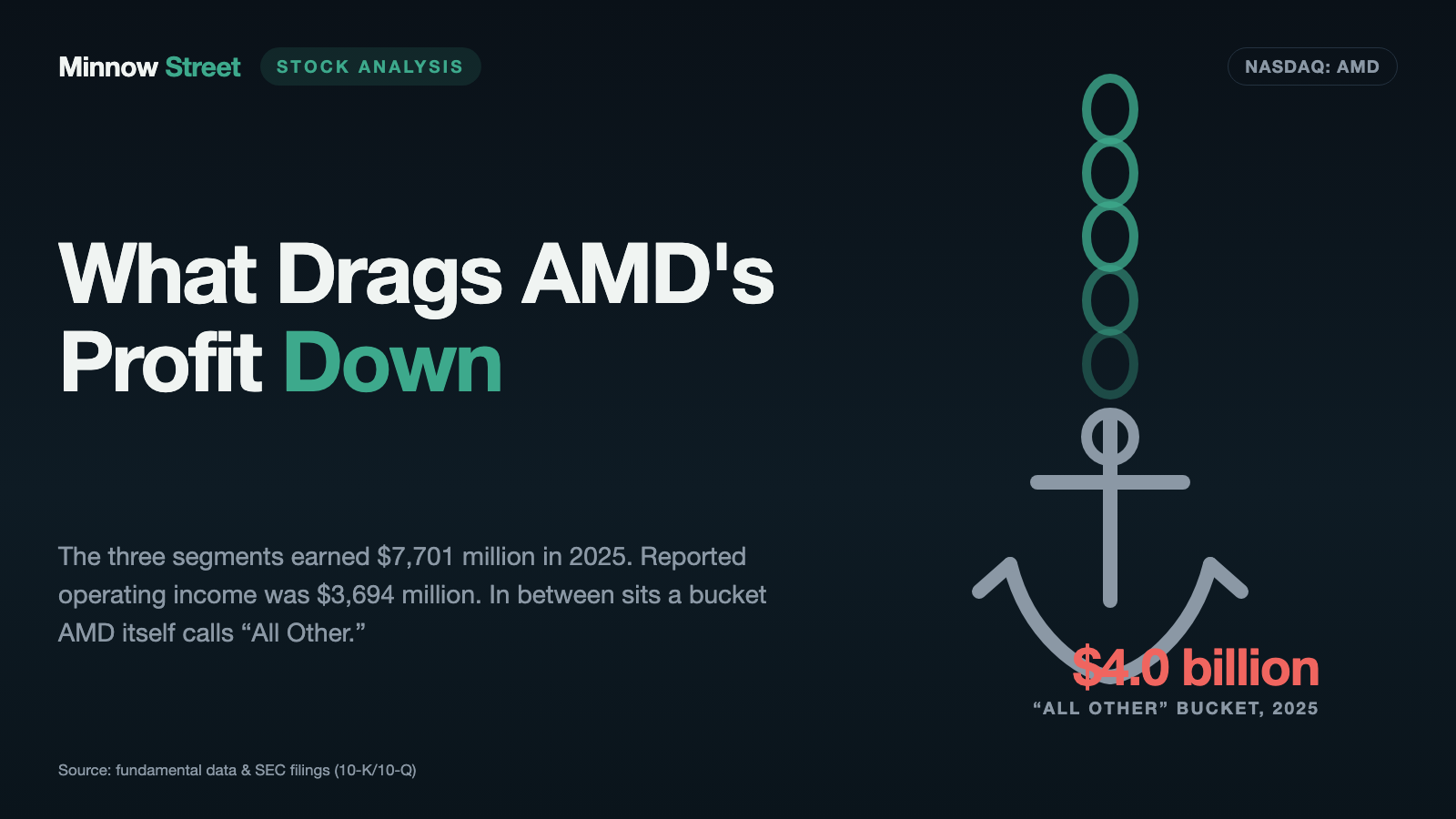
AMD's three segments reported combined operating income of $7,701 million for 2025. The consolidated statement shows $3,694 million. In between sits a bucket of purchase amortization and stock compensation — and the footnotes carry warrants on 320 million shares at one cent apiece. We read both line by line.
 Thomas Mücke
Founder & Publisher
Thomas Mücke
Founder & Publisher
Chart
Interactive price chart (TradingView).
Note: pure fact-based analysis, not investment advice and not a solicitation to buy or sell. All figures without guarantee.
The Gross-Versus-Net Trap
Let us make a deal. Before we talk about one of the most interesting semiconductor companies in the world, I will admit to a mistake we have both made. You get a job offer. There is a number on it. And before your head has finished the math, your gut has already spent it — vacation, car, new kitchen.
Then the first pay stub arrives. At the bottom sits a different number. Not wrong, not hidden, itemized cleanly. Just different.
At AMD the gross number sits in the segment table of the annual report. For 2025 the three segments — Data Center, Client and Gaming, Embedded — reported combined operating income of $7,701 million. One page later, in the consolidated statement of operations, the figure is $3,694 million.
In between sits an item AMD itself calls "All Other" — $4,007 million, or roughly $4.0 billion. It is neither a trick nor a hiding place. It simply has two components worth talking about: the amortization of a purchase price from 2022 and the cost of paying employees in the company's own shares.
Keep this tension in mind, because it runs through every chapter: the data center engine is running — but a large share of the profit is already spoken for, and a fifth of the company has been promised to two customers. Let us read it together, line by line.
Table of Contents
- What AMD Actually Does — and Why the Fiscal Year Ends on a Saturday
- How This Stock Landed on Our Desk
- The Numbers Over the Years — Given Their Due
- What the Filings Say — the Uncomfortable Truths
- Valuation: What You Are Paying For This Company
- Opportunities and Risks at a Glance
- A Human Conclusion
- Sources
What AMD Actually Does — and Why the Fiscal Year Ends on a Saturday
Advanced Micro Devices builds computing chips. The company was founded in California in 1969, has been publicly traded since 1972 and employed roughly 31,000 people as of December 27, 2025. It owns no chip factories of its own — more on that shortly, because that is one of the uncomfortable truths.
First a detail that trips up a lot of analyses: AMD's fiscal year does not end on December 31 but on the last Saturday in December. It therefore runs 52 or 53 weeks. Fiscal 2023, 2024 and 2025 ended on December 30, 2023, December 28, 2024 and December 27, 2025, each with 52 weeks; fiscal 2026 ends on December 26, 2026. What that means for you: these three years are comparable without adjustment. Had a 53rd week been inserted somewhere, one year would carry roughly 2 percent more selling days — and an unflagged comparison would be skewed.
The company reports in three segments. In order, with the fiscal 2025 figures:
- Data Center: $16,635 million in revenue, 48 percent of the group. This is where the AMD Instinct AI accelerators, the EPYC server processors, graphics processors, network cards and programmable logic devices for data centers sit. Segment operating income $3,603 million, a margin of 21.7 percent.
- Client and Gaming: $14,550 million, 42 percent. This holds the classic PC business built on Ryzen processors (Client: $10,640 million) and the gaming business with Radeon graphics cards and game console chips (Gaming: $3,910 million). Segment operating income $2,855 million, a margin of 19.6 percent.
- Embedded: $3,454 million, 10 percent. Embedded processors and programmable devices for automotive, industrial, medical, storage and networking markets — essentially the Xilinx business acquired in 2022. Segment operating income $1,243 million, a margin of 36.0 percent, the highest in the group.
Let us note that briefly, because it contradicts the story you hear everywhere: the highest-margin segment is not the data center business but Embedded. Except that it is shrinking. More on that shortly as well.
Since the first quarter of 2025 AMD has combined Client and Gaming into one segment and recast the prior years. So if you come across older analyses using four segments, they are not wrong — just not directly comparable.
One more thing that is easy to get wrong: ZT Systems, acquired in 2025, only partly remained in the group. AMD bought it in March 2025 for $3.2 billion in cash plus 8.3 million of its own shares, sold the manufacturing business to Sanmina for $2.4 billion in October 2025 and kept the design team. The divested business runs through the figures as a discontinued operation — $66 million of income in 2025 and $11 million in the first quarter of 2026.
How This Stock Landed on Our Desk
This time it was not a hit from our in-house stock scanners. Those filter on metrics — cheap valuation, high balance sheet quality, momentum — and that is exactly why the best-known heavyweights fall through: they are rarely cheap. When we counted on July 28, 2026 how many of the 100 largest U.S. stocks by market capitalization already had a deep dive on our site, 88 did not. AMD sat at number 14 on that overall list.
That is an honest statement about our own method: a scanner hunting for bargains does not find rockets. So we are working the list from the top down.
AMD is particularly worth the look because the company sits inside a triangle we have already measured piece by piece. On one side Nvidia, the benchmark in AI accelerators and AMD's direct opponent in the data center. On the other Broadcom, which builds custom silicon for the same customers instead of selling finished accelerators. And in between the customers themselves: Meta Platforms has since February 2026 been not only a buyer but a warrant holder in AMD stock — an arrangement we look at closely below. How tightly the whole industry hangs on memory we worked through at Micron; AMD now names the shortage in its own risk factors.
The Numbers Over the Years — Given Their Due
Let us start with what genuinely impresses. All figures in millions of U.S. dollars, all from the fiscal 2025 annual report:
| Fiscal year | Revenue | Gross profit | R&D | Operating income | Net income | EPS |
|---|---|---|---|---|---|---|
| 2023 (to Dec 30) | 22,680 | 10,460 | 5,872 | 401 | 854 | $0.53 |
| 2024 (to Dec 28) | 25,785 | 12,725 | 6,456 | 1,900 | 1,641 | $1.00 |
| 2025 (to Dec 27) | 34,639 | 17,152 | 8,091 | 3,694 | 4,335 | $2.65 |
Four things deserve a second look. First: revenue rose by $11.96 billion, or 53 percent, in two years. Second: operating income multiplied more than ninefold from $401 million to $3,694 million — the operating leverage is real. Third: research spending rose 38 percent to $8,091 million, or 23.4 percent of revenue. This company invests more in engineering than it earns. Fourth: net income of $4,335 million sits above operating income. That is unusual and it has a reason: in 2025 AMD reported an income tax benefit of $103 million rather than a tax expense, plus $577 million of other income. Anyone extrapolating the earnings series should know it carries that tailwind.
The first quarter of 2026 continued the trend: revenue of $10,253 million, up 38 percent year over year. Operating income $1,476 million, net income $1,383 million, earnings per share $0.84. Operating cash flow was $2,955 million and free cash flow per the company $2,566 million — three and a half times the figure a year earlier.
An honest footnote you rarely read in growth stories: against the prior quarter, revenue stood still. The fourth quarter of 2025 came in at $10,270 million, the first quarter of 2026 at $10,253 million. Operating income fell over the same span from $1,752 million to $1,476 million. Semiconductors are a cyclical business, and AMD says so in its own risk factors. Anyone annualizing a single quarter is annualizing the cycle away.
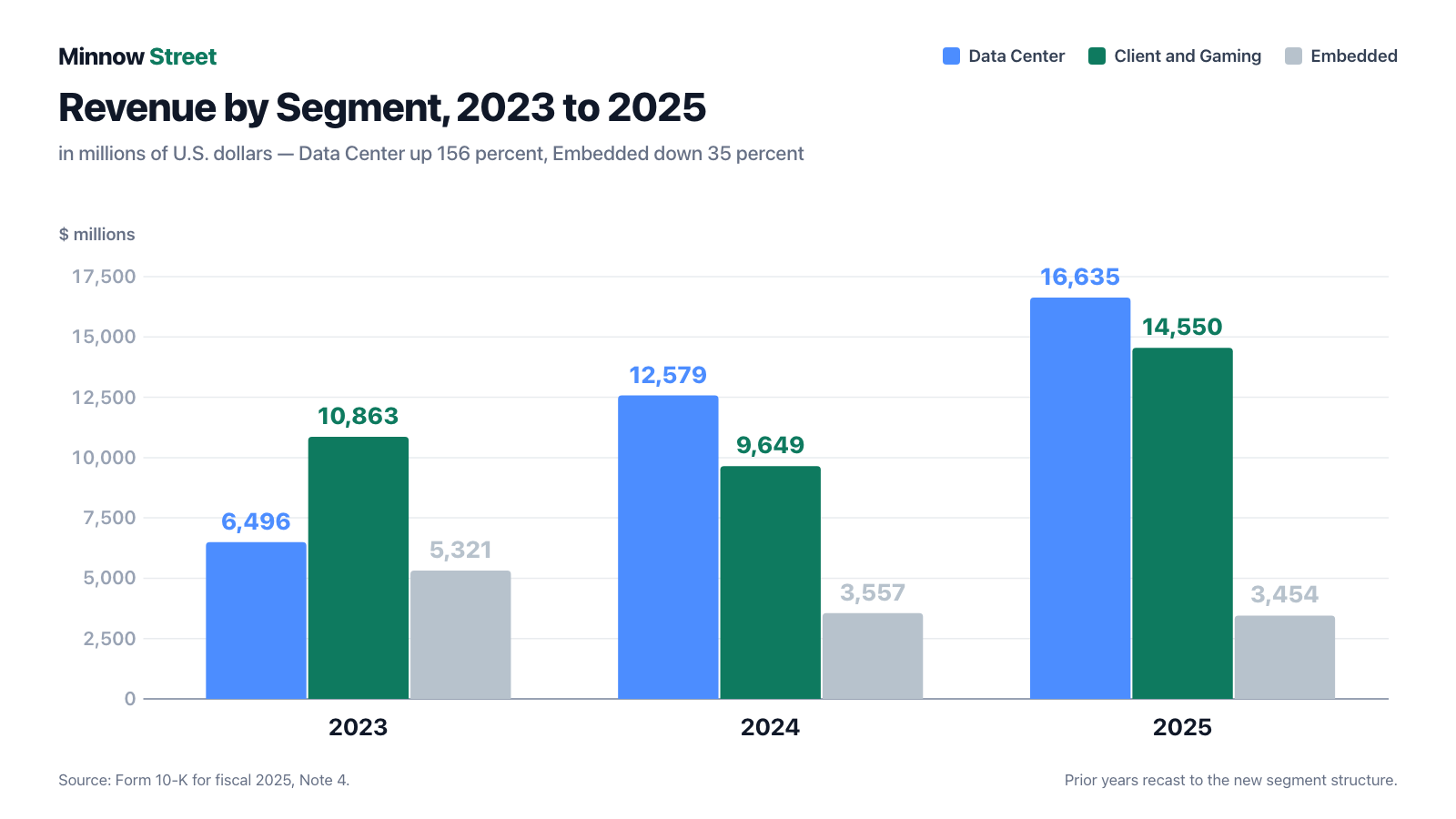
Before we get to the profit question, it is worth seeing where the growth came from. Data Center rose from $6,496 million (2023) through $12,579 million to $16,635 million — up 156 percent in two years. Client and Gaming first fell from $10,863 million to $9,649 million and then rose to $14,550 million. And Embedded fell from $5,321 million through $3,557 million to $3,454 million — down 35 percent. All of this company's growth comes from two segments; the third has shrunk by more than a third in two years.
Now to the question this article is about: where exactly does the profit go?
What the Filings Say — the Uncomfortable Truths
Uncomfortable Truth No. 1: Of $7.7 Billion in Segment Profit, $3.7 Billion Arrives
AMD does not allocate part of its costs to any segment. The report explicitly calls this residual category "All Other" and states that it is not a reportable segment. In 2025 it carried an operating loss of $4,007 million. Broken out, it looks like this:
- $2,254 million of amortization of acquisition-related intangibles
- $1,638 million of stock-based compensation
- $228 million of acquisition-related and other costs
- minus $67 million of inventory recovery from a contract manufacturer
- minus $67 million of licensing gains
- $21 million of other expense
This is not accounting gymnastics. Both large items are real expense. One pays off an acquisition that closed long ago; the other pays people in shares rather than cash.
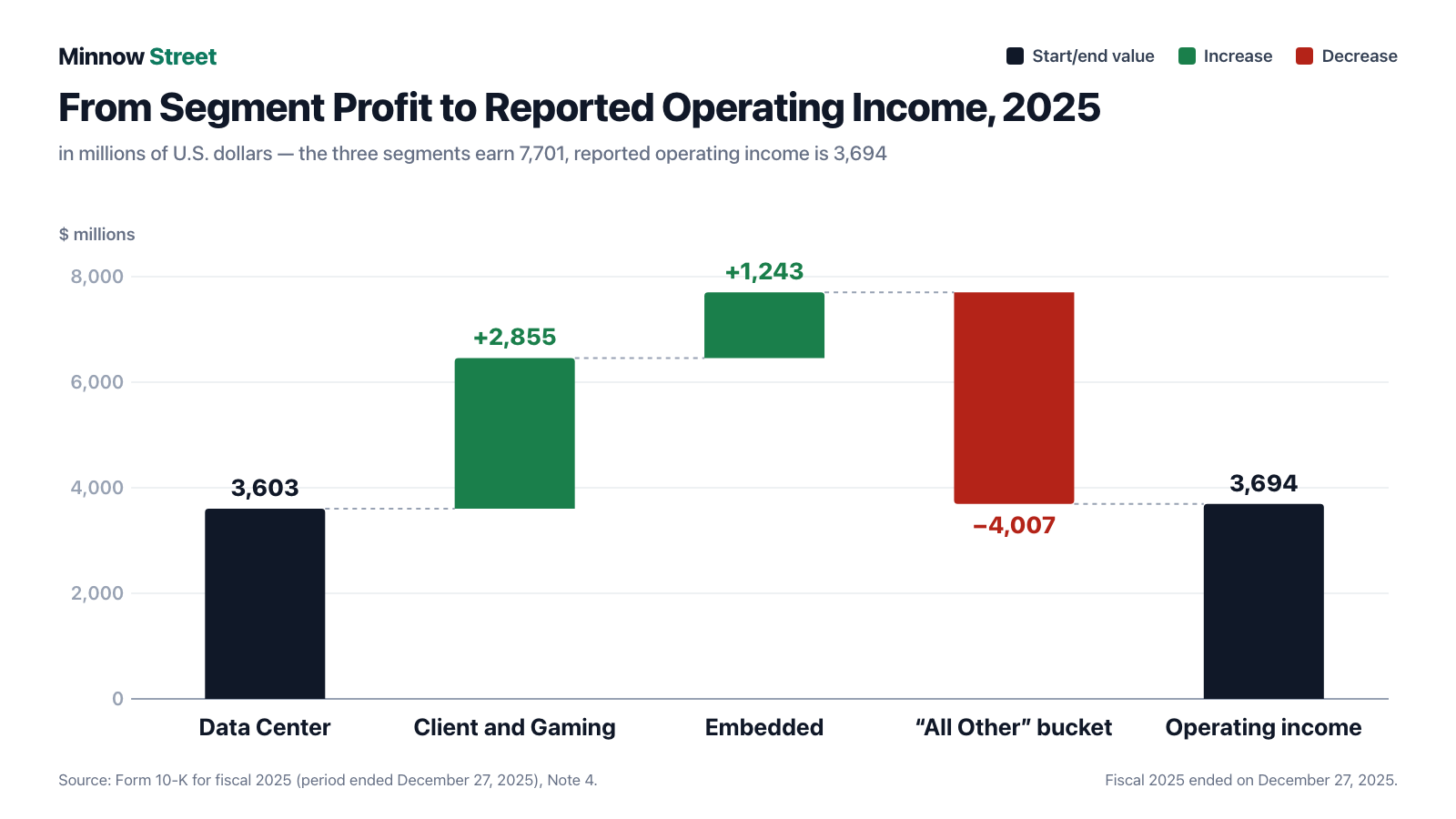
The difference between the two items is the decisive point. The amortization runs off. AMD publishes the schedule year by year: $2,153 million in 2026, then $2,036 million, $1,923 million, $1,691 million, $1,454 million and $7,448 million thereafter — together the $16,705 million carried on the balance sheet as of December 27, 2025. Every year this headwind gets a little weaker.
The stock compensation does not run off. It rose from $1,384 million (2023) through $1,407 million to $1,638 million (2025), and in the quarter ended March 28, 2026 to $487 million from $364 million a year earlier — an increase of 34 percent.
This is exactly where the gap opens between the two sets of numbers you see in every report about AMD. For the quarter ended March 28, 2026 the company reported earnings per share of $0.84 under U.S. generally accepted accounting principles (GAAP). On a non-GAAP basis it was $1.37. Almost the entire $0.53 difference comes from two lines: $0.33 of amortization and $0.30 of stock compensation, offset by tax and investment effects.
Both presentations have their place. You should simply know which one you are reading — and that stock compensation is not a booking artifact but a stream of new shares entering circulation every year.
Uncomfortable Truth No. 2: 84 Percent of the Goodwill Sits in the Shrinking Segment
Goodwill is the amount a buyer paid above the value of the individual assets acquired. It sits on the balance sheet as a carrying value and is not amortized on a schedule but tested annually for whether it is still justified. In plain language: it is the price of hope.
AMD carried $25,126 million of goodwill as of December 27, 2025 and discloses it by reporting unit:
- Embedded: $21,072 million — 83.9 percent
- Data Center: $3,690 million
- Client and Gaming: $364 million
Together with $16,705 million of acquisition-related intangibles that comes to $41,831 million — 54.4 percent of total assets of $76,926 million and 66.4 percent of stockholders' equity. More than half of what AMD owns is a carrying value from acquisitions.
And now the figure that catches. The segment holding almost all of that goodwill is the only one whose revenue declined: from $5,321 million (2023) through $3,557 million to $3,454 million (2025). Segment operating income fell over the same period from $2,628 million to $1,243 million — down 52.7 percent.
The impairment test took place in the fourth quarter of 2025 and was purely qualitative: AMD concluded it was not more likely than not that the carrying value of any reporting unit exceeded its fair value. There was no write-down. That is permitted and common practice. It also means the $21 billion carrying value was not last measured against a calculated valuation.
Fairness demands the other direction too: in the first quarter of 2026 Embedded grew again for the first time — up 6 percent to $873 million, with segment operating income of $338 million and a margin of 38.7 percent. One quarter is not a turn. But it is the number to watch now.
A look at the equity side completes the picture. As of December 27, 2025 additional paid-in capital stood at $63,365 million against retained earnings of only $6,699 million. In plain terms: this company's equity comes almost entirely from paid-in capital — above all from the shares used to pay for Xilinx in 2022 — not from profits earned over the years. That is not an accusation but a placement: as an earnings machine, AMD is very young.
Uncomfortable Truth No. 3: Two Customers May Buy 320 Million Shares at One Cent Apiece
This is the find that occupied us longest while reading the quarterly report. It does not sit in the fine print but in the notes under the heading "Warrants."
"In October 2025 and February 2026, the Company issued warrants to OpenAI OpCo, LLC (OpenAI) and Meta Platforms, Inc. (Meta) (the OpenAI Warrant and the Meta Warrant, respectively). Each warrant provides the holder the right to purchase up to an aggregate of 160 million shares of the Company's common stock at an exercise price of $0.01 per share."
— Advanced Micro Devices, Inc., Form 10-Q for the quarter ended March 28, 2026, Note 12, filed with the U.S. securities regulator, the SEC
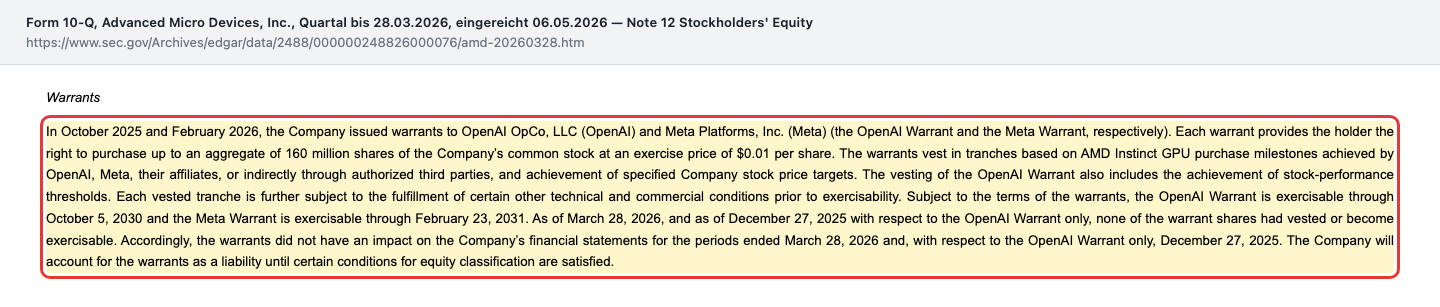
Let us run the math. 320 million shares stand against 1,630,600,639 shares outstanding as of April 29, 2026. That is 19.6 percent. Full exercise would bring AMD $3.2 million — roughly what the company sells in a single morning.
What this means for you as a shareholder is the everyday meaning behind the word dilution: your slice of the cake gets smaller without the cake getting bigger. If every right is exercised, the share count rises to roughly 1,951 million. At the same net income, earnings per share would fall by 16.4 percent.
Now the other side, because it belongs here just as much. The rights are not a gift. They vest only if OpenAI and Meta hit certain purchase milestones for AMD Instinct accelerators and the share price clears certain targets; the OpenAI warrant adds a stock-performance threshold. Every vested tranche is further subject to technical and commercial conditions. Behind all this sit two supply arrangements of 6 gigawatts of GPU capacity each — the first gigawatt in both cases powered by the AMD Instinct MI450 series.
Viewed soberly, this is a trade: AMD gives away ownership and gets visibility in the order book. Whether it was a good trade will be settled by how much revenue and margin those 12 gigawatts actually deliver.
For today's assessment one point matters most: as of March 28, 2026 not a single tranche had vested. None of it therefore appears in the financial statements — not even in the diluted share count of 1,650 million. AMD will carry the warrants as a liability until the conditions for equity classification are met. If you are projecting per-share figures today, keep that denominator in mind.
And dilution has a second, less spectacular source. At the annual meeting on May 13, 2026 shareholders approved increasing the equity incentive plan by 65 million shares to a total of 153 million. Buybacks only partly offset this: in 2025 AMD repurchased 12.4 million shares for $1.3 billion while stock compensation cost $1,638 million. Shares outstanding still rose during 2025 from 1,622 million to 1,630 million. Of the $14 billion repurchase authorization, $9.2 billion remained available as of March 28, 2026.
Uncomfortable Truth No. 4: One Contract Manufacturer — and a Fifth of Revenue in China
AMD owns no chip factories. For a long time that was mainly an advantage: no billion-dollar capital programs, no fabs standing idle when demand softens. The flip side sits in the risk factors of the annual report, and it is stated with remarkable clarity:
"We rely on Taiwan Semiconductor Manufacturing Company Limited (TSMC) for the production of all wafers for microprocessor and GPU products at 7 nanometer (nm) or smaller nodes, and we rely primarily on GLOBALFOUNDRIES Inc. (GF) for wafers for microprocessor and GPU products manufactured at process nodes larger than 7 nm."
— Advanced Micro Devices, Inc., Form 10-K for fiscal 2025, Item 1A

All wafers. Not most, not the bulk — all. On top of that, assembly, test and packaging run through third parties in Mainland China, Malaysia and Taiwan. The report explicitly names the geopolitical situation between China and Taiwan as a risk to delivery. AMD also holds 15 percent of two joint ventures with the Chinese packaging provider Tongfu and bought $2.0 billion of services from them in 2025.
The second dependency is the sales market. Here is how 2025 revenue split by customer billing location:
| Region | 2025 | Share | 2024 | 2023 |
|---|---|---|---|---|
| United States | 11,363 | 32.8 % | 8,693 | 7,837 |
| China (incl. Hong Kong) | 7,751 | 22.4 % | 6,231 | 3,417 |
| Taiwan | 5,186 | 15.0 % | 3,301 | 1,841 |
| Singapore | 4,284 | 12.4 % | 3,614 | 2,231 |
| Other regions | 6,055 | 17.5 % | 3,946 | 7,354 |
What happens when politics steps into that market, AMD found out in 2025. In April 2025 the U.S. government imposed a licensing requirement for certain semiconductors bound for China, which hit the MI308 accelerator:
"During the second quarter of fiscal year 2025, the Company recorded approximately $800 million of inventory and related charges on AMD Instinct MI308 Data Center GPU products due to new U.S. export restrictions on certain semiconductors to China."
— Advanced Micro Devices, Inc., Form 10-K for fiscal 2025, Item 7
In the fourth quarter of 2025 AMD reversed roughly $360 million of that after export licenses were granted. Net, about $440 million remained — 11.9 percent of that year's operating income. In February 2026 licenses for the successor MI325 followed, with a notable condition: the goods must first pass an inspection process in the United States and are subject to a 25 percent tariff on import for that inspection. Whether China will allow the chips in at all, AMD says it does not know. And in August 2025 U.S. government officials expressed an expectation of receiving 15 percent of the revenue from licensed MI308 sales to China — no regulation establishing that has been published to date.
That leaves the customer side. On revenue it looks relaxed: neither in 2024 nor in 2025 did a single customer account for 10 percent of consolidated revenue (in 2023 one Client and Gaming customer reached 18 percent). On outstanding receivables the picture differs:
"One customer accounted for approximately 11% and another customer accounted for 24% of the total consolidated accounts receivable balance as of December 27, 2025 and December 28, 2024, respectively."
— Advanced Micro Devices, Inc., Form 10-K for fiscal 2025, Note 14

On a receivables balance of $6,315 million as of December 27, 2025, 11 percent is roughly $695 million riding on a single address. AMD considers the default risk low and points to collection experience. That is plausible — it remains a number worth knowing.
Uncomfortable Truth No. 5: Purchase Commitments More Than Doubled in One Quarter
This figure surfaced when we compared two filings. In the annual report as of December 27, 2025 AMD lists unconditional commitments of roughly $12.2 billion, of which $8.5 billion fell due in 2026. Three months later, in the quarterly report as of March 28, 2026, the figure is roughly $25.7 billion — with $18.3 billion for the remainder of fiscal 2026.
The commitments relate mainly to wafers, substrates and components from contract manufacturers as well as multi-year cloud service provider arrangements. In parallel, leases not yet commenced rose from $1.3 billion to $4.4 billion.
For scale: $25.7 billion equals 74 percent of fiscal 2025 revenue and 2.1 times cash and short-term investments of $12,347 million as of March 28, 2026. This is not an alarm bell — when revenue grows 38 percent you order more. But it is a bet that demand holds. AMD writes as much in its risk factors: overestimating customer demand results in excess inventory and higher production costs, "particularly since we have prepayment arrangements with certain suppliers."
The same quarterly report carries an item the annual report did not:
"As of March 28, 2026, the Company had a maximum gross exposure of $4.1 billion from guarantees issued in connection with certain commercial partner data center lease obligations with a term of up to 15 years. Guarantees typically become payable in the event of a commercial partner's default and may be issued in exchange for warrants."
— Advanced Micro Devices, Inc., Form 10-Q for the quarter ended March 28, 2026, Note 8

So AMD guarantees that customers will pay their data center rent — over terms of up to 15 years, with maximum exposure of $4.1 billion. That equals 6.4 percent of stockholders' equity and 1.3 times total debt. It is recorded as a credit derivative within other long-term liabilities; changes in fair value have, by the company's own account, not been material.
A word of calibration, because this item is easy to dramatize: as long as the partners pay, nothing happens. And the exposure declines with every lease payment made. But it is an obligation outside the balance sheet total that did not exist a year ago — and it hangs on the same customer group that holds the warrants.
Valuation: What You Are Paying For This Company
First the caution that belongs with this stock. AMD swings hard: the 52-week range ran from $149.22 to $584.73 as of July 29, 2026, and the beta stood at 2.47 — the stock moves roughly two and a half times as much as the broad market. So what follows is an order of magnitude with a date on it, not a daily price.
Market capitalization stood at roughly $741 billion as of July 29, 2026. Measured against the last four reported quarters that gives:
- Revenue of $37,454 million → roughly 20 times
- Net income of $5,009 million → roughly 148 times
- Stockholders' equity of $64,462 million → roughly 11.5 times
Against the analyst consensus for the current year ($7.45 per share) it is roughly 61 times. AMD pays no dividend.
On any measure, that is a price for a great deal of future. For context: a price-to-earnings ratio of 148 means you would need 148 years of today's earnings to recover the purchase price — assuming those earnings never grew. Which is exactly the point of this stock: it is about growth. And the growth is there. You are simply paying for it already.
The professional view is unanimous. As of July 29, 2026 there were 49 analyst ratings: 32 strong buy, 4 buy, 13 hold and not a single sell. The mean price target stood at $575.49. That is a sentiment reading, not a forecast — and a consensus without a single dissenter has historically been more of a warning sign than a seal of approval.
What the company itself says is more concrete and shorter-dated. For the second quarter of 2026 AMD expects revenue of approximately $11.2 billion plus or minus $300 million — the midpoint would be up roughly 46 percent year over year — at a non-GAAP gross margin of approximately 56 percent. AMD does not issue full-year guidance.
Opportunities and Risks at a Glance
What speaks for AMD:
- The growth is real and broad: revenue up 34 percent in 2025 and 38 percent in the quarter ended March 28, 2026, with all three segments growing.
- The operating leverage works: operating income rose from $401 million (2023) to $3,694 million (2025) on 53 percent more revenue.
- The balance sheet is robust: $12,347 million of cash and short-term investments against $3,224 million of total debt as of March 28, 2026, plus an undrawn $5 billion facility with no financial covenants since May 14, 2026.
- The headwind from Xilinx amortization declines on schedule: from $2,153 million (2026) to $1,454 million (2030).
- Two of the largest data center operators in the world have committed to 6 gigawatts of capacity each.
- Research and development of $8,091 million, or 23.4 percent of revenue — more than twice operating income.
What speaks against it:
- More than half of segment profit does not arrive in reported operating income, and stock-based compensation — the largest permanent part of that gap — keeps rising.
- Warrants on 320 million shares at one cent apiece equal 19.6 percent of the share count; on top of that, the equity plan may issue 153 million shares.
- $21,072 million of goodwill sits in the segment with the weakest revenue trend, and the last impairment test was purely qualitative.
- All wafers at 7 nanometers and below come from a single contract manufacturer; assembly and test run through Mainland China, Malaysia and Taiwan.
- 22.4 percent of 2025 revenue came from China including Hong Kong — a market the U.S. government intervened in directly during 2025, at a net cost of roughly $440 million.
- Unconditional purchase commitments of roughly $25.7 billion and lease guarantees of up to $4.1 billion tie up room to maneuver if the cycle turns.
- The price is high: roughly 148 times the earnings of the last four reported quarters and roughly 20 times revenue (as of July 29, 2026).
A Human Conclusion
Back to the pay stub. The gross number was not a lie. It simply was not the number that lands in the account at the end of the month. And knowing the difference makes you plan better — not more fearfully, just more precisely.
At AMD the gross number is the segment table: $7,701 million, three segments, all profitable, one of them growing 57 percent in the latest quarter. The net number is reported operating income: $3,694 million. The difference has two names and both are stated openly — an acquisition being paid off and a workforce being paid in shares.
What occupied us longer than the bucket is the warrant arrangement. Two customers may buy a fifth of this company for a combined $3.2 million if they order enough and the share price cooperates. It is one of the most remarkable constructions we have found in a set of notes. It may prove a clever trade — ownership for visibility. It may also prove expensive, if the orders arrive and the price follows.
And then there is the balance sheet. $12.3 billion of cash against $3.2 billion of debt, free cash flow of $2.6 billion in a single quarter, a credit facility nobody is drawing on. This company has no substance problem. It has open questions — and every one of them sits in its own filings, readable by anyone who opens the footnotes.
We opened them for you. What you do with that is your decision. And that is exactly as it should be.
Sources
- Form 10-K for fiscal 2025 (period ended December 27, 2025, filed February 4, 2026) — Item 1 Business, Item 1A Risk Factors, Item 7 Management's Discussion, Note 4 Segment Reporting, Note 6 Goodwill and Acquisition-related Intangibles, Note 14 Concentrations
- Form 10-K for fiscal 2024 (period ended December 28, 2024, filed February 5, 2025)
- Form 10-Q for the quarter ended March 28, 2026 (filed May 6, 2026) — Note 8 Financial Instruments and Lease Guarantees, Note 12 Stockholders' Equity and Warrants, Item 2 Management's Discussion
- Form 8-K filed May 5, 2026 (Item 2.02, Exhibit 99.1: first quarter 2026 results and second quarter guidance)
- Form 8-K filed May 15, 2026 (Items 1.01, 1.02, 2.03, 5.02, 5.07: new $5 billion revolving credit facility, commercial paper program raised to $5.5 billion, annual meeting held May 13, 2026, equity plan increased by 65 million shares)
- Form 8-K filed July 1, 2026 (Item 5.02: executive compensation, grant date August 15, 2026)
- SEC submissions record, CIK 0000002488 — checked for Form 15, Form 25, former names and successor CIK: nothing found
- Fundamental data (market capitalization, valuation multiples, analyst consensus, 52-week range, beta), as of July 29, 2026
All figures in this analysis come from the primary documents listed above and were checked against the filings on July 29, 2026. The share count comes from the cover page of the most recent quarterly report (1,630,600,639 shares as of April 29, 2026). Market capitalization was cross-checked against the most recent price documented in a filing, $556.43 (Form 4 filed July 17, 2026 for the July 15, 2026 trade); the 18.3 percent deviation falls within the band we accept.
This article is journalistic analysis. It is not investment advice and not a solicitation to buy or sell securities. Stocks can lose value substantially at any time, up to the total loss of the capital invested. Semiconductor stocks are especially volatile — AMD's 52-week range ran from $149.22 to $584.73 as of July 29, 2026. Every investment decision is yours alone and, in case of doubt, should be taken after consulting a licensed adviser. The author holds no position in the stock discussed at the time of publication.
Our Bottom Line at a Glance
- Market position and growth positive
- Revenue rose 34 percent to $34,639 million in 2025 and 38 percent to $10,253 million in the quarter ended March 28, 2026. The Data Center segment grew 32 percent to $16,635 million in 2025 and 57 percent to $5,775 million in the first quarter of 2026. All three segments are profitable; Embedded grew again for the first time after two years of decline (Form 10-K fiscal 2025, Form 10-Q for the quarter ended March 28, 2026).
- Earnings structure neutral
- Of $7,701 million of segment operating income in 2025, $3,694 million arrived as consolidated operating income. The $4,007 million difference consists of $2,254 million of amortization of acquisition-related intangibles and $1,638 million of stock-based compensation. The amortization runs off on schedule — $2,153 million in 2026, only $1,454 million in 2030. The stock compensation does not: it rose to $487 million in the quarter ended March 28, 2026 from $364 million a year earlier (Form 10-K fiscal 2025, Notes 4 and 6).
- Balance sheet and liquidity positive
- As of March 28, 2026, $12,347 million of cash and short-term investments stand against $3,224 million of total debt, with stockholders' equity of $64,462 million. Operating cash flow for the quarter was $2,955 million and free cash flow per the company $2,566 million. Since May 14, 2026 there is an undrawn $5,000 million revolving facility with no financial covenants (Form 10-Q for the quarter ended March 28, 2026; Form 8-K filed May 15, 2026).
- Carrying value of acquisitions negative
- Goodwill and acquisition-related intangibles of $41,498 million make up 52.1 percent of total assets as of March 28, 2026. Of the goodwill, $21,072 million — 83.9 percent — sits in the Embedded reporting unit, whose revenue fell from $5,321 million in 2023 to $3,454 million in 2025. The fourth-quarter 2025 impairment test was purely qualitative (Form 10-K fiscal 2025, Note 6).
- Dilution negative
- OpenAI and Meta Platforms hold warrants for up to 160 million shares each at $0.01 — together 19.6 percent of the 1,630,600,639 shares outstanding as of April 29, 2026. On top of that, the equity plan may issue a total of 153 million shares as of May 13, 2026. Buybacks barely keep pace: $1.3 billion in 2025 against $1,638 million of stock compensation, and $221 million in the quarter ended March 28, 2026 against $487 million (Form 10-Q, Note 12; Form 8-K filed May 15, 2026).
- Dependencies negative
- By its own account AMD relies on a single contract manufacturer for all wafers at 7 nanometers and below, assembles and tests in Mainland China, Malaysia and Taiwan, and generated 22.4 percent of 2025 revenue in China including Hong Kong. The MI308 export restriction cost roughly $440 million net in 2025 — 11.9 percent of operating income (Form 10-K fiscal 2025, Items 1A and 7).
AMD grew strongly in 2025 and in the first quarter of 2026, earns money in all three segments and sits on a balance sheet with $12.3 billion of cash against $3.2 billion of debt. The open questions are operational and every one of them is in the company's own filings: more than half the segment profit disappears into a single bucket, 83.9 percent of goodwill sits in the segment with the weakest revenue trend, and two customers hold warrants on a fifth of the company. Not investment advice.
What Our Rating Means
Open questions
The business works in principle, but one material question is open. As long as it stays open, our findings do not carry a quality verdict.
The business works and the balance sheet is robust — no substance risk, no going concern doubt, no accounting or governance breach. Two operational questions carry weight: whether the $21,072 million of goodwill in the shrinking Embedded segment holds its carrying value, and whether AMD can ever spread production at 7 nanometers and below across more than one contract manufacturer. That the stock trades at roughly 148 times the earnings of the last four reported quarters as of July 29, 2026 is a price argument and does not enter this rating — that is what our scanners are for. Where the evidence sits between two levels, the more cautious one applies. The decision is yours.
A journalistic assessment by our editorial team at the time of the deep dive, based on public sources — not investment advice and not a solicitation to buy or sell. Your personal circumstances (investment goals, risk capacity, taxes) cannot be taken into account. What our levels mean, how verdicts are formed, and what conflicts of interest exist →
Worth Noting
- Hook: ranking of the 100 largest U.S. stocks by market capitalization (as of July 28, 2026), AMD at number 14 without an existing analysis. Not a scanner hit.
- As of: Form 10-K for fiscal 2025 (period ended December 27, 2025, filed February 4, 2026), Form 10-Q for the quarter ended March 28, 2026 (filed May 6, 2026), Form 8-K filed May 5, 2026. Valuation multiples and analyst consensus: July 29, 2026.
- Easy to confuse: the "Client and Gaming" segment has only been reported jointly since the first quarter of 2025; older analyses using four segments are not directly comparable. AMD recast the prior years itself.
- Easy to confuse: ZT Systems, acquired in 2025, only partly remained in the group — the manufacturing business went to Sanmina in October 2025 and runs through the figures as a discontinued operation.
Frequently Asked Questions
AMD uses a 52- or 53-week fiscal year that ends on the last Saturday in December. Fiscal 2023, 2024 and 2025 ended on December 30, 2023, December 28, 2024 and December 27, 2025, each with 52 weeks; fiscal 2026 ends on December 26, 2026. Because no 53-week year falls into the comparison period, the three years are comparable without adjustment. For a company with an inserted 53rd week, that would not be the case.
Because AMD does not allocate part of its costs to any segment. Data Center ($3,603 million), Client and Gaming ($2,855 million) and Embedded ($1,243 million) produced $7,701 million combined in 2025. From that the "All Other" bucket subtracts $4,007 million: $2,254 million of amortization of acquisition-related intangibles, $1,638 million of stock-based compensation, plus acquisition costs and smaller items. The reported $3,694 million is what remains.
AMD granted OpenAI in October 2025 and Meta Platforms in February 2026 a warrant each for up to 160 million shares at an exercise price of $0.01 — together 320 million shares, or 19.6 percent of the share count as of April 29, 2026. The tranches vest when both customers hit certain purchase milestones and the share price clears certain targets. As of March 28, 2026 no tranche had vested.
Very. The annual report says it verbatim: AMD relies on TSMC for the production of all wafers for microprocessor and GPU products at 7 nanometers or smaller. For larger process nodes it relies primarily on GLOBALFOUNDRIES, and for programmable logic devices additionally on UMC and Samsung. Assembly, test and packaging run through third parties in Mainland China, Malaysia and Taiwan.
They carry a price tag. In the second quarter of 2025 AMD recorded roughly $800 million of inventory and related charges on MI308 accelerators after the U.S. government imposed a licensing requirement in April 2025; in the fourth quarter roughly $360 million was reversed, leaving about $440 million net. China including Hong Kong accounted for $7,751 million, or 22.4 percent of 2025 revenue.
Because $21,072 million of it — 83.9 percent — sits in the Embedded reporting unit, essentially the Xilinx business acquired in 2022. That is precisely the segment that shrank: from $5,321 million of revenue in 2023 to $3,454 million in 2025, and segment operating income from $2,628 million to $1,243 million. The fourth-quarter 2025 impairment test was purely qualitative and produced no write-down.
For the quarter ended March 28, 2026 AMD reported GAAP earnings per share of $0.84 and non-GAAP earnings per share of $1.37. Almost the entire $0.53 difference comes from two items: $0.33 of amortization of acquisition-related intangibles and $0.30 of stock-based compensation, offset by tax and investment effects. Both items are real expense — one pays off an old acquisition, the other pays the workforce in shares.
For the second quarter of 2026 the earnings release dated May 5, 2026 guides to revenue of approximately $11.2 billion plus or minus $300 million. The midpoint would be up roughly 46 percent year over year and roughly 9 percent sequentially. Non-GAAP gross margin is expected at approximately 56 percent. AMD does not issue full-year guidance.
Found an error?
Did you spot a factual error, an outdated number, or a typo in this deep dive? Let us know briefly — your report goes straight to the editorial team.