Meta stock: a third of the record quarter came from the tax line — and $145 billion is already spoken for
Meta earned $26.77 billion on revenue of $56.31 billion in the quarter ended March 31, 2026. In the same income statement sits a tax line that was not an expense at all but a benefit of $8.03 billion. For 2026 the company guides to capital expenditures of $125 billion to $145 billion, funded in part with notes that run to 2066. And Note 8 discloses $182.88 billion of leases that have not even started yet. We read the filings the way you read a contractor's invoice: the total first, then the line items.
 Thomas Mücke
Founder & Publisher
Thomas Mücke
Founder & Publisher
Chart
Interactive price chart (TradingView).
Note: pure fact-based analysis, not investment advice and not a solicitation to buy or sell. All figures without guarantee.
The trap is called "best year ever"
Let us make a deal. Before we talk about Meta, I will confess to a thinking error we both fall into regularly. Call it income mistaken for wealth. In everyday life it sounds like this: "I earned more this year than ever before." Perhaps true. Except the kitchen is currently full of scaffolding, the contractor has a three-year agreement, and the first progress invoice is already on the table. The income was real. It was never free to spend.
Meta booked $200,966 million of revenue in 2025 — more than ever before. The quarter ended March 31, 2026 added $56,311 million, up 33 percent. And yet 2025 left less at the bottom than 2024 did, and free cash flow landed where it had been in 2023. That is not a contradiction. It is a construction drawing.
Hold on to this tension, because it runs through every chapter: Meta earns more from advertising than ever — and it has already committed the entire proceeds. To data centers whose invoices arrive over the coming years, funded in part with notes that run to 2066. Let us read that together — and find three numbers that made no headline.
Contents
- What Meta actually does
- How the stock landed on our desk
- The numbers over the years — given their due
- What the filings say — the uncomfortable truths
- Valuation: what you pay for this company
- Opportunities and risks at a glance
- A human conclusion
- Sources
What Meta actually does
Meta sells advertising space. That is the short answer, and it is very nearly the whole one. Of the $56,311 million of revenue in the quarter ended March 31, 2026, exactly $55,024 million came from ads — 98 percent. The platforms are Facebook, Instagram, Messenger and WhatsApp; the company groups them into a segment called Family of Apps. In March 2026 an average of 3.56 billion people used those apps every day, 4 percent more than a year earlier.
How the money flows takes one sentence to explain: a business pays for its ad to be shown to somebody. Meta therefore earns on two levers — how often an ad appears and what it costs. Both moved up in the quarter ended March 31, 2026: impressions rose 19 percent, the average price per ad 12 percent. That is the rare combination every advertising business hopes for.
Alongside it sits a second, very small segment: Reality Labs. It holds the Quest virtual-reality headsets, the AI glasses from Ray-Ban and Oakley, software and long-range research. Revenue in the quarter ended March 31, 2026: $402 million. Operating loss in the same quarter: $4,028 million. For every dollar taken in, ten dollars went out. We will come back to that.
Two things worth getting right. First, Meta's fiscal year is the calendar year, ending December 31. Unlike many technology companies, there is nothing to convert here — "fiscal 2025" means January 1 through December 31, 2025.
Second, there are two classes of stock. The Class A shares traded on Nasdaq carry one vote each; the unlisted Class B shares carry ten. As of April 24, 2026 there were 2,196,045,588 Class A shares and 342,377,716 Class B shares outstanding. Do the arithmetic: Class B accounts for 13.5 percent of the capital — and roughly 61 percent of the votes. Buying Meta stock buys you a share of the profit and almost no influence. What that means in practice appears in the chapter on uncomfortable truths.
How the stock landed on our desk
This was not a scanner hit. Our in-house stock scanners screen on metrics — cheap valuation, high Piotroski score, momentum — which is precisely why the best-known heavyweights fall through: they are rarely cheap. When we counted on July 28, 2026 how many of the 100 largest U.S. stocks by market capitalization already had a deep dive on our site, 88 did not. Meta was the fourth largest of those, at number 8, with a market capitalization of about $1,506 billion (data as of July 29, 2026).
That is an honest statement about our own method: a scanner built to find bargains does not find blue chips. So we are working the list from the top. Meta sits in the same data-center wave as two companies we have already examined: Microsoft is building at the same pace for the same reason, and the chips this money buys come in large part from Nvidia. Value one of these three and you are implicitly valuing the other two.
The numbers over the years — given their due
Start with what genuinely impresses. Meta has nearly doubled revenue in three years: from $116,609 million in 2022 to $200,966 million in 2025. Income from operations grew from $28,944 million to $83,276 million over the same stretch — very nearly a tripling. An operating margin of 41.4 percent means, in plain terms: of every $100 of revenue, $41.40 remains as operating profit. For scale, a solid industrial company sits at 10 to 15 percent, a very good one at 20. Meta plays its own league.
Now the four-year series. And here the tension appears for the first time:
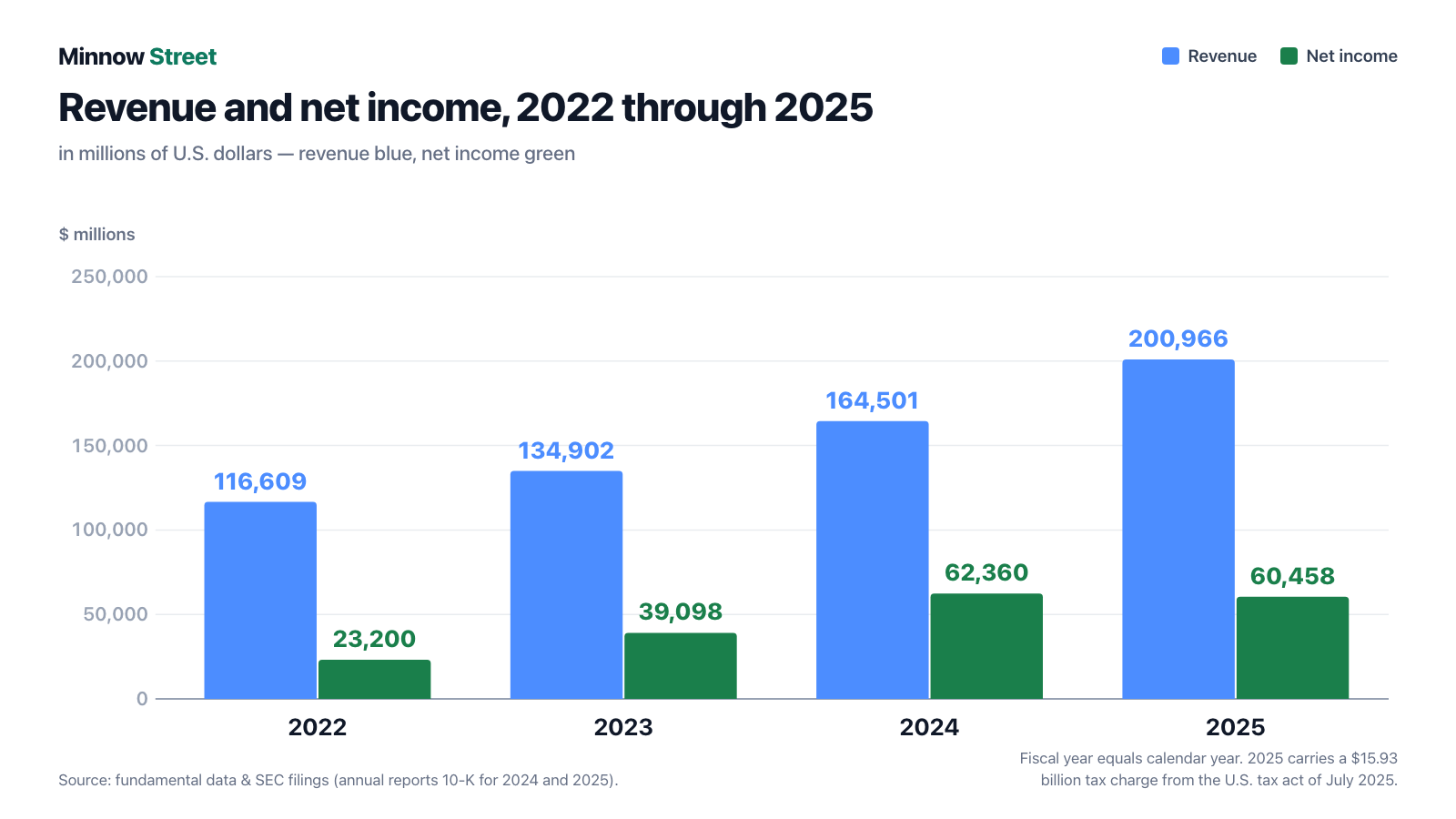
Read the green series again. Between 2022 and 2024 profit nearly tripled — and then, in the year of record revenue, it went down. The reason lies not in the business but in tax law: the tax line jumped from $8,303 million to $25,474 million, an increase of 207 percent. More on that in a moment.
The detail, all of it from the Forms 10-K for 2024 and 2025:
| Fiscal year (calendar year) | Revenue | Income from operations | Net income | Free cash flow |
|---|---|---|---|---|
| 2022 | $116,609m | $28,944m | $23,200m | — |
| 2023 | $134,902m | $46,751m | $39,098m | $43,010m |
| 2024 | $164,501m | $69,380m | $62,360m | $52,103m |
| 2025 | $200,966m | $83,276m | $60,458m | $43,585m |
The last column is the least friendly news in this analysis — and the heart of it. Free cash flow is the money actually left after running and building the business; Meta defines it as operating cash flow less purchases of property and equipment and principal payments on finance leases. In 2025 it came to $43,585 million, below the 2024 figure and barely above 2023. The current year continues the pattern: in the quarter ended March 31, 2026, $32,226 million of operating cash flow less $19,840 million of capital spending left $12,386 million.
What the filings say — the uncomfortable truths
Uncomfortable truth no. 1: profit after tax was bigger than profit before it
In the quarter ended March 31, 2026 Meta's income statement showed income before income taxes of $21,752 million. Below it, after the tax line, stood $26,773 million. Profit after tax was therefore some five billion dollars higher than profit before it. That is possible because of a line you rarely see: instead of a tax expense there was a benefit of $5,021 million.
Meta explains it in its own report, and the explanation is unambiguous:
"Effective tax rate was (23)% for the three months ended March 31, 2026. This rate reflects an income tax benefit of $8.03 billion related to the U.S. Corporate Alternative Minimum Tax transitional relief under Treasury Notice 2026-7. Excluding this tax benefit, the effective tax rate would have been 14%."
— Meta Platforms, Inc., Form 10-Q for the quarter ended March 31, 2026, Item 2 (MD&A), filed with the U.S. securities regulator, the SEC

Do the arithmetic: close to a third of the reported quarterly profit came from that single line — paid by no customer, but by a transitional rule. And the mirror image is only two quarters back. In 2025 the same body of tax law — the U.S. tax package enacted on July 4, 2025, the One Big Beautiful Bill Act — handed Meta a $15.93 billion charge, $14.03 billion of it a valuation allowance against deferred tax assets. Without it, the 2025 effective rate would have been 13 percent instead of 30. For the remaining quarters of 2026 Meta guides to 13 to 16 percent — so the one-off does not repeat.
The rule of thumb: when a profit line is larger than the line above it, the business did not work harder. Tax law did.
Uncomfortable truth no. 2: 63 percent more cash earned, less cash left
This is the number this analysis is really about. Meta's operating cash flow — the cash the running business actually generates — rose from $71,113 million in 2023 to $115,800 million in 2025. That is 63 percent in two years. Nothing more was left over:
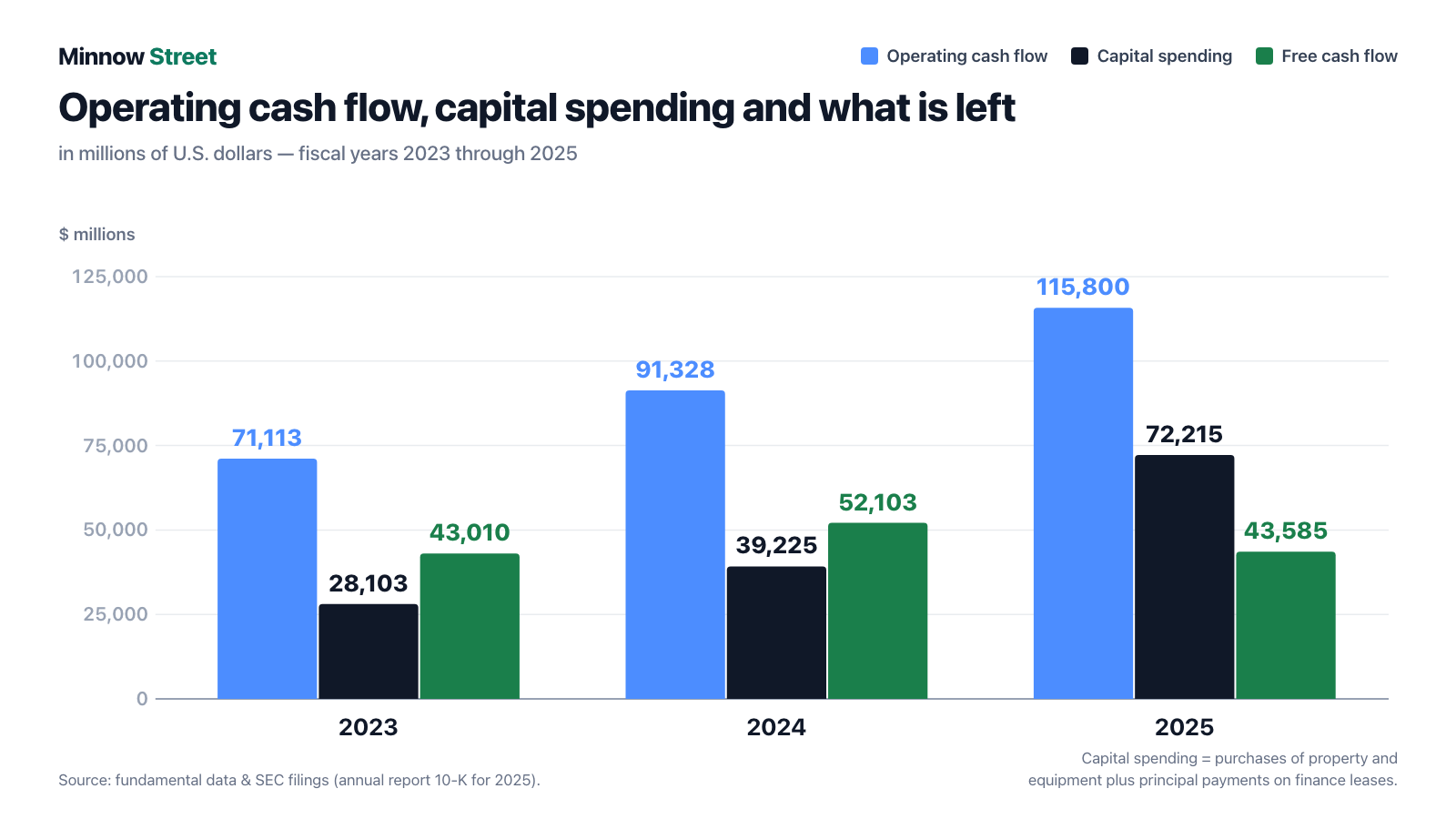
The figures behind it, year by year: operating cash flow of $71,113 million (2023), $91,328 million (2024) and $115,800 million (2025). Capital spending — purchases of property and equipment plus principal payments on finance leases — rose from $28,103 million through $39,225 million to $72,215 million. What was left: $43,010 million, $52,103 million and $43,585 million. Two years, 63 percent more cash earned and 157 percent more spent.
And it is not slowing. The liquidity section of the quarterly report for the quarter ended March 31, 2026 contains the sentence that holds the whole construction drawing:
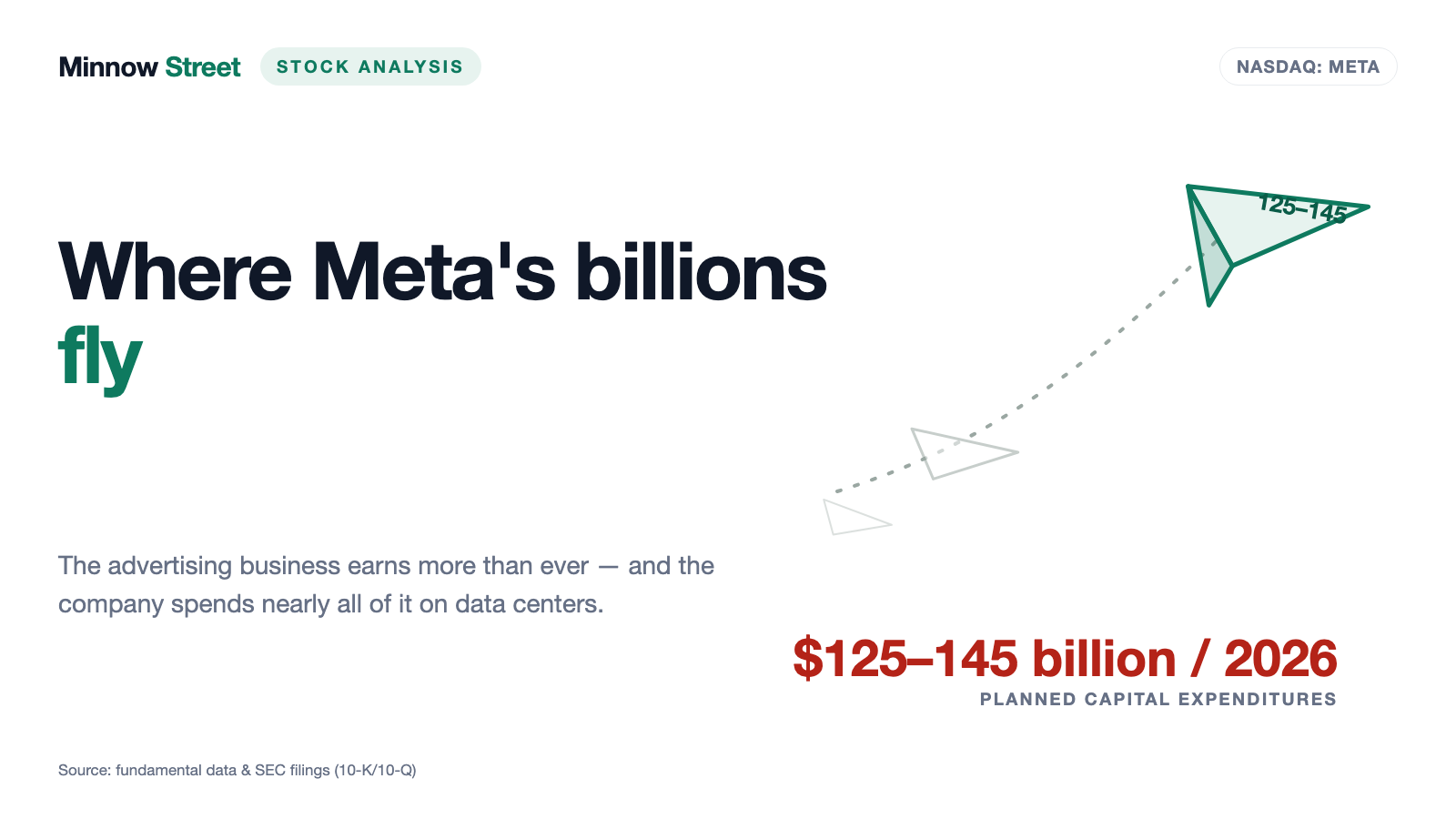
"We anticipate making capital expenditures of approximately $125 billion to $145 billion in 2026 to support our AI efforts and core business."
— Meta Platforms, Inc., Form 10-Q for the quarter ended March 31, 2026, Item 2 (MD&A), "Liquidity and Capital Resources"

Put the figures side by side: Meta spent $72,215 million in 2025. For 2026 it guides to $125,000 to $145,000 million — roughly double, and the range moved up by ten billion within three months. In the earnings release of April 29, 2026 the company cites higher component pricing and, to a lesser extent, additional data center costs for future capacity. The effect is already visible on the balance sheet: property and equipment rose in a single quarter from $176,400 million to $194,776 million, and depreciation on it from $3.84 billion to $5.68 billion per quarter.
This is no longer paid for out of the running business alone. In November 2025 Meta already raised $29.91 billion net through notes. And on May 4, 2026 it closed a second offering: $25,000 million in six tranches, with coupons from 4.550 percent (due 2031) to 6.450 percent (due 2066). Long-term debt therefore rises on a pro-forma basis from $58,748 million to $83,748 million. Meta sets out exactly that calculation in its own note prospectus.
One detail easily missed: in the quarter ended March 31, 2026 Meta bought back not a single share — against $12,754 million in the prior-year quarter. The $25,030 million authorization was left untouched. When a company issues notes and suspends buybacks in the same quarter, that says something about its priorities.
Uncomfortable truth no. 3: $182.88 billion of leases that have not started
Now the number that appears in no balance sheet line. Note 8 of the quarterly report for the quarter ended March 31, 2026, headed "Commitments and Contingencies", contains this sentence:
"In addition to the lease liabilities that are included on our balance sheet, we have operating and finance leases that have not yet commenced as of March 31, 2026. These lease obligations were approximately $182.88 billion, consisting of data centers, colocations, and certain network infrastructure, which will commence during the remainder of 2026 and 2036 with lease terms ranging from greater than one year to 30 years."
— Meta Platforms, Inc., Form 10-Q for the quarter ended March 31, 2026, Note 8 "Commitments and Contingencies"

A plain-language picture of what is happening here: you have signed a lease on an apartment you move into next year. The rent shows up on no bank statement yet — but you owe it. Meta has signed such agreements worth $182.88 billion, with terms of up to 30 years. And the item grew by roughly $79 billion in a single quarter.
The same note lists two further items: $237.67 billion of non-cancelable contractual commitments — mostly third-party cloud capacity, servers, network infrastructure and Reality Labs hardware — of which about $42.25 billion falls due in 2026 and $47.65 billion in 2027. Plus contingent obligations to purchase up to $14.72 billion of cloud capacity over five years. And in April 2026, after the balance sheet date, the report says non-cancelable commitments increased by roughly another $24 billion.
Add the three blocks and Meta is on the hook for about $420 billion — against stockholders' equity of $243,681 million and total assets of $395,250 million. This is neither a scandal nor a hidden liability: it is properly disclosed in the notes, exactly as the rules require. It simply is not where most people look.
Uncomfortable truth no. 4: $53 billion for a segment that sells $2 billion
Reality Labs is Meta's most expensive bet. The figures from the annual reports speak plainly: an operating loss of $16,120 million in 2023, $17,729 million in 2024 and $19,193 million in 2025. That is $53,042 million over three years. Segment revenue over the same period moved from $1,896 million to $2,207 million — effectively sideways.
Meta makes no secret of it. The annual report for 2025 says:
"Although it is inherently difficult to predict when and how the next computing platform will develop, we expect our RL segment to continue to operate at a loss for the foreseeable future, and our ability to support our efforts to build the next computing platform is dependent on generating sufficient profits from other areas of our business."
— Meta Platforms, Inc., Form 10-K for 2025, Item 1 (Business)
The second half of that sentence is the decisive one: the advertising business funds the bet. Elsewhere the report quantifies it — investments in Reality Labs reduced 2025 operating profit by roughly $19.19 billion, and 2026 losses are expected to remain similar. So when you look at Meta's $83,276 million of operating income, you are looking at a figure that already absorbs $19 billion of losses on a bet about the future. Read the other way: the advertising business alone earned $102,469 million in 2025.
Uncomfortable truth no. 5: the shareholders voted — and it changed nothing
Meta held its annual meeting on May 27, 2026. Item 5 on the agenda was a shareholder proposal to end the dual-class capital structure. The company reported the outcome two days later: 1,312,681,056 votes in favor, 3,647,675,248 against. The proposal failed.
Now do the arithmetic. Present or represented were 1,758,006,749 Class A shares carrying one vote each — and 342,307,492 Class B shares carrying ten. The Class B shares alone therefore carried roughly 3.42 billion votes. Without them the 3.65 billion block of votes against cannot be assembled at all. Put differently: of the Class A holders present, a large majority voted to end the structure — and lost comfortably.
Meta describes the position quite openly in the risk factors of the same quarterly report:
"Holders of our Class B common stock, including our founder, Chairman, and CEO, together hold a majority of the combined voting power of our outstanding capital stock, and therefore are able to control the outcome of all matters submitted to our stockholders for approval so long as the shares of Class B common stock represent at least 9.1% of all outstanding shares of our Class A and Class B common stock."
— Meta Platforms, Inc., Form 10-Q for the quarter ended March 31, 2026, Item 1A (Risk Factors)

Why this matters to you: with almost any other stock, the question "what if management sets the wrong priorities?" has a theoretical answer — the owners can vote. Here it does not. Buying Meta means buying one person's judgment on whether $125 to $145 billion of capital spending is the right call.
Uncomfortable truth no. 6: the lawsuits have a scale of their own
The legal section of the quarterly report for the quarter ended March 31, 2026 contains a sentence rarely put this plainly:
"The maximum aggregate monetary damages or penalties sought across our various legal proceedings could amount to an aggregate of up to hundreds of billions of dollars and, as a result, could be material to the financial condition of the company."
— Meta Platforms, Inc., Form 10-Q for the quarter ended March 31, 2026, Item 1A (Risk Factors)
Three specific proceedings carry dates in the filings. First, the antitrust case brought by the Federal Trade Commission, which in 2020 sought divestiture of Instagram and WhatsApp: on November 18, 2025 the court granted judgment in Meta's favor — and on January 20, 2026 the FTC filed a notice of appeal. The matter is not closed. Second, the European Commission's case on the "subscription for no ads" model: in April 2025 the Commission imposed a fine of EUR 200 million, Meta appealed on July 4, 2025 and writes that further modifications to the model may be imposed during the appeal, which could mean "a significant impact to our European business and revenue". Third, the New Mexico Attorney General's case: trial is scheduled to begin on September 8, 2026, with penalties of up to $62.85 billion indicated.
For scale: that $62.85 billion equals roughly 26 percent of stockholders' equity and more than all of 2025 net income. An award at that level is unlikely — a claim is not a judgment. But the number is in the filing, it comes with a date, and Meta does not list it for nothing.
Valuation: what you pay for this company
Let us talk in orders of magnitude, not daily prices. As of July 29, 2026 Meta's market capitalization stood at about $1,506 billion. That produces the following ratios:
- Trailing price/earnings: about 21.6 — you pay roughly 21.6 times what the company earned over the past twelve months. For a business with a 40 percent operating margin that is not expensive; for one with shrinking free cash flow it is not cheap.
- Forward price/earnings: about 19.0 — this already assumes profit grows in 2026. Meta itself guides to operating income above the 2025 level.
- Price/sales: about 7.0 — seven years of revenue. That is the valuation of a business the market credits with very high and very durable margins.
- Price/book: about 6.2 — remarkably low for a technology company, and the reason sits on the balance sheet: $194,776 million of property and equipment. Meta has become, to a meaningful degree, a real-estate and server company.
A professional view, labeled as such: as of July 29, 2026 there were 68 analyst ratings — 47 strong buy, 13 buy, 6 hold, 2 sell. The average price target was $824.68. Consensus figures like these are not a verdict but a mood: they tell you what the majority currently expects, not what happens. For a name covered by practically every house, the spread of opinion is narrow anyway.
What the ratios do not capture is the heart of this analysis. Neither P/E nor price/sales contains the $182.88 billion of leases not yet commenced, the $237.67 billion of non-cancelable commitments, or the question of whether $125 to $145 billion of annual capital spending ever earns a return. Those questions decide Meta's next five years — and they appear in no multiple.
Opportunities and risks at a glance
What speaks for Meta:
- An advertising business with a 48 percent segment margin in the quarter ended March 31, 2026 and 3.56 billion daily users — a moat few companies can match.
- Both price drivers are working: impressions up 19 percent, price per ad up 12 percent in the quarter ended March 31, 2026.
- $115,800 million of operating cash flow in 2025 — Meta can fund most of the building programme out of its own business.
- A balance sheet that carries it: $243,681 million of equity, $81,180 million of cash and securities, $58,748 million of reported debt (as of March 31, 2026).
- Meta guides to 2026 operating income above the 2025 level and to $58 to $61 billion of revenue for the second quarter alone (earnings release of April 29, 2026).
What speaks against it:
- Free cash flow has stalled since 2023 — $43,010 million against $43,585 million — even though the business generates 63 percent more cash.
- Roughly $420 billion of lease, purchase and contractual commitments sit outside the balance sheet (as of March 31, 2026 plus the April contracts).
- Reality Labs has burned $53,042 million since 2023; Meta expects 2026 losses in line with the prior year.
- The quarterly profit to March 31, 2026 contains $8.03 billion of one-off tax benefit; for the remaining quarters Meta guides to a 13 to 16 percent rate.
- Voting power sits with Class B: the shareholder proposal to end that structure failed on May 27, 2026 by 1.31 billion votes to 3.65 billion.
- Legal exposure that Meta itself puts at "up to hundreds of billions of dollars" — with a trial date of September 8, 2026 and a claim of $62.85 billion.
A human conclusion
Back to the kitchen with the scaffolding. Meta took in more in 2025 than ever before and still kept less than the year before — not because the business got worse, but because the rebuild is under way. That is neither good nor bad in itself. It is a decision: a company that generates more than $100 billion a year is putting a large part of it on a technology whose return nobody knows yet.
What makes this decision unusual is the question of who made it. At Meta that is not settled at an annual meeting. On May 27, 2026 a majority of the Class A holders present voted to end exactly this power structure, and the outcome changed nothing. Anyone investing here should not overlook that: you are buying an exceptionally profitable advertising business, and at the same time you are buying one person's judgment on one of the largest capital programmes in corporate history.
The figures are all on the table: $125 to $145 billion for 2026, $182.88 billion of leases that have not begun, $53 billion of losses in a segment that sells $2 billion a year — and an advertising business that has carried all of it so far. Whether this rebuild ends in a better kitchen or merely a more expensive one, nobody knows today. What you make of it is your decision. And that is exactly as it should be.
Sources
- Form 10-Q for the quarter ended March 31, 2026 (filed April 30, 2026) — income statement, balance sheet, cash flow statement, segments, Note 8 "Commitments and Contingencies", Item 1A (Risk Factors), Item 2 (MD&A)
- Form 10-K for 2025 (filed January 29, 2026) — Item 1 (Business), Item 1A (Risk Factors), Item 7 (MD&A), segment and tax disclosures
- Form 10-K for 2024 (filed January 30, 2025) — comparative figures for 2022 through 2024
- Earnings release of April 29, 2026 (8-K, Item 2.02, Exhibit 99.1) — guidance for revenue, expenses, capital expenditures and the tax rate in 2026
- Prospectus supplement 424B2 of May 1, 2026 — six tranches totalling $25 billion, capitalization table
- 8-K of May 4, 2026, Item 8.01 — completion of the note offering
- 8-K of May 29, 2026, Item 5.07 — voting results of the annual meeting held May 27, 2026
- Fundamental data & SEC filings (annual and quarterly reports, 10-K/10-Q) — valuation multiples and analyst consensus, data as of July 29, 2026
Journalistic analysis, not investment advice and not a solicitation to buy or sell securities. Shares can lose value at any time and a total loss is possible. All figures come from the primary documents linked above and carry the reporting date stated there; valuation multiples are marked with the data date of July 29, 2026 and will age. The author holds no position in Meta Platforms at the time of publication.
Our Bottom Line at a Glance
- Earning power of the advertising business positive
- The Family of Apps segment turned $55,909 million of revenue into $26,900 million of income from operations in the quarter ended March 31, 2026 — a 48 percent margin. Ad impressions rose 19 percent and the average price per ad 12 percent. Operating cash flow reached $115,800 million in 2025 (10-K 2025, 10-Q for the quarter ended March 31, 2026).
- Balance sheet and liquidity positive
- As of March 31, 2026, $243,681 million of stockholders' equity and $81,180 million of cash plus marketable securities stood against $58,748 million of reported debt. Even after the May 4, 2026 offering of $25,000 million, interest coverage is nowhere near critical: $83,276 million of 2025 operating income against $2,980 million of short-term interest obligations.
- Capital spending without proof of return neutral
- Operating cash flow rose from $71,113 million (2023) to $115,800 million (2025), up 63 percent. Free cash flow was flat over the same period at $43,010 million and $43,585 million, because capital spending climbed from $28,103 million to $72,215 million. For 2026 the company guides to $125,000–145,000 million (10-Q for the quarter ended March 31, 2026).
- Earnings quality and taxes neutral
- Net income of $26,773 million in the quarter ended March 31, 2026 exceeded income before taxes of $21,752 million, because the tax line was a benefit of $5,021 million — including an $8,030 million one-off from the transitional relief for the corporate minimum tax. In 2025 the same mechanism ran the other way: a $15.93 billion charge in the third quarter.
- Off-balance-sheet commitments negative
- As of March 31, 2026, Note 8 of the quarterly report discloses $182.88 billion of leases not yet commenced (December 31, 2025: $103.77 billion), $237.67 billion of non-cancelable contractual commitments and up to $14.72 billion of contingent cloud purchases. None of it sits on the balance sheet, whose equity is $243,681 million.
- Reality Labs and governance negative
- Reality Labs lost $53,042 million between 2023 and 2025 on barely growing revenue; Meta expects 2026 losses in line with the prior year (10-K 2025). At the same time the Class B shares, with ten votes each, decide every vote: the shareholder proposal to end that structure failed on May 27, 2026 by 1.31 billion votes to 3.65 billion (8-K filed May 29, 2026).
Meta runs one of the most profitable advertising businesses on earth: a 48 percent operating margin in the Family of Apps segment in the quarter ended March 31, 2026, $115,800 million of operating cash flow in 2025 and 3.56 billion daily active people. The price sits in the same filings: $125,000 to $145,000 million of planned capital spending for 2026, free cash flow that has not grown since 2023, $25,000 million of new notes maturing as far out as 2066, $53,042 million of cumulative Reality Labs losses and roughly $420 billion of commitments that appear in no balance sheet line. Not investment advice.
What Our Rating Means
Open questions
The business works in principle, but one material question is open. As long as it stays open, our findings do not carry a quality verdict.
The business itself is beyond doubt: an advertising operation with a 48 percent segment margin, $115.8 billion of operating cash flow in 2025 and 3.56 billion daily users is a moat few companies can match. The balance sheet is sound, interest coverage is not remotely an issue, and there is no going-concern language anywhere. What remains open is an operational question, and it is a big one: whether $125 to $145 billion of annual capital spending ever converts into returns is unproven — free cash flow in 2025, at $43.6 billion, sits where it sat in 2023, even though operating cash flow rose 63 percent. Add roughly $420 billion of lease and purchase commitments outside the balance sheet, a segment that has burned $53 billion in three years, and a quarterly profit whose top line owes a third of itself to the tax line. When the evidence sits between two levels, we take the more cautious one. The decision is yours.
A journalistic assessment by our editorial team at the time of the deep dive, based on public sources — not investment advice and not a solicitation to buy or sell. Your personal circumstances (investment goals, risk capacity, taxes) cannot be taken into account. What our levels mean, how verdicts are formed, and what conflicts of interest exist →
Worth Noting
- Hook: ranking of the 100 largest U.S. stocks by market capitalization (as of July 28, 2026); Meta stood at number 8 and had no analysis yet.
- Data as of: annual figures from the Form 10-K for 2025 (filed January 29, 2026) and for 2024 (filed January 30, 2025), quarterly figures from the Form 10-Q for the quarter ended March 31, 2026 (filed April 30, 2026), valuation multiples as of July 29, 2026. Every filing from April 29, 2026 onward was reviewed, including the earnings release (8-K Item 2.02 of April 29, 2026), the note offering (424B2 of April 30 and May 1, 2026; 8-K of May 4, 2026) and the annual meeting (8-K Item 5.07 of May 29, 2026).
- Possible confusion: Meta Platforms was named "Facebook Inc" until October 27, 2021. The ticker META belonged to Meta Financial Group until June 2022; that company trades today as Pathward Financial under the ticker CASH. Historical series for the symbol META can easily point to the wrong company.
- One-off effects: both 2025 (a $15.93 billion tax charge in the third quarter) and the quarter ended March 31, 2026 (an $8.03 billion tax benefit) contain opposing one-off effects from changes in law. Growth rates in net income cannot be read without that context.
- Analyses are evergreen; a daily share price is not an argument to buy.
Frequently Asked Questions
Almost entirely from advertising. Of $56,311 million of revenue in the quarter ended March 31, 2026, exactly $55,024 million came from ads on Facebook, Instagram and the other apps — 98 percent. The Reality Labs segment, which sells Quest headsets, AI glasses and accessories, contributed $402 million and lost $4,028 million doing so. Meta counted 3.56 billion daily active people on average in March 2026.
Because of taxes. Revenue rose 22 percent to $200,966 million in 2025 and income from operations 20 percent to $83,276 million. The tax line, however, jumped from $8,303 million to $25,474 million. The cause was the U.S. tax package enacted in July 2025, which produced a $15.93 billion charge in the third quarter of 2025. Without it the effective tax rate would have been 13 percent instead of 30 percent.
The quarterly report for the quarter ended March 31, 2026 gives a range of $125 billion to $145 billion for the full year 2026, raised from $115–135 billion. The first quarter of 2026 alone accounted for $19,840 million including principal payments on finance leases. For comparison: capital spending was $72,215 million in 2025 and $28,103 million in 2023.
As of March 31, 2026 the balance sheet showed $58,748 million of long-term debt (principal $59,000 million) against $81,180 million of cash and marketable securities and $243,681 million of stockholders' equity. On May 4, 2026 a further $25,000 million of notes was issued, taking long-term debt to $83,748 million on a pro-forma basis. Interest obligations as of March 31, 2026 were $2,980 million short term and $56,270 million long term.
Reality Labs is Meta's second reportable segment: Quest headsets for virtual reality, AI glasses from Ray-Ban and Oakley, software and long-range research. The segment lost $16,120 million in 2023, $17,729 million in 2024 and $19,193 million in 2025 — $53,042 million over three years. The quarter ended March 31, 2026 added $4,028 million. Meta expects 2026 losses to remain similar to 2025.
The holders of Class B common stock. That class carries ten votes per share; Class A carries one. As of April 24, 2026 there were 342,377,716 Class B shares and 2,196,045,588 Class A shares. Meta states in its quarterly report that the Class B holders — including the founder, Chairman and CEO — together hold a majority of the combined voting power for as long as Class B represents at least 9.1 percent of all outstanding shares.
Several. The European Commission fined Meta EUR 200 million in April 2025 over its "subscription for no ads" model; Meta appealed on July 4, 2025. In the Federal Trade Commission's antitrust case the court ruled in Meta's favor on November 18, 2025, and the FTC filed a notice of appeal on January 20, 2026. A trial in New Mexico is scheduled to begin on September 8, 2026, where penalties of up to $62.85 billion are being sought.
Yes, since 2024. In the quarter ended March 31, 2026 Meta paid $1,346 million of dividends and dividend equivalents; annualized, the current rate equals $2.10 per share. The second line is the striking one: in the same quarter Meta repurchased no shares at all, after $12,754 million in the prior-year quarter. The $25,030 million repurchase authorization was left untouched.
Found an error?
Did you spot a factual error, an outdated number, or a typo in this deep dive? Let us know briefly — your report goes straight to the editorial team.