Broadcom Stock: One Customer Brings 42 Percent of Revenue — and $29 Billion Sits Off the Balance Sheet
In the quarter ended May 3, 2026, Broadcom earned $9,310 million on $22,187 million of revenue, up 48 percent. The same quarterly report states that a single direct customer produced 42 percent of that revenue, against 29 percent a year earlier. And in the subsequent-events note, on the second-to-last page, sits a backstop entered into on June 8, 2026 for one AI customer's lease payments: a maximum exposure of $29 billion, nowhere on the balance sheet. We read the filings line by line — including the note where those $29 billion are hiding.
 Thomas Mücke
Founder & Publisher
Thomas Mücke
Founder & Publisher
Chart
Interactive price chart (TradingView).
Note: pure fact-based analysis, not investment advice and not a solicitation to buy or sell. All figures without guarantee.
The trap is called adjustment
Let us make a deal. Before we talk about Broadcom, I will confess to a habit we both have. It is called adjustment, and in everyday life it sounds like this: "Apart from the car repair, it was a really good month." True enough. Only the car repair happened. We strip out the unpleasant items, call the result "basically", and feel better afterwards without a single dollar more in the account.
Broadcom does exactly the same thing, entirely legally and transparently. Next to every profit figure the company places a second, "adjusted" one. In the quarter ended May 3, 2026 the official figure was $9,310 million of net income; the adjusted one was $12,074 million. In between sit $2.8 billion — and they are no accident. They are the price of the growth Broadcom did not build itself but bought.
Hold on to that tension, because it runs through every chapter: Broadcom bought its growth, and the price sits in the books in three places at once, from which the company then removes it again. As amortization of acquired intangibles. As debt with interest. As stock-based compensation. We are going to read that together — and along the way we will find two figures that made no headline at all.
Contents
- What Broadcom actually does
- How this stock landed on our desk
- The numbers over the years — given their due
- What the filings say — the uncomfortable truths
- Valuation: what you pay for this company
- Opportunities and risks at a glance
- A human conclusion
- Sources
What Broadcom actually does
Broadcom sells two very different things, and the annual report sorts them into two segments. First, semiconductors: custom AI accelerators (XPUs in company jargon), Ethernet switches for datacenters, plus chips for broadband access, wireless, set-top boxes, storage systems and mobile phones. Second, infrastructure software: VMware at its core — the software companies use to virtualize their own datacenters — plus mainframe and security software.
In fiscal 2025 the $63,887 million of revenue split like this: semiconductors $36,858 million (58 percent, up 22 percent year over year), infrastructure software $27,029 million (42 percent, up 26 percent). An everyday picture for the difference: the semiconductor business sells parts that get paid for once and built in. The software business rents out licenses that get billed again every year. One is a cycle, the other a subscription.
How does a chipmaker end up with a subscription business? It bought one. On November 22, 2023 Broadcom acquired VMware — for roughly $30.8 billion in cash plus 544 million of its own shares worth $53.4 billion. The cash portion was funded with $30.4 billion of term loans. Call it a good $84 billion for a single acquisition. That is why Broadcom’s balance sheet today holds more goodwill than plant and equipment — more on that shortly.
Two things that are easy to get wrong. First: Broadcom’s fiscal year ends on the Sunday closest to October 31. "Fiscal 2025" ended on November 2, 2025 and ran 52 weeks; fiscal 2024 ended on November 3, 2024 and ran 53 weeks — the extra week fell in the first quarter and lifted both revenue and costs, according to the filing. Compare Broadcom with calendar-year reporters and you are off by two months; compare fiscal 2023 with fiscal 2024 and you are comparing 52 weeks with 53.
Second: today’s Broadcom Inc. is a Delaware corporation. It is not the old Broadcom Corporation that Avago took over in 2016, and it is no longer the interim Singapore entity "Broadcom Ltd" — the submissions record of the U.S. securities regulator, the SEC, carries that name only as a former name, valid until March 9, 2018. Search old databases for a time series and it is easy to land on the wrong company.
How this stock landed on our desk
This time it was not a scanner hit. Our in-house stock scanners filter on metrics — cheap valuation, high Piotroski score, momentum — and that is precisely why the best-known heavyweights fall through systematically: they are rarely cheap. When we counted on July 28, 2026 how many of the 100 largest U.S. stocks by market value already had a deep-dive analysis with us, 88 did not. Broadcom was the third largest of those, at number seven with a market value of roughly $1,823 billion (data as of July 28, 2026).
That is an honest statement about our own method: a scanner that hunts for bargains will not find blue chips. So we are working the list from the top down. Broadcom sits in the same supply chain as two companies we have already taken apart — the chips of Nvidia and Broadcom’s custom accelerators compete for the same datacenter budgets, and both get paid by operators such as Amazon. Value one of these three companies and you are always valuing the other two as well.
The numbers over the years — given their due
Let us start with what genuinely impresses. Broadcom grew revenue 24 percent in fiscal 2025 (ended November 2, 2025) to $63,887 million, operating income to $25,484 million and net income to $23,126 million. In the current fiscal year that accelerates sharply again: for the six months ended May 3, 2026 revenue rose from $29,920 million to $41,498 million, and in the quarter alone from $15,004 million to $22,187 million — an increase of 48 percent.
An operating margin of 46.6 percent for the half year means, in everyday terms: of every $100 of revenue, $46.60 remains as operating profit. For scale — a solid industrial company runs at 10 to 15, a very good one at 20. Broadcom is exceptional in this discipline, and that despite a business half of which consists of physical parts.
Now the four-year time series. And here the tension shows itself for the first time:
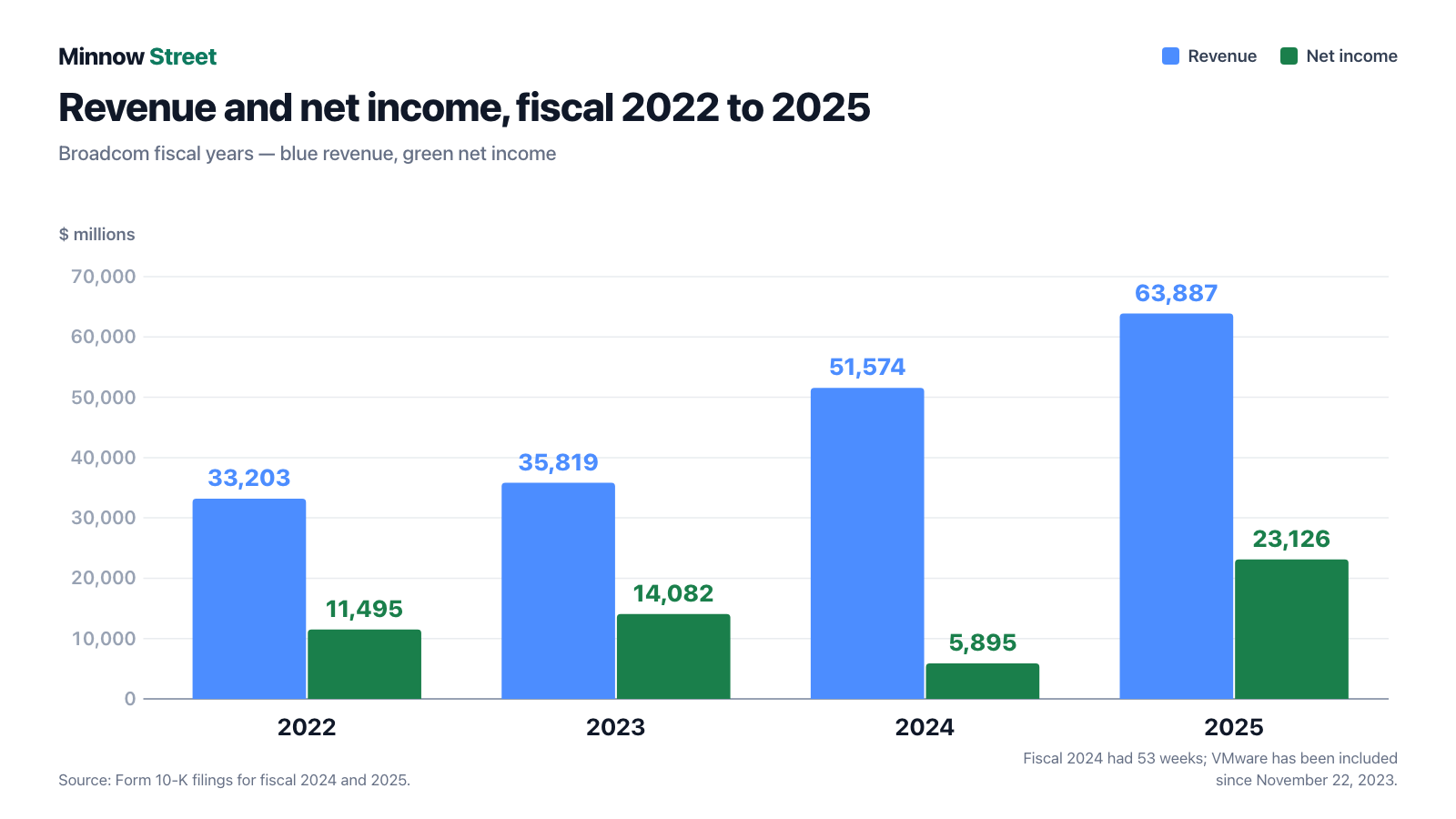
Read the green series again. In fiscal 2024 revenue rose 44 percent — and profit fell 58 percent. That was not a collapse in the business but the booking of a purchase price: amortization of acquired intangibles rose from $3,247 million to $9,267 million, joined by $1,787 million of restructuring and other charges and an interest expense that jumped from $1,622 million to $3,953 million. Only in fiscal 2025 did the picture flip back.
The figures in detail, all from the Form 10-K filings for fiscal 2024 and 2025:
| Fiscal year (ends early November) | Revenue | Operating income | Net income | Free cash flow |
|---|---|---|---|---|
| 2022 (52 weeks) | $33,203 million | $14,225 million | $11,495 million | — |
| 2023 (52 weeks) | $35,819 million | $16,207 million | $14,082 million | $17,633 million |
| 2024 (53 weeks) | $51,574 million | $13,463 million | $5,895 million | $19,414 million |
| 2025 (52 weeks) | $63,887 million | $25,484 million | $23,126 million | $26,914 million |
The last column is the friendliest news in this analysis. Free cash flow — operating cash flow less purchases of property, plant and equipment — kept rising even in the disaster year of 2024, because amortization depresses profit without costing cash. For the six months ended May 3, 2026 it came to $18,272 million, against $12,424 million in the prior-year period. Broadcom invests remarkably little in factories of its own along the way: just $481 million in six months. It has the chips made externally.
What the filings say — the uncomfortable truths
Uncomfortable truth number 1: two segments earn $42 billion — $25 billion arrives
Broadcom reports operating income for each segment. In fiscal 2025 the figures read: semiconductors $21,232 million, infrastructure software $20,765 million. Together $41,997 million. Below that, the consolidated income statement shows operating income of $25,484 million. Where are the remaining $16.5 billion?
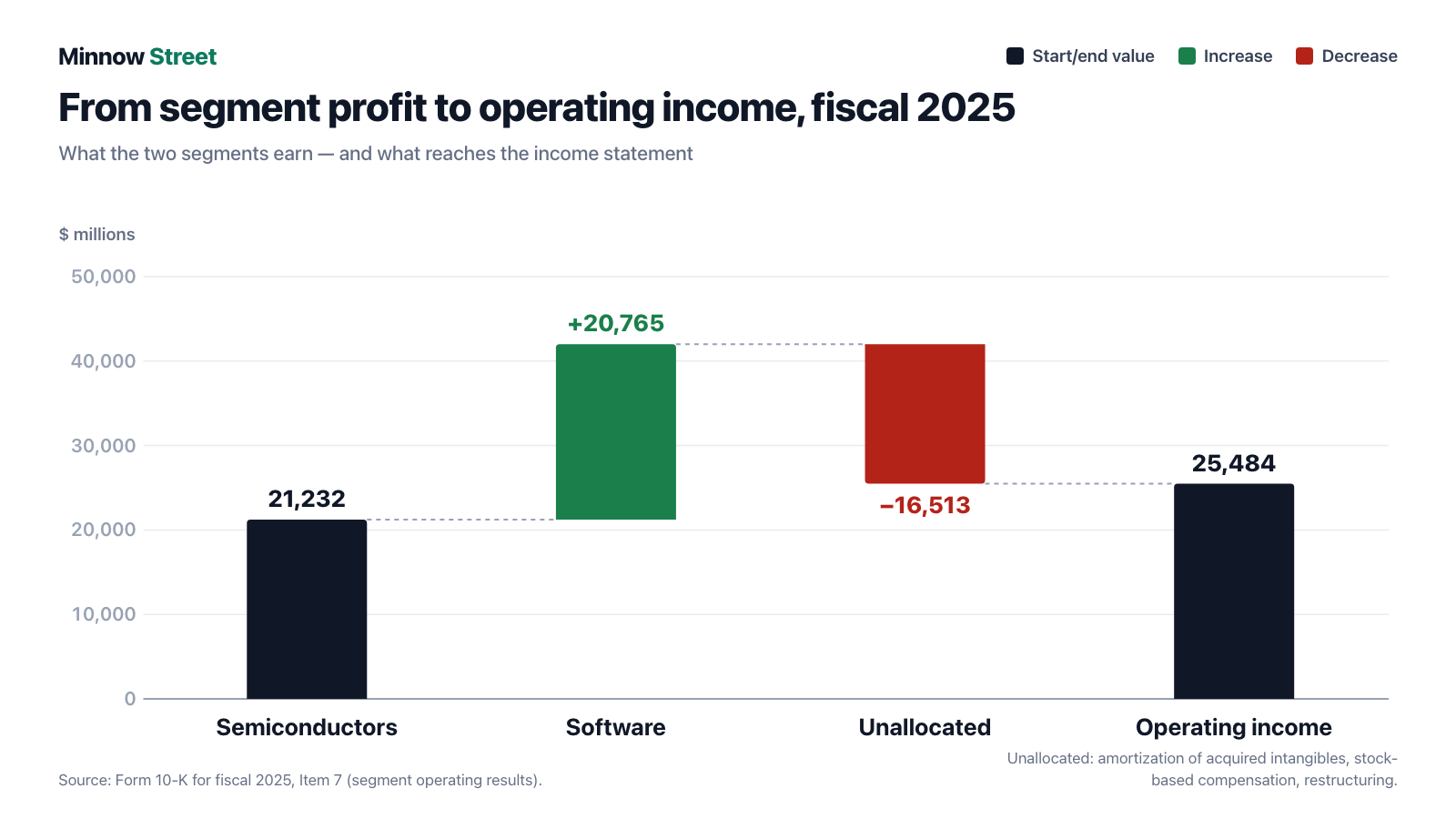
The annual report says it itself — and it also says why those costs are missing from the segment figures:
"Unallocated expenses include amortization of acquisition-related intangible assets, stock-based compensation expense, restructuring and other charges, and acquisition-related costs which are not used in evaluating the results of, or in allocating resources to, our segments."
— Broadcom Inc., Form 10-K for fiscal 2025, Item 7 (MD&A), section "Segment Operating Results"

Two of those items are economically very different, and that is worth a minute. The amortization of acquired intangibles — $8,062 million in fiscal 2025 — genuinely costs no more cash; the cash flowed in 2023 at the moment of purchase. It is the retrospective spreading of a price long since paid. Strip it out and you have a certain right to.
The stock-based compensation is something else. It costs no cash either — it costs you. Broadcom pays employees with new shares; your slice of the company gets smaller. That is dilution: the cake stays the same size, but new pieces keep being cut from it. In fiscal 2025 that came to $7,568 million, and in the six months ended May 3, 2026 another $4,268 million. For comparison: over the same six months Broadcom repurchased $8,450 million of its own shares — and the number of shares outstanding still rose from 4,741 million to 4,758 million.
Rule of thumb: a buyback that just about offsets a company’s own stock compensation is not a gift to you. It is the bill for other people’s pay.
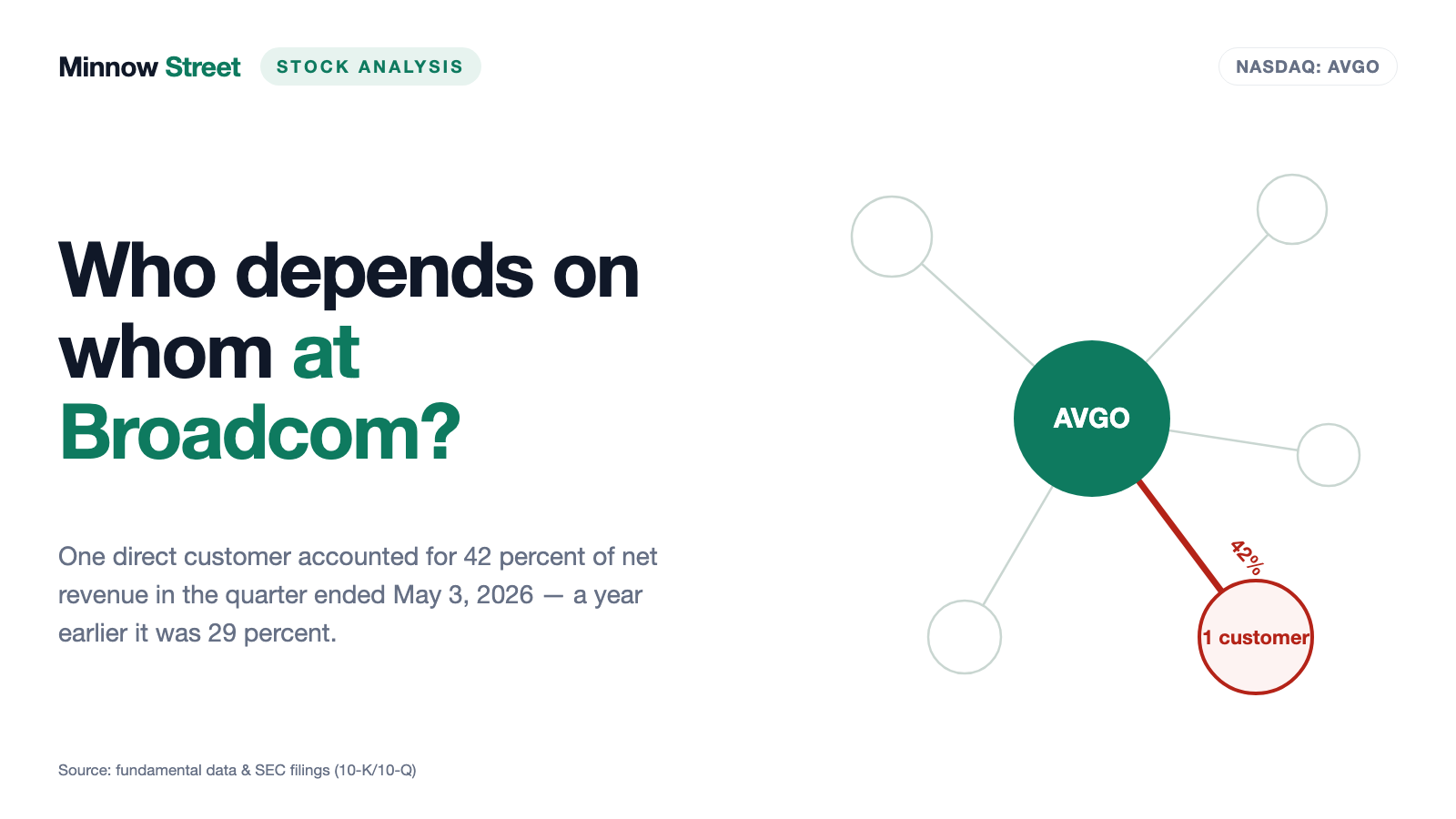
Uncomfortable truth number 2: one single customer brings 42 percent of revenue
This figure is not in the earnings release; it sits far back in the quarterly report (Form 10-Q). And it may be the most important number in the whole analysis:
"A relatively small number of customers account for a significant portion of our net revenue. Direct sales to one semiconductor solutions customer, which is a distributor, accounted for 42% of our net revenue for each of the fiscal quarter and two fiscal quarters ended May 3, 2026, and 29% of our net revenue for each of the fiscal quarter and two fiscal quarters ended May 4, 2025."
— Broadcom Inc., Form 10-Q as of May 3, 2026, Part I, Item 2 (MD&A), section "Net Revenue"

The movement is what stands out. In fiscal 2024 and 2025 the same customer stood at 28 percent and 32 percent; in the quarter ended May 3, 2026 it is 42. In absolute terms: from roughly $4.4 billion to roughly $9.3 billion of quarterly revenue. Over the same period the share of all distributors in revenue rose from 48 percent in fiscal 2025 to 56 percent in the first half of fiscal 2026. The top five end customers together came to roughly 45 percent, against 40 percent.
An everyday picture for why that matters: if your neighbor told you his business was booming but one single client brought 42 percent of the revenue — would you swallow for a second? Exactly. Broadcom puts the consequence plainly: the loss of, or a significant decrease in demand from, any of its top five end customers could have "a material adverse effect" on its business, results of operations and financial condition. And distributor agreements, the same report notes, are generally nonexclusive and some may be terminated at any time without cause.
In fairness: a distributor is not end demand, it is a channel. Several end customers sit behind it. And in early July 2026 came news that rather stabilizes the customer side — more on that in the chapter on the counterweight.
Uncomfortable truth number 3: a $29 billion backstop that appears in no balance sheet line
The quarterly report as of May 3, 2026 has a second-to-last note called "Subsequent Events". It contains what we consider the single most important sentence in the whole filing:
"On June 8, 2026, we arranged for an investor partner to take on certain agreements to purchase AI racks based on custom AI accelerators designed by us and the related lease agreements with a customer that enable access to compute capacity. In connection with the arrangement, we entered into a backstop agreement with the investor partner for the customer's lease obligations over 5-year terms. The backstop will increase over time as the AI racks are deployed and decrease as the customer makes payments on its lease obligations, with a maximum exposure of $29 billion."
— Broadcom Inc., Form 10-Q as of May 3, 2026, Note 11 "Subsequent Events"
Let us convert that into orders of magnitude you can remember. Stockholders’ equity stood at $87,691 million as of May 3, 2026. A maximum exposure of $29 billion therefore equals 33 percent of equity — and 45 percent of all debt of $64,907 million. None of it appears on the balance sheet.
Who this investor partner is, the note does not say — but the same report names it elsewhere. Under "Other Information" (Part II, Item 5) the identical arrangement appears a second time, there with the addition of Apollo. Read only the note and you do not learn who Broadcom is standing behind; read the filing to the end and you do.
What happened economically? An AI customer wanted to rent computing capacity rather than buy chips. Broadcom put a financial investor in the middle, who buys the racks and leases them to the customer. To get the investor on board, Broadcom guarantees the lease payments. In everyday terms: you guarantee your best customer’s car loan so he can afford the car he ordered from you. As long as he pays, it costs you nothing. If he does not, you own the car and the debt.
Broadcom also names its remedies: on default, the company could assume the lease or sell the racks, which would reduce the exposure. And it had already described the pattern in the same filing as a general risk — large customers increasingly want to lease racks rather than buy them, along with "alternative financings", which could impose "financial obligations, including backstops or guarantees" on the company. That is precisely what happened on June 8, 2026, on a scale that is hard to overlook.
Uncomfortable truth number 4: 70 percent of the balance sheet is purchase price
Take a look at Broadcom’s balance sheet as of May 3, 2026. Total assets $179,158 million. Of which:
- Goodwill $97,801 million — $71,788 million of it in the software segment, because the VMware acquisition alone created $54,206 million of goodwill
- Intangible assets $28,333 million — purchased technology, customer relationships, trade names
- Property, plant and equipment, by contrast: $2,788 million
Goodwill and intangibles together are $126,134 million, or 70 percent of total assets. Subtract both from stockholders’ equity of $87,691 million and tangible equity is minus $38,443 million. That is not unusual for a group grown by acquisition, and it is not an alarm signal — goodwill is not a debt. But it explains two things: why the price-to-book ratio looks so high at roughly 21 (data as of July 28, 2026), and why a goodwill write-down would be a different order of event for Broadcom than for a machinery maker.
The reassuring counter-figure: in the annual impairment assessments for fiscal 2023, 2024 and 2025 Broadcom concluded each time that goodwill was not impaired. As long as the software segment delivers $20,765 million of segment operating income, that is unlikely to change soon.
The cross-check: is this a peak profit that will not repeat?
We ask this in every analysis. For Broadcom the answer is: partly in the operating result, unambiguously yes in the tax line.
Look closely at the fiscal 2025 income statement. Income before income taxes: $22,729 million. Net income: $23,126 million. Profit after tax was therefore higher than before it — because the tax line held no expense but a benefit of $397 million. The filing names the reasons: expiring statutes of limitations, settled tax examinations, tax benefits from stock-based compensation. On top of that, tax incentives — mainly in Singapore and Malaysia — cut the provision by a further roughly $2,709 million and lifted diluted earnings per share by $0.56.
Broadcom says itself that this does not last:
"While the tax did not have a material impact on our fiscal year 2025 consolidated results of operations, we expect a material impact from the enactment of these laws on our consolidated results of operations and cash flows for our fiscal year 2026."
— Broadcom Inc., Form 10-K for fiscal 2025, Item 7 (MD&A), section "Provision for (benefit from) income taxes"

You can already see it: for the six months ended May 3, 2026 the tax line was back to an expense of $1,666 million — against just $107 million in the prior-year period. That is 9.1 percent of pre-tax income, still far below any standard rate, but the direction is clear.
On the operating side the cross-check comes out far friendlier. The growth does not come from one-off effects but from deliveries for AI datacenters — and from contracts already signed. This is not a one-quarter outlier: Broadcom guides to significantly more again for the following quarter.
The counterweight: $164.6 billion already ordered
It would be unfair to stop here. The same quarterly report contains the figure that justifies all this effort. The firmly committed remaining performance obligations — multi-year contracts under which the customer has no right to terminate — stood at roughly $164.6 billion as of May 3, 2026. That includes a long-term contract for custom AI accelerators signed in the same quarter. Roughly 30 percent of it is expected to be recognized as revenue over the following twelve months, which would be about $49 billion.
For scale: $164.6 billion is more than two and a half times the entire fiscal 2025 revenue ($63,887 million). If you wonder why Broadcom built inventory for custom AI accelerators from $2,270 million to $4,328 million: that is the answer.
On top of that came news on July 6, 2026, after the quarterly report:
"Broadcom Inc. (“Broadcom”) and Apple Inc. (“Apple”) have agreed to expand their long-standing technology collaboration through 2031 by entering into new multi-year long-term agreements for Broadcom to develop and supply a range of custom ASIC silicon products for use in multiple generations of Apple products."
— Broadcom Inc., Form 8-K dated July 6, 2026, Item 8.01

And finally the figures Broadcom itself gave on June 3, 2026: AI semiconductor revenue in the quarter ended May 3, 2026 was $10.8 billion, up 143 percent over the prior-year quarter. For the quarter ending August 2, 2026 the company guided to roughly $16.0 billion of AI revenue and roughly $29.4 billion of consolidated revenue — an increase of 84 percent. Guidance is not a figure from an audited statement; but it is not fantasy either when $164.6 billion is firmly on order.
Two footnotes for completeness, because they concern statements in the present tense: Broadcom’s chief financial officer has been Amie Thuener since June 12, 2026; her predecessor Kirsten M. Spears retired on that date. And in June 2026 Broadcom repurchased roughly $2.9 billion of principal of its own notes — roughly $5.5 billion had been tendered, and the company raised the purchase-price cap from $2.5 billion to $3.0 billion.
Valuation: what you pay for this company
Broadcom cost roughly $1,823 billion on the market at the end of July 2026 (data as of July 28, 2026). On trailing diluted earnings per share of $6.00 that gives a price-to-earnings ratio of roughly 64, a price-to-sales ratio of roughly 24 and a price-to-book ratio of roughly 21. Trailing revenue for the four quarters ended May 3, 2026 was $75,465 million.
For scale: a P/E of 64 is not a bargain price. To a first approximation it says the market is paying 64 years of profit at today’s size for the company — or is betting that profit rises sharply. That is exactly the bet. Annualize the company’s guidance for the quarter ending August 2, 2026 and you land at a good $117 billion of revenue and a price-to-sales ratio around 16. We write that down explicitly as an arithmetic exercise, not as a metric: it extrapolates a single quarter of guidance, not a full-year figure. The dependable number remains the trailing one.
The professionals see it very kindly. Forty-six estimates produced an average price target of roughly $525 as of the July 28, 2026 data cut-off, with 36 "strong buy" ratings, 7 "buy", 3 "hold" and not a single sell. A chorus without one dissenting voice, though, is rarely an independent second opinion — among the largest index heavyweights it is close to the normal state.
One dated anchor from the filings themselves, because it is more honest than any daily price: in the six months ended May 3, 2026 Broadcom repurchased 25 million of its own shares for $8,450 million — an average of roughly $338 per share. In the quarter ended May 3, 2026 it was only 2 million shares for $600 million, or roughly $300 per share. The company itself slowed its buyback pace markedly in the spring of 2026, while $10.1 billion of authorization remained open.
Opportunities and risks at a glance
What speaks for Broadcom:
- Firmly committed remaining performance obligations of roughly $164.6 billion as of May 3, 2026 — more than two and a half times fiscal 2025 revenue.
- An operating margin of 46.6 percent for the six months ended May 3, 2026, on 39 percent revenue growth.
- Free cash flow of $18,272 million for the six months, on just $481 million of capital spending — the manufacturing risk sits with contract manufacturers.
- Two legs to stand on: the cyclical semiconductor business and the VMware subscription business, which delivered $20,765 million of segment operating income in fiscal 2025.
- An expanded agreement with Apple through 2031 for custom ASIC silicon products (Form 8-K dated July 6, 2026).
- Returns to shareholders: $6,178 million of dividends and $8,450 million of buybacks in the six months, with $10.1 billion of authorization still open.
What speaks against it:
- A single direct customer brought 42 percent of revenue in the quarter ended May 3, 2026, against 29 percent in the prior-year quarter; the top five end customers roughly 45 percent.
- A backstop for one AI customer’s lease payments with a maximum exposure of $29 billion since June 8, 2026 — 33 percent of stockholders’ equity, outside the balance sheet.
- 70 percent of total assets is goodwill and intangible assets; tangible equity is negative at minus $38,443 million.
- $16,513 million of unallocated expenses in fiscal 2025, $7,568 million of it stock-based compensation — the share count rose despite $8,450 million of buybacks in the six months.
- The tax line was a benefit of $397 million in fiscal 2025; Broadcom expects a material burden from the minimum tax in Singapore in fiscal 2026.
- Broadcom itself describes the AI-driven upturn in the semiconductor industry as one that "may not be sustainable" in its annual report.
- $66,720 million of debt at face value, $47,787 million of it not due until after fiscal 2030 — a long refinancing shadow if rates rise.
A human conclusion
Remember the adjustment trap from the opening? At Broadcom it has a particular twist. Read the filings properly and you do not find the hidden catastrophe such analyses sometimes lead you to expect. You find an exceptionally profitable company that earns money, collects money and discloses both cleanly — including every item it then strips out itself.
What you also find are two numbers right at the back that made no headline: 42 percent of revenue through a single direct customer, and a backstop of up to $29 billion that appears nowhere on the balance sheet. Both say the same thing: Broadcom is growing so fast that it is taking on part of its customers’ risk. That is not forbidden, not hidden, and in a boom not unusual either. It is simply something other than "sell chips and send invoices".
Whether it pays off will not be settled in the profit line — but in whether the $164.6 billion of ordered revenue gets delivered and paid for, and whether the customer Broadcom stands behind keeps up its payments. Believe in that and you are buying one of the most profitable semiconductor companies in the world. Doubt it and you see a company whose success hangs on very few addresses. Both readings sit in the same document. What you make of that is your decision. And that is exactly as it should be.
Sources
- Broadcom Inc., Form 10-Q as of May 3, 2026 (filed June 9, 2026) — income statement, balance sheet, cash flow statement, Note 2 (Remaining Performance Obligations), Note 6 (Borrowings), Note 7 (Stockholders’ Equity), Note 9 (Segment Information), Note 11 (Subsequent Events, backstop), Part I Item 2 (MD&A, customer concentration), Part II Item 1A (Risk Factors, distributor share) and Part II Item 5 (Other Information, name of the investor partner)
- Broadcom Inc., Form 10-K for fiscal 2025 (filed December 18, 2025) — Item 1 (Business, headcount, AI products), Item 1A (Risk Factors), Item 7 (MD&A, segment results, taxes), financial statements, Note 7 (Goodwill and Intangible Assets), Note 12 (Income Taxes)
- Broadcom Inc., Form 10-K for fiscal 2024 (filed December 20, 2024) — comparative figures for fiscal 2022 to 2024, the VMware acquisition of November 22, 2023, the 53-week year
- Broadcom Inc., Form 8-K dated June 3, 2026 (Item 2.02 with Exhibit 99.1) — results for the quarter ended May 3, 2026, AI revenue, guidance for the quarter ending August 2, 2026, quarterly dividend
- Broadcom Inc., Form 8-K dated July 6, 2026 (Item 8.01) — expanded agreement with Apple through 2031
- Broadcom Inc., Form 8-K dated June 18, 2026 (Item 8.01 with Exhibits 99.1 and 99.2) — results and upsize of the cash tender offers for its own notes
- SEC EDGAR, filing index for Broadcom Inc. (CIK 0001730168) — every filing dated on or after June 3, 2026 was reviewed; the change of chief financial officer is disclosed in the Form 8-K dated April 2, 2026 (Item 5.02)
- Fundamental data (market value, valuation metrics, analyst consensus), data as of July 28, 2026
This analysis is journalistic commentary on publicly available information and is not investment advice. It is not a solicitation to buy or sell securities. Stocks can lose substantial value, up to and including the total loss of the capital invested. All figures come from the sources named above and carry their respective cut-off dates; reports published after the editorial deadline are not reflected. The author holds no position in the stock discussed at the time of publication.
Our Bottom Line at a Glance
- Growth and demand positive
- Revenue rose 48 percent to $22,187 million in the quarter ended May 3, 2026, with the semiconductor segment alone up 79 percent to $15,009 million. Firmly committed remaining performance obligations stood at roughly $164.6 billion (10-Q as of May 3, 2026); for the following quarter Broadcom guided on June 3, 2026 to roughly $29.4 billion of revenue.
- Earning power positive
- An operating margin of 46.6 percent for the six months ended May 3, 2026 (prior-year period 40.4 percent), a gross margin of 68.9 percent and a return on equity of roughly 37 percent (data as of July 28, 2026). Operating cash flow of $18,753 million for the six months exceeded net income of $16,659 million.
- Customer concentration negative
- A single direct customer — a distributor — accounted for 42 percent of revenue in both the quarter and the six months ended May 3, 2026, against 29 percent in the prior-year period. The top five end customers together came to roughly 45 percent. Broadcom itself names the loss of one of them as a possible material adverse effect (10-Q as of May 3, 2026, Item 2).
- Balance sheet structure neutral
- As of May 3, 2026, $126,134 million of the $179,158 million of total assets consisted of goodwill ($97,801 million) and intangible assets ($28,333 million) — 70 percent. Tangible equity is therefore negative. Goodwill was not impaired in any of the annual assessments for fiscal 2023 through 2025 (10-K 2025, Note 7).
- Off-balance-sheet commitment negative
- On June 8, 2026 Broadcom entered into a backstop for one AI customer's five-year lease obligations with a maximum exposure of $29 billion — 33 percent of stockholders' equity, invisible on the balance sheet (10-Q as of May 3, 2026, Note 11 "Subsequent Events").
- Quality of earnings and taxes neutral
- Net income of $23,126 million in fiscal 2025 exceeded pre-tax income of $22,729 million because the tax line was a benefit of $397 million. Tax incentives cut the fiscal 2025 provision by roughly $2,709 million. Broadcom expects a material impact from the global minimum tax in Singapore in fiscal 2026 (10-K 2025, Item 7).
Broadcom is one of the most profitable semiconductor companies in the world: an operating margin of 46.6 percent for the six months ended May 3, 2026, $18.3 billion of free cash flow in six months and firmly committed remaining performance obligations of roughly $164.6 billion. The price of that sits in the same filings: 42 percent of revenue through one direct customer, 70 percent of total assets in goodwill and intangibles, $16.5 billion of unallocated expenses in fiscal 2025, and a backstop of up to $29 billion that appears nowhere on the balance sheet. Not investment advice.
What Our Rating Means
Open questions
The business works in principle, but one material question is open. As long as it stays open, our findings do not carry a quality verdict.
The business unquestionably works: high margins, real cash generation, an order book of $164.6 billion and a balance sheet that carries $66.7 billion of debt against $87.7 billion of equity with interest covered roughly twelve times over. What stays open is an operating question, and it is a big one: a single direct customer brings 42 percent of revenue, the top five end customers roughly 45 percent, and since June 8, 2026 Broadcom also stands behind up to $29 billion of one AI customer's lease payments — outside the balance sheet. Broadcom itself writes that the AI-driven upturn "may not be sustainable". Where two ratings are arguable we take the more cautious one; the stock is expensive in any case, but that is a price argument, not a question of quality. The decision is yours.
A journalistic assessment by our editorial team at the time of the deep dive, based on public sources — not investment advice and not a solicitation to buy or sell. Your personal circumstances (investment goals, risk capacity, taxes) cannot be taken into account. What our levels mean, how verdicts are formed, and what conflicts of interest exist →
Worth Noting
- Origin: ranking of the 100 largest U.S. stocks by market value (as of July 28, 2026); Broadcom ranked seventh and had no analysis yet.
- Data cut-offs: annual figures from the Form 10-K for fiscal 2025 (filed December 18, 2025), quarterly and six-month figures from the Form 10-Q as of May 3, 2026 (filed June 9, 2026), valuation metrics as of July 28, 2026. Every filing dated on or after June 3, 2026 was reviewed; the annual report for the fiscal year ending November 1, 2026 had not been filed as of July 29, 2026.
- Risk of confusion: today's Broadcom Inc. is a Delaware corporation and is not identical to the former Broadcom Corporation (until 2016) or to the interim Singapore entity "Broadcom Ltd". The fiscal year ends in early November, not at the turn of the calendar year.
- Break in the time series: fiscal 2024 ran 53 weeks instead of 52 and included VMware from November 22, 2023. Growth rates between fiscal 2023 and 2024 therefore cannot be read as organic.
- Analyses are evergreen; a daily price is not a reason to buy.
Frequently Asked Questions
Broadcom reports in two segments. In fiscal 2025 the semiconductor business delivered $36,858 million of revenue (58 percent) and infrastructure software $27,029 million (42 percent). The semiconductors range from custom AI accelerators and Ethernet switches to broadband and wireless chips and storage controllers. The software is VMware at its core, plus mainframe and security software.
On the Sunday closest to October 31. Fiscal 2025 ended on November 2, 2025 and ran 52 weeks; fiscal 2024 ended on November 3, 2024 and ran 53 weeks. The extra week fell in the first quarter of fiscal 2024 and lifted both revenue and costs, according to the filing. The current fiscal year 2026 ends on November 1, 2026.
Very. For the quarter and the six months ended May 3, 2026, 42 percent of consolidated revenue came from direct sales to a single semiconductor solutions customer, a distributor. A year earlier it was 29 percent. The top five end customers together accounted for roughly 45 percent of revenue, against 40 percent in the prior-year period.
A backstop. On June 8, 2026 Broadcom arranged for an investor partner — named as Apollo elsewhere in the same report — to take on purchase agreements for AI racks and the related lease agreements of one customer. Broadcom stands behind that customer's five-year lease obligations with a maximum exposure of $29 billion. It sits in the subsequent-events note, not on the balance sheet.
Because book equity consists almost entirely of purchase prices for acquisitions. As of May 3, 2026, $97,801 million of goodwill and $28,333 million of intangible assets stood against stockholders' equity of $87,691 million. Strip both out and tangible equity is minus $38,443 million. The price-to-book ratio was roughly 21 as of the July 28, 2026 data cut-off.
For the quarter ended May 3, 2026 Broadcom reported AI semiconductor revenue of $10.8 billion in its earnings release, an increase of 143 percent over the prior-year quarter. For the quarter ending August 2, 2026 it guided to roughly $16.0 billion. Total quarterly revenue was $22,187 million, and guidance for the following quarter is roughly $29.4 billion.
As of May 3, 2026 the face value of debt was $66,720 million and the carrying value $64,907 million. Against that stood $19,628 million of cash and $87,691 million of equity. Interest expense was $1,577 million for the six months against $19,351 million of operating income. In June 2026 Broadcom also repurchased roughly $2.9 billion of principal of its own notes.
Yes. The quarterly dividend was most recently $0.65 per share, declared on June 3, 2026 and payable on June 30, 2026. In the six months ended May 3, 2026 Broadcom paid $6,178 million of dividends and repurchased $8,450 million of its own shares. Of the current repurchase authorization, $10.1 billion remained available as of May 3, 2026.
Found an error?
Did you spot a factual error, an outdated number, or a typo in this deep dive? Let us know briefly — your report goes straight to the editorial team.