Visa Stock: $55.8 Billion Came In — and $40 Billion Got Reported
Visa reported net revenue of $40,000 million for fiscal 2025. Before that line, $15,751 million went to its own bank partners, and the share is climbing. The bill for the interchange cases is paid not by class A shares but by an escrow account and a second class of stock. We read both structures in the quarterly report.
 Thomas Mücke
Founder & Publisher
Thomas Mücke
Founder & Publisher
Chart
Interactive price chart (TradingView).
Note: pure fact-based analysis, not investment advice and not a solicitation to buy or sell. All figures without guarantee.
The tollbooth illusion
You hold your card to the reader, it beeps, you walk away. Two seconds. In those two seconds Visa earned a tiny fee, and because that happens billions of times a day you think: this is a tollbooth. Whoever owns a tollbooth simply collects. Nobody can touch them.
That is exactly the trap. We look at the number Visa reports as revenue and never ask what came off before it. In fiscal 2025 Visa reported net revenue of $40,000 million. What actually came in was $55,751 million. The $15,751 million difference was already gone before the first line of the income statement even started.
And there is a second structure that even fewer people know about. Visa has carried several classes of stock since its initial public offering. When the interchange cases cost money, the bill is not primarily paid by the class A shares you buy on the exchange — it is paid by an escrow account and by a second class that never shows up in the share price.
The deal for this article: we read both structures in the original filings. No recommendation, no forecast. Just the numbers that are in the reports and what they mean.
What Visa actually does
Visa is not a bank. That is the most important sentence here, and Visa writes it into every quarterly report itself:
"Visa is not a financial institution. We do not issue cards, extend credit or set rates and fees for account holders of Visa products."
— Visa Inc., Form 10-Q for the quarter ended June 30, 2026, Management's Discussion and Analysis, filed with the U.S. securities regulator, the SEC
That is the entire trick of the business model. If a cardholder fails to pay the credit card bill, it is not Visa that loses the money, it is the bank. Visa merely operates the pipe in between — a network called VisaNet that authorizes, clears and settles a payment. Visa charges a fee for that and carries no credit risk whatsoever. Whoever owns the road does not have to drive on it.
Visa calls this a four-party model: cardholder, issuing bank, merchant, acquiring bank — and Visa as the network in the middle. How a card issuer experiences the other side of that model is something we wrote up in our analysis of JPMorgan Chase: that is where the credit risk sits and where the reserves for card losses are built. Visa stands beside it and collects the toll.
The four revenue lines
Visa reports four revenue categories. They sound technical but describe four straightforward things (fiscal 2025, in millions of dollars):
- Service revenue, $17,539: the fee for the Visa brand and network existing at all. It is based on the payments volume of the prior quarter — a lag worth knowing when comparing quarters.
- Data processing revenue, $19,993: the per-transaction fee for authorization, clearing and settlement. It is the largest line and the fastest growing.
- International transaction revenue, $14,166: payments where card and merchant sit in different countries. Visa also earns on the currency conversion here. This line is Visa's business-cycle gauge — it tracks foreign travel and cross-border e-commerce.
- Other revenue, $4,053: advisory work, licensing and additional services.
Together, $55,751 million. Client incentives come off that — more on those shortly. What remains is the reported $40,000 million.
The scale
In fiscal 2025, by Visa's own count, 329 billion payments and cash transactions carrying the Visa brand were processed, an average of 901 million a day; 258 billion of those ran across Visa's own network. Total volume was $17 trillion. There were close to 5 billion payment credentials — issued Visa card accounts — usable at more than 175 million merchant locations across more than 200 countries and territories. Roughly 14,500 financial institutions were clients. As of September 30, 2025 the company employed about 34,100 people in 86 countries, more than 60 percent of them outside the United States.
The fiscal year ends in September, not December
A point where many readers go wrong: Visa's fiscal year ends September 30. Fiscal 2025 therefore ran from October 1, 2024 through September 30, 2025. Where this analysis says "fiscal 2025," it means essentially October 2024 through September 2025, not the calendar year 2025. The nine-month figures cover October 1, 2025 through June 30, 2026 — the third quarter of the current fiscal 2026. Anyone comparing Visa with a calendar-year reporter is comparing periods offset by a quarter.
How the stock reached our desk
Honestly: not through a screen. Our in-house stock scanner sorts by metrics — cheap valuation, balance sheet quality, momentum. A company trading around 32 times earnings falls through filters like that by design. That is why we had no analyses of the largest U.S. names for years.
This one comes out of a stocktake dated July 28, 2026: we listed the 100 largest U.S. stocks by market capitalization and checked which of them already had an analysis. Visa ranked 15th — and had none. That is the whole hook. Not a signal, not a trade idea, but the closing of a gap.
That is the more honest order of operations: read first, judge second. Not: find a signal first, then go looking for a justification.
The numbers across the years — what genuinely impresses
Let us start with what is genuinely exceptional. Because it is.
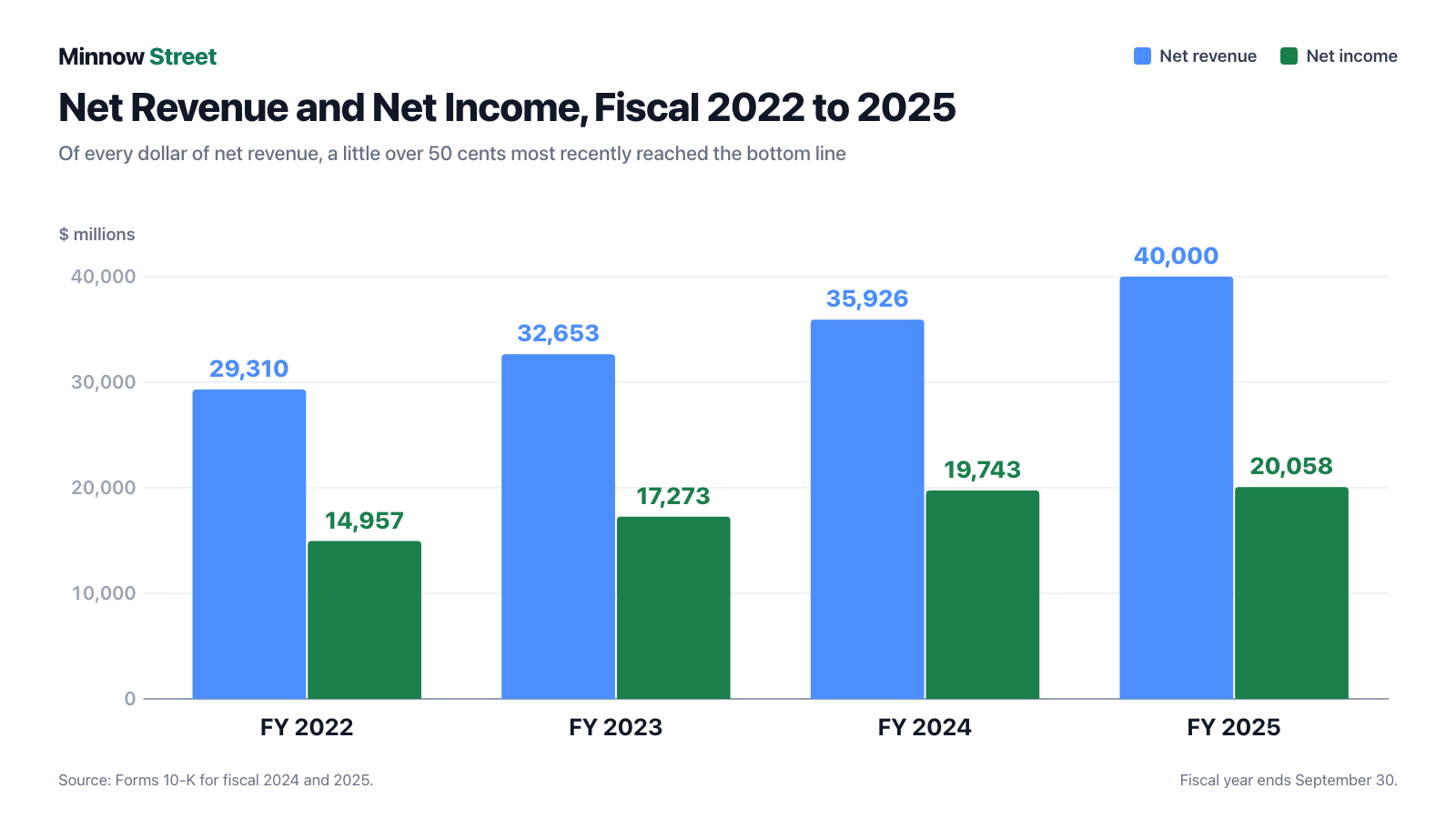
Net revenue rose from $29,310 million in fiscal 2022 to $40,000 million in fiscal 2025 — up 36 percent in three years, without a single down year. Net income grew from $14,957 million to $20,058 million.
The real story sits in the ratio between the two bars. Out of $40,000 million of net revenue came $20,058 million of after-tax profit. That is 50.1 percent. Of every dollar Visa reports after incentives, a little over half survives as profit — after tax. For context: a good industrial company celebrates 10 percent, a strong software business 25.
Operating income in fiscal 2025 was $23,994 million, or 60.0 percent of net revenue. In fiscal 2022 it was $18,813 million on $29,310 million — 64.2 percent. So the margin has slipped slightly, but it sits at a level most companies never reach.
The cash
Margin is accounting; cash flow is truth. In fiscal 2025 Visa generated $23,059 million from operations (fiscal 2024: $19,950 million; fiscal 2023: $20,755 million). Of that, $1,482 million went into property, equipment and technology. Roughly $21.6 billion was left free — against reported net income of $20,058 million. The profit is backed by actual cash, not by valuation effects. That quality marker is hard to overstate.
Where the money goes
Almost all of it goes back to shareholders. In fiscal 2025 Visa repurchased $18.2 billion of its own stock and paid $4.6 billion in dividends — $22.8 billion combined against $20.1 billion of profit. In the first nine months of fiscal 2026 it was $16,537 million for 50 million shares (average price $328.29) plus $3.9 billion of dividends. In April 2026 the board authorized a further $20.0 billion repurchase program; as of June 30, 2026, $28.4 billion of authorization remained.
That also explains why equity is shrinking rather than growing: from $37,909 million on September 30, 2025 to $35,178 million on June 30, 2026 — over nine months in which $17,502 million was earned. Pay out more than you earn and the balance sheet contracts. At Visa that is a deliberate choice, not an emergency.
And the current year
In the first nine months of fiscal 2026 (October 2025 through June 2026), net revenue rose 15 percent to $33,764 million and net income 17 percent to $17,502 million. In the third quarter alone, revenue was $11,633 million and profit $5,628 million. Visa processed 71.7 billion transactions in that quarter, 10 percent more than a year earlier.
The balance sheet
As of June 30, 2026, total assets of $94,590 million stood against $59,412 million of liabilities and $35,178 million of equity. Debt was $23,858 million ($2,996 million current, $20,862 million long-term), against $12,359 million of cash and $1,583 million of investment securities. Interest expense over the first nine months was $566 million against operating income of $20,848 million. That is 37 times interest coverage. This balance sheet is not the problem.
Hard truth No. 1: the number before the number
Now to what the revenue line leaves out. Visa pays its own customers to use Visa. These payments are called client incentives, and they are not an operating expense — they are deducted before the revenue line.
The reason is simple. A bank decides whether to give its customer a Visa or a Mastercard. A large merchant decides which network to promote. Visa buys those decisions with long-term contracts, upfront payments and volume-based rebates.
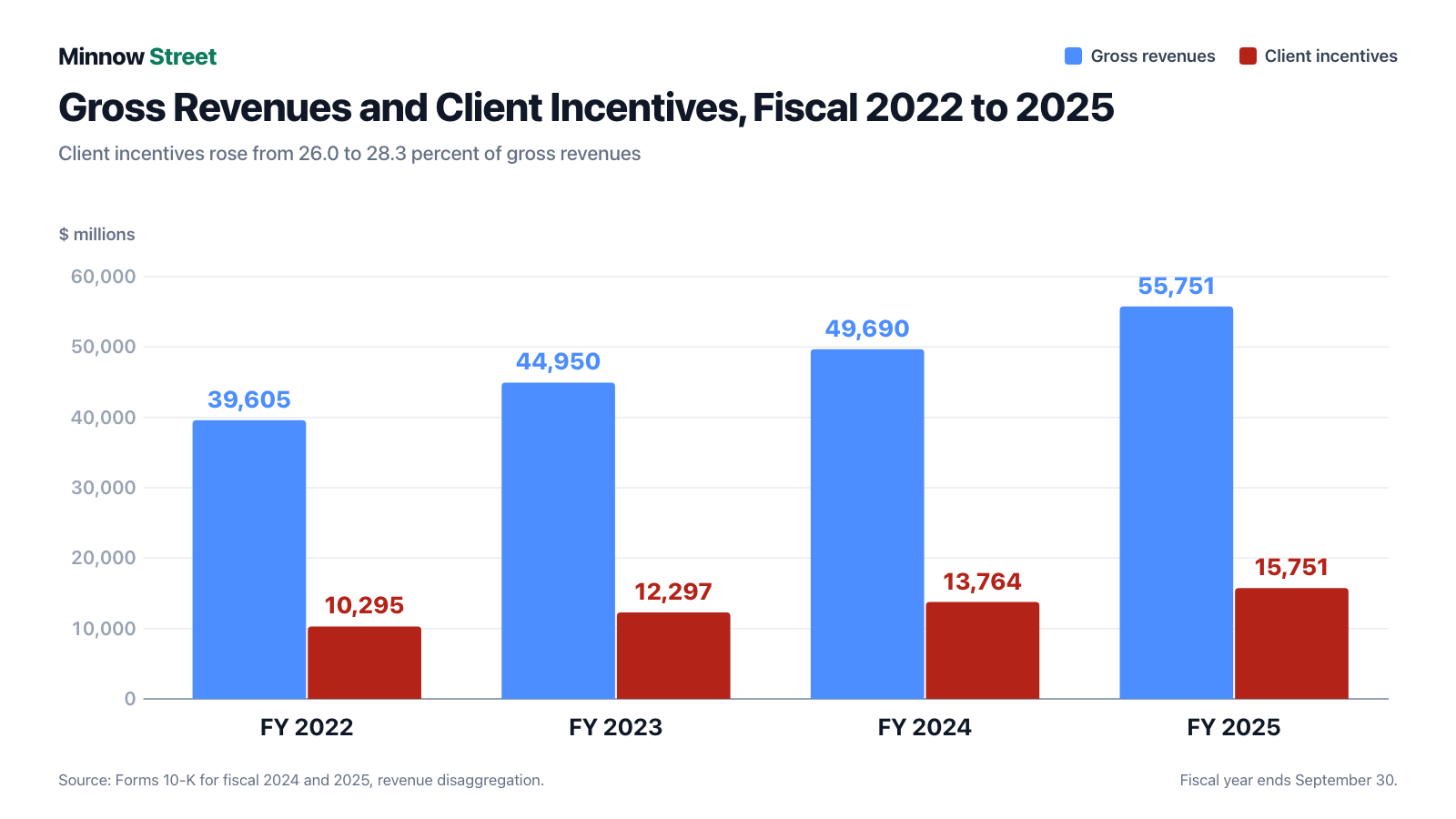
The series across four fiscal years, incentives against gross revenues:
- Fiscal 2022: $10,295 million of $39,605 million — 26.0 percent
- Fiscal 2023: $12,297 million of $44,950 million — 27.4 percent
- Fiscal 2024: $13,764 million of $49,690 million — 27.7 percent
- Fiscal 2025: $15,751 million of $55,751 million — 28.3 percent
In the first nine months of fiscal 2026 the share was 28.1 percent ($13,194 million of $46,958 million). A nine-month figure is not directly comparable with a full year, but it shows no reversal either.
Two and a third percentage points over four years sounds small. Measured against fiscal 2025 gross revenues, however, a single percentage point is $558 million. Had incentives stayed at the 26.0 percent of fiscal 2022, Visa would have reported roughly $1.3 billion more net revenue in fiscal 2025.
Visa itself will not say where the ratio is heading. The report puts it this way:

"The amount of client incentives we record in future periods will vary based on changes in performance expectations, actual client performance, amendments to existing contracts or the execution of new contracts."
— Visa Inc., Form 10-Q for the quarter ended June 30, 2026, Management's Discussion and Analysis
In plain English: it depends on how hard the other side negotiates. And the other side — large banks, large merchants — is not getting weaker. As of June 30, 2026, incentive obligations on the balance sheet stood at $11,429 million, up from $10,369 million on September 30, 2025.
Rule of thumb: you do not measure Visa's pricing power at the revenue line, but at the ratio in front of it.
Hard truth No. 2: the vault is nearly empty
Since the 2008 initial public offering, Visa has operated a structure with the unwieldy name "U.S. retrospective responsibility plan." Behind it sits an escrow account from which the U.S. interchange cases are paid. Interchange is the fee the merchant's bank pays the cardholder's bank; U.S. merchants have been litigating over it for decades.
The balance of that account changed dramatically in nine months:

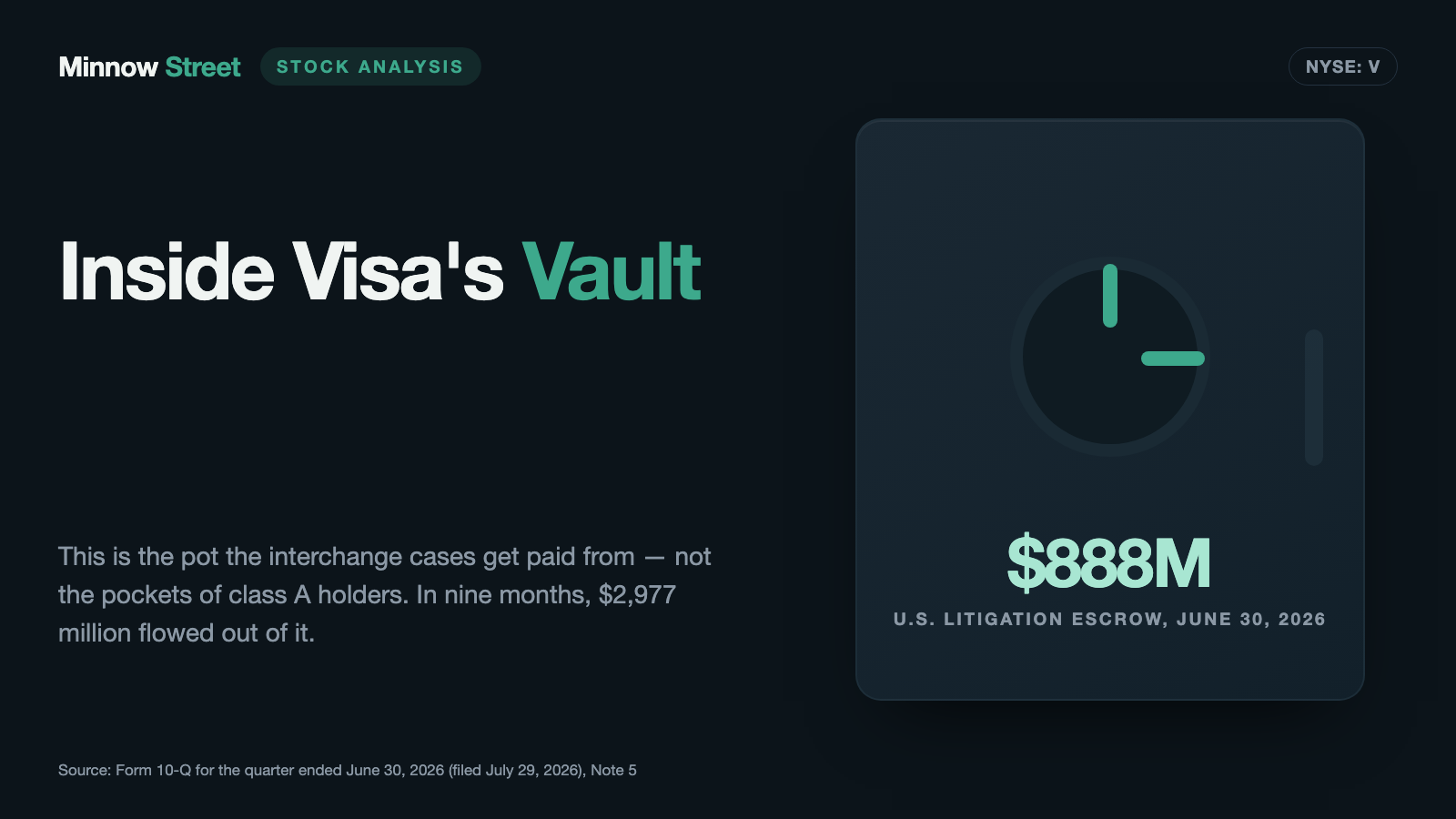
"For the nine months ended June 30, 2026, we deposited $875 million into the U.S. litigation escrow account to address claims associated with the interchange multidistrict litigation. The balance of this account as of June 30, 2026 was $888 million and is reflected as restricted cash equivalents in our consolidated balance sheets."
— Visa Inc., Form 10-Q for the quarter ended June 30, 2026, Management's Discussion and Analysis
The movement behind it, from Note 5 of the report: the account stood at $2,990 million on September 30, 2025. Deposits were $875 million. Payments of $2,977 million went to merchants who had opted out of the class settlement or belonged to the injunctive relief class. What remains is $888 million.
That is not bad news in itself — on the contrary, part of a decades-old dispute was actually cleared. The accrual for U.S. covered litigation fell accordingly, from $3,033 million on September 30, 2025 to $1,274 million on June 30, 2026. But the buffer is now largely used up. If new claims arrive — and they are arriving, see hard truth No. 4 — fresh deposits are required. And every deposit has a side effect that leads straight to the next truth.
Hard truth No. 3: there is a second class of stock
When Visa went public in 2008, the banks faced a problem: they were on the hook for the pending interchange cases. The solution was elegant — and it still operates today.
The banks received class B stock instead of class A. That class does not trade and can only become class A through conversion. And the conversion rate moves: every time Visa deposits money into the escrow account, the rate is reduced. The banks therefore pay the bill with their own stake in the company.

"Under the U.S. retrospective responsibility plan, we recover the monetary liabilities related to the U.S. covered litigation through a downward adjustment to the rate at which shares of our class B-1, B-2 and B-3 common stock ultimately convert into shares of class A common stock."
— Visa Inc., Form 10-Q for the quarter ended June 30, 2026, Management's Discussion and Analysis
For you as a class A holder that is good news: earnings per class A share were unchanged by those adjustments over the first nine months of fiscal 2026. The cost of the litigation was borne entirely by the other class.
But the other class is still there
And that is the part you have to understand. The class B and class C shares still exist, and at some point they become class A. Until then they are latent dilution — in plain terms: your slice of the pie gets smaller when they are cashed in.
The figures as of June 30, 2026, from Note 11 of the quarterly report, each converted into class A equivalents:
- Class A outstanding: 1,702 million
- Class B-1: 2 million shares × conversion rate 1.5445 = 3 million
- Class B-2: under 1 million shares × 1.5014 = 1 million
- Class B-3: 61 million shares × 1.4953 = 91 million
- Class C: 18 million shares × 4.0000 = 73 million
- Series B and C preferred: roughly 3 million combined
- All classes as converted: 1,880 million
The gap is 178 million shares, or 10.5 percent above the reported class A count. On September 30, 2025 it was 1,930 against 1,691 million — 239 million, or 14.1 percent. The overhang is shrinking, through conversions and through the rate reductions, but after 18 years it is still in double-digit percentages.
What happened in May 2026
And then came a change that even attentive readers may have missed:

"In May 2026, Visa accepted 3 million shares of class B-1 common stock and 120 million shares of class B-2 common stock tendered in the exchange offer. In exchange, Visa issued 61 million shares of class B-3 common stock and 23 million shares of class C common stock. … Future conversion rate adjustments for the class B-3 common stock will have four times and two times the impact compared to conversion rate adjustments for the class B-1 and B-2 common stock, respectively."
— Visa Inc., Form 10-Q for the quarter ended June 30, 2026, Note 11
What does that mean? Part of the banking group bought its way out. They handed over class B shares and received, among other things, class C — a class that future litigation costs no longer touch. What remains is class B-3, where every future reduction bites four times as hard as it previously did on B-1.
The buffer protecting class A has not disappeared, but it now rests on fewer shoulders. As of June 30, 2026, 95 million as-converted class B shares carried the load that on September 30, 2025 was spread across 191 million. How long that structure holds is the genuinely open question at Visa — and it hangs directly on the outcome of the cases.
Hard truth No. 4: the cases do not end
You might assume that after almost twenty years the interchange dispute would be settled. It is not. A look at the legal matters section of the quarterly report for the period ended June 30, 2026:
- United States, class actions: on November 10, 2025 Visa and Mastercard entered into an amended settlement for the injunctive relief class; preliminary approval followed on June 9, 2026 and the motion for final approval on July 15, 2026. Visa has settled with merchants representing roughly 95 percent of the card sales volume of those who opted out.
- But: on April 21, 2026 three merchants moved for a declaration that the settlement's forward-looking release is invalid and unenforceable. The same day they filed a new class action under the name Potayto-Potahto, covering all merchants that have accepted Visa or Mastercard credit cards since January 25, 2019. Visa and Mastercard moved on June 16, 2026 to enforce the existing settlement against them.
- United Kingdom and Europe: since July 2013 more than 1,200 merchants have brought proceedings against Visa entities. Over 950 have settled; more than 100 claims remain outstanding. Visa states that it anticipates additional claims.
- New: on April 20, 2026 a group of merchants from across Europe filed in the UK High Court, seeking damages from January 1, 2019. In May and June 2026 further merchants filed, with damages periods reaching back at least six years.
- UK Competition Appeal Tribunal: on February 18, 2026 the tribunal found that, except in certain merchant categories, interchange was not passed on by merchants. Visa has sought permission to appeal. On March 17, 2026 Visa was granted permission to appeal the June 2025 decision that certain interchange rates restrict competition.
Two things stand out. First, the expense is real and highly volatile: the litigation provision was $2,562 million in fiscal 2025 against $462 million in fiscal 2024 and $927 million in fiscal 2023. Second, a settlement that also covers the future is evidently attackable — and that is exactly what is being attempted right now.
Hard truth No. 5: regulators target the price itself
Lawsuits are one thing. Regulation is another, and more dangerous, because it sets the price directly instead of punishing it after the fact. Visa's fiscal 2025 annual report lists where its pricing is being intervened in:
- United States: under Regulation II the Federal Reserve caps debit interchange for large banks at 21 cents plus 5 basis points per transaction, plus a possible 1 cent fraud adjustment. In October 2023 it proposed a further reduction with automatic adjustment every two years. In August 2025 a federal court in North Dakota ruled that the Federal Reserve had exceeded its authority in implementing Regulation II and vacated the rule.
- Europe: the EU Interchange Fee Regulation caps the fee at 30 basis points on consumer credit and 20 on consumer debit. The European Commission has announced another impact assessment, which could lead to even lower caps and an extension to further products.
- Cross-border: Visa agreed limits on certain cross-border rates with the European Commission in 2019, extended through 2029. Costa Rica became the first country to regulate cross-border interchange in 2020; New Zealand adopted caps in July 2025 and Australia has proposed them.
- Market access: China, India, Indonesia, Thailand, Vietnam and South Africa favor domestic payment systems by regulation or require local processing.
On top of that comes competition from a direction that did not exist ten years ago: real-time account-to-account transfers, digital wallets, stablecoins. In its own competition section Visa writes that new entrants "depart from traditional network payment models." Visa answers with products of its own — Visa Direct processed more than 12.5 billion transactions for over 650 partners in fiscal 2025, and stablecoin settlement volume passed a $2.5 billion annualized run rate as of September 30, 2025. Both are still small measured against the core business.
What the stock costs
As of the data date of July 29, 2026, Visa's market capitalization was roughly $669 billion. The trailing price-to-earnings ratio was about 32; measured against the analyst estimate for the current fiscal year it was about 24. Enterprise value stood at roughly 24.7 times earnings before interest, taxes, depreciation and amortization.
For context, without a daily price: a price-to-earnings ratio of 32 means the market is willing to pay 32 times annual profit. Against a broad market average in the region of 20, that is a clear premium. It is not unjustified — a 50 percent net margin, 36 percent revenue growth over three years and a network nobody rebuilds in five years justify a good deal. But it is a price with a lot of future already inside it.
One metric you should ignore at Visa is the price-to-book ratio of roughly 19.6. Book value measures the assets a company carries on its balance sheet. For a business whose most valuable possessions are a brand, a network and contracts with 14,500 banks, book value says nothing. The largest balance sheet items are $27,532 million of intangible assets and $20,825 million of goodwill from acquisitions anyway — together more than half of total assets.
What the professionals expect: the analyst estimate for earnings per share in the current fiscal year stood at roughly $13.15 as of July 29, 2026, against $11.58 over the trailing twelve months. The consensus therefore still expects growth. That is an expectation, not a fact.
How a pure payments provider without a network monopoly fares in the same industry is something you can read in our analysis of Remitly, where competitive pressure on the margin is directly visible. And for how strongly cross-border e-commerce acts as a driver, see our analysis of Amazon.
Opportunities and risks at a glance
What argues for Visa
- A business model without credit risk. Visa earns on the transaction, not the loan. If a cardholder defaults, the bank absorbs it. That separation is the core of the 60 percent operating margin.
- Network effects in their purest form. Close to 5 billion payment credentials meet more than 175 million merchant locations (as of September 30, 2025). Each side grows only because the other is already there. A new entrant has to win both at once.
- Growth beyond the card. Value-added services revenue grew 24 percent in fiscal 2025 to $10.9 billion, and in the first nine months of fiscal 2026 reached $10.3 billion against $7.8 billion a year earlier. That revenue does not depend on interchange and is therefore further from the regulators.
- The business-cycle gauge cuts both ways. Cross-border volume excluding intra-Europe traffic grew 12 percent on a constant-dollar basis in the third quarter of fiscal 2026. Travel and international e-commerce are a structural tailwind.
- Free cash flow and buybacks. Roughly $21.6 billion of free cash flow in fiscal 2025; the share count has been falling for years.
What argues against
- The incentive ratio is climbing. From 26.0 to 28.3 percent of gross revenues across four fiscal years. Each further percentage point costs roughly $558 million of net revenue on a fiscal 2025 basis.
- The escrow account is largely drained. $888 million as of June 30, 2026, after $2,990 million nine months earlier. New claims require new deposits.
- Latent dilution of 178 million shares. That is 10.5 percent above the class A count as of June 30, 2026. The overhang is shrinking but remains double-digit after 18 years.
- The litigation continues. More than 100 open merchant claims in Europe, a new U.S. class action filed April 21, 2026, and fresh European filings in April, May and June 2026.
- Regulation sets the price directly. Interchange caps in the United States, the European Union, Australia and, since July 2025, New Zealand; market access restrictions in China and India.
- Valuation paid in advance. Roughly 32 times trailing earnings as of July 29, 2026 leaves little room for disappointment.
A human conclusion
The tollbooth from the opening genuinely exists. Visa takes a cut of almost every card payment on earth, carries no credit risk doing it, and keeps a little over half of every reported dollar as profit. That is not a marketing claim; that is what the filings say.
But the tollbooth is not a fortress. It stands on two structures you have to see if you take the numbers seriously. One costs a little more every year: the incentives Visa pays its own customers to stay. The other elegantly parked a problem in 2008 that has not grown smaller since: the bill for the interchange cases, carried by an escrow account and a second class of stock — and after nine months that account holds only $888 million.
Neither is cause for panic. A company generating $21.6 billion of free cash flow can absorb a great deal. But anyone buying Visa is not just buying the toll — they are also buying the question of how long the second structure holds. And that question lives in the notes, not in the headline.
What you make of it is your decision. And that is exactly as it should be.
Sources
- Visa Inc., Form 10-Q for the quarter ended June 30, 2026 (filed July 29, 2026, CIK 0001403161) — balance sheet, statements of operations, Note 3 (revenue), Note 4 (cash), Note 5 (retrospective responsibility plans), Note 11 (stockholders' equity), Note 12 (earnings per share), Note 16 (legal matters)
- Visa Inc., Form 10-K for fiscal 2025 (period ended September 30, 2025, filed November 6, 2025) — business description, risk factors (Item 1A), management's discussion and analysis, statements of cash flows, Note 12 (settlement guarantee management), Note 20 (legal matters)
- Visa Inc., Form 10-K for fiscal 2024 (filed November 13, 2024) — comparative figures for fiscal 2022 through 2024
- Visa Inc., fiscal third quarter 2026 earnings release (Form 8-K of July 28, 2026, Item 2.02, Exhibit 99.1) — quarterly metrics, volumes, special items
- Visa Inc., filing index at SEC EDGAR — review of all filings from July 28, 2026 onward, including the Form 8-K of July 15, 2026 (Item 5.03)
- Fundamental data (market capitalization, valuation metrics, analyst estimate), data as of July 29, 2026
Important notice
This article is journalistic commentary on publicly available corporate filings. It is expressly not investment advice and not a solicitation to buy or sell securities. All figures come from the sources listed above and carry the reporting date stated there; they may have changed after publication. Equity investments carry risks up to and including the total loss of the capital invested. The author held no position in Visa Inc. at the time of publication.
Our Bottom Line at a Glance
- Earning power positive
- In fiscal 2025, $40,000M of net revenue produced $23,994M of operating income (60.0%) and $20,058M of net income (50.1%). Operating cash flow of $23,059M exceeded reported profit — the margin is backed by actual cash, not valuation effects (period ended September 30, 2025).
- Business model and balance sheet positive
- Visa carries no credit risk and is expressly not a financial institution (10-Q for the quarter ended June 30, 2026). As of June 30, 2026 the balance sheet showed $35,178M of equity against $23,858M of debt, with interest coverage of roughly 37 times over the first nine months. No substance risk identified.
- Client incentives negative
- Client incentives rose from 26.0% of gross revenues in fiscal 2022 to 28.3% in fiscal 2025, and stood at 28.1% over the first nine months of fiscal 2026. Each percentage point equals roughly $558M of net revenue on a fiscal 2025 basis. Visa itself names no target level.
- Litigation buffer negative
- The U.S. escrow account fell from $2,990M (September 30, 2025) to $888M (June 30, 2026), with $2,977M going to merchants. Meanwhile more than 100 European merchant claims remain open, a new U.S. class action was filed April 21, 2026, and fresh European suits arrived in April, May and June 2026 (10-Q, Note 16).
- Share structure neutral
- As of June 30, 2026 all classes as converted totaled 1,880M class A equivalents against 1,702M reported class A shares — 178M, or 10.5%, of latent dilution, down from 14.1% on September 30, 2025. After the May 2026 exchange, future adjustments hit class B-3 four times as hard as class B-1.
- Regulation and competition negative
- Interchange caps exist in the United States (Regulation II, vacated by a court in August 2025), the European Union (30/20 basis points), Australia and, since July 2025, New Zealand. Several countries favor domestic systems by regulation. The price of the core business is therefore set by authorities, not by the market (10-K fiscal 2025, Item 1A).
Visa takes a cut of almost every card payment on earth without carrying credit risk, and in fiscal 2025 kept a little over half of every reported dollar as profit. Ahead of that revenue line, however, $15,751M went to its own bank partners, and the share keeps rising. The bill for the interchange cases has so far been carried by an escrow account and a second class of stock rather than by class A shares; that account held only $888M as of June 30, 2026. Not investment advice.
What Our Rating Means
Quality confirmed
Business model, numbers and balance sheet hold up to our review. Whether the current price supports an entry is a separate question — it hangs on the price, not on the company.
The company itself is demonstrably strong: a 60.0 percent operating margin in fiscal 2025, operating cash flow of $23,059 million exceeding reported profit, interest coverage of roughly 37 times, and a network of close to 5 billion payment credentials and 175 million merchant locations that no competitor rebuilds quickly. There is no going concern warning, no negative equity, no existential dependence on a single counterparty and no accounting or governance breach. The burdens identified — a rising incentive ratio, a drained escrow account, ongoing litigation and regulation of the core price — are serious but operational and regulatory in nature, and they do not threaten the substance of the business. The price question is separate: at roughly 32 times trailing earnings as of July 29, 2026 the stock is expensively paid for, with a lot of future already in the price. That is a valuation argument, not a quality argument, and it does not move the rating. The decision is yours.
A journalistic assessment by our editorial team at the time of the deep dive, based on public sources — not investment advice and not a solicitation to buy or sell. Your personal circumstances (investment goals, risk capacity, taxes) cannot be taken into account. What our levels mean, how verdicts are formed, and what conflicts of interest exist →
Worth Noting
- Hook: stocktake of the 100 largest U.S. stocks by market capitalization dated July 28, 2026. Visa ranked 15th and had no analysis. Not a scanner hit.
- Data basis: Form 10-Q for the quarter ended June 30, 2026 (filed July 29, 2026), Forms 10-K for fiscal 2025 and 2024, and the Form 8-K earnings release of July 28, 2026. Fundamental data as of July 29, 2026.
- Fiscal year caution: Visa's fiscal year ends September 30. "Fiscal 2025" denotes October 2024 through September 2025, not the calendar year 2025.
- Share class caution: only the class A share trades, under the symbol V. Class B-1, B-2, B-3 and C do not trade and never appear in the quoted price, but they do enter diluted earnings per share.
- The Form 25-NSE of June 15, 2026 relates solely to the maturing 1.500 percent senior notes due 2026 and is not a delisting signal for the stock.
Frequently Asked Questions
Visa's fiscal year ends September 30. Fiscal 2025 ran from October 1, 2024 through September 30, 2025, and fiscal 2026 ends September 30, 2026. Anyone comparing Visa with a calendar-year reporter is comparing periods offset by a quarter. The nine-month figures for the current year cover October 2025 through June 2026.
Client incentives are payments Visa makes to win banks, merchants and partners over to favoring Visa. In accounting terms they are not an expense but a reduction of revenue, so they come off before the reported revenue line. In fiscal 2025 they totaled $15,751 million — 28.3 percent of gross revenues of $55,751 million.
An escrow account under the U.S. retrospective responsibility plan, in place since the 2008 initial public offering. Settlements and judgments in the U.S. interchange cases are paid from it. As of June 30, 2026 it held $888 million, down from $2,990 million on September 30, 2025. Over those nine months $2,977 million went out to merchants and $875 million was deposited.
At the 2008 initial public offering the participating banks received the non-traded class B and class C shares rather than class A. Their conversion rate into class A is reduced whenever Visa deposits money into the litigation escrow account. That way the banks bear the cost of the interchange cases, not class A holders. Only class A trades, under the symbol V.
As of July 21, 2026 there were 1,704,112,694 class A shares outstanding, plus 2,180,148 class B-1, 486,669 class B-2, 60,589,871 class B-3 and 17,059,152 class C. Converting all classes into class A equivalents gives roughly 1,880 million shares as of June 30, 2026 against 1,702 million reported class A shares — a difference of 178 million, or 10.5 percent.
In May 2026 Visa exchanged 3 million class B-1 and 120 million class B-2 shares for 61 million class B-3 and 23 million class C shares. Future downward conversion rate adjustments hit class B-3 with four times the impact of class B-1. Class A protection remains, but it now rests on fewer shares: 95 million as converted, down from 191 million.
No. Visa states in every quarterly report that it is not a financial institution, does not issue cards, does not extend credit and does not set rates or fees for account holders. If a cardholder fails to pay, the issuing bank absorbs it. Visa earns solely on processing the transaction — which is why the operating margin reached 60.0 percent in fiscal 2025.
Yes. On July 28, 2026 the board declared a quarterly dividend of $0.67 per class A share, payable September 1, 2026. Visa paid $4.6 billion in dividends across fiscal 2025. Share repurchases are considerably larger: $18.2 billion in fiscal 2025 and $16,537 million in the first nine months of fiscal 2026.
Found an error?
Did you spot a factual error, an outdated number, or a typo in this deep dive? Let us know briefly — your report goes straight to the editorial team.