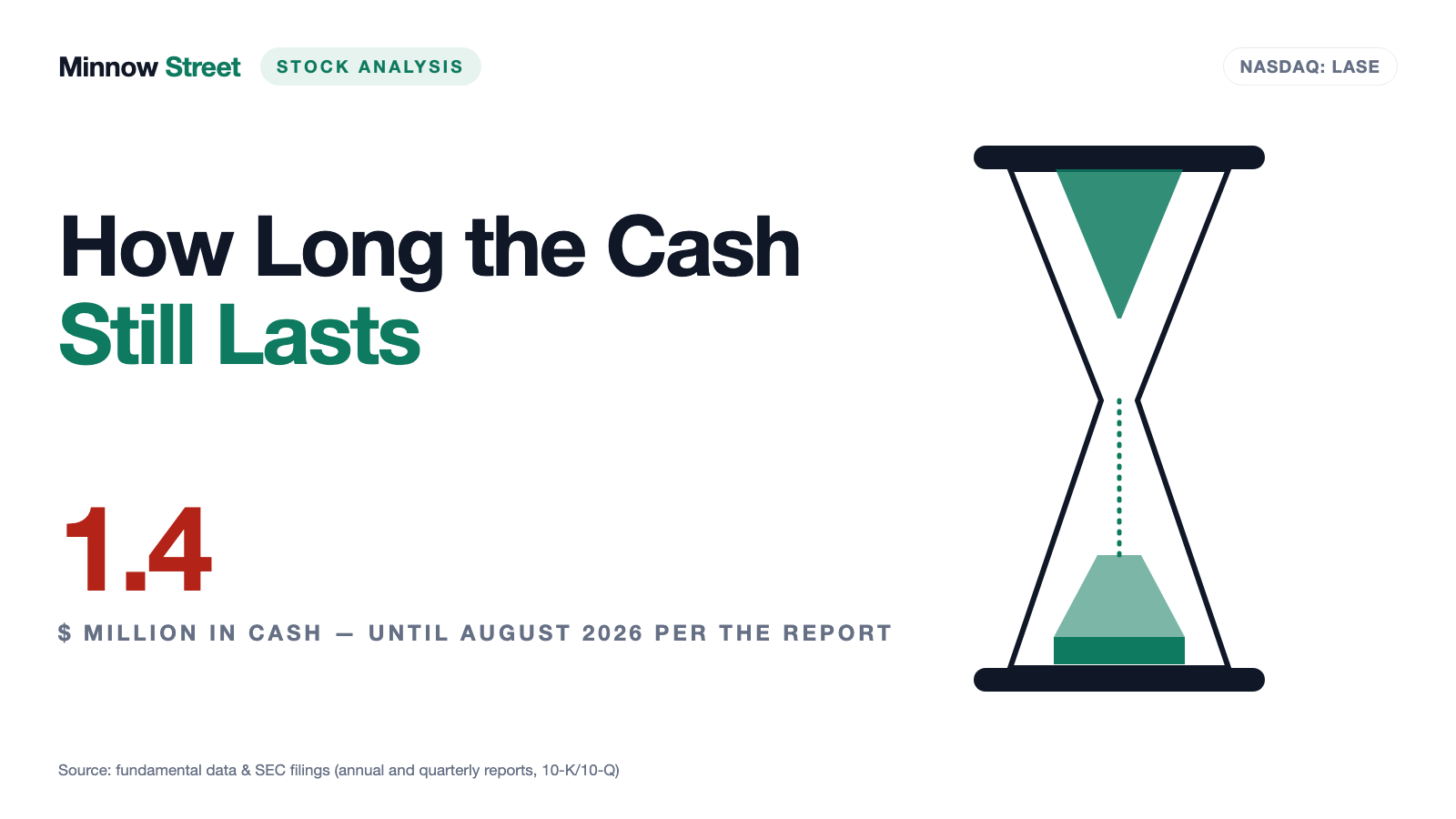
Laser Photonics: The Company Says Its Cash Lasts Until August 2026 — and the Share Count Has Doubled Since New Year
Laser Photonics builds machines that strip rust with light instead of sand. The product is real, the U.S. armed forces are among the customers, and revenue rose to $8.3 million in 2025. The same annual report — filed with the U.S. securities regulator, the SEC, on April 20, 2026 — also contains a sentence with an expiration date: existing cash of $1.4 million will last "until August 2026". The auditor attached a going-concern paragraph, stockholders' equity was negative $1.7 million as of March 31, 2026, and the share count climbed from 22.8 million (December 31, 2025) to roughly 50.2 million (July 16, 2026). Not investment advice — just the question of who pays the next bill, and with whose stake.
 Thomas Mücke
Founder & Publisher
Thomas Mücke
Founder & Publisher
Chart
Interactive price chart (TradingView).
Note: pure fact-based analysis, not investment advice and not a solicitation to buy or sell. All figures without guarantee.
There is an investor weakness that has nothing to do with greed and still catches all of us: we hear the loud message and skim past the quiet one. A press release saying "new contract", "$2.5 million raised", "Nasdaq compliance regained" — that gets through. A clause on page 42 of a mandatory filing that names the date the money runs out does not. At Laser Photonics (Nasdaq Capital Market: LASE) both kinds of news come from the same six months. The company, based in Lake Mary, Florida, builds machines that strip rust and paint with a focused beam of light instead of sand — serious technology with serious customers, the U.S. armed forces among them. And in its annual report on Form 10-K for 2025, filed with the U.S. securities regulator, the SEC, on April 20, 2026, sits this sentence: existing cash of $1.4 million will last "until August 2026". That is not a forecast, it is an hourglass in the form of a sentence: the report names the month by which the last grain is meant to have run through. So let us make a deal: before you weigh the loud headlines, we read together what the company itself put on the record. An SEC filing is honest under penalty of law. What you make of it is up to you.
What Laser Photonics actually does — light instead of sandblasting
The business model is refreshingly easy to explain. Anyone who needs to strip rust and paint off a ship's hull, an old bridge section or an aircraft part has traditionally reached for abrasive blasting: firing blast media at the surface under high pressure. It works, but it creates dust, hazardous waste and a health problem — silica dust is linked to silicosis and lung cancer. Laser Photonics sells the alternative: laser blasting. A focused beam vaporizes the top layer, the metal underneath stays untouched, and no blast media is consumed. Put in everyday terms: instead of sanding the wall down, you burn the paint off to the millimeter — and afterwards you only need to vacuum the soot instead of disposing of tons of grit.
The product line runs from handheld units to robotic cells. The annual report describes it as a range that "scales with customer needs": the low-price Laser Blasters for simple cleaning jobs at one end, AI-controlled, user-programmable robotic cells for precision production environments at the other. The acquisition of Control Micro Systems (CMS) on October 30, 2024 added laser cutting, welding and marking systems to the house. As of December 31, 2025 the company employed 94 full-time staff, plus eight direct salespeople and ten distributors worldwide. A second leg is growing in defense: the annual report describes the Laser Shield Anti-Drone System (LSAD) as a joint development with affiliated Fonon Drone Shield Solutions, Inc. — a laser against small drones whose prototype was tested at the Orlando facility. One detail is worth holding against everything that follows: the customer base is unusually unconcentrated. The largest single customer accounted for just 6 percent of net sales in 2025 (2024: 8 percent) — the classic micro-cap dependency on one buyer simply is not there. And the U.S. Government, mainly the Army, Navy and Air Force, contributed less than 18 percent of U.S. revenue in 2025; management wants to lift that to 25 percent within 12 to 24 months.
That frames the central tension of this analysis, and it runs through every chapter: the product carries its weight — the company does not. What keeps Laser Photonics alive is not selling machines, it is selling shares.
How the stock reached our desk — not through a scanner, but through the filing stream
Honesty first: Laser Photonics is not a scanner hit. As of July 29, 2026 the stock appears on no list of our in-house stock scanner — no value filter, no quality filter, no momentum screen. That is hardly surprising: the quality and valuation filters need earnings, positive equity and stable margins, and momentum needs a trend. (Those lists are recomputed daily, so the finding applies to that date.)
The stock arrived by a different route: the SEC filing stream itself. Between January 6 and July 24, 2026, Laser Photonics filed 16 current reports on Form 8-K. A Form 8-K is the filing for "something material has happened" — at a company this size you would normally see three or four in a year. Sixteen in a little over six months is not noise, it is a pattern. If you take one thing from this chapter, take this: the frequency of mandatory filings is a metric in its own right. It tells you nothing about direction — but it tells you where to look. So we looked.
The numbers over the years — the impressive part first
Start with what is genuinely good, because there is some. Revenue rose to $8,342,008 in 2025 from $3,415,196 in 2024 — an increase of 144 percent. Gross profit climbed from $414,994 to $1,202,254 and the gross margin from 12.1 to 14.4 percent. For a company that had hovered between $3.4 million and $4.2 million of revenue for four years, that is a visible jump. Fairness requires naming its source, though: almost all of it comes from the first full year of Control Micro Systems, which joined in October 2024. What grew, in other words, was mainly the consolidation perimeter, not the number of machines sold.
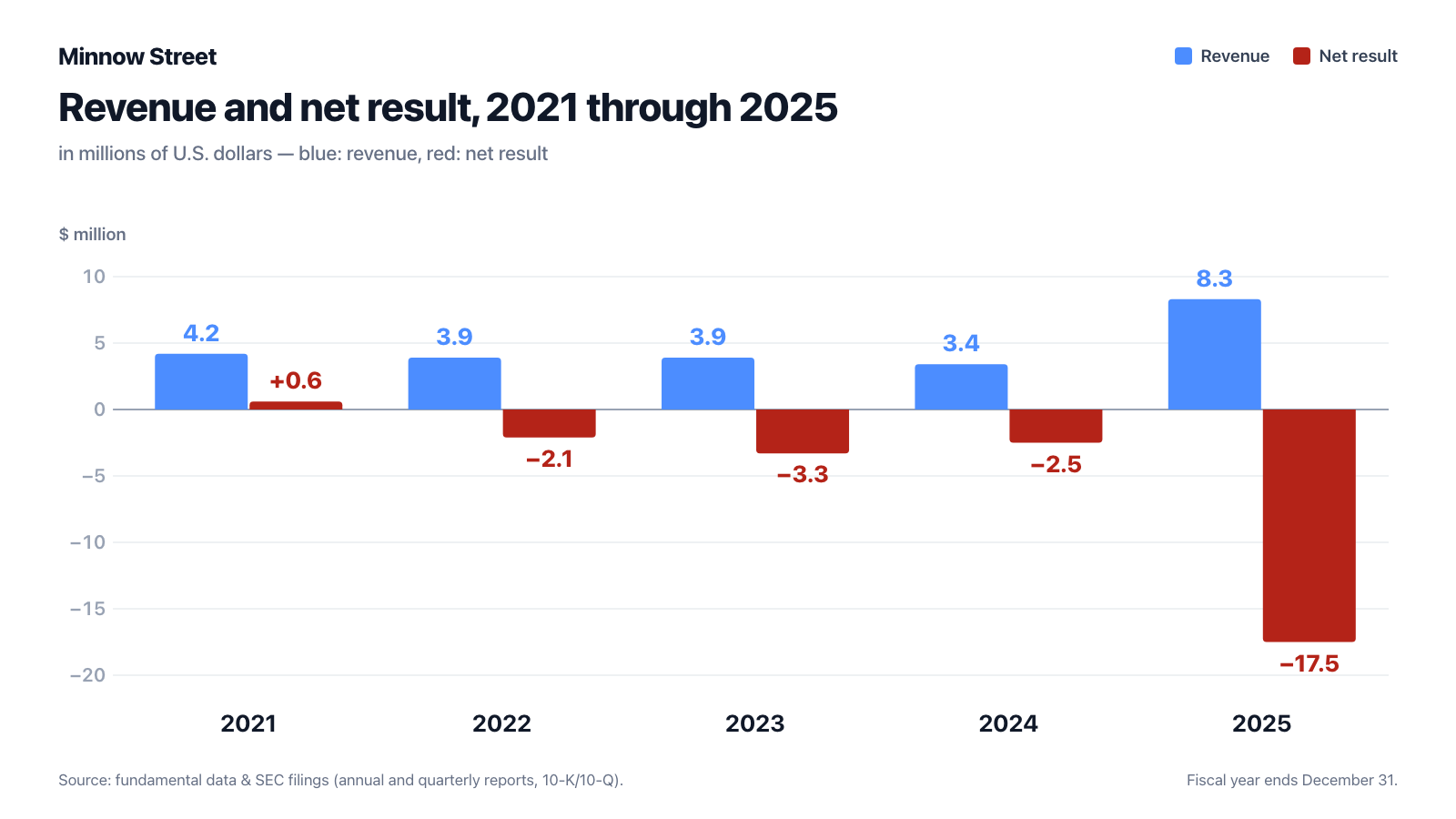
Which brings us to the red side. The net loss for 2025 was $17,456,046 after $2,518,827 the year before — almost seven times larger, while revenue merely doubled. Operating expenses went from $6.9 million to $14.5 million, including $3.9 million of intangible asset impairments and $1.6 million of stock-based compensation. The operating loss came to $13.3 million, and $4.2 million of net financing costs and interest sat below it. For context: there were losses before, but of an entirely different order — $2.1 million in 2022 and $3.3 million in 2023, while 2021 still showed a small profit of $0.6 million. Add the so-called deemed dividends — accounting charges that arise when a company hands shareholders more value than it receives — and $32,558,770 was attributed to common shareholders for 2025. Remember this: with this stock the line below net income matters more than net income.
The first quarter of 2026 then reversed the trend brutally. Revenue fell 60 percent to $915,553 (prior-year quarter: $2,290,282). Because cost of sales dropped only 6.2 percent, a gross profit of $900,491 turned into a gross loss of $388,451 — a gross margin of negative 42.4 percent after positive 39.3 percent a year earlier. Translated: every machine shipped in that quarter cost more to build than the customer paid for it. The company blames low utilization — with so little production, the factory's fixed costs spread across too few units. That is a plausible explanation but not an all-clear: the net loss widened to $2,946,284 and operations consumed $1,842,774 of cash in the quarter.
In fairness, one figure in the same balance sheet points the other way. Contract liabilities — money customers have already paid for orders not yet delivered — rose from $1,205,007 (December 31, 2025) to $2,874,427 (March 31, 2026), with another $1,342,536 of deferred revenue on top. Together that is roughly $4.2 million of paid-for but undelivered work, more than four times the quarter's revenue. It supports management's reading that the first quarter was about delivery timing rather than lost demand. Whether that turns into revenue at a profit is a question only the next quarter answers.
What the filings say — the uncomfortable truths
Uncomfortable truth no. 1: the note in the bottle names a month
Here is the sentence this is all about. In the "Liquidity and Capital Resources" section of the annual report for 2025, management states in black and white how long the money lasts — and the auditor confirms the consequence in the same paragraph:
"We have a history of reporting net losses. As of the issuance date of the financial statements included in this Annual Report on Form 10-K, management expects that the Company's existing cash of $1.4 million will last until August 2026. As a result, management has concluded, and our independent registered public accounting firm has agreed with our conclusion that there is a substantial doubt regarding our ability to continue as a going concern for a period of at least 12 months beyond the filing of this Annual Report on Form 10-K."
— Laser Photonics Corporation, SEC annual report 10-K 2025, Item 7 "Liquidity and Capital Resources — Going Concern"

What does a going-concern paragraph mean in everyday life? Imagine your accountant writing under your annual accounts: "I have substantial doubt that this business will still exist twelve months from now." He is not saying you are bankrupt tomorrow. He is saying he can no longer sign off on the opposite in good conscience. It is the strongest warning an auditor has — and at Laser Photonics it is not new: the audit report for 2024 already carried one.
The numbers behind it, all dated: as of December 31, 2025 the company held $650,339 in cash, stockholders' equity was negative $5,036,586 and the working capital deficit was $7,344,637. As of March 31, 2026 fresh money had improved that without reversing it: cash $1,627,600, equity still negative at $1,700,323, working capital deficit $3,984,822. "Negative equity" simply means the debts exceed everything the company owns — against total assets of $10,905,197 there are $12,605,520 of liabilities. Operations consumed $6,390,628 in 2025 and another $1,842,774 in the first quarter of 2026. A company burning $1.8 million a quarter with $1.6 million in the bank lives on its next financing. For what it looks like when a company puts the same arithmetic openly on the table, see our analysis of Fractyl Health — a company with far more cash on hand and the same paragraph in its report.
Uncomfortable truth no. 2: the share count more than doubled in seven months
When the cash is gone and the business throws off none, there are two roads: debt or new shares. Laser Photonics chose new shares, consistently. Dilution means exactly what it sounds like: your slice of the cake gets smaller because new slices keep being cut, without the cake growing. The reporting dates speak for themselves.
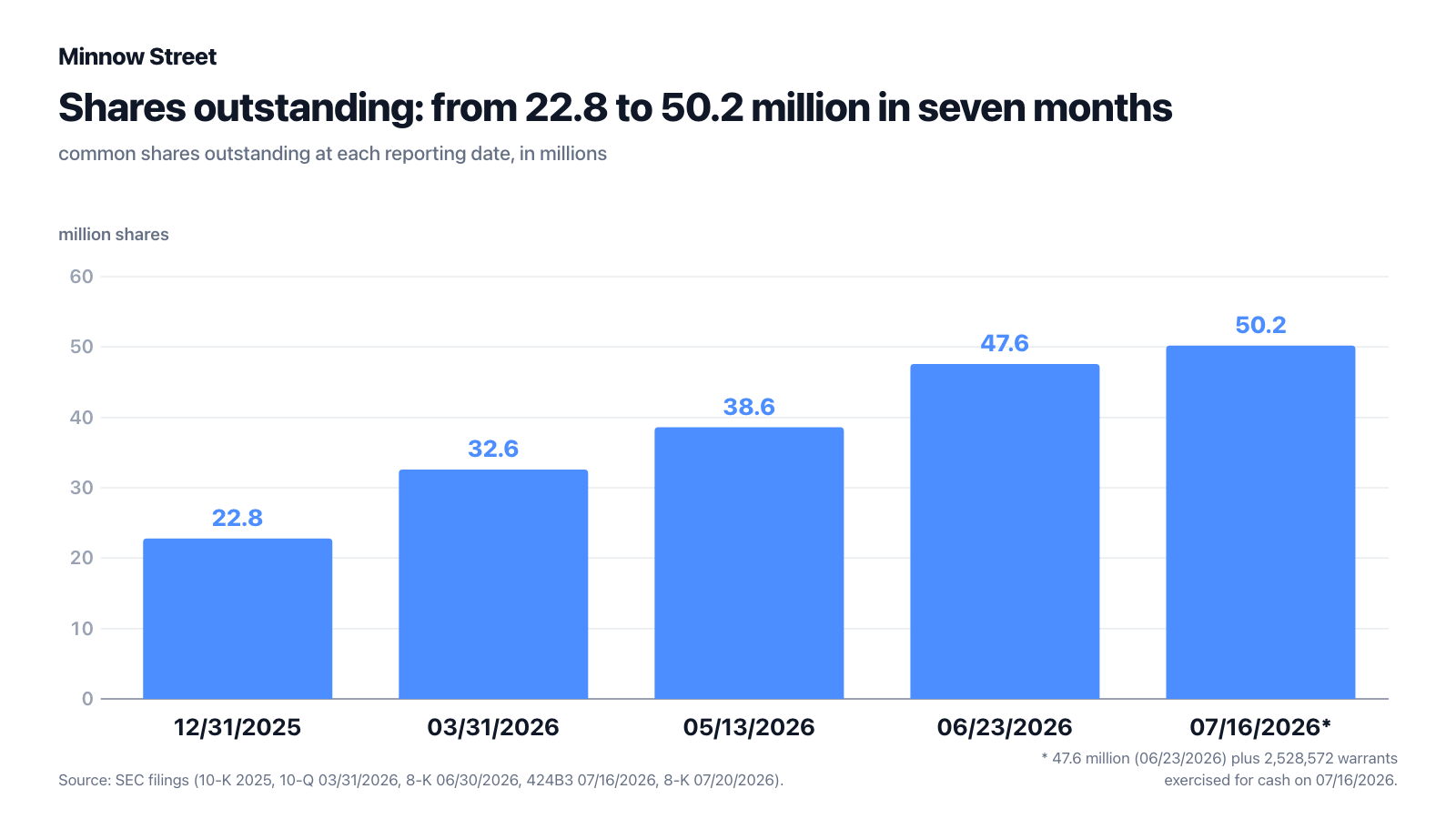
The path there is a chain of financings: a public offering on February 9, 2026 of 7,142,858 shares at $0.70 (gross $5,000,001, net $4.1 million), accompanied by warrants for another two times 7,142,858 shares. Then a warrant inducement agreement on April 28, 2026: holders exercised 5,715,085 warrants at $0.70 (gross roughly $4.0 million, net $3.6 million) — and received new warrants for 4,742,860 plus 6,687,310 shares at $0.975. On July 16, 2026 the same play again: 2,528,572 warrants exercised for cash (gross $2,465,357.70), and in exchange new warrants for 800,000 plus 4,257,144 shares, again at $0.975, plus 177,000 warrants for the placement agent. A warrant is nothing more than a voucher for a new share at a fixed price — every voucher redeemed makes your stake smaller.
The most uncomfortable variant is documented in the quarterly report as of March 31, 2026. Warrants can also be exercised cashless: the holder pays nothing, receives correspondingly fewer shares — and the company sees no money at all.
"Between June 1st, 2026 and the filing date, holders of the Company's outstanding warrants exercised Series A-1 and A-2 warrants to acquire 5,613,586 shares of the Company's common stock. Of these exercises, approximately 274,726 warrants were exercised for cash, resulting in aggregate proceeds to the Company of approximately $296,704. In addition, 6,550,778 warrants were exercised pursuant to the cashless exercise provisions of the applicable warrant agreements, resulting in the issuance of approximately 5,338,860 shares of common stock. No cash proceeds were received from the cashless exercises."
— Laser Photonics Corporation, SEC quarterly report 10-Q as of March 31, 2026, Note 8 "Subsequent Events"

Run the math for yourself: anyone who owned one percent of the company on December 31, 2025 and did nothing wrong owns roughly 0.46 percent today. And the arithmetic is not finished — as of March 31, 2026 there were still 17,511,441 warrants outstanding against 100,000,000 authorized shares. Growth paid for with fresh stock is never quite free; we worked through how punishing that arithmetic can get in our analysis of Arrive AI.
Uncomfortable truth no. 3: assets carried at $255,824, paid for with shares worth $8.4 million
Now for the transaction you have to read twice. On March 31, 2025, ICT Investments — the entity that controls Laser Photonics and, together with its sister companies, then held the share majority — bought the Beamer laser marking line from a third party. Price: $255,824 in cash. The assets moved on to Fonon Quantum Technologies, Inc. (FQTI), a sister company under the same control. Four months later Laser Photonics bought those same assets — from FQTI:
"On August 5, 2025, the Company entered into an Asset Purchase Agreement with FQTI, to acquire the Beamer assets. Under the terms of the Asset Purchase Agreement, the Company issued 3,000,000 restricted shares of its common stock with a fair value of $8,434,322 (valued at $2.80 per share as of the close of market on August 5, 2025), as payment for the assets acquired of $255,824, resulting in a deemed dividend of $8,835,228 for the year ended December 31, 2025."
— Laser Photonics Corporation, SEC annual report 10-K 2025, Note 3 "Asset Acquisition from Common Controlled Entity"

To be fair: the transaction is fully disclosed, accounted for under the rules for transactions between entities under common control, and the assets were taken onto the balance sheet at historical carrying amounts — so the difference was not capitalized as an asset but charged against equity as a deemed dividend. None of it is hidden. The scale is remarkable all the same: the deemed dividend from this one transaction exceeds the entire year's revenue for 2025.
And it was not the only one. On May 21, 2024, 3,000,000 shares worth $6,615,000 already went to affiliated Fonon Corporation in exchange for licenses. Add the distributions: $3,552,696 (2025) and $5,780,578 (2024) flowed to that same Fonon Corporation, per the report mostly as allocations for payroll, facilities and overhead. Over two years that is roughly $9.3 million — against revenue of $3.4 million and $8.3 million. The contrast comes from looking at an unrelated seller: for the operating subsidiary Control Micro Systems, Laser Photonics paid $950,000 in cash plus 100,000 shares in October 2024 — and booked a bargain purchase gain of $3,857,999 because the acquired assets were worth more than the price. Remember the pattern: buying from strangers produced a bargain; buying from the family produced a deemed dividend the size of a year of revenue.
Incidentally, the dilution caught the controlling shareholder too: the ICT group's 11,373,695 shares still amounted to 50.7 percent on December 31, 2025 — by March 31, 2026 the identical holding was down to 34.89 percent. The majority owner did not sell; it was diluted along with everyone else.
Uncomfortable truth no. 4: three auditors, two notices, one chief executive on leave
A great deal has been in motion around the reporting in 2026 — that is the fourth uncomfortable truth. In order, all of it from mandatory filings:
- Three audit firms in seven months: on December 31, 2025, Weinberg & Company replaced the previous auditor M&K CPAS; on July 20, 2026, Rosenfield & Company replaced Weinberg. In both cases the company expressly reports no disagreements and no reportable events — so neither change is documented as a dispute. The frequency is what stands out.
- Nasdaq notified twice, both matters closed: because the 2025 annual report was late, Nasdaq found a breach of Listing Rule 5250(c)(1); once the report was filed, it declared the matter closed on April 21, 2026. On May 21, 2026 the same notice followed for the late quarterly report — and that matter was also confirmed closed in writing on June 12, 2026. Important for context: as of this analysis no Nasdaq deadline is running. The 8-K of April 21, 2026 also gives a concrete reason for the delay: resolving accounting issues raised by the newly engaged auditor.
- The finance chief carousel: on May 7, 2026, Roman Franklin took on the role of principal financial officer through a services agreement with a firm called The CFO Portal, initially for six months. On June 24, 2026 — seven weeks later — the agreement was terminated, with a payment of $50,000. His successor is Ralph Venegas, until then vice president of finance and reporting at, of all places, sister company FQTI.
- Chief executive on leave: on June 16, 2026, president and CEO Wayne Tupuola told the board and the workforce that he was taking a three-month leave of absence for health reasons. Ann Tewari, previously executive vice president of global operations and strategy, has run the company as interim president since.
That the going-concern paragraph was recorded once more during July's auditor change is the cleanest evidence that the April finding still stands:
"Weinberg & Company's audit report on the Company's consolidated financial statements as of and for the year ended December 31, 2025, did not contain an adverse opinion or a disclaimer of opinion, nor was it qualified or modified as to uncertainty, audit scope or accounting principles, except that the report contained an explanatory paragraph regarding substantial doubt about the Company's ability to continue as a going concern."
— Laser Photonics Corporation, SEC current report 8-K of July 24, 2026, Item 4.01 "Changes in Registrant's Certifying Accountant"

Valuation: what roughly 50 million shares are supposed to cost
This is where it gets methodologically tricky, and we will be transparent about it. A price-to-earnings ratio cannot be formed — there are no earnings. A price-to-book ratio cannot either — equity is negative, so the denominator is useless. That leaves revenue. And even for that we need a market value we can pin down.
So we work exclusively with what a document states. The prospectus of July 16, 2026 gives two hard figures: 47,647,622 shares outstanding as of June 23, 2026 and, as the last documented price, $1.35 on July 9, 2026. Adding the 2,528,572 warrants exercised for cash on July 16, 2026 gets you to roughly 50.2 million shares. Together that puts the market value in the order of $67.7 million. To be straight about it: the market capitalization derived from fundamental data ($52.2 million, data as of July 28, 2026) sits about 23 percent below that — and not because of the share count, which is exactly the same 50,176,194 shares. The difference is purely the reference date of the price: our anchor is the last price a mandatory filing names, and that one is a good three weeks older. We stay with the filing anchor because it is documented — while noting that the market has lately valued the company below this calculation.
On the filing anchor, the valuation looks like this: roughly eight times 2025 revenue ($8.3 million). Annualize the first quarter of 2026 instead — $915,553 times four, so about $3.7 million — and it is roughly 18 times. For comparison: multiples like that are what you normally pay for software companies with 80 percent gross margins, not for a machine builder whose gross margin was negative in the most recent reported quarter. There is no analyst consensus — the stock is not covered by the large houses, so there is no professional view to push against either. And one point that often gets missed: every further warrant exercise raises the denominator of this calculation without raising revenue. The market value can rise while the share price falls.
Opportunities and risks at a glance
What speaks for Laser Photonics:
- A real product with an understandable benefit: laser cleaning replaces abrasive blasting and chemicals, avoids blast media and hazardous waste, and reduces the dust workers breathe — a market that environmental and workplace safety rules tend to enlarge rather than shrink.
- No customer concentration risk: the largest single customer accounted for only 6 percent of net sales in 2025 (2024: 8 percent). For a company this size that is unusually healthy.
- Government access as an anchor: less than 18 percent of U.S. revenue came from the U.S. Government in 2025, mostly from Army, Navy and Air Force work; management is targeting 25 percent within 12 to 24 months.
- Revenue rose to $8,342,008 in 2025 (up 144 percent) and the gross margin to 14.4 percent; Control Micro Systems added a subsidiary with its own manufacturing and 52,200 square feet of facility space, bought below value (bargain purchase gain of $3,857,999).
- Both Nasdaq deficiency notices of 2026 are documented as closed (April 21 and June 12, 2026); as of this analysis no listing deadline is running.
- There is documented tailwind from defense: per Exhibit 99.1 to the current report on Form 8-K of June 11, 2026, the Laser Shield Anti-Drone System was selected under the U.S. Department of War's "Vulcan" Call for Solutions as a top submission in the Counter-C5ISR-T category and invited to a technical exchange. First orders from new fields followed, among them a $0.25 million laser drilling system for Johnson & Johnson.
- The order book is growing against the revenue trend: contract liabilities of $2,874,427 as of March 31, 2026 after $1,205,007 as of December 31, 2025, plus $1,342,536 of deferred revenue — together roughly $4.2 million of work already paid for but not yet delivered.
What speaks against it:
- The auditor's going-concern paragraph for fiscal 2025 and the company's own statement of April 20, 2026 that cash of $1.4 million would last "until August 2026" — against an operating cash outflow of $1,842,774 in the first quarter of 2026 alone.
- Negative equity: minus $1,700,323 as of March 31, 2026 (December 31, 2025: minus $5,036,586) against $12,605,520 of liabilities and $10,905,197 of total assets.
- Dilution as a permanent condition: from 22,845,345 shares (December 31, 2025) to roughly 50.2 million (July 16, 2026), plus 17,511,441 warrants outstanding as of March 31, 2026 — a long-standing holder retains roughly 46 percent of the original stake.
- Related party transactions of material size: 3,000,000 shares ($8,434,322) for assets carried at $255,824, 3,000,000 shares ($6,615,000) for licenses, and $9.3 million of distributions to affiliated Fonon Corporation over two years.
- The business has recently shrunk, not grown: first-quarter 2026 revenue down 60 percent, gross margin minus 42.4 percent, net loss $2,946,284. On top of that a temporary change at the top and the third audit firm in seven months.
A human conclusion
Back to the hourglass from the beginning. What makes this stock tempting is that the loud news is genuinely true: the machines work, the market exists, armed forces buy, revenue has grown, the Nasdaq notices have been dealt with, and the order book is filling. None of that is invented. It is just that a sentence with a date in it sits next to all of it — and that sentence comes not from a critic but from the company itself, confirmed by its own auditor and repeated twice in later documents. Anyone buying Laser Photonics stock today is therefore not primarily betting on light versus sand. They are betting that the next financing arrives, that it does not arrive too cheaply, and that the company eventually ships machines at a profit rather than a loss.
That can work out. Companies have climbed out of deeper holes, and the operating core here is better than the balance sheet suggests — no customer above 6 percent, a real factory, a product with tailwind from workplace safety rules. But so far the price for all of it is paid in one currency only: ownership. So the honest question is not "is the technology any good?" — it is. The question is: do you want to be the one whose slice shrinks so the bills can be paid? If you answer yes and size the position accordingly, you have a thesis. If not, you have read a good story. What you make of it is your decision. And that is exactly as it should be.
Sources
Every original document used in this analysis, for your own reading:
- Laser Photonics Corporation — SEC annual report 10-K for 2025 (filed April 20, 2026)
- Laser Photonics Corporation — SEC quarterly report 10-Q as of March 31, 2026 (filed June 11, 2026)
- Laser Photonics Corporation — SEC prospectus 424B3 of July 16, 2026 (share count as of 06/23/2026, price as of 07/09/2026)
- Laser Photonics Corporation — SEC current report 8-K of July 20, 2026 (Items 1.01/3.02: warrant inducement agreement)
- Laser Photonics Corporation — SEC current report 8-K of July 24, 2026 (Item 4.01: change of certifying accountant)
- Laser Photonics Corporation — SEC current report 8-K of June 30, 2026 (Item 5.07: results of the special meeting of stockholders)
- Laser Photonics Corporation — SEC current report 8-K of June 23, 2026 (Item 5.02: leave of absence of the chief executive)
- Laser Photonics Corporation — SEC current report 8-K of June 25, 2026 (Item 5.02: change of principal financial officer)
- Laser Photonics Corporation — SEC current report 8-K of June 12, 2026 (Item 3.01: Nasdaq confirms compliance regained)
- Laser Photonics Corporation — SEC current report 8-K of June 11, 2026 (Item 7.01, Exhibit 99.1: quarterly results and the selection of the Laser Shield Anti-Drone System)
- Laser Photonics Corporation — SEC current report 8-K of April 21, 2026 (Item 3.01: deficiency notice and closure over the late annual report)
- Full SEC filing history for Laser Photonics: EDGAR overview (sec.gov)
- Fundamental data (revenue and result series 2021 through 2023, metrics; data as of July 28, 2026), reconciled with the SEC filings. The market capitalization from that source was not used because it deviates by about 23 percent from the filing anchor.
Transparency & disclaimer: This analysis is a journalistic contextualization of publicly available information and is not investment advice, not a financial analysis in the regulatory sense, and not a solicitation to buy or sell securities. Stock investments carry substantial risks up to total loss. All information without guarantee; the data cut-off is noted in the text in each case. The author holds no position in Laser Photonics stock at the time of publication.
Our Bottom Line at a Glance
- Product and market positive
- The business is real and the market makes sense: laser cleaning replaces abrasive blasting and chemicals, avoids blast media and hazardous waste, and cuts the dust workers breathe. As of December 31, 2025 the company had 94 full-time employees, less than 18 percent of U.S. revenue in 2025 came from the U.S. Government, and the customer base is remarkably broad — the largest single customer accounted for only 6 percent of net sales in 2025 (2024: 8 percent).
- Going concern and liquidity negative
- The audit report for fiscal 2025 carries a going-concern explanatory paragraph, and on April 20, 2026 management wrote that cash of $1.4 million would last "until August 2026". As of March 31, 2026 the company held $1,627,600 in cash, stockholders' equity was negative $1,700,323 and the working capital deficit stood at $3,984,822. Operations consumed $6,390,628 of cash in 2025 and $1,842,774 in the first quarter of 2026.
- Dilution negative
- Shares outstanding rose from 22,845,345 (December 31, 2025) to 47,647,622 (June 23, 2026) and roughly 50.2 million after July 16, 2026 — more than a doubling in seven months. Between June 1 and June 11, 2026 alone, 5,338,860 shares came from cashless warrant exercises that produced no proceeds. As of March 31, 2026 a further 17,511,441 warrants were outstanding against 100,000,000 authorized shares.
- Related party transactions negative
- On August 5, 2025 the company paid 3,000,000 of its own shares worth $8,434,322 to sister company FQTI for assets that had cost $255,824 inside the same control group four months earlier; the annual report records a deemed dividend of $8,835,228. Add $3,552,696 (2025) and $5,780,578 (2024) of distributions to affiliated Fonon Corporation, plus 3,000,000 shares issued for licenses in May 2024.
- Reporting and leadership negative
- Three audit firms in seven months (M&K CPAS, Weinberg & Company, and Rosenfield & Company since July 20, 2026), two Nasdaq deficiency notices for late filings in 2026 — both closed on April 21 and June 12, 2026 — a finance chief whose engagement was terminated after seven weeks (with a $50,000 payment), and a chief executive on a three-month medical leave of absence since June 16, 2026.
- Valuation neutral
- No earnings or book value multiple exists (loss, negative equity). That leaves revenue: roughly 50.2 million shares at the last price documented in a filing, $1.35 on July 9, 2026, works out to about $67.7 million — eight times 2025 revenue, and roughly 18 times if you annualize the first quarter of 2026. There is no analyst consensus for this stock.
Laser Photonics is a case where the product and the balance sheet point in opposite directions. The machines work, the market is real, revenue rose to $8,342,008 in 2025 — but the audit report carries a going-concern paragraph, stockholders' equity was negative $1,700,323 as of March 31, 2026, and management itself dated the cash runway in April 2026 as lasting "until August 2026". The funding comes from an endless stream of new shares: from 22,845,345 (December 31, 2025) to roughly 50.2 million (July 16, 2026), with 17,511,441 warrants still outstanding. Shareholders here carry the operating risk and pay for it with their own stake at the same time. Not investment advice.
What Our Rating Means
Substance risk
We found at least one documented issue that threatens the company itself — regardless of how the stock is currently valued.
Red here is not a judgment on the share price but the consequence of three documented findings about substance: the auditor's going-concern paragraph for fiscal 2025, stockholders' equity of negative $1,700,323 as of March 31, 2026, and the cash runway the company itself dated as lasting "until August 2026" while cash keeps draining. That the product works and that no customer accounts for more than 6 percent of sales speaks for the business — but it does not change the fact that continuity currently depends on the next financing, and that each financing shrinks the existing shareholders' slice further. The decision is yours.
A journalistic assessment by our editorial team at the time of the deep dive, based on public sources — not investment advice and not a solicitation to buy or sell. Your personal circumstances (investment goals, risk capacity, taxes) cannot be taken into account. What our levels mean, how verdicts are formed, and what conflicts of interest exist →
Worth Noting
- Laser Photonics did not reach our research list through a scanner hit — as of July 29, 2026 the stock appears on no list of our in-house stock scanner, and those lists are recomputed daily. The hook was the filing stream at the U.S. securities regulator, the SEC: 16 current reports on Form 8-K between January 6 and July 24, 2026, including two changes of auditor and three notices about the Nasdaq listing.
- Recency gate: the latest periodic report is the quarterly report on Form 10-Q as of March 31, 2026 (filed June 11, 2026); every filing after it was reviewed individually, exhibits included. Important for context: both Nasdaq deficiency notices of 2026 concerned late periodic filings under Listing Rule 5250(c)(1) only, and both are documented as closed (April 21 and June 12, 2026). No Nasdaq deadline is currently running, and no minimum bid price deficiency (Listing Rule 5550(a)(2), the one-dollar threshold) appears in any filing.
- The market capitalization from fundamental data ($52.2 million, data as of July 28, 2026) deviates by about 23 percent from the cross-check "share count × last price documented in a filing" (50,176,194 × $1.35 on July 9, 2026 ≈ $67.7 million). Under our house rule it is therefore not used. The gap does not come from the share count — the fundamental data carry exactly the same 50,176,194 shares — but from the reference date of the price: the filing anchor is a good three weeks older, so it is the documented figure rather than the lower one. All valuation statements rest on it and are deliberately phrased as orders of magnitude.
Frequently Asked Questions
Laser Photonics Corporation (Nasdaq Capital Market: LASE) of Lake Mary, Florida, builds industrial laser cleaning systems. They strip rust, paint and coatings with a focused beam of light, replacing abrasive blasting and chemical cleaning — no blast media, no hazardous waste. The line runs from handheld units to robotic cells, and includes laser cutting, welding and marking systems. As of December 31, 2025 the company had 94 full-time employees; revenue for 2025 was $8,342,008. Customers include the U.S. armed forces.
The auditor attached an explanatory paragraph to the annual report on Form 10-K for 2025 expressing "substantial doubt" about the company's ability to continue operating. The report points to the history of losses and negative operating cash flow; on April 20, 2026 management wrote that existing cash of $1.4 million would last "until August 2026". The quarterly report as of March 31, 2026 confirms the conclusion. A going-concern paragraph is not a bankruptcy filing, but it is the strongest warning an auditor can give.
Severely. Shares outstanding went from 22,845,345 on December 31, 2025 to 32,597,325 on March 31, 2026 and 47,647,622 on June 23, 2026 per prospectus 424B3 — plus 2,528,572 warrants exercised for cash on July 16, 2026, for roughly 50.2 million. That is more than a doubling in seven months. Between June 1 and June 11, 2026 alone, 5,338,860 shares came from cashless warrant exercises for which the company received nothing. A further 17,511,441 warrants were outstanding as of March 31, 2026.
Based on the filings, no Nasdaq deadline was running as of July 29, 2026. There were two deficiency notices under Listing Rule 5250(c)(1) in 2026, both for late filings: one for the annual report, closed on April 21, 2026, and one dated May 21, 2026 for the quarterly report, closed on June 12, 2026. Nasdaq confirmed both matters in writing as resolved. What remains is the economics: stockholders' equity of negative $1,700,323 as of March 31, 2026 and a going-concern paragraph.
On March 31, 2025, controlling shareholder ICT Investments bought the Beamer laser marking line for $255,824 and passed it to sister company Fonon Quantum Technologies (FQTI). On August 5, 2025, Laser Photonics acquired those same assets from FQTI and paid with 3,000,000 of its own shares worth $8,434,322. The annual report records a deemed dividend of $8,835,228 for the transaction — more than the company's entire revenue for 2025.
The core of the ownership structure is the group around ICT Investments, its managing partner Dmitriy Nikitin and the affiliated Fonon Corporation and Fonon Technology. Together they held 11,373,695 shares, or 50.7 percent, as of December 31, 2025. Dilution cut the same holding to 34.89 percent by March 31, 2026 — the controlling shareholder did not sell, it was diluted. The annual report for 2025 describes the company as a "controlled company" under the Nasdaq marketplace rules.
A price-to-earnings ratio cannot be formed because there are no earnings, and a price-to-book ratio cannot be formed because stockholders' equity is negative. That leaves revenue. Taking roughly 50.2 million shares at the last price documented in a filing — $1.35 on July 9, 2026, per prospectus 424B3 — gives a market value of about $67.7 million. That is eight times 2025 revenue, and roughly 18 times if you annualize the first quarter of 2026. Cheap it is not.
Because the stock meets none of our filters: quality and value screens need earnings, positive equity and stable margins, and momentum screens need a trend. As of July 29, 2026 Laser Photonics appears on no list of our in-house stock scanner — those lists are recomputed daily, so that can change. The stock reached our desk through the SEC filing stream instead: 16 current reports on Form 8-K between January 6 and July 24, 2026.
Found an error?
Did you spot a factual error, an outdated number, or a typo in this deep dive? Let us know briefly — your report goes straight to the editorial team.