JPMorgan Chase Stock: $21.2 Billion in Quarterly Profit — and Why $4.2 Billion of It Happens Only Once
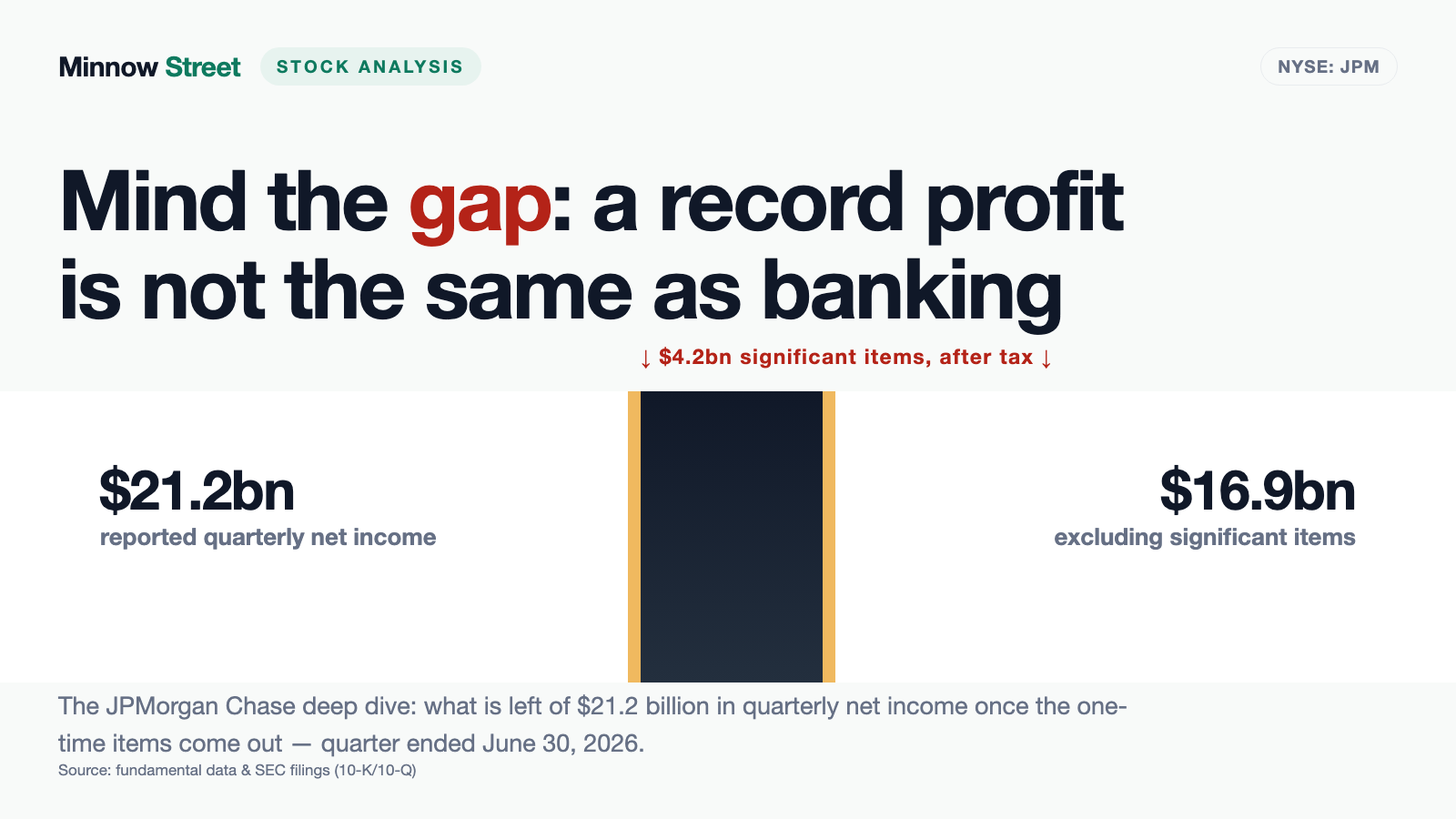
JPMorgan Chase reported net income of $21,155 million for the quarter ended June 30, 2026, up 41 percent year over year. The bank itself then subtracts $4.2 billion after tax: gains on Visa shares and equity investments that will not repeat in this form. That leaves $16.9 billion. We take the record apart item by item, with the filing reference alongside each one.
 Thomas Mücke
Founder & Publisher
Thomas Mücke
Founder & Publisher
Chart
Interactive price chart (TradingView).
Note: pure fact-based analysis, not investment advice and not a solicitation to buy or sell. All figures without guarantee.
The trap is called a tax refund
Let us make a deal. Before we talk about the largest bank in the United States, I will confess a mental trap we have both fallen into. It is the month the tax refund lands. Suddenly there is $2,400 more in the account than usual, and for a few days everything feels lighter: the bigger car, the better vacation, the new kitchen.
Except your salary did not change. That month was an exception, not a new normal. Budget around it and you are budgeting off the wrong number.
At JPMorgan Chase the headline for the quarter ended June 30, 2026 reads: $21,155 million of net income, up 41 percent year over year. That is accurate, and it is exactly how the earnings release to the U.S. securities regulator, the SEC, states it.
One page later, in the same release, sits the second number. The bank strips out two items that will not repeat in this form and arrives at $16.9 billion. Plus 41 percent becomes plus 13.
Hold on to that tension, because it runs through every chapter: JPMorgan Chase is earning more than ever — and the growth is coming from the least dependable parts of the business. Let us read it together, line by line.
Contents
- What JPMorgan Chase actually does
- How this stock landed on our desk
- The numbers over the years — given their due
- Why the usual metrics do not work here
- What the filings say — the uncomfortable truths
- Valuation: what you are paying for this bank
- Opportunities and risks at a glance
- A human conclusion
- Sources
What JPMorgan Chase actually does
JPMorgan Chase is a universal bank. It does nearly everything that can be done with money, and it does so at a scale that is hard to picture. As of June 30, 2026 total assets stood at roughly $5.0 trillion. For comparison, that is more than the annual economic output of Germany.
The company reports in four blocks. Here they are, with 2025 net income:
- Commercial & Investment Bank (CIB): $27,761 million. Corporate lending, payments, securities services, advice on mergers and listings — plus trading in bonds, currencies, commodities and equities.
- Consumer & Community Banking (CCB): $18,245 million. This is the "Chase" brand in daily life: checking accounts, branches, ATMs, mortgages, auto loans, credit cards and retail brokerage.
- Asset & Wealth Management (AWM): $6,522 million. Funds for institutions and service for very wealthy private clients. Assets under management reached $5.1 trillion in the quarter ended June 30, 2026.
- Corporate: $4,520 million. The catch-all for treasury, the bank's own securities portfolio and equity investments. This is where the items we are about to discuss land.
How a bank earns works differently from an industrial company, so here is the plain-language version. Two buckets:
The first is net interest income. The bank takes money from depositors and creditors and pays interest on it; it lends money out and collects interest. The difference is its earnings. In 2025 that came to $95,443 million.
The second is noninterest revenue: fees for advice, custody, card volumes, asset management — plus gains and losses from trading. In 2025 that was $87,004 million. Together they make up the $182,447 million that other companies would call revenue.
One thing that is easy to get wrong: JPMorgan Chase & Co. is not Morgan Stanley. Two separate firms, two tickers. Inside the group, "J.P. Morgan" denotes the corporate and wealth businesses and "Chase" the consumer bank. And if you are looking for old time series: the company was called Chase Manhattan Corp until 2000 and Chemical Banking Corp before that. The fiscal year is the calendar year, so nothing needs converting.
How this stock landed on our desk
This one did not come from our in-house stock scanners. They filter on metrics — cheap valuation, high Piotroski score, momentum — which is precisely why the best-known heavyweights fall through: they are rarely cheap. When we counted on July 28, 2026 how many of the 100 largest U.S. stocks by market capitalization already had a deep dive here, 88 did not. JPMorgan Chase was the largest financial among them, ranked 12th, with a market capitalization of roughly $950 billion (data as of July 29, 2026).
That is an honest statement about our own method: a scanner built to find bargains does not find blue chips. So we are now working the list from the top down.
JPMorgan plays a role here that reaches beyond its own balance sheet. Chairman and CEO Jamie Dimon cites "AI-driven capital investment" as a tailwind for the U.S. economy in the very same earnings release — and the bank helps finance that investment. If you want to see the other side of that trade, look at two companies we have already examined: Microsoft is spending this money on data centers, and Amazon is doing the same at the same pace. A bank earns twice from that cycle — on the financing and on the listings that follow. It also carries the credit risk when the cycle ends.
The numbers over the years — given their due
Start with what genuinely impresses, and there is plenty. Over the past three years JPMorgan Chase has earned $165 billion. Not in revenue — in net income, after tax. Return on equity was 17 or 18 percent in each of those years; for a bank, anything above 10 percent counts as respectable and anything above 15 percent as very good.
More telling still for a bank is book value per share — equity divided by the share count. It shows how much substance actually accrued per share:
| As of | Book value per share | Tangible book value per share |
|---|---|---|
| December 31, 2023 | $104.45 | $86.08 |
| December 31, 2024 | $116.07 | $97.30 |
| December 31, 2025 | $126.99 | $107.56 |
| June 30, 2026 | $133.01 | $113.35 |
That is 27 percent more book value in two and a half years — and it happened while the bank paid dividends and cut the share count from 2,876.6 million to 2,696.2 million (year-end 2025). Doing both at once is rare.
Now the full series. All figures in millions of U.S. dollars, all from the 2025 annual report:
| Fiscal year | Total net revenue | Noninterest expense | Provision | Net income | EPS (diluted) |
|---|---|---|---|---|---|
| 2023 | 158,104 | 87,172 | 9,320 | 49,552 | $16.23 |
| 2024 | 177,556 | 91,797 | 10,678 | 58,471 | $19.75 |
| 2025 | 182,447 | 95,640 | 14,212 | 57,048 | $20.02 |
Two columns reward a second look. Net income fell 2 percent in 2025 even though revenue rose — the provision jumped by a third. And earnings per share still went up, because the bank bought back stock. A useful rule of thumb: when EPS grows faster than earnings, the buyback is doing the work, not the business.
Where the money is earned has shifted noticeably over these three years:
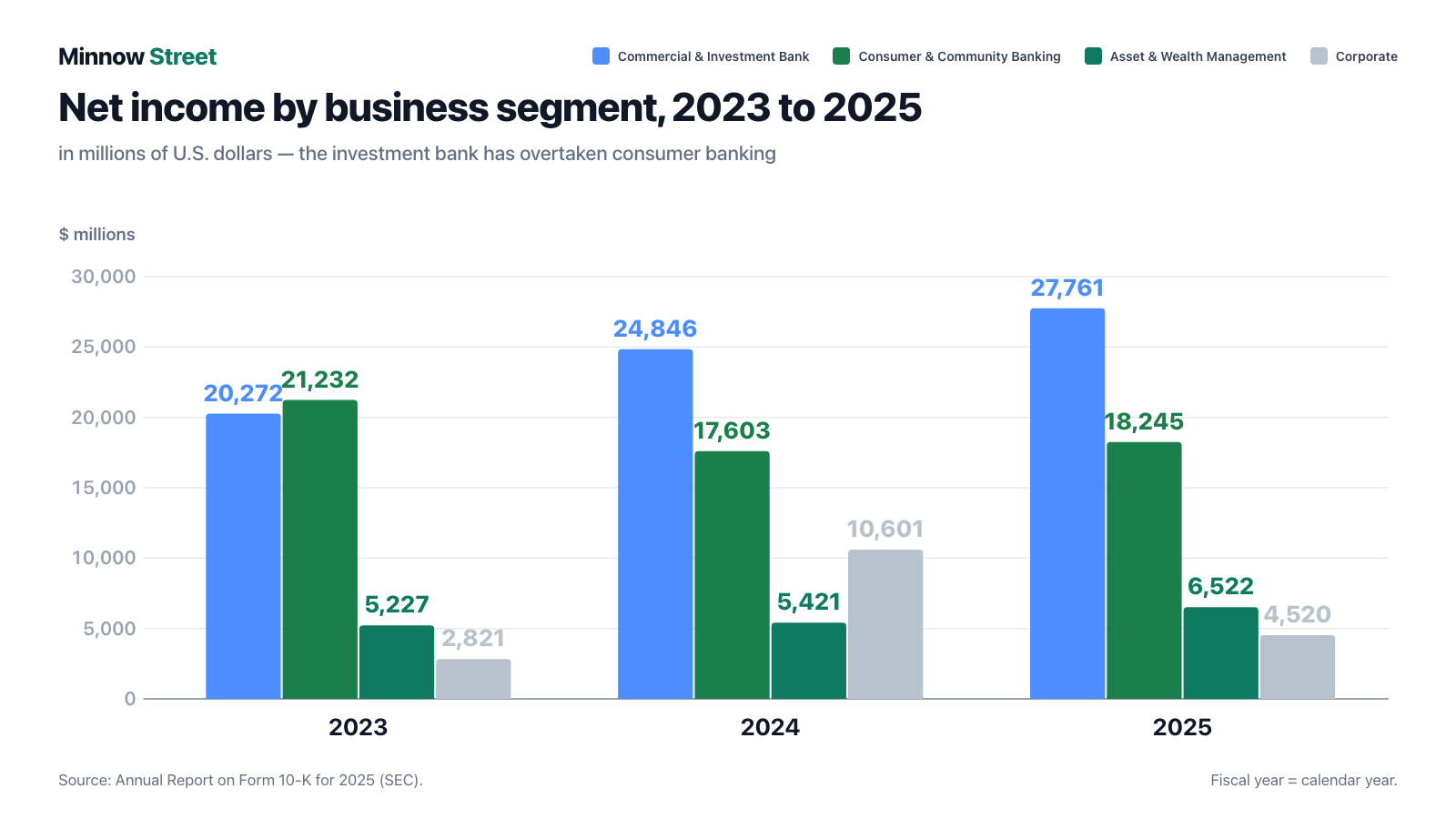
The grey bar in the middle is why this chapter does not end in applause. Corporate earned $2,821 million in 2023, $10,601 million in 2024 and $4,520 million again in 2025. What swings there is not the banking business. It is the valuation of equity stakes and securities.
Why the usual metrics do not work here
Before we go on, a chapter we insert for every financial stock — otherwise the wrong tools get used.
Among other things, our scanners compute an Altman Z-score for every company, an early-warning measure for insolvency. For JPMorgan Chase the formula returns 0.63, and at an industrial company that would be a loud alarm. Here it simply carries no meaning: the formula relates working capital and retained earnings to total assets — and a bank's total assets consist of loans and customer deposits. The model was built for factories, not for banks. The same caveat applies to insurers and real estate companies.
The price/sales ratio of roughly 5.1 is no more useful. A bank has no revenue in the ordinary sense; what ends up in the denominator is the sum of net interest income and fees — a figure that cannot be compared with the revenue of a retailer or a manufacturer.
Enterprise value, and everything built on it, is likewise unusable for banks: it deducts cash from market capitalization. At a bank, cash is working capital, not surplus money.
And free cash flow? A bank's operating cash flow swings by hundreds of billions depending on whether customers add or withdraw deposits and whether trading inventories grow or shrink. It measures movements of customer money, not money earned.
What does count is a short list: net interest income, noninterest revenue, provision for credit losses, return on equity, the CET1 ratio, the leverage ratio and the book value series. Those are the measures used here — and the ones the bank uses itself.
What the filings say — the uncomfortable truths
Uncomfortable truth no. 1: a fifth of the record came from shares carried at a nominal value
Net income for the quarter ended June 30, 2026 was $21,155 million. In the same release the bank spells out what was one-time about it:
"The significant items, each in the current quarter, consisted of a $4.6 billion net gain related to Visa shares in Corporate as well as $1.0 billion of gains on certain equity investments, of which $763 million was in Corporate and $263 million was in CIB."
— JPMorgan Chase & Co., Form 8-K earnings release of July 14, 2026 (Item 2.02, Exhibit 99.1)

What those $4.6 billion actually were is the real story, and it was already in the filings a quarter earlier. JPMorgan held 18.6 million Visa Class B-2 common shares. They date back to the era when the banks owned Visa together. They are restricted, their conversion rate into freely tradable Visa shares depends on the outcome of old antitrust litigation, and so — in the annual report's own words — they are "held at their nominal carryover basis." In plain terms: at almost nothing.
On April 13, 2026, Visa launched an exchange offer. The quarterly report for the period ended March 31, 2026 flagged what would follow:

Add it up. The significant items came to $4.2 billion after tax — $1.56 per share and 6 percentage points of return on tangible common equity. $7.70 of earnings per share becomes $6.14; 29 percent return on tangible common equity becomes 23.
And it was not the first time. In the second quarter of 2024 an earlier Visa exchange had already handed the bank $7.9 billion. That is why Corporate spiked in the chart above. After the 2026 exchange what remains are new Visa Class B-3 shares, again carried at a nominal value — and Visa is expressly authorized to extend further exchange offers.
Put it in everyday terms: this is a savings passbook from your grandmother that sat in a folder for decades carrying a value of one dollar. When it is cashed in, the proceeds are real. They are just not a salary.
Uncomfortable truth no. 2: the core business has been flat for two years
Now to the part that genuinely deserves the name banking. Net interest income rose 3 percent in 2025 to $95,443 million. That sounds fine. But the bank also reports a version that strips out Markets — and it is the more honest one, because trading revenue can sit inside the interest line without having anything to do with loans and deposits.
Excluding Markets, net interest income was $92,591 million in 2025 — against $92,419 million in 2024. That is growth of 0.2 percent. Effectively flat. Noninterest revenue excluding Markets actually fell 2 percent over the same period, to $57,208 million.
So where did the growth come from? Trading. Markets revenue rose 19 percent to $35,782 million in 2025. And in the quarter ended June 30, 2026 the pattern sharpened:
- Net interest income excluding Markets: $23.7 billion, up 4 percent. The bank cites higher deposit balances and higher revolving card balances, "largely offset by the impact of lower rates."
- Markets revenue: $12.1 billion, up 35 percent.
- Of which Equity Markets alone: $6.0 billion, up 86 percent.
The chief executive frames it himself, and the framing is notably candid:
"The Firm reported very strong results in the quarter, generating net income of $16.9 billion and an ROTCE of 23%, excluding gains related to Visa and certain equity investments. These results were the product of a particularly favorable environment with an elevated level of market activity, as well as rigorous execution, years of consistent investment and thoughtful capital deployment."
— Jamie Dimon, Chairman and CEO, in the Form 8-K earnings release of July 14, 2026
"A particularly favorable environment with an elevated level of market activity" describes a condition, not a trend. Trading revenue is the most volatile item on any bank's income statement. A quarter with 86 percent growth in equity trading is not a new level; it is a good quarter.
Fairness requires the other direction too. For 2026 the bank expects net interest income of approximately $103 billion, or roughly $95 billion excluding Markets — against $92.6 billion in 2025. That would be growth of about 3 percent in the core business. Solid, but not 41 percent.
Uncomfortable truth no. 3: loan losses are rising for the third year running
In a record year nobody looks at the charge-off line. Which is exactly why it is here.
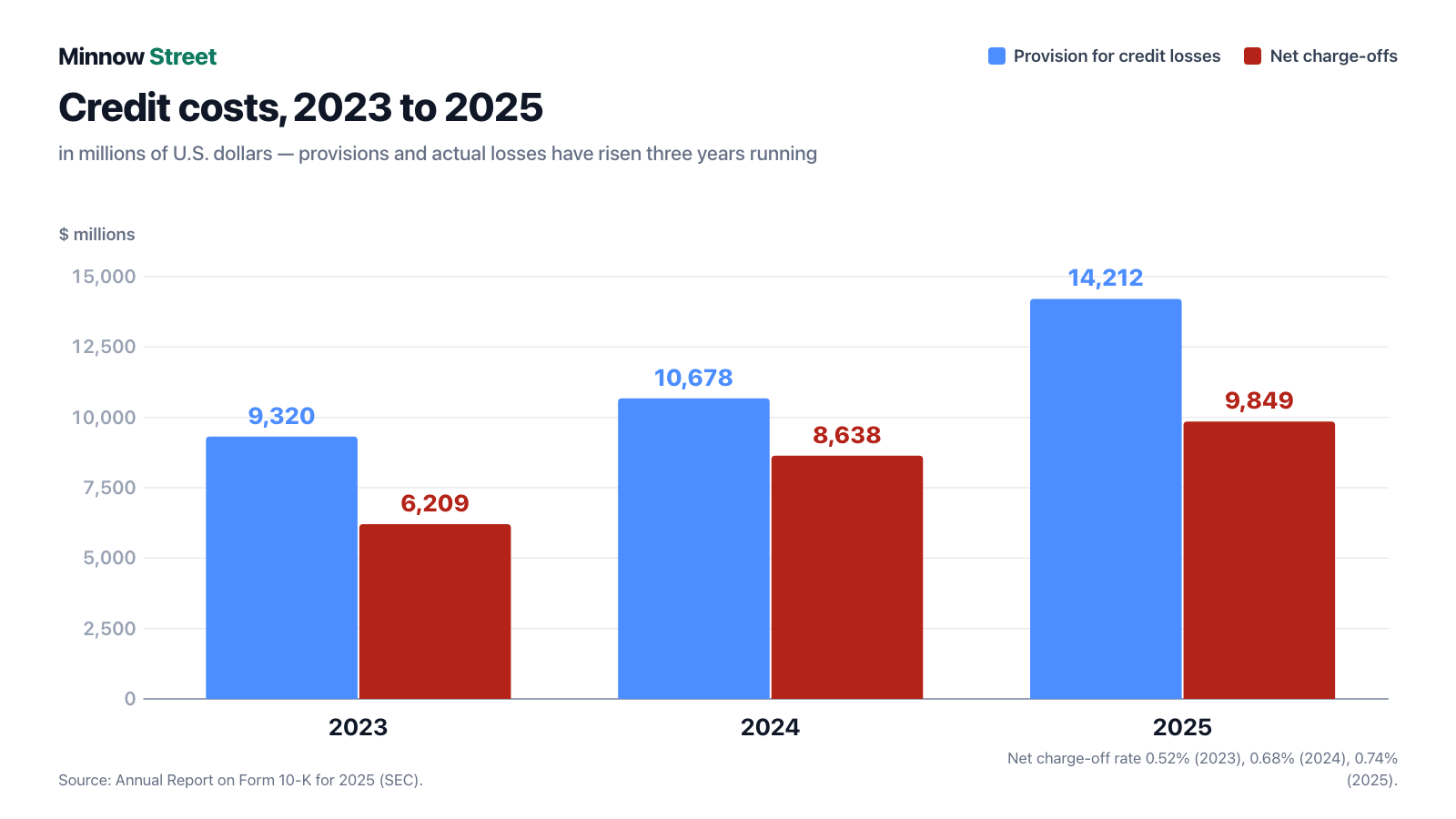
Two terms, briefly translated. The provision for credit losses is what the bank sets aside for expected losses — an estimate. Net charge-offs are what was actually written off as lost — a fact. Both are rising, but the fact is rising faster: up 59 percent in two years, while net income grew 15 percent.
Nonperforming assets went from $7,597 million to $10,359 million over the same span. In Card Services the net charge-off rate was 3.31 percent in 2025, 3.47 percent in the quarter ended March 31, 2026 and 3.34 percent in the quarter ended June 30, 2026. The bank itself expects approximately 3.4 percent for 2026.
Now the counterargument, and it is a strong one: these levels are historically low. A charge-off rate of 0.74 percent across the whole loan book is a good number for a universal bank, and the allowance of $31,230 million as of December 31, 2025 covers 1.83 percent of retained loans — two and a half times a single year of losses. JPMorgan does not have a credit problem.
What it has is a direction. And directions in lending rarely turn from one quarter to the next.
Uncomfortable truth no. 4: $2.2 billion of provisions for loans the bank does not own yet
The 2025 provision for credit losses jumped by a third to $14,212 million. A large part of that has nothing to do with the current loan book.
On December 30, 2025, JPMorgan Chase entered into a forward purchase commitment for the Apple Card credit card portfolio; it was announced on January 7, 2026. Closing is still ahead:
"On January 7, 2026, JPMorganChase announced that Chase will become the new issuer of Apple Card. The Firm entered into a forward purchase commitment on December 30, 2025 to acquire the Apple credit card portfolio, with an expected closing in approximately 24 months (the "Apple Card transaction")."
— JPMorgan Chase & Co., Annual Report on Form 10-K for 2025, Executive Overview

The accounting bites today regardless. The 2025 provision includes a $2.2 billion addition for lending-related commitments from this transaction alone — roughly 15 percent of the full-year provision and about half of the $4.4 billion net addition to the allowance. Capital pays too: the Standardized CET1 ratio as of December 31, 2025 came in approximately 25 basis points lower because of it.
None of this is improper; the accounting rules require it. But for year-on-year comparison it means one thing: the 2025 provision is not directly comparable with 2024. A sixth of it belongs to a business that does not begin until late 2027.
Uncomfortable truth no. 5: the board's own bonus hurdle is half the current return
On June 25, 2026, JPMorgan Chase announced a leadership change. Doug Petno and Troy Rohrbaugh were elected Co-Presidents of the firm; Petno becomes sole CEO of the Commercial & Investment Bank and Rohrbaugh CEO of Consumer & Community Banking. Marianne Lake, until then head of that business, is retiring after more than 25 years. The compensation committee approved one-time retention awards in stock: $30 million each for Petno and Rohrbaugh, $20 million each for Mary Erdoes and Jennifer Piepszak.
The interesting part is not the sum but the condition:
"The Awards 100% cliff-vest after three years and are subject to an additional Vesting Performance Condition that requires the Firm to achieve a three-year average return on tangible common equity ("ROTCE") of 12% for calendar years 2026, 2027 and 2028."
— JPMorgan Chase & Co., Form 8-K of June 25, 2026, Item 5.02
Twelve percent. For context: in the quarter ended June 30, 2026 JPMorgan delivered 29 percent, or 23 percent excluding significant items. For full-year 2025 it was 20 percent, and 22 percent in 2024.
The board is therefore setting the bar at roughly half of what the bank most recently earned. Two readings are possible and both are legitimate. Either it is a deliberately conservative floor, so the award still serves its purpose — keeping executives — through a bad cycle. Or it is the view of the people who know the bank best on how far earning power could fall by 2028.
Anyone extrapolating the 2026 earnings picture forward should keep that number in mind.
Valuation: what you are paying for this bank
As of July 29, 2026 the market capitalization stood at roughly $950 billion. For a bank, two ratios matter:
- Price/book: roughly 2.68. You are paying just under two and a half times reported equity. Historically large banks often traded below book value; above two is the exception, and it reflects years of above-average return on equity.
- Price/earnings: roughly 15.3 trailing, roughly 15.4 forward. That sits in the range of a broad U.S. index — and well above what banks cost for a long time.
Both numbers need a caveat. The denominator of the price/earnings ratio contains the last twelve months' significant gains. Strip the $4.2 billion after tax out of the record quarter and the multiple rises accordingly. As for price/book: it measures against an equity base the bank is actively shrinking through repurchases.
One valuation anchor often overlooked at banks is excess capital. As of June 30, 2026 the Standardized CET1 ratio stood at 14.1 percent. The requirement, including all buffers, is 11.5 percent:

The gap is 2.6 percentage points. On Standardized risk-weighted assets of roughly $2.1 trillion as of June 30, 2026, that works out — by our own calculation — to roughly $55 billion of capital above the requirement, close to the amount the board authorized for repurchases on June 24, 2026. It is also where the intended dividend increase from $1.50 to $1.65 per quarter from the third quarter of 2026 comes from. The net payout ratio over the last twelve months was already 73 percent.
The professional view on JPMorgan is unusually restrained for a market leader. Twenty-five estimates produced an average target price of roughly $372 as of July 29, 2026 — split into 8 "strong buy," 7 "buy," 9 "hold," 1 "sell" and no outright strong sell. The largest single group therefore counsels waiting. For a stock trading near its 52-week high of $359.25 on that date, that is no accident: the professionals are buying the company, not necessarily the price.
Here the rule we apply to every cyclical business kicks in: never extrapolate earnings from the peak. Banks earn through the cycle. Rate levels, trading volumes and charge-off rates all fluctuate — and all three currently sit in a favorable place.
Opportunities and risks at a glance
Opportunities
- Capital well above the requirement. A 14.1 percent Standardized CET1 ratio against an 11.5 percent requirement as of June 30, 2026, $303 billion of CET1 capital, $590 billion of total loss-absorbing capacity and roughly $1.5 trillion of liquidity sources.
- Four earning segments. In 2025 the investment bank, consumer bank and asset manager together produced $52,528 million of net income; in the quarter ended June 30, 2026 every segment set a revenue record.
- Book value compounds reliably. From $104.45 per share (end of 2023) to $133.01 (June 30, 2026) — up 27 percent, despite dividends and despite buybacks.
- Leadership in investment banking. Number one in global fees with 9.3 percent wallet share year to date; fees rose 30 percent in the quarter to $3.3 billion.
- Rising capital return. Quarterly dividend intended at $1.65 from the third quarter of 2026, up from $1.50; a new $50 billion repurchase program effective July 1, 2026.
- Litigation risk has receded. Legal expense fell from $1.4 billion (2023) to $740 million (2024) to $361 million (2025); the estimated range of reasonably possible losses in excess of reserves is $0 to approximately $1.2 billion.
Risks
- Earnings quality of the latest quarter. $4.2 billion after tax — a fifth of reported profit — came from Visa shares and equity-investment revaluations.
- Core business without momentum. Net interest income excluding Markets was $92,591 million in 2025, essentially flat year over year; noninterest revenue excluding Markets fell 2 percent.
- Dependence on trading. Growth came from the most volatile business in 2025 (up 19 percent) and in the quarter ended June 30, 2026 (up 35 percent, equity trading up 86 percent).
- Rising credit costs. Net charge-offs up 59 percent since 2023, the charge-off rate from 0.52 to 0.74 percent, nonperforming assets from $7,597 million to $10,359 million.
- Rates turning the other way. The bank cites lower rates as a drag on net interest income; in Corporate it fell $667 million in the quarter ended June 30, 2026.
- Pulled-forward Apple Card charge. $2.2 billion of provisions and roughly 25 basis points of capital for a portfolio that does not transfer until late 2027.
- Open succession at the top. Two Co-Presidents have been named but no successor to the chief executive; the $100 million of retention awards require only 12 percent average return on tangible common equity over three years.
- Regulatory uncertainty. Capital requirements will be recalculated in 2027 on revised supervisory stress-test models, and a U.S. proposal to amend the capital framework has been unfinished since July 2023.
A human conclusion
Back to the tax refund. In the quarter ended June 30, 2026, JPMorgan's account held a number it had never held before — and a fifth of it was the cashing-in of a passbook that had been sitting there since the days when the banks owned Visa together.
That is not an accusation. The bank named the item itself, stripped it out itself and quantified it itself: $4.2 billion after tax, $1.56 per share, 6 percentage points of return. Read the release and you cannot miss it. Read only the headline and you will.
What lies underneath is an exceptionally solid bank. Four segments that all make money. Book value per share up more than a quarter in two and a half years, even after dividends and buybacks. A capital position roughly $55 billion above the regulatory requirement. And legal expense down to a quarter of its 2023 level in two years.
What is equally true: the core business has been flat for two years, growth is coming from trading, loan losses are rising for a third year — and the bank's own board treats a 12 percent return on tangible common equity through 2028 as a hurdle that still has to be cleared. Against 23 percent most recently.
Both sit in the same filings, signed by the same people. There is no secret version. There is only the question of which month you treat as normal.
What you make of that is your decision. And that is exactly how it should be.
Sources
- JPMorgan Chase & Co., Annual Report on Form 10-K for fiscal 2025, filed February 13, 2026 (CIK 0000019617)
- JPMorgan Chase & Co., Quarterly Report on Form 10-Q for the period ended March 31, 2026, filed May 1, 2026
- JPMorgan Chase & Co., second-quarter 2026 earnings release (Form 8-K, Item 2.02, Exhibit 99.1) dated July 14, 2026
- JPMorgan Chase & Co., announcement on dividend, repurchase program and capital requirement (Form 8-K, Item 8.01, Exhibit 99) dated June 24, 2026
- JPMorgan Chase & Co., leadership announcement (Form 8-K, Item 5.02) dated June 25, 2026
- SEC EDGAR filing index for JPMorgan Chase & Co. (CIK 0000019617) — review of every filing dated on or after May 1, 2026
- Fundamental data (market capitalization, valuation metrics, analyst consensus), data as of July 29, 2026
This analysis is journalistic commentary on publicly available company filings. It is not investment advice, not a recommendation to buy or sell, and not a solicitation to buy or sell securities. Stocks can lose substantial value, up to a total loss. All figures come from the primary sources listed above and carry the as-of dates stated there; they may have changed since. The author holds no position in JPMorgan Chase & Co. at the time of publication.
Our Bottom Line at a Glance
- Franchise and business model positive
- Four segments that all make money: in 2025 the Commercial & Investment Bank earned $27,761 million, Consumer & Community Banking $18,245 million and Asset & Wealth Management $6,522 million in net income. In the quarter ended June 30, 2026 every segment set a revenue record; assets under management reached $5.1 trillion, up 18 percent, and JPMorgan ranked first in global investment banking fees with 9.3 percent wallet share (Form 8-K of July 14, 2026).
- Capital, balance sheet and liquidity positive
- As of June 30, 2026 the Standardized CET1 ratio stood at 14.1 percent against an 11.5 percent requirement, CET1 capital at $303 billion and total loss-absorbing capacity at $590 billion. Liquidity sources totaled roughly $1.5 trillion as of March 31, 2026. Book value per share rose from $104.45 (2023) to $133.01 (June 30, 2026) — 27 percent in two and a half years (10-K 2025, 10-Q for the period ended March 31, 2026, Form 8-K of July 14, 2026).
- Earnings quality of the record quarter negative
- From the $21,155 million of quarterly net income the bank itself subtracts $4.2 billion after tax — a $4.6 billion net gain on Visa shares previously carried at a nominal basis, and $1.0 billion from equity-investment revaluations. That is $1.56 per share and 6 percentage points of return on tangible common equity. 2024 already contained a $7.9 billion Visa gain (Form 8-K of July 14, 2026, 10-K 2025).
- Core business excluding trading neutral
- Net interest income excluding Markets stood at $92,591 million in 2025 against $92,419 million a year earlier — essentially unchanged; noninterest revenue excluding Markets fell 2 percent. In the quarter ended June 30, 2026 net interest income excluding Markets grew 4 percent while Markets revenue rose 35 percent and Equity Markets alone 86 percent. Growth is therefore coming from the most volatile part (10-K 2025, Form 8-K of July 14, 2026).
- Credit costs negative
- Net charge-offs rose from $6,209 million (2023) to $8,638 million (2024) to $9,849 million (2025), the charge-off rate from 0.52 percent to 0.74 percent, and nonperforming assets from $7,597 million to $10,359 million. In Card Services the bank expects a rate of approximately 3.4 percent for 2026 after 3.31 percent in 2025. Levels remain historically low; the direction has held for three years (10-K 2025).
- Leadership and succession neutral
- On June 25, 2026 Doug Petno and Troy Rohrbaugh were elected Co-Presidents and Marianne Lake announced her retirement after more than 25 years. The compensation committee approved $100 million of retention awards whose vesting requires a three-year average return on tangible common equity of 12 percent — against 23 percent most recently excluding significant items. Orderly succession planning, but the question of who succeeds Jamie Dimon is open (Form 8-K of June 25, 2026).
JPMorgan Chase is the largest U.S. bank and has delivered 17 to 18 percent return on equity for three straight years: $57,048 million of net income in 2025, book value per share up from $104.45 to $133.01, a Standardized CET1 ratio of 14.1 percent against an 11.5 percent requirement and roughly $1.5 trillion of liquidity sources. The record for the quarter ended June 30, 2026 is still no benchmark: $4.2 billion after tax came from Visa shares and equity revaluations, net interest income excluding Markets grew just 4 percent, and loan losses are rising for the third year running. Not investment advice.
What Our Rating Means
Quality confirmed
Business model, numbers and balance sheet hold up to our review. Whether the current price supports an entry is a separate question — it hangs on the price, not on the company.
The substance is documented and it is not thin: a Standardized CET1 ratio of 14.1 percent against an 11.5 percent requirement, $303 billion of CET1 capital, $590 billion of total loss-absorbing capacity, roughly $1.5 trillion of liquidity sources and a Stress Capital Buffer locked in through September 2027. All four segments make money, return on equity has been 17 to 18 percent three years running, book value per share is up 27 percent in two and a half years, and legal expense has fallen from $1.4 billion to $361 million. There is no going concern issue, no negative equity, no accounting or governance break here — hence green. That expressly does not mean the latest quarter is a benchmark: a fifth of reported profit came from Visa shares and equity revaluations, core lending has been flat for two years, growth is coming from trading, and loan losses have risen for three years. The stock is also not cheap at roughly 2.7 times book with the price near its 52-week high — that is a price argument, and it does not set this rating. The decision is yours.
A journalistic assessment by our editorial team at the time of the deep dive, based on public sources — not investment advice and not a solicitation to buy or sell. Your personal circumstances (investment goals, risk capacity, taxes) cannot be taken into account. What our levels mean, how verdicts are formed, and what conflicts of interest exist →
Worth Noting
- Hook: ranking of the 100 largest U.S. stocks by market capitalization (as of July 28, 2026); JPMorgan Chase ranked 12th and had no analysis on file.
- Data basis: annual figures from the Annual Report on Form 10-K for 2025 (filed February 13, 2026), figures as of March 31, 2026 from the Quarterly Report on Form 10-Q (filed May 1, 2026), figures for the quarter ended June 30, 2026 from the earnings release on Form 8-K dated July 14, 2026 (Item 2.02, Exhibit 99.1). Every filing dated on or after May 1, 2026 was reviewed; the 10-Q for the quarter ended June 30, 2026 was not yet on file as of July 29, 2026. Valuation metrics as of July 29, 2026.
- Metric note: for banks the Altman Z-score, price/sales, enterprise value and price to free cash flow carry no meaning — operating cash flow is driven by trading inventories and customer deposits, not by money earned. These measures are named in the article and not used.
- Cyclicality note: banking is cyclical. Rate levels, trading volumes and credit losses all move with the economy; neither the record quarter ended June 30, 2026 nor the 2025 credit year is a basis for extrapolation. That is why 2023 through 2025 appear in full in the article.
- Do not confuse: JPMorgan Chase & Co. (JPM) is not Morgan Stanley (MS) — two separate firms. Within the group the "J.P. Morgan" brand is used for corporate and wealth businesses and "Chase" for consumer banking. Older time series run under "Chase Manhattan Corp" or "Chemical Banking Corp".
- Analyses are evergreen; a daily share price is not a reason to buy.
Frequently Asked Questions
Through four segments. In 2025 the Commercial & Investment Bank, covering corporate lending, trading and payments, earned $27,761 million in net income, Consumer & Community Banking $18,245 million, Asset & Wealth Management $6,522 million and Corporate $4,520 million. Roughly half of revenue comes from lending: net interest income of $95,443 million against noninterest revenue of $87,004 million.
Largely because of two items the bank itself flags as significant: a $4.6 billion net gain on Visa shares and $1.0 billion from revaluing other equity investments. After tax that is $4.2 billion. Without them, net income for the quarter ended June 30, 2026 was $16.9 billion rather than $21.2 billion — growth of 13 percent. The rest came mainly from trading.
Net interest income is the difference between what a bank earns on loans and securities and what it pays depositors and creditors. It is the core business. JPMorgan reported $95,443 million for 2025. The more telling measure excludes Markets: it stood at $92,591 million in 2025 against $92,419 million a year earlier — essentially unchanged. For 2026 the bank expects approximately $95 billion.
By the regulatory measures, very. As of June 30, 2026 the Standardized CET1 ratio stood at 14.1 percent against a requirement of 11.5 percent including all buffers. CET1 capital was $303 billion and total loss-absorbing capacity $590 billion. The Stress Capital Buffer stays at 2.5 percent through September 30, 2027. Liquidity sources totaled roughly $1.5 trillion as of March 31, 2026.
Because they were designed for industrial companies. The Altman Z-score weighs working capital and operating profit against total assets — for a bank whose balance sheet consists of loans and deposits, that produces no meaningful reading. Price/sales presumes a revenue line that does not exist in the same sense. And operating cash flow swings by hundreds of billions with trading inventories and deposit flows. Price/book, return on equity and the CET1 ratio are what count.
In the quarter ended June 30, 2026 the bank paid $4.0 billion in common dividends ($1.50 per share) and repurchased $6.2 billion of stock on a net basis. The net payout ratio over the last twelve months was 73 percent of earnings. On June 24, 2026 the board announced its intent to raise the quarterly dividend to $1.65 from the third quarter of 2026 and authorized a new $50 billion repurchase program.
Chase is becoming the new issuer of Apple Card. JPMorgan entered into the forward purchase commitment for the credit card portfolio on December 30, 2025 and announced it on January 7, 2026; closing is expected in approximately 24 months. The accounting already bites: $2.2 billion of the 2025 provision for credit losses relates to it, and the Standardized CET1 ratio as of December 31, 2025 was roughly 25 basis points lower as a result.
That is not settled. On June 25, 2026, Doug Petno and Troy Rohrbaugh were elected Co-Presidents of the firm; Petno becomes sole CEO of the Commercial & Investment Bank and Rohrbaugh CEO of Consumer & Community Banking. Marianne Lake, until then head of that business, is retiring after more than 25 years. The compensation committee simultaneously approved $100 million of retention awards to "preserve top qualified internal succession candidates".
Found an error?
Did you spot a factual error, an outdated number, or a typo in this deep dive? Let us know briefly — your report goes straight to the editorial team.