Remitly: The First Profitable Year Is Real — the Stock Compensation Was More Than Twice as Large
Remitly moves money from immigrants to their families back home — $74.9 billion in 2025 alone. After two years of losses, 2025 finally showed a profit: $67.9 million. First-quarter 2026 revenue rose 25.2 percent, and the bank debt was gone by March 31, 2026. Yet the same filings with the U.S. securities regulator, the SEC, contain two numbers that sit awkwardly beside the turnaround story: $155.1 million of stock-based compensation in that same year 2025 — and revenue per dollar sent that has fallen every year since 2023. We read the primary filings and count who keeps how much.
 Thomas Mücke
Founder & Publisher
Thomas Mücke
Founder & Publisher
Chart
Interactive price chart (TradingView).
Note: pure fact-based analysis, not investment advice and not a solicitation to buy or sell. All figures without guarantee.
There is an investor trap that springs shut at the exact moment good news finally arrives: the break-even reflex. It works like this. A company loses money for years, and then, for the first time, the bottom line turns positive. Your brain reads that line as a finish line and switches off the checking: made it, from here it is only up. In truth a first profit is not a finish line but a waypoint — and it says nothing about who ends up owning that profit. Remitly Global (Nasdaq: RELY) of Seattle is exactly such a case: a digital cross-border remittance provider that earned $67.9 million in 2025 after two losing years. So let us make a deal. Before we celebrate the finish line, we will read together what the company itself filed with the U.S. securities regulator, the SEC — the annual report (10-K) for 2025 and the quarterly report (10-Q) for the period ended March 31, 2026. An SEC filing is honest under threat of prosecution. And this one tells a story of real growth, of debt repaid — and of $155.1 million that went to employees in the form of the company\'s own stock in that very same year.
What Remitly actually does — the wire transfer that moved into your pocket
Remitly does not run a bank and does not manage anyone\'s wealth. It does one thing, at scale: it moves money from immigrants to their families back home. In everyday terms, what used to mean queueing in a storefront on a Friday evening, filling in a form and pushing cash across a counter now happens in a few minutes on a phone. The customer enters an amount and a recipient; the recipient receives the funds in a bank account, a mobile wallet, or as cash at a payout location.
Money is earned in two places: the transfer fee and the foreign exchange spread — the difference between the rate at which Remitly buys currency and the rate the customer gets. Customers send mostly from the United States, Canada, the United Kingdom and the rest of Europe; the largest receive markets are India, Mexico and the Philippines, and payments reach recipients in more than 175 countries and territories. Around that core the company builds adjacent services: Remitly Flex (interest-free installments to fund a transfer), Remitly Wallet and Card (a digital wallet and debit card) and loyalty programs. As of December 31, 2025 Remitly employed more than 3,200 full-time equivalents; it is run by co-founder Matthew Oppenheimer and has been public since September 23, 2021.
The annual report sizes the market itself, citing the data firm FXC Intelligence: consumers and smaller businesses move more than $22 trillion across borders each year, of which roughly $2 trillion moves between individuals. Remitly carried about $74.9 billion of that in 2025 — a large number on its own, a sliver of the market. And that frames the central tension of this analysis, which runs through every chapter that follows: the business grows faster than it earns, and much of what it earns is paid back out in its own shares. The question is not whether the turnaround is real. The question is how much of it reaches the shareholder.
How the stock reached our desk
Remitly came onto our research list through our in-house stock scanner "Turnaround-Kandidaten": rank 12 of 62 U.S. hits, turnaround check 7 of 8, as of July 25, 2026. These lists are recomputed daily, so a rank is a dated snapshot, not a permanent state. The scanner looks for a fixed pattern: first the stock must have genuinely fallen, then the company must be able to survive the drought, and only then does the actual turnaround check apply — eight points, four from the quarterly numbers (revenue direction, net margin, operating cash flow, balance sheet repair) and four from market behavior (price above the 50-day line, relative strength, insider buying, institutional accumulation). Seven of eight means: on paper, something is turning here.
The price side fits that pattern. On November 12, 2025 the stock closed at $12.20, the lowest close of the trailing twelve months. On July 24, 2026 it closed at $22.53, some 84.7 percent higher, putting market capitalization at roughly $4.74 billion (as of July 25, 2026). A price is never a buy argument for us, but it is a dated valuation anchor, and we will need it later. The same scanner run also surfaced FactSet; for how differently two hits from one list can look, see our analysis of FactSet Research Systems. At Remitly the real question is this: if the stock has nearly doubled in eight months, what exactly got better in the business?
The numbers over the years — given their due
First what genuinely impresses, and there is plenty. Over three years revenue grew from $944.3 million to $1,635.1 million, up 73 percent. Over the same span the bottom line swung from a loss of $117.8 million (2023) through $37.0 million (2024) to a profit of $67.9 million (2025). This is not a cosmetic change of sign: operating income moved in the same rhythm, from negative $114.2 million through negative $39.1 million to positive $77.5 million.
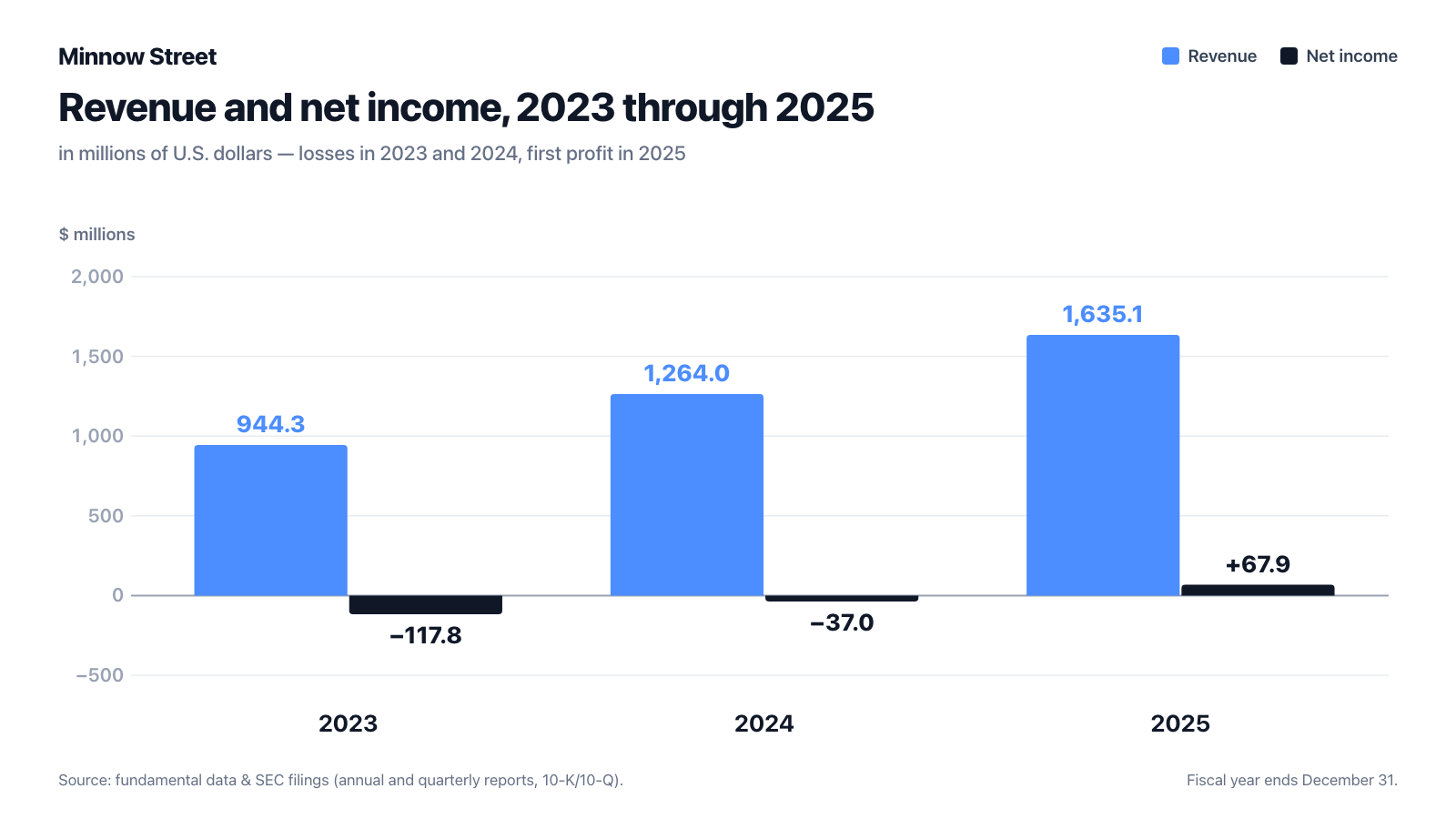
The operating picture behind it is just as solid. Send volume grew 37 percent to $74.9 billion in 2025 (2024: $54.6 billion, 2023: $39.5 billion). Active customers — those who completed at least one transfer in the quarter — rose 19 percent to 9.3 million in the fourth quarter of 2025. And operating cash flow, the money the business actually brought in, jumped from $66.8 million (2023) through $111.6 million (2024) to $325.1 million (2025).
The first quarter of 2026 carried that forward with a visible step up in profitability: revenue of $452.8 million (up 25.2 percent from $361.6 million), operating income of $53.7 million against $12.2 million, and net income of $49.1 million against $11.4 million. Send volume rose 37 percent to $22.1 billion and active customers 20 percent to roughly 9.6 million. The accumulated deficit — the sum of every loss ever booked — shrank in one quarter from $460.3 million to $411.3 million. Stockholders\' equity rose to $907.4 million on total assets of $1,385.8 million, with $649.1 million of cash on hand.
Anyone who stops reading here has a clean growth story with a successful turnaround. So let us go one line deeper.
What the filings say — the uncomfortable truths
Uncomfortable truth No. 1: less of every dollar sent stays with the company each year
Here is the quietest figure in the whole analysis, and it appears in no headline. Divide revenue by send volume and you get what Remitly keeps of every dollar it moves. That ratio has been falling for years: 2.39 percent in 2023, 2.31 percent in 2024, 2.18 percent in 2025. And in the first quarter of 2026 it was down to 2.05 percent, against 2.24 percent in the same quarter a year earlier — a decline confirmed by the year-over-year comparison, so not merely seasonal.
That is precisely why volume (up 37 percent) grows faster than revenue (up 25 to 29 percent). In everyday terms: Remitly carries more and more parcels and gets paid less and less per parcel. That is the signature of price competition — with digital rivals such as Wise on one side and the legacy storefront networks on the other. As long as the count rises faster than the price falls, revenue still grows. Remember the sentence: a falling margin per unit is not a problem — until volume growth slows.
Uncomfortable truth No. 2: stock-based compensation in 2025 was more than twice the profit
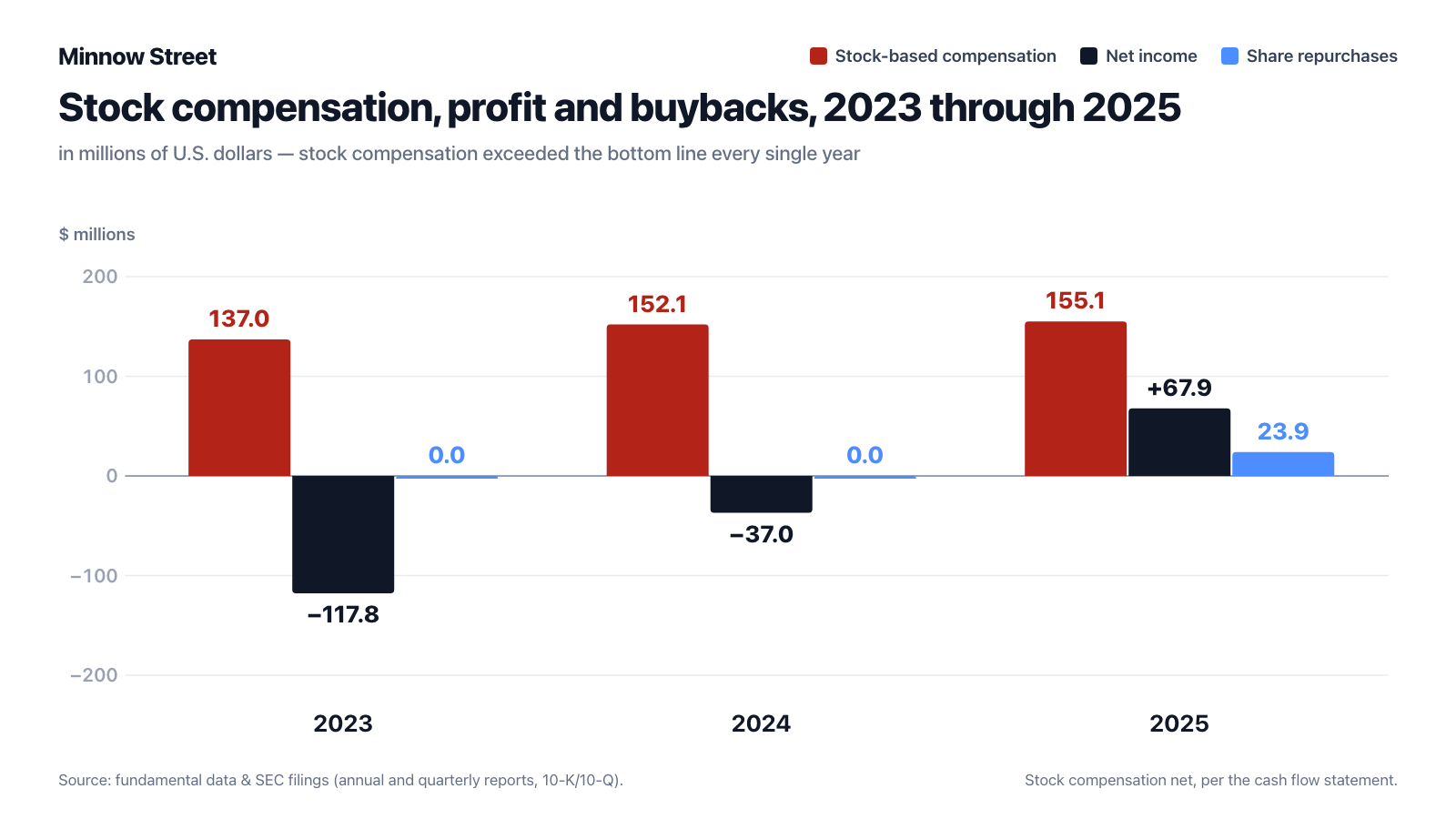
The $67.9 million of profit is real, but it arrives after one very large item has already been deducted — an item that costs no cash, only ownership: stock-based compensation. In 2025 it came to $155.1 million per the cash flow statement (2024: $152.1 million, 2023: $137.0 million). That is 2.3 times the annual profit and equal to 9.5 percent of revenue.
What that means for you as a shareholder is best explained with the cake: your slice does not shrink because you lost something, it shrinks because the cake is cut into more pieces. Shares outstanding grew from 188,435,952 (December 31, 2023) through 200,534,626 to 210,625,519 (December 31, 2025) — up 11.8 percent in two years. Over that same span the company repurchased a total of $23.9 million of stock, and only starting in 2025. For how extreme this kind of dilution can get in an individual case, we ran the numbers elsewhere: our analysis of HIVE Digital found 88.7 million new shares issued in twelve months.
One could object that stock compensation is an accounting entry, not a real expense. The company itself rejects that reading — in the footnote to its own adjusted earnings measure:
"These charges have recently been, and will continue to be for the foreseeable future, significant recurring expenses for our business as they are an important part of our compensation strategy; however, they are not directly linked to the current period\'s operational performance."
— Remitly Global, Inc., Form 10-Q for the quarter ended March 31, 2026, Item 2 (limitations of Adjusted EBITDA)
"Significant" and "recurring" is not how a company describes a one-off. Which is exactly why the adjusted measure deserves care: Adjusted EBITDA came to $272.2 million in 2025 (2024: $141.2 million, 2023: $50.2 million) and to $101.6 million in the first quarter of 2026 against $58.4 million. Most of the distance between that and the reported profit of $67.9 million consists of the very item the company calls recurring.
The first quarter of 2026 does show a genuine counter-movement, and it belongs in the picture: stock compensation fell to $27.5 million (prior-year quarter: $35.8 million) while $44.2 million of stock was repurchased and retired — 2,770,428 shares. The share count fell for the first time, to 210,332,998 as of March 31, 2026. It is the first quarter in which more was bought back than handed out.

Uncomfortable truth No. 3: the business hangs on three corridors — and on immigration policy
Most of Remitly\'s revenue arises on a few routes: from the United States and Canada to India, Mexico and the Philippines. That ties the business to something no management team controls — migration. The annual report says so plainly: changes to immigration law that discourage or limit migration, or that restrict the use of remittances, could hurt send volume.
In 2025 that became concrete policy. The quarterly report for the period ended March 31, 2026 names two developments in one paragraph — costlier H-1B visas and increased deportations — plus a new tax:
"For example, recent U.S. policy changes have increased the costs associated with the H-1B visa program and increased deportation activity more broadly, and the One Big Beautiful Bill Act (the "OBBBA"), which passed on July 4, 2025, imposes a tax on outbound, non-digital remittances from the United States to recipients abroad."
— Remitly Global, Inc., Form 10-Q for the quarter ended March 31, 2026, Item 2 (macroeconomic and geopolitical changes)
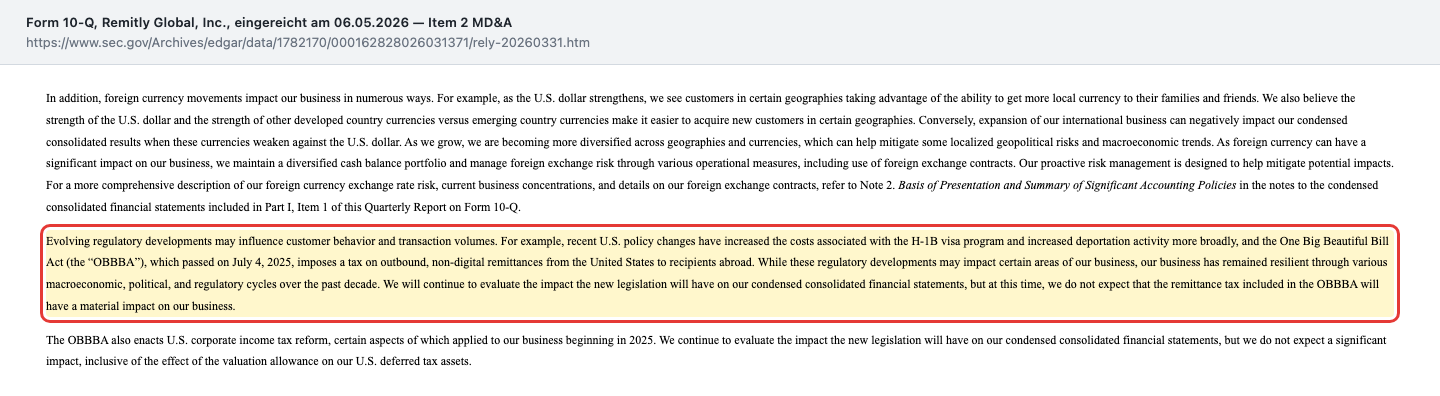
What is remarkable about this tax is whom it does not hit. It applies to non-digital remittances — the cash counter, not the app. For Remitly it is therefore, in the near term, an advantage over the storefront networks, and the company expressly does not expect a material impact on its business. The annual report warns in the same breath, however, that policymakers have discussed expanding this excise tax beyond 1 percent and beyond its current limitation to cash-like instruments. What is a competitive edge today can turn into a disadvantage with one act of legislation.
A second concentration sits in fraud losses. They rise with volume: $39.0 million (2023), $57.9 million (2024), $84.2 million (2025) — equal to 0.10 and 0.11 percent of send volume. The ratio is stable, but the absolute figure now exceeds the annual profit.
Uncomfortable truth No. 4: the attack on the business model is in the company\'s own risk section
Remitly earns money because an international transfer is complicated. Two developments attack precisely that complexity: real-time payment systems that connect central banks to one another, and stablecoins — digital currencies pegged to a national currency that can move value across borders in seconds at very low cost. The annual report lists stablecoin providers as competitors while also stating that the company views stablecoins as an emerging payment rail that may complement existing infrastructure. In the risk section of that same report the tone is less relaxed:
"In addition, the broader financial services sector is experiencing rapid evolution in technologies, and there has recently been significant advancement in the development of neobanking, as well as other real-time payment technologies, including cryptocurrency and stablecoins."
— Remitly Global, Inc., Form 10-K for 2025, Item 1A "Risk Factors"

An important qualification: Remitly\'s advantage lies not in moving the payment but in the last mile — the payout network, the money transmission licenses across dozens of jurisdictions, the fraud controls, and the fact that a recipient in Manila can collect cash at a counter or receive funds in a mobile wallet. A stablecoin does not dissolve that last mile. But it does press on the fee for the transport — and therefore on exactly the ratio that is already falling in truth No. 1.
What has happened since the last quarterly report
The most recent periodic report is the Form 10-Q for the quarter ended March 31, 2026, filed May 6, 2026. Remitly has published no financial statements since, but it did report three things that belong in the picture. First, on June 8, 2026 the company disclosed on Form 8-K that Ankur Sinha, chief product and technology officer, was resigning effective June 19, 2026, and that the resignation did not result from any disagreement over financial reporting or accounting. Second, at the annual meeting on June 10, 2026 all three director nominees were elected and PricewaterhouseCoopers LLP was ratified as auditor for 2026 — though one nominee drew a strikingly large number of withheld votes. Third, in the weeks that followed, sale notices from insiders (Form 144) and insider reports (Form 4) came thick and fast, which is unsurprising after a gain of more than 80 percent since November 2025 but worth noting.
Equally important is what was not filed: no merger agreement (Form 8-K Item 1.01), no merger proxy (DEFM14A or PREM14A), no going-private disclosure (Schedule 13E-3), no delisting notice (Form 25) and no deregistration (Form 15). As of this writing Remitly is a regularly listed, currently reporting Nasdaq company — there is no sale process to bet on.
Valuation — what the market is pricing in
Valuation is awkward for a company that has only just turned profitable, so let us stick to dated orders of magnitude. At the closing price of $22.53 on July 24, 2026, market capitalization was roughly $4.74 billion. Against trailing twelve-month revenue of $1.73 billion that is a price-to-sales ratio of about 2.7. Against reported trailing twelve-month earnings per share of $0.48 it is a price-to-earnings ratio of about 47.
A P/E of 47 sounds expensive — and it is expensive if reported earnings are the yardstick. It sounds different if you annualize the first quarter of 2026: at $49.1 million of quarterly profit the run rate would be roughly $196 million and the multiple about 24. That calculation carries two caveats you need to know. First, the first quarter is seasonally the weakest — the filing itself names the fourth quarter as the peak, with correspondingly higher marketing and fraud costs. Simply multiplying by four therefore overstates rather than understates. Second, those $49.1 million already arrived after $27.5 million of stock compensation was deducted, so the picture is honest in that respect.
The professional view is friendly without being euphoric: twelve analyst firms cover the stock, four at the highest buy rating, six at buy and two at hold; the average price target is $29.33 (as of July 25, 2026). There are no sell ratings. On the other side sits visible skepticism: roughly 16.1 million shares were sold short, equal to 7.6 percent of the float. Institutions hold 85.3 percent of the shares. Two in-house balance sheet measures round out the picture. The Piotroski score — a nine-point scale for balance sheet health — stands at 5 out of 9, which is middling; a genuinely healthy company sits at 8 or 9. The Altman Z-score, an early warning measure for insolvency risk, is 6.44 and thus comfortably in safe territory (as of July 25, 2026).
Opportunities and risks at a glance
What speaks for Remitly:
- A real, documented turnaround: revenue up 73 percent in three years, the bottom line from negative $117.8 million to positive $67.9 million, operating cash flow from $66.8 million to $325.1 million (2023 through 2025).
- Recurring usage: the filings describe the majority of active customers as people who send several times a month for recurring, non-discretionary needs — rent, school fees, a relative\'s medication.
- A balance sheet without bank debt: $649.1 million of cash, no drawings on the credit facility at March 31, 2026, equity of $907.4 million on total assets of $1,385.8 million.
- Capital returns have started: $44.2 million of repurchases in the first quarter of 2026, for the first time more than the stock compensation of the same quarter, with $131.9 million of the authorization still open.
- A very large market: more than $22 trillion of cross-border volume a year per the estimates cited in the annual report — Remitly\'s $74.9 billion is a fraction of it.
What speaks against it:
- Falling margin per dollar: from 2.39 percent (2023) to 2.05 percent (first quarter of 2026) — price competition is visible in the numbers, not just in the risk factors.
- Stock compensation above profit: $155.1 million against $67.9 million (2025); the share count rose 11.8 percent in two years. A single buyback quarter is not yet a trend.
- Political concentration risk: three main corridors, dependence on migration, and a U.S. remittance tax already enacted whose expansion the company\'s own annual report names as possible.
- A technological attack: stablecoins and real-time payment rails press on the transport fee; the company lists them as competitors and as a risk.
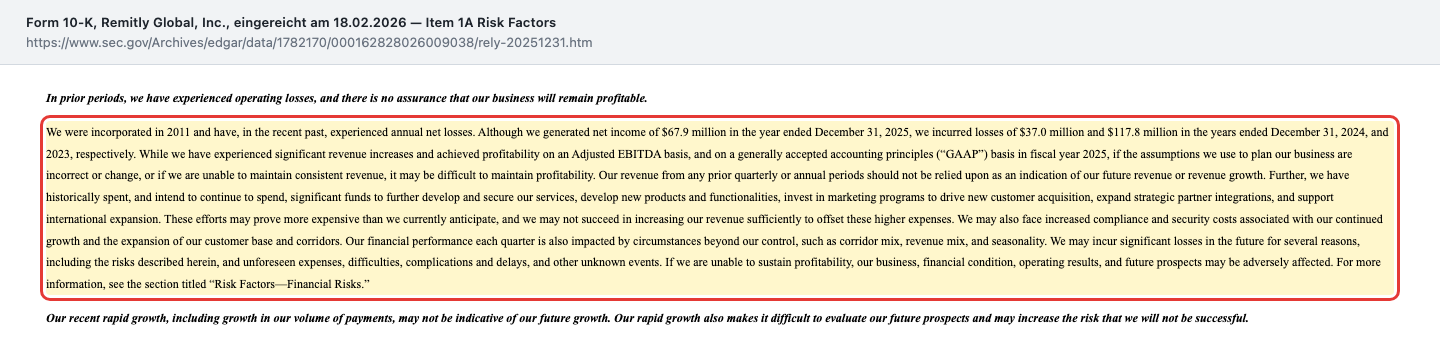
- Young profitability: one full profitable year. The risk factors state plainly that sustaining profitability may be difficult and that significant future losses remain possible.
- Fraud losses above annual profit: $84.2 million (2025) against $67.9 million of net income — the ratio is stable, the amount grows with volume.
A human conclusion
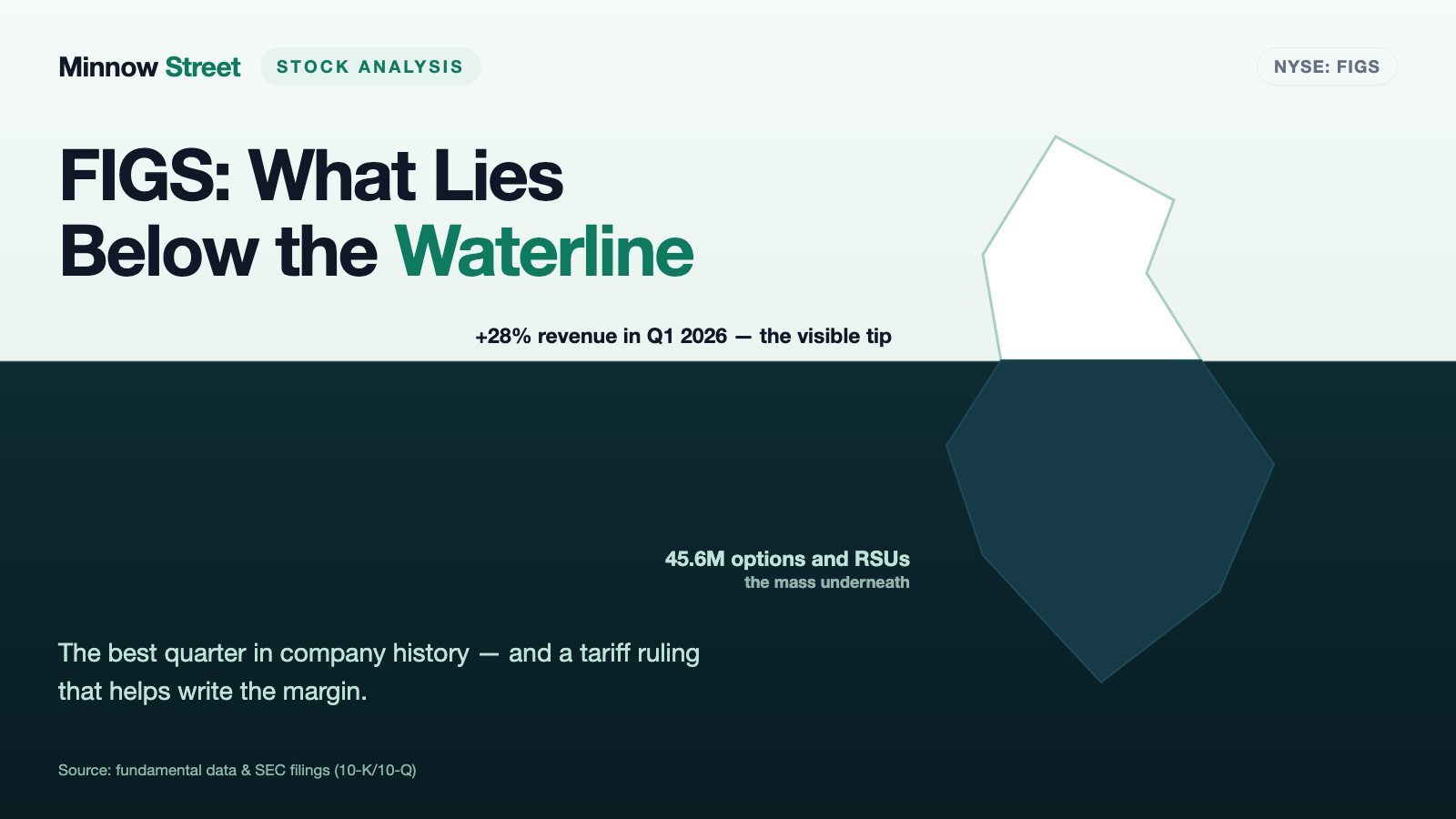
Back to the break-even reflex from the opening. It is especially tempting at Remitly, because here almost everything really does line up: volume up 37 percent, customers up 20 percent, two deep-red years turned black, bank debt repaid, and for one quarter money even flowing back to shareholders. Five pieces of the puzzle sit neatly side by side.
The sixth piece is the question of who owns that profit. In 2025, $155.1 million of compensation went to employees in the company\'s own stock while $67.9 million was reported as profit — and the number of shares across which that profit is spread was 11.8 percent smaller two years earlier. The first quarter of 2026 showed the company can reverse this. Whether it does so lastingly will not be decided in a press release but in two lines of the next quarterly report: the share count on the cover page and the repurchase figure in the cash flow statement.
Then there is the quiet number nobody emphasizes: Remitly keeps less of every dollar it moves each year. As long as volume grows faster than the price falls, the arithmetic works. The day volume growth slows is the day this analysis has to be rewritten. Until then: the turnaround is real, the question is its price. What you make of that is your decision. And that is exactly as it should be.
Sources
Every primary document used in this analysis, for you to read yourself:
- Remitly Global, Inc. — Form 10-Q for the quarter ended March 31, 2026 (filed May 6, 2026)
- Remitly Global, Inc. — Form 10-K for 2025 (filed February 18, 2026)
- Remitly Global, Inc. — Form 10-K for 2024 (filed February 19, 2025)
- Remitly Global, Inc. — Form 8-K of June 8, 2026, Item 5.02 (resignation of the chief product and technology officer)
- Remitly Global, Inc. — Form 8-K of June 11, 2026, Item 5.07 (results of the annual meeting held June 10, 2026)
- Complete SEC filing history for Remitly Global, Inc.: EDGAR overview (sec.gov)
- Fundamental data (metrics, valuation, analyst view, closing prices through July 24, 2026; as of July 25, 2026), reconciled with the SEC filings.
- Hook: our in-house stock scanner "Turnaround-Kandidaten" — rank 12 of 62 U.S. hits, turnaround check 7 of 8, as of July 25, 2026; the lists are recomputed daily.
Transparency & disclaimer: this analysis is journalistic commentary on publicly available information. It is not investment advice, not a regulated financial analysis and not a solicitation to buy or sell securities. Equity investments carry substantial risk up to and including total loss. All information without warranty; the as-of date of each figure is noted in the text. The author holds no position in Remitly shares at the time of publication.
Our Bottom Line at a Glance
- Growth and operating turnaround positive
- Revenue grew from $944.3 million (2023) through $1,264.0 million (2024) to $1,635.1 million (2025), and the bottom line swung from −$117.8 million through −$37.0 million to +$67.9 million. In the first quarter of 2026 revenue rose 25.2 percent to $452.8 million and net income to $49.1 million from $11.4 million. Operating cash flow reached $325.1 million in 2025, up from $111.6 million. This is not a cosmetic turnaround but one visible in operating income.
- Dilution and capital returns negative
- Stock-based compensation came to $155.1 million in 2025, 2.3 times net income; shares outstanding grew from 188,435,952 (December 31, 2023) to 210,625,519 (December 31, 2025), up 11.8 percent. Only in the first quarter of 2026 did the ratio flip: $44.2 million of repurchases against $27.5 million of compensation, with the share count falling for the first time to 210,332,998. One quarter is not yet a trend.
- Pricing pressure in the core business negative
- Revenue per dollar sent has fallen for years: 2.39 percent (2023), 2.31 percent (2024), 2.18 percent (2025) and only 2.05 percent in the first quarter of 2026, against 2.24 percent a year earlier. Volume grew 37 percent, well ahead of revenue at 25 to 29 percent. As long as volume absorbs the difference the business keeps growing — but the model cannot tolerate a slowdown.
- Balance sheet and funding positive
- No drawn bank debt as of March 31, 2026, after $155.0 million was outstanding at December 31, 2025 at a weighted average rate of 7.25 percent. Cash of $649.1 million, equity of $907.4 million on total assets of $1,385.8 million, and a $550.0 million credit line to June 2030 with the covenant met. The Altman Z-score is 6.44, comfortably in safe territory (as of July 25, 2026).
- Regulatory and political risk negative
- The business depends on three main corridors (India, Mexico, the Philippines) and therefore on migration. The Form 10-Q for the quarter ended March 31, 2026 names costlier H-1B visas, increased deportations and the remittance tax of the One Big Beautiful Bill Act of July 4, 2025; it targets non-digital remittances and thus, for now, the storefront competition, while the annual report expressly names an expansion as conceivable. Add fraud losses of $84.2 million in 2025, more than the annual profit.
- Valuation neutral
- At the closing price of $22.53 (July 24, 2026) market capitalization is roughly $4.74 billion, a price-to-sales ratio of about 2.7 and a price-to-earnings ratio of about 47 on reported earnings. Annualizing the first quarter of 2026 brings that to about 24 — although the first quarter is seasonally the weakest per the filings. Twelve analyst firms give an average target of $29.33, and 7.6 percent of the float is sold short.
Remitly is the break-even trap in pure form. The turnaround is real and documented in every line that matters — revenue up 73 percent in three years, the bottom line from −$117.8 million to +$67.9 million, operating cash flow at $325.1 million, no bank debt as of March 31, 2026 and $649.1 million of cash. What it does not answer is the real question: in 2025, $155.1 million went to employees as compensation in the company's own stock, 2.3 times the profit, and the share count grew 11.8 percent in two years. Beneath that runs a second, quieter movement: the company keeps less of every dollar it moves each year — 2.39 percent in 2023, only 2.05 percent in the first quarter of 2026. The first quarter of 2026 showed both can be reversed. It has not been proven. Not investment advice.
What Our Rating Means
Open questions
The business works in principle, but one material question is open. As long as it stays open, our findings do not carry a quality verdict.
Buying today is not a bet that the turnaround arrives — it already has — but that it reaches the shareholder: that the buyback quarter ($44.2 million against $27.5 million of stock compensation) becomes the rule rather than the exception, and that the falling margin per dollar sent keeps being absorbed by volume growth. Anyone waiting should check exactly three lines in every report: the share count on the cover page (210,561,079 as of May 4, 2026), the repurchase figure against stock-based compensation, and revenue divided by send volume (2.05 percent most recently). If all three keep moving the right way, a good growth story becomes a good equity story. The decision is yours.
A journalistic assessment by our editorial team at the time of the deep dive, based on public sources — not investment advice and not a solicitation to buy or sell. Your personal circumstances (investment goals, risk capacity, taxes) cannot be taken into account. What our levels mean, how verdicts are formed, and what conflicts of interest exist →
Worth Noting
- Remitly reached our research list through our in-house stock scanner "Turnaround-Kandidaten": rank 12 of 62 U.S. hits, turnaround check 7 of 8, as of July 25, 2026. The lists are recomputed daily, so the rank is a dated snapshot.
- Currency of the data: the most recent periodic report is the Form 10-Q for the quarter ended March 31, 2026 (filed May 6, 2026). Filings submitted after it were reviewed: the resignation of the chief product and technology officer effective June 19, 2026 (Form 8-K of June 8, 2026), the annual meeting of June 10, 2026 (Form 8-K of June 11, 2026), and numerous insider reports (Form 4) and sale notices (Form 144). No Form 8-K Item 1.01, no DEFM14A or PREM14A, no Schedule 13E-3, no Form 25 or Form 15 — there is no merger or take-private process under way.
- Valuation figures are dated and evergreen: closing price $22.53 on July 24, 2026, market capitalization roughly $4.74 billion, market data as of July 25, 2026. Daily prices are not a buy argument. Not to be confused: Remitly Global, Inc. is affiliated with neither the British competitor Wise plc nor Western Union; the ticker RELY has belonged to this company continuously since the 2021 IPO.
Frequently Asked Questions
Remitly Global, Inc. (Nasdaq: RELY), based in Seattle, runs digital cross-border remittances. Customers in the United States, Canada, the United Kingdom and Europe send money through an app or website to recipients in more than 175 countries; the largest receive markets are India, Mexico and the Philippines. Revenue comes from transfer fees and foreign exchange spreads. The company moved $74.9 billion in 2025, and 9.3 million customers used the service in the fourth quarter of 2025.
Yes, since 2025. Fiscal 2025 closed with net income of $67.9 million on revenue of $1,635.1 million, after losses of $37.0 million (2024) and $117.8 million (2023). In the first quarter of 2026 profit rose to $49.1 million from $11.4 million a year earlier. The company nevertheless states in its own risk factors that sustaining this young profitability may prove difficult.
Because it is larger than the profit. In 2025 Remitly reported $155.1 million of stock-based compensation — 2.3 times the net income of $67.9 million and 9.5 percent of revenue. It is not paid in cash but in new shares: the share count grew from 188,435,952 (December 31, 2023) to 210,625,519 (December 31, 2025), up 11.8 percent. Each existing share therefore represents a smaller slice of the company.
Yes, since 2025. The board approved a repurchase program of up to $200 million in July 2025, with no expiration date. During 2025 the company acquired 1,484,066 shares for $23.9 million, and in the first quarter of 2026 a further 2,770,428 shares for $44.2 million. As of March 31, 2026, $131.9 million of the authorization remained available, and the share count fell for the first time — to 210,332,998.
The 2025 annual report explicitly lists stablecoin providers as competitors because they may offer faster settlement and lower costs, and the risk section names advances in neobanking and real-time payment technologies. Remitly's advantage lies less in moving the payment than in its payout network, money transmission licenses and fraud controls. The pricing pressure is measurable nonetheless: revenue per dollar sent fell from 2.39 percent (2023) to 2.05 percent (first quarter of 2026).
The One Big Beautiful Bill Act, passed July 4, 2025, imposes a tax on outbound, non-digital remittances from the United States. It therefore hits cash counters, not the app. In its Form 10-Q for the quarter ended March 31, 2026, Remitly states that it does not expect a material impact on its own business. The annual report notes, however, that policymakers have discussed expanding the excise tax beyond 1 percent and beyond cash-like instruments.
No drawn bank debt as of March 31, 2026. The secured revolving credit facility of $550.0 million runs through June 24, 2030; $155.0 million was still drawn at December 31, 2025 at a weighted average rate of 7.25 percent, and zero three months later. The facility mainly prefunds customer flows and fluctuates seasonally. Cash on hand was $649.1 million as of March 31, 2026.
At the closing price of $22.53 on July 24, 2026, market capitalization stood at roughly $4.74 billion. That is a price-to-sales ratio of about 2.7 on trailing twelve-month revenue and a price-to-earnings ratio of about 47 on reported trailing earnings per share. Twelve analyst firms give an average price target of $29.33, and 7.6 percent of the float was sold short (as of July 25, 2026).
Found an error?
Did you spot a factual error, an outdated number, or a typo in this deep dive? Let us know briefly — your report goes straight to the editorial team.