Teradyne Stock: Every Buffett Criterion Passed, 87 Percent Growth — and a Price Buffett Would Never Have Paid
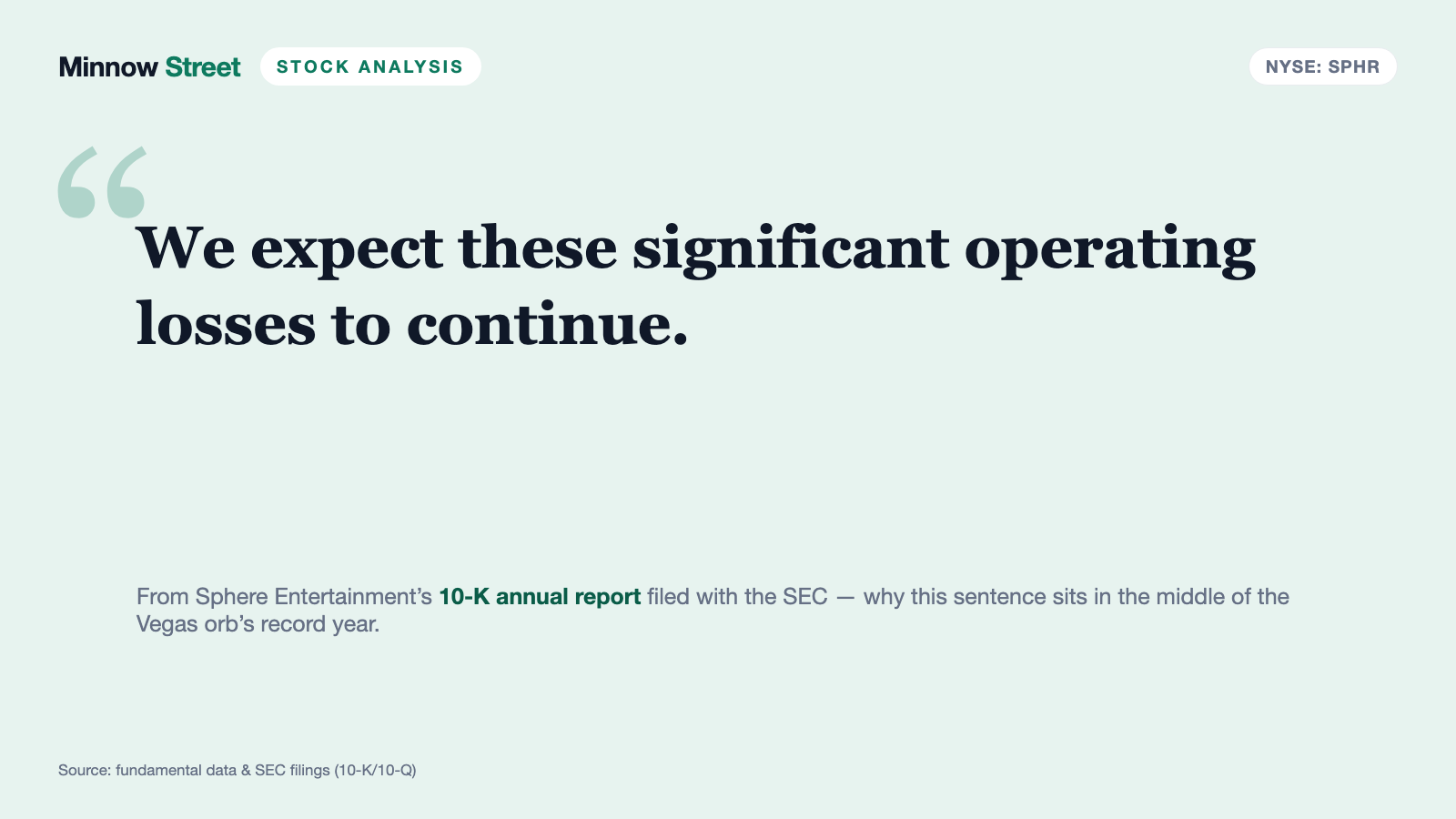
Teradyne builds the test benches every AI chip has to pass before it ships — and ranks no. 4 in the U.S. selection of our in-house Buffett Criteria scanner (as of July 18, 2026): return on equity near 29 percent, virtually no debt, six straight profitable quarters. We read the annual reports (10-K) and the quarterly report (10-Q) as of March 29, 2026: a record quarter with revenue up 87 percent because AI data centers need every chip tested — but also five customers carrying 44 percent of revenue, an industry that was still shrinking in mid-2025, and a price-to-earnings ratio near 80. Not investment advice — just the reminder that quality and price are two different exams, and a scanner only grades one of them.
 Thomas Mücke
Founder & Publisher
Thomas Mücke
Founder & Publisher
Chart
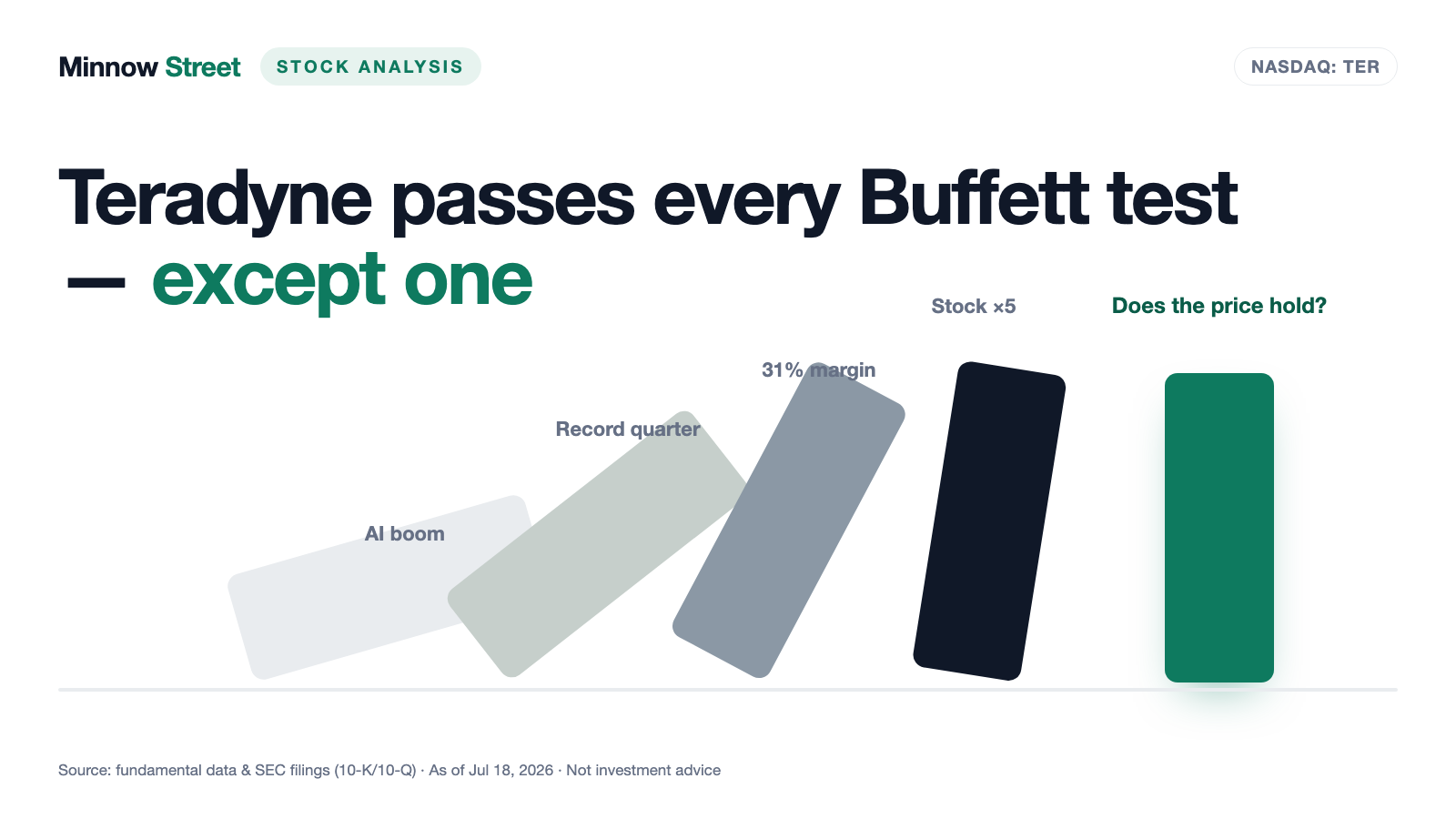
Interactive price chart (TradingView).
Note: pure fact-based analysis, not investment advice and not a solicitation to buy or sell. All figures without guarantee.
There is a thinking trap that catches the diligent investors of all people: the top-of-the-class trap. It works like this: somebody publishes a ranking — and the moment a stock sits near the top, your brain stops checking the company and starts celebrating the report card. The more famous the name above the exam rules, the harder the trap snaps shut. Teradyne, Inc. (Nasdaq: TER) is exactly such a top student right now: rank 4 of the U.S. selection in our in-house Buffett Criteria scanner (as of July 18, 2026) — return on equity near 29 percent, virtually no debt, six straight profitable quarters, and the name above the exam rules happens to be Warren Buffett. The report card whispers: "Passed — you can buy blind." So let\'s make a deal: before the report card replaces your own exam, we read together what Teradyne itself filed, under penalty of law, with the U.S. securities regulator, the SEC — the annual report (10-K) for 2025 and the quarterly report (10-Q) as of March 29, 2026. Both things are in there: a record quarter with 87 percent revenue growth, because every AI chip has to pass a Teradyne test bench before it ships. And a price tag near 80 times earnings for a cyclical whose five largest customers carry 44 percent of revenue. Because one thing never appears on a top student\'s report card: what the seat next to him costs. In the end, you decide.
What Teradyne actually does — the chip world's inspection agency
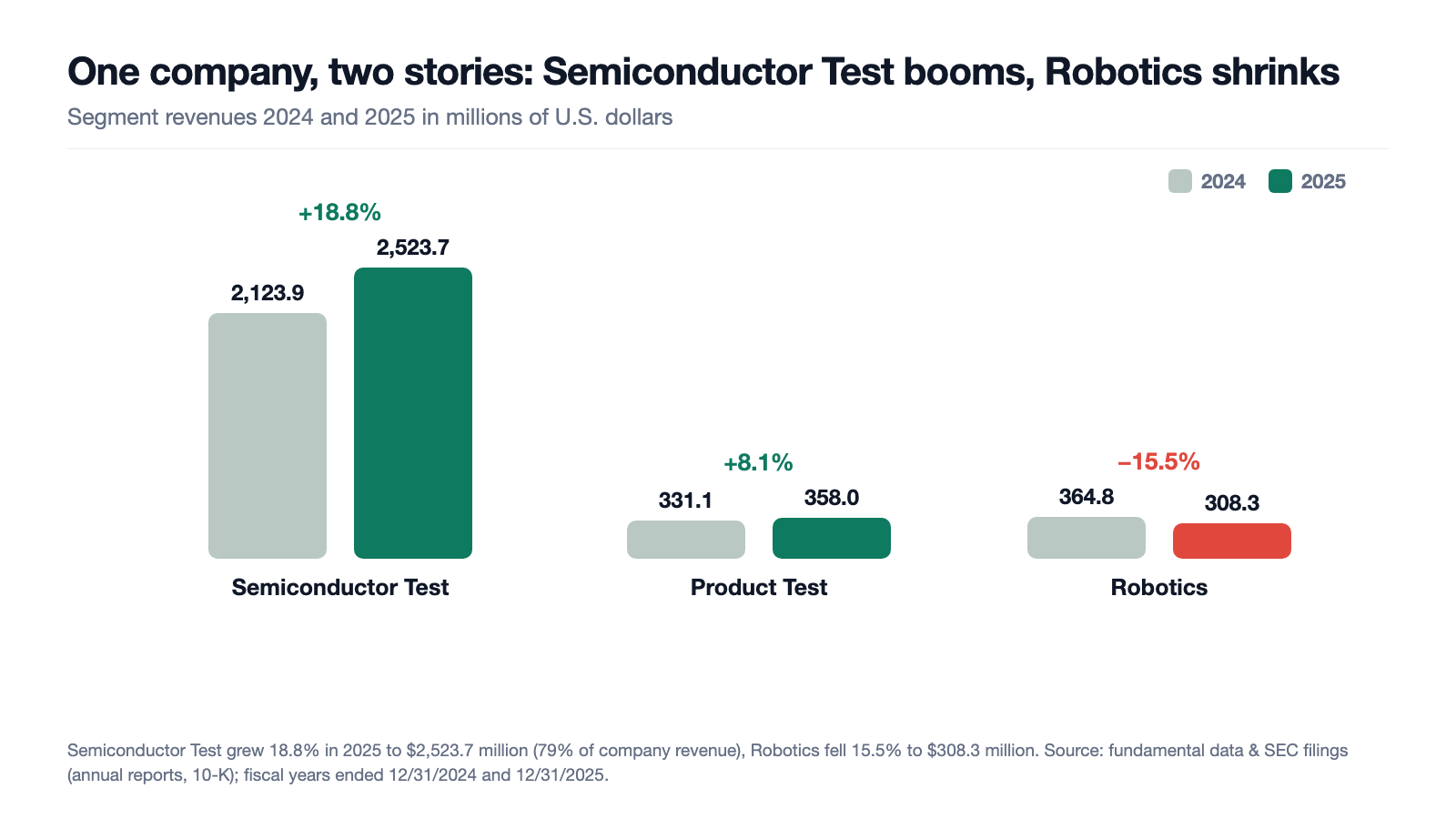
Teradyne, incorporated in Massachusetts in 1960 and headquartered in North Reading, employs about 6,600 people and builds what you might call the chip world\'s inspection agency: automatic test equipment on which semiconductors must pass their final exams before shipping. Every processor, every memory chip, every system that later lands in a data center, car or smartphone gets measured on machines like these — from the raw wafer to the fully packaged device. The company reports three segments: Semiconductor Test ($2,523.7 million in 2025 revenue — 79 percent of the company), Product Test (defense and aerospace electronics, storage drives and more, $358.0 million) and Robotics (collaborative robot arms from Universal Robots and mobile robots from MiR, $308.3 million). And here is the first surprise for anyone who knows Teradyne as "the robot company": the robotics business, marketed for years as the second pillar, shrank 15.5 percent in 2025 — while Semiconductor Test grew 18.8 percent, per the annual report "driven primarily by higher sales in compute related to artificial intelligence applications."
The logic is the same one we dissected at Micron (rank 1 in this scanner) and Western Digital (rank 2): the AI build-out devours chips — and every one of those chips, whether compute accelerator or HBM memory stack, has to be tested; the more complex, the longer and the more expensive. Teradyne earns from the AI boom without selling a single AI product: a tollbooth on the road between chip fab and data center. Which brings us to the central tension of this analysis, running through every chapter: the Buffett quality in the books is real — but the market now prices a cyclical with concentrated customers like a software company, and the one criterion Buffett cared most about is the one no quality scanner checks: the price.
Where the stock shows up in our scanner
We run roughly 3,500 stocks through our scanners every day. As of July 18, 2026, Teradyne has three hits, and the most prominent one is the occasion for this analysis: rank 4 in the Buffett Criteria scanner (U.S. selection). The scanner implements the screenable rules from Mary Buffett\'s "Buffettology," and Teradyne passes every single one: a return on equity near 29 percent (required: at least 15 — robust territory starts right there, 29 is top of the league), a debt-to-equity ratio of 0.03 (required: at most 0.5 — Teradyne carries three cents of debt per dollar of equity, which is practically debt-free), an EBIT margin near 38 percent (trailing twelve months; required: at least 10), a positive earnings per share in each of the six recorded quarters with a rising trend, and positive free cash flow over the last four quarters. Two confirming hits come on top: the Altman-Z balance sheet fortress (an early-warning score for financial distress near 9 — the danger zone starts below 1.8, this is a fortress) and the Levermann scanner. To replicate it yourself: open the scanner, set the country filter to "US" — Teradyne sits in the top 5. But now comes the part the report card leaves out: our scanner shelf also holds the sister scanner "Buffett: Owner Earnings Yield," which adds Buffett\'s price discipline to the same quality rules — free cash flow must yield at least 5 percent on the purchase price. Teradyne does not appear there. At roughly 140 times free cash flow, the owner earnings yield works out to about 0.7 percent. Remember the principle: a quality scanner grades the company — the price you pay for it today is graded only by your own head. Which is exactly why we now read the filings.
The numbers over the years — honestly appraised
First, what genuinely impresses. Revenue rose from $2,676.3 million (2023) through $2,819.9 million (2024) to $3,190.0 million (2025) — up 13 percent last year, at a stable 58.2 percent gross margin, with net income of $554.0 million ($3.47 per diluted share). But the annual figure hides the real movie, and that played out in the quarters:
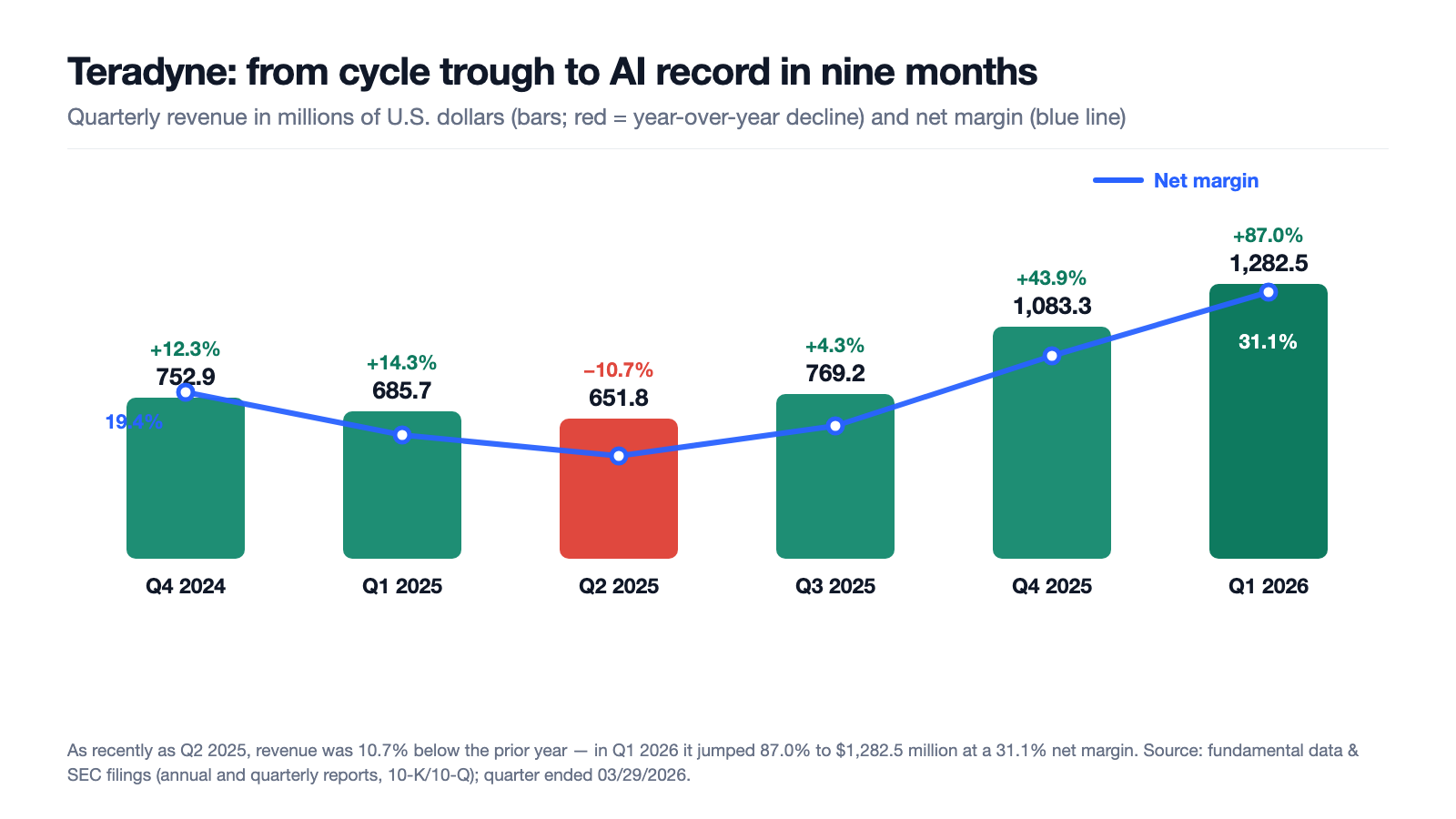
As recently as the second quarter of 2025, revenue shrank 10.7 percent to $651.8 million, the net margin fell to 12.0 percent, and earnings per share dropped 57 percent. Then the AI demand ignited: $769.2 million in the third quarter, $1,083.3 million in the fourth (up 44 percent) — and in the first quarter of 2026 the leap to $1,282.5 million, up 87 percent, with a 31.1 percent net margin and $2.53 in earnings per share (prior year: $0.61). The quarterly report itself frames it as a milestone:
"During the first quarter of 2026, our Semiconductor Test segment delivered record results, driven primarily by continued strength in Artificial Intelligence (“AI”)–related demand across compute and memory applications resulting in Semiconductor Test revenue alone exceeding $1.0 billion for the first time."
— Teradyne, Inc., SEC quarterly report 10-Q as of March 29, 2026, Item 2 "Management's Discussion and Analysis"
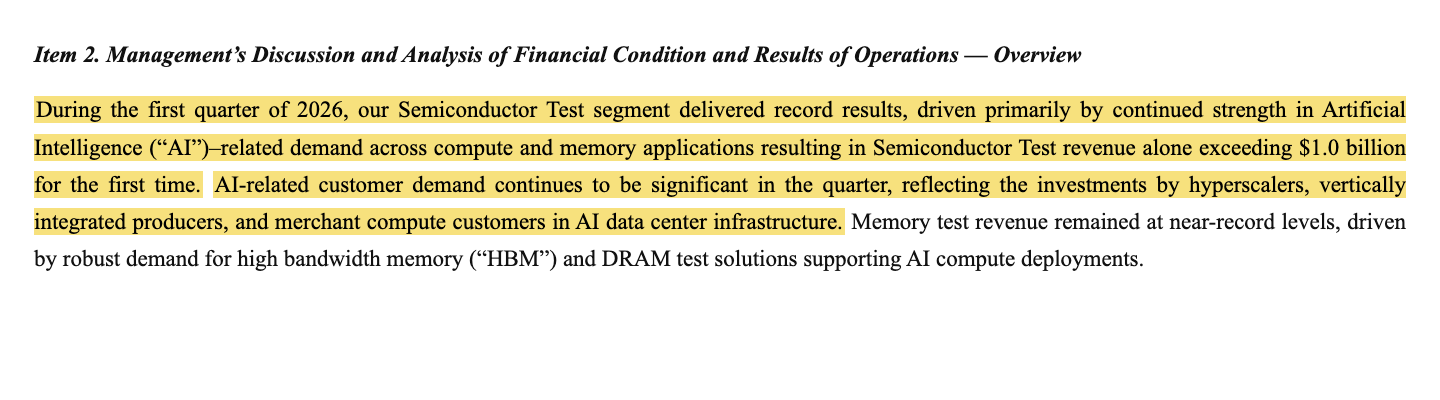
Per the filing, the boom is carried by hyperscalers, vertically integrated producers and merchant compute customers building out AI data centers; memory test revenue stayed near record levels on HBM and DRAM test systems — HBM being the stacked high-bandwidth memory that sits right next to the AI accelerators and whose production is so failure-prone that testing has never been busier. The cash register rings too: Teradyne generated $674.4 million of operating cash flow in 2025, and the first quarter of 2026 added $265.1 million. One honest caveat: accounts receivable grew to $1,107.5 million as of March 29, 2026 — 41 percent more than three months earlier and faster than revenue; for now that is invoice timing, not an alarm, but it is a line for next quarter. Remember the image: nine months lie between a down quarter and an all-time record — in both directions.
What the filings say — the uncomfortable truths
Uncomfortable truth no. 1: five customers carry 44 percent of revenue — and one alone carries 19
Buffett\'s favorite companies sell to millions of customers — Coca-Cola, American Express, Apple. Teradyne sells to a handful. The annual report quantifies it bluntly in the risk chapter:
"In each of the years, 2025, 2024 and 2023, our five largest direct customers in aggregate accounted for 44%, 36% and 32% of consolidated revenues, respectively. […] The two specifying customers drove 12% and 10% of consolidated revenues. The additional direct customer accounted for 19% of consolidated revenues including certain revenues specified by our 10% specifiers."
— Teradyne, Inc., SEC annual report 10-K for 2025, Item 1A "Risk Factors"
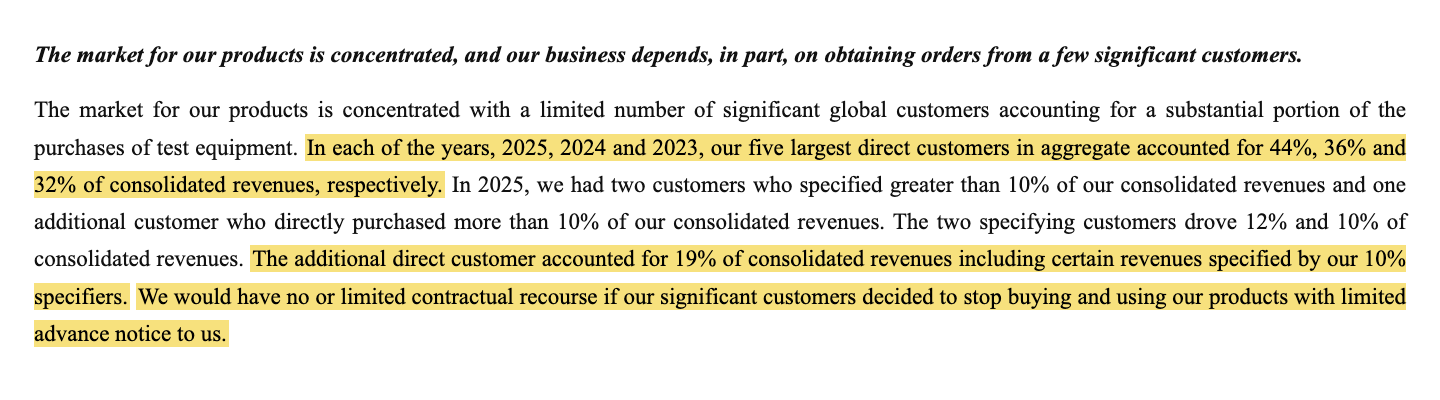
In everyday terms: picture a bakery where almost every second roll goes to just five bulk buyers — and the concentration is rising, from 32 percent (2023) to 44 percent (2025). "Specifying customers" are the secret kings of this supply chain: companies that have their chips produced by contract manufacturers and dictate which test systems get used — the machine is bought by the manufacturer, but the decision was made by someone else. Add the geographic clustering: 36 percent of 2025 revenue came from Taiwan (prior year: 21 percent), another 14 percent from China — in the middle of a trade environment of tariffs and export controls the report itself calls dynamically changing. And if a major customer walks? The filing says it dryly: "We would have no or limited contractual recourse" if significant customers stopped buying with limited advance notice. When your biggest customer fills a fifth of the till, his purchasing manager is your most important employee — you just don\'t pay him.
Uncomfortable truth no. 2: the cyclicality is written in the company's own risk chapter — and it bit as recently as mid-2025
"Predictable, rising earnings" is the heart of the Buffett criteria — and this is exactly where the scanner hit carries a built-in illusion: it looks six quarters back, while the industry thinks in decades. What the company itself writes about the nature of its business sounds different from the record-quarter cheer:
"Capital equipment providers in the electronics, semiconductor industries and robotics, such as Teradyne, have, in the past, been negatively impacted by both sudden slowdowns in the global economies and recurring cyclicality within those industries."
— Teradyne, Inc., SEC annual report 10-K for 2025, Item 1A "Risk Factors"
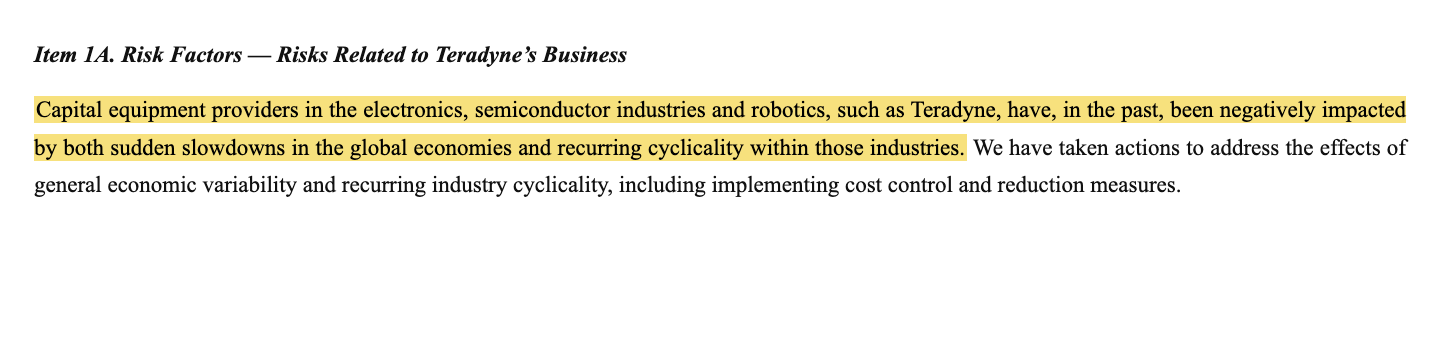
That is not theory but recent history: as recently as the second quarter of 2025 — just four quarterly reports ago — revenue shrank 10.7 percent and earnings per share fell 57 percent to $0.49. A test system is a capital expenditure: when chipmakers save, they postpone the machines first. The current boom hangs on hyperscalers and chip companies raising their AI budgets further — the same bet currently carrying half the equipment industry, as we also described at Lam Research (rank 6 of the same scanner selection). Remember the mechanism: a six-quarter window can paint a cyclical as a steady compounder — the industry itself calls its cyclicality "recurring."
Uncomfortable truth no. 3: the second pillar wobbles — robotics shrinks, 400 jobs cut
Of all businesses, the one meant to smooth out the semiconductor cycle became 2025\'s construction site. The robotics unit — collaborative robot arms from Universal Robots, mobile transport robots from MiR, both happily marketed with an AI story — lost 15.5 percent of its revenue, and the company drew consequences it quantifies in the footnotes:
"Teradyne recorded $29.4 million of severance charges, $24.3 million of which is related to the Robotics restructuring which impacted approximately 400 employees"
— Teradyne, Inc., SEC annual report 10-K for 2025, Note Q "Restructuring and Other"
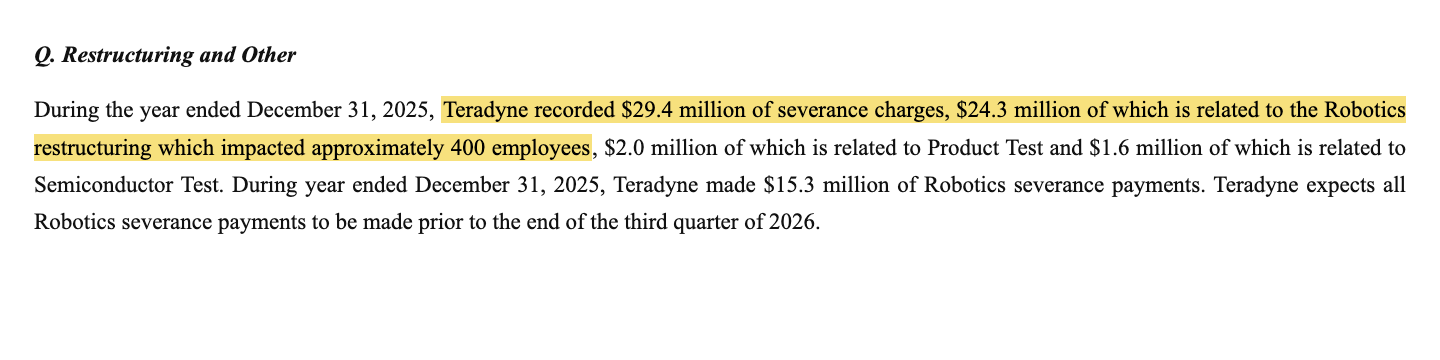
Four hundred impacted employees — against roughly 6,600 in total, that is a noticeable cut. Fairness requires the flip side: in the first quarter of 2026 the slimmed-down unit swung back to plus 32.3 percent (carried by the robot arms), and with the announced joint venture MultiLane Test Products (about $157 million for 75 percent ownership) Teradyne is additionally buying into the market for high-speed interconnect testing in AI data centers. But the lesson stands: the diversification promise of robotics did not carry through the 2025 downturn — only Semiconductor Test did. Whoever buys Teradyne buys, at its core, a bet on chip test demand, not on robots.
Valuation: what the market charges for the Buffett criteria
Now to the price tag — the chapter the Buffett Criteria scanner deliberately skips. In mid-July 2026, Teradyne\'s market value stood near $77 billion, at a share price around $490 (all valuation figures: data as of July 18, 2026, sanity-checked against 156.4 million shares outstanding per the quarterly report). That works out to: a price-to-earnings ratio near 80 (trailing twelve months), a price-to-sales ratio near 20, a price-to-book ratio near 24 and roughly 140 times free cash flow. The share price has almost quintupled within twelve months and sits only a few percent below its all-time high. The professionals\' view softens this only on the surface: the analyst community (17 estimates, data as of July 18, 2026) expects on average about $7.30 in earnings per share for 2026 and $9.50 for 2027 — even if that lands exactly, you are still paying about 67 times the current and a good 50 times the year-after-next\'s earnings, for a company that per its own risk chapter is subject to "recurring cyclicality." The quarterly dividend of $0.13 (raised from $0.12 in January 2026) yields about 0.1 percent at this price level — payout is visibly a side note here. What the company itself did is revealing: in 2025, in the cycle trough, it repurchased $702.1 million of its own shares at an average of $112.21 — partly funded with $200.0 million from the revolving credit facility — while in the expensive first quarter of 2026 it bought a mere $5.5 million worth at $229.00, and the revolver was repaid in full. Management, in other words, acted counter-cyclically straight from the textbook — at prices less than half of today\'s. On the edge of the balance sheet, by the way, slumbers a hidden reserve: the 10 percent stake in probe-card maker Technoprobe is carried at $537.1 million but was worth $935.7 million on the stock exchange as of December 31, 2025. Nice — but against a $77 billion market value, it does not move the math.
Opportunities and risks at a glance
What speaks for Teradyne:
- Buffett quality, measurable: return on equity near 29 percent, debt-to-equity of 0.03, EBIT margin near 38 percent (trailing), Altman-Z near 9, gross margin of 58 to 61 percent — a balance sheet fortress with $394.0 million in cash plus securities and a fully repaid credit facility (March 29, 2026).
- Structural tailwind: every AI chip has to be tested — Semiconductor Test revenue above $1.0 billion in a quarter for the first time (Q1 2026), memory test near record on HBM/DRAM; per the 10-K, AI-related demand already drove the majority of revenue in the second half of 2025.
- Momentum with substance: Q1 2026 revenue up 87 percent, a 31.1 percent net margin and $2.53 in earnings per share; operating cash flow of $674.4 million (2025) plus $265.1 million (Q1 2026).
- Capital allocation with price discipline: $702.1 million of buybacks at $112.21 in the 2025 trough, a near-full stop at $229.00 — plus the hidden Technoprobe reserve (market value $935.7 million against $537.1 million book value, December 31, 2025).
- Acquisitions along the AI test market: Quantifi Photonics (photonic chip test, $127.2 million) and the planned joint venture MultiLane Test Products (~$157 million for 75 percent, high-speed I/O testing for AI data centers).
What speaks against it:
- The valuation pays for perfection: P/E near 80, price-to-sales near 20, price to free cash flow near 140, dividend yield near 0.1 percent (as of July 18, 2026) — the owner earnings yield of roughly 0.7 percent misses Buffett\'s price discipline by a wide multiple.
- Concentration risk in its purest form: five direct customers = 44 percent of 2025 revenue (up from 32 percent in 2023), one buyer alone at 19 percent, "no or limited contractual recourse" if they walk (10-K, Item 1A).
- Geopolitical footprint: 36 percent of revenue from Taiwan, 14 percent from China — amid tariffs, export controls and a trade environment the report calls dynamically changing.
- Recurring cyclicality, most recently in mid-2025: Q2 2025 with revenue down 10.7 percent and EPS down 57 percent — the scanner\'s six-quarter window optically turns this into a steady compounder.
- Robotics as a permanent construction site: segment revenue down 15.5 percent in 2025, a restructuring impacting about 400 employees — the second pillar did not carry through the downturn; on top, receivables grew 41 percent in Q1 2026, clearly faster than revenue.
A human conclusion
Back to the top-of-the-class trap. The treacherous part is not that the report card lies — Teradyne\'s grades are real: the return on capital, the debt-free balance sheet, management\'s price discipline with its own buybacks. The treacherous part is that a report card only grades the subjects on the curriculum: Warren Buffett did not get rich by finding wonderful companies, but by finding wonderful companies at sensible prices — and in exactly that subject, which the Buffett Criteria scanner deliberately does not teach, our sister scanner with price discipline fails Teradyne. The honest math looks like this: you get the tollbooth of the AI boom, one record quarter after another, a balance sheet without a weak spot — at 80 times earnings, with five customers on 44 percent of revenue, a 36 percent Taiwan share and a cycle that was still printing minus signs four quarterly reports ago. Whether AI test demand carries long enough for the earnings to grow into this valuation — that is the bet, and no scanner rank takes it off your hands. If you take it, take it with open eyes: read three lines in every quarterly report (10-Q) — Semiconductor Test revenue (does it hold the billion-dollar mark?), the customer concentration, and the receivables. And if the price feels too hot: Teradyne itself showed in 2025 how to wait for better prices. What you make of it is your decision. And that is exactly as it should be.
Sources
All original documents used in this analysis — for your own reading:
- Teradyne, Inc. — SEC annual report 10-K for 2025 (filed February 19, 2026)
- Teradyne, Inc. — SEC annual report 10-K for 2024 (filed February 20, 2025)
- Teradyne, Inc. — SEC quarterly report 10-Q as of March 29, 2026 (filed May 1, 2026)
- Teradyne\'s complete SEC filing history: EDGAR overview (sec.gov)
- Fundamental data (metrics, quarterly series, valuation, analyst estimates; data as of July 18, 2026), cross-checked against the SEC filings.
- Screener and rating data: in-house stock scanner (data as of July 18, 2026), including the Buffett Criteria scanner (U.S. selection, rank 4), the Altman-Z balance sheet fortress and the Levermann scanner.
Transparency & disclaimer: This analysis is a journalistic contextualization of publicly available information and is not investment advice, not a financial analysis in the regulatory sense and not a solicitation to buy or sell securities. Stock investments carry substantial risks up to and including total loss. All information without guarantee; the data cut-off is noted in the text. The author holds no position in Teradyne shares at the time of publication.
Our Bottom Line at a Glance
- Balance sheet quality positive
- Return on equity near 29 percent, debt-to-equity of 0.03, Altman-Z near 9, gross margin of 58 to 61 percent; the $200.0 million revolver drawn in the cycle trough was fully repaid in the first quarter of 2026 (10-K 2025; 10-Q as of 03/29/2026; scanner data as of 07/18/2026).
- AI tailwind in the core business positive
- Q1 2026 revenue up 87 percent to $1,282.5 million, Semiconductor Test above $1.0 billion in a quarter for the first time, a 31.1 percent net margin; per the 10-K, AI-related demand already drove the majority of revenue in the second half of 2025 — Teradyne is the tollbooth between chip fab and AI data center.
- Customer concentration & geography negative
- Five direct customers = 44 percent of 2025 revenue (2023: 32 percent), one buyer alone at 19 percent, Taiwan at 36 and China at 14 percent of revenue — with explicitly "no or limited contractual recourse" should major customers walk (10-K 2025, Item 1A).
- Cyclicality negative
- The company's own risk chapter calls the industry cyclicality "recurring"; as recently as Q2 2025, revenue shrank 10.7 percent with EPS down 57 percent — the scanner's six-quarter window cannot capture this swing.
- Valuation negative
- P/E near 80, price-to-sales near 20, price to free cash flow near 140, dividend yield near 0.1 percent (as of July 18, 2026); the owner earnings yield of roughly 0.7 percent misses the 5 percent threshold of our in-house Buffett price scanner by a wide multiple — even on 2027 analyst estimates, a P/E near 50 would remain.
- Capital allocation positive
- Counter-cyclical straight from the textbook: $702.1 million of buybacks at an average of $112.21 in the weak year 2025, a near-full stop at $229.00 in Q1 2026; plus the hidden reserve of the Technoprobe stake (market value $935.7 million against $537.1 million book value, 12/31/2025).
Teradyne is the rare case where a quality scanner and the filings tell the same story — right up to the price tag: the Buffett criteria (return on capital, freedom from debt, margin, earnings streak) are met and SEC-documented, and the core business is the tollbooth of the AI boom with a record quarter of plus 87 percent. Against that stand a P/E near 80 and 140 times free cash flow for a cyclical whose five largest customers carry 44 percent of revenue, which earns 36 percent of its money in Taiwan, and whose most recent down quarter is just four quarterly reports old. Whoever invests here is not buying the Buffett criteria, but the continuation of the AI capex boom at full price. Not investment advice.
What Our Rating Means
- If you don't own the stock
- As long as the question raised in the bottom line stays open, we see no basis for an entry.
- If you hold it in your portfolio
- Our findings offer no acute reason to sell — the checkpoints named remain decisive.
A journalistic assessment by our editorial team at the time of the deep dive, based on public sources — not investment advice and not a solicitation to buy or sell. Your personal circumstances (investment goals, risk capacity, taxes) cannot be taken into account. What our categories mean, how verdicts are formed, and what conflicts of interest exist →
Worth Noting
- TER made the research list as rank 4 of our in-house Buffett Criteria scanner (U.S. selection, as of July 18, 2026) — part of our series on the top 20 of that selection, following Micron (rank 1) and Western Digital (rank 2).
- Scanner metrics (ROE, debt-to-equity, EBIT margin, P/E, P/S, price/FCF, Altman-Z) use trailing twelve-month figures as of July 18, 2026; the scanner's quarterly series spans six quarters (Q4 2024 through Q1 2026).
- Price and market value figures (~$490, ~$77 billion) from the July 18, 2026 feed, sanity-checked against 156.4 million shares outstanding per the quarterly report 10-Q as of March 29, 2026; analyses are evergreen, daily prices are not a buy argument.
Frequently Asked Questions
Teradyne, Inc. (Nasdaq: TER, North Reading, Massachusetts, about 6,600 employees) builds automatic test equipment that checks semiconductors, electronics and storage devices before they ship. In 2025 the company generated $3,190.0 million in revenue (up 13 percent); 79 percent came from the Semiconductor Test segment, 11 percent from Product Test (defense/aerospace among others) and 10 percent from the robotics unit (Universal Robots, MiR).
Every AI chip has to be tested before it ships — on machines like the ones Teradyne builds. Per the quarterly report (10-Q), Semiconductor Test revenue exceeded $1.0 billion in a single quarter for the first time in Q1 2026, driven by AI demand in compute and memory applications (HBM/DRAM); per the annual report (10-K), AI-related demand already drove the majority of revenue in the second half of 2025.
Because the stock passes every screenable criterion from "Buffettology" (as of July 18, 2026): return on equity near 29 percent (required: at least 15), debt-to-equity of 0.03 (at most 0.5), EBIT margin near 38 percent (at least 10), positive and most recently rising earnings per share in all six recorded quarters, and positive free cash flow over four quarters. In the U.S. selection, Teradyne ranks no. 4.
Nobody knows — but Buffett's most famous additional rule, the sensible price, is measurable: our sister scanner "Buffett: Owner Earnings Yield" requires free cash flow of at least 5 percent on the purchase price. Teradyne trades at roughly 140 times free cash flow, an owner earnings yield of about 0.7 percent (as of July 18, 2026) — it clearly fails this price test.
Very: per the annual report (10-K) for 2025, the five largest direct customers accounted for 44 percent of consolidated revenues (2024: 36, 2023: 32 percent); a single direct customer reached 19 percent, two further customers specified 12 and 10 percent each. On top, 36 percent of revenue came from Taiwan. If they walked, Teradyne would have "no or limited contractual recourse," per the filing.
Pronouncedly cyclical — the annual report (10-K) explicitly calls the cyclicality of the semiconductor, electronics and robotics industries "recurring." As recently as the second quarter of 2025, revenue shrank 10.7 percent with EPS down 57 percent; three quarters later came the record quarter at plus 87 percent. Test systems are capital goods: in downturns, chipmakers postpone the machines first.
No — it is historically expensive: as of July 18, 2026, the stock traded at roughly 80 times trailing earnings, 20 times revenue, 24 times book value and about 140 times free cash flow, with a dividend yield near 0.1 percent; the share price has almost quintupled within twelve months. Even on analyst estimates for 2027 (about $9.50 per share), a P/E near 50 would remain.
Found an error?
Did you spot a factual error, an outdated number, or a typo in this deep dive? Let us know briefly — your report goes straight to the editorial team.