Envela Stock: The Doubling That Belongs to the Price of Gold
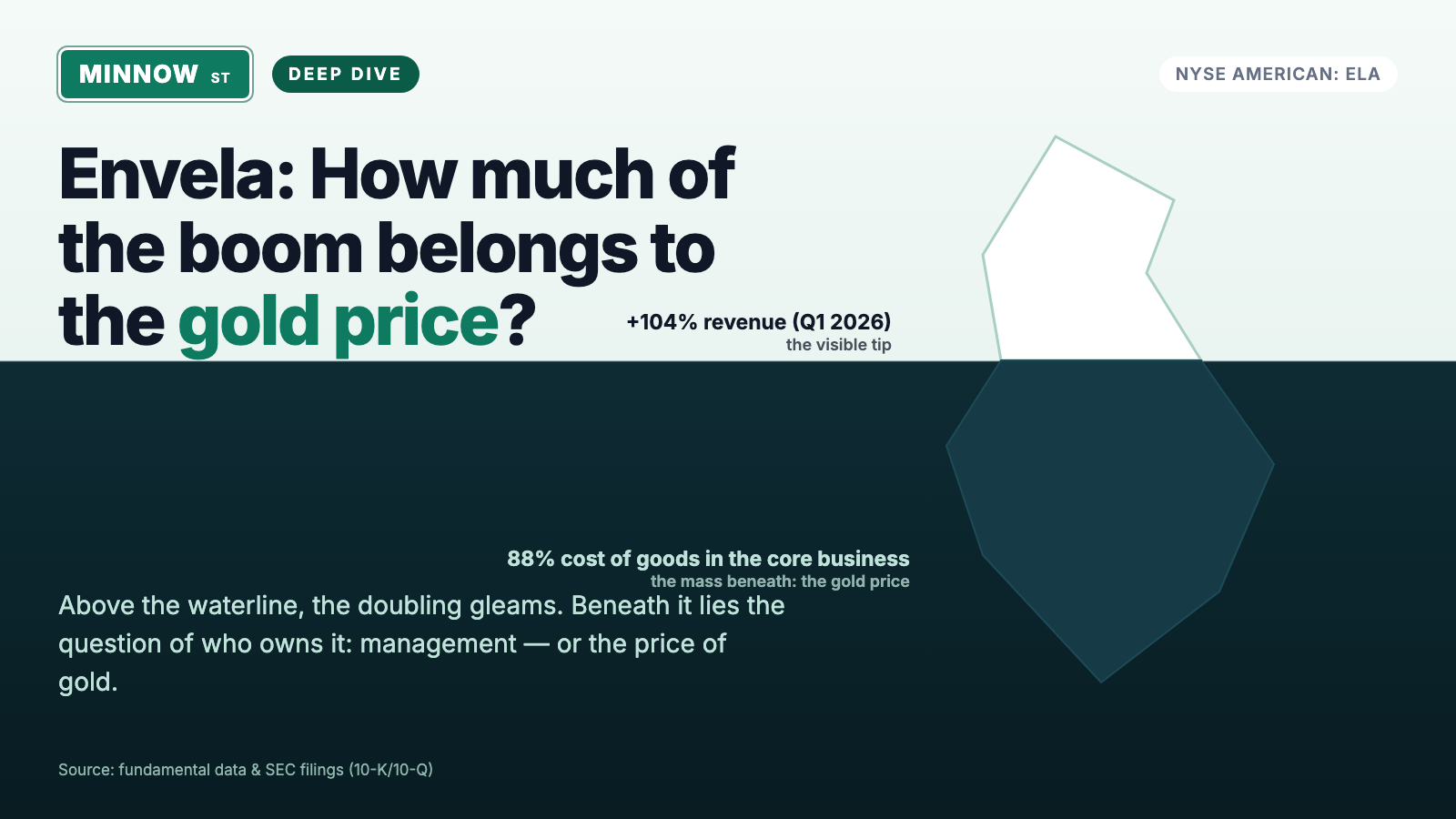
Envela buys and sells pre-owned jewelry, gold and electronic scrap — and has doubled its quarterly revenue from $48 million to $98 million within six quarters, with net cash on the balance sheet and not a single new share issued. We read two annual reports (10-K), four quarterly reports (10-Q) and one old ad-hoc filing (8-K) and found an engine that does not sit in the engine room: the price of gold. Add two customers that account for a good half of revenue, and a boss who owns almost three quarters of the company. Not investment advice — just the question of who deserves the applause: management, or the gold price.
 Thomas Mücke
Founder & Publisher
Thomas Mücke
Founder & Publisher
Chart
Interactive price chart (TradingView).
Note: pure fact-based analysis, not investment advice and not a solicitation to buy or sell. All figures without guarantee.
There is an old Wall Street saying every investor learns painfully at least once: "Never confuse brains with a bull market." It refers to our tendency to credit success to skill — the smart management, the brilliant strategy, our own good nose — and never to circumstances. Psychologists call this the attribution error, and it is expensive: whoever mistakes the tide for the boat buys the boat at the price of the tide. Exactly this trap lies in wait at Envela (NYSE American: ELA), a small Texas recommerce group whose quarterly revenue has doubled within six quarters and whose stock trades near its all-time high as of mid-2026. So let us make a deal: before you let the prettiest growth curve of this summer sweep you away, we will read together what the filings with the U.S. Securities and Exchange Commission say — those are honest under penalty of law. They tell a story that is both: better than feared and more uncomfortable than hoped. In the end, you decide for yourself who deserves the applause.
What Envela actually does
At its core, Envela is a professional second-hand dealer in valuables — the company itself calls it "recommerce" and circular economy. The business stands on two legs. The first, the consumer segment, operates 15 stores in Texas, Arizona and South Carolina (as of the end of 2025) where private individuals can sell and buy pre-owned jewelry, diamonds, luxury watches, and gold and silver coins. Whatever cannot be resold as a piece of jewelry is sent to precious-metals refiners as scrap for refining — Envela is thus also a wholesaler that passes gold and silver through close to the market price. These roots run deep: the house has traded silver since 1972 and gold since 1974, and until 2019 the company was simply called DGSE Companies — after its best-known store, the "Dallas Gold & Silver Exchange".
The second leg, the commercial segment, is younger and less conspicuous: it dismantles end-of-life electronics, recovers gold, silver, copper and aluminum from circuit boards, and processes retired IT equipment for corporate customers — the technical term is ITAD ("IT Asset Disposition"): the professional disposal and remarketing of old company computers, certified data destruction included. You can picture Envela as a combination of an upscale pawn-shop neighbor and an e-waste gold mine. The annual report puts it more formally:
"Envela is a leading provider of recommerce and recycling services at the forefront of the circular economy. […] The consumer segment focuses on selling authenticated luxury goods, including pre-owned and repurposed fine jewelry, diamonds, gemstones, luxury watches, and secondary-market bullion."
— Envela Corporation, SEC annual report (10-K) for fiscal year 2025, Item 1 "Business"
A charming detail on the side: for new stores, Envela prefers to lease or buy former bank branches — prime locations, vault included. And artificial intelligence? It barely appears in the filings — in our AI dossier, Envela is accordingly rated "neutral". Curiously, the only substantive AI mention in the 10-K is a pleasant one: AI data centers are driving industrial demand for silver, one of the metals Envela collects.
Where the stock shows up in our scanner
We run roughly 3,500 stocks through our scanners every day, and Envela is currently something of a permanent guest there: 17 scanners fire at once (data as of July 8, 2026) — from the confluence filter "Best of All" to "Strength on Stress Days" (stress RS of 94: the stock closed green on weak market days unusually often) to the "Altman Z: Balance Sheet Fortress", which only lets through balance sheets that could survive a recession. The strongest hit in substance is the "High Revenue Growth" filter: it requires revenue to have exceeded the year-earlier quarter by at least 20 percent in every one of the last six quarters. Only a handful of companies manage that — Envela is one of them:
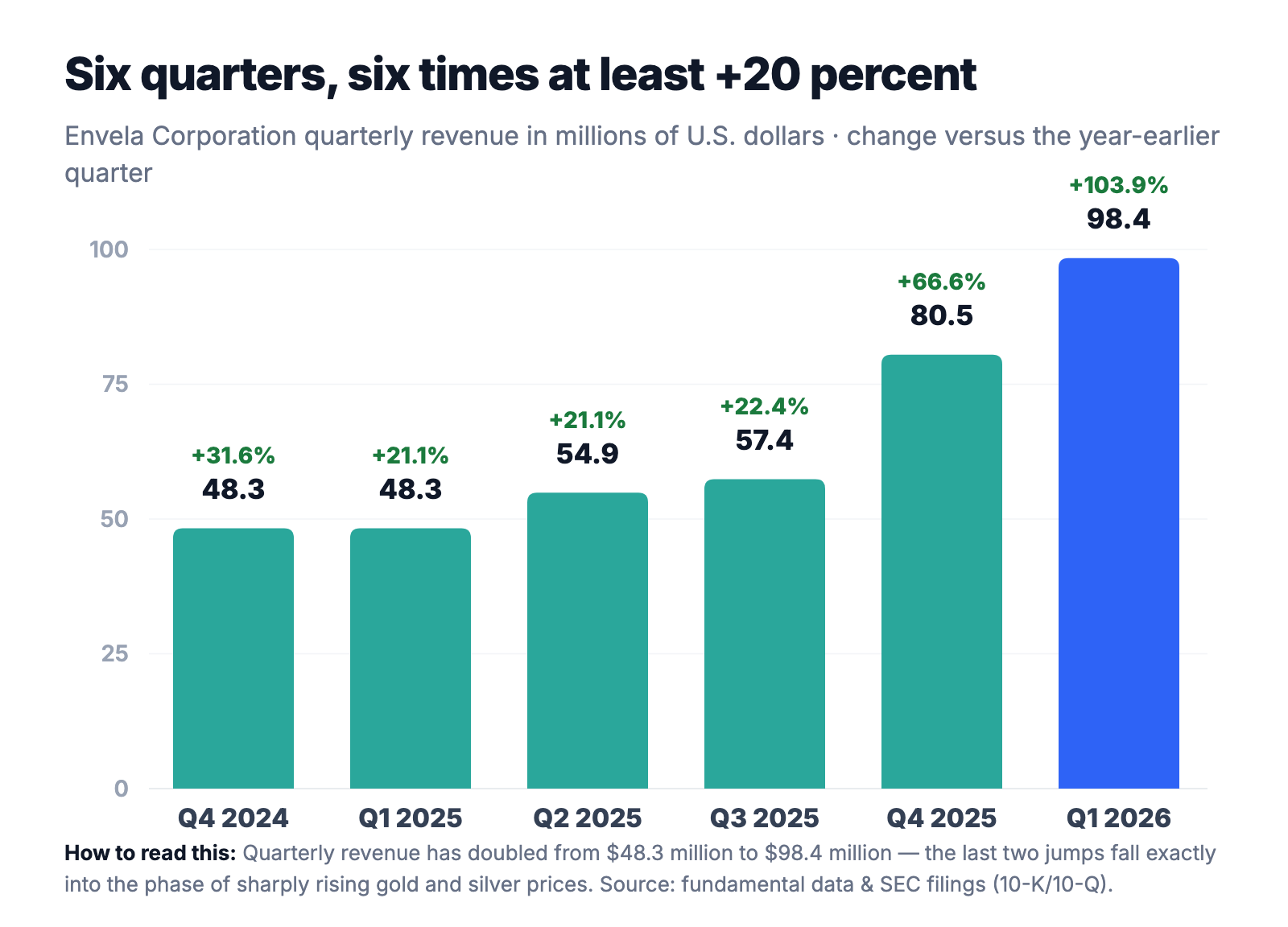
Add a relative-strength rating of 96, a Piotroski F-score of 8 (the balance-sheet health check: 8 out of 9 is very good) and an Altman Z-score above 11 — the bankruptcy early-warning number where anything above 2.6 counts as the safe zone. On paper, that is the rare combination of momentum and quality. Still, keep this tension in mind: the curve is real, but its engine does not sit in the engine room. It is the thread running through everything that follows. This is how you can find the stock yourself: on minnowstreet.com, open "Scanner" in the menu, select the "High Revenue Growth" filter and look for the ELA row.
The numbers: a doubling without new shares and without new debt
First the praise — it is deserved. In 2025, Envela generated $241.0 million in revenue, 33.6 percent more than in 2024, and earned a net $14.6 million — more than twice the prior year ($6.8 million). In the first quarter of 2026, the results positively erupted: $98.4 million in revenue (+103.9 percent) and $8.8 million in net income (+254.5 percent) — in a single quarter, more than in all of 2024. Operating cash flow for the quarter came to $21.2 million, partly because one refiner finally settled its accumulated invoices.
What is remarkable is what this growth was paid with: almost nothing. As of March 31, 2026, there were $38.6 million in cash against just $9.8 million in debt, the credit line is untouched, and the share count has held constant at about 26.0 million for quarters — in 2025 the company even bought back 32,225 of its own shares instead of issuing new ones. If you know our analyses, you know how rare that is: at Solaris Energy we dissected a doubling bought with a tower of debt and ever more shares. Envela, by contrast, grows out of its own pocket. One quarter does not make a summer — but a balance sheet like this is hard to break.
The uncomfortable truths
Uncomfortable truth no. 1: the engine of the doubling is the price of gold
Now to the question from the beginning: brains or tide? The quarterly report answers it itself — unusually candidly:
"Sales in the consumer segment increased by $45,022,918, or 122.4%, during the three months ended March 31, 2026 […]. The change was primarily attributed to strong performance across both our retail stores and wholesale verticals, supported by upward movements in gold and silver prices compared with the same period in Fiscal 2025."
— Envela Corporation, SEC quarterly report (10-Q) Q1 2026, Item 2 (MD&A)
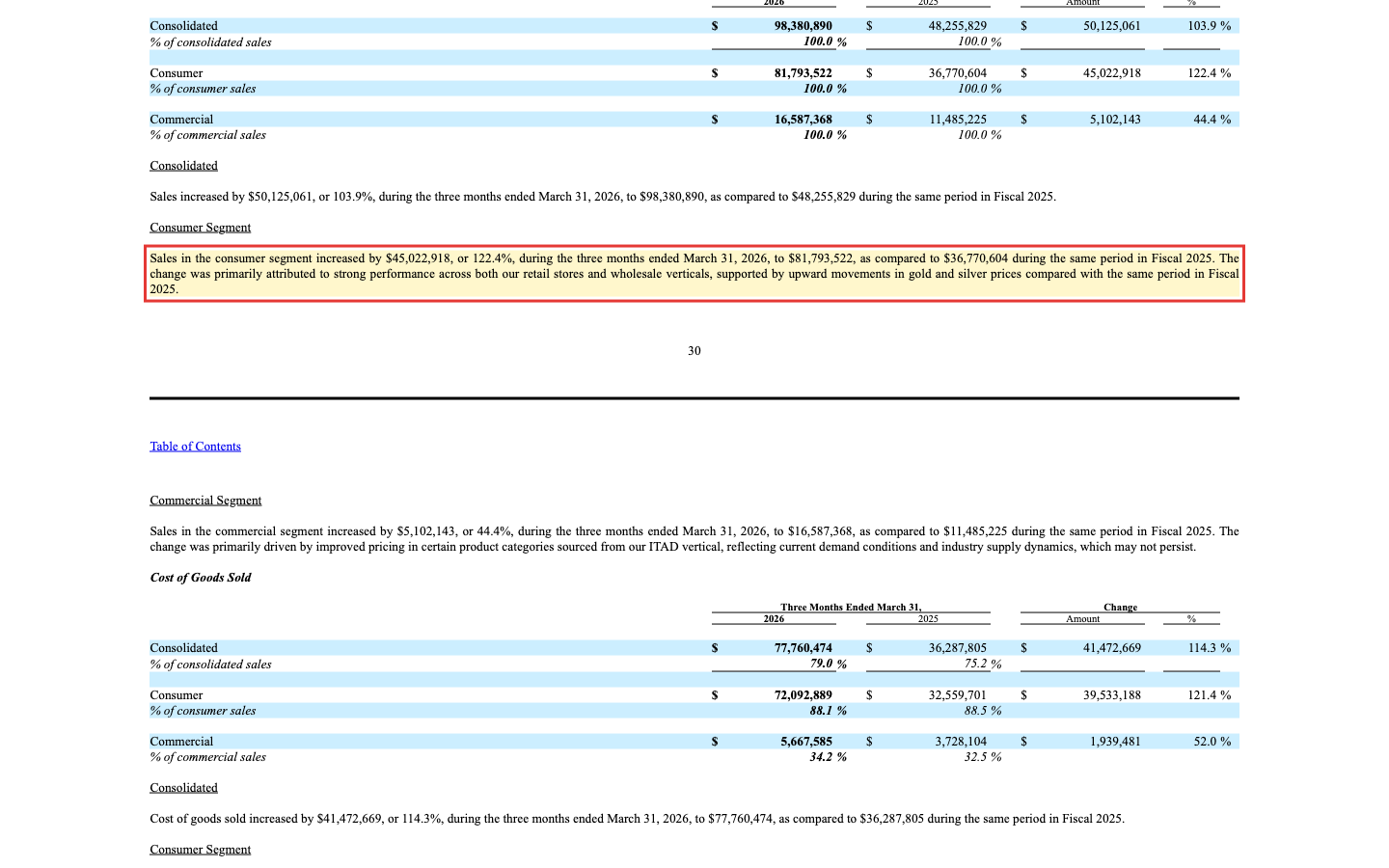
How strongly the tide lifts the boat becomes clear looking back: in the first quarter of 2025 — before the big gold-price surge — the very same consumer segment earned a net total of $69,094. Not a typo: not a million, but the equivalent of a small car; in all of 2024 it was $16,341. One year later it is $4.3 million. The business model has stayed the same; what changed, above all, is the price of the metal flowing through the stores. And the small, highly profitable recycling segment says it just as honestly: its 44.4 percent revenue jump in the first quarter of 2026 rested on better prices for certain product categories — "which may not persist" (10-Q Q1 2026, Item 2). As a reminder: in 2025, commercial revenue actually fell by 3.2 percent, and the number of electronics units sold dropped from 1.27 million to 921,480. What cyclical commodity tailwinds feel like inside a success story — and how quickly they turn — is something we walked through at steel trader Friedman Industries; Envela is the precious-metals edition of the same pattern.
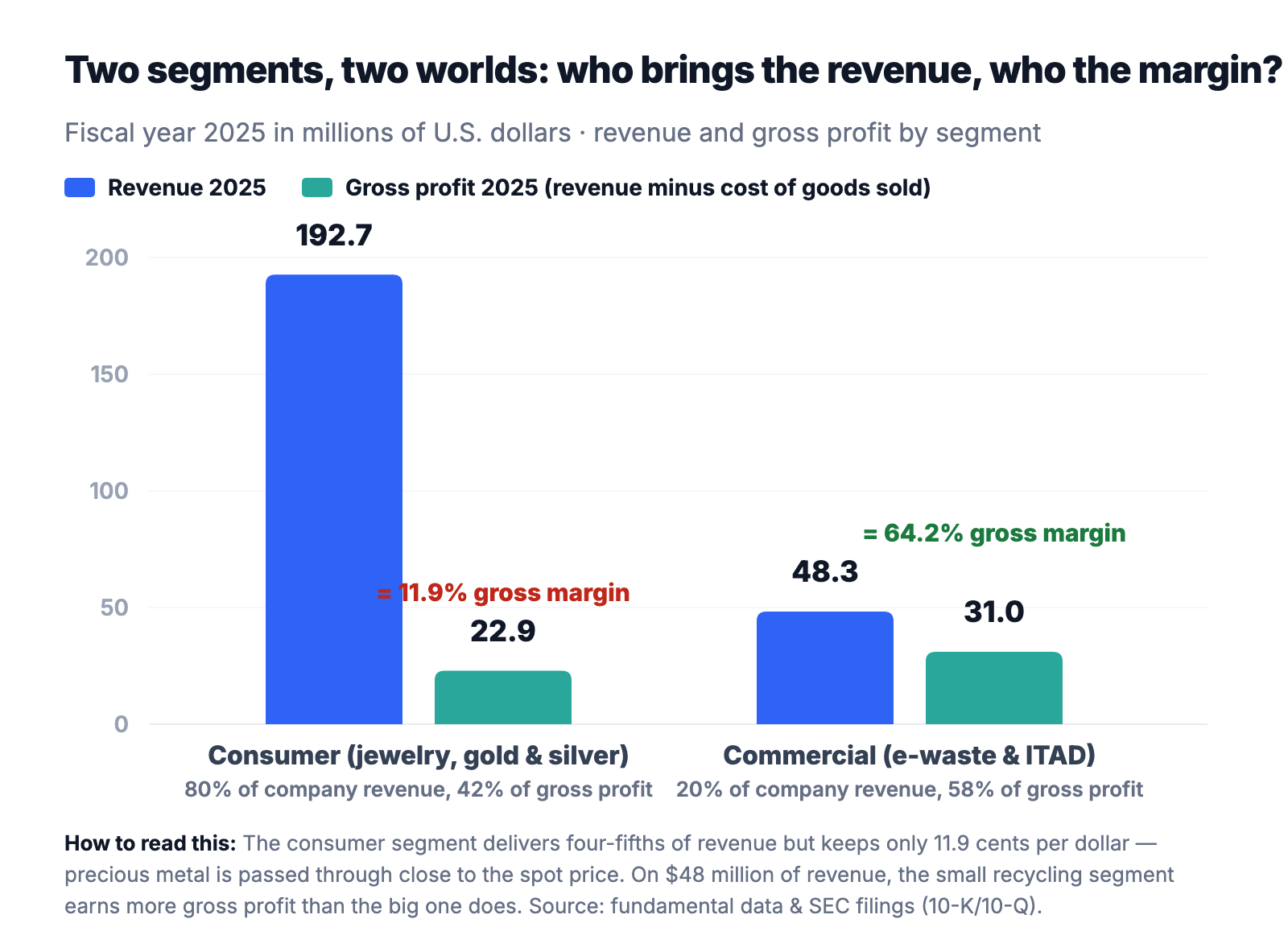
The chart shows the core of the problem: 80 percent of revenue carries only an 11.9 percent gross margin — of every dollar flowing through the stores and the wholesale desk, less than 12 cents stick before any operating costs. That is not an accusation; it is the nature of a business that passes precious metal through close to the spot price. But it means: revenue here is not a performance gauge — it is, above all, a price gauge. If the gold price falls, the curve that currently delights 17 scanners shrinks — without anyone at the company doing anything wrong.
Uncomfortable truth no. 2: two customers account for more than half of revenue — and the boom clogs the till
Whoever sells a lot of refining gold needs refiners to take it. At Envela, this wholesale business is concentrated on very few addresses:
"For the year ended December 31, 2025, two customers aggregated 54.9% of our sales and represented 68.3% of our accounts receivable balance. These customers were attributed to our consumer segment."
— Envela Corporation, SEC annual report (10-K) for fiscal year 2025, Note 3 "Concentrations and Credit Risk"
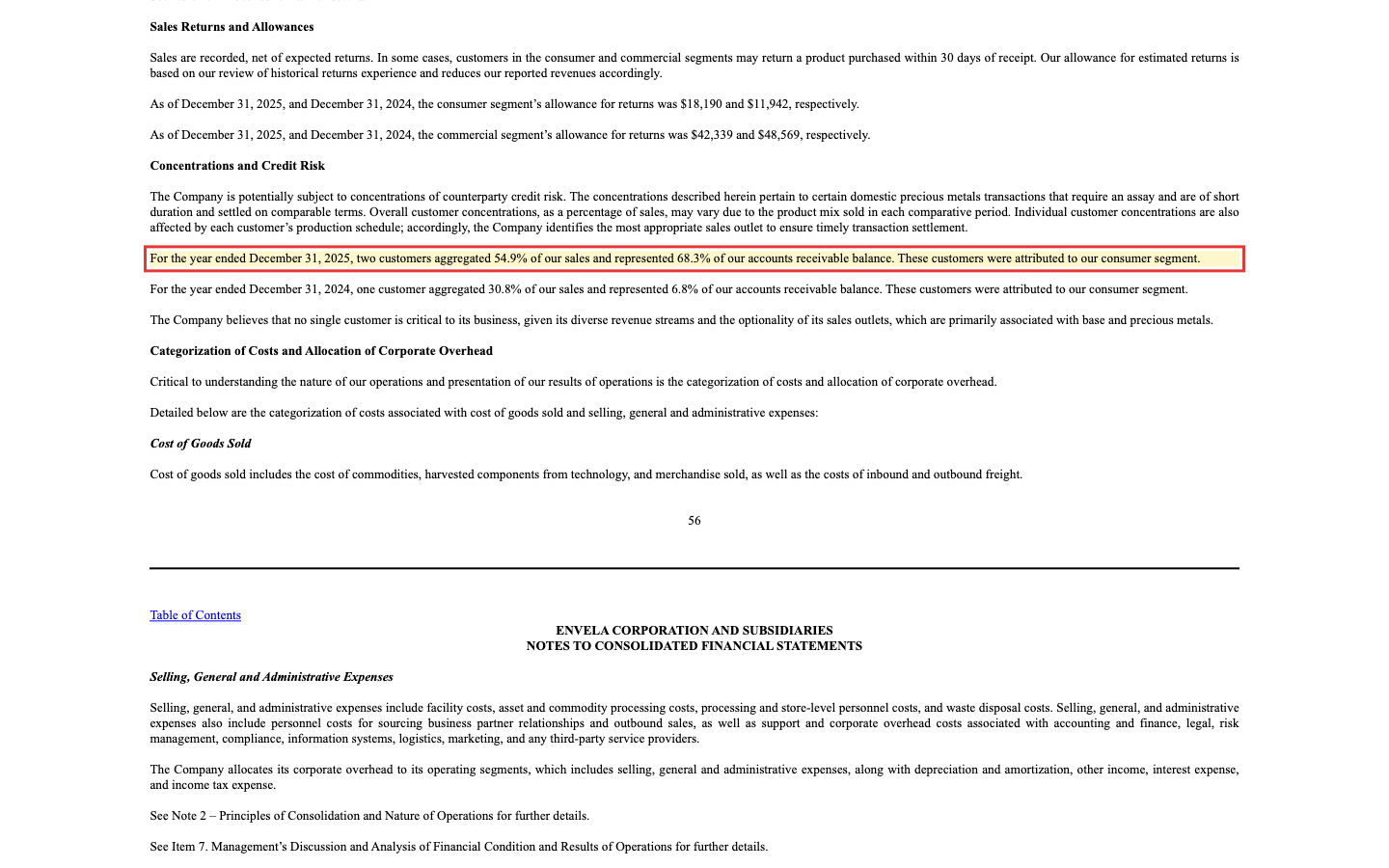
Envela itself puts this into perspective: precious metal can, if need be, be sold to other buyers; no single customer is business-critical. That is true — gold is gold. But a second passage in the same report shows that the dependence can hurt anyway, precisely because of the boom:
"While the current market for safe-haven metals has generally led to stronger premiums within our consumer segment, especially for gold and silver, demand for these metals has created industry-wide backlogs and slowed payments from refiners, which the Company has experienced."
— Envela Corporation, SEC annual report (10-K) for fiscal year 2025, Item 7 "Economic Conditions"
Translated into everyday language: Envela has to pay immediately when buying — to the customer selling her necklace — but gets its own money from the overloaded refiners later. The better business runs, the more money is stuck in transit. At the end of 2025, $11.0 million in receivables had piled up; in the first quarter of 2026 one refiner paid, and the balance fell to $3.6 million — the two major customers even stood at 0.0 percent of the receivables balance as of quarter-end (quarterly report (10-Q) as of March 31, 2026, Note 3), so the payment backlog has been fully cleared. That is exactly where a good part of the shiny quarterly cash flow came from. It is no scandal, but it is a mechanism you should know before cheering a single cash-flow number.
Uncomfortable truth no. 3: one man controls almost three quarters of the company
Whoever buys the Envela stock becomes a junior partner — a very small one. The annual report lays the power structure open:
"N10TR, LLC […] is the Company's largest shareholder, owning 12,814,727 shares of Common Stock, representing 49.3% […]. Eduro Holdings, LLC […] owns 6,365,460 shares of Common Stock, representing 24.5% […]. Both N10TR and Eduro are under the common control of John R. Loftus, the Company's CEO, President, and Chairman of the Board."
— Envela Corporation, SEC annual report (10-K) for fiscal year 2025, Item 1A "Risk Factors" (as of December 31, 2025)
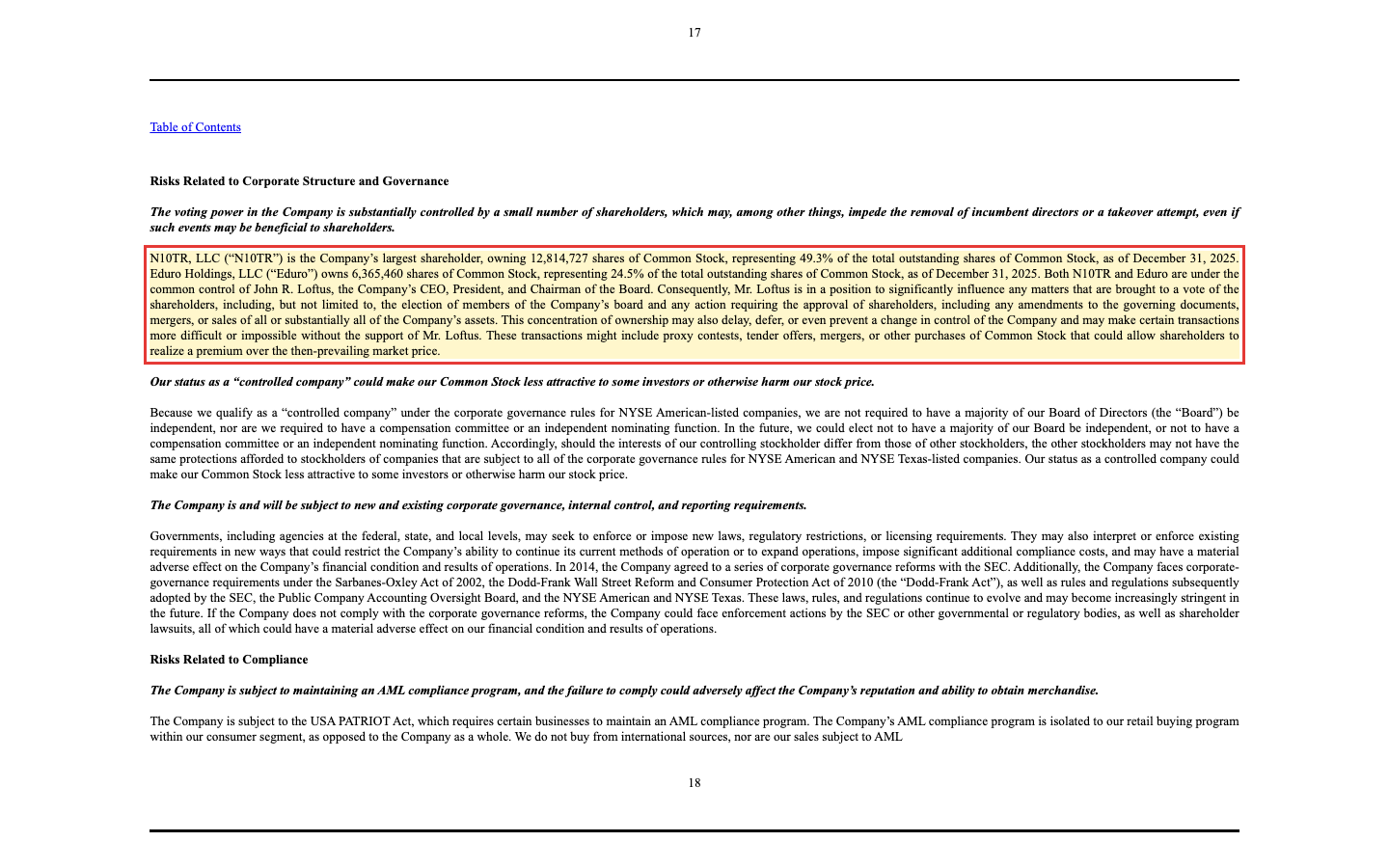
Together that is 73.8 percent — making Envela officially a "controlled company", exempt from key exchange governance rules: no obligation to maintain a majority-independent board, no obligation to have an independent compensation committee. You can read that positively — an owner with his own money at stake does not dilute lightly and thinks long-term; the constant share count fits that reading. But the flip side sits in the same risk factor: takeovers, mergers, or even just voting out directors are practically impossible without Loftus. And for you as an investor it has a very practical consequence: the free float is tiny. As of mid-2025, the report put the market value of the shares in free float at just $41.5 million; most recently, shares worth about $3 million changed hands per day on average (as of July 8, 2026). In a market this narrow, even small waves of buying or selling can trigger big price swings — up as well as down. Part of the spectacular rally is probably owed simply to this narrowness.
Uncomfortable truth no. 4: the ghosts of the past go by the name DGSE
Honesty also requires a chapter that no longer appears in the current filings — and must be told precisely because the same listed shell lived through it. In April 2012, the then DGSE Companies, Inc. had to admit in an 8-K that its books had been wrong for years:
"[…] the Board of Directors of DGSE Companies, Inc. […] determined the existence of certain accounting irregularities beginning approximately during the second calendar quarter of 2007 […]. Management of the Registrant believes that the Accounting Irregularities are the result of improper accounting of inventory and other balance sheet accounts by the former Chief Financial Officer […]."
— DGSE Companies, Inc. (today Envela), SEC current report (8-K) dated April 16, 2012, Item 4.02
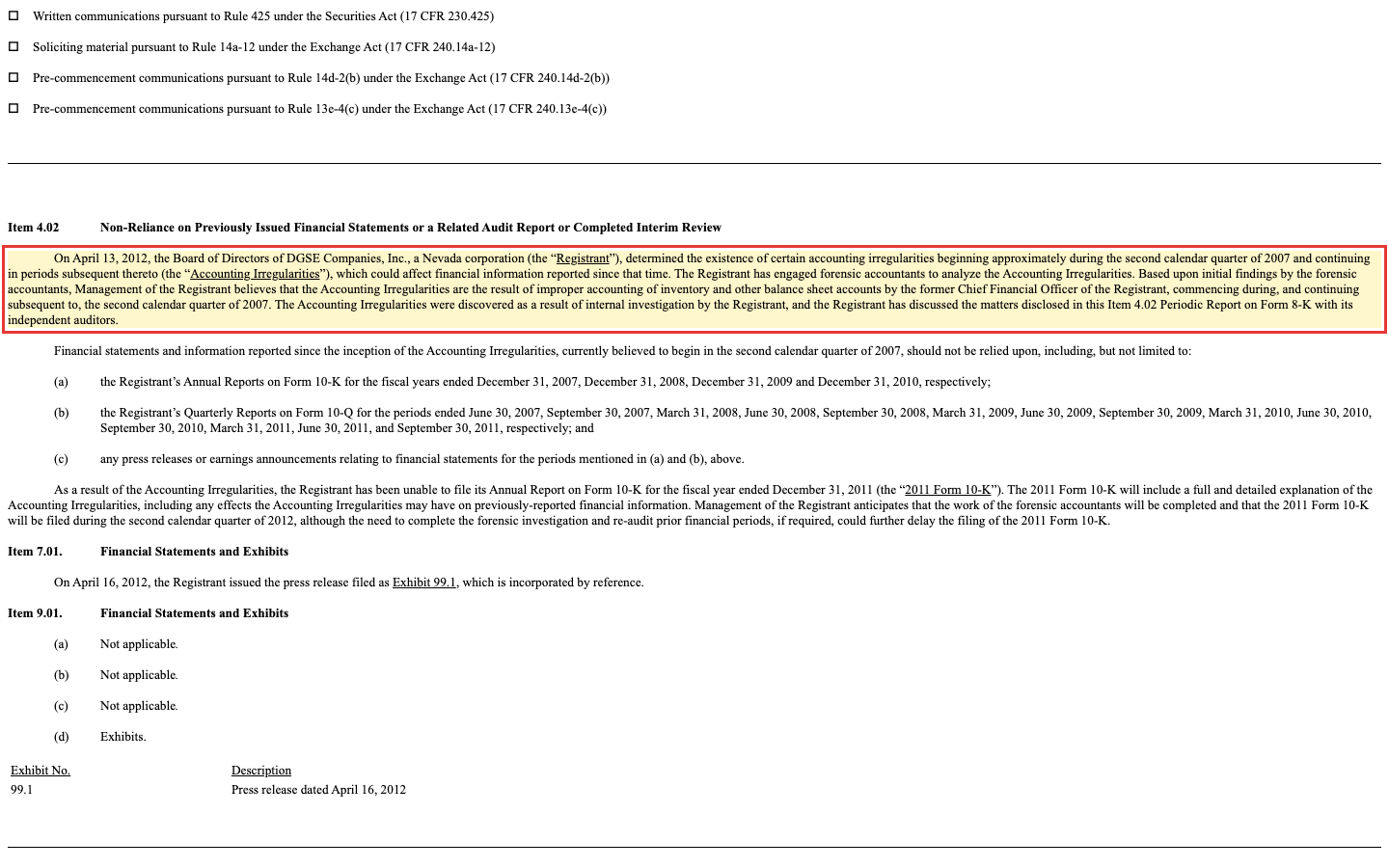
Four annual reports (2007 through 2010) and 14 quarterly reports were declared no longer reliable back then — and it was inventory positions, of all things, that had been misbooked: precisely the silver and gold holdings that are the heart of this business. In fairness: that was 14 years ago, the responsible CFO is long gone, today's majority owner Loftus took the helm only afterwards, and in 2019 the company reinvented itself in name as well. We tell the episode not to punish the son for the sins of the father — but because it holds a timeless lesson for exactly this kind of business: in a store through which metal worth millions flows every day, inventory accounting is the Achilles heel. Today's Piotroski score of 8 measures the quality of the reported numbers — not their honesty. That, you have to take on faith with every investment; here, at least, you know where the sore spot once was.
Valuation — what the market pays for the tide
Now for the price tag. As of mid-2026, Envela weighs in at about $0.7 billion in market value — with 25.96 million shares and a price level near the all-time high. Measured against the trailing twelve months of earnings, that is roughly 33 times earnings (P/E), 2.4 times revenue and — remarkable for a trading business — almost 9 times book value: the balance sheet shows $75.9 million in equity, and the market pays a multiple of it (all figures as of July 8, 2026). For comparison: before the gold surge, at the end of the first quarter of 2025, the whole company was worth about $160 million on the stock exchange — the market value has thus roughly quadrupled while earnings have "only" roughly doubled. The market is not paying for the past here; it is paying for the boom to be extrapolated.
That is exactly where it gets delicate, because with cyclicals the P/E ratio is a notorious liar: at the peak of the cycle, earnings look their best — and are worth the least, because they do not last. A detail from our fundamental data fits the picture: the revenue estimate on file for the current year sits about 11 percent below 2025 revenue (as of July 2026). For such a small stock, barely covered by analysts, an estimate like that can be stale — after a +104 percent quarter it looks almost absurd. But it is a reminder of what the 10-Q itself says: the prices carrying this boom "may not persist". Whoever buys today buys the bet that gold and silver stay expensive — at a price that leaves little room for a normal year.
Opportunities and risks at a glance
What speaks for Envela:
- Self-funded growth in its purest form: revenue up at least 20 percent for six quarters in a row, 2025 net income more than doubled — with a constant share count, $38.6 million in cash against $9.8 million in debt and an untouched credit line (March 31, 2026).
- Balance-sheet quality that is rare in the scanner: Piotroski F-score of 8, Altman Z above 11, relative strength of 96, stress RS of 94 — the stock held up unusually well even on weak market days (as of July 8, 2026).
- The small commercial segment is a margin jewel: 64.2 percent gross margin, a shift toward plannable "fee for service" revenue, tailwinds from e-waste volumes and circular-economy trends — and it earns more gross profit than the gold business five times its size.
- An owner with skin in the game: CEO Loftus holds 73.8 percent, does not dilute and rather buys back shares; as long as gold and silver prices stay high, the model earns handsomely — and the stores gain traffic exactly when people want to turn their old gold into cash.
What speaks against it:
- The engine is the gold price: 80 percent of revenue carries only an 11.9 percent gross margin, and the 10-Q explicitly attributes the growth to higher gold and silver prices — if the cycle turns, revenue and earnings shrink without anyone doing anything wrong (as recently as early 2025, the consumer segment earned practically nothing).
- Concentration risk and a clogged till: two refiner customers accounted for 54.9 percent of revenue and 68.3 percent of receivables in 2025; the boom causes industry-wide backlogs and delayed payments — the better the business, the more money is stuck in transit.
- A controlled company with a mini free float: 73.8 percent with one man, key governance protections waived, free float worth only about $41.5 million as of mid-2025 — thin trading can catapult the price in both directions.
- A cyclical's price tag and a prior record: about 33 times a boom-year profit and almost 9 times book value (as of July 8, 2026); plus the warning from 2012, when predecessor DGSE had to withdraw four annual reports after falsified inventory entries — long ago and under different leadership, but a timeless caution for metal-filled balance sheets.
A human bottom line
Back to the saying from the beginning: brains or bull market? The honest answer after reading the filings is: both — but in a clear order. The brains are there: Envela grows without debt, without dilution, keeps costs in check, has a genuine margin jewel in the basement with the recycling segment, and an owner with his own money in the fire. But the doubling that lights up all the scanners belongs first to the tide: to the gold and silver price streaming through the same stores as before — just at higher prices. The report to the SEC says so itself, and as recently as early 2025 the big segment earned practically nothing.
What you make of that is your decision. And that is as it should be. If you buy Envela, you are buying a soundly financed, smartly run cyclical business at the price of a growth company — a bet that the tide stays high for a long while. That can work out; precious-metals bull phases can last years. It can also mean that you pay the price of the tide for the boat and find out at low tide what of it floats on its own. The next look at the tide charts comes with the quarterly report in early August 2026: pay less attention to revenue — it tells the story of the gold price — and more to the gross margin in the consumer segment, the receivables from the refiners, and whether the margin jewel in the basement keeps growing. The FOMO impulse jumps at the curve; the attribution error whispers that management can turn water into wine. You now know better: it turns old gold into dollars — and how many, the tide decides.
Sources
- Envela Corporation — SEC annual report (10-K), fiscal year 2025 (filed March 18, 2026)
- Envela Corporation — SEC quarterly report (10-Q), Q1 2026 (as of March 31, 2026, filed May 6, 2026)
- Envela Corporation — SEC annual report (10-K), fiscal year 2024 (filed March 26, 2025)
- Envela Corporation — SEC quarterly report (10-Q), Q3 2025 (filed November 5, 2025), 10-Q Q2 2025 and 10-Q Q1 2025
- DGSE Companies, Inc. (today Envela) — SEC current report (8-K) dated April 16, 2012 (Item 4.02, accounting irregularities)
- Fundamental data (metrics, valuation, quarterly series); in-house stock scanner, data as of July 8, 2026.
Transparency & disclaimer: This analysis is a journalistic contextualization of publicly available information and is not investment advice, not a financial analysis in the regulatory sense, and not a solicitation to buy or sell securities. Stocks are subject to price swings; a total loss is possible. Make your investment decisions on your own responsibility and, when in doubt, seek independent advice. All information without guarantee; the data cut-off is noted in the text in each case.
Our Bottom Line at a Glance
- Business model & market neutral
- A fundamentally solid, 60-year-old trading business with two legs: buying and selling jewelry and precious metal (80% of revenue, but only an 11.9% gross margin — metal is passed through close to the spot price) plus electronics recycling/ITAD with a 64.2% gross margin. Revenue is therefore, above all, a price gauge of the precious-metals market.
- Growth & momentum positive
- Six quarters in a row of at least +20% revenue growth ($48.3 million to $98.4 million), 2025 net income more than doubled, Q1 2026 +254.5%; 17 scanner hits, relative strength of 96, stress RS of 94 (as of July 8, 2026). The 10-Q, however, explicitly attributes the surge to higher gold and silver prices.
- Balance sheet & financing positive
- Rock-solid: $38.6 million in cash against $9.8 million in debt (March 31, 2026), an untouched credit line, a Piotroski F-score of 8, an Altman Z above 11, a constant share count (25.96 million), even a small buyback in 2025. The growth is fully self-funded — the counter-model to the credit-levered growth story.
- Dependence & concentration risk negative
- The engine is the gold price, not the model: before the metals surge, the consumer segment earned practically nothing (Q1 2025: $69,094 net). Two refiner customers accounted for 54.9% of revenue and 68.3% of receivables in 2025; per the 10-K, the boom is backing up refiner payments industry-wide — though Envela's own backlog was fully cleared as of March 31, 2026 per the quarterly report (10-Q, Note 3), at 0.0% of receivables.
- Ownership & governance negative
- CEO Loftus controls 73.8% — a "controlled company" with no obligation to maintain a majority-independent board; the free float was worth only about $41.5 million as of mid-2025, and trading is thin. On the plus side: owner alignment without dilution. A warning from history: the 2012 DGSE accounting scandal (under previous leadership).
- Valuation negative
- About $0.7 billion in market value on $75.9 million of equity: roughly 33 times trailing twelve-month earnings, 2.4 times revenue, almost 9 times book value (as of July 8, 2026) — a growth price tag on a cyclical's profit that, per the 10-Q, rests on prices that "may not persist".
Envela is the rare combination of genuine momentum and a rock-solid balance sheet: revenue doubled in six quarters, net cash, no dilution, a margin jewel in the recycling segment. But the engine of the doubling is the gold and silver price, not the business model — 80 percent of revenue carries only an 11.9 percent gross margin, two customers account for more than half of revenue, and the CEO himself holds almost three quarters of the shares. Whoever buys here pays a growth price tag for a cyclical. Not investment advice.
What Our Rating Means
- If you don't own the stock
- At the current price level, we don't see a sufficient margin of safety for an entry.
- If you hold it in your portfolio
- Our findings offer no reason to sell.
A journalistic assessment by our editorial team at the time of the deep dive, based on public sources — not investment advice and not a solicitation to buy or sell. Your personal circumstances (investment goals, risk capacity, taxes) cannot be taken into account. What our categories mean, how verdicts are formed, and what conflicts of interest exist →
Worth Noting
- Traded as DGSE Companies, Inc. until 2019 (before that Dallas Gold & Silver Exchange); in April 2012, after inventory-booking manipulation by the former chief financial officer, four annual reports (2007–2010) and 14 quarterly reports were declared unreliable (8-K dated April 16, 2012). Today's majority owner took over later.
- The revenue estimate on file in the fundamental data for the current year (about −11% versus 2025, as of July 2026) may be stale for a small cap this thinly covered by analysts — but it illustrates the cyclical question, not the operating picture.
- Q1 2026 cash flow ($21.2 million operating) includes about $8.6 million from clearing backed-up refiner receivables — to be read as a one-off effect, not a new run rate.
Frequently Asked Questions
Envela (NYSE American: ELA) is a recommerce group from Irving, Texas, with two segments: 15 stores buying and selling pre-owned jewelry, luxury watches, and gold and silver coins (consumer), plus electronics recycling and the processing of retired IT equipment including certified data destruction, the ITAD business (commercial). Surplus precious metal is sold to refiners as refining scrap.
Quarterly revenue rose by at least 20 percent for six quarters in a row — from $48.3 million to $98.4 million (Q4 2024 through Q1 2026). According to the quarterly report, the main driver is the sharp rise in gold and silver prices: higher metal prices automatically mean more revenue on the same flow of goods. The consumer segment keeps only about 11.9 percent of it as gross profit, because precious metal is passed through close to the spot price.
CEO, President and Chairman John R. Loftus controls 73.8 percent of the shares through the entities N10TR, LLC (49.3 percent) and Eduro Holdings, LLC (24.5 percent) combined (as of December 31, 2025). That makes Envela a "controlled company", exempt from key exchange governance requirements. The free float was worth only about $41.5 million as of mid-2025; trading is correspondingly thin.
The dependence on precious-metals prices: 80 percent of revenue comes from the gold business at only an 11.9 percent gross margin — if the gold price falls, revenue and earnings shrink. Add two refiner customers with 54.9 percent of revenue and 68.3 percent of receivables (2025), industry-wide payment backlogs at the refiners, and thin trading due to the tiny free float.
No — it carries a growth price tag on a cyclical's earnings: about 33 times trailing twelve-month earnings, 2.4 times revenue and almost 9 times book value (as of July 8, 2026). With cyclicals, price-earnings ratios look most attractive at the peak of the cycle — but that is exactly when earnings are least repeatable, as the 10-Q itself hints with the phrase "may not persist".
Envela was called DGSE Companies until 2019. In April 2012, the company admitted in an 8-K to accounting irregularities dating back to 2007 — the former chief financial officer had misbooked inventory and other balance-sheet accounts. Four annual reports (2007–2010) and 14 quarterly reports were declared unreliable. Today's majority owner John R. Loftus took over only later; the episode remains a reminder of how central inventory accounting is in this business.
Found an error?
Did you spot a factual error, an outdated number, or a typo in this deep dive? Let us know briefly — your report goes straight to the editorial team.