Sphere Stock: The Wizard of Oz Turned the Vegas Orb Profitable — Yet the 10-K Still Promises More Losses
Everyone has seen the glowing orb of Las Vegas — and that is exactly the problem. Sphere Entertainment ranks no. 6 in the U.S. selection of our in-house Big Earnings Surprise scanner (as of July 18, 2026): four earnings beats in a row, two consecutive quarters of operating profit, revenue up 38 percent in the first quarter of 2026 — "The Wizard of Oz" fills the orb day after day. We read the annual report (10-K) for 2025 and the quarterly report (10-Q) as of March 31, 2026: they also contain five loss periods in a row, a TV network whose crown-jewel media rights expire in 2029, an $829 million loan that matured unpaid in 2024 — and the sentence that the significant operating losses are expected to continue. Not investment advice — just a reminder that the world's most spectacular building does not guarantee a spectacular business.
 Thomas Mücke
Founder & Publisher
Thomas Mücke
Founder & Publisher
Chart
Interactive price chart (TradingView).
Note: pure fact-based analysis, not investment advice and not a solicitation to buy or sell. All figures without guarantee.
There is an investor trap that starts with the eye: the availability trap. Your brain treats whatever it can recall effortlessly as likely and valuable — and hardly any company on earth supplies an image easier to recall than Sphere Entertainment Co. (NYSE: SPHR): the glowing giant orb of Las Vegas, rolling through every social feed as a basketball, an eyeball or a Christmas bauble. "Everyone knows that thing, it must be a business" — that is exactly how portfolios full of souvenirs are built. So let\'s make a deal: we let the orb glow and instead read what the company itself filed, under penalty of law, with the U.S. securities regulator, the SEC — the annual report (10-K) for 2025, the quarterly report (10-Q) as of March 31, 2026, and the earnings releases that go with them. Both stories are in there: an operation that, thanks to an 86-year-old film classic, just posted its first two consecutive quarters of operating profit. And a company that, in the same report, lists five loss periods in a row and expects its significant operating losses to continue. In the end, you decide what the picture in your head is worth.
What Sphere Entertainment actually does — an orb, a TV network and a long Madison Square Garden history
Sphere Entertainment is what remained of an empire after it split twice: in 2020 the company was spun off from the sports business MSG Sports (Knicks, Rangers) as Madison Square Garden Entertainment; in April 2023 it spun off the traditional live entertainment business — Madison Square Garden itself, the Rockettes\' Christmas Spectacular — as the new MSG Entertainment and renamed itself Sphere Entertainment. What stayed behind are two profoundly unequal businesses. First, the Sphere in Las Vegas: 17,600 seats, capacity for up to 20,000 guests, an interior display plane of about 160,000 square feet (roughly two soccer fields), 167,000 individually programmable speakers, and on the outside the "Exosphere" — the largest video advertising surface in the world. The orb is programmed three ways: with the in-house film production "The Sphere Experience," with concert residencies (currently announced: Metallica with 24 shows starting October 2026; the Backstreet Boys extended to 56 nights in total) and with brand events such as Lenovo\'s keynote at the CES tech show. Second, MSG Networks: two regional sports networks (MSG Network, MSG Sportsnet) plus the MSG+ streaming product, carrying mainly Knicks and Rangers games — a classic U.S. cable business in structural decline. And since 2025 a new fiscal calendar applies: after a July–December 2024 transition period (10-KT), the fiscal year ends December 31 instead of June 30 — anyone comparing older Sphere figures needs to know that.
Which brings us to the central tension of this analysis, running through every chapter: The orb really is turning profitable — but it hangs on a single show, the network next to it shrinks with a 2029 expiration date, and the company itself is announcing more losses.
Where the stock shows up in our scanner
Every day we run about 3,500 stocks through our scanners. As of July 18, 2026, Sphere Entertainment ranks no. 6 in the U.S. selection of our Big Earnings Surprise scanner. The scanner looks for companies whose reported earnings per share beat the analyst estimate by at least 20 percent in each of the last four completed quarters — consistently large earnings surprises. To replicate it: open the scanner, set the country filter to "US," and the list shows the hits in scanner order. Sphere\'s reported earnings per share over the last four calendar quarters were +$3.39, −$2.80, +$1.38 and +$0.12 (Q2 2025 through Q1 2026; scanner data as of July 18, 2026) — each time clearly better than expected. But let\'s translate honestly what did the surprising: the +$3.39 contained the book gain from the debt restructuring, the −$2.80 a goodwill impairment, the +$1.38 a $42.3 million tax benefit. The fundamental lens of the same scanner meanwhile shows genuine improvement: a Piotroski F-score of 9 of 9 in the first quarter of 2026 (a nine-point test of the direction of the books — 9 means everything is improving; a year earlier it stood at 2), an Altman Z-score around 4.9 (an early-warning gauge for financial distress — the danger zone starts below 1.8) and a relative strength rating of 95 after a 66 percent year-to-date run. Remember the principle: a surprise scanner measures how wrong the expectations were — not how good the business is. Which is exactly why we now read the filings.
The numbers over the years — honestly appraised
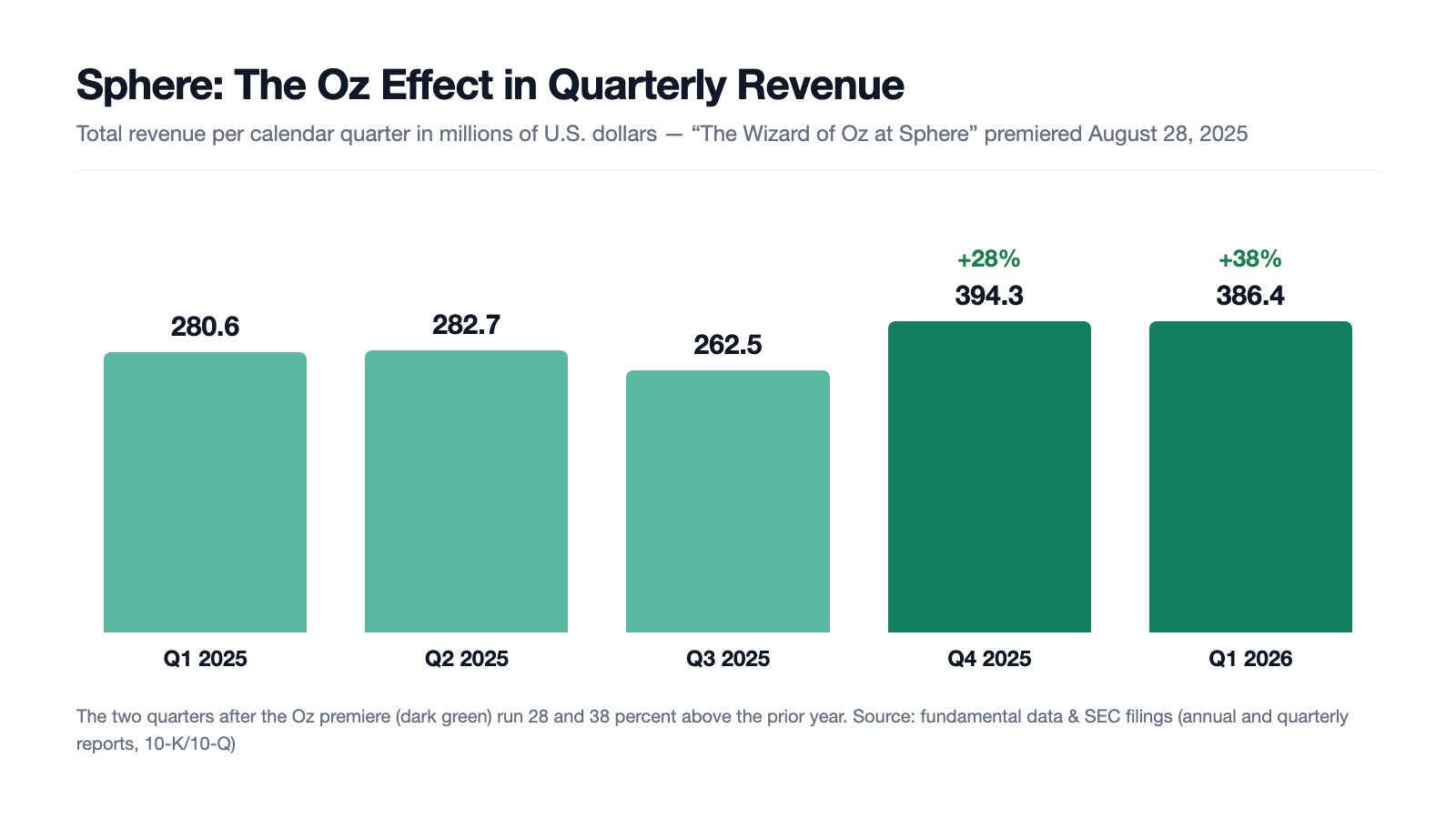
First, what genuinely impresses. On August 28, 2025, "The Wizard of Oz at Sphere" premiered — the 1939 film classic, brought to the orb\'s giant display with the help of artificial intelligence, augmented with wind machines, fog, fire bursts and haptic seats. By mid-January 2026, per the earnings release, more than two million tickets had been sold; the 500th showing ran in March 2026. The effect on the numbers is dramatic: Sphere segment revenue jumped 62 percent to $274.2 million in the fourth quarter of 2025 and 69 percent to $266.0 million in the first quarter of 2026 — on 209 Oz performances versus 200 shows of the predecessor productions in the prior-year quarter, so almost entirely through higher revenue per show. Company-wide, revenue rose 8 percent to $1,220.0 million in 2025 and 38 percent to $386.4 million in the first quarter of 2026:
Earnings quality turned as well: adjusted operating income (AOI — operating income before depreciation, share-based compensation and special items; management\'s steering metric) rose 138 percent to $261.8 million in 2025; the Sphere segment alone swung from minus $19.7 million (2024) to plus $144.6 million. Operating cash flow more than tripled to $243.3 million in 2025, with another $136.2 million added in the first quarter of 2026 (prior-year quarter: $6.3 million). And under GAAP — no adjustments — the fourth quarter of 2025 delivered the first operating profit, $28.9 million, followed by $7.2 million in the first quarter of 2026. Honesty requires the fine print: for full-year 2025 the operating result was still a loss of $229.6 million (after minus $372.3 million in 2024), and the reported net income of $33.4 million exists only because of the one-time debt gain we get to in a moment. Remember the image: the orb has learned to make money — but only since August 2025, and so far with exactly one show.
What the filings say — the uncomfortable truths
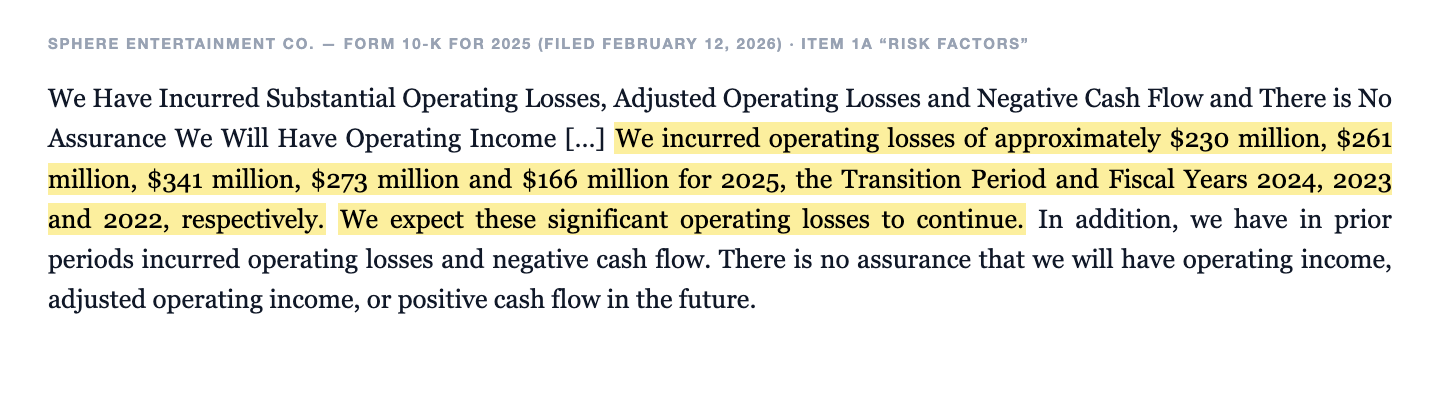
Uncomfortable truth no. 1: five loss periods in a row — and the company expects more
The momentum of the last two quarters is real. But the annual report frames it itself, in a sentence you would never find in a sales brochure:
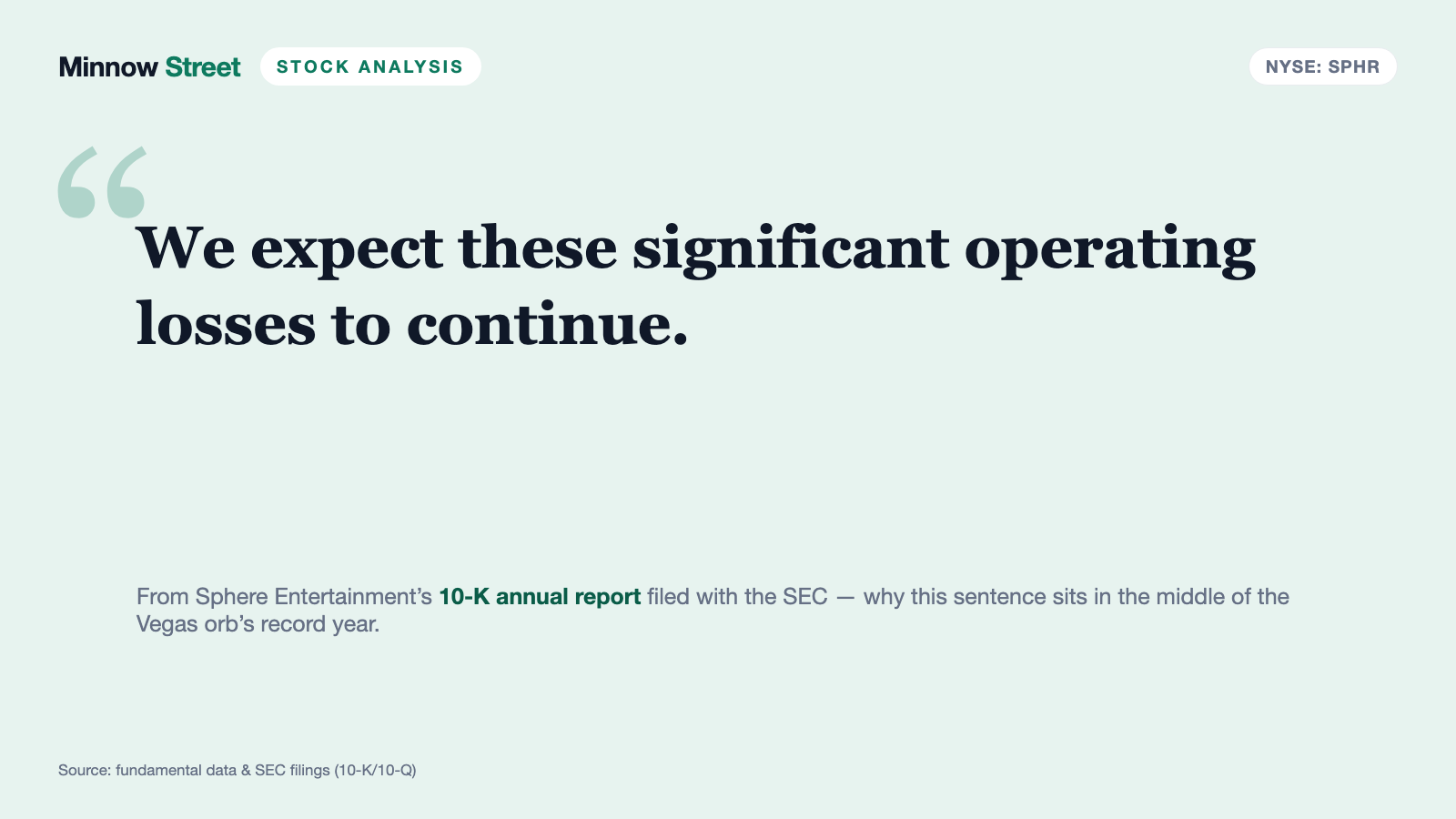
"We incurred operating losses of approximately $230 million, $261 million, $341 million, $273 million and $166 million for 2025, the Transition Period and Fiscal Years 2024, 2023 and 2022, respectively. We expect these significant operating losses to continue."
— Sphere Entertainment Co., SEC annual report 10-K for 2025, Item 1A "Risk Factors"
Why this caution, in the middle of the Oz boom? Because the orb is a depreciation machine: in 2025 alone, $336.4 million of depreciation and amortization ran through the income statement — the building, with $2.7 billion of property and equipment behind it, wears down on the books faster than a single show can earn. Add a dependence on audience taste that the report names with unusual candor: before the Oz premiere, revenue per show of The Sphere Experience had been falling — "prior to debuting The Wizard of Oz at Sphere, we had experienced a decline in the average revenues per show" (10-K 2025, Item 1A). The predecessor show "Postcard from Earth" cost about $80 million and wore out; Oz cost over $100 million and carries the venue — until this carousel, too, slows down and the next production is due. In everyday terms: the Sphere is a movie theater with a single auditorium and a single film — while the film runs, everything shines; when it fades, the most expensive building in Las Vegas stands without a program.
Uncomfortable truth no. 2: the 2025 net profit comes from a debt haircut — $829 million simply was not repaid
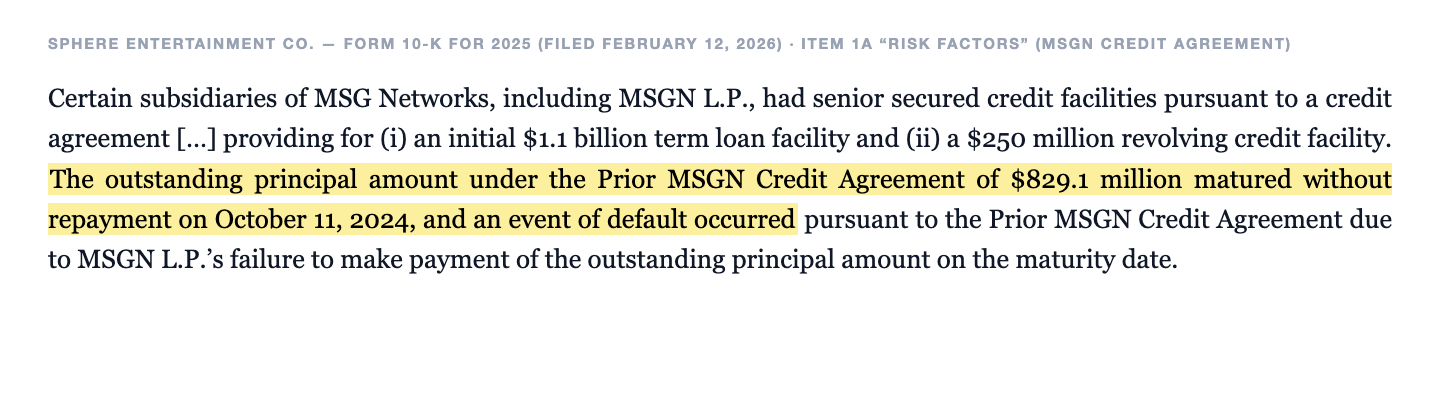
If you only look at "net income of $33.4 million" for 2025, you miss the most spectacular line of the report. MSG Networks had a loan of originally $1.1 billion — and could not pay it at maturity:
"The outstanding principal amount under the Prior MSGN Credit Agreement of $829.1 million matured without repayment on October 11, 2024, and an event of default occurred pursuant to the Prior MSGN Credit Agreement due to MSGN L.P.'s failure to make payment of the outstanding principal amount on the maturity date."
— Sphere Entertainment Co., SEC annual report 10-K for 2025, Item 1A "Risk Factors" / Note 14
After months of forbearance agreements, a deal was struck on June 27, 2025: the $829.1 million became a new $210 million term loan (due at the end of 2029, amortizing $10 million per quarter, principal at year-end 2025: $158.9 million) — and the company booked a $346.1 million gain on debt extinguishment. Without that one-off, 2025 would have been a deeply loss-making year at the bottom line as well. The price of the deal: the lenders participate in future surpluses through Contingent Interest Units, and the Knicks and Rangers media rights agreements did not just get cheaper — they now expire after the 2028-29 seasons, more on that in a moment. A curiosity on the side: the balance sheet carries the $158.9 million loan at $303.7 million, because troubled-debt-restructuring accounting bakes future interest into the carrying amount — in exchange, hardly any MSGN interest expense will run through the income statement going forward. You cannot grow a business on debt forgiveness — this gain arrives exactly once.
Uncomfortable truth no. 3: the profitable segment is shrinking — and its crown jewels run out in 2029
The irony of Sphere\'s numbers: it is the unloved cable business MSG Networks that has so far been the only segment reliably delivering operating profit ($38.6 million in 2025, $32.1 million in the first quarter of 2026 alone). But that cushion is melting from three sides. First, the customers: subscribers fell about 14.5 percent in the fourth quarter of 2025 and about 16 percent in the first quarter of 2026 (both year over year; in early 2025, cable operator Altice even dropped the channels entirely for seven weeks). Second, the buyer concentration:
"Substantially all of our affiliation fee revenue comes from our top four Distributors."
— Sphere Entertainment Co., SEC annual report 10-K for 2025, Item 1A "Risk Factors"
And third, the content itself:
"… the media rights agreements between MSG Networks, on the one hand, and the Knicks and the Rangers, on the other hand, were amended to (among other things) reduce the rights fees payable by MSG Networks and reduce the term of those agreements to expire after the 2028-29 NBA and NHL seasons, respectively, subject to a right of first refusal in favor of MSG Networks."
— Sphere Entertainment Co., SEC annual report 10-K for 2025, Item 1A "Risk Factors"
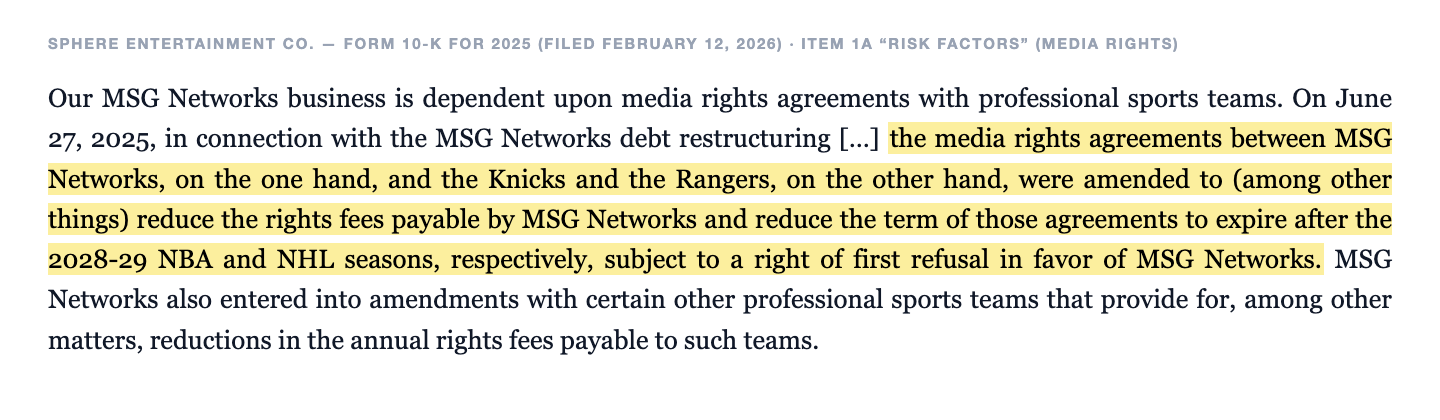
Translated: the company\'s profit engine is a network with a shrinking audience, four dominant customers and core content with an expiration date — to be renegotiated in 2029 with MSG Sports, the sister company of the same owner family. Which brings us to a fourth point that really deserves its own truth: the Dolan family holds, through Class B shares, about 72.3 percent of the voting power of Sphere Entertainment (with a good 18 percent of the shares) and simultaneously controls MSG Sports, MSG Entertainment and AMC Networks. As a free-float shareholder you ride in the back seat here — how strongly a controlling situation can shape an entertainment business is something we dissected from another angle in our AMC Entertainment analysis.
Valuation: what the market pays for the orb — and what it buys along with it
In mid-July 2026 the Sphere share cost about $160, for a market value of roughly $5.9 billion (36.8 million shares per the quarterly report; all valuation figures: data as of July 18, 2026, after a 66 percent year-to-date run). A price-to-earnings ratio is of little use here — trailing earnings consist mostly of the one-time restructuring gain. More robust: the company trades at about 4.5 times trailing revenue and — including net debt of roughly $60 million — at about 23 times its 2025 adjusted operating income ($261.8 million). Baked into that is a double bet: that the Oz run is not a one-off but the blueprint (Sphere Experiences as a standing program, plus residencies, plus Exosphere advertising), and that the orb becomes a network. To be fair: the expansion is designed not to burden Sphere\'s own balance sheet this time. For Sphere Abu Dhabi (agreements signed in July 2025), the local tourism authority DCT Abu Dhabi funds construction itself and pays Sphere a franchise initiation fee — part of it already received, per the 10-K — plus ongoing royalties; for National Harbor near Washington, D.C., an intent for the first smaller-scale Sphere was announced in January 2026. On the balance sheet, $630.2 million of cash (March 31, 2026) stands against roughly $687 million of principal debt: the 3.50% convertible notes of $258.8 million (due 2028; convertible into shares, which would dilute — the diluted share count recently stood at 46.9 million versus 35.7 million basic), the $275 million Las Vegas loan (refinanced in January 2026 out to 2031, plus a new $275 million revolver) and the MSGN term loan ($153.5 million after the January cash sweep). How fast a capital-hungry technology bet can consume money is a story we told from the other side in our Nvidia analysis — Sphere is now trying to shift exactly that burden onto franchise partners. Whoever buys the stock pays for the future of the orb network — and gets the shrinking TV business with its 2029 rights cliff thrown in, whether they want it or not.
Opportunities and risks at a glance
What speaks for Sphere Entertainment:
- Proof of product: "The Wizard of Oz at Sphere" sold more than two million tickets in four and a half months, lifted revenue per show markedly and swung the company to its first two consecutive quarters of operating profit — $28.9 million in Q4 2025 and $7.2 million in Q1 2026.
- Cash flow instead of story: $243.3 million of operating cash flow in 2025 (prior year: $69.4 million) plus $136.2 million in the first quarter of 2026; adjusted operating income up 138 percent to $261.8 million; Piotroski F-score of 9 of 9 (Q1 2026).
- A full program pipeline: the Metallica residency with 24 shows starting October 2026, Backstreet Boys extended to 56 nights, brand events (Lenovo/CES) and multi-year sponsors such as Anheuser-Busch, Delta Air Lines and Evian for the Exosphere.
- Expansion without construction risk: Sphere Abu Dhabi is funded by DCT Abu Dhabi (franchise initiation fee partly received, plus ongoing royalties and service fees), National Harbor announced as the first smaller-scale venue; the restructuring cut group debt massively, and cash stood at $630.2 million (March 31, 2026).
What speaks against it:
- The company itself expects significant operating losses to continue, per the 10-K — after five consecutive loss periods (operating losses of $166 million to $341 million per period since fiscal year 2022) and with $336.4 million of annual depreciation on the orb.
- Single-show risk: before the Oz premiere, revenue per show was falling; every new production costs a nine-digit sum (Oz: over $100 million, Postcard from Earth: about $80 million) with no guarantee of success.
- MSG Networks shrinks with an expiration date: subscribers down 14.5 to 16 percent, substantially all affiliation revenue from four distributors, goodwill impairments of $61.2 million and $65.4 million in two years — and the Knicks/Rangers rights end after the 2028-29 seasons.
- The 2025 net profit is a book gain: $346.1 million from a debt haircut after $829.1 million matured unpaid; the lenders remain entitled to future surpluses through Contingent Interest Units.
- Control and structure: the Dolan family holds about 72.3 percent of the voting power and sits on both sides of the table in the 2029 rights negotiation; the convertible notes can dilute the share count from 35.7 to as many as 46.9 million; after a 66 percent year-to-date run, 4.5 times revenue prices in a lot of future.
A human conclusion
Back to the availability trap from the opening. It does not lie — it weights wrongly: the image of the glowing orb is real, just as the two million Oz tickets, the cash flow swing and the Piotroski score of 9 are real. But your brain only recalls what glows. The filings do not glow; they speak in sober sentences: a company that has lost money operationally for five straight reporting periods and says itself that this should continue. A record year whose net profit comes from a loan that was not repaid. A second business that is shrinking on schedule and must negotiate its crown jewels back in 2029 with the family that also holds the majority of the company\'s votes. And against all that: perhaps the most singular venue in the world, currently proving that with the right content it can make real money — and planning to have others pay for its copies. The honest bill reads: you get a spectacular, young, one-of-a-kind business with genuine momentum — at 4.5 times revenue, with a single load-bearing show, a ticking TV clock and a family at the wheel. Whether the next production draws, what the Abu Dhabi franchise fees actually bring in and how long Oz carries — that is written in the next quarterly reports (10-Q), not in your Instagram feed. What you make of it is your decision. And that is exactly as it should be.
Sources
All original documents used in this analysis — for your own reading:
- Sphere Entertainment Co. — SEC annual report 10-K for 2025 (filed February 12, 2026)
- Sphere Entertainment Co. — SEC quarterly report 10-Q as of March 31, 2026 (filed May 5, 2026)
- Sphere Entertainment Co. — First quarter 2026 earnings release (8-K dated May 5, 2026, Exhibit 99.1)
- Sphere Entertainment Co. — Fourth quarter and full year 2025 earnings release (8-K dated February 12, 2026, Exhibit 99.1)
- Sphere Entertainment Co. — SEC transition report 10-KT for July–December 2024 (filed March 3, 2025; change of fiscal year-end to December 31)
- Complete SEC filing history of Sphere Entertainment: EDGAR overview (sec.gov)
- Fundamental data (metrics, quarterly series, valuation; data as of July 18, 2026), cross-checked against the SEC filings.
- Screener and rating data: in-house stock scanner (data as of July 18, 2026), including the Big Earnings Surprise scanner (U.S. selection, rank 6).
Transparency & disclaimer: This analysis is a journalistic contextualization of publicly available information and is not investment advice, not a financial analysis in the regulatory sense, and not a solicitation to buy or sell securities. Stock investments carry substantial risks up to and including total loss. All information without guarantee; the data cut-off is noted in the text. The author holds no position in Sphere Entertainment shares at the time of publication.
Our Bottom Line at a Glance
- Turn in the core business positive
- Q4 2025 (+$28.9 million) and Q1 2026 (+$7.2 million) delivered the first two consecutive quarters of operating profit; adjusted operating income rose 138 percent to $261.8 million in 2025, operating cash flow reached $243.3 million (2025) plus $136.2 million (Q1 2026) — driven by higher revenue per show (10-K 2025; 10-Q as of 03/31/2026).
- Drawing power of the orb positive
- "The Wizard of Oz at Sphere": more than two million tickets in four and a half months, 500th showing in March 2026; plus residencies (Metallica, 24 shows from October 2026; Backstreet Boys, 56 nights) and multi-year sponsors (Anheuser-Busch, Delta, Evian) for the Exosphere (earnings releases 8-K Q4 2025/Q1 2026).
- Loss history & earnings quality negative
- Five consecutive loss periods (operating losses of $166–341 million per period since FY 2022; 2025: $229.6 million), $336.4 million of annual depreciation; the 10-K literally expects significant operating losses to continue — the 2025 net profit stems from the $346.1 million restructuring book gain.
- MSG Networks negative
- Revenue down 15 percent (2025), subscribers down 14.5 to 16 percent, substantially all affiliation revenue from four distributors, goodwill impairments of $61.2 + $65.4 million; the Knicks/Rangers rights expire after the 2028-29 seasons — $829.1 million of legacy debt matured unpaid in 2024 (10-K 2025).
- Balance sheet after the restructuring neutral
- Cash of $630.2 million (03/31/2026) against roughly $687 million of principal debt (convertible notes $258.8 million due 2028, LV loan $275 million due 2031, MSGN $153.5 million due 2029); the convertible can dilute the share count from 35.7 to as many as 46.9 million (10-K 2025, Note 14; 10-Q as of 03/31/2026).
- Control & expansion neutral
- The Dolan family holds ~72.3 percent of the voting power (dual-class structure) and sits on both sides of the 2029 rights negotiation; expansion, in turn, is capital-light: the Abu Dhabi franchise is funded by DCT (initiation fee partly received), National Harbor is a declared intent (10-K 2025).
Sphere Entertainment is the rare case in which both extremes are true at once: with "The Wizard of Oz" the orb has proven it can make money — two consecutive quarters of operating profit, $261.8 million of adjusted operating income, cash flow more than tripled, future expansion on someone else's dime. And the same company lists five loss periods in a row, expects further losses per its own 10-K, owes its net profit to a loan that was never repaid, and drags along a shrinking TV business whose crown jewels expire in 2029. Whoever invests here buys a one-of-a-kind venue with single-show risk at 4.5 times revenue — controlled by a family with 72.3 percent of the votes. Not investment advice.
What Our Rating Means
- If you don't own the stock
- As long as the question raised in the bottom line stays open, we see no basis for an entry.
- If you hold it in your portfolio
- Our findings offer no acute reason to sell — the checkpoints named remain decisive.
A journalistic assessment by our editorial team at the time of the deep dive, based on public sources — not investment advice and not a solicitation to buy or sell. Your personal circumstances (investment goals, risk capacity, taxes) cannot be taken into account. What our categories mean, how verdicts are formed, and what conflicts of interest exist →
Worth Noting
- SPHR made the research list as rank 6 of our in-house Big Earnings Surprise scanner (U.S. selection, as of July 18, 2026) — part of our series on the top 20 of that selection.
- Scanner metrics (EPS surprises, Piotroski, Altman-Z, relative strength) use reported quarterly figures as of July 18, 2026; the EPS series (+$3.39/−$2.80/+$1.38/+$0.12) contains special items — the debt-restructuring gain (Q2 2025), a goodwill impairment (Q3 2025) and a $42.3 million tax benefit (Q4 2025).
- Price and market value figures (~$160, ~$5.9 billion) from the July 18, 2026 feed, sanity-checked against 36.8 million shares outstanding per the 10-Q as of March 31, 2026; analyses are evergreen, daily prices are not a buy argument.
Frequently Asked Questions
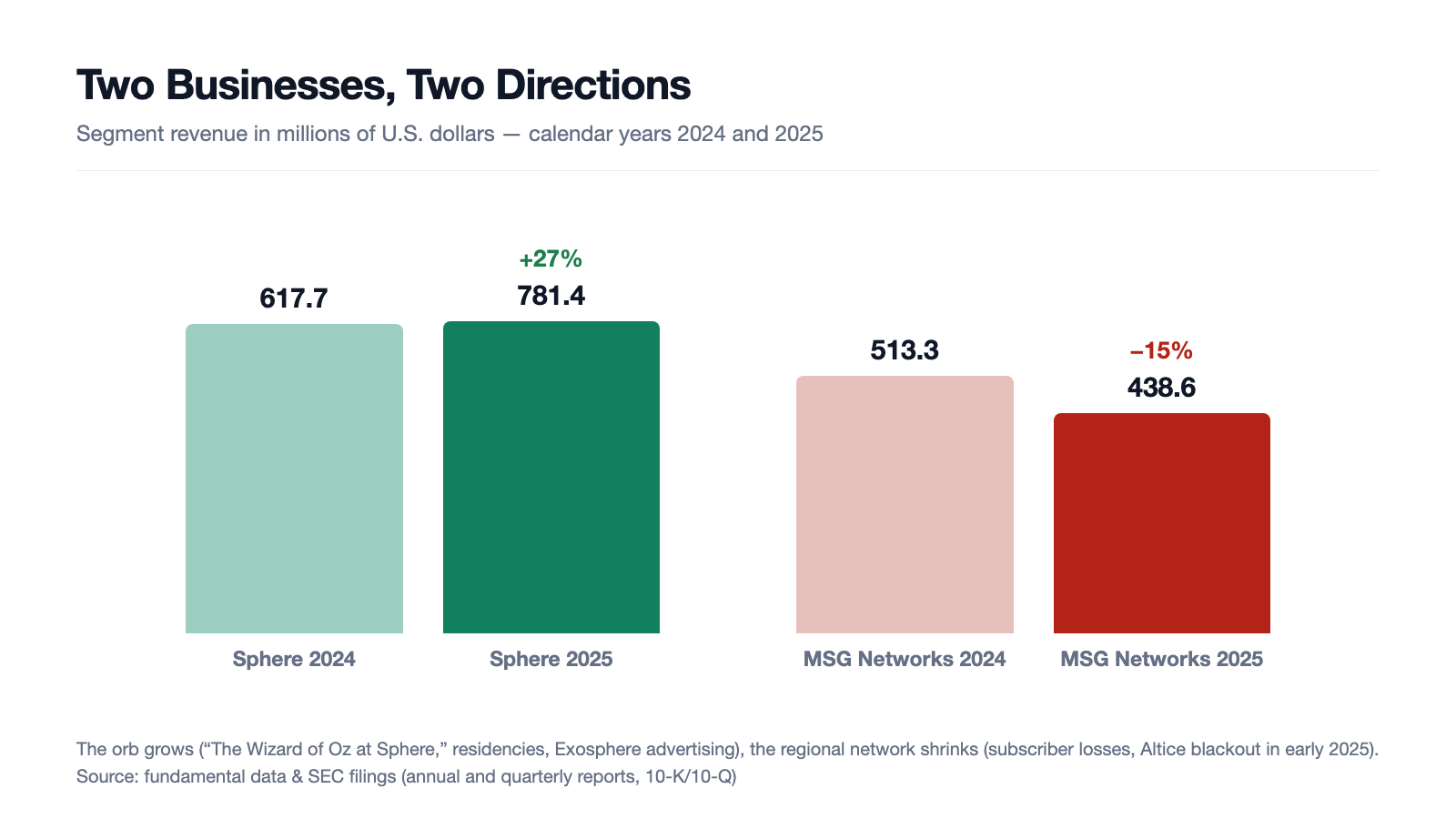
Sphere Entertainment Co. (NYSE: SPHR, New York) runs two businesses: the Sphere in Las Vegas (17,600 seats) with "The Sphere Experience" film production, concert residencies, brand events and Exosphere advertising — $781.4 million of revenue in 2025 (up 27 percent) — and the MSG Networks regional sports channels (MSG Network, MSG Sportsnet, the MSG+ streaming product) with $438.6 million (down 15 percent). Total 2025 revenue: $1,220.0 million (up 8 percent).
Sphere Entertainment was named Madison Square Garden Entertainment Corp. until April 2023 and was spun off from MSG Sports in 2020. On April 17, 2023, the company spun off the traditional live entertainment business (including the Madison Square Garden arena) as the new MSG Entertainment and renamed itself Sphere Entertainment Co. — the name history is documented in its SEC registration (CIK 1795250). The Dolan family controls all three companies.
Very — per the SEC filings: since the August 28, 2025 premiere, more than two million tickets were sold by mid-January 2026, and the 500th showing ran in March 2026. Sphere segment revenue jumped 62 percent in the fourth quarter of 2025 and 69 percent in the first quarter of 2026 — mostly through higher revenue per show. The production cost over $100 million per the 10-K and is the company's first to use artificial intelligence.
Partly — and only recently: the fourth quarter of 2025 (plus $28.9 million) and the first quarter of 2026 (plus $7.2 million) were the first two consecutive quarters of operating profit; full-year 2025 still showed an operating loss of $229.6 million. The $33.4 million of 2025 net income contains a $346.1 million one-time gain from the debt restructuring — and the 10-K explicitly expects further significant operating losses.
The network could not repay its loan: $829.1 million matured on October 11, 2024, and payment was not made (an event of default). On June 27, 2025, the parties agreed on a new $210 million term loan due at the end of 2029; Sphere booked a $346.1 million gain on debt extinguishment. In exchange, the Knicks/Rangers media rights were made cheaper and shortened to expire after the 2028-29 seasons; $158.9 million of principal remained outstanding at year-end 2025.
Planned, yes: for Sphere Abu Dhabi, Sphere and the tourism authority DCT Abu Dhabi signed franchise, development and services agreements in July 2025 — DCT funds construction, Sphere receives a franchise initiation fee (partly already received) plus ongoing royalties and service fees. For National Harbor near Washington, D.C., an intent for the first smaller-scale Sphere was announced in January 2026 — definitive agreements and government approvals are still pending there.
The company is controlled by the Dolan family: per the 10-K for 2025 it holds all Class B shares, about 6.7 percent of the Class A shares and thereby about 72.3 percent of the voting power — with only a good 18 percent of the capital (36.8 million shares in total). Executive Chairman and CEO is James L. Dolan; the family also controls MSG Sports, MSG Entertainment and AMC Networks.
Because reported earnings per share beat the analyst estimate by at least 20 percent in each of the last four completed quarters (scanner data as of July 18, 2026; rank 6 of the U.S. selection). The reported figures — +$3.39, −$2.80, +$1.38 and +$0.12 per share — do contain special items, though: the debt-restructuring gain, a goodwill impairment and a $42.3 million tax benefit in the fourth quarter of 2025.
Found an error?
Did you spot a factual error, an outdated number, or a typo in this deep dive? Let us know briefly — your report goes straight to the editorial team.