XPeng Stock: The First Profit in Company History Lasted Exactly One Quarter
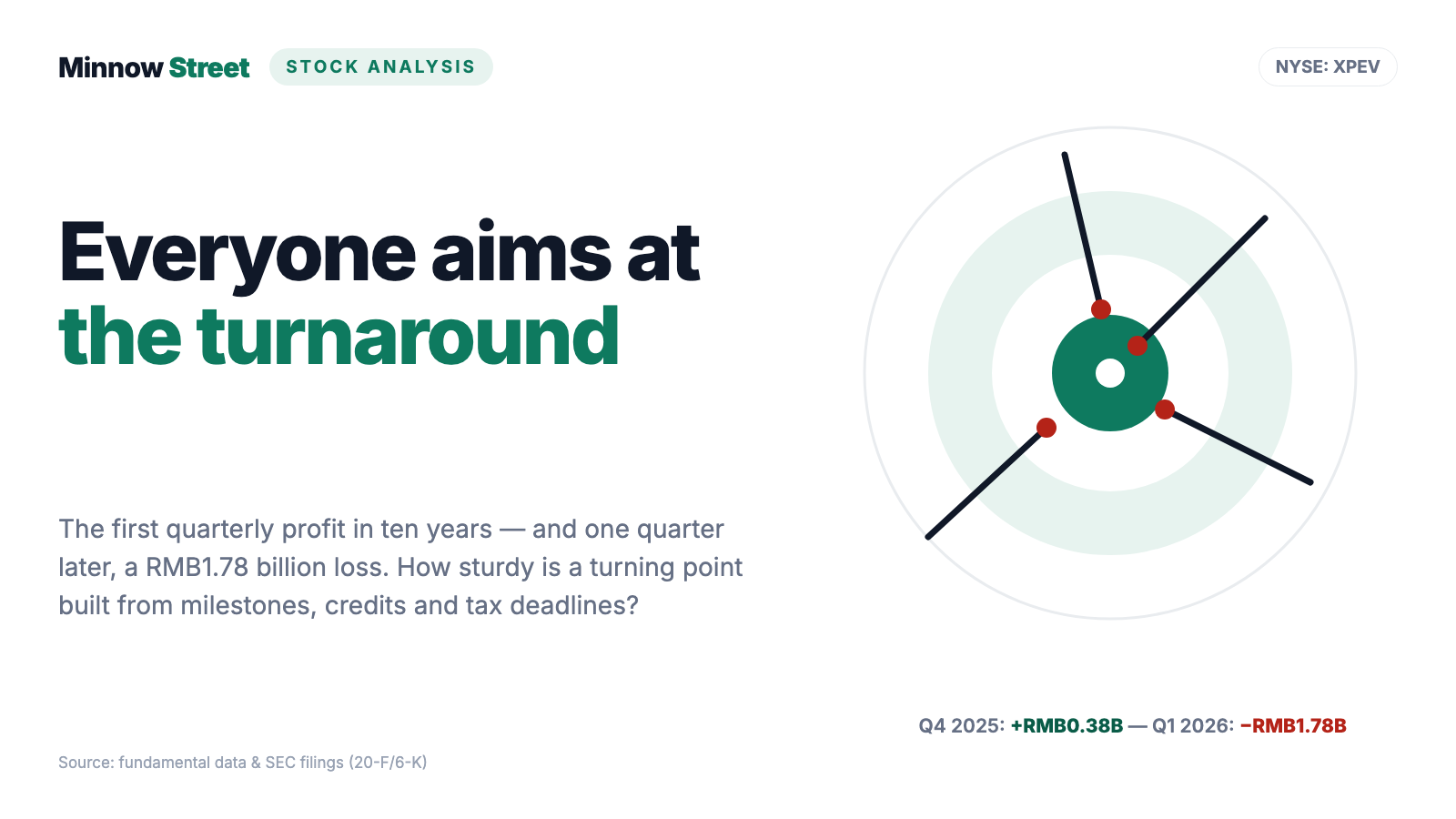
XPeng delivered in 2025 what most EV challengers only promise: 429,445 vehicles (+126 percent), RMB76.7 billion in revenue (+88 percent) — and, in the fourth quarter of 2025, the first quarterly net profit since its 2015 founding. One quarter later, the filings showed a RMB1.78 billion loss, deeper than any quarter of the prior year. We read the annual report for foreign private issuers (20-F) and the interim reports (6-K) — and found who actually paid for that first profit: a Volkswagen milestone, carbon credits, and the final sprint of an expiring tax break. Not investment advice — just the math on what a turning point is worth when it has held for 90 days so far.
 Thomas Mücke
Founder & Publisher
Thomas Mücke
Founder & Publisher
Chart
Interactive price chart (TradingView).
Note: pure fact-based analysis, not investment advice and not a solicitation to buy or sell. All figures without guarantee.
There is an investor trap that snaps shut whenever a loss-making company reports its first black quarter: the ruler trap. Your brain gets two data points — "RMB5.8 billion loss in 2024" and "first quarterly profit at the end of 2025" — and immediately lays a ruler across them: if this continues, the company is a profit machine within two years. Those are exactly the two points XPeng Inc. (NYSE: XPEV) rode through the headlines: deliveries more than doubled, record gross margin, first quarterly profit in company history. So let\'s make a deal: before you reach for the ruler, we read together what XPeng has filed, under penalty of law, with the U.S. securities regulator, the SEC. As a foreign private issuer, the company files an annual report on Form 20-F and interim reports on Form 6-K — the counterparts of the better-known 10-K and 10-Q. In those filings sits the third data point the ruler skips: in the quarter after the first profit, deliveries fell 33 percent and the net loss, at RMB1.78 billion, was deeper than in any quarter of the prior year. Three points no longer make a line — they make a story. And what you do with it is, in the end, your call.
What XPeng actually does — a carmaker priced like a software company (for better and worse)
XPeng — founded in Guangzhou in 2015 by former Alibaba executive and UCWeb founder Xiaopeng He, NYSE-listed since 2020 (one ADS represents two Class A shares) — builds battery-electric and extended-range vehicles across seven model lines: from the compact MONA M03 through the P7+ and Next P7 sedans to the G6, G7 and G9 SUVs and the X9 van. In 2025 the company delivered 429,445 vehicles, more than double the prior year\'s 190,068, sold through 721 stores in 255 Chinese cities plus a growing export business. What makes it special is less the sheet metal than what sits underneath: XPeng develops its driver-assistance software XNGP, its XOS Tianji operating system and its electronic architecture in-house — of 19,884 employees at the end of 2025, 44.5 percent work in research and development. Think of XNGP as an apprentice chauffeur who rides along on every trip and keeps learning; it is sold as part of the car. Management now calls XPeng "a leading global AI mobility technology company" and promises mass-produced robotaxis and humanoid robots. Sounds like marketing? Partly, it is — the robots appear in the annual report mainly as an acquired "robotics platform technology," and the famous flying cars belong to a company of the founder, not to XPeng (more on both in our side finds). But the technology revenue is real: Volkswagen pays XPeng to co-develop the electronic architecture for VW electric cars built in China — and right here begins the central tension of this analysis, which runs through every chapter: XPeng grows like a success story, but the first profit in its history came to a substantial degree from something other than selling cars — and it lasted exactly one quarter.
Where the stock shows up in our scanner
We run roughly 3,500 stocks through our in-house stock scanner every day. XPeng landed on the research list via the price-to-sales ranking (data as of July 20, 2026) — the list of the cheapest stocks relative to revenue. To replicate: open the scanner, sort by price-to-sales, or go straight to the XPeng stock page. And an honest warning belongs right at the top: the displayed price-to-sales ratio of about 0.18 is optically too good, because it divides a U.S. dollar market value by revenue booked in Chinese yuan — XPeng reports in RMB. Convert the trailing-four-quarter revenue (RMB73.9 billion through March 31, 2026) into dollars and the honest P/S ratio is about 1.2. Still remarkably little for a company that grew revenue 88 percent — but not a tenth-of-revenue bargain. Our scanner deliberately pulls the ripcord where mixed currencies would get dangerous: solvency metrics like the Altman Z-score and the net-net liquidation value (NCAV) stay blank for XPEV rather than serve up false precision. What the fundamental lens does show (data as of July 20, 2026): a Piotroski F-score of 7 of 9 — a nine-point test of the direction of the books; 7 means most measures are improving — a stock roughly 52 percent below its high and only about 12 percent above its 52-week low, down 34 percent over six months. Twenty-eight analysts cover the name; the consensus leans toward "buy." Remember this for everything that follows: a ranking sorts numbers — it does not check what currency they were born in. Which is exactly why we now read the filings.
The numbers over the years — honestly appraised
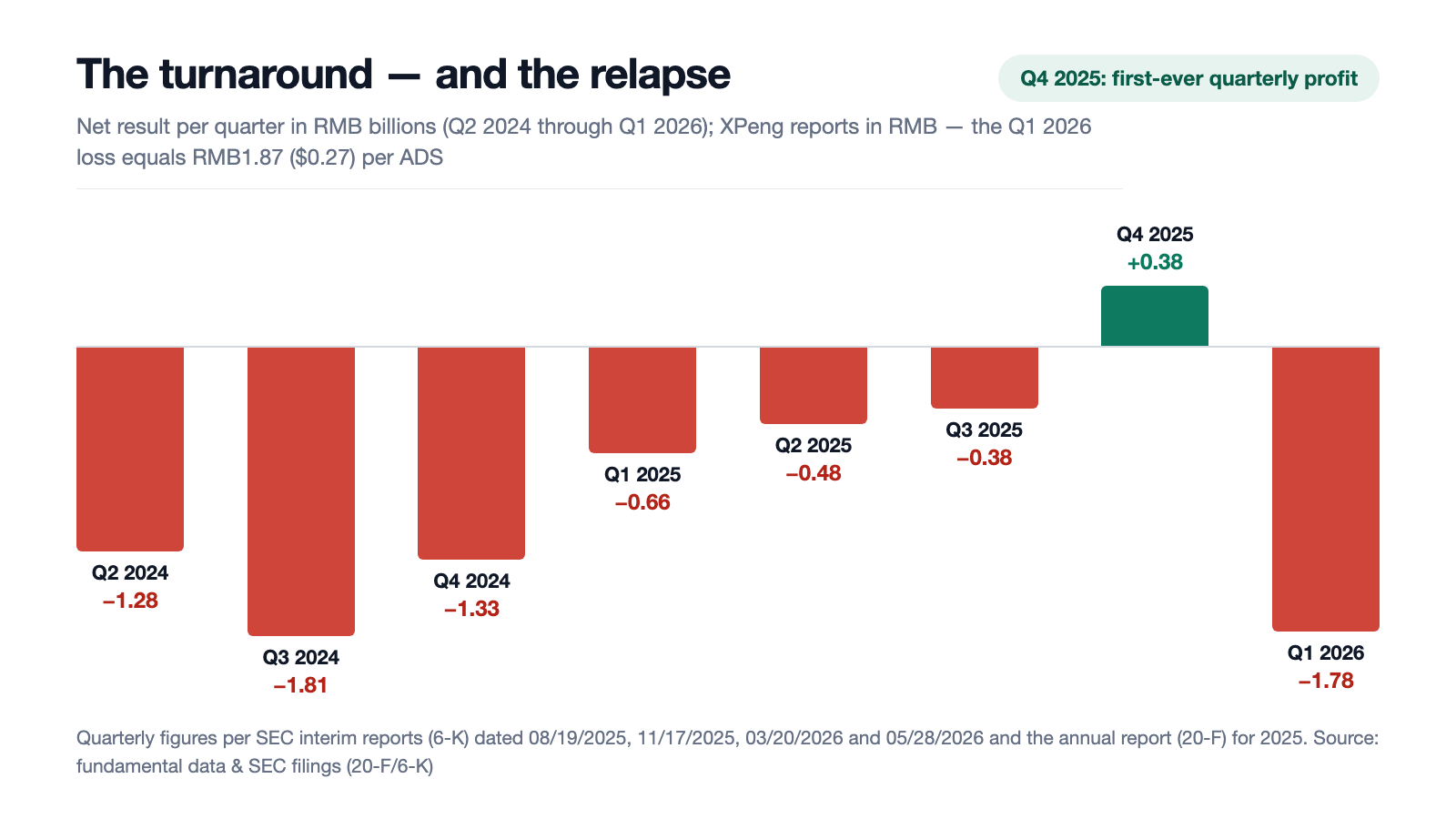
First, what genuinely impresses — and at XPeng that is a lot. Revenue jumped from RMB30.68 billion (2023) to RMB40.87 billion (2024) to RMB76.72 billion (2025, +87.7 percent, roughly $11 billion). Gross margin — the share of revenue left after pure production costs — climbed from a meager 1.5 percent to 18.9 percent in two years; the vehicle margin alone from 8.3 percent (2024) to 12.8 percent (2025). The operating loss melted from RMB10.89 billion through RMB6.66 billion to RMB2.77 billion, the net loss from RMB10.38 billion through RMB5.79 billion to RMB1.14 billion. And unlike many growth stories, XPeng stopped burning cash in day-to-day operations in 2025: operating cash flow swung from −RMB2.01 billion (2024) to +RMB8.26 billion, and cash plus deposits stood at RMB47.66 billion ($6.81 billion) at year-end 2025. The quarterly series shows how close the turnaround seemed — and how fast it tipped over:
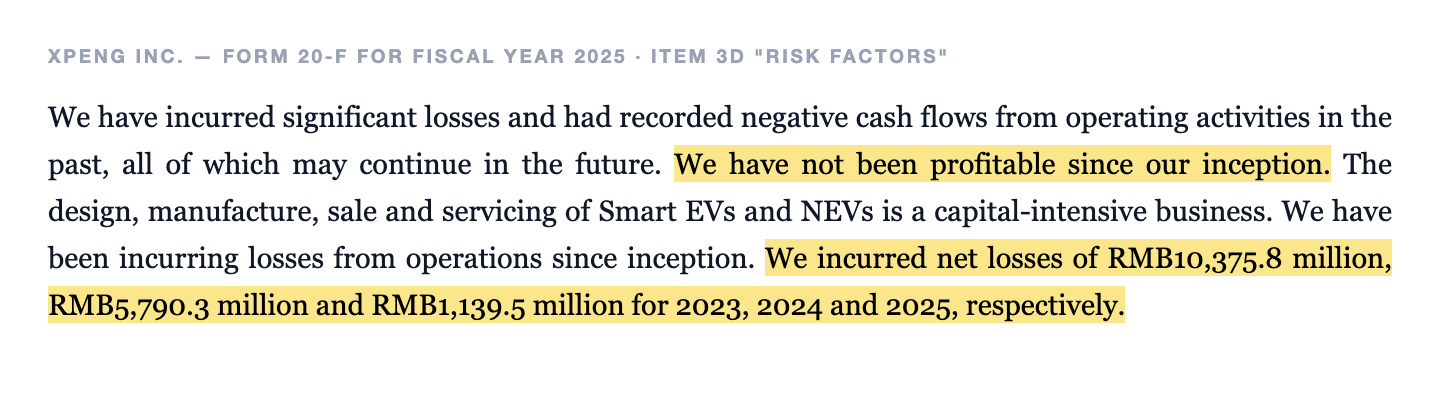
Honesty also demands the long line underneath this series. XPeng has never seen a profitable year, and the annual report says so without hedging:
"We have not been profitable since our inception. […] We have been incurring losses from operations since inception. We incurred net losses of RMB10,375.8 million, RMB5,790.3 million and RMB1,139.5 million for 2023, 2024 and 2025, respectively."
— XPeng Inc., SEC annual report 20-F for 2025, Item 3D "Risk Factors"
The accumulated deficit stood at RMB42.77 billion at the end of 2025 — roughly $6 billion that shareholders have fronted over the years. Remember the image: 2025 was the first year XPeng\'s engine ran smoothly — but the tank of the past is still far from refilled.
The break: the first quarter of 2026
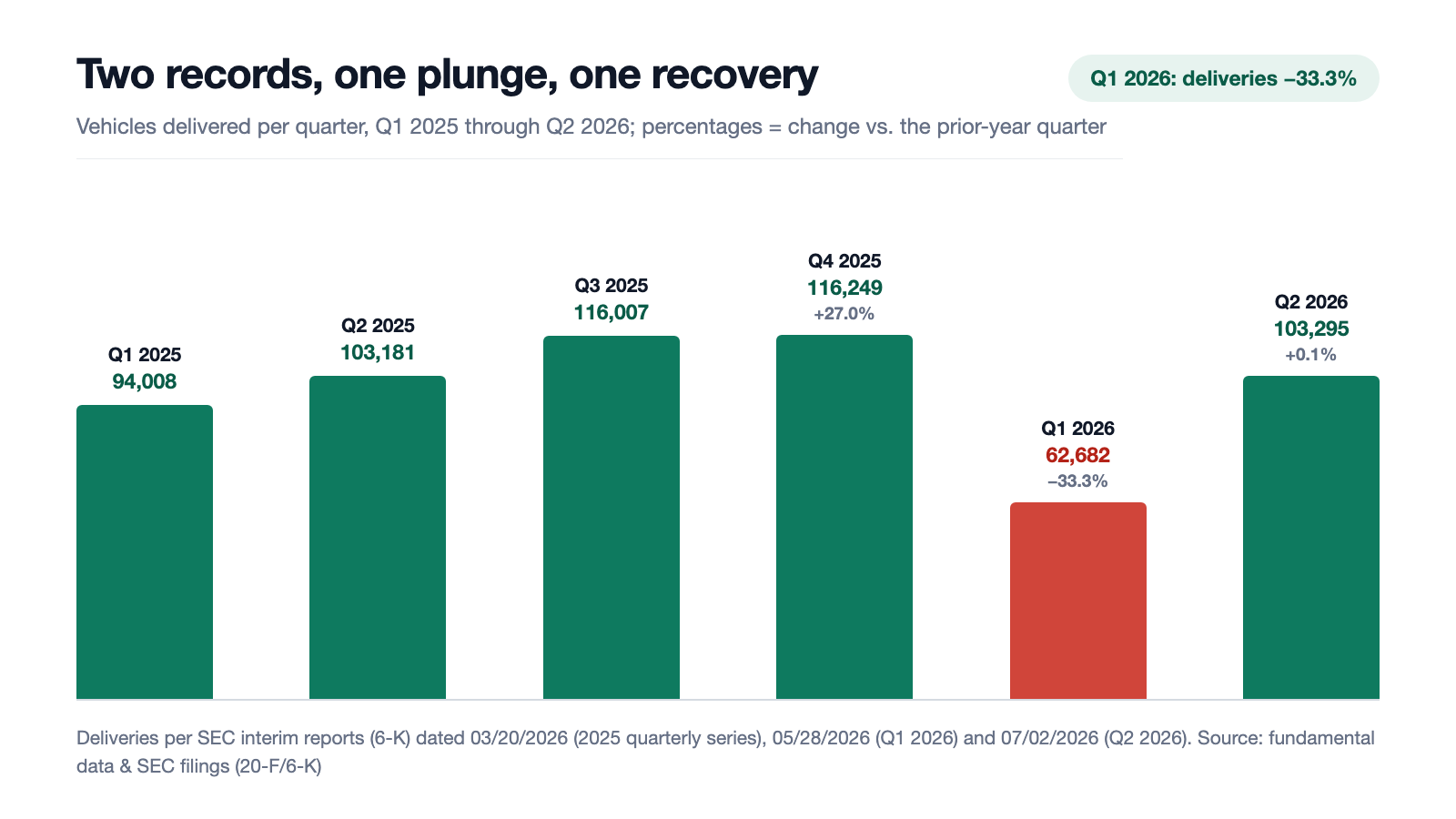
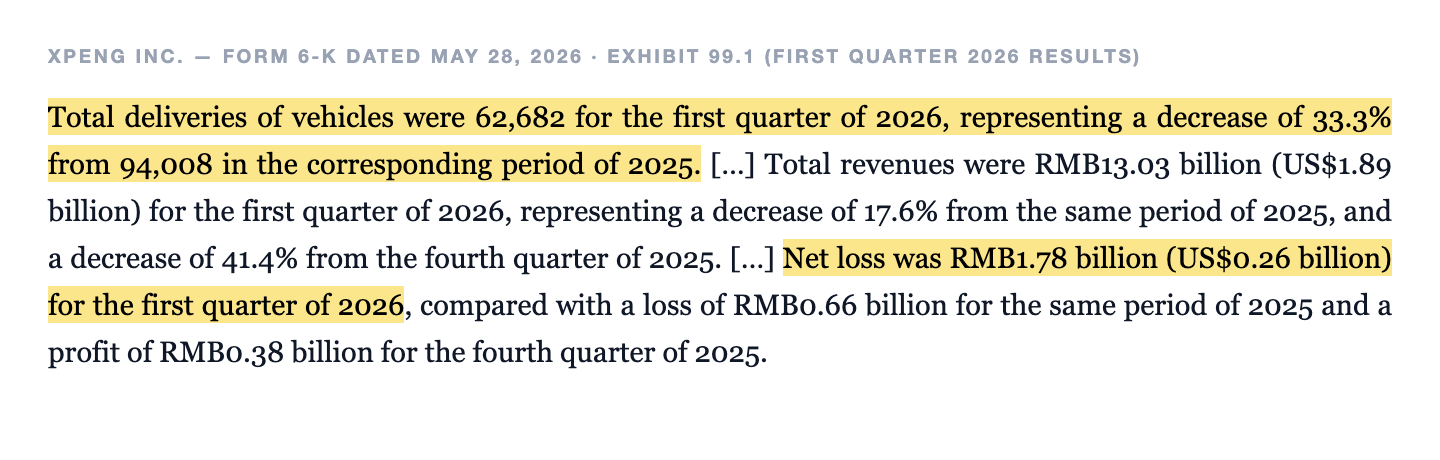
Then came the quarter after the first profit. The interim report (6-K) dated May 28, 2026 shows, for the first quarter of 2026: 62,682 vehicles delivered — down 33.3 percent year over year, revenue RMB13.03 billion (−17.6 percent), net loss RMB1.78 billion after RMB0.66 billion a year earlier and a RMB0.38 billion profit the quarter before. Per ADS, the loss was RMB1.87 ($0.27). Gross margin held strong at 20.6 percent — the cars were simply missing. Why? Three reasons can be documented from the SEC filings. First, China\'s NEV purchase-tax exemption of up to RMB30,000 per vehicle expired on December 31, 2025; since January 1, 2026 only half the break applies (at most RMB15,000) — a classic pull-forward that additionally inflated the record final quarter of 2025 and drained the following one. Second, XPeng sat mid-model-changeover — management had predicted the drop precisely with its own guidance of 61,000 to 66,000 deliveries. Third, the price war in China\'s EV market grinds on; the annual report describes "increasing price competition" alongside government "anti-involution" appeals against ruinous undercutting. The good news sits in the delivery announcement dated July 2, 2026: in the second quarter of 2026 XPeng delivered 103,295 vehicles — back at the prior-year level (103,181), carried by the new GX tech SUV (6,739 units in June) and ahead of the MONA L03 launch in July. Four new models are slated for 2026 in total.
What the filings say — the uncomfortable truths
Uncomfortable truth no. 1: The first profit walked on three crutches — and all three were gone the next quarter
The historic quarterly profit of RMB0.38 billion in the fourth quarter of 2025 did not come from selling cars alone. The "services and others" segment swelled to RMB3.18 billion in exactly that quarter — and the interim report for the following quarter explains, with unintended precision, why:
"The quarter-over-quarter decrease was primarily due to the reduction in technical R&D services revenues following a significant milestone catch-up in the prior quarter, as well as no revenue contribution from carbon credit trading in the current quarter."
— XPeng Inc., SEC interim report 6-K dated May 28, 2026 (Q1 2026 results)
In plain investor language: in the profit quarter, technology milestones (mostly from the Volkswagen collaboration) were billed in a lump and carbon credits were sold — both software-margin revenues, neither repeatable the next quarter. On top of that, the purchase-tax exemption expired, pulling purchases into the final quarter of 2025. And one more number belongs in this list: in 2025 XPeng booked RMB1.76 billion of "other income, net" — per the annual report "primarily due to the increase in government subsidies." Without it, the operating loss would have been not RMB2.77 billion but more than RMB4.5 billion. None of this is hidden or improper — it is all in the filings. But remember the principle: a turning point built out of milestones, credits and tax deadlines is an appointment — not a trend.
Uncomfortable truth no. 2: 11 percent of revenue, roughly 39 percent of gross profit — and "primarily" a single customer
The high-margin technology segment is XPeng\'s best card and its biggest concentration risk at once. In 2025, "services and others" produced RMB8.34 billion of revenue — just 10.9 percent of the group — but at a 68.2 percent gross margin it delivered roughly RMB5.69 of the RMB14.47 billion in gross profit: about 39 percent. Picture a bakery that teaches baking classes on the side: the classes are a tenth of revenue but almost half the profit — and there is effectively one student enrolled. The annual report names that student:
"However, we have a limited track record of providing technical services under the Technical Collaboration, and we primarily rely on the Volkswagen Group for the revenue arising from such services."
— XPeng Inc., SEC annual report 20-F for 2025, Item 3D "Risk Factors"
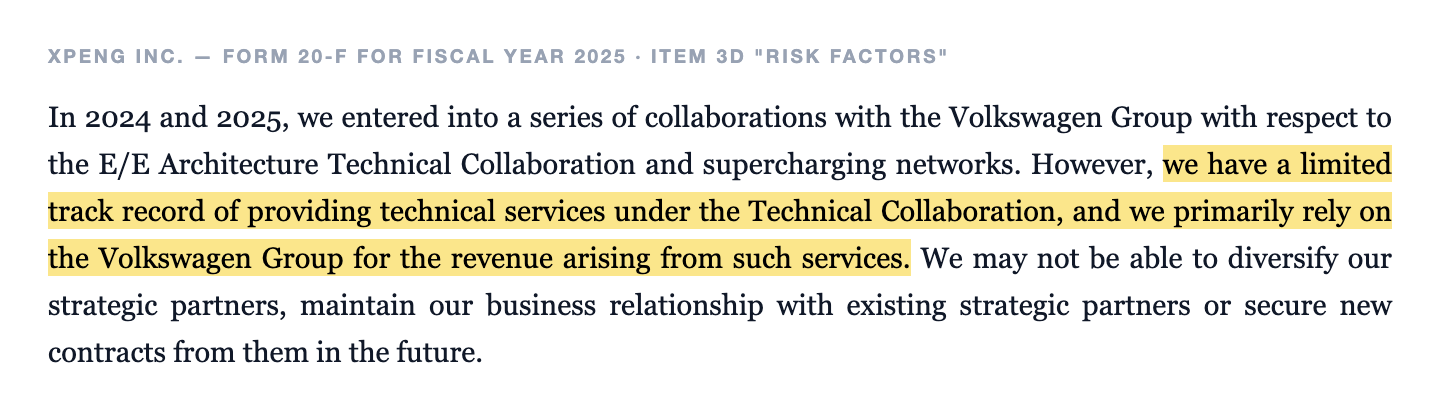
The collaboration itself is a genuine accolade: since July 2023 Volkswagen has owned 4.9 percent of XPeng (94.1 million Class A shares); since 2024 the two have been jointly developing the electronic architecture slated to power VW-brand electric cars produced in China from 2026, plus joint sourcing and a fast-charging partnership. If you believe in it, you get a Western auto giant as a paying technology customer and anchor shareholder. If you do the sober math, you see: if this one partner steps away, it is not a tenth of the business that wobbles but more than a third of gross profit. How concentrated Chinese tech companies can get is something we dissected at Agora — at XPeng, concentration is not a side effect; it is the profit model.
Uncomfortable truth no. 3: 69.1 percent of the votes for about 19 percent of the shares — and your car company is yours only by contract
Anyone buying the XPeng ADS should know two constructions. First, the voting rights: XPeng has two share classes — the publicly traded Class A with one vote, and Class B with ten votes per share. Every single Class B share sits with the founder:
"As of March 31, 2026, Mr. Xiaopeng He, our co-founder and chairman beneficially owned all the Class B ordinary shares issued and outstanding, which represented 69.1% of the voting power of our total issued and outstanding shares."
— XPeng Inc., SEC annual report 20-F for 2025, Item 3D "Risk Factors"
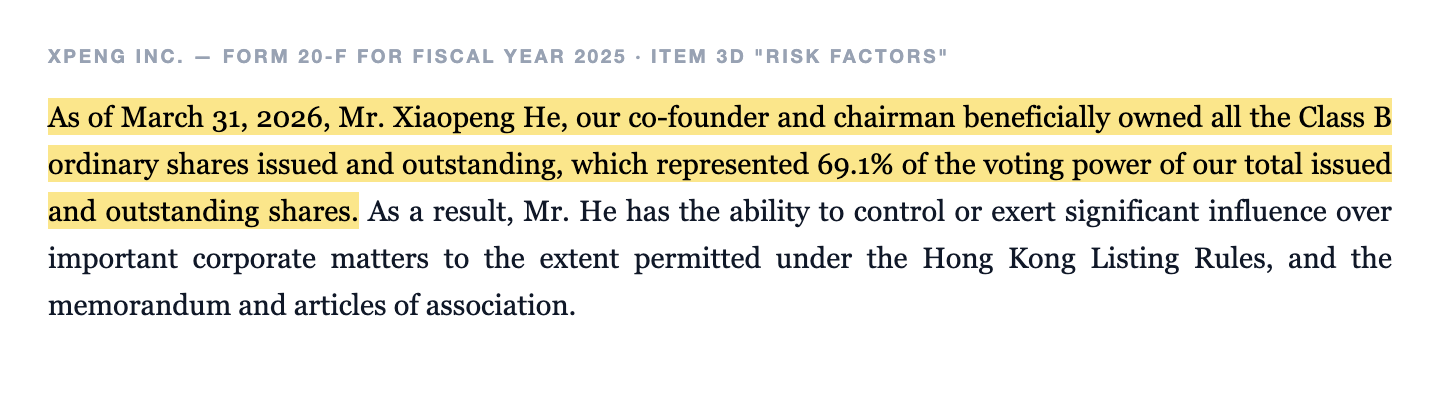
Counting all share classes, the 20-F\'s ownership table puts He at 69.3 percent of the votes on roughly 19 percent of the capital. Your ADS vote is background music — as at many founder-led tech firms, except that here a second construction stacks on top: parts of the China business (telematics, insurance brokerage) run through VIE contract entities — as an ADS holder you own shares of a Cayman holding company that does not own those units but controls them through contracts whose enforceability in Chinese courts the annual report itself calls untested. Add the sword of Damocles of the Holding Foreign Companies Accountable Act: if U.S. inspectors lose access to the audit workpapers again, a NYSE delisting looms after two consecutive years. XPeng shares all of this with most China ADS listings — we walked through the same architecture in our Weibo analysis. None of it is news to anyone who reads the 20-F. But it belongs in every honest calculation: you are buying growth here — control and direct ownership are not included in the box.
Valuation: what the market pays in mid-July 2026
As of the July 17, 2026 data cut-off, the XPeng ADS cost about $13.50 and the market value stood near $13 billion — roughly half below the 52-week high and only about 12 percent above the 52-week low. A P/E ratio does not exist for lack of sustained profits; the most honest yardstick is the currency-adjusted price-to-sales ratio of about 1.2 (trailing-four-quarter revenue: RMB73.9 billion, roughly $10.7 billion). Add a cash position of RMB42.09 billion ($6.10 billion) as of March 31, 2026 — nearly half the market value, though borrowings and the capital intensity of carmaking stand against it. For orientation: classic carmakers often trade at 0.3 to 0.5 times revenue, software companies at multiples above that — the market prices XPeng right in between, as a carmaker with a software admixture. The 28 analysts counted by the data provider lean toward "buy" in consensus but still expect red ink for 2026. Management itself guides for 100,000 to 106,000 second-quarter 2026 deliveries and RMB19.6 to 20.8 billion in revenue — the delivery landing (103,295) has been on file since July 2, 2026; the accompanying income statement was still outstanding at our editorial deadline. The ruler points in two directions here, depending on the investor: growth eyes see 1.2 times revenue for 88 percent growth — loss eyes see the ninth consecutive loss-making year in the books. Both are reading the same filings.
Opportunities and risks at a glance
What speaks for XPeng:
- Documented hypergrowth: deliveries +125.9 percent to 429,445 (2025), revenue +87.7 percent to RMB76.72 billion, gross margin up from 1.5 to 18.9 percent in two years — and Q2 2026 deliveries already back at 103,295 after the plunge (6-K dated 07/02/2026).
- First real operating substance: operating cash flow +RMB8.26 billion (2025), cash and deposits of RMB42.09 billion ($6.10 billion) as of 03/31/2026, Piotroski F-score 7 of 9 (data as of 07/20/2026).
- Volkswagen as paying technology customer and shareholder (4.9 percent): joint E/E architecture in VW-brand China EVs from 2026, joint sourcing, fast-charging partnership — the services segment earned a 68.2 percent gross margin in 2025 (20-F 2025).
- Genuine technology depth: 44.5 percent of 19,884 employees in R&D, XNGP driver assistance and the operating system built in-house, 2025 R&D budget of RMB9.49 billion (+47 percent); options on robotaxis, robotics and international expansion on top.
- A currency-adjusted P/S ratio of about 1.2 (mid-July 2026) for a maker growing at a high double-digit rate — the analyst community (28 estimates) leans toward "buy."
What speaks against it:
- The turnaround is unproven: the first quarterly profit (+RMB0.38 billion, Q4 2025) leaned on a VW milestone catch-up, carbon credits and a subsidy sprint — followed by a RMB1.78 billion loss and deliveries down 33.3 percent (6-K dated 05/28/2026).
- Volkswagen concentration: technology revenue (10.9 percent of sales, roughly 39 percent of gross profit) relies "primarily" on one partner per the 20-F; milestone billing makes it lumpy on top.
- Price war and politics: "increasing price competition" in China despite "anti-involution" appeals; the NEV purchase-tax break halved since 01/01/2026; an additional EU countervailing duty of 20.7 percentage points on China-built EVs (as a cooperating, non-sampled maker) weighs on the European expansion (20-F 2025).
- Structural risks: the founder controls 69.1 percent of the votes (all Class B shares), parts of the business run through VIE contracts, the HFCAA delisting scenario stays latent; accumulated deficit RMB42.77 billion (12/31/2025).
- Dilution and side stages: stock-based compensation of RMB564 million (2025), share placements to DiDi and VW in recent history; robotics via a related-party purchase (Dogotix, $98.96 million) and a flying-car story outside the company (Huitian) — more in our side finds.
A human conclusion
Back to the ruler trap. Its trick is not that it lies to you — the two data points are real. Its trick is that it does not let you wait for the third. At XPeng, all three are now on the table: a record year with genuine operating progress (cash flow, margin, scale); a first quarterly profit that, on inspection, was built from milestones, credits and a tax deadline; and a following quarter that brought the deepest loss since 2024 before deliveries steadied in the spring. This is not a takedown: a company that puts 44.5 percent of its people into R&D, wins Volkswagen as a customer and lifts gross margin from 1.5 to 18.9 percent in two years has achieved more than most EV challengers of its generation. But between "more than most" and "sustainably profitable" lie exactly the quarters still to come. If you hold or buy the stock, check three things going forward: whether the vehicle margin stays above 12 percent without subsidy tailwinds (every 6-K interim report), whether the technology revenue finds customers beyond Volkswagen — and whether the 2026 model offensive (GX, MONA L03 and two more launches) carries deliveries without a new round of discounts. That is the answer the ruler gets: do not extrapolate — re-measure, quarter by quarter. What you make of it is your decision. And that is exactly as it should be.
Sources
All original documents used in this analysis — for your own reading:
- XPeng Inc. — SEC annual report 20-F for 2025 (filed April 16, 2026)
- XPeng Inc. — SEC interim report 6-K dated March 20, 2026 (Q4 and fiscal year 2025 results)
- XPeng Inc. — SEC interim report 6-K dated May 28, 2026 (Q1 2026 results)
- XPeng Inc. — SEC interim report 6-K dated July 2, 2026 (June and Q2 2026 deliveries)
- XPeng Inc. — SEC interim report 6-K dated August 19, 2025 (Q2 2025 results) and 6-K dated November 17, 2025 (Q3 2025 results)
- XPeng\'s complete SEC filing history: EDGAR overview (sec.gov)
- Fundamental data (metrics, quarterly series, valuation, analyst consensus; data as of July 20, 2026, price/market-value figures as of July 17, 2026), cross-checked against the SEC filings.
- Screener and rating data: in-house stock scanner (data as of July 20, 2026), including the price-to-sales ranking.
Transparency & disclaimer: This analysis is a journalistic contextualization of publicly available information and is not investment advice, not financial analysis in the regulatory sense, and not a solicitation to buy or sell securities. Stock investments carry substantial risks up to total loss; China ADS listings add structural (VIE), regulatory and delisting risks. All information without guarantee; data cut-offs are noted in the text. RMB/U.S. dollar conversions follow the exchange rates stated in the respective SEC filings. The author holds no position in XPeng securities at the time of publication.
Our Bottom Line at a Glance
- Growth & scale positive
- Deliveries +125.9 percent to 429,445 (2025), revenue +87.7 percent to RMB76.72 billion, gross margin up from 1.5 to 18.9 percent in two years; after the Q1 plunge (−33.3 percent), Q2 2026 deliveries already back at 103,295 (20-F 2025; 6-K dated 05/28 and 07/02/2026).
- Cash & balance sheet positive
- Operating cash flow clearly positive for the first time in 2025 (+RMB8.26 billion), cash and deposits of RMB42.09 billion ($6.10 billion) as of 03/31/2026, Piotroski 7 of 9 — set against RMB42.77 billion of accumulated deficit since inception (20-F 2025).
- Earnings quality negative
- The first quarterly profit (+RMB0.38 billion, Q4 2025) leaned on a milestone catch-up in VW technology revenue, carbon credits and the subsidy sprint; the following quarter brought a RMB1.78 billion loss — plus RMB1.76 billion of 2025 "other income" mostly from government subsidies (6-K dated 05/28/2026; 20-F 2025).
- Technology revenue & Volkswagen neutral
- Services/technology: just 10.9 percent of revenue but a 68.2 percent margin and roughly 39 percent of 2025 gross profit — per the 20-F "primarily" dependent on the Volkswagen Group, which also owns 4.9 percent. An accolade and a concentration risk in one (20-F 2025).
- Governance & structure negative
- Founder Xiaopeng He controls 69.1 percent of the votes via Class B shares (10 votes each) on roughly 19 percent of the capital; VIE contract structures for parts of the China business, the HFCAA delisting scenario; related-party purchases like Dogotix ($98.96 million) warrant attention (20-F 2025).
- Competition & policy negative
- An ongoing price war in China's EV market ("increasing price competition," "anti-involution" appeals), the NEV purchase-tax break halved since 2026, an additional EU countervailing duty of 20.7 percentage points on the European expansion — demand and margins remain policy- and discount-driven (20-F 2025).
In 2025, XPeng delivered what growth investors wanted to see: deliveries more than doubled, record gross margin, operating cash flow clearly positive for the first time, Volkswagen as a paying technology customer and shareholder — crowned by the first quarterly profit in company history. But that profit only partly survived inspection: it leaned on milestone catch-ups, carbon credits and an expiring tax break — and the following quarter brought the deepest loss since 2024 at RMB1.78 billion before deliveries recovered. Whoever buys the ADS buys real growth with unreal voting power (69.1 percent with the founder), a VIE structure, and a profit model whose highest-margin part hangs on a single partner. Not investment advice.
What Our Rating Means
- If you don't own the stock
- As long as the question raised in the bottom line stays open, we see no basis for an entry.
- If you hold it in your portfolio
- Our findings offer no acute reason to sell — the checkpoints named remain decisive.
A journalistic assessment by our editorial team at the time of the deep dive, based on public sources — not investment advice and not a solicitation to buy or sell. Your personal circumstances (investment goals, risk capacity, taxes) cannot be taken into account. What our categories mean, how verdicts are formed, and what conflicts of interest exist →
Worth Noting
- XPEV reached the research list via the price-to-sales ranking of our in-house stock scanner (data as of July 20, 2026). The displayed P/S of about 0.18 mixes a U.S. dollar market value with RMB revenue; currency-adjusted it is roughly 1.2 — the article uses the adjusted figure throughout.
- XPeng is a foreign private issuer: it files 20-F and 6-K instead of 10-K/10-Q; the Altman Z-score and NCAV stay deliberately blank in the scanner (currency guard for an RMB reporter with a USD listing). One ADS represents two Class A ordinary shares — all per-ADS figures accordingly.
- Price and market-value figures (~$13.50, ~$13 billion) come from the July 17, 2026 feed and serve only as a dated valuation anchor; analyses are evergreen, daily prices are not a buy argument. The full second-quarter 2026 income statement was still outstanding at our editorial deadline (July 20, 2026).
Frequently Asked Questions
XPeng Inc. (NYSE: XPEV, Guangzhou) sells battery-electric and extended-range vehicles across seven model lines (including the MONA M03, P7+, G6, G7, G9 and X9) — RMB68.38 of RMB76.72 billion in 2025 revenue. On top come "services and others" (RMB8.34 billion): mainly technical R&D services for the E/E architecture collaboration with Volkswagen, plus parts, charging services and carbon credits — at a 68.2 percent gross margin the group's profit engine.
On an annual basis, no: 2025 still ended with a net loss of RMB1.14 billion (2024: RMB5.79 billion; 2023: RMB10.38 billion), and the accumulated deficit reached RMB42.77 billion as of December 31, 2025. The fourth quarter of 2025 brought the first quarterly net profit in company history (+RMB0.38 billion) — but the first quarter of 2026 swung back to a RMB1.78 billion loss. Operating cash flow turned clearly positive in 2025 at +RMB8.26 billion.
In the first quarter of 2026 XPeng delivered 62,682 vehicles — down 33.3 percent year over year (6-K dated May 28, 2026). Three documented reasons: China's NEV purchase-tax exemption (up to RMB30,000 per vehicle) expired on December 31, 2025 and has been halved since 2026, pulling purchases into late 2025; the model changeover to the 2026 generation (GX, MONA L03) was imminent; and the price war in China's EV market continued. Second-quarter 2026 deliveries recovered to 103,295 — the prior-year level.
Volkswagen has owned 4.9 percent of XPeng since July 2023 (94.1 million Class A shares) and pays XPeng for jointly developing the electronic architecture slated for VW-brand electric cars built in China from 2026; joint sourcing and a fast-charging partnership come on top. The annual report (20-F) warns at the same time: for the revenue from these technology services — a substantial part of RMB8.34 billion in 2025 services revenue at a 68.2 percent margin — XPeng relies "primarily" on the Volkswagen Group.
Founder and CEO Xiaopeng He owns all Class B shares (10 votes each) and thereby controls 69.1 percent of the voting power — 69.3 percent counting all classes, on roughly 19 percent of the capital (20-F for 2025, as of March 31, 2026). Larger Class A holders include JPMorgan (7.0 percent of Class A), Volkswagen (6.0 percent) and BlackRock (5.3 percent). ADS holders vote with one vote per Class A share — in practice, the founder decides.
On the NYSE you do not trade the ordinary share itself but American depositary shares (ADS), each representing two Class A ordinary shares. Every per-share figure in the SEC filings exists twice — per ordinary share and per ADS. The first-quarter 2026 loss, for example, was RMB0.93 per ordinary share but RMB1.87 ($0.27) per ADS. Anyone comparing metrics must watch that basis — and the fact that XPeng reports in RMB while the ADS trades in U.S. dollars.
The ranking sorts all stocks by price-to-sales (market value divided by trailing-four-quarter revenue). For XPeng the scanner shows about 0.18 — but that figure divides a U.S. dollar market value by revenue booked in RMB. Currency-adjusted, the P/S ratio is roughly 1.2 (market value about $13 billion, trailing revenue about $10.7 billion; as of mid-July 2026). For the same reason the Altman Z-score and NCAV stay deliberately blank for XPEV: metrics from mixed currencies would be false precision.
Found an error?
Did you spot a factual error, an outdated number, or a typo in this deep dive? Let us know briefly — your report goes straight to the editorial team.