Lam Research Stock: Records in the AI Boom — and a Third of the Revenue Hangs on China
Lam Research builds the machines without which no modern chip gets made — and delivers one record after another in the AI boom: $18.4 billion in revenue in fiscal year 2025, a gross margin near 50 percent, a record quarter in March 2026. We read the annual report (10-K), the quarterly reports (10-Q) and the insider filings (Form 4): 34 percent of revenue comes from China and sits under export controls, two customers pay a third of the bills, and the CEO sold in July 2026 at $390 per share. Not investment advice — we simply count what the record costs and what it hangs on.
 Thomas Mücke
Founder & Publisher
Thomas Mücke
Founder & Publisher
Chart
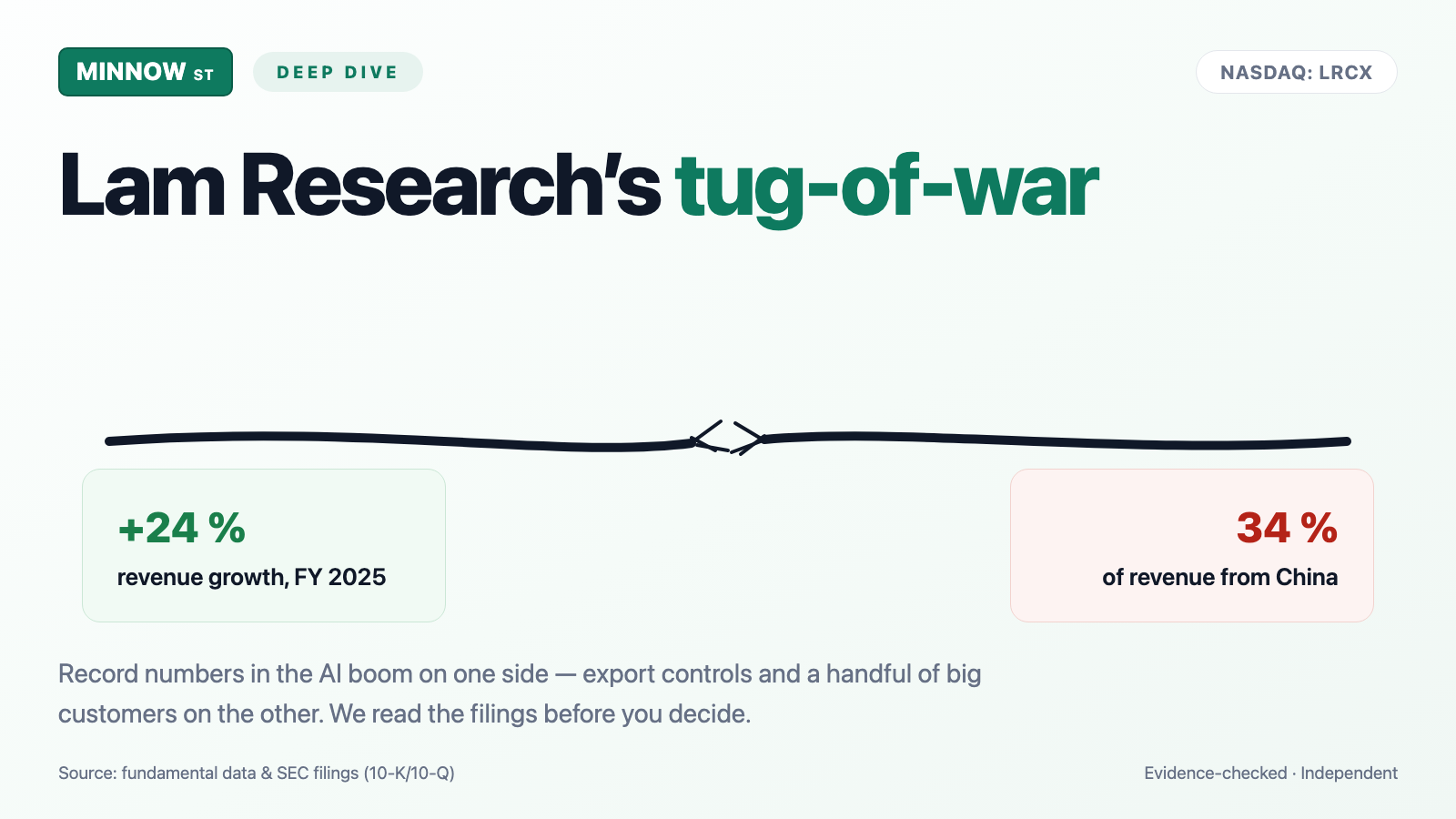
Interactive price chart (TradingView).
Note: pure fact-based analysis, not investment advice and not a solicitation to buy or sell. All figures without guarantee.
There is a sentence investors use to talk themselves into any price: "You can always buy quality." It feels wise because it sounds like Warren Buffett, and it is dangerous because it ends the thinking before the thinking starts. Whoever has a flawless company in front of them — record revenue, dream margins, a fortress balance sheet — stops looking for the catch. Exactly this reflex is the real danger at Lam Research (Nasdaq: LRCX) right now: the company delivers one record quarter after another in the AI boom, the stock has roughly quadrupled within twelve months, and the quality is entirely beyond dispute. So let's make a deal: before you sign the quality free pass, we read together what Lam itself reported to the U.S. securities regulator, the SEC — in the annual report (10-K) for fiscal year 2025, in three quarterly reports (10-Q) and in the insider filings (Form 4) of the executive floor. An SEC filing is honest under penalty of law. And at Lam it contains both: one of the best money machines of the chip world. And three cluster risks it hangs on. In the end, you decide for yourself.
What Lam Research actually does
A modern memory chip is a high-rise with well over a hundred floors — just a few nanometers wide. It is built not with cranes but with machines that apply wafer-thin layers of material (deposition) and then mill holes, trenches and channels back into them with atomic precision (etch). Exactly these machines are what Lam Research builds — plus systems for cleaning the silicon wafers. Translated: Lam sells the excavators and concrete pumps of the chip age. The customers are the world's big memory, foundry and logic manufacturers; their fabs sit mostly in Asia. Add a second, steadier leg: spare parts, service, upgrades and refurbished equipment — a solid $2.1 billion of the $5.8 billion in revenue in the March quarter of 2026 alone. The company was founded in 1980, headquarters are in Fremont, California, and about 19,000 people work for Lam worldwide (as of August 2025).
Two peculiarities you have to know before we go into the numbers. First: the fiscal year ends in late June, not in December. So when this analysis speaks of "fiscal year 2025", it means the twelve months from July 2024 through June 29, 2025 — and "fiscal year 2026" has been running since July 2025. Second: Lam carried out a 10-for-1 stock split in October 2024; all price and share figures in this analysis are split-adjusted. You may already know the industry from our analysis of inspection-equipment maker KLA — KLA checks what has been built, Lam builds it. Both earn from the same boom: no new fabs, no AI chips — and no new fabs without Lam machines.
Where the stock shows up in our scanner
Every day we run about 3,500 stocks through our scanners. Lam Research lights up in three scanners (data as of July 10, 2026) — and the selection is remarkably one-sided: Joel Greenblatt: Magic Formula (high return on capital combined with a relatively cheap valuation within the screener universe), Buffett criteria (Buffettology) (durably high returns on equity, reliable earnings) and Altman-Z: balance-sheet fortress — a scanner that looks for the opposite of our insolvency-warning radar: balance sheets so solid that the classic bankruptcy early-warning formula never even stirs. That is the complete quality shelf, and the metrics explain why: return on equity around 67 percent, operating margin around 35 percent, an equity ratio around 51 percent, financial debt of only a good third of equity (all data as of July 10, 2026). For context: a return on equity of 67 percent means the company earns 67 cents per year on every dollar of equity — a figure that the share buybacks also lever upward, more on that later.
But read the scanner row to the end, because the uncomfortable values stand there too: a price-to-earnings ratio around 70, a price-to-sales ratio around 25, a price-to-book ratio around 45 — and a rally of roughly +311 percent within twelve months (relative strength 92: the stock beat 92 percent of the market; all data as of July 10, 2026). Remember the tension of this analysis, it is the connecting thread for everything that follows: the machine is flawless — but the price assumes that nothing in its own annual report's risk section ever happens.
The numbers over the years — an engine room that delivers
Let's start with what this company has earned — in both senses of the word. In fiscal year 2025 (through June 29, 2025), revenue rose 24 percent to $18.4 billion and net income 40 percent to $5.4 billion — of every revenue dollar, 29 cents stuck as profit. Operating cash flow came to $6.2 billion, the gross margin to almost 49 percent. And fiscal year 2026 keeps pushing: in the first nine months (through March 29, 2026), revenue again grew a good 24 percent to $16.5 billion, and the March quarter of 2026 — $5.84 billion in revenue, a 49.8 percent gross margin and $1.45 in earnings per share — was the best in company history. For the closing quarter (through June 28, 2026), Lam's current report (8-K) of April 22, 2026 guides to roughly $6.6 billion in revenue and a 50.5 percent gross margin — the full year would thus land around $23 billion, a good half more than in fiscal year 2024.
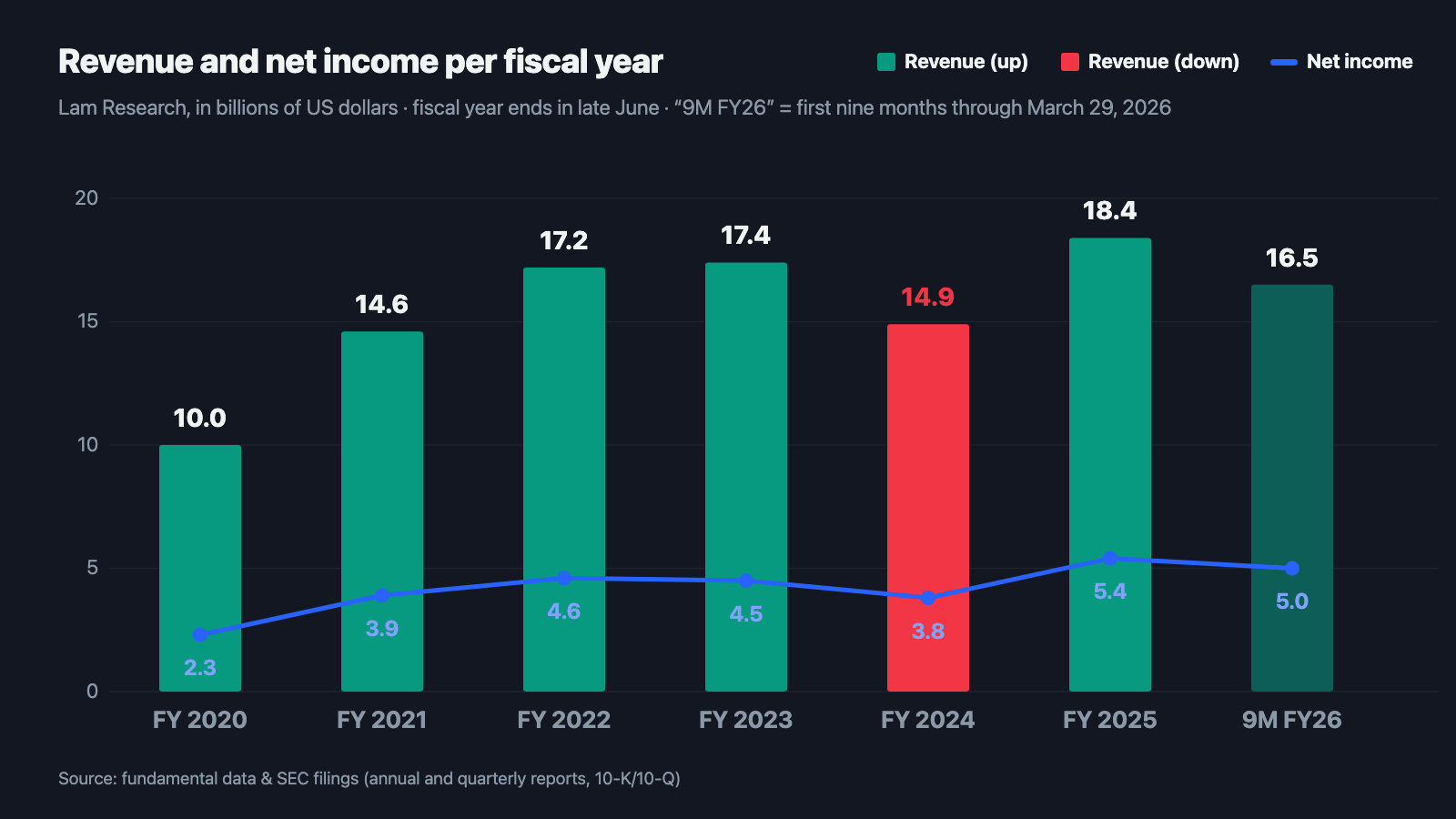
Look deliberately at the red bar in the chart: in fiscal year 2024, revenue fell 14.5 percent, mainly because the memory makers slashed their investments — an entirely normal equipment cycle, the same one the memory customer itself lives through (our Western Digital analysis shows the identical roller coaster from the customer's side). Lam stayed highly profitable throughout, no question. But the cycle is the reason equipment stocks historically rarely traded at luxury multiples: a record year was reliably followed, at some point, by an order year with the handbrake on. The current upswing, per the quarterly report (10-Q), is carried by foundry investment (58 percent of systems revenue in nine months) and lately, increasingly, by the memory business — in the March quarter, 39 percent of systems revenue came from the memory market, driven by DRAM, the working memory no AI data center can do without.
What the filings say — the uncomfortable truths
Uncomfortable truth no. 1: a third of the revenue comes from China — the country the U.S. restricts exports to
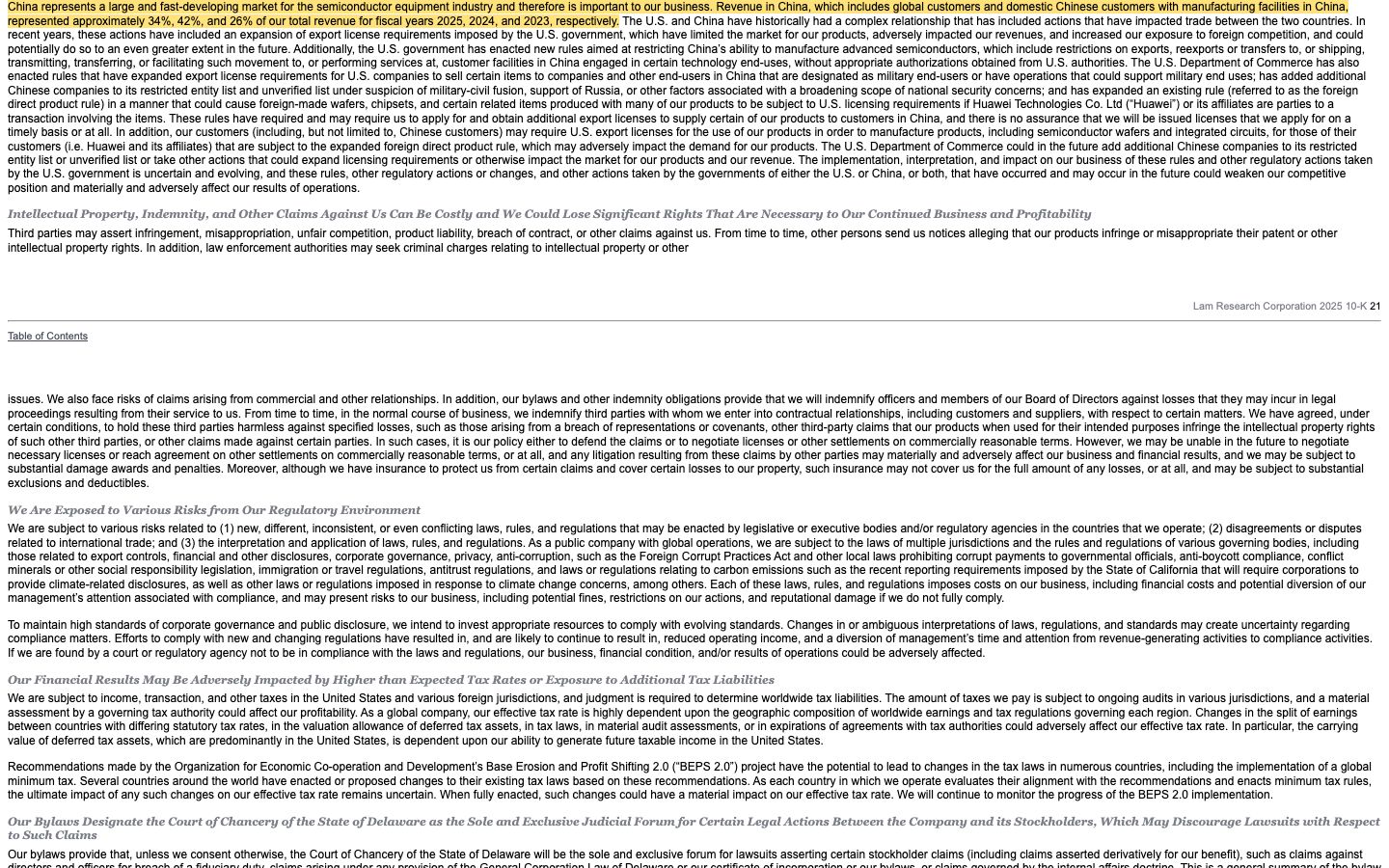
Now for the record's fine print. The annual report (10-K) devotes a dedicated risk factor to China with a remarkably candid heading: the China revenues have been impacted and are expected to be significantly and adversely impacted by export license requirements and other government measures. Below it stand the numbers:
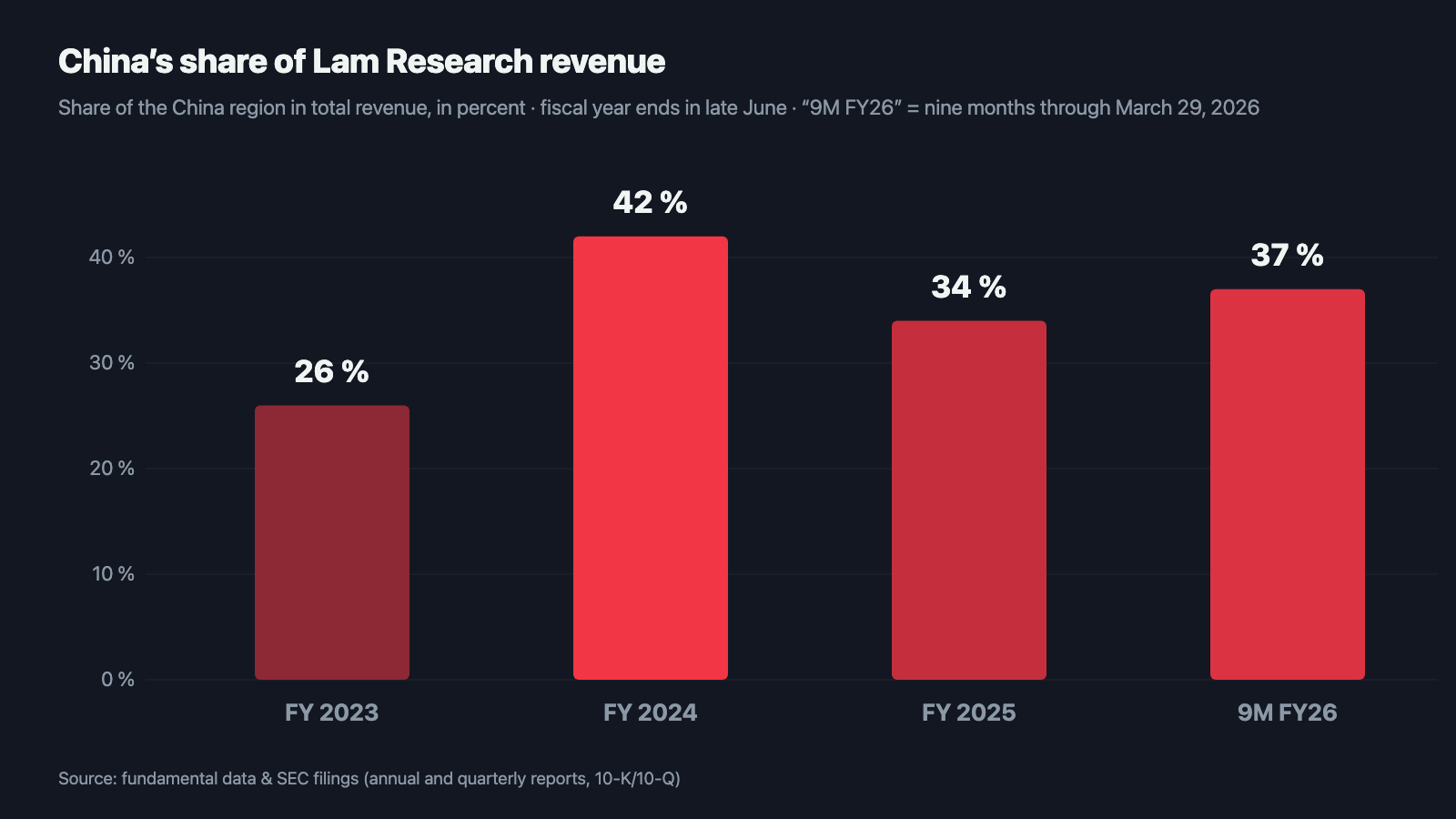
"China represents a large and fast-developing market for the semiconductor equipment industry and therefore is important to our business. Revenue in China, which includes global customers and domestic Chinese customers with manufacturing facilities in China, represented approximately 34%, 42%, and 26% of our total revenue for fiscal years 2025, 2024, and 2023, respectively."
— Lam Research, SEC annual report 10-K for fiscal year 2025, Item 1A "Risk Factors"
Read the sequence 26 — 42 — 34 twice, calmly. The China share has not settled harmlessly, it swings by enormous amounts: in fiscal year 2025 it was $6.2 billion, in the first nine months of fiscal year 2026 already $6.1 billion again — 37 percent of revenue. And this business stands under reservation: the U.S. government requires export licenses for selling certain equipment to China, has placed several Chinese customers on sanctions lists, and has tightened the rules several times in recent years. Lam itself writes there is no assurance it will receive requested licenses in time or at all. Meanwhile, Beijing is nursing up its own equipment makers with state money to clone exactly these tools. Put into an everyday image: a third of the rent is paid by one tenant whose lease has to be re-approved every year by two feuding agencies — and who is meanwhile learning to build the house himself.
Uncomfortable truth no. 2: two customers pay a third of the bills
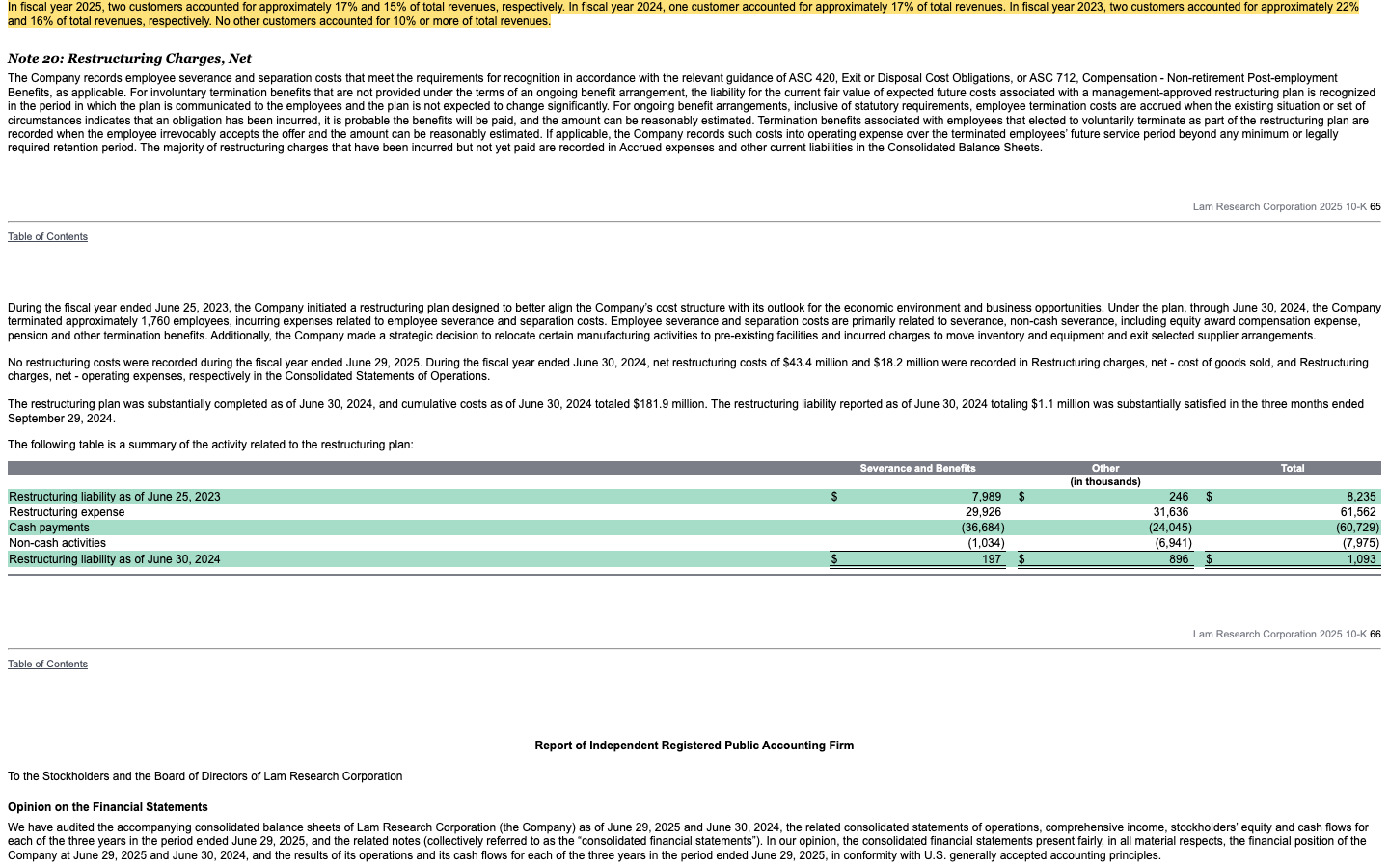
Customer concentration means: if your neighbor told you his shop was humming, but two buyers accounted for a third of the takings — would you swallow for a moment? At Lam it stands soberly in the notes to the annual report (10-K):
"In fiscal year 2025, two customers accounted for approximately 17% and 15% of total revenues, respectively. In fiscal year 2024, one customer accounted for approximately 17% of total revenues. In fiscal year 2023, two customers accounted for approximately 22% and 16% of total revenues, respectively. No other customers accounted for 10% or more of total revenues."
— Lam Research, SEC annual report 10-K for fiscal year 2025, notes (segment and geography disclosures)
For context, as fair as necessary: the names are not in the report, but geography and market structure — Korea 22 percent, Taiwan 19 percent of fiscal year 2025 revenue, and worldwide only a handful of buyers for equipment of this class — suggest these are the world's largest memory makers and foundries: financially powerful groups, not shaky candidates. The real risk is not their bankruptcy but their investment mood: semiconductor equipment is ordered in waves, and the annual report warns explicitly that the consolidation of the customer base means the investment decision of a single customer visibly moves demand. Fiscal year 2024 with its minus 14.5 percent was exactly that: no scandal, just two or three big customers snapping their order books shut at the same time. At the current price level, however, no room is priced in for such moods.
Uncomfortable truth no. 3: the counterstrike — China controls the rare earths Lam needs
The newest risk factor is the most remarkable, because it flips the export-control logic around. In the quarterly report (10-Q) as of March 29, 2026, Lam describes that now China too has imposed export controls — on rare earth elements, the specialty metals high-tech components cannot do without:
"For example, China is the primary source of supply of certain rare earth elements critical to the manufacture of certain of our products. The Chinese government has imposed export controls and license requirements on certain rare earth elements […] (which have been suspended in part until November 2026 (unless extended)) and could expand such controls or licensing requirements in the future. Such measures could delay or prevent our suppliers from sourcing the materials, or producing the components, required for us to manufacture our products, and increase the costs of such materials or components."
— Lam Research, SEC quarterly report 10-Q as of March 29, 2026, Item 1A "Risk Factors"
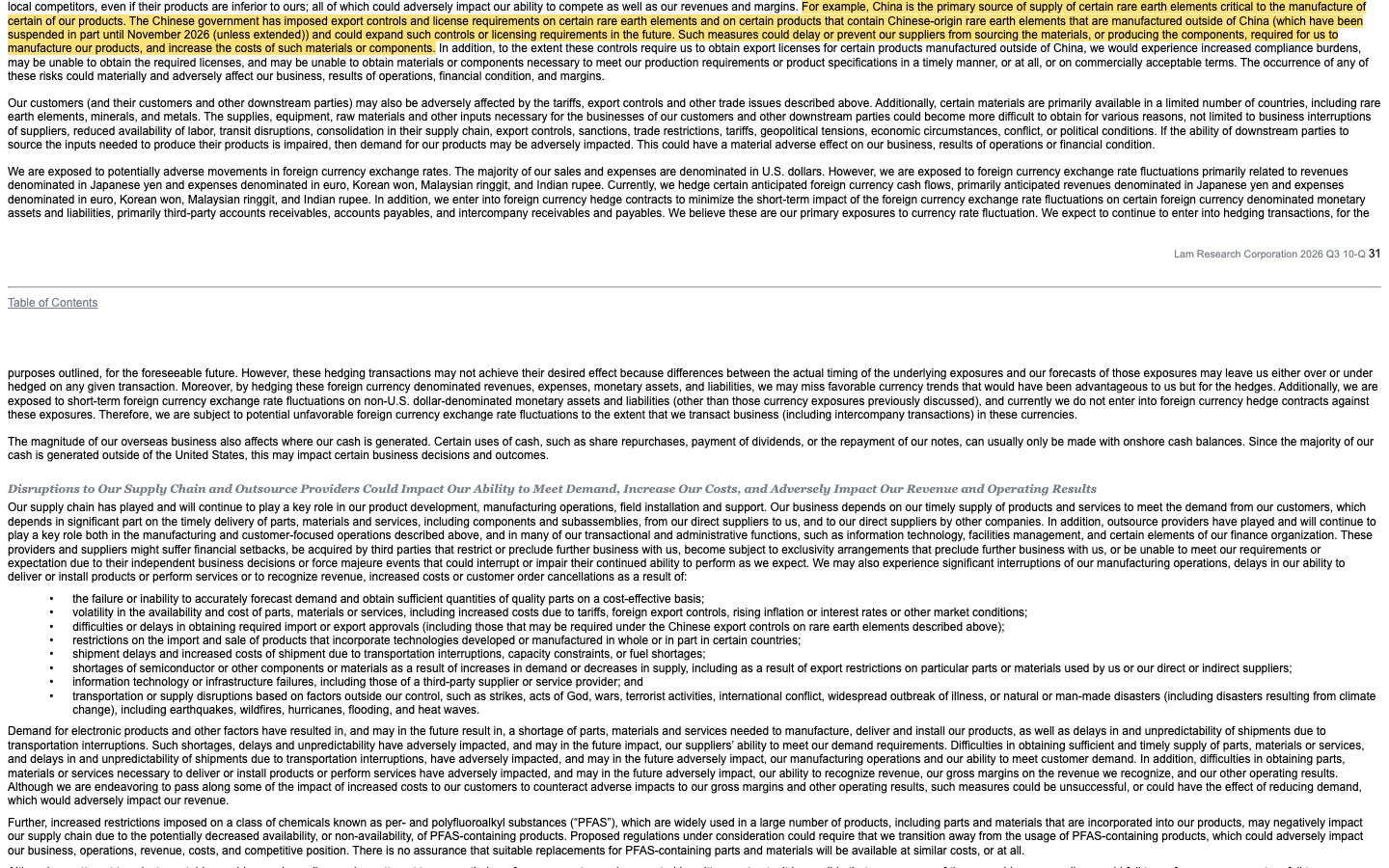
Lam thus hangs on both sides of the same trade conflict: Washington decides what Lam may sell to China — Beijing decides whether Lam's suppliers get the raw materials the machines are built from. The current détente is expressly temporary ("suspended in part until November 2026 (unless extended)"). A company with a 50 percent gross margin can absorb higher material costs for a long time; a supply stop for critical components would be a different league. For you as an investor this means: the biggest revenue cluster and the most important sourcing risk share the same address.
Uncomfortable truth no. 4: the company buys back at ever higher prices — and the executive floor sells
Lam gives its shareholders a lot back, that belongs to a fair account: a quarterly dividend has flowed since April 2014 (fiscal year 2025: $0.23 per share, $1.15 billion in total), and the company repurchased $3.4 billion of its own stock in fiscal year 2025, plus $3.6 billion in the first nine months of fiscal year 2026 — together with the dividend, more recently flowed to shareholders ($4.55 billion) than came in from operations ($4.40 billion). The share count falls reliably as a result, which additionally polishes earnings per share and helps lever up the return on equity we admired at the start. So far, so shareholder-friendly. It gets interesting when you lay the prices next to it:
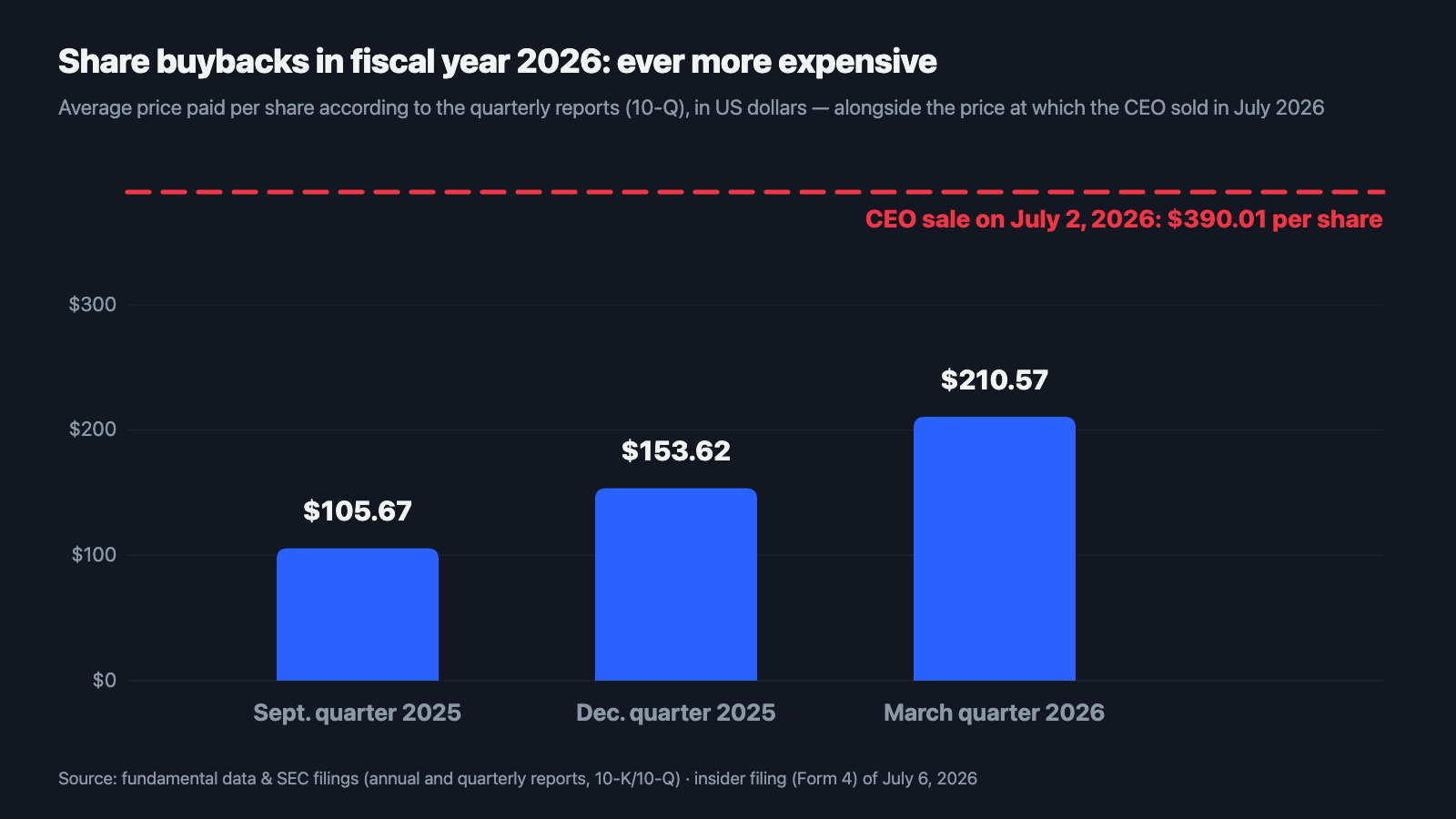
Per the quarterly report (10-Q), Lam paid an average of $105.67 for its own shares in the September quarter of 2025, $153.62 in the December quarter and already $210.57 in the March quarter of 2026 — every repurchased dollar of earnings is thus bought at an ever higher price; roughly $4.3 billion of buyback authorization remained as of March 29, 2026. And the executive floor? The most recent insider filings (Form 4) show a clear pattern: CEO Tim Archer exercised options on 30,000 shares at an exercise price of $30.03 on July 2, 2026, and sold every share the same day at $390.01 (he still holds more than a million shares afterwards). Board member Eric Brandt sold about 54,500 shares on June 12, 2026 at prices between $355 and $373 — a good quarter of his reported position —, Senior Vice President Neil Fernandes a good 18,000 shares on May 1, 2026 at $255.14. And the pattern continues: board member Abhijit Talwalkar sold 18,282 shares on July 13, 2026 at an average of about $335 (Form 4 filed July 14, 2026). Such sales are legal, often long pre-planned and, taken alone, no alarm signal. But hold the two pictures side by side: the company buys with shareholder money at ever higher prices — the people who know the order books best are cashing out. That is worth at least a margin note. Just like the look into the proxy statement (DEF 14A, the invitation to the annual meeting including the compensation report): CEO Archer earned a total of $28.3 million in fiscal year 2025 — 310 times the median employee ($91,230).
And AI? The boom is the business — not the product
Because in 2026 every second investment story starts with two letters, we checked the filings systematically on this too. The finding: Lam does not sell AI — Lam sells the shovels for the AI gold rush and uses AI itself as a tool along the way. The annual report (10-K) names artificial intelligence as a central demand driver ("Demand from cloud computing, artificial intelligence, 5G, the Internet of Things, and other markets is driving the need for increasingly powerful and cost-efficient semiconductors"), and CEO Tim Archer attributed the record quarter in the current report (8-K) of April 22, 2026 expressly to the AI-driven demand reshaping the semiconductor industry. At the same time, the annual report describes equipment makers like Lam using machine learning and AI in their own technology development, and even lists the company's own AI use among its cyber risks. The flip side is likewise in the quarterly report (10-Q): as an earnings risk, Lam explicitly names "changes in the extent of investment in artificial intelligence and associated infrastructure". Translated: if the data-center giants push their orders out by even one or two quarters, it hits the shovel sellers first. In our AI classification we therefore file Lam Research under "Uses AI" — with the AI boom as its demand engine, not as its own product shelf.
Valuation: the price of a flawless year
At mid-2026 (data as of July 10), the market values Lam Research at roughly $480 billion — almost half a trillion. Put that into proportion: that is about 70 times the earnings and 25 times the revenue of the past four quarters — for a company whose revenue shrank 14.5 percent in the fiscal year before last. For comparison: even highly valued, profitable semiconductor equipment makers historically tended to cost five to fifteen times revenue. There are, of course, arguments for a premium — a 29 percent net margin, near-net-cash, a service business that grows with every installed machine, and analysts expecting roughly 40 to 55 percent earnings growth for the coming years. The "professionals' view" is correspondingly unanimous: 33 observers, a consensus grade of 1.3 on a scale from 1 ("buy") to 5 ("sell") — almost nobody dares a "hold". But exactly this unanimity is part of the risk: in early July 2026 the stock traded only about 8 percent below its all-time high, after roughly +311 percent in twelve months, with average daily swings of 5.6 percent. The dividend yield has melted to about 0.3 percent at this price level. Remember: what is being paid here is not the record year 2026 — it is the assumption that many more will follow, with no cycle dent, no China break, no AI breather.
Opportunities and risks at a glance
What speaks for Lam Research:
- Records with substance: revenue up 24 percent to $18.4 billion in fiscal year 2025, another +24 percent in the first nine months of fiscal year 2026, a record quarter in March 2026 ($5.84 billion, 49.8 percent gross margin) and guidance of roughly $6.6 billion for the closing quarter.
- Structural tailwinds: AI data centers need memory (DRAM, NAND) and cutting-edge logic chips — both are made on Lam equipment; on top, the steadier service and spare-parts business ($2.1 billion in the March quarter of 2026 alone) grows with the installed base.
- Fortress balance sheet and capital discipline: about $4.75 billion in cash (March 29, 2026), an equity ratio around 51 percent, ongoing debt repayment, a quarterly dividend since 2014 and buybacks that reliably shrink the share count.
- Quality our in-house stock scanner confirms: hits in Magic Formula, Buffett criteria and "Altman-Z: balance-sheet fortress" — plus a return on equity around 67 percent and an operating margin around 35 percent (data as of July 10, 2026).
- The "professionals' view" is clearly positive: 33 analysts, consensus grade 1.3, expected earnings growth of roughly 40 to 55 percent (data as of July 10, 2026).
What speaks against it:
- A China cluster under double reservation: a 34 percent revenue share in fiscal year 2025 (nine months of fiscal 2026: 37 percent) — dependent on U.S. export licenses with no assurance of approval, while Beijing subsidizes its own equipment makers and sits on Lam's supply chain via rare-earth controls (suspended in part only until November 2026).
- Customer concentration: two unnamed major customers accounted for 32 percent of revenue in fiscal year 2025; per the annual report (10-K), the investment decision of individual groups moves overall demand.
- A cyclical business at a growth price: revenue down 14.5 percent in fiscal year 2024; currently a price-to-earnings ratio around 70, price-to-sales around 25, price-to-book around 45 — historically expensive for an equipment maker (data as of July 10, 2026).
- Insiders selling into the rally: the CEO's sale at $390.01 (July 2, 2026), board member Brandt about 54,500 shares in June, board member Talwalkar 18,282 shares in July — plus buybacks that got more expensive from quarter to quarter ($105.67 → $210.57 per share).
- AI dependence as an earnings risk: the quarterly report (10-Q) explicitly names "changes in the extent of investment in artificial intelligence and associated infrastructure" as a swing factor — if the big customers postpone their build-outs, the equipment maker is hit first; in addition, more money recently flowed to shareholders ($4.55 billion in nine months) than came in from operations ($4.40 billion).
A human conclusion
Back to the quality free pass. Yes: Lam Research is exactly the kind of company the sentence "you can always buy quality" was invented for — profitable for decades, technologically hard to attack, with a balance sheet our scanner rightly calls a "fortress", and in the middle of the biggest investment cycle in semiconductor history. But the sentence has fine print, and it stands in Lam's own filings: a third of the revenue from China, within reach of two feuding governments; two customers with a third of the bills; a cycle that delivered a minus of 14.5 percent as recently as fiscal year 2024 — and a price that, after roughly +311 percent in twelve months, asks 70 times earnings while the CEO exits at $390, pardon: cashes out. "You can always buy quality" would honestly have to read: you can always buy quality — but not at any price, and the current price is a bet on flawlessness. The good news for the patient: cyclicals like Lam have reliably delivered cheaper moments again in the past; the next test is already on the calendar, when the closing-quarter numbers of the fiscal year arrive in late July 2026 — and in November 2026, when the rare-earth grace period expires. What you make of it is your decision. And that is exactly as it should be.
Sources
All original documents used in this analysis — to read for yourself:
- Lam Research Corporation — SEC annual report 10-K for fiscal year 2025 (ended June 29, 2025; filed August 11, 2025)
- Lam Research Corporation — SEC quarterly report 10-Q as of March 29, 2026 (filed April 23, 2026)
- Lam Research Corporation — SEC quarterly report 10-Q as of December 28, 2025 (filed January 29, 2026)
- Lam Research Corporation — SEC quarterly report 10-Q as of September 28, 2025 (filed October 24, 2025)
- Lam Research Corporation — Current report (8-K) of April 22, 2026: March-quarter 2026 results and guidance
- Lam Research Corporation — Proxy statement (DEF 14A) of September 24, 2025 (executive compensation, shareholder structure)
- Lam Research Corporation — insider filings (Form 4): T. Archer of July 6, 2026, A. Talwalkar of July 14, 2026, E. Brandt of June 15, 2026, N. Fernandes of May 4, 2026
- Lam Research Corporation — Current report (8-K) of September 11, 2025: change of the independent auditor
- Lam Research's complete SEC filing history: EDGAR overview (sec.gov)
- Fundamental data (valuation, metrics, analyst consensus; data as of July 10, 2026), reconciled with the SEC filings and the SEC's XBRL company facts.
- Screener and rating data: in-house stock scanner (data as of July 10, 2026).
Transparency & disclaimer: This analysis is a journalistic contextualization of publicly available information and is not investment advice, not a financial analysis in the regulatory sense, and not a solicitation to buy or sell securities. Stock investments carry substantial risks up to total loss. All information without guarantee; the data cut-off is noted in the text in each case. The author holds no position in Lam Research stock at the time of publication.
Our Bottom Line at a Glance
- Growth & order books positive
- Revenue up 24 percent to $18.4 billion in fiscal year 2025, another +24 percent in the first nine months of fiscal year 2026, a record quarter in March 2026 and guidance of roughly $6.6 billion for the closing quarter — the AI investment cycle pays straight into Lam's order books.
- Profitability & balance sheet positive
- A gross margin around 49 to 50 percent, a 35 percent operating margin, a 29 percent net margin in fiscal year 2025; about $4.75 billion in cash and an equity ratio around 51 percent — our scanner rightly lists the stock in the "Altman-Z: balance-sheet fortress".
- Capital returns neutral
- A quarterly dividend since 2014 and massive buybacks ($3.6 billion in nine months of FY 2026) — but the buyback prices doubled within two quarters ($105.67 to $210.57), and more recently flowed to shareholders than came in from operations.
- China & export controls negative
- 34 percent of fiscal year 2025 revenue (37 percent in nine months of FY 2026) from China under U.S. license reservation with no assurance of approval; at the same time China controls rare earths for Lam's supply chain — the suspension applies only in part and until November 2026.
- Customer concentration & cyclicality negative
- Two unnamed major customers = 32 percent of fiscal year 2025 revenue; the investment decision of individual groups moves demand, and fiscal year 2024 showed with revenue down 14.5 percent how fast the equipment cycle turns.
- Valuation & insider behavior negative
- A price-to-earnings ratio around 70 and price-to-sales around 25 after roughly +311 percent in twelve months (data as of July 10, 2026); the CEO sold at $390.01 on July 2, 2026, board member Brandt a good quarter of his position in June, board member Talwalkar 18,282 shares in July.
Lam Research is a flawless cyclical in record form: the AI boom fills the order books, the margins are first-rate, the balance sheet a fortress. But a third of the revenue hangs on China and thus on two feuding governments, two customers pay a third of the bills, and after the stock's quadrupling within twelve months its price assumes none of this ever becomes a problem. Not investment advice.
What Our Rating Means
- If you don't own the stock
- As long as the question raised in the bottom line stays open, we see no basis for an entry.
- If you hold it in your portfolio
- Our findings offer no acute reason to sell — the checkpoints named remain decisive.
A journalistic assessment by our editorial team at the time of the deep dive, based on public sources — not investment advice and not a solicitation to buy or sell. Your personal circumstances (investment goals, risk capacity, taxes) cannot be taken into account. What our categories mean, how verdicts are formed, and what conflicts of interest exist →
Worth Noting
- The fiscal year ends in late June: "fiscal year 2025" = July 2024 through June 29, 2025; the closing quarter of fiscal year 2026 ends on June 28, 2026, with the numbers usually presented in late July.
- All price and share figures are split-adjusted (10-for-1 stock split in October 2024). Insider sales are legal and often long pre-planned; CEO Archer still holds more than a million shares after the July 2, 2026 sale.
- Governance margin note: after 44 years, Lam changed its audit firm for fiscal year 2026 (Ernst & Young since 1981, KPMG from September 2025) — per the current report (8-K) of September 11, 2025, without disagreements.
Frequently Asked Questions
Lam Research builds equipment for chip fabrication: etch machines that mill structures into silicon wafers with atomic precision, deposition systems that apply wafer-thin layers of material, and cleaning systems. Customers are the big memory, foundry and logic manufacturers. Added to that is a growing business in service, spare parts and upgrades. Headquarters are in Fremont, California; about 19,000 employees (as of August 2025).
Lam Research's fiscal year ends in late June, not in December: "fiscal year 2025" ran from July 2024 through June 29, 2025, and "fiscal year 2026" ends on June 28, 2026. When comparing with companies whose fiscal year matches the calendar year, keep that in mind — the record numbers of fiscal year 2025 already contain the second half of calendar 2024.
Considerably: per the annual report (10-K), 34 percent of fiscal year 2025 revenue came from China (prior year: 42 percent), and in the first nine months of fiscal year 2026 it was 37 percent. This business hangs on U.S. export licenses with no assurance of approval; several Chinese customers sit on sanctions lists. In addition, China controls the export of rare earth elements Lam needs for its own manufacturing — the relaxation, per the quarterly report (10-Q), is only partial and runs only until November 2026.
Yes, but indirectly: Lam sells no AI products but the fabrication equipment on which memory and logic chips for AI data centers are made — the CEO attributed the record quarter in March 2026 expressly to AI-driven demand. The flip side is in the quarterly report (10-Q): if the big customers change the pace of their AI investments, Lam's results swing first. In our AI classification, Lam therefore counts as "Uses AI" — the boom as a demand engine, not as a product shelf.
By classic yardsticks, no: a market value of roughly $480 billion equals about 70 times the earnings and 25 times the revenue of the past four quarters (data as of July 10, 2026) — for a cyclical business whose revenue fell 14.5 percent in fiscal year 2024. What is being paid is the expectation that the AI investment boom continues without interruption; analysts are almost unanimously optimistic with a consensus grade of 1.3 (33 observers).
Yes, a quarterly dividend has flowed since April 2014 (fiscal year 2025: $0.23 per share; the yield at the July 2026 price level is only about 0.3 percent). Much bigger are the share buybacks: $3.4 billion in fiscal year 2025, $3.6 billion in the first nine months of fiscal year 2026 alone — with the average buyback price rising from $105.67 to $210.57 within two quarters. Combined, more recently flowed to shareholders than came in as operating cash.
Found an error?
Did you spot a factual error, an outdated number, or a typo in this deep dive? Let us know briefly — your report goes straight to the editorial team.