Teradata: A P/E of 6 That SAP Paid For
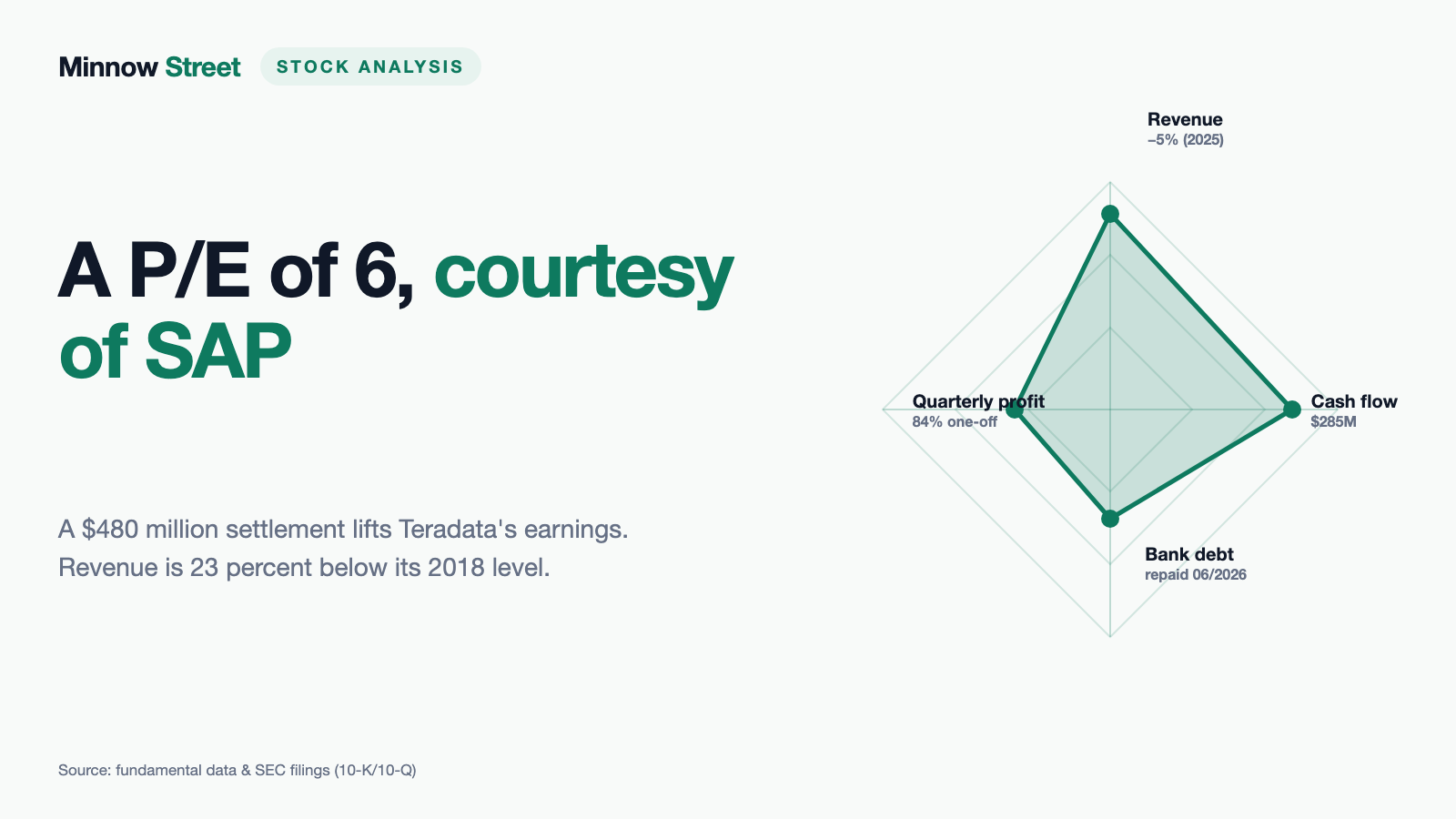
In the first quarter of 2026 Teradata earned $335 million — more than in all of 2025. $280 million of that came from SAP, as a settlement after eight years of litigation. We read the 2025 annual report, the quarterly report filed May 6, 2026 and every disclosure through late July, and test the question the check does not answer: is free cash flow already carried by the subscription business — or still by the old contracts? A windfall is not a business model.
 Thomas Mücke
Founder & Publisher
Thomas Mücke
Founder & Publisher
Chart
Interactive price chart (TradingView).
Note: pure fact-based analysis, not investment advice and not a solicitation to buy or sell. All figures without guarantee.
The one-off trap: when a single number promises more than it can keep
There is a reflex that regularly costs investors money. It looks harmless: This stock trades at a P/E of 6. Nothing else is that cheap. I should buy it.
The price-to-earnings ratio — market value divided by annual profit — is a convenient number. It tells you in one figure how many years of profit you are paying for. It has only one weakness: it never asks where the profit came from. And sometimes it came from a place you cannot visit twice.
That is exactly the case on the table here. Teradata Corporation earned more in the first quarter of 2026 than in all of 2025. The reason is not in the revenue line but in a footnote: a software group headquartered in Walldorf, Germany wired $480 million.
So we do what we always do: open the original filings, do the arithmetic, and see what is left once you put the check aside.
What this analysis covers
- What Teradata sells — and to whom
- Where this stock landed on our desk
- The $480 million check from Walldorf
- The numbers over the years
- Uncomfortable truth no. 1: a record quarter with an operating loss
- Uncomfortable truth no. 2: subscriptions do not carry the cash flow yet
- Uncomfortable truth no. 3: buybacks are losing the race against compensation
- Uncomfortable truth no. 4: a balance sheet that looks worse than it is
- AI: sold, not merely used
- What the stock costs
- Opportunities and risks at a glance
- A human conclusion
- Sources
What Teradata sells — and to whom
Teradata builds databases for customers whose data outgrows ordinary databases. When a retail chain wants to know what 40 million loyalty cards bought over ten years, or an airline wants to analyze every booking, rebooking and loyalty point since 1998, that workload often runs on a Teradata platform.
The company was founded in 1979, spent years inside NCR, and has traded independently on the New York Stock Exchange since September 30, 2007. It is headquartered in San Diego. As of December 31, 2025 it employed about 5,100 people in roughly 38 countries, a little over 30 percent of them in the United States.
The business has two segments and three revenue types. For 2025 they looked like this:
- Recurring revenue — subscriptions, cloud consumption, maintenance, rentals. $1,445 million, or 86.9 percent. This is the business today.
- Perpetual licenses and hardware — the old model: buy once, own forever. $17 million, one percent. A remainder.
- Consulting — projects, migrations, training. $201 million, 12.1 percent, and down 19 percent year over year.
Two terms will matter shortly. ARR stands for annual recurring revenue — the annualized value of all live contracts at a point in time. Think of it as the sum of all subscription fees currently under contract. And the net expansion rate measures what existing customers spend the following year: 108 percent means the same customers buy 8 percent more than before.
As of December 31, 2025 total ARR stood at $1,522 million, 3 percent above the prior year. Inside that number, however, sits a reshuffle: public cloud ARR $701 million (up 15 percent), subscription ARR $735 million (down 4 percent), maintenance ARR $86 million (down 13 percent). Growth comes from one bucket while two others drain.
Anyone looking for the competition need not guess — Teradata names them in the annual report:
“We compete in a large and growing market that is attractive to both current and new competitors. There is a large number of vendors in the market, and the landscape is rapidly growing with the increasing adoption of AI. Participants include AWS, Databricks, Google Cloud, Microsoft Azure, Snowflake, and more; the competitive market also comprises traditional legacy competitors.”
— Teradata Corporation, annual report on Form 10-K for 2025, Item 1 (Competition), filed with the U.S. securities regulator, the SEC

Where this stock landed on our desk
Every day we run roughly 3,500 stocks through our in-house stock scanner. Teradata came in through the turnaround candidates list — on July 27, 2026, with a turnaround check of 6 of 8 points.
One caveat straight away, so nobody searches in vain: the scanner page shows only the 25 strongest hits. The U.S. selection held 60 names that day, and 44 of them carried the same score of 6. When scores tie, the ordering is undefined and shifts with every recalculation — so we deliberately name no exact rank. What holds is the range: 16 names sit above the tied group with 7 or 8 points, which places Teradata somewhere between rank 17 and rank 60. Either way it means the same thing: bottom third, outside the 25 displayed, not visible on the page itself. We measured score, hit count and the size of the tied group directly in the database, separately for each brand — they agree. These lists are recalculated daily; rank and score are a dated snapshot.
The list has two mandatory pillars. Miss one and you are out:
- Pillar 1 — the crash: at least 50 percent below the all-time high. No real crash, no turnaround.
- Pillar 2 — survival: the company has to be able to sit out the drought — positive equity, no more than one balance sheet warning flag, a bankruptcy early-warning score outside the danger zone.
Pillar 1 we recomputed against the price history. The highest closing price ever reached was $80.62 on September 6, 2012; the stock closed at $28.52 on July 24, 2026. That is minus 64.6 percent — the hurdle clears with room to spare. The reference point, however, is nearly 14 years old, from an era when Teradata still sold hardware.
Pillar 2 is where we have to contradict our own data set. It stores a bankruptcy early-warning score of 3.83. We could not reconcile it with any financial statement — neither the 2025 annual statement nor the balance sheet as of March 31, 2026. So we do not quote it and prefer to work the balance sheet ourselves; that comes in truth no. 4 below. The short version: Teradata is not a bankruptcy case, but the formula has good reasons to look bad.
A second scanner also fired: EPS acceleration, meaning earnings per share growing faster than in the prior quarter. That signal is especially instructive here — because no formula checks where the acceleration came from. That is exactly what we look at next.
The $480 million check from Walldorf
On June 19, 2018 Teradata sued the software group SAP in federal court in Northern California. The allegation: SAP had misappropriated trade secrets from Teradata's data analytics products and used its market position in enterprise resource planning software to pressure customers. SAP countersued over patents, and further cases followed in the United States and in Germany. In 2021 the court dismissed the antitrust claims; the appeals court reinstated them.
After nearly eight years it ended. On February 19, 2026 both sides signed a settlement, on March 19, 2026 SAP paid, and on March 20, 2026 all remaining claims and counterclaims were dismissed with prejudice. The numbers are in Note 5 of the quarterly report:
“During the three months ended March 31, 2026, as a result of the SAP Settlement Agreement, Teradata received a gross payment of $480 million (the “SAP Legal Settlement Amount”). Additionally the Company recorded $121 million in selling, general and administrative expenses for the associated fees and expenses for the SAP Settlement Agreement, including a customary contingent fee arrangement and other outstanding legal fees incurred in connection with the SAP Litigation (the “SAP Legal Settlement Fees”).”
— Teradata Corporation, quarterly report on Form 10-Q for the quarter ended March 31, 2026, Note 5

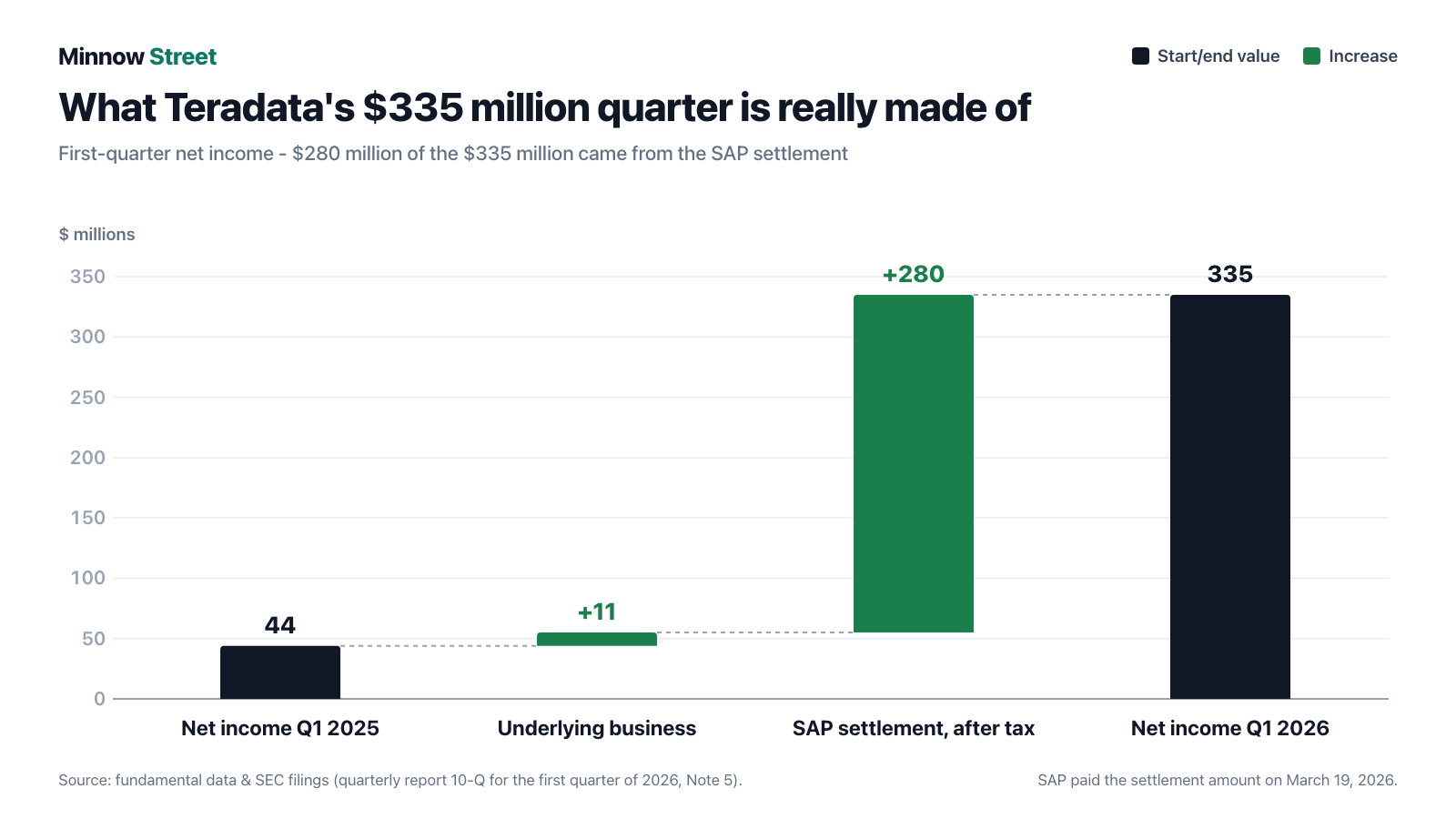
Of the $359 million before tax, $79 million went to the tax authorities. That left $280 million after tax — and those sit inside the $335 million of quarterly net income. The rest of the company, the entire operating business with $444 million of revenue and roughly 5,100 employees, contributed $55 million in that quarter.
Rule of thumb: a profit that arrives from a courtroom is real money — but it is not a forecast.
The numbers over the years
Start with what genuinely impresses. Teradata makes money, year after year, without interruption, in a market where five of the world's largest technology groups are bidding. Operating income was $186 million in 2023, $209 million in 2024 and $205 million in 2025 — remarkably stable even though revenue fell by $170 million over those three years. Free cash flow came to $285 million in 2025 after $277 million in 2024. Not many shrinking companies manage that.
And the shift worked: in 2018 Teradata still lived off perpetual licenses and hardware; in 2025, 86.9 percent of revenue came from live contracts, and in the first quarter of 2026 it was 90.1 percent. A vendor that moves its customers from buy-once to pay-monthly necessarily loses revenue along the way — the customer no longer pays everything upfront.
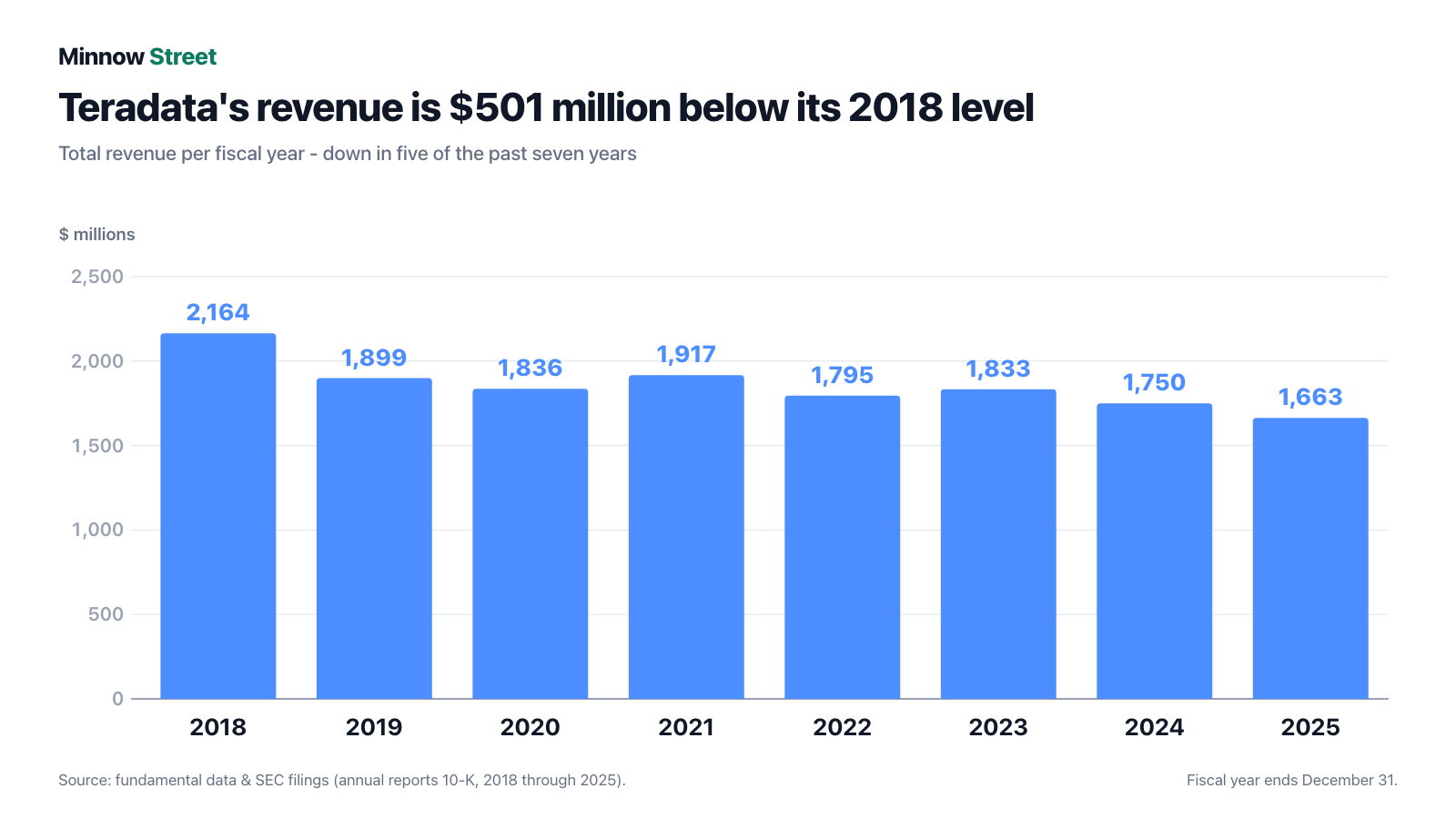
The catch: at some point the migration is finished, and then the line has to turn back up. So far it has not.
The profit side looks friendlier because costs were cut hard. On August 5, 2024 Teradata realigned its sales function and launched a global restructuring; by March 31, 2026 most of the actions were complete, the recognized cost was $20 million and cash outlays are estimated at roughly $45 million to $50 million. Net income rose from $62 million (2023) to $114 million (2024) and $130 million (2025) — on falling revenue. Cutting works. Cutting also has a natural end.
Uncomfortable truth no. 1: a record quarter with an operating loss
Anyone looking for the operating income line in the quarterly report finds a loss of $36 million for the first quarter of 2026. A year earlier the same line showed a profit of $66 million.
That sounds like a collapse but is an accounting matter. The $480 million from SAP counts as other income and therefore sits below operating income. The $121 million of fees for the very same matter sits inside operating income, in selling, general and administrative expenses. Those jump from $116 million to $240 million. Strip the fees out and operating income would be roughly $85 million — above the prior year.
Both figures mislead, each in its own direction: net income of $335 million looks too good, the operating loss of $36 million looks too bad. Only together do they form a picture. That is precisely why footnotes are worth reading.
One detail for accuracy: the quarterly effective tax rate was 23.3 percent, and the company expects roughly 25 percent for full-year 2026. The SAP amount carried $79 million of tax expense, $16 million of which came from a U.S. rule on foreign earnings.
Uncomfortable truth no. 2: subscriptions do not carry the cash flow yet
This is the question that matters at Teradata — and it can be answered.
Free cash flow was $285 million in 2025 and $277 million in 2024. Steady. But where does it come from? Not from growth: revenue fell 5 percent, recurring revenue fell 2 percent, consulting revenue fell 19 percent. Cash flow held up because costs fell faster than revenue — restructuring, fewer staff, less hardware in circulation.
Inside the live contracts the picture looks like this (as of December 31, 2025):
- Public cloud: $701 million of ARR, up 15 percent. The growth engine.
- Subscription (customer-operated data centers): $735 million, down 4 percent. Customers are migrating to the cloud — this bucket drains by design.
- Maintenance and software upgrade rights: $86 million, down 13 percent. This is what remains of the old license business, and it is disappearing.
Put differently: the largest single component of recurring revenue is still the old business inside customer data centers, and it is shrinking. The cloud grows faster but remains smaller. Until the cloud bucket overtakes the subscription bucket, cash flow depends materially on contracts that are running out.
Two further figures belong here. First, the cloud net expansion rate fell from 117 to 108 percent. Existing customers are still expanding — just far more slowly than a year earlier. Second, as of March 31, 2026 Teradata carried $2,033 million of remaining unsatisfied contractual obligations, of which $1,372 million falls due within one year. That is a solid cushion — roughly 15 months of revenue.
And for the first quarter of 2026 the same caution applies as with profit: free cash flow of $390 million includes $359 million from the SAP settlement. Adjusted, roughly $31 million remains, against $7 million a year earlier. Teradata's first quarter is traditionally weak because annual invoices land later; but it is no proof of a turn.
How hard it is for a technology services provider when revenue shrinks and costs have already been squeezed is something we documented in detail in our DXC Technology analysis. The pattern rhymes.
Uncomfortable truth no. 3: buybacks are losing the race against compensation
Teradata pays no dividend. Spare cash goes into share repurchases — the company buys its own shares and retires them, so every remaining share represents a bigger slice of the pie. That sounds good. You only need to know who is cutting new slices at the same time.
The company pays a substantial part of employee compensation in stock. That expense was $112 million in 2025, $119 million in 2024 and $126 million in 2023. Against free cash flow of $285 million, $112 million is 39 percent. Set against that are repurchases of 5.8 million shares at an average of $24.34, or roughly $141 million.
Across full-year 2025 the math just about worked: the share count fell. In the first quarter of 2026 it no longer did. Teradata repurchased 1.2 million shares for $34 million — and issued shares still rose from 92.5 million to 94.4 million. Stock-based compensation expense in the same quarter was $29 million.
On May 14, 2026 the next step followed:
“The Amended 2023 Plan amends and restates the Teradata 2023 Stock Incentive Plan to increase the number of shares available under the Amended 2023 Plan by 6,300,000 shares.”
— Teradata Corporation, Form 8-K filed May 19, 2026, Item 5.02

6.3 million shares are 6.7 percent of the 94.1 million shares outstanding on April 24, 2026. They will not all be issued at once, and part of them replaces expiring grants. But the direction is clear: for the share count to fall, Teradata has to repurchase far more than it has. Of the $500 million program approved on November 17, 2025, $470 million was still open at March 31, 2026 — against cash of $816 million. The money is there.
Uncomfortable truth no. 4: a balance sheet that looks worse than it is
Teradata's balance sheet carries an accumulated deficit of $1,621 million (March 31, 2026). Read cold, that suggests a company that burned cash for years. The opposite is true.
The line collects every profit and loss since inception — and every retired share. Teradata has repurchased and cancelled billions of dollars of its own stock since 2007, and those amounts are charged against precisely this line. The accumulated deficit is therefore mostly a monument to a buyback policy, not the trace of operating losses.
That also explains why every bankruptcy formula sounds the alarm here: the classic Altman formula gives heavy weight to retained earnings relative to total assets. Recompute it with the balance sheet as of March 31, 2026 and you get roughly 1.05; with the 2025 annual statement, roughly 0.77. The value of 3.83 stored in our data set cannot be reconciled with either — which is why we base no statement in this article on it. Instead we cite what can be checked:
- Equity ratio 26.0 percent — $557 million of $2,142 million of total assets (03/31/2026). At year-end 2025 it was 12.9 percent; the SAP amount more than doubled equity.
- Cash of $816 million against a $449 million term loan (03/31/2026) — more cash than bank debt even then.
- Interest expense of $6 million in the quarter against $3 million of interest income. Debt service was never the problem.
And then came June 24, 2026:
“The Credit Agreement replaces Teradata’s prior credit agreement, entered into in 2022, which provided for a revolving credit facility in the maximum principal of $400 million and a term loan commitment in the principal amount of $500 million (the “Prior Agreement”). In connection with the execution of the Credit Agreement, the term loan outstanding under the Prior Agreement was repaid in full.”
— Teradata Corporation, Form 8-K filed June 24, 2026, Item 1.01

Since then Teradata has an undrawn $400 million revolving facility running to June 24, 2031 — and no drawn bank debt at all. What remains is roughly $98 million of finance leases for hardware. So the SAP settlement did not evaporate: a good part of it now sits in a debt-free balance sheet.
For completeness: a shareholder class action filed in June 2024 over statements about the 2023 ARR outlook was dismissed with prejudice on September 26, 2025; final judgment in the company's favor was entered on January 6, 2026 and no appeal followed. The parallel derivative suit was then voluntarily dismissed.
AI: sold, not merely used
At many companies, AI is a word on a slide. At Teradata it is the product description. The 2025 annual report calls the company an AI and knowledge platform throughout and names concrete offerings: AI Factory for customers who must run AI inside their own data centers (banks, government agencies, regulated industries), AgentBuilder for building AI agents, and a consulting offering called AI Services.
“Across Teradata, we are executing and advancing in our transformation as a modern, leading AI and knowledge platform. Our transition has earned recognition from numerous industry analyst firms, and we delivered more than 150 AI engagements at customer accounts in 2025.”
— Teradata Corporation, annual report on Form 10-K for 2025, Item 1
In our classification Teradata therefore counts as a company that sells AI — not one that merely uses AI internally or is threatened by it. Two caveats belong with that. First, the report does not quantify how much revenue comes from AI products; more than 150 engagements is a count, not a dollar figure. Second, the same AI boom is the reason competition is intensifying — the annual report says so itself in the competition section.
Research spending rose to $72 million in the first quarter of 2026 from $66 million, explicitly for public cloud and AI. For full-year 2025 it was $280 million — just under 17 percent of revenue. For a vendor of this size that is respectable; against the budgets of the competitors named above it is a rounding error.
What the stock costs
As of July 26, 2026 market capitalization was about $2.64 billion. That produces these orders of magnitude — deliberately expressed as ranges, because prices move:
- Trailing price/earnings: about 6.5. Based on $4.37 of diluted earnings per share over the past four quarters.
- Price/earnings excluding the SAP amount: about 19. The $280 million after tax equal roughly $2.90 per diluted share. That leaves about $1.47 from the business.
- Price/earnings on the current-year estimate: about 11. Analysts expect $2.65 per share on average.
- Price/sales: about 1.6. For a software vendor with 87 percent recurring revenue that is low — for a shrinking vendor it is not unusual.
- Price/free cash flow: about 4 on the past four quarters — but about 8.5 once the SAP amount is stripped out. The same trap as the P/E, one floor down.
What the professionals think: 11 analyst firms cover the stock, 3 with strong buy, 1 with buy, 5 with hold and 2 with sell. The average price target is $35.50 — roughly a quarter above the closing price of July 24, 2026. A split picture, then, which matches the data: those who believe in the cloud curve see catch-up potential; those who look at the revenue series see a business that has not yet turned.
The counter-bet is notable: as of July 26, 2026, 17.3 million shares were sold short — roughly 18 percent of the 94.1 million shares outstanding and well above the 12.6 million of the prior month. Part of the market is explicitly betting the price falls. As with Teradata's contemporaries from the early database era, which we described in our Oracle analysis, the same rule applies here: old databases rarely die quickly — they just get paid for more slowly.
Opportunities and risks at a glance
Opportunities
- The shift is essentially complete: 90.1 percent recurring revenue in the first quarter of 2026, perpetual licenses down to $1 million. The revenue loss from the migration is behind the company.
- The balance sheet has been free of bank debt since June 24, 2026, with an undrawn $400 million facility running to 2031.
- Public cloud ARR grew 15 percent to $701 million in 2025 and 13 percent to $686 million in the first quarter of 2026 — the curve points up.
- $2,033 million of contracted, not-yet-delivered obligations (03/31/2026) provide planning certainty for a good year.
- $470 million of the $500 million repurchase program was still open at March 31, 2026 — against $816 million of cash, real leverage if management chooses to use it.
- Revenue rose 6 percent in the first quarter of 2026, the first increase in a long while.
Risks
- Revenue is 23 percent below its 2018 level; five of the past seven years were declines.
- The earnings jump is a one-off: $280 million of the $335 million in the first quarter of 2026 came from the SAP settlement, and the litigation is definitively over.
- The cloud net expansion rate fell from 117 to 108 percent — existing customers expand more slowly.
- The competitors are AWS, Databricks, Google Cloud, Microsoft Azure and Snowflake. Teradata's research budget of $280 million (2025) is small next to theirs.
- Stock-based compensation of $112 million consumes 39 percent of free cash flow; on May 14, 2026 another 6.3 million authorized plan shares were added.
- Consulting revenue fell 19 percent in 2025 and another 14 percent in the first quarter of 2026 — that is where Teradata loses proximity to the customer.
- Roughly 18 percent of the shares are sold short (data as of 07/26/2026); positions of that size can amplify moves in both directions.
A human conclusion
We started with the reflex: a P/E of 6, that has to be cheap. We checked where the profit came from — and the answer was a courtroom in Northern California.
That does not make Teradata a bad company. Quite the opposite: this is a profitable specialist that has largely completed its move from licenses to subscriptions, has been debt-free since June 24, 2026, and with $285 million of free cash flow (2025) earns more money than the revenue decline suggests.
It does, however, turn the valuation into a different calculation than the one on the screen. Anyone buying Teradata at a P/E of 6.5 is in truth buying a business at a P/E of roughly 19 — plus a one-time cash inflow that has already arrived and mostly gone into debt repayment. Whether that is expensive or cheap hangs on a single question: does the cloud curve bend upward fast enough before the old bucket runs dry?
The next quarterly numbers will say more about that than any metric available today. Until then, Teradata is a case for watching, not for doing arithmetic with somebody else's money.
What you make of it is your decision. And that is exactly how it should be.
Sources
- Annual report on Form 10-K for 2025, Teradata Corporation, filed February 27, 2026 (CIK 0000816761)
- Quarterly report on Form 10-Q for the quarter ended March 31, 2026, filed May 6, 2026 — SAP settlement (Notes 5 and 8), share repurchases, credit facility
- Form 8-K filed May 19, 2026 — annual meeting of May 14, 2026: stock plan with 6,300,000 additional shares, ratification of auditor PricewaterhouseCoopers (Items 5.02/5.07)
- Form 8-K filed June 24, 2026 — new $400 million credit agreement, prior term loan repaid in full (Items 1.01/1.02/2.03)
- Schedule 13D/A No. 3, Lynrock Lake LP, filed July 8, 2026 — 6,212,370 shares, 6.6 percent
- Screening and metric data: in-house stock scanner (data as of July 27, 2026), including the turnaround candidates scanner (U.S. selection, turnaround check 6 of 8, bottom third of 60 hits, measured July 27, 2026 on both brands) — the lists are recalculated daily and show only the 25 strongest hits
- Metrics, price history and analyst estimates: fundamental data, as of July 26 and 27, 2026
Journalistic analysis, not investment advice and not a solicitation to buy or sell securities. Share prices can move sharply; a total loss is possible. All figures come from the original documents linked above and carry their own as-of date. The author holds no position in Teradata Corporation at the time of publication.
Our Bottom Line at a Glance
- Quality of the earnings jump negative
- Of the $335 million of quarterly net income (03/31/2026), $280 million came from the SAP settlement. The underlying business contributed $55 million, against $44 million a year earlier. Over the same period the company reports an operating loss of $36 million, because the $121 million of fees sits in selling expenses.
- Shift to subscriptions neutral
- The shift is far along: 86.9 percent recurring revenue in 2025, 90.1 percent in the first quarter of 2026, perpetual licenses effectively gone ($17 million in 2025). But growth comes only from the public cloud (ARR $701 million, up 15 percent), while subscription ARR fell 4 percent and maintenance ARR fell 13 percent (12/31/2025).
- Cash generation neutral
- Free cash flow was $285 million in 2025 after $277 million in 2024 — steady even though revenue fell 5 percent. It therefore comes mostly from cost cuts and from a still-large legacy base, not from growth. The $390 million of the first quarter of 2026 includes $359 million from the SAP settlement; adjusted, roughly $31 million remains.
- Share count and compensation negative
- Stock-based compensation expense was $112 million in 2025, or 39 percent of free cash flow. In the first quarter of 2026 issued shares rose from 92.5 million to 94.4 million despite buybacks. On May 14, 2026 shareholders added 6,300,000 authorized plan shares — 6.7 percent of the count.
- Balance sheet after the repayment positive
- On June 24, 2026 Teradata repaid the term loan in full and put in place an undrawn $400 million revolving facility maturing in 2031. At March 31, 2026 cash of $816 million stood against a $449 million term loan; the equity ratio was 26.0 percent after 12.9 percent at year-end 2025.
- Competition negative
- The 2025 annual report names AWS, Databricks, Google Cloud, Microsoft Azure and Snowflake — rivals with far larger budgets. Revenue is 23 percent below its 2018 level, and the cloud net expansion rate fell from 117 to 108 percent (12/31/2025). Existing customers are therefore expanding more slowly than a year earlier.
Teradata is a profitable niche vendor with a genuine position in very large data estates: 86.9 percent recurring revenue, $2,033 million of contracted obligations, $285 million of free cash flow in 2025 and, since June 24, 2026, no bank debt. The price looks low — but the trailing P/E of 6.5 rests largely on a court settlement that will not repeat; without it the multiple is roughly 19. Behind that stands revenue 23 percent below its 2018 level, a cloud business whose existing customers expand more slowly than a year ago, and a share count that rises despite buybacks. The scanner sees a turnaround; the filings so far show one quarter. Not investment advice.
What Our Rating Means
Open questions
The business works in principle, but one material question is open. As long as it stays open, our findings do not carry a quality verdict.
The business is real and hard to replace: 86.9 percent recurring revenue in 2025, $2,033 million of contracted obligations, three consecutive years of operating income around $200 million and, since June 24, 2026, no bank debt at all — against $816 million of cash at March 31, 2026. No sign of substance risk, hence no red. What is missing for green is the growth side: revenue is 23 percent below its 2018 level and fell in five of the past seven years, the cloud net expansion rate slipped from 117 to 108 percent, consulting revenue shrank 19 percent in 2025, and stock-based compensation of $112 million consumes 39 percent of free cash flow — issued shares rose from 92.5 million to 94.4 million in the first quarter of 2026 despite buybacks. On top of that sits the competition the annual report names itself. The decision is yours.
A journalistic assessment by our editorial team at the time of the deep dive, based on public sources — not investment advice and not a solicitation to buy or sell. Your personal circumstances (investment goals, risk capacity, taxes) cannot be taken into account. What our levels mean, how verdicts are formed, and what conflicts of interest exist →
Worth Noting
- Hook: in-house stock scanner "Turnaround-Kandidaten", U.S. selection, turnaround check 6 of 8, measured July 27, 2026 on both brands. 44 of the 60 hits share the same score — Teradata sits in the bottom third and therefore outside the 25 displayed places. The lists are recalculated daily.
- Data as of July 26/27, 2026 for metrics and prices. All business figures come from the 2025 annual report (02/27/2026), the quarterly report for the period ended 03/31/2026 (05/06/2026) and the disclosures filed through July 8, 2026.
- Do not confuse: Teradata Corporation (TDC, San Diego) has nothing to do with the Danish telecom group TDC A/S. The SEC conformed name is "TERADATA CORP /DE/" — a registry convention, not a renaming.
- We did not use the Altman-Z value of 3.83 stored in our data set: it cannot be reconciled with the 2025 annual statement or the balance sheet as of 03/31/2026. The article uses self-computed balance sheet ratios instead.
Frequently Asked Questions
Teradata sells a platform on which very large companies collect, analyze and, these days, feed their data into AI. Its customers are banks, retail chains, telecom operators and airlines with data volumes that overwhelm ordinary databases. The company is based in San Diego, employed about 5,100 people as of December 31, 2025 and generated $1.663 billion of revenue in 2025.
Because of a lawsuit, not the business. Teradata sued SAP in 2018. On February 19, 2026 the two sides settled, and on March 19, 2026 SAP paid $480 million. After $121 million in legal and contingent fees, $359 million remained before tax and $280 million after tax. Quarterly net income was $335 million — so 84 percent of it came from the settlement.
The trailing P/E of 6.5 (data as of July 26, 2026) rests on $4.37 of diluted earnings per share over the past four quarters. About $2.90 of that comes from the SAP settlement and will not repeat. Excluding it, the P/E is roughly 19. Against the analyst estimate for the current year the multiple is about 11.
In the first quarter of 2026, yes: revenue rose 6 percent to $444 million, with 2 points of that from currency. Across full-year 2025, however, revenue fell 5 percent to $1,663 million. Measured against 2018 ($2,164 million) revenue is 23 percent lower. One quarter is not a turnaround.
In fiscal 2025, $1,445 million of $1,663 million was recurring, or 86.9 percent; in the first quarter of 2026 it was $400 million of $444 million (90.1 percent). The shift from perpetual licenses to subscriptions is therefore largely complete. Recurring revenue itself nevertheless fell 2 percent in 2025.
Since June 24, 2026, essentially no bank debt. On that day the company entered a new credit agreement providing a $400 million revolving facility maturing June 24, 2031 and repaid the old term loan in full; $449 million was still outstanding at March 31, 2026. It was paid from cash, which the SAP settlement had lifted to $816 million.
No. Teradata pays nothing out and spends the money on share repurchases instead. In 2025 that meant 5.8 million shares at an average of $24.34. On November 17, 2025 the board approved a new $500 million program, of which $470 million was still open at March 31, 2026.
Because the scanner page shows only the 25 strongest hits. On July 27, 2026 Teradata was one of the 60 U.S. hits on that list, but it scores only 6 of 8 points in the turnaround check — as do 43 other names. That puts the stock in the bottom third and outside the 25 displayed. We measured the ranking directly in the database.
Found an error?
Did you spot a factual error, an outdated number, or a typo in this deep dive? Let us know briefly — your report goes straight to the editorial team.