Oklo Inc.: Two and a Half Billion in the Bank — and Not One Customer
Oklo is building small nuclear power plants for data centers and has raised $2,536.9 million to do it. What the company did not have as of March 31, 2026: revenue, a binding power purchase agreement, a reactor license, or a single plant in the ground. We read the filings with the U.S. securities regulator and worked out what actually sits behind the gigawatt arithmetic.
 Thomas Mücke
Founder & Publisher
Thomas Mücke
Founder & Publisher
Chart
Interactive price chart (TradingView).
Note: pure fact-based analysis, not investment advice and not a solicitation to buy or sell. All figures without guarantee.
There is one investor weakness that fires especially reliably when a story is big enough: we mistake scale for certainty. A number like "12 gigawatts" or "a 1.2-gigawatt power campus" sounds so specific, so engineered, that the brain files it away as a fact — when it actually describes an intention. Call it the gigawatt reflex. At Oklo Inc. (NYSE: OKLO), a developer of small nuclear power plants based in Santa Clara, California, that reflex runs into a company that as of March 31, 2026 was two things at once: unusually well funded and completely without revenue. So here is the deal: before you convert those gigawatts into revenue in your head, let us read together what Oklo has actually told the U.S. securities regulator, the SEC, in its annual and quarterly reports.
What Oklo actually does — selling power, not reactors
Oklo develops nuclear power plants in miniature. The product is called Aurora and is designed to produce between 15 and 75 megawatts of electricity. For scale: a conventional large reactor runs at roughly 1,400 megawatts. Technically it is a metal-fueled fast fission reactor whose ancestor is a U.S. government test reactor, the Experimental Breeder Reactor-II, which according to the 2025 annual report (10-K) operated for 30 years. Aurora units are designed to run on fresh, recycled, or down-blended nuclear fuel.
The decisive difference from the traditional nuclear business is not the technology, though — it is the business model. Oklo does not intend to sell reactors; it intends to sell power. The company builds and operates the plants itself and signs long-term power purchase agreements, or PPAs, with offtakers. In everyday terms: Oklo does not want to be the boiler installer who sells you one furnace, it wants to be the district heating utility that bills you every month for thirty years. That ties up an enormous amount of capital, but it promises recurring revenue. We worked through what such a business looks like once it is running in our AES stock analysis — there you find revenue, contracts, and plants in the ground.
Two side branches round out the picture: recycling used nuclear fuel — in September 2025 Oklo announced a facility in Tennessee with an investment roadmap of up to $1.68 billion — and the subsidiary Atomic Alchemy, which is meant to produce medical and industrial radioisotopes. As of December 31, 2025, Oklo employed 205 full-time staff across 33 U.S. states plus two in Canada, including 13 PhDs, 50 master's degree holders, and eight former staff members of the U.S. Nuclear Regulatory Commission, the NRC (annual report 10-K for 2025).
One piece of corporate history worth knowing: Oklo did not go public in the classic way. On May 9, 2024, it merged with the already-listed special purpose acquisition company AltC Acquisition Corp. and became publicly traded overnight; the transaction involved the issuance of 43,099,811 shares (annual report 10-K for 2025). And that is exactly where the central tension of this analysis sits: a balance sheet many profitable mid-caps would envy — and an income statement whose top line is a single number: zero.
How the stock landed on our desk — through the forums, not the filters
Oklo is not a hit from our in-house stock scanner. We checked on July 27, 2026: at that point Oklo appeared in none of our scanner lists. That is neither an accident nor an oversight but a logical consequence — practically every one of our filters works with metrics that presuppose revenue or earnings: price-to-sales, margin trends, earnings growth, quality scores. A company without revenue falls straight through that mesh like sand through a sieve. One caveat for checking it yourself: our scanner lists are recalculated daily, so the finding applies to the date named.
What did put Oklo on our desk was an attention sweep across the most-discussed U.S. stocks in investor forums on July 27, 2026. That is explicitly not a quality signal — forum attention measures what people talk about, not what works. But it is a good reason to look closely. Which is what we do now.
The numbers over the years — given honest credit
Start with what genuinely impresses, because there is more of it than the missing top line suggests. As of March 31, 2026, Oklo held $2,536.9 million in cash and marketable debt securities — $1,594.1 million of cash, $614.5 million of short-term securities, and $328.3 million of longer-dated ones. Against that stand total liabilities of just $64.9 million. The company has no bank debt, no bond, no covenant that could break. Stockholders' equity stood at $2,638.6 million and total assets at $2,703.5 million. For comparison: one year earlier, on March 31, 2025, equity was $269.3 million. Whatever you want to criticize here, you have to concede one thing — there are worse starting positions for a project that needs time.
Second: the company does not just collect money, it earns on it. In the first quarter of 2026, Oklo booked $21.3 million of interest and dividend income, more than five times the prior-year quarter ($3.7 million). That is money generated simply because a couple of billion dollars sit in interest-bearing accounts and bonds. It covers roughly 42 percent of the operating loss. Put bluntly: at Oklo, the treasury is currently the most profitable department in the house.
Third, the milestones that are more than announcements. On January 5, 2026, Oklo entered a prepayment agreement with Meta Platforms for a planned 1.2-gigawatt power campus in Pike County, Ohio; Meta can prepay for power, and Oklo intends to use the funding to secure nuclear fuel. On January 7, 2026, the company executed an agreement with the U.S. Department of Energy for a radioisotope pilot facility. In August 2025, Oklo and Atomic Alchemy were selected for three of the eleven projects under the DOE reactor pilot program; the Aurora unit at Idaho National Laboratory has since been approved to proceed under DOE authority. And in December 2025, Oklo ran a fast-spectrum plutonium criticality experiment together with Los Alamos National Laboratory. Those are real, verifiable steps, not slideware.
Now the other side of the same balance sheet. None of the published financial statements contains a revenue line — Oklo's income statement begins directly with operating expenses. In fiscal 2025 those came to $139.3 million ($58.9 million of research and development, $80.4 million of general and administrative expense), up from $52.8 million in 2024. The net loss rose from $73.6 million (2024) to $105.7 million (2025), or minus $0.72 per share. In the first quarter of 2026 the pace stepped up sharply again:
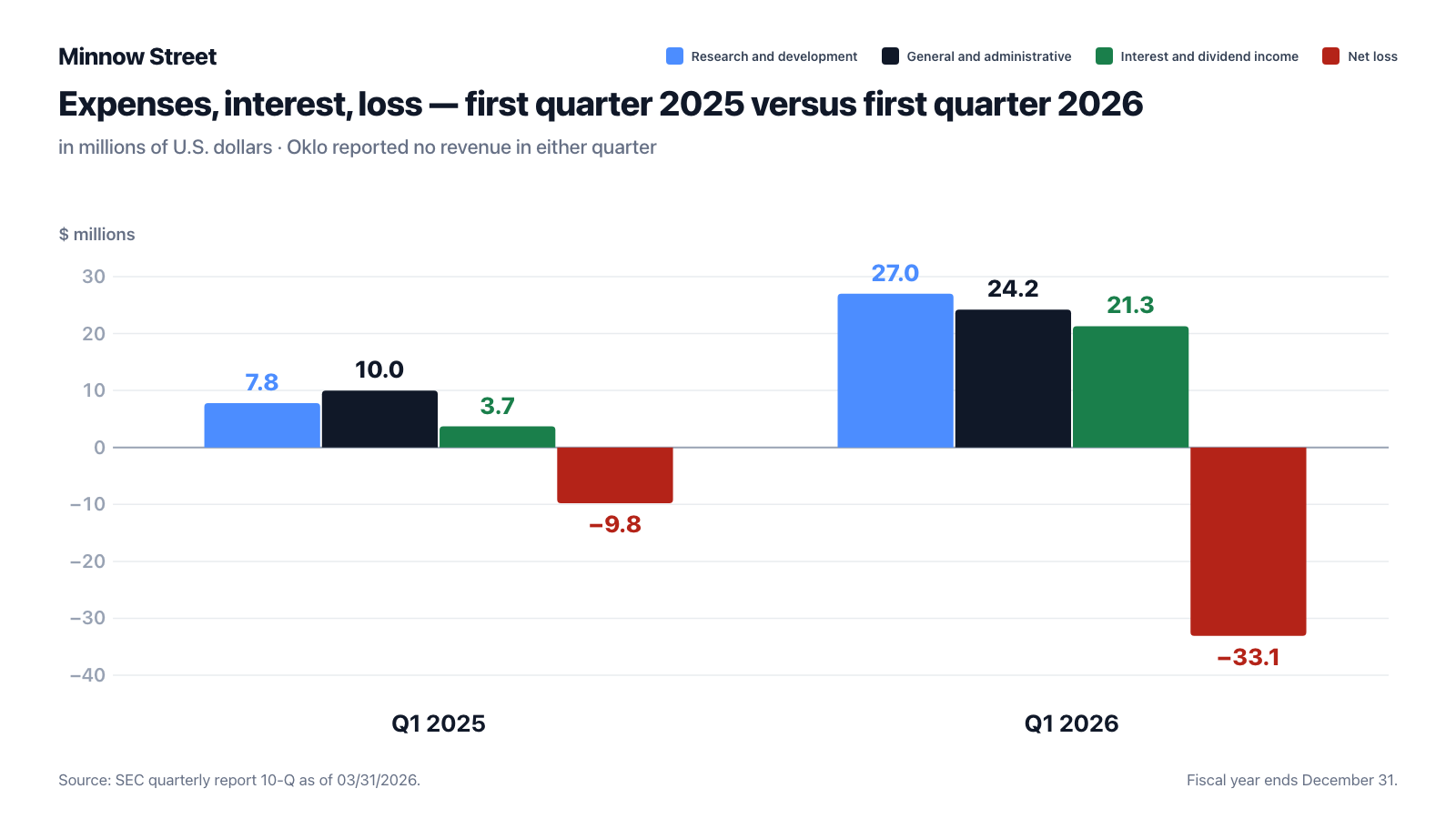
In numbers: $27.0 million of research and development (prior-year quarter $7.8 million), $24.2 million of general and administrative expense ($10.0 million), for total operating expenses of $51.2 million ($17.9 million). After $21.3 million of interest income and $3.2 million of income tax expense, the net loss came to $33.1 million, or minus $0.19 per share. Worth noting: actual cash used in operations was only $17.9 million — most of the remaining loss is stock-based compensation ($15.6 million in the quarter, up from $2.3 million a year earlier). That is expense which never touches the bank account but does increase the share count. On top came $32.8 million of capital expenditure, with a further $20.7 million still sitting in payables at the balance sheet date. For full-year 2026, Oklo expects to use $80 million to $100 million of cash in operating expenses.
What the filings say — the uncomfortable truths
Uncomfortable truth no. 1: no plant built, no binding power contract
Those 12 gigawatts from the gigawatt reflex have a name. In December 2024, Oklo signed a master power agreement with data center operator Switch, Ltd. covering 12 gigawatts, which the annual report itself describes as "one of the largest corporate power purchase agreements" in history. Add non-binding letters of intent with Equinix, Diamondback Energy, and Prometheus Hyperscale. What none of that has become yet, Oklo spells out in its own risk factor summary with remarkable clarity:
"We have not yet constructed any powerhouses or entered into any binding power purchase agreement with any customer to operate a plant or deliver electricity or heat, and there is no guarantee that we will be able to do so in the future. Our limited commercial operating history makes it difficult to evaluate our prospects, the risks and challenges we may encounter, and our total potential addressable market."
— Oklo Inc., SEC annual report on Form 10-K for 2025, Item 1A Risk Factors Summary

The difference between a master framework and a binding power purchase agreement is the difference between "we should grab dinner sometime" and a reserved table at a fixed hour. Both are friendly; only one is in a calendar. Oklo itself lists among its 2026 objectives "Negotiating term sheets and binding power purchases agreements with customers who have previously signed nonbinding agreements such as letters of intent to purchase power." (10-K 2025) — the conversion is still ahead.
Uncomfortable truth no. 2: the 2020 license application was denied — the new one has not been filed
Building a nuclear plant in the United States is impossible without a combined construction and operating license from the NRC. In 2020, Oklo was the first advanced fission developer to file a custom application. Then this happened:
"We became the first advanced fission company to submit a custom combined license application with the NRC in March 2020, which was denied without prejudice in 2022. We are currently working toward submitting an updated custom combined license application for NRC review."
— Oklo Inc., SEC annual report on Form 10-K for 2025, Item 1 Business

"Without prejudice" means the door stays open and Oklo may refile. But the identical wording still appears in the quarterly report filed on May 12, 2026 — four years after the denial, the new application had still not been submitted. In fairness: in July 2025 Oklo completed a Phase I pre-application readiness assessment with the NRC that identified no significant gaps, and in August 2025 the regulator accepted the company's principal design criteria topical report for expedited review. A second path runs through the Department of Energy: the Aurora unit at Idaho National Laboratory may be built and operated under DOE authorization, sparing that one plant the NRC route. Oklo still states the uncertainty plainly: "It is uncertain when, if at all, we will obtain NRC approvals for the design, construction, and operation of any of our powerhouses." The company's own target for the first plant is 2028 — described in the filing itself as "ambitious."
Uncomfortable truth no. 3: each share is backed by $14.97 of substance — almost all of it cash
When a company has no revenue, you reach for the balance sheet. Oklo did that math itself in the prospectus supplement (Form 424B5) dated May 13, 2026, because U.S. rules require a dilution calculation when stock is offered:
"Our historical net tangible book value as of March 31, 2026 was $2.6 billion, or $14.97 per share of Common Stock. Historical net tangible book value per share represents the amount of our total tangible assets less total liabilities and total intangible assets, divided by the 173,867,839 shares of our Common Stock outstanding on March 31, 2026."
— Oklo Inc., SEC prospectus supplement 424B5 dated May 13, 2026, section "Dilution"

That $14.97 is an honest number, and it says two things. First, it is real — there is no goodwill from an expensive acquisition propping it up, mostly cash and securities. Oklo's property, plant, and equipment — land, buildings, gear — stood at just $95.6 million as of March 31, 2026; the indefinite-lived intangibles ($27.5 million) and goodwill ($6.6 million) from the Atomic Alchemy acquisition are explicitly deducted in the calculation above. Second, it is a very low floor compared with what the market pays. The same section works out that a buyer at an assumed offering price of $78.13 per share — the last reported sale price on May 11, 2026 — takes immediate dilution of $58.92 per share against the as-adjusted net tangible book value. In plain terms: only a fraction of every invested dollar lands behind your share as accounting substance; the rest is expectation.
Uncomfortable truth no. 4: the share machine is running, and it is running fast
Where do the two and a half billion dollars come from? Not from customers. They come from new shareholders. The chronology in the SEC filings reads like a ladder Oklo climbed as the stock rose:
- June 16, 2025: underwritten offering of 7,666,667 shares at $60.00, gross proceeds $460.0 million, net proceeds $441.6 million.
- August 2 to 27, 2025: 5,458,953 shares through an at-the-market program at an average price of $73.27, gross proceeds $400.0 million.
- September 5 to 11, 2025: 1,925,066 shares at an average price of $72.72, gross proceeds $140.0 million.
- December 2025: 3,397,872 shares at an average price of $88.29, gross proceeds $300.0 million.
- January 1 to 28, 2026: 12,376,352 shares at an average price of $96.95, gross proceeds $1,199.9 million, net proceeds $1,181.9 million.
That is good craftsmanship — Oklo sold when people were buying. For existing shareholders it still means your slice of the cake gets thinner even as the cake grows. And the machine has not been switched off. Only four months after the last program closed, on May 13, 2026, Oklo signed a new equity distribution agreement with ten investment banks:
"We may issue and sell shares of our Common Stock having aggregate sales proceeds of up to $1.0 billion from time to time. Because there is no minimum offering amount required as a condition to close this offering, the actual total public offering amount, commissions and proceeds to us, if any, are not determinable at this time."
— Oklo Inc., SEC prospectus supplement 424B5 dated May 13, 2026, section "Use of Proceeds"
That program sits inside a shelf registration totaling $3.5 billion. How quickly it gets used shows up in the share count:
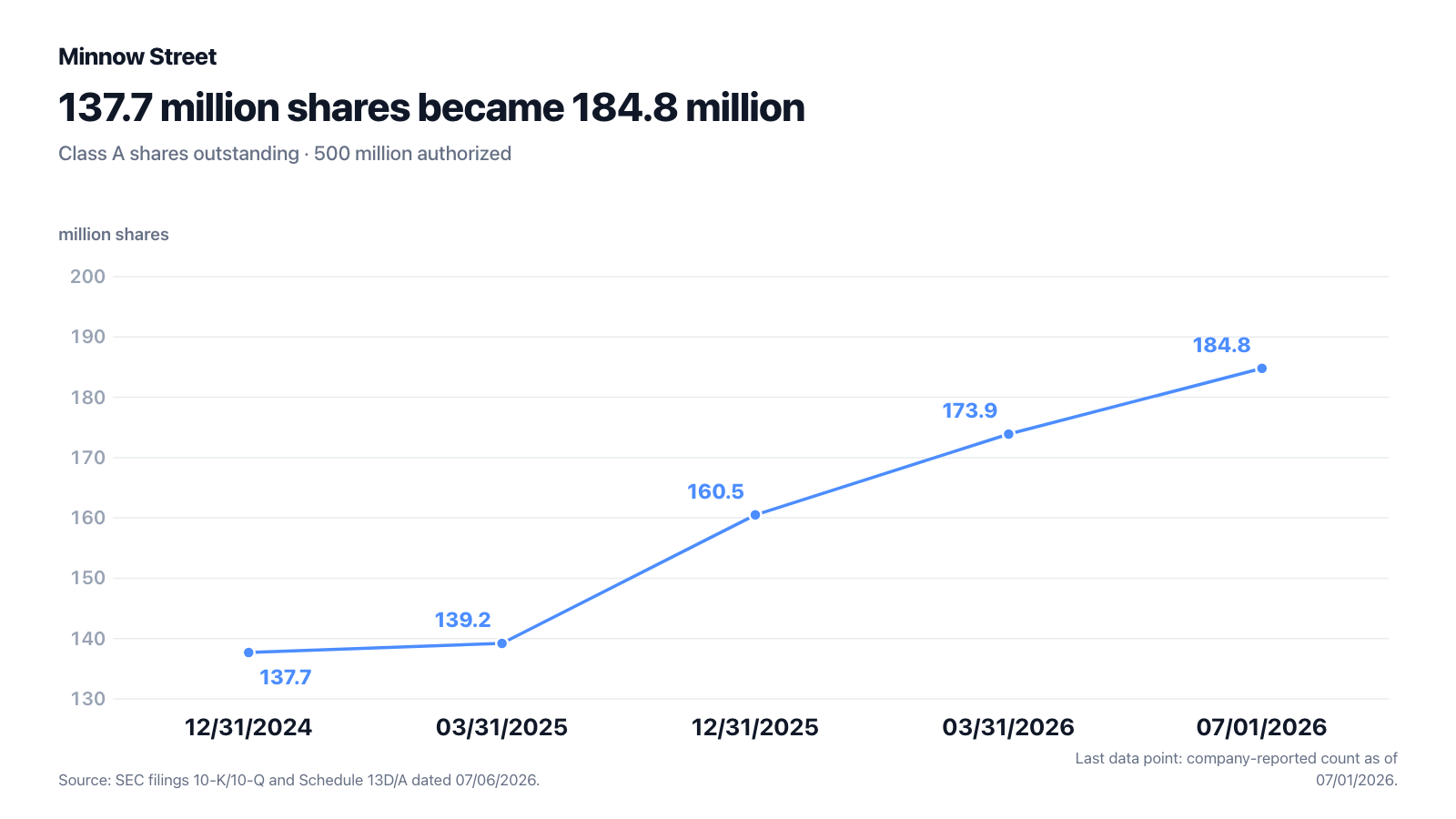
The final point on that line deserves an explanation, because it does not come from a quarterly report: the 184,836,005 shares as of July 1, 2026 appear in a Schedule 13D/A filed July 6, 2026, in which the reporting persons expressly note that the figure was provided by the company and was not obtained from a public filing. The cover page of the quarterly report still showed 173,990,987 shares as of May 7, 2026. On top of that sit securities not yet in that count: 6,130,247 stock options at a weighted average exercise price of just $2.09, 2,716,600 shares from outstanding restricted stock units, and 14,748,658 shares reserved for the employee plans (all as of 03/31/2026, prospectus supplement 424B5). On June 24, 2026, Oklo registered a further 8,025,494 shares for the equity incentive plan and 1,605,099 for the employee stock purchase plan on Form S-8.
Completeness also means naming who sells. Founders Jacob DeWitte (chief executive officer) and Caroline Cochran together hold 20,559,091 shares, or 11.1 percent. On June 1, 2026, they sold 200,000 shares at prices between $64.57 and $70.56; on July 1, 2026, another 200,000 shares between $51.52 and $54.30 — both under a 10b5-1 trading plan adopted on March 31, 2025, so neither spontaneous nor price-triggered (Schedule 13D/A dated 07/06/2026). One more line for the fine print: director Michael Klein receives an advisory mandate through an affiliated firm; Oklo paid a total of $500,000 under that agreement in 2025 (annual report 10-K for 2025, related party transactions).
What is not uncomfortable: the amended quarterly report
On June 17, 2026, Oklo filed an amendment to its quarterly report — a Form 10-Q/A. Filings like that set off alarm bells for experienced investors, because they often signal a restatement or a material weakness in internal controls. Neither is the case here, and it takes one paragraph to verify:
"The sole purpose of this Amendment No. 1 on Form 10-Q/A is to amend the certification filed as Exhibit 31.2 to the Quarterly Report on Form 10-Q of Oklo Inc. (the "Company") for the quarterly period ended March 31, 2026, filed with the U.S. Securities and Exchange Commission on May 12, 2026 (the "Original Filing") to correct the inadvertent omission of the conformed signature of the Chief Financial Officer."
— Oklo Inc., SEC Form 10-Q/A dated June 17, 2026, Explanatory Note

The amendment states explicitly that it does not modify any financial or other information in the original filing. And in Item 4 of that same report, the chief executive officer and chief financial officer conclude that disclosure controls and procedures were effective as of March 31, 2026, with no changes to internal control over financial reporting during the quarter. Auditor Deloitte & Touche was ratified at the annual meeting on June 3, 2026, with 114.2 million votes for and 0.4 million against (Form 8-K dated 06/08/2026). If "10-Q/A" makes you flinch: in this case, briefly and rightly so — permanently and wrongly.
Valuation — what more than seven billion for zero revenue means
A company without revenue has neither a price-to-earnings nor a price-to-sales ratio; both are simply undefined. What remains is the balance sheet and orders of magnitude. As of July 27, 2026, Oklo's market capitalization stood at just over $7 billion; the last close before that data point was $40.25 on July 24, 2026. Book value per share is roughly $15.18, putting the price-to-book ratio at about 2.7 (source: fundamental data, as of 07/27/2026). In other words, for every dollar of accounting substance — nearly all of it cash — you pay about $2.70. The difference is the price of expectation.
It is worth mirroring that price of expectation against the numbers in the filings, because those carry dates. In January 2026, Oklo sold new stock at an average of $96.95. On May 11, 2026, the last reported sale price was $78.13; on May 12 it was $73.63 (prospectus supplement 424B5). The founders sold on June 1, 2026, between $64.57 and $70.56, and on July 1, 2026, between $51.52 and $54.30 (Schedule 13D/A). The last close in our data set is $40.25 (07/24/2026). That chain is neither a price target nor a forecast — it simply shows that the expectation premium has shrunk considerably in recent months, while nothing changed in the operating facts: no revenue, no binding contract, no refiled license application.
The professionals' view: nine analysts cover the stock — four at strong buy, two at buy, three at hold, none at sell; the average price target is $86.20 (source: fundamental data, as of 07/27/2026). Such targets are opinions with a date, not measurements — and they necessarily assume that letters of intent turn into contracts and contracts into power plants. If you want to see how a revenue-less future story can also end, our Fermi stock analysis is the direct counterpoint: there, a revenue-less energy project with billions of property, plant, and equipment but doubt about its own ability to continue as a going concern. At Oklo it is the exact inverse — almost no fixed assets, but a treasury that funds years of patience.
Opportunities and risks at a glance
What speaks for Oklo:
- A balance sheet that buys time: $2,536.9 million of cash and securities as of 03/31/2026 against $64.9 million of total liabilities — no bank debt, no covenant, no refinancing date.
- Interest income on its own portfolio ($21.3 million in the first quarter of 2026 alone) currently covers roughly 42 percent of the operating loss.
- Cash used in operations was a modest $17.9 million in the first quarter of 2026 relative to the treasury; Oklo expects only $80 million to $100 million for full-year 2026.
- A regulatory workaround exists: the Aurora unit at Idaho National Laboratory may be built and operated under the Department of Energy authorization pathway, independent of the open NRC process.
- Serious counterparties: a prepayment agreement with Meta Platforms (01/05/2026) for a 1.2-gigawatt campus in Ohio, a 12-gigawatt master power agreement with Switch (December 2024), and a DOE agreement for a radioisotope pilot facility (01/07/2026).
What speaks against it:
- Zero revenue since inception; neither a price-to-earnings nor a price-to-sales ratio can be calculated. The entire valuation rests on events that have not yet occurred.
- No plant built and no binding power purchase agreement — stated by the company itself in the 2025 annual report.
- The 2020 license application was denied in 2022; as of the quarterly report filed 05/12/2026, the updated application had not been refiled, while the first plant is targeted for 2028.
- Ongoing dilution: shares outstanding rose from 137.7 million (12/31/2024) to 184.8 million (07/01/2026), with an open $1.0 billion sales program since 05/13/2026 inside a $3.5 billion shelf registration.
- The $14.97 of net tangible book value per share (03/31/2026) consists almost entirely of money rather than power plants — property, plant, and equipment stood at $95.6 million on the same date.
- Fuel remains an unresolved cost block: in its quarterly report, Oklo points to sharply higher prices for high-assay low-enriched uranium (HALEU) as well as tariffs, supply chain constraints, and sanctions.
A human bottom line
Back to the gigawatt reflex. Twelve gigawatts with Switch, 1.2 gigawatts for Meta, 15 to 75 megawatts per Aurora — none of those numbers is invented; every one of them appears in filings with the U.S. securities regulator. They all describe intentions, though, not deliveries. The only numbers that describe deliveries at Oklo still read: zero revenue, zero plants built, zero binding power purchase agreements. And at the same time — this is the honest second half of the story — this company sits on two and a half billion dollars, carries essentially no debt, burns less cash in operations than it earns in interest, and is working with the U.S. Department of Energy and with Meta on named sites. This is not vapor. It is a bet that license processes turn into licenses, that letters of intent turn into contracts, and that contracts turn into power plants — and that all of it happens fast enough to justify today's expectation premium. The difference between a good bet and a bad one rarely lies in the story itself. It lies in the price you pay for it, and in how honestly you admit to yourself that you are placing a bet rather than buying a return. What you make of that is your call. And that is exactly as it should be.
Sources
Every original document used in this analysis — for reading yourself:
- Oklo Inc. — SEC quarterly report on Form 10-Q as of March 31, 2026 (filed May 12, 2026)
- Oklo Inc. — SEC Form 10-Q/A (filed June 17, 2026, signature correction only)
- Oklo Inc. — SEC annual report on Form 10-K for 2025 (filed March 17, 2026)
- Oklo Inc. — Form 8-K dated May 13, 2026 (new equity distribution agreement of up to $1.0 billion)
- Oklo Inc. — SEC prospectus supplement 424B5 dated May 13, 2026 (dilution calculation)
- Oklo Inc. — Form 8-K dated June 8, 2026 (annual meeting results)
- Oklo Inc. — Form S-8 dated June 24, 2026 (registration of additional employee shares)
- Jacob DeWitte and Caroline Cochran — Schedule 13D/A dated July 6, 2026
- Complete SEC filing history for Oklo Inc.: EDGAR overview (sec.gov)
- Fundamental data (market capitalization, price-to-book, analyst coverage; as of July 27, 2026, last close July 24, 2026), reconciled against the SEC filings.
Transparency & disclaimer: This analysis is journalistic commentary on publicly available information. It is not investment advice, not a regulated financial analysis, and not a solicitation to buy or sell securities. Equity investments carry substantial risk up to total loss — particularly at a company with no revenue and no binding customer contracts. All information is provided without warranty; the data date is noted in the text. The author holds no position in Oklo shares at the time of publication.
Our Bottom Line at a Glance
- Balance Sheet & Liquidity positive
- As of March 31, 2026, Oklo held $2,536.9 million in cash and marketable debt securities against only $64.9 million of total liabilities — no bank debt, no bond, no covenant. Stockholders' equity stood at $2,638.6 million, up from $269.3 million a year earlier. Cash used in operating activities was just $17.9 million in the first quarter of 2026; the company expects $80 million to $100 million for 2026.
- Earnings Power negative
- There is no revenue line — neither in the 2025 annual report nor in the quarterly report as of March 31, 2026. Operating expenses rose to $51.2 million in the first quarter of 2026 (prior-year quarter $17.9 million) and the net loss to $33.1 million. The loss was not larger only because $21.3 million of interest and dividend income came in from the company's own portfolio.
- Customer Contracts negative
- In its 2025 annual report, Oklo states that it has not yet constructed any powerhouses or entered into any binding power purchase agreement with any customer. The 12-gigawatt Switch agreement (December 2024) is a master framework; the arrangements with Equinix, Diamondback Energy, and Prometheus Hyperscale are non-binding letters of intent. The only customer money received so far: $25.0 million paid in March 2024 for a right of first refusal, still carried unchanged as a liability.
- Licensing & Timeline negative
- The combined license application from March 2020 was denied without prejudice in 2022; as of the quarterly report filed May 12, 2026, the updated application had not been refiled. Oklo states that it is uncertain when, if at all, NRC approvals will be obtained — while the first plant is targeted for 2028, described in the filing itself as "ambitious." Mitigating: since August 2025 the Aurora unit at Idaho National Laboratory may proceed under the Department of Energy authorization pathway.
- Dilution negative
- Shares outstanding rose from 137.7 million (12/31/2024) to 184.8 million (07/01/2026, Schedule 13D/A). In January 2026 alone, 12,376,352 shares were sold at an average price of $96.95 (gross $1,199.9 million). A further sales program of up to $1.0 billion has been running since May 13, 2026 inside a $3.5 billion shelf registration; on June 24, 2026, another 9.63 million employee shares were registered on Form S-8.
- Valuation neutral
- Without revenue there is no P/E and no P/S ratio. On a book basis the stock trades at roughly 2.7 times equity per share (data as of 07/27/2026), against $14.97 of net tangible book value per share as of March 31, 2026 that consists almost entirely of cash and securities. Nine analysts cover the stock (four strong buy, two buy, three hold, none sell; average price target $86.20, data as of 07/27/2026).
Oklo Inc. is one of the best-funded revenue-less companies on the U.S. market: $2,536.9 million of liquidity against $64.9 million of liabilities as of March 31, 2026, plus $21.3 million of interest income in the first quarter alone. What is missing is everything else — revenue, a plant in the ground, a binding power purchase agreement, and a refiled license application. It is all funded with new stock: from 137.7 million shares (12/31/2024) to 184.8 million (07/01/2026), with an open program for a further $1.0 billion. Not investment advice.
What Our Rating Means
Open questions
The business works in principle, but one material question is open. As long as it stays open, our findings do not carry a quality verdict.
Yellow here is not about balance sheet risk — Oklo's balance sheet is unusually solid: $2,536.9 million of liquidity, $64.9 million of liabilities, no bank debt, no maturity date that could create pressure. Yellow is about the gap between valuation and evidence. The company has reported no revenue to date, states in its own 2025 annual report that it has neither built a powerhouse nor signed a binding power purchase agreement, and as of the quarterly report filed May 12, 2026 had not refiled the license application denied in 2022. At the same time the share count keeps climbing fast (137.7 million on 12/31/2024, 184.8 million on 07/01/2026), and a further sales program of up to $1.0 billion has been running since May 13, 2026. Anyone investing here is not buying earnings power but a funded window of time in which licensing, contracting, and construction have to prove themselves. The decision is yours.
A journalistic assessment by our editorial team at the time of the deep dive, based on public sources — not investment advice and not a solicitation to buy or sell. Your personal circumstances (investment goals, risk capacity, taxes) cannot be taken into account. What our levels mean, how verdicts are formed, and what conflicts of interest exist →
Worth Noting
- The hook for this analysis is an attention sweep across the most-discussed U.S. stocks in investor forums on July 27, 2026. At that point Oklo appeared in none of our in-house stock scanner lists — the metric filters require revenue or earnings, and Oklo has neither. Scanner lists are recalculated daily.
- Data as of: SEC filings through the Form 10-Q/A dated June 17, 2026, plus current reports, prospectus supplements, and beneficial ownership filings through July 6, 2026; market data (market capitalization, price-to-book, analyst coverage) as of July 27, 2026, last close July 24, 2026.
- The Form 10-Q/A dated June 17, 2026 is explicitly not a restatement: its sole purpose was to supply the chief financial officer's conformed signature, inadvertently omitted from the certification in Exhibit 31.2. No figures were changed and no material weakness was identified.
- Not to be confused: before May 9, 2024, Oklo Inc. was named AltC Acquisition Corp., a special purpose acquisition company. Figures from before the merger relate to the operating predecessor, Oklo Technologies, Inc.
Frequently Asked Questions
Oklo develops small nuclear power plants called Aurora, designed to produce 15 to 75 megawatts of electricity. Unlike traditional reactor vendors, Oklo does not intend to sell the plants but to own and operate them and sell the power under long-term agreements. It is also commercializing nuclear fuel recycling and, through its subsidiary Atomic Alchemy, radioisotope production.
No. Neither the annual report (10-K) for 2025 nor the quarterly report (10-Q) as of March 31, 2026 shows a revenue line — the income statement begins directly with operating expenses. As a result, neither a price-to-earnings nor a price-to-sales ratio can be calculated for Oklo.
As of March 31, 2026, Oklo held $2,536.9 million in cash and marketable debt securities against only $64.9 million of total liabilities. Cash used in operating activities was just $17.9 million in the first quarter of 2026, and the company expects $80 million to $100 million for full-year 2026. Arithmetically, the treasury covers far more than the twelve-month horizon required by accounting rules.
No. In the 2025 annual report Oklo states that it has not yet constructed any powerhouses or entered into any binding power purchase agreement with any customer. The 12-gigawatt Switch agreement from December 2024 is a master framework; the arrangements with Equinix, Diamondback Energy, and Prometheus Hyperscale are non-binding letters of intent.
Oklo names 2028 as its target for the first plant, describing it in its own filing as "ambitious." That requires a license: the application filed in March 2020 was denied without prejudice in 2022 and had not been refiled as of the quarterly report dated May 12, 2026. For the plant at Idaho National Laboratory, a second path exists under the U.S. Department of Energy authorization framework.
The amendment (Form 10-Q/A) dated June 17, 2026 states that its sole purpose was to supply the chief financial officer's conformed signature, inadvertently omitted from the certification in Exhibit 31.2. No figures were restated and no material weakness was identified; the chief executive officer and chief financial officer concluded that disclosure controls were effective as of March 31, 2026.
Shares outstanding rose from 137.7 million (12/31/2024) to 160.5 million (12/31/2025) and 184.8 million as of July 1, 2026. In January 2026 alone, Oklo sold 12,376,352 shares at an average price of $96.95. On May 13, 2026, a further program of up to $1.0 billion began, inside a shelf registration of $3.5 billion. A total of 500 million shares is authorized.
Without revenue there is no price-to-earnings or price-to-sales ratio. On a book basis the stock trades at roughly 2.7 times equity per share (data as of July 27, 2026) — against substance that is almost entirely cash and securities: $14.97 of net tangible book value per share as of March 31, 2026. Everything above that is expectation you are paying for.
Found an error?
Did you spot a factual error, an outdated number, or a typo in this deep dive? Let us know briefly — your report goes straight to the editorial team.