Oracle: $638 Billion on the Books — and $23.7 Billion Out the Door
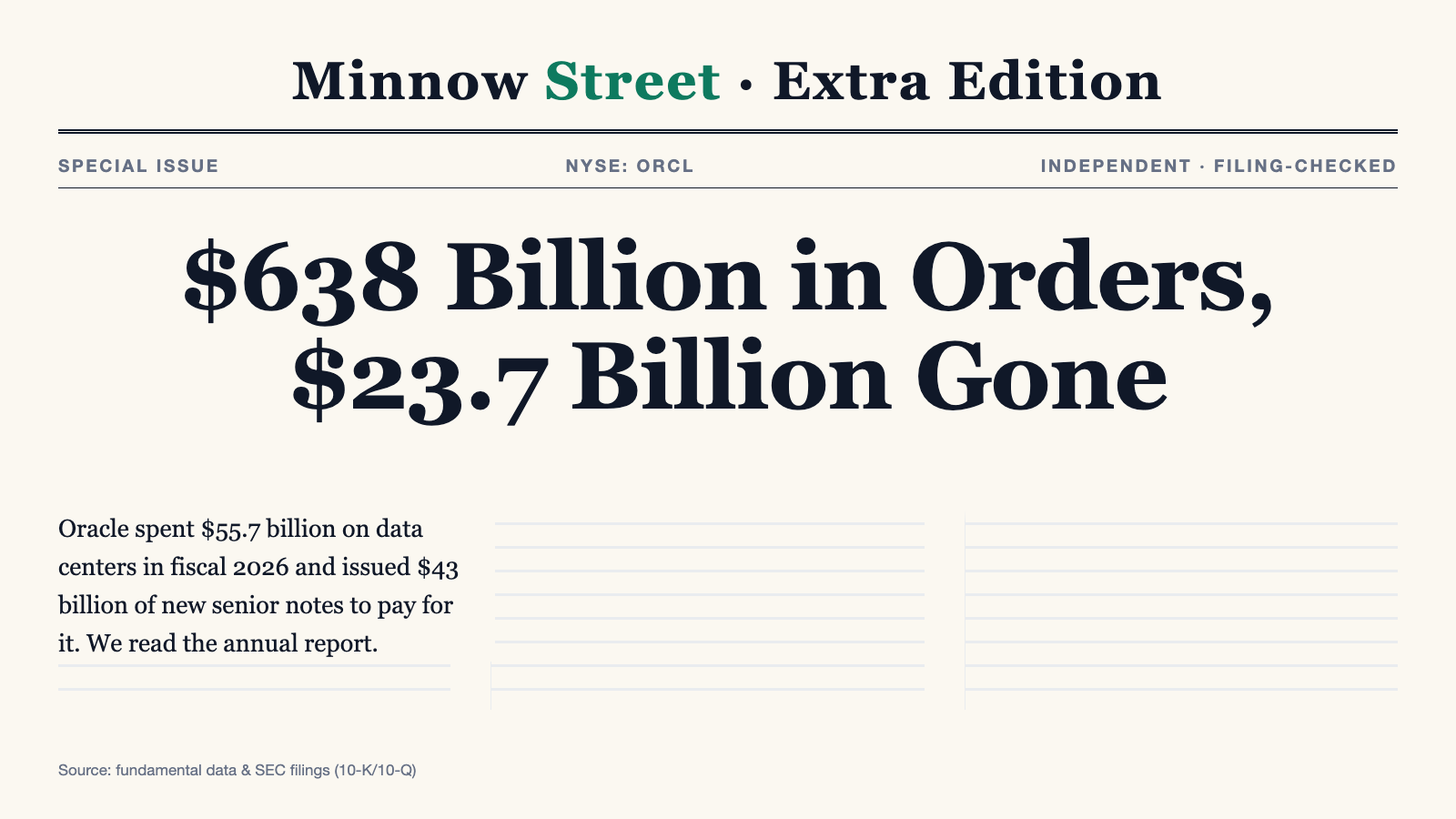
For the fiscal year ended May 31, 2026, Oracle reported remaining performance obligations of $638 billion — almost five times the prior year. In the same year, $55.7 billion went into data centers, free cash flow flipped to minus $23.7 billion, and debt climbed to $129.5 billion. The stock sits 65 percent below its all-time high, which is exactly why it shows up in our turnaround scanner. We read the annual report, the quarterly report and the note offerings — and found $260 billion of lease commitments that appear on no balance sheet. An order book is a promise. A data center is an invoice.
 Thomas Mücke
Founder & Publisher
Thomas Mücke
Founder & Publisher
Chart
Interactive price chart (TradingView).
Note: pure fact-based analysis, not investment advice and not a solicitation to buy or sell. All figures without guarantee.
There is an investor trap that springs shut most reliably around very large numbers: the order book trap. It works because your brain files any figure preceded by the word "orders" as money. Oracle Corporation (NYSE: ORCL) reported remaining performance obligations of $638 billion for the fiscal year ended May 31, 2026. A year earlier the figure was $138 billion. That is almost five times as much, and it is a number against which even annual revenue of $67.4 billion looks small.
So let us make a deal before the number does its work. Together we will read what Oracle filed with the U.S. securities regulator, the SEC — the annual report (10-K) for fiscal 2026, the quarterly report (10-Q) as of February 28, 2026, and everything filed since. An SEC filing is honest under penalty of law. And this one describes, next to the order book, $55.7 billion that flowed into data centers in a single year, $43 billion of new senior notes maturing as far out as 2066, $260 billion of lease commitments that appear on no balance sheet line — and one sentence in the risk factors worth reading twice.
What this analysis covers
- What Oracle actually does — the database and the power plant
- How the stock reached our desk — rank 20 among turnaround candidates
- The numbers over the years — given their due
- What the filings say — the uncomfortable truths
- Valuation — what the market is paying right now
- Opportunities and risks at a glance
- A human conclusion
- Sources
What Oracle actually does — the database and the power plant
Oracle sells two very different things, and the difference explains almost everything that follows. The first is a memory: the Oracle database, where banks, insurers, government agencies and corporations keep their data, plus enterprise software for accounting, human resources and supply chains. This business is old, sticky and wonderfully predictable. Once your accounting runs on Oracle, you do not switch on a whim. The maintenance contracts attached to it — "software support" in the filing — brought in $19.804 billion in fiscal 2026 and grew by exactly one percent. Dull, but as reliable as rent.
The second is a power plant: Oracle Cloud Infrastructure, or OCI. Here Oracle rents out computing capacity — servers, graphics processors, storage, networking — on which other companies run their software and their artificial intelligence. This business is young, hungry, and grew 77 percent to $18.101 billion in fiscal 2026. The difference from the memory business is the decisive one: a database license costs Oracle almost nothing to produce. A data center costs billions before the first customer pays a cent.
In between sit cloud applications ($15.888 billion, up 11 percent), traditional software licenses ($4.737 billion, down 9 percent), hardware ($3.084 billion) and consulting services ($5.743 billion). All told, 51 percent of fiscal 2026 revenue came from the cloud, against 43 percent a year earlier and 37 percent two years before that. The company is headquartered in Austin, Texas, employed roughly 141,000 people full time as of May 31, 2026 — 43,000 of them in research and development — and spent $10.272 billion on that development.
Which names the central tension of this analysis, and it runs through every chapter: Oracle is using yesterday’s certain money to fund a bet on the day after tomorrow — and has to pay the bill today.
How the stock reached our desk — rank 20 among turnaround candidates
We run roughly 3,500 stocks through our scanners every day. On July 25, 2026, Oracle stood at rank 20 of 62 hits in the Turnaround Candidates list (U.S. selection), with a turnaround check of 6 of 8 points. To reproduce it: open the scanner, set the country filter to "US", and sort by the turnaround check column.
And now the sentence that has to come first with a name like this: a company worth $331 billion does not normally belong on a restructuring list. Oracle is not there because the business is ailing. Oracle is there because the scanner does not read names — it tests two mandatory conditions, and both are purely arithmetic.
Mandatory pillar 1 — the crash. The stock must trade at least 50 percent below its all-time high. Without a real decline there is no turnaround; otherwise the list simply catches ordinary growth stocks. Oracle’s highest closing price was $328.33 on September 10, 2025. On July 24, 2026 the stock closed at $114.99 — 64.98 percent below that. The condition is comfortably met. Run it the other way and you see how narrow such a list is: if the price rises above roughly $164, it is no longer 50 percent down — and Oracle drops out of the scanner. Not because anything went wrong, but because the stock recovered.
Mandatory pillar 2 — survival. The Altman Z-score, a well-established bankruptcy early-warning measure built from five balance sheet ratios, has to sit outside the danger zone; our threshold is 1.1. Oracle came in at 1.43 on July 25, 2026. Met — but narrowly, and the composition is the most honest finding in this chapter. One of the five building blocks is market capitalization relative to total liabilities. At Oracle that single block contributes 0.91 of the 1.43 points, roughly 64 percent. Strip it out — that is, look at the balance sheet alone — and 0.52 is left. Translated: what keeps Oracle alive in this list is, to two thirds, the share price itself. Which yields the second threshold: if the price falls below roughly $74, the Altman Z-score drops under 1.1 — and Oracle drops out of the scanner as well, this time from below. For context: values below 1.8 are conventionally treated as the warning zone, values above 3 as the safe zone.
Only after that does the turnaround check apply, a checklist of eight points. Four test the operating turn — revenue direction, net margin, operating cash flow, a healing balance sheet — and four test market confirmation: price back above the 50-day line, three-month relative strength above twelve-month, insiders buying on balance, large funds adding. To appear at all, a stock must clear both mandatory pillars and score at least six of the eight points.
Three of the operating points can be recalculated straight out of the annual report, and they are real. Revenue in the quarter ended May 31, 2026 was $19.185 billion, up 20.6 percent year over year. The net margin rose to 22.4 percent, from 19.6 percent three quarters earlier and 21.6 percent in the prior quarter. And operating cash flow for that quarter was clearly positive at $14.620 billion. One point from the market block, on the other hand, is demonstrably missing: at $114.99 on July 24, 2026 the price sat well below the 50-day line of $171.55 — and below the 200-day line of $187.40 as well.
Remember the principle, it applies to every ranking: a rank and a score are a photograph, not a condition. The lists are recalculated daily. What the scanner measures is the direction of a few quarters. Whether the bet holds is decided in the filings. So let us read them.
The numbers over the years — given their due
First what genuinely impresses, and there is plenty. In fiscal 2019 Oracle booked $39.506 billion of revenue. In fiscal 2026 it was $67.357 billion — up 70 percent in seven years, and up 17.3 percent in the last year alone. Operating income rose from $13.535 billion to $20.606 billion, an operating margin of 30.6 percent. Net income came in at $17.087 billion, or $5.83 per diluted share, against $4.34 a year earlier. This is not a distressed company. This is a company in the best shape of its recent history.
The cash side was strong too: operating cash flow rose 54 percent to $31.977 billion — 1.87 times net income. A company that collects more cash than it books in profit generally has a clean income statement. And then comes the other side of the page.
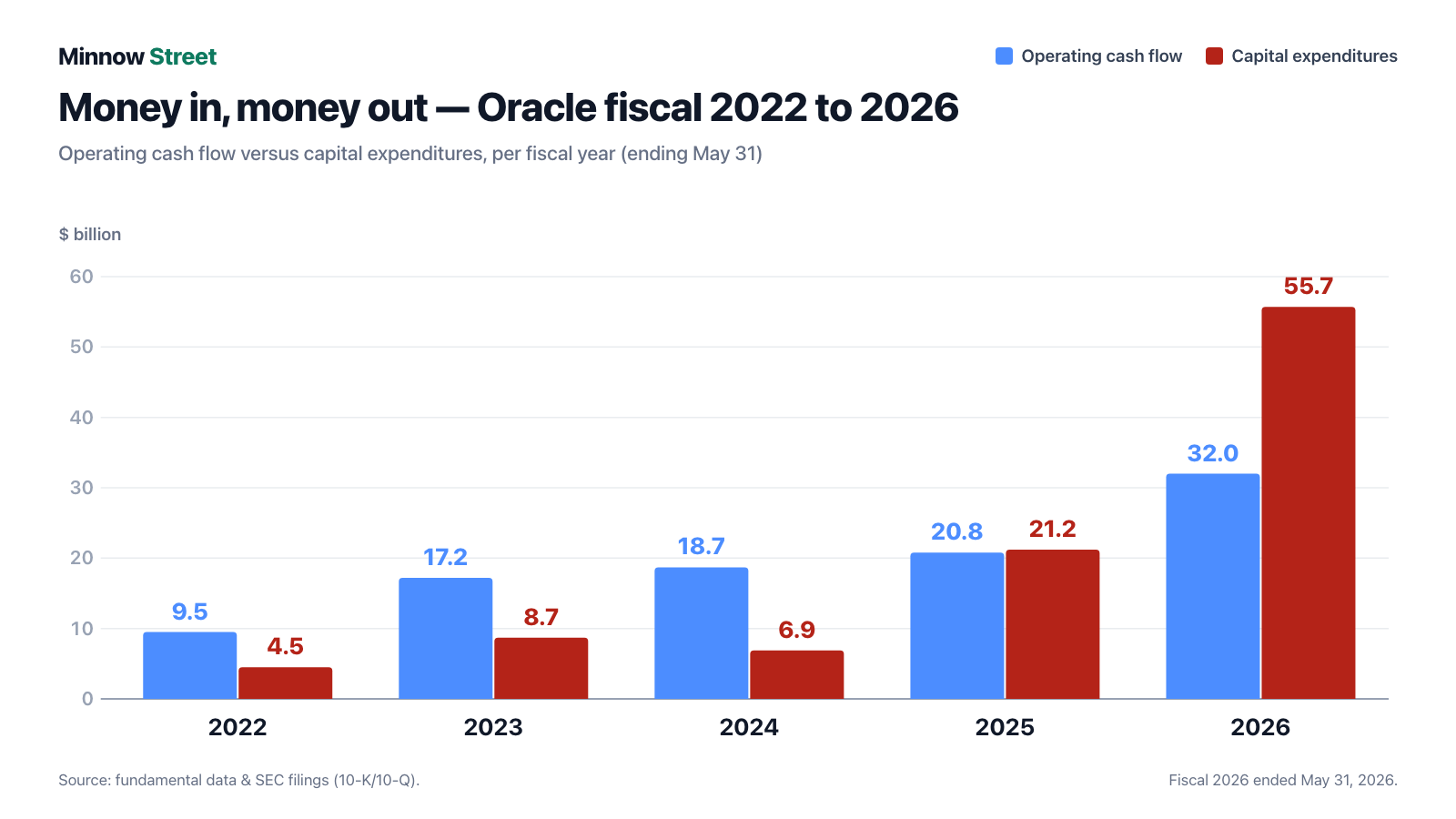
Capital expenditures — almost entirely data centers — rose from $6.866 billion in fiscal 2024 to $21.215 billion in 2025 and $55.663 billion in fiscal 2026. That is an eightfold increase in two years. The two series for the past five fiscal years side by side, rounded, in billions of dollars: operating cash flow 9.5 · 17.2 · 18.7 · 20.8 · 32.0, capital expenditures 4.5 · 8.7 · 6.9 · 21.2 · 55.7. Through 2024 the inflow was far larger than the spending, in 2025 the two were level, and in 2026 the relationship inverted. The balance sheet shows the same move: net property, plant and equipment grew from $43.522 billion to $99.957 billion. Oracle is building at a pace that has nothing to do with the classic software business.
What the filings say — the uncomfortable truths
Uncomfortable truth No. 1: free cash flow has flipped
Subtract $55.663 billion of capital expenditures from $31.977 billion of operating cash flow and you get free cash flow — the money left over after maintaining and expanding the business. Oracle presents the calculation itself in the annual report and arrives at minus $23.686 billion, after minus $0.394 billion a year earlier. As a percentage of net income: minus 139 percent. For seven years that figure had been comfortably positive: in billions of dollars it ran plus 12.9 (fiscal 2019), plus 11.6 (2020), plus 13.8 (2021), plus 5.0 (2022), plus 8.5 (2023) and plus 11.8 (2024), before edging negative at minus 0.4 in 2025 and collapsing to minus 23.7 in 2026.
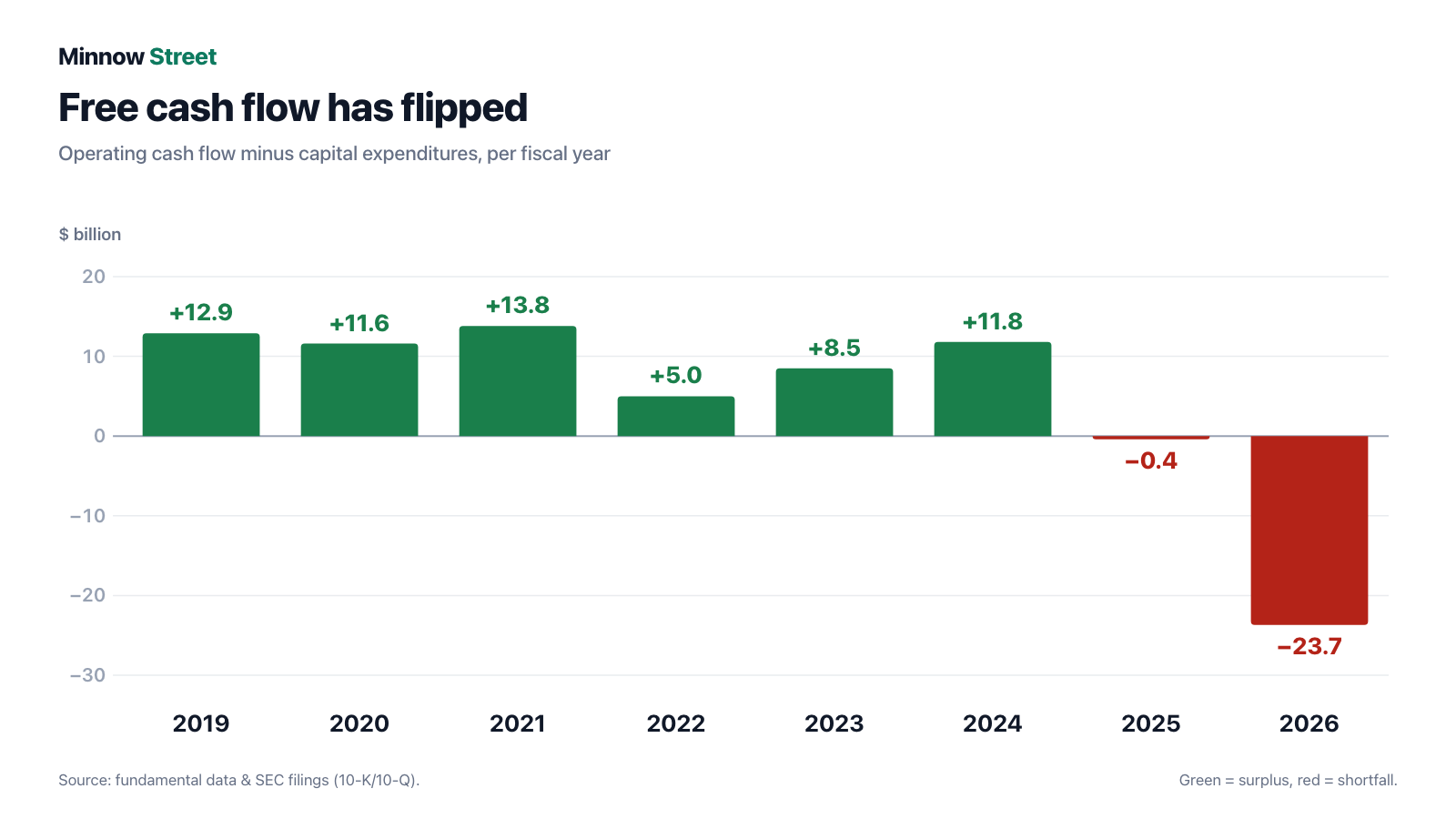
Important for fairness: this is not cash burn in the usual sense. Oracle earns very well operationally and is spending that money, plus borrowed money, on assets that will be usable for decades. The filing is also clear that it continues:

A line worth filing away: profit tells you how the books were kept. Free cash flow tells you who is fronting the money. At Oracle, the capital markets are currently fronting it. The cash flow statement shows where it came from: $42.7 billion net from new senior notes, $5.0 billion from preferred stock, $4.9 billion from selling investments, $3.3 billion of short-term financing related to capital expenditures, and $1.3 billion net from employee stock programs.
Uncomfortable truth No. 2: $260 billion of rent appears on no balance sheet line
This is the finding that stays with you longest. When a company leases something, accounting rules now require the lease obligation to appear on the balance sheet — as a right-of-use asset on one side and a liability on the other. Oracle does that: $30.190 billion of operating and $7.701 billion of finance lease liabilities sit on the balance sheet as of May 31, 2026. But the requirement only bites once the lease term has commenced. And then this paragraph appears in the notes:

"As of May 31, 2026, we had $260 billion of additional lease commitments, substantially all related to data center arrangements, that are generally expected to commence between the first quarter of fiscal 2027 and fiscal 2029 and for terms of fifteen to nineteen years that were not reflected on our consolidated balance sheet as of May 31, 2026 or in the maturities table above."
— Oracle Corporation, SEC annual report 10-K for fiscal 2026, Note 9 (Leases, Other Commitments and Certain Contingencies)
Take a moment for the scale. Oracle’s entire balance sheet on the same date totals $261.759 billion. The lease commitments not yet on it total $260 billion. There is, in effect, a second balance sheet standing beside the first one, invisible, with terms of fifteen to nineteen years. That is entirely correct accounting and openly disclosed — but anyone who looks only at the leverage ratio is seeing half the picture.
The same paragraph holds one more detail that is easy to miss: Oracle has guaranteed up to $3.3 billion of a lessor’s borrowing under one of these leases — maturing in September 2026. In the quarterly report as of February 28, 2026, the same disclosure named a guarantee of up to $2.2 billion. In one quarter the commitment grew by $1.1 billion.
Uncomfortable truth No. 3: the order book is a concentration, not a certainty
Now to the headline number. Remaining performance obligations are the total of all contracted services that have not yet been recognized as revenue. They rose from $138 billion (May 31, 2025) through $552.6 billion (February 28, 2026) to $638 billion as of May 31, 2026.

Two details in that paragraph deserve more attention than the $638 billion itself. First, the wording: the increase is attributed to "certain significant cloud contracts". How many contracts, and with whom, the filing does not say. Second, the schedule: Oracle expects to recognize roughly 12 percent of the order book as revenue over the next twelve months, 34 percent in months 13 through 36, another 34 percent in months 37 through 60, and the remainder after that. So 88 percent lies beyond the coming year, and roughly a fifth beyond five years.
The good news is in the notes: "No single customer accounted for 10% or more of our total revenues in fiscal 2026, 2025 or 2024." The uncomfortable news sits fifty pages earlier, in the risk factors, and it is the sentence worth reading twice:
"Conversely, if we overestimate customer demand or any of our key customers are unable to pay or otherwise perform under their contracts with us, we could be locked into multi-year commitments for excess data center space and related capital expenditures, as well as associated financings, without receiving corresponding revenue. … In certain OCI offerings, we are more concentrated among a number of large customers, which could increase these risks."
— Oracle Corporation, SEC annual report 10-K for fiscal 2026, Item 1A (Risk Factors)
That is the whole bet in one sentence, written by the company itself. Oracle leases data centers for fifteen to nineteen years and finances them with notes maturing in 2066. The customers meant to absorb that capacity are few and large. Remember: an order book measures what somebody promised — not what they can pay for next year. We saw the same mechanism at the other end of the chain in our Nvidia analysis, where demand for graphics processors comes from the same handful of addresses.
Uncomfortable truth No. 4: $129.5 billion of debt — and the bond market pays 89 cents
Debt rose from $92.6 billion (May 31, 2025) to $129.5 billion (May 31, 2026). In fiscal 2026 alone Oracle issued $43.0 billion of new senior notes across fourteen tranches — from 4.45 percent for five years to 6.85 percent for forty years, maturing in February 2066. Interest expense climbed 29 percent to $4.599 billion. Measured against operating income of $20.606 billion, interest coverage is roughly 4.5 times — adequate, but a long way from the comfort of earlier years.

And now the figure that makes no headlines but says more about the situation than any price target. The notes give a carrying value of $128.1 billion for the long-term borrowings — and a fair value of $114.4 billion. The bond market therefore values Oracle’s debt at roughly 89 cents on the dollar. A year earlier it was $81.3 billion against $90.3 billion, about 90 cents, and as of February 28, 2026 it was $118.4 billion against $130.9 billion, also about 90 cents. Part of that discount is a rate effect — older notes with low coupons lose value when market rates rise. But it is also a verdict. Professional creditors are paying less than face value for Oracle’s promises.
Fairness here means saying that the company is not under pressure. Since March 6, 2026 it has an undrawn $10 billion revolving credit facility (previously $6 billion), a commercial paper program raised to $10 billion with $1.5 billion drawn, $31.894 billion of cash and marketable securities — and it states explicitly: "We were in compliance with all debt-related covenants at May 31, 2026." Near-term maturities are manageable: $7.210 billion in fiscal 2027, $10.145 billion the year after. The mountain sits far out: $90.250 billion falls due only after fiscal 2031.
Uncomfortable truth No. 5: part of the record profit is one-time — and part of the cash is borrowed
Two items you need to know to read the record numbers correctly. The first sits in non-operating income, which jumped from $60 million in fiscal 2025 to $3.547 billion. The reason is a sale. On November 25, 2025, SoftBank acquired all equity interests in chip developer Ampere Computing; Oracle received $4.3 billion in cash and recorded a realized gain of $2.7 billion. That is real money and entirely legitimate — but it does not come back. Of the $4.644 billion increase in net income, well over half traces to this single transaction. Operating income over the same period rose "only" from $17.678 billion to $20.606 billion.
The second item sits in the revenue recognition note and is subtler. In fiscal 2026 Oracle received $4.6 billion of prepayments from customers that included a significant financing component — in fiscal 2025 and 2024 there were no such payments at all. Translated: customers paid so far ahead of delivery that the accounting identifies what is economically a loan. The money is real and sits in operating cash flow. It is simply money for services Oracle still has to deliver. Without that item, operating cash flow would have been roughly $27.4 billion instead of $31.977 billion.
A third pointer in the same direction: the share repurchase, for years an Oracle hallmark, has effectively stopped. In fiscal 2026 the company bought back 0.4 million shares for $93 million — after 3.9 million shares for $600 million (2025) and 10.6 million for $1.2 billion (2024). For comparison: in fiscal 2019, fundamental data show more than $36 billion of net spending on own shares. Roughly $6.3 billion of authorization remains. The dividend, by contrast, is unchanged: $2.00 per share in fiscal 2026, $5.7 billion in total.
On top of that come two funding routes that did not exist before. On February 5, 2026, Oracle issued 100 million depositary shares representing 50,000 Series D preferred shares carrying a 6.50 percent dividend, raising $5.0 billion net; they convert automatically into common stock on January 15, 2029 at 499.8126 to 624.7657 shares per preferred share. Work out the upper bound and you have the conversion floor: only below roughly $160 per common share do preferred holders receive the maximum share count — and even then, less value than they paid in. And on February 2, 2026, Oracle set up a program allowing it to sell common stock worth up to $20 billion into the market over time. Not a single share had been sold under it as of May 31, 2026 — but on June 23, 2026, one day after the annual report, the syndicate of appointed banks was expanded from five to twenty.
Valuation — what the market is paying right now
Let us work in orders of magnitude rather than daily prices. At the July 24, 2026 close of $114.99 and 2,880,471,000 shares (cover page of the annual report, as of June 12, 2026), market capitalization was roughly $331 billion. Against diluted earnings of $5.83 per share that is a price-to-earnings ratio of about 20; against annual revenue of $67.357 billion, a price-to-sales ratio of about 4.9; against equity of $43.056 billion, a price-to-book ratio of about 8.8. Adding net debt, enterprise value comes to roughly $460 billion, or about 13.8 times operating income before depreciation and amortization.
For a software heavyweight with a 30.6 percent operating margin, twenty times earnings is not an exotic price. The catch lies elsewhere: earnings per share include the one-time Ampere effect, and the capital that produces them is currently growing faster than the profit. Forty-three billion dollars of new notes and $5 billion of preferred capital demand interest and preferred dividends from now on — in fiscal 2026 that was $4.599 billion of interest and $103 million of preferred dividends.
The professionals’ view, put in context: across 39 analyst ratings the consensus price target was $248.15 (data as of July 25, 2026), with 20 strong buys, 4 buys, 15 holds and no sell ratings. That is more than double the share price — a number to read not as a forecast but as the mood of a profession whose estimates have been chasing the price for the past twelve months. For a cross-check on another badly beaten enterprise software name from the same scanner list, see our ServiceNow analysis.
One footnote that belongs in the picture: as of July 25, 2026 roughly 50.1 million shares were sold short, up from 37.7 million a month earlier — just under three percent of shares outstanding. And since February 3, 2026 a shareholder class action has been pending in Delaware against Oracle, its chief technology officer, its two chief executive officers, two further executives and one board member over allegedly false statements about the cloud infrastructure business. Oracle believes it has meritorious defenses and does not expect a material impact; the defendants’ response is due by September 16, 2026.
Opportunities and risks at a glance
Opportunities
- $638 billion of remaining performance obligations as of May 31, 2026 — contracted revenue that maps out several years of growth if performed as agreed.
- Cloud infrastructure growing 77 percent to $18.101 billion; the cloud share of group revenue rose from 37 to 51 percent in two years.
- The old business still carries: $19.804 billion of support revenue with a high renewal rate funds a meaningful part of the build-out.
- Operating cash flow of $31.977 billion, up 54 percent and 187 percent of net income — earnings are backed by cash.
- Financing room: $31.894 billion of cash and securities, a $10 billion undrawn revolver, an untouched $20 billion equity program, and all debt covenants met.
Risks
- Free cash flow at minus $23.686 billion in fiscal 2026, and Oracle itself expects capital spending to keep rising in fiscal 2027 and beyond.
- $260 billion of off-balance-sheet lease commitments with terms of fifteen to nineteen years, plus $13.309 billion of unconditional purchase obligations and a further $19 billion committed after the balance sheet date.
- $129.5 billion of debt maturing out to 2066, $4.599 billion of interest expense and a 16.4 percent equity ratio; the bond market values the long-term borrowings at roughly 89 cents on the dollar.
- Concentration among a few large customers in parts of the cloud infrastructure business — by Oracle’s own account in the risk factors; if one falls away, the leases and their financing keep running.
- Quality of the record profit: $2.7 billion from the one-time Ampere sale and $4.6 billion of customer prepayments with a financing component support the fiscal 2026 records.
- Dilution path: preferred shares with mandatory conversion on January 15, 2029 and an equity sales program of up to $20 billion whose bank syndicate was quadrupled on June 23, 2026.
A human conclusion
Back to the order book trap from the opening. It works so well precisely because it does not rest on a lie. The $638 billion are real, they sit in a filing for which executives are personally liable, and they are the result of contracts somebody signed. The error is not in the number but in what our minds automatically turn it into: a bank balance.
What Oracle actually did in fiscal 2026 fits in one sentence: the company spent $55.7 billion, borrowed $43 billion and raised $5 billion of new preferred capital to build capacity for an order book of which 88 percent lies beyond the next year. That may be one of the best corporate decisions of the decade. It may also be the moment a software house listed since 1986 became a landlord of data centers, with everything that entails — leases of fifteen to nineteen years, guarantees for lessors, and notes that come due in 2066.
Which of the two stories is true, nobody knows today, and anyone who claims otherwise is selling you something. What you can do instead is count along. Does the order book keep growing? Do capital expenditures stay elevated? Does the $3.3 billion guarantee reappear in the filings after September 2026? And are shares sold under the $20 billion program? Every one of those four numbers appears in the next quarterly report, and each costs you five minutes.
What you make of that is your decision. And that is exactly as it should be.
Sources
- SEC annual report 10-K, Oracle Corporation, fiscal year ended May 31, 2026, filed June 22, 2026 (Item 1 Business, Item 1A Risk Factors, Item 7 MD&A, Notes 1, 3, 6, 9, 10 and 15)
- SEC quarterly report 10-Q, Oracle Corporation, as of February 28, 2026, filed March 11, 2026
- SEC annual report 10-K, Oracle Corporation, fiscal year ended May 31, 2025, filed June 18, 2025
- SEC prospectus supplement 424B5 dated June 23, 2026 (equity distribution program of up to $20 billion, additional sales agents)
- SEC current report 8-K dated June 10, 2026 (quarterly and annual results, dividend declaration, listing of the ORCL-PRD depositary shares)
- SEC submissions index for CIK 0001341439 (former names, exchanges, filing history; as of July 26, 2026)
- Screening and metric data: our in-house stock scanner (data as of July 25, 2026), including the Turnaround Candidates scanner (U.S. selection, rank 20 of 62, turnaround check 6 of 8) — the lists are recalculated daily.
- Source: fundamental data & SEC filings (annual and quarterly reports, 10-K/10-Q); price, valuation and analyst data as of July 25, 2026, based on the July 24, 2026 close.
Journalistic analysis, not investment advice and not a solicitation to buy or sell securities. Stocks can lose their entire value. All figures come from the original sources linked above and carry their respective as-of dates; metrics may have changed since the data date. The author holds no position in Oracle stock at the time of publication.
Our Bottom Line at a Glance
- Business model and market position positive
- Oracle sells the database a large part of the corporate world runs on, plus applications and, more recently, cloud computing capacity. In fiscal 2026, 51 percent of revenue came from the cloud, against 37 percent two years earlier. Revenue rose to $67.357 billion, the operating margin was 30.6 percent, and $10.272 billion went into research and development.
- Order book positive
- Remaining performance obligations jumped from $138 billion to $638 billion in twelve months (as of May 31, 2026) — contracted revenue that has not yet been recognized. Even the conservatively expected 12 percent for the next twelve months equals roughly $77 billion, more than the entire fiscal 2026 revenue.
- Cash flow and capital intensity negative
- Capital expenditures rose from $21.215 billion to $55.663 billion in fiscal 2026. Free cash flow fell to minus $23.686 billion, or 139 percent of net income. Oracle explicitly expects this upward trend to continue in fiscal 2027 and beyond.
- Leverage negative
- Debt rose to $129.5 billion as of May 31, 2026 from $92.6 billion a year earlier, and interest expense climbed 29 percent to $4.599 billion. The bond market valued $128.1 billion of carrying value at $114.4 billion of fair value, roughly 89 cents on the dollar. The equity ratio stood at 16.4 percent and the Altman Z-score at 1.43 (data as of July 25, 2026).
- Off-balance-sheet commitments negative
- As of May 31, 2026, $260 billion of data center lease commitments appear neither as an asset nor as a liability; they commence between fiscal 2027 and fiscal 2029 and run fifteen to nineteen years. Add $13.309 billion of unconditional purchase obligations and a further $19 billion committed after the balance sheet date. Total assets are $261.759 billion.
- Customer concentration neutral
- No single customer accounted for 10 percent or more of total revenues in fiscal 2024 through 2026 — that helps. At the same time Oracle writes in its own risk factors that in certain cloud infrastructure offerings it is "more concentrated among a number of large customers", and it attributes the jump in the order book to "certain significant cloud contracts". How many customers stand behind that, the filing does not say.
- Valuation neutral
- At the July 24, 2026 close of $114.99 and 2,880,471,000 shares, market capitalization was roughly $331 billion: about 20 times diluted earnings of $5.83 per share, about 4.9 times annual revenue and about 8.8 times book value. The consensus price target across 39 analyst ratings was $248.15 (data as of July 25, 2026).
Oracle set two records at once in fiscal 2026: $638 billion of remaining performance obligations and minus $23.686 billion of free cash flow. The two belong together, because one is the down payment on the other. The day-to-day business holds up: $67.357 billion of revenue, $20.606 billion of operating income, $31.977 billion of operating cash flow, 141,000 employees, and no single customer above 10 percent of revenue. The bill sits right next to it: $129.5 billion of debt, $4.599 billion of interest expense, a 16.4 percent equity ratio — and $260 billion of data center lease commitments that appear on no balance sheet line. Oracle poses the decisive question in its own risk factors: what happens if large customers cannot perform while the leases and their financing keep running. Not investment advice.
What Our Rating Means
Open questions
The business works in principle, but one material question is open. As long as it stays open, our findings do not carry a quality verdict.
The business works, and visibly so: $67.357 billion of revenue in fiscal 2026, a 30.6 percent operating margin, $31.977 billion of operating cash flow — 187 percent of net income — interest coverage of roughly 4.5 times, no single customer above 10 percent of revenue, and a statement in the annual report that all debt-related covenants were met as of May 31, 2026. That is a long way from a substance problem: equity stands at $43.056 billion, cash and marketable securities at $31.894 billion, plus an undrawn $10 billion revolving facility and a bond market that absorbed $43.0 billion from Oracle in fiscal 2026 alone. What is open, however, is a very large operating question, and it is the core of this analysis: the company put $55.663 billion into data centers, built up $260 billion of off-balance-sheet lease commitments and drove free cash flow to minus $23.686 billion — against an order book of which 88 percent lies beyond the next twelve months and whose growth is attributed to "certain significant cloud contracts" whose number the filing does not disclose. That is not proven balance sheet quality, but it is not a proven breach of substance either — hence yellow. The fact that the stock traded roughly 65 percent below its peak on July 24, 2026 explicitly plays no part in that color: price is not a quality attribute. The decision is yours.
A journalistic assessment by our editorial team at the time of the deep dive, based on public sources — not investment advice and not a solicitation to buy or sell. Your personal circumstances (investment goals, risk capacity, taxes) cannot be taken into account. What our levels mean, how verdicts are formed, and what conflicts of interest exist →
Worth Noting
- Oracle reached our research list through our in-house stock scanner: rank 20 of 62 in the "Turnaround Candidates" list (U.S. selection) with a turnaround check of 6 of 8 points, as of July 25, 2026. Rank and score are a snapshot of that single day — the lists are recalculated daily, and several names in this series have already dropped out after the next run. The list requires two mandatory pillars: at least 50 percent below the all-time high (Oracle: 64.98 percent as of July 24, 2026) and secured survival via an Altman Z-score of at least 1.1 (Oracle: 1.43), no more than one balance sheet warning flag, and positive equity.
- Every figure carries its own as-of date: annual figures from the 10-K for fiscal 2026 (period ended May 31, 2026, filed June 22, 2026), quarterly and comparative figures from the 10-Q as of February 28, 2026 (filed March 11, 2026), ATM details from the 424B5 prospectus supplement dated June 23, 2026, the dividend declaration from the 8-K dated June 10, 2026, and the share count from the cover page of the annual report (as of June 12, 2026). Price and valuation data as of July 25, 2026, based on the July 24, 2026 close — meant to be evergreen, with no daily price used as a buy argument.
- Identity and currency: the ticker ORCL belongs to Oracle Corporation of Austin, Texas (CIK 0001341439). The former name "Ozark Holding Inc." on record with the SEC (October 19, 2005 to February 1, 2006) was the vehicle for the reincorporation in Delaware, not a change of ownership. The NYSE symbol ORCL-PRD does not denote the common stock but depositary shares on the 6.50% Series D preferred stock. After the annual report filed June 22, 2026, the only filings through the most recent one reviewed on June 26, 2026 were the 424B5 prospectus supplement on the ATM program (June 23, 2026) and insider and resale notices — no acquisition, no take-private, no merger.
Frequently Asked Questions
On May 31. Fiscal 2026 ran from June 1, 2025 through May 31, 2026, so it covers roughly the second half of calendar 2025 and the first half of 2026. The corresponding annual report (10-K) was filed with the U.S. securities regulator, the SEC, on June 22, 2026. Anyone comparing Oracle with calendar-year reporters is always shifting the window by about six months.
Remaining performance obligations are the total of all contracted services that have not yet been recognized as revenue. They stood at $638 billion as of May 31, 2026, up from $138 billion a year earlier. Oracle expects to recognize only about 12 percent of that as revenue over the next twelve months. The rest is spread across years — and assumes the customers stay able to pay.
Because the scanner does not read names, it tests two mandatory conditions. First, the stock must trade at least 50 percent below its all-time high — Oracle closed at $114.99 on July 24, 2026, roughly 65 percent below the September 10, 2025 peak. Second, the Altman Z-score must be above 1.1; Oracle came in at 1.43. Both conditions met, so the stock appears on the list.
As of May 31, 2026 the annual report discloses $129.5 billion of outstanding indebtedness maturing out to calendar 2066, up from $92.6 billion a year earlier. Interest expense rose 29 percent in fiscal 2026 to $4.599 billion. The most recently issued long bonds carry coupons of up to 6.85 percent. Oracle states it was in compliance with all debt-related covenants at the balance sheet date.
Oracle has leased data centers whose lease terms have not yet commenced, so they appear neither as an asset nor as a liability on the balance sheet. The notes put them at $260 billion as of May 31, 2026, commencing between fiscal 2027 and fiscal 2029 with terms of fifteen to nineteen years. For comparison: total assets stand at $261.759 billion.
No. Fiscal 2026 earnings include a realized gain of $2.7 billion from the sale of Oracle's stake in Ampere Computing, which SoftBank acquired on November 25, 2025; Oracle received $4.3 billion in cash. Operating income itself came in at $20.606 billion against $17.678 billion a year earlier — so the operating improvement is real, but part of the jump in net income is one-time.
On February 5, 2026 Oracle issued 100 million depositary shares representing 50,000 shares of Series D preferred stock, raising $5.0 billion net. They convert automatically into common stock on January 15, 2029 at 499.8126 to 624.7657 shares per preferred share. Separately, since February 2, 2026 Oracle may sell common stock worth up to $20 billion into the market — no shares had been sold under it as of May 31, 2026.
The dividend continues: $2.00 per common share in fiscal 2026, $5.7 billion in total, plus $63 million to preferred holders. In June 2026 the board declared another $0.50 per share. Buybacks, however, have all but stopped: $93 million in fiscal 2026 after $600 million in 2025 and $1.2 billion in 2024. Roughly $6.3 billion of authorization remains available.
Found an error?
Did you spot a factual error, an outdated number, or a typo in this deep dive? Let us know briefly — your report goes straight to the editorial team.