Opendoor: A Third Fewer Homes, A Third More Shares
Opendoor sold 1,921 homes in the first quarter of 2026 instead of 2,946, and revenue fell 38 percent to $720 million. The reported loss doubled to $173 million — yet the company's own adjusted operating measure barely moved, at minus $31 million. The difference is $120 million of stock-based compensation, $105 million of it for awards whose price targets, per the filing, have not been met. Not investment advice — just the question of who ends up owning this house.
 Thomas Mücke
Founder & Publisher
Thomas Mücke
Founder & Publisher
Chart
Interactive price chart (TradingView).
Note: pure fact-based analysis, not investment advice and not a solicitation to buy or sell. All figures without guarantee.
There is a mental trap almost every investor falls into, and it has an innocent name: the “it doesn’t cost anything” trap. It springs shut whenever a company pays its people in shares rather than in cash. No dollar leaves the bank account, no cent is missing from the till — so, the feeling goes, it costs nothing. Picture instead a homeowner who pays the contractors not in money but in rooms. The house still stands exactly as it did. He simply no longer owns all of it. That is precisely the arithmetic at Opendoor Technologies (NASDAQ: OPEN) — a company whose entire business happens to consist of houses. So let us make a deal: we will read together what Opendoor itself told the U.S. securities regulator, the SEC — the annual report (10-K) for 2025, the quarterly report (10-Q) as of March 31, 2026, and everything filed since. Those documents are honest under penalty of law, and they answer the question of who ends up owning this house.
What Opendoor Actually Does
Opendoor is a middleman for residential homes. A seller enters an address online and receives a binding offer within a short time — not from an agent looking for a buyer, but from Opendoor itself. The company buys the home on its own balance sheet, has repairs carried out, presents it empty and tidy, and resells it. The industry term is iBuying. In everyday terms: Opendoor is to a house what a used-car dealer is to a car — except that a single home in inventory tied up roughly $333,000 on average as of March 31, 2026 ($1,139 million of carrying value across 3,420 homes).
Money is made in three places: a service fee, the spread between purchase and resale price, and increasingly adjacent services. Those adjacent services have included title insurance, escrow and a brokerage license for years; in the first quarter of 2026 the company added its own mortgage product through subsidiary Opendoor Home Loans LLC, licensed since February 2026. At the end of 2025 Opendoor widened its buying footprint from 50 individual markets to effectively the entire contiguous United States. Since inception — the entity was incorporated in Delaware on December 30, 2013 — it reports more than 299,000 transactions. As of December 31, 2025 it employed 1,042 people, 858 of them in the United States.
One detail from the company history matters because it still shapes the numbers: Opendoor did not reach Nasdaq through a conventional initial public offering but on December 18, 2020 through a special purpose acquisition company — a listed shell named Social Capital Hedosophia Holdings Corp. II, which renamed itself Opendoor Technologies Inc. on completion. Structures like that typically leave warrants and generous equity plans behind; both are still on Opendoor’s balance sheet today.
Which brings the central tension of this analysis into the open, and it runs through every chapter: the business is shrinking while the share count grows. Opendoor sells markedly fewer homes than a year ago — and markedly more shares divide up the result.
How the Stock Reached Our Desk
Opendoor did not come to us through a quality filter but through attention: the ticker landed on our research list on July 27, 2026 via our screen of Reddit mentions. That is an attention signal, not a quality verdict — it says a lot of people are talking about the stock, and nothing else. Where the stock stands in the lists of our in-house stock scanner changes daily, because those lists are recomputed every night; a snapshot would already be stale tomorrow.
Why so many people talk about Opendoor can be read off a single dated range: between the 52-week low of $1.70 and the 52-week high of $10.87 lies a factor of six (data as of July 24, 2026). On the same date the closing price was $3.84 — roughly 64 percent below the high and more than double the low. A second figure from the same source fits the picture: short interest stood at roughly 19.6 percent of the float, and the volatility measure beta at 3.56, meaning the stock moves on average more than three times as much as the broad market. Translated: two very determined camps face each other here, and the price is correspondingly jumpy.
Note the finding up front: at Minnow Street, Opendoor is not a fundamental find but an attention find. Which makes what the filings say all the more important.
The Numbers Over the Years — Given Their Due
First the part that genuinely impresses, and it is not small. Over the past three years Opendoor has managed something many capital-intensive dealers fail at: it brought its inventory under control without running into a liquidity squeeze. The share of homes listed for more than 120 days fell from 27 percent to 10 percent within a year (March 31 in each case). Gross margin rose over the same period from 8.6 percent to 10.0 percent. As of March 31, 2026 the company held $999 million in unrestricted cash, $37 million more than at year-end 2025, and shareholders’ equity was positive at $954 million. All lender covenants were met, per the filing. For a dealer that ties up virtually all of its capital in inventory, that is a real achievement.
On the revenue and earnings side, however, the picture is different.
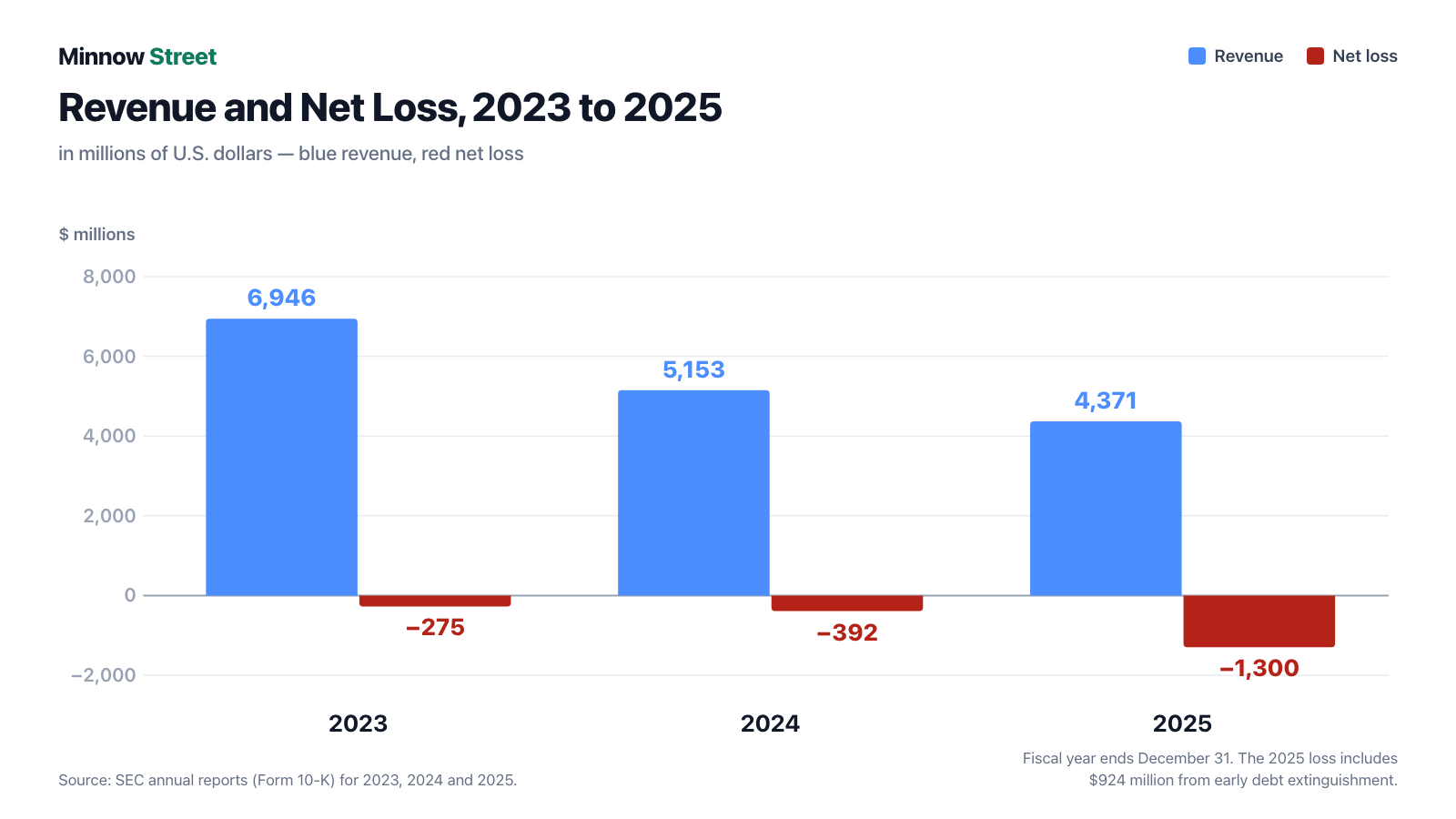
The chart covers three fiscal years, each ending December 31. 2023: revenue of $6,946 million, a net loss of $275 million. 2024: revenue of $5,153 million, a loss of $392 million. 2025: revenue of $4,371 million and a loss of $1,300 million. Revenue has fallen 37 percent in two years. There is a comprehensible external reason, and the company names it: the U.S. housing market is on the floor. Existing home sales are running at an annualized rate of roughly four million units — per the filing a 30-year low and about 20 percent below the pre-pandemic decade average. Mortgage rates fell to about 6.2 percent in November, briefly dipped below 6 percent in late February 2026 and were back in the mid-6 percent range by quarter-end.
The decline continued in the first quarter of 2026: $720 million in revenue against $1,153 million a year earlier, down $433 million or 38 percent. The company sold 1,921 homes instead of 2,946 and bought 2,474 instead of 3,609. Inventory fell from 7,080 to 3,420 homes and from $2,362 million to $1,139 million in carrying value. One thing matters for the reading: part of this is deliberate. Opendoor kept its purchase spreads wide through 2025 to keep poor risks out of inventory — and a company that offers less buys less, and a company that buys less later sells less.
What the Filings Say — The Uncomfortable Truths
Uncomfortable Truth No. 1: The Loss Doubled — The Business Barely Moved
Net loss rose from $85 million to $173 million in the first quarter of 2026. That sounds like a dramatic deterioration. Alongside it the company reports its own adjusted measure, adjusted EBITDA — loosely, “operating result before interest, taxes, depreciation and everything management considers one-off”. That figure came in at minus $31 million, against minus $30 million a year earlier. Practically unchanged.
Between minus $173 million and minus $31 million lies a gap of $142 million. Its largest component sits one line higher in the income statement: general and administrative expenses jumped from $33 million to $137 million. And the notes explain why: stock-based compensation rose from $14 million to $120 million, $110 million of it inside general and administrative.
„The Company recognized $105 million of compensation expense related to market condition awards during the three months ended March 31, 2026, with no comparable expense during the three months ended March 31, 2025. As of March 31, 2026 there was $654 million of unamortized stock-based compensation costs related to unvested market condition RSUs, which are expected to be recognized over a weighted-average period of approximately 2.3 years. As of March 31, 2026 and December 31, 2025, no market conditions were satisfied.“
— Opendoor Technologies Inc., SEC quarterly report on Form 10-Q as of March 31, 2026, Note 9 “Share-Based Awards”

Read the last sentence again: “no market conditions were satisfied”. These are share awards that only vest once the stock price clears defined hurdles. Those hurdles had not been cleared as of the reporting date. Expense arises anyway, and a great deal of it: under U.S. accounting rules the grant-date value of such awards is spread over the expected service period regardless of whether the price ever reaches the hurdle. That is technically correct and, for a reader, thoroughly confusing.
So the decisive question is not “is that real money?” but “whose money is it?”. And there is a clear answer: it is the money of existing shareholders, paid not out of the till but out of their stake in the company. Rule of thumb: stock-based compensation costs no cash — it costs percentage points of the house.
Uncomfortable Truth No. 2: The Queue Behind the Share Is Five Times Longer Than a Year Ago
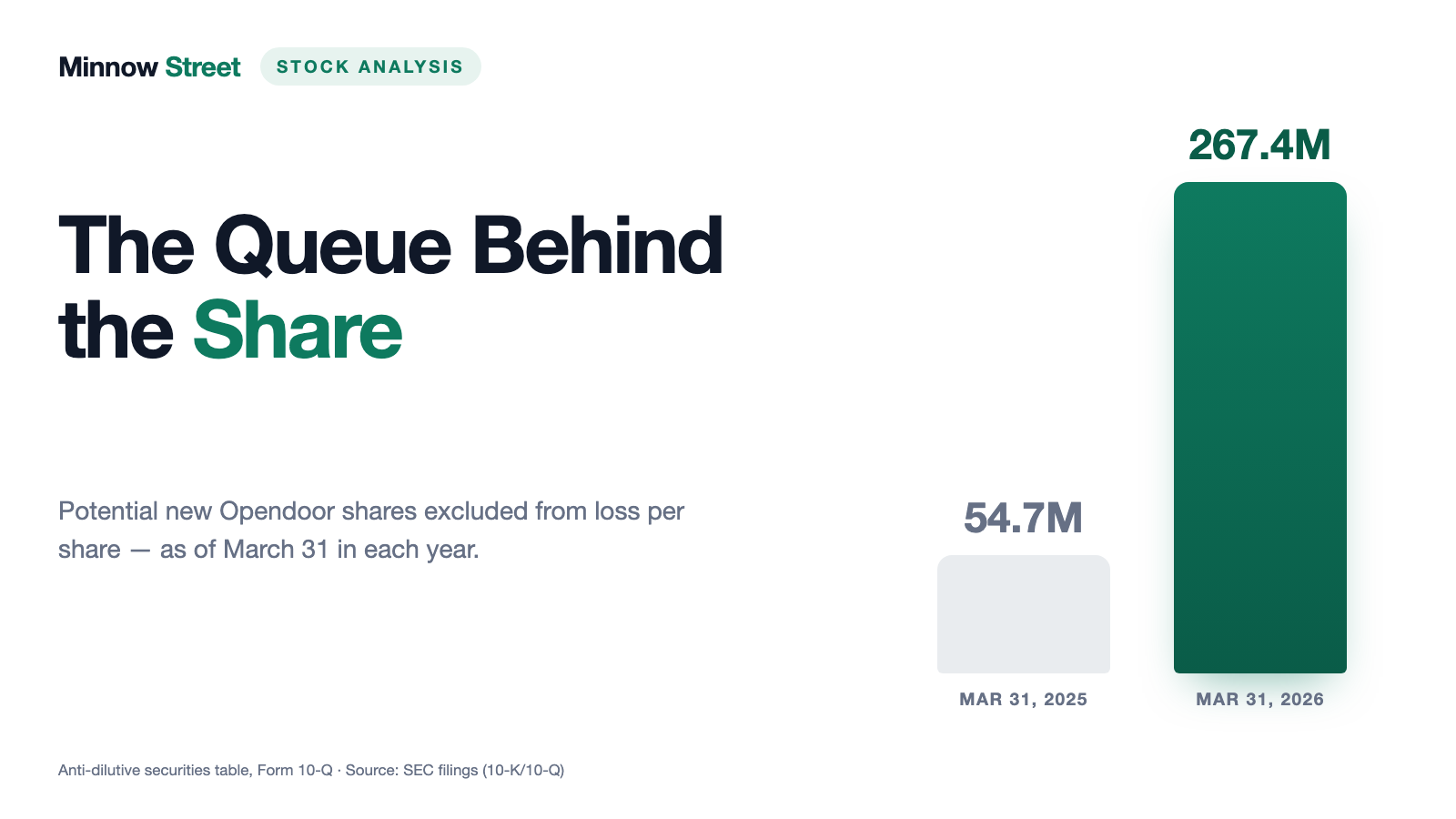
Every quarterly report contains an unremarkable table titled “anti-dilutive securities”. It lists everything that could one day become a new share but is not yet counted in loss per share — because including it would arithmetically improve rather than worsen the result. At Opendoor this may be the single most important page in the whole filing.
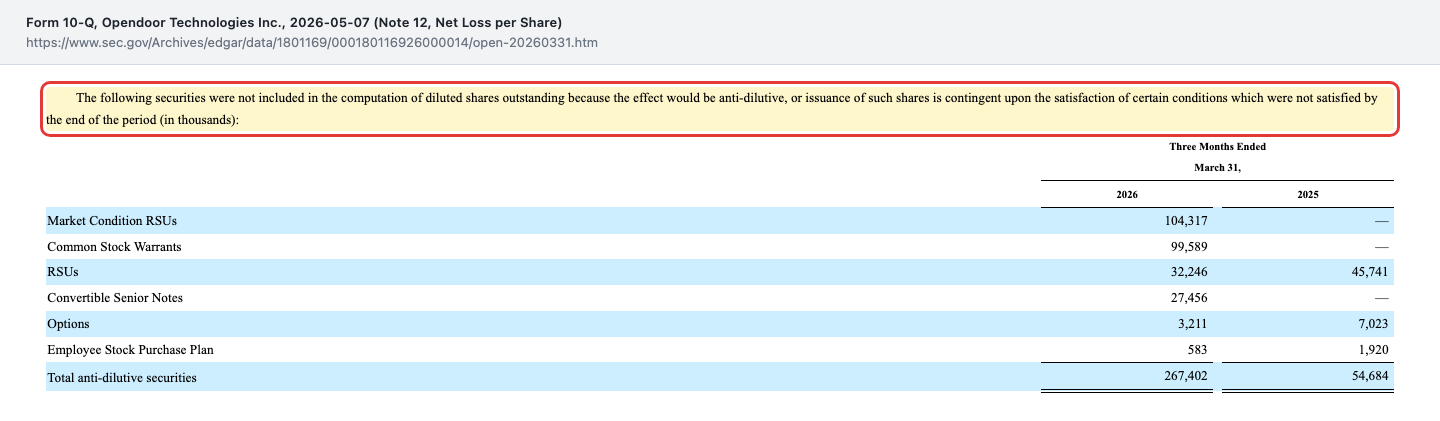
The total rose within a year from 54.7 million to 267.4 million shares — almost five times. Measured against the 963,283,777 shares outstanding on March 31, 2026, that is 27.8 percent. Put differently: if everything in that table one day becomes stock, today’s shareholder owns a little over three quarters of what he owns today.
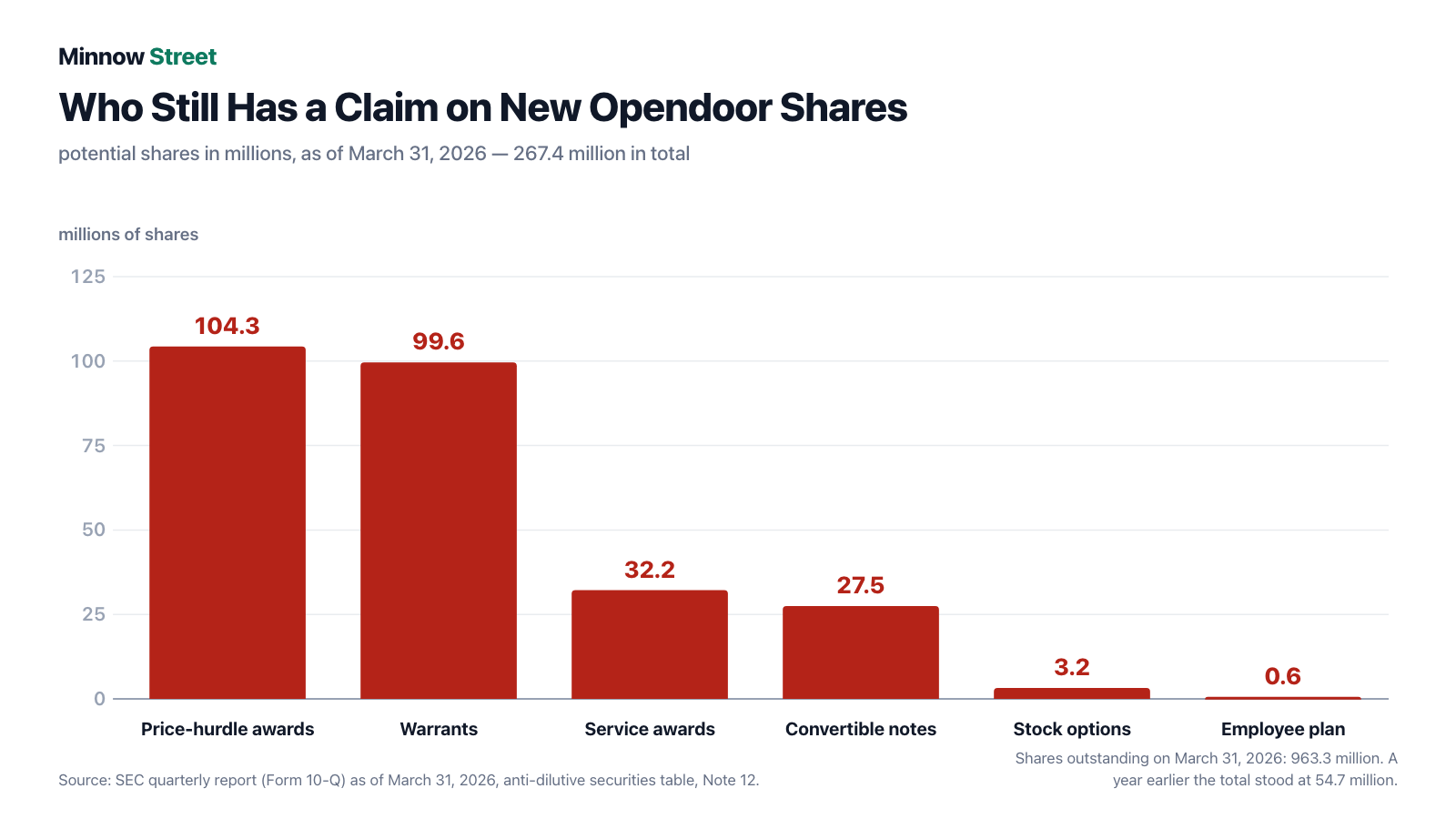
And that is on top of what has already happened. Shares outstanding rose from 726,835,454 on March 31, 2025 to 963,283,777 on March 31, 2026 — up 32.5 percent in twelve months. The cover page of the quarterly report puts the figure at roughly 964,736,632 as of April 30, 2026. The charter authorizes three billion shares. The runway is far from used up.
Picture it once more as a house: the rent this house earns — revenue — has fallen 38 percent in a year. The number of co-owners rose by a third over the same period, and another 28 percent are waiting at the door. Anyone who wants a feel for where that road led at another digital middleman will find it in our analysis of Vroom — the online car dealer that ultimately shut its buying operation down altogether.
Uncomfortable Truth No. 3: The Billion-Dollar Loss of 2025 Was the Price of One Convertible Bond
Reading the $1.3 billion loss for 2025 as an operating disaster gets it wrong — and so does waving it away. It arose differently than one might expect. Loss from operations in 2025 was $287 million, in fact slightly better than the $320 million of 2024. The billion came from a single transaction in November 2025.
„In November 2025, the Company entered into share purchase agreements with a limited number of purchasers (together, the “Purchasers”), providing for the issuance and sale by the Company of an aggregate of 180,580,200 shares of common stock at a price of $6.56 per share (the “Registered Direct Offering”). Concurrent with the Registered Direct Offering, the Company entered into separate, privately negotiated transactions with the Purchasers, pursuant to which the Company agreed to repurchase an aggregate of approximately $264 million principal amount of the 2030 Notes for an aggregate repurchase price of approximately $1.2 billion […] and (iv) recorded $933 million of loss on debt extinguishment.“
— Opendoor Technologies Inc., SEC annual report on Form 10-K for 2025, Note 8 “Convertible Senior Notes”
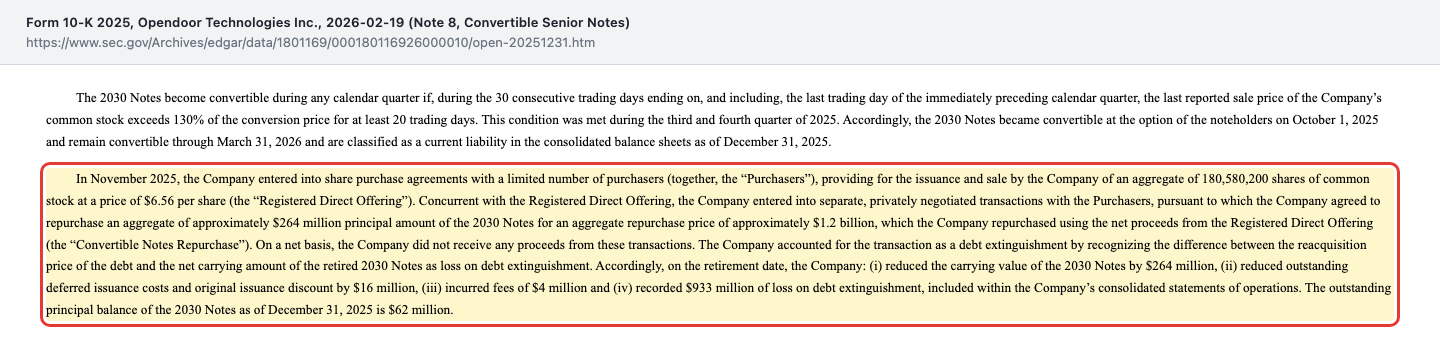
What had happened? In May 2025 Opendoor had issued new convertible notes carrying 7.00 percent interest and maturing in 2030. Their conversion price was $1.57 — a figure that says on its own how low the stock stood in May 2025. Then the price rose. A note with $264 million of principal thereby turned into a claim on a very large number of shares, suddenly worth roughly $1.2 billion to its holders. Opendoor resolved it by selling shares to those same investors and using the proceeds to buy their notes back. On a net basis the company received nothing from either leg — the filing says so explicitly: “On a net basis, the Company did not receive any proceeds from these transactions.”
The fair counterpoint: the swap served a real purpose. Left alone, the convertible would have produced even greater dilution over the years and cost 7 percent interest along the way. Only $62 million of the original principal is still outstanding. But the $933 million is not an accounting artifact to be subtracted and forgotten: it is the price existing shareholders paid because the noteholders had come in very cheaply. Rule of thumb: a convertible issued at the bottom is never cheap money — the bill arrives later and is settled in shares.
Uncomfortable Truth No. 4: 99.3 Million Free Warrants Are Running Toward a Fixed Date
In November 2025 Opendoor did something rarely seen on Nasdaq: on November 6 the board declared a dividend in the form of warrants. Every holder of record on November 18, 2025 received three warrants for each 30 shares held: Series K at an exercise price of $9.00, Series A at $13.00 and Series Z at $17.00. On November 21, 2025, 99,295,146 were issued, and since November 24 they have traded under OPENW, OPENL and OPENZ. Shareholders paid nothing for them.

A warrant is a bet on a given price by a given day. Here the day is November 20, 2026, 5:00 p.m. New York City time. As of March 31, 2026, 99,288,814 warrants were outstanding: 33,093,428 of Series K, 33,097,679 of Series A and 33,097,707 of Series Z. The closing price of the stock on July 24, 2026 was $3.84 — well below all three exercise prices. There is an early expiration clause, but it only works to the upside: if the volume-weighted average price reaches at least 120 percent of an exercise price on 20 out of 30 consecutive trading days — roughly $10.80 for Series K — the term ends immediately.
For investors that is an uncomfortable but clean piece of arithmetic. If the price rises sharply, the warrants turn into up to 99.3 million new shares and the rise is spread across more heads. If it does not, the warrants expire on a fixed date. Either outcome is clear — just not neutral.
Valuation — What the Market Is Charging for This House
Let us work it through in orders of magnitude and with explicit dates. As of July 24, 2026 the market capitalization stood at roughly $3.70 billion (964,736,632 shares per the April 30, 2026 cover page, at a closing price of $3.84). Against that:
- Trailing twelve-month revenue: about $3.94 billion. That puts the price-to-sales ratio near 0.94 — low at first glance. But Opendoor is not a software house, it is a dealer: roughly 10 cents of gross profit remain from each revenue dollar. Measured against trailing gross profit of $323 million, the market is paying about eleven times.
- Shareholders’ equity as of March 31, 2026: $954 million, or $0.99 per share. The market capitalization equals roughly 3.9 times book value. For a real estate dealer whose balance sheet is nearly half houses, that is a steep premium.
- Net current asset value (current assets less all liabilities): $847 million as of March 31, 2026, down from $897 million a quarter earlier. The market capitalization is about 4.4 times that asset backing.
- No price-to-earnings ratio, because there are no earnings. The accumulated deficit stood at $5,206 million as of March 31, 2026 — more than five times today’s equity.
The professionals are correspondingly reserved: of ten analysts tracked, 2 rate the stock a buy, 6 a hold and 2 a sell, with an average price target of about $4.88 (data as of July 24, 2026). That is a consensus which roughly says: “we don’t know either.” For a sense of how hard the environment is for anything tied to home finance, see our analysis of Rocket Companies, the largest mortgage originator in the United States.
Opportunities and Risks at a Glance
What speaks for Opendoor
- Inventory is healthier than it has been in a long time. The share of homes listed longer than 120 days fell from 27 percent to 10 percent (March 31 in each case) and gross margin rose from 8.6 percent to 10.0 percent. Inventory valuation adjustments fell from $13 million to $9 million per quarter.
- Funding is in place. $999 million of unrestricted cash as of March 31, 2026, $954 million of equity, total borrowing capacity of $7.1 billion (of which $1.5 billion is committed) and, per the filing, compliance with all financial covenants.
- The debt is non-recourse. The $1,138 million of inventory financing sits in dedicated special purpose entities whose creditors generally have no claim on the rest of the group.
- The market is on the floor — not the company alone. Roughly four million existing home sales a year is, per the filing, a 30-year low. If rates turn, volumes turn, and since the end of 2025 Opendoor covers the contiguous United States rather than 50 markets.
- New revenue lines are in place. Alongside title, escrow and brokerage services, the first quarter of 2026 added an in-house mortgage product; these services tie up little capital and improve the margin per transaction.
What speaks against it
- The business is shrinking fast. Revenue down 38 percent in the first quarter of 2026, homes sold down 35 percent, inventory down 52 percent. Over three years annual revenue fell from $6,946 million to $4,371 million.
- The dilution overhang has grown to 267.4 million shares — 27.8 percent of shares outstanding, against 54.7 million a year earlier. The share count itself rose 32.5 percent in twelve months.
- $654 million of compensation expense is still to come — for awards whose price conditions were, per the filing, entirely unmet as of March 31, 2026. That equals roughly two thirds of total shareholders’ equity.
- Expensive debt on the balance sheet. The $350 million of mezzanine inventory financing carries 12.50 percent interest. For scale: group interest expense in the first quarter of 2026 was $23 million.
- One business, one market. Opendoor reports a single segment and is fully exposed to U.S. residential real estate — to rates, to prices and to people’s willingness to move.
- Shareholders are split. At the annual meeting on June 11, 2026 roughly 41 percent voted against executive compensation; short interest stood at about 19.6 percent of the float on July 24, 2026.
A Human Conclusion
Remember the “it doesn’t cost anything” trap from the opening? The homeowner paying his contractors in rooms? At Opendoor that arithmetic can, for once, be worked out precisely, because it is all in the filings. In the first quarter of 2026, $120 million of stock-based compensation went out without a cent leaving the till. Cash even rose by $37 million. And still, the shareholder of March 31, 2025 owns less of the same house today — the share count rose by a third over those twelve months, and another 267.4 million shares stand in the queue.
At the same time it would be unfair to turn this into a pure story of decline. This company cleaned up its inventory, improved its margin, met its covenants and holds more unrestricted cash, at $999 million, than in years. It operates in a market sitting at a 30-year low — and that can turn.
What follows is not a recommendation but a question only you can answer: do you buy a repaired inventory in a dead market — and accept that your share of it shrinks while you wait? Saying yes is a bet that rates fall, volumes return and the 267.4 million waiting shares are worth it because the house is worth far more by then. Saying no points to three years of falling revenue, a third more shares in twelve months and $654 million of compensation expense still to come.
If you want to watch just three numbers in the coming filings, watch these: the number of homes sold (last reported 1,921 in the first quarter of 2026, after 2,946), the share count on the cover page of the quarterly report (last reported roughly 964,736,632 as of April 30, 2026) and the total of potential shares in the anti-dilutive table (last reported 267.4 million). If those three move in the same direction, the whole story changes. What you make of it is your decision. And that is exactly as it should be.
Sources
- Opendoor Technologies Inc. — annual report on Form 10-K for fiscal year 2025, filed February 19, 2026
- Opendoor Technologies Inc. — quarterly report on Form 10-Q as of March 31, 2026, filed May 7, 2026
- Current report on Form 8-K of May 7, 2026, Items 2.02, 7.01 and 9.01 — first-quarter results and supporting materials
- Additional proxy soliciting material (DEFA14A) of June 2, 2026 — the chief executive’s appeal to shareholders
- Current report on Form 8-K of June 12, 2026, Item 5.07 — results of the annual meeting held June 11, 2026
- Insider filings (Form 4) for Opendoor Technologies on SEC EDGAR, including those of June 15 and July 17, 2026
- All annual and quarterly reports of Opendoor Technologies on SEC EDGAR (CIK 0001801169)
- Source: fundamental data & SEC filings (annual and quarterly reports, 10-K/10-Q); market capitalization, analyst coverage, short interest, beta and the 52-week range as of July 24, 2026.
Disclosure: this article is journalistic analysis of publicly available documents. It is not investment advice, not a solicitation to buy or sell securities and not an individual recommendation. Shares of companies carrying large inventories and substantial debt are especially volatile; a total loss of invested capital is possible. All figures come from the SEC filings named above and carry their respective as-of dates. The author holds no position in Opendoor Technologies Inc. at the time of publication.
Our Bottom Line at a Glance
- Inventory quality and margin positive
- The share of homes listed for more than 120 days fell from 27 percent (March 31, 2025) to 10 percent (March 31, 2026); gross margin rose over the same period from 8.6 percent to 10.0 percent and inventory valuation adjustments fell from $13 million to $9 million. Inventory stood at 3,420 homes as of March 31, 2026, after 7,080 a year earlier.
- Business trajectory negative
- Revenue fell from $1,153 million to $720 million in the first quarter of 2026, down 38 percent, on 1,921 homes sold instead of 2,946. Across the years: $6,946 million (2023), $5,153 million (2024), $4,371 million (2025). The U.S. market is running at roughly four million existing home sales a year, per the filing a 30-year low.
- Earnings power negative
- Loss from operations was negative in each of the three years: minus $386 million (2023), minus $320 million (2024), minus $287 million (2025), plus minus $159 million in the first quarter of 2026 alone after minus $56 million a year earlier. The accumulated deficit stood at $5,206 million as of March 31, 2026, more than five times shareholders' equity.
- Balance sheet and liquidity neutral
- As of March 31, 2026 unrestricted cash stood at $999 million, up $37 million from year-end, with equity of $954 million on total assets of $2,349 million. The $1,138 million of inventory financing sits in special purpose entities without recourse to the group, and all financial covenants were met per the filing. Against that stand $350 million of mezzanine debt at 12.50 percent interest and $135 million of convertible notes maturing on August 15, 2026.
- Dilution negative
- Shares outstanding rose from 726,835,454 (March 31, 2025) to 963,283,777 (March 31, 2026), up 32.5 percent in twelve months. The overhang of potential shares grew over the same period from 54.7 million to 267.4 million — 27.8 percent of the count. The largest items are 104.3 million price-linked awards and 99.6 million warrants expiring on November 20, 2026.
- Compensation and governance negative
- Stock-based compensation rose from $14 million to $120 million in the first quarter of 2026, including $105 million for price-linked awards whose market conditions were entirely unmet as of March 31, 2026; $654 million of expense is still to come. At the annual meeting on June 11, 2026, 172,038,806 shares voted against and 243,135,496 for executive compensation — roughly 41 percent opposition, after the chief executive publicly campaigned against the proxy advisers' recommendations on June 2, 2026.
Opendoor has cleaned up its inventory: the share of homes listed more than 120 days fell from 27 percent to 10 percent, gross margin rose to 10.0 percent, and unrestricted cash stood at $999 million on March 31, 2026. At the same time the business is shrinking fast — $720 million of revenue in the first quarter of 2026 instead of $1,153 million, 1,921 homes sold instead of 2,946 — and the share count rose 32.5 percent in twelve months to 963,283,777. Behind it wait another 267.4 million potential shares, up from 54.7 million a year earlier, plus $654 million of compensation expense not yet recognized for awards whose price targets have not been reached. Not investment advice.
What Our Rating Means
Open questions
The business works in principle, but one material question is open. As long as it stays open, our findings do not carry a quality verdict.
Funding is solid: $999 million of unrestricted cash as of March 31, 2026, $954 million of positive shareholders' equity, total borrowing capacity of $7.1 billion with $1.5 billion committed, and compliance with all financial covenants per the filing; the inventory financing sits in special purpose entities without recourse to the group. There is no going-concern qualification, and management considers its resources sufficient for at least twelve months from the filing date. The earnings question remains open: no positive operating result in 2023, 2024 or 2025, revenue down from $6,946 million to $4,371 million, an accumulated deficit of $5,206 million and a dilution overhang equal to 27.8 percent of the share count. That is not a solvency problem, but neither is it demonstrated earnings power — hence amber.
A journalistic assessment by our editorial team at the time of the deep dive, based on public sources — not investment advice and not a solicitation to buy or sell. Your personal circumstances (investment goals, risk capacity, taxes) cannot be taken into account. What our levels mean, how verdicts are formed, and what conflicts of interest exist →
Worth Noting
- Opendoor reached our research list through the Reddit mention screen of July 27, 2026 — an attention signal, not a quality verdict. The lists of our in-house stock scanner are recomputed nightly, so a snapshot would already be stale the following day.
- Recency status: the basis is the annual report (10-K) for 2025 filed February 19, 2026 and the quarterly report (10-Q) as of March 31, 2026 filed May 7, 2026. Every document filed afterwards was reviewed — the Form 8-K of May 7, 2026 on first-quarter results, the additional proxy material (DEFA14A) of June 2, 2026, the Form 8-K of June 12, 2026 on the annual meeting results, and Forms 4 and 144 from May, June and July 2026.
- On valuation: the market capitalization was cross-checked — 964,736,632 shares per the quarterly report cover page (as of April 30, 2026) times the $3.84 closing price of July 24, 2026 gives roughly $3.70 billion; the figure from the fundamental data stands at $3.6998 billion, a deviation below one percent. A note on confusion: the former name Social Capital Hedosophia Holdings Corp. II belonged to a special purpose acquisition company with no operations of its own, so figures from before December 2020 are not comparable. The Form 25 entries of 2020 and 2021 relate to units and warrants of that shell, not to today's common stock.
Frequently Asked Questions
Opendoor buys residential homes in the United States on its own balance sheet, has them repaired and resells them. It earns a service fee, the spread between purchase and resale, and revenue from adjacent services such as title, escrow, brokerage and, since the first quarter of 2026, an in-house mortgage product. It employed 1,042 people as of December 31, 2025.
Net loss rose from $85 million to $173 million while the company's own adjusted measure was almost flat at minus $31 million against minus $30 million. The difference is stock-based compensation: $120 million versus $14 million, of which $105 million relates to price-linked awards. No cash left the company for it.
They are share packages for employees that vest only once the stock price clears defined hurdles. Under U.S. accounting rules the grant-date value is spread as expense over the expected service period — even if the hurdle is never reached. As of March 31, 2026 the filing states that every market condition was unmet, with $654 million of expense still to be recognized.
Shares outstanding rose from 726,835,454 on March 31, 2025 to 963,283,777 on March 31, 2026, up 32.5 percent in twelve months. On top of that sit 267.4 million potential shares from awards, warrants and convertible notes — 27.8 percent of the count. A year earlier that total stood at 54.7 million.
Loss from operations in 2025 was $287 million. The remainder came from a financing transaction in November 2025: Opendoor issued 180,580,200 shares at $6.56 and used the proceeds to repurchase $264 million principal amount of convertible notes for roughly $1.2 billion. That produced a book loss of $933 million.
On November 6, 2025 the board declared a special dividend in the form of warrants. Every holder of record on November 18, 2025 received three warrants per 30 shares, with exercise prices of $9, $13 and $17. A total of 99,295,146 were issued; they expire at 5:00 p.m. New York City time on November 20, 2026 unless exercised earlier.
As of March 31, 2026 the company held $999 million of unrestricted cash, shareholders' equity of $954 million and total assets of $2,349 million. The $1,138 million of inventory financing sits in special purpose entities without recourse to the group. All financial covenants were met per the filing; the accumulated deficit stands at $5,206 million.
Revenue fell from $1,153 million to $720 million in the first quarter of 2026. The company names two reasons itself: the U.S. housing market is at a 30-year low with roughly four million existing home sales a year, and Opendoor deliberately kept its purchase spreads wide, buying fewer homes and consequently selling fewer later on.
Found an error?
Did you spot a factual error, an outdated number, or a typo in this deep dive? Let us know briefly — your report goes straight to the editorial team.