ACADIA Pharmaceuticals: $391 Million in Profit — and $252 Million of It Came From the Tax Line
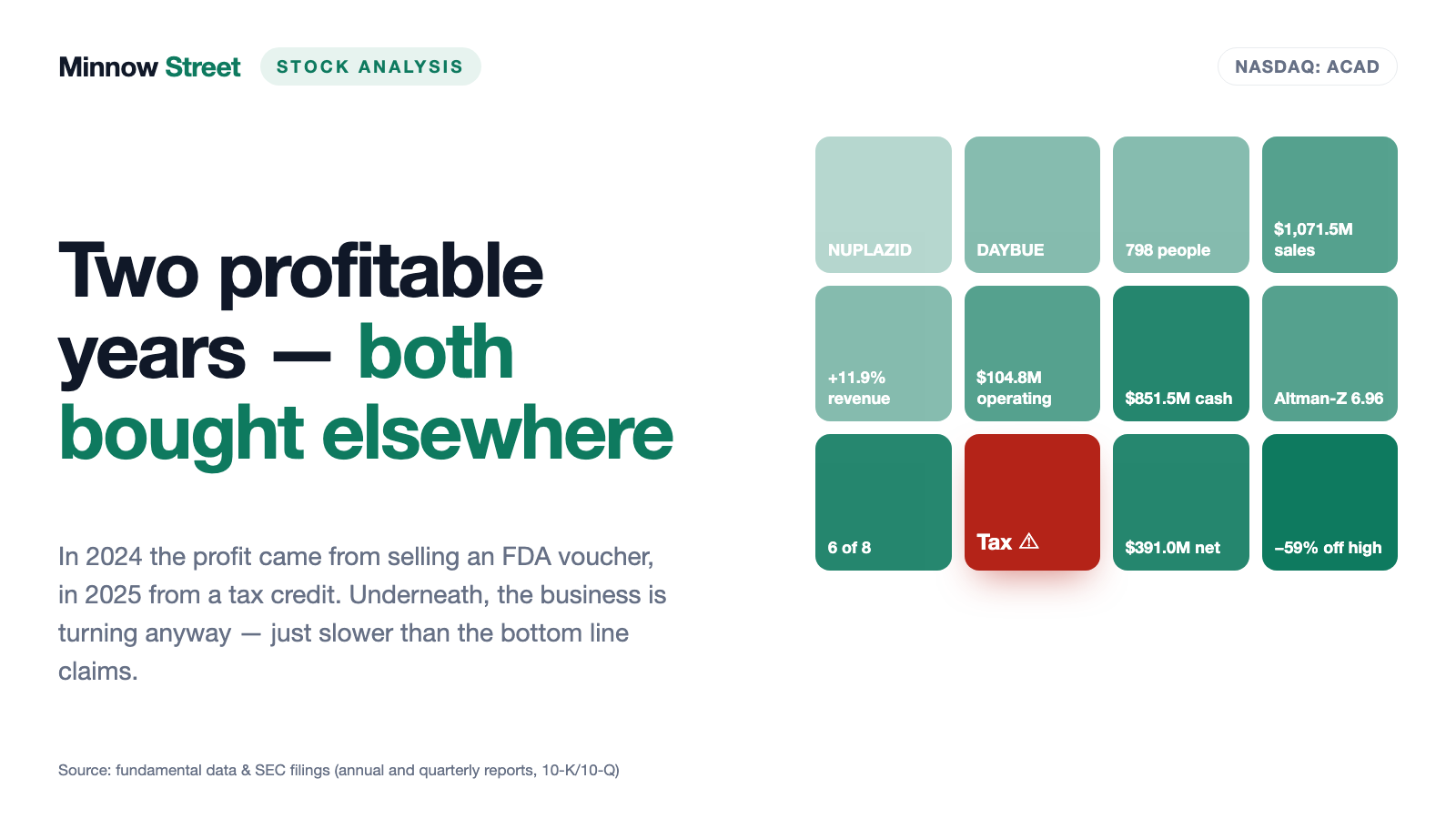
After eight loss-making years, ACADIA Pharmaceuticals reported profits in 2024 and 2025 — and both of them came from somewhere else. In 2024, $146.5 million from the sale of an FDA voucher lifted operating income; in 2025, a $252.1 million tax benefit turned $138.9 million of pre-tax income into the $391.0 million everyone quotes. In the first quarter of 2026 the company posted an operating loss of $4.6 million. Underneath all that, a real business with two medicines keeps growing — but a patent clock is running on the bigger one, and it is being set in a courtroom in Delaware. So we sort it out line by line: what this company earned, and what simply arrived.
 Thomas Mücke
Founder & Publisher
Thomas Mücke
Founder & Publisher
Chart
Interactive price chart (TradingView).
Note: pure fact-based analysis, not investment advice and not a solicitation to buy or sell. All figures without guarantee.
There is an investor trap that works precisely because it looks so sensible: the bottom-line trap. We read an income statement from the bottom up. Net income sits at the very end, and because it comes last it feels like the verdict — as if someone had condensed an entire year of work into one honest number. At ACADIA Pharmaceuticals Inc. (NASDAQ: ACAD) of San Diego, that number for 2025 is a beautiful one: $391.0 million in net income, after a $61.3 million loss in 2023. Two lines above it sits the less flattering truth: pre-tax income was $138.9 million. The difference is not an achievement. It is an accounting entry.
So let us make a deal. Before we let a bottom line convince us of anything, we read together what ACADIA filed with the U.S. securities regulator, the SEC — the annual report (10-K) for 2025, the quarterly report (10-Q) for the period ended March 31, 2026, and every filing after that. An SEC filing is honest under penalty of law; it has to tell you the parts that never make it into a press release. And this one tells a story about two medicines that really are growing, about two profitable years that belong to two one-time items, and about a clock that is being set in a courtroom in Delaware.
What ACADIA Pharmaceuticals actually does — two medicines, and no third
The business model fits into a single sentence, and that sentence is also the single most important finding of this analysis: ACADIA sells exactly two approved medicines, both for disorders of the nervous system, both almost entirely in North America.
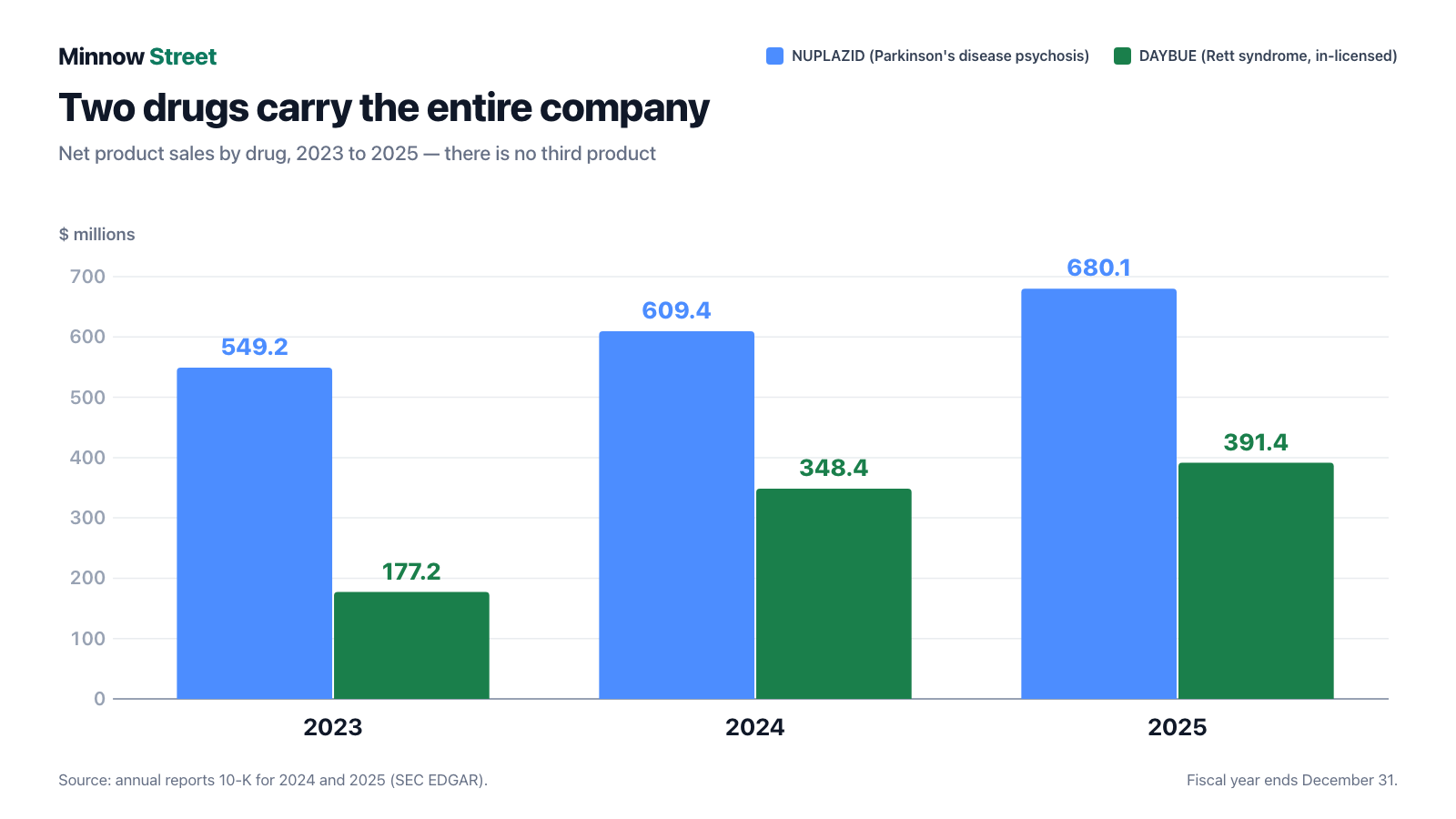
The first is NUPLAZID (pimavanserin). It treats the hallucinations and delusions that occur in Parkinson's patients — the company estimates that roughly half of all Parkinson's patients experience psychosis over the course of the disease. NUPLAZID was the first and remains the only medicine the FDA has approved for that specific indication. It generated $680.1 million in net product sales in 2025.
The second is DAYBUE (trofinetide), which treats Rett syndrome, a very rare genetic disorder that almost exclusively affects girls and causes severe disability. DAYBUE has been approved in the United States since 2023 and produced $391.4 million in 2025. One point matters for understanding the margin: DAYBUE is not entirely ACADIA's. The compound is in-licensed from Australia's Neuren Pharmaceuticals — ACADIA may sell it and pays running royalties for the privilege.
The company was founded in Vermont in 1993 as Receptor Technologies, Inc.; since 1997 it has been a Delaware corporation headquartered in San Diego, with sites in Princeton, New Jersey, and European headquarters in Zug, Switzerland. As of December 31, 2025 it employed 798 people, 796 of them full time. The fiscal year matches the calendar year, and the auditor is Ernst & Young LLP.
That frames the central tension of this analysis, and it runs through every chapter: the business really is turning — but the number you would most like to pin the turnaround on does not measure it. Twice in a row a one-time item made the bottom line, and the more important of the two revenue drivers is currently defending its patent protection in court.
Where the stock came across our desk — 6 of 8 on the turnaround check, but not in the visible 25
ACADIA did not reach us through a press release but through a ranking produced by our in-house stock scanner. In the Turnaround Candidates list (U.S. selection) the stock is a hit as of July 27, 2026 and scores 6 of 8 points on what the scanner calls the turnaround check. And here is the first honest caveat, before anyone assumes we found a front-runner: the detail page shows only the 25 strongest hits — ACADIA ranks below that cut and does not appear there.
So we counted ourselves, separately for both editions of our magazine: 60 U.S. hits on each brand — and we deliberately name no exact rank. The reason is precise: 44 of the 60 hits carry exactly the same 6 points. Inside that tie, only the database sort order decides, and that order changes with every nightly recalculation. The honest statement is therefore no single rank number but this: ACADIA falls somewhere in the range of ranks 17 to 60 — the broad middle, alongside nearly three quarters of the list. The lists are recalculated every day.
How the list works is worth spelling out in plain language, because it tests two very different things. First come the two mandatory pillars, and failing either one means instant elimination. Pillar 1 — the crash: the stock must trade at least 50 percent below its all-time high. No real crash, no turnaround. Pillar 2 — survival: the Altman Z score must sit outside the distress zone, there may be at most one balance sheet warning flag, and equity must be positive. Only then does the turnaround check apply, a checklist of eight points: four for the operating turn (revenue no longer declining, net margin above where it stood three quarters ago, cash flow improving, balance sheet healing) and four for market confirmation (price back above the 50-day line, three-month relative strength better than twelve-month, insiders buying on balance, institutions adding).
At ACADIA the two missing points sit exactly where you would expect them after everything above. The net margin fell from 10.1 percent in the second quarter of 2025 to 1.4 percent in the first quarter of 2026 — no point. And insiders are not buying: the stored data set shows zero purchases against nine sales, most recently on April 7, 2026 by two executives at $22.20. The six points ACADIA does earn are revenue growth (up 9.7 percent in the latest quarter), positive operating cash flow ($34.0 million), a healing balance sheet, a price back above the 50-day line, three-month relative strength ahead of twelve-month, and net institutional inflows.
Because the mandatory pillars are factual claims about our own data set, we recalculated them. The stored distance from the all-time high is -59.02 percent. We measured the full price history back to the 2004 IPO: the highest closing price ever was $57.00 on July 7, 2020; against the July 24, 2026 close of $24.84 that is -56.4 percent. Both values sit well past the 50 percent threshold; the gap comes from different as-of dates and from the stored series taking intraday highs into account. The conclusion does not change.
We also recalculated the Altman Z score of 6.96 from the 2025 annual accounts and arrive at 6.95 using the classic formula — confirmed. What is interesting is where that comfortable number comes from. It is largely carried by market value: the market value of equity is almost twelve times total liabilities. Balance sheet substance pulls hard in the other direction, because the accumulated deficit of $1,813.4 million is larger than the entire balance sheet. Remember: an Altman Z carried by the share price falls with the share price.
And one more finding we will not bury: on the same date ACADIA also appears on the risk list Beneish M-Score. The value is -0.81, above the -1.78 warning threshold. That proves nothing on its own — the M-Score measures eight balance sheet ratios across two annual reports and fires when they move abruptly. ACADIA's did move abruptly in 2025, and by now we know why. But it is a good reason to read the balance sheet carefully. So let us do that.
The numbers over the years — given their due
First the part that genuinely speaks for ACADIA, and it is more than the debate about one-time items suggests. Revenue has climbed in six years from $441.8 million in 2020 to $1,071.5 million in 2025 — more than double, without a single setback along the way: 484.1, 517.2, 726.4, 957.8, 1,071.5. That is not a flash in the pan. That is a curve.
The gross margin is what you would expect from a pharmaceutical company with patent-protected products: cost of product sales came to $89.0 million on $1,071.5 million of revenue in 2025 — a gross margin of 91.7 percent. In the first quarter of 2026 it was 90.8 percent. Each additional box sold costs almost nothing; the expensive parts are research ($328.8 million in 2025, or 30.7 percent of revenue) and selling ($548.9 million, or 51.2 percent).
And the turnaround itself is real, which deserves to be said plainly. Through 2023 ACADIA burned money: a net loss of $281.6 million in 2020, $167.9 million in 2021, $216.0 million in 2022 and $61.3 million in 2023. Operating cash flow was negative in every one of those years — $114.0 million flowed out in 2022 alone. Since 2024 money has been coming in: $157.7 million in 2024 and $109.8 million in 2025 from operations, plus $34.0 million in the first quarter of 2026 alone. Cash and investment securities rose from $819.7 million at the end of 2025 to $851.5 million as of March 31, 2026. This is a company that funds itself — and three years ago it was not.
If you want a neighbor to compare that curve with, our analysis of Neurocrine Biosciences shows a very similar pattern: a central nervous system company whose revenue rests on a handful of products, and whose most important question is likewise what happens once the patents expire.
What the filings say — the uncomfortable truths
Uncomfortable truth no. 1: two profitable years, two one-time items
Start with 2025, because that is where the number everyone quotes lives. The path from revenue to reported profit looks like this:
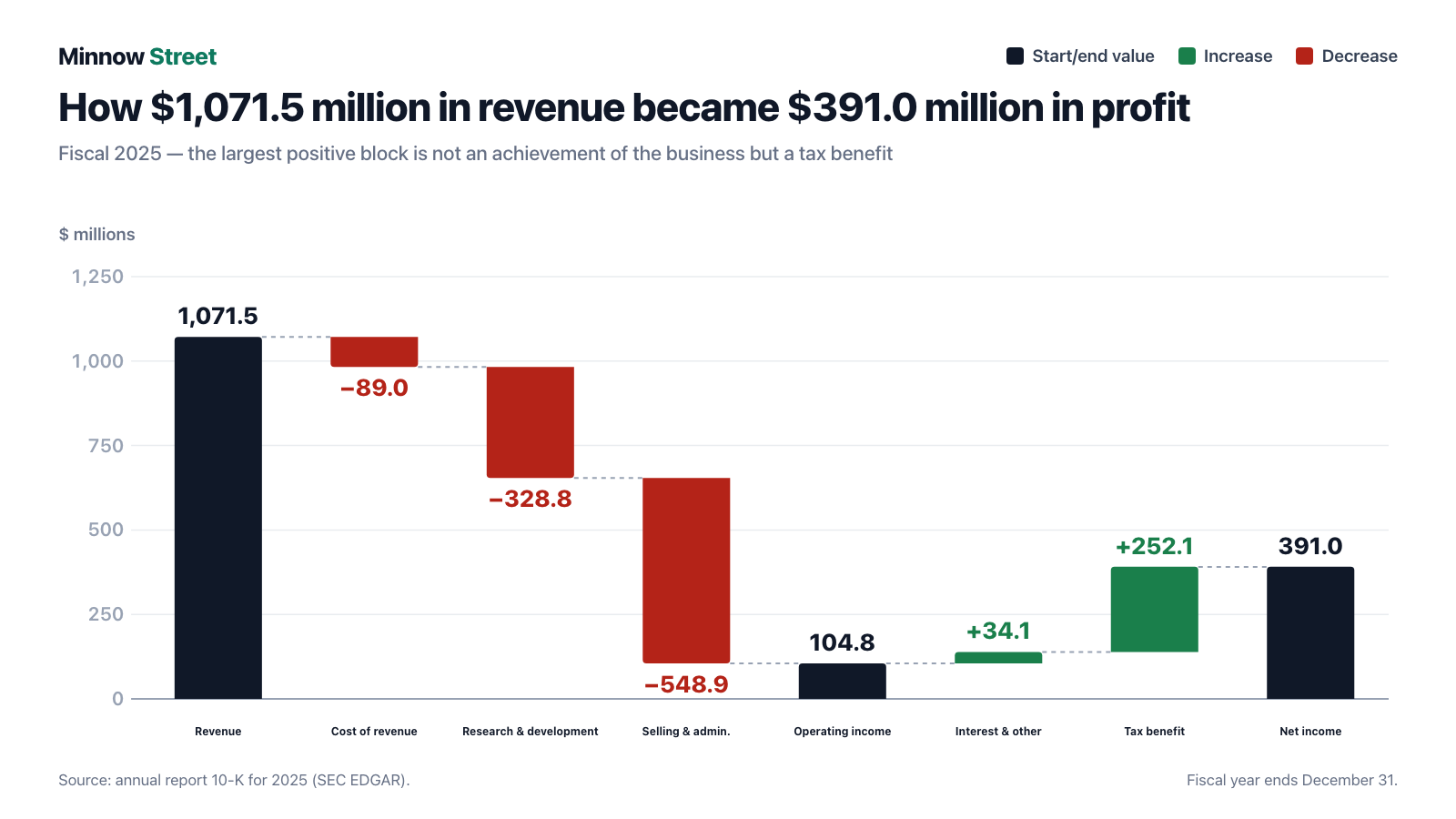
The mechanism behind it is explainable and entirely by the book. A company that loses money for years accumulates deferred tax assets — in plain terms, credits it may offset against future profits. As long as it is unclear whether profits will ever arrive, those credits must be written down on the balance sheet. Once profits do arrive, the write-down may be released. That is exactly what happened at the end of 2025, and ACADIA says so itself:
"As of December 31, 2025, in part because in the current year the Company achieved three years of cumulative pretax income, management determined that there is sufficient positive evidence to conclude that it is more likely than not that deferred taxes of $249.9 million are realizable. Accordingly, the valuation allowance was reduced by $340.4 million."
— ACADIA Pharmaceuticals Inc., SEC annual report 10-K for 2025, Note 13 Income Taxes

And 2024? That year was not a clean operating year either. Operating income of $230.8 million contains a line called "Gain on sale of non-financial asset" worth $146.5 million. Behind it sits a voucher: a company that wins U.S. approval for a medicine treating a rare pediatric disease receives a Priority Review Voucher from the FDA — the right to have any later approval process expedited. These vouchers are tradable, and ACADIA sold its own.

So let us run both years without the one-time items. 2024: $230.8 million of operating income minus $146.5 million of voucher proceeds leaves $84.3 million from the running business. 2025: $104.8 million, with no special item at all. That is growth of 24.4 percent — solid, but something entirely different from the jump from $226.5 million to $391.0 million that the bottom line implies. Remember: when two consecutive years are each carried by a different one-time item, comparability is not merely impaired. It is gone.
Uncomfortable truth no. 2: the first quarter of 2026 was operationally in the red
From January 1 to March 31, 2026 ACADIA generated $268.1 million in revenue, up from $244.3 million a year earlier — 9.7 percent growth, driven mostly by DAYBUE ($101.1 million against $84.6 million, up 19.6 percent), while NUPLAZID added only 4.5 percent at $166.9 million against $159.7 million. Even so, operating income came in at minus $4.6 million, after plus $19.3 million a year before. Net income of $3.6 million survived only because $8.1 million of interest income absorbed the operating loss.
The cause sits in a single line, and the company names it itself:

That is $44.6 million of additional selling, general and administrative expense in a single quarter — up 35.3 percent while revenue grew 9.7 percent. The share of quarterly revenue consumed by that line rose from 51.7 to 63.8 percent. The prior-year check shows it is not seasonality: the first quarter of 2025 ran at 51.7 percent and the full year 2025 at 51.2 percent. Research spending actually edged down over the same period, from $78.3 million to $76.9 million.
This may be money well spent — ACADIA explicitly cites "increased investments to support continued growth of NUPLAZID and DAYBUE." It may also mean that growth now has to be bought at a higher price than before. Which of the two is true will be decided in the next few quarterly reports by a single question: does revenue grow faster than that cost line, or not?
Uncomfortable truth no. 3: the patent clock is running, and a court is setting it
For a pharmaceutical company with two products, patent protection is not a footnote. It is the business model. For NUPLAZID the schedule reads as follows, verbatim from the annual report:
"The composition of matter patent covering pimavanserin and salts thereof currently has an expiration date in 2030, including a patent term extension approved by the U.S. Patent and Trademark Office. The patents covering the polymorph form and the use of pimavanserin or NUPLAZID for our approved indication are currently set to expire between 2026 and 2028."
— ACADIA Pharmaceuticals Inc., SEC annual report 10-K for 2025, Item 1 Business, Intellectual Property
Now comes the twist you have to understand or you will read this stock wrong: patent expiry is not the same thing as the date generics may enter the market. Since 2020 ACADIA has been suing generic manufacturers that filed abbreviated applications (ANDAs) for pimavanserin. Two of those cases ended in settlements, and those settlements name specific launch dates:
"The agreement allows Hetero to launch its generic pimavanserin product on February 27, 2038, subject to certain triggers for earlier launch."
— ACADIA Pharmaceuticals Inc., SEC annual report 10-K for 2025, Item 3 Legal Proceedings
For Zydus, the settlement of March 31, 2023 sets September 23, 2036 for 10 mg tablets and February 27, 2038 for 34 mg capsules. Against MSN Laboratories and Aurobindo, ACADIA has won in court — on January 11, 2024 and again on June 9, 2025 — but both appealed; briefing was completed on December 19, 2025 and no argument date had been set as of May 7, 2026. And on November 2, 2026 a new trial against Zydus begins over a 34 mg tablet that ACADIA argues the 2023 settlement does not cover.
For DAYBUE the clock is shorter: the method-of-use patent covering Rett syndrome expires in 2032 and could, on request, be extended to January 2036. And the question of what ACADIA lives on after the patents run out has no documented answer yet. The most advanced candidate is remlifanserin (formerly ACP-204) for Alzheimer's disease psychosis and Lewy body dementia psychosis — in Phase 2 as of the latest quarterly report, with a composition-of-matter patent running to 2038. The second big hope has already failed: the Phase 3 COMPASS PWS study of ACP-101 for hyperphagia in Prader-Willi syndrome missed its primary endpoint in September 2025 and was discontinued. On today's evidence there is a gap between the last protected revenue year and the first year in which a new product carries the company. What such a gap looks like once it opens is something we described in our analysis of Biogen — a company whose older revenue drivers were overtaken by generics before the new ones were big enough.
Uncomfortable truth no. 4: Europe has said no, for now
DAYBUE is so far almost entirely a North American business. The route into Europe was meant to be the second stage of growth — ACADIA filed a marketing authorization application for trofinetide in the EU in January 2025. It was rejected:

ACADIA has requested a re-examination and wrote in the 2025 annual report that it was preparing for a possible launch in the third quarter of 2026. Whether that happens was open as of the latest reviewed filing; the company itself writes that the outcome of the re-examination may not be favorable. Elsewhere things are going better: Canada granted approval in October 2024, Israel in December 2025, and a Phase 3 study is running in Japan with results due in the fourth quarter of 2026 or the first quarter of 2027.
Uncomfortable truth no. 5: a double-digit share of every DAYBUE dollar goes to Australia
DAYBUE accounted for 36.5 percent of consolidated revenue in 2025 — but not for 36.5 percent of the earnings. The compound is in-licensed from Neuren Pharmaceuticals, and the royalty ladder is spelled out in the annual report: in North America ACADIA pays 10 percent on the first $250 million of annual net sales, 12 percent up to $500 million, 14 percent up to $750 million and 15 percent above that. At $391.4 million of annual sales in 2025, DAYBUE sits in the 12 percent tier. Outside North America it gets considerably more expensive:
"we will be required to pay Neuren tiered royalties from the mid-teens to low-twenties percent based on net sales of trofinetide and NNZ-2591."
— ACADIA Pharmaceuticals Inc., SEC annual report 10-K for 2025, Item 1 Business, Neuren license agreement
On top of that come milestone payments: up to $426.3 million for trofinetide outside North America and up to $831.3 million for the development candidate NNZ-2591, plus amounts tied to sales thresholds — $50 million at $500 million of annual net sales, $100 million at $750 million and $150 million at $1 billion. None of this is a hidden trap; it is the price of not having invented the medicine yourself. But it explains why European success would be worth less to ACADIA than an equally large increase in U.S. sales.
Valuation — what the market is paying right now
At the July 24, 2026 closing price of $24.84 and 171,235,870 shares outstanding, the market value stood at roughly $4.25 billion. That is a price-to-sales ratio of about 4.0 on 2025 revenue and roughly 3.4 times book value (equity of $1,248.1 million as of March 31, 2026).
The price-to-earnings ratio is where it gets instructive. On a trailing twelve-month basis it sits around 11 — which looks very cheap. Except that this earnings figure contains the $252.1 million tax benefit. Use the analyst estimate for the current fiscal year instead and the multiple is roughly 74. Between those two numbers lies no arithmetic error, only the one-time item this whole analysis is about. A P/E of 11 that rests on a tax entry is not a bargain. It is a measurement error.
A second anchor: strip out the $851.5 million of cash and investment securities and the market is valuing the operating business at roughly $3.4 billion — about 32 times the 2025 operating income of $104.8 million. That is not a price for a company anyone expects to stand still; it contains an expectation about remlifanserin, about Europe, and about the patents holding.
The professionals' view, offered as context rather than as truth: 20 analyst firms cover the stock with a consensus price target of $32.80 — 7 strong buy, 6 buy, 6 hold, 1 sell (data as of July 26, 2026). Against that sit roughly 11.0 million shares sold short, a good 10 percent of the float. Institutions hold 98.9 percent, insiders 0.3 percent. On the Piotroski score, which tests nine balance sheet and earnings criteria, our data set shows 5 of 9; our own recalculation of the 2025 annual accounts against 2024 arrives at 6 of 9. The same items fail in both versions: operating cash flow below net income, a rising share count, and falling asset turnover. 6 of 9 is mid-table — a genuinely healthy company scores 8 or 9.
Opportunities and risks at a glance
What speaks in favor:
- Revenue grows without interruption: from $441.8 million in 2020 to $1,071.5 million in 2025, plus another 9.7 percent in the first quarter of 2026.
- The business funds itself: operating cash flow of plus $157.7 million in 2024, plus $109.8 million in 2025 and plus $34.0 million in the first quarter of 2026 — after four years of outflows.
- A pharmaceutical margin: a gross margin of 91.7 percent in 2025 and 90.8 percent in the first quarter of 2026.
- A balance sheet without worries: $1,248.1 million of equity against $357.2 million of liabilities, $851.5 million in cash and investment securities, an equity ratio of 77.8 percent and an Altman Z of 6.96 (as of March 31, 2026 and July 26, 2026 respectively).
- A lead product without competition: according to the company, NUPLAZID is the only medicine the FDA has approved for Parkinson's disease psychosis.
- Two generic challengers are bound until 2036 and 2038: settlements with Hetero and Zydus fix launch dates, and ACADIA won at first instance against MSN and Aurobindo.
What speaks against:
- Both profitable years rest on one-time items: $146.5 million from the voucher sale in 2024 and a $252.1 million tax benefit in 2025 — stripped of special items, 2025 left $104.8 million of operating income.
- The latest quarter was operationally in the red: minus $4.6 million, because selling, general and administrative expenses jumped 35.3 percent to $171.0 million.
- Two products, no third: NUPLAZID and DAYBUE account for 100 percent of revenue; the Phase 3 candidate ACP-101 failed in September 2025.
- A patent clock with a court date: composition-of-matter protection to 2030, method-of-use patents 2026 to 2028; trial against Zydus from November 2, 2026, appeal by MSN and Aurobindo pending.
- Europe is closed for now: a negative CHMP opinion in February 2026, re-examination requested, outcome open.
- Royalty leakage: 10 to 15 percent of North American DAYBUE sales go to Neuren, and mid-teens to low-twenties percent outside North America.
- A tax asset on the balance sheet: $249.6 million of deferred tax assets as of March 31, 2026 — 15.6 percent of total assets, worth something only if future profits arrive.
- Potential selling pressure: 43,576,075 shares held by the Baker Entities have been registered for resale since May 23, 2025, roughly 26 percent of the company.
A human verdict
Back to the bottom-line trap. It is stubborn precisely because it does not rest on greed but on a perfectly healthy need: we want one number that says everything. At ACADIA that number does not exist. There is $391.0 million of net income, and there is $104.8 million of operating income, and both are true — they simply measure different things.
What is honest about this case is that the turn has genuinely happened. A company that burned $114 million of operating cash in 2022 and now accumulates cash has really achieved something. It is just a slower, less spectacular turn than the bottom line suggests — and it has now arrived at the point where the easy growth years are over: selling is getting more expensive, Europe said no, and the patents have become bargaining chips in Delaware.
The decisive question sits in the next few quarterly reports, and it is pleasingly simple: does operating income return to positive territory without special items and without interest income, and does revenue grow faster than selling costs? If yes, the first quarter of 2026 was an investment. If no, it was the moment when the cost of an aging two-product portfolio became visible. What you make of that is your decision. And that is exactly how it should be.
Sources
- ACADIA Pharmaceuticals Inc., SEC annual report 10-K for fiscal 2025 (filed February 26, 2026), CIK 0001070494 — Item 1 Business (products, pipeline, patents, Neuren license agreement, employees), Item 1A Risk Factors, Item 3 Legal Proceedings, Item 7 MD&A and Notes 9 and 13.
- ACADIA Pharmaceuticals Inc., SEC quarterly report 10-Q for the period ended March 31, 2026 (filed May 7, 2026) — balance sheet, statement of operations, Item 1A Risk Factors, Item 2 MD&A and Note 9; share count from the cover page (as of April 29, 2026).
- ACADIA Pharmaceuticals Inc., SEC annual report 10-K for fiscal 2024 (filed February 27, 2025) — comparative figures for 2022 to 2024 and product revenue for 2023.
- ACADIA Pharmaceuticals Inc., SEC current report 8-K dated May 29, 2026 — Items 5.02 and 5.07, annual meeting results: election of three directors, ratification of Ernst & Young LLP as auditor for 2026 and an increase of 5,209,670 shares under the 2024 Equity Incentive Plan.
- ACADIA Pharmaceuticals Inc., SEC registration statement S-8 dated June 10, 2026 — registration of the shares approved at the annual meeting for the incentive plan.
- Rankings from our in-house stock scanner: Turnaround Candidates (U.S. selection, turnaround check 6 of 8, 60 U.S. hits on both brands, 44 of them tied — no exact rank, but the range of ranks 17 to 60) and Beneish M-Score (value -0.81 against a -1.78 warning threshold), as of July 27, 2026; the lists are recalculated daily.
- Fundamental data (market value, valuation ratios, analyst consensus, twelve-month range, short interest, ownership structure, insider transactions, Altman Z and Piotroski scores), data as of July 26, 2026, closing price of July 24, 2026.
Disclaimer: This article is a journalistic assessment of publicly available company data. It is expressly not investment advice, not a buy or sell recommendation and not a solicitation to buy or sell securities. Share prices can fall sharply at any time, and a total loss is possible. All figures come from the original sources linked above and carry the reporting dates stated there. The author holds no position in the stock discussed at the time of publication.
Our Bottom Line at a Glance
- Revenue and margin positive
- Revenue rose without interruption from $441.8 million in 2020 to $1,071.5 million in 2025 and added another 9.7 percent in the first quarter of 2026, reaching $268.1 million. The gross margin was 91.7 percent in 2025 and 90.8 percent in the first quarter of 2026 — the level you expect from a pharmaceutical company with patent-protected products.
- Quality of earnings negative
- Both profitable years rest on one-time items: $146.5 million from the sale of an FDA voucher in 2024, and a $252.1 million tax benefit in 2025 from releasing a $340.4 million valuation allowance. Stripped of special items, operating income was $84.3 million in 2024 and $104.8 million in 2025; in the first quarter of 2026 it was minus $4.6 million.
- Product concentration negative
- NUPLAZID and DAYBUE account for 100 percent of revenue, NUPLAZID alone for 63.5 percent in 2025. There is no third approved product; the Phase 3 candidate ACP-101 missed its primary endpoint in September 2025 and was discontinued. The most advanced successor, remlifanserin, was in Phase 2 as of the quarterly report filed May 7, 2026.
- Patent protection neutral
- The composition-of-matter patent on pimavanserin expires in 2030, with polymorph and method-of-use patents running out between 2026 and 2028. Settlements bind Hetero until February 27, 2038 and Zydus until September 23, 2036 or February 27, 2038. Still open are the appeal by MSN and Aurobindo, whose briefing has been complete since December 19, 2025, and a trial against Zydus beginning November 2, 2026.
- Balance sheet positive
- As of March 31, 2026 the company held $1,248.1 million of equity against $357.2 million of liabilities, plus $851.5 million in cash and investment securities after $819.7 million at the end of 2025. The equity ratio is 77.8 percent and the Altman Z score 6.96 (own recalculation: 6.95). One caveat: $249.6 million of those assets are deferred tax assets that presuppose future profits.
- Valuation neutral
- At the July 24, 2026 close of $24.84 the market value stood at roughly $4.25 billion — about 4.0 times 2025 revenue and about 3.4 times book value. The trailing price-to-earnings ratio of roughly 11 is distorted by the tax benefit; on the current-year estimate the multiple is roughly 74. The consensus price target is $32.80.
ACADIA Pharmaceuticals is the bottom-line trap in its purest form: the books show $391.0 million of net income for 2025, while pre-tax income was $138.9 million — the difference is a $252.1 million tax benefit from releasing a valuation allowance. A year earlier, an FDA voucher worth $146.5 million had carried operating income. Underneath sits a business that genuinely turned: revenue climbed from $441.8 million in 2020 to $1,071.5 million, operations threw off $109.8 million of cash in 2025, and the balance sheet carries $1,248.1 million of equity and $851.5 million of cash. But the first quarter of 2026 was operationally in the red at minus $4.6 million because selling costs jumped 35.3 percent, Europe rejected the DAYBUE application, and the lead product's patent protection returns to court on November 2, 2026. Not investment advice.
What Our Rating Means
Open questions
The business works in principle, but one material question is open. As long as it stays open, our findings do not carry a quality verdict.
The business is demonstrably there: two approved medicines, one of them without an approved competitor in its indication, a gross margin of 91.7 percent in 2025, six uninterrupted years of revenue growth from $441.8 million to $1,071.5 million, and a balance sheet with no question mark over survival — $1,248.1 million of equity against $357.2 million of liabilities, $851.5 million in cash and investment securities, an equity ratio of 77.8 percent and an Altman Z of 6.96. Two clearly operational questions remain open, and both carry weight. First, the quality of earnings: the profitable years 2024 and 2025 were each carried by a different one-time item — $146.5 million from a voucher sale and a $252.1 million tax benefit — and the first quarter of 2026 ended at minus $4.6 million operationally because selling, general and administrative expenses rose from 51.7 to 63.8 percent of revenue. Second, durability: 63.5 percent of revenue depends on a compound whose composition-of-matter patent expires in 2030 and whose protection against generics is being defended in two live proceedings; the Phase 3 candidate ACP-101 failed in September 2025, and the EU application for DAYBUE drew a negative opinion in February 2026. None of that rises to an existential question: the settlements with Hetero and Zydus run to 2036 and 2038, the company funds itself, and there is no meaningful financial debt. This is not demonstrated quality, but it is not a substance problem either — hence yellow.
A journalistic assessment by our editorial team at the time of the deep dive, based on public sources — not investment advice and not a solicitation to buy or sell. Your personal circumstances (investment goals, risk capacity, taxes) cannot be taken into account. What our levels mean, how verdicts are formed, and what conflicts of interest exist →
Worth Noting
- ACADIA Pharmaceuticals reached our research list through our in-house stock scanner: a hit on the "Turnaround-Kandidaten" list (U.S. selection) with a turnaround check of 6 of 8 points, as of July 27, 2026. We measured the list separately for both editions: 60 U.S. hits each, 44 of them tied at 6 points. Because the ordering inside that tie is undefined and shifts with every recalculation, we name no exact rank — only the range of ranks 17 to 60 is meaningful. The detail page shows only the 25 strongest hits — ACADIA does not appear there. The lists are recalculated daily.
- Our own cross-checks on the scanner metrics: the Altman Z score of 6.96 was recalculated from the 2025 annual accounts and confirmed at 6.95, although it is carried mainly by the market value of equity while the accumulated deficit of $1,813.4 million works against it. The Piotroski score diverges: the data set shows 5 of 9, while recalculating the 2025 10-K against the 2024 10-K gives 6 of 9 — the failing items in both cases are cash flow above net income, an unchanged share count and rising asset turnover. The stored distance from the all-time high of minus 59.02 percent implies an all-time high near $58; our own measurement of the highest closing price since the 2004 IPO gives $57.00 on July 7, 2020, or minus 56.4 percent against the close of July 24, 2026.
- Every figure carries its own reporting date: annual figures from the 10-K for 2025 (filed February 26, 2026) and for 2024 (filed February 27, 2025), quarterly figures from the 10-Q for the period ended March 31, 2026 (filed May 7, 2026), annual meeting and compensation data from the 8-K dated May 29, 2026 and the S-8 dated June 10, 2026, share count from the quarterly report cover page (April 29, 2026). Valuation ratios as of July 26, 2026 based on the closing price of July 24, 2026 — meant to be evergreen, never a daily price as a buy argument.
- Identity and recency: the ticker ACAD belongs to ACADIA Pharmaceuticals Inc. of San Diego (CIK 0001070494), not to the similar-sounding asset manager Acadian Asset Management. The company was incorporated in Vermont in 1993 as Receptor Technologies, Inc.; since reincorporating in Delaware in 1997 there has been no name change, and the SEC filing index lists no former names. Across every filing through June 29, 2026 there is no Form 25 and no Form 15, no tender offer (SC 14D9, SC TO) and no merger document — the company is independent and listed on NASDAQ.
Frequently Asked Questions
ACADIA Pharmaceuticals develops and sells medicines for disorders of the nervous system and rare diseases, largely in North America. Exactly two products are approved: NUPLAZID (pimavanserin) for hallucinations and delusions in Parkinson's patients and DAYBUE (trofinetide) for Rett syndrome. The company is headquartered in San Diego and employed 798 people as of December 31, 2025.
Pre-tax income for 2025 was $138.9 million. The gap to the reported $391.0 million comes from a $252.1 million tax benefit: because the company reached three years of cumulative pre-tax income for the first time, it was able to release a $340.4 million valuation allowance on deferred tax assets. That is a one-time effect and will not repeat in the same form.
A company that wins U.S. approval for a medicine treating a rare pediatric disease receives a tradable voucher from the FDA that expedites a later approval process. ACADIA received one after DAYBUE was approved and sold it in 2024 for aggregate net proceeds of $146.5 million. Without that item, 2024 operating income would have been $84.3 million instead of $230.8 million.
According to the 2025 annual report, the composition-of-matter patent covering pimavanserin expires in 2030, including an approved patent term extension; patents covering the polymorph form and the approved use expire between 2026 and 2028. Settlements with generic manufacturers nonetheless set later launch dates: Hetero on February 27, 2038 and Zydus on September 23, 2036 or February 27, 2038, depending on the dosage form.
ACADIA has been suing manufacturers that filed abbreviated applications for generic pimavanserin since 2020. Settlements were reached with Hetero in 2021 and Zydus in 2023. ACADIA won at first instance against MSN Laboratories and Aurobindo on January 11, 2024 and June 9, 2025; both appealed, and briefing was completed on December 19, 2025. A new trial against Zydus is scheduled to begin November 2, 2026.
Revenue rose 9.7 percent to $268.1 million, but selling, general and administrative expenses rose 35.3 percent to $171.0 million from $126.4 million. Their share of quarterly revenue climbed from 51.7 to 63.8 percent. That produced an operating loss of $4.6 million; the $3.6 million of net income survived only because of $8.1 million in interest income.
DAYBUE is in-licensed from Neuren Pharmaceuticals. In North America ACADIA pays tiered royalties from 10 percent on the first $250 million of annual net sales up to 15 percent above $750 million; at $391.4 million in 2025 the 12 percent tier applies. Outside North America the annual report puts the rates at mid-teens to low-twenties percent, and milestone payments come on top.
That is open. ACADIA filed its marketing authorization application in January 2025. In January 2026 the EMA committee CHMP signalled a negative trend vote, and a negative opinion followed in February 2026. ACADIA requested a re-examination and said in the 2025 annual report that it was preparing for a possible launch in the third quarter of 2026, while noting the outcome may not be favorable. Canada and Israel have approved DAYBUE.
Found an error?
Did you spot a factual error, an outdated number, or a typo in this deep dive? Let us know briefly — your report goes straight to the editorial team.