Target Stock: 54 Years of Rising Dividends — and a Boycott Written Into the Annual Report
Target has paid a dividend every quarter since its 1967 IPO and raised it for 54 consecutive years — rank 5 in our in-house Dividend Aristocrats scanner (US selection, as of July 18, 2026). We read the annual reports (10-K) and the quarterly report (10-Q) as of May 2, 2026: three years of shrinking sales, a 2025 boycott year spelled out in the risk factors, a tariff wildcard after the IEEPA ruling — and a comeback quarter whose earnings optically fall 24.5 percent while rising 31.6 percent adjusted. Not investment advice — just a reminder that a royal streak is not a pillow, it is a bill that has to be paid again every single year.
 Thomas Mücke
Founder & Publisher
Thomas Mücke
Founder & Publisher
Chart
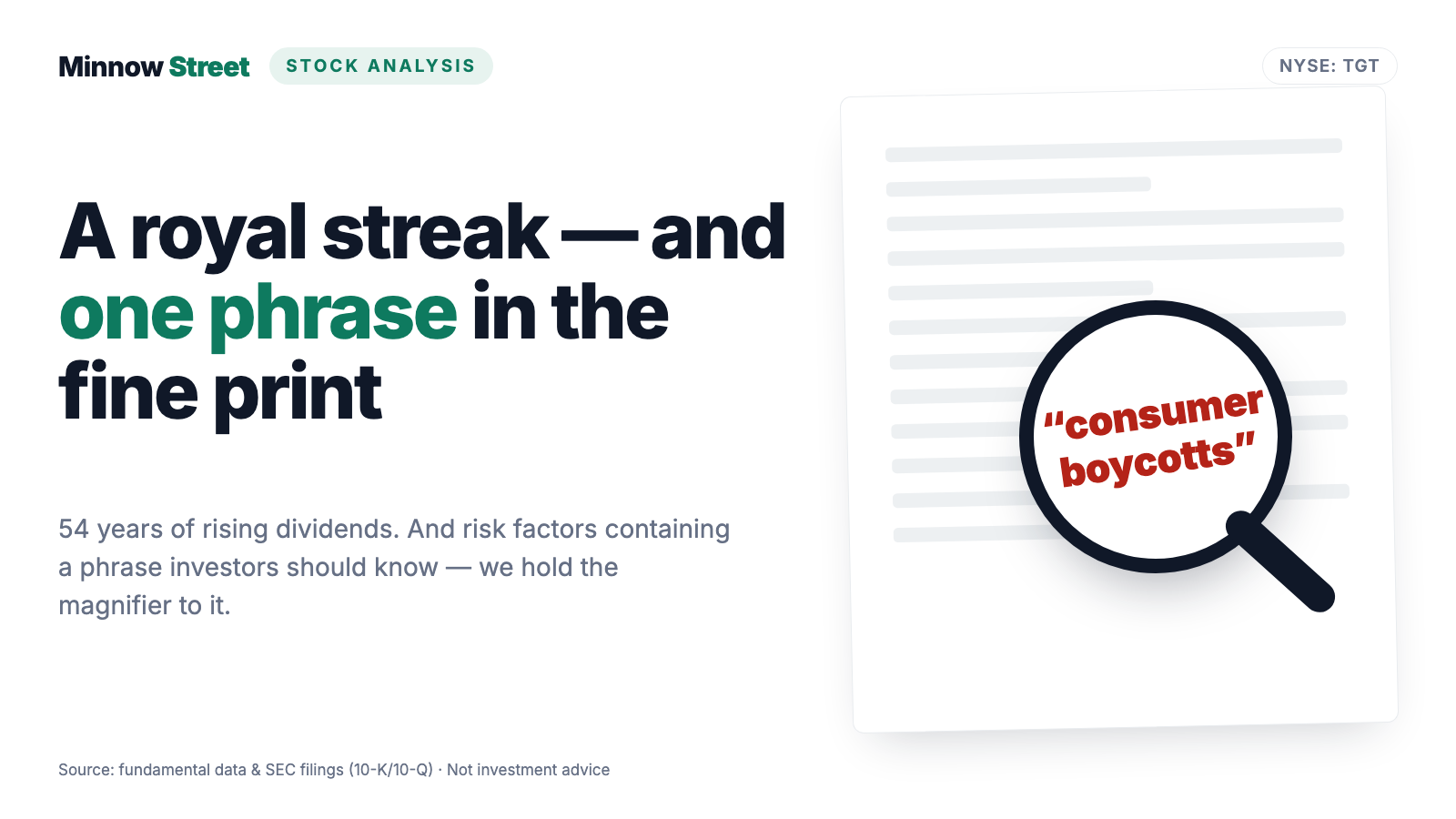
Interactive price chart (TradingView).
Note: pure fact-based analysis, not investment advice and not a solicitation to buy or sell. All figures without guarantee.
There is an investor trap that catches the most sensible people of all: the streak autopilot. It works like this: a stock has done something for 54 years in a row — and from that point on, your brain stops checking whether it can do it in year 55. The streak turns from evidence into proof, the standing order in your portfolio becomes a standing order in your thinking. Target Corporation (NYSE: TGT) is a textbook case: a dividend paid every quarter since the 1967 IPO, raised every single year for 54 years — a streak that survived oil crises, the dotcom crash, the financial crisis and a pandemic. Which is exactly why we make a deal: we switch off the autopilot and read, together, what the company itself reported under penalty of law to the U.S. securities regulator, the SEC — the annual report (10-K) for fiscal 2025 and the quarterly report (10-Q) as of May 2, 2026. Because those filings also contain sentences that do not sound like a royal streak: three years of falling sales, risk factors that speak of organized consumer boycotts, and a tariff squeeze whose outcome nobody can quantify. Plus a first quarter of 2026 that looks like a turnaround — once you know its footnote. In the end you decide for yourself whether the streak is a pillow or a bill that has to be paid again every year.
What Target actually does — and why the calendar and the name confuse people
Target operates 1,995 stores across the United States (as of January 31, 2026; by May 2, 2026 it was 2,002) — discount department stores where America buys apparel, beauty products, food, household essentials and decor, plus a webshop with pickup and delivery services ("Drive Up," same-day delivery via its Shipt subsidiary). Roughly 415,000 team members make the Minneapolis company one of the largest private employers in the United States. A good 20 percent of merchandise sales originate digitally, but the model's trick is that the stores fulfill most of those online orders too — the store around the corner doubles as a mini fulfillment center. Alongside the merchandise business, quieter revenue streams are growing: the in-house retail media network Roundel (advertising revenue within net sales: $915 million in fiscal 2025, up 41 percent), profit sharing from the Target Circle credit cards issued by partner bank TD ($522 million), and the Target Plus marketplace. The shop-in-shop deal with beauty chain Ulta Beauty, by contrast, winds down by mutual agreement in August 2026.
Two stumbling blocks before we run the numbers. First, the calendar: Target's fiscal year ends in late January or early February. "Fiscal 2025" ran from February 2, 2025, through January 31, 2026, and essentially covers calendar year 2025; fiscal 2023 had 53 weeks in the retail calendar instead of 52. Second, the name: the listed Target Corporation (NYSE: TGT) has nothing to do with Target Hospitality, a Texas provider of workforce housing camps — a namesake, different industry, different ticker (we analyzed that company separately: Target Hospitality). Even Target's own name is younger than you might think: until April 1999 the company was called Dayton Hudson Corporation, after its department store roots — the dividend streak began under a different nameplate. Which brings us to the central tension of this analysis, running through every chapter: One of the longest dividend streaks on the market meets a core business that shrank for three years, a boycott year and a tariff wildcard — and a comeback quarter whose optics deceive in both directions. For how store growth alone guarantees no profits, see our analysis of discounter Grocery Outlet.
Where the stock shows up in our scanner
The hook for this analysis is our in-house Dividend Aristocrats scanner: it lists companies that have raised their dividend for at least 25 consecutive years — computed from the actual payout history and supplemented by the curated S&P 500 Aristocrats list. In the US selection, Target sits at rank 5 of 25 hits (as of July 18, 2026; sorted by relative strength), behind Caterpillar, Nucor, Franklin Resources and West Pharmaceutical. Target's streak is one of the longest on the list: 54 consecutive years of increases (as of June 2026) — which even earns the company the unofficial title of "Dividend King," awarded from 50 years up. To replicate: open the scanner, select the "USA" market, find the TGT row — or go straight to the Target stock page. The confluence across scanners is remarkable: Target simultaneously appears in the P/S ranking (price-to-sales around 0.6 — the market pays about 60 cents for a dollar of annual revenue) and the P/CF ranking (price to operating cash flow around 9). Translated: the scanner says "royalty" and "bargain bin" in the same breath — and precisely that combination should make you curious and suspicious at once. The fundamental lens of the same scanner urges sobriety: grade C, a Piotroski F-Score of 5 out of 9 (a nine-point health check of the books — 5 is mediocre, not a distinction) and a trailing price-to-earnings ratio around 18.5 (data as of mid-July 2026). The Altman Z-Score, an early-warning gauge built from several balance sheet ratios, stands near 4.6 — well clear of the danger zone that historically begins below 1.8.
The numbers over the years — honestly appraised
First, what genuinely impresses. Target is a cash machine with century-old roots: $104.8 billion in net sales in fiscal 2025, $6.6 billion in operating cash flow, $3.7 billion in net income, $5.5 billion in cash as of the January 31, 2026 balance sheet date. The capital priorities have stood in the same order in the annual report for years: invest in the business first, then "maintain a competitive quarterly dividend and seek to grow it annually," buybacks last. The Roundel ad business grows at double-digit rates, the store count is rising (about 30 new stores planned for 2026, roughly $5 billion in capital expenditures), and in the first quarter of fiscal 2026 the core business turned too: net sales up 6.7 percent to $25.4 billion, comparable sales up 5.6 percent — carried by 4.4 percent more traffic, the metric that a year earlier stood at minus 2.4 percent. Gross margin rose to 29.0 from 28.2 percent, because less merchandise had to be cleared at markdown. Read only these paragraphs and you see a Dividend King in comeback shape. Now look at the whole curve:
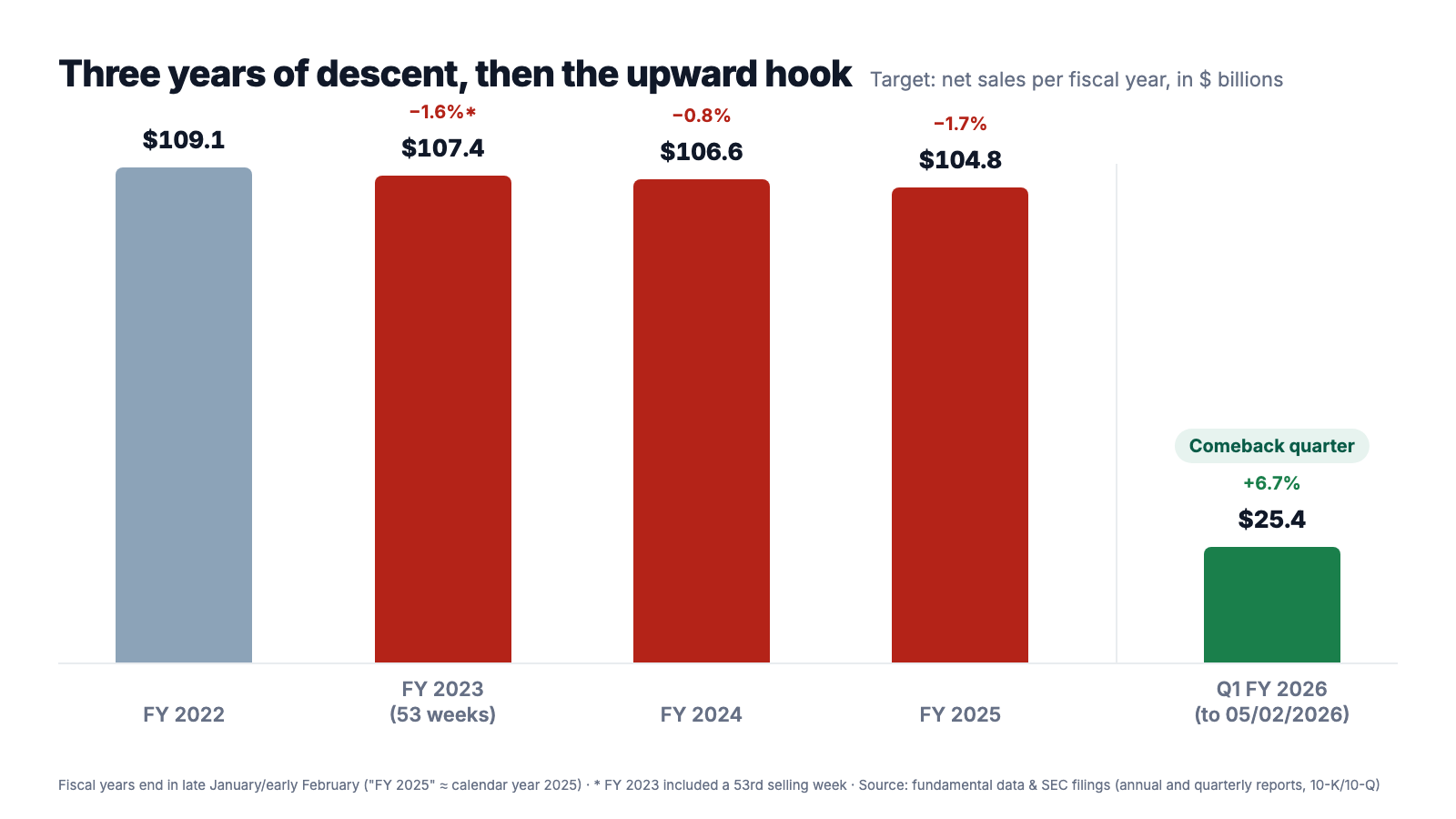
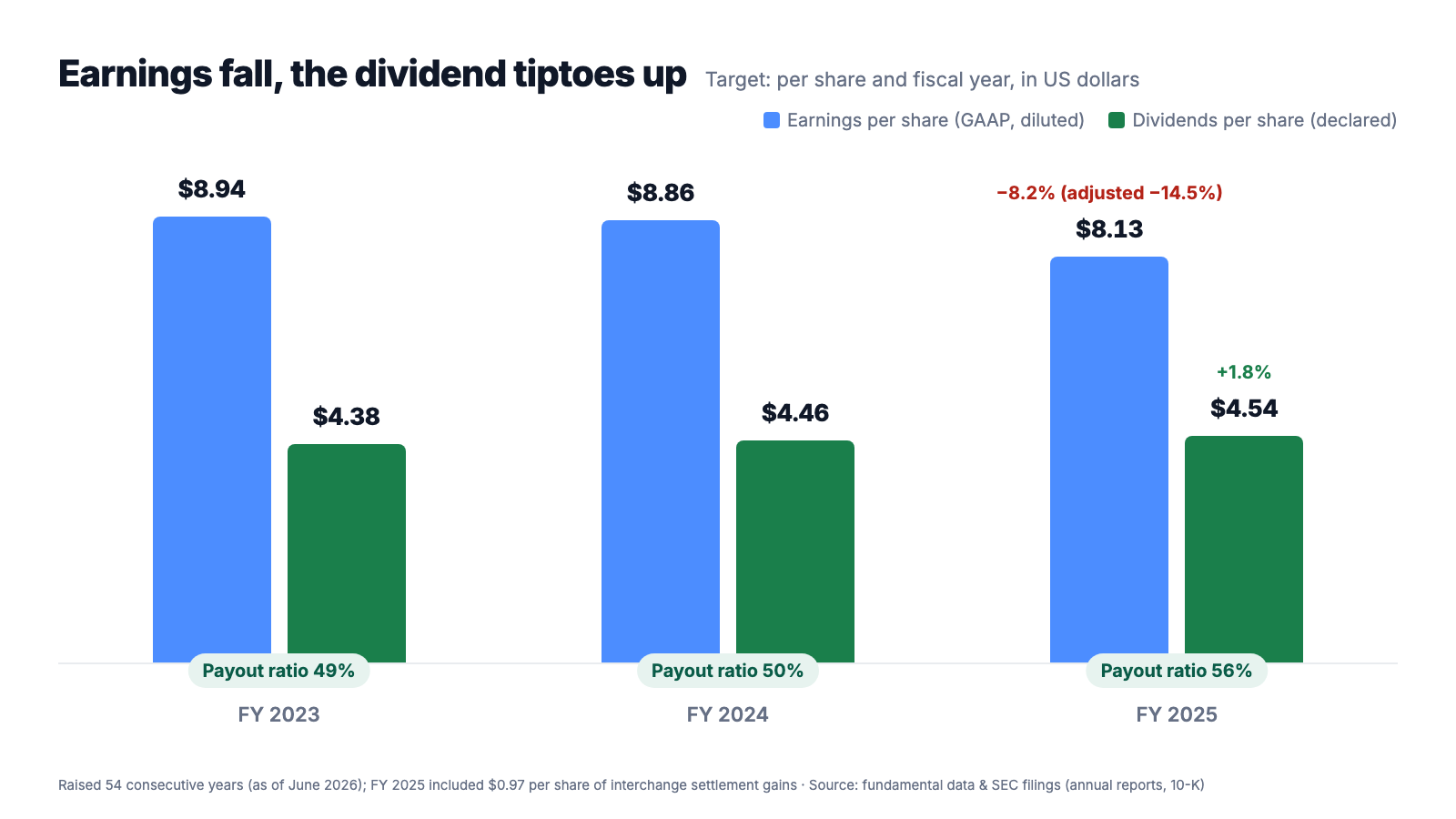
Net sales slid from $109.1 billion (fiscal 2022) through $107.4 billion (fiscal 2023, with a 53rd selling week) and $106.6 billion (fiscal 2024) to $104.8 billion — three down years in a row, in a country with inflation, mind you: in real terms the decline is bigger than the nominal figures show. Earnings tell the same story with a lag: $8.94 per share (fiscal 2023), $8.86 (fiscal 2024), $8.13 (fiscal 2025) — and that last number is flattered, because without the settlement windfall from credit card litigation (more on that shortly) it would have been $7.57 adjusted, a decline of 14.5 percent. Operating margin slipped from 5.3 through 5.2 to 4.9 percent (adjusted 4.6) — for scale: of a $100 shopping cart, Target keeps less than $5 in operating profit. Add $250 million in costs for a company-wide transformation program ($129 million in severance for the headquarters workforce reduction, $57 million for terminated office leases, $64 million in impairments), whose continuation the company explicitly cannot quantify. And the return on capital tells the same story from above: trailing after-tax ROIC fell from 15.1 to 12.4 percent within twelve months (each measured at the quarter end in early May). Remember the image: the comeback quarter is real — but it is one quarter against three years of headwind. One quarter does not make a summer.
The dividend: a 54-year streak — and what it still delivers today
Now to the core reason Target sits in our Aristocrats scanner. The facts from the source: in fiscal 2025 Target paid $2.1 billion in dividends ($4.52 per share); $4.54 per share was declared — an increase of 1.8 percent over the prior year. In the first quarter of fiscal 2026 a quarterly dividend of $1.14 per share went out. And the sentence that anchors the streak sits verbatim in the quarterly report:
"We have paid dividends every quarter since our 1967 initial public offering, and it is our intent to continue to do so in the future."
— Target Corporation, SEC quarterly report 10-Q as of May 2, 2026, Item 2 "Management's Discussion and Analysis — Dividends"

How safe is this dividend? The math from the original numbers: $4.54 in declared dividends stands against $8.13 in GAAP earnings per share — a payout ratio of about 56 percent; measured against adjusted earnings of $7.57 it is 60 percent. In cash terms: $2.1 billion in dividends against $2.8 billion in free cash flow ($6.6 billion operating cash flow minus $3.7 billion capital expenditures) — roughly 70 percent. That holds, but it no longer holds leaps: in the boom years Target raised the dividend at double-digit rates; for two years now it has been 1.8 percent a year — raises that keep the streak alive, not shareholders' income. And the valve that closes first is visible: share buybacks shrank from $1.0 billion (fiscal 2024) to $0.4 billion (fiscal 2025), and in the first quarter of 2026 Target did not repurchase a single share — $8.3 billion remains open under the $15 billion program from August 2021. In one image: the royal streak is no longer a waterfall but a carefully dosed drip — it does not run dry, but it does not fill buckets either. A dividend yield around 3.3 percent (data as of mid-July 2026) is what the market pays for reliability, not growth.
What the filings say — the uncomfortable truths
Uncomfortable truth no. 1: the 2025 boycott year is spelled out in the risk factors
Fiscal 2025 was not just cyclically sluggish for Target — it was a reputation year. In early 2025 the company announced it would end parts of its diversity, equity and inclusion initiatives. The reaction came from both sides — and, rare enough, it is written out in the annual report's risk factors:
"For example, in 2025, we announced that we modified and concluded certain of our initiatives related to diversity, equity, and inclusion, which resulted in adverse reactions from some of our shareholders, guests, team members, and others, as well as consumer boycotts organized throughout 2025."
— Target Corporation, SEC annual report 10-K for fiscal year 2025, Item 1A "Risk Factors"

The numbers behind it: in fiscal 2025 comparable sales fell 2.6 percent and traffic declined 2.2 percent — customers who stopped coming, in a business model that lives on drop-ins. The annual report turns this into a standing risk factor: Target sits between the chairs of a polarized customer base that partly demands initiatives and partly demands their end — the filing concedes it has been unable to meet some of these conflicting expectations, and explicitly names government investigations as a possible follow-on risk. In fairness: the traffic reversal in the first quarter of 2026 (+4.4 percent) suggests the storm is passing. But a customer base that has demonstrated it can stay away in an organized fashion is a new species of risk for a stock whose holders bought "boring reliability." For a retailer, reputation is not a soft topic — it is tomorrow's traffic.
Uncomfortable truth no. 2: $593 million from the courtroom — and earnings whose optics deceive in both directions
Anyone reading Target's earnings for the past five quarters needs a translation aid. In fiscal 2025 the company booked $593 million in net pretax gains from settlements of credit card interchange fee litigation — payouts from the retail industry's decades-long fight with the card networks over processing fees. That windfall lifted GAAP earnings by $0.97 per share: adjusted $7.57 became reported $8.13 — the GAAP decline of 8.2 percent understates the operating decline of 14.5 percent. A year later the same effect flips the optics, and the quarterly report does the math itself:
"Excluding the settlement gains, Adjusted operating income was 29.1 percent higher than $0.9 billion in the prior-year."
— Target Corporation, SEC quarterly report 10-Q as of May 2, 2026, Item 2 "Management's Discussion and Analysis — Financial Summary"

Concretely: in the first quarter of fiscal 2026, reported EPS fell 24.5 percent to $1.71 — adjusted, it rose 31.6 percent (from $1.30), because the prior-year quarter contained the $0.97 windfall. If you only read headlines, you mistook a strong quarter for a slump; if you only read the adjusted gain, you forget the base was a weak prior year. Remember the principle: without the footnotes you are not reading accounts, you are reading accounting poetry. A second line is quietly shrinking alongside: profit sharing from the Target credit cards fell from $667 million through $576 million to $522 million (fiscal 2023 through 2025) — while the Roundel ad business grew. Target's non-merchandise revenue is changing horses mid-race.
Uncomfortable truth no. 3: half the merchandise comes from abroad — and the tariff bill is open, in both directions
Target's shelves hang on global supply chains: the annual report states that roughly half of the merchandise on offer is sourced abroad, directly or through vendors — "with China as the single largest source of merchandise we import." The tariffs imposed in 2025 under the IEEPA emergency statute hit the company accordingly; countermeasures from price increases to supplier diversification are underway. Then came February 20, 2026: the Supreme Court struck down the IEEPA tariffs. What follows from that, the quarterly report describes with remarkable caution:
"As of May 2, 2026, no refunds had been received and no receivable was recorded. Subsequent to quarter-end, we began receiving refunds, which to date have not been material."
— Target Corporation, SEC quarterly report 10-Q as of May 2, 2026, Item 2 "Management's Discussion and Analysis — Business Environment"

That is the tariff wildcard in sober prose: Target is working to recover the IEEPA tariffs it paid through the customs authority's new CAPE refund system, but under the gain-contingency principle it books nothing until the cash actually arrives — and it warns that the refund order may still be appealed. On the other side of the scale: immediately after the ruling, the U.S. administration imposed new tariffs against most major trading partners (under Section 122 of the Trade Act of 1974) and previewed actions that could "restore or exceed" the old tariff level. The quarterly report draws the honest conclusion that the combined effect of tariffs, refunds, sourcing and pricing responses simply cannot be quantified. For you that means: this stock contains a lottery with two tickets — a possible refund gain from the past and a possible tariff loss for the future. Whoever buys Target buys both tickets. For how brutally tariffs can shake a retailer's margin, see our analysis of couch seller Lovesac — there they cost 380 basis points in a single quarter.
Valuation: a $63 billion market value for $105 billion in sales — the price of reliability
In mid-July 2026 Target weighed in at roughly $63 billion in market value (data as of mid-July 2026; a share price around $140 at roughly 454 million shares outstanding per the quarterly report). The resulting price tags are unspectacular, almost soothingly normal: a price-to-sales ratio around 0.6, price to operating cash flow around 9, a trailing price-to-earnings ratio around 18.5 — on the adjusted $7.57 per share more like 18 to 19. The dividend yield sits near 3.3 percent ($4.56 in annualized quarterly dividends). For scale: the broad U.S. market cost a multiple of that on sales at the same time — Target is priced as exactly what it currently is: a thin-margin retailer with a royal streak but no proof of growth. The professionals' view fits: 38 analysts cover the stock, the consensus sits on average between "buy" and "hold," and earnings estimates see mid-to-high single-digit percentage growth for the coming fiscal years (data as of mid-July 2026) — essentially a return to the old earning power, nothing more. The balance sheet carries it: $3.5 billion in cash as of May 2, 2026 (seasonal, after $5.5 billion at year-end), $15.4 billion in debt including current maturities, $16.4 billion in shareholders' investment, inventory 5.6 percent below the prior year — no stress, but no fortress either. The valuation is not an argument against Target. It is just not one for it either — what is being paid for here is the streak, not the story.
Opportunities and risks at a glance
What speaks for Target:
- Dividend royalty with substance: a dividend every quarter since 1967, raised 54 consecutive years (as of June 2026), payout ratio around 56 percent of GAAP earnings and roughly 70 percent of free cash flow — the streak is funded, not borrowed (10-K FY 2025, 10-Q as of 05/02/2026).
- The comeback quarter is broad: Q1 fiscal 2026 with sales +6.7 percent, comparable sales +5.6 percent, traffic +4.4 percent, digital +8.9 percent, gross margin 29.0 after 28.2 percent and adjusted operating income up 29.1 percent — the customers are coming back.
- Second businesses with leverage: advertising revenue (Roundel) +41 percent in fiscal 2025 to $915 million, +51 percent in Q1 — high-margin revenue riding on the same store base; plus about 30 planned store openings and roughly $5 billion in investment for 2026.
- Tariff wildcard to the upside: IEEPA tariffs struck down by the Supreme Court (February 20, 2026), the CAPE refund process is running and first monies are flowing — none of it is on the balance sheet yet; any material refund would be a windfall gain.
- Moderate valuation with a margin of safety in the history: P/E around 18.5 trailing, P/S around 0.6, dividend yield around 3.3 percent (data as of mid-July 2026), Altman Z around 4.6 — reliability is being paid for, not fantasy.
What speaks against it:
- Three years of nominal shrinkage, more in real terms: sales down from $109.1 billion to $104.8 billion (fiscal 2022 through 2025), adjusted EPS down 14.5 percent most recently, operating margin at just 4.9 percent, ROIC down from 15.1 to 12.4 percent — the foundation under the streak has narrowed.
- Reputation risk with receipts: "consumer boycotts organized throughout 2025" sits verbatim in the risk factors, full-year traffic fell 2.2 percent — a polarized customer base can stay away in an organized fashion, in either political direction.
- A structural tariff squeeze: about half the merchandise imported, China the largest single source, new Section 122 tariffs already imposed and more threatened — the net effect is, by the company's own account, unquantifiable.
- Mini-raises as a warning sign: dividend growth down to 1.8 percent a year, buybacks throttled from $1.0 billion to $0.4 billion and zero in Q1 fiscal 2026 — financial headroom is being visibly rationed; plus $250 million in transformation costs with an explicitly unquantifiable continuation.
- Quiet erosion in the non-merchandise mix: credit card profit sharing down from $667 million to $522 million; the Ulta partnership ends in August 2026 — Roundel has to keep growing, or the mix tips.
A human conclusion
Back to the streak autopilot from the opening. Its core is not that long streaks are worthless — on the contrary: 54 years of raises through four recessions are among the hardest quality proofs the market knows. Its core is that the streak does the checking for you at the very moment everything beneath it is moving: sales that fell for three years; earnings that gave up 14.5 percent once you remove the courtroom windfall; a customer base that stayed away in organized fashion in 2025; a tariff bill nobody can quantify — and, at the same time, a first quarter of 2026 in which traffic, margin and adjusted earnings all turned. The honest ledger looks like this: you get about 3.3 percent dividend yield with royal lineage, a moderate valuation and a comeback with its first receipt. In exchange you carry a core business without proof of growth, a documented reputation risk and two tariff lottery tickets with unknown outcomes. Switch off the autopilot and read the next quarterly reports (10-Q) at three spots: does traffic keep recovering? Do the IEEPA refunds turn into a quantified number? And is the next dividend raise finally bigger than 1.8 percent — or does the royal streak remain a tiptoe? What you make of it is your decision. And that is exactly as it should be.
Sources
All original documents used in this analysis — for your own reading:
- Target Corporation — SEC annual report 10-K for fiscal year 2025 (ended January 31, 2026; filed March 11, 2026)
- Target Corporation — SEC annual report 10-K for fiscal year 2024 (ended February 1, 2025; filed March 12, 2025)
- Target Corporation — SEC quarterly report 10-Q as of May 2, 2026 (filed May 29, 2026)
- Full SEC filing history of Target (including former name "Dayton Hudson Corp"): EDGAR overview (sec.gov)
- Fundamental data (metrics, quarterly series, valuation; data as of mid-July 2026), cross-checked against the SEC filings.
- Screener and rating data: in-house stock scanner, in particular the Dividend Aristocrats scanner (rank as of July 18, 2026); consecutive-increase years per the curated S&P 500 Aristocrats list (as of June 2026).
Transparency & disclaimer: This analysis is a journalistic contextualization of publicly available information and is not investment advice, not a financial analysis in the regulatory sense and not a solicitation to buy or sell securities. Stock investments carry substantial risks up to and including total loss. All information without guarantee; the data cut-off is noted in the text. The author holds no position in Target shares at the time of publication.
Our Bottom Line at a Glance
- Dividend streak & coverage positive
- A dividend every quarter since the 1967 IPO (10-Q as of 05/02/2026), raised 54 consecutive years (curated S&P list, as of June 2026); payout ratio about 56 percent of GAAP earnings and roughly 70 percent of free cash flow in FY 2025 — funded, but the raises have shrunk to 1.8 percent a year.
- Growth & core business negative
- Three straight down years in sales ($109.1 billion → $104.8 billion, FY 2022 through 2025), adjusted EPS −14.5 percent in FY 2025, operating margin at 4.9 percent, ROIC down from 15.1 to 12.4 percent — the foundation under the streak has narrowed.
- Comeback quarter Q1 FY 2026 positive
- Sales +6.7 percent, comparable sales +5.6 percent with traffic +4.4 percent (prior year: −2.4), gross margin 29.0 after 28.2 percent, adjusted operating income +29.1 percent (10-Q as of 05/02/2026) — a broad reversal, but one quarter so far.
- Reputation & customer base negative
- "Consumer boycotts organized throughout 2025" sits verbatim in the risk factors of the FY 2025 10-K; full-year traffic −2.2 percent. A polarized customer base that can stay away in organized fashion — in either direction — remains a structural risk for a traffic-driven business model.
- Tariffs & supply chain neutral
- About half the merchandise imported, China the largest single source; IEEPA tariffs struck down (02/20/2026), refunds trickling in ("not material" so far, nothing on the balance sheet), while new Section 122 tariffs are already in place — two open lottery tickets, net effect unquantifiable per the company itself.
- Valuation neutral
- P/E around 18.5 trailing, P/S around 0.6, price to operating cash flow around 9, dividend yield around 3.3 percent (data as of mid-July 2026) — a fair price for reliability without proof of growth; scanner confluence: Aristocrats rank 5 (US) plus two value rankings.
Target is the case of a royal dividend streak standing on a narrowed foundation: 54 years of raises and a dividend every quarter since 1967 stand against three years of falling sales, a boycott year with a documented traffic loss and an unquantifiable tariff bill. The first quarter of 2026 delivered the first real proof of a turn — traffic, margin and adjusted earnings all improved — while the GAAP optics remain distorted by the prior year's interchange windfall. Whoever invests here buys roughly 3.3 percent in dividend yield with royal lineage and bets that a comeback quarter becomes a comeback year. Not investment advice.
What Our Rating Means
- If you don't own the stock
- At the current price level, we don't see a sufficient margin of safety for an entry.
- If you hold it in your portfolio
- Our findings offer no reason to sell.
A journalistic assessment by our editorial team at the time of the deep dive, based on public sources — not investment advice and not a solicitation to buy or sell. Your personal circumstances (investment goals, risk capacity, taxes) cannot be taken into account. What our categories mean, how verdicts are formed, and what conflicts of interest exist →
Worth Noting
- TGT entered the research list through the in-house Dividend Aristocrats scanner: rank 5 of the US selection (25 hits, sorted by relative strength, as of July 18, 2026); simultaneous hits in the P/S and P/CF rankings — "royalty" and "bargain bin" in the same finding.
- The 54 consecutive increase years come from the scanner's curated S&P 500 Aristocrats list (as of June 2026); the SEC filings themselves verbatim document "dividends every quarter since 1967" and the most recent raises of 1.8 percent each.
- All GAAP-versus-adjusted comparisons carry the $593 million interchange effect of FY 2025 ($0.97 per share in the Q1 prior-year base); analyses are evergreen, daily prices are not a buy argument. Target's fiscal year ends in late January/early February — every annual figure carries that offset.
Frequently Asked Questions
Target Corporation (NYSE: TGT) operates 1,995 discount department stores across the U.S. (as of January 31, 2026) and generated $104.8 billion in net sales in fiscal 2025 — from apparel, beauty, food and household essentials, with a good 20 percent of merchandise sales originating digitally. On top come growing side revenues: the Roundel ad network ($915 million of advertising revenue within net sales, up 41 percent) and profit sharing from the Target Circle credit cards issued by partner bank TD ($522 million).
Target has paid a dividend every quarter since its 1967 IPO — that sentence sits verbatim in the quarterly report (10-Q) as of May 2, 2026 — and has raised the payout for 54 consecutive years (curated S&P 500 Aristocrats list, as of June 2026). That makes the stock a "Dividend King" (awarded from 50 years up). The most recent raises were small, though: 1.8 percent each, to $4.54 per share declared in fiscal 2025.
Coverage is solid but has tightened: $4.54 in declared dividends stands against $8.13 in GAAP earnings per share (a ratio of about 56 percent) or $7.57 adjusted (60 percent). In cash terms, fiscal 2025 saw $2.1 billion in dividends against roughly $2.8 billion in free cash flow. Notably, share buybacks were throttled from $1.0 billion to $0.4 billion, and to zero in the first quarter of 2026 — the savings valve closes at buybacks first, not at the dividend.
Because of a base effect: the prior-year quarter contained $593 million in settlement gains from credit card interchange litigation ($0.97 per share). Reported EPS therefore fell 24.5 percent to $1.71 — adjusted for the one-off, earnings rose 31.6 percent and adjusted operating income rose 29.1 percent. Operationally the quarter was strong: sales up 6.7 percent, traffic up 4.4 percent, gross margin 29.0 after 28.2 percent.
In early 2025 Target ended parts of its diversity, equity and inclusion (DEI) initiatives. The annual report (10-K) for fiscal 2025 cites, as a consequence, adverse reactions from shareholders, guests and team members as well as "consumer boycotts organized throughout 2025." Traffic fell 2.2 percent for the year and comparable sales fell 2.6 percent. In the first quarter of 2026, traffic turned positive again (+4.4 percent).
Per the annual report, roughly half of the merchandise is sourced abroad directly or indirectly, with China the largest import source. The 2025 IEEPA tariffs were struck down by the Supreme Court on February 20, 2026; Target is claiming refunds through the customs authority's CAPE system but had received nothing as of May 2, 2026, and recorded no receivable — first amounts arrived after quarter-end and were "not material" so far. At the same time the U.S. administration imposed new Section 122 tariffs; the company says it cannot quantify the net effect.
Moderately priced: at roughly $63 billion in market value (data as of mid-July 2026), the stock costs about 18.5 times trailing earnings, 0.6 times sales and around 9 times operating cash flow; the dividend yield sits near 3.3 percent. That is neither a bargain-bin nor a growth price — the market pays for the 54-year dividend streak and wants proof that the Q1 2026 comeback quarter was not an outlier before re-rating the stock.
Found an error?
Did you spot a factual error, an outdated number, or a typo in this deep dive? Let us know briefly — your report goes straight to the editorial team.