Grocery Outlet Stock: The Bargain King Is on Markdown — After a Botched Software Switch, 36 Store Closures and $307 Million of Goodwill Written Off
Grocery Outlet sells name-brand products 40 to 70 percent below regular prices — and its own stock trades about 79 percent below its all-time high (data as of July 8, 2026). The discounter is popping up in the Reddit chatter again (6 mentions in 24 hours as of July 15, 2026), and the bargain reflex asks: grab it? We read the annual reports (10-K) for 2024 and 2025 and the quarterly report (10-Q) as of April 4, 2026: an ERP conversion that disrupted operations for two years and drew investor lawsuits, goodwill written off twice ($307 million combined), 36 stores marked for closure — and an operator system in which half of the loans sit with supported storekeepers. Not investment advice — just the inventory count before you grab the deal.
 Thomas Mücke
Founder & Publisher
Thomas Mücke
Founder & Publisher
Chart
Interactive price chart (TradingView).
Note: pure fact-based analysis, not investment advice and not a solicitation to buy or sell. All figures without guarantee.
There is a reflex Grocery Outlet understands better than almost any other listed company: the bargain reflex. The entire business model consists of putting name-brand products on the shelf 40 to 70 percent below regular prices and letting your brain shout "grab it!" before your reason turns the package over. Psychologists call the mechanism behind it anchoring: we never judge a price in absolute terms, only against an anchor — and a crossed-out regular price makes almost any deal attractive. In the summer of 2026, the stock of Grocery Outlet Holding Corp. (Nasdaq: GO) sits in the clearance aisle itself: about 79 percent below its all-time high, price-to-sales ratio 0.2 (data as of July 8, 2026) — and the name is popping up in the Reddit chatter again; our Reddit hype scanner counted 6 mentions in 24 hours (as of July 15, 2026). The anchor is set: "Used to be worth more than four billion, now costs less than one." But stocks are not cornflakes: there is no regular price anyone has to return to. So let\'s make a deal: before you set off with the shopping cart, we turn the package over together — we read the annual report (10-K) for 2025, its predecessor and the quarterly report (10-Q) as of April 4, 2026, all filed with the U.S. securities regulator, the SEC. An SEC filing is honest under penalty of law. And this one contains things that appear on no price tag. In the end, you decide for yourself.
What Grocery Outlet actually does — and who actually runs the store
Grocery Outlet (founded in 1946, headquartered in Emeryville near San Francisco, listed since June 2019) calls itself an "extreme value retailer" — translated: a closeout supermarket. Its buying team purchases opportunistically whatever the brand industry has left over — overproduction, packaging changes, short remaining shelf lives, discontinued product lines — and sells that merchandise, per the annual report, generally 40 to 70 percent below the prices of conventional retailers. The assortment changes constantly; the company itself calls the shopping experience a treasure hunt with "WOW!" deals. At the end of the first quarter of fiscal 2026 the network counted 549 stores in 16 states, concentrated on the West Coast. And now the twist that separates Grocery Outlet from Aldi, Dollar General and the rest: the company does not run most of its stores itself. That is done by independent entrepreneurs, called "independent operators" (IOs) in the filings — often married couples who stand in the store themselves. The construction is remarkable: the merchandise remains the company\'s property until sold (consignment), the register receipts belong to the company as well, and the operator receives as compensation, as a rule, 50 percent of the store\'s gross profit. The company builds and leases the store; the IO hires the staff, carries the operating costs and finances the startup capital — very often through a loan from the company itself (more on that later). Losses from theft, spoilage and markdowns are generally split equally. Remember the picture: Grocery Outlet is wholesaler, landlord and bank of its own store managers, all in one. In good times that is an ingenious model — the entrepreneur on site fights for his store like no salaried market manager ever would. In bad times, though, the problems travel through all three roles at once. Which brings us to the central tension of this analysis, and it runs through every chapter: revenue keeps growing — but the company has written off $307 million of goodwill within two reporting periods, is closing 36 stores and is defending itself against investor lawsuits. Is this a healthy machine that merely stumbled — or does the model have a crack? How quickly the market withdraws its trust from a consumer favorite is something we recently dissected at Wendy\'s — and why Reddit attention alone is no buy case, at AMC.
Where the stock shows up in our scanner
Every day we run about 3,500 stocks through our scanners. Grocery Outlet lights up in 8 filters as of the July 8, 2026 data cut-off — and as so often with fallen stocks, the hits read like two expert opinions about two different companies. Opinion one, the value lens: in the P/S ranking the stock stands at a price-to-sales ratio of 0.2 — the market pays less than one billion dollars of market value for $4.69 billion of annual revenue. In the P/CF ranking the stock costs 3.8 times operating cash flow. Add net insider buying — eleven insider purchases in recent months against nine sales —, the "institutions and insiders accumulating" filter (twelve institutional holders added recently, four reduced) and the institutional-ownership filter: the largest shareholders are T. Rowe Price with 18.8 percent, BlackRock with 14.9 percent and Vanguard with 11.4 percent (filing dates as of March 31, 2026). Opinion two, the trend and quality lens, is notably cooler: a relative-strength rating of 39 — the stock performed worse than 61 percent of all others —, the Weinstein stage model files the chart under stage 3 (a transition zone after the rebound, not a confirmed uptrend), and the EPS rating of 17 mirrors the loss streak. That "power trend" and "gap-up (≥3%)" fire at the same time only shows the force of the latest countermove: plus 12.8 percent in one month, plus 37.5 percent in three — still minus 29 percent over twelve months (all data as of July 8, 2026). Cheap on revenue and cash flow, bought by insiders, but with bruised quality and a fresh recovery impulse: exactly this fingerprint appears when the market is arguing whether a stock is a bargain — or a business model with a crack.
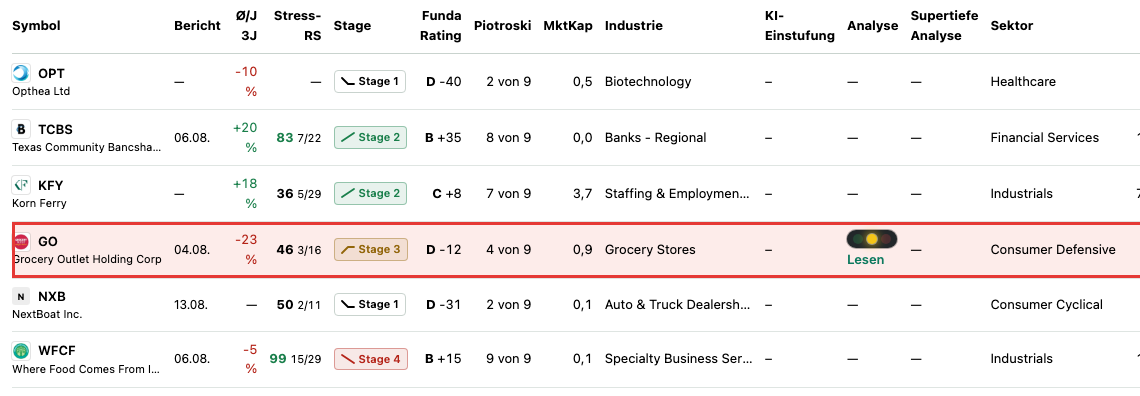
Two more scanner readings belong on the table because they temper the value thesis: the Piotroski F-Score, a nine-point test of balance-sheet quality, stands at only 4 of 9 — a thoroughly healthy company scores 8 or 9. And interest coverage is arithmetically negative because of the loss year — operating profit did not cover the interest bill recently. On the other hand: the Altman Z-score, a classic insolvency early-warning built from several balance-sheet ratios, sits around 3.0, outside the danger zone that historically begins below 1.8 (all data as of July 8, 2026). Grocery Outlet is no bankruptcy candidate — the question is a different one: what is growing revenue worth when the profit underneath it disappears?
The numbers over the years — honestly appraised
First, what genuinely impresses — the front of the package. Revenue has grown through every crisis: $3.97 billion (2023), $4.37 billion (2024), $4.69 billion (2025) — most recently plus 7.3 percent, with fiscal 2025 containing a 53rd week that alone contributed $82.4 million. Comparable store sales rose 0.5 percent in fiscal 2025, carried by 1.6 percent more customer transactions — shoppers come more often but buy less per visit (average basket: minus 1.1 percent). Gross margin held steady at 30.3 percent (prior year: 30.2 percent) — respectable for a discounter. The store network grew by 42 openings to 570 locations in fiscal 2025, and with the acquisition of United Grocery Outlet (April 2024, 40 stores) the company ventured into the U.S. Southeast for the first time. A retailer for tight budgets in an era of tight budgets, with growing revenue and a stable margin — whoever reads only these paragraphs understands the bargain reflex immediately. Now turn the package over:
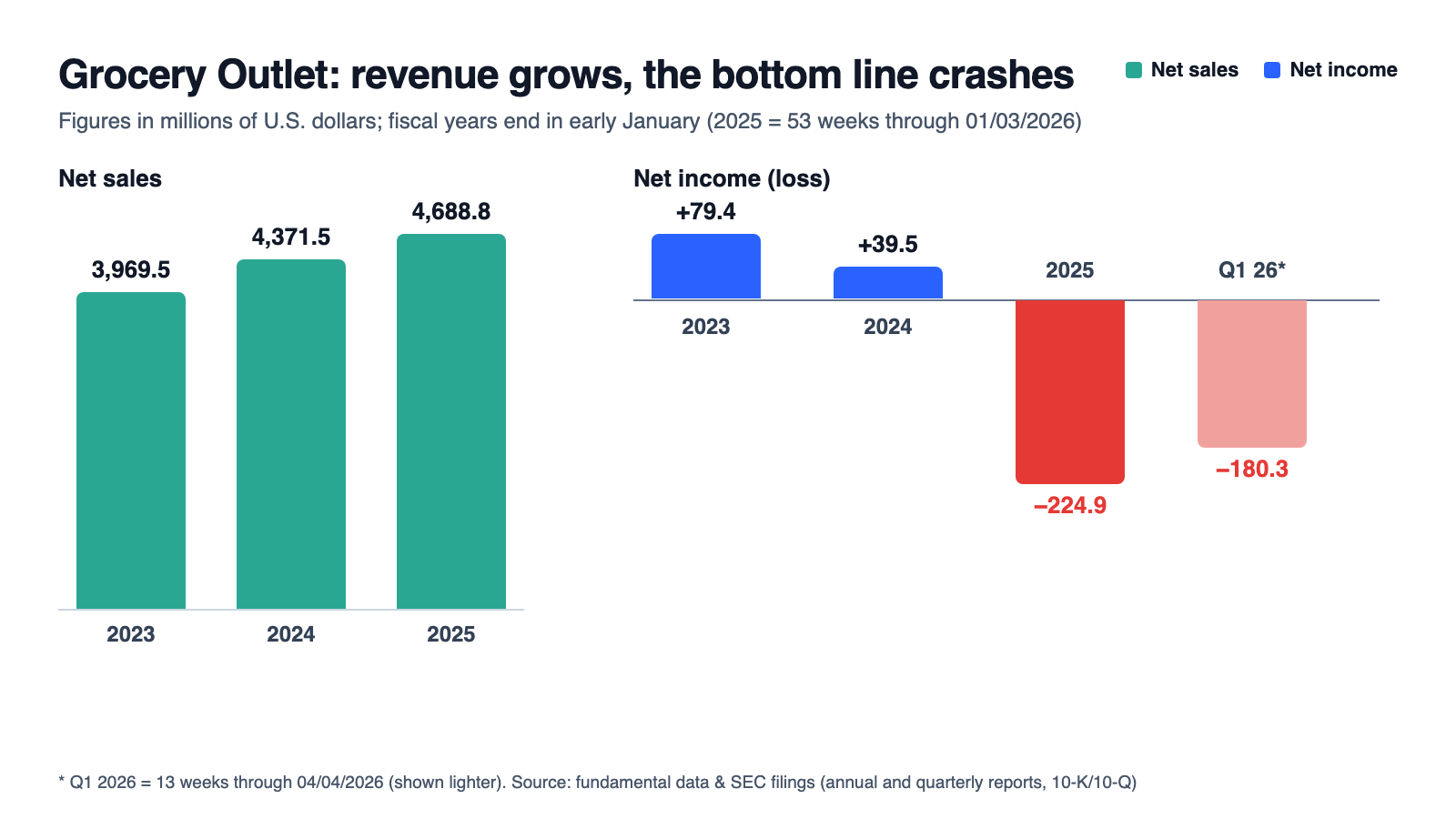
The bottom line for fiscal 2025 was a net loss of $224.9 million (minus $2.30 per share) — after profits of $39.5 million (2024) and $79.4 million (2023). The first quarter of fiscal 2026 added another $180.3 million of losses. Important context: the lion\'s share is not operationally burned cash but book entries — $149.0 plus $158.0 million of goodwill impairments, $113.8 million of write-downs on store assets, plus restructuring charges. Adjusted for these items the company reports net income of $75.2 million for fiscal 2025 ($0.76 per share) and adjusted EBITDA of $254.3 million. But be careful with the word "adjusted": even the adjusted result of the first quarter of fiscal 2026 fell from $13.0 million to $4.6 million, comparable store sales turned to minus 1.0 percent (average basket: minus 3.1 percent), and gross margin slipped to 29.6 percent. And operating cash flow tells the story of the past three years most honestly: $303.4 million (2023), $112.0 million (2024), $222.1 million (2025) — that 2024 collapse in the middle of growing revenue has a concrete cause. Which brings us to the uncomfortable truths.
What the filings say — the uncomfortable truths
Uncomfortable truth no. 1: the software failure — an ERP conversion disrupted operations for two years, and now investors are suing
In August 2023, Grocery Outlet swapped the IT systems it had developed in-house over decades for a new ERP system — the digital backbone for accounting, purchasing, inventory management and the connection of warehouses and stores. What happened next, the annual report describes like this:
"In late August 2023, we replaced our internally-developed legacy applications with a customized enterprise resource planning system, including our financial ledger, purchasing, inventory management and reporting platforms as well as integrations with our warehouse and store systems. The implementation of these system upgrades resulted in significant disruption to our business operations, including ordering and inventory disruptions, as well as payment processing, which adversely impacted our results of operations during the remainder of fiscal 2023 through fiscal 2024 and into fiscal 2025."
— Grocery Outlet Holding Corp., SEC annual report 10-K for 2025, Item 7 MD&A "Recent Trends and Developments"

Translate that onto the shop floor: a closeout retailer lives on having the right merchandise in the right shelf at the right time — when ordering, inventory and payments jam simultaneously, it hits the very core. The traces are in the numbers: operating cash flow collapsed to $112.0 million in fiscal 2024 (2023: $303.4 million), and the company voluntarily supported its operators with extra commission payments during that time. And the affair has a legal aftermath: since early 2025, two investor lawsuits consolidated into one class action have been pending, alleging that the company made "materially false and misleading statements" about the systems transition — the quarterly report meanwhile also lists several derivative lawsuits against current and former executives. Grocery Outlet says it will defend itself "vigorously", and none of the allegations has been decided. But hold on to what is undisputed: the management under which the failure happened is gone — since February 2025, Jason Potter has run the company, a turnaround executive with three decades in food retail. The crash of this stock is not a mood swing of the market — it has a docket number.
Uncomfortable truth no. 2: goodwill written off twice — $307 million of book value gone in two reporting periods
Goodwill is the premium a buyer once paid above the substance of a business — at Grocery Outlet it essentially stems from the private equity buyout that brought the company to the stock market in 2019. That position sat untouched at almost $783 million for years. Then came five quarters with real weight: at the regular annual test in the fourth quarter of fiscal 2025, the company concluded that its fair value had fallen below book value — a $149.0 million impairment. And only one quarter later:
"During the first quarter of fiscal 2026, we determined that a triggering event had occurred as a result of a decline in our stock price, necessitating an interim goodwill impairment evaluation. We performed a quantitative assessment as of April 4, 2026, and concluded that the carrying amount of goodwill exceeded its estimated fair value. Accordingly, we recognized a goodwill impairment charge of $158.0 million in the first quarter of fiscal 2026."
— Grocery Outlet Holding Corp., SEC quarterly report 10-Q as of April 4, 2026, Note 3 "Goodwill"

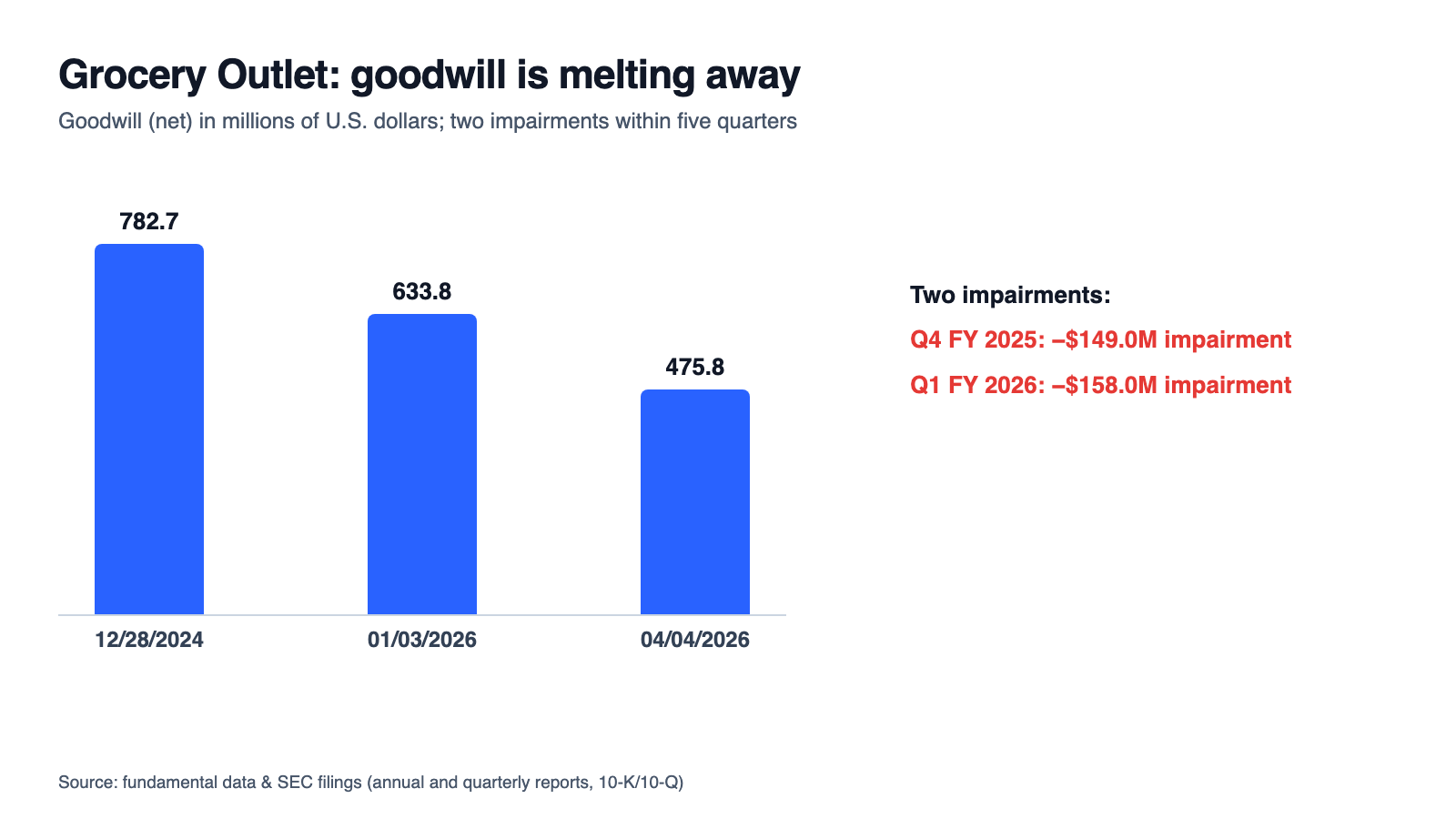
Why you should care even though not a dollar of cash moves: a goodwill impairment is management\'s written admission that its own expectations for the future no longer support the premium once paid — tested with discounted cash flow forecasts and market comparisons, signed off by the auditor. Twice in a row means: those expectations were lowered again within months. The side effect sits in the balance sheet: stockholders\' equity fell from $1,197.4 million (December 28, 2024) via $983.7 million (January 3, 2026) to $807.1 million (April 4, 2026) — minus 33 percent in five quarters. Against that stand $490 million of bank debt ($270 million term loan plus $220 million drawn on the revolving credit facility), floating at roughly 6 percent and due in February 2028, next to only $59 million of cash (all as of April 4, 2026). That is no emergency — but the cushion this company takes into its restructuring is visibly thinning. Remember: goodwill impairments cost no liquidity, but they put shrinking confidence on the record — here, twice.
Uncomfortable truth no. 3: the shrink cure — first 28 abandoned locations, now 36 closures
For years Grocery Outlet was an expansion machine — at times, 10 percent store growth per year was the internal marching order. The new course is the opposite, and it came in two waves. Wave one, adopted in the fourth quarter of fiscal 2024: a restructuring plan that terminated 28 leases for never-opened stores in "suboptimal locations", canceled capital-intensive warehouse projects and cut headcount — total costs through January 3, 2026: $61.8 million. Wave two arrived with the new CEO:
"Following that review, on March 2, 2026, our Board adopted a business optimization plan (the "Optimization Plan") that provides for the closure of 36 financially underperforming stores ("Closure Stores"), including the termination or sublease of the applicable store leases; the termination or sublease of a lease for a distribution center facility that we are no longer utilizing […]"
— Grocery Outlet Holding Corp., SEC annual report 10-K for 2025, Item 7 MD&A "Optimization Plan and Restructuring Plan"

The pace is remarkable: 27 of the 36 stores closed by late March 2026, the remaining nine in the second quarter — the store count fell from 570 to 549. Ahead of the plan, the company had already written down $110 million on the fixed assets of exactly these stores (part of the $113.8 million of impairments in fiscal 2025). Per the quarterly report, another $20 to $27 million of net restructuring charges follow in fiscal 2026/2027 — behind which sit gross $49 to $60 million of hard exit payments for lease terminations, softened in the books by writing off the lease liabilities. Honesty requires both halves: closing sick locations is economically sensible, it lifts the average of the remaining stores — and 36 of 570 stores is a good 6 percent of the network, not a breakup. At the same time the company still plans 30 to 33 new openings for 2026, now clustered and partly run company-operated at first instead of handing them straight to an IO. But do the math on the mechanics: a retailer that closes and opens at the same time pays for both — and the second class action, filed in March 2026, accuses management of "materially false and misleading statements" precisely about the growth strategy and the effectiveness of the restructuring plan (again: allegations, not verdicts). The shrink cure is the right therapy — but it is also the proof that the years-long expansion thesis did not hold.
Uncomfortable truth no. 4: the quiet helpers — half of the operator loans sit in a support program
Back to the peculiarity of this business model: the independent operators. The company is their bank — it extends "IO notes" for startup capital and working capital, bearing interest between 4.00 and 9.95 percent, payable on demand and without a maturity date. As of January 3, 2026, $57.5 million of such loans were outstanding (prior year: $46.9 million), carrying a $14.3 million allowance; the filing puts the total gross exposure to the operators at $88.3 million. And for operators in trouble, there is a dedicated program:
"TCAP allows us to provide a greater commission to participating IOs who require assistance in meeting their working capital needs for various reasons, such as new or increased competition or differences in IO skills and experience. […] Notes of IOs participating in our TCAP represented 50.6% and 49.1% of total IO note balances as of January 3, 2026 and December 28, 2024, respectively."
— Grocery Outlet Holding Corp., SEC annual report 10-K for 2025, Note 2 "Independent Operator Notes and Receivables"

Translated: every second loan dollar to the company\'s own store operators belongs to an entrepreneur who would not get by without an increased commission. And the accounting has a remarkable property: because the loans run on demand and TCAP participants by definition do not count as past due, the filing reports — formally entirely correct — "no past-due notes". An early-warning system that is structurally short on alarms. Why this matters: the IOs are not a footnote, they are the model — their entrepreneurial spirit is, per the company, the core of the customer experience, and the termination of operator agreements in the wake of the store closures already cost $15.5 million of additional loan-loss provisions in the first quarter of fiscal 2026. In fairness: TCAP is also a sign that the company carries its operators through hard times rather than dropping them — and part of the strain demonstrably came from the company\'s own software failure, not from the storekeepers\' shortcomings. But for you as an investor the rule stands: a business model whose foundation consists of hundreds of independent livelihoods is only as healthy as those livelihoods — and the footnotes say that half of the loan dollars extended to them currently sit in the support program.
Valuation: $0.95 billion of market value — the anchor and the reality
In early July 2026 the Grocery Outlet stock cost about $9.50, making roughly $0.95 billion of market value (data as of July 8, 2026) — about 79 percent below the all-time high from the days when the same share count was worth more than four times as much. The anchoring effect reads that as "minus 79 percent = cheap". Let\'s do the math: on the reported loss, no price-to-earnings ratio can be built. Take the adjusted profit for fiscal 2025 ($75.2 million, $0.76 per share) and you pay about 12.5 times — for a grocer with a stable gross margin no rip-off, but no fire-sale price either. The whole-company view: market value plus $490 million of bank debt minus $59 million of cash yields an enterprise value around $1.4 billion — about 5.4 times the adjusted EBITDA of $254.3 million (fiscal 2025). Again: moderate, not dirt cheap. And the price-to-sales ratio of 0.2 that blinks so temptingly in the scanner? For a retailer that keeps less than $2 of every $100 of revenue as adjusted profit, a low price-to-sales ratio is the natural state, not a gift. The optimists\' counter-calculation still deserves respect: once the 36 problem stores are gone, the ERP disruptions truly are history and the adjusted margin gains even one percentage point, profit grows at a double-digit clip — and insiders as well as institutions have recently been net buyers (data as of July 8, 2026). That is not an absurd bet. It is just not one the crossed-out old price pays you for: the anchor of the past is no regular price — it was the valuation of a growth story that the company itself is currently dismantling.
Opportunities and risks at a glance
What speaks for Grocery Outlet:
- Revenue that grows through every crisis: $3.97 → $4.37 → $4.69 billion (2023–2025, most recently +7.3 percent on 53 weeks), a stable gross margin around 30 percent and 1.6 percent more customer transactions in fiscal 2025 — the discount concept pulls shoppers in (annual report 10-K for 2025).
- Still profitable on an adjusted basis: $75.2 million of adjusted net income and $254.3 million of adjusted EBITDA in fiscal 2025; operating cash flow back at $222.1 million after the 2024 collapse; an Altman Z-score around 3.0 — no insolvency profile (data as of July 8, 2026).
- A new boss with a clear turnaround mandate: CEO Jason Potter (since February 2025) ended the expansion doctrine, marked 36 problem stores for closure and introduced stricter opening standards — the costs are quantified and mostly non-cash.
- Ownership signals: eleven insider purchases against nine sales, twelve institutional holders adding against four reducing; T. Rowe Price (18.8 percent), BlackRock (14.9 percent) and Vanguard (11.4 percent) as anchors (filing dates March 31, 2026; scanner data as of July 8, 2026).
- A moderate valuation if the turnaround lands: price-to-sales 0.2, 3.8 times operating cash flow, enterprise value around 5.4 times adjusted EBITDA — if the margin recovers, there is room (data as of July 8, 2026).
What speaks against it:
- Two goodwill impairments in two reporting periods ($149.0 + $158.0 million), the latter triggered by the company\'s own stock price; stockholders\' equity fell from $1,197.4 million to $807.1 million within five quarters — management cashiered its own assumptions about the future twice.
- The software failure lingers: ERP disruptions from August 2023 into fiscal 2025, operating cash flow cut to $112.0 million in 2024 — and two securities class actions (2025 on the systems transition, 2026 on growth strategy and restructuring) plus derivative lawsuits are pending, outcomes open.
- The core business is cooling right now instead of rebounding: comparable store sales minus 1.0 percent in the first quarter of fiscal 2026, average basket minus 3.1 percent, gross margin down to 29.6 percent, adjusted quarterly profit shrunk from $13.0 million to $4.6 million — and the company has announced further margin-dilutive promotions.
- The operator system is under stress: 50.6 percent of IO note balances in the TCAP support program, a $14.3 million allowance against $57.5 million of loans, plus $15.5 million of fresh provisions from agreement terminations in the first quarter of fiscal 2026; on-demand loans without maturities make delinquency structurally invisible.
- A balance sheet with a thinning cushion: $490 million of floating-rate bank debt (around 6 percent) comes due in February 2028 against $59 million of cash; on top, roughly 9 percent of revenue arrives via EBT/SNAP public benefits — a political risk the late-2025 government shutdown already demonstrated.
A human conclusion
Back to the bargain reflex from the beginning. Grocery Outlet owes its business to it — and its shareholders have learned over the past three years that it cuts both ways at the stock market. The anchor "79 percent below the high" feels like a WOW! deal. But turn the package over: the high was the price of an expansion machine with flawless software and a 10-percent growth doctrine. The company that stands in the SEC filings today suffered a systems conversion that disrupted ordering, inventory and cash flow for two years; it wrote off its goodwill twice in a row for a combined $307 million; it is closing 36 stores, supports half of its borrowing operators through a commission program and is defending itself against two securities class actions. None of this is a death sentence — revenue is growing, an adjusted profit remains, an Altman Z-score around 3.0 and buying insiders argue against the obituary, and the new CEO is doing what turnaround executives should do: close what is sick and put a number on what it costs. But the sequence belongs on the table: only when comparable store sales grow again, the margin stabilizes and the lawsuits have a price tag does today\'s price become an entry into a recovery — before that, it is the fair price for a construction site with a good foundation. In the store, the rule is: when the label promises 70 percent off, you check the expiration date. For the stock, the expiration date is called the quarterly report. What you make of it is your decision. And that is exactly as it should be.
Sources
All original documents used in this analysis — for your own reading:
- Grocery Outlet Holding Corp. — SEC annual report 10-K for 2025 (filed March 4, 2026)
- Grocery Outlet Holding Corp. — SEC annual report 10-K for 2024 (filed February 26, 2025)
- Grocery Outlet Holding Corp. — SEC quarterly report 10-Q as of 04/04/2026 (filed May 13, 2026)
- Grocery Outlet Holding Corp. — SEC quarterly report 10-Q as of 09/27/2025 (filed November 5, 2025)
- Grocery Outlet Holding Corp. — SEC quarterly report 10-Q as of 06/28/2025 (filed August 6, 2025)
- Grocery Outlet Holding Corp. — SEC quarterly report 10-Q as of 03/29/2025 (filed May 7, 2025)
- Complete SEC filing history of Grocery Outlet Holding Corp.: EDGAR overview (sec.gov)
- Fundamental data (metrics, quarterly series, valuation; data as of July 8, 2026), reconciled with the SEC filings.
- Screener and rating data: in-house stock scanner (data as of July 8, 2026); Reddit mentions: ApeWisdom (as of July 15, 2026).
Transparency & disclaimer: This analysis is a journalistic contextualization of publicly available information and is not investment advice, not a financial analysis in the regulatory sense and not a solicitation to buy or sell securities. Stock investments carry substantial risks up to and including total loss. All information without guarantee; the data cut-off is noted in the text for each figure. The author holds no position in Grocery Outlet shares at the time of publication.
Our Bottom Line at a Glance
- Business model & demand positive
- The closeout discounter grows through every consumer slump: net sales rose from $3.97 billion to $4.69 billion between 2023 and 2025 (+7.3 percent most recently), gross margin held steady around 30 percent, and fiscal 2025 brought 1.6 percent more customer transactions — the value promise of name brands 40–70 percent below regular prices works (annual report 10-K for 2025).
- Earnings quality & goodwill negative
- A net loss of $224.9 million in fiscal 2025 and $180.3 million in Q1 of fiscal 2026; two goodwill impairments within two reporting periods ($149.0 + $158.0 million, the latter triggered by the company's own stock price); stockholders' equity down from $1,197.4 million to $807.1 million in five quarters; even the adjusted Q1 profit shrank from $13.0 million to $4.6 million.
- Software failure & legal risk negative
- The ERP conversion begun in August 2023 disrupted ordering, inventory and payment processing into fiscal 2025 (operating cash flow 2024: $112.0 million after $303.4 million in 2023); two securities class actions (2025 on the systems transition, 2026 on growth strategy/restructuring) and several derivative lawsuits are pending — outcomes and potential costs open.
- Turnaround & operator system neutral
- The Optimization Plan (36 closures, one distribution center) and the restructuring plan (28 abandoned locations, $61.8 million in costs) form a coherent shrink cure under new CEO Jason Potter (since February 2025) — but 50.6 percent of operator note balances sit in the TCAP support program, and the agreement terminations already cost $15.5 million of extra provisions in Q1 of fiscal 2026.
- Valuation & balance sheet neutral
- A price-to-sales ratio of 0.2 and 3.8 times operating cash flow look cheap, but on adjusted earnings the stock costs about 12.5 times profit and, including debt, about 5.4 times adjusted EBITDA — moderate for a construction site; $490 million of floating-rate debt comes due in February 2028 (cash: $59 million), an Altman Z-score around 3.0 keeps the insolvency question at bay; insiders and institutions were recent net buyers (data as of July 8, 2026).
Grocery Outlet is not a dying retailer but a growing discount machine with damaged trust: revenue rose 7.3 percent even in fiscal 2025, and on an adjusted basis $75.2 million of profit and $254.3 million of EBITDA remained. But the 2023 software failure lingered into 2025, goodwill was written off twice for a combined $307 million, 36 stores are closing, half of the operator loans sit in a support program, and two securities class actions are pending. Optically cheap on sales, fairly priced on adjusted earnings — the turnaround only pays once margin and comparable store sales turn. Not investment advice.
What Our Rating Means
- If you don't own the stock
- As long as the question raised in the bottom line stays open, we see no basis for an entry.
- If you hold it in your portfolio
- Our findings offer no acute reason to sell — the checkpoints named remain decisive.
A journalistic assessment by our editorial team at the time of the deep dive, based on public sources — not investment advice and not a solicitation to buy or sell. Your personal circumstances (investment goals, risk capacity, taxes) cannot be taken into account. What our categories mean, how verdicts are formed, and what conflicts of interest exist →
Worth Noting
- GO reached our research list via the Reddit hype scanner (ApeWisdom, 6 mentions in 24 hours as of July 15, 2026); attention waves of this kind are snapshots, not quality judgments. The 8 hits in our in-house stock scanner carry the July 8, 2026 data cut-off and shift daily.
- Scanner metrics (P/S, P/CF, Piotroski, Altman Z, interest coverage) are computed on trailing twelve-month figures; the Q1 fiscal 2026 goodwill impairment and the March 2026 store closures show up in them only with a lag.
- Price and valuation figures are dated July 8, 2026 (about $9.50, about $0.95 billion in market value); analyses are evergreen, daily prices are not a buy argument.
Frequently Asked Questions
Grocery Outlet (Nasdaq: GO) buys name-brand closeout and surplus merchandise opportunistically and sells it, per the annual report, generally 40 to 70 percent below the prices of conventional retailers — through 549 stores in 16 U.S. states at the end of the first quarter of fiscal 2026. Most stores are run by independent operators (IOs): the merchandise remains company-owned consignment goods, the register receipts belong to the company, and the operator as a rule receives 50 percent of the store's gross profit as commission. Fiscal 2025 net sales: $4.69 billion.
Three reasons stand in the SEC filings: first, an ERP system conversion starting in August 2023 disrupted ordering, inventory and payment processing into fiscal 2025 — operating cash flow collapsed to $112.0 million in 2024. Second, the company wrote off a combined $307 million of goodwill in fiscal 2025 and the first quarter of fiscal 2026 and fell deep into the red (2025: a $224.9 million net loss). Third, a turnaround plan is closing 36 stores. The stock traded about 79 percent below its all-time high on July 8, 2026.
In August 2023, Grocery Outlet replaced its internally developed legacy systems with a new ERP platform for accounting, purchasing, inventory management and warehouse/store integration. Per the annual report 10-K for 2025, the implementation caused "significant disruption" to ordering, inventory and payment processing that adversely impacted results into fiscal 2025. Since 2025, a securities class action has been pending that alleges misleading statements about the transition; the company is defending itself against it.
At the regular annual test in the fourth quarter of fiscal 2025, the company's fair value was below its book value — a $149.0 million impairment. In the first quarter of fiscal 2026, the fallen stock price triggered an interim test that cost another $158.0 million. Goodwill thus fell from $782.7 million (December 28, 2024) to $475.8 million (April 4, 2026). No cash left the company, but stockholders' equity dropped from $1,197.4 million to $807.1 million over the same period.
The Optimization Plan adopted on March 2, 2026 provides for the closure of 36 financially underperforming stores and the exit of one distribution center; 27 stores closed by late March 2026, the remaining nine in the second quarter of fiscal 2026. Before that, a restructuring plan from the fourth quarter of fiscal 2024 had already terminated 28 leases for never-opened locations (costs: $61.8 million). In parallel, the company still plans 30 to 33 new store openings for fiscal 2026.
Not on the available numbers: the Altman Z-score sits around 3.0, outside the historical danger zone (below 1.8), adjusted EBITDA for fiscal 2025 was $254.3 million and operating cash flow $222.1 million (data as of July 8, 2026). However, the $490 million of bank debt (floating at roughly 6 percent) comes due in February 2028, against just $59.0 million of cash plus $174.9 million of unused revolver capacity (April 4, 2026) — the refinancing is a date to keep on the calendar.
Optically yes: a price-to-sales ratio of 0.2 and 3.8 times operating cash flow (data as of July 8, 2026). But no price-to-earnings ratio can be built on the reported loss; on the adjusted 2025 profit ($0.76 per share) the stock costs about 12.5 times earnings, and including debt about 5.4 times adjusted EBITDA — moderate, not dirt cheap. A low price-to-sales ratio is also the natural state for thin-margin grocers. It only gets truly cheap if margin and comparable store sales turn.
Found an error?
Did you spot a factual error, an outdated number, or a typo in this deep dive? Let us know briefly — your report goes straight to the editorial team.