Target Hospitality Stock: $2 Billion of New Contracts — and Why the Last Big One Ended in a Loss
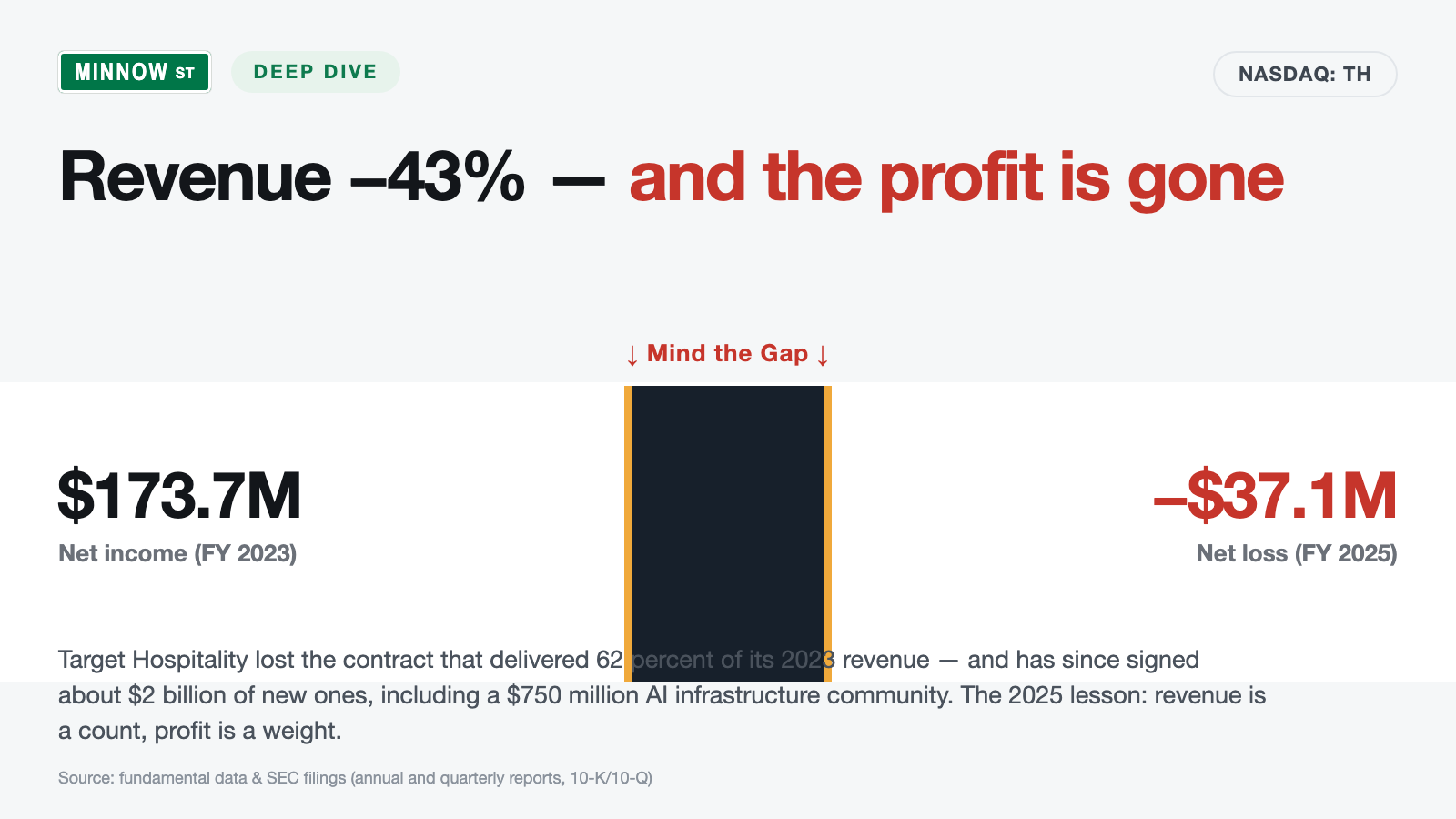
Target Hospitality rents out beds: 16,991 of them, in modular communities for oil crews, lithium miners, data center builders — and for a U.S. government contractor. Since March 2026 it has signed roughly $1.45 billion of new contracts, among them a $750 million community for AI infrastructure; counting the older deals, about $2.0 billion of contracted minimum revenue now sits on the books, and the stock is up 156 percent (data as of July 8, 2026). The catch is in the last big contract: it delivered 62 percent of 2023 revenue, ended in February 2025 — and what replaced it cut adjusted EBITDA by 85 percent and turned a $173.7 million profit into a $37.1 million loss. Not investment advice — just a careful look at what happens when you count the replacement instead of weighing it.
 Thomas Mücke
Founder & Publisher
Thomas Mücke
Founder & Publisher
Chart
Interactive price chart (TradingView).
Note: pure fact-based analysis, not investment advice and not a solicitation to buy or sell. All figures without guarantee.
When something big falls out of your life — a job, a tenant, a customer that paid half the bills — you do one of two things. You either sit with the hole, or you fill it. Filling it feels like competence, and it usually is. But there is a trap built into the relief, and it has no glamorous name, so let us call it the replacement trap: once the gap is filled, you count what came back and quietly stop asking whether it is worth what left. The new tenant pays rent — you no longer check whether it is the same rent. The number of items is restored; the quality of the items never gets audited. Hardly any stock puts that reflex on the table as cleanly as Target Hospitality (Nasdaq: TH). In 2023, one single contract delivered $347.8 million — about 62 percent of everything the company earned. It ended on February 21, 2025. And the company did not merely fill the hole: between March and May 2026 it signed roughly $1.45 billion of new contracted minimum revenue, including a community for AI infrastructure worth more than $750 million. The stock is up 156 percent year to date (data as of July 8, 2026), and our Reddit hype scanner counted a quiet 4 mentions in 24 hours (ApeWisdom, as of July 16, 2026) — this run has no forum drums behind it. So let us make a deal: we ignore the pivot narrative and read only what Target Hospitality reported, under penalty of law, to the U.S. securities regulator, the SEC. Our material is the annual reports (10-K) for 2024 and 2025 and the quarterly report (10-Q) as of March 31, 2026 — the last of which, in a subsequent-events note most readers never reach, contains the number this whole case turns on. We are not going to ask whether the hole got filled. We are going to weigh what filled it.
What Target Hospitality actually does — a hotel chain where nobody wants to be a guest
Target Hospitality, headquartered in The Woodlands, Texas, rents out beds. Not to tourists — to workers who have no choice. When an oil company fracks in the Permian Basin of West Texas, when a mining firm digs lithium out of the Nevada desert, when a hyperscaler drops a data center campus into empty land, thousands of workers arrive somewhere with no hotels, no apartments, sometimes no roads. Target builds the town: modular residential units it can truck in and bolt together, plus commercial kitchens, dining halls, medical and dental rooms, gyms, laundry, housekeeping — and then it runs the whole thing, 24 hours a day, under a service model it calls "Target 12". Think of it as a hotel chain for places where no hotel would ever pencil out, with one crucial difference in the business model: the guest does not book. The employer signs a multi-year contract and pays for the beds whether or not they are slept in. That is the beauty of the thing — a minimum revenue amount, contracted in advance. It is also, as we will see, the whole risk.
The scale, as of December 31, 2025: 16,991 beds across Texas, New Mexico, Nevada, North Dakota, Wyoming and Alberta, Canada, run by about 902 employees. The company reports in three segments. HFS – South — 16 communities in Texas and New Mexico — is the old core: housing for the oil and gas industry, which ties this segment directly to the drilling cycle. WHS (Workforce Hospitality Solutions) is the new one, created in 2025, and it is the entire bull case in three contracts: a workforce hub in Winnemucca, Nevada for Lithium Nevada's Thacker Pass project (one of the world's largest known measured lithium resources), a community serving a data center campus in the Southwestern United States, and a community supporting power generation for mining and data center projects. Government is the segment that made the company rich and then broke its heart: housing tied to U.S. immigration programs, provided not directly to the government but as a subcontractor to what the filings call the "NP Partner" — a national provider of migrant programming — whose own work sits under a U.S. government task order. In 2025 the Government segment was about 22 percent of revenue. In 2023 it was the company.
Which brings us to the central tension of this analysis, and it runs through every chapter that follows: Target Hospitality has replaced its lost revenue several times over — about $2.0 billion of contracted minimum revenue now sits on the books against $320.6 million of 2025 sales — but the one time we can already check what a replacement was worth, it cut adjusted EBITDA by 85 percent and turned a $173.7 million profit into a loss. Remember the mechanism, because everything below is a variation on it: revenue is a count, profit is a weight.
Where the stock shows up in our scanner — 17 hits, and every one of them is about the chart
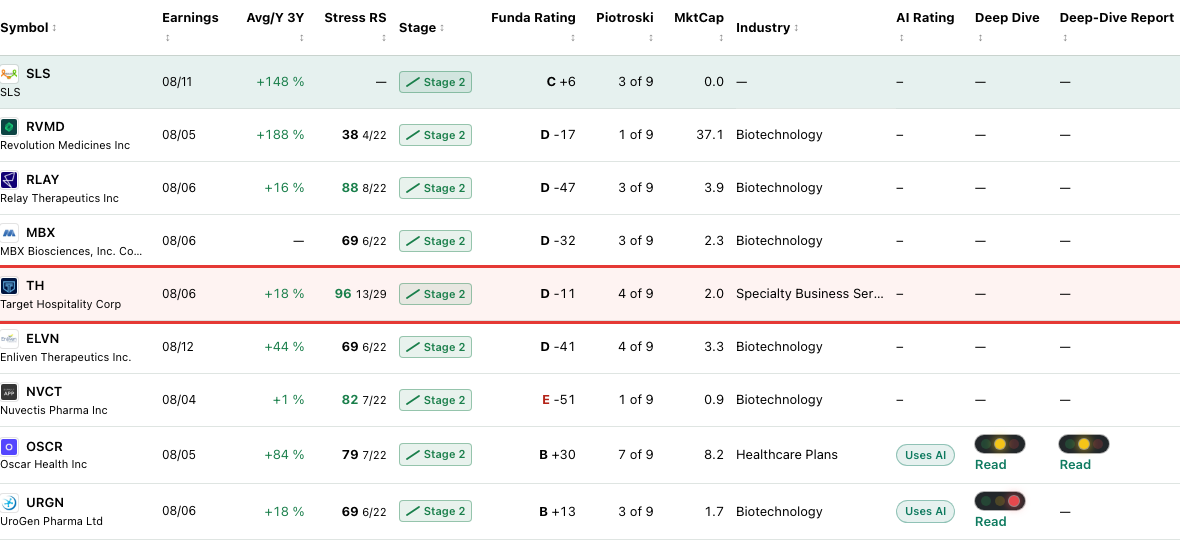
Every day we run about 3,500 stocks through our scanners. Target Hospitality has a row in our database — its company profile sits in the stocks section — and as of the July 8, 2026 data cut-off the stock lit up in 17 filters. Read the list and you learn something before you read a single number: Stan Weinstein: Stage 2, RS-Leader (≥90), Power Trend, Near 52-week high, Tight & Near High, Oliver Kell: Doublers, Institutional Accumulation, Ben Bennett: Power Screen. Momentum, momentum, momentum. Not one fundamental quality list is in there — and that is not an accident.
The metrics behind it read like two reports on two different companies. On the chart side: a relative-strength rating of 96 — the stock outperformed 96 percent of the market, and it is a genuine leader by that measure (97 over three months, 97 over six, 94 over twelve); stage 2 in Stan Weinstein's framework, the advancing phase; plus 156.2 percent year to date; barely 3 percent below the 52-week high; institutional ownership of about 78.8 percent. On the books side, the same row: a fundamental grade of D (rating minus 11 on our scale), an EPS rating of 12 — meaning 88 percent of the market has better earnings momentum — a Piotroski F-Score of 4 of 9 (a nine-point test of balance-sheet health; genuinely sound companies score 8 or 9), quarterly earnings growth of minus 59.1 percent against quarterly sales growth of just plus 4.1 percent. One number breaks the pattern and deserves its explanation: the Altman Z-score of 6.66, comfortably in the safe zone. That is not a sign of thriving — it is the arithmetic of a company that used its cash to erase its debt (more on that below). A stock that sits in eight momentum lists and carries a D on the fundamentals is not a contradiction in our scanners. It is the most honest thing they produce: the price is trading the pivot, the metrics are still counting the old business.
The numbers over the years — honestly appraised
Let us start with what genuinely impresses, because there is more of it than the loss line suggests. Target Hospitality did not lose its biggest customer and fall apart. It lost a contract worth $168 million a year in minimum revenue and, within twelve months, signed a lithium workforce hub (about $111.1 million of minimum committed revenue), a data center community that was expanded by 320 percent within a single quarter (about $134 million of committed minimum revenue over the initial terms), a 25-month power community contract (about $35 million, starting June 2026) and a reactivation of its own mothballed Dilley facility (over $246 million through March 2030). It did that while redeeming $181.4 million of 10.75 percent notes and ending 2025 with no debt beyond $3.8 million of vehicle finance leases and an undrawn $175 million credit line. Operationally, that is a serious performance, and any fair reading has to say so out loud.
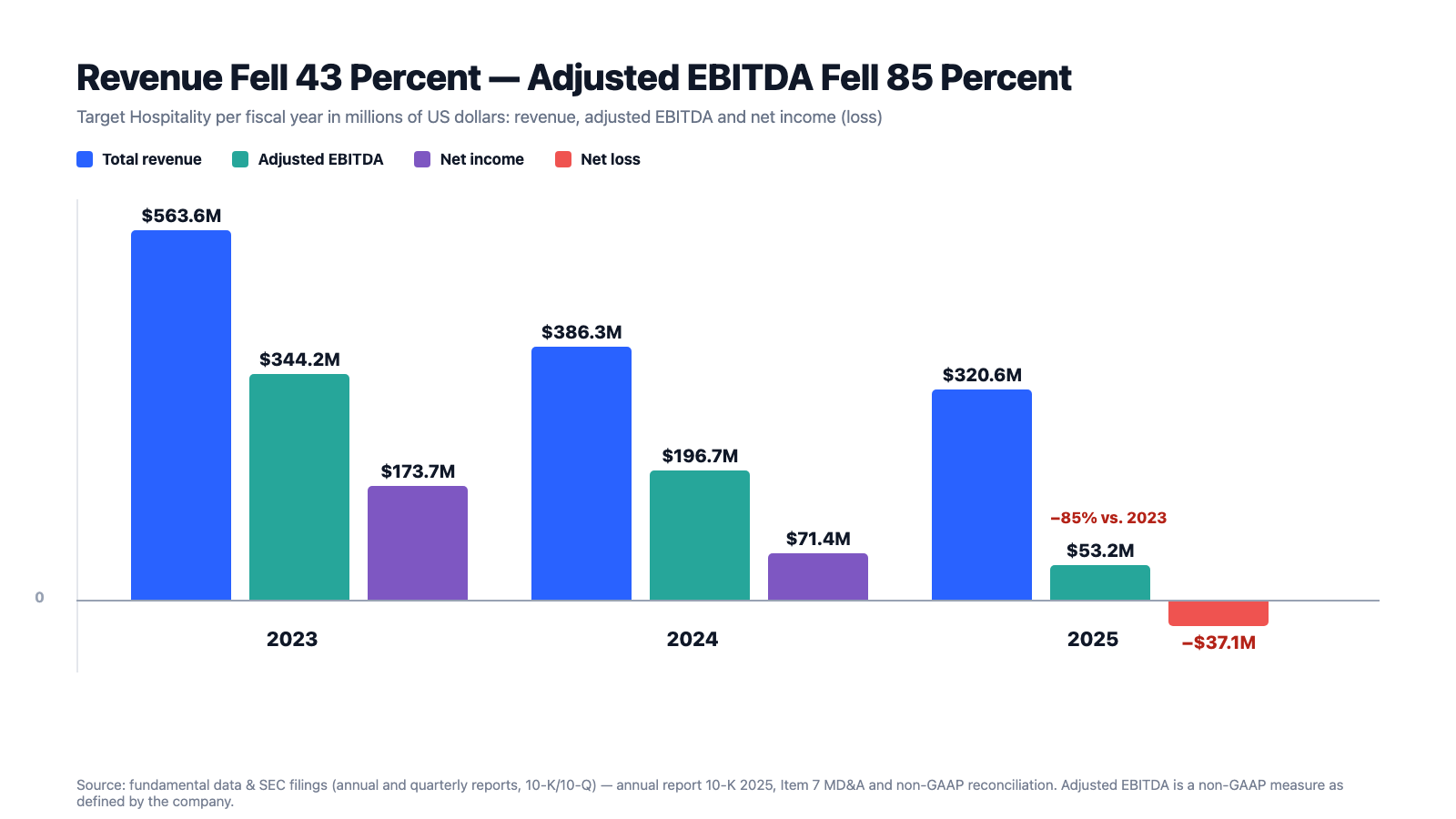
Now weigh it. Total revenue fell from $563.6 million (2023) via $386.3 million (2024) to $320.6 million (2025) — minus 43 percent in two years, minus 17 percent in the last one. Bad, but survivable. Then look one line down. Adjusted EBITDA — the company's own preferred measure of operating earnings before interest, taxes, depreciation and one-offs — fell from $344.2 million via $196.7 million to $53.2 million. That is minus 85 percent. And net income went from plus $173.7 million (2023) via plus $71.4 million (2024) to a loss of $37.1 million (2025). Read those two rows together, because their relationship is the whole story: revenue fell by 43 percent and earnings fell by 85 percent. When a business loses 43 percent of its sales and 85 percent of its profit, it has not merely shrunk — it has swapped what it sells. In 2023, of every $100 of revenue, about $61 arrived as adjusted EBITDA. In 2025, of every $100, about $17 did.
The most recent quarter shows the same shape and no turn yet. In the first quarter of 2026 (through March 31, 2026), revenue actually grew — up 4.1 percent to $72.8 million, exactly the "hole is filled" number. But gross profit fell from $18.0 million to $6.9 million, the operating loss widened from $1.1 million to $14.3 million, and the net loss went from $6.5 million to $13.0 million. More revenue, less profit, in one quarter. That is the replacement trap in miniature, and it is why the company's own "2026 Forward Look" leads with the words "we anticipate margin improvement" rather than "we anticipate growth". Cash stood at $5.5 million on March 31, 2026 — a number that looks terrifying until you learn why, which we come to shortly. How brutally an operator's economics can hinge on a cycle it does not control is something we took apart at W&T Offshore; Target's HFS – South segment lives on exactly that oil and gas drilling cycle.
What the market is actually buying — about $2.0 billion of contracted revenue
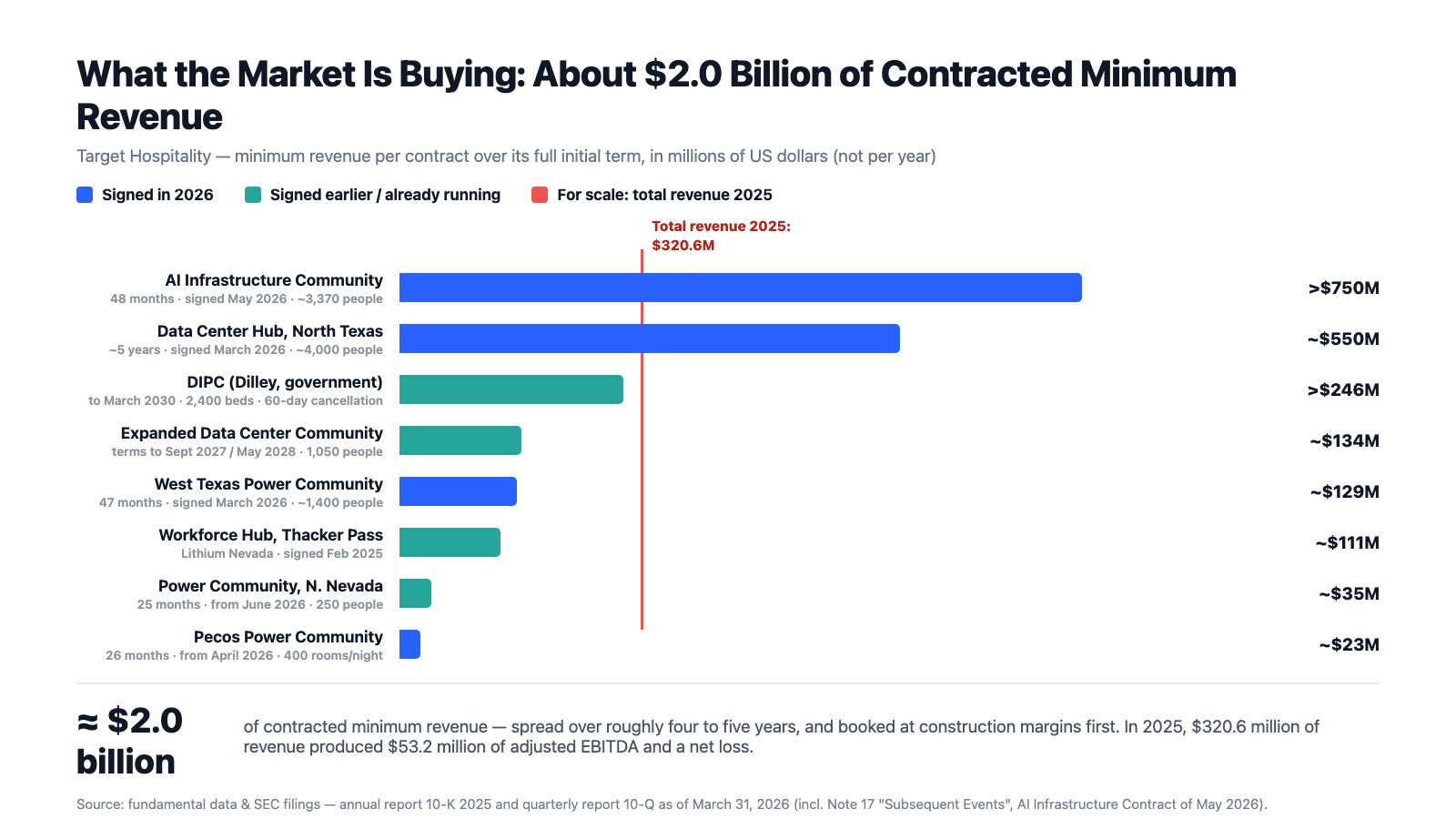
Everything so far reads like a company in trouble, and the stock is up 156 percent. That is not irrationality; it is information the income statement does not carry yet. It sits in the subsequent-events note of the quarterly report — Note 17, the last page most readers never reach — and in the contract disclosures of the first quarter of 2026. Between March and May 2026, Target Hospitality signed the following, all of it in the WHS segment, none of it visible in the 2025 annual figures:
- AI Infrastructure Community (May 2026): a 48-month contract expected to generate more than $750 million of revenue, housing about 3,370 people for AI infrastructure development. That single contract is more than twice the company's entire 2025 revenue.
- Data Center Hub, North Texas (March 2026): about $550 million of estimated minimum revenue over an initial term of roughly five years, plus potential variable revenue of $20 million to $40 million annually; designed for about 4,000 people, first occupancy expected in the third quarter of 2026, full completion in the second quarter of 2027, with two two-year extension options that could run services through January 2035.
- West Texas Power Community (March 2026): about $129 million over a 47-month term, about 1,400 people, supporting a multi-gigawatt power-generation project for a hyperscale AI-driven data center development. It began generating revenue in the first quarter of 2026.
- Pecos Power Community (March 2026): about $23 million over 26 months from April 2026, with a committed minimum of 400 rooms per night, housing workers building a natural gas power plant.
Add the contracts already running — the DIPC government contract (over $246 million to March 2030), the expanded Data Center Community (about $134 million), the Thacker Pass workforce hub for Lithium Nevada (about $111.1 million) and the Northern Nevada Power Community (about $35 million) — and the order book comes to roughly $2.0 billion of contracted minimum revenue. Against 2025 revenue of $320.6 million, that is the entire bull case in one number, and it is not a press release: it is in the filings, with terms, bed counts and dates.

Two things deserve genuine credit here. First, Target learned from the PCC wound: the AI contract "includes termination provisions, including customer termination rights, which in certain circumstances require the payment of termination fees to compensate the Company for its invested capital and contractual economics". That is exactly the protection the PCC contract lacked — the customer can still leave, but this time it pays for the buildings. Second, the demand is not a story about a chatbot: these are physical construction sites for power plants and data center campuses, with named terms and bed counts. So the question is not whether the order book exists. The question is what it earns, and what it costs to switch on — which is where the last two truths live.
What the filings say — the uncomfortable truths
Uncomfortable truth no. 1: one customer was 62 percent of the company — and the exit door had no lock
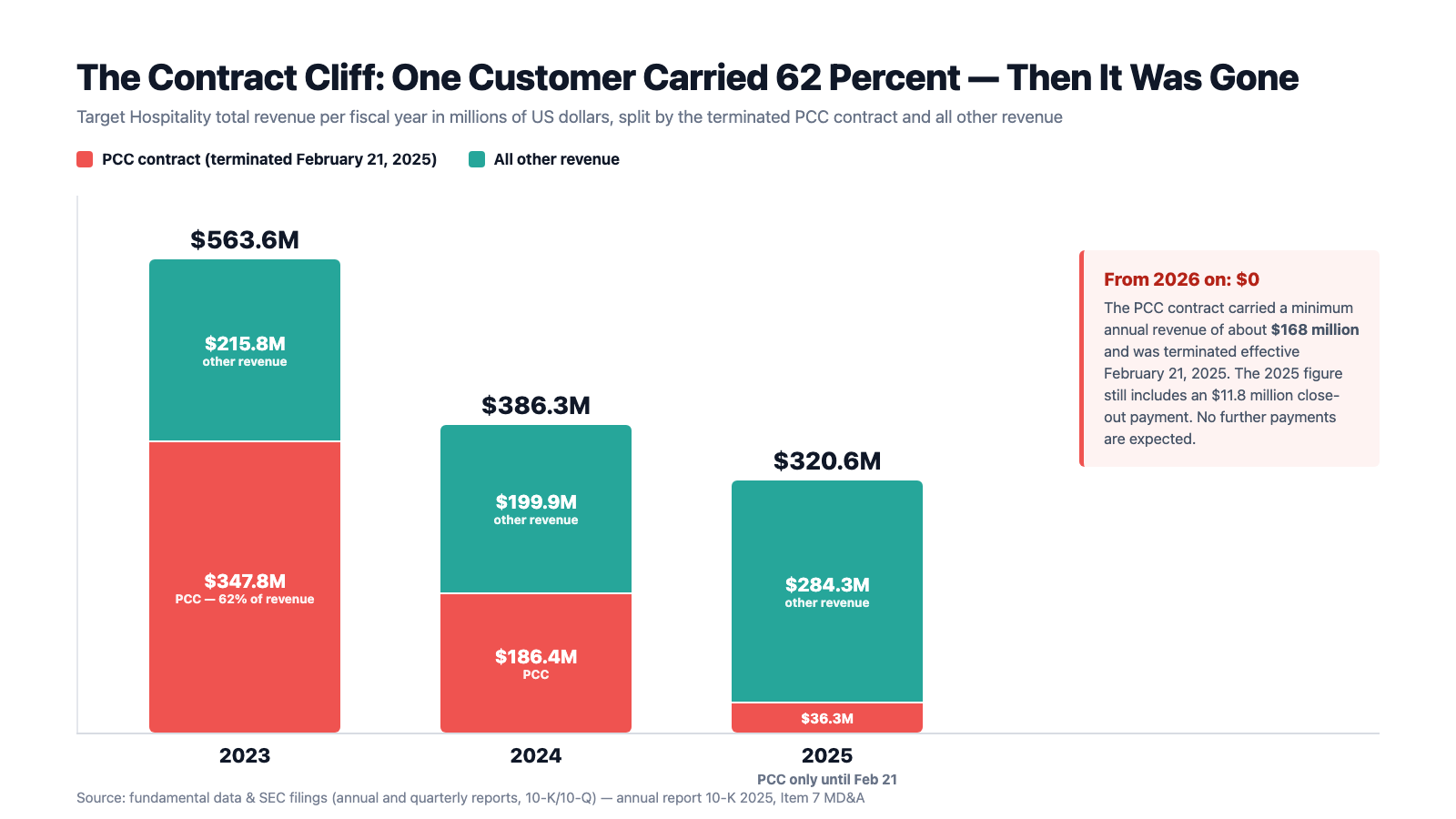
Investors talk about customer concentration as if it were a spectrum. At Target Hospitality in 2023 it was a single point. The annual report puts the historical progression in one flat sentence: "For the year ended December 31, 2024, we had one customer, who accounted for approximately 48% of our revenue. For the year ended December 31, 2023, we had one customer, who accounted for approximately 62% of our revenue." That customer relationship ran through the PCC contract — a lease and services agreement with the "NP Partner", backed by a U.S. government task order, housing up to 6,000 people. Here is what it was worth, and how it ended:
"In November of 2024, one of the four one year option period extensions was exercised with an annual minimum lease revenue of approximately $168 million supporting a community capable of serving up to 6,000 individuals. Effective February 21, 2025, the PCC Contract was terminated, but Target retained ownership of these assets [...]"
— Target Hospitality Corp., SEC annual report 10-K 2025, Item 1 "Business"

Note the timing, because it is the part that should stay with you: an option period was exercised in November 2024 — and the contract was terminated three months later. Read the numbers it left behind: the PCC contract produced $347.8 million (2023), $186.4 million (2024) and $36.3 million (2025) — and the 2025 figure includes an $11.8 million close-out payment, with the report stating plainly that "no further payments are expected from the PCC Contract". In fairness, the 2023 number was flattered: roughly $118.2 million of it was amortization of a non-recurring infrastructure enhancement payment received in advance. And this was not the only exit — a second government agreement, the STFRC contract at Dilley, was terminated effective August 9, 2024. Two of them, inside twelve months.
Uncomfortable truth no. 2: the replacement is worth a fraction — and the report says so itself
This is the heart of the matter, and the remarkable thing is that you do not have to infer it. Target Hospitality states it, in its own words, in the management discussion. Watch for the word "replacement":
"Generated consolidated net loss of approximately ($37.1) million for the year ended December 31, 2025 as compared to a net income of approximately $71.4 million for the year ended December 31, 2024 primarily because the PCC Contract described above historically generated substantially higher margins than our current construction-driven revenue stream, and its termination significantly reduced our profitability. The resulting replacement of high-margin PCC revenue in the Government segment with lower-margin construction services revenue from the WHS segment led this year-over-year decline in net income."
— Target Hospitality Corp., SEC annual report 10-K 2025, Item 7 "Management's Discussion and Analysis"

Translate it into an everyday image. The old business was rent: Target owned the buildings, a customer paid a fixed minimum for them every month, and almost every extra dollar of that rent dropped to the bottom line, because the buildings were already built and paid for. The new business is largely contracting: Target builds a community for someone else, bills the construction, and books the fee — a big, impressive revenue number with a thin slice left over. The revenue split proves it. Of 2025's $320.6 million, $87.3 million was construction fee income — a line item that did not exist at all in 2024 or 2023 — while specialty rental income collapsed 62 percent, from $120.4 million to $45.8 million. The high-margin rent shrank; low-margin building work replaced the top line. And the cost side tells the same story from the other end: services and construction costs rose 58 percent to $209.3 million, in a year when revenue fell. Remember the image: the company swapped a landlord's income for a builder's income — and kept calling both "revenue".
To be fair, this is a transition, not a permanent state, and management says so: construction is the front end of these contracts, and once the communities are built, the multi-year service and lease revenue — the good kind — starts. That is a reasonable argument, and the 2026 guidance leans on it. It is also, precisely, the bet.
Uncomfortable truth no. 3: the new government anchor can be cancelled with 60 days' notice
The single largest contracted revenue stream on the books today is the DIPC contract: on March 5, 2025, Target reactivated its own mothballed Dilley, Texas facility — 524,000 square feet, 2,400 beds, a library, chapels, an infirmary with medical, dental, pharmaceutical and x-ray capability — under a new agreement with the same partner, supported by an intergovernmental services agreement between the city of Dilley and U.S. Immigration and Customs Enforcement (ICE). It is expected to deliver over $246 million through March 2030. That sounds like a five-year floor. Read the next sentence in the filing:
"As is customary for U.S. government contracts and subcontracts, the IGSA and the DIPC Contract are subject to annual U.S. government appropriations and can be canceled for convenience with a 60-day prior notice."
— Target Hospitality Corp., SEC annual report 10-K 2025, Item 1 "Business"

"Canceled for convenience" is a term of art, and it means what it sounds like: the counterparty may end the agreement because it feels like it, without breach, without penalty, on 60 days' notice. "Subject to annual appropriations" means the money has to be voted every year. Neither clause is unusual — the filing is right that this is customary for U.S. government work — but customary is not the same as harmless, and this company has a documented history with exactly these clauses: the STFRC contract ended in August 2024, and the PCC contract ended in February 2025, three months after an option was exercised. The demand behind this revenue is immigration policy, which changes with administrations, appropriations and court rulings, and the company knows how exposed that leaves its brand — the risk factors devote a passage to the danger of being "associated with the ongoing social and political debates around immigration policy". So when you read "$246 million through March 2030", read it the way the contract is actually written: a series of 60-day renewals with a good story attached. The mechanics of living off a government customer who is never contractually obliged to stay is something we walked through in detail at Castellum — same clause family, different industry.
Uncomfortable truth no. 4: the concentration never went away — it just changed its name
Here is where the diversification story deserves both credit and scrutiny. Credit first: going from "one customer is 62 percent" to a broader base in two years is real progress, and the company earned it. Now the scrutiny — the risk factors state the new position precisely:
"For the year ended December 31, 2025, the Company had three customers who accounted for 28%, 11% and 11% of total revenue, respectively, and our five largest customers accounted for approximately 63% of our total revenue. Despite recent diversification discussed below, our business remains highly dependent on a limited number of large customers, including several in new end-markets such as critical minerals and data center infrastructure."
— Target Hospitality Corp., SEC annual report 10-K 2025, Item 1A "Risk Factors"

Sit with the arithmetic for a second. In 2023, the top customer was 62 percent. In 2025, the top five are 63 percent. The load did not get lighter — it got redistributed across five shoulders instead of one. That is a genuine improvement in fragility (one exit no longer removes the company's reason to exist), and it is much less of an improvement than "diversified" suggests. Worse, the new names bring new correlations the old ones did not have. The report flags it in the same breath: expansion into data center workforce solutions "may increase exposure to a concentrated group of hyperscale technology customers", while the WHS segment's other leg, critical minerals, rides lithium prices, and HFS – South rides the oil and gas drilling cycle. The company has swapped one political dependency for a set of commodity and capital-expenditure dependencies. Remember the image from the top: the beds are the same, only the reason people fill them has changed — and every one of those reasons is somebody else's budget decision.
Uncomfortable truth no. 5: the $750 million contract comes with a $210 million bill — and the money is not in the bank
Read the AI Infrastructure paragraph again, but this time the second sentence rather than the first. The contract needs $200 million to $210 million of capital investment, net of customer advance payments, and about 95 percent of that lands in 2026. Now look at what is available to pay it: $5.5 million of cash and $145 million of undrawn revolver as of March 31, 2026 — and the company had already drawn $30 million in the first quarter alone "to fund growth of the WHS business segment", while spending $45.5 million on capital expenditures in three months. The arithmetic does not close on its own, and the filing does not pretend otherwise:
"However, the pursuit of certain growth and diversification initiatives as discussed in Item 1, 'Business' of the Company's 2025 Form 10-K, may require capital resources in excess of these sources, which could necessitate additional debt or equity financing. We cannot assure you that such financing will be available on commercially reasonable terms or at all."
— Target Hospitality Corp., SEC quarterly report 10-Q as of March 31, 2026, Item 2 MD&A "Liquidity and Capital Resources"

The company names the menu itself: "additional unsecured or secured debt, equity securities and/or equity-linked securities". For a shareholder that word matters — equity means dilution, and it would be raised to build the very revenue the share price has already celebrated. There is a real cushion in the customer advance payments (the $200 to $210 million is already stated net of them, and deferred revenue rose from $9.3 million to $18.8 million in the quarter), and the revolver has room. But the company that spent 2025 proudly retiring $181.4 million of notes was, nine months later, drawing on its credit line at Term SOFR plus 4.25 to 4.75 percent — a facility that matures on February 1, 2028 and which the filing concedes it may not be able to renew "on commercially reasonable terms or at all". Remember the sequence, because it is the least glamorous part of a growth story and the one that decides it: the capital goes out first, the margin arrives later — and in between sits a financing question the company has explicitly declined to answer.
Valuation: about $1.7 billion for $53 million of adjusted operating earnings
In mid-July 2026 the stock traded around $17.05, giving roughly $1.70 billion of market value on about 100.2 million shares outstanding (July 16, 2026; share count per the quarterly report cover, May 6, 2026). An honest price-to-earnings ratio does not exist — 2025 ended in a loss. That leaves revenue and operating earnings. On 2025 revenue of $320.6 million, the price-to-sales ratio sits around 5.3. Because debt is small ($33.6 million as of March 31, 2026, including $30 million drawn on the revolver) and cash is smaller ($5.5 million), the enterprise value is close to the market value — which puts the company at roughly 32 times its 2025 adjusted EBITDA of $53.2 million. For a lessor of modular buildings, that is a growth multiple, not a value multiple, and it only makes sense on one assumption: that the $53.2 million is a trough, not a level.
The order book is the argument that it is a trough, and it is a strong one — about $2.0 billion of contracted minimum revenue against a $1.7 billion market value. But do the arithmetic the way the business actually works, not the way the headline reads. That $2.0 billion is not annual: it is spread across initial terms of roughly four to five years, so call it $400 million to $500 million a year of minimum revenue once everything is running — against $320.6 million in 2025. Meaningful growth, not a fivefold company. And the part that decides the stock is not the revenue but the margin the revenue carries: in 2025, $320.6 million of sales produced $53.2 million of adjusted EBITDA and a net loss, because construction work is the low-margin front end. The new contracts start in exactly that front end — with, this time, $200 million to $210 million of Target's own capital going in first. Whether $2.0 billion of contracted revenue is worth $1.7 billion depends entirely on whether it is 2023-quality revenue (61 cents of EBITDA per dollar) or 2025-quality revenue (17 cents). The filings do not yet say, and that is not evasion on our part — it is the actual state of the evidence.
The professionals lean positive but thinly: coverage is just three analysts (one strong buy, two hold) with an average price target around $22.75, and the consensus expects a return to profit, pricing the stock at roughly 20 times forward earnings (data as of July 8, 2026). Set against that: the stock is up 156.2 percent year to date and sits about 3 percent below its 52-week high — the recovery is not a possibility the market is weighing, it is a conclusion it has already reached. And one shareholder with better information than any analyst voted with his feet: TDR Capital sold 8,050,000 shares at $14.00 in April 2026, weeks before the $750 million AI contract was announced. One honest note on our own numbers: our scanner row carries a price of $20.20 and a $2.0 billion market cap from the July 8, 2026 cut-off, while the mid-July quote is lower; where sources disagree, the filings and the dated quote win. You can find more metrics in the Target Hospitality company profile of our scanner.
Opportunities and risks at a glance
What speaks for Target Hospitality:
- A genuinely hard-to-copy asset base: 16,991 beds in 3 segments across Texas, New Mexico, Nevada, North Dakota, Wyoming and Canada, vertically integrated from site selection through construction to catering and housekeeping — by the company's account the only provider with the scale and regional density to serve all of its customers' needs in its key regions (annual report 10-K 2025).
- An order book of about $2.0 billion of contracted minimum revenue against $320.6 million of 2025 revenue — signed, with terms and bed counts in the filings: the AI Infrastructure Community (more than $750 million over 48 months, May 2026), the Data Center Hub in North Texas (about $550 million over roughly five years, extension options to January 2035), the DIPC contract (over $246 million to March 2030), the expanded Data Center Community (about $134 million), the West Texas Power Community (about $129 million), the Thacker Pass workforce hub (about $111.1 million), plus the Northern Nevada and Pecos power communities.
- The lesson of the PCC loss was applied: the AI Infrastructure Contract includes customer termination rights that "in certain circumstances require the payment of termination fees to compensate the Company for its invested capital and contractual economics" — precisely the protection the terminated PCC contract lacked.
- The balance sheet was deliberately cleaned before the build: $181.4 million of 10.75 percent notes redeemed in March 2025 (about $19.5 million of annual interest savings), leaving $33.6 million of debt as of March 31, 2026 ($30 million of it revolver) and $145 million of undrawn capacity — hence the Altman Z-score of 6.66 in the safe zone.
- Capital efficiency where the assets already exist: the modular buildings are interchangeable across segments, so communities freed by the terminated PCC contract were re-contracted or redeployed into the WHS segment during the first quarter of 2026 — the West Texas and Pecos power communities need only single-digit millions of capital, and the Northern Nevada Power Community about $8 million to $10 million for roughly $35 million of revenue.
- The revenue floor is contractual, not occupancy-based: customers commit to minimum revenue amounts for multi-year terms, and the 2025 mix shift is, by management's account, a construction phase that precedes higher-margin service and lease revenue — the "2026 Forward Look" leads with anticipated margin improvement.
What speaks against it:
- The earnings base collapsed far faster than revenue: adjusted EBITDA from $344.2 million (2023) via $196.7 million (2024) to $53.2 million (2025) — minus 85 percent — while revenue fell 43 percent; net income swung from plus $173.7 million to a $37.1 million loss, and the first quarter of 2026 deepened it (revenue plus 4.1 percent, but gross profit down from $18.0 million to $6.9 million and the net loss up to $13.0 million).
- The margin problem is structural, not cosmetic: high-margin specialty rental income fell 62 percent to $45.8 million while $87.3 million of low-margin construction fee income replaced it on the top line, and services and construction costs rose 58 percent to $209.3 million — in a year when revenue fell.
- Contract risk is documented history, not theory: the STFRC contract ended August 9, 2024; the PCC contract — $168 million of minimum annual revenue — ended February 21, 2025, three months after an option period was exercised. The replacement DIPC contract is subject to annual U.S. government appropriations and cancellable for convenience on 60 days' notice.
- Concentration persists under a new name: three customers were 28, 11 and 11 percent of 2025 revenue and the top five about 63 percent; the company itself calls the business "highly dependent on a limited number of large customers" and flags rising exposure to a concentrated group of hyperscale technology customers, alongside lithium prices and the oil and gas drilling cycle.
- The order book has to be paid for before it pays: the AI Infrastructure Community alone needs $200 million to $210 million of capital net of customer advances, about 95 percent in 2026, against $5.5 million of cash and $145 million of remaining revolver (March 31, 2026) — the company states it "cannot assure" that additional debt or equity financing will be available on commercially reasonable terms, and names equity issuance as an option, which would mean dilution. The revolver matures February 1, 2028 with no guaranteed renewal.
- The price already assumes the recovery: roughly $1.7 billion of market value equals about 5.3 times 2025 revenue and about 32 times 2025 adjusted EBITDA, after plus 156.2 percent year to date and within about 3 percent of the 52-week high; our scanner's 17 hits are almost purely momentum lists against a fundamental grade of D, an EPS rating of 12 and a Piotroski score of 4 of 9 (data as of July 8, 2026). And the best-informed holder sold: TDR Capital, the roughly 65 percent owner, placed 8,050,000 shares at $14.00 in April 2026, weeks before the $750 million AI contract was announced.
A human conclusion
Back to the replacement trap from the opening — because with this stock it is not a metaphor, it is the accounting. Finding one: the replacement happened, and it was more than impressive. A company that lost a customer worth 62 percent of its revenue did not shrink into irrelevance; it signed a lithium hub, two data center communities, three power communities and a $750 million community for AI infrastructure, re-let its mothballed beds in Pecos, and paid off every dollar of real debt on the way. About $2.0 billion of contracted minimum revenue now stands against $320.6 million of 2025 sales. Do not let anyone tell you that was luck. Finding two: the one replacement we can already grade came in at a fraction. Not approximately, not arguably — the company says so itself, in its own annual report, in the word "replacement": 43 percent less revenue, 85 percent less adjusted EBITDA, a $173.7 million profit turned into a $37.1 million loss, and a first quarter of 2026 in which revenue grew 4.1 percent while gross profit fell by more than half. Finding three: the ropes are still short. The government anchor runs on annual appropriations and 60 days' notice; the top five customers are still 63 percent of revenue; and the $750 million contract needs $200 million to $210 million of Target's own capital before it earns a cent — money the company has $5.5 million of, and which the filing says it "cannot assure" it can raise on reasonable terms.
So the question this stock puts to you is unusually clean, and it is not "is the order book real?" — it is, down to the bed counts and the termination fees, and the company visibly learned from the wound that made this analysis necessary. The question is the one the replacement trap is built to stop you asking: what is that $2.0 billion actually worth? Spread over four to five years it is roughly $400 million to $500 million a year of minimum revenue — real growth on $320.6 million, not a fivefold company. And every dollar of it will land somewhere between 2023-quality revenue, where 61 cents of each dollar became EBITDA, and 2025-quality revenue, where 17 cents did. The market has already decided which. At about 32 times trough earnings, within 3 percent of the high, after a 156 percent run, the price says the good margin is coming — while the accounts still show a loss, a drawn revolver and an owner who sold 8,050,000 shares at $14.00 just before the biggest contract in company history was announced. If you can carry that gap knowingly — betting on margins that have not printed yet, funded by capital not yet raised — there is a genuine asset base and a genuine order book underneath the bet. If you cannot, the honest move is to wait for the one quarter that settles it, the one where revenue and gross profit finally rise together, and pay more for having seen the proof. Either way, do the thing the replacement trap talks you out of: do not count what came back. Weigh it. What you make of it is your decision. And that is exactly as it should be.
Sources
All original documents used in this analysis — to read for yourself:
- Target Hospitality Corp. — SEC annual report 10-K for 2025 (filed March 11, 2026)
- Target Hospitality Corp. — SEC annual report 10-K for 2024 (filed March 26, 2025)
- Target Hospitality Corp. — SEC quarterly report 10-Q as of March 31, 2026 (filed May 11, 2026)
- Target Hospitality Corp. — SEC quarterly report 10-Q as of September 30, 2025 (filed November 6, 2025)
- Target Hospitality Corp.'s complete SEC filing history: EDGAR overview (sec.gov)
- Fundamental data (metrics, quarterly series, valuation; data as of July 8, 2026 for scanner metrics, price and market value as of July 16, 2026), reconciled with the SEC filings.
- Screener and rating data: in-house stock scanner (data as of July 8, 2026); Reddit mentions: ApeWisdom (as of July 16, 2026).
Transparency & disclaimer: This analysis is a journalistic contextualization of publicly available information and is not investment advice, not a financial analysis in the regulatory sense, and not a solicitation to buy or sell securities. Stock investments carry substantial risks up to total loss. All information without guarantee; the data cut-off is noted in the text in each case. The author holds no position in Target Hospitality stock at the time of publication.
Our Bottom Line at a Glance
- Business model & asset base positive
- A vertically integrated network of 16,991 beds in places where no hotel would ever pencil out — modular, relocatable and interchangeable across segments, with customers on multi-year contracts carrying minimum revenue amounts. By the company's account the only provider with the scale and regional density to serve all of its customers' needs in its key regions (annual report 10-K 2025).
- Earnings quality after the contract loss negative
- Revenue fell 43 percent from 2023 to $320.6 million (2025) — but adjusted EBITDA fell 85 percent to $53.2 million and net income swung from plus $173.7 million to a $37.1 million loss. The annual report names the cause itself: high-margin PCC lease revenue was replaced by low-margin construction services revenue. Q1 2026 repeated the pattern: revenue plus 4.1 percent, gross profit down from $18.0 million to $6.9 million.
- Order book & pivot positive
- About $2.0 billion of contracted minimum revenue against $320.6 million of 2025 revenue — including the AI Infrastructure Community (more than $750 million over 48 months, signed May 2026) and the Data Center Hub in North Texas (about $550 million, options to January 2035). Signed with terms and bed counts in the filings, and this time protected: the AI contract carries termination fees compensating invested capital — the protection the PCC contract lacked. Caveat: spread over four to five years, that is roughly $400–500 million a year, not a fivefold company.
- Contract & customer risk negative
- Two government agreements ended inside twelve months (STFRC 08/09/2024; PCC 02/21/2025, three months after an option was exercised). The DIPC contract — over $246 million to March 2030 — is subject to annual U.S. government appropriations and cancellable for convenience on 60 days' notice. Concentration persists: three customers at 28/11/11 percent, top five about 63 percent of 2025 revenue, with new exposure to a concentrated group of hyperscale technology customers.
- Balance sheet & funding of the build neutral
- Deliberately cleaned up first: $181.4 million of 10.75 percent notes redeemed in March 2025 (about $19.5 million of annual interest saved), Altman Z-score of 6.66 in the safe zone. But the build is re-levering it: $30 million drawn on the revolver in Q1 2026, $45.5 million of capex in three months, and $200–210 million more required for the AI community (about 95 percent in 2026) against $5.5 million of cash and $145 million of undrawn capacity — with the filing stating it "cannot assure" financing on commercially reasonable terms and naming equity issuance as an option.
- Valuation & signals negative
- About $1.70 billion of market value equals roughly 5.3 times 2025 revenue and about 32 times 2025 adjusted EBITDA (July 16, 2026) — a growth multiple on trough earnings, after plus 156.2 percent year to date and within about 3 percent of the 52-week high. Our scanner's 17 hits are almost exclusively momentum lists (RS 96, stage 2) against a fundamental grade of D, an EPS rating of 12 and a Piotroski score of 4 of 9 (data as of July 8, 2026). And the best-informed holder sold: TDR Capital placed 8,050,000 shares at $14.00 in April 2026, weeks before the $750 million AI contract was announced.
Target Hospitality lost the customer that was 62 percent of its 2023 revenue — and has since signed about $2.0 billion of contracted minimum revenue, including a $750 million community for AI infrastructure and a $550 million data center hub. The order book is real and, unlike the lost contract, protected by termination fees. The catch is what the last replacement was worth: revenue minus 43 percent but adjusted EBITDA minus 85 percent, a $173.7 million profit turned into a $37.1 million loss, because high-margin lease income gave way to low-margin construction work — and the new contracts start in that same front end, with $200–210 million of capital going out first against $5.5 million of cash. At about 32 times trough earnings the market has already booked the good margin. Not investment advice.
What Our Rating Means
- If you don't own the stock
- In our view, the documented risks clearly outweigh — we see no basis for an entry.
- If you hold it in your portfolio
- In our view, the findings carry enough weight to warrant a critical look at your own position.
A journalistic assessment by our editorial team at the time of the deep dive, based on public sources — not investment advice and not a solicitation to buy or sell. Your personal circumstances (investment goals, risk capacity, taxes) cannot be taken into account. What our categories mean, how verdicts are formed, and what conflicts of interest exist →
Worth Noting
- TH reached our research list via the Reddit hype scanner (ApeWisdom, 4 mentions in 24 hours, as of July 16, 2026) — notable mainly for the silence: a 156 percent rally running without forum hype. The 17 hits in our in-house stock scanner carry the July 8, 2026 data cut-off and rotate daily.
- Data discrepancy, disclosed for transparency: our scanner row carries a price of $20.20 and a market capitalization of $2.0 billion (cut-off July 8, 2026), while the quote on July 16, 2026 stands at $17.05 (about $1.70 billion on 99,585,466 shares). Valuation statements in the text use the July 16, 2026 figures; scanner metrics are dated to July 8, 2026. Where sources disagree, the SEC filings take precedence.
- Adjusted EBITDA is a non-GAAP measure defined by the company and reconciled in the annual report 10-K 2025; it is used here because management steers by it and it makes the margin shift visible. The Altman Z-score of 6.66 reflects the near-absence of debt after the March 2025 note redemption and should not be read as a profitability signal.
- The decisive contracts are not in the 2025 annual report: the AI Infrastructure Contract (more than $750 million, May 2026) appears only in Note 17 "Subsequent Events" of the quarterly report as of March 31, 2026 and is explicitly not reflected in those financial statements; the Data Center Hub, West Texas Power and Pecos Power contracts were signed in March 2026. Order-book figures are contracted minimum revenue over full initial terms of roughly four to five years — not annual revenue, and not booked earnings.
- Price and valuation figures are dated (about $17.05, market value roughly $1.70 billion, July 16, 2026); analyses are evergreen, daily prices are not a buy argument.
Frequently Asked Questions
Target Hospitality (Nasdaq: TH) builds, owns and operates modular residential communities — 16,991 beds — where workers have nowhere to live: oil and gas fields in Texas and New Mexico, the Thacker Pass lithium project in Nevada, data center construction sites, and a U.S. government contractor. Customers sign multi-year contracts with minimum revenue amounts. Of $320.6 million in 2025 revenue, $187.5 million was services income, $87.3 million construction fee income and $45.8 million specialty rental income.
Because its most profitable contract ended. The PCC contract — worth about $168 million in minimum annual revenue — was terminated effective February 21, 2025. The annual report states the mechanism directly: high-margin lease revenue was replaced by lower-margin construction services revenue. Revenue fell 43 percent from 2023 to $320.6 million, but adjusted EBITDA fell 85 percent to $53.2 million, and net income swung from plus $173.7 million (2023) to a loss of $37.1 million (2025).
Two ended. The STFRC contract at Dilley, Texas was terminated effective August 9, 2024; the PCC contract was terminated effective February 21, 2025, three months after an option period had been exercised. The Dilley facility was reactivated on March 5, 2025 as the DIPC contract, expected to deliver over $246 million through March 2030 — but it is subject to annual U.S. government appropriations and can be canceled for convenience on 60 days' notice.
Still highly. In 2025 three customers accounted for 28, 11 and 11 percent of total revenue, and the five largest for about 63 percent. That is an improvement over 2023, when a single customer was about 62 percent of revenue (2024: 48 percent) — but the annual report still calls the business "highly dependent on a limited number of large customers" and flags growing exposure to a concentrated group of hyperscale technology customers.
In May 2026 the company executed a 48-month contract expected to generate more than $750 million of revenue, housing about 3,370 people for AI infrastructure development — more than twice its entire 2025 revenue. It needs $200 million to $210 million of capital net of customer advances, about 95 percent in 2026, but unlike the terminated PCC contract it carries termination fees. With the Data Center Hub (about $550 million) and the older deals, the order book totals about $2.0 billion of contracted minimum revenue, spread over roughly four to five years.
Little, but it is rising again. On March 25, 2025 the company redeemed $181.4 million of 10.75 percent senior secured notes, saving about $19.5 million of annual interest and leaving only $3.8 million of vehicle finance leases. By March 31, 2026 total debt was back to $33.6 million, including $30 million drawn on the revolving credit facility to fund the WHS build-out. Cash stood at $5.5 million, with $145 million of revolver still undrawn.
Arrow Holdings and MFA Global S.à r.l., entities controlled by the London private equity firm TDR Capital, together beneficially owned about 65 percent of the common stock as of December 31, 2025. In a secondary offering closing April 23, 2026 they sold 8,050,000 shares at $14.00 — the company received no proceeds — trimming the stake to roughly 57 percent. The annual report notes that TDR "may have interests that are different from those of other stockholders".
Measured against current earnings, yes. At about $17.05 per share, the market value of roughly $1.70 billion equals about 5.3 times 2025 revenue and about 32 times 2025 adjusted EBITDA of $53.2 million (July 16, 2026). There is no price-to-earnings ratio for lack of a profit; on analyst estimates for the coming year it would sit around 20. Measured against the roughly $2.0 billion order book it looks cheap — but that revenue spreads over four to five years and its margin is unproven.
Found an error?
Did you spot a factual error, an outdated number, or a typo in this deep dive? Let us know briefly — your report goes straight to the editorial team.