Lovesac Stock: $697 Million in Sales, $4 Million in Profit — the Receipt of a Sofa Empire in a Tariff Storm
Lovesac sells a couch built like Lego — its modular "Sactionals" platform carries 91 percent of revenue. The stock is making the rounds on Reddit again (8 mentions in 24 hours per ApeWisdom, as of July 17, 2026), and our in-house stock scanner lists it in three value rankings at once. We read the annual reports (10-K), the quarterly report (10-Q) as of May 3, 2026, and the 2023 restatement filings: revenue that has hovered around $700 million for three years, profit that melted from $47.5 million to $4.1 million, tariffs that cost 380 basis points of margin in the latest quarter — and a tariff refund that is suddenly wiring money back. Not investment advice — just a receipt worth reading down to the last line before you call it a bargain.
 Thomas Mücke
Founder & Publisher
Thomas Mücke
Founder & Publisher
Chart
Interactive price chart (TradingView).
Note: pure fact-based analysis, not investment advice and not a solicitation to buy or sell. All figures without guarantee.
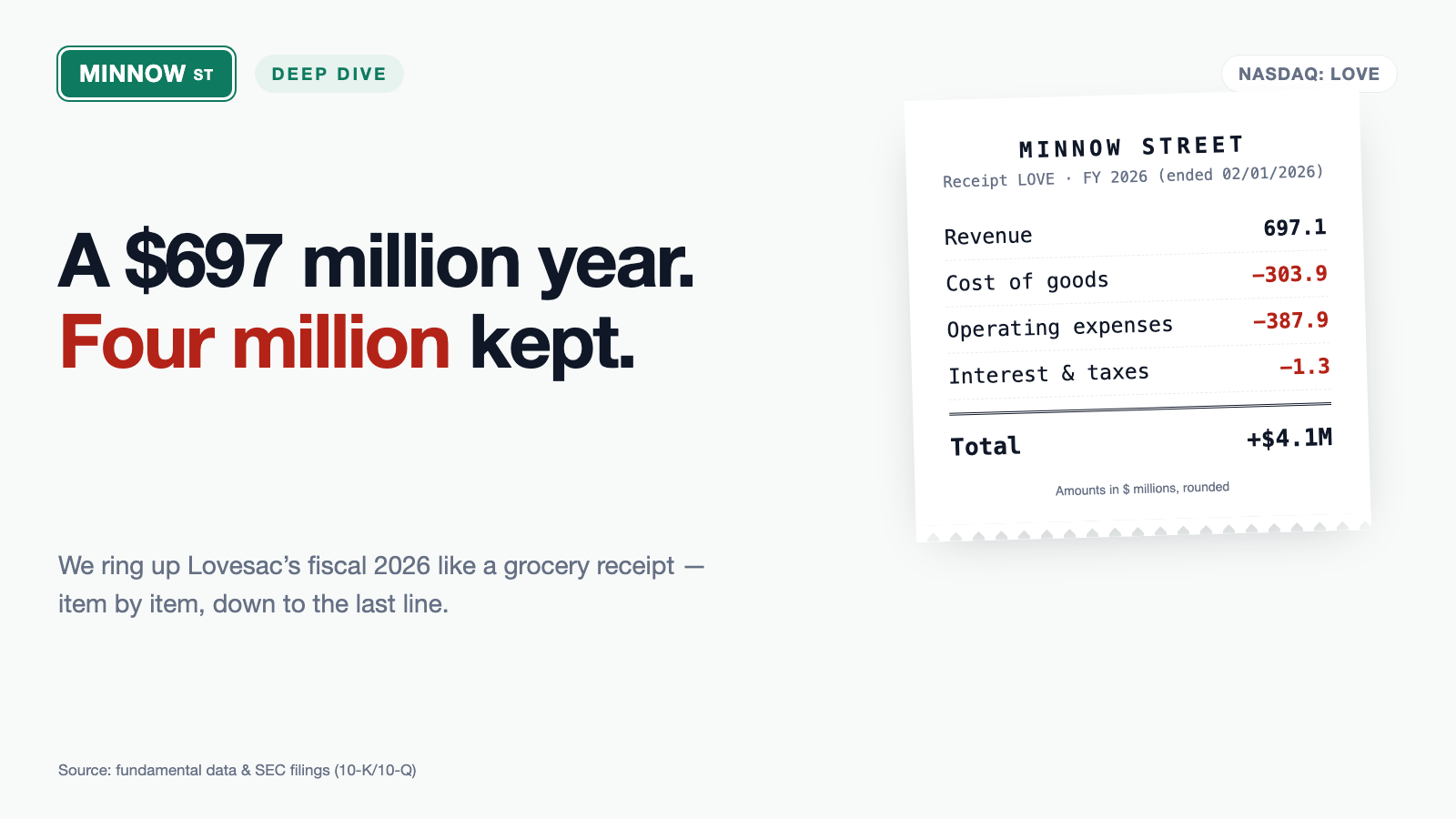
There is an investor trap that catches thrifty people in particular: the anchoring effect. It works like this: a stock once traded very high — and from that day on, your brain compares every new price not with the value of the business but with that old peak. "More than 80 percent below the high? That must be a bargain." The Lovesac Company (Nasdaq: LOVE) is a textbook case in the summer of 2026: the furniture maker's stock trades more than 80 percent below its pandemic-era all-time high (data as of mid-July 2026), it is making the rounds on Reddit again — 8 mentions in 24 hours (ApeWisdom, as of July 17, 2026), not a storm, but a murmur — and our in-house stock scanner lists it in three value rankings at once. So let's make a deal: before your inner bargain hunter reaches for the shelf, we read the receipt together — what the company itself reported, under penalty of law, to the U.S. securities regulator, the SEC: the annual report (10-K) for fiscal year 2026, the quarterly report (10-Q) as of May 3, 2026, and the restatement filings from 2023. One line on that receipt sums it all up: $697 million in revenue — $4 million in profit. In the end, you decide for yourself whether that is a bargain.
What Lovesac actually does — and why its fiscal year confuses everyone
Lovesac started in 1998 with an oversized beanbag that founder Shawn Nelson sewed together in Utah — the "Sacs" still exist, made by a single manufacturer in North Carolina. The real business, though, has long been the "Sactionals": a couch built on the Lego principle. Instead of a finished piece of furniture, you buy standardized seats and sides that can be combined, extended, washed and rearranged at will — if the family moves or grows, the couch grows with it. This one product system delivered 91.1 percent of revenue in fiscal 2026 (prior year: 91.4 percent) — at its core, Lovesac is a one-platform company with an accessories program attached, such as the "StealthTech" sound system with Harman Kardon speakers embedded in the couch. Everything is sold directly, with no furniture retailers in between: through 278 company-owned showrooms across the United States (as of February 1, 2026; 67 percent of revenue), the company's own webshop (28 percent), and pop-up spaces — including 689 ten-day sales shows at Costco in fiscal 2026 alone. The shop-in-shops at Best Buy, by contrast, were closed. International business: essentially zero. The company employs 917 full-time and 965 part-time associates (February 1, 2026) and is headquartered in Stamford, Connecticut.
Before we get into the numbers, one stumbling block that bends every comparison table involving Lovesac: the fiscal year ends on the first Sunday of February. "Fiscal 2026" ran from February 3, 2025, through February 1, 2026 — so it essentially covers calendar year 2025. And fiscal 2024, the leap year of the retail calendar, had 53 weeks instead of 52, which optically inflates its revenue by one selling week. Whenever you see "Lovesac 2026" somewhere, mentally subtract a year. Which brings us to the central tension of this analysis, and it runs through every chapter: measured by sales, Lovesac is one of the cheapest consumer stocks in our scanner — but almost nothing of those sales survives, because tariffs are eating the margin and growth has been stuck on a plateau for three years. What a strong consumer brand with an Asian supply chain looks like under tariff pressure is something we dissected at Deckers (UGG, Hoka) — and why store expansion alone guarantees no profits, at the discount grocer Grocery Outlet.
Where the stock shows up in our scanner
Every day we run about 3,500 stocks through our scanners. As of the mid-July 2026 data cut-off, Lovesac appears in four scanners — and the combination is unusual: three hits come from the value rankings — the P/S ranking (price-to-sales around 0.33 — the market pays about 33 cents for a dollar of annual revenue), the P/CF ranking (price to operating cash flow around 4) and the P/FCF ranking (price to free cash flow around 7). The fourth hit is a bearish Pradeep Bonde breakout signal — the stock has recently shown sharp down-moves on heavy volume. Translated: the scanner says "cheap" and "bruised" in the same breath. The fundamental lens of the very same scanner assigns a grade of C, a Piotroski F-score of 3 of 9 (a nine-point test of the direction of the books — 3 means more metrics are deteriorating than improving, with the seasonally weak latest quarter feeding into it) and a trailing price-to-earnings ratio around 68. The Altman Z-score (an early-warning gauge of insolvency risk built from several balance-sheet ratios) stands at roughly 4.8, clearly outside the danger zone that historically starts below 1.8. To replicate it yourself: open the Lovesac stock page and check the hits section. Remember the principle: a low price-to-sales ratio is not a gift, it is a question — namely, why the market trusts this revenue so little. The answer is in the next chapters.
The numbers over the years — honestly appraised
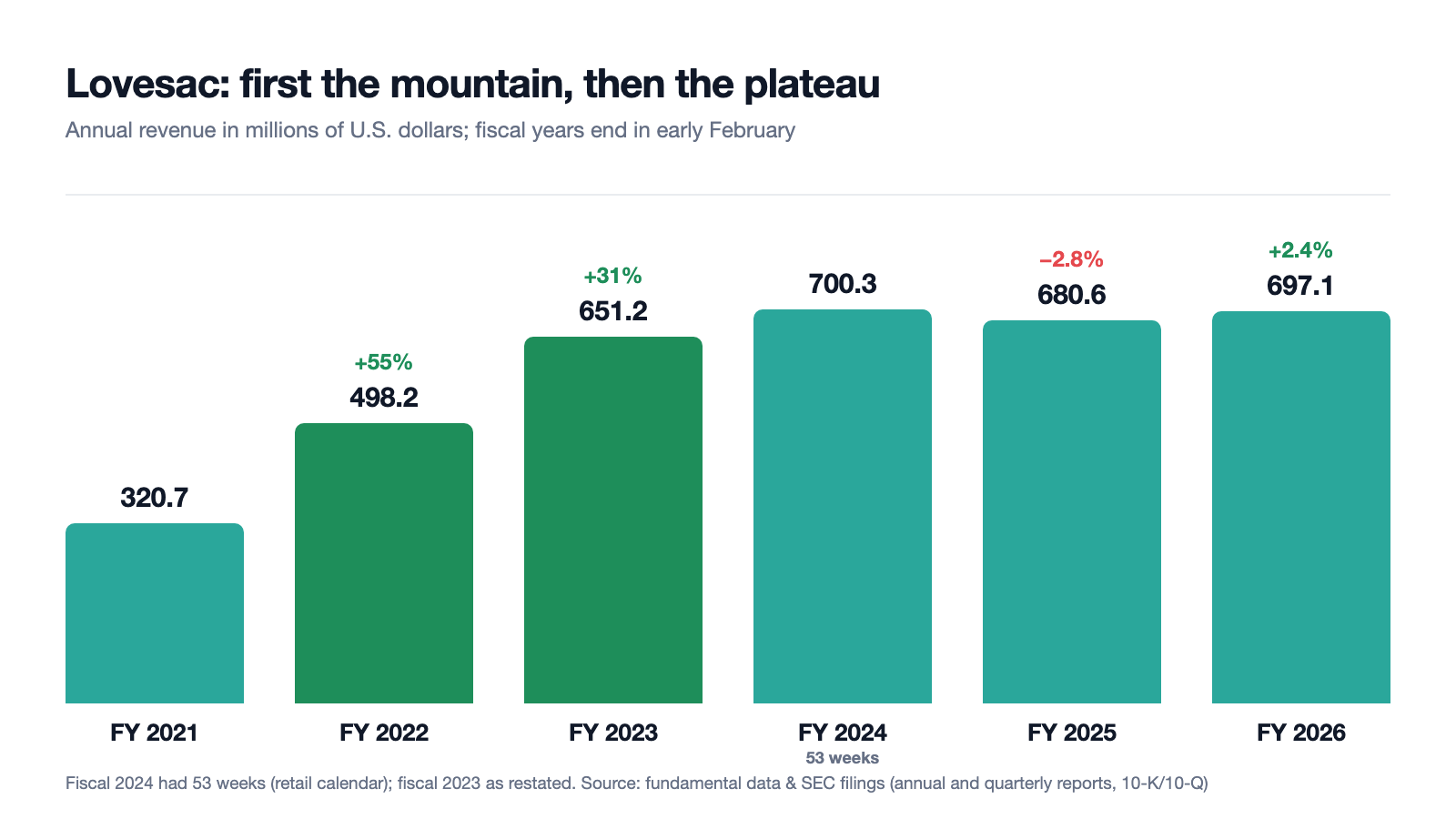
First, what genuinely impresses. When half of America renovated its living room during the pandemic, Lovesac delivered three boom years in a row: revenue jumped from $320.7 million (fiscal 2021) to $498.2 million (+55 percent, fiscal 2022), then $651.2 million (+31 percent, fiscal 2023) and on to $700.3 million in fiscal 2024 — the latter on 53 weeks. In fiscal 2022 the company earned $47.5 million in net income, a net margin of almost 10 percent. And today's picture is not all gray either: operating cash flow reached $49.3 million in fiscal 2026 (prior year: $39.0 million), cash grew to $101.9 million by February 1, 2026 — without a dollar of bank debt, the Wells Fargo credit line untouched. The webshop grew 7.1 percent in the latest quarter, and the number of repeat customers rose 8.8 percent in fiscal 2026 — the brand holds. If you read only these paragraphs, you see a fundamentally healthy consumer company at a clearance price. Now look at the whole curve:
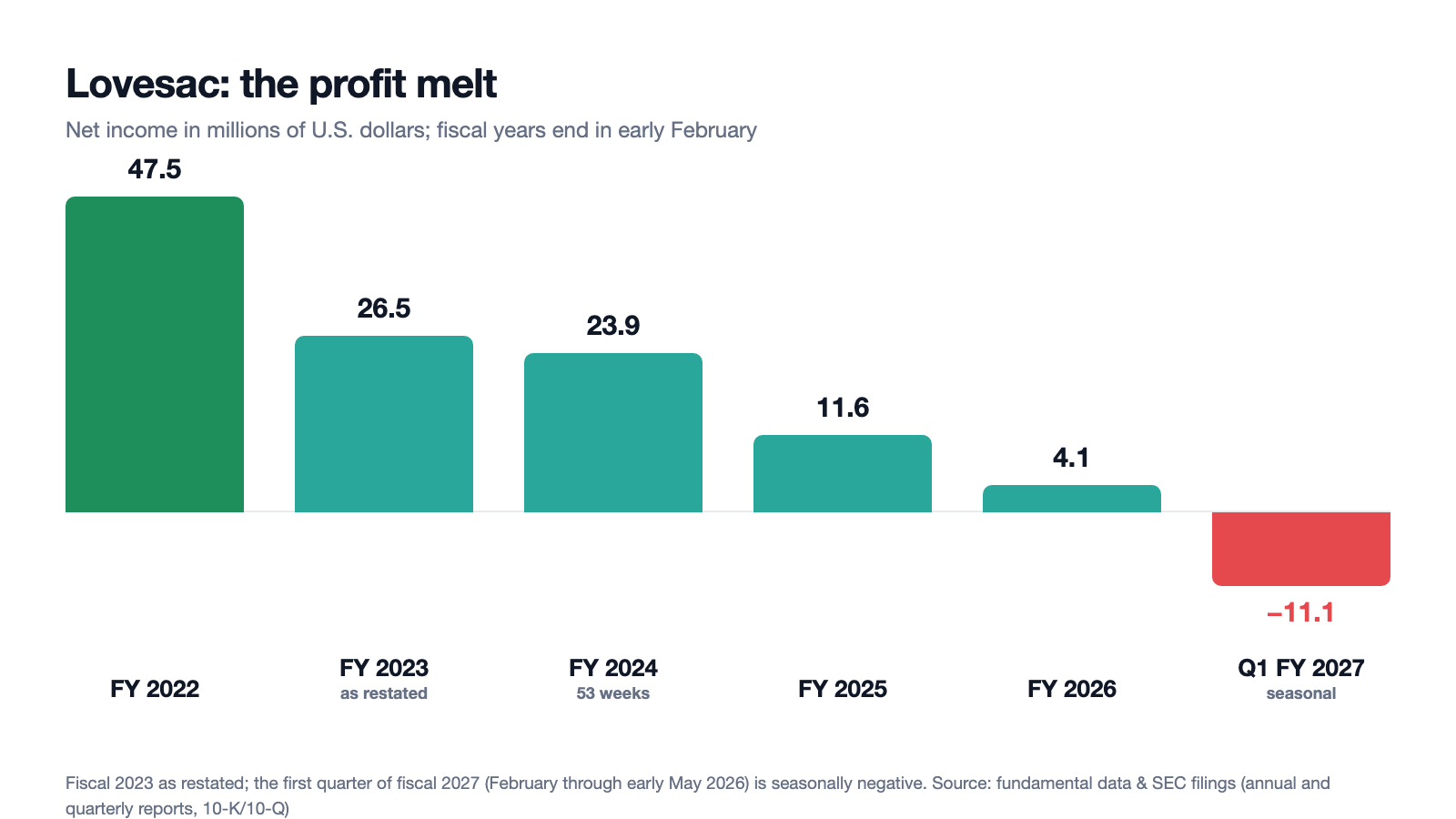
The plateau would be half as bad if more stuck to the bottom of the pan. It does not: net income melted from $47.5 million (fiscal 2022) through $26.5 million (fiscal 2023, as restated) and $23.9 million (fiscal 2024) to $11.6 million (fiscal 2025) and finally $4.1 million in fiscal 2026 — earnings per share of $0.28 and a net margin of 0.6 percent. The first quarter of fiscal 2027 (February through early May 2026) brought the usual seasonal loss: minus $11.1 million on stagnant revenue of $138.2 million (minus 0.1 percent) — Lovesac traditionally earns its money in the fourth quarter around Black Friday and the holidays. Remember the image: the store rings up as much as it did in the boom — but on the way from revenue to profit there now stands a customs booth. Which brings us to the uncomfortable truths.
What the filings say — the uncomfortable truths
Uncomfortable truth no. 1: Tariffs are eating the margin — 380 basis points in the latest quarter alone
Lovesac's couches are sewn and assembled almost entirely in Asia. The annual report (10-K) for fiscal 2026 names the manufacturing countries and the concentration risk without hedging: "Sactionals are currently manufactured by suppliers in Vietnam, Malaysia, China, Indonesia, Taiwan, and India." What that cost in the tariff year of 2025/26 is spelled out in the quarterly report — as a margin calculation:
"Gross margin decreased 160 basis points to 52.1% of net sales in the thirteen weeks ended May 3, 2026 from 53.7% of net sales in the prior year period primarily driven by increases of 380 basis points in inbound transportation and tariff costs and 110 basis points in outbound transportation and warehousing costs, partially offset by an increase of 330 basis points in product margin driven by price increases and cost reduction initiatives, partially offset by higher promotional discounting."
— The Lovesac Company, SEC quarterly report 10-Q as of May 3, 2026, Item 2 "Management's Discussion and Analysis"
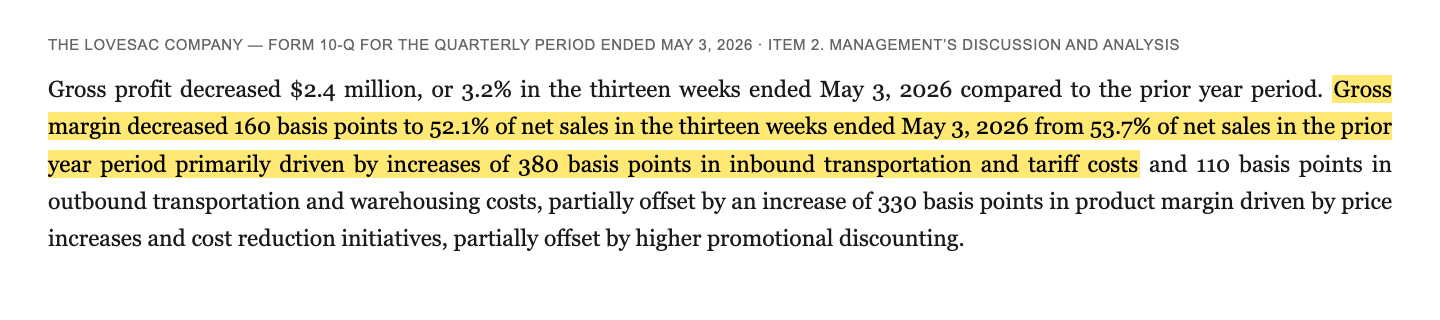
The same pattern runs through the full year: in fiscal 2026, gross margin fell 210 basis points to 56.4 percent — 180 basis points of it inbound freight and tariffs. Shipping and handling costs in the latest quarter rose from $27.2 million to $34.0 million, a quarter more on flat revenue. Fairness requires the counter-movement: Lovesac has raised prices, negotiated vendor concessions and is building U.S. manufacturing for part of its Sactionals output, which is expected to be "cost-neutral" after the ramp-up — and in February 2026 the Supreme Court even struck down the IEEPA tariffs retroactively (more on that below). But the plain arithmetic of fiscal 2026 reads: the tariff-and-freight block turned a solid consumer business into a zero-sum game. A margin that depends on trade policy is not a margin — it is a state of negotiations.
Uncomfortable truth no. 2: Growth is a plateau — and fewer new customers are coming
Revenue of $697 million sounds like strength — until you lay it next to the prior years: $700.3 million (fiscal 2024, with a 53rd selling week), $680.6 million (fiscal 2025), $697.1 million (fiscal 2026). Three years, zero growth. And the composition of the mini-increase in fiscal 2026 should give you pause — the annual report lays it out:
"In fiscal 2026, the number of repeat customers increased by 8.8%, partially offset by a 5.6% decline in new customers."
— The Lovesac Company, SEC annual report 10-K for fiscal year 2026, Item 7 "Management's Discussion and Analysis"
That is the friendliest possible wording for an uncomfortable pattern: existing customers dutifully buy expansions for their Lego couch — exactly what the system was built for — but the inflow of fresh households is drying up. In the first quarter of fiscal 2027, both numbers then fell: new customers minus 2.5 percent, repeat customers minus 1.2 percent, omni-channel comparable sales minus 1.0 percent. The exit from the Best Buy shop-in-shops pushed the "Other" channel down 36 percent, and the furniture market as a whole hangs on the sluggish U.S. housing market: people who do not move rarely buy a new couch — the annual report itself counts consumer sentiment, interest rates and the housing market among the biggest demand risks. Honesty requires the other side here too: 278 showrooms are nowhere near saturation (the company keeps opening), the webshop is growing, and a customer base that is 91 percent attached to an expandable platform is recurring revenue in raw form. But a growth story that delivers $700 million three years running is no longer a growth story — it is market share that has to be defended. And defending costs money: advertising and marketing consumed roughly $88.7 million in fiscal 2026 — more than twenty times the year's net income.
Uncomfortable truth no. 3: The 2023 restatement — and the SEC's $1.5 million invoice
Anyone valuing Lovesac needs to know a chapter that explains the older price charts: in the summer of 2023, an independent investigation by the audit committee found that shipping costs had been booked incorrectly — the financial statements had to be redone. The amendment to the annual report records the core soberly:
"The Audit Committee of the Board of Directors of Lovesac completed an independent investigation in August 2023 whereby the Company concluded $2.2 million of last mile shipping expenses relating to the fiscal year ended January 29, 2023 were improperly capitalized during the quarter ended April 30, 2023."
— The Lovesac Company, SEC annual report 10-K/A (Amendment No. 2) for fiscal year 2023, Note 2 "Restatement and Other Corrections"
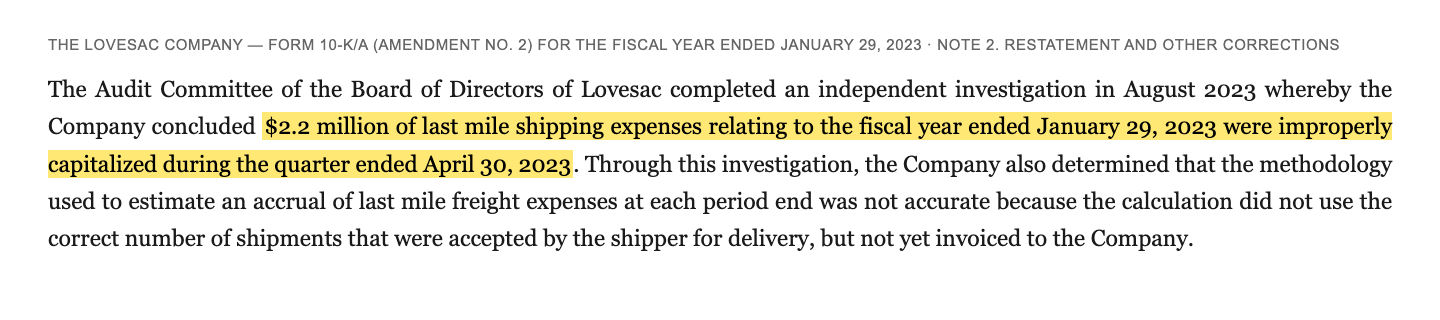
A second finding came on top: the method Lovesac used to estimate the accrual for shipments already handed to the carrier but not yet invoiced simply used the wrong number of shipments. The consequences stretched over years: restated figures for fiscal 2023 and several quarters, admitted material weaknesses in internal controls (since remediated, per the annual report), a shareholder class action (settled) — and the securities regulator. Lovesac self-reported, cooperated, and on October 29, 2024, accepted a settlement:
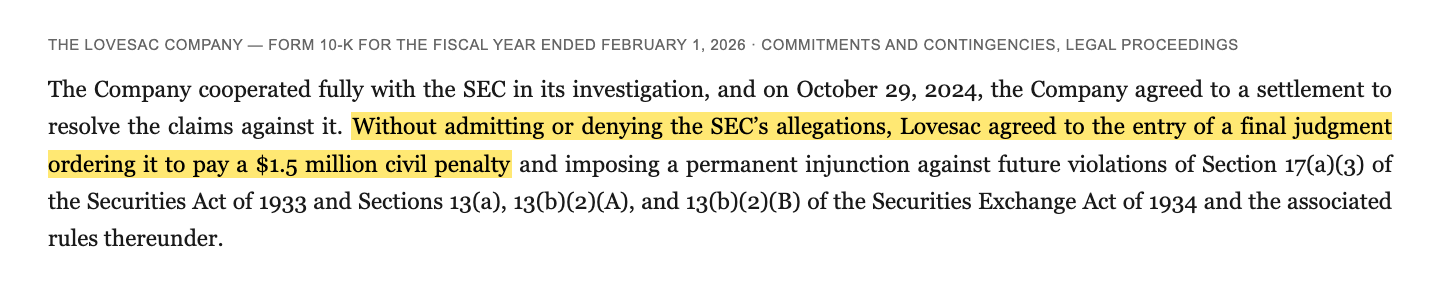
"Without admitting or denying the SEC's allegations, Lovesac agreed to the entry of a final judgment ordering it to pay a $1.5 million civil penalty and imposing a permanent injunction against future violations of Section 17(a)(3) of the Securities Act of 1933 and Sections 13(a), 13(b)(2)(A), and 13(b)(2)(B) of the Securities Exchange Act of 1934 and the associated rules thereunder."
— The Lovesac Company, SEC annual report 10-K for fiscal year 2026, note "Commitments and Contingencies — Legal Proceedings"
Perspective without scandalizing: $2.2 million of misbooked shipping costs against $650 million of revenue is no Enron, the company turned itself in, and the control weaknesses are considered remediated. But the episode belongs in the verdict because of where it happened: of all places, in freight and delivery costs — exactly the cost block that decides the margin's fate today. If you take the tariff debate from truth no. 1 seriously, you should know that the measuring instruments for precisely these costs were miscalibrated three years ago. And one thread is still running: since March 2024, Lovesac has been defending a class action alleging artificially inflated discounts (Nguyen v. The Lovesac Company); as of the June 2026 10-Q, the latest motion to dismiss was still awaiting a ruling.
Uncomfortable truth no. 4: Four days after earnings, the CFO was gone
On June 11, 2026, Lovesac published its quarterly results — signed by CFO Keith Siegner. On June 12, the company agreed on his separation; by June 15 he was out, with twelve months of salary ($576,800) as severance. The 8-K (the mandatory filing for material events) assures: "Mr. Siegner's separation of employment is not related to any financial or accounting issues or any disagreement with the Company." Sentences like that sit in the filing because investors get nervous at exactly this spot after a restatement — and the successor's résumé does not make the matter less conspicuous: new CFO Andrew Farag, per the same filing, already served as Lovesac's interim controller from August 2023 to January 2024, in the middle of the restatement cleanup. You can read that as the return of a man who knows the construction sites — or as a sign that this company's finance department has not found calm in three years. Both are true. A CFO chair that turns into an ejection seat is no footnote at a stock with an accounting history.
Valuation: a $270 million market cap for $700 million in sales — and the tariff wild card
In mid-July 2026, Lovesac weighed in at roughly $270 million in market value (ApeWisdom feed, as of July 17, 2026; against 14,638,550 shares outstanding per the quarterly report, that implies a price around $18 to $19). That produces two entirely different price tags, depending on which line of the receipt you look at. Measured by sales and cash flow, the stock is cheap: a price-to-sales ratio around 0.3 to 0.4, price to operating cash flow around 4 to 5, price to book around 1.2 to 1.3 on $205.5 million of equity (May 3, 2026; scanner metrics as of mid-July 2026). Measured by earnings, it is expensive: the trailing price-to-earnings ratio sits around 68, because only $4.1 million stuck. Analyst estimates assume roughly a doubling of earnings per share in the coming year (data as of mid-July 2026) — carried by price increases, the cost program and the hope of tariff relief. And here lies this stock's wild card: after the Supreme Court's February 20, 2026 ruling against the IEEPA tariffs, Lovesac filed refund claims and a lawsuit seeking a full refund — by June 10, 2026, roughly $3.6 million had already come back, booked only as the cash arrives:
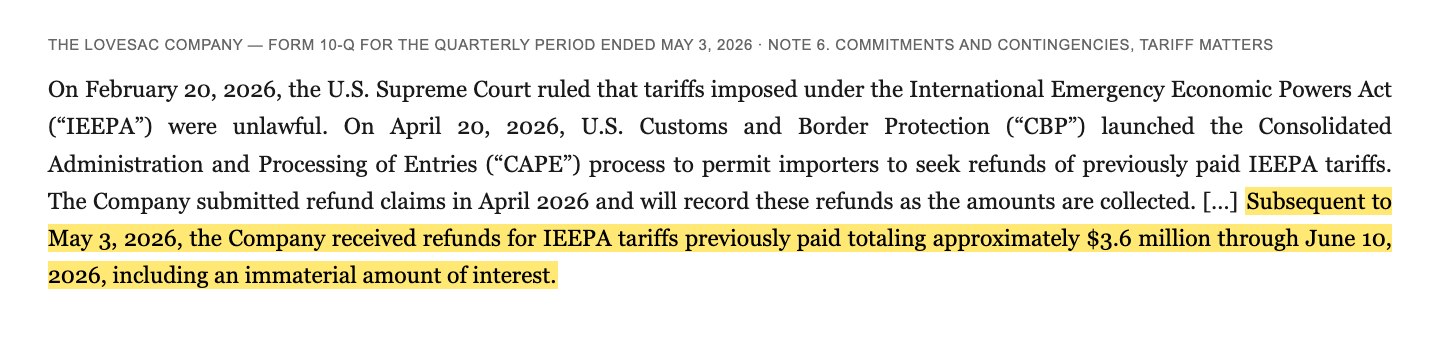
"Subsequent to May 3, 2026, the Company received refunds for IEEPA tariffs previously paid totaling approximately $3.6 million through June 10, 2026, including an immaterial amount of interest."
— The Lovesac Company, SEC quarterly report 10-Q as of May 3, 2026, Note 6 "Commitments and Contingencies — Tariff Matters"
The balance sheet behind it is more solid than the profit decay suggests: $57.0 million in cash as of May 3, 2026 (down from $101.9 million at February 1 — the outflow is seasonal and went mostly into inventory, bonuses and buybacks), no bank debt, the $40 million Wells Fargo credit line untouched through 2029. The leverage in the metrics (debt-to-equity around 0.9) consists almost entirely of the lease obligations of the 278 showrooms — roughly $191 million in lease liabilities. Management, meanwhile, is buying its own stock: after the March 26, 2026 top-up of $40 million, $51.7 million remained available under the repurchase program (May 3, 2026); in the latest quarter, 141,482 shares were retired for $2.4 million, and the share count fell from an average of 15.5 million to 14.7 million within a year. Against a $270 million market cap, an $80 million program (of which $28.3 million is already executed) is a statement — but it only works as long as operating cash flow ($49.3 million in fiscal 2026) keeps flowing.
Opportunities and risks at a glance
What speaks for Lovesac:
- A valuation on the floor: price-to-sales around 0.3 to 0.4, price to operating cash flow around 4 to 5, price to book around 1.2 to 1.3 (data as of mid-July 2026) — the market prices in a permanently profit-poor business; any margin normalization would have leverage.
- Possible tariff tailwind: $3.6 million in IEEPA refunds already received (through June 10, 2026), further claims and a lawsuit for a full refund pending; price increases lifted product margin 330 basis points in the latest quarter, and the U.S. onshoring effort is expected to be cost-neutral after the ramp-up (10-K FY 2026, 10-Q as of 05/03/2026).
- A balance sheet without bank debt: $57.0 million in cash (May 3, 2026; the seasonal low after $101.9 million at February 1), an untouched credit line, an Altman Z-score around 4.8; operating cash flow of $49.3 million in fiscal 2026.
- Capital returns: a buyback program with $51.7 million remaining (May 3, 2026), share count down a good 5 percent in one year — at this market cap, every repurchased dollar is felt per share.
- A sticky product platform: 91.1 percent of revenue from the expandable Sactionals system, repeat customers up 8.8 percent in fiscal 2026, the webshop up 7.1 percent in the latest quarter — the brand keeps its customers.
What speaks against it:
- The tariff squeeze is acute: 380 basis points of tariff and freight burden in the latest quarter, 210 basis points of margin lost in fiscal 2026 — and after the IEEPA ruling, the next 15 percent global tariff under Section 122 is already on the table; the supply chain hangs on Vietnam, Malaysia, China, Indonesia, Taiwan and India.
- Three years of revenue plateau around $700 million, new customers down 5.6 percent in fiscal 2026, comparable sales down 1.0 percent in the latest quarter — the growth story that once carried the all-time high is no longer delivering.
- Almost nothing survives to the bottom line: $4.1 million of net income in fiscal 2026 (a 0.6 percent net margin), a $11.1 million loss in Q1 of fiscal 2027; a trailing P/E around 68, a Piotroski F-score of 3 of 9 (data as of mid-July 2026).
- Product concentration: 91.1 percent of revenue from a single platform; on top, a U.S. furniture market at the mercy of housing, interest rates and consumer sentiment — and a single manufacturer for the entire Sacs line.
- Governance scars: the 2023 restatement ($2.2 million of improperly capitalized shipping costs), a $1.5 million SEC penalty (October 2024), a pending discount-pricing class action, and a CFO departure four days after earnings in June 2026 — trust in the numbers is young.
A human conclusion
Back to the anchoring effect from the opening. Its core is not that fallen stocks are never bargains — sometimes they are. Its core is that the old peak in your head replaces a number you actually need: today's profit. The anchor says "80 percent off the high." The receipt says "$697 million in revenue, $4 million in profit." Both are true — but only one of those numbers pays for buybacks, showrooms and, someday, a valuation above book value again. The honest ledger looks like this: at Lovesac you get a real brand with a sticky product platform, a balance sheet without bank debt, cash flow that is far more robust than the paper profit, and a tariff wild card that has already wired $3.6 million back — for the price of a third of one year's revenue. In exchange you carry: a margin in the grip of trade policy, growth in idle, a 91 percent single-product concentration, and a finance department whose recent history consists of a restatement, an SEC penalty and executive turnover. Whether refunds and price increases heal the margin faster than the furniture market and the next tariff round wound it — that is what decides this investment story, and no filing names a date for it. Throw the anchor out of your head and read the quarterly reports (10-Q) instead: gross margin, new-customer count, refund receipts. What you make of it is your decision. And that is exactly as it should be.
Sources
All original documents used in this analysis — for your own reading:
- The Lovesac Company — SEC annual report 10-K for fiscal year 2026 (ended February 1, 2026; filed April 2, 2026)
- The Lovesac Company — SEC annual report 10-K for fiscal year 2025 (ended February 2, 2025; filed April 10, 2025)
- The Lovesac Company — SEC quarterly report 10-Q as of May 3, 2026 (filed June 11, 2026)
- The Lovesac Company — SEC annual report 10-K/A (Amendment No. 2) for fiscal year 2023 (filed November 30, 2023; restatement)
- The Lovesac Company — SEC current report 8-K dated June 15, 2026 (CFO change)
- Complete SEC filing history of The Lovesac Company: EDGAR overview (sec.gov)
- Fundamental data (metrics, quarterly series, valuation; data as of mid-July 2026), reconciled against the SEC filings.
- Screener and rating data: in-house stock scanner (data as of mid-July 2026); Reddit mentions: ApeWisdom (as of July 17, 2026).
Transparency & disclaimer: This analysis is a journalistic contextualization of publicly available information and is not investment advice, not a financial analysis in the regulatory sense, and not a solicitation to buy or sell securities. Stock investments carry substantial risks up to and including total loss. All information without guarantee; the data cut-off is noted in the text. The author holds no position in Lovesac shares at the time of publication.
Our Bottom Line at a Glance
- Brand & product platform positive
- The Sactionals tie customers to an expandable system: 91.1 percent of revenue, repeat customers up 8.8 percent in fiscal 2026, the webshop up 7.1 percent in the quarter ended May 3, 2026 — direct sales through 278 company-owned showrooms with no furniture retailers in between (annual report 10-K FY 2026).
- Margin & tariff exposure negative
- Manufacturing in six Asian countries; gross margin fell 210 basis points to 56.4 percent in FY 2026 (180 bp freight/tariffs), and 380 bp of tariff and freight costs weighed on Q1 FY 2027 — price increases (+330 bp product margin) absorbed only part of it; a new 15 percent global tariff has been announced (10-K FY 2026, 10-Q as of 05/03/2026).
- Growth & demand negative
- Three years of plateau: $700.3 million (53 weeks), $680.6 million and $697.1 million of revenue in fiscal years 2024 through 2026; new customers down 5.6 percent in FY 2026, comparable sales down 1.0 percent in Q1 FY 2027 — the furniture market hangs on housing, interest rates and consumer sentiment.
- Balance sheet & capital returns positive
- No bank debt, an untouched credit line, $57.0 million in cash (May 3, 2026; seasonal, after $101.9 million at February 1), operating cash flow of $49.3 million in FY 2026; a buyback program with $51.7 million remaining, and a share count down a good 5 percent in one year.
- Governance & trust in the numbers neutral
- The 2023 restatement ($2.2 million of improperly capitalized shipping costs), a $1.5 million SEC settlement (October 29, 2024; control weaknesses remediated per the 10-K), a pending discount-pricing class action, and a CFO change four days after earnings in June 2026 — self-reported and cleaned up, but the streak is too fresh to check off.
- Valuation & the tariff wild card neutral
- A P/S around 0.3 to 0.4 and price/cash flow around 4 to 5 stand against a trailing P/E around 68 (data as of mid-July 2026); $3.6 million in IEEPA refunds have already arrived (through June 10, 2026) and the lawsuit for a full refund is pending — amount and timing remain open.
Lovesac is the case of an intact brand with a damaged bill: $697 million in revenue but only $4.1 million of profit in fiscal 2026, because tariffs and freight are eating the margin while growth has sat on a plateau for three years. Against that stand a balance sheet without bank debt, $49.3 million in operating cash flow, ongoing buybacks and the chance of further tariff refunds after the IEEPA ruling. Whoever invests here buys a cheap revenue base and bets that the margin returns before the market's patience runs out. Not investment advice.
What Our Rating Means
- If you don't own the stock
- As long as the question raised in the bottom line stays open, we see no basis for an entry.
- If you hold it in your portfolio
- Our findings offer no acute reason to sell — the checkpoints named remain decisive.
A journalistic assessment by our editorial team at the time of the deep dive, based on public sources — not investment advice and not a solicitation to buy or sell. Your personal circumstances (investment goals, risk capacity, taxes) cannot be taken into account. What our categories mean, how verdicts are formed, and what conflicts of interest exist →
Worth Noting
- LOVE reached the research list through the Reddit hype scanner (8 mentions in 24 hours, ApeWisdom, as of July 17, 2026); at the same time, our in-house stock scanner showed three value rankings (P/S, P/CF, P/FCF) and a bearish Pradeep Bonde breakout signal — "cheap" and "bruised" in the same reading.
- Scanner metrics (P/E, P/S, Piotroski, Altman Z) are computed on trailing twelve-month figures; the seasonally weak Q1 of fiscal 2027 (a $11.1 million loss) is in them, while possible further IEEPA refunds naturally are not — Lovesac books them only as the cash arrives.
- The market value figure (~$270 million) comes from the July 17, 2026 feed, sanity-checked against 14,638,550 shares outstanding per the 10-Q as of May 3, 2026; analyses are evergreen, daily prices are not a buy argument. Lovesac's fiscal year ends in early February — every annual figure carries that offset.
Frequently Asked Questions
The Lovesac Company (Nasdaq: LOVE) of Stamford, Connecticut, sells modular couches ("Sactionals") that can be expanded, washed and rearranged like a construction kit, plus oversized beanbags ("Sacs") — directly to consumers through 278 company-owned showrooms (as of February 1, 2026), its own webshop and pop-up spaces, for example at Costco. Sactionals delivered 91.1 percent of fiscal 2026 revenue of $697.1 million.
Lovesac's fiscal year ends on the first Sunday of February. "Fiscal 2026" ran from February 3, 2025, through February 1, 2026, and thus essentially covers calendar year 2025. In addition, fiscal 2024 had 53 instead of 52 weeks in the retail calendar — that extra selling week belongs in any comparison of fiscal years 2024 through 2026.
Hard: in fiscal 2026, gross margin fell 210 basis points to 56.4 percent, 180 basis points of it from inbound freight and tariffs; in the quarter ended May 3, 2026, the tariff and freight burden was 380 basis points. Manufacturing sits in Vietnam, Malaysia, China, Indonesia, Taiwan and India. After the Supreme Court struck down the IEEPA tariffs (February 20, 2026), Lovesac received about $3.6 million back by June 10, 2026; a new 15 percent global tariff has been announced.
An audit committee investigation concluded in August 2023 that $2.2 million of last-mile shipping costs had been improperly capitalized and that the freight accrual methodology was flawed. Lovesac restated fiscal 2023 and several quarters, self-reported to the SEC, and on October 29, 2024, accepted a settlement with a $1.5 million civil penalty. Per the annual report (10-K) for fiscal 2026, the identified control weaknesses have been remediated.
Decent: as of May 3, 2026, the books showed $57.0 million in cash (the decline from $101.9 million at February 1 is seasonal), no bank debt, and an untouched $40 million Wells Fargo credit line. Equity stood at $205.5 million; liabilities consist mostly of roughly $191 million in showroom lease obligations. The share repurchase program still had $51.7 million available.
Depends on the lens: by sales and cash flow, yes — a price-to-sales ratio around 0.3 to 0.4 and price to operating cash flow around 4 to 5 at a market value of roughly $270 million (as of July 17, 2026). By earnings, no — the trailing price-to-earnings ratio sits around 68, because fiscal 2026 left only $4.1 million of net income. The market is pricing the question of whether the margin comes back, not the current result.
The Reddit hype scanner counted 8 mentions in 24 hours (ApeWisdom, as of July 17, 2026) — a murmur, not a storm. Typical conversation starters: the optically low price-to-sales valuation, the tariff refunds after the IEEPA ruling, and the drop of more than 80 percent below the pandemic-era all-time high. Attention does not replace margins, though — the numbers are in the annual and quarterly reports (10-K/10-Q).
Found an error?
Did you spot a factual error, an outdated number, or a typo in this deep dive? Let us know briefly — your report goes straight to the editorial team.