Negative Equity of $58 Million Without a Cent of Bank Debt: Solaris Resources Sold Its Gold Before the Mine Exists
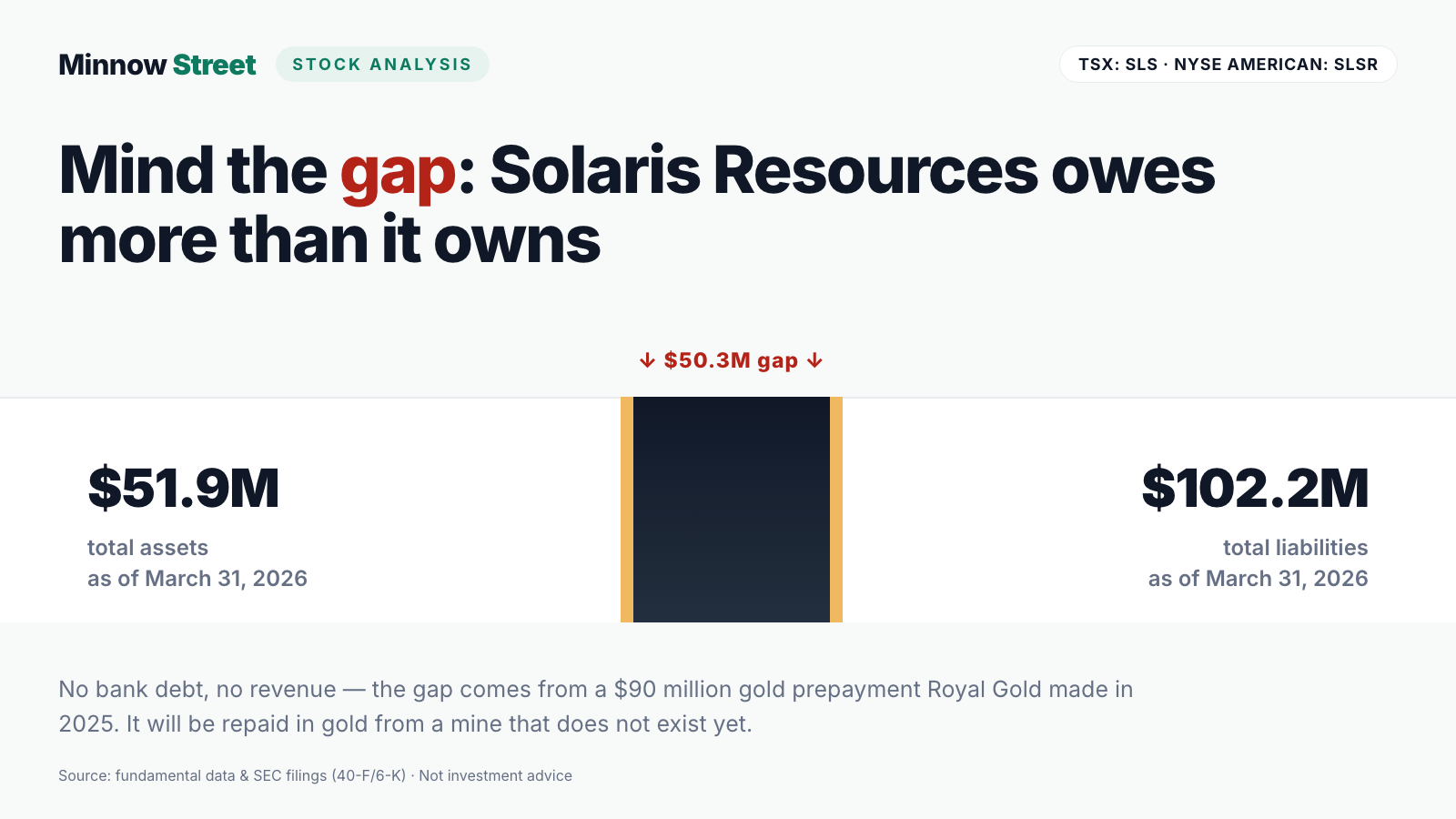
Solaris Resources owns Warintza in Ecuador, one of the largest undeveloped copper deposits in the world — its own pre-feasibility study puts the after-tax net present value at $4.617 billion. The balance sheet as of March 31, 2026 shows $51.9 million of assets against $102.2 million of liabilities, and a deficit attributable to shareholders of $58.1 million. There is no bank debt at all: the gap comes from a $90 million gold prepayment Royal Gold made in May 2025, repayable in gold from a mine that will not produce for years. The auditor flags material uncertainty about the going concern, and a London fund has more than tripled its stake in twelve months. No investment advice — just the sober question of what a prepayment is worth while the mine exists only on paper.
 Thomas Mücke
Founder & Publisher
Thomas Mücke
Founder & Publisher
Chart
Interactive price chart (TradingView).
Note: pure fact-based analysis, not investment advice and not a solicitation to buy or sell. All figures without guarantee.
There is an investor trap that has nothing to do with greed and everything to do with a bank balance — call it the retainer trap. You know it from freelancing: a big client wires $30,000 in January, the account looks glorious, and for a few months everything feels solved. Except the money is not yours. You traded it for work you still have to do — and when the invoice comes due in autumn, the account is empty and the work is still ahead of you. At Solaris Resources Inc. (TSX: SLS, NYSE American: SLSR) that trap is built into the balance sheet. As of March 31, 2026 it shows $51.9 million of assets and $102.2 million of liabilities. Deficit attributable to shareholders: $58.1 million. And the company carries no bank debt at all. So let’s make a deal: before you form an opinion from that number, we read together what Solaris itself filed with the U.S. Securities and Exchange Commission — the annual report on Form 40-F for 2025 filed March 26, 2026 with its audited accounts, MD&A and Annual Information Form, the interim report as of March 31, 2026 filed May 14, 2026, and every release through June 30, 2026. A filing to the SEC is honest under penalty of law. And this one tells you about a world-class copper deposit, about $90 million that already belongs to somebody else, and about an auditor who puts a question mark next to the words "going concern". You decide at the end.
What Solaris Resources actually does — a mountain, not a business
First a clarification, because plenty of people have got this wrong: do not confuse the names. There is also a Solaris Energy Infrastructure listed in the U.S. — a completely different, unrelated company. This piece is about Solaris Resources Inc., a copper-gold explorer headquartered in Baar, Switzerland.
Solaris produces nothing. It owns rock and permits. Its main asset is Warintza, a porphyry copper deposit in the province of Morona Santiago in south-eastern Ecuador — nine concessions covering 26,773 hectares, four of them (9,997 hectares) permitted for drilling, embedded in a land package of more than 260 square kilometres. Two large operating mines sit in the neighbourhood: Mirador (copper, China’s CRCC-Tongguan) and Fruta del Norte (gold, Lundin Gold). Beyond that come the ENAMI concessions in Ecuador, 60 percent of La Verde in Mexico (a Teck Resources subsidiary holds the other 40 percent) and Tamarugo in Chile. Eighty-four employees.
A word of translation: porphyry copper means "a lot of rock, very little metal". Warintza’s reserves grade 0.41 percent copper equivalent — one tonne of rock yields a little over four kilograms of recoverable metal. That sounds absurdly thin and is nonetheless the norm in copper mining; the trick is volume. At a planned throughput of 60.2 million tonnes a year it produces roughly 156,000 tonnes of copper annually for 22 years. That is the difference between a mine and a quarry: in copper you do not earn on grade, you earn on scale — and scale costs billions before it earns a cent.
Which names the central tension of this analysis, and it runs through every chapter: Solaris owns an asset whose own pre-feasibility study calculates an after-tax present value of $4.617 billion — and a cash box that held $12.9 million on March 31, 2026. Between the two sits $3.7 billion of construction cost that nobody has committed to.
How this stock landed on our desk
This analysis does not begin with a hit in the in-house stock scanner. It begins with a form. On May 8, 2026, Helikon Investments Ltd of London filed its Form 13F-HR with the SEC for the quarter ended March 31, 2026 (accession 0001839497-26-000002). A 13F is the mandatory quarterly disclosure for large U.S. asset managers: anyone managing more than $100 million in U.S.-listed equities must publish what they hold. Helikon’s table lists 17 positions worth $2,648,555,113 in total — including 15,545,845 Solaris shares worth $133,383,350, a little over five percent of the portfolio and roughly 9.3 percent of all Solaris shares.
More interesting than the size is the speed. Reported across four quarter-ends: 4,811,620 shares (June 30, 2025), 6,811,620 (September 30), 9,022,072 (December 31) — then 15,545,845 as of March 31, 2026. More than tripled in a year, and up 72.3 percent in the final quarter alone. After New Pacific Metals that was the most aggressive addition in the whole portfolio, a portfolio conspicuously full of gold, silver and copper explorers. In the same quarter the fund reshuffled hard: six brand-new positions, six complete exits.
Now the limitation that belongs with every 13F, so that a mandatory filing does not turn into folklore: a 13F shows U.S.-listed long positions only, reported 35 to 45 days late, without short sales, without derivatives and without anything listed outside the United States. It is a rear-view mirror, not a route map.
With Solaris, though, there is a second mirror, and it sees further. Because Helikon crossed the five percent threshold, it must also file an ownership statement on Schedule 13G. On May 6, 2026 it reported 15,545,845 shares, or 9.31 percent, as of March 31 — identical to the 13F. One day later, on May 7, 2026, came the next amendment with a new event date of April 30, 2026: 17,488,787 shares, 10.47 percent. The fund kept buying after quarter-end and crossed the ten percent mark. For comparison: the next largest disclosed holder stood at 4.4 percent as of December 31, 2025; directors and officers as a group hold 36.90 percent.
A word on the scanner, because honesty demands it: Solaris is not a stock our filters surface — and it could not be. The data set covers eight quarters, and all eight show zero revenue. There is no price-to-earnings ratio because there are no earnings. The Piotroski score sits at 5 out of 9 — a nine-point test of balance-sheet health on which genuinely healthy companies score 8 or 9; applied to a company without revenue it measures almost nothing meaningful. And the Altman Z of minus 2.95 is not a bankruptcy forecast, it is the mechanical consequence of negative equity: put a negative number into the numerator and a negative number comes out the other end. Remember this: metrics built for operating businesses say almost nothing about an explorer. What matters is cash, runway, permits and dilution.
Why Solaris files no quarterly report — and which exchange the stock actually hangs on
Two misunderstandings to clear up straight away. First: there is no 10-K and no 10-Q from Solaris. The company was incorporated in British Columbia and uses the MJDS regime, a mutual recognition between the securities regulators: it reports under Canadian rules and files the same package with the SEC as Form 40-F — for 2025 on March 26, 2026, plus an amendment one day later. Accounting follows IFRS, reporting is in U.S. dollars and in thousands. Quarterly figures arrive as an unaudited exhibit to a Form 6-K. In practice: one BDO Canada-audited package a year, unaudited numbers three times a year.
Second, the exchange question, where many data sheets are out of date: Solaris is not an OTC stock. The interim accounts say it in one line:
„Solaris’ common shares trade on the Toronto Stock Exchange under the symbol “SLS” and the NYSE American under the symbol “SLSR”."
— Solaris Resources Inc., interim financial statements as of March 31, 2026 (Form 6-K exhibit 99.1), Note 1 "Nature of operations and going concern"
The home market is Toronto; the U.S. listing has run on NYSE American since April 19, 2024. And the Annual Information Form records it explicitly: „Concurrent with the start of trading on the NYSE American, the Common Shares ceased trading on the OTCQB Venture Market." If you still see the stock described as an OTC name, you are reading two-year-old information.
On the back story, because it explains why the metric histories are so short: Solaris was incorporated on June 18, 2018 as a wholly owned subsidiary of Equinox Gold Corp. and subsequently spun out under a plan of arrangement. At the end of 2024 the company moved its operating base to Switzerland, closed its Canadian offices and appointed new management. And one chapter is missing from many timelines: on January 11, 2024 Solaris agreed a private placement of roughly C$130 million at C$4.55 per share with an affiliate of China’s Zijin Mining. On May 21, 2024 the company announced the termination of that placement. The money never came — and the hole it left is precisely what Royal Gold fills today.
The numbers over the years — for an explorer they go by different names
First the part that genuinely impresses, because there is plenty of it. On November 6, 2025 Solaris published the pre-feasibility study for Warintza, prepared with Ausenco, Knight Piesold and AMC Consultants. It contains the first reserve estimate in the company’s history: 1.3 billion tonnes of proven and probable reserves at 0.41 percent copper equivalent — containing 4.1 million tonnes of copper, 1.8 million ounces of gold, 54.1 million ounces of silver and 214,000 tonnes of molybdenum. Measured and indicated resources rose 312 percent against the 2024 estimate. The headline economics: a 22-year mine life, an after-tax net present value of $4.617 billion at an 8 percent discount rate, a 26 percent internal rate of return, a 2.6-year payback after construction — and all-in sustaining costs of $0.85 per pound of copper in the first five years, which would genuinely be world class.
Then, on April 9, 2026, came the approval everyone had been waiting for: technical approval of the Environmental Impact Assessment by Ecuador’s Ministry of Environment and Energy — submitted in the autumn of 2024, granted after eighteen months of review. The company’s stated goal is a fully permitted project by the end of 2026; ahead of that lies the government-led consultation process with the affected communities.
And now the other side, which for an explorer is the balance sheet — the cash:
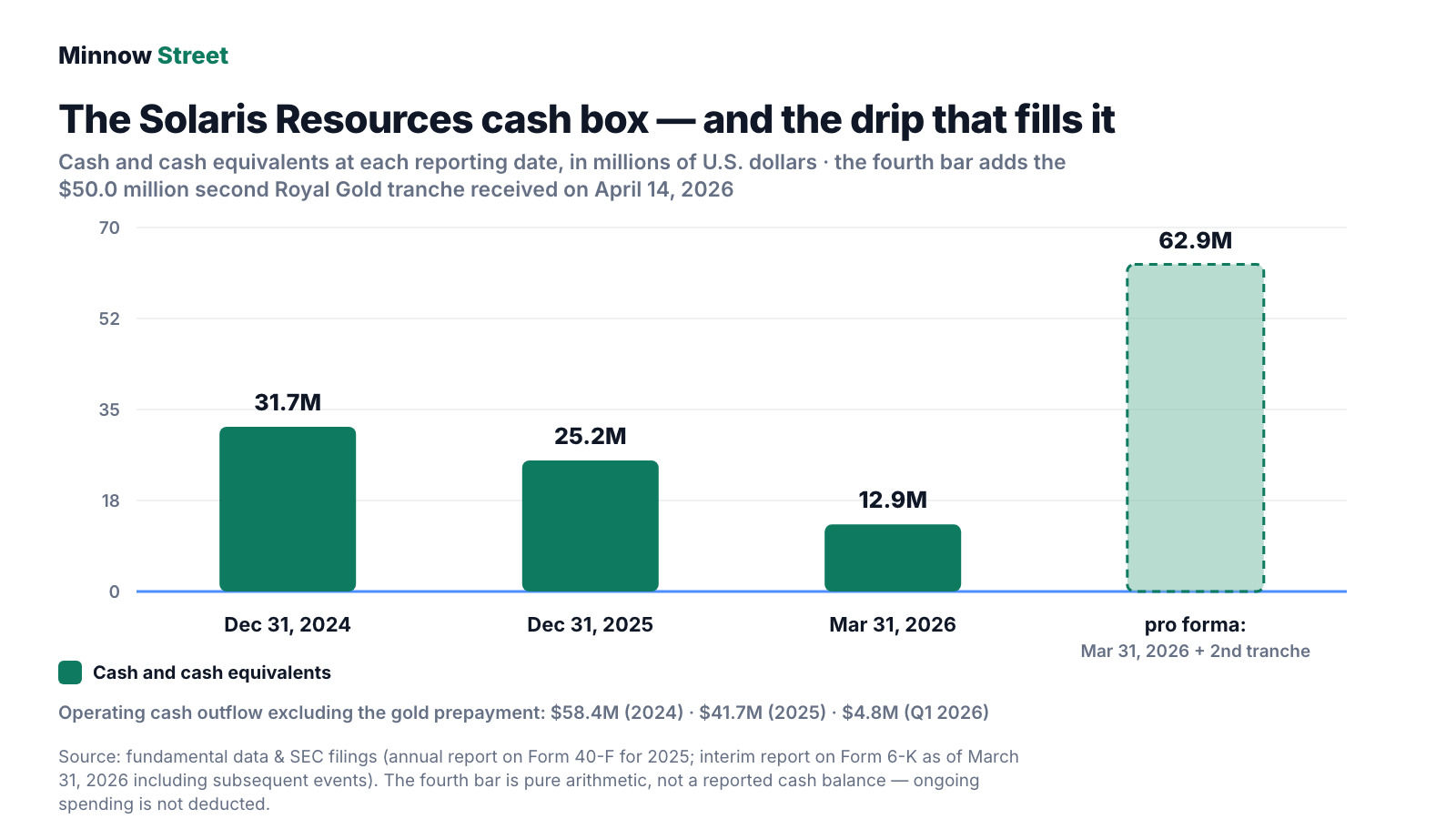
The losses across three years read like this: $41.1 million (2023), $77.1 million (2024), $42.3 million (2025), plus $5.0 million in the first quarter of 2026. Per share that was $0.29, $0.49, $0.26 and $0.03. The largest line item is the same every year: drilling. And this is exactly where something shifted in 2025 that you need to know before you misread the series:
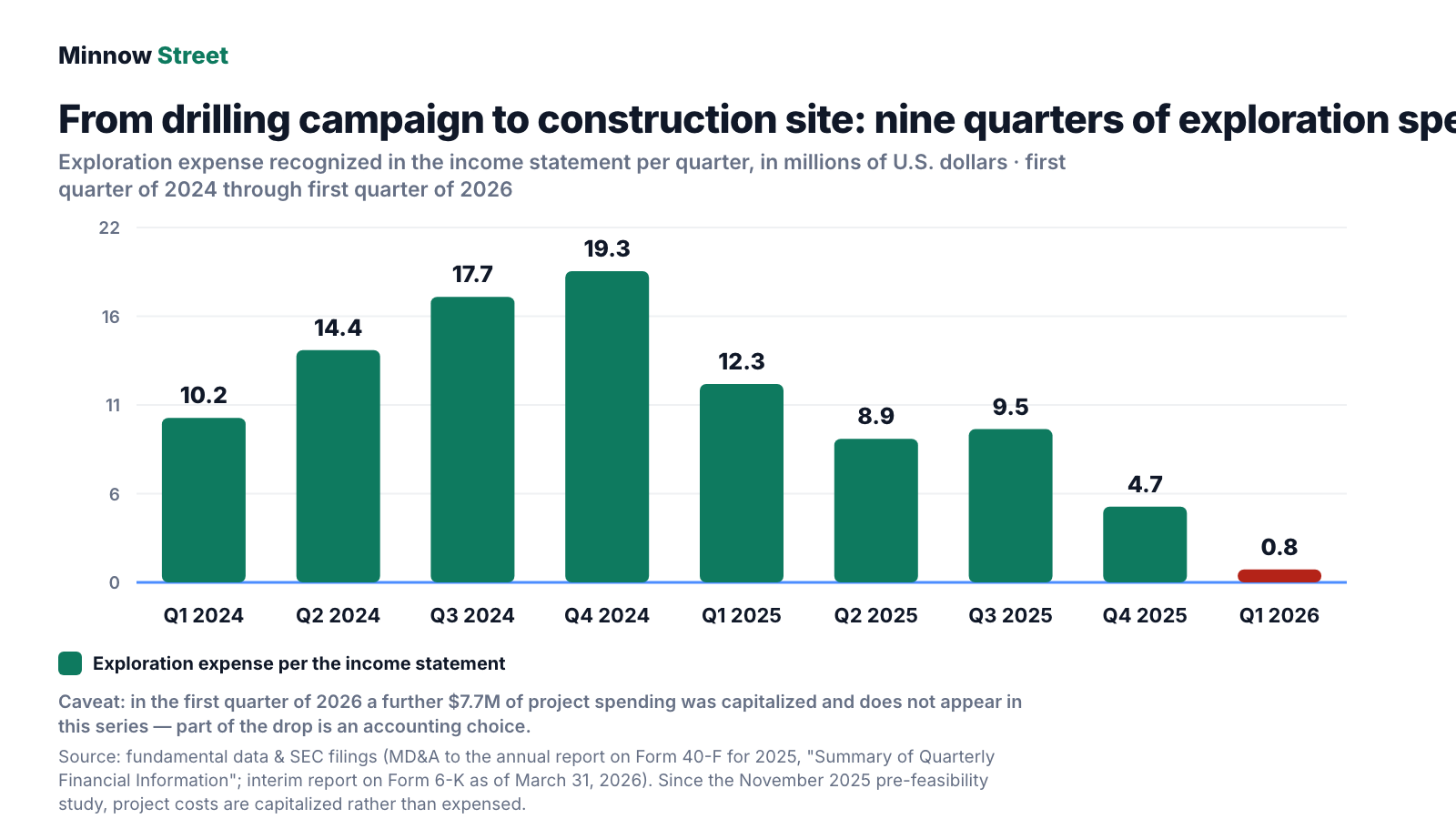
The MD&A explains the collapse itself: „Exploration expenses decreased from 2024 to 2025 primarily due to the decrease in exploration and drilling activities at Warintza and the capitalising of costs following the completion of the PFS." Spending fell because there was less drilling and because, after the study, part of the cost is capitalized instead of expensed. That is why the first quarter of 2026 shows only $0.8 million in the income statement while $7.7 million went onto the balance sheet as a project asset. Remember this: when an expense line suddenly collapses, first check whether the money is really gone — or whether it just changed sides in the ledger.
What the filings say — the uncomfortable truths
Uncomfortable truth no. 1: negative equity of $58.1 million — and not a bank in sight
This is the number the whole analysis hangs on. The interim balance sheet as of March 31, 2026 reports: total assets $51.910 million, total liabilities $102.229 million, deficit attributable to shareholders $58.148 million, non-controlling interests plus $7.829 million, total shareholders’ deficit $50.319 million. The company therefore owes roughly twice what its assets are carried at.
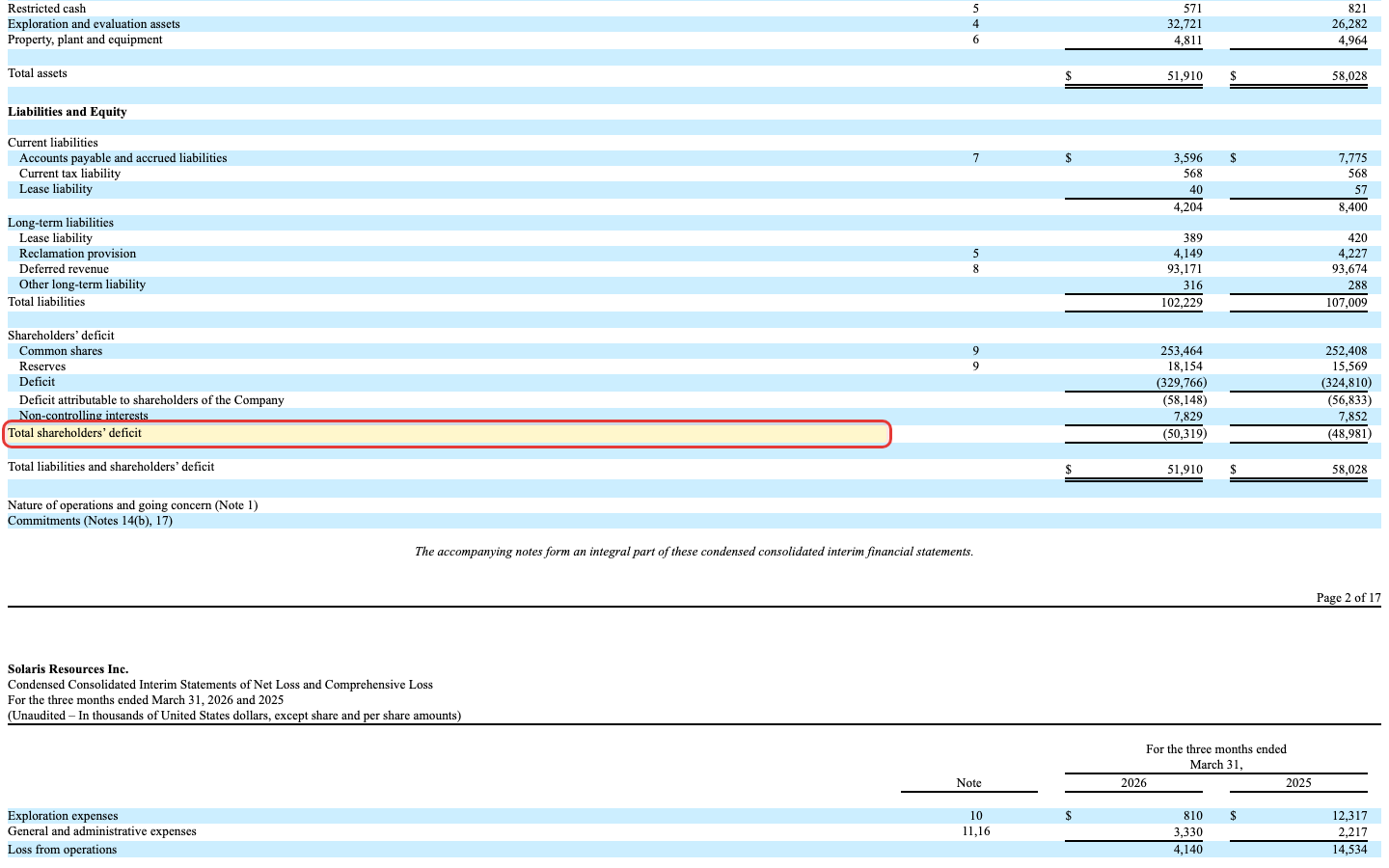
For most companies with negative equity there is a mountain of debt behind it. Not here: the $60 million Orion loan was repaid in full on May 21, 2025, and the line "Loans and borrowings" has read zero ever since. The gap has two entirely different causes, and both are instructive.
Cause one — the prepayment. By far the largest item on the liability side is $93.171 million of deferred revenue. Behind it sits not a loan but a sale: Royal Gold paid $90 million up front and will receive gold in return. The note puts it plainly:
„The Company recorded the Stream Upfront Payment as deferred revenue. The Company determines the amortization of deferred revenue on a per unit basis using the estimated total gold production over the life of the Warintza Project."
— Solaris Resources Inc., interim financial statements as of March 31, 2026 (Form 6-K exhibit 99.1), Note 8 "Deferred revenue"
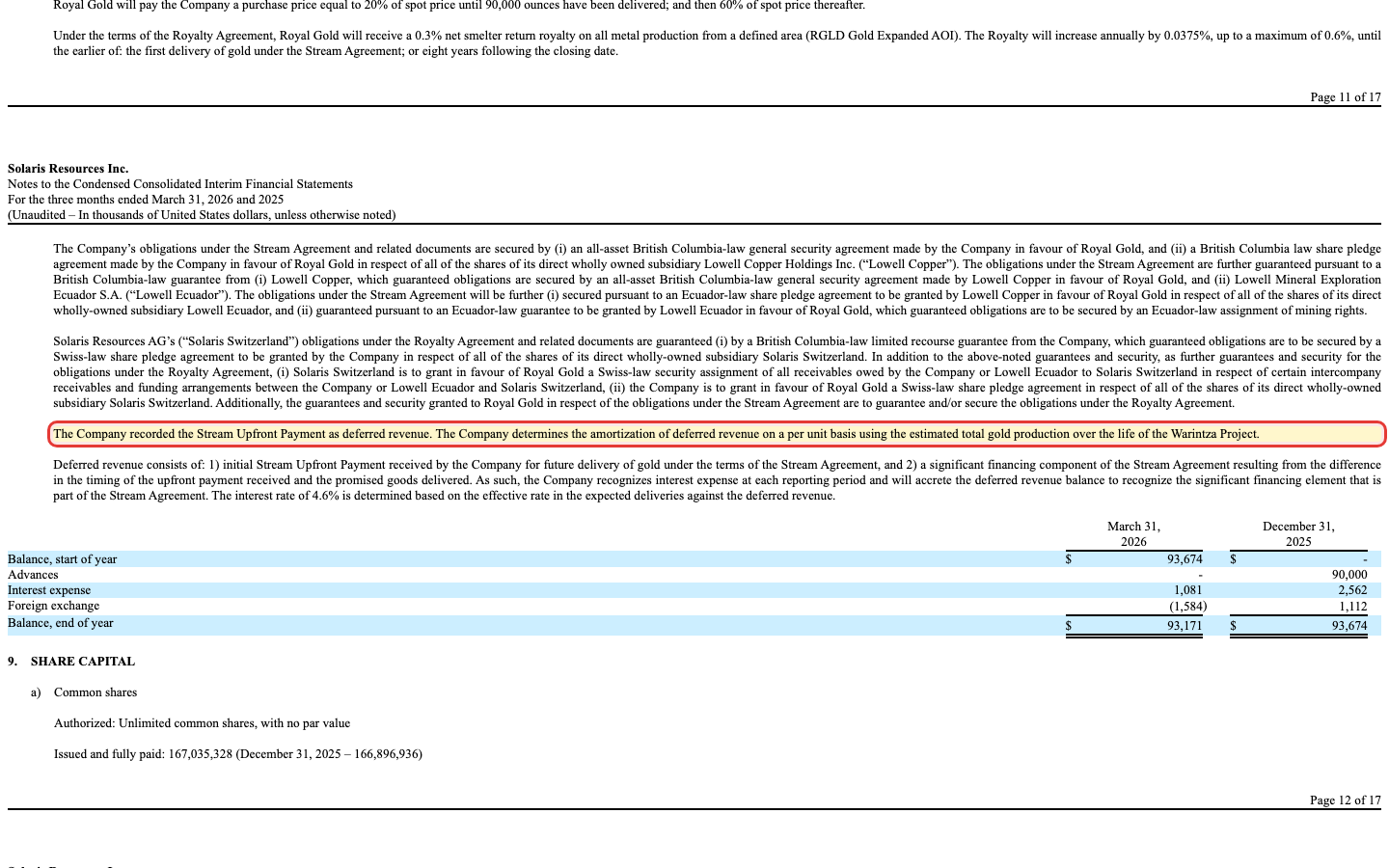
And the item keeps growing: because years pass between payment and delivery, Solaris accretes it at 4.6 percent — $2.562 million in 2025 and another $1.081 million in the first quarter of 2026 alone. It is secured like a bank loan, too: by an all-asset general security agreement, by a pledge over the shares of the intermediate holding company Lowell Copper Holdings and by guarantees from the Ecuadorian subsidiary.
Cause two — the accounting of drilling. Solaris never capitalized the bulk of its exploration spending; it expensed it immediately. The result sits in the balance sheet: an accumulated deficit of $329.766 million against paid-in share capital of $253.464 million. Put differently: more has been drilled away than was ever raised — which is why equity was already negative at December 31, 2024 (minus $17.201 million), long before Royal Gold entered the picture. The value of that drilling is not on the balance sheet; it is in the ground. In everyday terms: this is a developer who put every last dollar of savings into the land and booked the invoices as expenses — the bank statement reads like a loss, the land registry says otherwise. Except that you cannot pay invoices with a land registry entry.
Uncomfortable truth no. 2: the auditor puts a question mark next to "going concern"
BDO Canada’s audit opinion on the 2025 accounts carries its own section headed „Going Concern Uncertainty". It records that the company generates no operating cash flow from a producing mine, has incurred operating losses to date and depends on external financing — „that raise substantial doubt about its ability to continue as a going concern". The interim report then gets specific:
„Based on its current forecasted expenditures, the Company requires the additional financing from the third tranche of the Royal Gold funding package to fund ongoing operations for the next twelve months. As a result, material uncertainty exists that casts significant doubt about the Company’s ability to continue as a going concern."
— Solaris Resources Inc., interim financial statements as of March 31, 2026 (Form 6-K exhibit 99.1), Note 1 "Nature of operations and going concern"
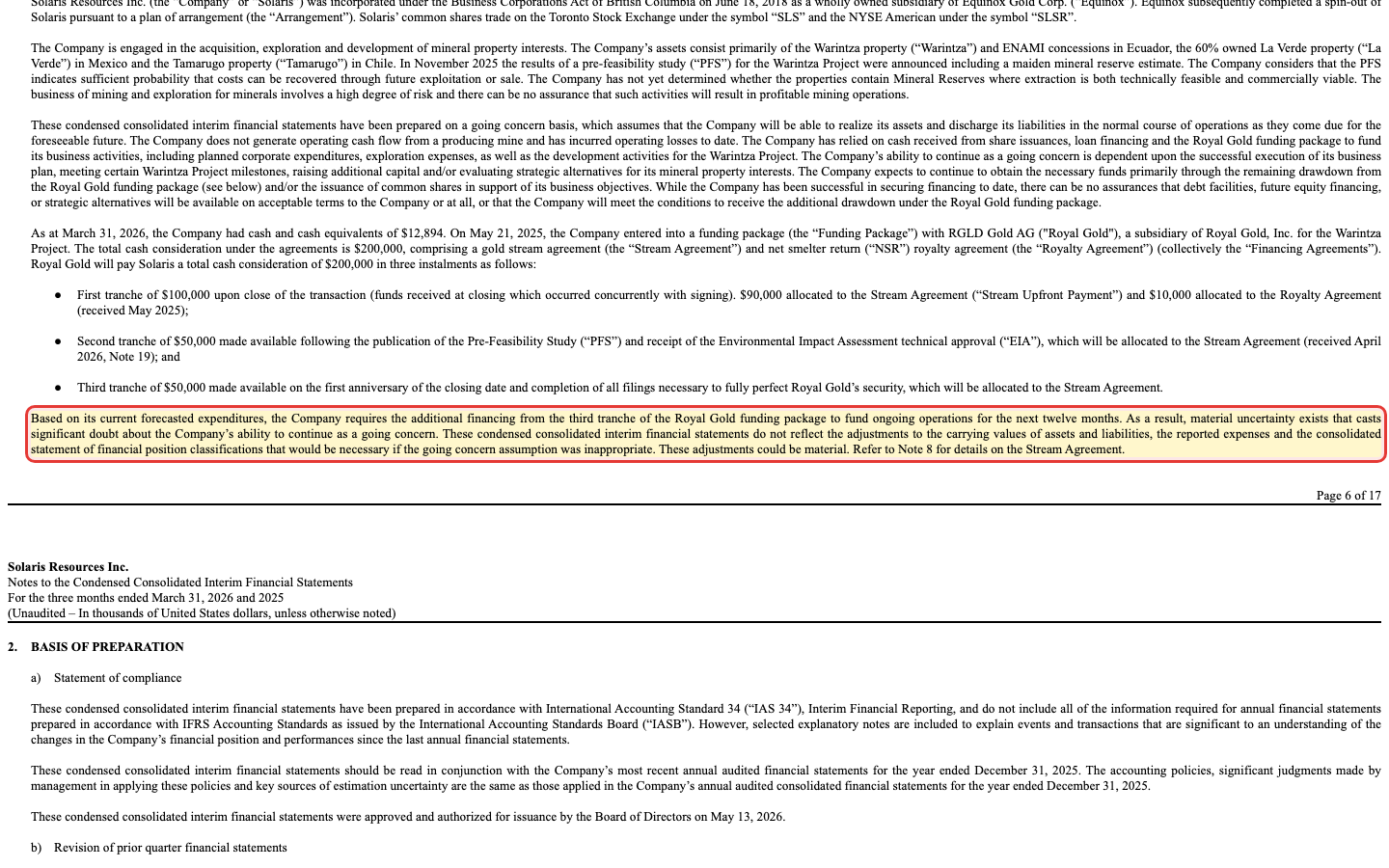
And this is where it gets interesting, because that third instalment hangs on a date. It falls due „on the first anniversary of the closing date and completion of all filings necessary to fully perfect Royal Gold’s security" — the first anniversary of closing, which is May 21, 2026, and full registration of every security interest, including Ecuadorian-law pledges that the accounts expressly describe as still outstanding. Solaris announced the second instalment in its own release on April 9, 2026. On the third instalment, nothing had been filed with the SEC as of the date of this analysis (July 24, 2026); the most recent filing is the Form 6-K of June 30, 2026 with the annual meeting results. That is no evidence that nothing has been drawn — a drawdown does not require a filing. It only means the confirmation is outstanding, and the first place it will surface is the next interim report.
Uncomfortable truth no. 3: 2025 operating cash flow was positive — for the wrong reason
The 2025 cash flow statement contains a figure you have to read twice: net cash flows from operating activities of plus $48.265 million. A company with not one dollar of revenue generating $48 million from operations? Two lines above sits the answer: "Deferred revenue 90,000". The Royal Gold prepayment is booked entirely within operating activities — correct under IFRS, because an advance on future deliveries of goods is an operating item. Strip it out and 2025 leaves an outflow of $41.7 million, after $58.4 million in 2024.
For you that means: as long as instalments keep arriving, the line looks healthy — another $50.0 million landed in the same place on April 14, 2026. In the first year without an instalment it drops back to the bare outflow. Anyone extending the series should read the sub-line, not the total.
Uncomfortable truth no. 4: the mountain is sold several times over before the first shovel
The study models gross revenue of roughly $42.4 billion across 22 years. Deducted before anyone speaks of profit: $2.529 billion of royalties and $3.204 billion of freight, treatment and refining charges. Who collects is set out in black and white in the annual report:
„a 2% NSR royalty is payable to South32 Royalty Investments Pty Ltd. on the Curigem 9, Curigem 9-1, Caya 21, and Caya 22 concessions. Ecuadorian mining law also applies a 4% NSR royalty to the state, along with corporate income tax (20% of taxable profits), profit-sharing requirements (12% to the state and 3% to employees), and annual concession fees based on hectares held and stage of development."
— Solaris Resources Inc., Annual Information Form 2025 (Form 40-F exhibit 99.1), "Warintza Project" section
On top of that come 0.45 percent for Royal Gold (contractually rising from 0.3 percent to as much as 0.6 percent) and the gold stream itself: Royal Gold receives 20 ounces of gold per 1 million pounds of copper produced and pays 20 percent of the spot price until 90,000 ounces have been delivered, then 60 percent. Across the entire mine life Solaris books just $131 million of revenue from that stream. And the offtake is spoken for too: the Orion package of December 2023 includes a contract for 20 percent of the copper and molybdenum concentrates, or at minimum 30,000 tonnes of copper and 1,500 tonnes of molybdenum a year, for 20 years — against planned output of 156,000 tonnes a year, the minimum alone is roughly a fifth.
In fairness: all of it is already inside the $4.617 billion present value. It changes nothing in the arithmetic, but a great deal in the picture — an explorer that produces nothing pays its drillers with slices of a future it does not yet own. How expensive such a pre-sale becomes once the commodity price rises is visible in a gold producer from the same portfolio — our analysis of Allied Gold, which also carries a Royal Gold contract on its books.
Uncomfortable truth no. 5: everything hangs on two villages — and Warintza already sat idle for twelve years from 2006
Ecuador is not an easy mining jurisdiction, and Solaris writes as much into its risk factors: political instability, corruption, expropriation, renegotiation of concessions, illegal mining. The decisive paragraph, though, is not about the state but about the neighbours:
„Warintza was in a period of inactivity from late 2006 as a result of social unrest within the surrounding communities and lack of support for mineral exploration within Ecuador. … While the IBA represents significant progress for the development of Warintza, continued development at Warintza is largely contingent on the continued support of these local communities. Any deterioration in Solaris’ relationship with these communities would significantly negatively impact the development of Warintza."
— Solaris Resources Inc., Annual Information Form 2025 (Form 40-F exhibit 99.1), "Relationships with, and claims by, local communities and Indigenous Groups"
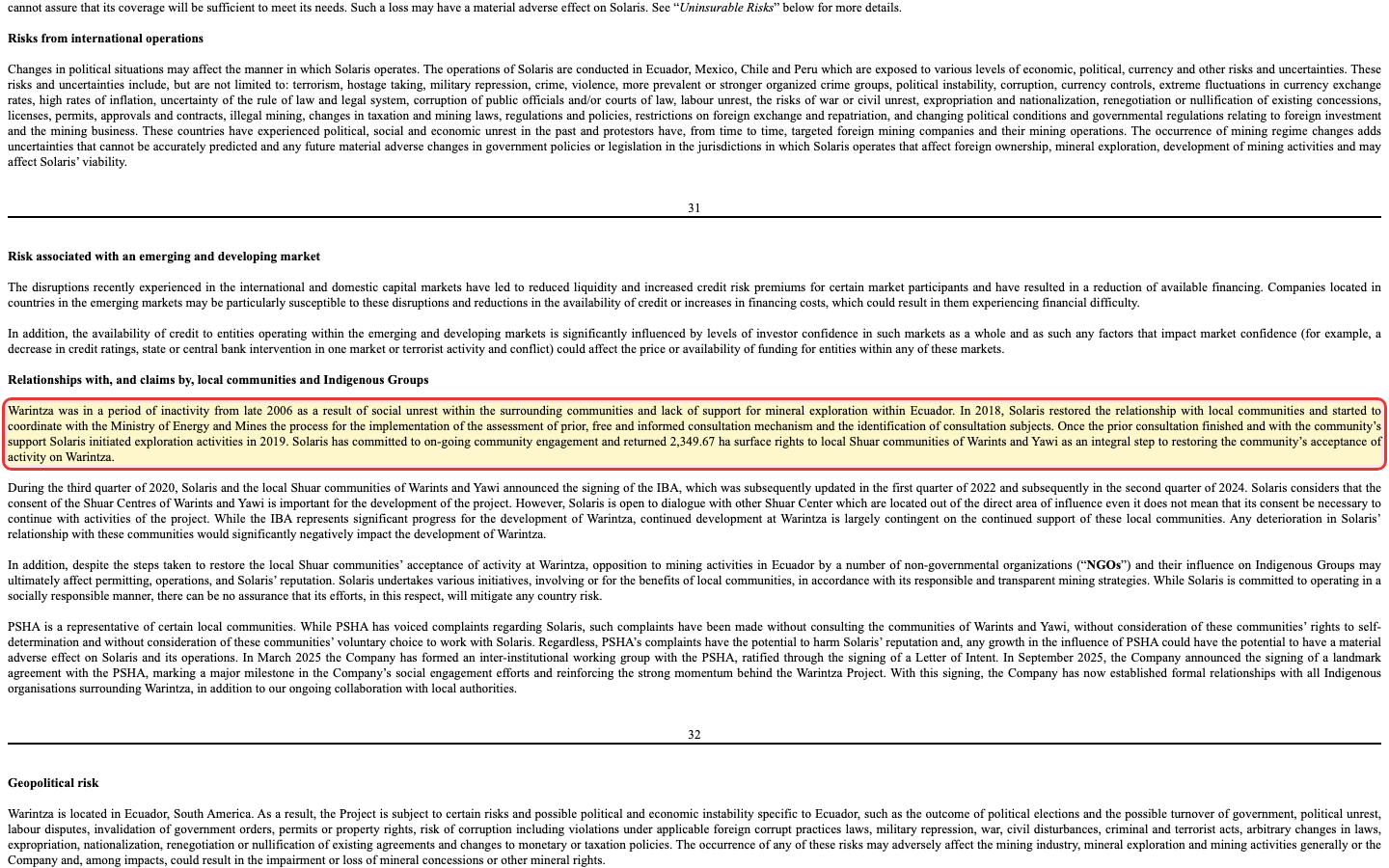
Solaris learned from it and has done more than most: 2,349.67 hectares of surface rights returned to the Shuar communities of Warints and Yawi, an Impact and Benefit Agreement since 2020 (renewed in 2022 and 2024), a cooperation agreement with the Shuar federation FICSH in March 2024, a joint working group in March 2025 and, in September 2025, an agreement with Pueblo Shuar Arutam, which represents nearly ten thousand people across 47 Shuar centres and had previously lodged complaints against the project. Community-agreement payments of $0.770 million and $0.378 million are committed for 2026 and 2027. The structure remains, though: the right to build comes from the ministry; the ability to build comes from the village. The next step is the government-led consultation process — and it has not started yet.
Uncomfortable truth no. 6: $3.7 billion of construction cost and nobody who has committed to it
The study puts initial capital at $3.729 billion across a three-year build, plus $1.713 billion of sustaining capital and $200 million of closure cost — $5.443 billion all told. Nobody has committed that money. Solaris is a company with 167.0 million shares and cash in the tens of millions; every financing to date — Orion, Royal Gold, equity raises — adds up to a fraction of it.
For shareholders that means two things. First, there will be more dilution. Dilution means your slice of the cake gets smaller because new slices keep being cut — the share count rose from 150,811,195 (end of 2023) through 163,234,932 (end of 2024) to 167,035,328 as of March 31, 2026, with 10,932,500 options outstanding on top. That has been modest so far; the scale of a multi-billion-dollar build is not. Second, the likelier route is a partner. That is exactly what the failed Zijin placement of 2024 was about, and the accounts name as an explicit option „evaluating strategic alternatives for its mineral property interests". Translated: a sale, a stake or a joint venture is not ruled out — it is planned for.
Valuation: what a third of a present value costs
For an evergreen framing we need a dated anchor rather than a daily price — and the form from the opening supplies one. From $133,383,350 for 15,545,845 shares the implied price as of March 31, 2026 works out at about $8.58 per share. On 167,035,328 shares that is a market value of roughly $1.43 billion.
Classic multiples do not exist here: no revenue, no earnings, no book value (it is negative). For developers the industry therefore measures against the project’s present value. The comparison: $1.43 billion of market value against $4.617 billion of after-tax present value — the stock traded at roughly 31 percent of the calculated project value at the reporting date. For a project still short of full permitting in Ecuador that is neither conspicuously cheap nor conspicuously expensive; developers without construction financing normally trade at a heavy discount to their present value. A second order of magnitude: against the 4.1 million tonnes of copper in reserves, the market was paying roughly 16 U.S. cents per pound of copper in the ground.
Both are arithmetic, not prices — and both rest on the same condition: that somebody eventually funds the $3.7 billion build. The $4.617 billion present value also assumes a copper price of $4.50 per pound across 22 years, and the study itself states that copper price is by far the most sensitive lever. All valuation figures as of July 24, 2026; analyses here are evergreen, and daily prices are not a buying argument. How thoroughly the politics of an emerging market can overlay an otherwise solid business is visible, from the same portfolio, in our analysis of Corporación América Airports.
Opportunities and risks at a glance
What speaks for Solaris Resources:
- An asset of rare scale: 1.3 billion tonnes of reserves at 0.41 percent copper equivalent, a 22-year life, 4.1 million tonnes of contained copper — and all-in sustaining costs of $0.85 per pound in the first five years, which puts it in the cheapest quartile of the industry.
- Permitting is moving: technical approval of the Environmental Impact Assessment on April 9, 2026 after eighteen months of review, with the company targeting a fully permitted project by the end of 2026.
- Financing is in place through the feasibility study: $150 million of the $200 million Royal Gold package has been received ($100 million in May 2025, $50 million on April 14, 2026), the $60 million Orion loan has been fully repaid since May 2025, and there is no bank debt.
- The register is tight: directors and officers hold 36.90 percent as a group, and a London fund reported 10.47 percent as of April 30, 2026 — addresses that can write cheques in an equity raise.
- Relations with the host communities are formalized to an unusual degree: 2,349.67 hectares of surface rights returned, agreements with the Shuar centres of Warints and Yawi since 2020, with the FICSH federation since 2024 and with Pueblo Shuar Arutam since September 2025.
What speaks against it:
- Material uncertainty about the going concern: on its own plan Solaris needs the third $50 million Royal Gold instalment for the next twelve months. It came due on May 21, 2026 and is tied to full perfection of Ecuadorian security; as of July 24, 2026 nothing about it had been filed with the SEC.
- Negative equity of $58.1 million against $51.9 million of total assets, an accumulated deficit of $329.8 million and cash of $12.9 million as of March 31, 2026 — before the second instalment arrived in April.
- The mountain is pre-sold: $2.529 billion of royalties over the life of mine (2 percent South32, 4 percent the state, up to 0.6 percent Royal Gold), a gold stream paying 20 percent of spot for the first 90,000 ounces, and an offtake contract for at least 30,000 tonnes of copper a year for 20 years.
- Country risk and social licence are not theoretical: Warintza sat idle for twelve years from late 2006 for lack of local support, and the government-led consultation process required for the exploitation permit has not begun.
- Initial capital of $3.729 billion stands against a market value of roughly $1.43 billion (as of March 31, 2026). Without a partner or heavy equity issuance there is no mine — and a pre-feasibility study is exactly that, not a feasibility study.
A human conclusion
Back to the retainer trap from the opening. Its point is not that Solaris is a bad company — Warintza is real, the reserves are signed off by independent experts, the environmental approval is in hand, and the relationship with the host communities is tended more carefully than at many competitors. Its point is that the balance sheet answers a question you never asked. It does not tell you what the mountain is worth. It tells you who owns it — and the answer, for now, is: to a considerable degree a streaming company, a trading house, an Australian resources group and the Ecuadorian state. What is left belongs to shareholders, and whether that remainder is large turns on three questions, all still open. Does the third instalment arrive? Does the exploitation permit arrive? And does somebody arrive with $3.7 billion? The London fund that more than tripled its position in twelve months and added again in April 2026 has evidently found an answer of its own — its filing does not say which. So the honest question for you is not "is Warintza any good?" — on everything in the filings, it is. It is this: are you willing to co-finance a prepayment whose consideration will not come out of the mountain for years, and to live with every equity raise in between making your slice smaller? If yes, you have a thesis. If no, you had an impression. What you make of it is your decision. And that is exactly as it should be.
Sources
Every original document used in this analysis — for you to read yourself:
- Solaris Resources Inc. — annual report on Form 40-F for 2025 (filed March 26, 2026)
- Solaris Resources Inc. — Annual Information Form for 2025 (Form 40-F exhibit 99.1) with project description, pre-feasibility results and risk factors
- Solaris Resources Inc. — audited IFRS financial statements 2025 (Form 40-F exhibit 99.2, auditor BDO Canada LLP)
- Solaris Resources Inc. — management’s discussion and analysis for fiscal year 2025 (Form 40-F exhibit 99.3)
- Solaris Resources Inc. — unaudited interim financial statements as of March 31, 2026 (Form 6-K exhibit 99.1, furnished May 14, 2026)
- Solaris Resources Inc. — management’s discussion and analysis for the first quarter of 2026 (Form 6-K exhibit 99.2, furnished May 14, 2026)
- Solaris Resources Inc. — news release on the $200 million Royal Gold funding package (Form 6-K exhibit 99.1, May 21, 2025)
- Solaris Resources Inc. — news release on the agreement with Pueblo Shuar Arutam (Form 6-K exhibit 99.1, September 11, 2025)
- Solaris Resources Inc. — news release on the Warintza pre-feasibility study results (Form 6-K exhibit 99.1, November 6, 2025)
- Solaris Resources Inc. — news release on the ENAMI option over roughly 40,000 hectares (Form 6-K exhibit 99.1, January 28, 2026)
- Solaris Resources Inc. — news release on the EIA technical approval and the second Royal Gold tranche (Form 6-K exhibit 99.1, April 9, 2026)
- Solaris Resources Inc. — news release on the results of the annual general meeting (Form 6-K exhibit 99.1, June 30, 2026)
- Helikon Investments Ltd — Form 13F-HR as of March 31, 2026 (filed May 8, 2026, accession 0001839497-26-000002)
- Helikon Investments Ltd — Schedule 13G/A no. 2 of May 7, 2026 (event date April 30, 2026: 17,488,787 shares, 10.47 percent)
- Complete SEC filing history of Solaris Resources: EDGAR overview (sec.gov)
- Fundamental data (metrics; data as of July 24, 2026), reconciled with the SEC filings (40-F/6-K, CIK 2019103).
Transparency & disclaimer: this analysis is a journalistic assessment of publicly available information. It is not investment advice, not a financial analysis in the regulatory sense and not an invitation to buy or sell securities. Equity investments carry substantial risk up to total loss; for exploration companies without revenue that risk is particularly pronounced. Reserve and resource figures follow the Canadian NI 43-101 standard and differ from U.S. requirements; pre-feasibility results rest in part on inferred resources and are no guarantee of eventual execution. All figures without warranty; the data date is stated in the text. The author holds no position in Solaris Resources shares at the time of publication.
Our Bottom Line at a Glance
- The Warintza asset positive
- The pre-feasibility study of November 6, 2025 delivered a maiden reserve: 1.3 billion tonnes at 0.41 percent copper equivalent, containing 4.1 million tonnes of copper, over a 22-year life at roughly 156,000 tonnes of annual production. After-tax net present value is $4.617 billion, the internal rate of return 26 percent, and all-in sustaining cost in the first five years $0.85 per pound of copper — that would sit in the cheapest quartile of the industry. Measured and indicated resources rose 312 percent against the 2024 estimate.
- Balance sheet & funding negative
- As of March 31, 2026, total assets of $51.910 million stood against $102.229 million of liabilities; the deficit attributable to shareholders was $58.148 million and the accumulated deficit $329.766 million. There is no bank debt — the largest liability is $93.171 million of deferred revenue from the Royal Gold prepayment, accreted at 4.6 percent and secured by an all-asset general security agreement and a pledge over the intermediate holding company. Cash was $12.894 million; a further $50.0 million from the second instalment arrived on April 14, 2026.
- Going concern negative
- Auditor BDO Canada devotes a separate section of its 2025 opinion to going-concern uncertainty. The interim report gets specific: on its own spending plan, Solaris needs the third $50 million Royal Gold instalment to fund operations for twelve months. That instalment fell due on the first anniversary of closing, May 21, 2026, and is conditional on full perfection of Ecuadorian-law security; as of July 24, 2026 nothing about it had been filed with the SEC — the most recent filing is the Form 6-K of June 30, 2026 on the annual meeting.
- Pre-sale of the project negative
- Across the mine life the study models $2.529 billion of royalties on roughly $42.4 billion of gross revenue: 2 percent to South32 on four core concessions, 4 percent to the Ecuadorian state plus 20 percent corporate income tax and 15 percent profit sharing, and 0.3 to 0.6 percent to Royal Gold. From the gold stream itself Solaris books just $131 million of revenue over the entire life. Offtake is committed under the Orion contract to at least 30,000 tonnes of copper and 1,500 tonnes of molybdenum a year for 20 years. The present value calculation already accounts for all of it.
- Permitting & social licence neutral
- On April 9, 2026, after eighteen months of review, the Environmental Impact Assessment received technical approval — the biggest permitting step so far. Still open are the government-led consultation process and the exploitation agreements; the company targets the end of 2026. Relations with neighbours are formalized to an unusual degree: 2,349.67 hectares of surface rights returned, agreements with the Shuar centres of Warints and Yawi since 2020, with the FICSH federation since 2024 and with Pueblo Shuar Arutam since September 2025. The annual report nevertheless records that further development is largely contingent on that support — Warintza sat idle for twelve years from late 2006.
Solaris Resources is the retainer trap in its purest form. The Warintza copper project in Ecuador is real, independently verified and technically approved on the environmental side since April 9, 2026; its own pre-feasibility study calculates an after-tax present value of $4.617 billion. The balance sheet behind it shows, as of March 31, 2026, $51.9 million of assets, $102.2 million of liabilities and a deficit attributable to shareholders of $58.1 million — without a cent of bank debt, because the largest item is a $90 million Royal Gold gold prepayment repayable in future deliveries. The auditor flags material uncertainty about the going concern, the third $50 million instalment came due on May 21, 2026 and remained unreported as of July 24, 2026, and $3.7 billion of construction cost is unfunded. Not investment advice.
What Our Rating Means
Substance risk
We found at least one documented issue that threatens the company itself — regardless of how the stock is currently valued.
Anyone buying here is not buying a business, they are buying a financing chain. On the 13F reporting date of March 31, 2026 the implied price was about $8.58 and the market value roughly $1.43 billion — just under a third of the present value the company’s own study calculates. That discount is the price of three open questions, and all three can be checked against dates. First, the third $50 million Royal Gold instalment: it came due on May 21, 2026, and without it the company’s own plan does not stretch twelve months; it will show up in the cash line of the next interim report, which last year was filed on August 13. Second, the government-led consultation process, without which there is no exploitation permit. Third, the feasibility study and the question of who brings $3.7 billion of construction capital — the accounts name the evaluation of strategic alternatives for the mineral property interests as an explicit option. Until then: every equity raise shrinks your slice, and an explorer without revenue has no second source of income. The decision is yours.
A journalistic assessment by our editorial team at the time of the deep dive, based on public sources — not investment advice and not a solicitation to buy or sell. Your personal circumstances (investment goals, risk capacity, taxes) cannot be taken into account. What our levels mean, how verdicts are formed, and what conflicts of interest exist →
Worth Noting
- Solaris Resources reached our research list not through a scanner hit but through the Form 13F-HR of Helikon Investments Ltd (London) as of March 31, 2026: 15,545,845 shares worth $133,383,350, one of 17 positions in a $2,648,555,113 portfolio. The fund more than tripled the position in twelve months (June 30, 2025: 4,811,620 shares), adding 72.3 percent in the first quarter of 2026 alone. In a Schedule 13G filing of May 7, 2026 it reported 17,488,787 shares, or 10.47 percent, as of April 30, 2026. A 13F shows only U.S.-listed long positions with a 35- to 45-day delay, excluding short sales and derivatives — a rear-view mirror, not a route map.
- Solaris Resources is a Canadian MJDS filer with the SEC: there is no 10-K and no 10-Q. The audited package appears once a year on Form 40-F (for 2025 filed March 26, 2026, auditor BDO Canada LLP; amended on Form 40-F/A on March 27, 2026), and interim figures are furnished only as an unaudited exhibit to a Form 6-K. Accounting is IFRS in U.S. dollars, amounts in thousands. Reserves and resources follow the Canadian NI 43-101 standard and differ from U.S. requirements.
- Do not confuse the names: there is a different, unrelated company with a similar name (Solaris Energy Infrastructure). This analysis covers Solaris Resources Inc. only, TSX: SLS and NYSE American: SLSR, CIK 0002019103. The U.S. listing has been in place since April 19, 2024; OTCQB trading ceased at the same time, so data sheets still describing the stock as an OTC name are out of date.
- Valuation figures are dated and evergreen: the implied price of about $8.58 per share comes from the 13F filing as of March 31, 2026 ($133,383,350 for 15,545,845 shares) and serves as an order of magnitude, not a daily price; the resulting market value of roughly $1.43 billion assumes 167,035,328 shares outstanding at the same date. The comparison with a $4.617 billion present value comes from the pre-feasibility study of November 6, 2025 and assumes a copper price of $4.50 per pound across 22 years. All figures as of July 24, 2026.
Frequently Asked Questions
Solaris Resources Inc. (TSX: SLS, NYSE American: SLSR), headquartered in Baar, Switzerland, explores for and develops copper deposits and has no revenue to date. Its main asset is the 100 percent owned Warintza project in the province of Morona Santiago in south-eastern Ecuador — nine concessions covering 26,773 hectares within a land package of more than 260 square kilometres. It also holds the ENAMI concessions in Ecuador, 60 percent of La Verde in Mexico (partner: Teck) and Tamarugo in Chile. The company employed 84 people as of the annual report.
As of March 31, 2026, total assets of $51.9 million stood against $102.2 million of liabilities, leaving a deficit attributable to shareholders of $58.1 million. There is no bank debt. The largest liability is $93.2 million of deferred revenue from the Royal Gold gold prepayment. On top of that, Solaris expenses most of its exploration spending immediately: the accumulated deficit of $329.8 million exceeds paid-in share capital of $253.5 million, which is why equity was already negative at December 31, 2024 (minus $17.2 million).
On May 21, 2025 Solaris agreed a $200 million package with RGLD Gold AG, a Royal Gold subsidiary, payable in three instalments: $100 million at closing ($90 million for the gold stream, $10 million for a royalty), $50 million after the pre-feasibility study and the environmental technical approval (received April 14, 2026) and $50 million on the first anniversary of closing once all security is perfected. In return Royal Gold receives 20 ounces of gold per 1 million pounds of copper produced and pays 20 percent of the spot price until 90,000 ounces have been delivered, then 60 percent. A royalty rising from 0.3 to as much as 0.6 percent comes on top.
Cash was $12.9 million as of March 31, 2026, down from $25.2 million at the end of 2025 and $31.7 million at the end of 2024. A further $50.0 million from the second Royal Gold instalment arrived on April 14, 2026. The interim report nevertheless records that, on the company’s own forecast, it also needs the third $50 million instalment to fund operations for twelve months, which creates material uncertainty about the going concern. As of July 24, 2026 nothing about the third instalment had been filed with the SEC.
The study published on November 6, 2025 delivered a maiden reserve: 1.3 billion tonnes of proven and probable reserves at 0.41 percent copper equivalent, containing 4.1 million tonnes of copper, 1.8 million ounces of gold, 54.1 million ounces of silver and 214,000 tonnes of molybdenum. The plan is a 22-year mine life at roughly 156,000 tonnes of copper a year. After-tax net present value is $4.617 billion at an 8 percent discount rate, the internal rate of return 26 percent, and initial capital $3.729 billion across a three-year build. The model assumes a copper price of $4.50 per pound.
No. Solaris Resources Inc. is a Canadian-incorporated, Switzerland-based copper-gold explorer listed on the Toronto Stock Exchange as SLS and on NYSE American as SLSR. Solaris Energy Infrastructure is a different, unrelated company. The similarity of the names causes regular confusion — the ticker is what settles it.
The home market is the Toronto Stock Exchange (symbol SLS). In the United States the stock has traded on NYSE American as SLSR since April 19, 2024; trading in the OTCQB Venture Market ceased at the same time. Data sheets that still describe it as an OTC name reflect a position from before April 2024. As a Canadian issuer Solaris reports to the SEC under the MJDS regime: an annual report on Form 40-F and interim figures as an unaudited exhibit to a Form 6-K — there is no 10-K and no 10-Q.
A 13F is the quarterly disclosure required of large U.S. asset managers. Helikon Investments Ltd of London reported 15,545,845 Solaris shares worth $133,383,350 as of March 31, 2026 — one of 17 positions in a portfolio of $2,648,555,113. A year earlier the holding was 4,811,620 shares. In a Schedule 13G ownership filing dated May 7, 2026 the fund reported 17,488,787 shares, or 10.47 percent, as of April 30, 2026. A 13F shows only U.S.-listed long positions with a 35- to 45-day delay, excluding short sales and derivatives.
Found an error?
Did you spot a factual error, an outdated number, or a typo in this deep dive? Let us know briefly — your report goes straight to the editorial team.