Freshpet: 94 Percent of the Quarterly Profit Did Not Come from Pet Food
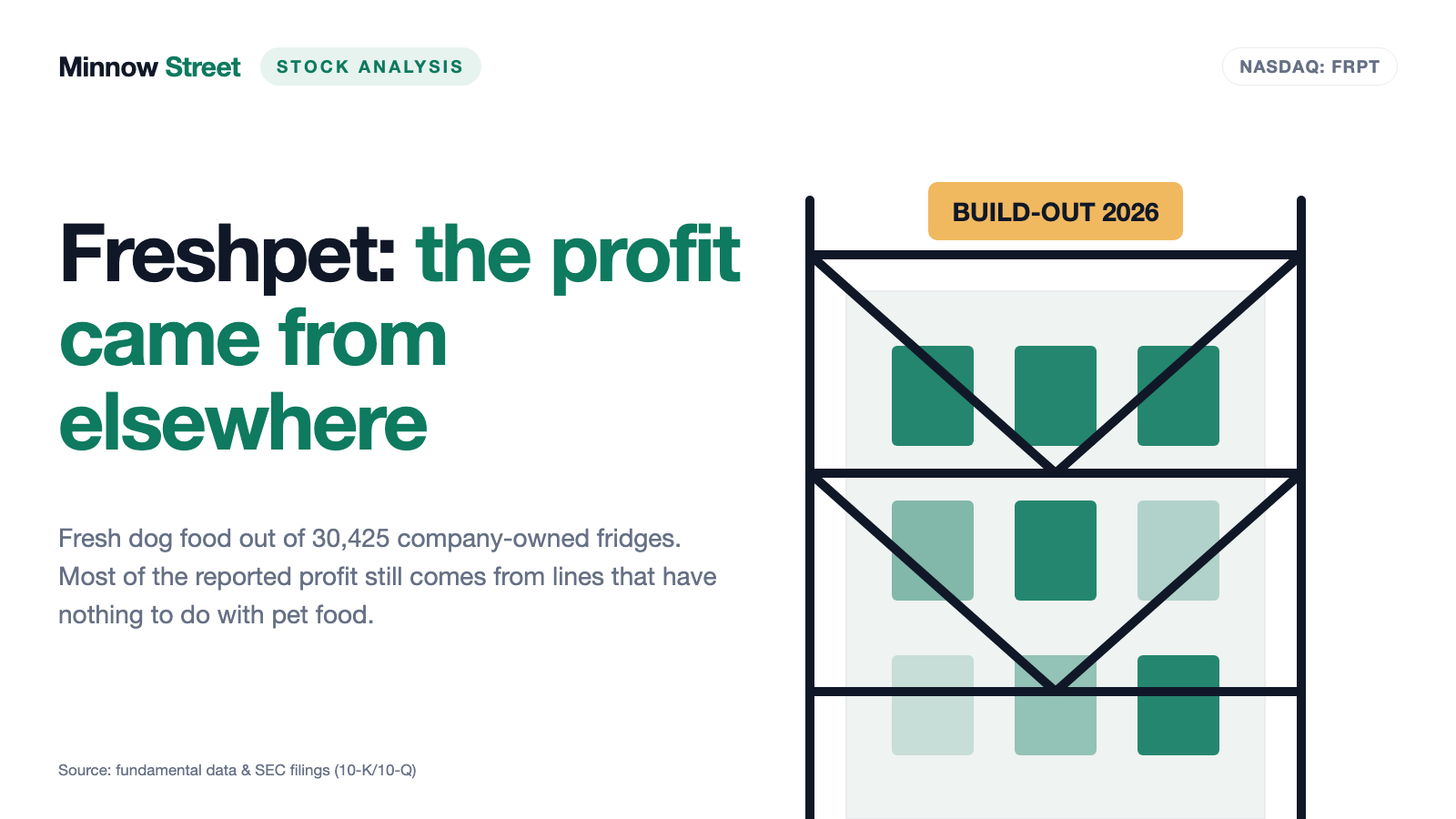
Freshpet sells fresh dog food out of 30,425 company-owned fridges in grocery stores. The company finally reports profits, and the price-to-earnings ratio suddenly looks cheap. One catch: of the $65.6 million in pre-tax profit in the first quarter of 2026, $62.0 million came from selling an equity investment. The operating business contributed $4.3 million, or 1.5 percent of net sales. The year before, it was a $68.4 million tax entry. We read the annual report (10-K) for 2025 and the quarterly report (10-Q) for the period ended March 31, 2026 line by line: what the fridge network really earns, what was one-time only, and what is left of it in 2026. No recommendation — just the question of how much turnaround sits inside a profit that did not come from the food.
 Thomas Mücke
Founder & Publisher
Thomas Mücke
Founder & Publisher
Chart
Interactive price chart (TradingView).
Note: pure fact-based analysis, not investment advice and not a solicitation to buy or sell. All figures without guarantee.
Table of Contents
- The receipt trap
- What Freshpet actually does
- How the stock landed on our desk
- The numbers over the years — given their due
- What the filings say — the uncomfortable truths
- Valuation: cheap on earnings, expensive on everything else
- Opportunities and risks at a glance
- A human conclusion
- Sources
The receipt trap
There is a thinking error that catches us in daily life just as reliably as in the market: the receipt trap. At the end of the month the bank statement shows a plus, and the mind files it under "I earn well" — even though the plus came from selling the car. The amount is real. The conclusion is not.
Freshpet, Inc. (NASDAQ: FRPT) is the textbook case. After years of red ink, the maker of fresh dog food finally reports profits: $139.1 million in fiscal 2025 and $48.5 million in the first quarter of 2026 alone. That puts the price-to-earnings ratio in the mid-teens — which, for a company that has more than quadrupled revenue since 2019, sounds like a find.
Before the reflex takes over, let us make a deal: we read the annual report (10-K) for 2025 and the quarterly report (10-Q) for the period ended March 31, 2026 together, and specifically the lines where that profit actually arises. Remember this sentence for the rest of the piece: a profit tells you money arrived — not that it came from the business.
What Freshpet actually does
Freshpet sells fresh, refrigerated dog and cat food. Not kibble from a bag, not wet food from a can, but product that sits in a chilled case and carries an expiration date — sold under the Freshpet brand and, for treats, under Dognation and Dog Joy. The idea behind it is pet humanization: people who buy fresh food for themselves are meant to do the same for the dog.
The real trick, though, is not the food. It is the fridge. A normal grocery store has no chilled case in the pet aisle, so Freshpet installs one at its own expense, in its own branding, typically four feet wide and seven feet high, replacing standard shelving or occupying an end-cap. The company describes it plainly in the quarterly report:

As of March 31, 2026, those fridges stood in 30,425 stores across North America and parts of Europe, up from 30,235 at December 31, 2025. Roughly 24 percent of stores had more than one at the end of 2025. That is the moat and the invoice at the same time: whoever installs a fridge takes a slot no competitor can have — and pays for it. The balance sheet at March 31, 2026 carries $210.809 million of refrigeration equipment at cost, inside gross property and equipment of $1,498.995 million.
Sales run through two channel groups. In the first quarter of 2026, $232.3 million (78 percent) came from grocery, mass, international and digital, and $65.3 million (22 percent) from pet specialty and club. The second group is growing faster — a year earlier its share was 18 percent.
Production happens in company-owned plants: Freshpet Kitchens Bethlehem in Pennsylvania, at roughly 100,000 and 140,000 square feet, and Freshpet Kitchens Ennis in Texas, at roughly 400,000 square feet after the first build stage. Stages two and three are meant to add another 400,000 square feet or so over the coming years. Keep that in mind for later: this company is always building — and building costs money before it brings any in.
One concentration risk is named without varnish in the annual report:
"In 2025, our largest distributor by net sales accounted for less than 10% of our net sales and our largest customers, Walmart and Costco, accounted for 25% and 10% of our net sales, respectively."
— Freshpet, Inc., SEC annual report 10-K for 2025, Item 1 ("Business")
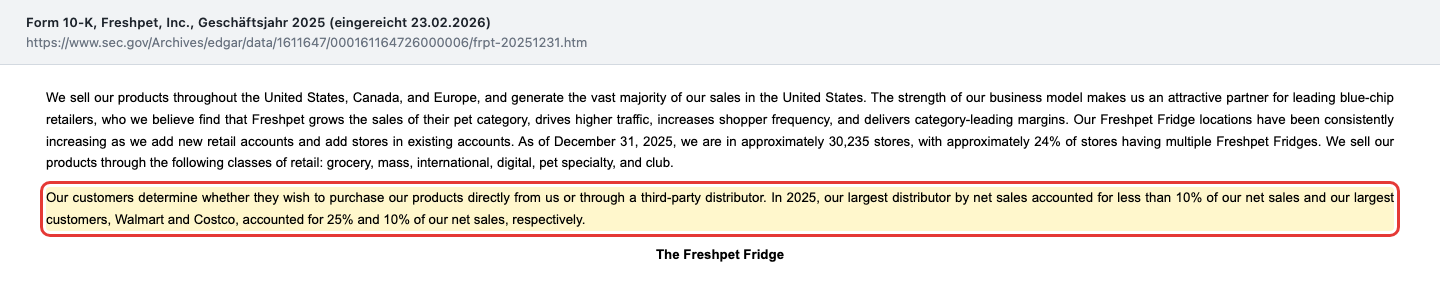
Thirty-five percent of net sales hang on two phone numbers. That is not unusual in packaged food, but it shifts the balance of power: a company with 30,425 fridges standing inside somebody else's stores does not negotiate shelf space from a position of strength.
How the stock landed on our desk
We run roughly 3,200 stocks through our scanners every day. Freshpet reached the research list through our in-house stock scanner "Turnaround Candidates": rank 11 of 60 U.S. hits, turnaround check 7 of 8 points, measured on the live list on July 27, 2026. To reproduce it: open the scanner and sort by the "turnaround check" column. These lists are recalculated daily — rank and score are a dated snapshot, not a permanent state.
The model behind it rests on four pillars, and two of them are mandatory. Fail either one and the stock drops out, however good the rest looks.
- Pillar 1 — the crash: the stock must trade at least 50 percent below its all-time high. Without a real crash there is no turnaround; otherwise the scanner simply catches ordinary growth stocks.
- Pillar 2 — survival: the Altman Z-score must be at least 1.1. That metric is a bankruptcy early-warning system: it compresses liquidity, profitability, leverage and asset efficiency into a single number. Below 1.1 the distress zone begins — the classic turnaround mistake is going bust before the turn. On top of that come no more than one balance sheet warning flag and positive equity.
Only then does the actual turnaround check count: eight points, four from the quarterly numbers (revenue direction, net margin, operating cash flow, healing balance sheet) and four from market behavior (price back above the 50-day line, short-term relative strength above long-term, insider buying, institutions adding). Anything from 6 of 8 upward is displayed. Freshpet stands at 7 of 8 — only one of the eight tests fails.
Pillar 2 is comfortable: the Altman Z-score is 7.60 (data cut-off July 27, 2026), far above the 3.0 mark at which the metric counts as safe. The equity ratio is 68.6 percent, the Piotroski balance sheet score 6 of 9. No survival problem here.
On pillar 1, a word about data quality belongs on the table. Our platform stores the distance to the all-time high at −71.5 percent (data cut-off July 27, 2026). We recomputed it against our own price history: the highest close in company history is $184.82 on April 30, 2021, the highest intraday print $186.98 on May 3, 2021. Against the closing price of $57.54 on July 24, 2026, that gives −68.9 percent on a closing basis and −69.2 percent on an intraday basis. All three measures sit in the same corridor; the small gap comes from the price date used, not from a misplaced all-time high. There has never been a stock split to distort the history.
Which sets the price threshold: pillar 1 only breaks once the stock trades above roughly $93 (half of $186.98; on a closing basis it would be $92). From the July 24, 2026 level that would take a gain of about 62 percent. And here is the difference from many other names on this list: the average price target of the 19 analysts covering the stock is $81.25 (data cut-off July 27, 2026) — that is below the exclusion threshold. Even if the professionals are right, Freshpet stays on this list. That is the rarer configuration; for other candidates such as Dollar General, the analyst target sits above the threshold, so a rally there would throw the stock out of the scanner.
At the same data cut-off, Freshpet also appears on eight other lists, among them "Big Earnings Surprise", "Insider buying (net)", "Institutions and insiders adding" and "Power Trend". That too is a snapshot from July 27, 2026 and changes with every recalculation. Remember the distinction: a scanner rank is an invitation to research, not a verdict on the company.
The numbers over the years — given their due
Start with what genuinely impresses: net sales have never fallen. $245.9 million (2019), then $318.8 million, $425.5 million, $595.3 million, $766.9 million, $975.2 million and most recently $1,102.0 million in fiscal 2025. A quadrupling in six years. And it is real volume growth: in the first quarter of 2026, volume rose 14.6 percent while price and mix together cost 1.5 percent. Freshpet is selling more food, not pricier food.
Margins have improved visibly as well. Gross margin climbed from 32.7 percent (2023) to 40.6 percent and 40.8 percent (2025); in the first quarter of 2026 it stood at 40.5 percent against 39.4 percent a year earlier. Adjusted EBITDA — roughly operating profit before depreciation and special items — rose from $66.6 million (2023) to $161.8 million and $195.7 million (2025), or from 8.7 to 17.8 percent of net sales. That is not cosmetics. The plants are filling up.
Operating income followed: from minus $30.4 million (2023) to plus $38.0 million (2024) and plus $75.7 million (2025). And for the first time, money was left after the excavators were paid — more on that shortly.
One curve, though, points the other way, and it is the most important one in this piece:
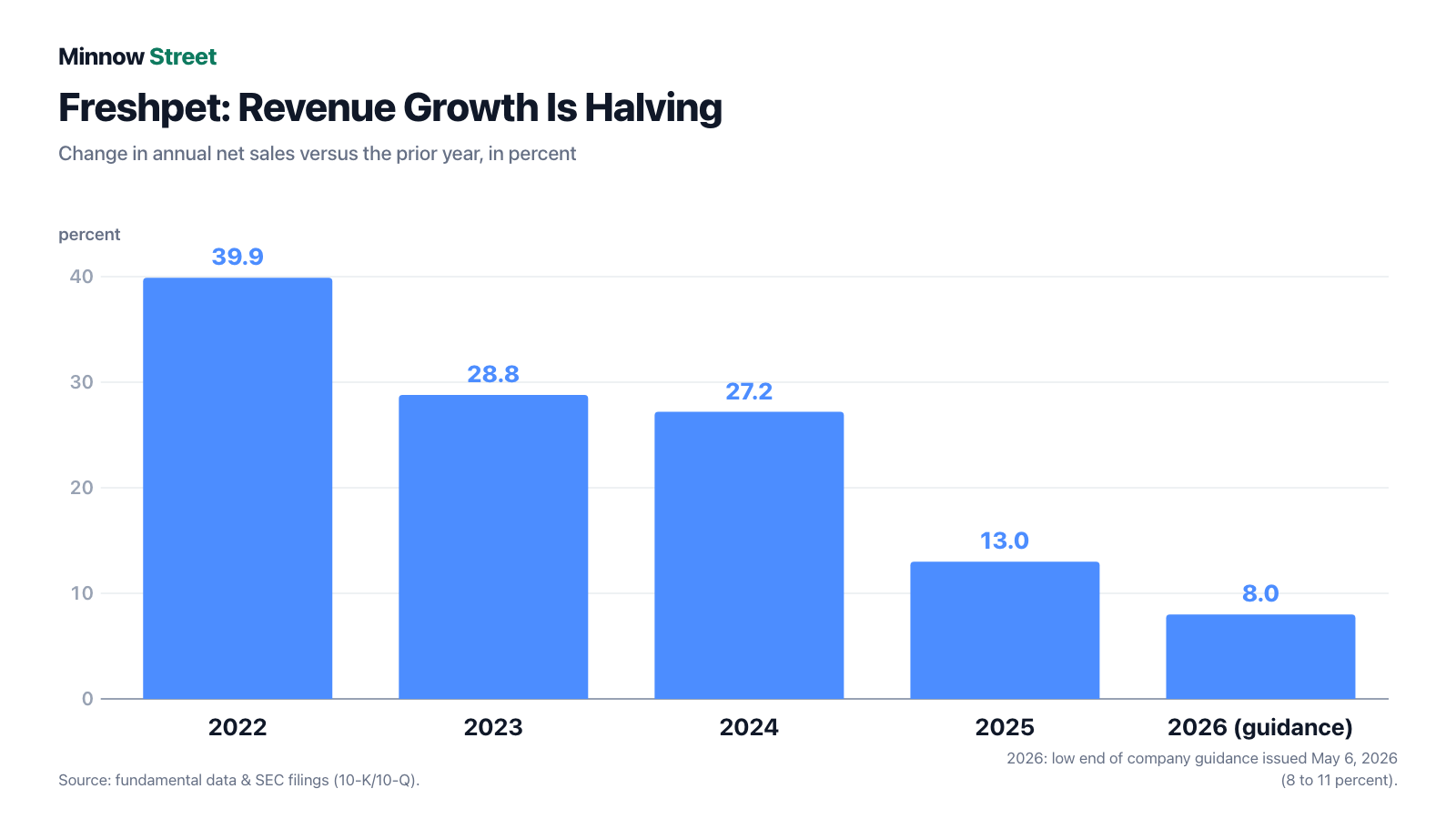
From 39.9 percent (2022) through 28.8 and 27.2 to 13.0 percent (2025). On May 6, 2026 the company guided to growth of 8 to 11 percent for 2026 — raised from 7 to 10 percent, because the first quarter came in at 13.1 percent, ahead of plan. Translated: Freshpet still grows faster than packaged food overall, but the era of doubling is over.
The balance sheet at March 31, 2026 is notably solid. Total assets of $1,839.2 million, of which $1,143.6 million is property and equipment and $381.4 million is cash. Against that sit $577.1 million of liabilities, essentially the convertible note at a carrying value of $397.9 million. Equity stands at $1,262.1 million. The accumulated deficit shrank in a single quarter from $142.7 million to $94.2 million — further evidence that money really is sticking. Just not only from the food. Which brings us to the uncomfortable truths.
What the filings say — the uncomfortable truths
Uncomfortable truth No. 1: the 2025 profit came from the tax authorities
The bottom line of the 2025 income statement reads beautifully: $139.1 million of net income after $46.9 million the year before. One line above sits pre-tax income: $70.8 million. Normally the bottom line is smaller than the one above it, because taxes come out. Here it is almost twice as large.
The reason is a balance sheet entry. Companies may offset accumulated losses against future profits and carry that advantage as a "deferred tax asset" — but only if they can credibly argue that future profits will exist. Anyone in doubt must record a valuation allowance that writes the asset down to zero. Freshpet had done exactly that at the end of 2024. A year later it reversed the judgment:
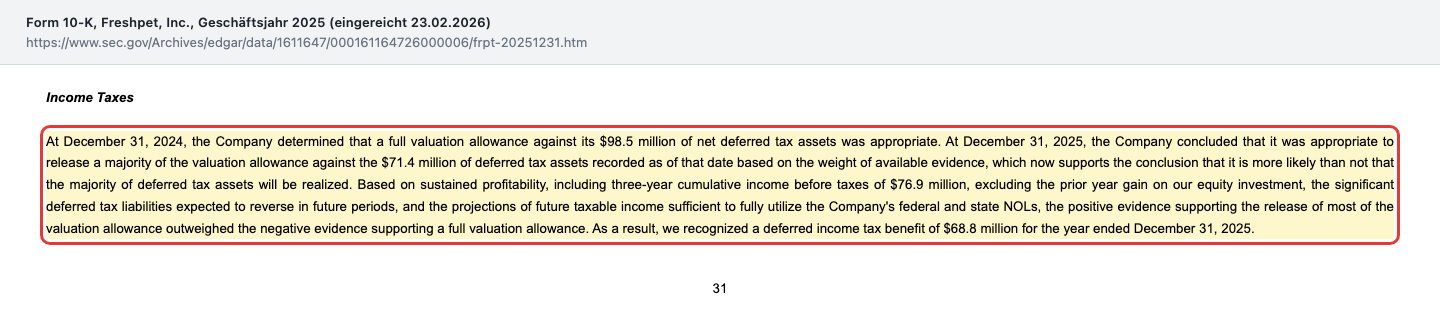
"At December 31, 2024, the Company determined that a full valuation allowance against its $98.5 million of net deferred tax assets was appropriate. At December 31, 2025, the Company concluded that it was appropriate to release a majority of the valuation allowance against the $71.4 million of deferred tax assets recorded as of that date […] As a result, we recognized a deferred income tax benefit of $68.8 million for the year ended December 31, 2025."
— Freshpet, Inc., SEC annual report 10-K for 2025, Item 7 MD&A ("Income Taxes")
The bottom line for 2025 was therefore an income tax benefit of $68.4 million rather than a tax expense. Strip it out and roughly $70 million of profit remains instead of $139.1 million — half. The entry is neither a trick nor an error; it is arguably a good sign, because the company now backs its own future earnings. But it can be made exactly once. What remains are loss carryforwards of $391.1 million at the federal level and $275.4 million at the state level (as of December 31, 2025), whose use may be limited under Section 382 of the U.S. tax code.
Uncomfortable truth No. 2: the 2026 quarterly profit came from selling a stake
The first quarter of 2026 repeats the pattern with a different label. Freshpet had held a minority stake in a privately held company since 2020. On January 16, 2026, that company was acquired by a third party, and Freshpet cashed out:

"The $62.0 million gain on equity investment for the three months ended March 31, 2026, resulted from the sale of the Company's non-controlling interest in a privately held company following the equity investment's acquisition by a third party."
— Freshpet, Inc., SEC quarterly report 10-Q for the period ended March 31, 2026, Item 2 MD&A
Here is what the bridge from operating income to net income looks like in that quarter:
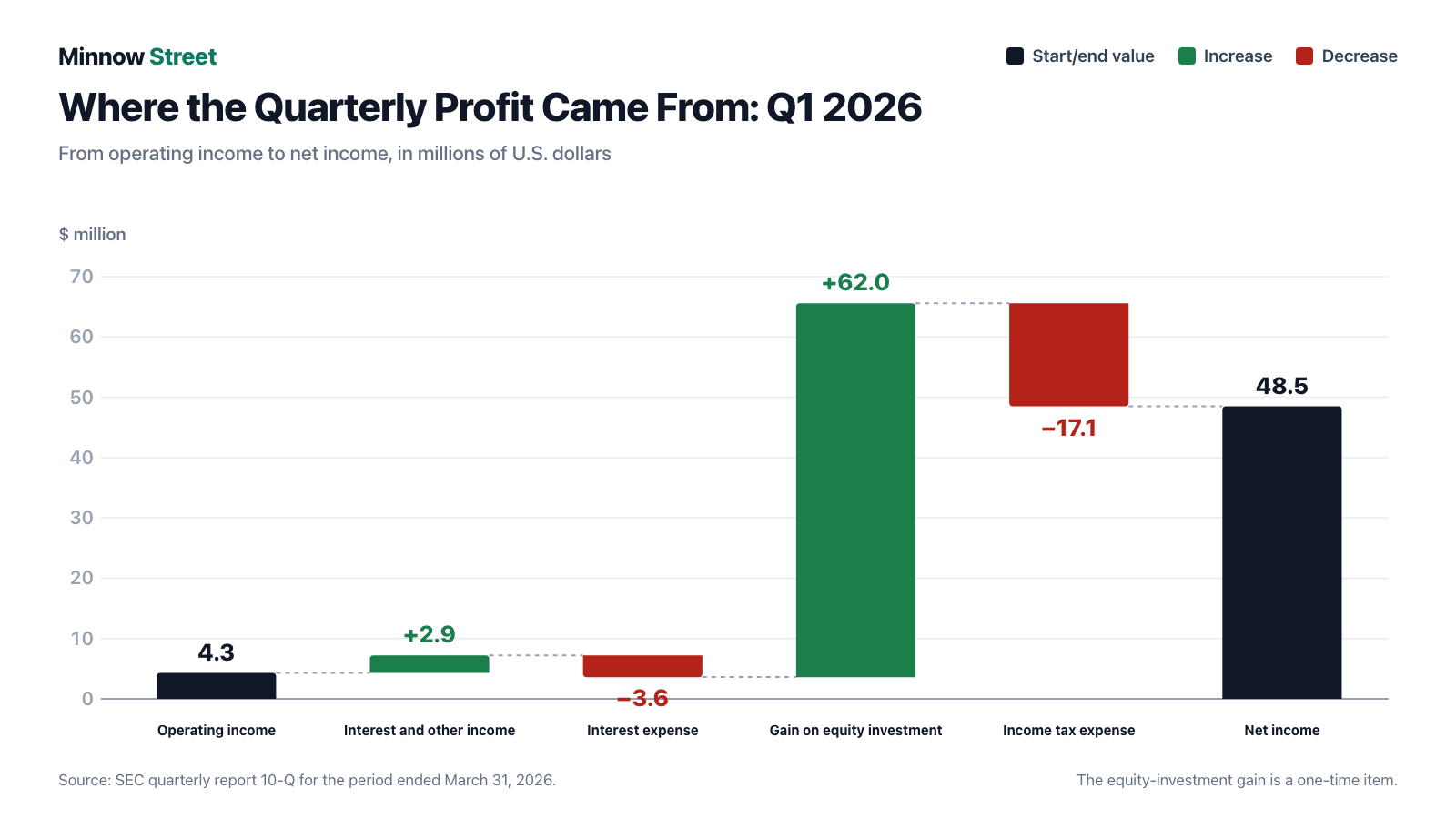
In numbers: operating income $4.331 million, interest and other income $2.883 million, interest expense minus $3.586 million, gain on the equity investment plus $62.013 million, income tax expense minus $17.133 million, net income $48.508 million. Of the $65.641 million of pre-tax income, 94 percent came from the one-time item. Without it, $3.6 million of pre-tax profit would remain — on $297.6 million of net sales.
The operating margin in that quarter was therefore 1.5 percent. For comparison: full-year 2025 was 6.9 percent. The first quarter is traditionally Freshpet's weakest — a year earlier it produced an operating loss of $11.5 million. The direction is right. The level is not yet.
Uncomfortable truth No. 3: the growth is bought with advertising
Freshpet makes no secret of how the volume growth happens: through advertising. The segment table in the annual report shows media costs as their own line — $85.5 million (2023), $111.3 million (2024), $140.5 million (2025). Measured against net sales that is 11.1, then 11.4 and most recently 12.7 percent. For context: roughly one dollar in eight of 2025 net sales went into advertising alone.
In the first quarter of 2026 it was $47.0 million against $39.8 million a year earlier — 15.8 percent of quarterly net sales after 15.1 percent. The company itself cites "increased media spend" as the reason adjusted selling, general and administrative expenses grew faster than sales, rising from 32.2 to 34.2 percent of net sales.
That is the real question behind the business model: is the advertising a kick-start or a permanent rent? Putting a fridge into a store that has never carried fresh dog food means the shopper has to be sent there first. If she stays, the advertising was an investment. If she has to be sent again every year, it is a running cost block that caps the margin for good. No filing answers this. It only shows up the year advertising grows more slowly than sales. So far it has been the other way around.
Uncomfortable truth No. 4: for six years the cash went out, not in
A fridge network is expensive; a plant is more expensive still. From 2023 through 2025, Freshpet invested $239.1 million, then $187.1 million and most recently $148.2 million in property, equipment and software — $574.4 million in total. Operating cash flow over the same three years was $75.9 million, $154.3 million and $160.6 million, or $390.8 million combined. Across three years that leaves a gap of $183.6 million, covered from cash and from the convertible note.
From 2019 through 2024, free cash flow was negative in every single year, at worst minus $321.5 million in 2021 (fundamental data, cut-off July 27, 2026). In 2025 it turned positive — and it was modest: $160.6 million of operating cash flow less $148.2 million of capital expenditures leaves $12.4 million. For 2026 the company again promises a positive figure, on capital spending of roughly $150 million. In the first quarter of 2026, $40.3 million of operating cash flow met $27.6 million of capital spending; without the $95.5 million of sale proceeds, cash would have risen only slightly.
Remember the yardstick: a company that generates $1.10 billion of net sales and needs $1.50 billion of property and equipment at cost to do it is not a branded food company but an industrial operation with a brand attached. That is not a criticism — it is simply a completely different valuation logic.
Uncomfortable truth No. 5: the convertible note already dilutes
In March 2023, Freshpet issued a convertible note to fund the plant build-out. The terms are in the annual report:
"The Convertible Notes are our senior, unsecured obligations and accrue interest at a rate of 3.0% per annum, payable semi-annually in arrears on April 1 and October 1 of each year, beginning on October 1, 2023. The Convertible Notes will mature on April 1, 2028 unless earlier converted, redeemed or repurchased by us."
— Freshpet, Inc., SEC annual report 10-K for 2025, Note 8 ("Convertible Senior Notes")
The principal amount is $402.5 million and the conversion rate 14.3516 shares per $1,000 — a conversion price of roughly $69.68 per share. Dilution in plain language: your slice of the cake gets smaller because the cake is cut into more pieces. And the effect is already live: in the first quarter of 2026, 49.062 million basic shares stood against 56.060 million diluted shares, a spread of 14.3 percent. Diluted earnings per share therefore came in at $0.91 instead of $0.99.
To cushion it, Freshpet bought capped call options for $66.211 million in 2023 — a hedge that absorbs part of the dilution. Since April 3, 2026, the company may call the notes under certain price conditions. Cash stood at $381.4 million at March 31, 2026, just below the principal amount — Freshpet could almost, but not quite, retire the note from its own resources today.
What happened with the activist — and who is leaving now
Part of the backstory shows up in the numbers only as a cost line. On September 22, 2022, activist investor JANA Partners filed a Schedule 13D — the form you choose when you intend to exert influence. On August 21, 2023 the two sides signed a cooperation agreement, still listed as a contract in the exhibit index of the 2025 annual report. The fight cost money: the annual report shows $8.177 million of "shareholder activism defense engagement" for 2023. In the ninth and final amendment to its filing on January 11, 2024, JANA reported 2,383,150 shares, or 4.9 percent — below the five percent threshold, the reporting obligation ends.
And in the summer of 2026, part of the leadership changes. In a current report dated June 24, 2026, Freshpet announced that co-founder and President Scott Morris will retire effective October 20, 2026. He will then advise the company for 18 months against payments of $38,904 every two weeks and is bound by a 24-month non-compete. Nicola Baty, chief operating officer since September 2024, takes on the additional role of President on the same date. At the annual meeting on June 10, 2026, all twelve directors were elected and KPMG was ratified as auditor.
Valuation: cheap on earnings, expensive on everything else
Now it becomes clear why the receipt trap snaps so neatly shut at Freshpet. At a price of $57.54 (closing price July 24, 2026) and 49,142,791 shares per the cover page of the quarterly report (as of April 30, 2026), market value comes to roughly $2.83 billion. Add the convertible note at $397.9 million and subtract cash of $381.4 million, and enterprise value is about $2.84 billion. Freshpet is effectively debt-free.
And now the metrics, all with a data cut-off of July 27, 2026:
- Price-to-earnings ratio of roughly 15 on the trailing twelve months — the number that looks cheap. It rests on earnings largely composed of the tax entry and the sale of the equity investment. It is not a valuation basis.
- Forward price-to-earnings ratio of roughly 35 — the more honest figure, because estimates for 2026 exclude one-time items.
- Enterprise value to adjusted EBITDA of roughly 14.5 on the $195.7 million from 2025; against company guidance of $205 million to $215 million for 2026 it is 13.2 to 13.9.
- Price-to-sales ratio of roughly 2.6 on 2025 net sales — for a food maker with a 6.9 percent operating margin, that is no bargain signal.
- Price to free cash flow above 200 — $2.83 billion of market value against $12.4 million of 2025 free cash flow. The number is uselessly high, and that is precisely the point: free cash flow is only just beginning.
- Price-to-book ratio of 2.2 on book value per share of $25.68 (as of March 31, 2026).
What the professionals think: 19 analyst opinions break down into 12 strong buy, 2 buy and 5 hold, with no sell rating; the average price target is $81.25 (data cut-off July 27, 2026). That is an unusually friendly picture — and it assumes the operating margin grows into the place the valuation already assumes it occupies.
On the other side of the table sits a large opposing position: as of July 27, 2026, 8,685,116 shares were sold short — roughly 18 percent of the 48,190,404-share float. Anyone betting that hard against a stock considers the growth story vulnerable. The share price moves accordingly: 52-week high $86.00 (March 5, 2026), 52-week low $46.45 (May 20, 2026), beta 1.61. Freshpet pays no dividend and runs no buyback program.
Readers who like this kind of setup will find a counterexample from the same scanner list in our CorVel analysis: a fallen share price attached to a business that has thrown off cash under its own power for years.
Opportunities and risks at a glance
What speaks for Freshpet:
- Real volume growth. Volume rose 14.6 percent in the first quarter of 2026 while price and mix cost 1.5 percent. The demand is not bought, it is there.
- A network that is hard to copy. 30,425 stores with a company-owned fridge (as of March 31, 2026) form a physical barrier: a challenger must first make the same investment and then still win the shelf space.
- Margins are visibly improving. Gross margin from 32.7 percent (2023) to 40.8 percent (2025), adjusted EBITDA from $66.6 million to $195.7 million, adjusted EBITDA margin from 8.7 to 17.8 percent.
- A quiet balance sheet. Equity ratio 68.6 percent, Altman Z-score 7.60, cash of $381.4 million against a $397.9 million convertible note — effectively no net debt.
- The heaviest build stage is behind the company. Capital spending fell from $239.1 million (2023) to $148.2 million (2025), and 2025 turned free cash flow positive after six negative years.
What works against it:
- The reported profit is not an operating profit. The $68.4 million tax benefit (2025) and the $62.0 million gain on the equity investment (Q1 2026) are one-time items. The operating business contributed $4.3 million in the first quarter of 2026.
- Growth is halving. From 39.9 percent (2022) to 13.0 percent (2025); guidance for 2026 is 8 to 11 percent.
- Advertising is getting more expensive. Media costs of $140.5 million, or 12.7 percent of net sales (2025), and 15.8 percent in the first quarter of 2026.
- Two customers, a third of net sales. Walmart 25 percent, Costco 10 percent (2025).
- Dilution. The $402.5 million convertible note already lifts the diluted share count by 14.3 percent; it matures April 1, 2028.
- Leadership change and a heavy short position. The co-founder retires effective October 20, 2026; roughly 18 percent of the float is sold short (data cut-off July 27, 2026).
A human conclusion
Back to the receipt trap. Freshpet really did make money in 2025 and early 2026 — but most of it came from a tax reclassification and from selling a stake in somebody else's company. That is not an accusation. Both are cleanly booked, plainly explained and readable in the filings. It simply is not what a metric like "price-to-earnings ratio of 15" sounds like.
At the same time it would be unfair to reduce the company to that. Beneath the one-time money runs a business that sells more food every quarter, fills its plants better each year and has lifted its gross margin by eight percentage points. What is missing is the last step: an operating profit at the end of that chain that needs no supplement. In 2025 the margin was 6.9 percent; in the weakest quarter of 2026 it was 1.5 percent.
So the honest question is not "is Freshpet cheap?" but: do you believe the fridge network will eventually throw off double-digit operating margins — and are you willing to wait for it? Answer yes and you are buying a bet on scale. Answer no and you are looking at a solid company at a price it still has to earn.
What you make of that is your decision. And that is exactly as it should be.
Sources
- Freshpet, Inc. — annual report 10-K for 2025 (filed February 23, 2026)
- Freshpet, Inc. — annual report 10-K for 2024 (filed February 20, 2025)
- Freshpet, Inc. — quarterly report 10-Q for the period ended March 31, 2026 (filed May 6, 2026)
- Freshpet, Inc. — quarterly report 10-Q for the period ended September 30, 2025 (filed November 3, 2025)
- Freshpet, Inc. — first quarter 2026 results and 2026 outlook, Exhibit 99.1 to the current report 8-K of May 6, 2026
- Freshpet, Inc. — current report 8-K of June 24, 2026 (Item 5.02, retirement of the co-founder)
- Freshpet, Inc. — current report 8-K of June 11, 2026 (Item 5.07, annual meeting results)
- JANA Partners Management, LP — Schedule 13D/A No. 9 on Freshpet (filed January 11, 2024)
- SEC filing index, CIK 0001611647
- Fundamental data and price history (data cut-off July 27, 2026)
This analysis is journalistic commentary on publicly available documents and is expressly not investment advice and not a solicitation to buy or sell securities. Share prices can move sharply; a total loss of the capital invested is possible. All figures come from the primary documents linked above and carry the reporting date stated there; price and valuation figures are dated snapshots. The author holds no position in Freshpet, Inc. at the time of publication.
Our Bottom Line at a Glance
- Demand & market position positive
- Net sales rose without interruption from $245.9 million (2019) to $1,102.0 million (2025). The quarter ended March 31, 2026 added 13.1 percent, driven by 14.6 percent more volume against an unfavorable price and mix effect of 1.5 percent. The network of 30,425 company-owned fridges (as of March 31, 2026) is a physical barrier for imitators.
- Operating turn positive
- Gross margin climbed from 32.7 percent (2023) to 40.8 percent (2025), adjusted EBITDA from $66.6 million to $195.7 million, and the adjusted EBITDA margin from 8.7 to 17.8 percent. Operating income turned from minus $30.4 million (2023) to plus $75.7 million (2025). In the quarter ended March 31, 2026, adjusted EBITDA improved from $35.5 million to $37.9 million.
- Source of the reported profit negative
- In fiscal 2025, pre-tax income of $70.8 million met net income of $139.1 million — the difference is a $68.4 million income tax benefit from releasing a valuation allowance. In the quarter ended March 31, 2026, $62.0 million of the $65.6 million pre-tax profit (94 percent) came from the sale of an equity investment. Operating income was $4.3 million, or 1.5 percent of net sales.
- Growth rate & advertising cost negative
- Net sales growth fell from 39.9 percent (2022) through 28.8 and 27.2 to 13.0 percent (2025); guidance issued May 6, 2026 calls for 8 to 11 percent in 2026. It is being held up by advertising: media costs rose from $85.5 million (2023) through $111.3 million to $140.5 million (2025) — from 11.1 to 12.7 percent of net sales; in the quarter ended March 31, 2026 they were $47.0 million, or 15.8 percent.
- Balance sheet & capital needs neutral
- The balance sheet is robust: equity of $1,262.1 million, an equity ratio of 68.6 percent, an Altman Z-score of 7.60 and cash of $381.4 million against a convertible note carried at $397.9 million (as of March 31, 2026). At the same time the model is capital-hungry: $574.4 million went into property and equipment from 2023 through 2025 against $390.8 million of operating cash flow; free cash flow turned positive only in 2025, at $12.4 million after six negative years, and roughly $150 million of capital spending is planned for 2026.
- Valuation & ownership neutral
- Roughly $2.83 billion of market value (49,142,791 shares at a closing price of $57.54 on July 24, 2026) equals 14.5 times 2025 adjusted EBITDA and 2.6 times net sales; the trailing price-to-earnings ratio of about 15 is distorted by the one-time items, while the forward figure is about 35. Nineteen analysts arrive at an average price target of $81.25, yet roughly 18 percent of the float is sold short (data cut-off July 27, 2026).
Freshpet has left the bottom behind: gross margin rose from 32.7 percent (2023) to 40.8 percent (2025), adjusted EBITDA from $66.6 million to $195.7 million, and 2025 turned free cash flow positive after six negative years, at $12.4 million. The uncomfortable half: the reported profit has so far come mostly from elsewhere. A $68.4 million tax benefit carried half of the $139.1 million of 2025 net income, and $62.0 million of the $65.6 million pre-tax profit in the quarter ended March 31, 2026 came from selling an equity investment; operating income in that quarter was $4.3 million, or 1.5 percent of net sales. Growth is halving as well (13.0 percent in 2025, guidance of 8 to 11 percent for 2026) while media costs climbed to 12.7 percent of net sales. The financing is comfortable: a 68.6 percent equity ratio, an Altman Z-score of 7.60 and effectively no net debt. Not investment advice.
What Our Rating Means
Open questions
The business works in principle, but one material question is open. As long as it stays open, our findings do not carry a quality verdict.
The business demonstrably works: net sales have not fallen in any year since the IPO and reached $1,102.0 million in 2025, gross margin rose to 40.8 percent and adjusted EBITDA to $195.7 million. Nothing supports red: equity of $1,262.1 million at a 68.6 percent equity ratio, an Altman Z-score of 7.60, cash of $381.4 million against a $397.9 million convertible note, no going-concern doubt and no covenant problem. Green is out of reach because the operating question is too large and too open: in both of the most recent reported periods the reported profit rested mostly on one-time items — a $68.4 million tax benefit in 2025 and a $62.0 million investment gain in the quarter ended March 31, 2026 — while operating income in that quarter was $4.3 million and net sales growth has fallen from 39.9 to 13.0 percent. A turnaround whose operating half is still ahead is yellow, even when the balance sheet carries it easily. The decision is yours.
A journalistic assessment by our editorial team at the time of the deep dive, based on public sources — not investment advice and not a solicitation to buy or sell. Your personal circumstances (investment goals, risk capacity, taxes) cannot be taken into account. What our levels mean, how verdicts are formed, and what conflicts of interest exist →
Worth Noting
- Hook: our in-house stock scanner "Turnaround Candidates" — rank 11 of 60 U.S. hits, turnaround check 7 of 8, measured on the live list on July 27, 2026. The lists are recalculated daily; rank and score are a dated snapshot, not a permanent state. The display starts at 6 of 8 points.
- The scanner's two mandatory pillars: at least 50 percent below the all-time high and an Altman Z-score of at least 1.1. Both are comfortably met (Altman Z 7.60; roughly 69 percent below the all-time high). Pillar 1 only breaks above roughly $93 (half of the highest intraday print of $186.98 on May 3, 2021; $92 on a closing basis). The average analyst price target of $81.25 sits below that — unlike many other candidates on this list, reaching the target would not throw the stock out of the scanner.
- Plausibility check on the all-time-high figure: the stored distance of −71.5 percent was recomputed against our own price history. Highest close $184.82 on April 30, 2021, highest intraday print $186.98 on May 3, 2021; against the closing price of $57.54 on July 24, 2026 that gives −68.9 percent (closing basis) and −69.2 percent (intraday basis). The stored value reflects the same calculation on an earlier price date. There is no all-time high misplaced by a factor of 1,000 here, and there has never been a stock split.
- No takeover situation: as of July 27, 2026 the SEC filing history contains neither a solicitation/recommendation statement (SC 14D9) nor a merger document, no Form 15 and no Form 25. Activist investor JANA Partners filed a Schedule 13D on September 22, 2022, signed a cooperation agreement on August 21, 2023 and reported 2,383,150 shares, or 4.9 percent, in the ninth and final amendment on January 11, 2024. Defense costs of $8.177 million are disclosed for fiscal 2023 as "shareholder activism defense engagement".
- Recency gate: the most recent periodic report is the 10-Q for the period ended March 31, 2026 (filed May 6, 2026). Filed after that, up to the July 27, 2026 data cut-off: the current report 8-K of June 11, 2026 (Item 5.07, annual meeting of June 10, 2026 — all twelve directors elected, KPMG ratified as auditor), the current report 8-K of June 24, 2026 (Item 5.02, retirement of co-founder and President Scott Morris effective October 20, 2026, with Nicola Baty taking on the role), routine insider filings (Form 4 and Form 144) and ownership filings on Schedule 13G, most recently July 15, 2026. All reviewed.
- Price figures are dated valuation anchors, not buy arguments: closing price $57.54 on July 24, 2026, 52-week high $86.00 (March 5, 2026), 52-week low $46.45 (May 20, 2026). Cross-check on market value: 49,142,791 shares per the cover page of the quarterly report (as of April 30, 2026) times $57.54 gives $2.83 billion — matching the value from fundamental data.
- Risk of confusion: Freshpet, Inc. (FRPT) is not related to Chewy, Inc. (CHWY), Petco Health and Wellness (WOOF) or the Nestlé unit Purina; the reference here is the Nasdaq listing under CIK 0001611647. The privately held company behind the equity investment is not named in the quarterly report.
Frequently Asked Questions
Freshpet makes fresh, refrigerated dog and cat food and sells it through a network of company-owned branded fridges inside other retailers' stores — 30,425 locations as of March 31, 2026. Net sales were $1,102.0 million in 2025. In the quarter ended March 31, 2026, 78 percent came from grocery, mass, international and digital and 22 percent from pet specialty and club.
Because 2025 brought an income tax benefit of $68.4 million instead of a tax expense. Freshpet released most of the valuation allowance on its deferred tax assets and recognized a deferred income tax benefit of $68.8 million. That turned $70.8 million of pre-tax income into $139.1 million of net income. The entry cannot be repeated.
Ninety-four percent of it from a one-time item. On January 16, 2026, Freshpet received $95.5 million for the sale of its minority stake in a privately held company, producing a pre-tax gain of $62.0 million. Of the $65.6 million of total pre-tax income, $3.6 million would remain without it. Operating income was $4.3 million on $297.6 million of net sales.
Much more slowly than before. Net sales rose 39.9 percent in 2022, 28.8 percent in 2023, 27.2 percent in 2024 and 13.0 percent in 2025, to $1,102.0 million. On May 6, 2026 the company guided to growth of 8 to 11 percent for 2026. The first quarter of 2026 came in at 13.1 percent, driven by 14.6 percent more volume against an unfavorable price and mix effect of 1.5 percent.
The metrics argue in its favor: Altman Z-score 7.60, equity ratio 68.6 percent, Piotroski F-score 6 of 9 (data cut-off July 27, 2026). At March 31, 2026, cash of $381.4 million stood against a convertible note with a carrying value of $397.9 million; equity was $1,262.1 million on total assets of $1,839.2 million. There is effectively no net debt.
The scanner requires two mandatory pillars: at least 50 percent below the all-time high and an Altman Z-score of at least 1.1. Freshpet clears both comfortably — Altman Z of 7.60 and roughly 69 percent below the all-time high of $186.98 (May 3, 2021). Only a price above roughly $93 would break pillar 1. The turnaround check stands at 7 of 8 points, measured July 27, 2026; the lists are recalculated daily.
No. As of July 27, 2026 the SEC filing history contains neither a solicitation/recommendation statement (SC 14D9) nor a merger document. Activist investor JANA Partners, which filed a Schedule 13D on September 22, 2022 and signed a cooperation agreement on August 21, 2023, reported 4.9 percent in its final amendment on January 11, 2024 — below the reporting threshold.
Noticeably. The $402.5 million convertible note issued in March 2023 carries 3.00 percent interest and matures April 1, 2028; the conversion rate of 14.3516 shares per $1,000 works out to roughly $69.68 per share. In the first quarter of 2026, 49.062 million basic shares stood against 56.060 million diluted shares — a spread of 14.3 percent.
Found an error?
Did you spot a factual error, an outdated number, or a typo in this deep dive? Let us know briefly — your report goes straight to the editorial team.