$4,873 on the Market, $3,936 in the Till: Allied Gold and the Cash Offer That Has Been Waiting for a Stamp Since January
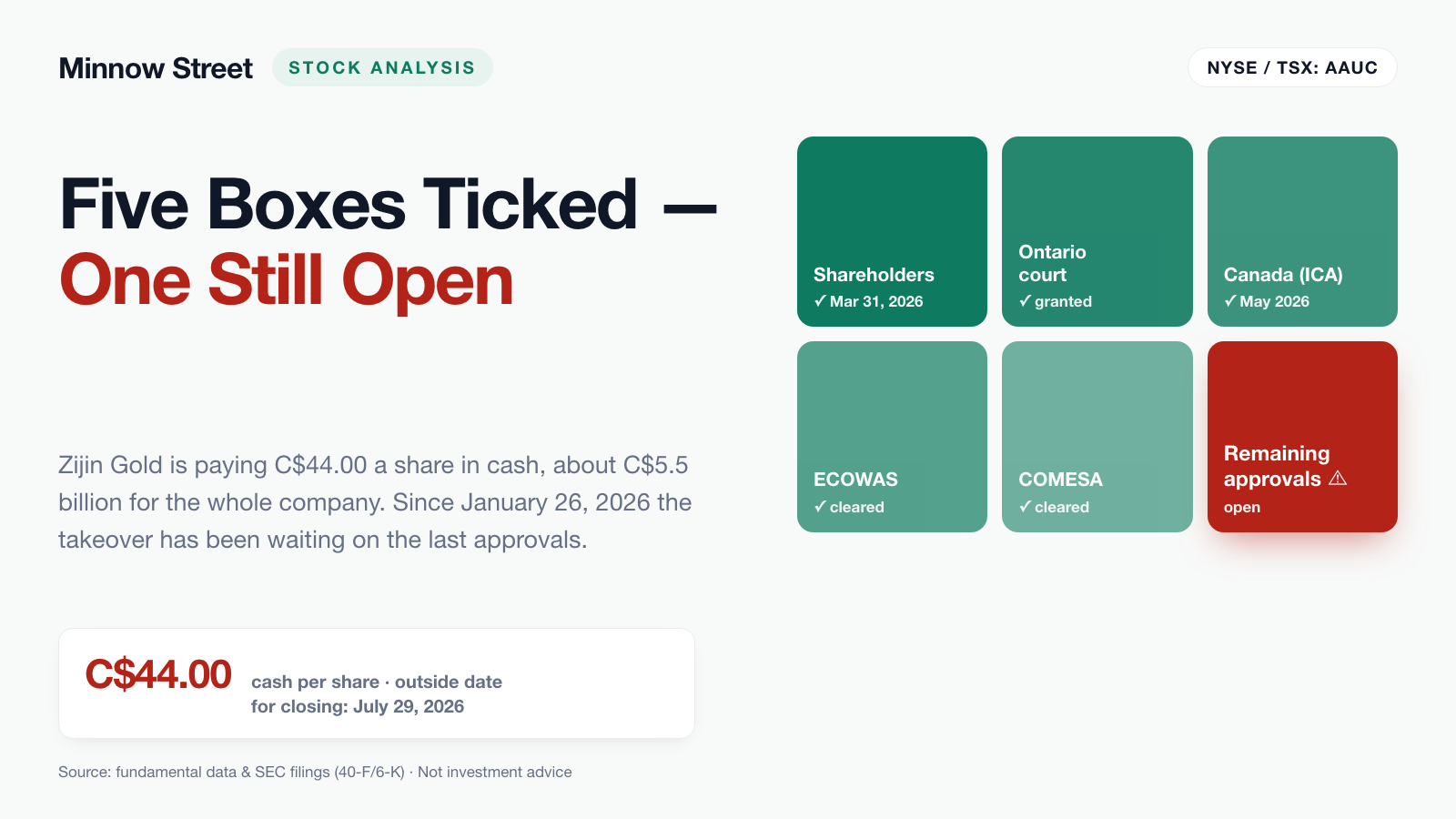
Allied Gold mines gold in Mali, Côte d’Ivoire and soon in Ethiopia — in the most expensive gold year on record. Its 2025 books still show a $51.8 million loss, and it lands entirely on the shareholders: the host governments, as co-owners of the mines, earned $55.2 million in the same year. In the first quarter of 2026 the average market price was $4,873 per ounce; $3,936 reached the till, because hedges and pre-sales shear off the peak. And above all of it, since January 26, 2026, sits a cash offer from Zijin Gold at C$44 per share — roughly C$5.5 billion for the whole company. Shareholders and the court have said yes, closing was expected by late April, and the deadline has already been pushed to July 29, 2026. No investment advice — just the question of what a share price actually measures once it hangs on a regulator’s signature.
 Thomas Mücke
Founder & Publisher
Thomas Mücke
Founder & Publisher
Chart
Interactive price chart (TradingView).
Note: pure fact-based analysis, not investment advice and not a solicitation to buy or sell. All figures without guarantee.
There is an investor trap that has nothing to do with greed and everything to do with relief — call it the handover trap. You know it from buying a house: the contract is signed at the notary, everyone has raised their hand, and in your head you already live there. You are measuring for curtains. But between the signature and the keys sit a bank, a land registry and a stack of permits — and until the last stamp is on the paper you do not own a house, you own a promise. At Allied Gold Corporation (NYSE and TSX: AAUC) that trap is currently the single most important factor. Since January 26, 2026 a cash offer from the Hong Kong-listed miner Zijin Gold International has been on the table at C$44 per share — about C$5.5 billion, or roughly $4 billion for the entire company. Shareholders approved it on March 31, 2026; so did the Ontario court. Closing was expected by late April 2026. So let us make a deal: before you take that promise as cash in hand, we read together what Allied Gold itself reported to the U.S. securities regulator, the SEC — the annual report on Form 40-F for 2025 filed April 1, 2026, the interim report as of March 31, 2026 furnished May 14, 2026, and five news releases from 2026. A filing to the SEC is honest under penalty of law. And this one tells of a record year in which shareholders still lost money, of $937 per ounce that never reached the till, and of a deadline that has already been moved once. In the end you decide.
What Allied Gold actually does — three mines, three countries, one building site
Allied Gold is a pure gold producer, and exclusively an African one. The company runs three producing mines and is building a fourth:
- Sadiola in the Kayes region of western Mali (80 percent interest; the associated Korali-Sud licence at 65 percent) — the largest unit, delivering roughly half of group production in 2025.
- Bonikro (89.89 percent) and Agbaou (85 percent) in Côte d’Ivoire, about 100 kilometres south of Yamoussoukro, managed together as the "CDI Complex."
- Kurmuk in western Ethiopia (100 percent), roughly 750 kilometres from Addis Ababa — not a mine but a construction site, with first gold planned for mid-2026 under company guidance.
The business model is as old as it is simple: take rock out of an open pit, crush it, leach the gold out chemically, pour bars, sell. Profit is the gap between the gold price and the cost per ounce — and because both are measured in dollars, a gold mine is essentially leverage on the gold price with a fixed cost base. The industry metric for that is AISC, all-in sustaining cost: everything it takes to produce an ounce and keep the mine running — labour, diesel, explosives, royalties, sustaining capital. In 2025 AISC came to $2,037 per ounce (2024: $1,730); in the first quarter of 2026 it was $2,264. Remember that number: it is the height of the bar the gold price has to clear before anything is left over.
Which brings us to the central tension of this analysis, running through every chapter: Allied Gold is mining in the most expensive gold year in history — and remarkably little of that price reaches shareholders. What the share price reflects today is therefore no longer gold, but a cash offer waiting on permits.
How this stock landed on our desk
This analysis does not begin with a hit in our in-house stock scanner but with a form. On May 8, 2026, Helikon Investments Ltd of London filed its Form 13F-HR with the SEC as of the March 31, 2026 reporting date (accession 0001839497-26-000002). A 13F is the mandatory quarterly disclosure for large U.S. asset managers: anyone managing more than $100 million in U.S.-listed equities must show what they hold. Helikon’s table lists 17 positions worth $2,648,555,113 in total — and among them 12,272,202 Allied Gold shares worth $380,929,150. That is the second-largest position in the entire portfolio, 14.4 percent of it, and equal to roughly 9.8 percent of all Allied Gold shares outstanding.
More interesting than the size is the movement. Across four reporting dates: 11,791,913 shares (June 30, 2025), 14,736,634 (September 30, 2025), 16,498,498 (December 31, 2025) — and then 12,272,202 as of March 31, 2026. So the fund built the position aggressively and then, in the very quarter in which the takeover was announced, sold roughly a quarter of it. And still stayed in with its second-largest holding. In the same quarter Helikon reshaped the portfolio noticeably: six brand-new positions, six complete exits — one of them the gold producer B2Gold.
Now the limitation that belongs with every 13F, so that a mandatory filing does not turn into a legend: a 13F shows only U.S.-listed long positions, reported with a 35- to 45-day lag, without short sales, without derivatives and without anything listed outside the United States. It is a rear-view mirror, not a road map. For a stock in the middle of a takeover that matters doubly: whether the fund was still in by early May, the form does not say. It says only what sat in the portfolio on March 31.
A word on the scanner, because honesty demands it: Allied Gold is not a name our filters push to the front. Our data set only knows the company from the fourth quarter of 2024 onward — six quarters, no five-year series. What is there is mixed: a Piotroski F-Score of 5 out of 9 (a nine-point test of the health of the books; 5 is middling, genuinely healthy firms sit at 8 or 9), an Altman Z-Score of 1.90 (below the classic warning band of roughly 1.8 to 3.0 — the grey zone), an equity ratio of about 0.19 and no price-to-earnings ratio, because there is no shareholder profit to divide by. A name like this triggers neither a momentum signal nor a quality signal. That gap is exactly what a filing sometimes fills.
Why there is no quarterly report from Allied Gold — and what that means for you
Before we get to the numbers, one point many investors miss: there is no 10-K and no 10-Q from Allied Gold. The company is Canadian and uses the Multijurisdictional Disclosure System, a mutual recognition arrangement between the two regulators: it reports under Canadian rules and files the same package with the SEC as a Form 40-F. Accounting is under IFRS, reporting is in U.S. dollars — the interim statements say so explicitly: "The unaudited condensed consolidated financial statements are presented in United States dollars ('US$', or '$'), which is the Company's functional and presentation currency." Quarterly figures arrive as an unaudited exhibit to a Form 6-K.
In practice that means: once a year you get a complete work audited by KPMG (for 2025 filed on April 1, 2026, with the statements dated March 31, 2026). Three times a year you get unaudited numbers without any auditor review. And there is a further point the 40-F names itself:
"This annual report on Form 40-F does not include a report of management's assessment regarding internal control over financial reporting due to a transition period established by rules of the SEC for newly public companies. … This annual report does not include an attestation report of the Company's registered public accounting firm due to a transition period established by rules of the SEC for newly public companies."
— Allied Gold Corporation, SEC annual report on Form 40-F for 2025, "Disclosure Controls and Procedures"
That is entirely lawful and normal for young public companies — but it is a thinner control regime than you would get from an established U.S. peer. And young the company genuinely is: it was incorporated on January 14, 2021 as Mondavi Ventures Ltd. in British Columbia, continued into Ontario on August 31, 2023, changed its name, and went public through a reverse takeover on September 7, 2023; the shares have traded in Toronto since September 11, 2023. On the New York Stock Exchange the stock has been listed only since June 9, 2025, following a three-for-one share consolidation. Remember this: a short listing history is not a weakness of the business, but it is a weakness of your data. It is why every metric series on this name begins in the fourth quarter of 2024.
The numbers over the years — or rather, over six quarters
First what genuinely impresses, and there is plenty. Revenue rose to $1,331.8 million in 2025 from $730.4 million in 2024 — a doubling in twelve months, driven by higher output (379,081 ounces versus 358,091) and above all by a gold price that leapt. Gross profit before depreciation reached $578.3 million, adjusted EBITDA $523.8 million. The fourth quarter of 2025, at 117,004 ounces, was the strongest quarter in company history. And the reserve base carries far: as of December 31, 2025 Allied reported 11.2 million ounces of proven and probable reserves (247.1 million tonnes at 1.41 grams per tonne) plus 15.3 million ounces of measured and indicated resources. At just under 380,000 ounces a year, that is arithmetically close to three decades of supply.
Now the curve that matters — six quarters, which is all the reporting history there is:
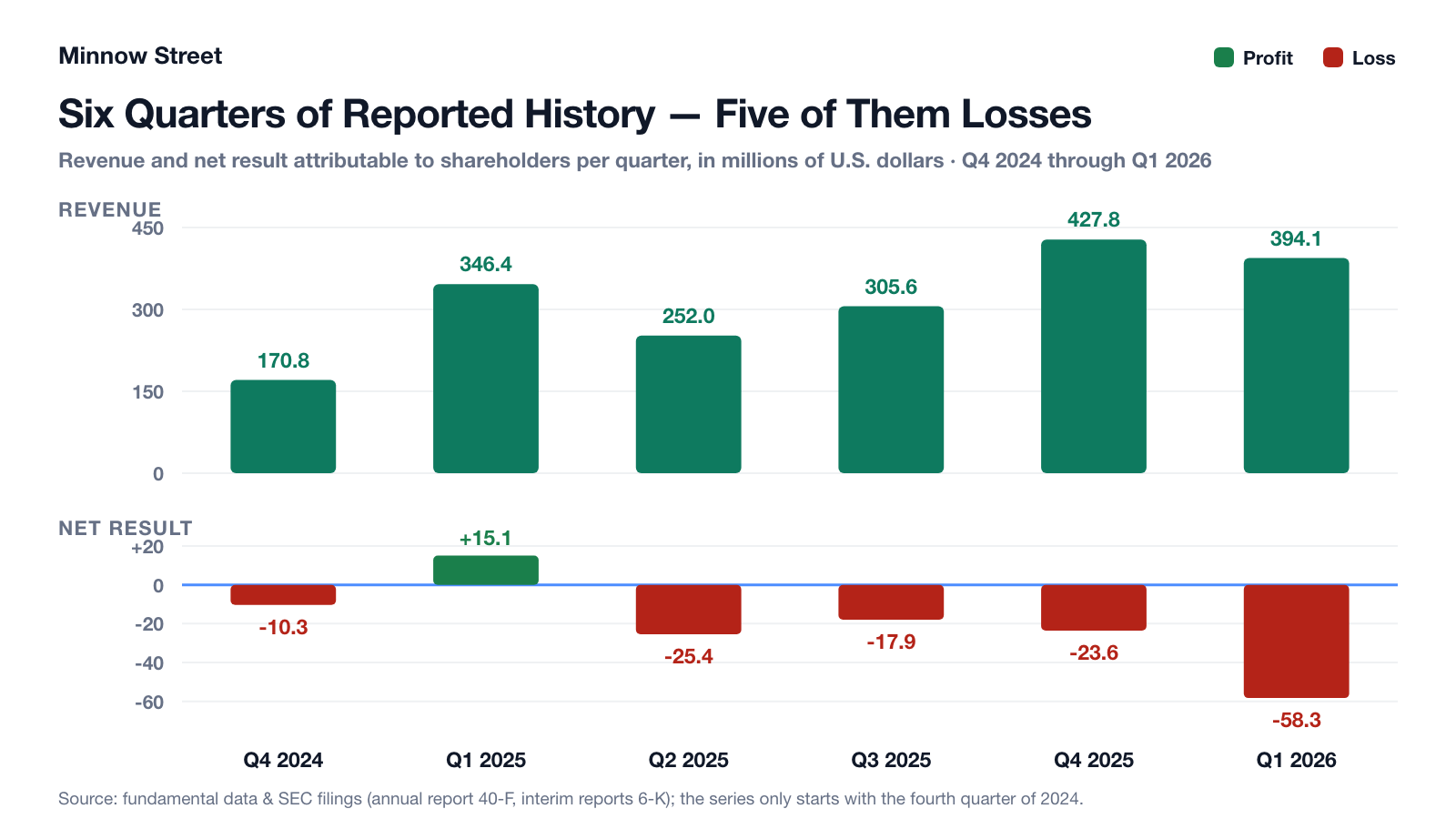
Revenue rises; the result does not. For the full year 2025 the bottom line shows group net earnings of $3.3 million — of which $55.2 million went to the non-controlling interests and minus $51.8 million to Allied Gold shareholders, or a loss of $0.45 per share. The year before it was a loss of $0.43 per share. In the first quarter of 2026 the gap widened rather than closed: $394.1 million of revenue, but a $58.3 million loss attributable to shareholders ($0.47 per share), while the non-controlling interests were again allocated $13.9 million of profit. Adjusted for revaluation effects, Allied reports $48.6 million of earnings for the same quarter — a gap of roughly $107 million between the reported and the adjusted result. How wide such an adjustment spread can get shows up in other commodity names too, for example in our TRX Gold analysis from Tanzania.
What the filings say — the uncomfortable truths
Uncomfortable truth no. 1: in the most expensive gold year in history, shareholders lost money
Do the arithmetic. Allied Gold earned $237.4 million before tax in 2025. Of that, $175.0 million went to current income taxes and $59.0 million to deferred taxes — $234.0 million in total, or 98.6 percent of pre-tax earnings. That left $3.3 million. And those $3.3 million still had to be shared, because Allied does not own its mines outright: the government of Mali holds 20 percent of Sadiola, the government of Côte d’Ivoire 10.11 percent of Bonikro and 15 percent of Agbaou. Their share of 2025 profit: plus $55.2 million. What was left for shareholders: minus $51.8 million.
On top of that come the royalties, which never show up in profit at all because they sit inside cost of sales: the "Royalties" line rose from $55.4 million (2024) to $179.4 million (2025) — more than a tripling, because many African levies are indexed to the gold price. Picture it: the innkeeper has the best year of his life, but rent, tax and the silent partner are all tied to revenue — and at the end of the month he has less than before. Remember the pattern: at mines in countries with state participation, the host country's share grows faster than the profit. And January 2025 showed how concrete that gets: Mali demanded 280 kilograms of gold as an advance on future dividends; Allied transferred it in February 2025 at a fair value of $23.9 million. In the same move, Allied's interest in the Korali-Sud licence fell from 100 to 65 percent — a consequence of Mali's 2023 mining code.
Uncomfortable truth no. 2: of $4,873 per ounce, $3,936 reached the till
This is the number this analysis hangs on. In the first quarter of 2026 the average market price for an ounce of gold was $4,873. Allied Gold realized $3,936 per ounce sold. The $937 difference has two names, and both are in the interim report: $646 per ounce went to hedge settlements and another $193 to streams, in-kind dividends and revenue-recognition adjustments. On 99,878 ounces sold that is roughly $84 million in a single quarter.
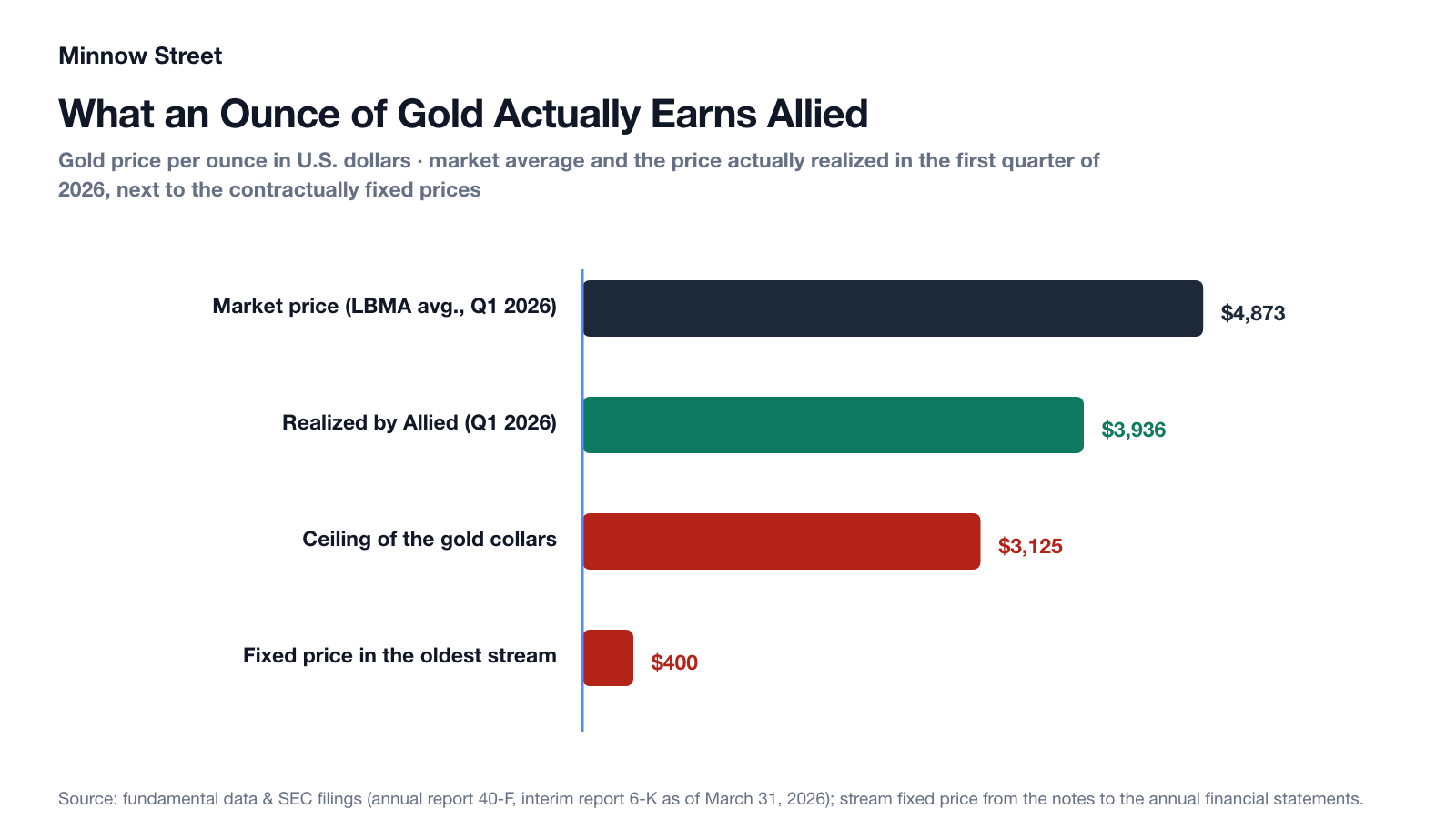
The first reason is called a collar. A collar is a price bracket: you buy a floor against falling prices and sell a ceiling against rising ones to pay for it. It costs nothing up front — hence "zero-cost" — but the ceiling binds. Allied put these brackets in place on December 19, 2024, in the middle of funding the Kurmuk project:
"On December 19, 2024, the Company entered into zero-cost collars to hedge the price on gold production of 10,000 ounces per month, beginning April 2025 through to December 2026, for a total of 210,000 ounces, at an average put and call strike price of $2,200 per ounce and $3,125 per ounce, respectively."
— Allied Gold Corporation, interim financial statements as of March 31, 2026 (6-K exhibit 99.2), Note 11 "Financial Instruments"
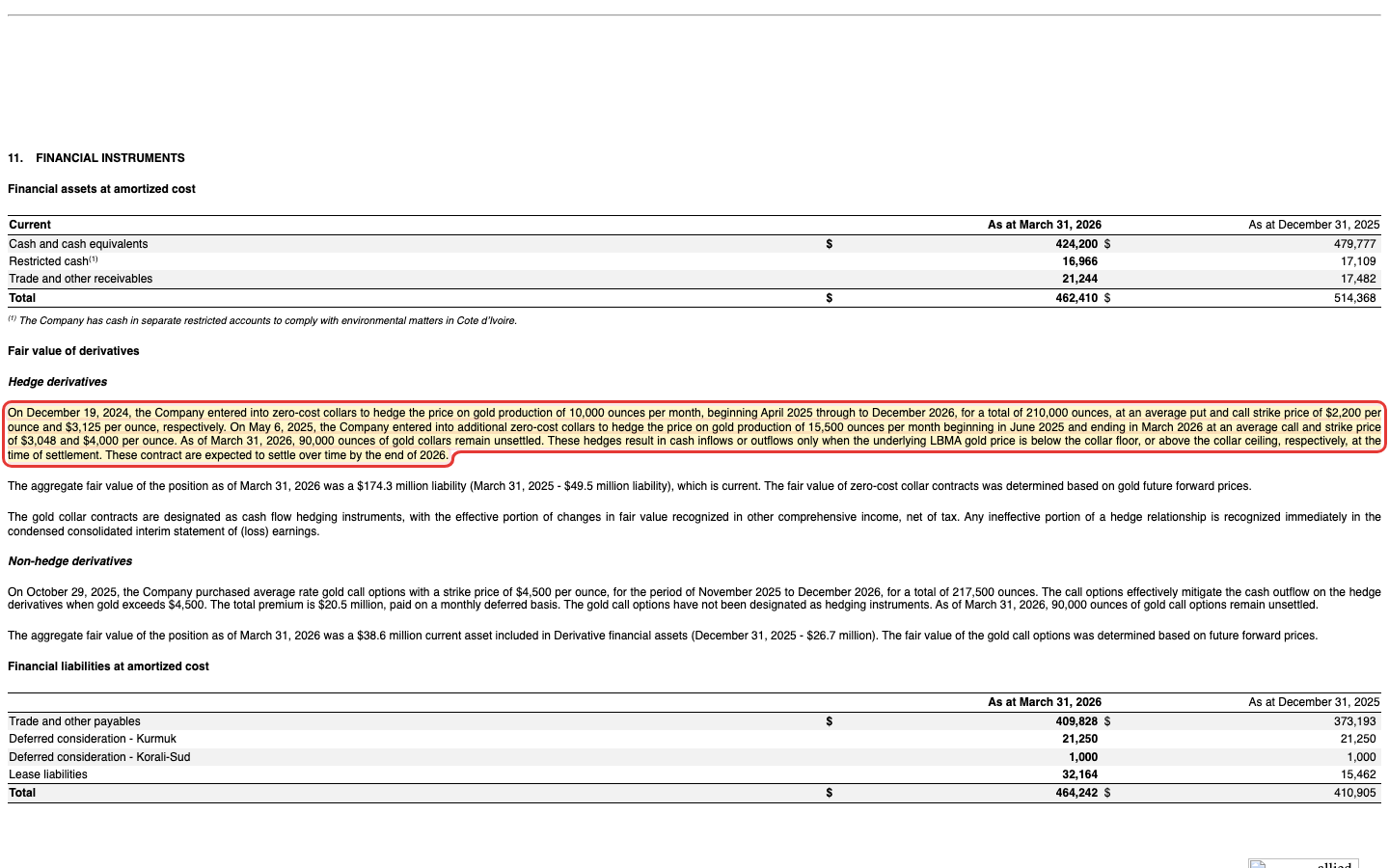
At a market price of $4,873, a ceiling of $3,125 is no longer a hedge — it is a waiver. The balance-sheet entry is correspondingly large: the entire hedging position sat at $174.3 million as a liability as of March 31, 2026, up from $49.5 million a year earlier. To be fair, Allied did push back: in October 2025 it bought average-rate call options struck at $4,500 covering 217,500 ounces for a $20.5 million premium, which softens the outflow above that level. And the good news sits in the same paragraph: the collars run out "by the end of 2026," with 90,000 ounces still open as of March 31, 2026.
The second reason is called a stream. A stream is a pre-sale: a financier pays a large sum today and in return may buy a slice of future production at a fixed, very low price. For a miner without bank access it is money that does not show up as debt. The price of that convenience is in the notes to the annual financial statements:
"On October 10, 2019 the Company entered into a streaming agreement, currently held by Royal Gold Inc. … Under this agreement, the counterparty has the right to purchase certain quantities of gold at a fixed price of US$400/ounce."
— Allied Gold Corporation, audited annual financial statements 2025 (40-F exhibit), Note 22 "Deferred Revenue"
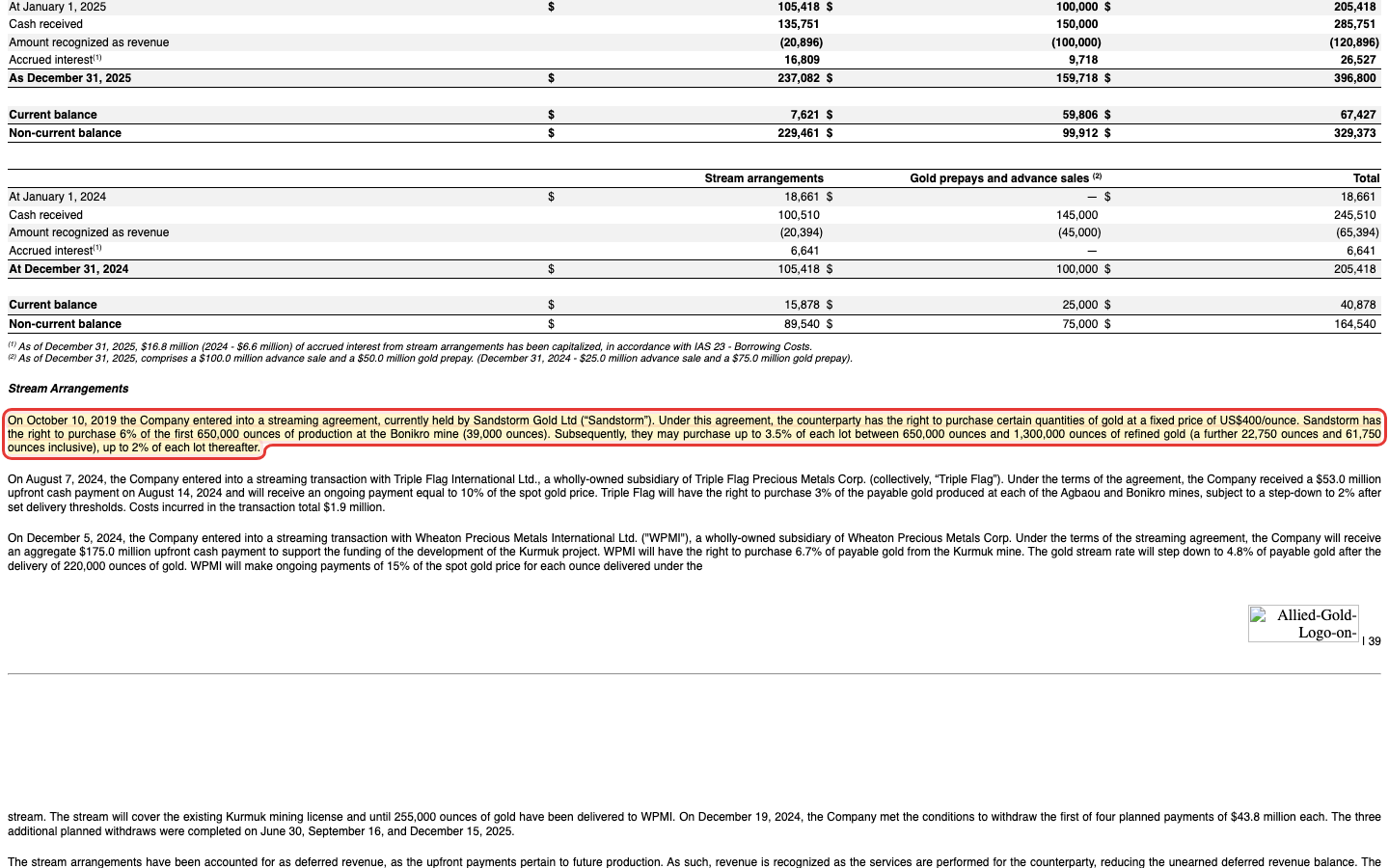
Three streams are running: Royal Gold (since 2019, fixed price $400, 6 percent of the first 650,000 ounces from Bonikro), Triple Flag ($53.0 million upfront in August 2024, an ongoing payment of 10 percent of spot) and Wheaton Precious Metals ($175.0 million for Kurmuk, an ongoing 15 percent of spot, 6.7 percent of payable gold until 255,000 ounces are delivered). The annual statements state the embedded financing component openly: 24.99 percent for the Royal Gold stream, 9.98 percent for Triple Flag, 12.02 percent for Wheaton. Remember this: a stream is not a loan — it is more expensive than one. Together with gold prepays, $376.2 million of deferred revenue sat on the balance sheet as of March 31, 2026: gold that is sold before it is mined.
Uncomfortable truth no. 3: 86 percent of the gold goes to a single customer
Gold is meant to be the commodity you can always offload. Which makes the footnote to Note 7 of the annual financial statements all the more striking: "Approximately 86% of gold sales were to a single customer for the year ended December 31, 2025 (87% for the year ended December 31, 2024)." In absolute terms: roughly $1.14 billion of the $1.33 billion. The name is not in the report.
To be fair: among gold producers this is standard, because a single refinery usually takes the entire output, and unlike a bespoke component, gold could in principle be sold elsewhere. Still: if your neighbour told you his business was booming but nine of every ten invoices went to the same recipient, you would swallow hard. And here two things compound it — the stream deliveries run through the same channel under fixed contracts, and the goods come from two countries whose governments have already intervened in the flow of gold.
Uncomfortable truth no. 4: current liabilities exceed current assets — at a purchase price of roughly $4 billion
The balance sheet as of March 31, 2026 reads differently from what you would expect at a company someone is bidding roughly $4 billion in cash for. Total assets $2,244.8 million. Of that, $748.4 million of current assets — against $1,156.1 million of current liabilities. The gap is $407.7 million; for every dollar of short-term debt there are 65 cents of short-term assets. Among the largest items: $409.8 million of trade payables, $230.3 million of income tax payable and the $174.3 million from the hedging book.
On the other side: total equity was $445.6 million, of which $334.6 million belonged to shareholders and $110.9 million to the host governments — an equity ratio just under 20 percent. Accumulated deficit: $339.1 million. Cash stood at $424.2 million (year-end 2025: $479.8 million), alongside an undrawn $50.0 million credit facility whose covenants were met at the reporting date. And there is one line worth reading twice: the convertible debentures issued in 2023, with a face value of $107.3 million at 8.75 percent (conversion price $17.37 per share), are now carried at a fair value of $214.6 million because the share price is so high — the revaluation alone cost $60.2 million in the first quarter of 2026 and is a principal reason why $52.0 million of pre-tax earnings turned into a loss.
In plain terms: the substance of this company is not on the balance sheet, it is in the ground — 11.2 million ounces of reserves still to be converted into revenue, plus a construction site in Ethiopia that absorbed $83.4 million of the $118.5 million of first-quarter 2026 capital spending. That is precisely what Zijin is buying. And it is precisely why the purchase price bears no relation to book value.
Uncomfortable truth no. 5: the offer has been on the table since January — and the deadline has already moved
On January 26, 2026 Allied Gold announced its takeover by Zijin Gold International, a company listed on the Hong Kong Stock Exchange. The key terms are in the interim report:
"Zijin Gold, a public company listed on the Hong Kong Stock Exchange, agreed to acquire all of the issued and outstanding shares of Allied Gold at a price of C$44 per share (the 'Offer Price') in cash, pursuant to the terms of a court-approved plan of arrangement under the Business Corporations Act (Ontario)."
— Allied Gold Corporation, management's discussion and analysis for the first quarter of 2026 (6-K exhibit 99.1), "Transaction with Zijin Gold"
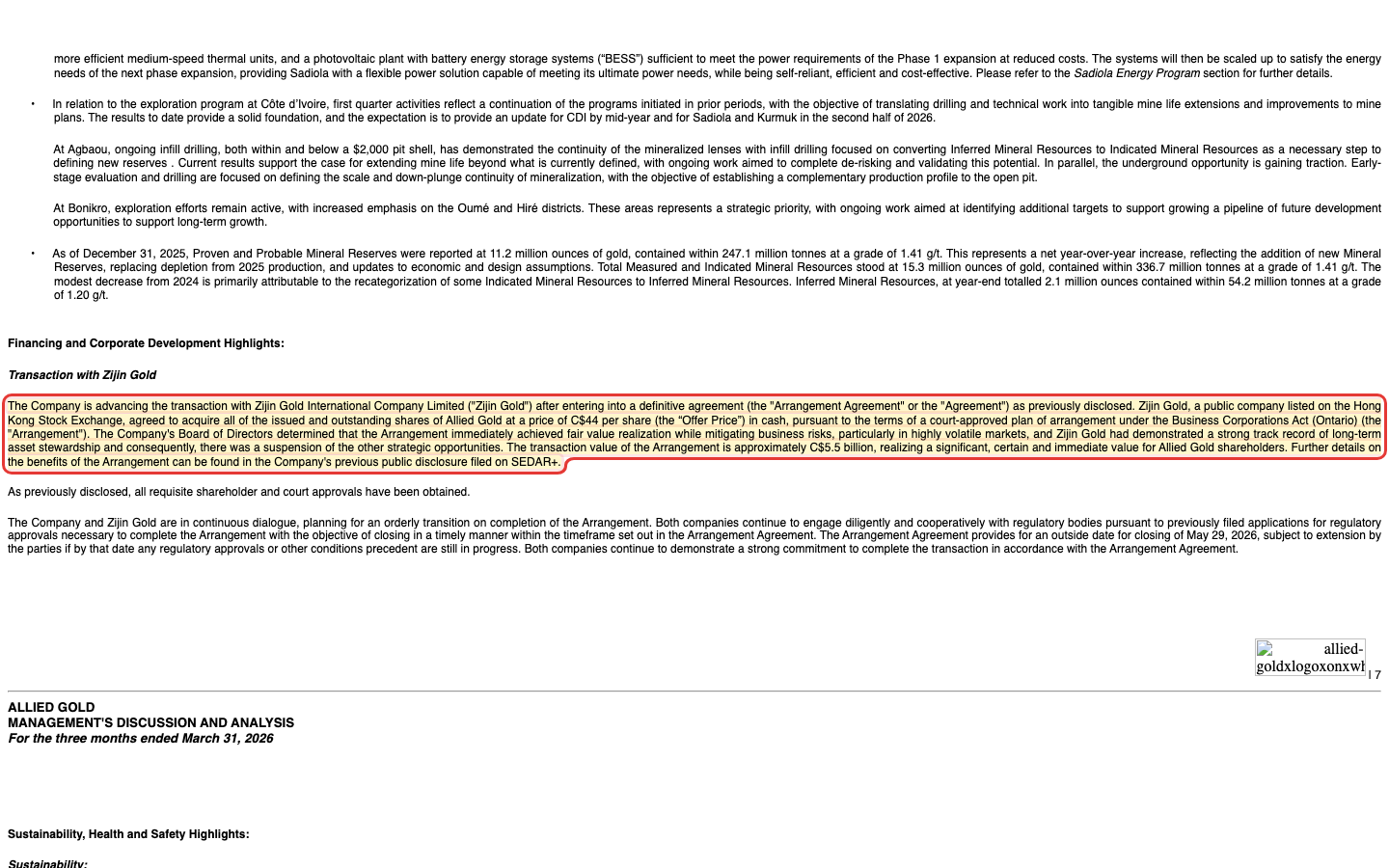
The terms are comfortable for shareholders: a premium of about 27 percent over the 30-day volume-weighted average price as of January 23, 2026, no financing condition, cash funded from the buyer's existing balances. Directors and officers holding roughly 15.4 percent of the shares signed voting support agreements; the termination fee is C$220 million. Shareholders approved on March 31, 2026, and the Ontario court followed. The company named the expected timing itself: "Closing expected by late April 2026."
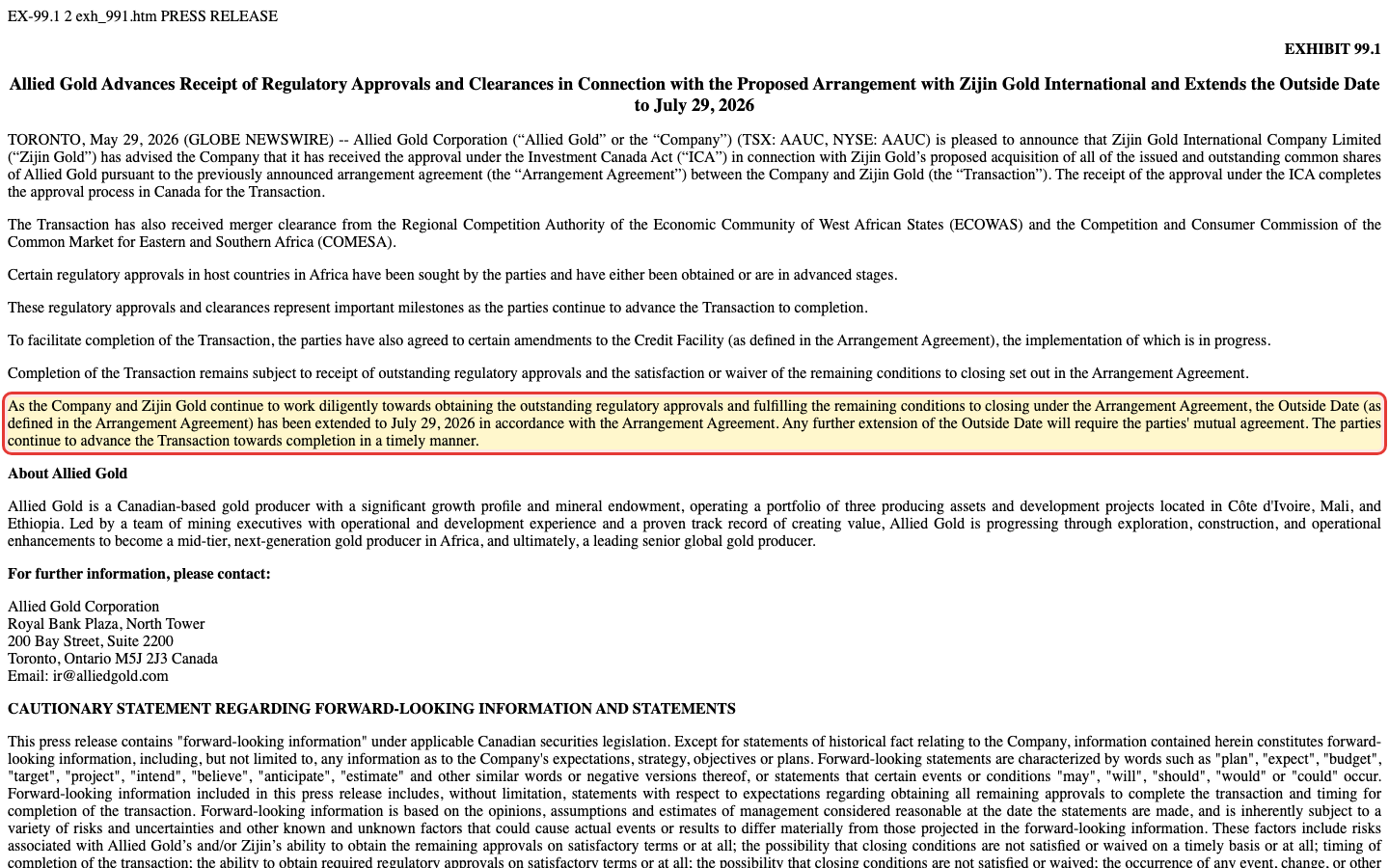
Late April came and went. What has happened since can be read off the filings. On April 28, 2026 Allied confirmed "normal course conduct of business" and, in the same text, mentioned the conflicts between the government and insurgent groups in Mali — its mines, it said, are far away. On May 29, 2026 the Canadian investment clearance arrived, along with merger clearances from the West African and the East and Southern African competition authorities — and one sentence carrying the whole point:
"As the Company and Zijin Gold continue to work diligently towards obtaining the outstanding regulatory approvals … the Outside Date (as defined in the Arrangement Agreement) has been extended to July 29, 2026 in accordance with the Arrangement Agreement. Any further extension of the Outside Date will require the parties' mutual agreement."
— Allied Gold Corporation, news release of May 29, 2026 (6-K exhibit 99.1)
On June 10, 2026 a release followed on mine-life extensions and project progress "in parallel with normal course progress" on the transaction. And on July 17, 2026 Allied filed a circular for an annual general meeting on August 7, 2026 — on the grounds that the transaction had not closed and that corporate law required the meeting regardless. As of this analysis (July 24, 2026) no completion notice had been filed. Which approval exactly is still missing is not named in any of the documents; the Annual Information Form lists among the conditions approvals in several jurisdictions "including the People's Republic of China."
Valuation: the share price is the offer price
For an evergreen anchor we need a dated reference rather than a daily quote — and the form from the opening supplies one. From $380,929,150 for 12,272,202 shares, the implied price as of March 31, 2026 is about $31 per share. The offer is C$44; at the year-end 2025 exchange rate cited in the 40-F ($1.00 = C$1.3706), that is a little over $32. In other words: at quarter-end the stock traded essentially at the offer price, with a small discount. That is exactly how a security behaves when its price no longer reflects the business but the probability of a closing.
Classic multiples are of little help here. There is no price-to-earnings ratio, because no profit is attributed to shareholders. Against 2025 revenue ($1,331.8 million) the price-to-sales ratio is about 3; against 2025 adjusted EBITDA ($523.8 million) roughly 7.7 times — for a growing producer with nearly three decades of reserves, not an absurd price, but no bargain either. The most honest calculation is a different one: roughly $4 billion for 11.2 million ounces of reserves is about $360 per ounce in the ground — against a market price of $4,873 and mining costs around $2,000. Zijin is buying inventory, not a balance sheet. All valuation figures: data as of July 24, 2026; analyses are evergreen, daily prices are not a buy argument.
For you as an investor that means the share price now moves almost entirely between two points — the offer price if the takeover completes, and the pre-January 26, 2026 price if it collapses. How completely a single permit or a single contract can overshadow everything else showed up recently in another African name from the same portfolio — our Helios Towers analysis.
Opportunities and risks at a glance
What speaks for Allied Gold:
- A cash offer with real commitment: C$44 per share, about C$5.5 billion, no financing condition, approved by shareholders (March 31, 2026) and the Ontario court, at a premium of roughly 27 percent over the 30-day average as of January 23, 2026.
- The operation is growing: 379,081 ounces in 2025 (2024: 358,091); the fourth quarter of 2025, at 117,004 ounces, was the strongest in company history; the first quarter of 2026 came in 14 percent above the prior year at 96,016 ounces. Company guidance for 2026 is 485,000 to 575,000 ounces.
- A reserve base measured in decades: 11.2 million ounces of proven and probable reserves and 15.3 million ounces of measured and indicated resources as of December 31, 2025; management's stated path is roughly 800,000 ounces a year by 2029.
- The growth project is funded and far advanced: Kurmuk in Ethiopia absorbed $83.4 million in the first quarter of 2026 alone, with first production planned for mid-2026; a twenty-year power purchase agreement locks in $0.04 per kilowatt-hour.
- The price cap has an expiry date: the gold collars run out by the end of 2026 (90,000 ounces still open as of March 31, 2026); after that a far larger share of the market price reaches the till.
What speaks against it:
- The share price hangs on a signature, not on gold: closing, originally expected by late April 2026, was still outstanding on July 24, 2026, the outside date has already moved to July 29, 2026, any further extension requires mutual agreement — and a shareholder meeting was called for August 7, 2026 as a precaution.
- The record price does not arrive: $3,936 instead of $4,873 per ounce in the first quarter of 2026, a collar ceiling of $3,125, a stream fixed price of $400 in place since 2019 with a stated financing component of 24.99 percent, $376.2 million of deferred revenue and a $174.3 million derivative liability.
- State and partners first: of $237.4 million in 2025 pre-tax earnings, $234.0 million went to taxes, leaving $3.3 million — of which $55.2 million went to the host governments and minus $51.8 million to shareholders; royalties rose from $55.4 million to $179.4 million.
- Country risk is real, not theoretical: Mali cut Allied's interest in Korali-Sud from 100 to 65 percent in January 2025 and demanded 280 kilograms of gold as a dividend advance; in April 2026 the company itself referenced conflicts between the government and insurgent groups in Mali.
- A thin balance sheet and thin disclosure: $1,156.1 million of current liabilities against $748.4 million of current assets, $334.6 million of shareholder equity, a $339.1 million accumulated deficit — and, as a Canadian filer, no audited quarterly reports, no management report on internal control over financial reporting and no auditor attestation on it, both because of the transition period for newly public companies.
A human conclusion
Back to the handover trap from the opening. Its core is not that the takeover is an illusion — it is real, signed, blessed by shareholders and a court, free of financing conditions and backed by a well-capitalized buyer. Its core is that the signature answers a question you never asked. It tells you that someone wants to pay C$44. It does not tell you when — and it certainly does not tell you what you own if it never happens. That second answer is in the filings: a company with three mines in politically demanding countries, nearly three decades of reserves in the ground and a construction site in Ethiopia; a company that in the most expensive gold year in history booked a $51.8 million loss for its shareholders while the tax authorities and host governments earned; a company that kept $3,936 of a $4,873 ounce because, in the funding squeeze of 2024, it sold away the top of its own price. The London fund that still held its second-largest position in this stock as of March 31, 2026 sold a quarter of it in the same quarter — its form does not say why. So the honest question is not "is the offer good?" — for shareholders of early 2026 it was. It is this: do you want to collect the last few percent between the share price and the offer price, and carry the risk that a stamp never arrives and you suddenly own a gold producer you never meant to buy? If yes, you have a thesis. If no, you had an impression. What you make of it is your decision. And that is exactly as it should be.
Sources
Every original document used in this analysis — for you to read yourself:
- Allied Gold Corporation — SEC annual report on Form 40-F for 2025 (filed April 1, 2026)
- Allied Gold Corporation — audited annual financial statements 2025 under IFRS (40-F exhibit; auditor KPMG LLP)
- Allied Gold Corporation — management's discussion and analysis for fiscal 2025 (40-F exhibit)
- Allied Gold Corporation — Annual Information Form for 2025 (40-F exhibit 99.1)
- Allied Gold Corporation — unaudited interim financial statements as of March 31, 2026 (6-K exhibit 99.2, furnished May 14, 2026)
- Allied Gold Corporation — management's discussion and analysis for the first quarter of 2026 (6-K exhibit 99.1, furnished May 14, 2026)
- Allied Gold Corporation — news release on the acquisition by Zijin Gold (6-K exhibit 99.1, January 26, 2026)
- Allied Gold Corporation — news release on business conduct and the approvals process (6-K exhibit 99.1, April 28, 2026)
- Allied Gold Corporation — news release on clearances and the extension of the outside date to July 29, 2026 (6-K exhibit 99.1, May 29, 2026)
- Allied Gold Corporation — news release on mine life and project progress (6-K exhibit 99.1, June 10, 2026)
- Allied Gold Corporation — management information circular for the annual general meeting on August 7, 2026 (6-K exhibit 99.1, July 17, 2026)
- Full SEC filing history of Allied Gold: EDGAR overview (sec.gov)
- Helikon Investments Ltd — Form 13F-HR as of March 31, 2026 (filed May 8, 2026, accession 0001839497-26-000002)
- Fundamental data (metrics; data as of July 24, 2026), reconciled with the SEC filings (40-F/6-K, CIK 1993344).
Transparency & disclaimer: This analysis is a journalistic contextualization of publicly available information. It is not investment advice, not a financial analysis in any regulatory sense and not an invitation to buy or sell securities. Equity investments carry substantial risk up to and including total loss. In a pending takeover, deadlines, conditions and completion can change at any time. All information without warranty; the data cut-off is noted in the text. The author holds no position in Allied Gold shares at the time of publication.
Our Bottom Line at a Glance
- Takeover situation neutral
- The Zijin Gold cash offer of C$44 per share (about C$5.5 billion) is signed and binding, carries no financing condition and was approved by shareholders on March 31, 2026 and by the Ontario court; the termination fee is C$220 million. What remains open are regulatory approvals: closing was expected by late April 2026, the outside date was extended on May 29, 2026 to July 29, 2026, any further extension requires mutual agreement — and an annual general meeting was called for August 7, 2026 as a precaution.
- Operations positive
- Production is growing: 379,081 ounces in 2025 after 358,091 the year before; the fourth quarter of 2025, at 117,004 ounces, was the strongest in company history, and the first quarter of 2026 came in 14 percent above the prior year. Guidance for 2026 is 485,000 to 575,000 ounces at mine-site costs of $1,750 to $1,900 per ounce, with the Kurmuk construction project in Ethiopia due to deliver first gold in mid-2026. Reserves of 11.2 million ounces equate to almost three decades.
- Price realization negative
- Of a $4,873 market price per ounce, only $3,936 reached the till in the first quarter of 2026: $646 went to hedge settlements and $193 to streams and in-kind dividends. The December 2024 collars cap at $3,125 and run to the end of 2026 (90,000 ounces open as of March 31, 2026); the 2019 Royal Gold stream allows purchases at $400 per ounce and carries a stated financing component of 24.99 percent. The hedging position sat on the balance sheet as a $174.3 million liability.
- Profit split & country risk negative
- Of $237.4 million in 2025 pre-tax earnings, $234.0 million went to taxes, leaving $3.3 million; of that, $55.2 million was attributed to the governments of Mali and Côte d’Ivoire as co-owners, and shareholders were left with a $51.8 million loss. Royalties rose from $55.4 million to $179.4 million. In January 2025 Allied’s interest in the Korali-Sud licence fell from 100 to 65 percent, and Mali demanded 280 kilograms of gold as a dividend advance (fair value $23.9 million).
- Balance sheet & disclosure negative
- As of March 31, 2026, $748.4 million of current assets stood against $1,156.1 million of current liabilities; equity attributable to shareholders was $334.6 million and the accumulated deficit $339.1 million. The convertible debentures of $107.3 million face value are carried at $214.6 million fair value. As a Canadian MJDS filer, Allied publishes no audited quarterly reports, and its 40-F contains neither a management report on internal control over financial reporting nor an auditor attestation on it, both because of the transition period for newly public companies.
Allied Gold is the handover trap in its purest form: the Zijin Gold takeover at C$44 per share is signed, approved by shareholders and a court and free of financing conditions — only the regulatory approvals are missing, the closing originally expected by late April 2026 was still outstanding on July 24, 2026, and the deadline has already moved to July 29, 2026. Behind it sits a producer that grew in 2025 to 379,081 ounces and $1,331.8 million in revenue and still handed shareholders a $51.8 million loss, while taxes, royalties and host governments earned; and that kept only $3,936 of a $4,873 ounce, because collars cap at $3,125 and a stream has paid $400 since 2019. Not investment advice.
What Our Rating Means
Open questions
The business works in principle, but one material question is open. As long as it stays open, our findings do not carry a quality verdict.
Whoever buys today is not buying a gold bet but a deadline. As of the 13F reporting date of March 31, 2026 the implied price was about $31 per share, just below the C$44 offer — the remaining gap is the payment for a permit that has not yet arrived. If completion comes, the gain is small and quick; if it does not, you own a producer with 11.2 million ounces of reserves, but also with capped selling prices to the end of 2026, $1,156.1 million of current liabilities against $748.4 million of current assets, and two host governments that are paid before shareholders. Whoever waits watches exactly three things: does a completion or an extension notice arrive by July 29, 2026? Does the annual general meeting on August 7, 2026 take place? And what is the realized price per ounce in the next interim report once the collars expire? The decision is yours.
A journalistic assessment by our editorial team at the time of the deep dive, based on public sources — not investment advice and not a solicitation to buy or sell. Your personal circumstances (investment goals, risk capacity, taxes) cannot be taken into account. What our levels mean, how verdicts are formed, and what conflicts of interest exist →
Worth Noting
- Allied Gold reached our research list not through a scanner hit but through the Form 13F-HR of Helikon Investments Ltd (London) as of March 31, 2026: 12,272,202 shares worth $380,929,150, the second-largest of 17 positions and roughly 9.8 percent of all Allied Gold shares. As of December 31, 2025 it was still 16,498,498 shares — the fund sold about a quarter in the first quarter of 2026. A 13F shows only U.S.-listed long positions with a 35- to 45-day lag, excluding short sales and derivatives — a rear-view mirror, not a road map.
- Allied Gold is a Canadian MJDS filer at the SEC: there is no 10-K and no 10-Q. Audited reporting happens once a year on Form 40-F (for 2025 filed April 1, 2026, auditor KPMG LLP); interim figures are furnished only as an unaudited exhibit to a Form 6-K. Accounting is under IFRS in U.S. dollars. Metric series on this name begin only in the fourth quarter of 2024 — there is no five-year series, and longer histories come exclusively from the 40-F itself.
- Valuation figures are dated and evergreen: the implied price of about $31 per share comes from the 13F filing as of March 31, 2026 ($380,929,150 for 12,272,202 shares) and serves as an order of magnitude, not a daily price. The exchange rate of $1.00 = C$1.3706 is the December 31, 2025 rate cited in the 40-F. All takeover-related statements are as of July 24, 2026 — no completion notice had been filed by then.
Frequently Asked Questions
Allied Gold Corporation (NYSE and TSX: AAUC), headquartered in Toronto, mines gold in Africa: Sadiola in Mali (80 percent interest), Bonikro (89.89 percent) and Agbaou (85 percent) in Côte d’Ivoire. A fourth mine, the Kurmuk project in Ethiopia (100 percent), is under construction. In 2025 the company produced 379,081 ounces of gold and $1,331.8 million in revenue; all-in sustaining cost was $2,037 per ounce.
On January 26, 2026 Allied Gold agreed to be acquired by Zijin Gold International of Hong Kong at C$44 per share in cash — about C$5.5 billion, or roughly $4 billion. Shareholders approved on March 31, 2026 and the Ontario court followed. Closing was expected by late April 2026; on May 29, 2026 the outside date was extended to July 29, 2026, and as of July 24, 2026 the deal still depended on outstanding regulatory approvals.
Allied earned about $237.4 million before tax in 2025. Of that, $234.0 million went to current and deferred income taxes, and royalties rose from $55.4 million to $179.4 million. Of the remaining $3.3 million, $55.2 million was attributed to the governments of Mali and Côte d’Ivoire as co-owners of the mines — leaving shareholders with a loss of $51.8 million, or $0.45 per share.
Because of hedges and pre-sales. In the first quarter of 2026 the average market price was $4,873 per ounce and Allied realized $3,936: $646 went to hedge settlements and $193 to streams and in-kind dividends. The collars entered into in December 2024 cap at $3,125 per ounce and run to the end of 2026; the Royal Gold stream from 2019 allows purchases at a fixed $400 per ounce.
Because Allied Gold is a Canadian issuer reporting to the SEC through the Multijurisdictional Disclosure System. For such companies there is no 10-K and no 10-Q: the audited annual report is filed on Form 40-F (for 2025 on April 1, 2026), and interim figures are furnished only as an unaudited exhibit to a Form 6-K. Accounting is under IFRS with U.S. dollar reporting.
A 13F is the quarterly disclosure required of large U.S. asset managers. Helikon Investments Ltd of London reported 12,272,202 Allied Gold shares worth $380,929,150 as of March 31, 2026 — the second-largest of 17 positions. As of December 31, 2025 it held 16,498,498 shares, so roughly a quarter was sold in the first quarter of 2026. A 13F shows only U.S.-listed long positions with a 35- to 45-day lag, excluding short sales and derivatives.
As of December 31, 2025 Allied Gold reported 11.2 million ounces of proven and probable mineral reserves, contained in 247.1 million tonnes of rock at a grade of 1.41 grams per tonne. Measured and indicated resources stood at 15.3 million ounces and inferred resources at 2.1 million ounces. At roughly 380,000 ounces of annual production, the reserve equates to almost three decades.
Found an error?
Did you spot a factual error, an outdated number, or a typo in this deep dive? Let us know briefly — your report goes straight to the editorial team.