Corporación América Airports: 86.7 Million Passengers Across 52 Airports — and the Company Owns None of Them
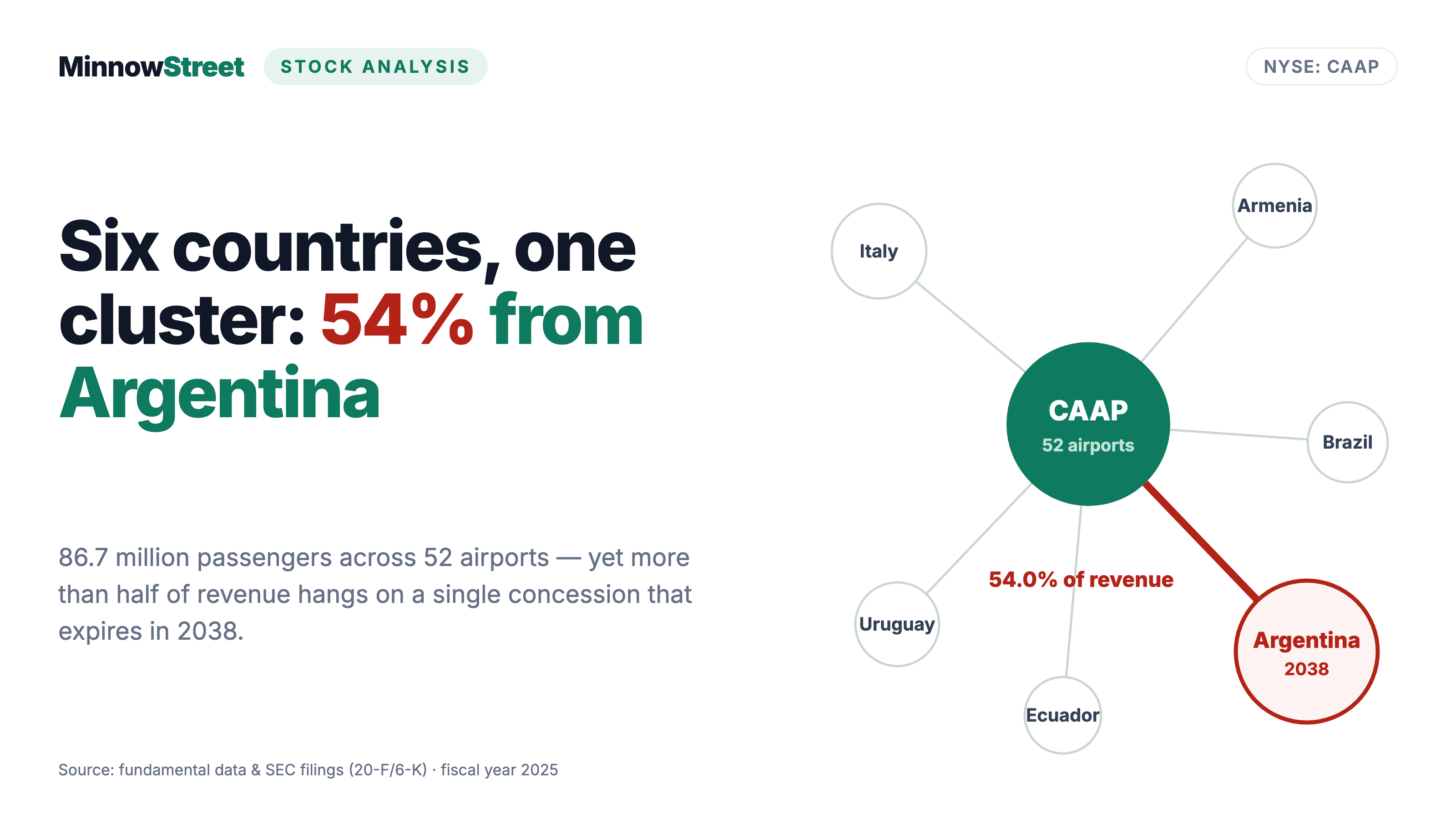
Corporación América Airports calls itself a leading private airport operator in the world: 52 sites in six countries, 86.7 million passengers in 2025. Its annual report to the U.S. securities regulator, the SEC, spells out what no headline mentions: the airports belong to the governments. The company only holds them for a while — eleven time-limited concessions, the largest of which ends on February 13, 2038 and which Argentina may buy back even earlier, with no compensation for lost profits. That single concession carries 54.0 percent of consolidated revenue. In 2025 revenue hit a record $1,962.1 million, yet net income still fell 16.3 percent. London fund Helikon Investments owns 8.3 percent of the shares and has barely touched the position for quarters. Not investment advice — just the question of what an airport is worth when you have to hand it back.
 Thomas Mücke
Founder & Publisher
Thomas Mücke
Founder & Publisher
Chart
Interactive price chart (TradingView).
Note: pure fact-based analysis, not investment advice and not a solicitation to buy or sell. All figures without guarantee.
There is a mental trap that spares nobody, experienced investors included. Call it the rental-car illusion. You lease a car, drive it for three years, wash it, fuel it, get a dent pulled out and park it in your driveway every night. At some point you say "my car" without thinking. And then comes the day you hand back the keys. That illusion carries an entire asset class: infrastructure. An airport looks like the very definition of ownership — concrete, runways, terminals, millions of passengers. At Corporación América Airports S.A. (NYSE: CAAP) that picture is wrong. As of its annual report the group operates 52 airports in six countries and counted 86.7 million passengers in 2025 — yet it owns none of them. It has borrowed them, for a fixed number of years, by concession. So let's make a deal: before you read "airport operator" as "concrete gold", we look together at what the company itself reported, under penalty of law, to the U.S. securities regulator, the SEC — the annual report on Form 20-F for 2025 filed March 17, 2026, the interim figures as of March 31, 2026, and the traffic release of July 17, 2026. This one tells the story of a record year, of an asset with an expiration date, of a government free to demand its keys back at any time — and of numbers that hyperinflation accounting makes incomparable from one year to the next. What you make of it is up to you.
What Corporación América Airports actually does — 52 airports on lease
The business model is quickly explained and constantly misunderstood. A national or city government owns an airport but does not want to run it. So it tenders the operation: whoever wins gets to collect the fees for a set number of years, but must invest, keep the airport running and usually hand over a slice of revenue. At the end of the term everything reverts to the state — including the terminals the operator built itself. In everyday terms: you lease a restaurant, install the kitchen at your own cost, pay the landlord 15 percent of revenue every month — and when the lease ends, the kitchen is his.
That is exactly how CAAP works. The holding company sits in Luxembourg (128, Boulevard de la Pétrusse), has been listed on the New York Stock Exchange since its IPO in early 2018, and holds eleven concessions in six countries: Argentina, Italy, Brazil, Uruguay, Ecuador and Armenia. Among them are large international gateways such as Ezeiza in Buenos Aires, city airports like Aeroparque, the Brazilian capital's Brasília airport, tourist destinations such as Bariloche, the Iguazú falls, the Galápagos airport and Florence. Income comes from two pots: aeronautical revenue (per-passenger and per-landing fees, set by regulators) and commercial revenue (duty-free, parking, food, cargo, advertising, lounges). On top of that sits a line that inflates revenue without adding much profit: construction services — under international accounting rules, concession holders must show their mandatory capital works as revenue and as an almost identical cost (2025: $205.8 million). If you do not know that, the business looks bigger than it is.
Which names the central tension of this analysis, and it runs through every chapter: the business has never been bigger than in 2025 — but the most valuable item on the balance sheet is a usage right that gets shorter every day, and more than half of it sits in a single country.
How the stock landed on our desk
Not through a hit in our in-house stock scanner, but through a mandatory filing. On May 8, 2026, London-based Helikon Investments Ltd filed its Form 13F-HR for the quarter ended March 31, 2026 — the disclosure larger U.S. asset managers must file on their holdings. Of 17 positions worth $2,648,555,113 in total, Corporación América Airports is the third largest: 13,165,225 shares worth $332,948,540. More interesting than the size is the stillness behind it. Across four quarters the position reads: 13,342,552 shares (June 30, 2025) → 13,430,445 (September 30) → 13,565,960 (December 31) → 13,165,225 (March 31, 2026), a decline of 3.0 percent in the last step. In the same quarter six positions were opened from scratch and six were sold out entirely — including Pampa Energía ($50.0 million), another Argentine name — yet CAAP was left essentially untouched. A rebuilding quarter in which this holding simply stays put: that is a statement.
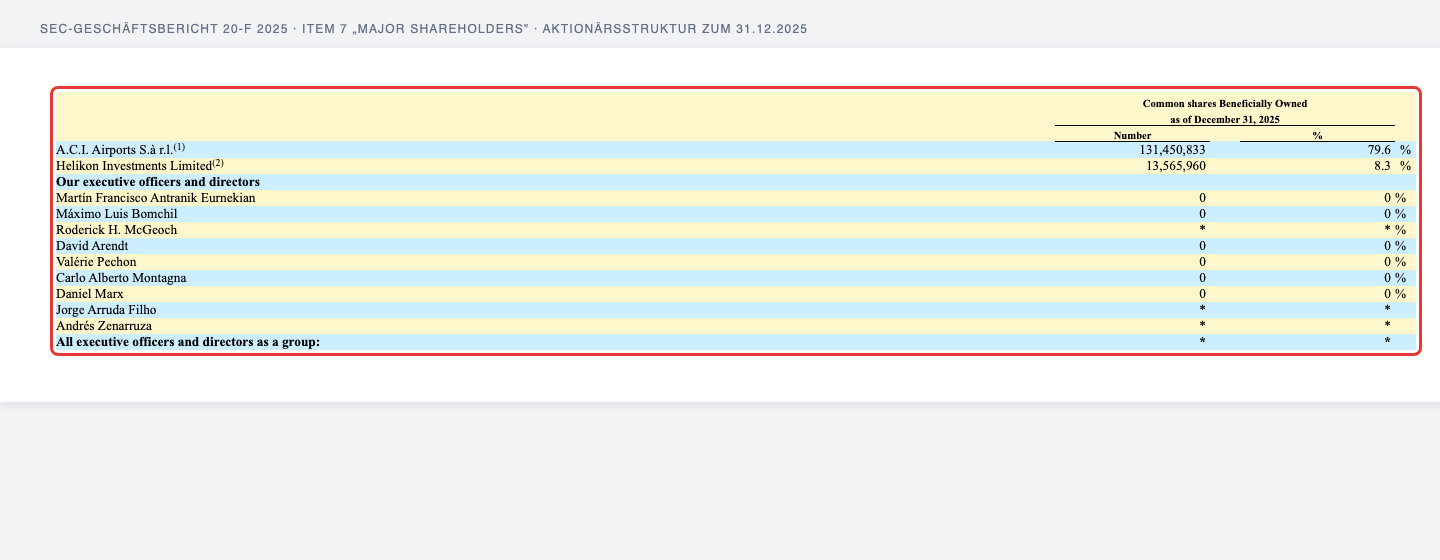
And there is a second place to look that almost nobody opens. Corporación América Airports lists Helikon among its major shareholders in its own annual report — with 13,565,960 shares, or 8.3 percent, as of December 31, 2025, behind majority holder A.C.I. Airports S.à r.l. at 79.6 percent. So the fund is not merely a line in a portfolio; it is the company's second-largest shareholder.
Before that turns into an investment case, the limits of the form belong in the picture: a 13F shows only U.S.-listed long positions, it appears 35 to 45 days late, and it contains no short sales, no derivatives beyond reported options and no European holdings. It is a rear-view mirror, not a route plan. And one more thing belongs to honesty here: our scanner carries no metrics row for CAAP — the stock is not yet covered in our data set, so there is no Piotroski score and no momentum rating to quote. Rather than invent a number, we read the original documents. Which is what we do now.
The numbers over the years — honestly appraised
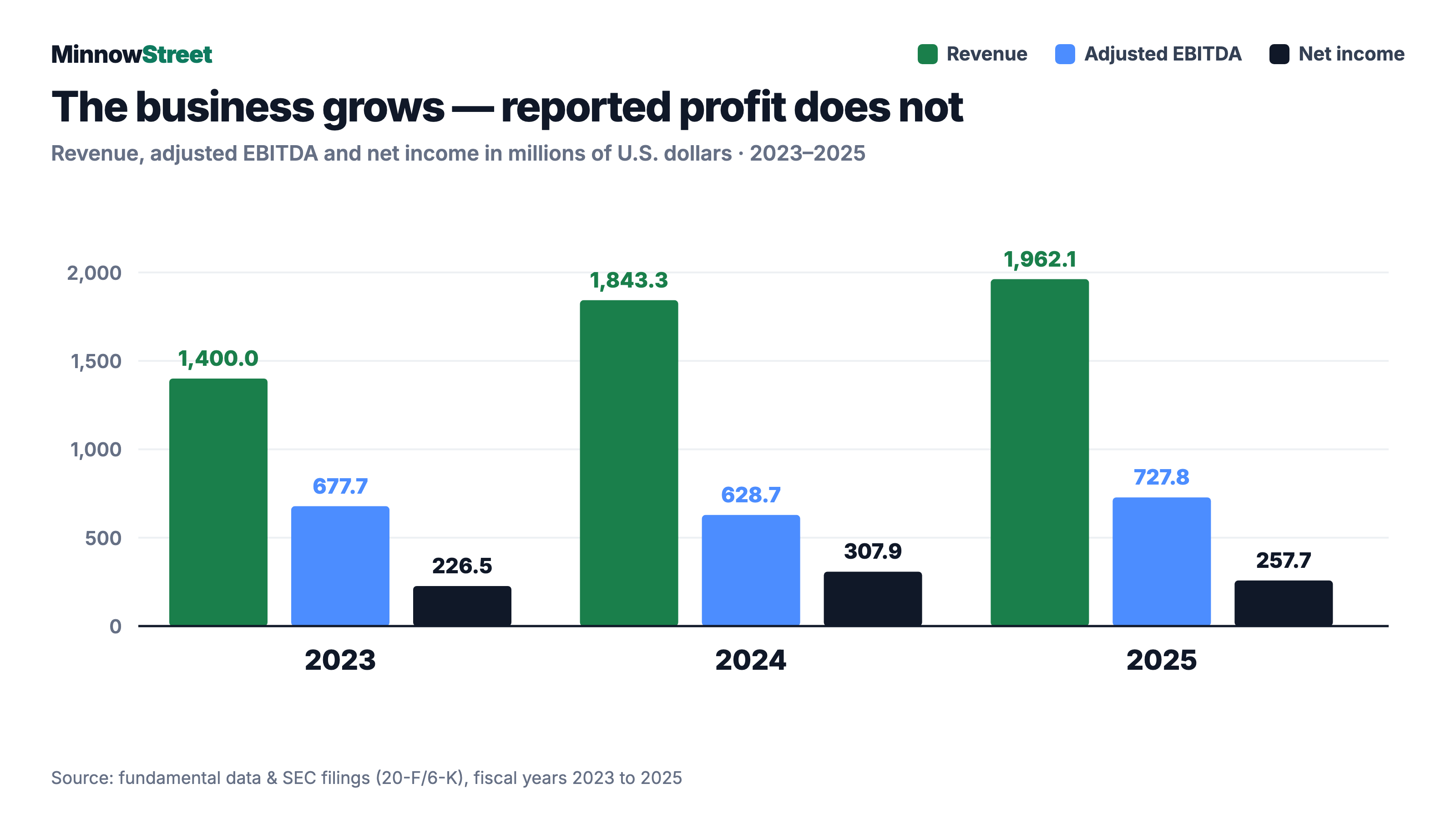
First what genuinely impresses. Operationally, 2025 was the best year in the company's history. Revenue rose 6.4 percent to $1,962.1 million (2024: $1,843.3 million; 2023: $1,400.0 million). Adjusted EBITDA — operating profit before interest, taxes and depreciation, and here the most honest proxy for the cash the business throws off — climbed 15.8 percent to $727.8 million (2024: $628.7 million). Traffic recovered strongly: 86.7 million passengers, up 9.8 percent from 79.0 million in 2024, plus 876,428 aircraft movements and 403,700 tons of cargo. The balance sheet is far steadier than three years ago: $592.8 million of cash (prior year $439.8 million) against borrowings of $1,095.2 million (prior year $1,158.1 million) — net debt of roughly $502 million, less than one times adjusted EBITDA. Equity grew to $1,660.7 million. And the first quarter of 2026 kept the trend going: $537.6 million of revenue (+20.1 percent) and income for the period of $80.4 million, against $36.2 million a year earlier.
And now the line where the story turns: net income fell. From $307.9 million (2024) to $257.7 million (2025) — down 16.3 percent, even though revenue and operating income rose.
Open the segments and you see how different the six countries are. Argentina: $1,069.5 million of revenue (54.5 percent of the group), 47.4 million passengers, $388.8 million of adjusted segment EBITDA. Armenia: $296.3 million (15.1 percent) on just 5.8 million passengers — the strongest earner per head. Uruguay: $192.2 million. Italy: $170.4 million on 9.8 million passengers. Brazil: $118.5 million on 16.7 million passengers — many people, little income. Ecuador: $114.4 million. Remember this ratio: at airports, passenger counts and earnings drift far apart; what matters is what a passenger spends and how much of it the operator gets to keep. Which brings us to the uncomfortable truths.
What the filings say — the uncomfortable truths
Uncomfortable truth no. 1: the most valuable asset expires
In the balance sheet as of December 31, 2025 the largest item sits under "intangible assets": $3,138.0 million — that is 70.5 percent of total assets of $4,448.7 million. Behind it are no patents and no brands, but the concession rights themselves; the auditor puts the concession asset balance at $3,123 million, of which $538.8 million relates to Brazil. A right like that behaves less like land and more like a lease: it is amortized over the remaining term until nothing is left. You can see it in the income statement — depreciation and amortization rose from $130.0 million (2023) to $182.5 million (2024) to $208.4 million (2025). In everyday terms: this is not a house you pass on to your children, it is an ice cube you sell while it melts.
How long each cube lasts is set out in a single table in the annual report:
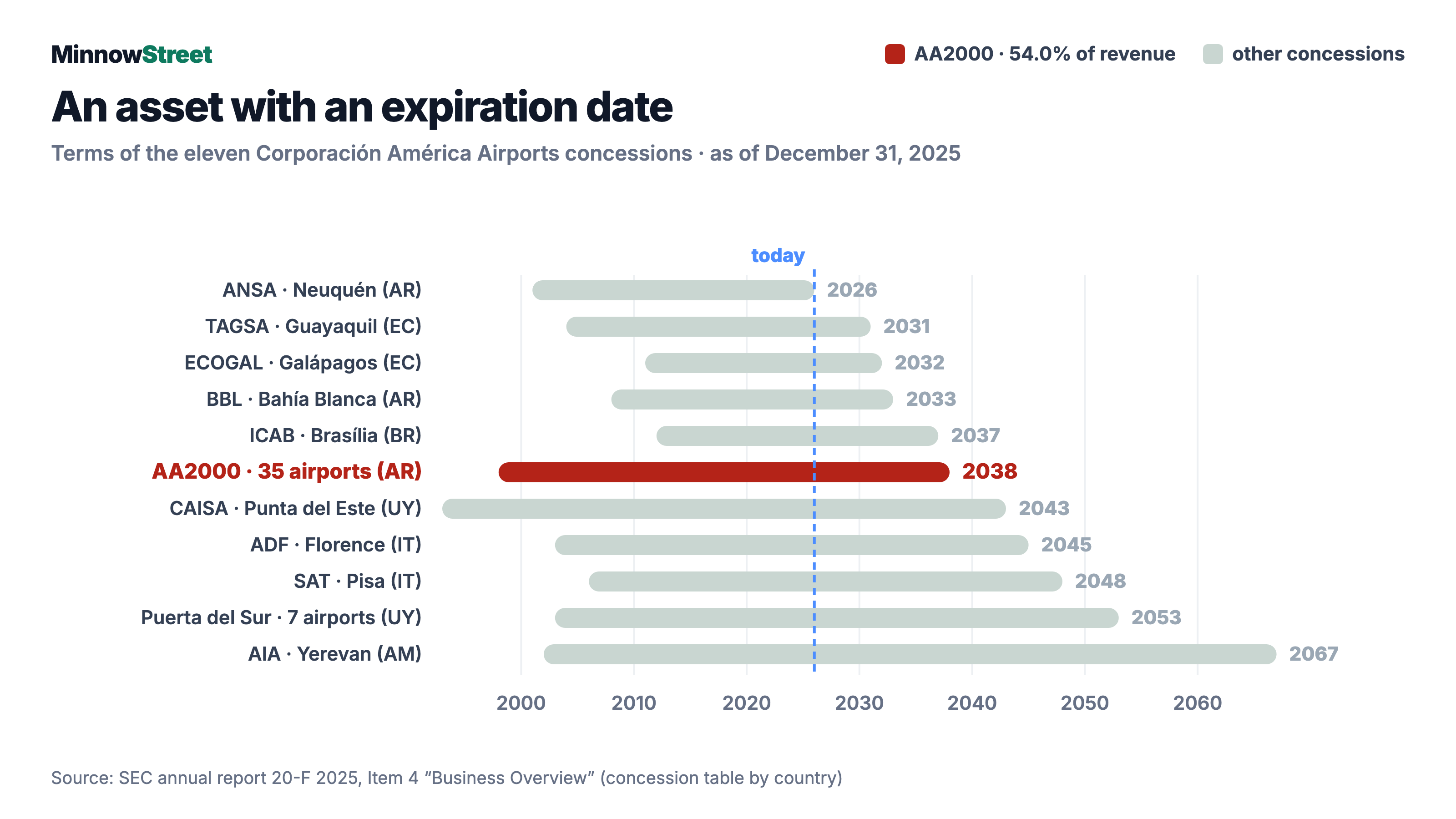
The next maturity is not a distant date: the ANSA concession for Neuquén airport was extended to October 2026 and therefore runs out within months. Then come Guayaquil (July 27, 2031), Galápagos (December 31, 2032), Bahía Blanca (May 22, 2033), Brasília (July 24, 2037) and the big one, AA2000, on February 13, 2038. Only Armenia, after the January 2026 extension, reaches December 31, 2067. Remember the mechanism: every extension has to be negotiated again — and the counterparty is always a government.
Uncomfortable truth no. 2: Argentina may buy back the largest concession at any time — with no payment for lost profits
This is where a maturity question becomes a price risk. Since February 13, 2018 the Argentine government has had the right to take the AA2000 concession back for reasons of public interest. The annual report describes it like this:
"Pursuant to the AA2000 Concession Agreement, since February 13, 2018, the Argentine Government has the right to “buy-out” (“rescatar”) the AA2000 Concession Agreement for public interest reasons and upon prior notification to us. […] The Argentine Government would also not be required to indemnify us for lost revenue or lost profits."
— Corporación América Airports S.A., SEC annual report on Form 20-F for 2025, Item 3 "Risk Factors"
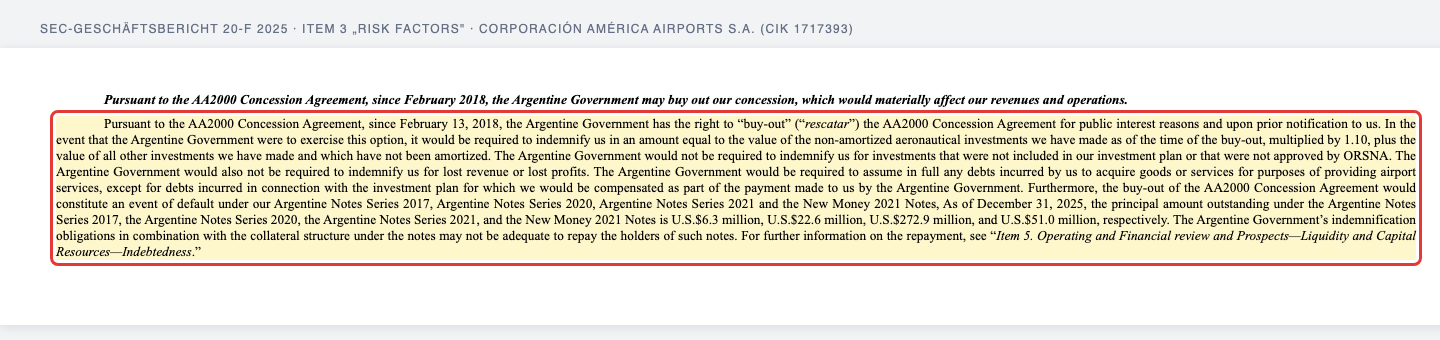
To be fair: there would be compensation. It is measured by the value of the non-amortized aeronautical investments multiplied by 1.10, plus the value of all other non-amortized investments — but only for investments included in the approved investment plan. What is missing is the earnings value: the profit the concession would still have produced through 2038. That is precisely what a share price capitalizes. And this is not theoretical, as one episode from inside the group shows: in Peru the government unilaterally terminated a concession in 2017; Kunter Wasi, in which CAAP indirectly holds 50 percent, only received a settlement of $91.2 million in December 2025, after arbitration before the World Bank's ICSID. Eight years, an international tribunal, a settlement. That is what it looks like in practice when a government asks for the keys back.
Uncomfortable truth no. 3: more than half the group hangs on one country
How heavily that buy-out right weighs depends on how big Argentina is inside the group. The answer sits a few lines further down in the same chapter:
"For the years ended December 31, 2025, 2024, and 2023, the revenue derived from our operation of the airports under the AA2000 Concession Agreement represented 54.0%, 56.4% and 45.1%, respectively, of our total consolidated revenue."
— Corporación América Airports S.A., SEC annual report on Form 20-F for 2025, Item 3 "Risk Factors"

It gets narrower still. 52.8 percent of all group passengers and 52.9 percent of all aircraft movements run through AA2000; Ezeiza airport alone produced $409.0 million, or 20.8 percent of consolidated revenue, in 2025. A fifth of the business therefore depends on one terminal complex in Buenos Aires. The dependency runs both ways: the group operates 37 of the 56 airports in Argentina's national airport system, which have carried more than 93.4 percent of the country's commercial passenger traffic every year since the concession was acquired. Add the cost of the lease: AA2000 pays 15 percent of its revenue excluding construction services to the Argentine state, and the fees it may charge passengers and airlines are set by the regulator ORSNA, not by the operator. How quickly that can turn shows in the latest traffic release: in June 2026 group passenger traffic fell 4.1 percent year over year, and in Argentina alone by 13.0 percent — domestic traffic there dropped 18.0 percent because the airline Flybondi operated only three aircraft that month, roughly 30 percent of its originally scheduled fleet. When a single low-cost carrier in one country can flip group growth, that is the definition of concentration risk.
Uncomfortable truth no. 4: the series are not comparable — hyperinflation does the math
Now to the part that is easily mistaken for growth. Argentina has qualified as a hyperinflationary economy since July 1, 2018. The group must therefore treat its Argentine subsidiaries' figures under IAS 29: all peso amounts are first restated with a general price index to the price level at the reporting date, then translated into U.S. dollars at the closing rate. In everyday terms: you measure with a rubber band and still write down the result in centimeters. The outcome depends on whether the peso devalued faster in a given year than prices rose — or the other way round. In 2025 that flipped:
"Our financial loss was a loss of U.S.$244.0 million for the year ended December 31, 2025, compared to a gain of U.S.$110.3 million for the year ended December 31, 2024. This increase of U.S.$354.3 million in financial loss was primarily due to the increase in foreign exchange expenses mainly in our Argentina subsidiaries, due to higher devaluation of the Argentine peso against the U.S. dollar compared to inflation in 2025 […]."
— Corporación América Airports S.A., SEC annual report on Form 20-F for 2025, Item 5 "Operating and Financial Review and Prospects"
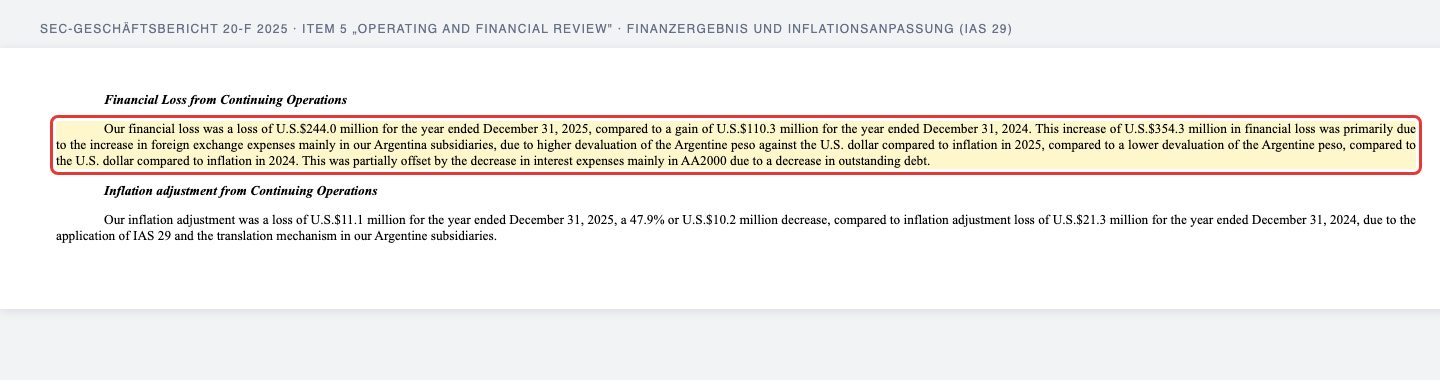
The second distortion sits in the tax line. In 2024 the group reported pre-tax income of $606.7 million and paid $298.8 million of tax on it — a rate of 49.3 percent, far above any statutory rate, because the inflation adjustment also moves the tax base. In 2025 pre-tax income was $332.7 million and tax expense $75.0 million, a rate of 22.5 percent. Two years, two entirely different tax rates, same company, same countries. The practical rule to take away: at CAAP, net income says little about the business; the meaningful figures are passengers, revenue per passenger and adjusted EBITDA by segment. The inflation adjustment line itself is the smaller item, by the way (2025: −$11.1 million; 2024: −$21.3 million) — the big effect runs through currency differences in the financial result.
Uncomfortable truth no. 5: 79.6 percent belongs to a foundation — and nothing is paid out
Finally, the ownership question. A.C.I. Airports S.à r.l. holds 131,450,833 of the 165,219,146 shares issued, or 79.6 percent. That Luxembourg entity is wholly controlled by the Southern Cone Foundation, a foundation under the laws of Liechtenstein whose potential beneficiaries, per the annual report, are members of the Eurnekian family together with religious, charitable and educational institutions. The group's chief executive is Martín Francisco Antranik Eurnekian. That leaves a free float of roughly 12 percent, Helikon's 8.3 percent included. For you as a minority holder that means: you ride along, you do not vote. And you receive nothing: the annual general meeting of May 13, 2026 recorded a 2025 profit of $103,958,250.55 at the Luxembourg holding level, allocated $5,197,912.53 to the legal reserve and carried $98,760,338.02 forward. There has been no dividend since the 2018 IPO. All of the earnings stay inside the company — and finance, among other things, capital works on assets that revert to the state at the end of the term. That can be sensible if it buys extensions and new concessions. But it is the opposite of the income story with which infrastructure stocks are usually sold.
Valuation: no growth premium — but how much remaining term are you buying?
For a dated valuation anchor we need no daily price: Helikon's 13F for the quarter ended March 31, 2026 puts a market value of $332,948,540 on 13,165,225 shares — roughly $25.29 a share. Applied to the 163.2 million shares outstanding (165.2 million less 2.0 million treasury shares), that is a market value of about $4.1 billion. In orders of magnitude: a price-to-earnings ratio of roughly 16 on 2025 net income, an enterprise value of about $4.6 billion (market value plus net debt of roughly $502 million) and therefore 6.4 times adjusted EBITDA, plus a good two and a half times the book value of about $9.72 a share. That is not an inflated growth price — airport operators in stable jurisdictions routinely trade far higher.
The discount has a name, though, and it is not only "Argentina risk". It is remaining term. A price-to-earnings ratio quietly assumes the earnings continue forever. At CAAP, in the largest unit, they continue for twelve more years. What comes after is a negotiation, not an entitlement — and in the meantime the counterparty may end the contract. Valuing this company therefore means valuing a chain of fixed-term contracts and the probability of their renewal. How strongly such a contractual frame can dominate a valuation showed most recently in another infrastructure name from the same portfolio — our Helios Towers analysis, where it is not the towers but the leases and the debt that decide. More cases in which contract structure beats operations are collected in our deep dives.
Opportunities and risks at a glance
What speaks for Corporación América Airports:
- Operationally the strongest year on record: 86.7 million passengers (+9.8 percent), $1,962.1 million of revenue (+6.4 percent) and $727.8 million of adjusted EBITDA (+15.8 percent); the first quarter of 2026 followed with $537.6 million of revenue (+20.1 percent).
- Solid balance sheet: $592.8 million of cash against $1,095.2 million of borrowings, net debt of roughly $502 million and therefore less than one times adjusted EBITDA; equity of $1,660.7 million as of December 31, 2025.
- Genuine spread across six countries and currency areas: Armenia ($296.3 million of revenue), Uruguay ($192.2 million), Italy ($170.4 million), Brazil ($118.5 million) and Ecuador ($114.4 million) together contribute 46 percent — in 2023 it was 54 percent, because Argentina has grown back since.
- Extensions do get done: Armenia was extended in January 2026 by 35 years to the end of 2067, Galápagos by six years to the end of 2032, Uruguay in 2021 by 20 years to 2053 — and Argentina in 2020 by ten years to 2038.
- Growth options outside the balance sheet: awards to operate Baghdad International Airport (November 2025) and AIAAN airport in Angola (December 2025) — though neither definitive agreement has been signed.
What speaks against it:
- No airport is owned: $3,138.0 million, or 70.5 percent of total assets, are fixed-term usage rights that are amortized on schedule ($208.4 million in 2025) and expire between 2026 and 2067.
- Argentina concentration: 54.0 percent of revenue and 52.8 percent of passengers from a single concession, with 20.8 percent of consolidated revenue from Ezeiza alone — against a 15 percent concession fee and regulator-set tariffs.
- Buy-out right since February 13, 2018: Argentina may end the AA2000 concession in the public interest without compensating lost revenue or lost profits; in Peru, compensation after a unilateral termination took eight years and ended in a 2025 ICSID settlement of $91.2 million.
- Reported results are not comparable across years: the financial result swung from +$110.3 million to −$244.0 million and the tax rate from 49.3 percent to 22.5 percent — both consequences of IAS 29 hyperinflation accounting.
- Minority holders have no say and no payout: 79.6 percent sits with a Liechtenstein family foundation, roughly 12 percent is free float, and there has been no dividend since the 2018 IPO — 2025 earnings were carried forward in full. On top of that, a fragile core market: Argentine traffic fell 13.0 percent in June 2026.
A human conclusion
Back to the rental-car illusion. Its core is not that renting is a bad deal — for many journeys it is the smarter choice. Its core is that while you are driving you forget who owns the car, and so you pay the wrong price for it. Corporación América Airports is a real, working, recently record-sized business: 86.7 million people walked through terminals it operates in 2025, and it earned $727.8 million of adjusted EBITDA doing it. But the asset on the balance sheet is a usage right with an expiration date, more than half of it sits in a country whose government may end the contract early without paying for lost profits — and none of it is paid out. So the honest question is not "is this a cheap airport operator?" but: how much are you willing to pay for twelve years of remaining term — and how sure are you that it gets renewed after that? If you have an evidenced answer, you have a thesis. If you do not, you have a picture of concrete in your head. What you make of it is your decision. And that is exactly as it should be.
Sources
Every original document used in this analysis — to read for yourself:
- Corporación América Airports S.A. — SEC annual report on Form 20-F for 2025 (filed March 17, 2026)
- Corporación América Airports S.A. — SEC annual report on Form 20-F for 2024 (filed March 27, 2025)
- Corporación América Airports S.A. — Interim financial statements as of March 31, 2026, Form 6-K filed May 13, 2026 (Exhibit 99.1)
- Corporación América Airports S.A. — June 2026 traffic report, Form 6-K filed July 17, 2026 (Exhibit 99.1)
- Corporación América Airports S.A. — Resolutions of the annual general meeting of May 13, 2026, Form 6-K
- Complete SEC filing history: EDGAR overview for Corporación América Airports S.A. (sec.gov)
- Helikon Investments Ltd — Form 13F-HR for the quarter ended March 31, 2026, filed May 8, 2026 (EDGAR overview, sec.gov)
- Fundamental data (metrics, segment contributions, valuation; data as of July 23, 2026), reconciled with the SEC filings and the SEC's XBRL financial series.
Transparency & disclaimer: This analysis is a journalistic contextualization of publicly available information and is not investment advice, not a financial analysis in the regulatory sense, and not a solicitation to buy or sell securities. Equity investments carry substantial risks up to total loss. All information without warranty; the data cut-off is noted in the text. The author holds no position in Corporación América Airports shares at the time of publication.
Our Bottom Line at a Glance
- Operating business positive
- 2025 was operationally the strongest year on record: 86.7 million passengers (+9.8 percent), $1,962.1 million of revenue (+6.4 percent) and $727.8 million of adjusted EBITDA (+15.8 percent) across 52 airports in six countries. The first quarter of 2026 followed with $537.6 million of revenue (+20.1 percent) and income of $80.4 million.
- Asset substance negative
- No airport is owned. $3,138.0 million, or 70.5 percent of total assets, are fixed-term concession rights that are amortized on schedule ($208.4 million in 2025) and expire between October 2026 (Neuquén) and the end of 2067 (Armenia); the largest unit, AA2000, ends on February 13, 2038.
- Country risk & concentration negative
- 54.0 percent of revenue and 52.8 percent of passengers depend on the AA2000 concession, with Ezeiza alone carrying 20.8 percent of consolidated revenue. Argentina has been free since February 13, 2018 to buy the contract back without compensating lost profits; in June 2026 traffic there fell 13.0 percent year over year.
- Reliability of the numbers negative
- IAS 29 hyperinflation accounting makes the series incomparable across years: the financial result swung from +$110.3 million to −$244.0 million and the tax rate from 49.3 percent to 22.5 percent. Net income therefore fell 16.3 percent even though revenue and operating income rose.
- Balance sheet & valuation neutral
- The financial position is solid: $592.8 million of cash against $1,095.2 million of borrowings, net debt of roughly $502 million and therefore less than one times adjusted EBITDA. The valuation anchor from the 13F for the quarter ended March 31, 2026 ($25.29 per share, market value about $4.1 billion) implies a P/E of roughly 16 and 6.4 times adjusted EBITDA — cheap for an airport operator, expensive for twelve years of remaining term in the core business.
- Ownership & payout negative
- 79.6 percent of the shares sit with A.C.I. Airports S.à r.l. and therefore ultimately with a Liechtenstein family foundation; the free float is roughly 12 percent. There has been no dividend since the 2018 IPO — the holding company's 2025 profit of $103.96 million was carried forward in full except for the legal reserve.
Corporación América Airports is the rental-car illusion in its purest form: from the outside an infrastructure group with 52 airports, 86.7 million passengers and the strongest year in its history — inside the annual report a bundle of fixed-term contracts whose value ($3,138.0 million, or 70.5 percent of the balance sheet) melts away on schedule. More than half of it sits in Argentina, which has been free since 2018 to buy the concession back without compensating lost profits, and the reported results are further distorted by hyperinflation accounting. Whoever buys is buying twelve years of secured core operations and a negotiation after that. Not investment advice.
What Our Rating Means
Substance risk
We found at least one documented issue that threatens the company itself — regardless of how the stock is currently valued.
Whoever buys today is betting less on passenger growth than on contracts: that Argentina leaves the AA2000 concession untouched through 2038 and renews it afterwards, that the regulator ORSNA keeps tariffs in economic equilibrium and that the still unquantified investment obligations for 2028 to 2038 stay bearable, and that the peso roller coaster in the financial result does not make the picture permanently unreadable. Whoever waits checks three things in every report: how are passengers and revenue per passenger developing outside Argentina? How large is the investment obligation for the final phase of the AA2000 concession? And does a first distribution arrive, or do the earnings stay inside the company for good? The fixed-term asset in a country with a buy-out right is the dominating risk and the reason for caution. The decision is yours.
A journalistic assessment by our editorial team at the time of the deep dive, based on public sources — not investment advice and not a solicitation to buy or sell. Your personal circumstances (investment goals, risk capacity, taxes) cannot be taken into account. What our levels mean, how verdicts are formed, and what conflicts of interest exist →
Worth Noting
- Corporación América Airports reached our research list through the Form 13F-HR of London-based Helikon Investments Ltd for the quarter ended March 31, 2026 (filed May 8, 2026): 13,165,225 shares worth $332,948,540, the third largest of 17 positions and virtually unchanged for quarters. A 13F shows only U.S.-listed long positions, appears 35 to 45 days late and contains no short sales or derivatives — a rear-view mirror, not a route plan. Our in-house stock scanner carries no metrics row for CAAP, so no scanner figures are available.
- Corporación América Airports is a foreign private issuer: there is no 10-K and no 10-Q. The evidence chain for this analysis is the annual report on Form 20-F for 2025 (filed March 17, 2026) plus the interim reports and announcements on Form 6-K (interim financial statements as of March 31, 2026 filed May 13, 2026; annual general meeting filed May 14, 2026; June 2026 traffic data filed July 17, 2026).
- Valuation figures are dated and evergreen: the anchor price of $25.29 per share comes from the market value of the Helikon position in the 13F for the quarter ended March 31, 2026 and is not a daily price; analyses are evergreen, daily prices are not a buy argument. Because of IAS 29 hyperinflation accounting, earnings series are only comparable across years to a limited extent — passenger numbers, revenue per passenger and adjusted segment EBITDA are the more reliable measures.
Frequently Asked Questions
Corporación América Airports S.A. (NYSE: CAAP), based in Luxembourg, operates airports on behalf of national and city governments. As of its annual report on Form 20-F for 2025 that meant 52 airports in Argentina, Italy, Brazil, Uruguay, Ecuador and Armenia. In 2025 the group handled 86.7 million passengers and generated $1,962.1 million of revenue from aeronautical fees, commercial income such as duty-free and parking, and construction services.
No. Every site is run under a time-limited concession — the assets belong to the respective governments and revert to them at the end of the term. On the balance sheet as of December 31, 2025 those usage rights appear as intangible assets of $3,138.0 million, or 70.5 percent of total assets of $4,448.7 million. They are amortized over the remaining term; in 2025 that came to $208.4 million.
Between 2026 and 2067. The ANSA concession for Neuquén expires in October 2026, Guayaquil on July 27, 2031, Galápagos on December 31, 2032, Bahía Blanca on May 22, 2033, Brasília on July 24, 2037, and the largest concession, AA2000 with 35 Argentine airports, on February 13, 2038. Punta del Este runs to 2043, Florence to 2045, Pisa to 2048, Carrasco to 2053 and Armenia, after a January 2026 extension, to the end of 2067.
Heavily. In fiscal 2025 the annual report attributes 54.0 percent of consolidated revenue, 52.8 percent of passengers and 52.9 percent of aircraft movements to the single AA2000 concession. Ezeiza airport alone contributed $409.0 million, or 20.8 percent of consolidated revenue. In June 2026 Argentine passenger traffic fell 13.0 percent year over year, with domestic traffic down 18.0 percent.
Yes. Since February 13, 2018 the Argentine government may buy out the AA2000 concession for reasons of public interest upon prior notification. Compensation would cover non-amortized investments from the approved investment plan multiplied by 1.10, plus other non-amortized investments. Expressly not compensated, according to the annual report, are lost revenue and lost profits.
Because of the currency, not the business. The financial result swung from a gain of $110.3 million in 2024 to a loss of $244.0 million in 2025 — a $354.3 million move, because the Argentine peso devalued faster than inflation rose in 2025. Argentina has qualified as a hyperinflationary economy since July 2018 (IAS 29). Revenue rose 6.4 percent while net income fell 16.3 percent to $257.7 million.
No. The annual general meeting of May 13, 2026 recorded a 2025 profit of $103,958,250.55 at the Luxembourg holding level, allocated $5,197,912.53 to the legal reserve and carried $98,760,338.02 forward. There has been no dividend since the 2018 IPO; as a holding company, the parent also depends on distributions from its operating subsidiaries.
As of December 31, 2025, A.C.I. Airports S.à r.l. held 131,450,833 of the 165,219,146 shares issued, or 79.6 percent. That Luxembourg entity is wholly controlled by the Southern Cone Foundation under the laws of Liechtenstein, whose potential beneficiaries are members of the Eurnekian family together with religious, charitable and educational institutions. The second-largest holder is Helikon Investments Limited with 8.3 percent.
Found an error?
Did you spot a factual error, an outdated number, or a typo in this deep dive? Let us know briefly — your report goes straight to the editorial team.