Intuitive Machines: Revenue Tripled — On a Like-for-Like Basis It Fell
In the first quarter of 2026 Intuitive Machines reported revenue of $186.7 million, three times the prior-year quarter. But $141.6 million of it came from a satellite builder the company bought in January 2026 for $851.0 million. On the company's own like-for-like basis — assuming it had owned that business a year earlier — revenue fell from $218.2 million to $199.8 million. At the same time all four NASA lunar missions awarded so far are booked as loss contracts in its own filings, and since June 2, 2026 the company may sell up to $500 million of new stock straight into the open market. Not investment advice — just the arithmetic behind the moon landing.
 Thomas Mücke
Founder & Publisher
Thomas Mücke
Founder & Publisher
Chart
Interactive price chart (TradingView).
Note: pure fact-based analysis, not investment advice and not a solicitation to buy or sell. All figures without guarantee.
There is an investor trap almost nobody is immune to, and it has nothing to do with greed. It has to do with childhood. Call it the wonder trap. It springs shut when a company does something bigger than making money. A firm that sets a probe down on the Moon speaks to a part of you that existed long before the calculator did. You see the pictures from the lunar south pole, you hear the words “first commercial Moon landing in history” — and in that exact moment the part of your brain that asks what a thing costs and who pays for it quietly switches off. Intuitive Machines (NASDAQ: LUNR) of Houston is the most honest test of that trap the U.S. market currently offers. This company really has landed on the Moon twice. It really does carry $1.1 billion of contracted backlog. And it really has just bought one of the best-known satellite builders in the world. So let us make a deal: before we talk about the wonder, we read together what the company itself told the U.S. securities regulator, the SEC — the annual report (10-K) for 2025, the quarterly report (10-Q) as of March 31, 2026, and everything filed since. Those documents are honest under penalty of law. And they tell a second story alongside the first.
What Intuitive Machines Actually Does — From Lunar Lander to Satellite Group
Intuitive Machines was founded in Houston in 2013, within sight of the Johnson Space Center, and describes its business in the annual report in three words: Build — Connect — Operate. Build means designing and manufacturing spacecraft, landers, satellites, propulsion and avionics. Connect means folding those assets into communications and navigation networks so they can talk to each other and to Earth. Operate means selling the running of those systems as an ongoing service rather than concluding at delivery. The strategic idea behind it is easy to remember: away from the one-off contract, toward infrastructure — like a construction firm that does not merely build the toll plaza but runs the highway afterward.
The fame comes from the lunar landers. Under NASA’s Commercial Lunar Payload Services program the company has won four cargo missions to the Moon. IM-1 landed in February 2024 as the first commercial vehicle ever to reach the lunar surface; IM-2 followed in March 2025. IM-3 is in progress and, per the filings, runs through March 2027; IM-4 through August 2028. Alongside these sit large contracts that have little to do with landing at all: NASA’s Near Space Network, for which Intuitive Machines is to build a satellite constellation around the Moon; the Lunar Terrain Vehicle contract covering a lunar rover and a heavy cargo lander; and defense work, including satellite buses supplied to L3Harris for the Space Development Agency.
Two pieces of history belong here, because they sit in the filings and still shape the numbers. First: the company did not reach Nasdaq through a conventional initial public offering but in February 2023 through a special purpose acquisition company — an already-listed shell then named Inflection Point Acquisition Corp., into which the operating business was contributed. Such structures typically leave behind warrants, founder earn-outs and a multi-class share structure; at Intuitive Machines you can still find all three on the balance sheet today. Second: since October 2025 the company has been buying. On October 1, 2025 it added deep-space navigation specialist KinetX for $31.3 million. And on January 13, 2026 came the big step: Lanteris Space Holdings — until shortly before known as Maxar Space Systems, one of the most storied satellite manufacturers in the United States — for $851.0 million from private equity firm Advent International.
Which brings the central tension of this analysis into the open, and it runs through every chapter that follows: Intuitive Machines became three times larger overnight — but the size was bought, not grown. And the core business that made the company famous loses money on every single mission.
How the Stock Reached Our Desk
Intuitive Machines did not come to us through a quality filter. It came through attention: the ticker landed on our research list on July 26, 2026 via our Reddit hype scan. That is an attention signal, not a quality verdict — it says a lot of people are talking about the stock, and nothing more.
We ran the cross-check against our own database on July 27, 2026, and the result is unambiguous: on that day Intuitive Machines appears in none of the lists produced by our in-house stock scanner — not a value list, not a balance sheet list, not a quality or momentum list. No filter we operate holds on to this stock. One caveat for later: those lists are recomputed daily; the finding applies to July 27, 2026 and may look different tomorrow.
Keep that in mind from the outset: for us, Intuitive Machines is an attention find, not a fundamental one. Which makes what the filings say all the more important.
The Numbers Over the Years — Fairly Credited
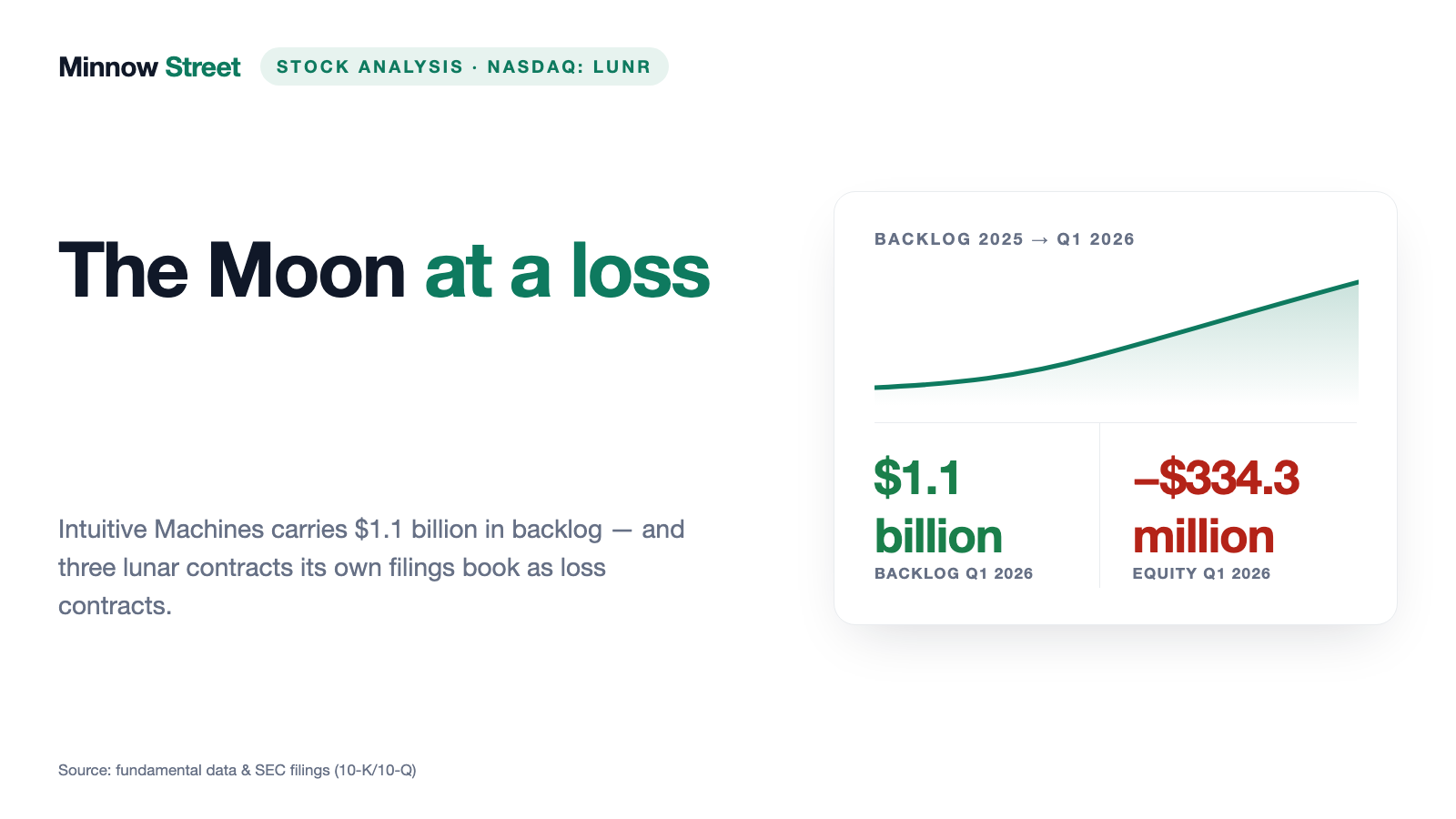
First the part that genuinely impresses, and it is not small. A company that booked $79.6 million of revenue in 2023 has, within three years, become an operation employing roughly 1,695 people (the figure the annual report for 2025 gives for the combined group after the Lanteris deal; as of December 31, 2025 it was still 525). Contracted backlog stood at $1.1 billion as of March 31, 2026, up $842.4 million in three months — $612.8 million of that arrived with Lanteris, while $428.9 million were genuine new awards, including the fifth lunar mission IM-5 and a government defense contract. Two Moon landings in thirteen months is something no company had achieved commercially before. That is not a small thing, and it should not be talked down here.
The earnings side, however, has looked the same from day one.
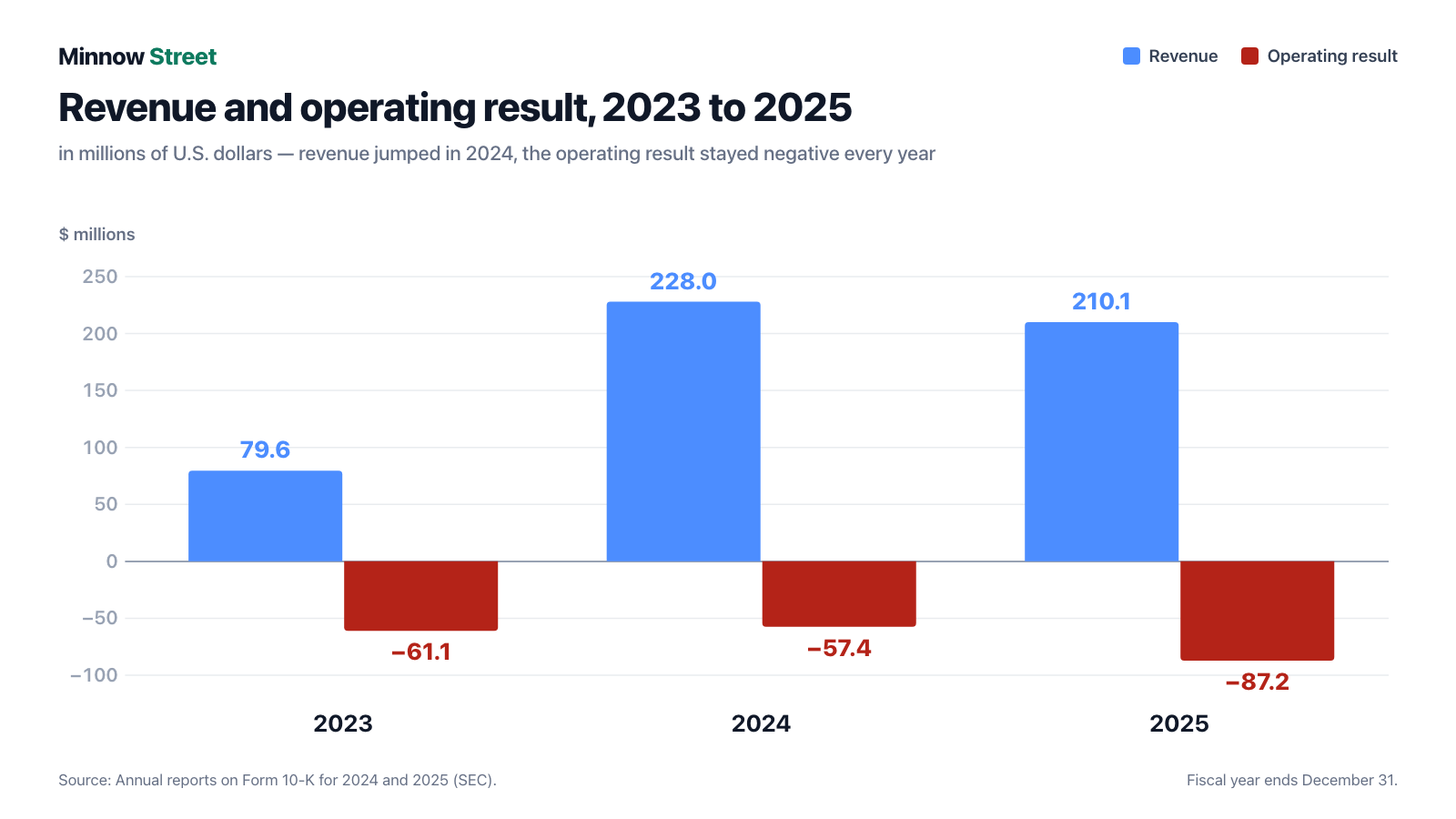
The chart covers three fiscal years, all ending December 31. 2023: $79.6 million of revenue, an operating loss of $61.1 million. 2024: $228.0 million of revenue — nearly triple, because the OMES III engineering contract for NASA ran for a full year — and an operating loss of $57.4 million. 2025: $210.1 million of revenue, down $17.9 million or 8 percent, and an operating loss of $87.2 million. The 2025 decline has a specific cause the filing names: NASA cancelled the OSAM project task orders, which alone removed roughly $71.9 million of revenue. The bottom line for 2025 was a net loss of $106.8 million, $83.9 million of it attributable to Class A shareholders.
Then came the first quarter of 2026 and a number that appears, at first glance, to change everything: $186.7 million of revenue in three months, against $62.5 million a year earlier. Almost triple. This is where you need to read slowly.
What the Filings Say — The Uncomfortable Truths
Uncomfortable Truth No. 1: The Revenue Jump Was Bought — Like for Like, the Business Is Shrinking
Of the $186.7 million of quarterly revenue, $141.6 million is product revenue — a line that did not exist at all in the prior-year quarter, because Intuitive Machines then sold no products in the accounting sense. The filing itself says where it came from:
“The result of operations of Lanteris has been included in the Company’s condensed consolidated statement of operations since the date of acquisition, January 13, 2026, and includes revenues of $141.6 million and operating income of $0.2 million for the three months ended March 31, 2026.”
— Intuitive Machines, Inc., SEC quarterly report 10-Q as of March 31, 2026, Note 3 “Acquisitions”
Read the second figure again: $141.6 million of revenue — and $0.2 million of operating income. The most expensive acquisition in the company’s history, $851.0 million, earned two hundred thousand dollars in its first quarter under new ownership. That is a margin of 0.1 percent. For comparison, a discount grocery chain works on ten to twenty times that.
More revealing still is the like-for-like table the company publishes in the same note. It answers a single question: what would the quarter have looked like if Lanteris had belonged to the group since January 1, 2025? The answer sits in a small pro forma table. Revenue for the first quarter of 2026 would be $199.8 million — against $218.2 million in the comparable quarter of 2025. That is not growth. That is a decline of roughly 8 percent. The pro forma net loss widens as well, to $54.4 million from $47.6 million.
Translated into an everyday picture: imagine two bakeries. Yours takes in 60,000 dollars, you buy the second one, and suddenly the receipts show 190,000. It looks like a tripling. But add both shops together for last year too and the total was 218,000. You did not grow — you bought revenue, and that revenue is shrinking. Remember this: a revenue jump that arrives via a purchase agreement is an addition, not growth.
What the acquisition undeniably did deliver is scale and access: $612.8 million of backlog, 1,695 employees instead of 525, a real satellite factory — and an operating loss that widened from $10.1 million in the first quarter of 2025 to $39.2 million in the first quarter of 2026, partly because amortization of the acquired intangibles leapt from $0.6 million to $13.0 million. Growth by acquisition is not wrong in itself. It is simply expensive, and the bill has only started arriving.
Uncomfortable Truth No. 2: All Four Lunar Missions Are Loss Contracts
When a company is famous for landing on the Moon, you would expect that particular business to make money. At Intuitive Machines the opposite is on the record — for every mission awarded so far. The annual report (10-K) for 2025 lists them one by one: IM-1 became a loss contract, IM-2 in 2023, IM-3 as early as 2021, IM-4 in the second quarter of 2025. A loss contract here is not a dispute or a mishap but an accounting term with a precise meaning: as soon as it becomes foreseeable that a contract will cost more than it brings in, the entire expected loss must be booked immediately, even if the work runs for years.
“Our IM-3 mission contract for lunar payload services became a loss contract in 2021 due to estimated contract costs exceeding the estimated amount of consideration that we expected to receive.”
— Intuitive Machines, Inc., SEC quarterly report 10-Q as of March 31, 2026, Note 4 “Revenue”, loss contracts section

The annual report shows the size of the amounts. On IM-3 alone, estimated contract costs rose by $20.1 million in 2025 and $12.5 million in 2024, each time at the expense of earnings. On IM-2 the figures were $1.0 million (2025) and $9.9 million (2024); on IM-4, $1.4 million in its first year. The reason for the largest step is spelled out in the filing and is almost symbolic: the IM-3 schedule had to be aligned with the completion of an internally developed satellite that must reach lunar orbit in time to meet the Near Space Network obligations. One contract slips because another takes priority — and the delay costs money.
The practical consequence is uncomfortable: every lunar mission this company has taken on so far costs more than it earns. The landings are technical triumphs and commercial subsidies. Turning them into a business requires charging materially more or flying materially cheaper — and neither shows up in the numbers published so far.
Uncomfortable Truth No. 3: One Customer Accounted for 78 Percent of Revenue
The notes to the annual report for 2025 contain a sentence worth reading twice:
“There was one major customer that accounted for 78% and 90% of the Company’s total revenue for the years ended December 31, 2025 and 2024, respectively.”
— Intuitive Machines, Inc., SEC annual report 10-K for 2025, note “Concentration of Credit Risks”
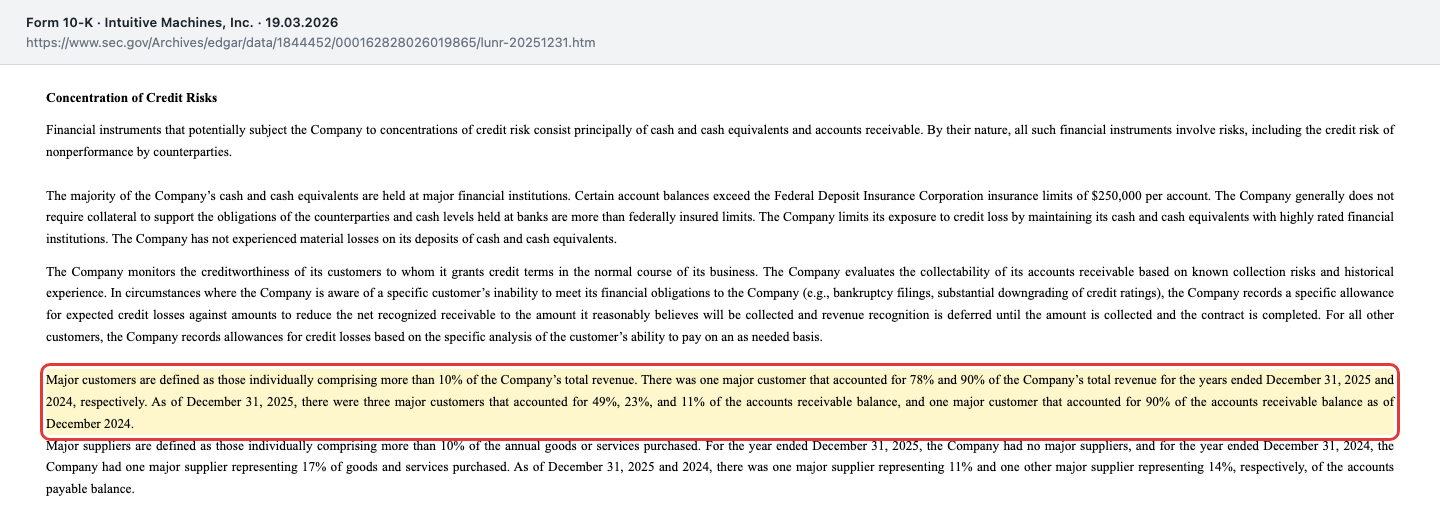
The filing does not name that customer outright, but it does say that essentially every large contract is a NASA contract. Translated into an everyday picture: a contractor who sends four out of five invoices to the same client. As long as that client keeps ordering, everything works. Cut its budget and the shop stops. That is precisely what happened in miniature in 2025: cancelling the OSAM task orders removed roughly $71.9 million of annual revenue at a stroke.
And here belongs the fair counter-argument, because it runs in the company’s favor: the Lanteris acquisition materially loosened exactly this dependency. For the first quarter of 2026 the quarterly report names four major customers at 36, 26, 13 and 13 percent of revenue — where the prior-year quarter had a single one at 78 percent. One concentration risk became four. That is real progress, and it is one of the few places where the $851.0 million purchase price bought something immediately visible.
Uncomfortable Truth No. 4: Cash More Than Halved in One Quarter
On December 31, 2025 Intuitive Machines held $582.6 million in the bank. Three months later the figure was $231.6 million. The filing states the position plainly:
“As of March 31, 2026, the Company had cash and cash equivalents of $231.6 million and working capital of $89.8 million.”
— Intuitive Machines, Inc., SEC quarterly report 10-Q as of March 31, 2026, “Liquidity and Capital Resources”
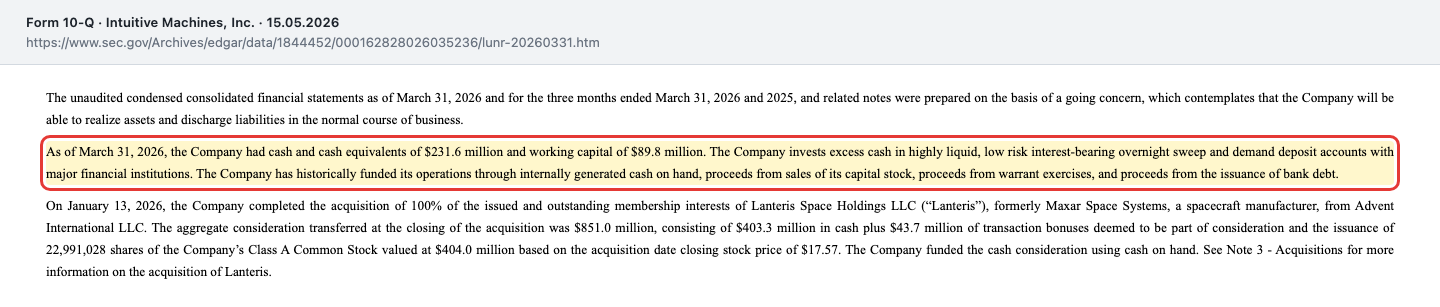
The largest item is accounted for: $403.3 million left the building in cash for Lanteris. But a second figure sits beside it, gets far less attention and says more about the running business: operations consumed $54.8 million in the first quarter of 2026 — against a $19.4 million inflow a year earlier. The sign has flipped.
One balance sheet item needs an explanation, because it looks alarming at first glance: total shareholders’ deficit attributable to the company was minus $334.3 million. That sounds like insolvency but is mostly a consequence of the corporate structure. Intuitive Machines is what is known as an Up-C: the operating entity is an LLC in which the founders hold units directly. Those units — carried at $1,057.8 million as of March 31, 2026 — sit not in equity but in a mezzanine layer of the balance sheet. Add them back and the balance sheet is not underwater. The substantive point remains, though: of $1,717.9 million of total assets, $684.0 million is goodwill and intangible assets created by the acquisitions — roughly 40 percent. That is value you cannot touch, and value that must be written down if the calculation proves wrong.
Uncomfortable Truth No. 5: 38.5 Million New Shares in One Quarter — and $500 Million More May Follow
Dilution is the technical term for something very simple: your slice of the cake gets smaller because new slices are cut. At Intuitive Machines the cake was cut hard in the first quarter of 2026. Class A shares outstanding rose from 121,281,880 on December 31, 2025 to 159,819,721 on March 31, 2026 — up 38.5 million shares, or roughly 32 percent in three months. Two events sit behind it: 22,991,028 shares went to the seller of Lanteris as part of the purchase price (valued at $17.57 apiece on the acquisition date), and on February 27, 2026 the company sold 11,574,069 shares at $15.12 to institutional investors, raising $175.0 million.
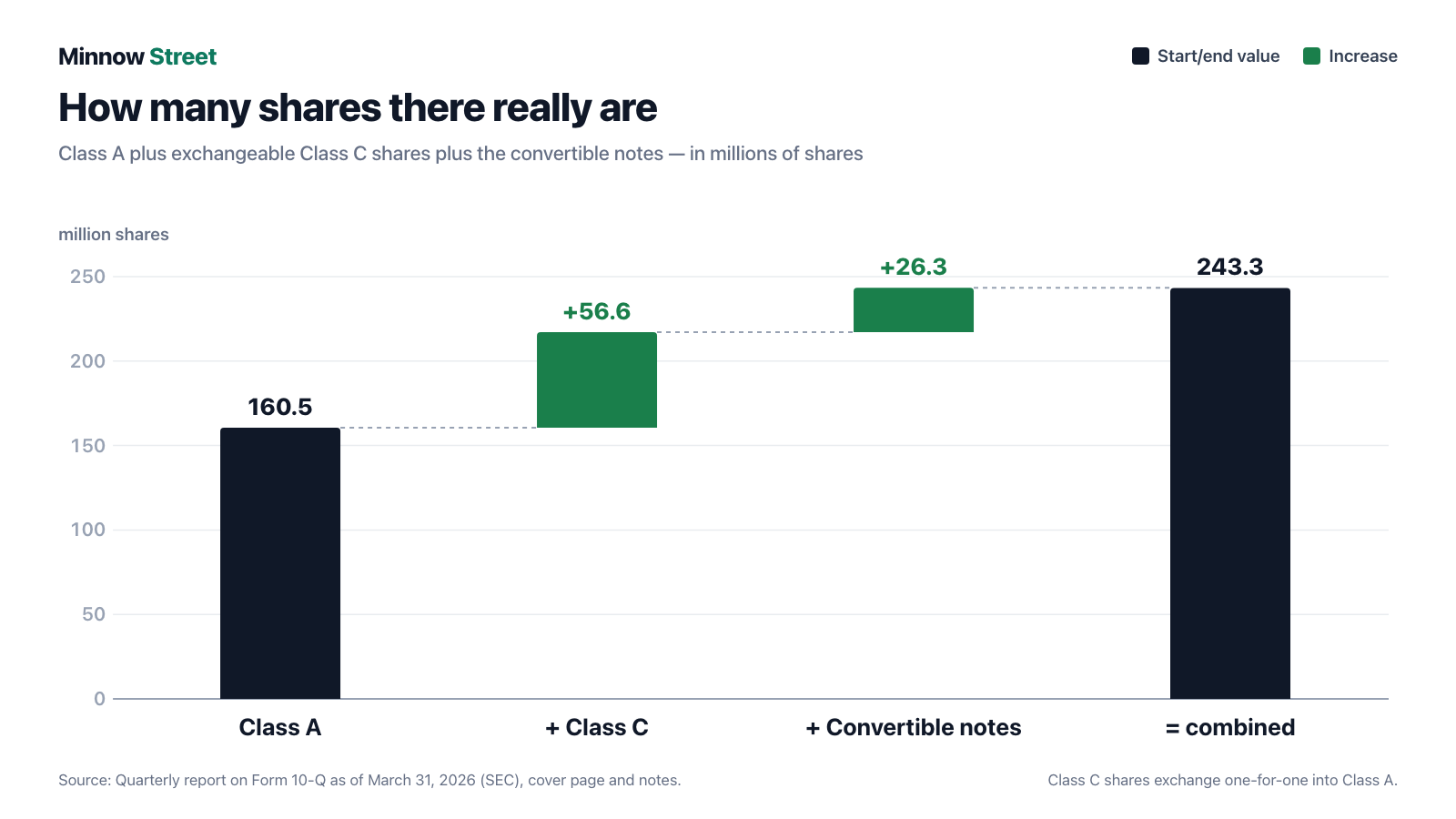
The three building blocks in detail: the cover page of the quarterly report shows 160,452,309 Class A shares, zero Class B shares and 56,568,640 Class C shares as of May 7, 2026. The Class C shares belong to the founders and, together with the matching LLC units, exchange one for one into Class A — economically they are already part of the cake. On top sits the convertible note issue of $345.0 million from August 2025, carrying a 2.500 percent coupon and maturing October 1, 2030: at a conversion price of $13.1125 it can produce up to 26,310,770 additional shares. Together, 243.3 million.
And the sequence is not over. On June 2, 2026 a registration statement took effect that allows the company to sell up to $500.0 million of Class A common stock directly into the open market — an at-the-market program executed through ten banks that collect up to 3.0 percent in commission. This is not a one-off event with an announcement and a price; it is a permanently open tap. The company can sell in pieces at any time, without further notice. For investors that cuts both ways — the funding question is settled for years, and a standing supply now hangs over the stock. For a far more extreme worked example of how quickly dilution can eat an investment case, see our analysis of Lucas GC, where 40 shares first became one and 40 million new ones appeared four months later.
Uncomfortable Truth No. 6: Three Founders, 52 Percent of the Vote — Through Shares With No Claim on Profits
Now to the share class that appears on no ticker and nevertheless decides who owns the company. The annual report describes it this way:
“Each holder of Class C Common Stock is entitled to three votes for each share of Class C Common Stock held of record in person or by proxy on all matters submitted to a vote of the holders of Class C Common Stock, whether voting separately as a class or otherwise. Class C Common Stock does not have rights to the economics of the Company nor to receive dividend distributions, except in limited circumstances.”
— Intuitive Machines, Inc., SEC annual report 10-K for 2025, section “Class C Common Stock”

Do the arithmetic: 56.6 million Class C shares times three votes gives roughly 169.7 million votes — against 160.5 million votes held by all Class A shareholders combined. The filing states the outcome itself: as of March 11, 2026 the founders controlled approximately 52 percent of the combined voting power. Translated into an everyday picture: you pay for the cake, you get your slice, but who writes the recipe was settled in advance. In practical terms that means a takeover, a sale of business units or a fight over pay will not be decided by a majority of the capital at risk.
Two disclosures from July 2026 show how stable that arrangement is, and they are worth reading side by side. On July 1, 2026, Ghaffarian Enterprises, LLC — the vehicle of board chairman Kamal Ghaffarian — reported having sold 709,545 Class A shares in the open market over the preceding 60 days, under a trading plan adopted in December 2025. Six days later, on July 7, 2026, came the disclosure of a new plan dated July 2, 2026 covering up to 1,935,568 further Class A shares. The stated reason appears verbatim in the document: the plan is “being entered into solely to generate liquidity.” Such plans are entirely legal and are set up in advance precisely so nobody can allege insider trading. What is notable is the direction: while the company issues new shares, its largest individual owner is selling them. Ghaffarian reports holding 38,429,036 shares in total, or 19.7 percent, so the 1.9 million in the new plan is a small slice. But the direction is the direction.
What the Stock Costs — and What Sits Behind the Price
We quote no daily prices here; they would be wrong tomorrow. Instead we use a price that appears in an SEC document and carries a date: the prospectus supplement (424B5) of June 3, 2026 gives the June 1, 2026 closing price of $38.21 per Class A share on Nasdaq. For a sense of how fast it got there: on October 1, 2025 the company valued the shares issued for KinetX at $10.61; on January 13, 2026 the shares issued for Lanteris at $17.57; and on February 27, 2026 it placed new shares at $15.12. All four figures come from mandatory filings and carry a date.
With 217.0 million shares — Class A plus the one-for-one exchangeable Class C — that implies a market value on the order of $8.3 billion (as of June 1, 2026). Set that against revenue and the expectation embedded in the price becomes visible. Measured against 2025 revenue of $210.1 million, it is roughly 40 times. The fairer comparison is post-acquisition, and the filing supplies the inputs: the company expects to recognize 60 to 65 percent of its $1.1 billion backlog as revenue over the remainder of 2026 — $660 million to $715 million on top of the $186.7 million already booked in the first quarter, so roughly $850 million to $900 million for the year. On that basis the market value sits at about 9 to 10 times revenue. A price-to-earnings ratio cannot be formed — there are no earnings, and the consensus estimate for the current year stands at minus $0.22 per share (data as of July 26, 2026).
A note on diligence: the market value that fundamental data providers report for this stock deviates, as of July 26, 2026, by more than a factor of three from the calculation above — it rests on a materially older price. We therefore did not use it, nor any metric derived from it. Every valuation figure in this analysis stands on the share count from the quarterly report and the price documented in the prospectus supplement.
The professionals see it more kindly than our arithmetic does: eight analysts cover the stock (data as of July 26, 2026) — four at the highest buy rating, one at buy, two at hold and one at sell, with an average target of roughly $41. That is a wager that backlog eventually becomes margin. It may pay off. But it is exactly that: a wager on something the published numbers do not yet show. For the extreme version of how far expectation and reported figures can diverge, see Fermi Inc., where the promise so far stands against no revenue at all.
Opportunities and Risks at a Glance
Opportunities
- The backlog is real and growing. $1.1 billion as of March 31, 2026, up $842.4 million in three months. Of that, $428.9 million were genuine new awards, including the fifth lunar mission and a government defense contract. The company expects to convert 60 to 65 percent of the backlog into revenue during the remainder of 2026.
- Customer dependency has fallen sharply. One customer at 78 percent of 2025 revenue became four major customers at 36, 26, 13 and 13 percent in the first quarter of 2026. That is exactly what the acquisition was meant to achieve, and exactly what it delivered.
- Funding is secured for years. $231.6 million of cash as of March 31, 2026, plus the ability since June 2, 2026 to sell up to $500.0 million of stock into the market. The $345.0 million convertible note issue does not mature until October 1, 2030 and costs only 2.500 percent in interest.
- One-off contracts are meant to become services. The Near Space Network award for a satellite constellation around the Moon is the first building block for recurring revenue instead of milestone billing — and the filing names exactly that as the core of the strategy.
- Policy tailwinds. Lunar and space programs in the United States are anchored in both civil and national security policy; Intuitive Machines is one of two awardees for the Near Space Network direct-to-Earth services and the sole awardee for its data relay services.
Risks
- Like for like, revenue is shrinking. The company’s own pro forma table shows $199.8 million for the first quarter of 2026 against $218.2 million a year earlier — a decline of roughly 8 percent. The visible jump comes from the purchase agreement, not from operations.
- The core business loses money. All four lunar missions awarded so far are loss contracts in the company’s own filings. On IM-3 alone, estimated costs rose by $20.1 million in 2025 and by a further $2.8 million in the first quarter of 2026.
- The acquisition earns nothing yet. Lanteris contributed $141.6 million of revenue in the first quarter of 2026 but only $0.2 million of operating income — against a purchase price of $851.0 million. Goodwill and intangibles account for $684.0 million of total assets.
- Cash flow has changed sign. A $19.4 million operating inflow in the first quarter of 2025 became a $54.8 million outflow in the first quarter of 2026. The operating result deteriorated from minus $10.1 million to minus $39.2 million.
- Permanent dilution. Plus 38.5 million Class A shares in the first quarter of 2026 alone, on top of 56.6 million exchangeable Class C shares, 26.3 million shares from the convertible notes and a running program of up to $500.0 million.
- Votes without capital at risk. Three founders control roughly 52 percent of the vote (as of March 11, 2026) through a class with no claim on profits. At the same time the chairman’s vehicle is selling shares on a schedule — most recently under a plan adopted July 2, 2026 covering up to 1,935,568 shares.
A Human Conclusion
Remember the wonder trap from the opening? The moment the picture of the Moon switches off the calculator? Intuitive Machines is such a good test because both things are true at once, and neither cancels the other. This company has landed on the Moon twice, where no private business had landed before. It has acquired one of the best-known satellite builders in the world. It carries $1.1 billion of contracted work and roughly 1,695 people on the payroll. None of that is fantasy.
And yet: of the $851.0 million paid for Lanteris, $0.2 million of operating income came back in the first quarter. On a like-for-like basis revenue fell rather than rose. Every lunar mission this company has taken on so far costs more than it earns. And anyone buying today pays roughly nine to ten times the revenue the company itself expects for 2026 — for a business that has not reported a positive operating result in any year since going public.
What follows is not a recommendation but a question only you can answer: do you buy a company whose story is magnificent and whose arithmetic does not yet work, hoping that backlog eventually turns into margin? Say yes and you are wagering that satellite manufacturing scales and that Moon landings get cheaper with practice. Say no and you point to four loss contracts, a negative operating result in every year since the listing, and a share counter rising faster than revenue.
If you want to watch only three numbers in the coming filings, watch these: the operating result (most recently minus $39.2 million in the first quarter of 2026), the operating cash flow (most recently minus $54.8 million), and the Class A share count on the cover page of the quarterly report (most recently 160,452,309 as of May 7, 2026). If all three move in the same direction, the whole story changes. What you make of it is your decision. And that is exactly as it should be.
Sources
- Intuitive Machines, Inc. — annual report (10-K) for fiscal year 2025, filed March 19, 2026
- Intuitive Machines, Inc. — quarterly report (10-Q) as of March 31, 2026, filed May 15, 2026
- Intuitive Machines, Inc. — annual report (10-K) for fiscal year 2024, filed March 25, 2025
- Prospectus supplement (424B5) dated June 3, 2026 — program for up to $500.0 million of Class A common stock, quoting the June 1, 2026 close
- Current report (8-K) dated June 3, 2026, Item 1.01 — sales agreement with ten banks for the equity program
- Current report (8-K) dated June 8, 2026, Item 5.07 — results of the annual meeting held June 4, 2026
- Schedule 13D/A No. 11, filed July 1, 2026 — sale of 709,545 Class A shares within 60 days
- Schedule 13D/A No. 12, filed July 7, 2026 — new trading plan for up to 1,935,568 Class A shares
- Insider filings (Form 4) for Intuitive Machines on SEC EDGAR, including the filing of July 15, 2026
- Source: fundamental data & SEC filings (annual and quarterly reports, 10-K/10-Q); analyst coverage and provider headcount as of July 26, 2026.
Disclaimer: This article is journalistic analysis of publicly available filings. It is not investment advice, not a solicitation to buy or sell securities, and not an individual recommendation. Shares of young space companies are especially volatile; a total loss of invested capital is possible. All figures come from the SEC filings named above and carry their reporting dates. The author holds no position in Intuitive Machines, Inc. at the time of publication.
Our Bottom Line at a Glance
- Backlog and market access positive
- Contracted backlog stood at $1.1 billion as of March 31, 2026, up $842.4 million in three months — $612.8 million acquired with Lanteris and $428.9 million genuine new awards, including the fifth lunar mission IM-5. Intuitive Machines is one of two awardees for NASA's Near Space Network direct-to-Earth services and the sole awardee for its data relay services.
- Quality of growth negative
- The revenue jump from $62.5 million to $186.7 million in the first quarter of 2026 includes $141.6 million from satellite builder Lanteris, acquired on January 13, 2026. On a like-for-like basis the company's own pro forma table shows $199.8 million against $218.2 million a year earlier — a decline of roughly 8 percent. Lanteris contributed $141.6 million of revenue but only $0.2 million of operating income.
- Earnings power negative
- The operating result has been negative in every year since the listing: −$61.1 million (2023), −$57.4 million (2024), −$87.2 million (2025) and −$39.2 million in the first quarter of 2026 alone, after −$10.1 million a year earlier. All four lunar missions awarded so far are loss contracts in the company's own filings; on IM-3 estimated costs rose by $20.1 million in 2025 and by a further $2.8 million in the first quarter of 2026.
- Balance sheet and liquidity neutral
- Cash fell from $582.6 million (December 31, 2025) to $231.6 million (March 31, 2026), chiefly because of the $403.3 million cash payment for Lanteris; operating cash flow turned from +$19.4 million to −$54.8 million. Against that stand a 2.500 percent coupon on $345.0 million of convertible notes maturing in 2030 and the equity program of up to $500.0 million running since June 2, 2026. Shareholders' deficit attributable to the company is −$334.3 million, a structural consequence of the holding form.
- Dilution negative
- Class A shares outstanding rose from 121,281,880 (December 31, 2025) to 159,819,721 (March 31, 2026) — up 32 percent in one quarter. On top sit 56,568,640 one-for-one exchangeable Class C shares and up to 26,310,770 shares from the convertible notes, for 243.3 million combined, plus an at-the-market program of up to $500.0 million running since June 2, 2026.
- Ownership and voting power negative
- Founders Ghaffarian, Altemus and Crain controlled roughly 52 percent of the combined voting power as of March 11, 2026 through Class C shares that carry three votes apiece but, per the annual report, no rights to the economics of the company. Ghaffarian Enterprises disclosed the sale of 709,545 Class A shares within 60 days on July 1, 2026 and a new plan for up to 1,935,568 further shares on July 7, 2026.
Intuitive Machines has landed on the Moon twice, carries $1.1 billion of contracted backlog and has acquired one of the best-known satellite builders in the world. But the first-quarter 2026 revenue jump to $186.7 million was bought: $141.6 million came from the acquisition, and on a like-for-like basis revenue fell from $218.2 million to $199.8 million. All four lunar missions awarded so far are loss contracts, the operating result has been negative in every year since the listing, cash halved in one quarter to $231.6 million, and the Class A share count rose 32 percent between January and March 2026 alone. Not investment advice.
What Our Rating Means
Open questions
The business works in principle, but one material question is open. As long as it stays open, our findings do not carry a quality verdict.
The business is real and funded: $1.1 billion of backlog, $231.6 million of cash as of March 31, 2026, convertible notes at only 2.500 percent running to 2030, and an equity program of up to $500.0 million. There is no going-concern warning, and the negative book equity of −$334.3 million is a structural consequence of the holding form, because $1,057.8 million of noncontrolling interests sits in a mezzanine layer. The core operating question, however, is open and large: the operating result has been negative in every year since the listing, all four lunar missions are loss contracts, the $851 million acquisition produced $0.2 million of operating income in its first quarter, and $684.0 million of total assets is goodwill and intangibles. That is not a substance finding, but neither is it demonstrated earnings power — hence yellow.
A journalistic assessment by our editorial team at the time of the deep dive, based on public sources — not investment advice and not a solicitation to buy or sell. Your personal circumstances (investment goals, risk capacity, taxes) cannot be taken into account. What our levels mean, how verdicts are formed, and what conflicts of interest exist →
Worth Noting
- Intuitive Machines reached our research list through the Reddit hype scan of July 26, 2026. The cross-check against our own database on July 27, 2026 showed that the stock appears in none of the lists produced by our in-house stock scanner on that day — no value, balance sheet, quality or momentum list. Those lists are recomputed daily.
- Recency status: the basis is the annual report (10-K) for 2025 filed March 19, 2026 and the quarterly report (10-Q) as of March 31, 2026 filed May 15, 2026. Every later filing was reviewed — the registration statement and prospectus supplement (S-3ASR/424B5) of June 3, 2026, current reports (8-K) of June 3 and June 8, 2026, Schedule 13D/A filings of July 1 and July 7, 2026, a Schedule 13G of July 15, 2026, and Form 4 and Form 144 filings from June and July 2026.
- On valuation: the market value is not a feed number but calculated from 217.0 million shares (Class A plus exchangeable Class C per the 10-Q cover page, as of May 7, 2026) and the last price documented in a filing, $38.21 (the June 1, 2026 close per the prospectus supplement of June 3, 2026). The market value from the fundamental data feed deviates from this by more than a factor of three and was therefore not used, nor was any metric derived from it. A note on possible confusion: the former name Inflection Point Acquisition Corp. belonged to a special purpose acquisition company with no operating business; figures from before February 2023 are not comparable.
Frequently Asked Questions
Intuitive Machines builds lunar landers, satellites and spaceflight electronics and operates communications and navigation services in space. It landed on the Moon in February 2024 as the first commercial company to do so, and repeated the feat in March 2025. It had 525 employees as of December 31, 2025; after the Lanteris acquisition in January 2026 the annual report puts the combined workforce at roughly 1,695.
Of the $186.7 million of quarterly revenue, $141.6 million came from satellite builder Lanteris, acquired on January 13, 2026. The company's own pro forma table shows that had Lanteris belonged to the group in 2025, revenue would have fallen from $218.2 million to $199.8 million. The jump is an addition, not growth.
A loss contract exists when the estimated costs of a contract exceed the consideration expected. The entire expected loss must then be recorded immediately. The annual report for 2025 lists IM-1, IM-2, IM-3 and IM-4 as loss contracts. On IM-3 alone, estimated costs rose by $20.1 million in 2025.
On January 13, 2026 Intuitive Machines acquired satellite builder Lanteris Space Holdings — previously Maxar Space Systems — from private equity firm Advent International for $851.0 million. Payment consisted of $403.3 million in cash, $43.7 million of transaction bonuses and 22,991,028 of its own Class A shares valued at $404.0 million.
Total shareholders' deficit attributable to the company stood at minus $334.3 million as of March 31, 2026. The reason is the holding structure: the founders' units in the operating LLC, carried at $1,057.8 million, sit not in equity but in a mezzanine layer of the balance sheet. Add them back and the balance sheet is not underwater.
The three founders Kamal Ghaffarian, Stephen Altemus and Timothy Crain controlled roughly 52 percent of the combined voting power as of March 11, 2026. The Class C share makes that possible: it carries three votes apiece but, per the annual report, no rights to the economics of the company and no dividend entitlement.
Class A shares outstanding rose from 121.3 million on December 31, 2025 to 159.8 million on March 31, 2026. On top sit 56.6 million exchangeable Class C shares and up to 26.3 million shares from the convertible notes — 243.3 million combined. Since June 2, 2026 the company may additionally sell up to $500.0 million of stock into the open market.
Cash stood at $231.6 million as of March 31, 2026, down from $582.6 million at the end of 2025. Operations consumed $54.8 million during the quarter. Management believes the funds are sufficient to finance the business plan for at least twelve months from the issuance of the financial statements, with the equity program of up to $500.0 million on top.
Found an error?
Did you spot a factual error, an outdated number, or a typo in this deep dive? Let us know briefly — your report goes straight to the editorial team.